Judge: ‘Reasonable Suspicion’ of Crime Doesn’t Arise Simply from Being Parked in a Bad Neighborhood, Talking to Someone

by Van Smith

Published in City Paper, Dec. 17, 2014

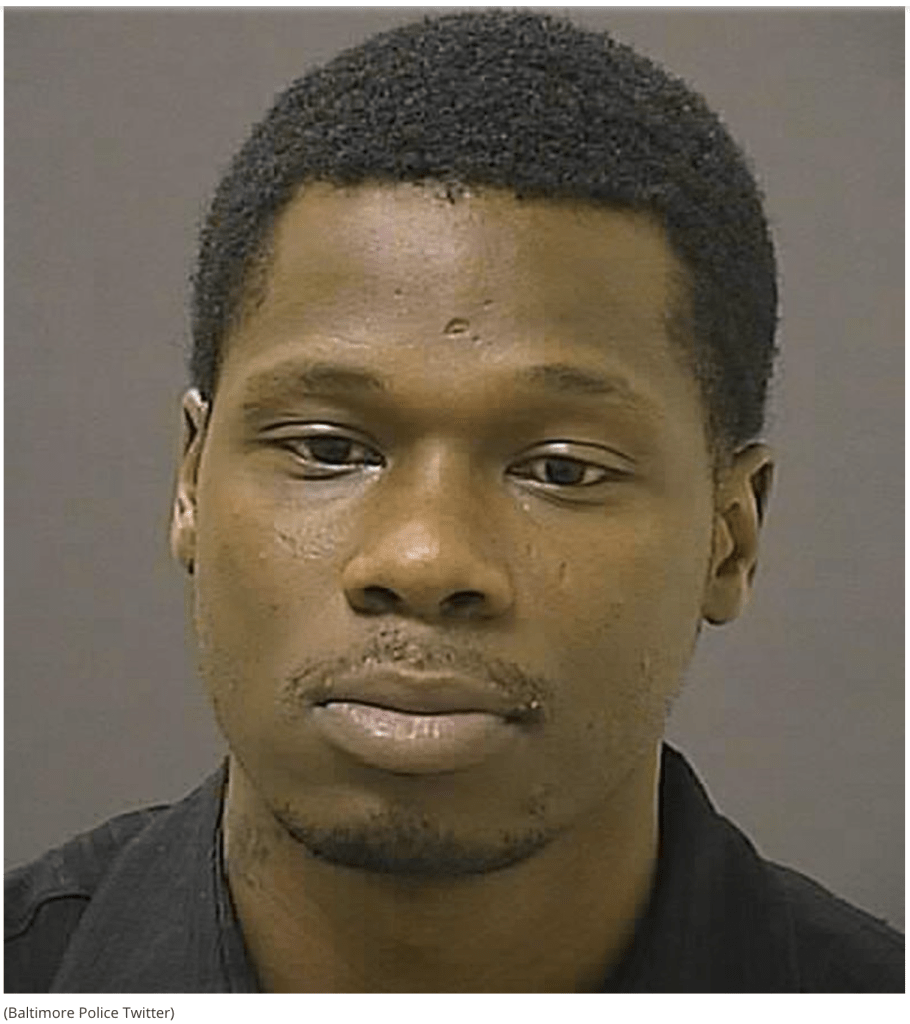
Moryne Louden’s mugshot is all over the internet because the Baltimore Police Department on Oct. 16, 2013, tweeted it with the caption that he “was arrested by #BPDSWD in the 3200 Block of W. Baltimore St. for a handgun violation.” The case against him ended up in federal court, where he was charged for being a felon in possession of a firearm—charges that are now imperiled, because today Maryland U.S. District judge James Bredar ruled that virtually all of the evidence against him “must be suppressed as fruit of the poisonous tree.”

The reason: BPD officers’ traffic stop that resulted in Louden’s arrest was an “unlawful seizure,” since they had no “reasonable suspicion” that crime was afoot until just after the stop occurred.

In the motions battle leading up to Bredar’s ruling, federal prosecutors presented the facts of what transpired prior to Louden’s arrest.

A plain-clothes team of officers in an unmarked police car noticed a blue Ford Windstar parked at the intersection of West Baltimore and South Hilton streets, and watched a man later identified as Louden approach the vehicle, engage in a brief conversation with the driver, and then enter it. Seconds later, another man got in, too.

So the officers, “suspecting that a hand-to-hand drug transaction was about to occur,” pulled up on the scene and “activated their lights and exited the vehicle.” As soon as they approached the Windstar, Louden got out, and the cops immediately “detected the odor of burnt marijuana emanating from within the Windstar.” They asked Louden who had the pot, and he responded: “No one. We just finished smoking. You can check me.” So they did, patting him down and finding a handgun in his waistband.

All the prosecutors could come up with in defending the traffic stop was that, thanks to the officers’ “knowledge of and experience in this particular part of Baltimore City, as well as their experience investigating drug activity,” and the fact that the “officers were personally aware of recent criminal activity that had occurred in the area” and “knew the area to be known for violent crime and drug activity,” they had “ample grounds to believe they were witnessing a potential drug transaction.”

In Bredar’s judicial estimation, that’s just not good enough. Had the Windstar been parked illegally, or its taillight been broken, or its windshield cracked, perhaps this case would still have legs, but a man approaching a car in a bad neighborhood, talking to its driver, and getting in does not justify a police response. And if the traffic stop is illegal, it doesn’t matter that Louden consented to a pat-down and had a gun.

With any luck, this story will have a happy ending. Louden’s been out on pre-trial supervised release, and according to a Baltimore Sun story by Justin George that ran in July, called “Transforming cars and lives,” he’s been getting job training as a car detailer at a nonprofit program for offenders called Vehicles for Change. When Louden got his certificate for completing the program, he was wearing a court-ordered ankle bracelet and tearfully told the audience, according to the article, “I want to thank Vehicles for Change, because we still be changing.” Perhaps, because in all likelihood Louden will now beat his federal charges, keeping his freedom will give him a better chance than prison to straighten out his life.

Kids Say the Darndest Things: 11-Year-Old’s Exclamation in Play in Mondawmin Mall Drug-Arrests Case

by Van Smith

Published in City Paper, Dec. 16, 2014

“Shut the fuck up!” Latoya Eaton yelled at her 11-year-old daughter. What the daughter had just said—”That’s not my mom’s money!”—is now in play in a $4,530 drug-money forfeiture case filed Dec. 9 in federal court in Maryland.

The case is part of the fallout from the arrests of nine men on Aug. 11, seven of them in the parking lot of Baltimore’s Mondawmin Mall. They’d gone there after a drug supplier—a man who, unbeknownst to them, had been arrested days earlier by the FBI with several kilograms of cocaine and heroin, and promptly turned informant—had called each of them to set up a series of government-controlled coke-and-dope deals. All nine have since been indicted and pleaded not guilty, with many filing motions challenging the constitutionality of the case.

The role of Eaton and her daughter was a sideshow of the big takedown. One of the nine defendants is Ronald Sampson, whom Eaton had driven to the mall. After Sampson was arrested, agents approached the Honda Accord he’d arrived in and saw Eaton “attempting to hide a large stack of U.S. currency under her leg,” the lawsuit states. The cops removed Eaton from the vehicle and found she’d been trying to hide $820, and that’s when Eaton’s daughter blurted out her fateful words. Ultimately, the search also turned up “a roll” of $1,550 “inside of Eaton’s open purse” and “a second roll” of $2,160 “in plain view, lying in the vehicle’s console under the radio.”

Eaton and her daughter were free to leave in the Accord after the money was seized, and in October Eaton filed a petition for its return, writing, “I didn’t have anything to do with the situation that took place I was just in my car and it was taken because I drive someone to mondawmin [sic] with my daughter not knowing anything of the circumstances,” according to the lawsuit.

Turns out, the lawsuit states, “over 700 calls between Ms. Eaton and Mr. Sampson” were made over jail phones after Samspon’s arrest, and they indicate the two “are involved in a personal relationship,” since Eaton refers to Sampson “as ‘baby’ in these calls.”

In one of the calls, made two days after the arrests when Sampson was at the Chesapeake Detention Facility in Baltimore, Sampson told Eaton what was stated in his charging papers—that he was going to buy a kilogram each of heroin and cocaine for $75,000 and $38,000, respectively—and added, “but I had ten-thousand five hundred (10,500) on me,” the lawsuit states.

Given that Sampson was arrested holding $6,000 and another $4,530 was taken from Eaton, totaling $10,540—almost exactly the amount Sampson said he’d brought to the deal—it’s looking like her daughter’s exclamation was spot on. No wonder Eaton wanted her to keep her trap shut.

Baltimore’s All-State Career School is in Federal Law-Enforcers’ Crosshairs

by Van Smith

Published in City Paper, Dec. 2, 2014

All-State Career School, a trade school in Baltimore for would-be truckers, healthcare workers, and others seeking a route to gainful employment, is apparently under federal criminal investigation for possible violations of U.S. Department of Education (DOE) regulations meant to ensure the lawful disbursement of federal student aid. The school, which receives city funds to help pay students’ tuition, is also one of 27 schools that, according to DOE data released in October, is not complying with requirements that for-profit schools derive less than 90 percent of their revenue from federal student aid, out of almost 2,000 schools that fall under the regulations. 

The All-State probe first became public early this year, when two former All-State admissions representatives and a former testing administrator for the company were sentenced in Maryland federal court for a conspiracy to boost the school’s enrollment by engaging in a test-cheating scheme that enabled ineligible students to access federal student loans and grants. The cheating scandal involved changing the answers on pre-admissions tests taken by approximately 170 prospective All-State students, and about 72 of them ended up improperly receiving almost $575,000 in federal student aid, including Pell grants for non-degreed students in financial need. 

At the January sentencing hearing for former All-State admissions representative Jesse Raymond Moore, Sr., Assistant U.S. Attorney Martin Clarke told the judge that “we endeavor to investigate the school that Mr. Moore worked for, investigations continue,” according to a transcript of the hearing. Moore “is not the only one who has assisted the Government” in the All-State investigation, Clarke continued, “but the Government need[s] as many people as possible to get at an inside look on how the school was conducting itself within the Department of Education regs for Federal financial assistance for their students.” 

The Maryland U.S. Attorney’s Office declined to confirm whether the investigation remains ongoing, and the top leaders of the company that owns All-State, White Marsh-based Education Affiliates (EA)—chief executive Duncan Anderson and chief financial officer Stephen Budosh—did not respond to a detailed email asking for comment. Education Affiliates is one of the largest privately held companies in the Baltimore region, with revenue pulled in from seven schools it operates at about 50 campuses across the country, according to its website.

An attorney who currently represents EA in an unrelated civil lawsuit, Richard Hafets, said, “I seriously doubt that anyone at Education Affiliates or any of its related entities will want to comment,” when asked if he could pass City Paper’s inquiries on to his clients.  

The school is part of an industry providing for-profit education that has erupted in controversy in recent years, as Clarke noted at the sentencing hearings of the All-State defendants. Pointing to “a trend” in which schools, “especially trade schools,” do “not take the regs of the Department of Education seriously,” Clarke stated that “in those institutional cultures, a lot of things that are deemed criminal by Federal law are taking place.”

At the sentencing of another former All-State admissions representative, Barry Sugarman, U.S. Magistrate Judge Timothy Sullivan echoed Clarke’s sentiments. Calling Sugarman “a small cog in a large wheel,” Sullivan said that “when you engage in a conspiracy to misuse or abuse” the regulations, “all you are doing is lining the coffers of your own business” by engaging in “a conspiracy to defraud the Government” while “not caring about the people that are in your school in the first place.”

Moore, Sugarman, and a test administrator, Jacqualyn Sue Caldwell, who worked for All-State under contract with her employer, the testing-service company Wonderlic, pleaded guilty to “conspiracy to defraud a student financial aid program,” according to a Federal Bureau of Investigation (FBI) press release about their case. “Students without high school diplomas who applied to for financial aid to attend” All-State “were required to pass” the Ability to Benefit (ATB) test to “demonstrate their aptitude to complete the educational program and work in the field,” Maryland U.S. Attorney Rod Rosenstein said in the release, but “by cheating, the defendants defeated the purpose of the tests and defrauded the government.”

The three defendants received light sentences. Moore was put on probation for four years and assessed a $2,000 fine, while Sugarman got two years probation and a $5,000 fine and Caldwell was imprisoned for one day of time already served, and three years of supervised release. Attorneys for Moore, Sugarman, and Caldwell did not respond to City Paper’s request for comment. 

Court documents show that the investigation included the use of “confidential sources” (CSs) and “undercover agents” who “applied for admission to All-State and intentionally failed the ATB test,” but the defendants would assure that the failing students would pass the ATB on their second attempt. Sugarman, for instance, “became aware through another Admission Representative” that Caldwell “could ensure that students who failed the ATB the first time would pass it the second time,” the court records state, because “she could manipulate the results to give them a passing score.”

In one instance, Sugarman informed a prospective student who, unbeknownst to him, was a CS, that he had “passed the second ATB test (even though the CS intentionally gave wrong answers to purposely [sic] fail the test),” the court records state. Referring to Caldwell, Sugarman told the CS that “she won’t do it the first time” because “she says, they gotta at least make an effort. She says I’ll work with them a second time.” The CS responded to the passing-grade news by saying, “Look, ask no questions, tell no lies.” 

Another episode included in the court files suggests that changing test answers wasn’t the only way that the admissions and financial-aid apparatus at All-State prompted fraudulent outcomes. Court records state that Sugarman, while advising undercover agents posing as applicants who had not filed tax returns in previous years, would tell them “to understate their income” on the Free Application for Federal Student Aid (FAFSA) so that they could “qualify for the maximum amount of Pell grants and student loans.” 

One undercover agent in the All-State investigation was taken to the school’s financial-aid department by Sugarman, who “told the financial aid representative that he earned between $25,000 to $28,000 the previous year, but he was a ‘non-filer,’” the court records state. “The representative suggested that they put down $1,500 as earned income for that year” in the FAFSA, and “as a result of the undercover agent’s under-reported income, the DOE awarded him a Pell grant for $3,330, $4,000 in federal unsubsidized loans, and $2,333 in subsidized loans.”

“Trust me,” Sugarman told the undercover agent as he explained why and how he should under-report his income in the FAFSA. “I do this enough. You’re not doing anything wrong,” adding that “they’re not the fucking IRS up there.” 

 In November, the City of Baltimore’s Board of Estimates (BOE) approved $25,000 for the Mayor’s Office of Employment Development (MOED) to help pay All-State tuition for job-seeking clients. Mary Sloat, MOED’s assistant director for workforce operations, did not have data about the full extent of the city’s payments to All-State, but BOE records show $15,000 approved in November 2011, $18,000 in June 2012, and $20,000 in January 2013.

The All-State scandal shares traits with another federal prosecution, just announced in Florida against the owner and three admissions representatives of the now-shuttered Fast Train for-profit school. The four allegedly defrauded the government by “recruiting students who were not eligible for federal student aid and falsifying student aid applications in order to obtain federal Pell grants and Direct Loans,” according to the FBI press release about the indictment. The scale of the alleged Fast Train scheme was larger than what was proven so far at All-State, though, with about 1,300 fraudulent applications bringing about $6.5 million in federal student aid into Fast Train’s coffers.

The for-profit education industry draws about $30 billion per year in federal student-aid funding, and its poor public image has come as a result of critical government investigations in recent years, prompted by allegations that the schools aggressively market their programs, enticing enrollees into high levels of debt without adequately preparing them for the job market after graduation. 

The ongoing controversies have prompted federal reforms aimed at improving student outcomes. One, called the “90/10 rule,” requires almost 2,000 regulated for-profit schools to have at least 10 percent of their revenues from sources other than federal student aid. All-State and another EA school, Fortis College in Florida, were among 27 schools nationwide that are currently noncompliant, a status that puts their eligibility to participate in federal student-aid programs at risk. 

On Oct. 31, DOE announced a new set of “gainful employment” rules, after its previous reform effort was derailed by a federal judge’s ruling that it was too arbitrary. This time, schools will lose their eligibility to participate in federal student-aid programs if they cannot demonstrate that their typical graduates’ estimated annual loan payments are 20 percent or less of discretionary income or 8 percent of total income. 

The for-profit schools’ main trade group, the Association of Private Sector Colleges and Universities, of which EA’s schools are members, immediately filed suit to stop the new gainful-employment rules, which are set to go into effect next summer.

U.S. Secretary of the Department of Education Arne Duncan, in a statement, deemed that new regulations are “a necessary step to ensure that colleges accepting federal funds protect students, cut costs, and improve outcomes. We will continue to take action as needed.”

The Counselor: Did Baltimore Super-Lawyer Kenneth Ravenell Serve as More Than Just a Criminal-Defense Attorney for Accused Narco-Mogul Richard Byrd?

by Van Smith

Published in City Paper, Sept. 23, 2014

Maryland criminal-defense attorney Kenneth Ravenell has been called the “MVP” of the Baltimore defense bar, a man whose arguments once convinced the U.S. Supreme Court to uphold a ruling that a murder defendant’s statements were inadmissible at trial. But a current federal case against one of his clients, accused drug-trafficker Richard Christopher Byrd, suggests Ravenell may have gone beyond helping Byrd fight the charges: He may have had some role in helping coordinate Byrd’s efforts to conduct counter-surveillance of law enforcers’ lengthy probe into his alleged nationwide drug-trafficking and money-laundering conspiracy.

The 16-page superseding indictment against Byrd and four others, filed in Maryland U.S. District Court in July, does not name Ravenell, and he has not been accused of any wrongdoing. But the indictment describes “a representative” paid by Byrd who “gathered information about law enforcement activities and inquiries” from co-conspirators, and then relayed the information to Byrd so “he could monitor” the investigation. It then states “the representative of Richard Byrd contacted law enforcement officials and sought details of the seizure of $85,000 in currency from the luggage of Najah Stewart” at Baltimore-Washington International Airport (BWI) on September 1, 2009, when Stewart checked luggage onto a flight to Ontario, California, but didn’t board the plane. In the separate resulting forfeiture case, in which the government sought to keep the cash, one of the court’s rulings recites that same set of events on September 1, 2009 involving the $85,000 seizure and names Ravenell as an attorney for Stewart who called DEA agents to discuss the seizure.

On Sept. 11, according to the docket in Byrd’s case, an attorney-inquiry hearing was scheduled to be held before U.S. District judge Richard Bennett, who is presiding over the case, regarding Ravenell’s representation of Byrd. Such hearings can be called for any number of reasons, such as addressing potential conflicts in an attorney’s representation of a defendant or resolving a defendant’s complaints about an attorney’s efforts on his or her behalf. The docket, though, does not indicate whether the scheduled hearing took place, nor does it convey what may have resulted, if anything.

City Paper sent a detailed email to Ravenell, and followed up with phone calls, asking if the indictment’s language suggests the government believes he is the representative paid by Byrd to gather intelligence about the investigation, but he did not respond by press time. The Maryland U.S. Attorney’s Office declined to comment about any aspect of the case or the investigation, which has already resulted in convictions of members of Byrd’s family and alleged organization.

In court filings, Ravenell has portrayed Byrd as a towering behind-the-scenes figure in entertainment circles, a successful impresario whose brand-awareness campaigns on behalf of major companies, such as the makers of Courvoisier and Hennessy cognacs, for the past 15 years have involved holding huge events in major U.S. cities with celebrities—from hip-hop superstars Sean “P. Diddy” Combs and Jay Z to sports greats Magic Johnson, Shaquille O’Neal, Michael Vick, and LeBron James—hosting or making appearances. This has been “profitable for Mr. Byrd,” Ravenell wrote, making the 41-year-old Byrd rich enough to send his kids to Garrison Forest School in Baltimore County and Valley Forge Military Academy outside Philadelphia. 

The U.S. government, though, describes Byrd as a major, nationwide narcotics trafficker. After Ravenell represented him in an early 1990s armed drug-dealing case in Baltimore that resulted in a five-year prison sentence, Byrd, the government contends, emerged as the leader of a sophisticated outfit that has distributed at least 200 kilograms of cocaine and up to 20 tons of marijuana—a sprawling drug enterprise that is the true source of Byrd’s wealth. The prosecutor, assistant U.S. attorney James Warwick, has stated in court filings that Byrd “was born in Jamaica” and “entered the United States as a teenager,” adding that he “has substantial ties to Jamaica” and “is believed to have moved financial assets to that country through third parties.” 

These competing versions of the truth about Byrd are vying to prevail in the case. Also indicted are Byrd’s brother, Rasan Byrd; attorney James S. Bowie II and Kimberly Reid of Houston, who are accused of helping launder money; and Richard Drummond of Maryland, who allegedly helped manage and transport large sums of cash. An earlier co-defendant, Maurice Jones, has pleaded guilty and on Sept. 16 Bennett sentenced him to seven years in prison.

Other than the defendants’ liberty, at stake are some high-profile assets, since the indictment claims the government, in its effort to collect $20 million in ill-gotten gains it ascribes to the conspiracy, is entitled to real estate in Baltimore and Fort Lauderdale, vehicles, seized cash, and two large celebrity-drawing nightclubs: The Griffin, in Manhattan’s Meatpacking District, and the Gold Room, in Atlanta’s uptown Buckhead district. 

Two other companies targeted for forfeiture also are a testament to Byrd’s entertainment ties: Fever Beverage, a Pennsylvania-based company that makes libido-enhancing drinks headed by Delmond Newton of the streaming-video subscription service UrbanClout and creator of the “Strip Club Queens” reality show; and D.C.-based LOC Marketing, which has worked with Byrd’s celebrity events and is headed by Lamont “Monte” Wanzer, rapper Biz Markie’s manager.

An attorney representing The Griffin, Joan Toro, had “no comment” in response to City Paper’s inquiries, and attempts to obtain comments from Newton and Wanzer were fruitless as of press time. Jonathan Clay, a former owner of the Gold Room who City Paper reached by phone, said, “that’s bizarre,” adding that Byrd’s name “doesn’t ring a bell.”

The probe began in 2009 under the auspices of Arizona law enforcers, about two months after the cash in Stewart’s luggage was seized at BWI, and in 2011 the U.S. Drug Enforcement Administration, the Arizona Financial Crimes Taskforce, and Homeland Security Investigations of the U.S. Immigration and Customs Enforcement joined the effort. 

Since then, several members of Byrd’s family and alleged organization have already been convicted in Maryland federal court, including: his mother, Yvonne Castle Taylor, in connection with her attempt to surreptitiously carry more than $100,000 in cash onto a flight to Jamaica, a bulk-cash courier role she admitted to having played before; his half-brothers Harold Alexander Byrd and Josef Ibreham Byrd, for drug trafficking; his Jamaican lieutenant in charge of Baltimore operations, Jerome Adolfo Castle; and Thurston Lindsey, also for drug trafficking. Ravenell initially represented Castle, when he was indicted for illegal re-entry of a deported alien, but withdrew shortly before Castle’s indictment on drug-conspiracy charges. 

In addition, the government successfully sued to keep $40,222.25 seized from the Owings Mills residence of Byrd’s sister, Andrea Shelly Ann King-Chang, who’s alleged to have had bank accounts used to funnel money to Byrd in Arizona. Byrd was present in King-Chang’s residence when the money was seized during a raid. 

Other than the glitzy assets and large sums of cash targeted for forfeiture, the case is colored with intrigue, including the allegation that Byrd hired a private investigator who “conducted surveillance outside the residence” of an Arizona law enforcer who was working the case in 2012. During the course of the investigation, Rasan Byrd and Lindsey allegedly confronted law enforcers working the case. 

Until Richard Byrd’s arrest earlier this year as a result of the Maryland indictment, he’d been on pre-trial release on Arizona charges since February 2011. Since then, and before, his brand-awareness campaigns have been prolific, according to Ravenell’s filings, which describe events where thousands of people pay to attend, generating tremendous cash flows. Two such events in 2012, for instance, generated $448,500 in currency that was securely carted away by Dunbar Armored. His business is conducted through two companies, Deandre Byrd Entertainment and LOC Marketing, Ravenell explained, though he also operates under the banners of 10 Fingers Entertainment and Von-a-Don, the name of a Baltimore clothing store where Byrd used to work before he “organized, coordinated, and promoted social events from 2003 to 2007 at Vision, the most popular nightclub in Houston.” 

Informant’s phone calls lead to massive federal drug-dealing indictment in Baltimore

by Van Smith

Published in City Paper, Aug. 29, 2014

The FBI had a busy day in Baltimore on Aug. 11, thanks to an informant’s flurry of phone calls setting up drug deals that resulted in federal charges against nine men. The informant, dubbed “CW1” in court documents, had been arrested with “several kilograms of both heroin and cocaine,” and proceeded to set up sales of the drugs to his customers so the FBI could arrest them.

Seven were arrested over a four-hour period that afternoon, when they arrived in succession at the Mondawmin Mall parking lot, allegedly prepared to purchase kilograms of cocaine and heroin from CW1, who had supplied them in the past. Two, from Washington, D.C., were arrested that night at the Haddon Hill Apartments in Northwest Baltimore, where one allegedly worked as a maintenance man; agents seized $216,140 in cash from a maintenance-closet cabinet there. In one case, a defendant allegedly expected a setup at the mall parking lot, thanks to an earlier call from his probation agent, who asked him if he’d been arrested by the FBI, and so he came to the deal without any money.

All nine were indicted Aug. 22 by a federal grand jury, which charged them in a cocaine-and-heroin conspiracy. Many appear to have prior federal convictions. The court documents portray a hectic schedule of wheeling and dealing as the informant and the men prepared for major drug transactions that lured the alleged dealers into the hands of waiting law enforcers.

First arrested were Dominic William “Nick” Parker of Gwynn Oak and Jermaine “Main” Cannady of Eutaw Place in Baltimore, after their 1:05 p.m. arrival at the mall’s parking lot. Earlier, at 9:27 a.m., CW1 called Cannady, who was convicted of assault in the 2000s after throwing scalding-hot baby oil on a fellow inmate who he also beat with a broom handle while he was serving time for a 1999 drug-conspiracy conviction, and told him to “call Nick” and “wake his ass up” because “I don’t want fat boy and any other them motherfuckers, just Yo” to come to the drug deal. Later, just after noon, Parker got on the phone with CW1 and said he had some errands to do first, but CW1 told him to come do the deal first—which he and Cannady did, and were promptly arrested.

Next up, after their 1:41 p.m. arrival at the mall parking lot in a white pickup truck, were Tavon Alexander Louis “Tay” Hopkins and Cornell Dion “Nelly” Brown Jr., both of Northeast Baltimore. Described as “multi-kilogram dealers” who CW1 “supplied with cocaine,” the court documents indicate that CW1 initially tried to get them to come do the deal with Cannady and Parker, with whom Brown was previously convicted on armed bank-robbery charges. A half-hour before their arrival, Brown told CW1 that “I’ma come get four” kilograms, and then, later, “I’ma come back [and] get ten.” After their arrests, agents found $157,000 in cash in the truck, enough to purchase four kilograms. Hopkins told agents he “knew it was a set up” because “CW1’s vehicle was far from other vehicles, like the police set it up,” and that “he told Brown that he needed to drive away.”

At 3:01 p.m., Donte Eugene Taylor of McElderry Park arrived at the mall parking lot, having enthusiastically received CW1’s news, delivered over the phone at 9:41 a.m., that kilos of cocaine and heroin were available. “You ready to see me?” CW1 had asked, to which Taylor responded, “Yeah!” The deal was for one kilogram of each drug, and CW1 told Taylor he didn’t need to bring all the money, just enough “so I have something.” At 1:49 p.m., Taylor told CW1 that “I’m just waiting on my little homie to get me” some money. When Taylor was arrested, he had $2,504.

Guy Bordes Agnant Jr. was the next arrestee to arrive at the mall parking lot, at 4:05 p.m. The Laurel resident has a prior conviction for involuntary manslaughter in a highly publicized case in D.C. after a car crash, in which he was driving a vehicle at 90 mph, resulted in a man’s death. Agnant was skeptical of CW1’s proposed deal, since in his prior purchases from CW1—which court documents say involved a total of about 25 kilos of coke—had occurred in Columbia, Maryland. Nonetheless, Agnant was intrigued, texting CW1 a question—”How far can you go?”—to which CW1 replied, “As far as you want to go,” meaning as much coke as he wanted. The agreed-upon amount ended up being 15 kilos, with Agnant bringing half the money up-front. But when Agnant arrived, he was empty-handed, and CW1 explained that “Agnant was very nervous as he had been set up before” and “was nervous about the change in their normal dealings.”

After his arrest, Agnant told officers “that he knew something was up today because his probation officer called him and asked if he had been arrested by the FBI.” FBI special agent Eric Nye contacted the probation officer, “who confirmed she had called Agnant” and asked “if he had been arrested by the FBI.” Agnant also told officers he didn’t understand why he was being arrested, since “I didn’t have any money on me, I just came to look at it.”

About 25 minutes later, Ronald Timothy “Little Ronald” Sampson of Windsor Mills arrived at the mall parking lot and was arrested. Earlier in the day, he’d told CW1 he wanted to buy a kilogram each of heroin and coke, saying, “I need to see you bad.” CW1 responded by saying, “I got you, I got you . . . on both,” adding that it would cost $75,000 for the heroin and for the cocaine, “I’ma say about 38, since it’s a drought.” At 3:40 p.m., Sampson told CW1 that “I gotta put the word out as we speak”—meaning he would be alerting his customers that he’s about to be flush with drugs—and added that “I got some cash for when I see you.” He was arrested with $10,500.

The last two busted due to CW1’s efforts were D.C. residents Antoine Demarr “Vito” Washington and Vincent Ronald “Cuzo” Cooper, who both appear to have prior federal drug convictions. CW1 “has sold over 40 kilograms of cocaine” to them in the past, the court documents state. In the Aug. 11 deal, Cooper allegedly agreed to buy seven kilos of coke, but only had enough money to buy six kilos. At 8:45 p.m., the two men arrived at  the Haddon Hill Apartments, where Cooper allegedly “was a maintenance man” who had “access to vacant apartments there to safely exchange the cash for the cocaine.” Washington was detained first, then Cooper was found “coming up from the vicinity of a basement storage door,” and, after agents detained him, they found a key to the maintenance closet, where they found “a large cabinet on the floor” in which was found “a brown paper bag containing” $216,140. Another $7,000 was recovered from Washington’s car.

Thus, thanks to CW1’s well-placed phone calls, law enforcers arrested nine alleged kilo-level drug dealers, some with serious criminal pasts, and seized about a half-million dollars in cash­. That’s an impressive haul for a day’s work.

Baltimore police “credibility issues” in drug case stymie feds’ effort to keep $106,000 in seized cash

by Van Smith

Published in City Paper, Aug. 28, 2014

U.S. District Court Judge Richard Bennett on Aug. 26 ruled that the federal government has no right to keep $106,467 in cash that a Baltimore City Circuit Court judge previously ruled had been seized illegally from a drug suspect by Baltimore police. Maryland U.S. Attorney’s Office spokesperson Marcia Murphy, in an emailed response to a request for comment, said, “we expect to file a motion for reconsideration.”

The Baltimore City criminal case against the drug suspect, 37-year-old Adolfo-Gitchenos Aduso Lucas of Northeast Baltimore, fell apart last year when his criminal-defense lawyer, Lawrence Rosenberg, persuaded Circuit Court judge Barry Williams that a traffic stop of Lucas and subsequent search of Lucas’ home violated the Fourth Amendment of the Constitution, which prohibits illegal searches and seizures. As a result, the evidence against Lucas—not only the cash, but also 105 grams of crack cocaine, cutting agents, drug paraphernalia and packaging materials, and a loaded handgun—was suppressed. With no admissible evidence to prove Lucas’ guilt, prosecutors had to abandon the charges against him.

Rosenberg explains in an interview that Baltimore police “stopped the car without probable cause,” and “after they made the arrest, they somehow got a search warrant for Lucas’ house, but there were things in the warrant that were not true. In my opinion, there were credibility issues, and that’s why we won, and the case was dropped.”

After the criminal case against Lucas came to a halt—as did, according to online court records, state-level forfeiture cases seeking to keep three of Lucas’ vehicles—state prosecutors “took no steps to forfeit the seized currency,” Bennett’s ruling explains, but instead “forwarded the currency to the Drug Enforcement Administration.” Assistant U.S. Attorney Stefan Cassella filed a forfeiture case against the cash last August, asserting the U.S. government’s right to keep it as criminally derived assets—a move that, in essence, sought to bring the suppressed evidence against Lucas back to life in civil rather than criminal court.  

Cassella’s initial forfeiture filing made no mention of Williams’ ruling that the cash had been seized illegally. But Lucas’ civil attorney, Brian Murphy, raised the issue in a motion for summary judgment filed in February, arguing that the federal government has no right to relitigate the issue. Cassella countered that since the federal government was not a party to the prior proceedings before Williams, it should be allowed to pursue forfeiture of the cash as criminally derived assets.

Bennett sided with Murphy, ruling that “the United States is in privity with the State of Maryland on this issue,” meaning it is asserting “precisely the same legal right in respect to the subject matter involved.” Therefore, he ruled, “no genuine dispute remains that the evidence in this case was unlawfully seized,” so “the illegally seized currency must be excluded from this forfeiture proceeding” and “this Court will grant summary judgment as a matter of law in favor of [Lucas] as to ownership of the currency.”

“We tried to settle the case,” Rosenberg says, “but Cassella would have none of it.” Murphy adds that Cassella “is a good lawyer,” but “you’ve got to pick your cases wisely,” and says “the government can always file an appeal, but I hope they don’t. I think they would be picking the wrong case to appeal.”

Lucas, meanwhile, said in court documents that the money was obtained legally. The $4,500 “found in my vehicle upon my arrest was the proceeds of the sale of a 2000 Volkswagen Jetta” that he had “sold to a co-worker,” who “had paid me . . . shortly before I was arrested.” The money “found in the safe in my house,” meanwhile, “was essentially working capital for and profits from my side occupations—the buying and selling of cars and the buying and selling of properties that I renovate.” Lucas, who explained that he works as “a quality control inspector at Elite Spice in Jessup,” where he has worked “for many years,” stated that “the original source of much of the working capital for these side occupations was the proceeds of the sale of a house that I and a partner bought, renovated, and resold in 2007 for a profit of approximately $126,000.”

Once Lucas gets his cash back, courtesy of Bennett’s ruling, his working capital will be replenished—partially anyhow, given the expense of fighting the government in court. Despite the financial hit, though, he can rest on the laurels of having beaten prosecutors in two courts—and perhaps having sent a message to Baltimore police to keep their cases clean and credible.

Shot and Seized: Baltimore Man’s Lawsuit, Claiming a Detective Illegally Seized Him from Hospital after Police Shot Him, Moves Forward

by Van Smith

Published in City Paper, Aug. 12, 2014

Baltimore media erupted with coverage of a police-involved shooting in West Baltimore on April 22, 2013 that left one man dead and two injured. The two men who survived the cops’ barrage of bullets—23-year-olds Guy Jackson and Rickey Dixon—are charged in an attempted-murder conspiracy involving firearms and a stolen vehicle, and are scheduled to go to trial in September. But Jackson has already won a victory of sorts: He had sued the Baltimore Police Department (BPD) and several officers over the incident and subsequent events, and a federal judge recently ruled against BPD, saying some of Jackson’s claims can move forward.  

While senior U.S. District judge William Nickerson dismissed counts arising from the police shooting Jackson, he allowed claims involving a homicide detective’s allegedly unconstitutional seizure of Jackson from Maryland Shock Trauma, where he was recovering from multiple bullet wounds. The detective, Julian Min, allegedly told Shock Trauma doctors that he was taking Jackson to the Baltimore City Jail’s medical facility—despite their advice not to do so—but instead took the patient to police headquarters to interrogate him, and then put him out on the streets. Jackson, with a bullet hole in his face and a feeding tube protruding from stomach, was wearing a hospital gown, and family members eventually returned him to medical care. 

Although Jackson’s “claim is perhaps an unusual factual scenario,” Nickerson wrote in his ruling, “there is no question that Plaintiff was seized,” and Jackson “adequately pleaded that the seizure was unreasonable under the circumstances, particularly considering the alleged deception used by Detective Min and the medical concerns of Plaintiff’s doctors at Shock Trauma.”

On Aug. 6, Nickerson ordered that Jackson’s claims against Min be litigated first and separately from those against the BPD, which Jackson seeks to hold liable as Min’s supervisor. The surviving counts seek $1 million from Min and the BPD.

Michael Marshall and Chaz Romero Ball, who represent Min, and Dorrell Brooks, who represents the BPD, did not respond to City Paper’s effort to reach them for comment, but Jackson’s civil attorney, Joshua Insley, spoke openly about the matter.

“What they did,” Insley says, “is patently illegal. Under false pretenses they deprived Jackson of medical care and interrogated him because they wanted information about a third party, under color of legal authority. I use the word ‘torture’ to describe what was done because, we think, this meets the United Nations’ and the federal government’s definition of torture.”  

The circumstances leading up to Jackson’s treatment at Shock Trauma are described in the lawsuit and reiterated in Nickerson’s ruling. Jackson claims that he was on Winchester Street in West Baltimore when he was approached by two men, Larry Hooker and Rickey Dixon, who “brandished handguns” and ordered him to get into a car with them and “drive the vehicle” to North Dukeland Street and Edmondson Avenue, according to the ruling. Once there, Hooker and Dixon ordered Jackson to stay in the car “while they exited and confronted two unknown individuals outside,” and “shots were fired.” Then, as Hooker and Dixon started to get back in the car, BPD officers Lester Manuyag and Alejandro Pena arrived and “began discharging their weapons” into the car, striking Jackson “in the arms, body, and head.” The police shooting also resulted in injuries to Dixon and the death of Hooker, according to media accounts of the incident.

Insley says Jackson “is not a gangster, he’s just a regular kid from the ghetto” who was “walking through an alley, when he’s accosted by two men who he knows by reputation—they are gangsters—in a stolen car, and they pull out guns and order him to drive.” After the shooting and before Min’s hospital visit, law enforcers “realized that Mr. Jackson was pressed into service,” Insley asserts, and so they wanted to talk to him. But Jacksons’ “mouth is wired shut,” Insley continues, so the interrogation involved Jackson having to write down his responses to questions, and the police “humiliated him, they were laughing at him.” Prosecutors, Insley says, told him they are “not going to use those statements” obtained from the interrogation, and “they didn’t want to nail Guy Jackson,” but instead “are trying to get him to be a witness” against Dixon.

Jackson’s criminal attorney, Granville Templeton, says his client “is still incarcerated and charged with a crime that I think the state’s attorney knows he did not commit. They know he didn’t shoot anybody. And there are no victims—there are ‘John Doe’ victims in this case, who have not come forth.” He adds that Jackson, when he was shot by the officers, “thought he was going to die, and now he’s charged. It’s just a terrible situation. I want the charges dropped, and if not, we’re going to get a not-guilty [verdict] before a jury.”

Min has not been disciplined as a result of his alleged handling of Jackson, says Insley, and online court records show that Min continues to be involved in the prosecution of numerous ongoing criminal cases, including murder charges. This prompts Insley to emphasize the BPD’s culpability in Min’s alleged misconduct: “They know what he does and they condone what he does,” he says, “because actions speak louder than words. This is at least the second time Min’s gone rogue on them, and they allow it.” The first time—a young man was detained for seven months on false attempted-murder charges, partly based on Min’s word—resulted in a lawsuit that the city settled for $150,000 about a month before Min’s alleged dealings with Jackson, according to an article in the Baltimore Brew about the city approving funds for paying out the settlement.

Nickerson set a schedule for litigating the case against Min, with pretrial motions due by Jan. 20, without setting a trial date. 

Baltimore Police Missteps Prompt Dismissal of Federal Charges in Two Separate Cases

by Van Smith

Published in City Paper, Aug. 1, 2014

Credibility issues involving Baltimore police officers prompted federal prosecutors to dismiss charges against two men yesterday. The exonerated defendants had been charged in separate cases.

One, Kevin T. Jones, was charged and tried earlier this year before a jury for being a felon in possession of a firearm, but a mistrial was declared after the jury couldn’t return a verdict. As the retrial approached, earlier police testimony about the circumstances leading to Jones’ arrest was shown to be so conflicted that, as the defense put it in a motion, it raised “well known credibility problems associated with the Baltimore City Police Department.” The government’s motion to dismiss Jones’ charges was filed yesterday by assistant U.S. attorneys Jason Medinger and Bonnie Greenberg.

The other, Robert Lomax III, was charged last year in a heroin-conspiracy indictment, facing counts for being a felon in possession of ammunition and maintaining a drug-involved premises, but evidence against him was obtained through an unconstitutional warrantless search of trash on his property. Assistant U.S. attorneys Christopher Romano and Seema Mittal filed Lomax’s dismissal motion, stating that “the Government now believes that the trash pull conducted at Defendant Lomax’s residence ran afoul” of constitutional protections.

In Jones’ case, three officers’ conflicting testimony on the stand during a pre-trial hearing was made even more dubious when their case agent, Det. Edgar Allen, was questioned during the trial about official notes he wrote describing Jones’ arrest. The arrest, on Jan. 19, 2013, occurred after police approached Jones while he was leaning in through the open drivers’ side front door of his van, handling some clothes over the console area, and when the officers spoke to him, he tossed the clothing to the passenger-side seat, and a gun tumbled out. Three officers testified at trial, including James Kostoplis, and all three said Kostoplis saw the gun first, and seized it. But Allen’s notes contradicted that account, saying the gun was first seen and seized by a fourth, non-testifying officer, Steven Langjahr.

“This discrepancy reflected in Detective Allen’s notes,” Jones’ defense attorneys, federal public defenders Deborah Boardman and Joseph Evans, wrote in a motion, “relates directly to the credibility of the officers and the integrity of their account” and “raises the significance of the other inconsistencies in their testimony by challenging the core version of events.” Allen, they wrote, “recognized the central significance of the discrepancy when he testified” that the case “would have never come through” for federal prosecution if the officers had first said it had been Langjahr who seized the gun, then “came back later and said, ‘Oh, no, it was Kostoplis.” The defense attorneys added that “this was a stunning admission” by Allen that “the discrepant account was central to the case and central even to the original decision to authorize the matter for federal prosecution.”

Lomax, meanwhile, was indicted last fall in a 14-member heroin conspiracy headed by Antoine “Twizzy” Wiggins. The case made headlines because one of the defendants is Marlow Bates, the son of a famous Baltimore gangster who pleaded guilty to a 2009 Black Guerrilla Family prison-gang racketeering indictment, and because it involved the seizure of a small fleet of high-end luxury vehicles, including a Bentley convertible and an Aston Martin, and a 33-foot power boat. From the very beginning, though, Lomax’s attorney, Nicholas Vitek, sensed problems with police tactics involving his client.

“There are serious legal issues” with the warrant issued to search Lomax’s home, Vitek said at a Sept. 30, 2013, hearing in the case. “There is to my mind not sufficient probable cause. And even if there was sufficient probable cause, it was done in a way that violated Mr. Lomax’s rights. So there are serious legal issues with whether or not what can be recovered in the home can actually be used against him.”

Turns out, Vitek was right. The warrant was “defective because the probable cause for the warrant is premised on an illegal search that took place when the police entered Mr. Lomax’s property for the express purpose of obtaining information,” he wrote in a motion to suppress evidence filed in June. “The police crossed the curtilage of Mr. Lomax’s property and seized bags of trash without a warrant,” he continued, adding that “this warrantless search requires not only the suppression of the evidence directly obtained from the trash bags, but also all evidence that is the fruit of the poisonous tree.”

What’s more, Vitek asserted that police included in their application for the warrant to search Lomax’s home “intentional false statements or statements that were made with reckless disregard for the truth” which “misled the issuing judge, the Honorable Nathan Braverman of the District Court of Maryland, into believing that a trash pull that was conducted from Mr. Lomax’s house had been lawfully conducted when, in fact, it clearly had not.” Applying for the warrant, according to court records, were Baltimore Police detective Julie Pitocchelli and Sgt. Steven Olson.

Romano had already indicated that Lomax’s dismissal was in the works. In a massive response to defendants’ many motions contesting issues in the government’s case, which he filed on July 28, Romano wrote in a footnote that “the Government will not be responding to Lomax’s motion to suppress” because it “intends to move for dismissal of the counts in which Lomax is named as a defendant.”

Juris-Imprudence? Former Employee Claims High-Level Cabal at Baltimore’s District Court Perpetuates Longstanding Discrimination

by Van Smith

Published in City Paper, March 12, 2014

A federal lawsuit’s claims of gender-based discrimination and retaliation at Baltimore City’s district court at Wabash Avenue may get ratcheted up to accuse high-level judges and administrators of more pervasive injustices, should a federal judge rule that the complaint may be amended. Included in the newly proposed charges is an allegation that Maryland District Court’s Chief Judge Ben C. Clyburn recently quashed an investigation into the problems, which had been ordered by judge Barbara Waxman, the recently installed administrative judge of the Baltimore court. The court has been in upheaval with retirements and reassignments since the lawsuit first brought the issues to public light last year.

The initial lawsuit—a four-page handwritten document filed in Maryland federal court last February by Kim Sumner, a human-resources associate at the district court who remained in her job until resigning in January—claimed Maryland’s judiciary discriminated against her by “having a history of protecting” Lonnie P. Ferguson, the court’s longtime administrative clerk who has since retired. Sumner’s complaint called Ferguson, her supervisor, “a man in power with powerful friends” whose record of “being a sexual preditor [sic] of the women who work under him” was “condoned and has continued for many years.” Sumner’s experiences under Ferguson included an incident in 2010 when he gave her pornographic DVDs at work, and yet received only lenient discipline (“NSFW,” Mobtown Beat, Jan. 8, 2014).

Since then, Sumner has found a lawyer, Gerardine Delambo, who on Feb. 27 asked the judge in the case to approve the filing of an amended complaint—a 93-page document claiming “that the leadership of the District Court of Maryland allowed personnel management in its Baltimore City district to become ‘polluted’ with discrimination,” according to a press release emailed to City Paper by Delambo.

Sumner’s initial lawsuit made allegations against one defendant, named as “Maryland Judiciary/District Court of Maryland.” The amended complaint, if approved, would add seven more: Clyburn; associate judge John Hargrove Jr., who was the court’s administrative judge until, according to the press release, he “was removed” from the position in November; visiting judge Keith E. Mathews, who was the court’s administrative judge until March 2010, when he was succeeded by Hargrove; Ferguson, who the press release says was “forced” into retirement in November; administrative clerk Mary Abrams; division chief Angela Naylor; and deputy administrative clerk Lavone Grant, who the press release says was fired in November.

Sumner’s claims are being fought by the Maryland Attorney General’s Office, whose spokesperson, David Paulson, wrote in an email, “sorry, but we can’t comment during the litigation,” a position repeated by Maryland judiciary spokesperson Terri Bolling, who assured City Paper that Mathews—the object of some of the amended complaint’s more serious allegations—would be alerted to City Paper’s request for comment. Delambo, too, declined to comment, other than to provide the four-page press release.

The press release says that “Clyburn and top court officials in Baltimore conspired to violate [Sumner’s] free-speech rights and to discriminate against her on the basis of her race and gender, and that they were motivated also by their ‘animus,’ or hostility, against whites and women who did not engage in sexual or romantic relationships with Mr. Ferguson or Judge Mathews.” Sumner is white, as is Waxman, while the proposed defendants are African-American—and Delambo’s press release says “the work force of the District Court for Baltimore City,” about 400 people, “is alleged by Ms. Sumner to be ‘98 percent black.’”

The amended complaint says that Mathews, while married and an associate judge and administrative judge, “engaged in relationships with female employees” at the court that “were sexual and/or romantic,” that other court employees “perceived” the relationships as “sexual and/or romantic and/or adulterous,” and that at least one of those relationships involved Mathews “exploiting and/or abusing the powers of his position” to “procure” favorable employment circumstances for the “female subordinates.” Thus, the complaint continues, Mathews “perpetrated quid-pro-quo sexual harassment and/or unlawful discrimination—on the basis of race, gender, age, marital status, and/or other nonmerit factors—against qualified individuals” who were “denied the advancement of their employment interests to which they were entitled by reason of their legitimate qualifications.”

When a “subordinate male supervisor” confronted Mathews over this while he was administrative judge, the complaint contends that “Mathews responded by stating, ‘I don’t give a fuck’ about the impact” of his “improper behavior, which continued undiminished.”

As for the quashed investigation Waxman ordered into Sumner’s allegations, the amended complaint says the newly installed administrative judge started it because she was aware of Sumner’s lawsuit and “was aware also of the history of misconduct” by Mathews and Ferguson “involving abuse of the powers of their respective offices.” After it began, including “interviews of at least four employees,” Clyburn caught wind of it and ordered it to “be halted,” while also telling Waxman to give her subordinate, administrative clerk Abrams, “freedom to manage personnel matters.”

Clyburn’s directive, the amended complaint continues, “contrasted with his substantially more deferential treatment of [Waxman’s] two black male predecessors,” Hargrove and Mathews, and “constitutes invidious discrimination on the basis of gender.” Furthermore, the amended complaint continues, Clyburn’s treatment of Waxman is meant “to preserve and leave unredressed a longstanding pattern of invidiously discriminatory personnel actions” at the court and “to preclude any action or disclosures” that could support Sumner’s claims.

The amended complaint also alleges that Maryland Gov. Martin O’Malley (D), whose wife, Catherine Curran O’Malley, is a Baltimore City district court judge, “has for years been personally aware of the above-described misconduct” of Mathews, Clyburn, and Hargrove, “and has chosen not to exercise his substantial power or prestige to bring about meaningful redress of that misconduct and its impact upon the efficiency and morale” of the court’s employees.

Last August, Sumner’s case was reassigned from Maryland U.S. District Court Judge Catherine Blake to Joseph R. Goodwin, a West Virginia U.S. District Court judge. The move may have been due to the fact that a material witness in Sumner’s case—Baltimore City District Court Judge Devy Patterson Russell—is the wife of Maryland U.S. District Court Judge George Levi Russell. Judge Devy Patterson Russell’s affidavit in Sumner’s case claims that the Baltimore City district court is beset with “gender based discrimination, harassment and/or hostile work environment,” and discloses that in 2012 she filed a complaint against judge Hargrove with the Maryland Commission on Judicial Disabilities, which disciplines judges.

According to the press release, one of the reasons Sumner resigned from her job on Jan. 3 was that “she learned that the judiciary leadership intended to ‘hide’ Mr. Ferguson” at a “‘secret’ worksite unknown to the public and the media,” enabling him to “continue to draw a salary of $115,000 per year,” so “she felt that her superiors thus viewed her as an adversary and that she would continue to be subjected to retaliation” and “would have no future in the court system.”

Whether Sumner’s amended complaint goes forward depends on a pending decision by Goodwin, after the Maryland assistant attorney general defending the Maryland judiciary, Michelle McDonald, files a response due by March 17. Delambo’s press release quotes “the rule governing such amendments” as saying that federal trial courts “should freely give leave when justice so requires.”

NSFW: Porn-DVD Incident Spawns Litigation Revealing Alleged Baltimore District Court Gender Hostilities

by Van Smith

Published in City Paper, Jan. 8, 2014

More than three years ago, Kim Sumner discovered her boss, then-administrative clerk Lonnie P. Ferguson of the Baltimore City District Court, had given her a passel of pornographic DVDs. The long-simmering aftermath of the incident, including an ongoing civil rights lawsuit brought by Sumner against the Maryland judiciary, has brought to light a tender issue: that, as Baltimore City District Court Judge Devy Patterson Russell claimed in an affidavit filed in Sumner’s case in September, there is “gender based discrimination, harassment and/or hostile work environment occurring in the District Court for Baltimore City.”

Russell’s affidavit disclosed that in June 2012 she filed a complaint with the Maryland Commission on Judicial Disabilities, which probes allegations of improper conduct by judges, against Baltimore City District Court Judge John Hargrove Jr., who then was the court’s administrative judge. The affidavit does not summarize the substance of Russell’s complaint but states that she has been “identified as a material witness” in Sumner’s case, and that “if I am subpoenaed to testify,” then “I will attest to the facts contained in my complaint against Judge Hargrove, as well as other matters not mentioned in the complaint supporting the past and ongoing gender based discrimination and hostile work environment” in the court.

Two months after Russell’s affidavit was filed in Sumner’s case, Hargrove left his position as the court’s administrative judge to become chair of the Judiciary Task Force on Pretrial Confinement and Release, which is exploring how the state can comply with a recent court ruling that criminal defendants have a constitutional right to have a lawyer represent them at their first appearance before a court commissioner. District Court Judge Barbara Baer Waxman assumed the role of administrative judge when Hargrove, who continues to hear cases, stepped down.

A call to Ferguson’s office, meanwhile, was met with the news that he no longer works there, and that the new administrative clerk is Mary Abrams, who used to hold that position in Prince George’s County District Court.

Sumner remains a human-resources associate at the court and continues to plug ahead with her lawsuit, which contends that the penalty meted out in 2011 for Ferguson’s porn-DVD conduct—30 days unpaid leave—was insufficient and that the Maryland judiciary is “failing to protect its women” from civil rights violations.

In the lawsuit, Sumner calls Ferguson “a man in power with powerful friends” who has a “well known and documented record of being vulgar around women and being a sexual preditor [sic] of the women who work under him.” She filed the lawsuit in February 2013, claiming that “I consider myself in an isolated hostile environment.” More recently, in August, according to court documents, Sumner was made uncomfortable by Ferguson’s nearby presence as she left the courthouse. “I find this man vile and abhorrent,” Sumner wrote, adding that “he makes my skin crawl.”

The DVDs apparently were lost during an internal investigation of the incident, but Sumner describes them as “hardcore degradation of women: two black men with a white woman, or two white men with a black woman, hands on their throats choking them while they engage in sexual activity.”

Since 2011, “I have looked for legal representation,” Sumner continued, and “it is my belief that because of where I work, who I work for, who this complaint is against, and the very nature of this complaint, that I cannot even get a lawyer to help me.”

Sumner proceeded to prosecute the lawsuit on her own, fighting against a motion to dismiss filed by assistant attorneys general H. Scott Curtis and Michele McDonald, representing the Maryland judiciary. A spokesperson for the Office of the Attorney General, Alan Brody, says “we don’t comment” on cases that are, like Sumner’s, “still pending.”

In August, the case was reassigned from Maryland U.S. District Court Judge Catherine Blake to another federal judge—Joseph R. Goodwin, who sits on the bench in West Virginia’s Southern District courthouse in Charleston. No reason was given for transferring the case to a judge from another state, but Russell’s presence as a material witness may have had something to do with it: Her husband is Maryland U.S. District Judge George Levi Russell.

Within weeks of taking over the case, Goodwin denied the state’s dismissal motion, handing Sumner a David-and-Goliath win by allowing her to proceed.

Sumner, Goodwin wrote, “has pleaded facts sufficient to show that the offending conduct was unwanted and based on her sex” and that it was “sufficiently severe and pervasive to create an abusive work environment.” Moreover, Goodwin continued, Sumner’s allegations are “sufficient to impute the behavior to her employer,” the Maryland judiciary, because she asserts that Ferguson’s conduct “has been condoned and has continued for many years, while the Maryland Judiciary either looked the other way, or when complaints were filed, applied minimal punitive actions.”

Shortly after Goodwin’s ruling, Sumner got an attorney: Gerardine Delambo, a solo practitioner in Baltimore. Asked why she took the case, Delambo says, “being a former Maryland state employee, I have great empathy for employees who have disputes with their superiors.”

Goodwin has set an ample schedule for the case to be litigated: Trial currently is set for next January in Baltimore.

Delambo, meanwhile, says she will be filing an amended complaint soon, explaining that it’s a “massive undertaking and a work in progress” and that “more individual defendants” will be added. If Sumner’s allegations are true—that Ferguson “has had sexual relationships with multiple women at the same work location at the same time” and “has transferred out those women that he is through with or women that fight him and try to report him”—there may yet be more plaintiffs coming forward too. And given Russell’s affidavit, gender-based hostilities are still thought to be ongoing—though the recent shuffling of staff may have helped soften them.