Good Cop, Bad Cop: Accused officer allegedly facilitated drug dealing on same days she busted people with drugs

By Van Smith

Published by City Paper, June 12, 2013

Since the mid-2000s, when Baltimore police officers William King and Antonio Murray were busted for robbing drug dealers and received combined sentences totaling hundreds of years, the string of corruption scandals involving the Baltimore Police Department (BPD) has been notable for its persistence.

Since 2005, prosecutors have brought cases against BPD law enforcers for rape, murder, theft, gambling, fraud, stalking, lying, obstructing justice, extortion, drug dealing, assault, and prostitution. And the cases keep coming—the latest was unsealed on May 31 against Ashley Roane, a BPD officer accused in a gun, drugs, and fraud case investigated by the FBI (the News Hole, May 31).

Sometimes the crimes were committed while on duty, other times not, but all point to a powerfully intriguing characteristic of corrupt cops: their split personalities, manifesting the human capacity for both good and evil that all people share yet few exhibit to such a trust-busting extreme. Though sworn to uphold the law—which they did on a daily basis—they also broke it, sometimes in shockingly egregious ways, perhaps due to a sense of impunity borne of being an armed badge-holder.

In Roane’s case, her alleged criminal conduct, the evidence of which spanned several months, occurred on two days when she also busted alleged lawbreakers. The proximity in time of her law-enforcing and alleged lawbreaking activities brings the duplicitous nature of police corruption into stark contrast.

Though the accusations against Roane are fresh and unproven, the evidence is weighty, based on the FBI’s observations of her conduct and interactions with what court documents call a “Confidential Human Source” (CHS) who she first approached, but who thereafter conspired with her under the FBI’s watchful eye. She thought the CHS was a high-level drug dealer with a job as a tax preparer and she allegedly offered to provide protection for his supply-side drug transactions while also getting him names, dates of birth, and Social Security numbers from law enforcement databases which she thought he would use to file fraudulent tax returns.

On the afternoon of April 24, Roane was on the job, patrolling the 500 block of South Catherine Street—an area of the Mill Hill neighborhood known for drug activity—with another officer, Richard Pinheiro, when she noticed a woman, 33-year-old Sariah Parker, enter the yard of a vacant house that had previously been the target of burglaries.

When the two officers got out of their patrol car and entered the yard, court documents say, they heard voices coming from inside the house, so Pinheiro knocked on the back door. A man—48-year-old John Toomer—opened the door and said he lived there, and while the officers waited for him to produce verification, they saw Parker and another man, 24-year-old Ricky Warren, standing around the kitchen table. After admitting he couldn’t prove he lived there, Toomer took two gelatin capsules out of his pocket and put them on the kitchen table, and all three people were placed in custody.

In a subsequent search, Roane and Pinheiro recovered from the suspects two sandwich bags of pot, a pill container with six ziplock bags of crack, 10 gelatin capsules of heroin, and a folded-up piece of paper containing heroin, according to court records. All three have criminal convictions in their past—including an armed-robbery conspiracy for Parker—and Warren has since been charged in two separate Baltimore City circuit court cases involving drugs and weapons charges. On the day before the federal charges against Roane were made public, though, state prosecutors declined to proceed with the case against Parker, Toomer, and Warren.

The same day Roane and Pinheiro arrested the three drug suspects, the FBI says Roane called and texted the CHS to arrange payment for having previously provided the CHS with the identification information of 10 people so that fraudulent tax returns could be prepared in their names. The payment occurred later that day, in front of Roane’s Pikesville house while Roane wore a tan bandana and a white T-shirt, according to court documents.

“Roane expressed her displeasure at only receiving $1,500,” court documents state, since “she thought she would have received $3,000,” but she stated that “she was preparing for next tax season and wanted to provide CHS with the names earlier in the tax season.” The money, she said, would be used “to pay her traffic tickets.” When the CHS said he would soon need her protection during a drug meeting in the upcoming week, Roane said “she was still working evenings next week and would be able to assist CHS during the meeting.”

On the day of the meeting, April 30, the CHS called Roane to explain the details—to look for a certain brown Ford Explorer in the parking lot of the Westside Shopping Center and that the CHS “would pay her for her assistance,” according to court documents. Roane texted back: “Ok sound good.”

When the time came, Roane called the CHS to say she saw the Explorer—in which agents had placed “a blue backpack containing a brick-shaped package of white powder wrapped in tan tape which resembled a kilogram of heroin,” according to court documents—and then she drove a patrol car, with another woman in plain clothes and a yellow baseball cap in the passenger seat, and parked behind the Explorer. The CHS then drove up, took the backpack out of the Explorer, and drove away, as did Roane and her passenger.

Minutes later, Roane, now alone and in a different patrol car but still in uniform and carrying her holstered service firearm, met the CHS in the 400 block of South Longwood Street. There, according to court records, she “hugged” the CHS, “acknowledged that she saw CHS retrieve the bag,” and received $500 in payment for her services.

Later, according to court records, the CHS texted Roane: “Wassup lady dat my bag was real good it’s was a fucking whole boy for 60K thanks boo the time hope u can start helping me more and I will bless ur pocket So we cool.” Roane texted back: “awesome…. Yup.”

Also on April 30, Roane and Pinheiro were again patrolling the 500 block of South Catherine Street, which is right next to the Westside Shopping Center parking lot where she’d provided protection for the CHS. As they were driving in the patrol car, they noticed a man who, when he noticed them, quickly stepped out of their view into the yard of a vacant property.

Roane and Pinheiro got out of their patrol car, approached the man, 61-year-old Richard Floyd, and eventually found he had a baggy of suspected crack and a gelatin capsule of suspected heroin in a small container attached to his key ring. Floyd—whose record of petty, drug-related criminal charges in Baltimore City stretches back nearly 20 years and suggests he has long struggled with substance-abuse problems—was once again charged with drug possession. He’s scheduled for trial in August.

Thus, if the charges Roane is facing are proven true, on April 30 she thought she was using her police powers to facilitate the distribution of addictive drugs in Baltimore. And on that very day—and in nearly the same location—Roane’s routine policing handed Floyd yet another entry on his ever-growing rap sheet that appears to have resulted largely from the distribution of addictive drugs in Baltimore. That would be a perverse and cynical twist on the “good cop/bad cop” routine.

Best Intentions: The list of Baltimore’s drug-dealing gang-interventionists grows

By Van Smith

Published by City Paper, Aug. 8, 2012

Back in 2007, Brian Morris, then Baltimore City’s public schools board president, was impressed by Kevin Foreman. At the board’s Aug. 28, 2007, meeting, Foreman declared that he’d “left the private industry to come back and work . . . to service these children, these gangs, this issue with education, the drop-out rate and what have you” via a group Foreman had started with a former Baltimore City policeman, Trevor Britt. Morris responded, “We do need to find a way to plug you in.”

Earlier that year, Foreman and Britt were listed in incorporation papers as the two directors of Continuous Growth Foundation, Inc., a nonprofit that set out to provide “education, counseling, and mental health services to at-risk and/or disadvantaged youths,” ages 12 to 21. Britt also formed Continuous Growth, LLC, a business that provides “education and reclamation for high school dropouts in addition to counseling services,” according to its incorporation papers.

Four years later, in July 2011, Continuous Growth, LLC was indeed “plugged in” to the school system, having clinched a three-year contract for conflict resolution and extended learning services for city students. But Foreman was in big trouble: On June 16, he had been caught in a U.S. Drug Enforcement Administration sting operation, while trying to close a 10-kilogram cocaine transaction with someone he thought was directly linked to a Mexican drug cartel.

The investigation into Foreman’s drug-dealing activities began in January 2011, according to court records. That’s when one of Foreman’s co-conspirators, David Humphries, introduced him to someone Humphries thought was a Mexican drug-dealer, and Humphries had told the Mexican that Foreman was the “man with all the money.” Foreman told the Mexican that he could handle transporting shipments, as his drug organization “already had vehicles that had concealed compartments”—two of them, with a combined capacity of 30 kilograms. Foreman drove to meet the Mexican in an Audi SUV registered to Continuous Gro, LLC, at 2119 St. Paul St., two blocks south of Foreman’s apartment.

Though Foreman had told the Mexican in January that “he was currently out of cocaine and had many customers waiting,” and that he had enough money to buy 17 kilograms immediately, the deal was delayed until June 16, 2011, when Foreman and another co-conspirator, Andre Carter, went to the Fairfield Inn in White Marsh to meet the Mexican. They shelled out $150,000 for 10 kilograms of cocaine, with the remaining balance of $125,000 to be paid after the coke was sold.

The Mexican turned out to be a DEA confidential source, and Foreman and Carter were immediately arrested after the transaction took place. A search of Foreman’s Charles Village apartment turned up a .45-caliber semi-automatic handgun, 15 rounds of .45-caliber ammunition, a money counter, a digital scale, a kilogram of suspected cocaine, Foreman’s Continuous Growth business card, and a document reflecting that Britt owed money to Foreman’s landlord.

Foreman pleaded guilty, and is now serving a 10-year prison sentence, as is Carter. The two were caught as a result of a joint investigation involving the DEA, the FBI, and the Baltimore City Police Department, that also snared two other major drug-dealing operations, one of which caught former Baltimore City cop Daniel Redd, who is awaiting his sentence on a heroin-conspiracy conviction. Foreman has a prior federal conviction for wire fraud and, in 2004, was sentenced to three years of probation and nearly $40,000 in restitution.

According to David Barney, a publicist representing Continuous Growth, Foreman has a master’s degree in education “as well as years of classroom experience.” In an e-mail, Barney describes Foreman as a “dedicated and passionate professional whose genuine concern for providing support and guidance . . . made him a valuable asset to the organization.”

As for Foreman’s criminal conduct, Barney says Continuous Growth “can’t always be with our employees every minute of every day” and “cannot control what a person might do or has done outside of the organization. Just like the youth we try and reach, we know that we will not change the lives or direction of each and every youth that we look to serve. We can only do our best at providing skills and dedication needed to help bring about a change of habit and direct them in making a conscious decision to adopt new behaviors.”

After Foreman was arrested, Britt tried to convince the federal judge on the case to allow Foreman to keep working at Continuous Growth, though the motion to allow him to do so ultimately was withdrawn.

In a July 22, 2011, e-mail that was submitted as part of the court record, Britt called Foreman “an indelible part of our program,” and that, if allowed to continue working, he would “help the company conduct interviews, perform staff trainings in crisis prevention and intervention, negotiate services with schools, compose manuals concerning protocol as it pertains to services rendered, and solicit new services to principals in the Baltimore City public school system.”

Foreman joins several others in Baltimore who, in recent times, while working to help solve the problems faced by at-risk kids in Baltimore’s streets and schools, were accused and convicted of committing the same kinds of crime they ostensibly sought to prevent. Three men indicted and convicted for their parts in the Black Guerrilla Family (BGF) prison gang—Rainbow Williams, Todd Duncan, and Ronald Scott—were so employed; Williams worked as a mentor for at-risk Baltimore City public school kids through a company called Partners in Progress, while Duncan and Scott were outreach workers for a West Baltimore group called Communities Organized to Improve Life. In addition, BGF leader Eric Brown incorporated Harambee Jamaa, a nonprofit that sought to promote peace and betterment in Baltimore’s poverty- and crime-stricken communities.

Heroin “Hustlin’”: Courthouse hot dog vendor sold heroin with cop

By Van Smith

Published by City Paper, July 31, 2012

Shanel Stallings works hard selling hot dogs from a cart in front of Baltimore’s downtown circuit courthouses, as City Paper reported recently (‘Every Day I’m Hustlin’, July 18). But her other gig—at least between January and July last year, when she was indicted in federal court—was selling heroin.

Stallings, according to her April guilty plea, hustled between one and three kilograms of junk with four co-conspirators, including Baltimore City cop Daniel Redd, whose supplies were smuggled to the U.S. from Ghana. All five defendants have pleaded guilty, and all have been sentenced but Redd, who is scheduled to learn his fate on Sept. 6. Stallings received her sentence on July 11 and is set to start serving her 30-month prison stint on Sept. 10.

Stallings’ role in the conspiracy is detailed in FBI special agent Craig Monroney’s 51-page search warrant affidavit, used to justify searches of 11 locations last summer, including Stallings’ Cedonia home and the 2007 Cadillac Escalade she and Redd used. The document includes transcriptions of phone calls intercepted by wiretaps, which picked up Stallings and Redd discussing the hard times they’d been facing obtaining more heroin to sell and the potential need for Redd to intervene on Stalling’s behalf should she be stopped by police or be threatened with a robbery by customers looking to take her money or heroin.

Stallings’ conspiracy was unearthed as a result of a lengthy joint investigation by the FBI, DEA, and the Baltimore Police Department. The probe resulted in two other federal indictments: a cocaine case against Kevin Foreman and Andre Carter, and a heroin-and-cocaine case against Will Evans and five codefendants.

Foreman had been a Charles Village resident working as a gang-interventionist for at-risk Baltimore City Public Schools students through the non-profit organization, Continuous Growth, prior to his arrest. Carter has a long history of drug arrests and convictions. In June 2011, according to court documents, the two men went to a hotel room near White Marsh Mall, believing they were buying 10 kilograms of cocaine from a representative of a “Mexican-based drug-trafficking organization,” but it turned out to be a sting operation set up by the DEA. They have pleaded guilty and been sentenced to long prison terms.

The Evans case, which, according to court documents, was centered at Club 2300, a West Baltimore bar operated by codefendant Clifford Andrews, and supplied Eastern Shore communities, is still winding its way through the court, with two defendants—including Samuel Brown, in whose name the Cadillac Escalade used by Redd and Stallings was registered—still fighting the charges.

The Stallings-Redd case also overlapped with a case in which one of Stallings’ co-defendants – a Ghanaian named Abdul Zakaria, also known as Tamim Mamah – testified as a state’s witness in the federal heroin-conspiracy trial of Moses Appram, which ended with a conviction on May 2. That case involved other Ghanaians who smuggled heroin into the United States from West Africa using couriers aboard commercial flights.

Zakaria’s sentencing hearing was held on July 17, though what happened remains a secret, as the proceeding was sealed as a result of a motion by Zakaria’s attorney, who wrote in a since-sealed letter to U.S. District Judge William Quarles that CP’s recent coverage involving Zakaria (“Straight Outta Accra,” May 23) had given rise to threats against his client.

The case against Stallings was remarkable for the presence of Redd, a heroin-dealing police officer who sold drugs while on duty and in uniform, including from the department’s Northwestern District parking lot. But Stallings, too, was not a typical drug dealer. Not only did she sell hot dogs in front of a courthouse where defendants, cooperators, and grand-jury witnesses regularly go in and out, but she also sold food at the municipal pools, according to court documents.

Stallings “prepares the tastiest food and work[s] tirelessly for patrons who attend the pools,” wrote Darryl Sutton, director of the Baltimore City Department of Recreation and Parks Aquatic Division, in a June character letter, written on City of Baltimore letterhead and submitted as part of the court record in Stallings’ case. “She has become an essential member of our team,” Sutton continued, “as we serve more than 100,000 visitors at the pools each year.”

Another letter, written by a former employee of Stallings’ hot dog business, who was offered the job despite a lengthy criminal record, including convictions for drugs and armed robbery, was glowing in its estimation of Stallings’ character.

“I understand that she has made a grave mistake,” wrote Timothy Wrenn, “but if at all possible don’t take her from her children for too long. She is truly a great person.”

Machine Gun Mama Returns: Lightly sentenced machine-gun seller gets another 6 months in prison for again violating the terms of her release

By Van Smith

Published in City Paper, May 8, 2015

Screen Shot 2019-03-31 at 3.07.00 PM
Jennifer Debois Dickerson’s Facebook photo from 2012.

“Leave the girl alone,” Richard Debois says to a reporter entering Maryland U.S. District Judge Richard Bennett’s courtroom on Apr. 16 to cover the violation-of-supervised-release hearing of Debois’ daughter, 35-year-old Jennifer Debois Dickerson, whose machine-gun case has drawn repeated City Paper coverage since August 2012. That’s when Bennett, despite Dickerson’s prodigious flurry of drug-related arrests in late 2011 and early 2012, gave her a surprisingly light sentence: time served for a conviction that carried a maximum penalty of 10 years in prison and a $250,000 fine. She’d sold a machine gun to an undercover federal agent.

Since then, Dickerson has already come before Bennett a second time, receiving a six-month sentence in 2013 for violating the terms of supervised release by testing positive for cocaine and morphine and failing to appear for court-ordered counseling. So this is her third trip before a judge who’s given her extraordinary opportunities to fly straight.

Dickerson, her long, straight hair flowing freely to the middle of her back, is wearing a yellow jumpsuit as she sits with her attorney, assistant public defender Susan Hensler. Bennett explains the alleged violations: In addition to testing positive for a variety of drugs, including cocaine, morphine, and marijuana, four times between Nov. 20, 2014 and March 12, 2015, she also left Maryland without permission on Dec. 31, 2014, failed to submit monthly supervision reports as required, failed to stay employed since her last job at Vagabond Sandwich Company in Bel Air, failed to notify authorities when she changed address, and failed to participate in required mental-health treatment.

Dickerson “has been a frustrating person to supervise,” assistant U.S. Attorney John Purcell tells Bennett, since she’s “not making whole-hearted efforts to essentially save her own life.” Still, Purcell explains, there is “an unusual way we are proceeding on this,” because, despite the fact that Dickerson’s “continued drug use” is clear, the government acknowledges the “uncertain nature of some of those tests.” So Dickerson is agreeing to plead guilty to only two violations: leaving the state without permission and failing to submit monthly reports.

Hensler says Dickerson is “struggling still with addiction,” since “she hasn’t been able to get her drug problem under control.” She adds that a recent “psychiatric diagnosis” is “the issue that has not been addressed,” and suggests to Bennett that treatment for the condition, which is not disclosed in open court, “may help Ms. Dickerson address this insidious addiction.”

Dickerson’s history of interaction with law enforcers, other than the machine-gun sale, depicts a working mother living in a nice Green Spring Valley home whose life spiraled out of control. The arrests started to mount in September 2011, when cops raided the home she shared with her husband and son and discovered a trove of pot, prescription pills, and cash. She pleaded guilty to pot possession in that case, but in January 2012, she sold 4 ounces of weed to an undercover cop in the Mondawmin Mall parking lot, and when she was later arrested, she was holding weed, heroin, and equipment for shooting it up. The same day, the cops raided her father’s Ellicott City home and turned up evidence of a high-volume pot-sales enterprise, along with some LSD, hashish, hash oil, and a handgun. Dickerson and Debois were both convicted of pot dealing in Howard County as a result.

“I apologize,” Dickerson says to Bennett, for “coming back here again” and causing “so much problems and worry” for those around her. She “made attempts” to get her act together, she continues, and when she served the six months at Federal Correctional Institution-Danbury (the facility where Piper Kerman was incarcerated, and subsequently wrote the book on which the Netflix series “Orange is the New Black” is based), “all I got was a drug-education class.” But, she tells Bennett she was drug-free while in prison, and that “I’ve had periods of abstinence,” but “outpatient programs” were “not good enough” to help her stay clean in the long haul.

“Do you know how many people stand here and have drug issues?” Bennett asks Dickerson, rhetorically. Saying she’s caused “great pain” to her father, mother, and son, who Bennett said was 9 years old in 2013, “who’s doing quite well without you,” Bennett declares that she is going to “have to go back to prison again” and adds that “we’re determined to use all the resources we can to get to the root of this problem.”

Explaining his philosophy of handling offenders still beholden to him, Bennett says, “I’m not of the mind … to just cut them free,” because “we don’t give up on people. I want to keep my thumb on them. That’s how I feel about it. I’m not going to throw in the towel on people.”

“I wish you the best of luck,” Bennett says to Dickerson, after pronouncing another six-month sentence followed by two more years of supervised release. “You just have to buckle down. It requires a certain amount of self-discipline.” Meanwhile, he adds, “your son is growing up,” and he’s “doing it without you.”

Machine-Gun Mama Goes Free: Despite multiple drug arrests, suburban mom gets time served for selling AK-style machine gun

By Van Smith

Published in City Paper, Sept. 5, 2012

Screen Shot 2019-03-31 at 3.07.00 PM
Jennifer Debois Dickerson’s Facebook photo from 2012.

Maryland U.S. District judge Richard Bennett on Aug. 27 gave a 32-year-old suburban Baltimore mother, who pleaded guilty to machine-gun possession, a chance to rehabilitate her drug-addled life without going to federal prison. Bennett sentenced Jennifer Debois Dickerson to the three months she’d already spent incarcerated on charges stemming from her sale, for $1,350, of an AK-style machine gun to an undercover agent of the U.S. Bureau of Alcohol, Tobacco, Firearms, and Explosives (ATF) last November.

The maximum sentence faced by Dickerson was 10 years in prison and a $250,000 fine. Bennett did not impose a fine, but put her on three years of probation, the first five months of which will be spent on home detention at Dickerson’s mother’s house in Bethany Beach, Del., where, the judge disclosed, he owns a second home.

The judge cited Dickerson’s drug-addiction problems and family situation in justifying the light sentence despite her two prior pot convictions. Though evidence in the case shows she sold a machine gun, Bennett stated that Dickerson “is not a machine-gun dealer,” adding that “the simple fact of the matter” is that she was “dragged into this by a husband that subsequently left her and her child.”

“I have looked very carefully at this case,” Bennett said to Dickerson, noting that he has a “second home within walking distance of your mother’s place” in Bethany Beach. “I was there just yesterday,” Bennett added, pointing out the irony of Dickerson’s “pain and heartache” amidst the resort community’s beachside beauty.

City Paper left a message at Bennett’s chambers, asking for comment, but did not hear back from him.

Similar machine-gun cases in Maryland federal court have had notably different outcomes. In 2010, Ernest Johnson was sentenced to nearly 12 years in prison after pleading guilty to possessing the same kind of machine gun Dickerson sold. Johnson did not sell the gun, but his prior convictions lengthened his sentence.

A decade ago, Bennett himself sentenced Edgardo Nieves, Jr., to 21 months in prison for possessing a broken machine gun that he had stored in a guest house on his parent’s farm. Nieves, whose conviction was overturned on appeal, appears not to have had a prior criminal record and, like Johnson, he did not sell the machine gun—in fact, Nieves told agents where it was.

During Dickerson’s sentencing hearing, Bennett twice asked Dickerson’s retained defense attorney, Lawrence Rosenberg, and assistant U.S. attorney John Purcell, who prosecuted the case, if they’d like to seal the proceeding to shield it from public scrutiny. Each time, they declined.

Before telling Dickerson “it is ironic that you are here, but it may be a blessing,” Bennett noted that “this court sees many drug-addiction cases” in which defendants go to “prison for 15, 25, and 30 years.” Bennett added that Dickerson’s appearance before him is “perhaps the best thing that could have happened to you.”

Dickerson—who has a 9-year-old son and had, until her legal troubles mounted, a $30,000-a-year job as an office manager at her husband’s construction firm—faces an uphill battle to put her life in order. Based on court records, it appears to have fallen apart starting last September, when police executed a no-knock, predawn raid at her rented Green Spring Valley home, which she shared with her husband and son, and found pounds of marijuana, hundreds of prescription pills, about $1,300 in cash, and evidence of a cocaine party.

Dickerson and her husband, John Turner Dickerson, were arrested, as were two guests, Alan Franklin Chapman and Elizabeth Supharat McCarron. Dickerson pleaded guilty to pot possession and was sentenced to time served. Her husband received an 18-month suspended sentence and currently has an open warrant for violating probation in the case; his last known address was in Eureka, Calif., in Humboldt County. McCarron received a six-month suspended sentence and the charges against Chapman were dropped.

Chapman was present when Dickerson sold the machine gun to the undercover ATF agent, according to court records. The agent “entered a residence” in the Baltimore area “and Dickerson followed with Chapman and placed the weapon on a couch.” The agent then “asked if it was fully automatic. Chapman replied by stating, ‘I don’t know, it’s not mine,’” and Dickerson “stated, ‘It’s fully automatic.’” After counting the $1,350 the agent had handed her for the gun, Dickerson agreed to sell the agent “high grade marijuana for $4,500 per pound” and handed the agent “two loaded 50 round magazines” for the machine gun, saying, “You can’t buy the fifty ones here,” according to the records.

Dickerson’s unraveling continued in January, when she sold four ounces of weed to an undercover ATF agent for $1,300 in the parking lot of Mondawmin Mall in Baltimore City. A warrant for her arrest was issued about two weeks later, and after she was spotted leaving Brown’s Motel in Ellicott City with her husband, Dickerson was arrested. They found joints on her husband (who was charged and is currently wanted on a warrant in the case) and, on Dickerson, they found weed, heroin, a syringe, a tourniquet, and a burnt spoon.

Later that morning, police raided the home of Dickerson’s dad, at the end of Hobsons Choice Lane in the nearby Allenford development, where she had been living and where her husband’s company, JTD Building and Remodeling, was based. They found marijuana stored in labeled glass mason jars, hashish, hash oil, and LSD, along with a handgun and other evidence of a high-volume weed-selling operation. Dickerson and her father, Richard Evan Debois, were indicted in Howard County as a result. Debois was found guilty of pot-dealing at an Aug. 13 trial before a judge, and is awaiting his sentence, while Dickerson is scheduled for trial in September.

Dickerson was first charged in the machine-gun case on Feb. 16, the same day another man—Robert Taylor Holderman—was charged for selling a machine gun to an undercover ATF agent for $1,500 in the Severn area. Court records describe Holderman as Dickerson’s co-defendant, though Holderman, unlike Dickerson, has not been indicted by a grand jury. Nothing has happened in Holderman’s case since March, and he has not yet been arraigned, though he is out on conditional release while the case is pending.

During Dickerson’s sentencing in the machine-gun case, Bennett expounded in detail on U.S. Supreme Court rulings that, over the past decade, have liberated federal judges from mandatory sentences under the federal sentencing guidelines. Now they are free to depart, sometimes significantly, from the guidelines’ astringent calculus, Bennett explained, based on factors that they have great latitude in weighing.

After announcing that the guideline range for Dickerson was 21 to 27 months in prison, Bennett called a bench conference, leaving courtroom observers unable to know what was discussed. When it was over, he announced that Dickerson’s criminal history had been “overrepresented” in the prior calculation, and now her range would be “reduced considerably” to eight to 14 months in prison.

“You are here because you put yourself here,” Bennett told Dickerson, and warned her of “the cycle that is created” by addiction that “is passed to the next generation,” so if she’s not careful, “you’ll see your son up here at the age of 19 or 20 . . . I see it all the time.”

After announcing the time-served sentence, Dickerson’s mother, Cheryl Debois, wept, dabbing her eyes with a tissue. “I intend to keep a thumb on this case,” Bennett said sternly to Dickerson, adding, “I’ve got loads of defendants that come before me who have children issues,” so “don’t let me down on this.”

Dickerson, reached by phone in Bethany Beach on Aug. 30, declined to comment. “I just don’t want to be in the paper,” she said, adding, “every day is a new day.”

The Rumrunner Diary: Maryland liquor stores suspected of supplying New York booze smugglers

By Van Smith

Published in City Paper, Sept. 26, 2012

For nearly two generations, court records show law enforcers have had evidence of large-scale illegal smuggling of Maryland-taxed booze to New York, where alcohol taxes are much higher. Only recently, though, have the revenue collectors taken to fighting it seriously, staging a raid last year on Northside Liquors in Elkton, Md., that resulted in the owner being criminally prosecuted and forfeiting to the government nearly $250,000 in seized, ill-gotten cash.

The crackdown continued this summer, according to a search-warrant affidavit filed in Maryland’s U.S. District Court on Sept. 14, before it was sealed from public scrutiny by a judge on the same day. The document reveals a series of raids on five other Maryland liquor stores, all in Cecil County, also suspected of supplying booze smugglers from New York: Happy 40 Discount Liquors in Elkton, Chesapeake Wine and Spirits in Chesapeake City, North East Liquors in North East, and Crown Liquors and Park Liquors in Perryville.

The warrant, signed July 12 by U.S. District Judge Beth P. Gesner, was written by M. Lisa Ward, a special agent with Homeland Security Investigations, a branch of the U.S. Department of Homeland Security’s Immigration and Customs Enforcement, also suggests that liquor distributors, not just liquor stores, are in on the alleged smuggling scheme.

The latest round of raids were based on an investigation started last July, according to Ward’s affidavit, when law enforcers received information that liquor distributors in Maryland “have been engaged in selling liquor, knowing that it was being transferred for resale in New York, without paying New York State liquor taxes.”

Booze in Maryland is taxed at $1.50 per gallon, Ward’s affidavit explains, whereas in New York, the rate is $6.44 per gallon—plus another dollar per gallon in New York City. Thus, there is a significant margin of profit to be made in the alleged scheme—especially if, as Ward’s affidavit and other court documents claim, it has been going on for a long time, involving large volumes of alcohol.

When City Paper called James E. Smith, chairman and chief executive officer of Reliable Churchill, one of the wholesalers named in the affidavit, on Sept. 20, and started to share with him what the affidavit states, he said, “I have no comment. I don’t know anything about it,” and hung up the phone. Smith is also president of his industry’s trade group, Licensed Beverage Distributors of Maryland. Tom Cole, the New Orleans-based president of Republic National Distributing Company, the other wholesaler named in the affidavit, could not be reached for comment.

As for the law enforcers staging the investigation, ICE spokesperson Nicole Navas, in a Sept. 20 e-mail, stated “there is nothing for public release at this time,” while Marcia Murphy, spokesperson for the Maryland U.S. Attorney’s Office, also had no comment. Cary Ziter, spokesperson for the New York State Department of Taxation and Finance, which Ward’s affidavit says is involved in the probe, writes in an e-mail that, while “our Criminal Investigation Division often is involved with local, state or federal officials around the country on investigations,” he won’t “comment on, or confirm, any particular investigation that might be in progress.”

Messages left with the targeted liquor stores and their attorneys were not returned by press time. Joseph Shapiro, spokesperson for the Maryland Comptroller’s Office, which court documents say has been aware of the alleged smuggling scheme, had no comment other than to say the agency “takes the illegal sales of alcohol very seriously” and is “very proud” of its “strong working relationships” with law-enforcement agencies.

According to sources cooperating with the probe, Ward’s affidavit explains, “it would be perfectly obvious to anyone with knowledge of the retail liquor business that it literally would take years to sell in retail the quantities of liquor that Republic or Reliable was delivering to Northside every couple of weeks.” (Emphasis in the original.)

Bank records, Ward’s affidavit explains, “show deposits from most Republic and Reliable customers around the state of Maryland to be under $3,000; exceptional are the Cecil County customers who routinely paid more than $15,000 and sometimes paid up to hundreds of thousands of dollars in each check.” The affidavit says, for example, that Chesapeake Wine and Spirits paid over $300,000 to Republic and $400,000 to Reliable in one 10-day period in late 2011.

Until the crackdown on Northside Liquors last year, law-enforcement attention to the problem had been spotty, according to court records. Though seven men from New York were charged federally, and five of them convicted, in a 2000 case involving Maryland liquor smuggled to Canada, Northside’s prior owner, Robert Pagliaro, was given wide latitude for years, despite much evidence of the store’s involvement in liquor smuggling.

In 1995, Pagliaro agreed to pay $5,000 to avoid criminal prosecution in connection with the alleged smuggling activities, according to court records. In 2004, when 160 cases of Northside-purchased booze were intercepted in a vehicle headed to New York, Pagliaro got another visit from authorities. In 2007, after Wilmington, Del., law enforcers seized a large amount of cash and liquor after a New York-bound vehicle was stopped, the driver said he’d been purchasing 100 cases of booze every three months from Northside. This time, when Pagliaro was visited by the authorities, he agreed to give up $5,000 in seized money and told agents he was selling the liquor store and moving to Italy.

Northside’s new owner, Tushar Patel, kept the scheme going, according to court records—and also kept Pagliaro’s son, Michael Pagliaro, in the corporate fold. Patel ended up pleading guilty to possession of untaxed alcohol in Cecil County Circuit Court and receiving probation before judgment. The federal government sued to keep nearly $250,000 in funds seized during the Northside raid, and Patel settled the matter by agreeing not to contest the money in return for the government returning nearly 600 cases of seized booze.

Ward’s affidavit describes “a cycle of proceeds from the New York smugglers to the Cecil County liquor stores and then to Republic and Reliable,” characterizing the conduct as breaking wire-fraud and money-laundering statutes. While her affidavit refers to several arrests of New York smugglers while on their return trips with vehicles laden with booze, it appears that none of the liquor store owners and wholesalers have been formally accused of committing any crimes.

Laid Bare: Case of drug-dealing stripper murdered for snitching headed for trial

By Van Smith

Published in City Paper, Oct. 3, 2012

screen-shot-2019-03-31-at-2.00.51-pm.png
From left to right: Cherrie Marie Gammon, Donte Bernard Baker, and Gary Thenor Cromartie.

Cherrie Marie Gammon, a 25-year-old stripper at Club Pussy Cat on Baltimore’s Block, was due in court on Dec. 17, 2010 to answer to drug-possession charges filed that August. She didn’t show up.

Five days earlier, she’d died in a hospital after having been found by police, shot five times in the chest, near Leon Day Park in West Baltimore. Federal prosecutors allege she was killed over a $100 drug debt owed to the crew she was dealing drugs for, who suspected she was an informant who’d helped police make recent arrests, according to court records. The four people charged with murdering her are also accused of running a $14,000-a-week drug business, supplying heroin and cocaine to customers on the Block, using strip-club dancers as sellers.

A three-week racketeering-and-murder trial is scheduled to begin Nov. 5 in U.S. District Court in Baltimore. Prosecutors had hoped to seek the death penalty against three defendants—22-year-old Donte Bernard Baker, 23-year-old Gary Thenor Cromartie, and 30-year-old Tyrone Johniken—but their request to do so was denied by the U.S. Attorney General in March. Baker’s mother, 42-year-old Monica McCants, was added as a defendant in January 2012.

McCants is expected to testify for the prosecution, court records show, though she has yet to plead guilty in the case, which includes evidence that defense attorneys contend was improperly obtained from defendants’ statements to the police and from search warrants executed in the aftermath of Gammon’s murder.

The weapon used to kill Gammon has never been found, prosecutors said in recently filed court documents, though in August 2011 Cromartie divulged to police that it was in the home of Baker’s girlfriend.

Immediately after Gammon’s murder, court records explain, police canvassed potential witnesses, gleaning that Gammon worked at Club Pussy Cat as a stripper, that she’d been selling crack and heroin for Baker and owed him money for drugs, that members of Baker’s crew had been arrested, and that she was suspected of being the cause of those arrests by cooperating with law enforcers about Baker’s drug-dealing operation.

Recorded phone calls made from jail by McCants, Baker, and Cromartie are also expected to be introduced as evidence, and prosecutors have used some of them in motions filed recently. Conversations between Baker and McCants—who was charged with drug crimes in October 2010 and held in jail until being placed on home detention before Gammon was murdered—appear damning.

On Nov. 25, 2010, Baker told McCants that Gammon had told him that someone had stolen drugs from her locker at work. In response, according to court records, McCants said, “Take the bitch around the corner. Smack the shit outta her ass. Tell her that I’m gonna fuck her up when I come home. If she fucked up, she gotta get that money, work for that shit.” The next day, Baker told McCants that he would “make Cherrie give the money back.”

After Baker’s Dec. 27, 2010 arrest on state drug and guns charges, Baker told police he’d been a Block habitué since about 2003 but denied providing drugs to Gammon or having any knowledge about her murder. Cromartie, who was with Baker when he was arrested, but was not charged at the time, told police that Gammon was his “heart” and that she was killed for being a snitch; he couldn’t bear to look at the photograph of Gammon that police tried to show him.

Later, during an interview with police on Feb. 16, 2011, Cromartie said he “knew that Gammon had owed $100 because she used all of the pills from a package she was supposed to sell,” court documents say. On the same day, Baker initially told police he made $500 to $600 per night selling powder cocaine, but not heroin or crack, on the Block and supplied the operation by buying an eighth of an ounce about twice a week. But in the same interview, he came clean, saying he did sell drugs with Cromartie and Johniken and supplied Gammon, who made deliveries to customers in the club. Baker estimated he made about $14,000 a week in profits, using strippers “from different clubs” who would send runners to him “to purchase narcotics for the club,” according to court records.

Investigators tracked the location of Baker’s cell phone on the night of Gammon’s murder and found that it traveled from the area of Gammon’s home to the Block, then to the Gwynns Falls/Leakin Park area—where Gammon was shot—and onto the vicinity where McCants was on home detention, in the 3900 block of Edmondson Avenue. Gammon’s cell phone has never been recovered, prosecutors say in court documents, but records show the last call she made before her death was to Baker, who promptly cancelled his cell phone service after Gammon’s death.

Prosecutors anticipate that McCants will testify at trial, when she’s expected to repeat what she said during a January 2011 recorded statement she made to police: that she’d heard Gammon was a “snitch” and had shared that information with Baker, Cromartie, and Johniken, who arrived at McCants’ home-detention house in the early-morning hours of Dec. 12, 2010, after Gammon was shot. That’s when Johniken told her, “I shot [Gammon] five times in the chest,” and Baker said, “I wasn’t the shooter.” Johniken, court records say, has asserted an alibi, saying he was in Pittsburgh on the night of Gammon’s murder due to his father’s death.

Trial testimony is also expected to include an eyewitness who heard Cromartie tell Gammon, as he picked her up at her home on the night of the murder, “You know why I’m here, bitch.”

Good Times: Dion Fearon in Baltimore, asking all about Jean Brown

By Van Smith

Baltimore, March 21, 2019

Yesterday at Studio 4 in downtown Baltimore, producer Dion Fearon asked me questions about lifer Jean Brown, the Baltimore-based Jamaican who in 2009 ordered and oversaw the tortuous murder and dismemberment of Michael Knight, Brown’s friend and co-conspirator in a $1M-a-month Mexican cannabis-trafficking operation. Knight’s body, which was sawed to pieces, packaged, and tossed into various dumpsters in the Baltimore area, was never recovered.

I’d first written about Brown in late 2010, when a search warrant in the case dropped at U.S. District Court in Maryland, and ended up writing about her two more times. Fearon is now putting together a documentary about Brown, and managed to track me down just in time for me to go back over my records and writings quickly in preparation for the shoot.

We covered a lot of ground involving Brown, but Fearon also asked me about how the Brown conspiracy compared to other major pot-trafficking cases I’d covered. That prompted me to recall that the very building we sat in was once part of the real-estate holdings of Jeremy Landsman, who played a role in the globe-trotting, jet-setting cannabis conspiracy headed by Matt Nicka, and that next door used to be the location of Sonar, Dan McIntosh‘s nightclub that prosecutors contended, unsuccessfully, was part of the scheme.

When I arrived at the studio just prior to the appointed time, former federal prosecutor Stefan Cassella, who led the prosecution of Brown, was seated in front the cameras. When we were introduced, he was incredibly pleasant – considering all the words I’ve written about his work in Maryland over the years, much of which was critical reporting. There were stories about seizing assets from South Mountain Creamery, prosecuting online gambling and synthetic drugs, a forfeiture case marred by agents’ creating a faked drug-dog certification in litigation, and an occasion when Cassella drew the ire of a veteran federal judge – and that’s just what I can readily recall.

IMG_7293
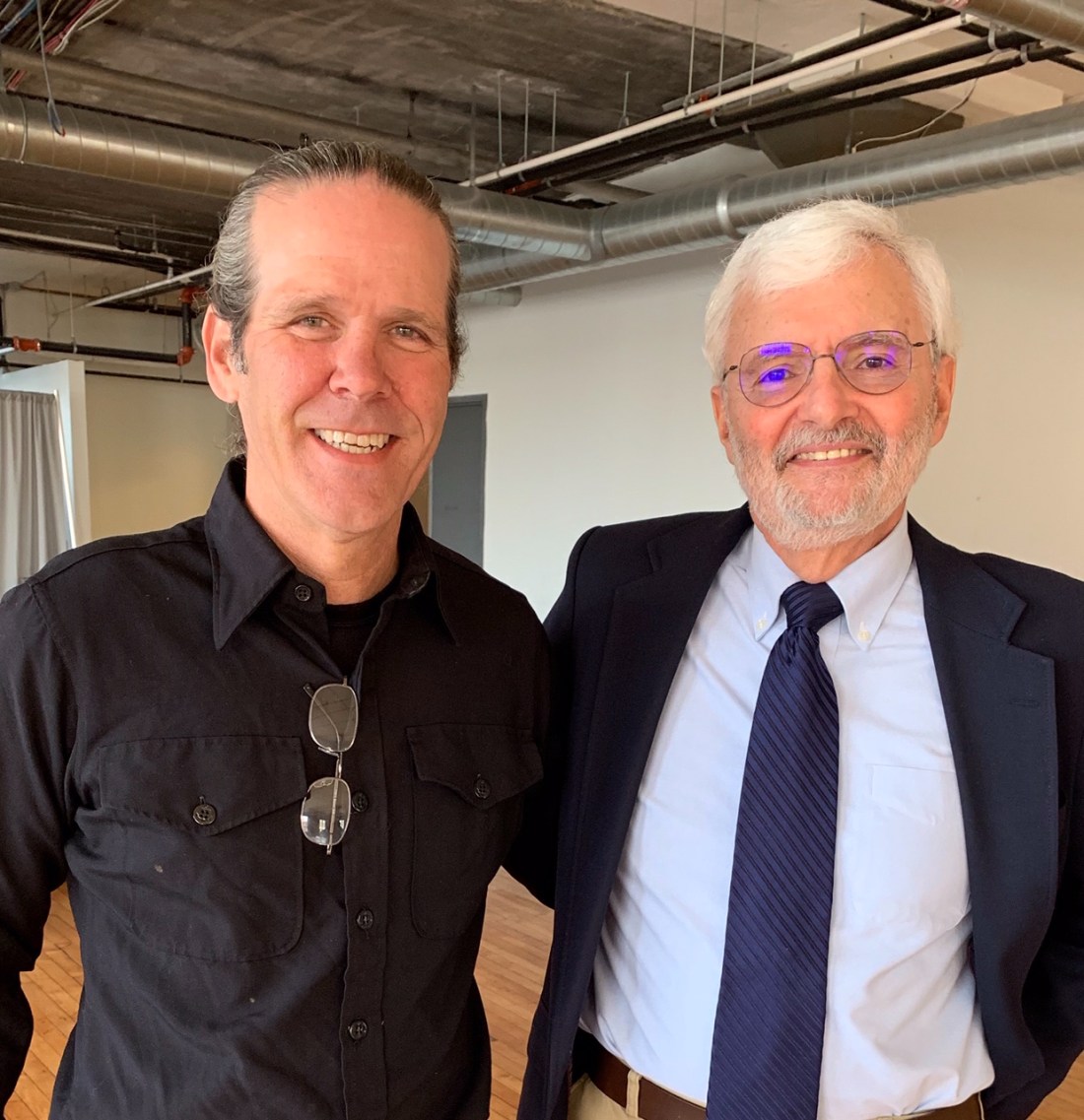
That’s Cassella on the right. Photo: Dion Fearon

When my interview was over, Fearon and I spoke about other stories, including Querida Lewis – Fearon brought her up her name, asking if I had heard of her – and Sean Hinton, the Baltimore police trainee whose body was found floating off Manhattan in 1992, and whose son Ronald Hinton was later convicted, on shaky evidence and a controversial confession, of raping and murdering a four-year-old girl.

I had presumed Fearon was a Californian – which she is – but it turns out she grew up in Baltimore. I predict we’ll be crossing paths again, and look forward to seeing what comes of her Brown biopic.


Black-Booked: The Black Guerrilla Family prison gang sought legitimacy, but got indictments

By Van Smith

Published in City Paper, Aug. 5, 2009

“I’m a responsible adult,” 41-year-old Avon Freeman says to Baltimore U.S. District Court Magistrate Judge James Bredar. The gold on his teeth glimmers as he speaks, his weak chin holding up a soul patch. He’s a two-time drug felon facing a new federal drug indictment, brought by a grand jury in April as part of the two conspiracy cases conducted by the U.S. Drug Enforcement Administration (DEA) in Maryland involving the Black Guerrilla Family (BGF) prison gang (“Guerrilla Warfare,” Mobtown Beat, April 22). Now it’s July 27, and Freeman, standing tall in his maroon prison jumpsuit, believes himself to be a safe bet for release. He’s being detained, pending an as-yet unscheduled trial, at downtown Baltimore’s Supermax prison facility, where he says he fears for his safety.

The particulars of Freeman’s fears are not made public, though Bredar, defense attorney Joseph Gigliotti, and Assistant U.S. Attorney Clinton Fuchs have discussed them already during an off-the-record bench conference. Danger signs from prison first cropped up in the case immediately after it was filed, though, when Fuchs’ colleague on the case, James Wallner, told a judge on Apr. 21 that the BGF had allegedly offered $10,000 for a “hit placed out on several correctional officers” and “all others involved in this investigation, and that would include prosecutors” (“BGF Offers $10,000 for Hits, Prosecutor Says,” The News Hole, April 23).

In open court, though, Gigliotti has said only that Freeman feels “endangered” by “conditions” at the Supermax, that “several of his co-defendants” also are housed there, and that “at a minimum,” Bredar should “put him in a halfway house, or at home with his sister under electronic monitoring.” The judge disagrees, but Freeman–against Judge Bredar’s adamant warning that it’s a “bad idea” and that “any statement you make could be used against you”–still wants to speak.

“I did have a job–I was working,” Freeman says of his days before his BGF arrest, and says of his family and friends, about 20 of whom are watching from the benches of the courtroom gallery, “I got the kids here, responsible adults here.” He declares he’s “not a flight risk” and says he “always come[s] to court when I’m told.” He stresses, “I am a responsible adult.”

Freeman’s doing what many people in his shoes do. He may be accused of being caught on wiretaps arranging drug transactions and of being witnessed by investigators participating in one. The prosecutor may say a raid of Freeman’s home turned up scales and $2,000 in alleged drug cash. But Freeman is still claiming to be a hard-working family man, a legitimate citizen, as safe and reliable as the next guy.

The details of the more than two dozen defendants indicted in the BGF case, filed against a Maryland offshoot of BGF’s national organization, suggest Freeman is not the only one among them who craves legitimacy. Information from court records, public documents, and the defendants’ court appearances over the past three months make some appear as “responsible adults” leading productive lives–or at least, like Freeman, as wanting to be seen that way.

Bredar sides with the government on the question of letting Freeman out of the Supermax. “There’s a high probability of conviction” based on the evidence against Freeman, Bredar says, adding that, given Freeman’s well-established criminal past, he poses a danger to society. So back Freeman goes to face his BGF fears. “I love you all,” he calls out to his 20-or-so family members and friends in the gallery, as U.S. marshals escort him out of the courtroom. “Love you, too,” some call back.

Take, for instance, Deitra Davenport. For 20 years, until her April arrest, the 37-year-old single mom worked as an administrator for a downtown Baltimore association management firm. Or 42-year-old Tyrone Dow, who with his brother has been running a car detailing shop on Lovegrove Street, behind Mount Vernon’s Belvedere Hotel, ostensibly for nearly as long. Mortgage broker and reported law student Tomeka Harris, 33, boasts of having toy drives and safe-sex events at her Belair Road bar, Club 410. Baltimore City wastewater technician Calvin Renard Robinson, 53 years old and a long-ago ex-con, owns a clothing boutique next to Hollins Market. Even 30-year-old Rainbow Lee Williams, a recently released murderer, managed to get a job working as a mentor for at-risk public-school youngsters.

The trappings of legitimacy are most elaborate, though, with Eric Marcell Brown, the lead defendant in the BGF prison-gang indictment. By the time the DEA started tapping his illegal prison cell phones in February, the 40-year-old inmate and author, who was nearing the end of a lengthy sentence for drug dealing, had teamed up with his wife, Davenport, to start a non-profit, Harambee Jamaa, which aims to promote peace and community betterment. His The Black Book: Empowering Black Families and Communities came out last year and, until the BGF indictments shut down the publishing operation, it was distributed to inmates and available to the public online from Dee Dat Publishing, a company formed by Brown and Davenport. Court documents indicate that at least 700 to 900 copies sold, at $15 or $20 a pop. The book has numerous co-authors, including Rainbow Williams.

According to the BGF case record, though, they’re all shams. Davenport, for instance, helps smuggle contraband into prison, prosecutors say, and serves as a “conduit of information” to support Brown’s violent, drug-dealing, extortion, and smuggling racket. The Black Book and Harambee Jamaa, the government’s version continues, are fronts for Brown’s ill-gotten BGF gains, which, thanks to complicit correctional employees, are derived from operating both in prisons and on the outside. As a result, the government contends, Brown appears to have had access to cigars, good liquor and Champagne, and high-end meals in his prison cell.

The alleged scheme has Dow supplying drugs to 46-year-old Kevin Glasscho, the lead defendant in the BGF drug-dealing indictment and the only one of the co-defendants who is named in both indictments. Freeman and Robinson, meanwhile, are accused of selling Glasscho’s drugs. Williams, the school mentor, is said to oversee the BGF’s street-level dealings for Brown, including violence. Harris is described as Brown’s girlfriend (even while her murder-convict husband, inmate Vernon Harris, is said by investigators to be helping Brown, too); among other things, she helps with the BGF finances. Most of the rest were inmates already, or accused drug dealers, smugglers, and armed robbers, except for the three corrections employees and one former employee who are accused as corrupt enablers, betraying public trust to help out in Brown and Glasscho’s criminal world. Only one, 59-year-old Roosevelt Drummond, accused of robbery and drug-dealing, remains at large.

Looking legit allows underworld players to insinuate themselves into the shadow economy, where the black market, lawful enterprise, and politics come together. Sometimes, though, people look legit simply because they are legit, even though they’re criminally charged. If that’s the case with any of the BGF co-defendants, they’re going to have their chance to prove it, just as the prosecutors will have theirs to prove otherwise. An adjudicated version of what happened with the BGF–be it at trial or in guilty pleas–eventually will substantiate who among them, if any, are “responsible adult[s].”

Glimpses of Brown’sleadership style are documented in the criminal evidence against him, including a conference call last Nov. 18 between Brown and two other inmates, “Comrade Doc” and Thomas Bailey, each on the line from different prisons.

“Listen, man, we [are] on the verge of big things,” Brown said, and Bailey assured him that “whatever you need me to do, man, I’m there.” “This positive movement that we are embarking upon now . . . is moving at a rapid pace,” Brown continued, and is “happening on almost every location.” He exhorted Bailey with a slogan, “Revolution is the only solution, brother,” and promised to send copies of his book, explaining how to use it as a classroom study guide.

The Black Book is a self-described “changing life styles living policy book” intended to help inmates, ex-cons, and their families navigate life successfully (“The Black Book,” Mobtown Beat, May 27). Its ideological basis is rooted in the 1960s radical politics of BGF founder George Jackson, the inmate revolutionary in California who, until his death in 1971, pitched the same self-sufficient economic and social separatism that The Black Book preaches. Throughout, despite rhetorical calls for defiance against perceived oppression and injustice, it promotes what appears to be lawful behavior–with the notable exception of domestic abuse, given its instructions that the husband of a disobedient wife should “beat her lightly.”

The BGF is not mentioned by name in The Black Book, which instead refers to “The Family” (or “Jamaa,” the Swahili equivalent), explaining that it is not a “gang” but an “organization.” The back cover features printed kudos from local educators, including two-time Democratic candidate for Baltimore mayor Andrey Bundley, now a high-ranking Baltimore City public-schools official in charge of alternative-education programs. His blurb praises Brown for “not accepting the unhealthy traditions of street organizations aka gangs” and for trying “to guide his comrades toward truth, justice, freedom, and equality.”

Tyrone Powers, director of the Anne Arundel Community College’s Homeland Security and Criminal Justice Institute, and a former FBI agent, offers back-cover praise for The Black Book, describing it as an “extraordinary volume” and calling Brown and his co-authors “extraordinary insightful men and leaders.”

Powers says in a phone interview that he knows Brown “by going into the prison system as part of an effort to deal with three or four different gangs.” Powers is “totally unapologetic” about endorsing The Black Book.

“The gang problem is increasing,” Powers explains, “and we need to have direct contact with the people involved, or who have been involved. We need to be bringing the gang members together and tell them there’s no win in that, except for prison or the cemetery. Gang members can be influential in anti-gang efforts, and we have got to utilize them. Are we calling them saints? No, we are not. My objective is to reduce the violence, and I don’t think sterile academic programs work as well as engaging some of our young people, like Eric, as part of a program.”

In early May, nearly a month after Brown was indicted, Bundley explained his ties to the inmate to The Baltimore Sun. “I’ve seen [rival gangs] come together in one room and work on the lessons in The Black Book to get themselves together,” he was quoted as saying. “I know Eric Brown was a major player inside the prison doing that work. The quote on the back of the book is only about the work that I witnessed: no more, no less.”

The DEA’s original basisfor tying Brown to BGF violence came from a confidential informant called “CS1” in court documents. A BGF member who’s seeking a reduced sentence, CS1 starting late last year gave a series of “debriefings” that lasted into early 2009. The investigators say in court records that CS1’s information has a track record of reliability, and the story checked out well enough to convince a grand jury to indict and a handful of judges to sign warrants as the case has progressed.

“BGF is extremely violent both inside and outside prison,” investigators recounted CS1 saying, “and is responsible for numerous crimes of violence and related crimes, including robbery, extortion, and murder for hire.” But “historically BGF has not been well-organized outside of prison,” CS1 asserted, and now the BGF “is attempting to change this within Baltimore, Maryland by becoming more organized and effective on the streets.” Brown “is coordinating and organizing BGF’s activities on the streets of Baltimore” and The Black Book “is a ploy by Brown to make BGF in Maryland appear to be a legitimate organization and not involved in criminal activity,” CS1 said, even though “Brown is a drug trafficker” and the BGF “funds its operations primarily by selling drugs.”

If CS1 is correct, then Brown is not as he was perceived by his supporters. Could it be that yet another purported peacemaker is actually prompting violence? It happened in Los Angeles last year, when a so-called “former” gangmember who headed a publicly funded non-profit called No Guns pleaded guilty to gun-running for the Mexican Mafia prison gang. It may have happened in Chicago last year, when two workers for the anti-violence group Ceasefire, which uses ex-gangmembers as street mediators, were charged in a 31-defendant gang prosecution.

Brown, with his book and his non-profit organization, wasn’t up and running at nearly the same scale as No Guns and Ceasefire, and there’s no evidence he was grant-funded. He was only just beginning to set up his self-financed positive vibe from inside his prison cell. But his is the same street-credibility pitch as in Los Angeles and Chicago: redeemed gangsters make effective gang-interventionists because the target audience will respect them more. Clearly, the approach has its risks, and Brown may end up being another example of that.

“It’s a dilemma,” Powers says of the question of how to prevent additional crimes from being committed by gang leaders who claim redemption and profess to work for reductions in gang-related violence and crime. “It has to be closely monitored.” As for Brown’s indictment, the lessons remain to be seen: “I don’t know if I can make it make sense,” Powers says.

For dramatic loss of legitimate appearances, Tomeka Harris may take the cake among the BGF co-defendants. She’s been on the ropes since late last year, when in December she caught federal bank-fraud and identity-theft charges in Maryland, in a case involving Green Dot prepaid debit cards that turned up later as the currency for the BGF’s prison-based economy. But from then until her April arrest in the BGF case, Harris had been out on conditional release–and making a good impression in public.

Media attention had been focused on Club 410, at 4509 Belair Road in Northeast Baltimore near Herring Run Park, because the police, having noted that violence was on the rise in its immediate vicinity, were trying to shut it down. At a March 26 hearing on the matter, Harris fought back, and The Sun‘s crime columnist, Peter Hermann, wrote that she “handled the case pretty well, calling into question some police accounts of the violence.” Herman described her as a “law student representing the owners,” and Sun reporter Justin Fenton, in his coverage, called her “the operator and manager” of the club. Not in the stories was the fact that she’s out on release, pending trial in a federal financial-fraud case in Baltimore.

Club 410’s liquor-board file lists as its licensees not Harris, but city employee Andrea Huff and public-schools employee Scott Brooks. Harris is referred to as its “owner” only in a March 3 police report, in which she “advised that she and her husband are the current owners of Club 410” and that “she has no dealings with the previous owners for several years.” Making matters murkier is the fact that “Andrea Huff,” whose name is on the liquor license is Harris’ alias in her BGF indictment. No wonder Sun writers were confused–Harris seems to have wanted it that way.

Harris made another public appearance before the BGF indictment came down in April. This time, it was in connection with John Zorzit, a local developer whose Nick’s Amusements, Inc., supplies “for amusement only” gaming devices to bars, taverns, restaurants, and other cash-oriented retail businesses around the region. The feds weren’t buying Zorzit’s non-gambling cover, though, and, based on a pattern of evidence that suggests he’s running a betting racket, in late January they filed a forfeiture suit and sought to seize as many of Zorzit’s assets as they could find. In the process, they raided his office on Harford Road, and there in the files were documents pertaining to Tomeka Harris and Club 410. Turns out, a Zorzit-controlled company owns Club 410, and ongoing lawsuits indicate Harris and Zorzit have had a falling out (“The 410 Factor,” Mobtown Beat, April 22).

Meanwhile, Harris still found the time to be Eric Brown’s girlfriend, according to the BGF court documents, in addition to helping the BGF smuggle, communicate, and arrange its finances. While her husband, alleged BGF member Vernon Harris (who has not been indicted in the BGF conspiracies), was in jail for murder, Tomeka Harris is said by investigators to have conducted “financial transactions involving ‘Green Dot’ cards on behalf of BGF members.” Court documents also say “one of her other business ventures was establishing bogus corporations for close associates so that they could obtain loans from banks in order to purchase high-priced items such as vehicles.”

Despite the vortex of drama that has been Harris’ life of late, she seems calm and collected at her first appearance in the BGF case on April 16. Her straight, highlighted hair hangs down the back of her black hoodie, heading south toward the tattoos peeking out from her low-hanging black hiphuggers; she’s wearing furry boots. She’s unflappable when a parole officer wonders about her claims of being a mortgage broker, when the conditions of her release in the fraud case don’t allow it.

But on June 4, a court hearing is called to try to untangle the various issues involved in Harris’ two federal indictments, and she comes undone. Her wig is gone, as are the boots and street clothes. She’s wringing her hands and holding her forehead as she talks with her lawyer, looking both exhausted and agitated. Finally, as the judge orders her detained pending trial, Harris starts crying.

The historic Belvedere Hotel has had its troubles over the years since is past glories, but it remains a highly visible symbol, like the Washington Monument, of the grandeur of Baltimore’s Mount Vernon neighborhood. Its presence in the BGF picture is a statement as to how far a prison gang’s reach may extend.

Club 410’s liquor board file contains records of 2007 drug raids carried out at Club 410 and Room 1111 at the Belvedere Hotel in Mount Vernon. The records state that evidence taken from Club 410 (a scale, razor blades, and a strainer, all with residue of suspected heroin) match evidence taken from the secure, controlled-access Belvedere Hotel condominium (a handgun, heroin residue, face masks, a heat sealer). That evidence was traced to a suspect, Michael Holman, with ties to both the Belvedere Hotel room and Club 410. Though it is unclear what, if any, ties the raids have to BGF’s currently indicted dealings, they call to mind instances in the BGF case where the Belvedere Hotel appears.

BGF court documents say Tyrone Dow, drug supplier for Kevin Glasscho’s BGF drug dealing conspiracy, “is the owner of Belvedere Detailers,” which is “located at 1014 Lovegrove Street” in Baltimore. A late-July visit there reveals that it is still operating, and that the property is right next to the rear entrance of the Belvedere Hotel parking garage.

In June 2008, Dow and his brother were highlighted in a Baltimore Examiner business article about the fortunes of Baltimore-area “garage-based premium car-wash services” during an economic downturn. Credited for Belvedere Detailers’ ongoing success is “client loyalty for the business,” which the article says Dow and his brother have operated “out of the same brick garage for more than 15 years.”

Public records of car-detailing shops operating at the Lovegrove Street location, though, don’t list Belvedere Detailers, despite the Examiner article’s claim that it’s been there for so long. In fact, no company by that name exists in Maryland’s corporate records. Instead, Mount Vernon Auto Spa LLC, headed by Hadith Demetrius Smith, has been operating there. Smith, court records show, was found guilty in Baltimore County of drug dealing in 2007, a conviction that brought additional time on a federal-drug dealing conviction from 2000, which itself violated a 1993 federal drug-dealing conviction in Washington, D.C.

City Paper‘s attempts to establish clear ties, if any exist, between Belvedere Detailers and Mount Vernon Car Wash, were unsuccessful. But the BGF investigators maintain in court records that Dow’s detailing shop at that location is tied to the prison gang’s narcotics dealings.

The Belvedere Hotel also figured in BGF investigators’ wiretap of a conversation between two BGF co-defendants, Glasscho and Darien Scipio, about a drug deal they were arranging to hold there on March 24, according to court documents.

“Yeah you gotta come down to the Belvedere Hotel, homey,” Glasscho told Scipio, who said, “Alright, I’m gonna call you when I’m close.” Just before they met there, though, Scipio called back and told Glasscho to “get the fuck away from there” because “it’s on the [police] scanner” that “the peoples is on you,” referring to law enforcers. The alleged drug deal was quickly aborted.

Glasscho, who has a 1981 murder conviction and drug-dealing and firearms convictions from the early 1990s, is accused of being the leader of a drug-trafficking operation that smuggled drugs into prison for the BGF. As the only BGF co-defendant named in both indictments, he alone bridges both the drug-dealing and the prison-gang conspiracies that the government alleges. The contention that Glasscho was a Belvedere Hotel habitu while dealing drugs for the BGF suggests that, until the indictments came down, the prison gang was becoming quite comfortable in mainstream Baltimore life.

CS1, when laying out the BGF leadership structure for DEA investigators in late 2008 and early 2009, gave special treatment to Rainbow Williams and Gregory Fitzgerald. Williams is “an extremely violent BGF member” who has “committed multiple murders” and “numerous assaults/stabbings while in prison,” CS1 contended, while Fitzgerald “has killed people in the past” and carried out “multiple stabbings on behalf of BGF while in prison.” CS1 wouldn’t actually say they were “Death Angels,” the alleged name for BGF hitmen whose identities “only certain people know,” pointing out as well that the BGF sometimes “will employ others to act as hitmen who may or may not be ‘Death Angels.'” Nonetheless, CS1 said Williams and Fitzgerald “are loyal to and take orders from” Eric Brown.

Fitzgerald was not indicted in the BGF case, and though recently released from prison on prior charges, he has since been arrested in a separate federal drug-dealing case. Williams’ fortunes, though, had been rising since he was released from prison last fall after serving out time for a murder conviction.

When Williams was named in the BGF prison-gang conspiracy, he had a job. As his lawyer, Gerald Ruter, explained in court on April 21, Williams was working for the nonprofit Partners in Progress Resource Center, a four-day-a-week gig for $1,200 a month he’d had since he left prison. Partners in Progress works with the city’s public-schools system at the Achievement Academy at Harbor City, located on Harford Road. Ruter told the judge he’d learned from Partners in Progress’ executive director, Bridget Alston-Smith (a major financial backer of Bundley’s political campaigns), that Williams “works on the campus itself as a mentor to individuals who have behavioral difficulties and is hands-on with all of the students.”

The contrast between Williams’ post-prison job, working with at-risk kids, and his alleged dealings as a top BGF leader is striking. In early April, for instance, he’s caught on the wiretap talking with Lance Walker, an alleged BGF member whose recent 40-year sentence on federal drug-dealing charges was compounded in July by a life sentence on state murder charges. Williams confides in Walker, telling him that rumors that Williams ordered the Apr. 1 stabbing murder of an inmate are putting him in danger with higher-ups in the BGF. The next day, Williams is again on the phone with an inmate, discussing how Williams is suspected of passing along Eric Brown’s order to hurt another inmate named “Coco.” Court documents also have Williams aiding in BGF’s smuggling operation and mediating beefs among BGF rivals.

And yet, Williams, with his job, was starting to appear legitimate. When law enforcers searched his apartment in April, Williams’ dedication to Brown’s cause was in evidence. Gang literature, “a large amount of mail to and from inmates,” photos of inmates and associates, and a “handwritten copy of the BGF constitution” were found, according to court documents. But they also found 38 rounds of .357 ammo. Now, Williams is back in jail, awaiting trial.

If proven right, either at trial or by guilty pleas, the accusations against the BGF in Maryland would mean not only that Brown’s legitimate-looking “movement” is a criminal sham. It would mean that the prison gang, while insinuating itself so effectively within the sprawling correctional system as to make a mockery of prison walls, was also able to embed itself in ordinary Baltimore life. If not for the indictments, should they be proved true, one can only imagine how long it could have lasted.

Calvin Robinson might have gone undetected. But the city waste-water worker, who owns real estate next to the Baltimore Police Department’s Western District station house and next to the city’s historic Hollins Market, where his In and Out Boutique clothing store continues to operate, instead was heard on the BGF wiretap talking with Glasscho about suspected drug deals. And he was observed conducting them. And when his house was raided, two guns turned up.

Robinson at least made a good show at legitimacy during court appearances in the BGF case, unlike Freeman’s performance before Judge Bredar. His lawyer played up Robinson’s city job, and even had his supervisor, Dorothy Harris, on hand in the courtroom to attest to his reliability at work. He looked poised and professional, with his clean-shaven head, trimmed mustache, and designer glasses. But just like Freeman, Robinson, who has drug convictions from the early 1990s, lost his plea to be released and was detained pending trial.

Of the 25 BGF defendants, five were granted conditional release. All of them women, they include three former prison guards, Davenport, suspected drug dealer Lakia Hatchett, and Cassandra Adams, who is Glasscho’s girlfriend and alleged accomplice. All were deemed sufficiently “responsible adults” to avoid being jailed before trial, so long as they continue to meet strict conditions. They, unlike the rest of their co-defendants, were found neither to be a threat to public safety nor a risk of flight, should they await trial outside of prison walls. Given the sprawling conspiracies, one can imagine why Freeman’s in fear at the Supermax–and why the released women should be breathing a sigh of relief.

Costly Charges: Drug prosecutions suffer after detective is accused of embezzlement

By Van Smith

Published by City Paper, Nov. 11, 2009

On Aug. 3, Ira Jimmy Martin was arrested for armed drug dealing in Baltimore City. “Lots of cash [was] recovered in this case,” Baltimore City State’s Attorney’s Office spokeswoman Margaret Burns says. But on Sept. 24, court records show, prosecutors dropped all six charges against 33-year-old Martin. The reason, according to Burns: The case rested on the honesty of veteran Baltimore Police Det. Mark James Lunsford.

A U.S. Drug Enforcement Administration (DEA) High-Intensity Drug Trafficking Area task-force officer, Lunsford was revealed in federal court as being accused by the FBI of embezzlement and lying (“Baltimore Cop Charged by Feds with Lying and Embezzlement,” News Hole, Sept. 24 ) on the same day Martin was let off the hook.

Burns explains in an Oct. 7 e-mail that it “turns out that the drugs [in Martin’s case] were handled at all points by Lunsford only, and so we lost this one. There is no way we could get the drugs in [as evidence in court] due to the taint of the officer.”

Lunsford-related cases dropped by city prosecutors since the FBI’s accusations include drug charges against Ivan James, Teon White, and Demetrius Waters. Burns predicts the total tally is likely to be few in number, since much of Lunsford’s work was for federal investigations.

Federal prosecutions impacted by Lunsford’s charges include two cases previously covered by City Paper.

Querida Lewis and Inga Bacote (“Femme Fatale,” Mobtown Beat, Jan. 14) have pleaded guilty to a cross-country marijuana-trafficking conspiracy, but have not yet been sentenced. Their attorneys won court approval to postpone sentencing so they can better determine Lunsford’s role, which ties in through Lunsford’s affidavits in another, related case against Gilbert Watkins. Watkins pleaded guilty early this year to a cocaine conspiracy and received a 135-month prison sentence. Lunsford was “clearly involved” in the Lewis-Bacote case, says Lewis’ lawyer, Catherine Flynn, who says she now will take the “opportunity to re-review the discovery in the case, now that the information about Mark Lunsford has been disclosed.”

Firearm-and-narcotics charges against Wade Coats and his co-conspirators (“Armed Drug Dealer for Steele?” Mobtown Beat, June 17), whose alleged dealings occurred, in part, in a Baltimore Marriott Inner Harbor Hotel room, were based upon a statement of charges sworn out by Lunsford.  In a motion for disclosure of exculpatory evidence filed in the case by attorney Marc Zayon, who represents co-defendant Jose Cavazos, Lunsford is said to have a stolen a watch from the hotel room. Court records show Assistant U.S. Attorney James Wallner’s response to the motion, due on Nov. 5, has not yet been filed as of press time.

[The Coats/Cavazos trial later became the subject of Corner Cartel, City Paper, Feb. 23, 2011.]

“We are reviewing all federal cases in which [Lunsford] had a role to determine if it impacts the evidence,” U.S. Attorney Rod Rosenstein says. “Abuse of a position of public trust is one of our highest priorities, and this case is of significant concern because Det. Lunsford was working with a federal task force on important cases.”

The details of the charges against Lunsford are found in a 16-page affidavit by FBI Special Agent Brian Fitzell. The document lays out a time line, starting in June and ending with the filing of the sealed complaint on Sept. 22, during which Lunsford arranged to have an informant paid government funds in exchange for helping in investigations, and then allegedly split the proceeds with the informant, who reported the kickback scheme to the FBI. In fact, the FBI affidavit explains, the informant provided no help in the cases for which Lunsford arranged for funds to be paid.  In addition, the informant told the FBI of instances when Lunsford allegedly stole valuables from suspects, including watches, clothing, and video games.

Conversations between Lunsford and the informant–referred to in Fitzell’s affidavit as “CHS,” short for “confidential human source”–were recorded by the FBI, and some of the exchanges were included in the affidavit. Regarding $10,000 in funds that the two had split, the CHS asked, “Me and you are the only ones that know we split that 10 grand, right?” “Oh, yeah, nobody knows,” Lunsford replied according to the affidavit, “don’t nobody know nothin’ about that money . . . but me and you.” In another conversation, Lunsford told the CHS that he’d stolen video games from the house of someone interviewed recently by law enforcers.

“I ain’t goin’ into a [expletive] house,” Lunsford said, “if I ain’t gettin’ something out of that bitch.”

On Sept. 23, the day after the sealed complaint was filed against Lunsford, FBI agents conducted a morning raid on his home at 1246 Canterbury Drive in Sykesville (“Stash Found at Home of City Cop Charged With Lying and Embezzlement,” News Hole, Sept 30). According to court documents, they seized a host of items, including a money-counting machine, $48,300 in cash, a digital scale, testosterone gel packets, 29 pieces of expensive jewelry and watches, $1,000 money wrappers, a “zipped plastic bag containing green leafy substance,” and a “box of property taken from Darrell Francis.” According to court records, Lunsford wrote the complaint against Francis that resulted in the defendant’s 2008 guilty plea and a resulting 19-month prison sentence, in a federal drug-conspiracy case that spanned from Baltimore to Atlanta and Texas.

Rosenstein would not comment specifically on the fruits of the raid on Lunsford’s home, but says, generally, that his office “often pursues additional leads that are generated when search-and-seizure warrants go with arrests.”

Baltimore Police spokesman Anthony Guglielmi, asked to comment on Lunsford’s case, says that the department won’t put up with corrupt conduct on the part of its officers. “Commissioner [Frederick] Bealefeld has made it very clear that we hold people accountable,” Guglielmi says. “Any behavior which undermines the integrity of this agency and the hard work of our police officers simply will not be tolerated by this administration.”

Lunsford’s attorney, Paul Polansky, declined to comment. In early October, Lunsford was quoted by WJZ-TV saying that “there is a legitimate explanation” for his alleged conduct “that does not involve illegal activity, and hopefully the truth will come out in court.”

Court documents in the case against Lunsford suggest the charges against him are based, in large part, on Ira Jimmy Martin’s arrest. Fitzell’s FBI affidavit discusses an individual described as “Suspect-3,” who was arrested on Aug. 3–the same day Lunsford arrested Martin. During a recorded meeting between Lunsford and the CHS, the affidavit explains, Lunsford said he “hoped to seize all of Suspect-3’s assets when he arrested him” and credit the CHS with providing the information leading to Suspect-3’s arrest.

“If I get him when he comes back from New York, you know,” Lunsford’s was recorded as saying of Suspect-3, “it’s 30 grand or 40 grand to [expletive] buy the kilo, you know, or maybe a lot more than that but anything he’s got in that [expletive]. I’m jammin’ this [expletive] toad up, man. [Expletive] it. ‘Cause that counts as money. That counts as you [expletive] givin’ me [expletive] and they got these [expletive] assets; therefore, I can get money off of that.”

The day after Suspect-3’s arrest, another conversation between Lunsford and the CHS was recorded. “I did that house,” Lunsford allegedly said. “Didn’t come up with nothin’ too good, man. I got ah . . . maybe like 10 grand, 11 grand, so I’m gonna try to put you in for that.” The next day, Fitzell’s affidavit says, Lunsford told the CHS that he was putting in “for a 20 percent payment from the $17,490 cash seizure made on the Suspect-3 case,” so the CHS could get paid.

Later, when Lunsford put in paperwork for the payment, Fitzell’s affidavit says that Lunsford falsely stated on the form that, “‘without the valuable intelligence provided by the [CHS] . . . [Suspect-3] could not have been arrested.’ As Lunsford well knew at the time he submitted the claim for an award to the DEA, the CHS had provided no intelligence to him concerning Suspect-3.” The CHS later received a $3,498 check from the DEA “for his supposed assistance on the Suspect-3 case,” Fitzell’s affidavit says.

City Paper could not confirm that Suspect-3 was Ira Jimmy Martin because the court file of the case against Martin is “not subject to be inspected,” according to the Baltimore City Circuit Court clerk’s office. Though online information for the case had been available on Oct. 27, when City Paper printed it out, on Nov. 4–the day after a scheduled hearing on the matter–it no longer was.

Attempts to reach Martin through his father, also named Ira Martin, were unsuccessful as of press time. His attorney, Stanley Needleman, did not return calls asking for comment about the allegations against Lunsford and whether they relate to Martin.