Hot Contract: City bribery scandal tied to influential father and son

By Van Smith

Published in City Paper, Jan. 26, 2005

Mark Sapperstein owns 113 W. Hamburg St., an 8,000-square-foot commercial building in Sharp-Leadenhall. The South Baltimore property, though devoid of signs, houses Allstate Boiler Service, a company owned by Gilbert Sapperstein, Mark’s 73-year-old father.

On Jan. 7, Allstate Boiler’s bookkeeper and office manager, Ida Marie Beran, pled guilty in a bribery case involving the company’s contract with the city to provide boiler services for municipal agencies. Also pleading guilty was Cecil Thrower, a city Department of Public Works employee since 1984 who worked at the Back River Wastewater Treatment Plant in Essex.

The case ties an established name in Baltimore’s business and political class—that of the Sapperstein family—to an ongoing criminal investigation.

In the statement of facts filed in the case, which was brought by the Office of the State Prosecutor, Beran and Thrower admitted that they conspired together to inflate invoices under Allstate Boiler’s contract with the city. While Thrower received somewhere between $1,500 and $2,000 for his part in the scheme, Beran received nothing—though her employer received “well over” $120,000 in excess payments as a result of the fraudulent bills, according to case documents.

The court record further explains that the conspiracy began in approximately 1998, at which point “Mr. Thrower was approached by the business owner who employed Ms. Beran [who] suggested to Mr. Thrower, ‘From time to time you could do something for us and perhaps we could do something [for] you.’ . . . [O]n more than one occasion, while acting at the instruction of and in concert with her employer, Ms. Beran prepared the envelopes containing cash for Thrower and provided them to other employees for delivery to Thrower.”

The case documents make no mention of Allstate Boiler or the Back River plant. Department of Public Works spokesman Robert Murrow, however, confirmed for City Paper that the city contract defrauded in the scheme has been held by Allstate for “like 20 years” to provide boiler work for any city agency that needs such services, and that the inflated bills were for work at Back River.

Allstate, which has been in business since 1965, also holds the boiler contract for the Baltimore City Public School System, according to city schools spokeswoman Vanessa Pyatt, though she says the contract is “set to expire in February.”

State prosecutor Robert Rohrbaugh confirms that, “absolutely, this is a continuing investigation,” though he could “neither confirm nor deny” that the investigation continues to focus on Allstate Boiler or the Sappersteins. Rohrbaugh’s reticence aside, the record makes clear that Allstate, not Beran, benefited from the longstanding bribery scheme.

Mark Sapperstein acknowledged to City Paper that Allstate Boiler Service is located at his property, but he declined comment about the company or the bribery scandal. Gilbert Sapperstein did not return calls for comment left at Allstate, and contact information for Beran could not be found. Thrower’s phone at his West Baltimore residence has been disconnected.

Mark Sapperstein is a major player in local real-estate circles. He’s a partner in Silo Point, a $200 million proposal to convert a derelict grain elevator in Locust Point into a residential-retail development. On Jan. 13, the Baltimore Development Corp. awarded development rights to a city-owned parcel at Calvert and Lombard streets to Mark Sapperstein and his partners, who planned to turn it into a $71 million apartment complex called Cityscape. In 2002, he and his partners constructed a $13.5 million parking garage at Calvert and Lombard. Last spring, Sapperstein purchased 200 acres on North Point in eastern Baltimore County, where he plans to build luxury single-family homes on the Bauer Farm tract, where British troops in the War of 1812 marched en route to face Baltimore militias.

Gilbert and Mark Sapperstein, through their respective companies, have been active as donors to campaigns of elected officials. Since the fall of 1999, the two, along with Mark Sapperstein’s wife and several Sapperstein companies, gave at least $33,270 to the campaign committees of various elected officials.

Of the total, $9,650 went to Mayor Martin O’Malley (D), $8,000 went to Baltimore County Executive Jim Smith (D), and $4,250 went to Gov. Robert Ehrlich (R). Nearly all of the rest went to legislators representing Baltimore City and Baltimore County. At the federal level, Gilbert Sapperstein donated $250 each to U.S. Rep. C.A. “Dutch” Ruppersberger (D-2nd District) and the Republican National Committee. Mark Sapperstein gave $1,000 to U.S. Sen. Joseph Biden (D-Del.) and $500 each to Ruppersberger, U.S. Sen. Barbara Mikulski (D), and Virginia Congressman Eric Cantor (R-7th District). Mark Sapperstein’s wife also gave $500 to Cantor.

Gilbert Sapperstein, according to several sources familiar with the workings of the Baltimore City Board of Liquor License Commissioners, is known as a go-to guy for prospective liquor licensees looking to break into the bar business. As a secured creditor for bars that fail, he assumes control of properties and liquor licenses and thus can procure opportunities for new entrepreneurs. According to liquor board documents, for example, Sapperstein was a secured creditor in a March 2003 license transfer for Mary’s Place in West Baltimore. Often, sources say, bar owners who are indebted to Sapperstein, who has been in the poker-machine business for years, agree to keep his poker machines in their establishments.

Both Sappersteins have had run-ins with the law for gambling-related charges. Gilbert, whose Star Coin Machine Co. is housed at 113 W. Hamburg with Allstate Boiler, faced 107 gambling-related charges in state courts in the 1980s and ’90s relating to Star Coin’s poker machines, though prosecutors declined to prosecute nearly all of them. In two cases, he received probation before judgment and was fined $1,475. Mark Sapperstein was charged with four gambling-related counts in 1989, though prosecutors chose not to pursue the cases. State records indicate that Mark Sapperstein’s poker-machine company, Mark’s Vending, has been inactive for more than a decade.

In 1984, Gilbert Sapperstein faced 18 housing-code violations for properties he owned in the city, receiving probation before judgment for 16 of them while prosecutors declined to pursue the remaining two charges. In 2003, Gilbert Sapperstein was charged with 10 housing-code violations in connection with a rowhouse he owned at 3203 Fleet St., receiving probation before judgment and $170 in fines. He sold the property shortly afterward.

Last April, Gilbert Sapperstein sold one of his properties in the Hollins Market neighborhood—the former Tom Thumb/Gypsy’s Café property, which in 2000 collapsed amid ill-conceived renovations. Two of his other properties in the same Southwest Baltimore neighborhood on Carrollton Avenue—one of which housed the Club Medusa, a hipsters’ after-hours social club, in the 1990s—are for sale. In July, he sold a property at 1600 W. Baltimore St., which houses a tavern called Good Times.

Currently for sale in the 800 block of West Cross Street is the property that housed Foul Ball Bar and Grille, which is owned by 2001 Eastern Ave. LLC, one of Gilbert Sapperstein’s companies. The Fells Point address the company is named after houses the Colonial Inn (owned by the same company). In Baltimore County, Gilbert Sapperstein owns 9727 Pulaski Highway, a large restaurant currently under renovation, and 2123-25 Sparrows Point Road, a strip club and bar.

The list of Sapperstein properties—many of them with liquor licenses attached—could go on and on.

In the 1990s, Mark and Gilbert Sapperstein were named, along with dozens of other parties, in a civil Racketeer-Influenced and Corrupt Organizations (RICO) lawsuit brought by Donald D. Stone, a self-described surfer dude who alleged that the Sappersteins, their business partners and lawyers, and the law-enforcement bureaucracy in Maryland and Florida conspired to keep him from shedding light on their allegedly corrupt schemes. The case, which was filed separately in federal courts in Maryland and Florida, went nowhere. That outcome has not kept Stone from posting potentially libelous statements about the Sappersteins and others on the internet—though, so far, Stone says he has not been sued.

Part of Stone’s investigation into the Sappersteins focused on an Anne Arundel County deal for cell-phone towers that led to a lawsuit against Mark Sapperstein and his business partners by George and Mary Jane Chamberlain, who moved from Annapolis to New Hampshire before filing the complaint in 1999. The lawsuit, which has since been settled, alleged that Mark Sapperstein and two partners, both of whom also sat on the Anne Arundel County Economic Development Commission, stole the couple’s idea for dominating the communications-tower industry. The terms of the settlement are confidential, though the amount paid to the Chamberlains—$40,000—later leaked out. The lawsuit was filed shortly after Mark Sapperstein sold his communications-tower companies to a Florida company for $8 million in 1998.

Investigators are keeping mum about where they might be headed as they scour the books. Only time will tell whether the Sappersteins are in the clear or headed for more trouble as the case progresses.


Fouled Nests: The bust of a local poker club uncovers all sorts of messy connections

By Van Smith

Published by City Paper, Nov. 23, 2005

When Baltimore City Police Sgt. Craig Gentile’s vice enforcement unit arrested 95 people for illegal gambling at the Owls Nest poker club in South Baltimore near M&T Bank Stadium on the evening of Nov. 2, it opened up a can of worms. Gentile, a veteran vice cop who routinely busts strip joints and nightspots, wouldn’t discuss the raid or the ongoing investigation of the Owls Nest for this article. But the public record, law-enforcement sources who spoke to City Paper on the condition of anonymity, and interviews with people close to the action at the Owls Nest and in the local poker world show that it is more than just a refurbished warehouse hosting charity gambling.

At its core, the Owls Nest is an illegal poker den with political, criminal, and law-enforcement ties.

The situation at the Owls Nest revolves first and foremost around the relationship between its principals—Joseph Anthony Cary, 50, and Gerald Curtis Dickens, 65—and Frank Darby Moran Sr., 76, a man dubbed by some as “the king of Arbutus.”

Cary and Dickens worked for Moran’s Arbutus-based charity gambling outfit, the Orioles Nest, before they split from him about a year ago and started the competing Owls Nest. Both private clubs are chapters of national fraternal organizations, similar to Elks or Moose lodges; the Owls have been around since 1904. Both the Owls and Orioles (nothing to do with the baseball team) have seen a renaissance in recent years. Chapters open their doors and people become members, often in order to gamble, ostensibly to raise money for charitable causes.

Despite Cary and Dickens’ split from Moran, ties remain. Cary’s Statewide Amusement vending company’s web site (www.statewideamusements.com) lists its address as 5404 East Drive in downtown Arbutus—a commercial property owned by Moran. It’s also the address of record for the Orioles Nest, which has operated at several locations since at least 2003.

Right around front, in the same strip of small businesses that houses the Orioles Nest, are the 12th Legislative District office of state Sen. Edward Kasemeyer, Del. Steven Deboy, and Del. James Malone, all Democrats.

Deboy is a retired Baltimore County cop who now works as a warrant investigator for the Howard County Police Department, while Malone is a lieutenant in the Baltimore County Fire Department.

Next door to the district office is Sport Cuts, a barbershop and clothing store owned by Andre Fozard, a federally convicted ecstasy dealer, former bail bondsman, and former strip-club co-owner on the Block in downtown Baltimore.

Delegates Malone and Deboy both say they do not know Fozard, but admit they were aware that the Orioles Nest was based out of the same small commercial building where their district office is located. Deboy denies being a member of the Orioles Nest.

“This is actually bizarre,” he says of the contention, made by City Paper’s sources, that he belonged to the private club, and suggests that anyone who says that he was a member may be engaging in “politics of destruction.” Malone, however, says “to be very, very honest, I don’t know whether I’m a member or not,” adding that he’d been to one Orioles Nest event, years ago. “I’d be very surprised if I was a member,” he says, adding, “I don’t gamble, period.”

Baltimore County Councilman Sam Moxley (D-1st District) was also named by City Paper’s sources as being an Orioles Nest member.

“No, not that I know of,” he responds. “I don’t think that I’ve ever been at any of their events, though I talked to [Frank] Moran about the situation [with the club]. He wanted to know about the gambling laws in the county.”

According to a law-enforcement source who has seen the Orioles Nest membership list, Fozard was a member of the organization. Several sources say Thomas Wayne Damron, a drug convict with a violent record, was too. So was Naylor Harrison, a convicted drug dealer who reportedly runs an asphalt paving business, according to Orioles Nest manager William Sachse and a law-enforcement source, though they say he was suspended for misbehaving in the club.

Fozard, Damron, and Harrison, law-enforcement sources say, have also been frequent habitués of the Owls Nest, which hired retired and off-duty cops from local jurisdictions as security for its tournaments. According to the police report of the Owls Nest raid, Barry Lee Boone, a retired Howard County cop, was armed and working for the tournament’s organizers that night, taking money from players.

Attempts to contact Fozard and Damron for comment were unsuccessful, but Harrison was reached. He denied ever being a member of either the Orioles or Owls, adding, “I stopped going to those places a long time ago.”

Though Moran, Cary, and Dickens could not be reached to interview them for this article, Orioles Nest manager William Sachse could. In a telephone interview, he explains that Cary and Moran go way back, through Cary’s vending-machine business, Statewide Amusements, which other associates of Cary, including John Leroy Long Jr., confirm.

“Joe Cary was pretty much raised and taken care of by Frank Moran,” Sachse says. “He taught Joe everything he needed to know in the vending business.”

The two also worked together running Moran’s club, the Orioles Nest, in a business park on Vero Road in Arbutus, a stone’s throw from the city line. Once inside the innocuous business-suite door, patrons paid a nominal fee—sometimes $20, sometimes $50, sometimes more, depending on the night’s event—to gamble, with the proceeds ostensibly going to various charities. But in late 2004, the club’s management experienced a falling out.

Sachse says Moran suspected that Orioles Nest money was being “misappropriated” by Cary and Dickens, and a “very ugly breakup” ensued. Sachse says Moran brought in Kimberly Acton, Sachse’s fiancé, late last year to clean up the Orioles Nest operations. After a couple of months, Sachse continues, Acton “got tired of the drama” of running the place, and he took over for her about eight months ago.

After the split, Sachse says, the “drama” continued, but he didn’t elaborate. A law-enforcement source familiar with the situation did. When Cary and Dickens left the Orioles Nest, the source says, they took a lot of the club’s assets with them.

“That night in November [2004], when the establishment closed, Joe Cary backed a truck up and cleaned the place out,” the source alleges. “He took TVs, poker chips, poker tables, food, soap dispensers, cigarette machines—everything except the pool table.” Cary and Dickens, the source continues, didn’t go far to start their own charity-gambling club—they set up in the next suite over.

Cary and Dickens “hung a cardboard sign up with the owls nest on it,” the source continues, adding that Moran purchased new amenities and kept his club open. “They were running side by side, wide open. [Cary and Dickens] were there through Christmas, maybe into January, while they were refurbishing the Worscester Street warehouse”—the location that was raided by Gentile and his squad on Nov. 2.

Meanwhile, the source says, Moran tried to roust Cary and Dickens from their location next door to his by starting his own Owls Nest chapter.

“There’s something with these fraternal organizations that two with the same name have to be at least six or eight miles apart,” the law-enforcement source says. “[Moran] was hell-bent on getting his own Owls Club established, because then [Cary and Dickens’] club couldn’t stay.”

While state records do not show Moran incorporating another Owls Club, a sign on a rear door to his East Drive property in Arbutus read, as of press time: “Owls Nest 4535—Private Club. The awning of Cary and Dickens’ establishment in South Baltimore announces it as, “Owls Club 4525.” (The door reads, “Owls Nest 4525.”)

After Moran’s falling out with Cary and Dickens, the source says, Baltimore County police paid a visit to the Orioles Nest: “The police said the Orioles Nest had all the proper paperwork and everything, but [that] it cannot play Texas hold-’em. They told Sachse and Kim [Acton], ‘This is it. It’s over.’”

Sachse confirmed the police visit to City Paper. Baltimore County Police Department spokesman Bill Toohey couldn’t confirm the visit but explains the county police practice involving charity poker events: “The gambling unit goes there, proactively, and reminds the operators of the county law—you can only hold [poker tournaments and other charitable gambling events] once a year, you can’t give cash as prizes—only merchandise of less than $1,000 in value—and everybody who plays has to be a [club] member.”

Shortly after the county police laid down the law to the Orioles Nest, both clubs’ promotional materials show that they relocated to Baltimore City.

According to a flier obtained by City Paper, Owls Nest 4525—Cary and Dickens’ outfit—opened in Baltimore City on Jan. 22, 2005, at 1800 Worscester St., sandwiched between the Russell Street overpass and the railroad tracks near M&T Bank Stadium.

“During the time I was with the Orioles Club, I had the pleasure of meeting many of you and invite you to come visit our new facility,” reads the flier, which bore a signature line for “Jerry,” secretary/treasurer of the Owls Nest. It politely adds that “we encourage you to continue to support the Orioles Club, as it is a fine organization.”

After Cary and Dickens split from Moran’s Orioles and started the Owls Nest, “we didn’t want our organization to be associated in any way with the Owls,” Sachse says, citing Moran’s bitterness over Cary’s disloyalty and the Owls’ indiscretion in holding widely publicized games on a regular basis.

“I mean,” Sachse adds incredulously, “they were advertising in the Sunpapers!”

The police report of the Owls Nest raid mentions an Oct. 18 advertisement in The Sun, which revealed that the Owls Nest was holding a nine-night tournament, and that winners would get seats at the World Poker Challenge tables on Nov. 13 at a Foxwoods, Conn., casino, airfare included.

Which is not to say the Orioles Nest didn’t continue hosting games of chance, ostensibly for charity. In April, Moran’s Orioles Nest distributed a flier, also obtained by City Paper: “We are proud to announce our grand re-opening at our new location . . . less than a mile from our old location.” The event’s date was April 14, and the address—where the club is still operating—was 2930 Washington Boulevard, Suite A, in Southwest Baltimore “next to the Warehouse bar and grill.”

The flier offered a “re-union promotion,” thanking members “for their patience and loyalty” by “giving away $50 in free chips with your first $100 buy-in to be used in any of our games. To the first sixty members to come to the window.”

The flier doesn’t mention any charities, though Sachse makes a point of saying that it would be “unethical if we don’t have a specific beneficiary” for the club’s fundraisers. “You need to deem one charity for that event, so to speak,” he explains, adding that “you don’t tell the charity what kind of event it was. Just give checks.”

By the time the Orioles Nest reopened in Morrell Park in April, the Owls Nest had a calendar of events reflecting twice-a-week poker tournaments. For April 29, the club’s calendar announced “A Special Tournament for Pi Kappa Phi,” a fraternity at UMBC.

According to a flier for the tournament, the event’s beneficiary was Push America, an organization “to serve persons with disabilities.” The cost to participants, the flier reads, was $55, plus $10 for “re-buys”—more chips if players run out. It adds: “All are invited.”

The charitable result of the fraternity tournament was $150, as reflected by a copy of an April 29 check made out by the Owls Nest to Pi Kappa Phi obtained by City Paper. If only three people paid to play, the $150 donation would have been recouped by the event.

In an effort to determine how many people paid to play, City Paper contacted the fraternity’s treasurer at the time, Chris Manger, and its vice “archon,” Greg Quigley. Both asked if they could call back. Neither did, and neither returned repeated subsequent messages.

Since the Baltimore Police Department busted the Owls Nest Nov. 2, the Orioles Nest has continued to host fundraising events. Baltimore City Councilman Edward Reisinger (D-10th District) tells City Paper that he’s not happy about it.

“After the Owls Nest gets busted, this Orioles Nest is still in operation!” Reisinger exclaims. “I called the police on that.” \

Sachse, though, tells City Paper that the Orioles Nest has stopped holding poker tournaments. Furthermore, he contends, the Orioles Nest has been run well and properly on the charity front since Cary and Dickens left.

“I’ll show you exactly where the money goes,” he says, offering to show City Paper the organization’s checkbook. “At the end of each quarter, monies are given out.” When asked if he would demonstrate how the Orioles Nest’s charitable giving has changed from when Cary and Dickens ran the show, Sachse balks: “I mean, if we get audited, that would be a skeleton in [our] closet. I’ll ask Frank [Moran] and get back to you.” He never did, and subsequent calls went unanswered as of press time.

There are other skeletons in the Orioles Nest’s closet, though. Sachse, the man who was brought in to bring order and propriety back to the Orioles Nest, was jailed in the early 1990s for a Howard County drug-distribution conviction, court records show.

Joseph Cary’s skeletons have been coming out of the closet in recent days, as well. First, the Owls Nest got busted Nov. 2, and Gentile says he expects to file criminal charges against Cary soon. Then on Nov. 14, the Comptroller of Maryland’s office announced that it has filed a $953,515.58 tax lien in the Anne Arundel County courts against Statewide Amusements, Cary, and his wife, Deborah Cary (the couple being the officers of Statewide).

“Sticker shock,” is how state comptroller spokesman Kevin Kane characterizes the amount. “There is no appealing this,” he adds.

Comprising the total are $412,507.58 in unpaid taxes, $180,530.55 in interest, and $360,477.45 in penalties. Kane says it is “a case of intentional fraud” in which Statewide underrepresented its gross sales, uncovered by an audit that started in February of this year and examined the period between February 1999, when the company was formed, and November 2004.

Cary is no stranger to financial stress, though. In 2001, he sought and received Chapter 7 bankruptcy protection from creditors including the state of Maryland, a California company that makes monitors for vending machines, the city of Baltimore, Anne Arundel County, and the University of Maryland Medical System.

He’s also no stranger to the criminal courts. Court records show Cary has had criminal charges filed against him at least once in nearly every year since 1978.

Many of the charges have involved alleged violent disputes with his wife (she sometimes, but not always, refused to testify against him during the trials), and he also has faced charges of, among other things, arson, assault, malicious destruction of property, battery, escape from confinement, breaking and entering, resisting arrest, drug possession, and gambling.

He often avoided convictions when prosecutors declined to bring cases to trial, but there are a few guilty findings—for battery, assault, resisting arrest, malicious destruction of property, and failure to appear at court, for instance. Cary also took probation before judgment in many cases, including an arson charge.

Criminal charges against Dickens are not reflected in a court-record search, but he, too, filed for bankruptcy in 2001. He gained protection from the Internal Revenue Service, the state of Maryland, Prince George’s County, various banks, and an accountant.

Based on their records, Cary and Dickens aren’t exactly the model proprietors of a charitable enterprise that specializes in raising funds through gambling events. Cary, however, manages his money well enough to own a 2003 Hummer H2, a 2001 Chevy Corvette convertible, a large RV, and a 2001 Chrysler PT Cruiser, among other vehicles, all registered in his, his business’, or his family’s names. It’s an impressive automotive fleet for someone who recently emerged from bankruptcy.

Nonetheless, the charitable company Cary and Dickens started—Fraternal Order of Owls 4525 Inc., incorporated two weeks before it was busted, according to the Maryland State Department of Assessments and Taxation—appears to be a proper charity. That is, if the documentation provided to the Baltimore City Zoning Board in April, when the Owls Nest applied for a variance to put its club in a manufacturing district, is reliable.

(The Owls Nest was given its variance in July, though, according to city housing department records, it received no permits for the $50,000 in renovations stated in the zoning application.)

A signed letter purporting to be from Diane Meader, the supreme secretary of the Home Nest, Order of Owls, located in the “Owl Building, Hartford, Conn.,” includes an undated enclosure to the IRS “to certify that Nest #4525 a duly constituted body of the Fraternal Order Of Owls operating under the lodge system.”

The Home Nest, Order of Owls letterhead in the zoning file gives no street address or phone number for the organization, and the Hartford Public Library couldn’t unearth any information about the “Owl Building” or the “Home Nest, Order of Owls” in Hartford or Connecticut. City Paper could not locate a Diane Meader in Connecticut. According to GuideStar.org, a nonprofit information service, there is no charitable enterprise operating in Connecticut using that name. Nor does GuideStar turn up Cary and Dickens’ Fraternal Order of Owls 4525—although it does show Moran’s Orioles Nest.

The Owls Nest in Baltimore does make charitable donations, though. The zoning file includes copies of numerous checks cut to various entities for charitable purposes, including Pi Kappa Phi ($150), the Church of the Redemption in Locust Point ($150), the Linda Whelan Fund ($150), Toni Aguilar ($500), Seniors Helping Seniors ($250), the American Breast Cancer Foundation ($150), the Boys Home Society of Baltimore ($150), Carol Reyes ($100), Maryland Food Bank ($150), the Baltimore City Fire Fighters Widows and Orphans Fund ($200), the Baltimore Child Abuse Center ($200), and the Associated Black Charities ($200).

The amount donated totals $2,350 and was given between February and July of this year. By way of comparison, on the night of the Nov. 2 raid, a Wednesday, more than $25,000 was seized from the Owls Nest tournament then in progress, including more than $6,600 from Cary’s pants pocket.

These numbers make another letter in the zoning file that much more interesting. It’s from Edward Reisinger, and it states that the city councilman supports the zoning variance for the Owls Nest, pointing out that “all money raised is donated to local charities.”

Reisinger says he supported the zoning change for the Owls Nest and wrote the letter based on the word of the building’s owner, Gilda Johnson, “who’s a respected member of the community,” he says. “I wish I could take that [letter] back, but it’s too late now.”

Johnson says she was convinced the Owls Nest was a charitable enterprise: “There was nothing that would have allowed me to think otherwise. It was done strictly by the books.”

The Nov. 2 vice-squad raid on the Owl’s Nest was historic. According to The Sun, it was the largest gambling bust since the Prohibition era, although prosecutors dropped their charges against nearly everyone arrested Nov. 10 (charges are still pending against 15 accused event organizers).

The prosecutors said the wrong law was used in citing them, and that if so many cases were brought to court they would unnecessarily clog up the docket. While especially large, however, the Owls Nest bust was not unique—even in the past year.

On Feb. 25, Jimmy’s Famous Seafood Restaurant on Holabird Avenue in Southeast Baltimore was busted for a Texas hold-’em tournament (“Game Sharks,” City Paper, March 9), and Peter’s Pour House on Mercer Street near Camden Yards was raided this past spring. Eugene Lovito of Fund Raisers Unlimited was charged with gambling in the Peter’s case, but the charges were shelved by the prosecutor.

Nor was the Owls Nest raid the most recent gambling bust. A week later, on Nov. 10, Gentile’s vice squad nabbed another game, at the Aces High Club on the second floor above the B.J. Mattheiss Insurance Agency at 6716 Harford Road. (Bruce Mattheiss, the building’s owner, did not respond to a call for comment.)

Arrested there on gambling charges, according to court documents, were Baltimore City police officer Vicki Mengel, allegedly hired to provide security, and Brad Lukens, who also was cited at the Owls Nest raid. (Charges against Lukens relating to the Owls Nest were dropped; Mengel and Lukens are scheduled to be tried on charges relating to the Aces High in January 2006.)

Law-enforcement sources say another Owls Nest player from the night of the Nov. 2 raid tipped Gentile off to the Aces High game, setting it up for the bust.

In April, Anne Arundel County got into the poker-raid action. Police there hit a place called Tykie’s Lodge, a Texas hold-’em hot spot housed in an emergency-services contractor’s building right next to the Maryland State Police post in Glen Burnie.

Among those arrested was an 18-year Howard County Police Department veteran, Michael Thorn, who’s accused by Anne Arundel County authorities of helping to organize the game. According to Thorn’s attorney, Clarke Ahlers, the game wasn’t for money, but was an instructional event intended to teach people how to play and deal poker. The case is set for trial next March.

In Baltimore City, even nonprofits are barred from holding poker tournaments for charity. (Laws vary from jurisdiction to jurisdiction, but in Baltimore County, for example, charities are permitted to hold one gambling event a year, including card games.) As Nathan Irby, executive secretary of the Baltimore City Board of Liquor License Commissioners, wrote in a Nov. 5, 2004, letter to liquor licensees, “although specific types of organizations may conduct gambling after obtaining a permit from the Baltimore City Police Department, there are no permits issued for a poker tournament.”

Copies of Irby’s letter were found at the Owls Nest when it was raided, according to law-enforcement sources. Brian Clark, the owner of online poker forum MD-Poker.com, says simply that “poker is illegal in Maryland.”

Clark says he has become an expert on poker laws and thinks charity poker tournaments are giving his game a bad name. “These places that are getting busted, they were asking for it,” he says. “I don’t allow them to advertise on my site. They may give a small portion to charity, but they’re holding games multiple times a week. They’re not doing anything to help our cause, only hurt it. Most of my members were warned beforehand—watch out for places like this.”

Clark’s cause is to legalize poker in Maryland, but “in small baby steps,” he explains. “People should be allowed to have their own friendly poker games with no raking,” he says, referring to the practice of game organizers taking money off the top from players. Ultimately, he’d like to see Maryland copy the Golden State. “In California, where there are legal poker halls, the state reaps a ton of revenue from them, and the state recognizes it for what it is—a game of skill, not a game of chance, like slots or roulette.”

Clark says he is “trying to start a lobbying group” to influence lawmakers in Annapolis on the subject. “We’ve been in the planning stages for about a year now.”

On Nov. 4, immediately after The Sun first covered the Owls Nest raid, Clark posted on MD-Poker.com’s home page a statement to his members: “To put it simple the Owl’s Club got busted because they are idiots.” He added that the club’s organizers “were running a near full time poker room” and “keeping the profits” for themselves. “They advertised and promoted an already illegal game, they rented a business facility to hold the game, they served alcohol without a license. . . . It is their own fault they got busted and this should not scare the average member who enjoys a good low stakes game with 10 or so friends.”

Not all local players agree with Clark that the Owls Nest was a disreputable place.

“I don’t see why they’re outlawing it,” says Joseph Cary associate John Leroy Long Jr., who says he’s been friends with the Owls Nest principal “for many years.”

While law-enforcement sources say Long has been Cary’s driver and has worked for him in other ways over the years, Long, a 56-year-old Southwest Baltimore resident, is adamant: “I never worked for him. I never drove for him.” But he sure enjoyed the Owls Nest. “I played there every day that I could. It’s a shame they closed it down. It was a nice, clean, respectable place, and they weren’t hurting nobody, and they’re honest.”

(Long was sentenced to 34 months in federal prison in 1994 for a cocaine-distribution conviction.)

Toni Aguilar, who received a $500 donation from the Owls Nest to help with her medical expenses while she cared for her terminally ill son earlier this year, says she’s known Owls principal Gerald Dickens since she used to play in and work at poker games in Prince George’s County firehouses, until they were outlawed in 1997. She says Baltimore and Maryland are hurting themselves by keeping poker illegal. Aguilar was among those cited during the Nov. 2 raid (charges against her were dropped).

“The time is ripe to take the lead in regulating it, so it’s legal,” she says. “It’s so hypocritical. The state has keno, the lottery—all games of chance, not skill like poker—and they take money from people who can least afford it. With poker, I know some very prominent lawyers and people in politics who play the games. Any night of the week, you can find a house game, so why not make it legal?”

As for the Owls Nest, Aguilar says that “they set it up very nice. It was a nice atmosphere, and they went out of their way to decorate it with lamps hanging over the tables, neon signs, pictures of poker chips from casinos around the world hanging on the wall, a pool table, a dart board, chess games, video machines with word puzzles and challenge games on them. There were video slot machines in the back, but it was rare to see somebody back there.”

Aguilar’s comments echo those of Sun columnists Dan Rodricks and Michael Olesker, who both wrote about the Owls Nest raid. “With problems as serious as . . . addiction and violence,” Rodricks contended in a Nov. 6 piece, “maybe we could tolerate a little poker and keep the cops on the important stuff.” Olesker chimed in Nov. 11: “Beautiful. The crack dealers stand on nearby street corners, and the cops bust up a poker game. The homicide count climbs, and we turn card players into criminals. Could we have a little perspective please?”

What Aguilar, Rodricks, and Olesker may not appreciate, however, is that clubs like the Owls and Orioles nests, where cops and criminals and perhaps even politicians appear to flock together, are among the reasons why anti-gambling laws are on the books—to prohibit potential corrupting influences on public officials and law enforcement.

The alternative, perhaps, is the Owls motto, found on the mysterious letterhead from the Home Nest in Connecticut: “There’s so much bad in the best of us, and so much good in the worst of us, it hardly behooves any of us, to speak ill of the rest of us.” In other words, leave well enough alone.

Gentile, the city vice cop, appears unwilling to do so. And that’s his job. Given what he’s tapped into with the recent raids, his job’s not over yet.

Balling The ‘Jack: Ex-con aims to reopen Hammerjacks as Heaven

By Van Smith

Published by City Paper, Jan. 30, 2008

“The law is very clear that the licensee can’t be a convicted felon,” explains Douglas Paige, spokesman for the Baltimore City Board of Liquor License Commissioners. He’s fielding questions about a newly filed application to transfer a liquor license from the closed Red Lyon Tavern in Canton to the old Hammerjacks nightclub property, downtown at 316 Guilford Ave. The plan is to open a large club called Heaven, but a convicted felon who is not the proposed licensee is listed in the application as its full-time operator. Felons are barred from holding liquor licenses, Paige says, but full-time operators of liquor-licensed businesses can have a felony background, as long as they’re not on the liquor license.

Having paid the $400 filing fee and filled out the necessary paperwork, he says, “the applicants are entitled to a hearing.” Valentine’s Day is the scheduled date of the hearing in the Pressman Board Room in City Hall, Paige says, and the three-member Liquor Board then will decide what to do about the proposed transfer.

“The board would have grave concerns about this, I’m sure,” he predicts. “They will have to look over this application closely to see how this is going to be operated.”

The application lists Leroy M. Brown, 50, and Joanne Giorgilli, 63, as the would-be owners of Heaven’s liquor license, and the full-time operator of Heaven would be Joanne Giorgilli’s 41-year-old son, John Americo Giorgilli.

Known to many as “Johnny G,” Giorgilli’s career as a nightlife impresario includes Club 101 in Towson, which closed in the mid-1990s amid controversy, and the China Room, a downtown club that operated at Uncle Lee’s Szechuan Restaurant and closed down in the early 2000s. He is currently under indictment in Baltimore County for first- and second-degree assault and false imprisonment, and since the mid-1990s he’s racked up charges and convictions for drugs and violence and served at least one stint in jail. The state’s online court-case database lists 85 cases dating back to 1993 in which Giorgilli was a criminal defendant.

On Jan. 25, Liquor Board Chairman Stephan Fogleman told City Paper that “the Liquor Board, in addition to making sure that licensees aren’t felons, wants to make sure the actual operators aren’t felons, too. . . . There are numerous ways we can look at applications such as this, and we will do just that at the hearing.”

One issue raised by information in the Heaven liquor-license application is the source of funds for starting up the club. The application shows that Brown has no money in it, but, since the Giorgillis live in Baltimore County, he satisfies board requirements that a resident city taxpayer be on the license. Joanne Giorgilli, a 29-year employee of Maryland School for the Blind, is listed as 100 percent owner, with the money for the club coming from her Bank of America savings account. Not mentioned in the application is the fact that Joanne Giorgilli is listed as co-debtor in her husband’s 2005 filing for bankruptcy protection. Two others listed in the license application–John Goertler and Ron Jones–are named as each having $200,000 available to pay for remodeling, should the club need financial assistance.

“If the question is, do I have that kind of money, the answer is yes,” says Goertler, one of John Giorgilli’s former partners in the China Room. “If the question is, have I committed fully to [putting $200,000 into Heaven], the answer is, not at this time. I’m thinking about it.”

Jones declined to be interviewed, but sources who spoke to him about it say he, like Goertler, is considering the Heaven proposal. Jones, a former Baltimore City police officer whose interests over the years include for-amusement-only gambling devices, dry cleaning, used cars, bars, and strip clubs. (“Mob Rules,” Oct. 6, 2004).

The Hammerjacks property is owned by 316 Guilford Avenue LLC, controlled by Richard W. Naing, and is on the footprint of a proposed skyscraper. Lonnie Fisher, project manager for RWN Development Group, says “we do not care to make any comment on the liquor application at this time.” The license application states Heaven has a three-year lease on the building for $15,000 per month.

John Giorgilli would not answer questions about Heaven during a phone interview on Jan. 28 unless, he said, City Paper gave him “final proof and approval of whatever is written” about the deal. When asked if he had a financial stake in the proposed club, his response was, “No, not at this time.”

Brown says the plan for Heaven is for it to be like Hammerjacks was–a place for large crowds to gather for a good time. “It’s going to be just basically like it was before,” he explains, “for enjoyment, for partying.” Brown refuses to say whether he has a monetary stake in the club, stating only that “I’m going to be a part of it. As for John Giorgilli, Brown says, “we’re friends, business friends.”

For 12 years, Brown’s job has been, as he explains it, to “assist, teach, and counsel mildly mentally challenged adults” for the National Center on Institutions and Alternatives, a Woodlawn-based nonprofit that promotes ways other than incarceration and institutionalization to help troubled people. Brown says he’s never before been on a liquor license and is not entirely familiar with what the requirements are.

“As a juvenile, there was some stuff,” Brown says of his own criminal record. “But I thought that was expunged.” When reminded that public records indicate that a man with his name and birthday was convicted of breaking and entering, in 1986, and of theft, twice, in 1993–long after Brown passed his juvenile years–he exclaims, “You have a computer there and you can look that up?” He asks for the web address, says, “I’m going to look that up,” and abruptly ends the phone call.

Subsequent attempts to reach Brown for this article were unsuccessful. Whether his record of criminal convictions came up in the Liquor Board’s required review of his background was unclear as of press time, as was the question of whether Brown’s theft-related background, which includes a history of incarceration, bars him from being on a liquor license.

“Leroy Brown, I didn’t know he didn’t have a clean record, and that pisses me off,” Giorgilli says. As for his own background, Girogilli owns up to having one felony conviction–“and that’s under appeal,” he says, “so that doesn’t even really count, according to my lawyer. I served jail time, I paid restitution, I paid my debt to society, and it’s under appeal.”

Giorgilli refused to discuss or confirm details of his criminal charges and declined to have an attorney explain any possible discrepancies in the online court records, which show he was guilty of second-degree assault and false imprisonment in 1997, drug possession and telephone misuse in 1998, a traffic violation with $14,000 in court costs and fines in 2000, and theft and passing a bad check in 2005. A pending sentence-modification motion was filed in the drug case in 2005. His arraignment on the open assault charges was held on Jan. 7, though no court date had been set as of Jan. 28.

Melvin Kodenski, a veteran lawyer for clients appearing before the Liquor Board, is the attorney for both parties in the license transfer for Heaven. At a Jan. 24 hearing, Kodenski appeared before the board with Craig Stanton, the current owner of the Red Lyon liquor license that owners are hoping to move to Heaven. The Red Lyon shut its doors last July, Kodenski told the board. Since inactive licenses die for good after 180 days of disuse, unless a 180-day “hardship extension” is granted, Kodenski asked the board to extend the license’s life for another six months.

“This is the license that’s up for transfer to John Giorgilli for the old Hammerjacks,” Kodenski said. “So while the board’s mulling that, we’re asking you to give [Stanton] an extension.”

The board agreed, pushing back the deadline for transferring the license to July 9. Thus, if Stanton’s Red Lyon license does not go to Giorgilli, as proposed, Stanton still has time to find another buyer.

In the Liquor Board’s conference room the day after the Red Lyon’s extension, board spokesman Paige is reminded that the circumstances surrounding Giorgilli’s application for Heaven are similar to a case uncovered by City Paper 12 years ago. That situation involved a large club called the Royal Café slated for the old Sons of Italy Building on West Fayette Street downtown. In that case (“The High Life,” Jan. 3, 1996), Kenneth Antonio “Bird” Jackson, owner of the Eldorado Gentleman’s Club and a felon and former lieutenant in “Little Melvin” Williams’ drug organization, appeared to be the co-owner (with his mother, Rosalie Jackson) of the proposed club, but a high-school guidance counselor named Mary Collins applied for the license. Though the Liquor Board approved the Sons of Italy license, the club never opened and Jackson eventually sold the building to the University of Maryland.

Why, Paige is asked, is there a prohibition on felons being on liquor licenses when felons are permitted to own and operate liquor-licensed businesses? Isn’t the point to keep felons from owning and running nightclubs, whether they are on the license or not?

“That’s a matter for the legislature,” Paige responds. “The law is the law. We just administer it.”

The Heat’s Off: Trial in fatal blaze raises questions about city fire probes

By Van Smith

Published in City Paper, May 29, 2002

In the middle of a cold night in February 2001, a fire broke out in an apartment in Cylburn, a neighborhood near Pimlico. The dwelling was well known to Northern District police. It’s where Leonie Barnes lived and fought regularly with her longtime lover, Donald Morton, drawing officers time and again.

Arrests for assault – including a stabbing three years ago in which Barnes accidentally drove a butcher knife into Morton – had become a ritual at the apartment.

So when firefighters found Donald Morton engulfed in fatal flames on Barnes’ kitchen floor, another fire in the bedroom, and a half-empty bottle of nail-polish remover with matches nearby, it didn’t take them long to conclude that it was no accident. It looked like arson, it looked like murder, and they had their suspect at the scene – Leonie Barnes, unharmed except for minor smoke inhalation and a chill from leaving the apartment wearing only her underwear.

On May 13, after nearly 16 months in jail and a seven-day trial, Barnes was found not guilty on all counts.

The jury concluded that Barnes may not have purposefully doused Morton with nail-polish remover and set him aflame in a fit of rage, as the state asserted. Prosecutor Cheryl Jacobs, in an e-mailed response to written questions about the case, says she still believes Barnes “meant to set Don Morton on fire, not her apartment.”

“The jurors,” retorts public defender Jeff Gilleran, who represented Barnes, “were intelligent and hardworking, and they obviously believe justice was served. . . .

“It was a tragedy what happened to Donald Morton,” Gilleran continues. “But in my opinion, the fire and police investigators in this case assumed this was an arson before they even entered the building, and then proceeded to ignore overwhelming evidence that the fire was accidental and never should have been classified” as purposefully set.

Videotapes of the trial demonstrate how Gilleran undermined the state’s case: by faulting an investigator’s methods in deeming the fire an arson, by revealing the fire and police departments’ uncoordinated handling of the follow-up probe, and by establishing a plausible accident scenario to create reasonable doubts in jurors’ minds. In the process, the defense raised questions about the quality of fatal-fire investigations in the city – revisiting issues that have nettled the department before.

Though never mentioned at trial, the ghost of the 1995 Clipper Mill fire – a much larger blaze in which a firefighter died – haunted the Barnes case. Communication breakdowns between fire investigators and police – documented in the Oct. 2, 1996, City Paper cover story “Firestorm” – plagued the Clipper Mill probe, in which no one was charged despite apparently strong evidence of arson. In the Barnes case, the defense showed similar departmental dysfunction, and argued that it led to unfounded charges of arson and murder.

“I’m amazed this thing ever went to trial,” says Bernard Schwartz, a private fire investigator who served as the defense’s chief expert witness, in an interview a few days after Barnes’ acquittal. Schwartz, whom the state’s attorney’s office has used as an expert witness in the past, says the case indicates that attempts to improve Baltimore City fire investigations in the wake of Clipper Mill haven’t taken root.

The main culprit of the investigative bungling in the Barnes case, the defense team argued at trial, was Fire Investigation Bureau Capt. Donald Wilson.

The bureau’s investigators have the sole authority in Baltimore City to deem fires incendiary, and they do so by determining the origin and cause of the blaze. Testimony showed that Wilson made the arson call within 20 to 40 minutes after arriving at the scene. His one-page report of the fire showed how he ruled out nonhuman causes – no electrical outlets or appliances or heat-producing devices near the point of origin. Then, he writes, “it appears that an accelerant … was poured on the victim and the mattress and an open flame was used for the ignition source. After the victim was on fire, he ran into the kitchen, causing the fire to spread.”

Gilleran’s alternative explanation for the fire was simple and, to jurors, more convincing: Barnes and Morton are sitting at the foot of her bed, watching the television. “They were drinking,” the attorney told the jury. “They were smoking, she was doing her nails, the bottle spilled, he had a lit match or a cigarette, and he caught on fire.”

Wilson, who did not receive departmental clearance to be interviewed for this article, worked for about 35 years as a firefighter. At trial, he explained that he became a fire investigator a year before the fire at Barnes’ apartment because he had been injured on the job and took a reassignment to the Fire Investigation Bureau, where he spent the first six months in field training. The Barnes case was his first fatal-fire investigation.

Testimony showed Wilson failed to collect key information before making the arson call. He didn’t interview the two witnesses, Barnes and her 19-year-old son, Jermaine. He didn’t notice key elements of the fire scene, in particular the presence of cigarette butts. He didn’t find out that Morton was smoking when the fire started, and had been drinking. And he didn’t learn that Leonie Barnes is uncoordinated and accident-prone due to a stroke that has affected the left side of her body, permanently contracting the muscles in her left hand – a condition that, in conjunction with alcohol, may have contributed to an accidental spill of nail-polish remover.

“Captain Wilson didn’t do his job,” Gilleran told the jury.

Wilson did, however, make the following, vaguely attributed comment in his field notes of the fire: “The statement was made that the son had said that his mother, using fingernail polish remover, had lit the victim on fire.”

At trial, Gilleran would use this statement to suggest that Wilson relied on “roadside gossip” to reach his arson conclusion.

Ultimately, a year after the fire, prosecutor Jacobs disclosed to the defense that Wilson, in a meeting with the prosecution team, had “momentarily expressed concern that the setting of the fire could have been accidental,” according to court documents.

Wilson was not alone in allowing for the possibility of an accidental cause – five of the state’s expert witnesses, under cross-examination, expressed the same opinion. And there was testimony that no one involved in the probe – neither Wilson, nor police arson and homicide investigators – checked the results of tests for the presence of accelerants on materials gathered at the fire scene. They were negative.

“It seemed to me that half of the state’s witnesses were learning new information for the first time when they were on the stand,” Gilleran opined to the jury. “Nobody followed up. Nobody cared. [The Fire Investigation Bureau] handed it off to police arson, who handed it off to homicide. It was nobody’s job.”

Out of Storage: Lifestyles of the lowly bankrupt bureaucrats

By Van Smith

Baltimore, Jan. 7, 2019

When the Feds came down on the Baltimore-based Rice Organization in 2005, the politically connected violent drug-dealing enterprise had been operating largely with impunity for about a decade. As the facts unfolded in drips and drabs with successive court filings in the hotly contested RICO case that ensued in U.S. District Court in Baltimore, and real-life parallels to themes in the then-running HBO series The Wire became apparent, I took notes.

There was George Butler, already a star on the streets for his appearances in the Stop Fucking Snitching DVD. There was actress Jada Pinkett Smith, co-owning an East Baltimore property with Rice Organization co-conspirator Chet Pajardo. There was the backstory on the multiple stabbing that had occurred during Kevin Liles’ birthday bash at Hammerjacks nightclub in 2002. There was Robert Simels, the bigshot NYC attorney who kept showing up in connection with players I was writing about, and who ended up going to prison himself, for witness-tampering in connection with a Guyanese death-squad drug-dealer he was defending. There was Eric Clash, cooperating with the government and living to tell about it. The story just kept on giving, and kept on connecting to other matters I was pursuing.

So when I picked up some old investigative records of mine from storage earlier today, the name “Raeshio Rice” popped up off the page. Back in the day, I’d poured over bankruptcy filings that I’d connected, through various other public records, to Rice Organization players. People go bankrupt for any number of reasons, but sometimes when a crime figure suddenly loses income as the law enforcers close in, people close to them may start to suffer sudden financial hardship.

Brothers Howard Rice and Raeshio Rice, ages 38 and 32 when the indictment came down in 2005, were the leaders of the outfit, and Raeshio’s name appeared in connection with his mother’s 2004 bankruptcy case. Her listed occupation was “program coordinator” for “the City of Baltimore” since 1994, earning less than $50,000 annually. Her 1999 Bentley Arnage had already been repossessed early in 2004, but she still had payments to make on the 1998 Mercedes Benz E320 station wagon that was titled in Raeshio Rice’s name.

Another 2004 bankruptcy case tied via public records to the Rice Organization featured a woman who’d worked for 29 years as a case worker for the Maryland Department of Social Services, earning a little over $35,000 a year. Among her assets: times shares in Massanutten Resort in Virginia and St. Martin Island in the Caribbean.

A Bentley and vacations at the Friendly Island – not bad for a couple of low-level civil servants.

Star-Crossed: Property co-owned by Jada Pinkett Smith tied to alleged Baltimore drug conspiracy

By Van Smith

Published in City Paper, Feb. 16, 2005

A Feb. 2 indictment of 13 men who federal prosecutors say are involved in a violent Baltimore drug conspiracy called the “Rice Organization” seeks forfeiture of co-conspirators’ assets—including an East Baltimore property that state records show is co-owned by actress Jada Pinkett Smith. The property, 1538 N. Caroline St., is a three-story corner building on a 1,440-square-foot lot in the heart of Oliver, a neighborhood long ravaged by the illegal-drug economy. The indictment does not mention what role the property played in the alleged conspiracy, only that the government would seek “all of the right, title and interest of Chet Pajardo, the defendant, in the real property and appurtenances” there.

The $22,000 purchase of the house by Pinkett Smith (listed as “Jada K. Pinkett” in the property records; her middle name is Keran) and Chet Pajardo, a 36-year-old Owings Mills man named as a defendant in the case, was recorded with the Maryland Department of Assessments and Taxation on Nov. 17, 1994. At the time, Pinkett Smith was 23, had already appeared in her feature-film debut, Menace II Society, and was on theater screens co-starring with Keenan Ivory Wayans in A Low Down Dirty Shame. Less than three years later, in 1997, she married fellow actor Will Smith in a ceremony at the Cloisters in Baltimore County.

Ken Hertz, senior partner of the Beverly Hills, Calif., law firm Goldring, Hertz, and Lichtenstein, who represents Pinkett Smith, told City Paper on Feb. 10 that the actress, who grew up in Baltimore and was living here in 1994, met Pajardo about 10 years ago, when Pajardo was working for United Parcel Service. “He was an acquaintance,” Hertz says, explaining that Pinkett Smith split the down payment with Pajardo and has been paying her share of the monthly mortgage payments ever since. She’s had no contact with Pajardo in many years, Hertz contends, and she’d forgotten she owned the building because her accountant made the monthly payments.

Despite the neighborhood’s plight—two blocks away in 2003, for example, all seven members of the Dawson family were burned to death in their home by one of the drug dealers they’d been trying to run off—Hertz says Pinkett Smith’s was “not a dumb investment, because it was so little money.” The Sun reported on Feb. 12 that Hertz also said it was “very important to note that we’ve been assured that she is not a target of the investigation.” (City Paper first reported on its web site that Pajardo and Pinkett Smith co-own the Caroline Street property on Feb 10.)

Pajardo’s defense attorney in the federal conspiracy case, James Gitomer, told City Paper that “I don’t speak to reporters about my clients” when asked if he would be willing to answer some questions about Pajardo.

Members of the Rice Organization, according to the federal indictment, are charged with murders in connection with a drug-trafficking conspiracy that yielded at least $27 million since 1995. Prosecutors allege the group has brought at least 3,000 pounds of cocaine and heroin to the streets of Baltimore. Chet Pajardo faces one conspiracy count, though the details of his alleged crimes are not given.

One Rice member appears in the locally produced Stop Fucking Snitching DVD that drew widespread attention late last fall as an unusual example of witness intimidation doubling as entertainment. Another of those indicted as an ostensible part of the Rice Organization, Anthony B. Leonard, co-owned the former Antique Row restaurant Downtown Southern Blues, which was housed in a North Howard Street property owned by the family of Kenneth Antonio Jackson. Jackson is a strip-club owner and an ex-con who, in the 1980s, became famous as a top lieutenant for the heroin-trafficking organization of Melvin Williams, a major figure in Baltimore’s drug underworld of the 1960s, ’70s, and ’80s.

Pajardo has a noteworthy connection to city politics. On Sept. 8, 2003, he gave $200 to the re-election campaign of city Comptroller Joan Pratt (D) at a fund raiser catered by Downtown Southern Blues; the event brought in a total of $11,500. Four days later, on Sept. 12, 2003, Pajardo donated $100 to the campaign of Democrat Charese Williams, who challenged incumbent City Councilwoman Stephanie Rawlings Blake (D-6th District) and lost in the September 2003 primary. Pratt also donated to Williams’ upstart campaign, giving $1,500 of the $22,500 it raised. Pratt did not respond to requests for comment by press time; attempts to reach Williams were unsuccessful.

During a Feb. 9 visit to the Caroline Street property co-owned by Pajardo and Pinkett Smith, the building was boarded up but had a fresh coat of paint on the entrance. It appeared structurally sound and well-maintained, though its property-tax assessment dropped from $14,100 to $3,000 this year, according to state records. A pay phone was attached to its outside wall. When a photographer visited the building the next day, a woman driving by in a car shouted out, “Is that Jada’s place?” On another Feb. 10 visit, an unidentified man was seen locking up and leaving the property.

Baltimore City Board of Municipal and Zoning Appeals records indicate that Everton Allen applied in April 2003 to use a portion of the building as a grocery store, though housing records indicate that the property has been vacant since 2000. A phone number could not be found for Allen at the Randallstown address given in his application.

The previous zoning application for the Caroline Street property was filed in 1996 by Brian E. Macklin, who wanted to open a convenience store at the site. A Polaroid of the building contained in the zoning file shows a Pepsi-Cola sign hanging over the entrance that reads andy’s grocery. A copy of Macklin’s application was sent by the zoning board to “C&J Inc., c/o Chet Pajardo,” and the file notes that in 1993 Pajardo and Jay Anderson pulled an occupancy permit for the address. Court records indicate that Macklin’s current address is on Kentbury Court in the Lyonswood subdivision of Owings Mills, the same small cul-de-sac as another Pajardo property that is under federal forfeiture as part of the Rice Organization indictment. The listed phone number for Macklin’s home-improvement company, Sorgen LLC, is disconnected, and no other contact information for him could be found.

An internet search of the Caroline Street address turns up the name of a business, Peaceful Image Inc., located there. Its corporate charter was forfeited for failure to file tax returns for 1998, according to state records, and it was incorporated by Pajardo on Aug. 15, 1995, “to engage in the business of retailing, wholesaling, manufacturing, and distributing clothing and accessories.” The founding board members were Pajardo, Leon Dickerson, and Michelle Narrington. A year earlier, on Aug. 3, 1994, these three and another individual, Condessa Tucker, registered Peaceful Image as a trade name, and stated its business as “silkscreen, embroidery, T-shirts, and hats.” The company’s principal office was in a building Pajardo owned between 1992 and 2000, on the 1000 block of West 43rd Street in Medfield.

Leon R. Dickerson was identified on the Peaceful Image trade-name application as Leon Dickerson III. An obituary for Leon R. Dickerson III was published in The Sun on Dec. 21, 2001, after he was killed in a stabbing. He was 31 years old and described as a social worker and basketball coach who worked with students struggling with learning disabilities and emotional challenges. According to Baltimore County Police records, Dickerson, who was married, was killed in a lovers’ triangle when the estranged husband of his girlfriend entered her Cockeysville apartment and stabbed both of them; only Dickerson died from his wounds. Dickerson’s parents are neighbors of Pajardo and Macklin in the Owings Mills subdivision of Lyonswood.

When Pajardo and Pinkett Smith purchased the Caroline Street property in 1994, the address given for property-tax mailings was in the 2300 block of North Monroe Street in West Baltimore. The owner, then and now, is listed as Wahseeola C. Pajardo. City Paper’s attempts to reach her at her listed phone number were unsuccessful.


Sweet Deal: Reptilian Records’ Chris X pleads guilty, gets probation on drug charges

By Van Smith

Published on March 23, 2011 in City Paper

On March 15, 44-year-old Christopher Neu, better known as “Chris X,” owner of Reptilian Records in Baltimore, started five years of probation during which he could face up to 60 years of incarceration if he is found to be in violation.

As Baltimore City Circuit Judge Lawrence Fletcher-Hill explained from the bench that day, after Neu pleaded guilty to possession with intent to distribute cocaine, hydrocodone, and oxycodone, “I’m going to strike the convictions and enter probation before judgment” on all three counts, each of which carries a maximum 20-year prison sentence.

The outcome was hammered out during a bench conference between the judge, Neu’s attorney Andrew Cooper, and Baltimore City Assistant State’s Attorney Staci Pipkin. If Neu is convicted of new crimes or violates the terms of his probation during the next five years, Fletcher-Hill said he can “enter the convictions without any further proceedings” and Neu will face “the possibility of 60 years” in prison.

Neu, who was busted last summer as a result of a narcotics investigation, said in a post-hearing phone interview that “I feel damn good not to be in jail, and you can quote me on that.”

Cooper, also reached by phone after the hearing, explains that Pipkin’s plea-deal offers for Neu had come in a succession of proposals carrying ever-lighter sentences. At first, she offered 10 years in prison, with all but five years suspended; then she dangled the prospect of suspending all but one year. In the end, Cooper says, probation before judgment “was a good result for everyone involved,” but was “a big benefit” for Neu.

Cooper predicts that Neu, who has no prior criminal record, is unlikely to violate the terms of his probation. He also points out that two other people charged in the investigation received probation before judgment despite the fact that one of them, whose past included prior run-ins with the law, had a gun seized when the police arrested him. Cooper also says he believes that the police conducted an illegal search when they came for Neu. Had the prosecutor continued to press the charges, Cooper contends, the case may have fallen apart before trial with a ruling that the seized drugs could not be used as evidence.

Baltimore City State’s Attorney’s Office spokesperson Mark Cheshire, in an e-mail, says that “the defense claim that this case involved an illegal search is baseless and played absolutely no role in the outcome.” Cheshire also took issue with Cooper’s assertion that Pipkin offered anything short of “prison time for the defendant. The presiding judge sentenced him to five years of probation, which is [the judge’s] prerogative and a decision we respect.”

Reptilian Records has long received coverage from City Paper, including awards in the annual Best of Baltimore issue in 1996 (“Best Open/Closed Store Sign”), 2001 (“Best Punk Rock Bastion”), 2004 (“Best Record Label”), and 2007 (“Best Relocation”). The store had operated on South Broadway in Fells Point for 17 years until 2007, when it relocated to North Howard Street, next to Ottobar, and then shuttered in 2009 (“Vinyl Destination,” Music, Jan. 14, 2009), opting for online-only sales. In addition to noting Chris X’s book-publishing foray (Q&A, June 22, 2005), CP marked two of Reptilian’s anniversaries with coverage: in 2003 (“Noise to the World,” No Cover, Nov. 26, 2003) and in 2010, when it was described as “Baltimore’s cornerstone underground heavy music outlet and record label” (“Chris X,” Music, Nov. 24, 2010). In the latter piece, Neu’s legal name was given incorrectly as Christopher Xavier Donovan; confusion over Neu’s identity delayed CP’s ability to obtain records of his legal troubles.

Neu was arrested on the night of July 30 last year, after Baltimore City police arrived at his closed record store at 2545 N. Howard St. They came there after having served a search-and-seizure warrant at 4903 Harford Road in Waltherson, where they arrested two men—38-year-old Michael Deming and 37-year-old Daniel Mersheck—and seized about 7 ounces of cocaine, 4 ounces of marijuana, 27 oxycodone pills, a loaded 9mm handgun, and other contraband.

Deming, court records state, told the police “that he and his friend, later identified as Christopher Neu, ‘went halfs’ on a brick of cocaine” and “that a significant amount of cocaine was located” at Neu’s Howard Street business. As a result of this information, “two uniform officers were sent” there “to secure the location pending an investigation.”

After the uniformed officers arrived at Reptilian Records, court records state, a search turned up a pharmacopeia of mind-altering substances. In all, about 13 ounces of cocaine (street value: $16,740), more than 21 ounces of marijuana (street value: $3,635), 14 grams of psilocybin mushrooms, and hundreds of pills—mostly hydrocodone and oxycodone, but also Valium, Oxycontin, methadone, and muscle relaxers—were seized, along with other contraband.

“Neu advised he had borrowed more than $12,000 from a friend to purchase the amount of cocaine which he had possession of,” the court records state, noting that Neu “was cooperative throughout the entire investigation.”

Neu is also cooperative with CP, openly discussing his charges and the context in which he was caught. He is anxious to explain that he’d entered the coke-dealing arena only recently, in an attempt to dig himself out of debt, and that he had obtained the pills by purchasing monthly prescriptions from elderly public-housing residents who had come to rely on his cash payments to supplement their meager household incomes.

“I sold weed for years,” Neu says—something that this writer, as a patron of Reptilian Records and acquaintance of Chris X’s, had known, having purchased small quantities of marijuana at the store more than 10 years ago while working as a freelance journalist and bartender. “But I always said I’d never sell coke,” Neu explains, adding, “I broke my own rule and that’s basically why I fell. I never would have done that had I not been so desperate” financially, due to unpaid mortgage and property-tax payments. “Now I’m more in the hole than I was before,” he says, and “my first concern is paying [family and friends] all back for helping with my bail and my lawyer.”

Neu’s Howard Street property is currently listed for sale, he explains, which “is the only reason it hasn’t been foreclosed on.” He has been selling off belongings, and says he still has “plenty of stuff to sell,” including comics, posters, records, and other collectibles.

As for the pills, Neu says, “The truth is, I got them from older people who live in public housing, who got by by selling me their prescriptions. But I’m not running around selling this stuff—that’s why [the pills] were stockpiled. I was kind of loaded up on them, because I only sold them to a few people I trusted who had drug problems, so they wouldn’t run out and buy heroin off the streets. It was a way for them to stop putting needles in their arms.”

Regarding the police search, Neu says the officers “lied to get in the door. They said they had an anonymous tip of a woman screaming” inside his business. Cooper adds that, when the case was first brought in Baltimore City District Court last summer, “The officers admitted this in discussions outside the courtroom, that they made up the reason to go in to begin with. They needed a warrant, but instead they used a ruse to get into his place of business.”

Furthermore, Cooper says, having already found the drugs, the police secured Neu’s consent to a search. To be lawful, such consent must be given beforehand and voluntarily, but Cooper and Neu say it was tendered after-the-fact and under duress. “They told me,” Neu recalls, “that if I didn’t sign the consent, they’d get a warrant and tear the place apart.”

“It was a horrible search,” Cooper concludes. In the end, though, Cooper did not have to argue these legal points before a judge, since Neu agreed to probation in return for a guilty plea without a trial.

The experience prompts Neu to offer cautionary words for others who may be tempted to try to turn a quick buck in the drug game: “Hey kids,” he says, “don’t do what I did. Pay your taxes and keep your noses clean.”

The Doctor Is In: Schmoke Inches Toward His “Medicalization” Approach to Drug Reform

IMG_8119

By Van Smith

Published in City Paper, Apr. 13, 1994

With two recent political and legislative breakthroughs for Mayor Kurt Schmoke, Baltimore is becoming a model city for drug reform. In March, a $2.3 million federally funded Substance Abuse Treatment and Education Program (STEP), or “drug court,” began diverting nonviolent drug criminals from prisons to treatment programs. And on April 5, the Maryland State legislature passed a bill exempting Baltimore City from certain drug-paraphernalia laws and approving funding for a needle-exchange program called the AIDS Prevention Pilot Program. In a reversal of his earlier stance, Governor William Donald Schaefer supported the bill and is expected to sign it. The success of these two initiatives is a major priority for Schmoke, who is out to prove that what he calls a “medicalization” approach is the best solution for our multiple woes of drugs, crime, and AIDS.

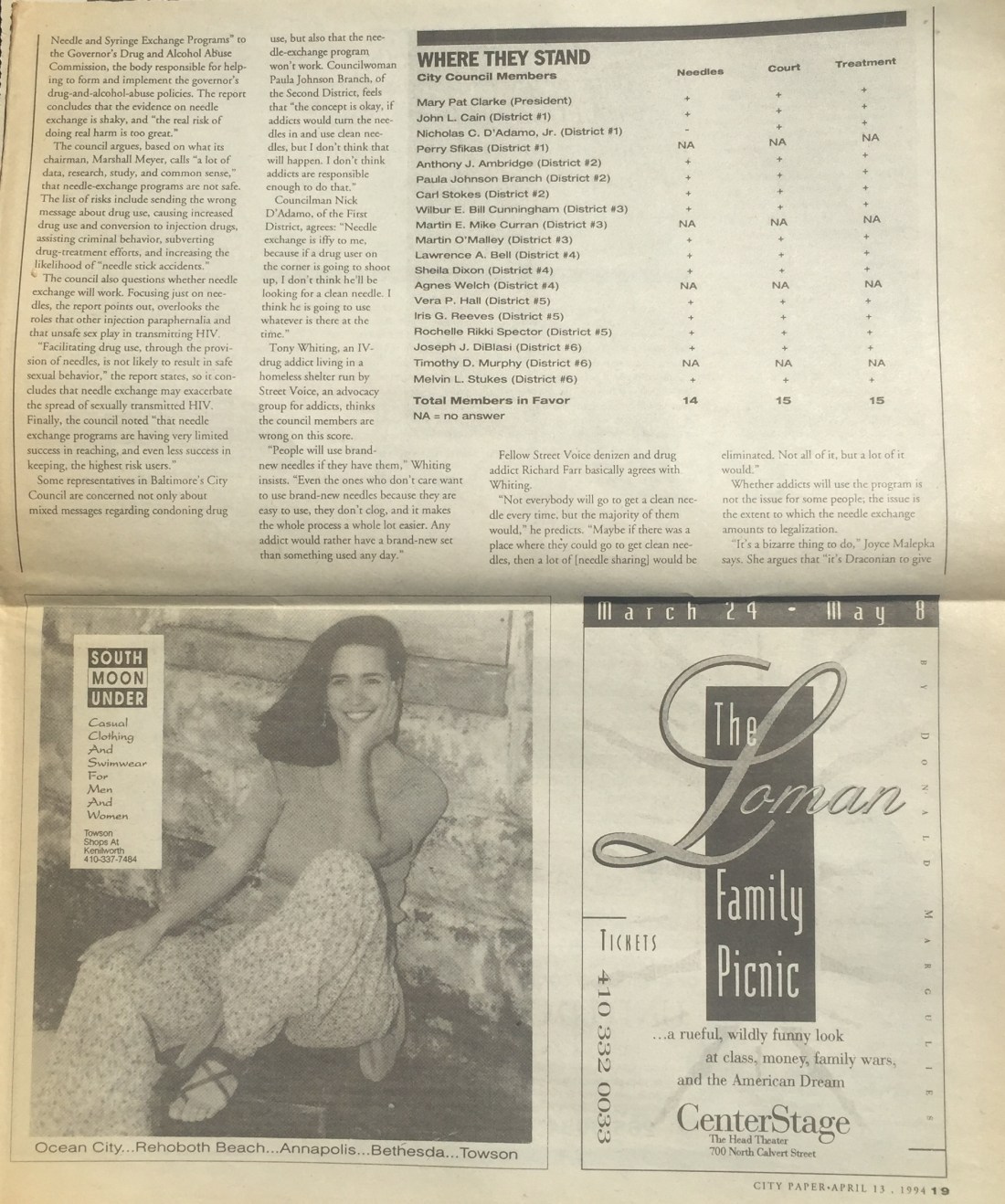
The drug court and the rest of Schmoke’s immediate drug-reform measures appear to enjoy wide support here in Baltimore City. The City Council is almost unanimously behind the mayor’s initiatives. Baltimore’s public-health and drug-treatment providers, who stand to gain funding and stature from the initiatives, also generally approve of them. The new police commissioner, Tom Frazier, says needle exchange, the drug court, and expanded treatment will make his job easier. And of course Baltimore’s heroin and cocaine addicts – who make up about six percent of the population, according to Bureau of the Census figures – are all for it.

In fact, one gets the impression that the mayor’s local drug-reform agenda has been falling into place with relative ease. People tend to see needle exchange, the drug court, and expanded treatment as almost clinical prescriptions for treating the symptoms of the drug crisis.

It is Schmoke’s national long-term drug policy, with its overtones of decriminalization, that has attracted strong and vocal opposition.

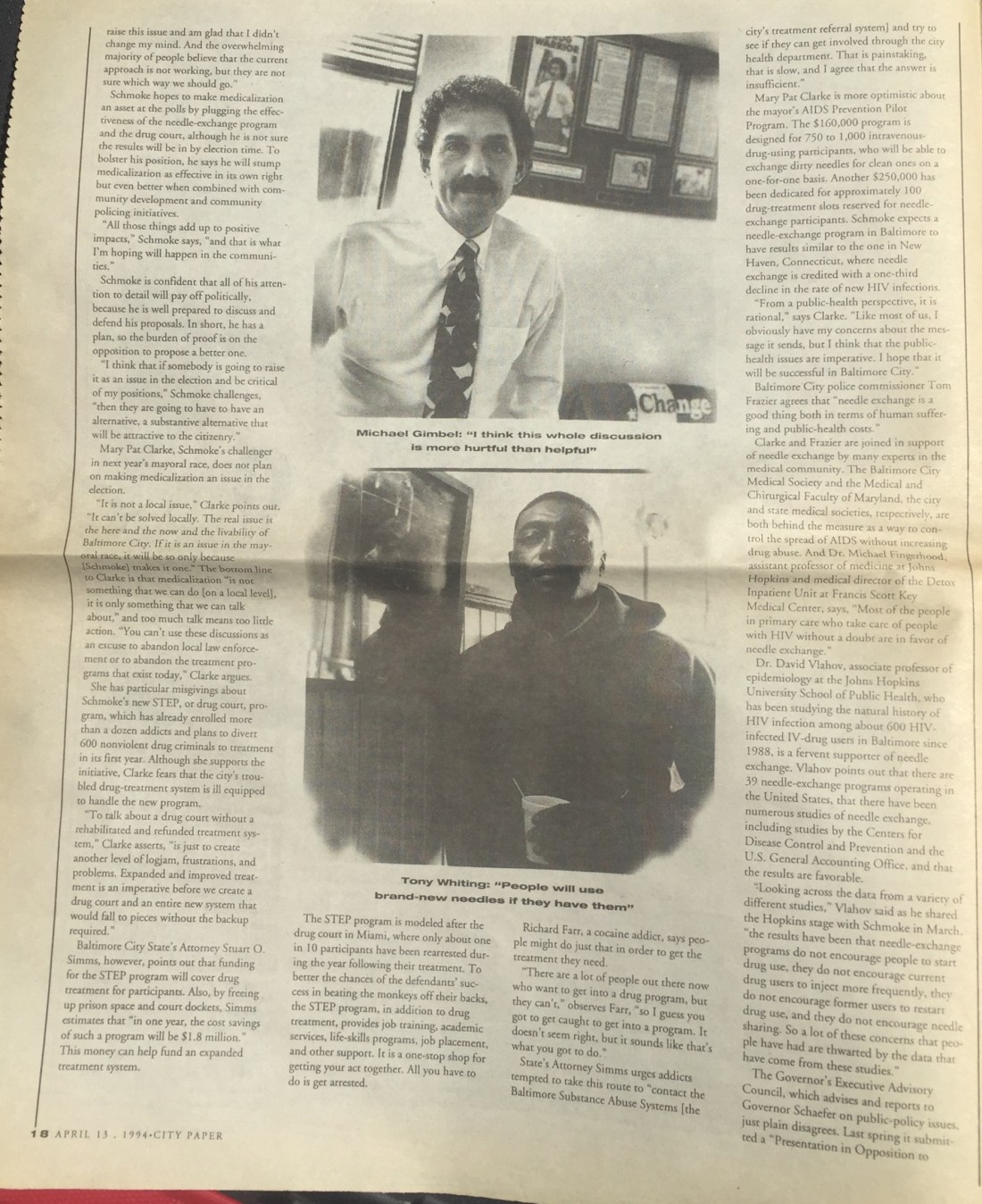
By now, everybody knows that Schmoke advocates some form of drug decriminalization. To a lot of people, that strategy sounds so radical on the surface that they aren’t very interested in the details. For example, Lieutenant Leander Nevin, president of the Baltimore City Fraternal Order of Police, says the bottom line is that Schmoke “wants to legalize drugs and give away free needles,” and asks sarcastically, “It’s socialism, right?”

To Michael Gimbel, director of the Baltimore County Office of Substance Abuse, the details of decriminalization are insignificant compared to the impact of even talking about it. He sees a direct correlation between rising drug use in high schools and the whole debate over decriminalization, which Schmoke has persistently publicized for six years now.

“I think this whole discussion is more hurtful than helpful,” Gimbel says. “I have to deal with the kids today who believe in legalization only because the mayor or the rap group Cypress Hill said so. For the last ten years we have seen major decreases [in drug use] and changes of attitude. Now all of the sudden these kids are changing the way they looking at [legalization]. I have to deal with that, and I blame it on the legalization debate.”

Barring some undetected tectonic shift in public opinion over the last six years, Nevin and Gimbel are right in line with most Marylanders’ opinions of legalization. In 1988, The Evening Sun contracted a public-opinion research firm to survey a random sample of Marylanders over 18 years old to ask them whether they support drug legalization. The results were basically the same for Baltimore as for the whole state: less than 20 percent were for legalization, and more than 70 percent were opposed to it.

In spite of this opposition, Schmoke has high hopes for his long-term, national strategy, which he clearly does not want associated with the term legalization.

“My approach is not legalization, that is, the sale of drugs in the private market,” he told an audience of doctors and nurses at the Johns Hopkins School of Hygiene and Public Health in March. Rather, he proposes lifting a corner of the current blanket prohibition on illegal drugs by drawing addicts into the public-health system, where they could be maintained, if necessary, using drugs made available through a government market.

“The government, not private traffickers, would control the price, distribution, purity, and access to particular substances, which we already do with prescription drugs,” Schmoke told the audience. “This, mind you, would take most of the profit out of street-level drug trafficking, and it is the profits that drive crime. Addicts would be treated and, if necessary, maintained under medical auspices. In my view, street crime would go down, children would find it harder, not easier, to get their hands on drugs, and law-enforcement officials would concentrate on the highest echelons of drug-trafficking enterprises.”

Schmoke’s zeal for reform is coupled with a hardened distaste for drug prohibition.

“Drug prohibition is a policy that has now turned millions of addicts into criminals, spawned a huge international drug-trafficking enterprise, and brought unrelenting violence to many of our urban neighborhoods,” Schmoke said. “It was a flawed strategy when it began, and it is still a flawed strategy now.”

Legalization or not, the mayor’s approach is roundly dismissed by people who think any fiddling with drug prohibition would, as a sociobiologist might say, damage the antidrug “chromosomes” that have been grafted into society’s DNA sequence over the last few generations. One such person is Dr. Lee P. Brown, the director of President Clinton’s Office of National Drug Control Policy. In a statement on drug legalization last December, after U.S. Surgeon General Joycelyn Elders suggested that legalization would reduce crime, Brown commented that “[a]ny change in the current policy of prohibiting drug use would seriously impair antidrug education efforts, drug-free community programs, drug-free workplace programs, and the overall national effort to reduce the level of drug use and its consequences.”

Local opposition to Schmoke’s call to change national drug laws is every bit as pointed as the Washington establishment’s. Gimbel protests that decriminalization “is a real intellectual pipe dream, and it scares me because the mayor is very articulate in selling this program.” City Councilman Martin O’Malley, of the Third District, thinks it “just amounts to so much more intellectual bullshit.” Joyce Malepka, founder of the Silver Spring antidrug lobbying group called Maryland Voters for a Responsible Drug Policy, says, “There is no intellectual argument about legalizing drugs because anyone who is that short-sighted isn’t really experienced, and if that is the case, then there is certainly no business talking about it.”

One objection that Schmoke’s medicalization opponents make is that a prescription-based drug-treatment system for addicts would be ripe for abuse. Steve Dnitrian, vice president of the Partnership for a Drug-Free America, in New York City, argues that legal drugs are already abused and a wider array of them would lead to greater use and abuse.

“Take a look at the drugs that are already regulated medically, such as Valium,” Dnitrian says, by way of illustration. “Are they abused? Heavily. Medicalization would be the same thing. You would just be adding a couple of more flavors to the vast array of products we have right now to alter reality. If you make available a product that is not readily available, it is going to get used. Even people who favor decriminalization acknowledge that drug use would go up dramatically.”

Still, Schmoke has so far managed to buck the antidecriminalization establishment and remain in office. How has he done it?

One explanation is that his drug-reform strategy is multi-faceted and comprehensive, so many who oppose him on decriminalization or needle exchange agree with many of his other drug-reform ideas. For instance, his crusade for drug treatment on demand and the creation of drug courts is lauded from all corners, including by Malepka and Gimbel, President Clinton, and the antidrug advertising venture Partnership for a Drug-Free America.

Schmoke hasn’t got this far by smart policymaking alone, however. Part of it was political drive: he is on the line with this medicalization talk, so he has been campaigning hard to prove his is right; if he can’t, he risks losing legitimacy with the public. Frank DeFillipo, a political columnist for The Evening Sun, says, “Schmoke has a lot to defend. He is going to have to go out and defend that issue in the mayoral race, and there are compelling arguments against what he is advocating.”

On the mayor’s side are a significant number of individual legislators, doctors, lawyers, judges, and religious leaders – powerful people with connections to organizations that can effect change. Schmoke feels that the average voter may also be coming around to agree that we need a new strategy against drugs, crime, and AIDS, and that medicalization should be given a sporting chance. Depending on how he plays this issue during the upcoming mayoral campaign, Schmoke may bet his future in political office on that perceived trend. He has been making every effort to swing the Zeitgeist around. Given the poll-pending strength of his supporters, he just might be able to do it.

“My sense is that the majority of Baltimoreans may disagree with my conclusion about the need for medicalization and decriminalization,” Schmoke acknowledges, “but that they agree that I should raise this issue and am glad that I didn’t change my mind. And the overwhelming majority of people believe that the current approach is not working, but they are not sure which way we should go.”

Schmoke hopes to make medicalization an asset at the polls by plugging the effectiveness of the needle-exchange program and the drug court, although he is not sure the results will be in by election time. To bolster his position, he says he will stump medicalization as effective in its own right but even better when combined with community development and community policing initiatives.

“All those things add up to positive impacts,” Schmoke says, “and that is what I’m hoping will happen in the communities.”

Schmoke is confident that all of his attention to detail will pay off politically, because he is well prepared to discuss and defend his proposals. In short, he has a plan, so the burden of proof is on the opposition to propose a better one.

“I think that if somebody is going to raise it as an issue in the election and be critical of my positions,” Schmoke challenges, “then they are going to have to have an alternative, a substantive alternative that will be attractive to the citizenry.”

Mary Pat Clarke, Schmoke’s challenger in next year’s mayoral race, does not plan on making medicalization an issue in the election.

“It is not a local issue,” Clarke points out. “It can’t be solved locally. The real issue is the here and the now and the livability of Baltimore City. If it is an issue in the mayoral race, it will be so only because [Schmoke] makes it one.” The bottom line to Clarke is that medicalization “is not something that we can do [on a local level], it is only something that we can talk about,” and too much talk means too little action. “You can’t use these discussions as an excuse to abandon the treatment programs that exist today,” Clarke argues.

She has particular misgivings about Schmoke’s new STEP, or drug court, program, which has already enrolled more than a dozen addicts and plans to divert 600 nonviolent drug criminals to treatment in its first year. Although she supports the initiative, Clarke fears that the city’s troubled drug-treatment system is ill equipped to handle the new program.

“To talk about a drug court without a rehabilitated and refunded treatment system,” Clarke asserts, “is just to create another level of logjam, frustrations, and problems. Expanded and improved treatment is an imperative before we create a drug court and an entire new system that would fall to pieces without the backup required.”

Baltimore City State’s Attorney Stuart O. Simms, however, points out that funding for the STEP program will cover drug treatment for participants. Also, by freeing up prison space and court dockets, Simms estimates that “in one year, the cost savings of such a program will be $1.8 million.” This money can help fund an expanded treatment system.

IMG_8123

The STEP program is modeled after the drug court in Miami, where only about one in 10 participants have been rearrested during the year following their treatment. To better the chances of the defendants’ success in beating the monkeys off their backs, the STEP program, in addition to drug treatment, provides job training, academic services, life-skills programs, job placement, and other support. It is a one-stop shop for getting your act together. All you have to do is get arrested.

Richard Farr, a cocaine addict, says people might do just that in order to get the treatment they need.

“There are a lot of people out there now who want to get into a drug program, but they can’t,” observes Farr, “so I guess you got to get caught to get into a program. It doesn’t seem right, but it sounds like that’s what you got to do.”

State’s Attorney Simms urges addicts tempted to take this route to “contact the Baltimore Substance Abuse Systems [the city’s treatment referral system] and try to see if they can get involved through the city health department. That is painstaking, that is slow, and I agree that the answer is insufficient.”

Mary Pat Clarke is more optimistic about the mayor’s AIDS Prevention Pilot Program. The $160,000 program is designed for 750 to 1,000 intravenous-drug-using participants, who will be able to exchange dirty needles for clean ones on a one-for-one basis. Another $250,000 has been dedicated for approximately 100 drug-treatment slots reserved for needle-exchange participants. Schmoke expects a needle-exchange program in Baltimore to have results similar to one in New Haven, Connecticut, where needle exchange is credited with a one-third decline in the rate of new HIV infections.

“From a public-health perspective, it is rational,” says Clarke. “Like most of us, I obviously have my concerns about the message it sends, but I think that the public-health issues are imperative. I hope that it will be successful in Baltimore City.”

Baltimore City police commissioner Tom Frazier agrees that “needle exchange is a good thing both in terms of human suffering and public-health costs.”

Clarke and Frazier are joined in support of needle exchange by many experts in the medical community. The Baltimore City Medical Society and the Medical and Chirurgical Faculty of Maryland, the city and state medical societies, respectively, are both behind the measure as a way to control the spread of AIDS without increasing drug abuse. And Dr. Michael Fingerhood, assistant professor of medicine at Johns Hopkins and medical director of the Detox Inpatient Unit at Francis Scott Key Medical Center, says, “Most of the people in primary care who take care of people with HIV without a doubt are in favor of needle exchange.”

Dr. David Vlahov, associate professor of epidemiology at the Johns Hopkins University School of Public Health, who has been studying the natural history HIV infection among about 600 HIV-infected IV-drug users in Baltimore since 1988, is a fervent supporter of needle exchange. Vlahov points out that there are 39 needle-exchange programs operating in the United States, that there have been numerous studies of needle exchange, including studies by the Centers for Disease Control and Prevention and the U.S. General Accounting Office, and that the results are favorable.

“Looking across the date from a variety of different studies,” Vlahov said as he shared the Hopkins stage with Schmoke in March, “the results have been that needle-exchange programs do not encourage people to start drug use, they do not encourage current drug users to inject more frequently, they do not encourage former users to restart drug use, and they do not encourage needle sharing. So a lot of these concerns that people have had are thwarted by the data that have come forth from these studies.”

IMG_8124

The Governor’s Executive Advisory Council, which advises and reports to Governor Schaefer on public-policy issues, just plain disagrees. Last spring it submitted a “Presentation in Opposition to Needle and Syringe Exchange Programs” to the Governor’s Drug and Alcohol Abuse Commission, the body responsible for helping to form and implement the governor’s drug-and-alcohol-abuse policies. The report concludes that the evidence on needle exchange is shaky, and “the real risk of doing real harm is too great.”

The council argues, based on what its chairman, Marshall Meyer, calls “a lot of data, research, study, and common sense,” that need-exchange programs are not safe. The list of risks include sending the wrong message about drug use, causing increased drug use and conversion to injection drugs, assisting criminal behavior, subverting drug-treatment efforts, and increasing the likelihood of “needle stick accidents.”

The council also questions whether needle exchange will work. Focusing just on needles, the report points out, overlooks the roles that other injection paraphernalia and that unsafe sex play in transmitting HIV.

“Facilitating drug use, through the provision of needles, is not likely to result in safe sexual behavior,” the report states, so it concludes that needle exchange may exacerbate the spread of sexually transmitted HIV. Finally, the council noted “that needle exchange programs are having very limited success in reaching, and even less success in keeping, the highest risk users.”

Some representatives in Baltimore’s City Council are concerned not only about mixed messages regarding condoning drug use, but also that the needle-exchange program won’t work. Councilwoman Paula Johnson Branch, of the Second District, feels that “the concept is okay, if addicts would turn the needles in and use clean needles, but I don’t think that will happen. I don’t think addicts are responsible enough to do that.”

Councilman Nick D’Adamo, of the First District, agrees: “Needle exchange is iffy to me, because if a drug user on the corner is going to shoot up, I don’t think he’ll be looking for a clean needle. I think he is going to use whatever is there at the time.”

Tony Whiting, an IV-drug addict living in a homeless shelter run by Street Voice, an advocacy group for addicts, thinks the council members are wrong on this score.

“People will use brand-new needles if they have them,” Whiting insists. “Even the ones who don’t care want to use brand-new needles because they are easy to use, they don’t clog, and it makes the whole process a whole lot easier. Any addict would rather have a brand-new set than something used any day.”

Fellow Street Smart denizen and drug addict Richard Farr basically agrees with Whiting.

“Not everybody will go to get a clean needle every time, but the majority of them would,” he predicts. “Maybe if there was a place where they could go to get clean needles, then a lot of [needle sharing] would be eliminated. Not all of it, but a lot of it would.”

Whether addicts will use the program is not the issue for some people; the issue is the extent to which the needle exchange amounts to legalization.

“It’s a bizarre thing to do,” Joyce Malepka says. She argues that “it’s Draconian to give someone who injects heroin needles to continue that process. We see it as a giant step toward legalization.”

IMG_8125

Mary Pat Clarke feels that for now, Schmoke’s visions may be delusions.

“If he can help to improve and enlarge the treatment system in Baltimore City, I would support that,” Clarke says, “but the council has been looking at the current programs and is beginning to meet with [drug treatment] providers and explore the gaps. The providers are out there, underfunded and struggling to survive and handle their caseload, and it is a system in crisis. They are overloaded, they are underfunded, and the city has failed to supply an adequate system of coordination to really assist.”

At least part of the problem is the miniscule amount of funding that comes from the city itself for drug treatment: the figure hovers around $150,000 per year, or about one percent of the total drug-treatment budget for Baltimore City. Because of this meager contribution, some people believe that Schmoke is merely canting when he calls for more treatment.

“He’s been talking like this for so many years,” Michael Gimbel says, “but how much money has he put in his budget to back up his word that he really believes in treatment? Baltimore City gets millions right now from the state for drug treatment, and the city puts virtually nothing in. Yet he wants to go to Annapolis and say, ‘My top priority is needle exchange.’ Why isn’t his top priority treatment for everybody? That is hypocrisy. That is politics, so I can’t respect that.”

Politics or not, if Schmoke manages to get 10,000 new federally funded treatment slots, it will be a coup for the beleaguered Baltimore treatment community.

According to “Baltimore’s Drug Problem,” published by the Abell Foundation, which has funded or carried out many studies about local issues for the city government, “drug treatment experts in Baltimore City suggest that the number of treatment slots needs to be increased, conservatively, by three-fold.” Since there are currently 5,300 treatment slots, Schmoke’s proposal would almost meet the target.

The mayor is seeking a meeting with Clinton Administration officials to discuss his drug-treatment proposal. In the meantime, alternative funding may be found from two other federal sources: Clinton’s crime bill, if passed by Congress, will provide more money for drug treatment, and U.S. Attorney Janet Reno has created a new block-grant program that can be used for either policing or drug treatment.

“Both of those together don’t make up ten thousand [treatment slots],” Schmoke says, “but they would allow us to almost double the number of slot that we have now.”

Despite Schmoke’s optimism, the operable word when it comes to expanded federal funding for drug treatment in Baltimore City is if. And if Schmoke doesn’t produce the proposed treatment slots, then Baltimore’s addicts will continue queuing up on the treatment waiting list and continue to rob, steal, smoke, and shoot up until they can get effective treatment for their disease. According to “Baltimore’s Drug Problem,” on any given day there are about 730 addicts on the treatment waiting list, and only one out of 10 Baltimore substances abusers who want help can get it.

Since 1988, when Schmoke opened a national debate over drug decriminalization, he has done his fair share of talking about providing the help addicts need. Now he has started to take steps to do something about it. He is determined to prove that his medicine works, and if he stays in office another term, Baltimore is destined to be the testing ground.

Schmoke, casting himself as the good doctor, has donned the white lab coat and drawn up the syringe, and Baltimore, gravely ill from the combined effects of drugs, crime, and AIDS, is rolling up its sleeve to take the dose. But will the good doctor find a vein?


Cashed Out: South Mountain Creamery’s Bank Account Seized as Part of Money-Laundering Crackdown

By Van Smith

Published by City Paper, Apr. 18, 2012

South Mountain Creamery, the Frederick County dairy farm and food-distribution company, is a fixture of Baltimore-area farmers markets, particularly the Waverly market on Saturdays or the one on Sundays, downtown under the Jones Falls Expressway. South Mountain co-owner Randy Sowers is now in the hot seat with the feds, because in late February, the Internal Revenue Service’s Criminal Investigations Division (IRS-CID) used a federal anti-money-laundering statute to seize the contents of a PNC bank account Sowers says was the depository of cash earned by his company’s farmers-market business.

Sowers has not been charged with a crime, and says he expects to learn soon whether or not he will be. As for getting his money back—nearly $70,000, a fraction of the nearly quarter-million dollars in cash deposits the feds say Sowers laundered between May and December last year—well, based on the experiences of others in his position, he’ll likely not see it again, at least not all of it.

Baltimore County Police officer Michael Aiosa, who has been detailed as an IRS-CID task-force member since October 2010, signed the six-page affidavit used to get the seizure warrant to empty the account, of which Sowers and his daughter-in-law, Karen Sowers, are co-signatories. The affidavit says cash deposits were broken down into increments of under $10,001 each, causing PNC to not generate required “currency transaction reports” (CTRs) that financial institutions must file with regulators when they receive or disburse more than $10,000 in a single cash transaction. Under 31 U.S.C. 5324, federal law prohibits such conduct, which is called “structuring.”

Sowers, who did not seek publicity about his predicament but spoke to a reporter after the search warrant in the court records came to City Paper’s attention, says he deposited the cash he’d made in the increments in which it had been earned. If the deposited amounts often ended up being a little under $10,001, he explained, that’s just the way it worked out and he no intention of breaking the law.

“We had no idea there was supposedly a law against it—we were just doing it the way we figured we were supposed to, making deposits every week,” Sowers explains. “We weren’t laundering money,” he adds. “We’re farmers, we struggle every day to pay bills. We don’t know what else to do. Now we just feel like putting [our cash] in a can somewhere.”

Sowers’ attorney, David Watt, says his client “probably shouldn’t have said anything” when contacted by City Paper, and declined to comment further, saying, “We don’t want to act like we’re trying to influence the goings-on” by talking with the press.

Historically, the anti-structuring statute has been used by prosecutors as an ancillary charge with other accusations of nefarious behavior, such as drug dealing or terrorism. And it still is. But over the last few years, prosecutors have started to use it more regularly as a standalone charge—an observation noted by defense attorneys that Maryland U.S. Attorney Rod Rosenstein confirms.

Syracuse University’s Transactional Records Access Clearinghouse, a data center about federal court cases, reports that in fiscal year 2011 Maryland brought 14 of the nation’s 99 structuring cases, making it the top state for such prosecutions. Nationally, the numbers have been rising; the 2011 figures are up 8.8 percent from the year before and up 57.1 percent from five years ago.

Greater prosecutorial emphasis on enforcing the anti-structuring statute has resulted in a rise in money seizures, civil-forfeiture cases, and criminal charges against small businesses and the people who own them. Typical targets handle a lot of cash, and in Maryland gas stations, liquor stores, and used-car dealerships have landed in expensive trouble, losing money through seizures, criminal penalties, and legal bills.

South Mountain is not the first seasonal-produce market to find itself targeted for structuring recently. Taylor’s Produce Stand, on the Eastern Shore, was stung last year after the feds seized about $90,000 from its bank accounts. In December, pursuant to a civil-forfeiture settlement agreement after no criminal charges were filed, the stand’s owners got back about half of the seized money.

Two members of the defense bar who handle structuring cases, Gerard Martin and Steven Levin, both former Maryland assistant U.S. attorneys, say they have noticed the anti-structuring enforcement trend emerging in Maryland over the last several years.

“The emphasis is on basically seizing money, whether it is legally or illegally earned,” Levin says. “It can lead to financial ruin for business owners, and there’s a potential for abuse here by the government, where they use it basically as a means of seizing money, and I think we’ve seen that happen.”

“South Mountain Creamery!” Martin exclaims when contacted by phone. “They’re going after South Mountain Creamery! That’s an icon. That’s like going after mom and apple pie.” Then he settles in to ruminate on the general trends, saying cases typically arise because financial institutions “are required to tell the government about it” when they suspect a pattern of structured cash deposits. Then, “the government gets a search warrant and takes every nickel out of the guy’s bank account,” Martin continues, adding that “structuring is generally an indication that there is something going wrong, but the government doesn’t always find another crime,” such as drug dealing or tax evasion.

“There are a lot of legitimate reasons why a liquor store or a gas station would be depositing $9,500 in cash a day,” Martin says. “Sometimes the numbers just work out that way. But it is usually not an accident that it is happening.”

Rosenstein says that anti-structuring efforts “are an increasing area of emphasis for the Justice Department, and there has been an influx of resources” to investigate and prosecute it. Thus, he says, “I’d be disappointed if there wasn’t an uptick” in prosecutions, given the additional resources.

Post-Sept. 11 changes to banking laws, Rosenstein continues, have prompted financial institutions to report suspicious financial doings more vigilantly, and as a result, investigators and prosecutors now have “a treasure trove of information” about transactions, which provides them with “potential leads for finding criminal activities.” Structuring is often a red flag for other crime since, Rosenstein says, “typically people who go through all those lengths” to make multiple cash deposits of just under $10,000, sometimes at multiple bank branches on the same day, are trying to hide something. But, he continues, “There’s a possibility that somebody did it innocently, and we are always open to that.”


Sowers spoke at length about being targeted for structuring. In essence, he thinks the government used an exotic legal gimmick to suck hard-earned money out of his business just as he’s facing bills for hay and other spring-time expenses farmers incur—but he admits that, if there’s a law against what he did, “well, it looks like we did break the law,” even if he didn’t mean to.

The seizure and the resulting legal limbo as he awaits the prosecutor’s charging decision has “scared us to death,” he says. And the banking headaches that resulted from an emptied account have been never-ending, including bounced checks, mucked-up automatic withdrawals, and the resulting overdraft fees.

“It makes me look bad,” Sowers says.

Homicide, Revisited: Two Men Want Detectives Made Famous by David Simon to Pay After Flawed Murder Convictions Put Them in Prison for Decades

By Van Smith

Published in City Paper, Dec. 10, 2013

James Owens is angry.

“I get pissed off every time I think about this,” the 53-year-old from Southeast Baltimore declares, sitting at a conference table in his lawyer’s office. “I don’t trust the cops,” he says, his glasses only slightly shielding the fury in his eyes, a thin mustache punctuating his vehemence. “Never have, after this happened, and I never will. I hate them.”

Looking at Owens, hearing his Baltimore accent stridently utter those words, it’s clear he’s simply telling it like it is. Twenty years in prison before being cleared of a murder conviction will make a man mad.

But Wendell Griffin, a 62-year-old also at the lawyer’s office meeting, is not the least bit angry. His bald pate rests smoothly above his kind face and soft eyes, a wispy gray beard on his chin. Griffin appears to be a gentle soul, and it seems perfectly natural for him to wax calmly and philosophically about his experience: “If the good Lord does things in such a way that I don’t even understand it,” he says, “then I just keep my faith and I move forward.”


Clarification: Neither of the murders for which James Owens and Wendell Griffin were wrongfully convicted occurred in 1988, and thus neither were mentioned, much less covered, in Homicide.