Out of Reach: The Black Guerrilla Family Gang Aimed to Show a Way Out of the Criminal Lifestyle – Until Its Criminal Activities Brought It Down

By Van Smith

Published in City Paper, Feb. 15, 2012

IMG_7394

“It’s hard to promote black nationalism when you have a black man in the White House,” Thomas Bailey said on Jan. 6, 2009, weeks before Barack Obama was sworn in as the first African-American President of the United States. Bailey, a Maryland inmate serving life for murder, couldn’t have known at the time how prophetic his words were, or that they would end up memorialized in court documents.

As Obama was moving into the White House, court documents show that federal investigators with the U.S. Drug Enforcement Agency in Maryland—a unit dubbed the Special Investigations Group (DEA-SIG)—were kicking into gear a sprawling probe of the Black Guerrilla Family (BGF), the black-nationalist prison gang for which Bailey ran “the day-to-day operations” at North Branch Correctional Institution (NBCI), a maximum-security prison near Cumberland.

When Bailey uttered those prescient words, he was talking over a prison phone at NBCI with Eric Marcell Brown (“Eric Marcell Brown,” Mobtown beat, May 7, 2009), who was on a cell phone at the Maryland Transition Center (MTC), a correctional facility in Baltimore, where Brown was close to finishing a lengthy prison stint for a 1992 drug-dealing conviction. Brown, DEA-SIG investigators wrote in court documents, was “in command of day-to-day operations” in Maryland for the BGF, a national prison gang founded in California in the 1960s by inmate/radical George Jackson, a Black Panther Party member who espoused the black-nationalist view that African-Americans needed to build separate economic and social structures for themselves.

Numerous conversations between Bailey and Brown were intercepted by DEA-SIG, unbeknownst to them at the time, and they show that the two, and their many BGF comrades, seemed to have a genuine desire to promote a better, less violent, more productive path for ex-cons and street hustlers. They weren’t the first. Jackson’s ideas were wrapped up with the Panthers’, and few would question that at least some of their intentions were good. It was their tactics and internal contradictions—along with the machinations of law enforcers—that quashed their ambitions. The same, it now appears, could be said of the BGF in Maryland.

As the DEA-SIG’s probe began in late 2008, Eric Brown had already established himself as a soon-to-be-released inmate prepped to become a force for economic and social good, both in prisons and on the streets.

Brown and his wife, Deitra Davenport (“Deitra Davenport,” Mobtown Beat, May 27, 2009), had started a nonprofit, Harambee Jamaa Inc., “to improve the lives of our people who are living under sub standard conditions here in Baltimore” and “to educate, invigorate and liberate our people from poverty, crime, and prison,” according to its incorporation papers. They had formed DeeDat Publishing Inc., which had printed and distributed The Black Book: Empowering Black Families and Communities, a “living policy book” intended to serve as “a deterrent to continued criminal behavior and prison recidivism.”

The Black Book condemned drug dealing as “genocide” and “chemical warfare,” and promoted a vision for “Jamaa”—the Swahili word for “family,” which The Black Bookuses to refer to the BGF—to build “legitimate and organized ventures” and to “establish Jamaa in a positive light in the prison system and in the streets.”

The rhetoric was persuasive. The Black Book’s back cover featured glowing blurbs from Andrey Bundley, a Baltimore City Public Schools administrator and two-time mayoral candidate; two Anne Arundel Community College professors; former FBI agents Tyrone Powers and Leslie Parker Blyther; Bridget Alston-Smith, executive director of the nonprofit Partners in Progress, which works with at-risk children in Baltimore City’s public schools; and Michael Curtis Jones, an author and youth counselor based in Washington, D.C.

“Kudos, to Eric Brown (E.B.) for not accepting the unhealthy traditions of street organizations aka gangs,” Bundley’s blurb stated. “He has availed his leadership capacity in Jamaa to guide his comrades toward truth, justice, freedom and equality.” Blyther’s blurb called Brown “an extraordinary human” who “deserves our respect,” and said that “what he has to say” is “life changing!”

But DEA-SIG’s success torpedoed the love-fest. Scores of Bailey’s “comrades”—the term BGF members use to address one another—would plead guilty to a host of federal charges brought in 2009 (“Black-Booked,” Feature, Aug. 5, 2009) and 2010 (“Round Two,” Mobtown Beat, April 28, 2010), including racketeering, heroin trafficking, extortion, assault, money laundering, and smuggling contraband into prison. Those convicted include inmates (though not Bailey, who, like many of the investigation’s targets, ultimately wasn’t charged), prison personnel, and previously law-abiding citizens.

The presence of prison staff in the scheme prompted City Paper to look at the issue of corrupt correctional officers in Maryland, in connection both with the BGF and other gangs (“Inside Job,” Feature, May 12, 2010), but there were other defendants with legitimate-looking careers. Todd Duncan was a gang-interventionist for a government-funded nonprofit (“Inside Out,” Mobtown Beat, April 14, 2010). Rainbow Williams was a youth mentor for Baltimore City Public Schools students (“Rainbow Lee Williams,” Mobtown Beat, May 1, 2009). Kimberly McIntosh was a health care worker (“Health Care Worker Accused,” Mobtown Beat, April 16, 2010). Tomeka Harris was a mortgage broker (“Day of Reckoning,” Mobtown Beat, Dec. 22, 2010). And Calvin Robinson was a Baltimore City wastewater worker with a clothing boutique (“Calvin Renard Robinson,” Mobtown Beat, June 10, 2009).

In all, as much as City Paper could determine from federal court records, 40 people were charged in connection with the probe, and at least 28 of them—maybe more; the court docket is vague on the fates of some defendants—have pleaded guilty so far. According to a Jan. 12 press release issued by the Maryland U.S. Attorney’s Office, “all the indicted high ranking members of BGF, and their associates, including four employees of state prisons, have pleaded guilty to charges relating to their BGF activities.”

In reality, the problem for Bailey and the BGF was not “a black man in the White House.” It was their hubris and hypocrisy in promoting themselves as a legitimate alternative to the criminal lifestyle, when, in reality, they were committing crimes like any other prison gang. And they got caught.

Though Brown and his BGF comrades claimed to be engaging potential re-offenders in an effort to set them on a more productive path in life, court documents show they were, in fact, engaged with a who’s-who in Baltimore’s underworld as they carried on like common gangsters.

“You are trying to do good,” explains a BGF member who wasn’t charged as a result of DEA-SIG’s investigation, but who knows many of the now convicted BGF leaders and members well, “but you are doing so much fucked-up shit at the same time.” The member, who asked that his real name not be published (in this article, he’ll be called Sam) so that he could speak freely and stay safe from retribution, identifies what may be the BGF’s central contradiction: “You [can’t] tell people about uplifting your people but you’re one of the biggest drug dealers around. There’s no gray area in the struggle. You’re either in it, or you’re not. You can’t say you’re a revolutionary and you’re in the struggle, but you’re a dope-slinging, gangbanging, shooting motherfucker. That ain’t what the struggle is about.”


Because there was no trial in the prosecution of the BGF racketeering probe, the full scope of the evidence that yielded the long cascade of guilty pleas is not publicly available. What is available, though, is abundant. DEA-SIG’s affidavits supporting search warrants and wiretap orders provide hundreds of pages of detailed information about what the investigators were finding. A host of them, attached to a motion filed in the case last year by Assistant U.S. Attorney James Wallner, show that investigators linked BGF leaders—especially its main heroin trafficker, Kevin Glasscho, who has prior convictions for murder, handgun possession, and drug trafficking—to a roster of suspected and convicted drug traffickers, some of whom have been the focus of City Paper articles in recent years.

Glasscho ended up on DEA-SIG’s radar thanks to a confidential informant, identified in court documents as “CS1” and described as a BGF member incarcerated at NBCI. On March 3, 2009, CS1 told the investigators that Glasscho “is a major Baltimore drug trafficker and a drug-trafficking associate of Melvin Williams, a/k/a ‘Little Melvin,’ a notorious convicted drug dealer from Baltimore who is now back on the streets of Baltimore.”

Williams is a legendary figure in Baltimore, and his alleged ties to Glasscho add perspective to the extent of the BGF’s reach in the city’s streets—as well as its affinity to people who suffer their own contradictions.

Williams had an acting role in the HBO series The Wire, playing a church deacon who tries to draw hustlers out of “the game.” In real life, he served a lengthy federal prison sentence, starting in the 1980s, for bringing heroin to the streets of Baltimore in bulk. He says he put his gangster ways behind him in 1996, when God appeared to him in a vision (“Little Melvin’s Holiday,” The Nose, Jan. 22, 2003). After his release from prison, he became a bail bondsman, and in 2000 was convicted of possessing a firearm, but his 22-year sentence for that crime was reduced in 2003 to time served, courtesy of U.S. District Judge Marvin Garbis. In 2005, Williams’ house in Randallstown was raided after investigators intercepted phone conversations he’d had with Antoine K. Rich, a major Baltimore drug trafficker with whom Williams claimed to play high-stakes craps (“Redemption Song and Dance,” Mobtown Beat, March 19, 2008). The raid turned up more than $100,000 in cash, including $90,000 stashed in the ceiling of his basement bathroom. Ultimately, though, Garbis in 2006 ordered the money returned to Williams, calling it “unlawfully seized property.”

Two days before CS1 described Glasscho’s alleged relationship with Little Melvin Williams, investigators intercepted a phone conversation between Eric Brown and Glasscho. According to the affidavits, the two discussed the then recent murder of Frederick Jeffrey Archer, a 68-year-old who had been stabbed and bludgeoned with a brick inside a Harlem Park apartment complex for senior citizens. They referred to Archer as “Archie,” and talked about how “Melvin”—a reference to Williams, according to DEA-SIG—was upset about the murder, because Archer had been a “close associate” of his. They agreed that Glasscho, who was already investigating the murder, would handle the punishment. In another call later the same day, Brown told Davenport that “when they find out who did it, I know they going to torture his ass. That whole West Baltimore love old man Archie, boy.”

(Baltimore police say the murder of Archer, who in 2002 was charged in a cocaine and heroin conspiracy and received a three-year federal prison sentence, remains unsolved.)

During their conversation, according to the affidavit, Glasscho also told Brown that “Melvin want some trees. I got to get him some damn trees.”

“Some what?” Brown asked.

“Trees,” Glasscho responded.

“What the hell is that?” Brown asked.

“That weed shit,” Glasscho said.

“Oh, oh, oh, the trees,” Brown said.

The DEA-SIG investigators believed the two were referring to Little Melvin Williams, according to court documents.

When City Paper told Williams over the phone about how he was described in the affidavit, and what Glasscho and Brown had said while DEA-SIG was listening in, he said, “I don’t have a clue who Glasscho is, and you do what you want to do” with the information. Asked if he knew Archer, Williams said, “I don’t know none of these people. Whatever the U.S. attorney wants to do they can go ahead and do. I’m through with this.” After a short pause, he hung up the phone.


DEA-SIG’s probe into Glasscho’s criminal activities monitored his phones to develop evidence tying him to 27 people who had figured in DEA investigations in recent years. Investigators came up with this list of people by tracking back which phones his phones had called, and which phones those phones had called, thereby mapping a network of contacts linked to Glasscho.

Perhaps Glasscho was working his network in order to draw them into BGF’s path of greater legitimacy, or perhaps he was leveraging his high-level criminal contacts in order to boost the gang’s standing as a drug-trafficking enterprise. Either way, the picture that emerges from this list is that the BGF was fully embedded with Baltimore’s underworld on the streets.

Some of those named in the affidavit have no record of being charged with crimes, though many have been convicted in federal court. Among the latter are:

• Sherman Kemp, who made an appearance in the famous Stop Fucking Snitching DVD (“Skinny Suge Presents Stop Fucking Snitching Vol. 1,” Film, Jan. 19, 2005). Kemp pleaded guilty in Maryland in 2008 to federal cocaine and firearms charges, receiving 180 months in prison (“Return Flight,” Mobtown Beat, Dec. 24, 2008), and in 2010 in Pennsylvania, after a months-long jury trial, he was found guilty for his part in the massive Phillips Cocaine Organization conspiracy, and received a 30-year federal prison sentence.

• David Funderburk, a co-defendant in Frederick Archer’s 2002 coke and heroin case. Funderburk’s bail documents were found in bailbondsman and stevedore Milton Tillman Jr.’s car (“Another Tillman Court Document Comes Available,” The News Hole, Aug. 28, 2008) during the high-profile 2008 federal raids that led to Tillman’s indictment on tax and fraud charges (“Milton Tillman and Son Indicted in Bailbonds Conspiracy,” The News Hole, March 17, 2010), to which he has since pleaded guilty.

• James Henderson, who in 2008 was sentenced to five years in federal prison for his part in a heroin conspiracy centered at Fat Cats Variety (“All the Emperor’s Men,”Mobtown Beat, Aug. 27, 2008) in Southwest Baltimore, a business that was co-owned by one of Tillman Jr.’s bailbonds agents.

• Duane Truesdale, a co-defendant in 1990 with Savino Braxton (“The Wire Meets Baltimore Reality, Redux,” Mobtown Beat, Sept. 10, 2009) in the legendary Baltimore heroin conspiracy headed by Linwood Rudolph Williams.

• David Zellars, who last year was sentenced to 70 months in federal prison for his part in a large cocaine conspiracy.

• Richard Cherry, who in 2009 was sentenced to 60 months in federal prison for a cocaine conspiracy.

• Tahlil Yasin, who in 2007 received a 92-month federal prison sentence for a heroin conspiracy.

Among those whom DEA-SIG tied to Glasscho is Noel Liverpool, who, despite having a clean criminal record, is described in the affidavit as “a multi-kilogram cocaine trafficker operating the Baltimore area.” When the Tillman Jr. raids went down in 2008, the feds seized evidence involving Liverpool (“All Around Player,” Mobtown Beat, Oct. 8, 2008), whose business ties to Tillman Jr. and his son, Milton Tillman III, (“Creative Licensing,” Mobtown Beat, April 9, 2008) have been reported by City Paper. Another Liverpool associate is Shawn Green (“Flight Connections,” Mobtown Beat, March 12, 2008), a former federal fugitive now serving time for drug trafficking and money laundering; court documents also link Green to the Phillips Cocaine Organization in Pennsylvania, though he was never charged in that prosecution.

Attempts to reach Liverpool, who was a basketball and football star at Morgan State University in the 1980s, were unsuccessful. His attorney, Jeffrey Chernow, did not return phone calls, as was the case in prior City Paper articles that mentioned Liverpool.


Drug dealing, money laundering, violence—this was far from the image Brown was trying to project through The Black Book and Harambee Jamaa. Rather than ushering ex-cons and hustlers to their redemptions, with hopes for productive lives to come, the BGF was organizing and executing crimes, undermining the very communities it was ostensibly trying to build up. What were they thinking?

BGF members are supposed to operate in secrecy, but City Paper was able to get incisive perspective from Sam, a BGF member who wasn’t charged in the investigation. He spoke at length about the gang’s mentality, potential, and shortcomings.

From Sam’s perspective, very few of BGF’s members in Maryland are even faintly aware of the gang’s ideological underpinnings. “Do dudes get involved in it because of the revolutionary aspect and the struggle?” he asks, rhetorically, then answers: “Hell, no. Two-thirds of them never even heard of that shit, nor do they care. Not even a fucking clue. Because if they did, and they had any understanding of it, [the BGF] wouldn’t be where it is now, and never would have went where it went.”

Asked whether the BGF prosecution had any impact, Sam at first says, “None at all. It actually probably made it worse for the simple fact of this: The few people that actually had the ability to steer and think and really, truly put some shit in motion are gone. The only people left keep it on a street level, the motherfuckers who can’t think bigger than this corner or this neighborhood.” Later in the conversation, though, Sam says DEA-SIG’s investigation put a stop to something that could have become truly insidious—a gang masquerading as a do-gooding organization supported by the city’s political class.

“We were getting ready to take it to a whole different level,” he recalls. “We were ready to come on the street and really try and put that Black Book to work and be able to make money and make some changes in the way shit was going.”

The wherewithal to effect change, though, required that some damage be done, Sam says. “You might have one neighborhood selling drugs and the next neighborhood over you have rotating food kitchens,” he says. “The streets would have provided the money. We would have got the city to provide grant money. If it had worked,” Sam speculates, “that shit would have gone in the fucking history books, and Baltimore would have been a city where every fucking mayor and every fucking councilman is corrupt. That’s what that shit would have been. That’s the direction it was going.

“There’s a duality to it, though,” Sam continues. “In [the gang’s] laws, it says you’re not even supposed to use drugs, not just [not] sell them. But here’s the biggest level of hypocrisy—you have so many motherfuckers that are up here [in charge], who violate all that shit, and then you got motherfuckers down here, and I’m trying to discipline you for the same shit these motherfuckers up top are doing? Come on, man. You can’t get more hypocritical than that.”

The BGF’s efforts to become an “organization,” not a gang, were bound to fail, whether or not DEA-SIG dismantled its ambitions, Sam says, because its members never rose above their ingrained street-level mentality.

“Baltimore’s a fucked-up city,” he observes, “and these dudes are a product of the streets, a product of what they know. They always do what they’re comfortable doing. Motherfuckers comfortable with that street shit, so why not join something that’s going to keep you in the street? That’s what it comes down to.” Many ostensible BGF members “ain’t even official,” he says. They might think they’ve been made members because someone initiated them, but often it’s actually a farce. “OK, here’s the oath,” he says, pretending to be a BGF recruiter. “You got it. It’s yours. You’re a comrade. Alright, go shoot him. You’re a comrade, you gotta do what I tell you to.

“The real struggle,” Sam continues, “is about overcoming the condition, the situation, learning from it, and bettering that situation—whether it be yourself, your family, your neighborhood, your whole community and all that shit. And it’s a fucking shame that the blueprint is there—George [Jackson] and them laid that shit out in the ’60s. But [many BGF members in Baltimore] are a product of what George tried to fight against—you become an actual enemy of your own fucking people.

“Do people have to die in a revolution? Sure, absolutely, but they die for a cause, not because he owed me $100 or he called my girl a bitch. There’s got to be a purpose to it. A revolution is a full and complete change. It’s a turnaround. None of these motherfuckers are doing that shit. You come from [prison], being a part of classes and learning [about Jamaa], and now all of the sudden you’re out and you’re running a regime uptown and you guys have the highest crime rate in the fucking city. How the fuck are you in the struggle?

“They don’t know the difference between the animal ‘gorilla’ and the revolutionary freedom-fighter ‘guerrilla,’” Sam says. “They get tattoos of gorillas on them—that’s how fucking stupid they are.”


Though Eric Brown and the BGF’s positive spin may have been utterly discredited by the DEA-SIG probe, at least one man—Tyrone Powers, the ex-FBI agent who endorsed The Black Book—doesn’t blame the message. “I still believe that much of The Black Book can provide positives,” he writes in an e-mail. “Endorsing the book does not endorse the criminal behavior of Eric Brown.”

To drive home his point, Powers draws an analogy to this country’s founding documents, the Declaration of Independence and the Constitution of the United States. Endorsing the messages of those documents, he says, does not endorse “the criminal and genocidal racist actions of those that owned slaves, such as Thomas Jefferson and others who were involved in authoring these historic documents that called for justice.” He points out that Jefferson wrote that African-Americans “are inferior to the whites in the endowments both of body and mind,” yet “Jefferson has a monument in Washington, D.C., and not one president has denounced him—not even our current black president.

“I do suggest that that damage done to Blacks and the ‘Black Community’ of that time by Jefferson was more detrimental than what Eric Brown pled guilty to,” Powers writes. “This does not exonerate Eric Brown, but it does say that his written work can have merit even if he lived a contradiction.” Powers explains that he continues to engage gang members in unorthodox ways in order to get them to stop the violence, and Brown facilitated his ability to do that work.

Powers was “able to have access to gang members via Eric Brown,” he writes, and that fact “may still change the deeds of at least one of them, in spite of Eric Brown.”
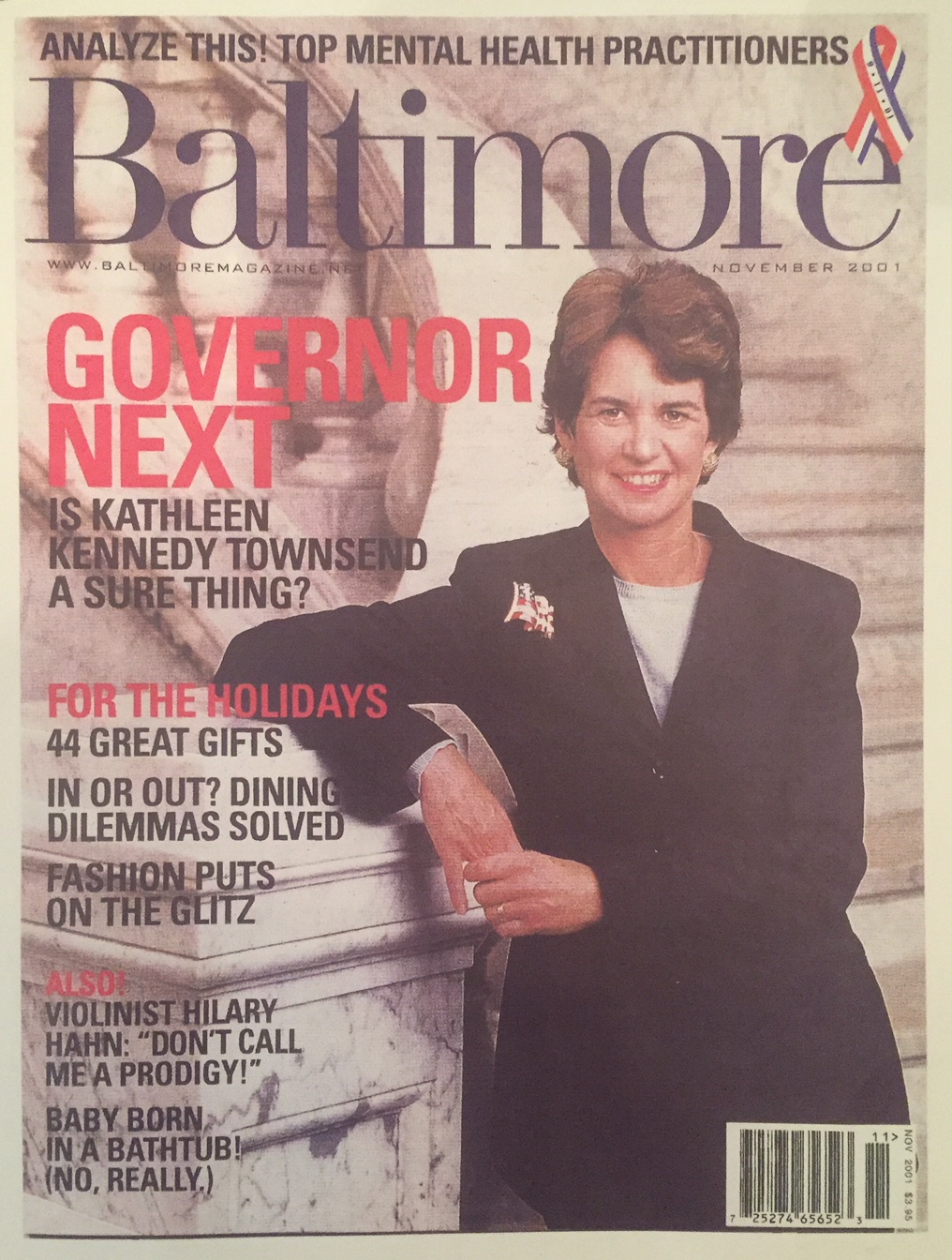
Governor Next? With the Name, the Money, and the Aura of Virtual Incumbency, Kathleen Kennedy Townsend is the Odds-On Favorite to be Elected to the State’s Top Job 12 Months From Now. Or Will She Pull a “Steinberg”?

By Van Smith

Published in Baltimore Magazine, Nov. 2001

IMG_7296

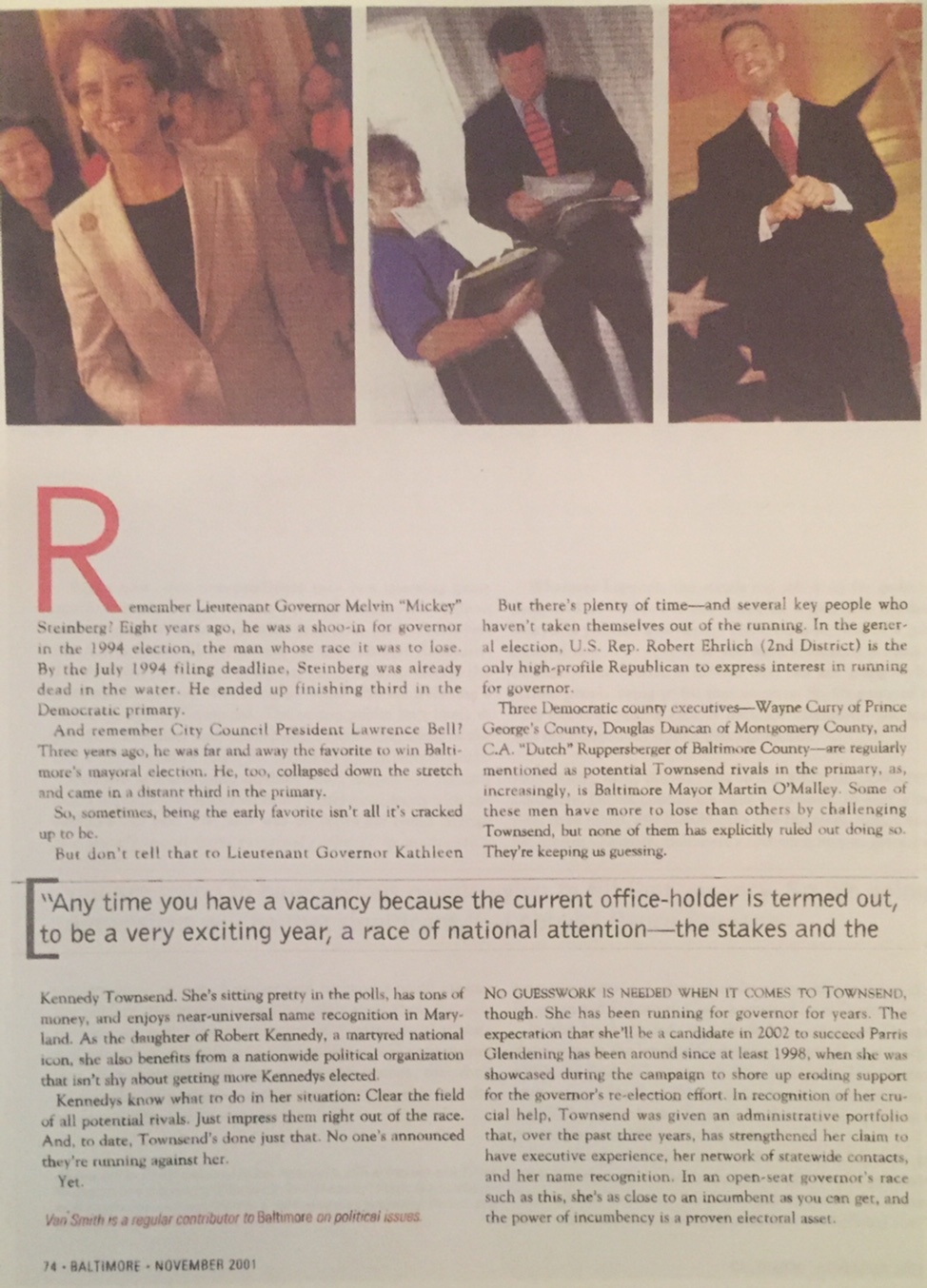
Remember Lieutenant Governor Melvin “Mickey” Steinberg? Eight years ago, he was a shoo-in for governor in the 1994 election, the man whose race it was to lose. By the July 1994 filing deadline, Steinberg was already dead in the water. He ended up finishing third in the Democratic primary.

And remember City Council President Lawrence Bell? Three years ago, he was far and away the favorite to win Baltimore’s mayoral election. He, too, collapsed down the stretch and came in a distant third in the primary.

So, sometimes, being the early favorite isn’t all it’s cracked up to be.

But don’t tell that to Lieutenant Govenor Kathleen Kennedy Townsend. She’s sitting pretty in the polls, has tons of money, and enjoys near-universal name recognition in Maryland. As the daughter of Robert Kennedy, a martyred national icon, she also benefits from a nationwide political organization that isn’t shy about getting more Kennedys elected.

Kennedys know what to do in her situation: Clear the field of all potential rivals. Just impress them right out of the race. And, to date, Townsend’s done just that. No one’s announced they’re running against her.

Yet.

But there’s plenty of time – and several key people who haven’t taken themselves out of the running. In the general election, U.S. Rep. Robert Ehrlich (2nd District) is the only high-profile Republican to express interest in running for governor.

Three Democratic county executives – Wayne Curry of Prince George’s County, Douglas Duncan of Montgomery County, and C.A. “Dutch” Ruppersberger of Baltimore County – are regularly mentioned as potential Townsend rivals n the primary, as, increasingly, is Baltimore Mayor Martin O’Malley. Some of these men have more to lose than others by challenging Townsend, but none of them has explicitly ruled out doing so. They’re keeping us guessing.

IMG_7297

No guesswork is needed when it comes to Townsend, though. She has been running for governor for years. The expectation that she’ll be a candidate in 2002 to succeed Parris Glendening has been around since at least 1998, when she was showcased during the campaign to shore up eroding support for the governor’s re-election effort. In recognition of her crucial help, Townsend was given an administrative portfolio that, over the past three years, has strengthened her claim to have executive experience, her network of statewide contacts, and her name recognition. In an open-seat governor’s race such as this, she’s as close to an incumbent as you can get, and the power of incumbency is a proven electoral asset.

Right now, this one-candidate race is a guessing game watched mostly by insiders and political junkies. It’s likely to stay an insiders’ game until early next year, when the Governor hands a new electoral map to the General Assembly. That’s when next year’s prospects for candidates across the state will be altered – including for some who are weighing a challenge against Towsend. The voting public isn’t likely to pay close attention until next spring, as jockeying ahead of the July 1 filing deadline raises the debate to a more fevered pitch.

Between now and then, anything could happen – or nothing could happen. The state’s economy could head south with the nation’s – or not. The new war on terrorism could change the state’s mood from relatively liberal to moderately conservative – or not. A strong new contender could capture the public’s imagination, swinging voters away from the early favorite – or not. Nascent criticism of Townsend – that she’s not enough of a heavyweight for gubernatorial contention, that she’s overprivileged with out-of-state money, that she’s mishandled her key administrative assignments – may get the attention of the public – or not.

Whatever happens, the state’s top job is up for grabs next year, and as lobbyist Bruce Bereano, a longtime insider in Maryland politics, says dryly, “There certainly will be a gubernatorial race. … Any time you have a vacancy because the current office-holder is termed out, you are going to have serious people vying to fill that vacancy. So it’s going to be a very exciting year, a race of national attention – the stakes and the dimensions will be that significant.”

IMG_7299

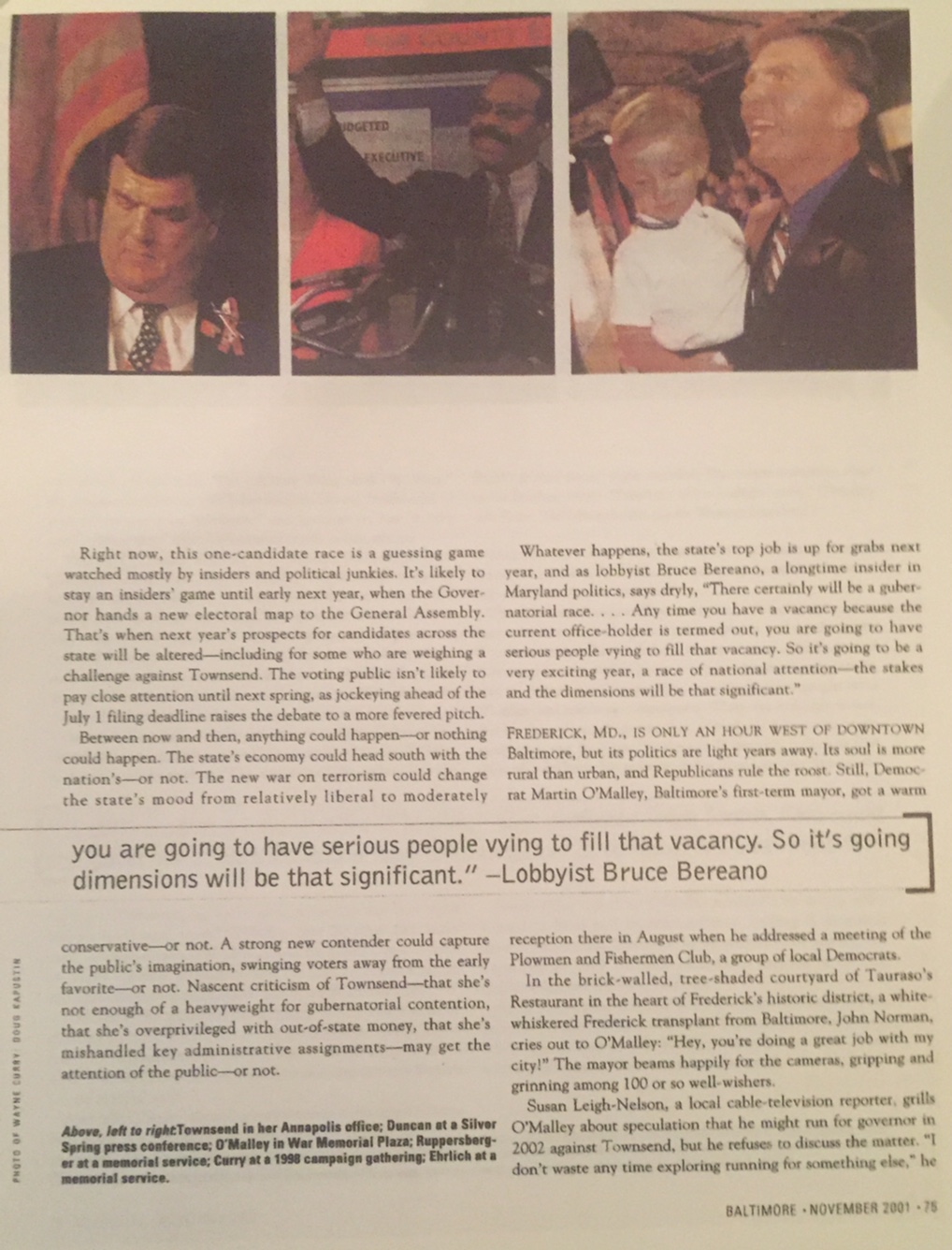
Frederick, Md., is only an hour west of downtown Baltimore, but its politics are light years away. Its soul is more rural than urban, and Republicans rule the roost. Still, Democrat Martin O’Malley, Baltimore’s first-term mayor, got a warm receptiopn there in August when he addressed a meeting of the Plowmen and Fishermen Club, a group of local Democrats.

In the brick-walled, tree-shaded courtyard of Tauraso’s Restaurant in the heart of Frederick’s historic district, a white-whiskered Frederick transplant from Baltimore, John Norman, cries out to O’Malley: “Hey, you’re doing a great job with my city!” The mayor beams happily for the cameras, gripping and grinning among 100 or so well-wishers.

Susan Leigh-Nelson, a local cable-television reporter, grills O’Malley about speculation that he might run for governor in 2002 against Townsend, but he refuses to discuss the matter. “I don’t waste any time exploring running for something else,” he says as the camera rolls. “I’m too busy doing what I’m doing.” He praises Glendening and Townsend for having “made a lot of wise investments in Baltimore” and declares he has “a very good relationship” with the administration in Anapolis.

Thomas G. Slater, who chairs Frederick’s Democratic State Central Committee, says O’Malley’s invitation to speak tonight has nothing to do with the 2002 election. “He’s young, he’s new, he’s exciting, and we want to get a look at him – especially early on,” Slater explains as he peruses a table of hors d’oeuvres. He’s an old hand in Western Maryland politics, and he simply doesn’t foresee an O’Malley challenge to Townsend. “It’s too soon” after his 1999 election as mayor of Baltimore. Besides, he says, Kathleen’s “got it.”

Frederick County’s only elected Democrat, State Delegate Sue Hecht, steps up on a low stone wall to introduce Martin O’Malley to the assembled partisans. “This is our star,” she gushes, “our rising star in Baltimore, and we’re going to see him and hear about him for many more years.” O’Malley takes the stage and, in his usual unscripted oratorical style, cajoles his fellow Dems to focus on results-oriented governance, does Bill Clinton impersonations, and ticks off his every-ready list of upbeat trends in Baltimore.

Afterward, the gathering turns informal. The mayor ends up chatting with Jeb Byron, the evening’s host and the son of former U.S. Representative Beverly Byron. With them is Brent Ayer, a sandy-haired long-distance runner and Bevery Byron’s former chief of staff.

Ayer tells O’Malley about big public events in Frederick County that draw large numbers of people – mass gatherings where statewide political candidates can reach a broad audience. He touts Colorfest, an October crafts fair in Thurmont – “You can get to 60,000 at that alone,” Ayer explains. The mayor introduces Ayer to his brother, Peter. “Take one of his business cards,” O’Malley tells Peter. “He’s the numbers guy for Western Maryland.”

IMG_7300

O’Malley, like all the undeclared, potential candidates, is interested in numbers – including the 400,000 potential voters in Western Maryland.

The numbers that got the attention of a lot of politicos last May were those turned up in a public opinion poll conducted by Gonzales-Arscott Research & Communications, which showed Townsend leading O’Malley in a head-to-head primary race by only 47 percent to 40 percent – a surprisingly close margin since O’Malley had not been campaigning. What was strikingly embedded in the poll numbers as that O’Malley’s 67-percent name recognition was far below Townsend’s 95 percent, indicating that those who did know his name tended to favor him over Townsend.

Some of the buzz about O’Malley subsided a bit in July when a head-to-head poll by Mason-Dixon Polling & Research showed him trailing Townsend by 49 percent to 28 percent, but Carol Arscott finds “his name recognition creeping up on hers, and his negatives are very, very low.”

So, O’Malley goes to Frederick for a little politicking. As State Senator Barbara Hoffman (D-42nd District) says of the visit, “He’s smart to do that – you build up credits for the future, create a little profile for yourself. It will come in handy some day.”

The question is, “When? There are some who think that next year – while he’s still perceived as a “rising star” and is still relatively unscarred by the years in office any mayor endures – may be O’Malley’s best chance to become governor. But if he runs, he risks losing and becoming damaged goods – a brash youngster who misjudged his moment and shot too high too early in the game.

IMG_7301

Opinion, of course, is divided over O’Malley’s 2002 gubernatorial prospects. “It still remains a long shot for him,” says Western Maryland College political science professor and columnist Herb Smith. “He could win, but the chances are he won’t. What does he gain by losing? An enemy in the governor’s mansion and a long-term negative in terms of his ambitions for any other statewide office.”

“If he runs for governor, I think it is his for the taking,” says Anirban Basu, director of Applied Economics at Towson University’s Regional Economic Studies Institute. “I pray, as a Baltimore City resident, that he does not run for governor. We need him much more than the state needs him, but I think it is his – if he wants it.”

Montgomery County State’s Attorney Douglas Gansler can’t see O’Malley or anyone else beating Townsend. “I don’t think anybody can come close to Kathleen in a race,” he muses, “so I don’t know why the Martin O’Malley thing is out there.”

“I personally don’t think he’s going to run,” former State Senator Julian “Jack” Lapides says of O’Malley. Townsend already has lined up too much of the city’s power structure, he explains. “I don’t see it shifting. First of all, African Americans will be overwhelmingly for her, and she certainly will have a significant percentage of the white vote in the city. So who’s O’Malley going to get from the city? Any votes he does get will be offset by the Kennedy name and mystique” elsewhere in the state.

“There are only so many Irish-American politicians from Maryland that the nation can absorb,” quips Arscott. A showdown between the two – Townsend, a blue-blood Kennedy, versus O’Malley, an in-law of the Curran dynasty of Maryland politicians, who have been dubbed “the brown-bag Kennedys” – could be an eventuality. Maybe not next year, but some day.

IMG_7304

Chuck Goldsborough is a race-car driver, a Baltimore boy who’s stayed true to his roots. Since 1999, he’s been the president, owner, and driver for Team Lexus, the luxury-car marker’s only racing team in the country. He’s been running the operation out of a large, immaculate garage with adjacent offices in an industrial complex in Arbutus. On a Tuesday morning in early September, Baltimore County Executive Dutch Ruppersberger comes over to see Team Lexus firsthand, meet Goldsborough, and offer the county’s help and support.

Rupperberger, a large man, dons a Team Lexus shirt (“You got XXL?” he asks Goldsborough) and manages to squeeze himself into the cramped driver’s seat of one of the Team Lexus race cars. And there he stays for a good 20 minutes or more, asking Goldsborough question after question. How often does Team Lexus race? Who does the body-work on damaged cars? And so on. Finally, what happened to Dale “The Intimidator” Earnhardt?

Earnhardt was the NASCAR driver who died in a fiery crash at the Daytona 500 in February. Goldsborough explains that Earnhardt was a risk-taker in the extreme, habitually refusing to use standard safety gear that probably would have saved his life. But his son, Dale Jr., isn’t as reckless – in fact, he’s a natural and is already showing himself to be a great driver. “There are legacies in every sport,” Goldsborough explains, “including racing – the Earnhardts, the Andrettis.”

“Just like Kennedys in politics,” Ruppersberger interjects.

“That’s right,” Goldsborough agrees, laughing. “Just like Kennedys in politics.”

Ruppersberger laughs, too – masking what must be a certain amount of jealousy. He comes from a family of local meat merchants, far from the Camelot of the Kennedys, and has succeeded in Baltimore County politics the hard way: eight years as a prosecutor and nine years on the County Council before becoming executive in 1994. Now he’s term-limited out of running for a third term. After winning every precinct in 1998 – a reward for his having turned around the county’s once-failing budget and economy during his first term – he was widely considered prime gubernatorial material. But he’s in the shadow of a Kennedy. Now he might run for Congress rather than confront Townsend in the governor’s race.

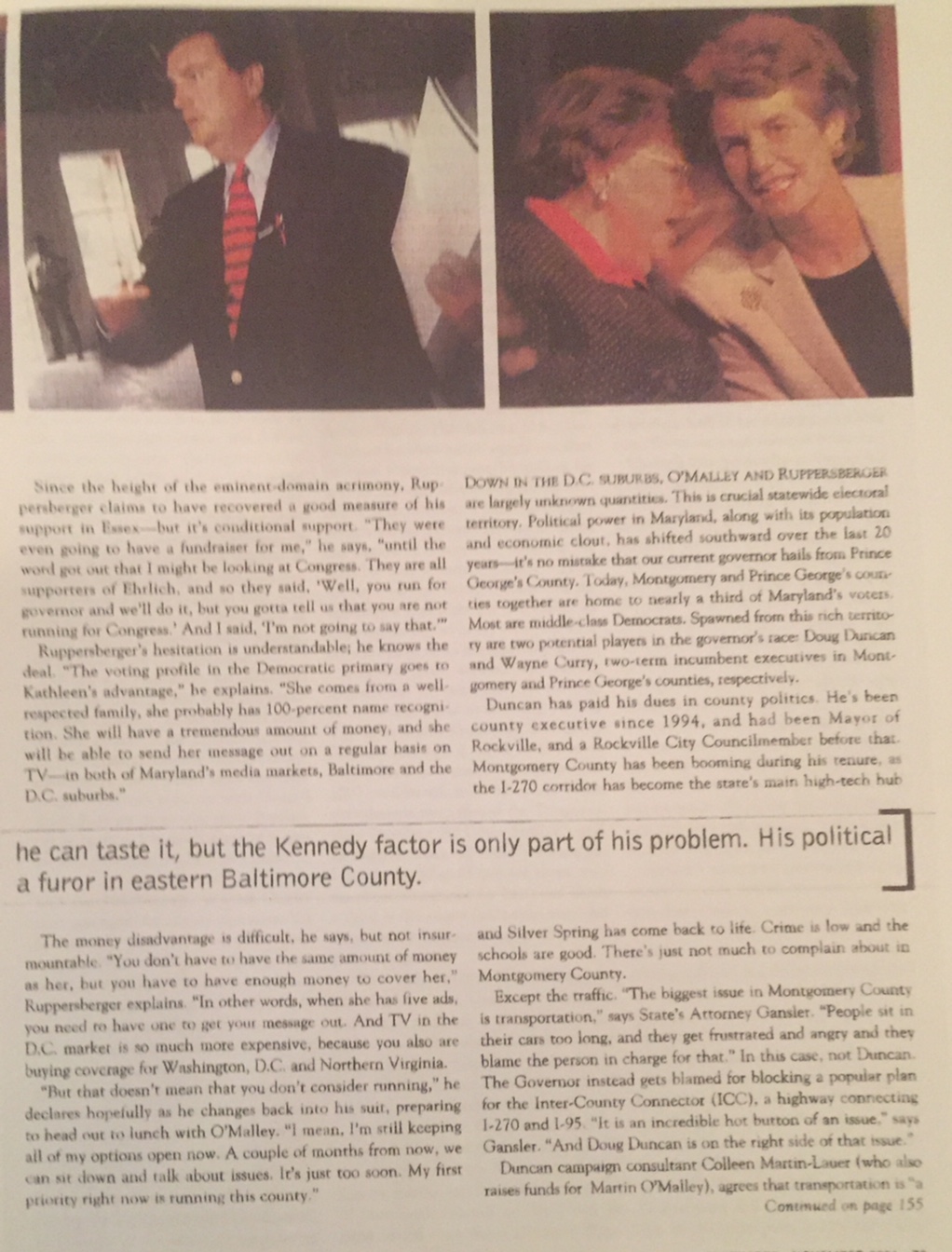
This is a man in the throes of political agony. He wants to be governor so badly he can taste it, but the Kennedy factor is only part of his problem. His political disability is largely his own doing. It happened in 2000, when he quietly ushered an eminent-domain bill through the General Assembly – and ran headlong into an indigenous dislike for government incursions into private property rights. The reaction started in Essex, which was the bill’s main target for redevelopment, but spread countywide and was defeated by referendum. On top of this, Ruppersberger’s plans to expand the county jail have caused a damaging level of public furor. His political base – the solid ground from which every statewide candidate must launch a campaign – has been badly shaken.

In Team Lexus’ conference room, Ruppersberger settles in to talk about his options. “A lot of people are telling me,” he says, “’Dutch, I know you would be the best governor, but I don’t think you can beat Kathleen, so let’s find another alternative.’” When friends urged him to consider a congressional bid instead, he at first rejected the notion. “I want to be governor,” he says. “I want to do for the state what I did for Baltimore County. I love my state. I’m homegrown. But in the end, they say, ‘We’re telling you as friends, she’s got name recognition everywhere. How are you going to do it? People don’t know who you are. They know Kathleen.’”

Governor Glendening – who controls the redistricting process and therefore has a lot of say over Rupperberger’s congressional aspirations – has asked him to consider a run for Congress, too, he reports. “So, I think at this point I’m keeping those options open because I do love public service and I think I can make a difference wherever I go,” Ruppersberger declares. “But I want to make a difference. I don’t want to be in just for the sake of keeping my name alive. That’s not me. I want to do something. I want to be active, and I want to count for something.”

Since the height of the eminent-domain acrimony, Ruppersberger claims to have recovered a good measure of his support in Essex – but it’s conditional support. “They were even going to have a fundraiser for me,” he says, “until the word got out that I might be looking at Congress. They are all supporters of Ehrlich, and so they said, ‘Well, you run for governor and we’ll do it, but you gotta tell us that you are not running for Congress.’ And I said, ‘I’m not going to say that.’”

Ruppersberger’s hesitation is understandable; he knows the deal. “The voting profile in the Democratic primary goes to Kathleen’s advantage,” he explains. “She comes from a well-respected family, she probably has 100-percent name recognition. She will have a tremendous amount of money, and she will be able to send her message out on a regular basis on TV – in both of Maryland’s media markets, Baltimore and the D.C. suburbs.”

The money disadvantage is difficult, he says, but not insurmountable. “You don’t have to have the same amount of money as her, but you have to have enough money to cover her,” Ruppersberger explains. “In other words, when she has five ads, you need to have one to get your message out. And TV in the D.C. market is so much more expensive, because you also are buying coverage for Washington, D.C. and Northern Virginia.

“But that doesn’t mean that you don’t consider running,” he declares hopefully as he changes back into his suit, preparing to head out to lunch with O’Malley. “I mean, Im still keeping all of my options open now. A couple of months from now, we can sit down and talk about issues. It’s just too soon. My first priority right now is running this county.”

IMG_7305

Down in the D.C. suburbs, O’Malley and Ruppersberger are largely unknown quantities. This is crucial statewide electoral territory. Political power in Maryland, along with its population and economic clout, has shifted southward over the last 20 years – it’s no mistake that our current governor hails from Prince George’s County. Today, Montgomery and Prince George’s counties together are home to nearly a third of Maryland’s voters. Most are middle-class Democrats. Spawned from this rich territory are two potential players in the governor’s race: Doug Duncan and Wayne Curry, two-term county executives in Montgomery and Prince George’s counties, respectively.

Duncan has paid his dues in county politics. He’s been county executive since 1994, and had been Mayor of Rockville, and a Rockville City Councilmember before that. Montgomery County has been booming during his tenure, as the I-270 corridor has become the state’s main high-tech hub and Silver Spring has come back to life. Crime is low and the schools are good. There’s just not much to complain about in Montgomery County.

Except the traffic. “The biggest issue in Montgomery County is transportation,” says State’s Attorney Gansler. “People sit in their cars too long, and they get frustrated and angry and they blame the person in charge for that.” In this case, not Duncan. The Governor instead gets blamed for blocking a popular plan for the Inter-County Connector (ICC), a highway connecting I-270 and I-95. “It’s an incredible hot button of an issue,” says Gansler. “And Doug Duncan is on the right side of that issue.”

Duncan campaign consultant Colleen Martin-Lauer (who also raises funds for Martin O’Malley) agrees that transportation is “a key issue in the Washington suburbs.” Given that Glendening has been defiant in opposing the ICC, she says, “I think people who sit on the Washington Beltway everyday will question the accomplishments” of his administration “when it comes to transportation issues.”

Here, then, is a weak point for Townsend in the D.C. suburbs – some of the anti-Glendening sentiment on transportation issues is bound to rub off on her, giving Duncan and others a stick to poke her with. But Gansler doesn’t see it that way. “She is the Lieutenant Governor,” he explains. “She needs to be loyal to the governor and his position. That’s her job. People understand that.” Later on, closer to the election, she’ll have to take an independent stance, and at that point, says Gansler, “she’s going to be acutely aware of the need to address the transportation issue here.”

Duncan, like every other potential rival, faces an intimidating challenge in taking on Townsend’s already established electoral might. He, like Ruppersberger, suffers from a shaky political base. Key Montgomery County politicians, such as former County Executive Sidney Kramer, say he’s not ready to be governor.

“There’s a perception out there that Doug has drifted away from his base,” explains Gansler. “He has alienated many political people in the Democratic Party in Montgomery County. Unlike [Ruppersberger], there really isn’t anything tangible you can point to with Doug. I think there are those who see it as political arrogance. Its much more of a personality issue than a substantive issue.”

IMG_7306

Like Ruppersberger, Wayne Curry can’t run again for county executive. Yet he has eight years under his belt of running the Prince George’s County government. At a fundraiser he held at his home in May, he announced his intention to travel the state and “listen to what people have to say” about a statewide bid for something – governor, attorney general, or comptroller. But his schedule since hasn’t borne out that vow. He’s been busy tending to his police department, which has been jolted with a series of disturbing and embarrassing scandals that have hurt him at home. Few seem to think he’s got the legs for a gubernatorial bid – especially in light of Townsend’s popularity among Curry’s potential base of African-American voters.

John McDonough, a Prince George’s County attorney and political operative, believes Curry is most attractive as a lieutenant governor’s candidate, teaming up with Duncan, Ruppersberger, or O’Malley, should one of them choose to take on Townsend. “If one of the county executives or the Mayor actually does declare – and there’s only room for one opponent – then it will be a competitive primary,” says McDonough, making Curry “somewhat of a wild card” because he “could successfully cut into Townsend’s base among African-American voters.”


One person who appears increasingly willing to match Townsend’s bet in the governor’s stakes is Republican Robert Ehrlich. This fall, the U.S. Congressman announced to supporters that he’ll run if they can raise $2 million for him by the end of the year. Only one other Republican, Prince George’s County Councilwoman Audrey E. Scott, has expressed interest in entering the race, but only if Ehrlich doesn’t. “I know he can raise that money,” Scott told the Washington Post after the September 21 announcement, “so in my mind, Bobby is the candidate, and I’m supporting him.”

Whether he ended up facing Townsend or another Democrat, Ehrlich’s task would be daunting. Among registered voters, Democrats outnumber Republicans 2-to-1. And in the most recent statewide general election – the 2000 presidential race – Maryland voters overwhelmingly preferred the Democrat, Vice President Al Gore. Ehrlich’s poll numbers in a face-off with Townsend are low – in the 30 to 35 percent range, versus about 50 percent for her – and about a third of the voters don’t even know his name, while Townsend enjoys 95 percent name-recognition.

“The odds against Republicans in Maryland are very steep – any Republican,” sums up Carol Arscott. “You begin with a base vote about half the size of your opponent’s base vote. And to chip away that much at someone’s natural base is a very difficult thing to do.”

The last time a Republican made a strong challenge to the Democratic hold on the Governor’s Mansion (Spiro Agnew was the last Republican governor of Maryland, elected in 1966) was in 1994, when then-State Delegate Ellen Sauerbrey came within 6,000 votes of victor Parris Glendening. That was the same year as the Republican takeover of Congress – and also the year 2nd District voters sent Ehrlich to Washington.

But Ehrlich’s 2nd District base, which spans parts of Baltimore, Harford, and Anne Arundel counties, isn’t reflective of Mayland as a whole. If he tosses his hat in the ring, Ehrlich will run up against the political reality that Sauerbrey saw so vividly in the 1994 returns – that without successfully swaying a large number of left-leaning voters in Baltimore City and Prince George’s and Montgomery counties away from the Democratic candidate, a statewide Republican candidate has precious little chance of claiming victory. Voters from those three jurisdictions combined provided Glendening with more than half of his winning statewide vote. Those are tough numbers to crack.

Ehrlich has gradually softened his sharply conservative edge over the years. When he first gained office in 1994, Ehrlich was a freshman in what was hailed at the time, by Republican activist Vin Weber of Empower America, as “the Rush Limbaugh Congress,” a reference to the right-wing radio-talk-show host. In 1995, Ehrlich stood on the Capitol steps with then-House Speaker Newt Gingrich to unveil the “Contract With America,” a 10-point conservative agenda the new Congress planned to push.

Since then, Ehrlich has slowly gained a reputation as a more moderate Republican: He doesn’t like gun control and he voted to ban partial-birth abortions, but he generally backs abortion rights, supports stem-cell research, and enjoys a measure of support from labor unions.

Ehrlich’s perceived moderation as an incumbent has helped him win re-election four times in a majority-Democrat district. He could have a safe seat for another term, depending on how Glendening redraws his district’s boundaries this coming winter. But, if he runs for governor instead, he’s going to need Democrats from all over the state to cross party lines and vote for him.

Early indications suggest he’ll use at least three anti-Townsend themes in appealing to voters – incumbency, out-of-state money, and upper-crust privilege. In a Washington Post interview, he called the Glendening/Townsend forces “a dominant and entrenched monopoly, run by the most petty politicians you’re ever going to see,” and flogged Townsend for relying on family connections to garner fundraising support from outside Maryland. “I grew up in a rowhouse, not a castle in Camelot,” he wrote in a fundraising letter.

If Ehrlich enters this race, it’s going to be a bruiser.


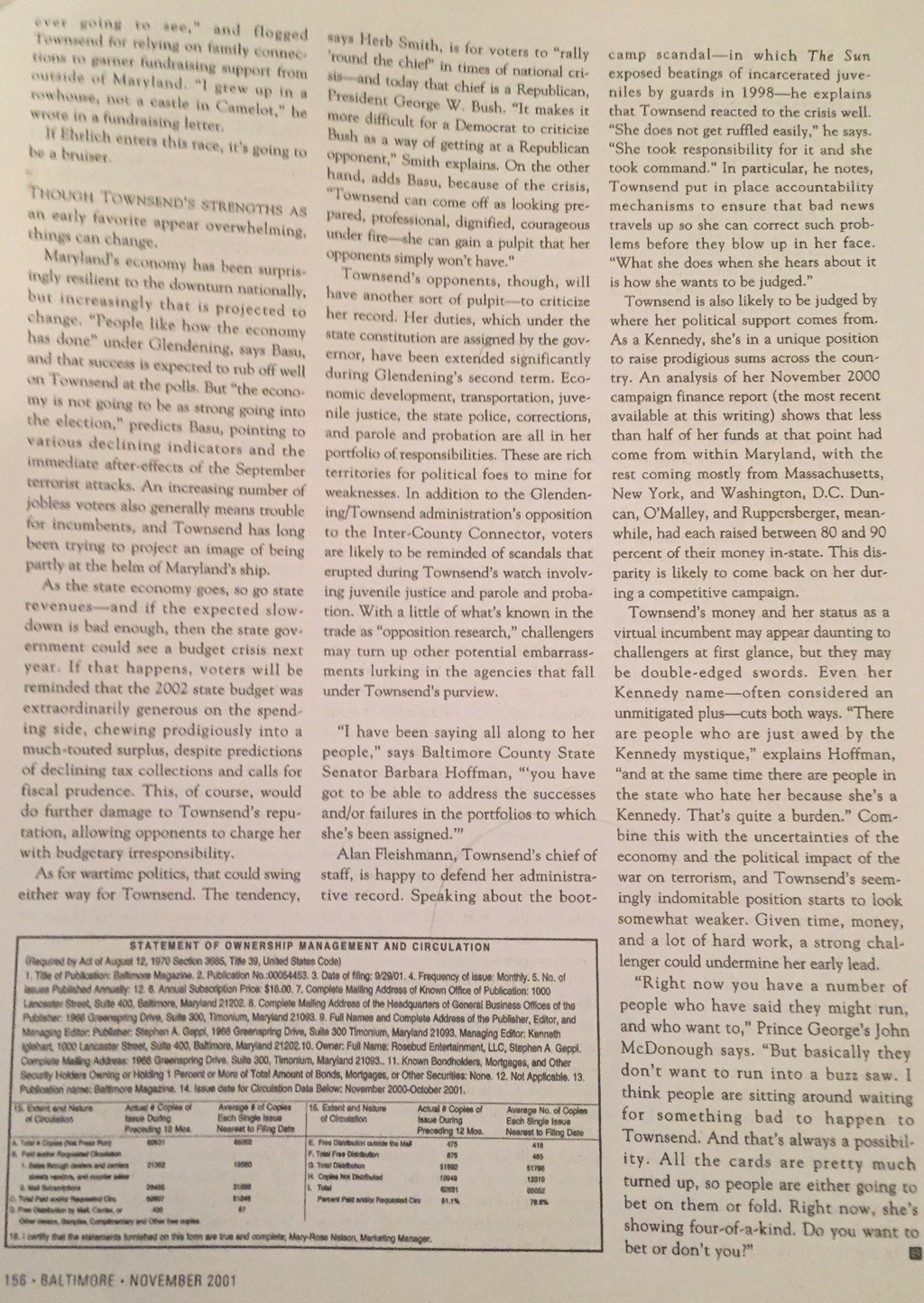
Though Townsend’s strengths as an early favorite appear overwhelming, things can change.

Maryland’s economy has been surprisingly resilient to the downturn nationally, but increasingly that is projected to change. “People like how the economy has done” under Glendening, says Basu, and that success is expected to rub off well on Townsend at the polls. But “the economy is not going to be as strong going into the election,” predicts Basu, pointing to various declining indicators and the immediate after-effects of the September terrorist attacks. An increasing number of jobless voters also generally means trouble for incumbents, and Townsend has long been trying to project an image of being partly at the helm of Maryland’s ship.

As the state economy goes, so go state revenues – and if the expected slow-down is bad enough, then the state government could see a budget crisis next year. If that happens, voters will be reminded that the 2002 state budget was extraordinarily generous on the spending side, chewing prodigiously into a much-touted surplus, despite predictions of declining tax collections and calls for fiscal prudence. This, of course, would do further damage to Townsend’s reputation, allowing opponents to charge her with budgetary irresponsibility.

As for wartime politics, that could swing either way for Townsend. The tendency, says Herb Smith, is for voters to “rally ‘round the chief” in times of national crisis – and today that chief is a Republican, President George W. Bush. “It makes it more difficult for a Democrat to criticize Bush as a way of getting at a Republican opponent,” Smith explains. On the hand, adds Basu, because of the crisis, “Townsend can come off as looking prepared, professional, dignified, courageous under fire – she can gain a pulpit that her opponents won’t have.”

Townsend’s opponents, though, will have another sort of pulpit – to criticize her record. Her duties, which under the state constitution are assigned by the governor, have been extended significantly during Glendening’s second term. Economic development, transportation, juvenile justice, the state police, corrections, and parole and probation are all in her portfolio of responsiblities. These are rich territories for political foes to mine for weaknesses. In addition to the Glendening/Townsend administration’s opposition to the Inter-County Connector, voters are likely to be reminded of scandals that erupted during Townsend’s watch involving juvenile justice and parole and probation. With a little of what’s known in the trade as “opposition research,” challengers may turn up other potential embarrassments lurking in the agencies that fall under Townsend’s purview.

“I have been saying all along to her people,” says Baltimore City State Senator Barbara Hoffman, “you have got to be able to address the successes and/or failures in the portfolios to which she’s been assigned.”

Alan Fleishmann, Townsend’s chief of staff, is happy to defend her administrative record. Speaking about the bootcamp scandal – in which The Sun exposed beating of incarcerated juveniles by guards in 1998 – he explains that Townsend reacted to the crisis well. “She does not get ruffled easily,” he says. “She took responsibility for it and she took command.” In particular, he notes, Townsend put in place accountability mechanisms to ensure that bad news travels up so she can correct such problems before they blow up in her face. “What she does when she hears about it is how she wants to be judged.”

Townsend is also likely to be judge by where her political support comes from. As a Kennedy, she’s in a unique position to raise prodigious sums across the country. An analysis of her November 2000 campaign finance report (the most recent available at this writing) shows that less than half of her funds at that point had come from within Maryland, with the rest coming mostly from Massachusetts, New York, and Washington, D.C. Duncan, O’Malley, and Ruppersberger, meanwhile, had each raised between 80 and 90 percent of their money from in-state. This disparity is likely to come back on her during a competitive campaign.

Townsend’s money and her status as a virtual incumbent may appear daunting to challengers at first glance, but they may be double-edged swords. Even her Kennedy name – often considered an unmitigated plus – cuts both ways. “There are people who are just awed by the Kennedy mystique,” explains Hoffman, “and at the same time there are people in the state who hate her because she’s a Kennedy. That’s quite a burden.” Combine this with the uncertainties of the economy and the political impact of the war on terrorism, and Townsend’s seemingly indomitable position starts to look somewhat weaker. Given time, money, and a lot of hard work, a strong challenger could undermine her early lead.

“Right now you have a number of people who have said they might run, and who want to,” Prince George’s John McDonough says. “But basically they don’t want to run into a buzz saw. I think people are sitting around waiting for something bad to happen to Townsend. And that’s always a possibility. All the cards are pretty much turned up, so people are either going to bet on them or fold. Right now, she’s showing four-of-a-kind. Do you want to bet or don’t you?”

Harm City

By Van Smith

Published as a “Postmark: Baltimore” column in New York Press, 1998

IMG_7381

Back in August 1996, when I moved into the house I recently purchased, my next-door neighbors appeared to be a problem. A bullethole still marred a windowframe of their rented house, left there after a Sunday afternoon shootout on the street a few months earlier. They kept seven chows in the basement; you could hear the inbred curs barking in the dark, day and night. About a dozen people used the house as a temporary crash pad on a rotating basis – younger guys, mostly, with shiny Acuras and eye-fucking attitudes. The landlord lived in New York City and apparently was waiting for the bank to foreclose on the property so he wouldn’t have to be responsible for the shady scene going down on his property.

Within weeks of moving in, I noted a connection between my next-door neighbors and the barbershop around the corner. Fresh Cuttz, it was called. Open all night, its barber chairs were always full and lots of traffic moved through its doors. Late at night, flashy cars with out-of-state license plates were often double-parked before its entrance. Directly in front of the shop was a payphone, a well-placed utility for the high-volume retail drug trade spreading a half block in either direction. I regularly saw many of the guys who lived next door to me hanging in or around Fresh Cuttz.

I was curious, so I asked around. Although many neighborhood people said they had complained to the police about drug dealing they believed was originating from Fresh Cuttz, no one had any information about cops ever having busted the joint. The police, for their part, said three separate investigations had reached the same conclusions: Fresh Cuttz was a place where drug dealers went to get their haircuts, end of story. This made the neighborhood people laugh cynically. Some were of the honest opinion that police were connected to the drug dealing there.

Around this time, an FBI agent who works the press in Baltimore started warming up to me. He would call regularly, friendly as can be, probably in an attempt to get information about the things I look into as an investigative reporter. I never gave him anything that hadn’t already been printed, but he would call me anyway to chat about local politics. When he started offering personal information about himself – where he lives, where he went to high school – I figured he was extending a measure of trust. Not wanting to be needlessly paranoid in dealing with a federal agent, I returned this gesture by telling him the location of my new abode.

“That would be right around the corner from Fresh Cuttz, right?” the FBI guy asked. I was amazed that he would be aware of the place. After plugging him for more information, I learned that Fresh Cuttz caused a blip on the radar screen of a federal investigation of convicted money-launderer Gregory Scroggins. Court records show that Scroggins drove an undercover FBI agent posing a DC drug dealer looking to hide money in Baltimore real estate straight from the Downtown Athletic Club to Fresh Cuttz. Just as he was pulling up to the barbershop, ostensibly to meet with a potential co-investor, Scroggins noticed the suited white men tailing him in an unmarked car, so he took off. The operation failed, but my FBI guy, who was in charge of the investigation, was convinced Fresh Cuttz was somehow connected to the potential co-investor, who name was Kenneth Antonio “Bird” Jackson.

I got quite a rush from this information. Earlier that year, I had written about Jackson. I reported that he was a strip-club manager who, along with his mother, was trying to get a liquor license for a major new downtown nightclub apparently by using a surrogate applicant and the interventions of controversial state Sen. Larry Young. Jackson himself, an ex-con who says his violent days as a leading figure in Baltimore’s west-side drug trade are over, was not legally permitted to hold a liquor license, so he was attempting the next best thing: using a high school guidance counselor with a clean record as the licensee. The scandal exposed not only Jackson’s past crimes and current shenanigans with the liquor board, but also his shoulder-rubbing with some of Baltimore’s most powerful political leaders. If the folks living next to me were associated with Jackson – as it now seemed they were – I had good reason to be paranoid.

After the article ran, my publisher got a letter from New York attorney Robert Simels, who not only counsels jailed New York gangster Henry Hyde, but also my new-found nemesis, Kenny Jackson. On Jackson’s behalf, Simels was threatening to sue me and my employer, Baltimore’s City Paper, for libel. He never followed through, but I was very impressed that Jackson would have such an expensive attorney pen such a piss-poor letter to my publisher. I would have expected the threat to come from Jackson’s esteemed local attorney, Piper & Marbury’s George Russell, a former judge, city solicitor and president of the Maryland Bar Association. Jackson seemed to be saying, “See, I can afford the costliest – just like Henry Hyde.”

Jackson can afford more than expensive attorneys. He has given thousands to the campaign coffers of the city’s three top political leaders: Mayor Kurt L. Schmoke, City Council President Lawrence Bell (who got $3500 from Jackson, his largest contributor) and Comptroller Joan Pratt. He bankrolled a political action committee, called A Piece of J.U.I.C.E. (Justice, Unity, Integrity, Choice, Equality), which was formed to give people on the streets of Baltimore – many of whom can’t vote because they, like Jackson, have felony convictions – a voice in the political process. J.U.I.C.E. spends thousands among the city and state politicians.

Perhaps the contributions explain Jackson’s extraordinary access. At a birthday party for a politician’s mother last fall, Jackson was the only person there – other than the mother – who wasn’t either an elected official or an elected official’s employee or spouse, according to a person who was at the celebration. A plaque from former U.S. representative and now NAACP President Kweisi Mfume hangs over Jackson’s desk in his backroom office at his strip club, the Eldorado Gentlemen’s Club.

The existence of Kenny Jackson explains a lot about Baltimore’s political culture. He has everyone who knows him convinced that he’s just a businessman, an ex-con trying to redeem himself by making legal money in the entertainment business. And maybe that’s all he is. But then there’s the matter of Scroggins (who, by the way, is widely said to be the father of Mayor Schmoke’s adopted son), caught on a wiretap calling Jackson “the nicest guy in the world, but he’s a killer and he has killed.” (Jackson was once convicted of manslaughter, and later beat a murder charge in New York.) Meanwhile, Jackson is making cash overtures to the city’s political elite. And the elite is not shying away from him by any means.

“Mr. Jackson is a businessman, that’s all I have to say,” City Council President Bell told me after the scandal erupted.

The lingering question after hearing such a statement is, Which business is he in, entertainment or drugs? Even if Jackson no longer controls a sizeable chunk of the Baltimore drug trade, as law-enforcement officials speaking background insist he does, he has this very sinister history involving large sums of cash, guns and white powder. It seems that in Baltimore it is okay for politicians to be associated with people like Kenny Jackson. No one gets outraged about it; rather, folks generally seem fascinated by the details without having any sense that something is fundamentally amiss. Perhaps this numbness has been learned after living with generations of corrupt leaders. After all, this is the state that produced such stalwarts of integrity as Spiro Agnew and still displays his bust in the state Capitol.

If you run the numbers on the size of the local drug trade, you begin to understand why Baltimoreans might tend to write off their leaders as corrupt. The city health department says there are 50,000 daily users of heroin or cocaine in Baltimore city – a conservative estimate, I’d say. Let’s assume each of them spends $50 per day to support his habit – also a conservative estimate. And this goes on 365 days a year. That’s 50,000 times 50 times 365, or $912.5 million a year. Money is power, politicians love power, so people tend to presume some of this money must somehow be getting into some politicians’ pockets. The easiest way for average citizens to deal with this possibility is to accept it and go on with their lives. Who’s going to shut down a $912 million-a-year industry? An outraged citizenry? No way, especially since so much of the citizenry creates the demand that fuels that industry.

On Jan. 3, 1997, Fresh Cuttz made the news. James Smith, III, a three-year-old sitting in a barber chair to get his birthday haircut, was killed in the crossfire of a shootout inside the barbershop. The police investigation concluded that the violence was over stolen shirts. Smith’s death caused a widespread spasm of hand-wringing in a city that consistently rates in the top 10, per capita, for murders. Media coverage of the murder stressed the tragedy not only of Smith’s death, but of the barbershop owner’s victimization; these were legitimate businesspeople, the media reported, who had the misfortune of having senseless violence visit their innocent premises. Following the murder, Fresh Cuttz shut down, and so did the drug market in my neighborhood.

The guys next door with the chows, they moved out a few months before the Smith murder; the house is now owned by a bank and is vacant. Kenny Jackson is laying low at the Eldorado, where his butt-slapping variety show is shot on video for the city’s public-access cable channel. His buddy Larry Young – the state senator who tried to help Jackson negotiate the liquor board – was just expelled from the state Senate in early January for breaking ethics laws by using his public office for fun and profit. Schmoke, Bell and Pratt are all still in power, trying their level best – but to no good effect – to turn “Harm City” back into “Charm City.”

For my part, I own a fully functional, three-story, historic storefront row house with an oversized backyard located within 10 blocks of the city center for $34,500. I don’t think that kind of money would buy a parking space in Manhattan.