Early on in the pandemic, we made flash cards using a business-card app and our newly obtained printer. Our home having suddenly become a school/office, cafeteria included, an occasional practice after lunch for our daughters, then 8 and 10, was to zoom an astrology class with my Renaissance-mama sister, an artist up in Philly.
This home-schooling activity produced a set of self-descriptors that quickly proved useful as a vocabulary builder, when together we made a set of cards with definitions and sentence uses on the back. Collectively, it produced a wonderfully devastating portrait, a hybrid Hydra of all our celebrations and challenges as parents. “Aspiring,” “acquisitive,” “rapturous,” “enterprising,” “overzealous,” “foolhardy,” “egocentric,” and “pragmatic” combine quite artfully among them.
Zeroing in on the six words in the flashcard set that have as the sentence subject our dog, a 14-pound rat terrier on Prozac named Elphie (whose eternal existential battle is over territory dubbed “The Couch” by her owners), produces a mash-up of our daughters and dog, a montage to inspire both fear and adoration. Let’s take it in alphabetical order.
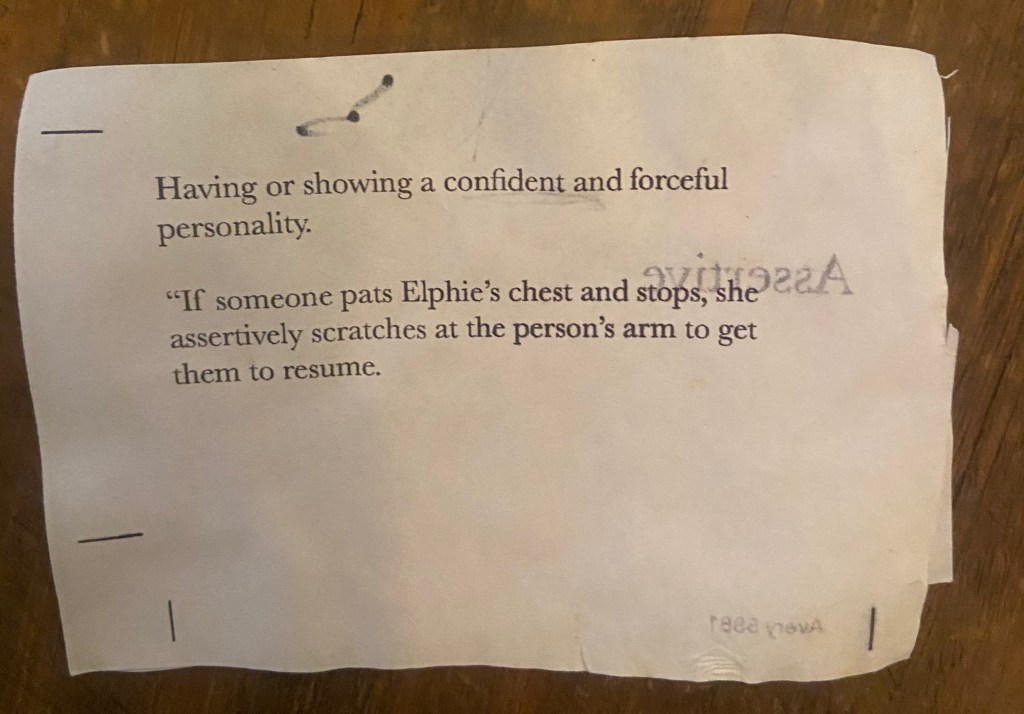
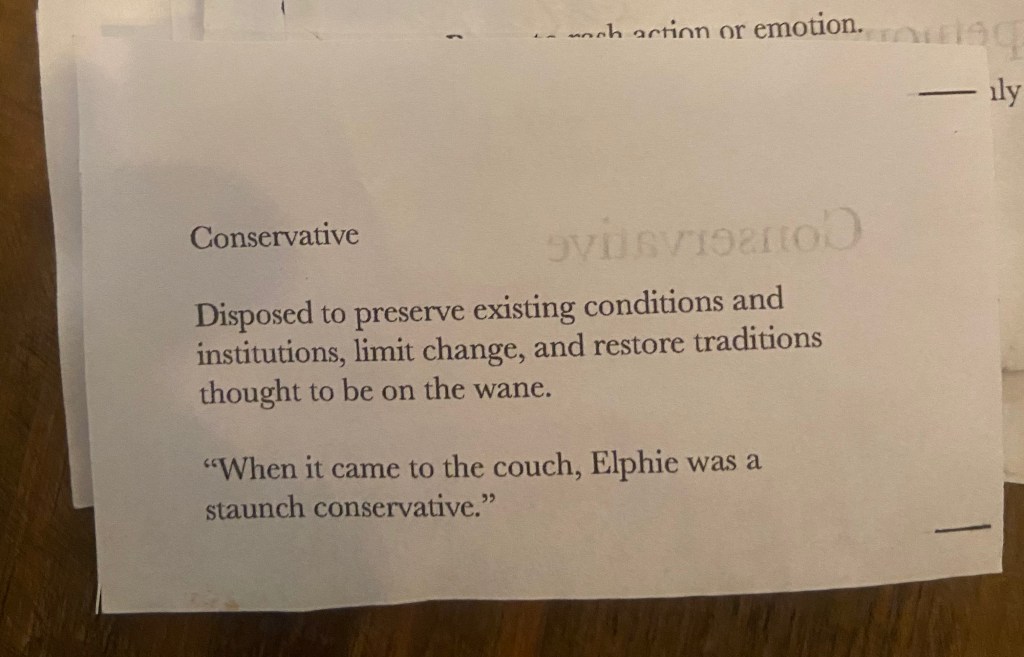
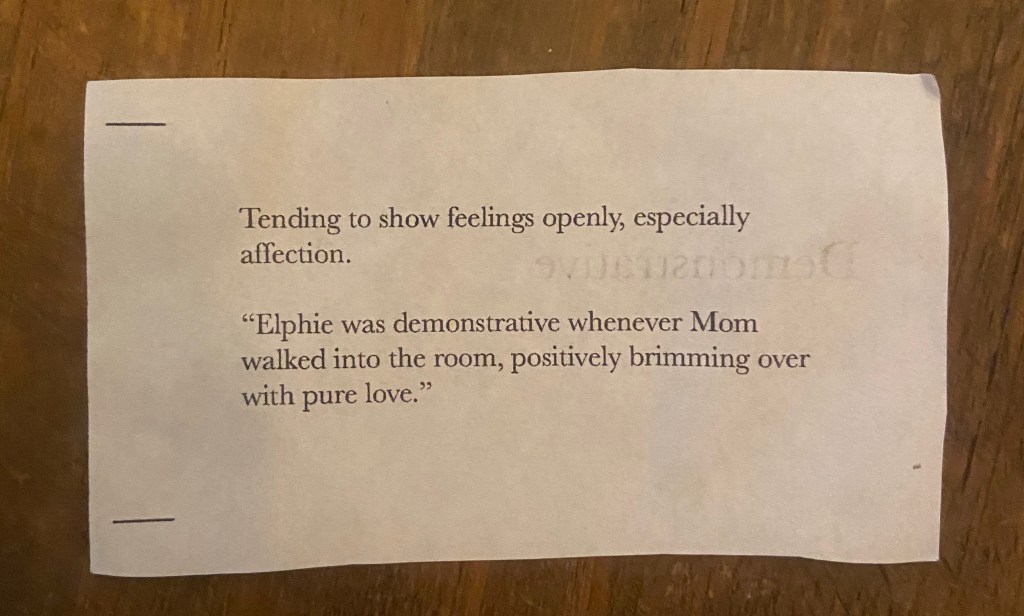
Assertive: Having or showing a confident and forceful personality. “If someone pats Elphie’s chest and stops, she assertively scratches at the person’s arm to get them to resume.”Conservative: Disposed to preserve existing conditions and institutions, limit change, and restore traditions thought to be on the wane. “When it came to the couch, Elphie was a staunch conservative.” Demonstrative: Tending to show feelings openly, especially affection. “Elphie was demonstrative whenever Mom walked into the room, positively brimming over with pure love.” Fervent: Having or displaying a passionate intensity. “It was Elphie’s fervent belief that danger forever was knocking on our front door.” Impetuous: Prone to rash action or emotion. “Elphie, always the impetuous dog, suddenly bit Olive in the face.”Substantial: Of considerable importance, size, or worth. “Though small and nearly given away to us, Elphie holds substantial value in our hearts.”
So there we have it: an assertive, conservative, demonstrative, fervent, impetuous, substantial lot, they are. We wouldn’t – indeed, we couldn’t – have it any other way.
My name is Rye Pierre. I am a student in 6th grade. First, I wanted to say that you are my idol and I support all of your decisions. I know that your next 100 days will be busy. Over the next four years, I wanted to ask if you could do a few things that might improve our country.
First, I would really, really like to go back to school and Mr. President said he would work on that first thing when he went into office. I’ve never actually seen my school before and I don’t want to spend my full first year at this school online.
Another thing is getting the vaccine out as fast as possible to as many people as possible. My father has bad lung problems and is very vulnerable to the virus. But he isn’t qualified as a senior citizen so he won’t get it very quickly, being 55.
Something else I would love to happen as quickly as possible is definitely getting someone to prosecute our old president, Mr. Trump, as quickly as possible. I wish I could do it myself, but I’m only 11.
I’ve been rooting for you since your ran for President, but even VP is so important for all women. One last thing that I would like you to do in your four (and hopefully more) years in office is teach some men how to respect women. It really bugs me how women are still treated like they are lesser than men, even though we could be more powerful if some men weren’t telling young girls that they were nothing, and they were just there for men’s entertainment purposes.
I trust that you will do all these things because you are my idol and I believe that you are an extremely strong woman.
This is the child who coined the phrase, “the Jesus Generation,” to describe kids like her: living sacrifices for the sins of her forebears. As a culture, we’ve done so much wrong while achieving so much good across generations, and our collective excesses, our greed, our hatred, our selfishness, our thoughtlessness, all come with a price exacted on those now growing up or still to be born. It’s shameful. Here is our hope, taking in the wind with sacred beauty stretched before her.
When Soviet ruler Joseph Stalin died 50 years ago this March 5, Leningrad was celebrating its 250th year. Now the old Russian capital is called St. Petersburg again, and for its 300th anniversary the Baltimore arts establishment is throwing a party: Vivat! St. Petersburg, a month-long celebration of Russian culture. While neither Stalin nor Soviet art have been featured, the dictator and state-sponsored work from the former U.S.S.R. no doubt left impressions on Baltimore’s large community of immigrants from the former Soviet states. They, too, were largely left out of the Vivat! parade.
With Vivat! winding down and Stalin’s death day upon us, the time is ripe to showcase official Soviet art. But where does one go to find it? Near the Baltic spa town of Druskininkai in Lithuania, about 75 miles southwest of its capital, Vilnius. Here is Grutas Park, opened on April Fool’s Day in 2001, styling itself as the world’s only “attempt to accumulate and duly exhibit the relics of Soviet ideology.” Dubbed “Stalin World” by the press, the sculpture park exhibits 86 Soviet-era works, many of them damaged by crowds as the Soviet Union collapsed in the early 1990s.
When in the planning stages in 1999, Grutas Park was met with protests and hunger strikes in Lithuania. Yet the park has hosted more than 300,000 visitors so far, and a debate over Soviet tourism as a whole–of which Stalin World is as fine an example as one can hope to find–has begun in Baltic newspapers. Even in Western academia, where official Soviet art has long been dismissed as worthless, its cultural value is, in some corners, being reassessed.
When asked, many in Baltimore’s Soviet-immigrant community, tens of thousands strong, said they would rather not remember Stalin or reconsider the severely constrained artistic expressions he and other Soviet leaders permitted. But some were willing. Artists, in particular, shared their thoughts after looking at images of Grutas Park that were brought back last fall by Baltimore artist and photographer John Ellsberry. Most reacted with a shrug.
“Maybe when people are not afraid of communist regime . . . they will be interested to see these images.” –Gennadiy Gurvich
“It’s funny stuff,” chuckles Noi Volkov, a ceramics maker and painter who moved here from Odessa, Ukraine, in 1989, when he was already an established artist in his early 40s. “It’s just government propaganda. A group of members of the Communist Party took the power and they want to have this power as long as possible. It’s why they say art must be way under control and about just one idea. The idea? That the communist regime is the greatest regime in the world. That’s it.”
Official Soviet art is often seen, like the U.S.S.R. itself, as an outgrowth of the paternalism that long characterized Russian culture. Stalin, like the czars, bred a cult of personality around himself, lording over his nation like a conqueror over the vanquished. But the czars’ patronage underwrote a more “democratic” arts environment, Volkov says, while Stalin stoked and shaped the creative class to pay homage to the state’s ideals–Stalin’s ideals–and brutally oppressed those who tried to express anything else.
Stalin held sway over the U.S.S.R. and Soviet art until his death in 1953; his monomaniacal cult of personality would outlive him long. In the mid-1950s, Soviet leader Nikita Kruschev denounced “how the cult of the person of Stalin has been gradually growing,” becoming “the source of a whole series of exceedingly serious and grave perversions.” Soon after, the Soviet Union began removing many of the publicly displayed statues of Stalin, which helps explain why Grutas Park has only two sculptures of the regime’s most infamous icon.
But even after Stalin’s era passed, the centralized Soviet approach to the arts never ceased. It was immortalized in the Soviet constitution: “The state concerns itself with protecting, augmenting, and making extensive use of society’s cultural wealth for the moral and aesthetic education of the Soviet people, for raising their cultural level.”
Art, in other words, was used to shape and mold the populace rather than as a means of self-expression. For 74 years, the Soviet regime used this legal foundation to fuel the production of prodigious quantities of anonymous official art and persecuted artists who didn’t make use of the approved style, Socialist Realism, typified by the realistic yet idealized renderings of Soviet leaders and stoic workers found at Grutas Park. “They lived very hard lives,” says Noi Volkov of the nonconformist artists. “Some died. Some went to jail or mental clinic and spent very poor life, full of difficulties. Terrible life.” Volkov knows of these hardships from first-hand experience. He was held and interrogated by Soviet police for two months for his illegal artistic activities, he recalls, and underwrote his unofficial art endeavors by making and selling ceramic clocks on the black market. “This clock is very popular,” he says, pointing to a timepiece on a bookshelf in his studio. “It helped me live probably 10 years.”
“I don’t think Russian art would be where it is now were it not for these images.” — Nino Leselidze
In 1917, when the Russian Revolution brought czarism to its knees, monumental statues of previous Russian leaders were destroyed by fervent masses. In 1991, when the Soviet Union crumbled in a series of bloodless coups, its statues, too, were toppled. Ten years later, Grutas Park started to put some of the Soviet remains on display. “This is not a show park,” writes Grutas Park founder Viliumas Malinauskas, a Lithuanian pickled-mushroom exporter, in the first issue of the park’s newsletter. “This is a place reflecting the painful past of our nation, which brought a lot of pain, torture, and loss. One cannot forget or cross out history, whatever it is.”
Elena Volkov (no relation to Noi), a 27-year-old photographer and recent Maryland Institute College of Art graduate originally from Kiev, Ukraine, says, “It surprises me that this would happen in Lithuania. . . . The Baltic countries always resisted the Soviet regime, so it is interesting that someone is collecting Soviet sculpture there.”
Norton Dodge, a longtime collector of Soviet art from Mechanicsville, fills in the history. “The Baltics were taken over two times by the Soviets,” he says. “First they were under Stalin, then Hitler, then Stalin again. Under Hitler, 30,000 to 50,000 Baltic intellectuals, including many artists, were taken to camps in the Urals. Then, when Stalin came back in, tens of thousands more were sent to camps in [eastern Russia]. So it was a very rough beginning with the Soviet situation in the Baltics.”
Visitors to the Grutas Park are given an eerie taste of totalitarianism upon first arriving. Just past the entrance is a railroad cattle car–a grim reminder of how unfortunate Soviet citizens were hauled off to worker camps. Authentic Soviet mortars from World War II greet kids entering the park’s playground, and a boardwalk trail meanders through a dense pine forest and bogs. A moat-like canal, electrified fences, and mock guard towers with loudspeakers broadcasting tinny Soviet marching music help re-create the feel of a Siberian gulag. Here and there are clearings in the woods, filled with immense Soviet-era sculptures.
The squeals and squawks of Stalin World’s petting zoo are more appealing than the sculpture to Regina Buloviene, a bed-and-breakfast owner from Vilnius who served as an unofficial guide for Ellsberry’s visit. “I like the ostriches better than the old statues,” she said laughingly.
“They lived very hard lives. Some died. Some went to jail or mental clinic and spent very poor lives, full of difficulties.” –Noi Volkov
Back in Baltimore, Nino Leselidze, a 23-year-old photographer whose family moved to Baltimore in 1992 from Georgia’s capital, Tbilisi, looks at the Stalin World images and thinks first and foremost that “people were getting brainwashed by this propaganda.” But she still believes “they have value–historical value at least. And also technical value. Technically, they are very well done. But historically, the people growing up now, the younger generations, they should know the history. So [Grutas Park] would be a very good way to learn and see, because they are not growing up with these images anymore.”
Leselidze also attaches a grander importance to these images in the development of art in Russia. “I don’t think Russian art would be where it is now were it not for these images,” she says. “Even though it was propaganda, it helped people get into another frame of mind and make different kinds of work.” The monolith of Socialist Realism, Leselidze suggests, pushed artists to find room to breathe in other, more experimental styles that have since been lumped together as Soviet nonconformist art.
“I can’t be very much surprised because this is what I grew up with,” Elena Volkov says dryly while looking at images from Grutas Park. “A collection of such sculpture at one place, it can be very depressing. But if this type of art served the country, I can’t call it useless.
“During [World War II], it really inspired people and helped people to overthrow the Germans and deal with the humongous power of the Nazis,” she continues. “After that, it was like, ‘We defended ourselves and we won the war, and this is what helped us do it and so we are going to continue in this direction.’ And it was all about the happy life that we were building–this is our future and everybody’s happy. The only bad aspect of it is that it eliminated other forms of art.”
Gennadiy Gurvich, a ceramics maker and designer who moved to Baltimore nearly six years ago from Belarus, says Stalin World’s value is akin to that of the miniature models of communist icons his Russian real-estate agent displays in his office. “I ask him, ‘Why are you collecting that?’ And he answer, ‘This is best medicine for nostalgia,'” Gurvich says. “So [Grutas Park] is to treat the mentality. Because many people grow up in the Soviet era and they have communist mentality and they can’t change in so short a time. Because, you know, this new period for former Soviet republics is not so good. And when they come see this exhibition, maybe it is like a treatment for them.”
“This type of art served the country . . . the only bad aspect of it is that it eliminated other forms of art.” –Elena Volkov
Gurvich has another idea, though: “Maybe when people are not afraid of communist regime, they will be interested in what happened in the past. And maybe they will be interested to see these images. So maybe it is all for a commercial idea, to sell [tickets] to monuments.”
And that may be the nicest thing about Stalin World. At five Lithuanian litas–about $1.50–admission is light on the wallet. The weighty part is what that buys: a bizarre trip through the iconography of Soviet repression, full of reminders of power gone amok amid lies and terror.
“After the revolution, Lenin came to power,” says Noi Volkov, giving a thumbnail sketch of his view of Soviet history. “And he killed a lot of people. And after Stalin came to power, he killed more people. A couple of generations become very much afraid. They remember everything.” On the 50th anniversary of Stalin’s death, perhaps too many don’t remember. And that, Volkov says, is what makes Stalin World worthwhile: “Like Gennadiy [Gurvich] said, it is best medicine for nostalgia.”
After the polls closed at 8 p.m. on June 24, it quickly became clear that Heather Mizeur was not going to be the Democrats’ standard-bearer heading into November’s general election, much less Maryland’s first gay, woman governor elected by tapping into the state’s public campaign-financing system. But judging from how her supporters reacted as they gathered on election night at the Maryland Historical Society in Baltimore to hear her concession speech, she—and they—somehow still seemed victorious.
“Heather! Heather!” the crowd of a couple hundred supporters and campaign workers cheered, as Mizeur basked in the intense glow of the TV news teams’ lights.
“We now have a core, organized movement going forward—I have names and numbers,” said Karen Stokes, the Mizeur campaign’s Baltimore City coordinator and the executive director of the Greater Homewood Community Corporation. State Del. Mary Washington, who represents Northeast Baltimore, added that “no one feels tonight that they’ve lost. They’re moving the progressive agenda forward. Their voices were heard. This is exciting. Six months ago, could anyone imagine her breaking 20 percent?”
In a telephone interview two days after the election, Mizeur makes it clear “I was in it to win it,” but says the campaign was “never really about winning an election as much as it was about raising consciousness and encouraging people to stay involved.”
Mizeur did break the 20-percent mark, getting about 100,000 votes from Maryland’s Democratic electorate, only 11,000 or so fewer than Maryland Attorney General Douglas Gansler, a well-established statewide political figure who came in second behind the overwhelming victor, Maryland Lieutenant Governor Anthony Brown, whose campaign raised and spent many millions. Not bad for a two-term state delegate from Takoma Park.
“Maryland politics will never be the same,” declared Delman Coates, the Prince George’s County pastor who ran for lieutenant governor as Mizeur’s running mate. “This is not a moment in time, but a movement,” he said while addressing the crowd, adding that Mizeur “compelled us to believe in new things to make our communities better” and “did not run for governor to make history or further her political career,” but “to make change.” Addressing Mizeur directly, Coates added: “You have started a movement and I will happily ride with you.”
When Mizeur spoke, she declared that her supporters “have shown the power a movement can have when we work together for positive change.” Claiming that “the pundits, the media, the politicians all agree: We ran, hands down, the best campaign in this election,” Mizeur exhorted the crowd for having “changed the way campaigns will be run in Maryland” and argued that “we have restored so much integrity to the electoral process” by showing that voters “can come together to build community again.” That process, she continued, “does not stop with an election”—after “building this movement” and having “changed the conversation” in Maryland, her supporters need to make sure “Maryland becomes a truly progressive state and heeds your call for change” by creating “Maryland’s new ruling progressive class.”
The progressive policy template that Mizeur touted on the campaign trail was tailored to advance basic notions of societal equality though targeted government policies. Tax relief for working families and small businesses, educational reform funded in part by legalizing and taxing marijuana, assuring workers earn a living wage, ending what she calls the “cradle-to-prison pipeline” created by existing criminal-justice policies, and expanding access to affordable healthcare—these and many other proposals she advanced on her website, her campaign advertising, during media interviews, and in the televised debates.
The extent to which Mizeur’s ideas resonated with Maryland’s Democrats can be measured not only by the 100,000 votes she received, but by the grass-roots fervor reflected in her campaign finances, as compared to Brown’s, during the final weeks leading to the election. Brown’s campaign took in almost 1,300 contributions totaling more than $1.1 million since May 1, for an average donation of almost $900. At the same time, Mizeur’s campaign got more than 3,800 contributions, yielding around $420,000 in private contributions (another $270,000 or so came in the form of matching funds from the state’s public-financing system), for an average contribution of just over $100. That’s an impressively broad base of citizen donors.
The preliminary election results show where Mizeur’s campaign did best. While nearly 60 percent of her votes came out of Baltimore County, Baltimore City, and Montgomery County, she led the pack in Kent County on the Eastern Shore—where she and her wife, Deborah Mizeur, have a farm—and came in second in Baltimore City and Carroll, Frederick, Garrett, and Howard counties.
After Mizeur’s speech was over, the crowd slowly thinned and the camera crews broke down their equipment. In the days following, City Paper contacted some of Mizeur’s Baltimore-area supporters to see if they thought Mizeur’s stab at the State House could have a lingering effect on Maryland politics.
“I think other politicians will take notice of the type of campaign she ran and realize that they can run positive, idea-driven campaigns and thrive because of it,” suggests Keith Gayler, a former research director at the Abell Foundation and policy analyst at the Maryland State Department of Education. “She ran an unapologetically progressive campaign when progressive is often used as term of derision,” Gayler continues, adding, “who else was really talking about inequality, the issue of our time?”
Thomas Dolina, a lawyer who says he first met Mizeur when both were at the 2004 Democratic National Convention in Boston, says Mizeur’s qualified success as a gubernatorial candidate is partly due to the fact that “she’s a progressive without demonizing those who disagree with her, and I find that to be a rare attribute.” He says the fact that she performed so well at the polls “while making a sacrifice not to take money” the way campaigns traditionally do—without the constraints of the public-financing system, which limits a campaign’s fundraising and spending—”creates a model where that kind of methodology is successful.” He’s not so sure that the progressive coalition that backed Mizeur will be able to keep its momentum going. “I’ve seen that happen so many times,” he says. “It’s a ripple. It might turn into a wave.”
Joanne Nathans, the founder of the Job Opportunities Task Force, a Baltimore-based nonprofit that seeks to economically empower the working class and unemployed, says Mizeur “carried off a really impressive grass-roots campaign” in which “a large number of people supported her and her ideas” even though “she sort of came out of nowhere. She’s now a force to be reckoned with.” As for the “future impact” of the campaign, Nathans notes that Mizeur is “a progressive, principled person” who “respects the voters” and “became a credible candidate despite having very little name recognition initially,” so “other candidates will pay attention to how Heather conducted herself in this campaign.”
Mizeur says her campaign organization and supporters “have loosely discussed having a retreat to explore how to keep everyone engaged” after the election. The issues her campaign sought to address, she continues, “are not going away, so I’m thinking about the best way for me to continue to make a difference” through “this movement of people who are pressing our government and leaders to make these changes.”
In particular, Mizeur says she believes work needs to be done to change the culture at like-minded, progressive institutions in the state that “support me on the issues, but weren’t willing to back the campaign because they are part of the establishment. There’s a sense that some of these organizations have become part of the problem, not part of the solution, and we have to figure out how to harness that.”
Despite the loss, Mizeur says she is committed to continuing the work her campaign started. “There are lots of ways for me to serve,” she says, “and I’m very open to figuring out the best way. I’m not walking away from this work, or this movement, or this state that I love so dearly.”
Arriving at a bar by boat seems to make the subsequent drink more rewarding. The adventure of getting there, of steering a vessel according to the liberal rules of the road that boaters get to enjoy, of having the sky above and the water below as you glide across the surface, soaking in the sights along the shore—somehow, enjoying these freedoms, though they are their own reward, calls for a toast. You worked for it, even if the work itself was really recreation.
Baltimore City’s waterfront has opportunities for this: a few, select places where you can tie up your boat, disembark, try to pay the harbor master, and head for the closest watering hole. You can go for a boat-in drink at, say, the Inner Harbor’s Rusty Scupper, Harborview’s Tiki Barge, or Bo Brooks and the Bay Café in Canton. But if you’re departing from the Patapsco River’s Northwest Branch—the harbor’s geographic name—these don’t really qualify as destinations. To get to them, you don’t even leave the harbor and its 6 mph, no-wake speed limit inside Fort McHenry.
Beyond the harbor, you can dock to get a drink at Nick’s Fish House and Grill, next to the Hanover Street Bridge on the Patapsco’s Middle Branch. It’s a dandy place to boat to, with a mile or two of fast boating along the way, but it’s not quite enough of a voyage to feel you’ve earned much reward. You’re still in the city, and all you’ve done to get there is hug the Locust Point shoreline.
To claim a trophy drink, you need to go some distance. You need to head out over open, unrestricted waters, get a little wet at a high rate of speed. You need to build your thirst, see some new sights, gain your sea legs.
Some local old salts who know the lay of the land suggested this: Glen Burnie’s Furnace Branch, about eight miles over water from Fells Point. Along its sandy shore, there’s a biker bar called Reckless Ric’s, in a neighborhood known as Point Pleasant. There, you can dock your boat, take a table perched on sand among palm trees, have your drinks and grub brought to you by barely clad waitresses while you listen to 98Rock-style jukebox music, and look out over the water you came in over.
If that sounds like a worthy outing, rustle up some friends, board a willing vessel, and head out of the harbor past Fort McHenry. Keep to the Patapsco’s south shore, giving the industrial peninsula of Fairfield a wide berth until you reach the mouth of Curtis Bay, just shy of the Francis Scott Key Bridge. Hawkins Point, with the W.R. Grace and Co. chemical plant and the Quarantine Road Landfill, looms in the background.
As you go upstream, Curtis Bay gives way to Curtis Creek. Along the way, remaining vestiges of Baltimore’s industrial past still show some muscle, though its ghosts—partially submerged wooden barges and an old tugboat, rotting slowly in the shallows—also haunt the scene. Further along, the very active U.S. Coast Guard’s Curtis Bay Yard comes into view, across the creek from the old U.S. Army Depot, largely abandoned as authorities try to clean up its contamination.
Here, where Curtis Creek forks to become Marley Creek and Furnace Branch, the industrial shoreline gives way to woodlands and, on the Point Pleasant peninsula, a special kind of suburbia where nearly everyone’s backyard has a dock. And here, along Furnace Branch, is where you’ll find Reckless Ric’s dock, with enough room for maybe six small boats.
If you enter Reckless Ric’s the way most people do—from its parking lot, generally packed with motorcycles and muscle cars—it seems like just another biker bar. But if you enter from its dock, you can pretend you’re in Key West. Next door is an old-fashioned, family-style joint called Duke’s Tavern, with its own dock (in disrepair during a recent visit) and, rather than palm trees and sand, a giant oak tree and a grass lawn with a horseshoe pit and picnic tables.
After hitting Reckless Ric’s and Duke’s, you can re-dock downstream at the Point Pleasant Beach Tavern, maybe shoot some pool and get one more for the road—or the river. You’ve earned it.
U.S. District Judge Catherine Blake ruled in the government’s favor in a gun case today, allowing a gun to be used as evidence in the case of Arthur Jeter, who’s charged with being a felon in possession of a firearm. But Blake noted “troubling issues” involving the conduct of Baltimore police officers who seized the gun from Jeter.
Without elaborating, Blake writes that Jeter’s attorney, Brendan Hurson of the Office of the Federal Public Defender, “raises troubling issues concerning the handling of a confidential informant (‘CI’), the apparent failure of the city police to disclose the existence of that CI to the city prosecutor, and the reliability of the lead detective’s recollection.” During a September motions hearing in the case, according to the transcript, Blake commented that “this is a fairly unusual case,” noting that at an earlier motions hearing, Hurson “was surprised” when he “learned a lot of information . . . that had not previously been disclosed.”
The informant “was not anonymous,” Blake continues in her written opinion, “but rather agreed to become a CI to avoid a drug charge (and backup time on an armed robbery).” In October 2013, the informant “told Det. Robert Clark ‘he would be able to have a friend bring him a gun,'” and Clark “told him that if he did so, he would not be charged with the drug offense.” So, “outside the Baltimore City Police Department’s Southeast District,” the informant spoke with Jeter “on a cell phone placed on speakerphone so Det. Clark could hear the conversation,” and told Jeter “he needed a gun,” and “Jeter agreed to give him one the following day.”
The next day, Jeter was indeed found in possession of a gun while in a car with the informant, and Blake ruled that the officers “had reasonable, articulable suspicion that Mr. Jeter possessed a gun when they seized him by approaching and surrounding the car.” However, she adds in a footnote that “the defense identified numerous inconsistencies in the testimony concerning the events leading up to the seizure of the gun,” as well as “omissions from the statement of probable cause to support the initial charges” against Jeter. But she concludes the omissions “appear intended to protect the identity of the CI.”
Hurson, in previous motions in the case, argued that Clark, “in addition to drafting a statement of probable cause riddled with misrepresentations and critical factual omissions,” offered testimony at a motions hearing that “was repeatedly contradicted by the government’s purported eyewitness, the CI.” He pointed to “undisclosed calls to internal affairs by the CI and his girlfriend, the failure to record or memorialize any of the critical interactions between the CI, Mr. Jeter, and the police, and the apparent inability of Det. Clark to recall any detail adverse to the government’s case at all” in urging the court to suppress the gun evidence because of “inconsistencies in witness testimony coupled with other glaring ‘red flags’ of improper police conduct.”
“While a jury may reach a different opinion on credibility” of the officers on the case—Clark, Sgt. Edward Davis, and detectives David Kincaid and Sabrina Hill—Blake writes that “I do not find the inconsistencies and omissions sufficient to conclude there was no reasonable suspicion of criminal activity when the officers seized the individuals in the car.”
Sounds like a close call in favor of the government, and plenty of doubt-raising fodder for Hurson to play up before a jury, should this case go to trial.
Drug dealing isn’t always the quick-buck, easy-street business it is sometimes thought to be. It’s often hard, demanding work, and, as court records in a recent drug-trafficking takedown in Baltimore show, sometimes involves unruly, hard-to-manage workers causing no end of trouble for their bosses.
Richard “Fat Boy” Smith is alleged to be at the top of drug-trafficking organization that is “pervasive in the Western Police District of Baltimore,” the records say, and “acts as the final arbiter for organizational decisions.” In October, while in Miami on a trip, Smith had to make such a call, over the phone.
“Nah my nigga,” Smith tells one of his underlings, Brian “Pitt” Nettles, “you ain’t even got no business to be on the block no more. You fired, yo.”
Turns out, Pitt had started trouble in a convenience store near one of the group’s street-level drug shops. As mid-level manager Eldridge Dubois put it to Smith, “Pitt in there fucking with yo, in the store man” and “threw juice in the window and all that dumb shit man,” prompting a police response, which was bad for the drug business. So Smith tells Nettles, “Yo, give them niggas whatever yo got yo and don’t come back up that motherfucker till Tuesday my nigga,” when Smith was due to be back from Miami. “Give them the money you got and them motherfucking pills yo,” he adds, since “I ain’t got no time for that dumb ass shit man.”
Earlier, in September, a couple of Smith’s lieutenants had to manage a different kind of situation: While one of their street-level slingers, Marvin Germany, was selling in an alley, the rest of the crew was hanging out in a convenience store, chatting, rather than keeping lookout like they were supposed to be doing. Bruce Jeffries, a lieutenant, calls up mid-level manager Darrell Randolph and says Bernard “Jig” Kingsborough is “watching yo, and he’s saying the same thing I’m saying, ain’t nobody watching Marvin while in the alley yo. Ain’t no way in the world niggas should be all in that store right there while a nigga hittin yo.” Randolph takes the orders well: “Alright,” he says, “I got it.”
In October, it becomes clear why having lookouts in place is important. Randolph gets a call from his brother, Pernell Randolph, and tells him that “Fresh just robbed Marvin, put the gun to his head and all that,” and “Cuddy acting like he don’t want to go get the joint and shit.” He’s talking about Marvin Germany, who is “in the house, he ain’t trying to come outside, he said he wants the joint.” The “joint” is a gun, so Germany can avenge the robber, Thomas “Fresh” Chambers, but Vincent “Cuddy” Jones doesn’t want to give him a gun. “Oh no,” Pernell Randolph responds, “where’s Cuddy at? I may tell Cuddy get that for him.”
Jeffries had to light a fire up under the crew again in October, when he called Darrell Randolph, who’s supposed to overseeing them, to ask why no one was working. Randolph, when Jeffries asks him where he is, is cagey, saying “right here on Monroe Street,” but Randolph was already there. “I’m on Monroe Street” Jeffries says, “so where at on Monroe Street?” Randolph covers himself, saying, “I’m talking about riding down Monroe Street.”
Jeffries then gets to the point—and learns that, rather than working, the crew is horsing around. “I’m trying to figure out why ain’t nobody out here selling dope yo,” he says to Randolph, “I’m like, nobody out here, nobody. Not one nigga out here yo.” Randolph explains that “Ticket on a dirt bike,” referring to Dedrick Coates, and “Pernell was just, Pernell just pulled up right there.” Jeffries gets angry: “What the fuck is his fat ass doing on a dirt bike? Niggas need to start, yo, alright.”
Work-ethic complaints cut both ways, though, as happens in November, when another of Smith’s lieutenants, Brian Carr, takes some guff from one of the lower-level managers, Kevin Grey, for starting work late in the day for a drug trafficker.
“Damn yo,” Gray says, “I’m glad I called you at six o’clock and just didn’t come straight outside,” to which Carr replies, testily, “Yeah, that’s what the fuck you going to always do.” Gray then has to cajole Carr to bring more drugs to sell. “Uhh,” says Carr, “I really don’t feel like going up there for real,” and Gray urges him to re-up, since the shop’s almost empty, saying “it’s nothing down here but half a joint,” a reference to the quantity of drugs.
Fear of the boss is evident in the records, as when, in October, Jeffries orders up some more drugs to sell, asking Derek Shorts to bring them to Darrell Randolph on Baltimore Street, and advises him to be smart about it, because Smith was watching. “Be careful how you move,” Jeffries tells Shorts. “Be careful how you move because Fat Boy on Bmore street too.”
Bosses can be tightwads, giving no leeway when it comes to the till. In November, Jeffries, after counting up the crew’s take, calls up Dubois to complain: “That shit was twelve dollars off yo” because “when I put it together it come up to thirteen eighty-eight” and “it supposed to count fourteen hundred.” Dubois acknowledges that the count came up short, so Jeffries says, “tell them niggas, one of them niggas they have short money man,” so “tell them niggas to get six dollars a piece for that shit man.” Dubois agrees, saying, “alright, well say no more.”
The end of former Baltimore Police Department (BPD) detective Joseph Crystal’s career was well-documented in the media this year, as two of his colleagues were convicted of misconduct arising from beating up a drug suspect. Crystal was a key witness in the case against the officers, Anthony Williams and Marinos Gialamas, and while the case was being investigated, a dead rat was found on Crystal’s car windshield in Nov. 2012. Publicity about the dead-rat incident prompted BPD Commissioner Anthony Batts in June to appoint outside investigators to look into the matter, but Crystal resigned after finding himself the target of an internal investigation involving a take-home police vehicle.
On Dec. 21, with Crystal’s filing of a free-speech retaliation lawsuit in Maryland U.S. District Court against BPD, his detailed account of what happened to him is now a matter of public record. The 21-page complaint portrays BPD as an agency imbued with the same stop-snitching culture that prevails on the streets it is sworn to patrol.
“Crystal has experienced taunting, intimidation, personal threats, and harassment that have endured since blowing the whistle on the police misconduct” in 2011, the lawsuit states, and suffered “an intolerable and hostile work environment” as “his position, assignments, and career were directly affected” in the aftermath of his whistle-blowing, including being “unjustifiably investigated” by Internal Affairs. Due to this treatment, the lawsuit continues, Crystal “resigned and is no longer with the Department,” while Williams, Gialamas, and “the supervisors and fellow employees who retaliated against him remain with the Department.”
Initially, Crystal’s BPD career appeared exceptionally promising, the lawsuit explains. He was “Class Commander” at the police academy, and at graduation in 2009, he received the “Police Commissioner’s Award” for “being the trainee that demonstrated the most leadership.” By the end of 2010 he’d been promoted from officer to detective, and was assigned to the Violent Crime Impact Section.
Then, in late 2011, Crystal’s career quickly started to tank after he and his colleagues chased a drug suspect, Antoine Green, who kicked in the door of an East Baltimore house to take refuge. The home happened to be the abode of BPD officer Williams’ girlfriend, and Green was arrested. While Green was en route to Central Booking, however, Gialamas called for him to be returned to the house, where Gialamas and an off-duty Williams assaulted him—the initial conduct for which both were later convicted.
At first, though, what Gialamas and Williams did went unreported, “despite multiple officers . . . being present and/or aware of this incident,” the lawsuit states, while “attempts were made to ‘cover up’ the assault.” So Crystal reported it to the Baltimore City State’s Attorney’s Office, resulting in charges filed in October 2012 against Williams and Gialamas.
The day after Williams and Gialamas were charged, the lawsuit recounts that Lt. Tracey Geho in a police meeting said, “I told you Gialamas was fucked” and “I want to know who the source is.” Geho “then got very close” to Crystal’s face and, “while pointing his finger” in Crystal’s face, said: “What the fuck are you going to say?!” adding that “you are going to get charged with perjury when you testify” and “your story better not change even a little bit.”
A week later, Sgt. Robert Amador called Crystal on the phone, the lawsuit claims. “You better pray to God you are not the star witness,” Amador is quoted as saying, “because your career is already fucked, but if you’re the star witness you may as well just resign.” Amador allegedly added that Crystal “did not have to lie,” but he “did not have to bury the motherfucker. You better pray you are not the star witness against ‘G.’” Amador also, in person, told Crystal that “people don’t like you and you need to watch your back,” the lawsuit states, which Crystal took as “a direct threat of physical harm” and “feared for his safety.”
After Amador’s call—as well as a subsequent incident, in which Amador allegedly ordered him to “falsify” a “confidential informant slip” in order to “set him up with altering the police voucher,” the lawsuit states—Crystal “knew that the culture of the Defendant Baltimore City Police Department would condone this type of behavior.” He was “thereafter labeled a ‘rat’ and was constantly referred to as such by police officers both behind his back and to his face.”
Crystal’s efforts to seek help over the situation from the police union and internal affairs were fruitless, the lawsuit continues, and then the dead-rat incident occurred on Nov. 23, 2012. From that point on, Crystal’s “safety was at stake,” because “he would call for backup in certain situations” while working the streets “and no backup would come.”
The alleged retaliation against Crystal started to affect his assignments in 2014, when the media started to report on the case against Williams and Gialamas, including the loss of his security clearance, his being pulled from working with the FBI, and his being assigned to burglary and rape details, with confusing or contradictory instructions from supervisors about where and when he was to report for duty.
“With pervasive retaliation against him condoned and fostered by Defendants,” the lawsuit states, “and with his career as a Detective destroyed by the Defendants,” Crystal “resigned on Sept. 3, 2014.” During this time, “efforts were made by the Defendants to smear and tarnish” Crystal’s reputation, the lawsuit states, “including with news reporter Justin Fenton” of the Baltimore Sun, “who was contacted and advised” by BPD members that Crystal “was quitting because he was about to be fired. This was not true.” Fenton, asked to confirm this alleged contact, said he cannot discuss any tips he may have received.
What’s more, the lawsuit alleges that “nothing has come of the investigation” that Batts ordered into what happened to Crystal “for whistleblowing police misconduct.”
Crystal’s lawsuit asks for $500,000 in compensation for his allegations of freedom-of-speech retaliation, and another $1 million in punitive damages. He also alleges he is owed approximately $10,000 in unused sick and vacation time, and that he “requested his last paycheck,” but BPD “has refused to pay,” so Crystal seeks an additional $30,000 in compensation and another $5 million in punitive damages. Finally, claiming that he “did not resign in order to avoid being fired,” but that he was “forced to resign” because “he was reasonably fearful of his safety as a result of the Defendants’ actions,” Crystal seeks another $500,000 in damages for “constructive discharge,” plus another $5 million in punitive damages. BPD spokesman Jarron Jackson, asked if the department would like to comment on the case, said that “we do not comment on active litigation.”
Court records in the lawsuit indicate that Crystal now lives in Florida. His attorneys are A. Donald C. Discepolo and Alan B. Neurick of the Baltimore firm Discepolo LLP. Discepolo and Neurick did not respond to an email requesting comment about the case.
While the City of Baltimore has been fighting back hard against lawsuits brought by two men who were wrongfully convicted of murder and each spent decades in prison, it now faces a new suit brought in late March by a man who spent 19 years in prison for a murder he did not commit.
The latest case, brought by 44-year-old Sabein Burgess, joins one brought by 54-year-old James Owens in 2011 and another brought by 63-year-old Wendell Griffin in 2013, who both are suing members of Baltimore’s famed 1980s-era squad of detectives whose work inspired David Simon’s celebrated book “Homicide: A Year on the Killing Streets” and the popular television series based on it. Griffin spent nearly 31 years in prison, and Owens spent nearly 20 years, until they were released when serious flaws were found in the evidence used to convict them.
The stories of each man’s experience in Baltimore’s criminal-justice system bear similarities to one another. In all three, evidence discovered long after they’d been sentenced cast new and dubious light on the manner in which they were convicted. All three convinced judges they should have new trials, and in Burgess’ and Owens’ case, prosecutors opted to drop the charges rather than try to mount a new trial. Before a new trial was ordered for Griffin, though, he agreed to a plea that reduced his life sentence to time served, allowing his immediate release from prison rather than wait for prosecutors to decide whether to keep trying to prosecute him.
Owens’ case, in particular, shows the lengths to which the city’s lawyers will go in defending taxpayers against liability for claims involving wrongful murder convictions. After Owens’ case was dismissed by U.S. District Judge George Russell in 2012, last fall it was sent back for further litigation after Owens’ attorneys successfully argued before the federal appellate court in Richmond that the dismissal was wrongfully granted. Now, with the case back in active litigation, the city’s lawyers have prepared and submitted a lengthy petition for the U.S. Supreme Court to review the appellate court’s decision, and have asked that further proceedings in the case be put on hold until the high court rules.
Owens’ lawyers call the city’s move for Supreme Court review a “Hail Mary petition.” They point out that Owens’ two decades in prison for the 1987 murder of Colleen Williar resulted from a flawed trial. The evidence against him “had been tainted by police and prosecutorial misconduct” and relied on “junk science” and “a hunch based on a tip from a pathologically lying witness.” While the city’s lawyers “continue to throw up every roadblock possible to prevent him from being compensated for their misdeeds,” Owens’ lawyers argue that they “should not be permitted to delay justice any longer.”
Wrongful murder convictions in Maryland haven’t always prompted lengthy and expensive litigation. The first person in the U.S. exonerated from death by DNA evidence, Kirk Bloodsworth, in 1993 received a gubernatorial pardon and $300,000 from the state of Maryland. Ten years later, Michael Austin, who spent 27 years in prison for a murder he didn’t commit, also received a gubernatorial pardon and the state gave him $1.4 million.
In Griffin’s case, lengthy appellate briefs submitted in writing by both sides are to be reviewed by a three-judge panel in Richmond, which will either return an opinion or ask for more arguments at an appellate hearing, according to an order filed in February. A key point of contention in the appeal is whether or not Griffin obtained a “favorable termination” of his life sentence when he consented to a time-served agreement rather than await a new trial. The prospect of a new trial arose after a judge in 2012 agreed with Griffin’s post-conviction claims that detectives had suppressed exculpatory evidence, including the results of photo arrays, contradictory witness statements, and evidence that pointed to others being responsible for the murder of James Wise in 1981.
Given the city’s track record in these wrongful-murder-conviction cases, Burgess can expect a long, dispute-riddled battle. His conviction for the 1994 murder of his girlfriend, Michelle Dyson, was overturned last year, after he proved that Baltimore police “withheld and fabricated evidence” in the case, his lawsuit contends. “The real killer confessed to the crime,” the lawsuit contends, and evidence against Burgess derived from gunshot residue “was exposed as a sham,” while the police also “concealed statements of the victim’s son revealing that he had seen” the killer and it wasn’t Burgess.
Representing Burgess is the Chicago-based civil-rights firm Loevy & Loevy, which is celebrating a just-announced $20 million settlement in an Illinois wrong-conviction lawsuit brought by Juan Rivera, a man who served 20 years in prison for a murder and rape he didn’t commit. Attempts to reach Loevy & Loevy’s Gayle Horn were unsuccessful. Owens and Griffin are both represented by Charles Curlett, who declined to comment. The city’s lawyers have a policy of not commenting on pending litigation.
While Burgess, Owens, and Griffin are pursuing civil suits seeking compensation for the time they were imprisoned for wrongful murder convictions, another Baltimore murder convict—Richard Nicholas, who was found guilty of the 1997 murder of his 2-year-old daughter, Aja—has been seeking federal review of his conviction since 2006, claiming it was wrongfully obtained. On March 30, U.S. District judge Richard Bennett ruled in Nicholas’ favor, overturning state-court judges’ opinions that his conviction should stand. Bennett has ordered a new trial for Nicholas, because statements given to Baltimore police by two witnesses, who both said they heard gunshots at about the time and place Nicholas said Aja had been shot—which bolstered Nicholas’ version of events, while undermining the state’s case—were illegally withheld from his defense.
“There was absolutely no basis for the state courts to conclude that the suppressed statements conflicted with [Nicholas’] theory of the case,” Bennett wrote in his opinion, adding that “it is clear that no fair-minded jurist could have concluded that the suppressed statements were not material” to the case. “In sum,” Bennett concluded, because “the State put on a circumstantial case in which much of their evidence was disputed,” and because the suppressed witness statements touched “on the critical point of the State’s theory—the time of Aja’s shooting,” they were “likely to have an effect on the outcome” of the trial. The result, he wrote, was “a verdict unworthy of any confidence.”






 “Maybe when people are not afraid of communist regime . . . they will be interested to see these images.” –Gennadiy Gurvich
 “I don’t think Russian art would be where it is now were it not for these images.” — Nino Leselidze
 “They lived very hard lives. Some died. Some went to jail or mental clinic and spent very poor lives, full of difficulties.” –Noi Volkov
 “This type of art served the country . . . the only bad aspect of it is that it eliminated other forms of art.” –Elena Volkov