Tax Break: A yet-to-be-released study concludes that the City isn’t getting its full share from property taxes

By Van Smith

Published in City Paper, Oct. 13, 2004

This spring—as happens almost every spring—Baltimore confronted a budget crisis. City Hall’s $2.1 billion spending plan for fiscal year 2005 entailed cutting 533 government jobs and curtailing city services to pay for it. On April 14, Mayor Martin O’Malley proposed an alternative: a suite of new taxes and fees that would preserve the jobs and services with $48 million in revenue.

Five weeks later, with the budget process complete, the City Council had trimmed O’Malley’s tax proposal down to three elements that would generate $30 million from taxpayers: doubling levies on real-estate sales and imposing new fees on phones and energy use.

“It happened so fast,” City Councilman Keiffer J. Mitchell Jr. (D-4th) says in summing up this year’s open-and-shut budget battle in Baltimore, the most heavily taxed jurisdiction in Maryland. Mitchell chairs the council’s Taxation Committee and thus led the legislative body’s tax debate. In a recent interview, he remembered how he and his council colleagues felt as if “we had our backs against the wall” when confronted with the mayor’s proposals.

Since April, Mitchell has learned that there was an unexplored option—going after millions in untapped revenue potential from the city’s existing property-tax rolls by appealing low assessments. While O’Malley touched on this idea in passing in a Sun article in December 2003, saying that “generally the state underassesses city properties,” a strategy to get the state to do more accurate assessments never made it into his set of gap-closing proposals in April 2004—or into the City Council’s ensuing tax debate.

Property assessments are the basis for calculating how much property owners are taxed for their holdings, and are conducted by the state in three-year cycles—a third of the city is assessed each year. Baltimore City’s property tax rate, just shy of $2.33 per $100 of assessed value, is much higher than in any of the state’s 23 counties. Thus, underassessing property in Baltimore shortchanges city coffers—and, due to the high tax rate, those coffers are being shortchanged more dramatically than in other parts of the state. Montgomery County is the only jurisdiction in Maryland that appeals property assessments it believes are too low, but under state law any jurisdiction is free to do so.

Unbeknownst to Mitchell and the public during the five-week debate this past spring, a privately funded study about the revenue potential locked up in underassessed city commercial property had already been underway for more than two years. While the City Council was weighing its options, a draft report from this effort was in the hands of a select group of people for review and comment, including staff at the city’s Department of Finance. Its fundamental finding: The city should consider going after millions in unrealized revenues by appealing underassessments of commercial property within its borders. By the time Mitchell learned of the draft report, the new taxes had already become law.

“I guess it was July when I first heard about it,” Mitchell recalls, “and that was through some businesspeople. I’ve asked for a copy of it from the [city’s] finance department, but was told it was in draft form.”

The study, which has yet to be released, was overseen and underwritten by the Abell Foundation, the renowned research and grant-making outfit that works to improve quality of life in the city and state. In mid-September—five months after first hearing rumors about the study—City Paper obtained a draft copy of the report, titled “A Costly Problem: Commercial Property Assessments in Baltimore.” Its preliminary conclusions, based on comparing assessed values to the sales value of a sample of 121 commercial properties, show that nonresidential property in the city is significantly underassessed.

For example, one of the properties study author John Hentschel looked at as part of his research was the old United Iron and Metal site at Pulaski Highway and Haven Street in East Baltimore, a scrap-metal processing facility on one acre of land with a 4,400-square-foot building. The property sold for $220,000 in 2000, yet Hentschel discovered that it was assessed at $42,000—less than a fifth of the sales price. He also looked at the old Abbey Schaefer Hotel at 723 St. Paul St. in Mount Vernon, which sold for $650,000 in 2001; its assessed value was $315,020, less than half of the sales price.

The question of exactly how much city commercial properties are underassessed is still a matter for discussion as the study continues to wend its way through the review process, but it is enough to translate into millions in unrealized tax revenue—potential revenue that Mitchell believes should have been on the table when the council was weighing its budget options.

While the councilman still hasn’t seen the report, he says that what he’s heard “suggests to me that I didn’t have all the tax information that I would have liked to have had before we went raising taxes on everyone.”

Steve Kearney, O’Malley’s director of policy and communication, says that the mayor’s office wasn’t “aware of the report, because it was still a draft that was under review.” He adds that “the purpose of the report is to promote public discussion, but you don’t have the debate before you have the facts.”

“As soon as the report comes out,” Mitchell promises, “I’m going to have a hearing—one that we should have had before we started biting the hands that have invested in this city.”

The Abell Foundation was not pleased that a copy of its report-in-progress had gotten into the press’ hands.

“We’ve got a problem here,” said a stern-voiced Gilbert Sandler, Abell’s spokesman, in a late-September phone call to City Paper. “That report has not been vetted. We have no idea what’s true and what’s not true, so it is not ready, by any means—we are not ready to release any piece of it.”

Later, after talking it over with other staff at Abell, Sandler called back to say, “You do what you want to do, and we’ll do what we’re going to do.” Abell’s people would not be available for interviews or meetings to discuss the study, he explained, and he cautioned that “there are many points of view that need to be taken into account that aren’t in that draft. It’s a work in progress. You shouldn’t publish [its findings] until we release it.”

On Oct. 4, City Paper learned that Abell’s position had shifted—the study’s author would be allowed to discuss the study and address its shortcomings. John Hentschel, a real-estate appraiser who served as the city’s real-estate officer from 1982 to 1992, is founder and president of Hentschel Real Estate Services, an Abingdon-based consulting firm, and an internationally recognized expert in public-sector real-estate practices. An afternoon meeting with Hentschel at the White Marsh Mall food court presented a clearer picture of the study’s findings.

During the meeting, Hentschel—a friendly, forthcoming, well-dressed fellow who chooses words carefully as he wrangles complex real-estate concepts into clear language—readily concedes that his draft report contains some errors in analysis. But, he adds, his overall conclusions stand: The city is missing out on substantial revenues due to underassessed commercial properties, and there are steps—at both the local and state level—that can be taken to remedy the situation.

The road to the “A Costly Problem” report started, Hentschel recalls, late in 2000 or early in 2001, when “Abell called me and said, ‘We are thinking about doing a study about this, are you interested in doing it?’ And I said, ‘Sure,’ and I wrote a proposal.” He had noted, while perusing newspaper reports, that when major commercial properties sold the assessed values were well below the sales prices. “It would make you scratch your head,” he recalls.

And so, starting in late 2001 or early 2002, Hentschel embarked on a lengthy project that would ultimately lead to the draft report, “A Costly Problem,” which he submitted to Abell in late January or early February 2004. It was based foremost on looking at recently transacted commercial property sales and comparing the sales prices to the properties’ assessed values.

“The more you got into it, the more you would say, ‘Well, why is this, why is this, why is this?’” he says. “So you start asking more and more questions. And if you are not coming in with a pre-conceived conclusion, it takes you where it goes.” And where it went, Hentschel says, indicated that underassessments of commercial properties were a real problem that could be remedied if the city chose to appeal low assessments.

“Each year,” Hentschel wrote in his conclusion of the draft, “taxpayers diligently review their property tax assessments to ensure that they are being asked only to pay their appropriate share of property taxes, and no more. Isn’t it reasonable to expect local public officials to exert a similar degree of fiscal prudence on behalf of all City residents by diligently performing a similar annual review to ensure it is receiving its fair share of revenues from the assessable tax base, and no less?”

The main constructive criticisms of the “A Costly Problem” draft so far, Hentschel explains, have come from Doug Brown, supervisor for public-policy analysis in the city’s Department of Finance, who handed over his thoughts in writing to the Abell Foundation on Sept. 28.

First, Hentschel says, Brown identified a link between tax rates for real property (land and improvements, such as buildings and parking lots), which are levied against property owners, and personal property (equipment, machinery, furniture, fixtures, and the like), which are levied against business owners. The draft report, Brown pointed out, did not consider that link.

“The personal property tax rate is computed at two and a half times the real-property tax rate,” Hentschel says. Thus, he continues, if the city were to lower its real-property tax rate in response to more revenue from increased commercial-property assessments, it would have “a corresponding effect of reducing the personal property taxes” entering the community chest.

The draft report also failed to include the impact of increased property-tax assessments on the amount of state education aid to the city. If the city, on its own, successfully appealed assessments upward to the tune of millions of dollars, Hentschel says, then Brown’s “projections show there would be an adverse affect on state aid to education.” (In 2004, the state provided $533 million of the city school system’s $931 million operating budget.) Since the state divvies up education aid based on each jurisdiction’s wealth, as measured by the assessed value of its real estate, then a rise in Baltimore’s assessments—without a corresponding rise in the rest of the state’s assessments—would lead to a reduction in state aid to Baltimore’s cash-strapped education system.

Thirdly, Hentschel continues, if the city unilaterally appealed state assessments upward, “there may be an adverse reaction from an economic-development standpoint, in terms of perception” among businesses that feel they’re being picked on.

Donald Fry, president of local business group the Greater Baltimore Committee, says he knows that in the one Maryland jurisdiction where appeals of underassessments are routinely brought by local government—Montgomery County—“it has resulted in some consternation among some property owners.” Given the city’s “financial strains,” he adds, “City Hall is going to want to look at that very closely, as will we.”

However, Hentschel adds, “the report basically re-emphasizes and re-emphasizes again the matter of parity, equity—that it has to be done in an equitable and above-board fashion. There have to be safeguards put in it so there are no maneuvers to aggressively or capriciously go after certain taxpayers.”

In order to calm such concerns, Hentschel suggests a process by which the city could “look for anomalies that might give basis for appeals” of low assessments. “You need to be comparing apples to apples,” he explains, so the city should find an average assessment value for different types of properties, classified by use, age, size—whatever category works best.

“Once you have each group’s average assessment,” he continues, “you look for outliers—properties that appear to be underassessed because their values are so far below the average. And then you try to find out why. Maybe they are in an off location or they’re deteriorated with age. Then the low assessment is either explainable or not, and if not, you consider it for appeal.”

That’s a fair and equitable way, Hentschel says, to find assessments that don’t pass the smell test. The city could take up such cases with the state’s assessments office in Baltimore City for initial appeal, then, if necessary, to the Baltimore City Property Tax Assessment Appeals Board, and finally—if a case goes this far—to the Maryland Tax Court for a final, binding decision.

But, Hentschel says, Brown makes a good point on behalf of the city: Appealing for assessment increases has to be done on a statewide basis. “Otherwise,” he says, “there would be certain unintentional and adverse effects on the city because of these various linkages in other things—personal property tax, and state aid to education, and adverse perception.”

Though Hentschel did not provide a copy of Brown’s comments to City Paper, Kearney did, faxing them to the paper on Oct. 6 and asking that the document not be quoted directly. (Brown was out of the country and unavailable for comment until after press time.) Computations and conclusions contained in Brown’s written comments reveal the city’s analysis of the revenue impact of seeking to raise underassessments.

According to Brown’s written comments, an 18 percent increase in nonresidential property assessments overall would yield $26.5 million annually in new revenues for the city; and that the same assessment boost on all city property—residential properties included—would add $76.8 million to the coffers. (Brown’s analysis, in the second instance, assumes the same kind of underassessment for residential properties as well.) If the city’s response to this was to try to give taxpayers a break and reduce the real-property tax rate by the same proportion as the boost in assessments—18 percent—there would be a corresponding 18 percent decrease in the personal-property tax rate, the document explains. In other words, any reduction in the real-property tax rate would lead to a reduction in the personal-property tax rate, as well, which would result in a greater over-all revenue reduction.

When Brown’s comments turn to the subject of the aid-to-education impact of increased assessments, he uses a slightly different example—a 15 percent increase in assessments. If the city increased assessments 15 percent without any increases in property assessments in the state’s 23 counties, the city would lose $21.5 million in state aid for education, much of which would shift to other counties. If, however, each county reassessed its properties to the tune of 15 percent, then the city’s share of state aid would increase by about $7 million.

Without delving further into the mathematical and statistical minutiae of Brown’s comments and Hentschel’s draft report, it is clear that addressing underassessed properties in Maryland would have a significant impact on local-government budgets—all the greater if the job was undertaken state-wide, as Brown recommends.

For now, the state agency in charge of property assessments is staying mute on the subject. “The Abell report hasn’t been officially released,” John Sullivan, head of the state’s Department of Assessments and Taxation, says in a phone conversation. “We received the draft in April, and we responded to everything in the report, and so far the Abell Foundation has not gone forward with it. Our response to their draft is in their hands, and I’m not obliged to give you my response to that draft until it is officially released.”

However, Sullivan says that he does not think there is an underassessment problem in Baltimore, much less Maryland. “We treat all property owners the same,” he says. “Each one is our customer, and we treat that customer as we would want to be treated. And all of our assessments—every one, and we have 2 million properties we’re responsible for assessing—are valued uniformly and equitably across the state.”

While Sullivan won’t share his written comments on Hentschel’s draft, he reveals that there was at least some administrative reaction to what it contained. “It did show many examples of inaccurate assessments that have since been corrected,” he says. “I think 90 percent of the properties he cited have been adjusted.”

When City Paper reviewed some of the properties Hentschel sampled as underassessments, state Department of Assessments records indicate that nearly all have been adjusted since the study was conducted (see “The Short Lists”). Some assessments were raised to almost equal the sales price—but several upward adjustments were minor, and a couple were adjusted downward, so that the gap between assessed value and the sales prices actually widened.

In addition, City Paper did an analysis on its own set of sample properties (see “The Short Lists”). Anyone with Internet access and a minimal amount of database searching skills can go to the Department of Assessments Web site and do his or her own analysis of assessment-to-sales-price comparisons.

Even before Hentschel’s “A Costly Problem” draft report was sent out for review and comment, rumbles of discontent over possible underassessments statewide were being heard last year in Annapolis. “Property under-assessments are a significant problem facing the State of Maryland,” wrote Ronald Bowers, administrator of the state’s Property Tax Assessment Appeals Board, to state Del. Leroy Myers (R-Allegany and Washington counties) in a May 13, 2003, letter (emphasis in the original). “Many properties in the state are under-assessed at between 10 and 80 percent of the actual market value,” the letter continues. “This translates into inequitable taxes for similar properties and lost revenue for the State and local governments.”

The state Department of Assessments and Taxation “was cut back, budget-wise, and it was kind of hampering them from doing their job,” Bowers said recently when asked about the letter. “They need modern equipment other than clipboards to keep up with this ongoing problem, and they were losing people,” he says—touching on a possible reason why assessments appear to have gotten out of whack in the first place. “The proper equipment and the right amount of people is a good investment,” he continues, “because a little bit for them yields a lot for government—and a greater sense that the process is working fairly. If it isn’t fair, if it isn’t done properly, then the mainstream taxpayer is paying an extra burden.”

Councilman Mitchell echoes that sentiment: “I don’t think the city’s getting its fair share, so let’s recoup what we already have [from correcting underassessments] before we go taxing everybody. And these new taxes—especially the phone taxes—hit everybody at the same level, $3.50 per line per month. At least with property taxes, the amount you’re supposed to pay is intended to be in line with the amount of value you have.

“Right now, there is so much distrust in government that it’s not right,” he says. “We have to do what is right.”

Premature Death? Political club’s closing prompts last-ditch revival effort

By Van Smith

Published in City Paper, Dec. 9, 2009

After 55 years of political organizing in Baltimore, the Mount Royal Democratic Club is closing down. “I think we’re getting to the point where we’re tired” in the face of flagging interest, says its president, former state senator Julian Lapides.

But even as invitations went out announcing the club’s last holiday party, scheduled for Dec. 12 at the Maryland Institute College of Art–in the heart of the club’s geographical base in Bolton Hill–its youngest board member, 46-year-old Kim Forsyth, bucked the decision to close as undemocratic, and possibly premature.

“I am simply frustrated that this is a Democratic club and, ironically, it is being terminated by anything but a democratic methodology,” Forsyth writes in a Dec. 4 e-mail to City Paper. “There has been no consultation with members or vote of the membership, and I think the group should continue if there is adequate enthusiasm among its membership.”

She says the matter could be put up for debate and a vote among the members. Forsyth says that Lapides and Mount Royal Democratic Club leaders who are ready to fold the group should “retire, if they choose, gracefully” and allow the club to continue. “There is no reason for [it] to end,” she says.

The decision to close was made, she says, by a few members instead of “a democratic vote”–a process she’d like to see happen, after “providing a venue for the discussion of the club’s future.” She intends to provide that venue, at a meeting to be held on Jan. 31, 2010.

Lapides is encouraged by Forsyth’s enthusiasm. But in a Dec. 4 interview at his Cross Keys law office, he says, “there’s not a tremendous amount of interest in traditional Democratic clubs anymore–for traditional any kind of clubs anymore. I think people are so geared to sitting home on their butts watching TV or doing nothing that it’s hard to get people to meetings anymore.”

Lapides is vague about the current size of the Mount Royal club’s membership. Reached by phone, the club’s founder, retired Baltimore City Circuit Court judge Thomas Ward, says it stands at around 55 to 60 dues-paying members, down from a high of 850 in the late 1960s.

“After 9/11, we lost our regular meeting place,” Lapides says. “We’d been at the officer’s club of the Fifth Regiment Armory for years, when it became a restricted area. So we met at Memorial Episcopal Church in Bolton Hill, but there was choir practice [to schedule around], and we were getting very little turnout. Instead of the Mount Royal Democratic Club, it was sort of almost becoming the Mount Royal Social Club. But it was a club with a great tradition.”

Ward recalled that tradition in a recent press release to announce Lapides’ decision to close the club “with honor.” Its 1954 founding, Ward wrote, “challenge[d] an aging political structure married to old ways,” and the club’s members “quickly assembled increasing effectiveness by electing a new wave of elected officials”–including Lapides, who spent three decades in the Maryland General Assembly until 1994; Ward, who was in the Baltimore City Council prior to his election to the Circuit Court in 1982; Walter Orlinsky, who rose up to become City Council president until his political career was destroyed by a 1982 extortion conviction; and several others.

On issues, according to Ward’s write-up, the club–which “was integrated from the beginning, the first to lead the way in a segregated city”–was a leader over the decades on important matters of the day, including promoting historic preservation and expanded options for public transportation, while opposing highways planned for development through historic Baltimore neighborhoods.

The watershed event in the club’s history happened in 1968, when a new organization–the New Democratic Club of the 2nd District, or NDC-2–split from Mount Royal over what Ward now calls “a hidden antagonism.” He says the problem erupted over Ward’s control of the club’s newsletter, but it was really centered on the issues of gun control and the Vietnam War. The new group, Lapides says, was “more liberal” than Mount Royal and more in keeping with Lapides’ own politics, though he stayed on with Ward, helping to guide the club for decades.

When Ward is asked what undermined Mount Royal Democratic Club’s viability, he echoes Lapides’ assessment by bluntly snapping: “Television is what killed the club, the same way television’s destroyed all organizations. I do not have and never have had a TV. People don’t go to meetings anymore, and don’t have clubs–they stay home and watch television.”

Forsyth, though, points out that the club “has not recruited new people for years.” The lack of new blood means that natural attrition will, over time, drain the club of vitality. A good measure of Mount Royal’s wane is the result of a Nexis news search of the club’s name, which yields many more mentions in obituaries than in political coverage.

“It is too important for Baltimore right now to have a political force in place to let this go,” Forsyth says of the decision to pull the plug on the club. “We need to see the kind of enthusiasm the club used to generate recreated.”

According to long-time club member Herb Smith, a professor of political science at McDaniel College, the club’s vitality has been on the decline for some time.

“The long period of Mount Royal Democratic Club activism probably ended about a decade ago,” says Smith. “Urban political clubs have been on the long good-bye for quite awhile.” He says that Lapides “was the last man standing from its heyday in the 1950s to the 1970s. There didn’t seem to be a generational transfer to Gen X or Gen Y as the baby-boomers aged. And internet organizing has really replaced the clubhouse–instead of newsletters, there are blogs.”

Regardless, he says, the closure of the club will be a loss.

“Mount Royal, it was phenomenal in its day,” he says. “The Mount Royal holiday party–there’s the governor on one side, the mayor on the other, a U.S. senator over there. The networking possibilities were amazing. The city will be less for not having the Mount Royal holiday cocktail party anymore.”

Unless the party goes on, should Forsyth be successful in rallying the troops.

“I’m seen as a rebel,” she says, “because I don’t think we should fold the club just because the current leadership is aging and tired. I really do respect them, and I understand, you can’t make enthusiasm happen–it has to be there already.”

In the weeks and months to come, she plans to find out if it is.

Costly Charges: Drug prosecutions suffer after detective is accused of embezzlement

By Van Smith

Published by City Paper, Nov. 11, 2009

On Aug. 3, Ira Jimmy Martin was arrested for armed drug dealing in Baltimore City. “Lots of cash [was] recovered in this case,” Baltimore City State’s Attorney’s Office spokeswoman Margaret Burns says. But on Sept. 24, court records show, prosecutors dropped all six charges against 33-year-old Martin. The reason, according to Burns: The case rested on the honesty of veteran Baltimore Police Det. Mark James Lunsford.

A U.S. Drug Enforcement Administration (DEA) High-Intensity Drug Trafficking Area task-force officer, Lunsford was revealed in federal court as being accused by the FBI of embezzlement and lying (“Baltimore Cop Charged by Feds with Lying and Embezzlement,” News Hole, Sept. 24 ) on the same day Martin was let off the hook.

Burns explains in an Oct. 7 e-mail that it “turns out that the drugs [in Martin’s case] were handled at all points by Lunsford only, and so we lost this one. There is no way we could get the drugs in [as evidence in court] due to the taint of the officer.”

Lunsford-related cases dropped by city prosecutors since the FBI’s accusations include drug charges against Ivan James, Teon White, and Demetrius Waters. Burns predicts the total tally is likely to be few in number, since much of Lunsford’s work was for federal investigations.

Federal prosecutions impacted by Lunsford’s charges include two cases previously covered by City Paper.

Querida Lewis and Inga Bacote (“Femme Fatale,” Mobtown Beat, Jan. 14) have pleaded guilty to a cross-country marijuana-trafficking conspiracy, but have not yet been sentenced. Their attorneys won court approval to postpone sentencing so they can better determine Lunsford’s role, which ties in through Lunsford’s affidavits in another, related case against Gilbert Watkins. Watkins pleaded guilty early this year to a cocaine conspiracy and received a 135-month prison sentence. Lunsford was “clearly involved” in the Lewis-Bacote case, says Lewis’ lawyer, Catherine Flynn, who says she now will take the “opportunity to re-review the discovery in the case, now that the information about Mark Lunsford has been disclosed.”

Firearm-and-narcotics charges against Wade Coats and his co-conspirators (“Armed Drug Dealer for Steele?” Mobtown Beat, June 17), whose alleged dealings occurred, in part, in a Baltimore Marriott Inner Harbor Hotel room, were based upon a statement of charges sworn out by Lunsford.  In a motion for disclosure of exculpatory evidence filed in the case by attorney Marc Zayon, who represents co-defendant Jose Cavazos, Lunsford is said to have a stolen a watch from the hotel room. Court records show Assistant U.S. Attorney James Wallner’s response to the motion, due on Nov. 5, has not yet been filed as of press time.

[The Coats/Cavazos trial later became the subject of Corner Cartel, City Paper, Feb. 23, 2011.]

“We are reviewing all federal cases in which [Lunsford] had a role to determine if it impacts the evidence,” U.S. Attorney Rod Rosenstein says. “Abuse of a position of public trust is one of our highest priorities, and this case is of significant concern because Det. Lunsford was working with a federal task force on important cases.”

The details of the charges against Lunsford are found in a 16-page affidavit by FBI Special Agent Brian Fitzell. The document lays out a time line, starting in June and ending with the filing of the sealed complaint on Sept. 22, during which Lunsford arranged to have an informant paid government funds in exchange for helping in investigations, and then allegedly split the proceeds with the informant, who reported the kickback scheme to the FBI. In fact, the FBI affidavit explains, the informant provided no help in the cases for which Lunsford arranged for funds to be paid.  In addition, the informant told the FBI of instances when Lunsford allegedly stole valuables from suspects, including watches, clothing, and video games.

Conversations between Lunsford and the informant–referred to in Fitzell’s affidavit as “CHS,” short for “confidential human source”–were recorded by the FBI, and some of the exchanges were included in the affidavit. Regarding $10,000 in funds that the two had split, the CHS asked, “Me and you are the only ones that know we split that 10 grand, right?” “Oh, yeah, nobody knows,” Lunsford replied according to the affidavit, “don’t nobody know nothin’ about that money . . . but me and you.” In another conversation, Lunsford told the CHS that he’d stolen video games from the house of someone interviewed recently by law enforcers.

“I ain’t goin’ into a [expletive] house,” Lunsford said, “if I ain’t gettin’ something out of that bitch.”

On Sept. 23, the day after the sealed complaint was filed against Lunsford, FBI agents conducted a morning raid on his home at 1246 Canterbury Drive in Sykesville (“Stash Found at Home of City Cop Charged With Lying and Embezzlement,” News Hole, Sept 30). According to court documents, they seized a host of items, including a money-counting machine, $48,300 in cash, a digital scale, testosterone gel packets, 29 pieces of expensive jewelry and watches, $1,000 money wrappers, a “zipped plastic bag containing green leafy substance,” and a “box of property taken from Darrell Francis.” According to court records, Lunsford wrote the complaint against Francis that resulted in the defendant’s 2008 guilty plea and a resulting 19-month prison sentence, in a federal drug-conspiracy case that spanned from Baltimore to Atlanta and Texas.

Rosenstein would not comment specifically on the fruits of the raid on Lunsford’s home, but says, generally, that his office “often pursues additional leads that are generated when search-and-seizure warrants go with arrests.”

Baltimore Police spokesman Anthony Guglielmi, asked to comment on Lunsford’s case, says that the department won’t put up with corrupt conduct on the part of its officers. “Commissioner [Frederick] Bealefeld has made it very clear that we hold people accountable,” Guglielmi says. “Any behavior which undermines the integrity of this agency and the hard work of our police officers simply will not be tolerated by this administration.”

Lunsford’s attorney, Paul Polansky, declined to comment. In early October, Lunsford was quoted by WJZ-TV saying that “there is a legitimate explanation” for his alleged conduct “that does not involve illegal activity, and hopefully the truth will come out in court.”

Court documents in the case against Lunsford suggest the charges against him are based, in large part, on Ira Jimmy Martin’s arrest. Fitzell’s FBI affidavit discusses an individual described as “Suspect-3,” who was arrested on Aug. 3–the same day Lunsford arrested Martin. During a recorded meeting between Lunsford and the CHS, the affidavit explains, Lunsford said he “hoped to seize all of Suspect-3’s assets when he arrested him” and credit the CHS with providing the information leading to Suspect-3’s arrest.

“If I get him when he comes back from New York, you know,” Lunsford’s was recorded as saying of Suspect-3, “it’s 30 grand or 40 grand to [expletive] buy the kilo, you know, or maybe a lot more than that but anything he’s got in that [expletive]. I’m jammin’ this [expletive] toad up, man. [Expletive] it. ‘Cause that counts as money. That counts as you [expletive] givin’ me [expletive] and they got these [expletive] assets; therefore, I can get money off of that.”

The day after Suspect-3’s arrest, another conversation between Lunsford and the CHS was recorded. “I did that house,” Lunsford allegedly said. “Didn’t come up with nothin’ too good, man. I got ah . . . maybe like 10 grand, 11 grand, so I’m gonna try to put you in for that.” The next day, Fitzell’s affidavit says, Lunsford told the CHS that he was putting in “for a 20 percent payment from the $17,490 cash seizure made on the Suspect-3 case,” so the CHS could get paid.

Later, when Lunsford put in paperwork for the payment, Fitzell’s affidavit says that Lunsford falsely stated on the form that, “‘without the valuable intelligence provided by the [CHS] . . . [Suspect-3] could not have been arrested.’ As Lunsford well knew at the time he submitted the claim for an award to the DEA, the CHS had provided no intelligence to him concerning Suspect-3.” The CHS later received a $3,498 check from the DEA “for his supposed assistance on the Suspect-3 case,” Fitzell’s affidavit says.

City Paper could not confirm that Suspect-3 was Ira Jimmy Martin because the court file of the case against Martin is “not subject to be inspected,” according to the Baltimore City Circuit Court clerk’s office. Though online information for the case had been available on Oct. 27, when City Paper printed it out, on Nov. 4–the day after a scheduled hearing on the matter–it no longer was.

Attempts to reach Martin through his father, also named Ira Martin, were unsuccessful as of press time. His attorney, Stanley Needleman, did not return calls asking for comment about the allegations against Lunsford and whether they relate to Martin.

Two Swift Kicks

IMG_7288

By Van Smith

Baltimore, March 17, 2019

Sibling conflicts roiled our household yesterday. It was nothing off the curve of normalcy for a four-member family, but extreme enough that I decided to take one of the kids on an outing, leave the home storminess to calm behind us, and start fresh elsewhere for a few hours before the afternoon agenda.

I push the garage-door opener so we can walk into the alley, and the rickety, screeching piece of essential machinery opens.

I say the door is essential not only because we park a car in the garage, but we also keep there: four bikes, four push scooters, a Honda 50cc scooter, a pedal-assist electric cargo bike, and an assortment of kayaking, camping, sledding, and picnicking gear. Even when we aren’t using any of that, we walk through the garage on the regular. We need the door to be operational. The only other option is the front door, which opens to the sidewalk of a busy city street, and that’s simply not doable as the only point of egress for our active lifestyle.

It’s not the door’s opening, but its closing, that’s occasionally problematic. This I’ve chalked up to what’s likely a decades-long accumulation of lightly damaging blows from vehicles trying to negotiate the tight confines of the narrow alley, and lately as well to the kids pretending to be superheroes by lifting it as it opens.

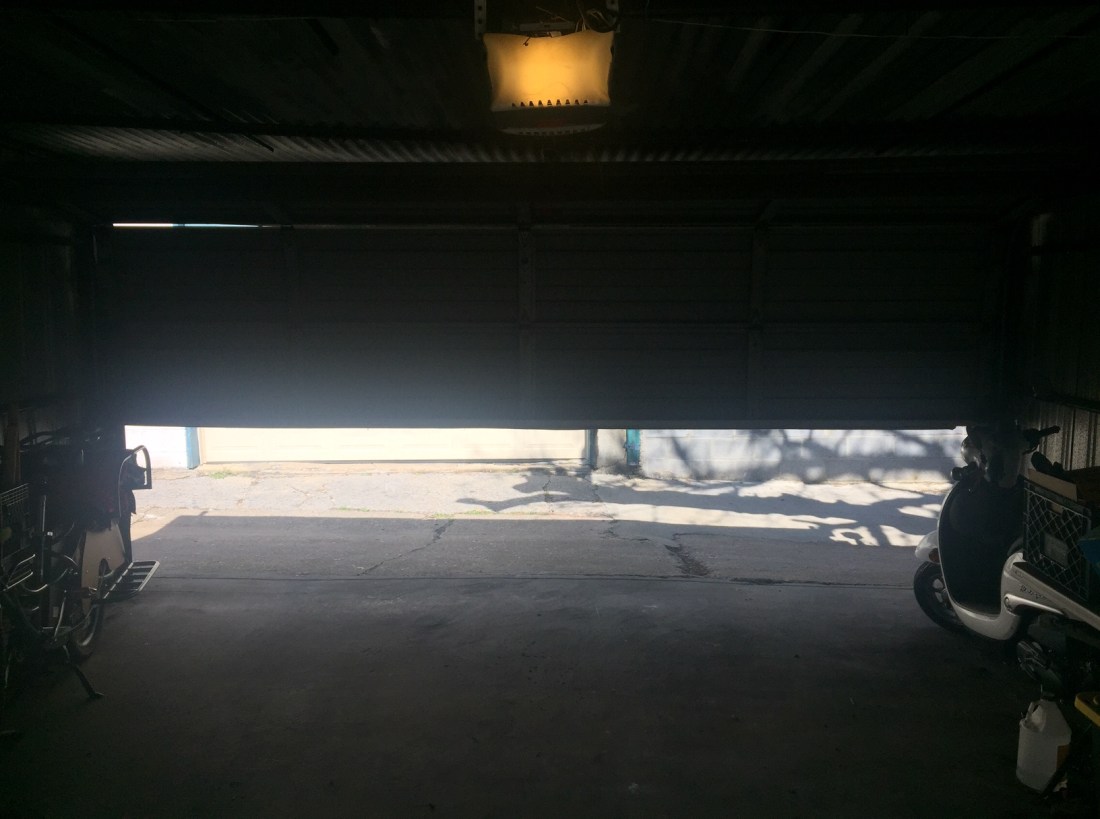
Now we’re in the alley, and I hit the hand-held clicker. This time, the door gets close to closing, and then, pop!, the bottom flap flies off track. It retracts and, once fully open, falls silent.

My plan for restoring familial peace is foiled.

I take off my jacket and start the door-fixing ritual. Basically, it requires hitting the hand-held opener and, having put on leather gloves, manipulating the door back on track as it comes down or retracts. Then you hit the opener again and again, opening and closing and making adjustments to the moving door’s position so as to, hopefully, eventually, after much trial and error, assure it stays on track throughout its to-and-fro journey.

Today, my best efforts aren’t working. After 10 or 15 minutes, with me getting increasingly agitated and shedding more layers of clothing as I huff and puff, I send the kid inside, rolling the dice on what might result of an unexpected sibling reunion mid-morning on this already exhausting day.

I empty the last of the little can of WD-40 onto all the door’s moving parts. Still, it goes off track. About two-thirds of the way down is the point where it pops every time, but I can’t puzzle out the exact point where the sound is coming from. I break out the tube of marine-grade lube, apply it to the wheels in the tracks, but it too is of no use.

I keep trying, pretending I don’t care, hoping for a magical fix. I can close it all the way by forcing it down with my hands while standing inside the garage, but that doesn’t help when you’re out in the alley, trying to get on with your day.

After an hour, I take a seat on the backyard furniture, frustrated and tired. No one has emerged yet from indoors to update me on the state of play, and I decide I’d rather not know at the moment.

The sun is shining, though it’s brisk out. I grab my jacket, put it on my lap, put my heavy boot-clad feet up on the table, and lean back into the thick, soft seat cushion, my face turned partly away from the sun. It feels wonderful. I pull up a sleeve to catch more of the rays on my skin. I fall asleep.

I am not a napper. A 10-minute siesta can ruin my day. I need two hours, minimum, or I’ll just be a groggy mess of sleep-addled grumpiness. So when I awake after some fraction of my minimum, I go inside and head straight to bed, mumbling something about my intentions as I pass the rest of the family.

Later, when I re-emerge, the house is empty. I make a cup of coffee. I head into the back yard to sit in the sun.

I look at the garage door. I hit the clicker. It retracts, as always. I hit it again. It starts to close, but, as expected, it pops somewhere about two-thirds down, and goes back up.

This time, though, from the acoustical perspective of my comfortable chair, I think I know where the “pop” is coming from. I get up and hit the clicker again. I walk up to the door and force it all the way closed.

The spot I’m thinking of is about a foot off the ground, just right of center. I haul back with my foot and let it swing, hard, right onto that spot. I kick it again, surprised at how loud the sound is.

I hit the clicker. The door opens. I hit it again. The door closes. Over and over again, it works. With two swift kicks aimed just right, it’s back to fulfilling its essential purpose so I can go back to mine: preparing a roasted vegetable tart for dinner before movie night.


Falling Waters: One longtime polluter is cleaning up, but the Jones Falls’ troubles are far from over

By Van Smith

Published in City Paper, Feb. 4, 2004

When City Paper literally stumbled upon Hollins Organic Products in December (“Untestable Waters,” Dec. 24, 2003), the three-acre mulch-making operation in Baltimore County’s Bare Hills section was polluting an adjacent stream with black, fusty runoff from its towering piles of compost. The unnamed stream, which runs through city-owned Robert E. Lee Park, was opaque and dark from the point where Hollins Organic discharge entered it, and its sediments were stained from the discoloration.

Hollins Organic owner Doug Hollins told City Paper it was a new problem, brought on by 2003’s unusually wet weather, and that he was in the midst of designing a permanent fix to keep the compost-laden water from overflowing the site’s containment pond and spoiling the stream.

In a Jan. 29 interview, though, Hollins changed his tune after he was informed that the Baltimore County permit file for Hollins Organic shows a 10-year history of stream pollution, despite a permit requirement that the facility “shall not be operated in such a manner as to create water pollution.”

The overflows from the site, the file makes clear, are believed to be brought on by storm events, but the record rains of 2003 were by no means unique in the documented history of Hollins Organic’s sullying of the stream. Community complaints and inspection reports about problems at the site fill the file, with county visits dating back a decade. By that time, the business had already been operating there for 12 years.

“We probably should have done this years ago,” Hollins concedes, referring to the solution he hopes to have installed by early March: a large cement tank to hold site runoff, designed with a mechanism that automatically sprays its contents back onto the mulch piles when it fills to a certain level. “In the long term, it’s going to be a better process,” he predicts, adding, “I do take this stuff very seriously. We will do whatever it takes to make sure this issue is solved.”

In the big picture, Hollins Organic’s faulty runoff containment may seem insignificant. But the unnamed tributary it despoils tumbles downhill for about half a mile before emptying into the Jones Falls, the heir of more than 350 years of human-generated runoff, which rolls along in all of its nutrient-laden, sediment-bearing glory, bound for Lake Roland, then down through the city to the Inner Harbor, the Patapsco River, and the Chesapeake Bay. The Hollins Organic problem is yet another thread in the much larger story of what water-quality experts call “loads to the system”: erosion, animal waste, leaky septic systems and sewers, the runoff from roads, buildings, farms, and parking lots–all of them bringing more water-borne baggage for the Jones Falls to handle.

The efforts of government and citizens to reduce this load have been underway since at least 1972, when the federal Clean Water Act was passed, establishing rules intended to stem pollution. Slow, steady implementation of laws and better management choices have led to some improvements in some upstream parts of the Jones Falls, but, ironically, as the river approaches the relative idyll of Robert E. Lee Park, its water quickly degrades. That’s because the park’s main attraction, Lake Roland, is the common catch basin for every source of upstream water pollution, from Pikesville east to Towson.

Lake Roland, in essence, is like Hollins Organic’s sediment pond–instead of a small composting yard, though, Lake Roland handles the drainage for 33 square miles of suburban watershed. Like Hollins Organic’s pond, Lake Roland over the years has been much studied and lightly managed. Both hold back pollution from the Chesapeake Bay, and both do so less effectively when it rains.

But, whereas Hollins Organic is on track to stopper up its leaky catch-basin, there are no plans to keep Lake Roland from continuing to do what it’s done since it ceased being an active reservoir in 1915–filling in with whatever pollutants drop out of the Falls’ water as it settles behind the dam. The lake’s capacity to trap pollutants before the river crests over the dam, en route to the city, depends on plugging up upstream sources–like Hollins Organic. It’s a never-ending task that, despite years of talk, has only just begun.

The first visit to Hollins Organic Products by the Baltimore County Department of Environmental Protection and Resource Management (DEPRM), back in January 1993, found “an open dump consisting of old 55 gallon drums, 275 gallon oil tanks, pressure treated lumber, metal pipes, etc., . . . Mr. Hollins stated that his landlord . . . dumped the material.”

That was count number one, leveled against the landlord–who dragged his feet past the 30-day deadline for cleaning up the mess, but eventually complied. Count two was against Hollins Organic, whose owner was informed that the facility had 30 days to apply for a DEPRM solid-waste processing permit. The company finally submitted the paperwork after nearly a year, without penalty–though DEPRM did threaten legal action, which seemed to get the process in gear.

The permit file indicates that the delay was due to Hollins’ uncertainty about how to go about controlling sediment on the site. Ultimately, though, Hollins Organic installed a containment pond to trap runoff, a low basin on the site where the liquid dregs of the operation would drain and settle. The pond is separated from park property by an earthen berm, leading to a steep slope down to the unnamed stream, which starts beneath parking lots and businesses along Falls Road and meanders through the woods behind Hollins Organic on its way to the Jones Falls.

The stream courses through an area of uncommon history and ecology. In 1992, months prior to DEPRM’s first visit to Hollins Organic, the National Registry of Historic Places had made 450-acre Robert E. Lee Park the centerpiece of the then-newly designated Lake Roland Historic District, named after the erstwhile city reservoir a mile or so downstream from the composting facility. A stone’s throw away from the mulch piles is an abandoned quarry, a reminder that here is where chromite was first discovered, in 1808, heralding a half-century of Baltimore domination of global chromium production. The Virginia pines and briars that dominate Hollins Organic’s side of the park cover rocky terrain known as serpentine barren, an unusual geology attractive both for mineral extraction and, in small outcroppings of unforested space, a special array of grasses, flowers, and bugs that can tolerate its metallic soil.

Thus, it would seem, the case for stopping its degradation by Hollins Organic was that much more compelling.

In April 1994, a DEPRM inspector noted that Hollins Organic’s pond “did not appear to be designed properly. Runoff and leachate from the compost stockpiles overflows through rip-rap stone to a small feeder stream to the Jones Falls.” In February 1995, a DEPRM supervisor noted that the pond “was filling up with sediment and should be upgraded with the addition of stone”–a measure Hollins Organic took immediately.

It didn’t fix the leak, though, because a year later Robert E. Lee Park Conservancy President Robert Macht wrote a letter to DEPRM, pointing out that the stream’s “water quality is being adversely effected” by the Hollins Organic operation, that “sometimes the stream is bright green,” and that “an unpleasant odor is emanating” from the water. The county investigated the complaint, and in March 1996 issued a one-page report explaining that runoff “ponds behind blockage [on the site] and percolates into the ground and is seeping out from the side of the berm.” The one-page report’s solution: Remove the blockage, and if that didn’t work, install an impermeable liner to contain the runoff on-site.

Concerned citizens wanted more. “Water [in the stream] above this runoff is clear and largely odorless,” observed Laurie Long, then-executive director of the Ruxton-Riderwood-Lake Roland Area Improvement Association, in a March 1996 letter to DEPRM. “Water below the runoff is very dark and murky, somewhat frothy, and sometimes green,” adding that “we request that DEPRM . . . establish stream quality requirements as a condition” of Hollins Organic’s permit.

No liner was installed. No stream-quality requirements were established as a condition of the permit. Instead, the pollution continued–not continuously, perhaps, but whenever there was sufficient rainfall to overwhelm the pond’s ever-changing capacity. A Dec. 10, 1996, DEPRM memo about a phone call from the Valleys Planning Council’s then-executive director, John Bernstein, summed up the problem in shorthand: “Organic material washing into stream during storm events–improper containment. Mr. Bernstein said the stream smelled like Hollins Organic Product’s site.”

It’s not as if county officials were simply sitting on their hands. When complaints were lodged, they inspected the site. Within a week after Bernstein’s December 1996 call, for instance, an inspector again visited Hollins and found that the “pond has been washed out and filled in with mulch. The runoff was filtering through . . . [and] was murky in color and did have odor of [Hollins] products.” Doug Hollins told the inspector “he would correct the problem ASAP.” If Hollins did correct the problem, though, it was a short-lived solution because follow-up DEPRM visits, most responding to complaints in 1998 and 1999, showed the leaking continued–and was often “malodorous.”

Then, in April 2000, a DEPRM inspector visited Hollins Organic, prompted by an anonymous phone call, and discovered that “a pump was being used to empty a sediment control pond and water was being discharged” over the berm into the stream. “Mr. Hollins stated that that was the usual practice during a significant rain event.” After that, DEPRM in May 2000 secured assurances from Hollins that he would stop the illegal pumping and come up with a permanent solution to the pond problem. Nearly four years later, the county still awaits one.

In an effort to determine Hollins Organic’s impact on the stream, DEPRM sampled its water at various times starting in 1996–including once at the suggestion of Mr. Hollins himself–but the permit file is only clear about the results from 2002. The data shows that, after a rainstorm, the leaky pond dramatically elevated the stream’s concentrations of common minerals such as iron, sodium, calcium, and potassium, and discharged so much organic content that the stream water exceeded by up to 10 times the recommended standards for water released from the state’s wastewater treatment plants.

DEPRM ordered more samples, but by the end of 2002 the data-gathering was called off. “Plans have been submitted to relocate HO facility to site off of Beaver Dam Rd., in Cockeysville,” a memo in the DEPRM file reads. “As a result, no additional sampling of stream behind Falls Rd. facility is warranted.”

So far, Hollins’ plans to move to the 4.5 acres he purchased in Cockeysville haven’t borne out. (Today he says he still hopes to at least use that property as “a satellite site to relieve the pressure off of” his Bare Hills base.) But, as noted, 2003 turned out to be a record year for rainfall, and history had already shown what happens at Hollins Organic when it rains. When DEPRM returned for a routine inspection in December, it found yet again that Hollins Organic’s pond was polluting the stream.

The county agency declined, for now, to share with City Paper the documents pertaining to the latest discoveries at Hollins, but its director, David Carroll, was willing to talk about DEPRM’s position during an interview in his Towson office. “We’ve said to [Hollins Organic], you’ve got to control this permanently,” Carroll explains, his water-quality staff at hand, ready to answer further questions. “We’ll have to see what he designs, and then decide whether or not to renew his license.”

One thing is clear, though: “The law says he can’t discharge any water” from the site, says DEPRM’s waste-management chief, William Clarke, who adds that Hollins “understands now that there is no scenario under which he is permitted to discharge. Those fixes he tried over the years proved to be inadequate, and now a lot more attention has to be paid to how [the pond] is constructed.”

Clarke bristles at the conclusion that DEPRM’s efforts on behalf of the stream constitute bureaucratic foot-dragging, but, when reminded of the permit file that shows the same problem cropping up over and over again for a decade, he sums up the obvious: “Sometimes it’s a long process.”

David Carroll is head of Baltimore County’s Department of Environmental Protection and Resource Management now, but he’s had similar leadership roles in Baltimore City, state, and federal government over the decades–experience that brings a hardened sense of reality about managing the environment in and around a major urban area.

“People have this romantic notion that eventually we’ll get it cleaned up, and that’ll be it,” he says of efforts to improve water quality, in the Jones Falls or any other watershed. “No, it is forever,” he announces solemnly, his slacks and sweater complementing his well-worn bearing of a wizened administrator, comfortable with the big picture and the nitpicking details alike.

“You have to manage for invasive species and deer so that birds will come back, do expensive stream restorations, fix sewer leaks–there’s always something happening there–and make new development create options to improve streams and forest cover with plantings, and install the best technology to control runoff,” Carroll says rapidly. “It’s a long-term commitment and a very complicated project. We spend quite a bit of money every year to go back and find and fix problems. Everybody has their role in it–and we welcome efforts to keep the heat up, because that’s the media’s role.”

Carroll’s posture is understandably defensive, considering the longstanding water-quality problems such as those at Hollins Organic, despite decades of lip service about cleaning them up. In his view, though, certain portions of the upper Jones Falls watershed are recuperating after decades of abuse or neglect. “A large portion of this stream is actually in pretty good status,” he points out. “We do see improvement, and it’s not finished–we have more work to do and we wish we could do even more.”

The good news is that long-term indicators of ecological health confirm that upstream sections of the watershed in the Greenspring Valley area support enough bugs and fish to qualify for removal this year from the state’s annual list of biologically impaired waters. Last year, the entire Jones Falls was taken off a similar list of waters impaired by zinc. Baltimore County officials, meanwhile, report that the Jones Falls trout population has been found as far downstream as Sorrento Run, inside the Beltway where the Jones Falls nears Lake Roland, and is so robust that it is used to stock streams in other county watersheds.

But the Jones Falls continues to bear heavy burdens from bacteria, copper, lead, nutrients, sediments, and PCBs (only in Lake Roland), according to Richard Eskin, head of the Maryland Department of the Environment’s Technical and Regulatory Services Administration. The state Department of Natural Resources, meanwhile, deems the Jones Falls a “Priority Category 1” watershed, meaning the watershed fails to meet the agency’s clean water and natural resources goals. Volunteer stream-water monitors with Maryland Save Our Streams, a now-defunct environmental group, assessed water quality just below the Lake Roland Dam 17 times between 1990 and 1999, finding it “poor” on 13 of those visits. Clearly, something’s rapidly fouling the Jones Falls water as it travels from Interstate 83 to the Lake Roland Dam.

County officials finger three urban subtributaries–Moore’s Branch, Roland Run, and Towson Run–as the most troublesome contributors to these problems. “All three have poor ratings on nine years of biological monitoring,” says DEPRM’s water-quality chief Steve Stewart, adding that costly stream restorations are planned. All three of them dump their loads on the threshold of Lake Roland, which continues to be what researchers dubbed it in a 20-year-old report about the lake: a “microbial sink,” where bacteria, sediment, and other pollutants settle out of the water. As a result, its value for water-based recreation is all but gone–swimming is a high-risk endeavor, and don’t eat the fish–but its value as a giant ecological filter is beyond question.

“Lake Roland’s been doing quite a clean-up job in itself,” observes Eldon Gemmill, another DEPRM water-quality expert. “It’s shallow, it has a lot of aquatic life and wetlands to help treat the runoff. I would dare say the Chesapeake Bay would be a lot worse off without Lake Roland.”

After all, as Carroll points out, “for 140 years, it’s been capturing everything that has come off that watershed. And all that sewerage and storm-water infrastructure from all the highways, and runoff from unregulated pre-1990s development, all of it coming through there–if I wasn’t from around here, and I was seeing the maps for the first time, I’d expect that’s where all the problems would be–right around Lake Roland.”

Field trips to hard-to-reach stretches of the Jones Falls watershed near Lake Roland leave the same unavoidable impression that Carroll describes–these are the areas where it all comes together, so to speak, and dumps a heavy load of contaminants into the falls as it rushes toward the lake. The effects of past abuses–chlordane from termite-control treatments at Greenspring Valley homes, effluent from the textile mill that operated for 150 years until 1979 on the Jones Falls banks just east of I-83–are no longer apparent, but it’s clear the water is still actively polluted.

Each little downstream tributary between Moore’s Branch and Robert E. Lee Park–about a mile-long stretch where the river’s main stem runs just east of Falls Road–makes it own little offering. One, emerging from a secluded, wooded dell right next I-83, trickles with a low but constant flow of foul-smelling water, which wells up from the ground beneath a jumbled wreck of old moss-covered pipes. Another rushes out of the Sorrento Run housing development, staining the creek-bed orange with iron oxide–a sign, county officials explain, of nutrient-rich, oxygen-depleted water upstream, possibly due to sewage. The same phenomenon can be seen where the next two downstream creeks come out of culverts carrying them from neighborhoods west of I-83. Next is the tributary that drains down from Hollins Organic, its banks periodically stained black from the murky discharges upstream.

The combined loads from these active sources are already in the Jones Falls when Roland Run and Towson Run join it at the head of the lake. Roland Run drains Riderwood’s middle-class tracts of detached single-family homes, as well as the posh yards of Ruxton, where leak-prone septic systems are the prevailing sewerage. Towson Run handles the runoff of the Shepherd Pratt/Towson University area, and by the time it approaches Lake Roland, just east of Bellona Avenue, it’s already assumed what DEPRM’s Stewart calls “an urban character” from pollution.

Pollution, of course, has been entering Lake Roland for a long time. It wasn’t until a 1972 study by Goucher College, though, that anyone had a well-informed understanding of its modern problems: rapid in-fill from sediments, high levels of nutrients robbing the water of oxygen, and bacterial contamination. The Goucher study also documented the lake’s ability to cleanse the water. Far fewer microbes were in the water as it left the lake than when it entered, the report showed, so Lake Roland was not only holding back sediments, it was also eliminating microbes.

A Baltimore City report from 1984 confirmed the Goucher group’s finding that Lake Roland was “an efficient microbial trap,” and added that nutrient concentrations in the lake had decreased since 1972. Yet it uncovered a new mystery: “in-lake bacterial contamination was observed which could not be accounted for by tributary inputs.” In other words, something in or immediately around the lake itself, as opposed to its feeder streams, was adding bacteria to the water. The report speculated that the giant sewer main that runs under the lake, or failing septic tanks nearby, might be to blame.

Given the sediment loads entering the lake, meanwhile, the city researchers working on the 1984 report estimated the lake would fill in completely sometime between 2004 and 2048. Without dredging, the report predicted, a filled-in Lake Roland would lose effectiveness as a trap and “sediment and pollutants now trapped in the lake will be transported” downstream to the harbor, where they would have to be dredged later as part of shipping-channel maintenance.

The lake was not dredged, though a stronger replacement dam–the first since the original was put in service in 1861–was constructed in the early 1990s. Carroll knows of no dredging plans–“It would cost a great deal,” he points out. Much better, he says, to let Lake Roland continue to fill in, its open water replaced with emerging acres of stream-traversed wetlands soaking up and settling out the pollutants–cleansing the Jones Falls, at least partially, before it heads across the dam. “We’d almost have to reproduce it by design,” Carroll says of the wetlands’ aid to Jones Falls water quality.

Still, the 1984 report raises the undeniable prospect that the lake will continue to lose more of its valuable capacity to trap so much of the pollutant load the Jones Falls brings it. Since dredging is not in the cards, the obvious solution is more of the same–working to plug leaks, slow erosion, and generally lighten the load the lake and the Jones Falls have to handle.

When it comes to improving the health of the upstream portions of the watershed, “that’s the only way we’ve been able to turn the corner” Carroll contends. “And that’s how we’ll work our way out of the rest of these years of abuses.

“We still have a long, long way to go, certainly in the lower watershed,” he continues. “And the city has a doubly or trebly tough situation.”

The city’s contribution to the Jones Falls’ pollutant load is substantial, and measured in great detail by the city Department of Public Works in an annual report. The latest one, issued last June, shows that Western Run (which enters the Jones Falls at Mount Washington after coursing along Cross Country Boulevard) and Stony Run (which drains Roland Park and Hampden) both suffer from chronic sewage contamination and are virtually devoid of fish. Channel improvements for Stony Run, costing $6.65 million, have been put in the city’s capital budget to help improve matters.

But above the dam, the city also has key responsibilities. After all, city-owned Lake Roland and Robert E. Lee Park fall under the bailiwick of the city Department of Recreation and Parks. Efforts to improve the department’s attention to the park have proven exasperating for critics, such as Robert Macht of the Robert E. Lee Park Conservancy, who says he’s “really frustrated by the lack of care that I perceive the city has taken–little if any management, maintenance, enforcement of rules, or concern for environmental problems. They’ve just failed to show concern on so many counts.”

“There is a lot of controversy around the use of the park,” concedes city Recreation and Parks spokesman Robert Green, “about upkeep and maintenance and future safety, particularly in regards to the 30 acres that are to be closed–the peninsula area–for a soil remediation and erosion control project.” This effort, which is scheduled to begin soon, intends to rectify suspected contamination from dog waste in an area of the park that has long been used almost exclusively by dog owners.

The move was sparked by an October soil analysis on the peninsula that found bacteria and acid levels up to 17,000 times what’s acceptable for human contact, Green explains, though he’s hesitant to speculate that these over-the-top bacteria readings may help explain the 1984 study’s mystery of in-lake bacterial sources: “It’s hard to say for sure, but clearly the soil is very contaminated” and is actively eroding into the lake. Many dog owners have vocally voiced doubt about the contamination, and heated public meetings this winter have left an acrimonious air around the controversy.

In addition, Green adds, the long-planned replacement of the old footbridge across the Jones Falls just below the dam with a bridge capable of handling heavy equipment “is in the final planning stages, and will enable us to do the [soil-remediation] project, and provide better maintenance on an ongoing basis.”

Jeff Budnitz, a board member of the Ruxton-Riderwood-Lake Roland Area Improvement Association, lives next to Robert E. Lee Park and is optimistic that the city is beginning to take an active interest in improving the park. He points to the city’s 13-point “concept plan” for improving the park, a one-page planning document distributed last September, that he says marks the beginning of a coordinated city-county effort to “make the community feel like the pump is being primed” for more action. Some issues set to be addressed, such as shoreline stabilization, erosion protection, and trails maintenance, are much-needed elements of any strategy to help the park reduce its impact on Jones Falls water quality.

Of course, humans and human use are the biggest contributors to the decline in the ecology of the park area. As Christel Cothran, program director of the Jones Falls Watershed Association, notes, “There is so much foot traffic, you have to ask, as with so many such parks, are we loving them to death with high use?” The city’s strategy of closing off the peninsula seems wise, she says, adding that it should extend the practice to other areas of the 450-acre park–“close off sections at a time, give them a rest,” she says. Either way, she adds, now that the city’s doing something, “I think maybe we should give them a little bit of credit for that.”

The same, Cothran continues, holds true for the county. While its handling of the Hollins Organic permit appears to have been a case of ineffectual regulation, Baltimore County’s government “is more attuned to protecting the environment than most any other place in the country,” she contends, rattling off various ways that agencies there have been recognized nationally for their zealous pursuit of good environmental management. “They’re way advanced,” in her estimation, which is why she’s tickled that her organization is partnered with DEPRM to help improve conditions for the Jones Falls by monitoring for pollution problems.

“This is a great opportunity to promote stream-watch programs,” Cothran says of the current attention focused on Lake Roland and the Jones Falls, including the snafu at Hollins Organic, which garnered lots of attention over the years from complaining citizens, yet continued to pollute the stream. “We try to catch these things,” she says. “But the effort’s still not good enough, in many cases. Years go by before people walk back in some of those stream-valley areas, much less report what they might come across. The more people doing that, the better we’re going to be at catching and stopping sources.”

Echoing Carroll’s response when confronted with suggestions that maybe not enough was being done to lessen the Jones Falls’ load, Cothran says bring on the spotlights. “All of the attention we can get for these problems is welcome and needed,” she says. “That’s the only way to fix them, is to have more people involved in the solutions.”

Untestable Waters: A Jones Falls tributary in Robert E. Lee Park spoiled by composting operation

By Van Smith

Published in City Paper, Dec. 24, 2003

Walking in city-owned Robert E. Lee Park, along the east side of Bare Hills in Baltimore County, you’re bound to turn up some deer or maybe scare up a grouse or two. Virginia pines and thick mats of briars and vines dominate the rocky, thin-soiled landscape, which is crisscrossed with streams and trails, some of them used occasionally by humans, most of them blazed faintly by deer that leave scat and hoof-prints on the ground and rub marks from their antlers on tree-trunks.

This pocket of the park, while idyllic, is situated up against the backs of several businesses lining Falls Road, including Hollins Organic Products, a two-acre composting and mulching operation. The company has been located at this Falls Road site for 22 years and, of late, City Paper has discovered, it has been giving Robert E. Lee Park and the Jones Falls, which runs through the park, a nasty dose of pollution.

“This is almost making me puke,” exclaims Darin Crew, a stream monitor for the Herring Run Watershed Association, as he steps carefully around a tree-strewn, briar-choked stream-bed in this rarely traveled area of the park. This particular stream runs alongside Hollins Organic Products, and its water is a murky blackish-brown; it eventually empties into the Jones Falls, less than a mile downstream.

“It smells like a combination of manure and old tobacco chew,” Crew notes. “And the water’s black as English breakfast tea. It’s so full of suspended matter that you can’t see through it at all.”

Robert E. Lee Park’s more high-profile pollution problem, as reported recently in the news, has not been dirty, smelly run-off from Hollins Organic, but rather the tremendous concentration of dog waste that’s accumulated in another, more populated section of the park. City officials are mulling the wholesale replacement of contaminated topsoil near the Jones Falls Dam, which is a hugely popular dog-walking spot.

The pollution from Hollins, discovered by Baltimore County officials on Dec. 12 and stumbled upon by a City Paper reporter walking in the park two days later, has been mostly off the radar. Runoff from Hollins may have been polluting the stream at varying intensities for years, however, though no one has previously noted or reported it.

At City Paper‘s request, Crew agreed to test the water to find out what, if anything, could be polluting the small, unnamed tributary. The test, conducted on Dec. 16, involves adding chemical tablets to vials of samples, causing reactions that change the water’s color to indicate levels of acidity, nitrogen, and phosphates. But because the water was, in Crew’s words, “too dark and turbid to show any color,” it was untestable.

“So at this point I don’t know what’s in it,” Crews says. “But it’s definitely a problem.”

Among other lines of business, Hollins Organic accepts natural wood waste–mostly tree stumps, trunks, branches–and turns it into marketable mulch sold for landscaping and gardening. During the processing, excess water that isn’t soaked up in the compost piles drains to the lowest point of the company’s yard, where it collects in a pool next to a berm separating it from park property. The park side of the berm is a steep slope, and water from the pool is seeping through rapidly, cascading down in black, bubbling rivulets until it collects in a small marsh that drains steadily into the stream, which runs dark from that point on. The side of the berm and the marshy soils are stained black from the effluent.

The day after the test, Crews speculated about what could be in the “black seep overflow” that is making its way to the stream and what impact it could be having on living things in the water.

“We definitely know that there are nutrients, coloring, and fine sediments leaving Hollins,” he says. “The sedimentation within the stream, combined with the coloring, has to be disrupting the aquatic life, suffocating and smothering bugs and fish. I would guess, based on my professional experience, that sediments and color are impairing the stream, if this is occurring year-round.”

Based on anecdotal evidence from dog walkers who frequent these woods, it has been occurring year-round, and for a while.

“It’s been running murky for a couple of years now,” says Chris Toland, who visits the parks regularly on his dog walks–and this time was trying to keep nine dogs from drinking the sullied stream water. “But it appears to have gotten worse fairly recently.”

Following the stream to its mouth at the Jones Falls, one crosses two smaller tributaries, which run clean and clear from the uphill woods until they join the despoiled stream. The stream-side sediments are stained black, and the stream’s banks are lined with downed, dead, and dying trees. In the long-abandoned railroad bed that runs through the park, the stream forms still, black pools. At its entry to the Jones Falls, it spills out in a distinct black ribbon that runs with the current for 20 or so yards before mixing into the much larger river.

Toland (a personal friend of this writer) and his companion, Mary Byrne, always figured authorities knew about the problem, they say, since the stream has been obviously polluted for so long. But then again, they note, this area of the park is so remote that such problems could be missed, or not recognized as problems.

“We never see anybody out here,” Byrne says.

When contacted about the runoff into the stream from his business, Hollins Organic owner Doug Hollins invited City Paper to visit the company’s Falls Road site, with his engineer, Rick Richardson, in tow. The Hollins officials say they are aware of the pollution problem the company is creating, and they are trying to come up with a solution.

The company has tried to contain excess runoff from its mulching operations with a makeshift stone dam built into a low part of the berm that separates the yard from the park. This runoff management system, Hollins says, is designed according to standards required under state and county permits. But this year’s extraordinary amount of rainfall–2003 is heading toward being Baltimore’s wettest year on record–has overwhelmed it, causing runoff to breach the berm and flow into the stream.

“I want to fix this right away,” Hollins says, as a pump-out truck pulls up and prepares to drain the pond. Behind him, a giant grinder is spitting shredded wood, hot and steamy from decomposition, into piles that are being pushed around by bulldozers. “Then I want to engineer something so this won’t happen again. I’ve been here 22 years and I take this seriously.”

Hollins says inspectors from the Baltimore County Department of Environmental Protection and Resource Management visited the site on Dec. 12, which is when the pollution problem was discovered.

“We went out on a routine inspection,” says Baltimore County spokesman Bill Clark, “and noted that there was a problem with the pond, and they were advised at that time that they were in violation.”

“I don’t think it had been going on very long,” Hollins contends, adding that on Nov. 5 the Maryland Department of the Environment performed a routine inspection and found nothing wrong “that I know of.”

As for the stench of the water, and its dark, turbid quality, Hollins explains that “it’s murky because, in an effort to maintain [run-off] water on the property, we’ve created a stagnant pond. The organic matter [from the composting and mulching operation] gets trapped in the pond and is basically fermented, which is why we have this odor.”

Maryland Department of the Environment spokesman Richard McIntire says he has no record of a department inspection at the company on Nov. 5, the date Hollins cites. “We have not been there recently,” he says, noting that the case “has been assigned to an area inspector . . . but we don’t know when we’ll get there” to analyze the seepage and determine the level of pollution it is likely causing.

“We should have heard about this long ago from somewhere,” McIntire says. “We can’t be everywhere all the time, but taking care of the environment is everyone’s responsibility.”

Christel Cothran, who runs the nonprofit Jones Falls Watershed Association, was notified by City Paper about the Hollins Organic situation. She notes that the Jones Falls is already suffering from fecal-coliform contamination, which was revealed most recently in a midsummer sampling her organization did at 26 locations throughout the Jones Falls watershed–23 of them were found to exceed limits for contamination.

Cothran says she is hopeful that a combination of regulatory pressure and Hollins’ ingenuity will fix the leak and allow the stream to take on a semblance of healthfulness. But her hope is tinged with a level of frustration borne of experience: “It’s just amazing, once something like this is spotted, how long it takes to fix.”

Dave Desmarais: 1958-2004

By Van Smith

Published in City Paper, Nov. 24, 2004

David Desmarais was City Paper‘s dry cleaner for years, and he became friends with many of its sales staff as a result. In the editorial department, too, Desmarais was regarded as a friend, but even more so as a vital force in city life.

As a small-business owner, he wanted Baltimore to do well, but his true motivation as a civic booster derived from his role as a community activist and resident – though he sometimes admitted deep disappointment in the city’s directions, especially during its bleakest years in the late 1990s. He died of cancer Nov. 12 at the age of 46.

Desmarais was a man on the scene, always present at festivals, films, political events, taverns, concerts, and government hearings, always ready to start a free-ranging conversation, offer a news tip, comment on the outrages of local leaders, or constructively critique City Paper, whose writers became very familiar with the sound of his calm, steady voice, hearkening from Northeast Baltimore, or receiving e-mails from him—his address was ilovebaltimore@aol.com. (His license plate read “bawlmer”).

Desmarais moved here from his native Boston when he was still a toddler. His father, Ken Desmarais, took to the airwaves as a WCBM-AM radio jock, and Dave took to his new neighborhood, Northwood. Graduation from Calvert Hall College High School (1976) was followed by enrollment at Randolph Macon College in Virginia, where he earned an English degree. After that, he worked in retail sales downtown and, later, for the Downtown Partnership business association.

By 1990, he’d gotten into the dry-cleaning business, and his routes for pickups and deliveries added to his impressive knowledge of local culture, history, and architecture.

Desmarais was also a community activist. He helped found the Herring Run Watershed Association, a local environmental group, and Communities Organized for Responsible Development, which monitors Harford Road economic development. He also served as president of the Moravia-Walther Community Association.

At the Nov. 20 memorial service for Desmarais, held at the Church of Jesus Christ of Latter-Day Saints in Lutherville, brother Doug Desmarais recalled that, before he succumbed to cancer on Nov. 12 at the Gilchrist Center for Hospice Care in Baltimore County, Dave made a last-minute change in his own memorial plans.

“One of the things we talked about was this gathering,” Doug Desmarais said. Dave ultimately opted against “going to a dive on Harford Road for crabs and Natty Boh” to commemorate his Balto-centric life. Instead, though he was not a member of the church, he decided that a service where his siblings—Doug and sister Suzanne Vinyard—practice their faith was fitting.

Anthony Tomassetti, who shared a birthday with Dave Desmarais, rued that he’ll miss an annual tradition: drinking a mutual beer to one another on Feb. 16, no matter where each was at the time. He commended Desmarais for his curiosity, intellect, and individuality, and recalled that the dry cleaner/activist “forced local political-signage laws to be enforced” in Baltimore City—a crusade for which City Paper dubbed Desmarais “Baltimore’s cherub of political-sign justice.” Tomassetti used the title “passionate pilgrim of Baltimore” to describe Desmarais, and pointed out that Mayor Martin O’Malley sent Desmarais a “very nice letter” before his passing.

“That Dave, he knows almost everything,” was a common remark made about Desmarais, Tomassetti continued. “I fully expect he will be debriefed in heaven on current affairs by everyone from Ben Franklin, Abe Lincoln, and Martin Luther King Jr., to John Lennon of the Beatles.”

Put that roster around a table of crabs and beer at a Baltimore local, and Desmarais would know he’d reached Nirvana.


Hot Contract: City bribery scandal tied to influential father and son

By Van Smith

Published in City Paper, Jan. 26, 2005

Mark Sapperstein owns 113 W. Hamburg St., an 8,000-square-foot commercial building in Sharp-Leadenhall. The South Baltimore property, though devoid of signs, houses Allstate Boiler Service, a company owned by Gilbert Sapperstein, Mark’s 73-year-old father.

On Jan. 7, Allstate Boiler’s bookkeeper and office manager, Ida Marie Beran, pled guilty in a bribery case involving the company’s contract with the city to provide boiler services for municipal agencies. Also pleading guilty was Cecil Thrower, a city Department of Public Works employee since 1984 who worked at the Back River Wastewater Treatment Plant in Essex.

The case ties an established name in Baltimore’s business and political class—that of the Sapperstein family—to an ongoing criminal investigation.

In the statement of facts filed in the case, which was brought by the Office of the State Prosecutor, Beran and Thrower admitted that they conspired together to inflate invoices under Allstate Boiler’s contract with the city. While Thrower received somewhere between $1,500 and $2,000 for his part in the scheme, Beran received nothing—though her employer received “well over” $120,000 in excess payments as a result of the fraudulent bills, according to case documents.

The court record further explains that the conspiracy began in approximately 1998, at which point “Mr. Thrower was approached by the business owner who employed Ms. Beran [who] suggested to Mr. Thrower, ‘From time to time you could do something for us and perhaps we could do something [for] you.’ . . . [O]n more than one occasion, while acting at the instruction of and in concert with her employer, Ms. Beran prepared the envelopes containing cash for Thrower and provided them to other employees for delivery to Thrower.”

The case documents make no mention of Allstate Boiler or the Back River plant. Department of Public Works spokesman Robert Murrow, however, confirmed for City Paper that the city contract defrauded in the scheme has been held by Allstate for “like 20 years” to provide boiler work for any city agency that needs such services, and that the inflated bills were for work at Back River.

Allstate, which has been in business since 1965, also holds the boiler contract for the Baltimore City Public School System, according to city schools spokeswoman Vanessa Pyatt, though she says the contract is “set to expire in February.”

State prosecutor Robert Rohrbaugh confirms that, “absolutely, this is a continuing investigation,” though he could “neither confirm nor deny” that the investigation continues to focus on Allstate Boiler or the Sappersteins. Rohrbaugh’s reticence aside, the record makes clear that Allstate, not Beran, benefited from the longstanding bribery scheme.

Mark Sapperstein acknowledged to City Paper that Allstate Boiler Service is located at his property, but he declined comment about the company or the bribery scandal. Gilbert Sapperstein did not return calls for comment left at Allstate, and contact information for Beran could not be found. Thrower’s phone at his West Baltimore residence has been disconnected.

Mark Sapperstein is a major player in local real-estate circles. He’s a partner in Silo Point, a $200 million proposal to convert a derelict grain elevator in Locust Point into a residential-retail development. On Jan. 13, the Baltimore Development Corp. awarded development rights to a city-owned parcel at Calvert and Lombard streets to Mark Sapperstein and his partners, who planned to turn it into a $71 million apartment complex called Cityscape. In 2002, he and his partners constructed a $13.5 million parking garage at Calvert and Lombard. Last spring, Sapperstein purchased 200 acres on North Point in eastern Baltimore County, where he plans to build luxury single-family homes on the Bauer Farm tract, where British troops in the War of 1812 marched en route to face Baltimore militias.

Gilbert and Mark Sapperstein, through their respective companies, have been active as donors to campaigns of elected officials. Since the fall of 1999, the two, along with Mark Sapperstein’s wife and several Sapperstein companies, gave at least $33,270 to the campaign committees of various elected officials.

Of the total, $9,650 went to Mayor Martin O’Malley (D), $8,000 went to Baltimore County Executive Jim Smith (D), and $4,250 went to Gov. Robert Ehrlich (R). Nearly all of the rest went to legislators representing Baltimore City and Baltimore County. At the federal level, Gilbert Sapperstein donated $250 each to U.S. Rep. C.A. “Dutch” Ruppersberger (D-2nd District) and the Republican National Committee. Mark Sapperstein gave $1,000 to U.S. Sen. Joseph Biden (D-Del.) and $500 each to Ruppersberger, U.S. Sen. Barbara Mikulski (D), and Virginia Congressman Eric Cantor (R-7th District). Mark Sapperstein’s wife also gave $500 to Cantor.

Gilbert Sapperstein, according to several sources familiar with the workings of the Baltimore City Board of Liquor License Commissioners, is known as a go-to guy for prospective liquor licensees looking to break into the bar business. As a secured creditor for bars that fail, he assumes control of properties and liquor licenses and thus can procure opportunities for new entrepreneurs. According to liquor board documents, for example, Sapperstein was a secured creditor in a March 2003 license transfer for Mary’s Place in West Baltimore. Often, sources say, bar owners who are indebted to Sapperstein, who has been in the poker-machine business for years, agree to keep his poker machines in their establishments.

Both Sappersteins have had run-ins with the law for gambling-related charges. Gilbert, whose Star Coin Machine Co. is housed at 113 W. Hamburg with Allstate Boiler, faced 107 gambling-related charges in state courts in the 1980s and ’90s relating to Star Coin’s poker machines, though prosecutors declined to prosecute nearly all of them. In two cases, he received probation before judgment and was fined $1,475. Mark Sapperstein was charged with four gambling-related counts in 1989, though prosecutors chose not to pursue the cases. State records indicate that Mark Sapperstein’s poker-machine company, Mark’s Vending, has been inactive for more than a decade.

In 1984, Gilbert Sapperstein faced 18 housing-code violations for properties he owned in the city, receiving probation before judgment for 16 of them while prosecutors declined to pursue the remaining two charges. In 2003, Gilbert Sapperstein was charged with 10 housing-code violations in connection with a rowhouse he owned at 3203 Fleet St., receiving probation before judgment and $170 in fines. He sold the property shortly afterward.

Last April, Gilbert Sapperstein sold one of his properties in the Hollins Market neighborhood—the former Tom Thumb/Gypsy’s Café property, which in 2000 collapsed amid ill-conceived renovations. Two of his other properties in the same Southwest Baltimore neighborhood on Carrollton Avenue—one of which housed the Club Medusa, a hipsters’ after-hours social club, in the 1990s—are for sale. In July, he sold a property at 1600 W. Baltimore St., which houses a tavern called Good Times.

Currently for sale in the 800 block of West Cross Street is the property that housed Foul Ball Bar and Grille, which is owned by 2001 Eastern Ave. LLC, one of Gilbert Sapperstein’s companies. The Fells Point address the company is named after houses the Colonial Inn (owned by the same company). In Baltimore County, Gilbert Sapperstein owns 9727 Pulaski Highway, a large restaurant currently under renovation, and 2123-25 Sparrows Point Road, a strip club and bar.

The list of Sapperstein properties—many of them with liquor licenses attached—could go on and on.

In the 1990s, Mark and Gilbert Sapperstein were named, along with dozens of other parties, in a civil Racketeer-Influenced and Corrupt Organizations (RICO) lawsuit brought by Donald D. Stone, a self-described surfer dude who alleged that the Sappersteins, their business partners and lawyers, and the law-enforcement bureaucracy in Maryland and Florida conspired to keep him from shedding light on their allegedly corrupt schemes. The case, which was filed separately in federal courts in Maryland and Florida, went nowhere. That outcome has not kept Stone from posting potentially libelous statements about the Sappersteins and others on the internet—though, so far, Stone says he has not been sued.

Part of Stone’s investigation into the Sappersteins focused on an Anne Arundel County deal for cell-phone towers that led to a lawsuit against Mark Sapperstein and his business partners by George and Mary Jane Chamberlain, who moved from Annapolis to New Hampshire before filing the complaint in 1999. The lawsuit, which has since been settled, alleged that Mark Sapperstein and two partners, both of whom also sat on the Anne Arundel County Economic Development Commission, stole the couple’s idea for dominating the communications-tower industry. The terms of the settlement are confidential, though the amount paid to the Chamberlains—$40,000—later leaked out. The lawsuit was filed shortly after Mark Sapperstein sold his communications-tower companies to a Florida company for $8 million in 1998.

Investigators are keeping mum about where they might be headed as they scour the books. Only time will tell whether the Sappersteins are in the clear or headed for more trouble as the case progresses.


Fouled Nests: The bust of a local poker club uncovers all sorts of messy connections

By Van Smith

Published by City Paper, Nov. 23, 2005

When Baltimore City Police Sgt. Craig Gentile’s vice enforcement unit arrested 95 people for illegal gambling at the Owls Nest poker club in South Baltimore near M&T Bank Stadium on the evening of Nov. 2, it opened up a can of worms. Gentile, a veteran vice cop who routinely busts strip joints and nightspots, wouldn’t discuss the raid or the ongoing investigation of the Owls Nest for this article. But the public record, law-enforcement sources who spoke to City Paper on the condition of anonymity, and interviews with people close to the action at the Owls Nest and in the local poker world show that it is more than just a refurbished warehouse hosting charity gambling.

At its core, the Owls Nest is an illegal poker den with political, criminal, and law-enforcement ties.

The situation at the Owls Nest revolves first and foremost around the relationship between its principals—Joseph Anthony Cary, 50, and Gerald Curtis Dickens, 65—and Frank Darby Moran Sr., 76, a man dubbed by some as “the king of Arbutus.”

Cary and Dickens worked for Moran’s Arbutus-based charity gambling outfit, the Orioles Nest, before they split from him about a year ago and started the competing Owls Nest. Both private clubs are chapters of national fraternal organizations, similar to Elks or Moose lodges; the Owls have been around since 1904. Both the Owls and Orioles (nothing to do with the baseball team) have seen a renaissance in recent years. Chapters open their doors and people become members, often in order to gamble, ostensibly to raise money for charitable causes.

Despite Cary and Dickens’ split from Moran, ties remain. Cary’s Statewide Amusement vending company’s web site (www.statewideamusements.com) lists its address as 5404 East Drive in downtown Arbutus—a commercial property owned by Moran. It’s also the address of record for the Orioles Nest, which has operated at several locations since at least 2003.

Right around front, in the same strip of small businesses that houses the Orioles Nest, are the 12th Legislative District office of state Sen. Edward Kasemeyer, Del. Steven Deboy, and Del. James Malone, all Democrats.

Deboy is a retired Baltimore County cop who now works as a warrant investigator for the Howard County Police Department, while Malone is a lieutenant in the Baltimore County Fire Department.

Next door to the district office is Sport Cuts, a barbershop and clothing store owned by Andre Fozard, a federally convicted ecstasy dealer, former bail bondsman, and former strip-club co-owner on the Block in downtown Baltimore.

Delegates Malone and Deboy both say they do not know Fozard, but admit they were aware that the Orioles Nest was based out of the same small commercial building where their district office is located. Deboy denies being a member of the Orioles Nest.

“This is actually bizarre,” he says of the contention, made by City Paper’s sources, that he belonged to the private club, and suggests that anyone who says that he was a member may be engaging in “politics of destruction.” Malone, however, says “to be very, very honest, I don’t know whether I’m a member or not,” adding that he’d been to one Orioles Nest event, years ago. “I’d be very surprised if I was a member,” he says, adding, “I don’t gamble, period.”

Baltimore County Councilman Sam Moxley (D-1st District) was also named by City Paper’s sources as being an Orioles Nest member.

“No, not that I know of,” he responds. “I don’t think that I’ve ever been at any of their events, though I talked to [Frank] Moran about the situation [with the club]. He wanted to know about the gambling laws in the county.”

According to a law-enforcement source who has seen the Orioles Nest membership list, Fozard was a member of the organization. Several sources say Thomas Wayne Damron, a drug convict with a violent record, was too. So was Naylor Harrison, a convicted drug dealer who reportedly runs an asphalt paving business, according to Orioles Nest manager William Sachse and a law-enforcement source, though they say he was suspended for misbehaving in the club.

Fozard, Damron, and Harrison, law-enforcement sources say, have also been frequent habitués of the Owls Nest, which hired retired and off-duty cops from local jurisdictions as security for its tournaments. According to the police report of the Owls Nest raid, Barry Lee Boone, a retired Howard County cop, was armed and working for the tournament’s organizers that night, taking money from players.

Attempts to contact Fozard and Damron for comment were unsuccessful, but Harrison was reached. He denied ever being a member of either the Orioles or Owls, adding, “I stopped going to those places a long time ago.”

Though Moran, Cary, and Dickens could not be reached to interview them for this article, Orioles Nest manager William Sachse could. In a telephone interview, he explains that Cary and Moran go way back, through Cary’s vending-machine business, Statewide Amusements, which other associates of Cary, including John Leroy Long Jr., confirm.

“Joe Cary was pretty much raised and taken care of by Frank Moran,” Sachse says. “He taught Joe everything he needed to know in the vending business.”

The two also worked together running Moran’s club, the Orioles Nest, in a business park on Vero Road in Arbutus, a stone’s throw from the city line. Once inside the innocuous business-suite door, patrons paid a nominal fee—sometimes $20, sometimes $50, sometimes more, depending on the night’s event—to gamble, with the proceeds ostensibly going to various charities. But in late 2004, the club’s management experienced a falling out.

Sachse says Moran suspected that Orioles Nest money was being “misappropriated” by Cary and Dickens, and a “very ugly breakup” ensued. Sachse says Moran brought in Kimberly Acton, Sachse’s fiancé, late last year to clean up the Orioles Nest operations. After a couple of months, Sachse continues, Acton “got tired of the drama” of running the place, and he took over for her about eight months ago.

After the split, Sachse says, the “drama” continued, but he didn’t elaborate. A law-enforcement source familiar with the situation did. When Cary and Dickens left the Orioles Nest, the source says, they took a lot of the club’s assets with them.

“That night in November [2004], when the establishment closed, Joe Cary backed a truck up and cleaned the place out,” the source alleges. “He took TVs, poker chips, poker tables, food, soap dispensers, cigarette machines—everything except the pool table.” Cary and Dickens, the source continues, didn’t go far to start their own charity-gambling club—they set up in the next suite over.

Cary and Dickens “hung a cardboard sign up with the owls nest on it,” the source continues, adding that Moran purchased new amenities and kept his club open. “They were running side by side, wide open. [Cary and Dickens] were there through Christmas, maybe into January, while they were refurbishing the Worscester Street warehouse”—the location that was raided by Gentile and his squad on Nov. 2.

Meanwhile, the source says, Moran tried to roust Cary and Dickens from their location next door to his by starting his own Owls Nest chapter.

“There’s something with these fraternal organizations that two with the same name have to be at least six or eight miles apart,” the law-enforcement source says. “[Moran] was hell-bent on getting his own Owls Club established, because then [Cary and Dickens’] club couldn’t stay.”

While state records do not show Moran incorporating another Owls Club, a sign on a rear door to his East Drive property in Arbutus read, as of press time: “Owls Nest 4535—Private Club. The awning of Cary and Dickens’ establishment in South Baltimore announces it as, “Owls Club 4525.” (The door reads, “Owls Nest 4525.”)

After Moran’s falling out with Cary and Dickens, the source says, Baltimore County police paid a visit to the Orioles Nest: “The police said the Orioles Nest had all the proper paperwork and everything, but [that] it cannot play Texas hold-’em. They told Sachse and Kim [Acton], ‘This is it. It’s over.’”

Sachse confirmed the police visit to City Paper. Baltimore County Police Department spokesman Bill Toohey couldn’t confirm the visit but explains the county police practice involving charity poker events: “The gambling unit goes there, proactively, and reminds the operators of the county law—you can only hold [poker tournaments and other charitable gambling events] once a year, you can’t give cash as prizes—only merchandise of less than $1,000 in value—and everybody who plays has to be a [club] member.”

Shortly after the county police laid down the law to the Orioles Nest, both clubs’ promotional materials show that they relocated to Baltimore City.

According to a flier obtained by City Paper, Owls Nest 4525—Cary and Dickens’ outfit—opened in Baltimore City on Jan. 22, 2005, at 1800 Worscester St., sandwiched between the Russell Street overpass and the railroad tracks near M&T Bank Stadium.

“During the time I was with the Orioles Club, I had the pleasure of meeting many of you and invite you to come visit our new facility,” reads the flier, which bore a signature line for “Jerry,” secretary/treasurer of the Owls Nest. It politely adds that “we encourage you to continue to support the Orioles Club, as it is a fine organization.”

After Cary and Dickens split from Moran’s Orioles and started the Owls Nest, “we didn’t want our organization to be associated in any way with the Owls,” Sachse says, citing Moran’s bitterness over Cary’s disloyalty and the Owls’ indiscretion in holding widely publicized games on a regular basis.

“I mean,” Sachse adds incredulously, “they were advertising in the Sunpapers!”

The police report of the Owls Nest raid mentions an Oct. 18 advertisement in The Sun, which revealed that the Owls Nest was holding a nine-night tournament, and that winners would get seats at the World Poker Challenge tables on Nov. 13 at a Foxwoods, Conn., casino, airfare included.

Which is not to say the Orioles Nest didn’t continue hosting games of chance, ostensibly for charity. In April, Moran’s Orioles Nest distributed a flier, also obtained by City Paper: “We are proud to announce our grand re-opening at our new location . . . less than a mile from our old location.” The event’s date was April 14, and the address—where the club is still operating—was 2930 Washington Boulevard, Suite A, in Southwest Baltimore “next to the Warehouse bar and grill.”

The flier offered a “re-union promotion,” thanking members “for their patience and loyalty” by “giving away $50 in free chips with your first $100 buy-in to be used in any of our games. To the first sixty members to come to the window.”

The flier doesn’t mention any charities, though Sachse makes a point of saying that it would be “unethical if we don’t have a specific beneficiary” for the club’s fundraisers. “You need to deem one charity for that event, so to speak,” he explains, adding that “you don’t tell the charity what kind of event it was. Just give checks.”

By the time the Orioles Nest reopened in Morrell Park in April, the Owls Nest had a calendar of events reflecting twice-a-week poker tournaments. For April 29, the club’s calendar announced “A Special Tournament for Pi Kappa Phi,” a fraternity at UMBC.

According to a flier for the tournament, the event’s beneficiary was Push America, an organization “to serve persons with disabilities.” The cost to participants, the flier reads, was $55, plus $10 for “re-buys”—more chips if players run out. It adds: “All are invited.”

The charitable result of the fraternity tournament was $150, as reflected by a copy of an April 29 check made out by the Owls Nest to Pi Kappa Phi obtained by City Paper. If only three people paid to play, the $150 donation would have been recouped by the event.

In an effort to determine how many people paid to play, City Paper contacted the fraternity’s treasurer at the time, Chris Manger, and its vice “archon,” Greg Quigley. Both asked if they could call back. Neither did, and neither returned repeated subsequent messages.

Since the Baltimore Police Department busted the Owls Nest Nov. 2, the Orioles Nest has continued to host fundraising events. Baltimore City Councilman Edward Reisinger (D-10th District) tells City Paper that he’s not happy about it.

“After the Owls Nest gets busted, this Orioles Nest is still in operation!” Reisinger exclaims. “I called the police on that.” \

Sachse, though, tells City Paper that the Orioles Nest has stopped holding poker tournaments. Furthermore, he contends, the Orioles Nest has been run well and properly on the charity front since Cary and Dickens left.

“I’ll show you exactly where the money goes,” he says, offering to show City Paper the organization’s checkbook. “At the end of each quarter, monies are given out.” When asked if he would demonstrate how the Orioles Nest’s charitable giving has changed from when Cary and Dickens ran the show, Sachse balks: “I mean, if we get audited, that would be a skeleton in [our] closet. I’ll ask Frank [Moran] and get back to you.” He never did, and subsequent calls went unanswered as of press time.

There are other skeletons in the Orioles Nest’s closet, though. Sachse, the man who was brought in to bring order and propriety back to the Orioles Nest, was jailed in the early 1990s for a Howard County drug-distribution conviction, court records show.

Joseph Cary’s skeletons have been coming out of the closet in recent days, as well. First, the Owls Nest got busted Nov. 2, and Gentile says he expects to file criminal charges against Cary soon. Then on Nov. 14, the Comptroller of Maryland’s office announced that it has filed a $953,515.58 tax lien in the Anne Arundel County courts against Statewide Amusements, Cary, and his wife, Deborah Cary (the couple being the officers of Statewide).

“Sticker shock,” is how state comptroller spokesman Kevin Kane characterizes the amount. “There is no appealing this,” he adds.

Comprising the total are $412,507.58 in unpaid taxes, $180,530.55 in interest, and $360,477.45 in penalties. Kane says it is “a case of intentional fraud” in which Statewide underrepresented its gross sales, uncovered by an audit that started in February of this year and examined the period between February 1999, when the company was formed, and November 2004.

Cary is no stranger to financial stress, though. In 2001, he sought and received Chapter 7 bankruptcy protection from creditors including the state of Maryland, a California company that makes monitors for vending machines, the city of Baltimore, Anne Arundel County, and the University of Maryland Medical System.

He’s also no stranger to the criminal courts. Court records show Cary has had criminal charges filed against him at least once in nearly every year since 1978.

Many of the charges have involved alleged violent disputes with his wife (she sometimes, but not always, refused to testify against him during the trials), and he also has faced charges of, among other things, arson, assault, malicious destruction of property, battery, escape from confinement, breaking and entering, resisting arrest, drug possession, and gambling.

He often avoided convictions when prosecutors declined to bring cases to trial, but there are a few guilty findings—for battery, assault, resisting arrest, malicious destruction of property, and failure to appear at court, for instance. Cary also took probation before judgment in many cases, including an arson charge.

Criminal charges against Dickens are not reflected in a court-record search, but he, too, filed for bankruptcy in 2001. He gained protection from the Internal Revenue Service, the state of Maryland, Prince George’s County, various banks, and an accountant.

Based on their records, Cary and Dickens aren’t exactly the model proprietors of a charitable enterprise that specializes in raising funds through gambling events. Cary, however, manages his money well enough to own a 2003 Hummer H2, a 2001 Chevy Corvette convertible, a large RV, and a 2001 Chrysler PT Cruiser, among other vehicles, all registered in his, his business’, or his family’s names. It’s an impressive automotive fleet for someone who recently emerged from bankruptcy.

Nonetheless, the charitable company Cary and Dickens started—Fraternal Order of Owls 4525 Inc., incorporated two weeks before it was busted, according to the Maryland State Department of Assessments and Taxation—appears to be a proper charity. That is, if the documentation provided to the Baltimore City Zoning Board in April, when the Owls Nest applied for a variance to put its club in a manufacturing district, is reliable.

(The Owls Nest was given its variance in July, though, according to city housing department records, it received no permits for the $50,000 in renovations stated in the zoning application.)

A signed letter purporting to be from Diane Meader, the supreme secretary of the Home Nest, Order of Owls, located in the “Owl Building, Hartford, Conn.,” includes an undated enclosure to the IRS “to certify that Nest #4525 a duly constituted body of the Fraternal Order Of Owls operating under the lodge system.”

The Home Nest, Order of Owls letterhead in the zoning file gives no street address or phone number for the organization, and the Hartford Public Library couldn’t unearth any information about the “Owl Building” or the “Home Nest, Order of Owls” in Hartford or Connecticut. City Paper could not locate a Diane Meader in Connecticut. According to GuideStar.org, a nonprofit information service, there is no charitable enterprise operating in Connecticut using that name. Nor does GuideStar turn up Cary and Dickens’ Fraternal Order of Owls 4525—although it does show Moran’s Orioles Nest.

The Owls Nest in Baltimore does make charitable donations, though. The zoning file includes copies of numerous checks cut to various entities for charitable purposes, including Pi Kappa Phi ($150), the Church of the Redemption in Locust Point ($150), the Linda Whelan Fund ($150), Toni Aguilar ($500), Seniors Helping Seniors ($250), the American Breast Cancer Foundation ($150), the Boys Home Society of Baltimore ($150), Carol Reyes ($100), Maryland Food Bank ($150), the Baltimore City Fire Fighters Widows and Orphans Fund ($200), the Baltimore Child Abuse Center ($200), and the Associated Black Charities ($200).

The amount donated totals $2,350 and was given between February and July of this year. By way of comparison, on the night of the Nov. 2 raid, a Wednesday, more than $25,000 was seized from the Owls Nest tournament then in progress, including more than $6,600 from Cary’s pants pocket.

These numbers make another letter in the zoning file that much more interesting. It’s from Edward Reisinger, and it states that the city councilman supports the zoning variance for the Owls Nest, pointing out that “all money raised is donated to local charities.”

Reisinger says he supported the zoning change for the Owls Nest and wrote the letter based on the word of the building’s owner, Gilda Johnson, “who’s a respected member of the community,” he says. “I wish I could take that [letter] back, but it’s too late now.”

Johnson says she was convinced the Owls Nest was a charitable enterprise: “There was nothing that would have allowed me to think otherwise. It was done strictly by the books.”

The Nov. 2 vice-squad raid on the Owl’s Nest was historic. According to The Sun, it was the largest gambling bust since the Prohibition era, although prosecutors dropped their charges against nearly everyone arrested Nov. 10 (charges are still pending against 15 accused event organizers).

The prosecutors said the wrong law was used in citing them, and that if so many cases were brought to court they would unnecessarily clog up the docket. While especially large, however, the Owls Nest bust was not unique—even in the past year.

On Feb. 25, Jimmy’s Famous Seafood Restaurant on Holabird Avenue in Southeast Baltimore was busted for a Texas hold-’em tournament (“Game Sharks,” City Paper, March 9), and Peter’s Pour House on Mercer Street near Camden Yards was raided this past spring. Eugene Lovito of Fund Raisers Unlimited was charged with gambling in the Peter’s case, but the charges were shelved by the prosecutor.

Nor was the Owls Nest raid the most recent gambling bust. A week later, on Nov. 10, Gentile’s vice squad nabbed another game, at the Aces High Club on the second floor above the B.J. Mattheiss Insurance Agency at 6716 Harford Road. (Bruce Mattheiss, the building’s owner, did not respond to a call for comment.)

Arrested there on gambling charges, according to court documents, were Baltimore City police officer Vicki Mengel, allegedly hired to provide security, and Brad Lukens, who also was cited at the Owls Nest raid. (Charges against Lukens relating to the Owls Nest were dropped; Mengel and Lukens are scheduled to be tried on charges relating to the Aces High in January 2006.)

Law-enforcement sources say another Owls Nest player from the night of the Nov. 2 raid tipped Gentile off to the Aces High game, setting it up for the bust.

In April, Anne Arundel County got into the poker-raid action. Police there hit a place called Tykie’s Lodge, a Texas hold-’em hot spot housed in an emergency-services contractor’s building right next to the Maryland State Police post in Glen Burnie.

Among those arrested was an 18-year Howard County Police Department veteran, Michael Thorn, who’s accused by Anne Arundel County authorities of helping to organize the game. According to Thorn’s attorney, Clarke Ahlers, the game wasn’t for money, but was an instructional event intended to teach people how to play and deal poker. The case is set for trial next March.

In Baltimore City, even nonprofits are barred from holding poker tournaments for charity. (Laws vary from jurisdiction to jurisdiction, but in Baltimore County, for example, charities are permitted to hold one gambling event a year, including card games.) As Nathan Irby, executive secretary of the Baltimore City Board of Liquor License Commissioners, wrote in a Nov. 5, 2004, letter to liquor licensees, “although specific types of organizations may conduct gambling after obtaining a permit from the Baltimore City Police Department, there are no permits issued for a poker tournament.”

Copies of Irby’s letter were found at the Owls Nest when it was raided, according to law-enforcement sources. Brian Clark, the owner of online poker forum MD-Poker.com, says simply that “poker is illegal in Maryland.”

Clark says he has become an expert on poker laws and thinks charity poker tournaments are giving his game a bad name. “These places that are getting busted, they were asking for it,” he says. “I don’t allow them to advertise on my site. They may give a small portion to charity, but they’re holding games multiple times a week. They’re not doing anything to help our cause, only hurt it. Most of my members were warned beforehand—watch out for places like this.”

Clark’s cause is to legalize poker in Maryland, but “in small baby steps,” he explains. “People should be allowed to have their own friendly poker games with no raking,” he says, referring to the practice of game organizers taking money off the top from players. Ultimately, he’d like to see Maryland copy the Golden State. “In California, where there are legal poker halls, the state reaps a ton of revenue from them, and the state recognizes it for what it is—a game of skill, not a game of chance, like slots or roulette.”

Clark says he is “trying to start a lobbying group” to influence lawmakers in Annapolis on the subject. “We’ve been in the planning stages for about a year now.”

On Nov. 4, immediately after The Sun first covered the Owls Nest raid, Clark posted on MD-Poker.com’s home page a statement to his members: “To put it simple the Owl’s Club got busted because they are idiots.” He added that the club’s organizers “were running a near full time poker room” and “keeping the profits” for themselves. “They advertised and promoted an already illegal game, they rented a business facility to hold the game, they served alcohol without a license. . . . It is their own fault they got busted and this should not scare the average member who enjoys a good low stakes game with 10 or so friends.”

Not all local players agree with Clark that the Owls Nest was a disreputable place.

“I don’t see why they’re outlawing it,” says Joseph Cary associate John Leroy Long Jr., who says he’s been friends with the Owls Nest principal “for many years.”

While law-enforcement sources say Long has been Cary’s driver and has worked for him in other ways over the years, Long, a 56-year-old Southwest Baltimore resident, is adamant: “I never worked for him. I never drove for him.” But he sure enjoyed the Owls Nest. “I played there every day that I could. It’s a shame they closed it down. It was a nice, clean, respectable place, and they weren’t hurting nobody, and they’re honest.”

(Long was sentenced to 34 months in federal prison in 1994 for a cocaine-distribution conviction.)

Toni Aguilar, who received a $500 donation from the Owls Nest to help with her medical expenses while she cared for her terminally ill son earlier this year, says she’s known Owls principal Gerald Dickens since she used to play in and work at poker games in Prince George’s County firehouses, until they were outlawed in 1997. She says Baltimore and Maryland are hurting themselves by keeping poker illegal. Aguilar was among those cited during the Nov. 2 raid (charges against her were dropped).

“The time is ripe to take the lead in regulating it, so it’s legal,” she says. “It’s so hypocritical. The state has keno, the lottery—all games of chance, not skill like poker—and they take money from people who can least afford it. With poker, I know some very prominent lawyers and people in politics who play the games. Any night of the week, you can find a house game, so why not make it legal?”

As for the Owls Nest, Aguilar says that “they set it up very nice. It was a nice atmosphere, and they went out of their way to decorate it with lamps hanging over the tables, neon signs, pictures of poker chips from casinos around the world hanging on the wall, a pool table, a dart board, chess games, video machines with word puzzles and challenge games on them. There were video slot machines in the back, but it was rare to see somebody back there.”

Aguilar’s comments echo those of Sun columnists Dan Rodricks and Michael Olesker, who both wrote about the Owls Nest raid. “With problems as serious as . . . addiction and violence,” Rodricks contended in a Nov. 6 piece, “maybe we could tolerate a little poker and keep the cops on the important stuff.” Olesker chimed in Nov. 11: “Beautiful. The crack dealers stand on nearby street corners, and the cops bust up a poker game. The homicide count climbs, and we turn card players into criminals. Could we have a little perspective please?”

What Aguilar, Rodricks, and Olesker may not appreciate, however, is that clubs like the Owls and Orioles nests, where cops and criminals and perhaps even politicians appear to flock together, are among the reasons why anti-gambling laws are on the books—to prohibit potential corrupting influences on public officials and law enforcement.

The alternative, perhaps, is the Owls motto, found on the mysterious letterhead from the Home Nest in Connecticut: “There’s so much bad in the best of us, and so much good in the worst of us, it hardly behooves any of us, to speak ill of the rest of us.” In other words, leave well enough alone.

Gentile, the city vice cop, appears unwilling to do so. And that’s his job. Given what he’s tapped into with the recent raids, his job’s not over yet.