

STEP/P3 at BMPCS, Apr. 20, 2018.
City Paper Contents page, 4/13/94.
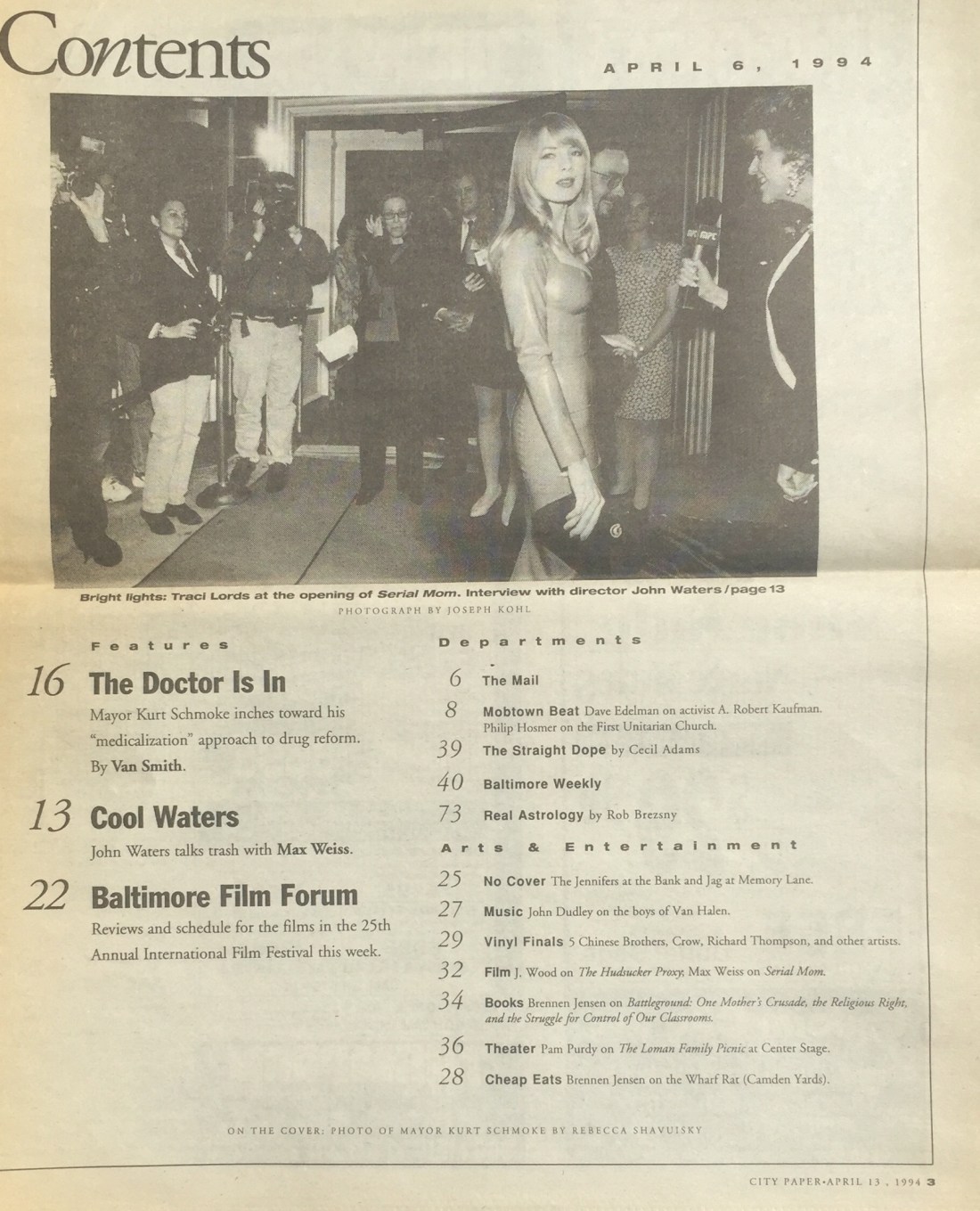
RIP Joseph Kohl and Pam Purdy.
Mulch Day
Influence-Peddling.
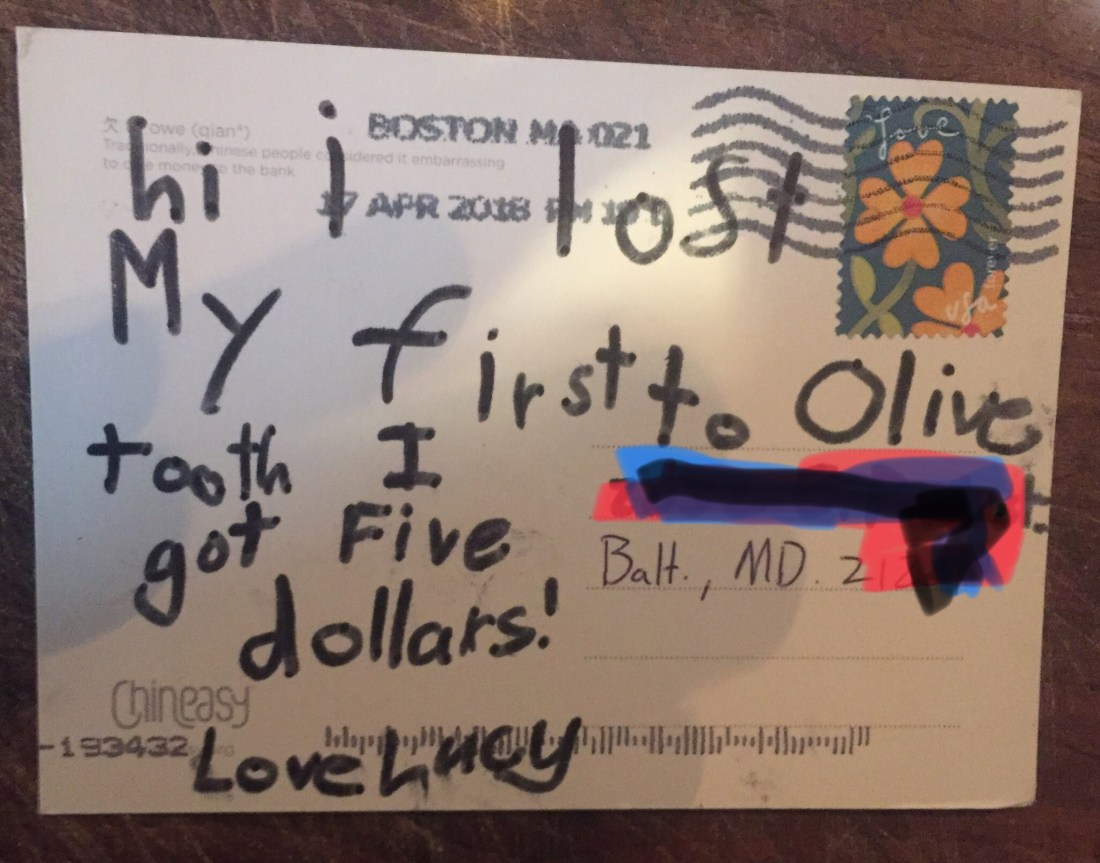
Readers.

#prattlibrary
Mid-Morning Snack.

Making a Magnet: Baltimore’s Fledgling High-Tech Community May Be the Key to Rebuilding the City and Slowing Sprawl
By Van Smith
Published in City Paper, Sept. 1, 1999
Vice president Al Gore calls it “Building Livable Communities.” Maryland Gov. Parris Glendening calls its “Smart Growth.” But the two Democrats are talking about the same thing: Public policies that emphasize new investment in existing communities rather than in the fast-expanding fringe of metropolitan areas. Opponents say this idea is a Trojan horse for bigger government, but the goal is something many voters support strongly — slowing the spread of what both Gore and Glendening call a “monster”: suburban sprawl.
The vice president and the governor share another prescription for promoting a healthy, balanced economy. Gore’s slogan is “building American prosperity in the Information Age”; Glendening calls it “Maryland’s technology revolution.” Both want to encourage continued expansion of an industry that has spurred an unprecedented creation of wealth in America during the 1990s: high technology, that broad area of economic activity that seeks to harness the fruits of the scientific frontier for commercial use. High-tech is the potent heart of what many have come to call “the new economy.”
What neither leader explicitly acknowledges is that sprawl and the new economy are closely linked — a point first made by Fred Siegel, a history professor and urbanologist at the New York college Cooper Union. (The author of this article worked for Siegel as a researcher earlier this year.) The phenomenal expansion of the suburbs in recent years has been fueled first and foremost by the technology boom. The challenge, if the state and the nation are going to beat back sprawl and encourage the technology revolution, is to induce the new economy to choose cities and older suburbs over the green, cheap fields of exurbia.
That won’t be easy, but there are hints that it may already be happening — albeit in a limited fashion — in Baltimore. Some boosters are touting the city as a budding magnet for the fast-growing, fast-moving high-tech sector, particularly for that corner known as “new media,” which focuses on advertising, selling, and communicating through computers.
Available data about high-tech jobs and businesses show that Baltimore City’s participation in the new economy is lagging significantly behind that of the surrounding counties, where sprawl has become a critical issue. Despite the presence of big medical-research institutions (Johns Hopkins, the University of Maryland), which traditionally spin off biotechnology start-ups, the city’s high-tech numbers don’t measure up to those of its neighbors, according to data from state agencies.
But in the fast-moving world of the Information Age, data tends to lag behind reality. A look around the city quickly makes clear that Baltimore is home to a growing and largely unnoticed high-tech sector — not just biotechnology, which the city is already known for, but information and computer technology. The Can Company in Canton, the Bagby Building in Little Italy, and even the Inner Harbor’s Power Plant are home to new or expanding high-tech ventures — evidence that tech types like working in funkily rehabbed industrial artifacts. And Baltimore has plenty of those.
Inner Harbor East and another planned development at a defunct Proctor & Gamble plant in Locust Point are expected to draw more technology tenants to the city. Some business leaders predict that the controversial west-side redevelopment project will also draw high-tech investment that could preserve some of the historic structures currently at risk of being demolished.
To lend techies a sense of community — considered to be of supreme importance in any technology-savvy economic-development strategy — the regional business group the Greater Baltimore Committee spun off a new organization earlier this year: the Greater Baltimore Technology Council, headed by Penny Lewandowski, an exuberant veteran of Washington, D.C.’s successful tech-promotion effort.
Before anyone gets too excited about Baltimore’s high-tech future and making sprawl a thing of the past, it’s important to examine the obstacles — and some unpredictable factors that come into play. Even if individuals and tech enterprises pondering Baltimore overlook the city’s crime statistics and social ills, they still face a labor force ill-prepared to meet the demands of technology jobs. Then there is the issue of regionalism: Baltimore will be competing with surrounding jurisdictions trying to attract companies, and the ‘burbs have more attractive tax structures and more available land to explore for locations. Finally, there are unforeseen circumstances — such as the current drought, which is already causing farmers to put their land on the market for development (and hence sprawl), and the possibility of a downturn in the business cycle, which would lead to economic contraction and less investment everywhere.
Such pitfalls notwithstanding, Smart Growth and high-tech are high priorities in Maryland and on the presidential-campaign trail, and voters and business leaders alike are going to be hearing more and more about them. For Baltimore City, which has failed to hitch its wagon to the economic gravy train that’s been rolling across the country and the region during the last several years, this strategy may be the last chance to rebound for a long time to come. “Shame on us,” developer William Struever says, “if we don’t all come together and recognize this opportunity.”
In June, the Home Builders of Maryland held a conference at the Columbia Hilton to discuss Smart Growth. The keynote speaker was Joel Kotkin, a professor of public policy at Pepperdine University in Southern California and an energetic student of what makes cities tick. Kotkin wholeheartedly embraces the idea that the market, not government, is the best arbiter of prickly issues such as suburban sprawl. The key, he suggests, is to bring cities such as Baltimore back to life, make them competitive in ways that will attract new people and businesses, and let market preferences take care of tempering runaway sprawl.
Home builders and other developers tend to quake at the mention of sprawl. The issue has them in a bind. They claim to be chasing the demand for more and more space farther and farther from urban centers, but the constituency the developers say they are trying to serve has grown resentful of the bulldozers clearing open land and replacing it with cookie-cutter tract housing, office parks, malls, and parking lots. Sprawl was created by suburban migration, but increasingly the migrants are saying enough is enough, as the traffic congestion, pollution, crowded schools, and social ills they left the city to escape have followed them outward. Environmentalists, with good reason, see sprawl’s effects in the poor health of the Chesapeake Bay and its tributaries.
Kotkin’s audience of developers smells the threat of land-use regulation in all the anti-sprawl talk, but they also sense a market-based demand for a fundamental change in the way development is done, and they know the writing is on the wall. “We have to look at the market,” Kotkin tells them. “We have to look at the competition between different kinds of areas as our best way of dealing with the sprawl issue and the growth-management issue.”
In the face of conventional wisdom that the suburbs and exurbs, with their plentiful land, are ground zero for development, Kotkin says cities such as Baltimore have some advantages that can help them compete.
What helped give the suburbs an edge in the first place — what created “the economic conditions for sprawl,” in Kotkin’s words — was the shift to “a knowledge-based society. . . . Knowledge is the primary resource and the traditional factors of production are no longer tied to particular places” — places with a certain kind of infrastructure, or accessibility to a port or raw materials. This new reality created what Kotkin calls “nerdistans: places where nerds like to live. A nerdistan is generally in the outer fringes, and high-tech companies generally are going to go to the nerdistans.”
But high-tech isn’t exclusively attracted to nerdistans, Kotkin continues. “Cities do have a niche in the new economy, [attracting] the group where the single largest disadvantage of cities — the education system — doesn’t matter. Single people, gay, double-income-no-children, empty nesters, Generation Y, the yuppies — these are groups that are increasing in population. One-third of the baby-boomer generation is single, childless, or only has one child. That’s going to be a major factor as we start to see fewer and fewer people who have to live in the suburbs because of family reasons . . . and start to see resettlement of the downtowns. It’s the beginning of a new urban demographic.”
On top of that, Kotkin says, Baltimore has one of the characteristics the new urbanists are looking for: old urban settings. “Baltimore has the environment, it has the architecture, it has the kind of vistas, the kind of cultural institutions which are going to attract them.”
In this light, he says, the question becomes, “What part of this new economy makes sense for Baltimore to go after?” The answer, he suggests, is the so-called “new media” — people focused on harnessing computer technology and the Internet to expand and improve communication and the flow of information, such as Web-site designers and online publishers. The new-media industry is growing, Kotkin says, “and that growth tends toward the cities. It attracts younger people, freelancers, the creatives. They don’t like the very things that the nerds like. The chaos and excitement of the cities attracts the creatives.
“So this is really where I see the future of the cities going, and we might see a much more appropriate dispersion of growth as a result — that kind of strong headlocking of competition [between cities and suburbs] that will see the new economy allocate resources and will make growth take place quite differently than we’ve seen in the last 20 years.”
If any one company in Baltimore typifies the local potential of the high-tech media industry, it is Gr8. Headed by Craig Ziegler, an exuberant businessman whose excitement about the prospects of his industry in Baltimore borders on mania, Gr8 has grown from about 20 employees to close to 100 since its move to the Can Company building last year. He expects to need another 300 or more staffers in the next few years to meet the demand for his services, which include Web-page design, Internet advertising, and other creative computer consulting.
Ziegler is concerned that Baltimore is selling itself short, failing to maximize its potential. “As a combined unit, Baltimore and Washington is the fourth largest in regards to size in the advertising and new-media arena,” he says. “That’s huge. Do we capitalize on it? Not at all. Baltimore needs to start informing people that this market exists here. Go to any one of the outside areas in New York or L.A. or San Francisco, and people say, ‘Baltimore? What’s Baltimore doing in high-tech? They are institutional. They are the biotechs. But they are not creative media.’ We are not on anybody’s radar screen. This community has to come together to rewrite the moniker that we’ve all been stuck with: ‘What the hell’s in Baltimore?'”
The answer to that question may be: not much now, but more and more, sooner and sooner. William Struever — whose firm, Struever Bros. Eccles & Rouse, increasingly specializes in adapting older buildings for high-tech uses — has perhaps the best sense of what’s here and what’s coming in terms of new media. He says he first noticed the new-media and computer- and info-tech trend in cities a few years ago as he traveled to different urban areas around the country.
“Computer-tech, info-tech is much faster growing than biotech,” Struever says, “and I think on a long-term basis it is much more likely to deliver the wealth and jobs and business development that we are looking for. . . .
“It’s all about having the right idea and making the right alliances and having the right funding to be able to go fast and take advantage of an opportunity,” he continues. “Baltimore’s going to be a central place for Web-page design and e-commerce and a whole bunch of tech stuff, not just with Gr8 but these other businesses.” He cites Sylvan Learning, Caliber, Eisner & Associates, e.magination — new or established businesses in Baltimore that are entering the Internet and electronic-commerce markets.
Ziegler says new-media companies bring with them a certain breed of entrepreneurs and employees who can transform city neighborhoods. “We have the ability to attract not blue-collar, but fairly well-educated white-collar young professionals that are city dwellers,” he says. “You look at the numbers that have been declining in regards to people moving outside the city into the suburbs — it is staggering. And you look at the neighborhoods that are starting to become rundown. And then you look at what happened in Canton. This was a very undesirable area for quite a while. [The Can Company] and some of the other projects up and down the strip here have revitalized this entire area in a very short period of time. I mean, that’s staggering. And there’s a lot of technology focus down here.”
Another boost new media can bring to the city is exposure, Ziegler says. “I can’t tell you how many CEOs and presidents from major companies have come through my office space, which means they come through Baltimore. They’ve never been to Baltimore. ‘What a lovely city,’ they say. I mean, I hear some comments I’m sure the mayor would just love to suck up. You can’t pay for that kind of exposure.”
Ziegler plans to grow Gr8 through acquisitions and other expansion, but he is also starting new ventures such as Guest Tech, which is obtaining contracts with hotel companies to install computer hook-ups in hotel rooms.
“According to the analysts,” he says with heated excitement, “we will be the number-five player in terms of size, worldwide, in the new-media space once we get through this next move. Number five. And we’re in Baltimore. If that’s not newsworthy I don’t know what the hell is. Have I talked to the mayor’s office yet? No. Have I ever gotten any tax incentives? No. Did I get any help? Not that I’m aware of. What we have is a major ability to attract world-class customers and world-class talent. And with the help of the city, I think we can build it — we are going to build it with or without them, by the way, but having their help would sure be nice — because the market is just so fertile.”
What Ziegler and Struever are up to dovetails perfectly with Al Gore’s and Parris Glendening’s agenda: combating sprawl by revitalizing cities through high technology. And it is in keeping with Kotkin’s philosophy of achieving economic outcomes through market decisions rather than government programs. But as the authority that still has ultimate say over how land can be used, government can and will have a significant role.
Ron Young, the deputy director of the state Office of Planning and a former mayor of Frederick, was appointed by the governor to chair the Smart Growth and Neighborhood Conservation Coordinating Subcommittee, which grew out of the Smart Growth legislation passed by the General Assembly in 1997. High-tech “certainly is an expanding area of the economy in Maryland,” Young says, and Smart Growth “is about bringing all of that into established areas. The market forces are there. But we need to have the right public policies to turn the incentives back into these established areas, just as we incentivized moving out [to the suburbs] with poor public policies for years.”
For generations now, as Glendening said when he rolled out his Smart Growth proposal in 1996, “sprawl has been supported by an avalanche of federal, state, and county policies.” School-funding formulas, road-focused transportation spending, and other policies sped the spread to the suburbs. Gore, speaking last fall before the Brookings Institution, a think-tank in Washington, D.C., cited “federal subsidies [that] actually gave handsome financial rewards to communities to extend sewage lines far out into undeveloped areas . . . [and] gave employers big subsidies to offer parking spaces to their employees, but much less help if they wanted to help cover their employees’ mass-transit costs.”
As a key implementer of Maryland’s program to reverse these kinds of sprawl-inducing incentives, it’s part of Young’s job to be bullish on Baltimore’s high-tech potential. But he can cite the specific conditions behind the optimism. For start-up companies, he says, “there is a realization that there’s an availability of reasonable space, reasonable price, and a good standard of living there, and quite often these companies are young people who have discovered cities.” Approximately 60 percent of Maryland adults, he adds, are “empty nesters,” people with no children or none living with them. “So when you look at what the city has to offer, everything is there if a few issues are addressed to bring people back in. The state needs to show people those opportunities, and give them incentives to do it. So, yes, I could very easily see a major boom in Baltimore.”
The Smart Growth program is essentially an attempt to use government funds and policies to change investment behavior and direct development to cities and older suburbs. It has three main components. First, it establishes seven “Priority Funding Areas” — already developed areas (including Baltimore City and the suburbs inside the Baltimore Beltway) — outside of which state investment in growth-related projects is, to quote the statute, “generally prohibited.” Thus, Baltimore will get preferential treatment in state funding for roads, sewers, housing, and other investments in economic growth. Second, the “Rural Legacy” program is designed to fund state acquisition of farms, forests, or natural-resource lands to protect them from future development — sending the market elsewhere for future investment. Finally, there is the “Brownfields” program, which uses incentives to encourage cleanup and reuse of abandoned industrial lands that may be contaminated, many of which are found in the city.
Barriers to the program’s success remain, including circumstances not foreseen when the state legislature debated it last year. The drought has exacerbated financial problems already plaguing Maryland farmers, prompting some to sell off their land, most likely to developers who want to put up homes, malls, or office parks.
Another recent and unforeseen wrinkle for Smart Growth was a transportation-planning fiasco uncovered by The Sun. Tens of millions of dollars of federal funds for building new roads in Maryland may be held up because the political leaders in the Baltimore region failed to accurately report the amount of emissions from cars. There is a “silver lining” in this snafu, Young says: Developers might decide that unfunded road projects nix their plans for rural areas and choose to look at established areas that don’t need new transportation infrastructure.
There is also general uncertainty about the economy. The current boom has been going on for about seven years now, fueled in recent years by what Federal Reserve chairman Alan Greenspan calls “irrational exuberance” in the marketplace, particularly over Internet companies. The Federal Reserve has been bumping interest rates slowly upward to try to cool down the hot times, but at some point, many predict, an economic downturn will hit. This would slow down not only sprawl, but new investment in Baltimore’s nascent high-tech sector.
“I sweat bullets,” Struever says. “We are all dependent on interest rates and the overall momentum in the economy. Things could go wrong, short term or long term. I think very much the ball game is establishing that the opportunity is here today, and to get us as far along as we possibly can while things are good and interests rates are low.”
Struever’s worries are echoed by M.J. “Jay” Brodie, the head of the Baltimore Development Corp., the city’s quasipublic economic-development arm. “Those of us who have lived through recessions . . . tend to believe that this wonderful economy will not go on forever, not at the present rate. It doesn’t mean there will be a depression, but interest rates will probably creep up a bit, investment may cut back a bit. So while interest rates are low, we want to keep pushing for economic-development investment in Baltimore.”
Finally, licking sprawl in the suburbs and powering a high-tech magnet in the city depends in large part on the success or failure of regional approaches to economic development. The Greater Baltimore Committee (GBC) zealously advocates cooperation across city and county lines, and the idea that a strong urban core is key to the health of the region. But Baltimore’s weaker economic condition makes it difficult for city leaders to establish a strong presence at the regional table.
Donald Hutchinson, the former Baltimore County executive who heads GBC, says that despite its weakened condition, the city is still very much the heart and soul of the region. The city, he says, has to use this psychological advantage to extract agreements from its surrounding counties to share prospects for growth.
“You have to understand that 70 percent of all new growth comes from already existing businesses,” he says. “Only 30 percent is start-ups or pulling some other company from outside into the region. So if 70 percent of the movement is internal within the city and the five surrounding counties, they gotta compete for what’s already here, and that’s where the city gets hurt. And that’s why the city has to establish understandings and relationships.
“If I’m the new mayor,” Hutchinson continues, “the first thing I do is say [to the surrounding counties], ‘It is to your advantage for the city core to be strong. If a corporation is looking to move from the city to the county, you’ve got to give me the courtesy of having the first run. Don’t try to take them from me. Don’t try to compete with me for that business. Now, if they decide that they are going to leave and I’m absolutely convinced that they are going to leave, I, the mayor, will do whatever I need to do to make sure they stay in the region, and I’ll work with you to help create the environment to make sure they stay in the region.’ That’s the leadership that you are going to need. Otherwise, the city will fail if it puts itself into a competitive posture with the counties.”
Ultimately, though, the city’s position as a regional player is only as strong as its economic competitiveness, and the high-tech sector may well be key to securing that strength. The first step to attracting high-tech is recognizing its potential and taking steps to capitalize. That’s where Penny Lewandowski, the head of GBC’s newly formed Greater Baltimore Technology Council, comes in.
“Nobody has a clue that this community is growing and thriving right here in the city,” Lewandowski says. “The feeling is that the city is ignoring the tech community and the tech community really could be a very important part of the city’s economy. We have to find these companies, build a community, figure out how we are going to promote this, push their success stories. But then there’s got to be quid pro quo on the other side. There has to be good office space. Bill Struever is doing his part, but what else is going to happen in the city that makes this happen?”
Gr8’s Craig Ziegler thinks he has the answer. “Baltimore has the ability to become a major player in this market,” he says. “We have to help the local government understand the opportunities of what this emerging market could do, what it means to the economy. And it’s huge. Across the board it is a major topic.
“You got to capitalize on it now, because who knows where it’s going to be a year from now. We got to work on Internet time.”
Around the Block: The Colorful Past, Controversial Present, and Uncertain Future of Baltimore’s Red-Light District
By Van Smith
Published in City Paper, Feb. 2, 2000
Our values have changed,” Joanne Attman proclaims.
Attman and her husband, Ely Attman, own the building at 425 E. Baltimore St., and are thus the landlords of Club Harem, a strip club in Baltimore’s red-light district, the Block. “There’s nothing wrong with sex,” she says in a telephone interview. “There just isn’t. It’s an adult thing, and as long as it stays an adult thing, that’s all that’s important.
“You know,” she continues, “we’ve come a long way, and people do not view sex as a bad thing if they can do all that’s on the Internet, do what they do on TV, and on the phone. So, as far as the Block, the Block is benign.”
The Attmans, like most of the owners of Block property and businesses, do not live in Baltimore City. Their abode, most recently assessed at more than $225,000, is in a new development in Pikesville. Being a nice, suburban couple, the Attmans probably don’t often come down to the Block and look around; as Joanne Attman says, “We don’t really pay any attention to it.” Like most landlords, they just get a check from their tenants and make the necessary improvements to their property. End of story.
But if the Attmans were paying more attention to what’s happening on the Block, they’d know that its problems have little to do with the morality of sex among adults. The area is besieged by negative publicity over drug dealing, prostitution, employment of underage dancers, and the threatening atmosphere some civic and business leaders contend the Block creates in the middle of the downtown business district.
If they were paying attention, the Attmans would know that last May four pipe bombs were found and defused in the Diamond Lounge, a few doors down from their Block property. They’d know that a club next door to their building, the Circus Bar, was ordered to sell its liquor license last October after a former doorman, convicted of dealing drugs from the club, told the Baltimore City Board of License Commissioners (aka the liquor board) that he thought it was “part of my duties” to sell cocaine from the bar. They’d know that in July 1998, the 408 Club was cited by the liquor board for employing two 16-year-old Baltimore County high-school students as dancers and using three rooms above the bar for prostitution. And they’d know that these incidents are just the tip of the iceberg. (For a fuller accounting of Block property owners and the records of businesses there, see “What’s Around the Block”.)
But Joanne Attman doesn’t want to hear about it. “That’s ludicrous,” she says of the idea that a Block employee considered drug dealing part of his job. “You can go anywhere and buy drugs anywhere in the city. You can buy them at school. They’re being sold everywhere. So to focus in on the Block is absolutely ludicrous.” She is adamant that the action on the Block is essentially harmless: “You know, most of the people down there are there to make a living and that’s what they’re doing–a clean living.” With that, the interview ends abruptly.
The way people make their living on the Block isn’t causing ripples just in City Hall and law-enforcement circles; it is fast becoming a divisive issue within the red-light district’s business community itself. Today, two separate entities–Baltimore Entertainment Center Inc. (BEC) and Downtown Entertainment Inc.–claim to represent the interests of Block businesses. Both groups, at least on the face of it, share the same goal: to clean up the Block’s act so that its businesses can work with city leaders to promote the district as a destination for tourists and conventioneers. But their respective members don’t see eye to eye on how to achieve that aim, according to Block sources.
Today, Baltimore Entertainment Center is effectively defunct, although it is still recognized by many on the Block as an ongoing concern. BEC was formed in February 1997 and until a few months ago was represented by Baltimore attorney Claude Edward Hitchcock, a confidant of former Mayor Kurt Schmoke. At the time the group was launched, Hitchcock said it represented a “new breed of owner and operator on the Block” that is “trying to become better citizens and better neighbors.” Hitchcock resigned as BEC’s attorney in September; the following month, the group forfeited its right to operate in Maryland due to its failure to file property-tax returns–a rectifiable situation, should the taxes be brought up to date. (Attempts to speak with Frank Boston III, reportedly BEC’s new attorney, were unsuccessful.)
Days after Hitchcock left BEC, Downtown Entertainment was formed, with Hitchcock as its lawyer and Jacob “Jack” Gresser–the owner of the Gayety Building, a Block landmark, and another former BEC guiding force–as president. Gresser says Downtown Entertainment wants “to go in the direction of a partnership with the city, in respect of getting involved in the conventions that are coming to town, where the city will advertise these particular businesses in their convention brochures and throw the business our way, if possible.” Ultimately, Gresser says, he wants the Block to become like Bourbon Street, New Orleans’ famous playground of vice. So far, eight to 10 of the Block’s two dozen adult-entertainment establishments have joined the new group, he says.
Gresser says the splintering of BEC occurred over the course of last year, culminating about six months ago–“That’s when we decided to go our different ways.” While he’s loath to speak for those who haven’t joined Downtown Entertainment, he says there are “two distinct, different views of how people want to run their business down on the Block. Everybody runs their business differently. Everyone has a responsibility to run their business properly. I would just like to see everyone get together and go in one direction. We really don’t need this diversification.”
That “diversification” has created to some bad blood. “This has not been a walk in the park,” Hitchcock says. “I mean, I’ve gotten calls here in the office on my voice mail, you know, the use of the ‘N’ word, and ‘Who the fuck do you think you are?’ and all. One guy who was a part of [Downtown Entertainment] got his windows bashed in–both in his business and his car–and his family got threatening phone calls over the telephone at home. I’ve gotten it all. I mean, this has not been easy.”
Neither Gresser nor Hitchcock will go into detail about the causes of the split. Other sources familiar with the situation, who spoke on condition of anonymity, are less cagey–they claim the split is between clubs that host prostitution and clubs that don’t.
“Apparently the difference is private rooms, no private rooms,” says one source. “If there are no private rooms, then you obviously can’t have prostitution on the site.” The clubs without private rooms are the ones moving into Downtown Entertainment, he says.
Sources say the new group also wants police officers currently on the Block beat rotated out. “The policemen around there have been around there for years and have a bunch of friendships,” one source says. “If you are there too long, familiarity can breed bad things.”
Hitchcock says Downtown Entertainment has “scheduled an appointment to talk with the new police commissioner [Ronald Daniel] to basically introduce this new organization to him, to give him a feel for what we intend to do, how we intend to run the businesses, [and] to affirm or reaffirm with him our willingness to be cooperative with the Baltimore City Police Department. In fact, we encourage the police department to be active–fair, but active–on the Block.”
Police spokesperson Robert Weinhold says Daniel “has had conversations with representatives from the Block” and recognizes that they want to make the red-light district as crime-free as possible. “We would expect the efforts of the Block representatives to continue, and that all of the establishments and the citizens who work there will be law-abiding in their business efforts.”
Eventually, Hitchcock says, Downtown Entertainment will seek a meeting with Mayor Martin O’Malley, but it has yet to broach the subject with him. For the time being, the new mayor’s approach to managing the situation on the Block remains a mystery. Despite assurances that he would grant an interview for this article, repeated attempts to set up such a meeting were unsuccessful. O’Malley’s press secretary, Tony White, eventually explained that the mayor has yet to formulate his opinions about the Block district and therefore would rather not discuss it at this time.
“Being the entertainment mogul that he is, he’s thinking about” the Block, White says, but this thinking “hasn’t come to fruition yet.”
It would be a stretch to suggest that contributions to O’Malley’s mayoral campaign last year will have a direct impact on his eventual stance. But several Block interests did pledge support for his candidacy, in all likelihood out of a desire to foster access to and good relations with their potent neighbor in City Hall.
Between July and October of 1999, Block interests donated $6,400 to O’Malley’s cause, according to campaign-finance reports. One of Gresser’s businesses, Custom House News, gave $1,000, as did PP&G, which co-owns the strip club Norma Jean’s and is headed by Pete Koroneos, secretary and treasurer of Downtown Entertainment. The law firm O’Malley worked for before he became mayor gave $2,000 to his campaign, and one of its partners, Joseph Omansky, has long represented Block interests. The remaining $2,400 came from other Block lawyers, owners, liquor licensees, and an accountant.
The Block’s generosity toward politicians is a long-established tradition–probably as old as the Block itself. The district sprang up almost immediately after the Great Baltimore Fire of 1904, with the Gayety Theater (opened in 1906 at its present site at 403 E. Baltimore St.) becoming its first landmark. Initially, penny arcades and vaudeville venues dominated, but after the repeal of Prohibition the area took off as a dense concentration of bars and burlesque houses.
During the World War II years and into the 1950s, the Block’s reputation spread nationally as striptease acts became the main attraction at many of the nightclubs and, as two out-of-town reporters wrote in 1951, “any and all forms of vice are tolerated and protected. There is a price for everything, and it’s not much.”
With all of the fun and money being generated on the Block, heat from law enforcement was turned up. Various congressional inquiries and grand-jury investigations fingered the Block as an organized-crime stronghold in the 1950s and ’60s, a place where the rackets, gambling and prostitution in particular, thrived and fueled corruption and violence. Even during its heyday–so romanticized by a legion of old-time Baltimoreans and local scribes–the Block was a dangerous place that spawned crime sprees and fear and trepidation among hand-wringing city residents.
If the 1960s were bad on the Block from a criminal-justice standpoint, the ’70s were much worse. Julius “The Lord” Salsbury, the acknowledged king of Block rackets, was finally convicted on federal charges in 1969, only to flee the country the following year. (Never brought to justice, he remains a legendary fugitive.) But with the end of Salsbury’s reign–and perhaps because of the destabilizing effect of his absence–came an era of unprecedented violence in the district. When crime fighters did try to put the screws to the Block, they often ended up embarrassing themselves: A 1971 raid by federal agents produced little in the way of convictions and made law-enforcement appear groundlessly zealous in pursuit of justice for Block racketeers.
With downtown’s renewal into a modern entertainment district, however, the Block gained a sense of legitimacy, due largely to rose-colored memories of its former glory and its faded Damon Runyonesque character. Then-Mayor William Donald Schaefer spared the Block from his wide-swinging wrecking ball as he rebuilt downtown, and in 1977 it received a special designation as an entertainment district. But the Block’s salad days were long gone; drugs and sleaziness continued to define its identity into the 1980s and ’90s.
As Schaefer moved from City Hall to the State House, his tolerance for the Block wore down. Late in his second term as governor, he ordered a four-month investigation of crime on the Block that culminated in a January 1994 Maryland State Police raid in which some 500 state troopers descended on the district and shut it down. Initially, the governor and his troopers made great claims–one drug kingpin and three distributors had been nabbed, an arsenal of guns had been confiscated, the back of criminal interests on the Block had been irreparably broken. But attempts to prosecute those arrested fell apart amid allegations of improprieties and faulty techniques among the investigators. Once again, law enforcement was left red-faced by its flawed attack on the tenderloin.
Schaefer’s raid occurred as his mayoral successor, Kurt Schmoke, was in the midst of his own attempt to put the Block out of his misery, by buying it out and relocating businesses. This economic attack failed, however–community leaders around the city feared porn shops and strip clubs would spring up in their backyards. Ultimately, after a flood of contributions to Schmoke’s campaign committee from Block interests in late 1996, a détente was reached. Fronted by the Schmoke-friendly Hitchcock–who had previously represented other downtown business interests that hoped to end the Block once and for all–Block operators received a respite as City Hall promised to await improvements promised by the newly formed Baltimore Entertainment Center.
The city held up its commitment, providing physical improvements such as new brick sidewalks in 1997, but so far the businesses haven’t held up their end of the bargain by substantially cleaning up their acts. If and how O’Malley reacts remains to be seen.
The mayor may still be forming his ideas on the future of the Block, but a new regulatory era is already underway. In November, the city liquor board started enforcing new rules that hold the threat of revocation of adult-entertainment licenses should club employees commit too many violations.
Hitchcock says Downtown Entertainment welcomes the restrictions. “We frankly saw it as tightening of the regulations in a fashion that we all agreed needed to happen,” he says. “We’ve had some very damaging rulings by the liquor board against some of those clubs down there. People are getting the message–you know, you do this stuff and you will lose your livelihood, period, end of story. You may be able to appeal it until it gets to some point of finality, but the liquor board’s not playing about this because they have taken on a responsibility and their credibility is on the line.”
Perhaps even more significant than the new regulations, from a business standpoint, is a January 1999 court ruling that full nudity is legal at adult-entertainment establishments that opened before 1993. The ruling arose when the Spectrum Gentlemen’s Club in East Baltimore appealed a nude-dancing violation and found a loophole in the law, which had been interpreted to require that dancers be partially clothed while performing. The decision was handed down by Circuit Court Judge Richard Rombro, in his last judicial act before retiring from the bench. (Unnoticed at the time was the fact that the judge’s nephew, Stuart Rombro, is an attorney who represents Gresser’s Custom House News.) Regardless, it’s been good for business on the Block.
Hitchcock downplays the ruling’s practical significance. “There’s no real difference,” he says. “I mean, yeah, rather than you put a little star on the nipple, you can take the star off now.” But he acknowledges that Baltimore strip clubs have become a “more marketable and a bigger revenue-generating business because you can basically say it’s nude dancing.”
And a more marketable Block is a boon for Baltimore, says City Council member Nicholas D’Adamo, a Democrat whose 1st District includes the Block and many other adult-entertainment venues.
“Let’s be honest,” asserts D’Adamo, who acknowledges that he patronizes Block establishments now and again. “Is it a plus for the city of Baltimore? I think it is. I think for out-of-towners to come to the city, it could be a stop on their agenda if they’re staying downtown.” He further maintains that Block businesses employ some 1,000 workers and should be recognized as job-providers.
Of the allegations of vice associated with Block clubs, the council member says, “I think the press has blown it out of proportion. Sure, there are problems down there. But I think there are problems in every bar. It’s just a matter of what you consider a problem. So why pick on the Block?
“You show me a person a week’s being killed on the Block, or a person a week’s being stabbed and almost died–you show me numbers like that, we got a problem,” D’Adamo continues. “But goddammit, there’s a lot of streets in this city that have these problems that are a lot worse than the Block. We need to address that first.” And, for the time being, it appears that’s exactly what the city’s going to do.
Hot Line: The Feds Are Considering Shipping Spent Nuclear Fuel Through the Howard Street Tunnel. Are They Playing With Fire?

By Van Smith
Published in City Paper, Sept. 12, 2001
(Photo: commons.wikimedia.org, image of a test rail car carrying a spent nuclear fuel shipping cask.)
For a few days in mid-July, a few dozen train cars carrying hazardous chemicals and other materials burned out of control beneath the city. After a century of barely being known even to Baltimoreans, the Howard Street tunnel was suddenly in the national spotlight.
As an event, the tunnel fire was both scary and enthralling. Local residents and commuters were inundated with news of gridlock, a water-main break, and possibly toxic smoke. TV sets all over the country glimmered with images of menacing plumes and flooded streets, coupled with reports that the too-hot-to-fight inferno was disrupting not only rail traffic, but Internet services via cables that also run through the tunnel. But as normalcy was restored in the ensuing days and weeks, coverage tailed off. Today, for most folks, the fire is just a memory.
Lost in the immediacy of the moment and the disinterest of its aftermath are two questions that may ensure the Howard Street tunnel fire’s lasting legacy: What if nuclear waste had been among the freight in the hottest part of the fire? Could radioactivity have been released, contaminating people and property in the heart of a major East Coast city?
The question isn’t merely theoretical. A long-studied proposal for handling the nation’s growing inventory of nuclear waste by carting it from points around the country to a permanent repository in Nevada’s Yucca Mountain is expected to reach President Bush’s desk later this year. If the project gets a presidential thumbs-up and survives the resulting legal challenges, spent nuclear fuel will be a frequent passenger on the nation’s highways and railroads for the next three or four decades, en route to the Nevada desert. Plans drawn up by the U.S. Nuclear Regulatory Commission (NRC) call for carrying used-up fuel assemblies from Constellation Energy’s Calvert Cliffs Nuclear Power Plant in Southern Maryland by train through the Howard Street tunnel.
When it comes to managing the potential of large-scale risks such as nuclear accidents, examining extreme hypothetical situations–the possibility, for instance, of nuclear waste in the Howard Street tunnel fire–is crucial to finding ways to avoid disasters. Thus, nuclear-transportation experts have started to examine and debate what they have dubbed “the Baltimore fire.” Until the actual conditions of the fire–the top temperature reached, how long it stayed that hot–are established, much of the talk is necessarily speculative. But the central questions posed by the fire are already known: How sturdy are the containers used to transport nuclear waste? How foolproof are the methods of moving them safely by train?
Critics contend that the containers, called “transportation casks,” haven’t been tested enough to know their true strength; cost, rather than safety, is the chief priority in designing nuclear-transportation plans, they say. The nuclear-energy industry points out the exemplary safety record of waste shipments and outlines the stringent measures taken to guard against reasonably foreseeable dangers. However the argument turns out, it’s a good bet that as the Yucca Mountain Project heats up, the Howard Street tunnel fire will be national news once again.
Sitting in her Mount Washington home July 18, Gwen Dubois listened anxiously to reports of a tunnel fire downtown. Her teenage son had already left on the light rail for a double-header at Oriole Park. “On any given day, he’s as likely to be at Camden Yards as he is to be home, despite what’s happened to the Orioles this season,” she says, recalling her worries in an interview later that month. Knowing that freight trains often carry chemicals that can produce toxic smoke when burned, Dubois was “concerned about whether his health was at risk.” When “later on I found out that he was stopped on North Avenue and came home, I was greatly relieved,” she says.
Dubois’ relief about the fire was short-lived. An internist, she sits on the board of directors of Physicians for Social Responsibility, a nonprofit group based in Washington that works to raise public awareness of nuclear issues. On her house hangs a large banner reading nuclear-free zone. Attuned as she is to nuclear risks, her thoughts quickly broadened from the chemical fire to larger issues.
“Within hours,” she says, “I was thinking, If this were a train carrying radioactive waste, what kind of exposures would there be? Who would be monitoring? Would we even know? What about the psychological impact on people who are afraid that they’ve been exposed? So, as bad as this fire was, I thought it would have been just truly a catastrophe if the train had carried nuclear waste. . . .
“As time goes by, the other issue is, it’s going to become more and more likely that trains will contain nuclear waste, and nuclear waste carried in containers that haven’t been adequately tested. And also, this train wreck–the temperatures were extremely high, high enough to cause burning of nuclear waste and make some of the radioactivity airborne and carried over a wider area,” she continues. “So all of the specifics about this train fire–the temperature, the difficulty getting to it, the fact that it was in an urban area where a lot of people were potentially exposed–all of these factors are so relevant. If the cargo was radioactive, the implications would have really been just mammoth.”
Dubois’ mind was not the only one turning to the potential nuclear risks posed by the Howard Street tunnel fire. U.S. Sen. Harry Reid (D-Nev.)–the Senate majority whip and, like every other elected official in Nevada, a strident opponent of the Yucca Mountain plan–took to the Senate floor the day after the fire began to offer his take on the dangers.
“People think hydrochloric acid is bad, which it is,” Reid said, referring to one of the hazardous materials carried by the burning train in Baltimore, “but not as bad as nuclear waste. A speck the size of a pinpoint would kill a person. And we’re talking about transporting some 70,000 tons of it all across America.”
Reid enlisted the aid of Maryland Sens. Barbara Mikulski and Paul Sarbanes in promptly convincing his colleagues to do what politicians often do when drastic accidents occur: order a study. On July 23, as charred rail cars were being removed from the Howard Street tunnel, the Senate voted 96-0 to attach an amendment to the U.S. Department of Transportation appropriations bill requiring DOT to conduct a top-down assessment of the nation’s system for transporting hazardous and radioactive waste.
Reid’s actions in the wake of the Baltimore fire caused a flurry of interest–back in Nevada. “Baltimore’s experience should be reason enough to comprehend that Yucca Mountain isn’t just Nevada’s problem, it would be a land mine for any city or town that had the misfortune of being located near the path that would take nuclear waste to Yucca Mountain,” the daily Las Vegas Sun editorialized on July 25 under the headline “Baltimore derailment a bad omen.”
Also quick to pick up on the nuke-train angle was the Nuclear Information and Resource Service, a Washington-based activist group. The organization’s nuclear-waste specialist, Kevin Kamps, shot off a press release on July 21, revealing that a U.S. Department of Energy assessment of the Yucca Mountain Project included route maps that showed nuclear-waste shipments going by rail from Calvert Cliffs through the Howard Street tunnel. Kamps spent the next two weeks touring the country, garnering news coverage of this new twist to the Yucca Mountain debate.
Pro-Yucca forces dismiss attempts to play up the Baltimore fire as a nuclear-waste-transportation issue. The day after Reid made his speech on the Senate floor, the industry issued its response. “It is really unfair for Sen. Reid to use this as an opportunity to make a case against Yucca Mountain by scaring the public,” said Mitch Singer, a spokesperson for the D.C.-based Nuclear Industry Institute (NEI). Sarah Berk, spokesperson for U.S. Sen. Larry Craig (R-Idaho), told reporters that Reid’s response to the tunnel fire is “a misguided and misinformed effort to connect something that should not be connected. The fact of the matter is, if that train had been carrying nuclear components, it would have been protected in containers that would have prevented this sort of a spill.” Berk stressed the nuclear-power industry’s “phenomenal safety record” and its ongoing efforts “to develop safe and responsible methods to handle nuclear waste.”
The NEI’s Web site (www.nei.org) points out that nuclear-waste shipments are small, carefully managed, and do have a remarkable safety record: In nearly 40 years of transporting spent nuclear fuel, there have been 2,900 shipments and only eight accidents. Only one was serious, and none resulted in a radioactive release.
In Maryland, shipments of high-level radioactive materials have occurred without incident. Twenty-eight thousand pounds of radioactive material passed through Maryland in four shipments during July and August 2000, according to the Maryland State Police, which is notified of such hauls, and since 1996 approximately 15 kilograms of spent nuclear fuel were trucked through the state in five separate shipments.
In addition, an NRC report shows that between 1993 and 1997 154.8 kilograms of spent nuclear fuel were shipped out of state from the Dundalk Marine Terminal, Calvert Cliffs, and the National Institute of Standards and Technology in Gaithersburg. Another 17.1 kilograms were sent to Dundalk for export.
The key to safely transporting spent nuclear rods is the survivability of the casks. The NRC, according to NEI’s Web site, requires that transportation casks “pass a series of hypothetical accident conditions that create forces greater than the containers would experience in actual accidents. The same container must, in sequence, undergo 1) a 30-foot free fall onto an unyielding surface, 2) a 40-inch fall onto a steel rod six inches in diameter, 3) a 30-minute exposure to fire at 1,475 degrees Fahrenheit that engulfs the entire container, and 4) submergence under three feet of water for eight hours.”
What the NEI site doesn’t point out is that never has an actual, full-size cask been subjected to this battery of assaults. Quarter-scale models have been used as the basis for computer models that predict how an actual cask would perform in extreme circumstances. But no actual full-scale testing has been conducted, because subjecting a 130-ton cask to those conditions is logistically challenging and very expensive–probably near $20 million per test. Thus–as Yucca Mountain Project critics like to point out–there is no real-life basis for concluding the casks can survive such extreme circumstances.
The third element in the NRC’s list of standards–the 30-minute, all-engulfing fire at 1,475 degrees Fahrenheit–is the one that turned attention to the Baltimore blaze. Firefighters here reported whole train cars aglow from the heat of the tunnel fire. On the second day of the fire, Baltimore City Fire Department officials told the press that the temperature in the tunnel was as high as 1,500 degrees. If the hottest part of the fire rose above 1,475 degrees for more than 30 minutes–as appears likely, though technical analysis has yet to prove it–then the Howard Street tunnel fire achieved a rare intensity that gives pause to nuclear-waste- transportation experts.
Questions to NEI’s press office about whether casks are designed to survive a fire as intense as Baltimore’s was reported to be were referred to Robert Jones, a Los Gatos, Calif., nuclear engineer who designed casks for General Electric for 13 years and now works as a nuclear-industry consultant. Jones was skeptical about whether the Baltimore fire actually exceeded the design standard for casks. If it did, he says, it would be a singular event. Jones cites a government study showing that the probability of an actual railroad fire exceeding the regulatory conditions is less than 1/10 of 1 percent.
“I’ll wager that 1,500 degrees did not exist totally for a day and a half” in the Howard Street tunnel, Jones says. He acknowledges, though, that if it did, “there’s a potential for some release. But we’re not talking about this thing blowing up.” Rather, he explains, “the leakage, if it was to occur, is likely to be a radioactive gas that would be dispersed.”
Daniel Bullen, who sits on the federal Nuclear Waste Technical Review Board , concurs with Jones. “Would there potentially be a release? Yes,” says Bullen, an Iowa State University engineering professor who used to run that school’s now-closed nuclear-reactor laboratory. Foreseeing the questions his answer raises, he fires off a quick interview with himself: “Would it be a significant release? Probably not. Would it be hard to find? No, because radiation is pretty easy to find. Would it be difficult to remediate? Maybe. You might have to move a lot of dirt and clean up a lot of surface and stuff. But would it be significantly life-threatening? Probably not.”
“Oh, this guy’s just shooting from the hip,” Marvin Resnikoff says upon hearing Bullen’s characterization of the effects of a long-burning 1,500-degree fire. Resnikoff, a physicist, heads Radioactive Waste Management Associates, a New York-based consulting firm that specializes in analyzing nuclear-waste safety. The state of Nevada recently hired him to look at the Howard Street tunnel fire and report on its implications for safe transport of spent nuclear fuel. The report is due to be completed this month; when it’s released, Resnikoff asserts, “we’ll have much more definitive answers.”
In the meantime, Resnikoff offers a glimpse of what he’s learning. If the fire turns out to be as hot as reported–and his analysis will establish whether or not it was–then a potential release would include other materials besides radioactive gas.
“There are particulates,” he says. “We are concerned about cesium 137 because it is semivolatile. And we are concerned about cobalt 60, to a lesser extent, because that material is on the outside” of spent-fuel assemblies and could be released more quickly in the event of a leak. Cesium 137 and cobalt 60 are radioactive carcinogens that have half-lives of 30 and five years, respectively, so they represent a long-term cancer risk. They emit gamma rays, which, according to a U.S. Environmental Protection Agency fact sheet, “can easily pass completely through the human body or be absorbed by tissue, thus constituting a radiation hazard for the entire body.” Based on the weather conditions that existed during the Baltimore fire, Resnikoff estimates that a radioactive smoke plume exiting the southern terminus of the tunnel would have spread perilously close to Camden Yards.
Until the report is concluded and released, Resnikoff declines to give any more details of his concerns about what could have happened if nuclear waste had been in the Howard Street tunnel fire. Robert Halstead, transportation adviser for the Nevada Office of Nuclear Projects, which hired Resnikoff to study the Baltimore fire, is much more candid.
If the fire was hot enough for a long enough time to compromise the casks and cause a leak, Halstead says, “you are going to be concerned with this plume of smoke carrying cesium and some other fission products. Obviously it’s bad if you breathe it, but also, because it is a big-time emitter of gamma radiation, there is direct radiation from the plume. If anything’s been deposited on the ground, it’s irradiating the area also. It would cause a very big cleanup problem.
“So you basically would face this terrible choice,” Halstead says. “You could easily spend in excess of $5 [billion] to $10 billion to clean the area. Or you could simply quarantine the area. The real answer on this is that you are probably going to have a situation where you’ve spent money rather than lives. There probably aren’t going to be thousands of latent cancer fatalities, but you are going to have to spend hundreds of millions or billions of dollars to prevent that. That’s a pretty fair ballpark [figure].”
If Resnikoff concludes that the Baltimore fire actually could damage a nuclear-waste-transportation cask enough to cause a radiation leak, the question becomes how to ensure that nuclear waste bound for Yucca Mountain (or anywhere else, for that matter) is never subjected to such an accident. This opens up a whole other area of debate–some experts contend the shipping risks are minimal, while others assert transportation is the weakest link in the nuclear-waste-management chain.
Jones, the cask designer, points out that rail shipments of spent nuclear fuel are made on dedicated trains, hauling only nuclear-waste casks. That reduces the probability of waste being in a contained, inaccessible environment, such as a train tunnel, along with volatile chemicals and other materials that, when burning, can create extremely high temperatures for a long period of time. (The train that caught fire under Howard Street, for example, was loaded with wood and paper products.) Furthermore, shipping schedules can be coordinated to eliminate the possibility that a dedicated nuclear-waste train and a mixed-freight train with hazardous materials are in the same tunnel at the same time.
“You know, railroads don’t just cut things loose and say we’ll see you at the other end,” Jones says. “They’re very good at tracking these things. So the circumstances that would have to exist in order to have an environment where a spent-fuel train would be in that Baltimore tunnel fire or its equivalent is just extraordinary. A billion to one. It virtually isn’t going to happen, just because that’s the way the business is structured.”
Resnikoff counters that “there is no regulation that says that nuclear-waste shipments will be by dedicated train. It would all be voluntary on the industry’s part. If they’d like to sign a requirement that it will be by dedicated train, that would make a big difference. It costs more money to have a dedicated train. Do they want to put up the money? [That] is the question.”
“It’s perfectly credible that you could have one or two casks of spent fuel in a mixed-freight train going through that Baltimore tunnel,” Halstead maintains. His reasoning is based on cost. In all likelihood, dedicated trains will be used to make large hauls of nuclear waste. But the small amount of waste at Calvert Cliffs–930 metric tons, about 1/10 of 1 percent of the nation’s growing inventory of spent nuclear fuel–may well end up on trains carrying a variety of other materials.
“A contractor working for the Department of Energy who got [its] contract on a low-bid basis would be tempted to shave nickels and dimes by transporting a small number of casks a short distance on a mixed-freight train–say, from Calvert Cliffs maybe up to Harrisburg [Pa.],” Halstead says. There, he speculates, the Calvert Cliffs casks would be transferred to a dedicated train carrying other waste from other reactors in the region.
Calvert Cliffs spokesperson Karl Neddenien cautions that “at this point there is no plan whatsoever as to where and how the shipments will go. It’s wide open.” He notes that Calvert Cliffs is right next to the Chesapeake Bay, so “it may turn out to be safer to put it on a barge to go down to Norfolk, Va., to a railhead. We don’t know.” He acknowledges that Yucca Mountain planning documents do show a proposed route through the Howard Street tunnel but says nothing is set in stone.
And Bullen, of the Nuclear Waste Technical Review Board, suggests the proposed route may be changed in light of this summer’s events. “I’d be surprised if they let them use that tunnel after the fire,” he says.
Another problem with shipping waste by train is that “there are no federal regulations that govern the selection of shipping routes for rail,” Halstead says. “There are for trucks, and the highway routes are generally selected to minimize shipments through highly populated areas, but there aren’t any equivalent regulations for rail.” He suggests laws that prevent the use of two-way tunnels and require circuitous routing and dedicated trains.
“Why in the world would we allow spent fuel to be shipped in mixed-freight trains in the first place?” Halstead says. “And, secondly, if they were in mixed-freight trains, who would be stupid enough to run them through dangerous areas? Congress should just say, ‘Bang, you will not ship any spent fuel in mixed-freight trains.’ My god, what could be more common sense than that?”
His harsh critique of the existing waste-transport system notwithstanding, Halstead says he is not against nuclear power. “I personally think that there is a very good green case to be made for nuclear power,” he says. But after years of studying the industry and how it’s regulated, he says, he finds it “just pathetic that the people running this business are incapable of doing it technically and in a way that would have public confidence.”
The public is going to have plenty of opportunity to express its confidence, or lack thereof, in the Yucca Mountain Project as it winds through the approval process. Based on NRC’s assessment of the site’s scientific and technical feasibility, Energy Secretary Spencer Abraham and President Bush are expected to give the plan the green light later this year. Then Nevada Gov. Kenny Guinn and that state’s legislature will have an opportunity to veto that decision–something they’re assured to do. Once Nevada rejects it, Congress gets the final say by a simple majority vote of both houses. Along the way, lawsuits brought by the state of Nevada and coalitions of environmental groups will throw up roadblocks. All together, this level of contention is bound to attract big media attention and raise Yucca Mountain’s profile as a national issue.
In the meantime, a major snafu has cast a shadow over Yucca. In late July, the Las Vegas Sun reported that for the last six years, the same Chicago law firm that the Department of Energy has been paying to provide legal services in support of Yucca Mountain has been lobbying on behalf of the NEI to get the project built. The firm, Winston & Strawn, and the NEI severed their relationship shortly after reporters called for comment on the apparent conflict of interest. “This situation,” Guinn wrote to Abraham in an Aug. 1 letter, “presents serious issues concerning conflict of interest and possible bias in the site evaluation process” for Yucca Mountain.
Around the same time, in an incident seized upon by anti-Yucca forces to bolster their case, a leaking cask was discovered on a truck carrying low-level nuclear waste through Nevada. No radioactive material escaped, but the July 30 incident served as a reminder of a leaky container found on a truck in Arizona in 1997–and that one did release radioactivity, leading to a suspension of additional shipments until corrective measures were put in place. Guinn promptly fired off another letter to Abraham: “It appears DOE’s protocol for the transportation of nuclear waste is seriously ineffective in protecting public health and the environment.”
Critics’ concerns about the Yucca Mountain Project aside, most everyone agrees that the technology doesn’t exist today to allow the waste to be stored on-site at the nation’s 72 nuclear-reactor sites for 10,000 years, until it has cooled off enough to be relatively safe. “It’s gotta go someplace, it can’t just stay around forever where it is,” says Robert Jones, the former GE nuclear engineer. As the nation has already invested $6 billion to $8 billion in the Yucca site, Jones contends, we should move forward with it. But it will cost another $50 billion to bring the Yucca site online; rather than continue throwing good money after bad, Nevada’s Sen. Reid contends, the Bush administration should scrap Yucca and start anew, finding another site or developing strategies to safely keep the waste where it is.
It remains to be seen how exercised the public will get over the potential hazards of transporting nuclear waste to Yucca Mountain. But as bad press, including the doubts about safety posed by the Baltimore fire, feeds into the collective realization that shipments are going to pass within a mile of an estimated 60 million U.S. residents over the course of 30 or 40 years, grass-roots opposition is bound to coalesce. If Resnikoff demonstrates that the Howard Street tunnel fire actually did burn at or about 1,500 degrees for more than a few hours–potentially enough to break a cask and cause a radioactive release–Yucca’s opponents’ arsenal will be stocked with a credible, real-life incident that raises serious doubts about the current framework for shipping the waste.
“The issue of waste transportation to Yucca Mountain is lurking on the national horizon,” Nevada Agency for Nuclear Waste Projects executive director Robert Loux wrote in an Aug. 16 guest column in the Las Vegas Sun, “like a thousand-pound gorilla waiting to pounce.”
Moscow Nights: Getting Down With Baltimore’s Burgeoning Eastern Bloc
By Van Smith
Published in City Paper, Mar. 13, 2002
“No, no, it’s not possible,” says Mark, a music promoter from New York. A short middle-aged man with brown hair and mustache, he looks exhausted and harried as he explains in a Russian accent, his English slightly broken: “I’m sorry, but she’s very, very big pop star, you understand. It’s not possible. It has been a very tough tour. We just drove from Boston–nine hours straight here. Very tough.”
Mark is politely declining a request to interview Larisa Dolina–an unknown in the United States but a household name in the 15 countries that formerly made up the Union of Soviet Socialist Republics. As her Web site proudly proclaims, Dolina has been dubbed “Woman of the Year” in Russia, won the Russian equivalent of the Tony Award, performed with Ray Charles at the Kremlin, and sold 10 million albums. And on this Friday night in February, she’s performing at Randallstown High School.
Over the course of more than two hours in this suburban auditorium, Dolina and her troupe of 13 dancers, musicians, and backup singers perform 21 songs and change costumes time and again–from Rent-style baggy getups to disco-era spandex suits to traditional Hasidic attire. It’s an elaborate extravaganza, and by the end of the show the crowd of about 700 people is ecstatic, in a subdued, Russian sort of way; every man, woman, and child is standing up and singing along. The fans’ appreciation is expressed not only with ovations, but also with elaborate, expensive-looking flower arrangements, which scores of people carry to the stage and place before Dolina.
With the exception of one song–“I Will Survive,” made famous by American pop star Gloria Gaynor, who has recorded a version with Dolina–every number is performed in Russian. The announcements over the PA system before and after the show are in Russian, as are the conversations among the ticket holders as they mill about the school entrance, where Russian-speaking travel agents pass around handbills advertising tour packages–all printed in the Russian Cyrillic alphabet.
There’s a scene in the movie Diner in which Boogie, the Mickey Rourke character, and Fenwick, played by Kevin Bacon, are driving in the aristocratic horse country north of Baltimore. A woman on horseback is riding along, and Boogie flags her down, asks her name. “Jane Chisholm,” she says, before abruptly riding off, “as in the Chisholm Trail.” Boogie turns to Fenwick and asks, “What fuckin’ Chisholm Trail?”
“You ever get the feeling,” Fenwick replies, “there’s something going on we don’t know about?”
The Dolina concert is part of something most of us don’t know about–Baltimore’s parallel Russian universe, a place inhabited by tens of thousands of local residents who commune in their native tongue, dine and dance at their own banquet halls, read their own newspapers, and shop at their own businesses. For an outsider, entering this sizable enclave is like crossing an invisible border. Once inside, it’s easy to forget you’re still in Baltimore.
It seems like any other Tuesday afternoon along Reisterstown Road, just over the city line: Shops are open for business, people are waiting for buses, delivery trucks are unloading their merchandise. Suddenly, there’s a blast of Jewish music, bringing a festive air to the bustling corridor. It’s coming from speakers mounted on a large camper that pulls into the parking lot in front of the International Food Market, one of several Russian groceries in the area. A banner hanging from the side of the vehicle proclaims, CHABAD LUBAVITCH WISHES YOU A HAPPY PURIM! The door opens and a half-dozen boys, clad in Orthodox Jewish garb, emerge.
“Are you Jewish?” one of the youngsters asks me. When I say no, he starts to move on. I ask what’s going on, and he stops. “It’s Purim,” he says, “and we’re celebrating by giving out three-cornered pastries called hamantaschen to other Jews–particularly Russian Jews because they don’t do much of this.” By “this,” he means celebrating Jewish holidays such as Purim, which commemorates the failure of a plan, hatched long ago by a Persian named Haman, to kill Jews. Haman, the boy explains, is said to have worn a three-cornered hat–hence the shape of the namesake pastry. “That’s why we’re here, because of the Russians,” he says, before skipping off with his friends.
The outreach effort is in keeping with the Russian roots of Chabad-Lubavitch, an Orthodox movement whose philosophy combines intellectualism and spirituality, and which was born 250 years ago in the Russian town of Lubavitch. But the visits also square with a longstanding Baltimore tradition–the intertwining of local Jewish culture and that of immigrant Russians, many of whom are Jews.
In 1880, according to Isaac Fein’s The Making of an American Jewish Community: The History of Baltimore Jewry from 1773 to 1920, Baltimore was home to 10,000 Jews, most of whom had arrived before 1860 as immigrants from Germany. “And then,” Fein writes, “‘they’ came. ‘They’ were the East European Jews, who drew attention to themselves by being so uncouth, so untutored, so ragged, so outlandish in their manners and mannerisms in the eyes of the German Jews.” Between 1881 and 1898, new Jewish arrivals in Baltimore numbered more than 40,000–this, in a city whose total population at the time was about 450,000. As a whole, they were known as “Russian Jews,” although how many were actually Russian isn’t known.
Despite misgivings about the new arrivals’ unfamiliar customs, Baltimore’s established Jewish community stepped in to help them resettle. “The German Jews, with their gift for organization, threw themselves into the enormous undertaking, helping the immigrants in every way possible–by giving outright charity, by restoring health, by finding work,” Fein writes. “Many helped to diminish misery and make the newcomers self-supporting.”
Many of the Russians found work in the needle trades, which dominated downtown Baltimore, and which were dominated by Jewish owners and workers. A 1911 federal government report on immigrants found that 34 percent of males employed in the city’s clothing industry were Russian Jews. The garment workers were also among the first nationally to organize labor unions. The resulting strife, along with Russian-Jewish involvement in local anarchist and socialist groups and, eventually, the Russian Revolution itself, helped form an impression of the immigrants as predisposed to unsavory radical politics.
Many of the Russian Jews settled in Jonestown, just north of Little Italy. Henrietta Szold, a rabbi’s daughter of Austrian heritage, helped them to assimilate by starting an English-language night school on Gay Street, which instructed thousands of newcomers through the 1890s. Highlandtown, Canton, and Barre Circle were also home to many Russians.
The flood of Russians into Baltimore continued until World War I, when it practically ceased and never resumed to pre-war levels. But their settlement here had a lasting demographic and cultural impact. The 1930 U.S. Census counted 17,500 native Russians living in Baltimore–the largest foreign-born group in the city. The same census found more than 24,000 native Baltimoreans of Russian parentage. As Fein writes:
With great pride immigrant parents called these children of theirs gantze Yenkis (one hundred percent Americans). This new breed of Jews, most of them American-born, became socially, economically, and culturally an integral part of the general community, as much so as the German Jews. But like their American-born sons and daughters, the immigrants themselves underwent a change–at a slower pace. . . . They were no longer greenhorns. They felt themselves to be Baltimoreans rather than Vilner or Odesser. . . . No more could one speak of the immigrants as anarchists. They were becoming more and more a substantial group, active in all phases of the city’s life.
As assimilation continued through successive generations, and with immigration from what was now the Soviet Union at a virtual standstill, local ethnic Russians’ cultural connection to the land of their forebears weakened. They were absorbed into the larger Jewish community and, with it, migrated out of downtown enclaves and into Northwest Baltimore along Liberty Heights and Park Heights avenues and Reisterstown Road.
“400 Soviet Jews Settle Here Since ’73,” a 1977 Evening Sun headline proclaimed. It was, said Milton Goldman, then-head of the immigrant-aid group Jewish Family and Children’s Service, in the article “the largest resettlement of Russians we have had since the 1880s.” This trickle of immigration continued in fits and starts, depending on the vagaries of Soviet emigration policies, into the 1980s. After the Soviet Union collapsed in 1991, the floodgates opened. And once again, Baltimore’s Jewish community was ready to help the newly arriving immigrants.
Over the last 20 years, the Hebrew Immigrant Aid Society has smoothed the way for 10,000 Russian-Jewish arrivals to the Baltimore area, says Ellen Rosen, who coordinates the society’s Russian-resettlement program. In the late 1980s and early 1990s, she says, 1,200 to 1,500 Russian immigrants per year were given aid in securing housing, employment, and language instruction. Since the mid-1990s, the society’s caseload has diminished, partly because the organization instituted a policy of only taking on cases of immigrant families who already have relatives in the Baltimore area; after Sept. 11, with the federal government placing substantial bureaucratic obstacles in the way of refugee arrivals, it dropped nearly to zero. “Now they are starting to arrive again, but much more slowly,” Rosen says.
Today, the total number of Russian immigrants in the Baltimore area is hard to pin down. According to the 2000 Census, between 17,000 and 41,000 residents of Baltimore City and Anne Arundel and Baltimore counties report being of Russian ancestry, most of them in Baltimore County. Estimates by Russian immigrants interviewed for this article–among them a real-estate agent, a lawyer, a bookstore manager, and a newspaper executive–range even more widely, from 10,000 to 110,000 people in the Baltimore metropolitan area, many of them congregated in the Randallstown/Pikesville/ Owings Mills corridor.
Suffice it to say, as Rosen does, that “it’s a big community.” And its size and vitality are apparent in many ways. No less than five Russian-language periodicals–three newspapers and two magazine–are published locally. Numerous Russian-owned shops, stocked with Russian and Eastern European goods, dot the main corridors heading northwest out of the city. Two large restaurants–one in Bolton Hill, the other at the city line right off of Reisterstown Road–cater to Russian diners. At the Millbrook Apartments in Pikesville, hundreds of Russian immigrants living cheek-to-jowl create an Old World atmosphere here in the New.
A romp through Baltimore’s Russian haunts may be as close as one can come to international travel without leaving town. The tour provides a rich sampling of Russian culture and belies the stereotype of Russians as cold, somber, and suspicious. On the contrary, the people I encountered on this local journey were exceedingly warm, effusive, and open to an inquisitive stranger.
At Lev and Rose Volynskiy’s home in Owings Mills’ New Town neighborhood, visitors are asked to remove their shoes upon entering, as is customary in Russian households. Lev is the marketing director for the Pikesville-based Russian-language newspaper Kackad (Cascade), and he teaches Russian on the side. He speaks English well, if haltingly, and is prone to telling jokes and poking fun at himself. We chat around the kitchen table, which is covered with plates of sausage, cheese, crackers, and cookies.
Kackad is a 6-year-old biweekly that distributes 20,000 copies around the Baltimore-Washington area. It is filled with articles about events in Russia, the world, the United States, and the local Russian community. Lev also writes for Baltimorsky Boulevard, a 4-year-old monthly paper based in the Twin Ridge neighborhood off Old Pimlico Road, and another Russian-language monthly produced locally, Nash Golos (Our Voice). There are also two magazines: Vestnik (The Herald), a monthly based in Upper Park Heights, and Chayka (The Seagull), a semimonthly whose offices are in Owings Mills.
Rose works for Circle of Friends, a Pikesville-based adult-day-care provider that serves elderly Russians in three locations around Baltimore. Only two years old, the company now employs 80 people–yet another testimony to the stout market the Russian community represents.
A visit to Kackad‘s offices finds Lev Volynskiy in a cheerful, ebullient mood. After introducing the paper’s three other staffers, he spins tales about his arrival in the United States in 1995. His first job, he says, was as a clerk in a low-end department store, where he immediately encountered difficulties due to the language barrier. On his first day, a customer asked, “Do you have socks?” He thought the woman was asking to have sex with him and, astounded, answered no. Behind him was a table covered with socks for sale. “Why do you lie to me?” the customer angrily demanded. “You have socks on the table!” Volynskiy, utterly perplexed, thought she was demanding he service her on the table. The matter was finally resolved when the store manager intervened.
Next, Volynskiy ushers me to an auto-body shop behind the newspaper office, where his friend Alex Dudkin works as a painter. A surrealist artist whose work brings to mind Salvador Dali, Dudkin moved here from New York about five years ago. He lives nearby, in the Millbrook Apartments, and dotes on his car, which he has fitted with a roll bar and covered with racing decals and pro-American patriotic slogans. He too is given to laughter and jokes–particularly about the Russian proclivity for drinking, which he has sworn off due to its ill effect on his work ethic.
Volynskiy and Dudkin suggest a stop at Victor Kamkin Bookstore, around the block from Kackad at Reisterstown and Old Milford Mill roads. The store, opened last year, is an offshoot of the much larger Kamkin store in Rockville, which opened in 1952 but is in the process of closing. (The managers of the Baltimore outlet say it will remain open.) Although nearly all of the books are in Russian, three rows of a bookshelf at the back contain titles in English–travel guides, cookbooks, and some Russian literature. The prices are low: Cookbooks cost $4 or $5; a 600-page hardcover collection of 19th-century Russian Gothic tales is only $9.25.
Over in Owings Mills, in the 10500 block of Reisterstown Road, is a must-see stopover for anyone seeking Russian food or spirits, Euro Deli and Euro Liquors. The liquor-store proprietors, Nella and Nick Solovyovsky and Lisa and Michael Rudyak, came to the States in 1979 and at first worked menial jobs: cleaning houses, driving cabs, and the like, raising capital to start their own business.
“We always wanted to have a business where we could work as a family,” says Nella, who is Lisa’s sister. In 1990, they opened the International Food Market in Pikesville, followed by Euro Deli in 1995 and Euro Liquors in 1998. They have since sold all but the liquor store, finding the responsibilities of running three shops simultaneously to be too much.
In Reisterstown, near the intersection of Reisterstown Road and Franklin Boulevard, are the Babushka Deli and Everfresh Produce Market. Both feature traditional Russian goods–potato and cabbage rolls stuffed with meat, beef tongue, jars of mixed garlic and kelp, Russian chocolates by the pound–and Everfresh also has picture-perfect fruits and vegetables. An Everfresh truck visits Millbrook Apartments every Wednesday and Saturday morning, creating an ad hoc farmers market for the complex’s residents. Two other food markets–the Old World Deli near Liberty and Deer Park roads in Randallstown and Stolichny Deli in Northwest Baltimore–offer a similar variety of Russian foods.
The Old World was the first food store in Baltimore to offer Russian foods, Nella Solovyovsky says. As the local Russian community burgeoned in the 1980s, the Old World, then a German deli, expanded its stock to cater to the newcomers’ desire for tastes from home.
“We needed the Russian bread, the Russian salami, the Russian yogurt,” Solovyovsky says. The need was cultural as well as culinary. “It’s very important, the food,” she explains. “The way we socialize is with food, and Russian people are very generous–you can’t see the tablecloth between all the dishes on the table. It brings the family together.”
The story of years of hard, low-paying work en route to business success is common among immigrants from Russia and its former Soviet neighbors. It is told eloquently by Michael Gutin, a real-estate agent with O’Connor, Piper & Flynn’s Owings Mills office.
Gutin, a native Ukrainian, arrived in Baltimore with his wife and two young children in 1977. At the time, he says, they were one of about 10 immigrant families living in small apartments in Park Heights. He left the Soviet Union for the United States because he wanted to provide a better future for his children, he says. Today, his older son is a vice president for the financial firm Goldman Sachs in New York, and the younger attends Harvard on a full scholarship.
In Odessa, Gutin had designed ships; arriving in Baltimore, he worked as a $5-an-hour pipe fitter for Maryland Shipbuilding and Drydock Co., a now-defunct concern on the industrial waterfront. Work was sporadic due to the company’s precarious financial health, and before long he lost the job. To make ends meet, he worked numerous jobs–tending bar at Woodholme Country Club (after getting some mixology training), doing house-painting and wallpapering, pulling graveyard shifts installing body molding on cars, and getting his taxi license. (He still drives a cab on the side, when he has time.)
His success in real estate for the past 20 years–he says he’s put hundreds and hundreds of Russians into homes in the Baltimore area–and his seniority as an early arrival in the most recent wave of immigration have lent him standing in the Russian community. “I try to help everybody,” he says in accented, somewhat broken English. “Everybody know Michael. I give advice–then never follow this advice, but I give advice.” He, like many Russian immigrants, says he is “proud” to have taken low-paying jobs rather than resorting to welfare.
“I’m ready to work for $2, $3 an hour,” he says. “Maybe it’s not a job you can be proud of, but it pays. And my sons, they start work at 16. The whole family work together–and everything is family money. I know that a lot of Russians are like that. If you want to build your own life here, you can build your own life. This is a great country–if you want it, you can get it.”
The Russian-immigrant work ethic builds a healthy appetite–Russians enjoy their leisure time with gusto, Gutin says. They go to Russian restaurants–New York Palace in Bolton Hill and Europe off of Reisterstown Road hard on the city’s edge–and enjoy themselves for hours. “Food must be on the table–all night, until 4, 5, 6 in the morning,” he explains. “We eat,” he declares, with an adamance that suggests outsiders can’t really understand this phenomenon until they experience it.
Friday, March 1, was a big day in the Russian community. Baltimorsky Boulevard was celebrating its fourth anniversary with a big party at New York Palace. For $55 a head, partygoers would be treated to endless food and drink and entertainment by the Rose Sisters, two stylish Russian pop singers from New York. The restaurant, known in previous incarnations as Moscow Nights and Astoria, is the downtown place to be for local Russians, nearly all of whom live in the suburbs.
Starting around 8:30 p.m., a crowd that will eventually number several hundred people streams in. Seated at tables covered with dishes of food, bottles of vodka, and plenty of ashtrays, they settle in for the long haul. The Rose Sisters–all aglitter in red, white, and blue one-piece outfits for the first set, then more sultry in black corsets and bras later in the night–wow an appreciative crowd for hours. When they break into “God Bless America,” the entire audience rises to its feet and sings along. It’s nearly 3 a.m. when liquor-board inspectors arrive to shut the party down–and, true to Gutin’s words, plates of food still fill every available space on every table, and everyone is still eating and drinking.
The next night, at Europe, is more subdued, this being just another Saturday. But the routine is the same. From around 8:30 on, endless rounds of food–caviar, sturgeon filets in aspic with beet-colored horseradish on the side, salads of plums, eggs, mushrooms, and cucumbers–are brought out, and every table has its own bottle of vodka. The house band, a synthesizer-driven outfit churning out Russian pop songs and Ricky Martin covers, plays for hours before a dance floor that never empties. Grandmothers dance with their families, holding hands, twirling in big circles. At 2:30 in the morning, the place is still packed. The patrons are still eating.

