Rogues or Regulars? Federal Inmate-Beating Probe Conflicts with Official Line at Maryland Prison Agency

by Van Smith

Published in City Paper, Feb. 20, 2013

An FBI investigation into a Maryland inmate’s 2008 beatings at Roxbury Correctional Institute (RCI) in Hagerstown is challenging the Maryland prison agency’s official take on the exhaustively investigated incident, court records show, prompting agency spokespeople to attack the probe’s direction and mount an impassioned defense of the agency.

Yet the FBI’s contention, revealed in recent court filings, that the beatings stemmed from institutionalized, extra-legal retribution for inmates who strike officers—an angle fiercely denied by Maryland Department of Public Safety and Correctional Services (DPSCS) spokespeople—is echoed in ongoing federal lawsuits brought by inmates who claim to have been unlawfully assaulted by staff who then took steps to cover up the incidents.

The FBI’s take on what gave rise to the 2008 beatings was made public in early February, in a criminal conspiracy case against two former correctional officers, 26-year-old Ryan Lohr (“And the Beating Goes On,” Mobtown Beat, Jan. 30) and 28-year-old Dustin Norris. The case is being prosecuted by the U.S. Department of Justice Civil Rights Division (CRD), which has extensive experience with cases involving public-safety officers assaulting their charges and attempting to cover up the crimes.

Lohr’s guilty plea and criminal charges filed against Norris portray a practice in which the newly hired correctional officers were instructed by their colleagues that inmates who strike officers will be beaten with intent to injure them—conduct that Lohr and Norris knew to be unlawful. Lohr, Norris, and six others—four officers and two supervisors, all identified only by two-letter initials, and none of whom have been publicly charged in federal court—then allegedly worked to obstruct the investigation that followed beatings inflicted on inmate Kenneth Davis. In Norris’ charging document, one of the supervisors is alleged to have told Norris, after leaving the scene of the beating, that, “I had to get mine too,” presumably a reference to striking the inmate.

An FBI press release about Lohr’s case includes a statement by Assistant Attorney General Thomas E. Perez, CRD’s chief, that “the U.S. Constitution protects inmates and the Justice Department will continue to vigorously prosecute correctional officers who use their official position to assault inmates or to cover up crimes committed by their fellow officers.”

DPSCS and the Maryland State Police conducted high-profile investigations of the incident, resulting in multiple firings and criminal prosecutions of officers. Most of the firings were upheld after administrative challenges, but the criminal cases, in large part, resulted in jury acquittals. Court records show only officers were disciplined or prosecuted by Maryland authorities, so the inclusion of two supervisors in court documents involving Lohr and Norris indicates the FBI’s investigation reaches higher up the chain of command.

Court records show that DPSCS concluded that the beatings Kenneth Davis received while in handcuffs—four in a 24-hour period on March 8 and 9, 2008—were “an isolated matter involving rogue officers and that no additional training or supervision was necessary.”

The FBI’s contention that other correctional officers schooled Lohr and Norris in the practice of beating and injuring inmates who strike officers is “a ridiculous supposition,” DPSCS spokesperson Rick Binetti wrote in response to City Paper’s inquiries. Binetti contends that Lohr’s guilty plea, along with DPSCS’ record of disciplining the officers involved in the Davis beatings, “stand as strong evidence that [Lohr’s] perception about how he was supposed to conduct himself as a professionally trained DPSCS correctional officer was wrong. It certainly wasn’t what he was taught at the correctional academy.”

Binetti’s colleague, DPSCS communications manager Danielle Lueking, posted an online comment on a recent City Paper story (“Guilty plea suggests inmate beatings were institutionalized at Maryland prison,” The News Hole, Feb. 5, 2013), strenuously defending the department. “It is quite a stretch,” Lueking wrote, “for the City Paper to suggest that the comments of one [former] officer, who just plead [sic] guilty to federal [conspiracy] charges, that the use of excessive force in one of Maryland’s correctional facilities is ‘institutionalized’ in any form.”

At least two ongoing federal lawsuits filed by other inmates—Benjamin Davis (no relation to Kenneth Davis) and Heru Segu—claim correctional officers illegally assaulted them in circumstances similar to those described in the case against Lohr and Norris, and both involve officers who were caught up in the investigative aftermath of the Kenneth Davis beatings.

Segu’s case, filed in 2007, survived DPSCS efforts to have it dismissed and is on track for a jury trial. He alleges that a correctional officer who was tried and acquitted in state court of assault charges over the Kenneth Davis beatings, “repeatedly punched” Segu “in the face” while he was handcuffed, “without provocation while other officers watched and took no action,” according to court records. Subsequently, the officers allegedly took steps to cover up the assault by filing reports saying that Segu had been the attacker.

Benjamin Davis’ case was filed in 2008 and alleges he was assaulted and deprived of medical care in retaliation for aiding investigations into unlawful use of force by correctional officers. Much of the litigation has explored the department’s handling of the Kenneth Davis matter—including the role of a lieutenant who may be the “supervisor ES” identified as a co-conspirator in Lohr’s guilty plea in the Kenneth Davis case.

In a recent letter to City Paper, Benjamin Davis says the lieutenant helped “frame” him on a “fraudulent assault allegation” of which he was “ultimately exonerated.” In Lohr’s plea, the supervisor is described as having destroyed videotape that would have provided key evidence about Kenneth Davis’ beatings.

In his letter, Benjamin Davis says that, in light of Lohr’s case, with its indication that other officers and supervisors may also face federal charges, “I am inclined to refuse any settlement” offer to end his litigation. (Court records show his case is expected to be settled without a trial.) While “there is no dispute that some inmates do assault some officers,” the letter states, “for decades” correctional staff “have not only been inflicting physical violence on the inmate population, they have also been manipulating the criminal justice system to aide them in covering up such abuse.”

Whether the FBI’s investigation into Kenneth Davis’ beatings will extend to other instances of allegedly unlawful violence and cover-up remains to be seen. But the FBI press release about Lohr’s plea says “the case is ongoing.”

Biker Bust: Baltimore Man Nabbed in FBI Motorcycle-Club Probe in Philadelphia

by Van Smith

Published in City Paper, Feb. 13, 2013

The FBI has a long, storied history of infiltrating and prosecuting the Outlaws Motorcycle Club (OMC) as an organized-crime gang, including some high-profile cases in recent years. On Jan. 31, a Baltimore man put himself squarely in the middle of one such probe in Philadelphia by allegedly phoning in threats in an effort to collect money owed for about two pounds of methamphetamine, court documents show. What the Baltimore man didn’t know is that the person he allegedly threatened was pretending to be a biker-gang member and was actually working undercover to infiltrate the OMC on behalf of the FBI.

The man who made the alleged phone calls, 42-year-old Michael James Privett of 6600 Gary Ave. in East Baltimore’s O’Donnell Heights neighborhood, was charged with “collection of extensions of credit by extortionate means,” which carries a maximum penalty of 20 years in prison. Privett appeared in Maryland U.S. District Court on Feb. 5, after his arrest, and his case was transferred to federal court in Philadelphia.

Records in the case also document threats over the meth deal made by a second person calling from Baltimore, but City Paper has been unable to determine whether that person has been arrested and charged too. The assistant U.S. attorneys handling the case, Jason Bologna and Robert Livermore, said in an email that “our investigation is ongoing, so we don’t have any comment at this time.”

The threats were received by the undercover’s phone just after the president of OMC’s Philadelphia chapter, Roland L. “Bugs” Sells of Churchville, Md., was arrested Jan. 31 on federal meth-dealing charges.

Sells, who was paroled in 1978 after a 1972 second-degree murder conviction in Ohio, had been keeping the meth at his Churchville home, near Belair, but was worried that his wife knew about it, so he transferred the drugs to the OMC clubhouse in Philadelphia on Jan. 17. While there, according to court documents, he told other OMC members, including the undercover, that “this shit can’t be in the clubhouse,” and “if the bosses find out, I’m going to be dead and so are you.” In subsequent days, the undercover and Sells spoke repeatedly about how the meth would be sold, and on Jan. 31 they met at the Philadelphia parking lot where Sells was arrested.

Almost immediately after Sells’ arrest, the undercover’s phone started receiving threatening messages. The first, allegedly left by Privett, referred to the undercover’s property being held hostage until payment was made. “I don’t got time for games, man,” the message said, “You want your bikes back, you need to come up with my money. Can’t get a hold of Bugs. Guess I have to start taking people apart, that’s all. See you around.”

The next message came from someone else using a Baltimore-area phone and was more direct: “You can believe one thing. You can fuck with me all you want to, but motherfucker, trust me, your family is in danger. Fuck you.”

The last one included in the court documents, also allegedly left by Privett, starts out by listing two street addresses, then says, “I’ll have the address for your son’s house in Florida this week. I got the tag numbers, I got your bike, I got your trailer. I want my money. Your whole family is going to be in danger if not. You need to pick up the fucking phone. You’re supposed to meet Bugs today; now he’s not answering the phone either. As far as I’m concerned, both you all in the same boat.”

Court documents reflect that Privett has a prior criminal history for second-degree assault and malicious destruction of property, and that he’s 6 foot 3 inches and 240 pounds. A man with the same name was being initiated into the Chosen Sons Motorcycle Club at the Haven Place strip club in Baltimore on April 24, 2008, when a brawl erupted, resulting in the shooting death of Norman Stamp, a 44-year Baltimore police veteran and co-founder of the club, according to press accounts at the time. Attempts to confirm Privett’s association with the Chosen Sons—which, when it was formed in the 1960s, was only open to law enforcers—were unsuccessful. Court documents in Privett’s case in Philadelphia describe him as a “patched” OMC member.

The Philadelphia probe comes on the heels of large FBI-investigated cases brought last year against the OMC in Georgia and Indiana. The Indiana case involves scores of defendants accused of running “an extensive criminal network” that “‘pumped a deadly mixture of drugs, violence, and fraud’” into “Indianapolis and throughout the Midwest,” according to a press release issued by the U.S. Attorney’s Office there, while using “violence and the threat of force to collect personal debts from individuals.”

In Georgia, for two years, the FBI used undercovers—including one who was exposed while the probe was underway, thanks to a suspected public corruption leak that put the undercover’s identity in the OMC’s hands—to help build a drugs-and-guns case involving meth and cocaine against OMC members and affiliates. The case agent wrote in court documents that the investigation “uncovered 3 law enforcement officials that are maintaining close, unprofessional relationships” with targeted club members, and that through such relationships, “members often gain information that is obstructive to FBI investigations and dangerous to the safety of FBI informants.”

In the Philadelphia case, though, the FBI undercover ended up in danger not due to a public corruption leak or the OMC’s close relationships with law enforcers, but because two guys in Baltimore, allegedly including Privett, were owed money for meth. It’s a risk that comes with the job—and quickly resulted in criminal consequences for Privett.

Spicing It Up: Fells Point Smoke Shop Nabbed in Bath Salts Sting Helps in Fake-Pot Probe

by Van Smith

Published in City Paper, Aug. 29, 2012

Just-released records in Maryland’s federal court show the Dragon’s Den Smoke Shop in Fells Point and the Tobacco Shop in Bel Air are part of an ongoing drug investigation into the distribution of synthetic marijuana, sometimes marketed as “Spice” and “K2,” which was banned last year. The role each shop played is spelled out in a warrant for the seizure of more than $2.2 million from M&C Wholesale, a company in Laguna Niguel, Calif., south of Los Angeles, suspected of supplying synthetic marijuana to head shops, including the Dragon’s Den and the Tobacco Shop.

The seizure occurred July 25, the same day a multi-agency federal crackdown on banned designer drugs descended on 91 communities in 31 states, according to a U.S. Drug Enforcement Administration (DEA) press release. Dubbed “Operation Log Jam,” the operation netted nearly 100 arrests and the seizure of more than $36 million and more than five million packets of synthetic weed and “bath salts,” designer stimulants that also were banned last year. Baltimore was not among Operation Log Jam’s long list of targeted communities, but Laguna Niguel was, perhaps due to the M&C Wholesale money seizure.

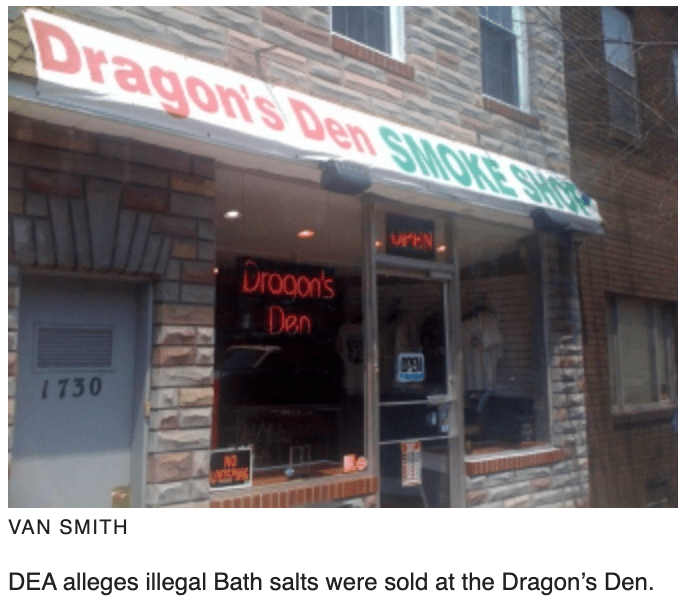
Last winter, the Dragon’s Den was implicated in an undercover DEA operation that resulted in an indictment against a Baltimore man, Carlo D’Addario, for allegedly supplying bath salts to distributors in Virginia (“Undercover in the Dragon’s Den,” May 30). The disclosure of the shop’s role in the fake-pot investigation came in court filings made public on the afternoon of Aug. 21, after City Paper went to press with an Aug. 22 article about the sentencing of Holly Renae Sprouse, D’Addario’s co-defendant in the Virginia bath salts case (“Bath Time,” Mobtown Beat, Aug. 22).

Sprouse, after prosecutors filed a motion recognizing her “substantial assistance” in prosecuting D’Addario, received a lenient, 20-month prison sentence on Aug. 14 for her role in the alleged conspiracy. The trial in the case, initially scheduled for May, has since been rescheduled twice. D’Addario is currently set to stand trial starting on Oct. 22.

The investigation leading to the M&C Wholesale seizure began last September, according to the warrant, when a DEA undercover officer entered the Tobacco Shop and purchased a gram of “Hysteria,” a fake-pot brand, for $20. In November, the same undercover officer returned to the shop and purchased another three grams of Hysteria for $47. The place was raided in December, turning up invoices for its wholesale purchases of the substances, branded not only as Hysteria, but also “Black Sabbath” and “Game Over.”

Using contact information from the invoices seized from the Tobacco Shop, agents arranged for a confidential source to order fake-pot products from the wholesaler in early April, and have it delivered to the Dragon’s Den in Fells Point. Two packages arrived there on April 4 and 5, containing packages of “Dr. Feelgood,” “Game Over XXX,” “Brain Freeze,” and “Black Sabbath,” along with documentation of the purchases from M&C Wholesale.

The operation then began surveillance of M&C Wholesale’s offices in Laguna Niguel, watching on June 11 and 12 as operators and employees managed incoming and outgoing deliveries. Later, in July, investigators were contacted by a courier-service employee that made and picked up deliveries there, and had seen its operations. The courier informed them that the only activity going on inside was “eight to 10 individuals seated around a table handling piles of a green herb-like substance.”

The investigation also probed M&C Wholesale’s financial transactions, learning that it gets paid for providing supplies to smoke shops with names such as “Puff N Snuff,” “Happy Daze,” “Up in Smoke,” and “Sky High Smoking Accessories.” Payments would enter an M&C bank account at Wells Fargo. Then, on July 24—the day before the seizure—$2.2 million was transferred from that account to another Wells Fargo account, held in the name of individual who is a signatory of M&C Wholesale’s account.

CP searched federal court records as well as those in Orange County, Calif., where Laguna Niguel is located, and found nothing to suggest M&C’s owners and operators have been charged with any crimes. Two phone numbers for them were included in the warrant. One of the numbers has been disconnected, and messages left at the other were not returned.

According to the Operation Log Jam press release, the probe is a partnership of seven federal law-enforcement agencies—DEA, IRS Criminal Investigations, FBI, U.S. Immigration and Customs Enforcement, U.S. Postal Inspection Service, U.S. Customs and Border Protection, and U.S. Food and Drug Administration Office of Criminal Investigations—in tandem with “countless state and local law enforcement members.” DEA administrator Michele Leonhart is quoted, saying “this enforcement action has disrupted the entire illegal industry, from manufacturers to retailers,” and emphasizing that “we are committed to targeting these new and emerging drugs with every scientific, legislative, and investigative tool at our disposal.”

Gun Trouble: Arizona Machine-Gun Probe Prompts Dispute Over Seized Maryland Gun Collection

by Van Smith

Published in City Paper, June 6, 2012

It’s been nearly seven years since 58-year-old auto mechanic and gun collector David Bord made a purchase that has caused him no end of grief: a Hatton Industries machine gun, which he got at the Armory, a gun store near Annapolis, in exchange for 10 pistols and $10,000. What Bord didn’t learn until almost three years later—in spring 2008, when agents of the federal Bureau of Alcohol, Tobacco, and Firearms (ATF) visited him—was that the gun was suspected of being part of an allegedly fraudulent gun-registration ring based in Arizona.

In December 2009, as a result of an ATF tip involving Bord’s purchase at the Armory, Baltimore County police raided Bord’s home and business and seized a large part of his gun collection. Bord says they took 25 firearms worth $250,000, nearly all of them 35 to 50 years old, based on a faulty warrant, and that the guns are now in ATF’s possession.

“They said the guns weren’t registered with Maryland or the [United States],” Bord says of the Baltimore County police who took his guns, “but every single one of the guns is—I showed them the paperwork. They know everything is legal, and they still refuse to return them. Every single one of them is legal and registered, but the idiots still won’t back down.”

Bord’s ongoing efforts to have the guns returned to him include a lawsuit against Baltimore County, which is scheduled for trial in September, having survived the county’s attempt last year to have it dismissed. In addition, Bord says he asked the Maryland U.S. Attorney’s Office to file a federal lawsuit seeking to keep two of the guns, which it did in April; Bord hopes this strategy will mean a federal judge will review the legal issues involved in the guns’ return, and that he will prevail.

Meanwhile, in 2010, Hal Paul Goldstein—the owner of the Armory—and another Maryland licensed firearms dealer, Randolph Benjamin Rodman, were charged in a 39-page, 107-count federal indictment in Arizona, along with four Arizona dealers: George Dibril Clark III, Lorren Marc Kalish, James Patrick Arnberger, and Idan C. Greenberg (“Blunderbusted,” Mobtown Beat, Aug. 5, 2010). The six stand accused of “harvesting” serial numbers from older machine guns made before May 19, 1986, and welding the numbers onto newer machine guns they had manufactured, in order to evade a federal machine-gun ban that prohibits citizens from possessing or transferring machine guns made after 1986.

The Arizona case has been fraught with battles between the government and the defendants, who have claimed prosecutors have not been forthcoming with required disclosures of evidence. During an August 2011 hearing, U.S. District Judge Roslyn O. Silver, after hearing of evidence-sharing problems experienced by the defendants, said, “I’m going to consider dismissing the case” if the issues persist, according to a court transcript. A jury trial is scheduled for August.

The 34 machine guns at issue in the Arizona indictment include the Hatton Industries weapon that Bord purchased from Goldstein, according to court records.

In addition to the Arizona charges, Goldstein was indicted in Maryland federal court in December, charged with unlawful possession of machine guns and firearms. On May 24, Goldstein filed a court notice consenting to having the Maryland case transferred to Arizona, where he intends to plead guilty to a single count of improper firearms record-keeping.

Goldstein’s attorney, Joseph Conte, declined to comment for this article, as did the Maryland U.S Attorney’s Office, whose spokesperson, Marcia Murphy, wrote in an e-mail that “since there is litigation pending, I don’t think we will have comment on either” the criminal charges or the forfeiture case involving Bord’s weapons. Bord, though, is openly indignant about his predicament. As a collector for more than 30 years, he says “my firearms paperwork is beyond reproach,” and he’s aghast that, despite the fact that he produced proof that his weapons were registered with the proper authorities, law enforcers continue to keep his property.

Bord says ATF agents like to say that their agency’s acronym stands for “Always Think Forfeiture,” since taking and keeping people’s guns is an important part of their law-enforcement strategy. (Indeed, a few years ago, ATF suffered a dustup when it ordered Leatherman tools for its trainees inscribed with the words “Always Think Forfeiture,” then recalled the order after a member of Congress complained.)

Bord’s lawsuit against Baltimore County over the seizure of his guns asserts that the two police officers named as defendants—Detective Erik Socha and Cpl. Anthony Kidwell—undertook the raids on Bord’s home and business based on faulty warrants “in order to intimidate” Bord and cause him “economic injury,” but also “for gratuitous sport rather than for proper law-enforcement purposes,” according to court documents. The lawsuit also contends that Socha and Kidwell, when presented with Bord’s firearms paperwork after the raids, said “save it for court,” that the paperwork was “wrong” or “bull___t,” and “words to the effect” that Bord “would never get his property back.”

The county’s filings in the case, meanwhile, say the police and ATF are keeping the weapons while they continue “their investigation to determine if the weapons. . .are a violation of state or federal law.” Bord was accused of a misdemeanor firearms offense in Baltimore County Circuit Court after the raids, but in 2011 prosecutors tabled the charges.

Undercover in the Dragon’s Den: Virginia “Bath Salts” Investigation Nabs Fells Point Smoke Shop

by Van Smith

Published in City Paper, May 30, 2012

Last December, about two months after synthetic stimulants used in “bath salts” were put in the same class of federally banned substances as heroin and cocaine, two customers plunked down $675 for some at the Dragon’s Den Smoke Shop in Fells Point. They did the same in January, buying packets of powder branded as “Speedy Gonzalez,” “Incredible Hulk,” “Taz,” and, during the January visit, “Bugs Bunny.” Each time, the guy they bought it from, Carlo D’Addario, explained that some people smoke the stuff while others snort it, according to court documents.

Those two visits to the Dragon’s Den gave the “customers,” who were part of a drug probe and had recorded what transpired on audio and video, evidence for an indictment and search warrants. The court documents spell out how, since last July, law enforcers with the Augusta County, Va., Sheriff’s Office and the Richmond, Va., and Baltimore offices of the U.S. Drug Enforcement Administration (DEA) had targeted D’Addario, building a case that he is a source of now illegal bath salts sold in Virginia.

On March 1, the investigation culminated with raids on the Dragon’s Den and D’Addario’s home on Pot Spring Road in Timonium and the unsealing of the indictment, first filed on Feb. 22, against D’Addario and his co-defendant, a Virginia woman named Holly Renae Sprouse.

In the past two years or so, the sudden popularity of bath salts, which were lawful, taxed commodities typically found in convenience stores, gas stations, head shops, and the like, has coincided with a spike in medical emergencies reported as related to its abuse, including violent and self-destructive reactions that have grabbed headlines. The feds and many states have consequently outlawed them.

The banned compounds have names comprised of lengthy combinations of numbers and letters, but popularly they are known as MDPV, 4-MEC, and MDMC (also called methylone). (For the hard-core chemists out there, who probably already know this, they are related to cathinones, alkaloids found in the khat plant.) The effects of these designer drugs are said to be similar to other stimulants such as methamphetamine and ecstasy, and are described in a DEA fact sheet as “feelings of empathy, stimulation, alertness, euphoria, and awareness of senses.” One of them, methylone, was patented in 1996 as an antidepressant.

“First there was ‘K-2’ and ‘Spice,’” says Mark Campbell, supervisor of Virginia’s RUSH Drug Task Force, based in Harrisonburg, Va., referring to synthetic cannabis, which also became a craze, prompted scares due to reports of medical emergencies, and was listed as a controlled substance. “Now it’s ‘bath salts,” Campbell continues. “It’s the ‘in’ thing right now. The perception has been that it is legal and that there are no health issues, and that just couldn’t be further from the truth.” Users, Campbell says, tend to be young, and they don’t just snort or smoke bath salts, which come in powder form; they also “put it in a spoon, heat it up, and turn a solid to liquid” to inject intravenously, like heroin.

Campbell says the profit margin from dealing bath salts is “ridiculous.” The court documents in D’Addario’s case say that street prices range from $40 to $100 per gram, and that each gram contains eight to 40 doses. At those prices, the 20.6 grams allegedly sold by D’Addario for $675 in the undercover operation at the Dragon’s Den on Dec. 13, 2011, at $33 a gram, could have been quite profitable.

The take from the March 1 raids of the Dragon’s Den, according to court records, was prodigious: more than 100 containers—jars, packets, boxes, and the like—labeled with names such as “Dragon’s Breath,” “Bayou Blaster,” “Get Twisted,” “Zombie Matter,” and “Super Villain.” Among the items agents seized from D’Addario’s Timonium home are “suspected K-2 spice,” “tablets” of other drugs, a “tally sheet” of transactions, and an “undetermined” amount of U.S. currency in a “basement safe.”

D’Addario’s co-defendant, Sprouse, pleaded guilty on May 8 and her sentencing is scheduled for August. The factual statement attached to Sprouse’s guilty plea does not name D’Addario, but mentions her “Baltimore supplier” and says she was arrested twice last year—in August and October—in connection with bath-salts possession, and after the second arrest she began to assist law enforcers in their probe. If D’Addario does not plead guilty, but instead chooses to assert his innocence before a jury, his trial is scheduled to take two days starting June 28.

D’Addario’s attorney, Andrew Carter Graves, said he and his client would have no comment for this article. City Paper called the Dragon’s Den and spoke to a woman, who said she was the manager and called herself Chrissy. She offered to try to get in contact with D’Addario, whom she described as the shop’s owner, and put the call on hold. A few minutes later, a man picked up the phone, refused to disclose his first or last name, and explained, “We were told not to talk to you.” When asked who gave those instructions, he said, “the DEA guy in charge of the investigation.”

Metro Crime Stopper: Rookie Transit Cop Arrests Federal Fugitive, but Feds Dismiss Indictment

by Van Smith

Published in City Paper, May 2, 2012

If you’re a federal fugitive, you better not skimp on paying the Baltimore Metro Subway fare when Generia Lawson is on the job.

On April 17, Lawson, a rookie Maryland Transit Administration (MTA) police officer, was in full uniform, doing routine fare checks at the West Cold Spring Metro Station on Wabash Avenue, when she accomplished what the U.S. Marshals Service has not done in three years: arrest 62-year-old Roosevelt Drummond, the only one of scores of indicted members of the Black Guerrilla Family (BGF) prison gang in Maryland who has not faced the federal grand-jury charges brought against him.

Drummond, who has prior convictions for drugs and guns, was charged federally with narcotics, robbery, and firearms crimes on April 8, 2009, and has eluded arrest ever since. A source from within the BGF who was not charged in the federal investigation but who asks to remain anonymous due to safety concerns, told City Paper earlier this year that Drummond is “an outlaw. The next time you’ll hear about him, it’ll be, ‘Oh, we got a dead black man in Montana,’ and come to find out it’s him. He ain’t going back to prison. It’ll either be the police kill him trying to get him, or he just dies. Or he probably ODs or something.”

Turns out, there was no showdown with the cops, no Butch Cassidy-style drama, just a routine inspection over a Metro ticket. Lawson’s suspicions were aroused when Drummond produced a discounted ticket he wasn’t entitled to, and then proceeded to give her false information about his identity. After she concluded he was a fugitive and arrested him, she found a small amount of heroin in his pocket and charged him with possession.

But a week after Drummond’s arrest, the open federal warrant that led Lawson to arrest him was ordered “quashed and recalled,” according to federal court documents. Assistant U.S. Attorney James Wallner, the lead prosecutor in the BGF cases, filed a motion on April 24, seeking dismissal of the federal indictment against Drummond. The filing is spare in explaining why, stating only that “based upon information developed during the investigation of the BGF, the Government seeks to dismiss the Indictment.” The next day, U.S. District Judge William Quarles, who has handled the BGF docket since 2009, obliged by ordering the dismissal. The Maryland U.S. Attorney’s Office declined to comment on the dismissal of the indictment against Drummond.

When reached by phone on April 30, Lawson, who says she finished her training as an MTA police officer about three months ago, remarks that “you have to expect these types of things” in a job like hers, and that she was “a little shocked” to have nabbed a federal fugitive while checking fares, “but not really.” Until City Paper’s inquiries about Drummond’s arrest, she adds, she did not know he was part of the BGF case, nor did she know that the federal indictment against him had been dismissed, which she says is “just the process.” As for her interaction with Drummond, she says “he was cooperative,” “very compliant,” and “calm” when being arrested, and “did not appear to be nervous.” In her job, she adds, she understands that “small things can turn into big things,” such as arresting Drummond.

Lawson’s “statement of probable cause” to charge Drummond with heroin possession, filed in district court, tells the story pretty well. When Lawson asked Drummond for his ticket, shortly before noon on April 17, he showed her one that’s for senior citizens and disabled people, yet he did not have the MTA identification required of patrons who purchase such tickets. That prompted a slippery-slope interaction between Lawson and Drummond, in which he said he was “James Green,” and gave her a date of birth and Social Security number that did not jibe with the MTA dispatcher’s data.

When Lawson asked Drummond if he wanted to change any of the information he’d provided, he gave her his correct birth date. Soon thereafter, a photo of Drummond “was sent to my mobile” by the dispatcher, Lawson wrote, and “I was able to confirm” who she was dealing with, and conclude that “there was a warrant out” on him.

After arresting Drummond, Lawson found a small packet of heroin in a black velvet bag in his pants pocket. He was charged in Maryland District Court with heroin possession. Bail was set at $20,000, but online court records indicate he has not posted it and remains detained pending a trial scheduled for May 21, when he could face up to four years in prison and a $25,000 fine.

While Drummond’s treatment at the hands of a rookie transit cop appears to be straightforward police work, the dismissal of the indictment against him by seasoned federal authorities stands in marked contrast to his BGF co-defendants, some of whom are serving lengthy prison sentences.

Court documents in the sprawling BGF conspiracy cases, which include racketeering convictions against many of the defendants, indicate that Drummond’s role was limited to a March 13, 2009, incident involving three men in a car with a stolen handgun, handcuffs, rubber gloves, and a mask. The car was pulled over by Baltimore police, and Drummond was the only one arrested for possessing the gun. The state charges against him were dropped after his federal indictment. Now, three years later, Drummond is the only one of the men in that car who isn’t in trouble in federal court.

One of them, Randolph Edison, last year pleaded guilty to possessing a stolen firearm and is serving 96 months in prison. The other, Zachary Norman, entered into a plea agreement in October 2010 and is facing a superseding charge of conspiring to commit an assault.

Though Edison pleaded guilty, he afterward sought to rescind that plea—in part because, as he told Quarles at his sentencing hearing last August, “I never had possession of a gun, and nor did I know the gun was stolen.” Drummond, now that his indictment has been dismissed, doesn’t have to worry about that particular gun anymore.

Maryland Super-Lobbyist Bruce Bereano Aims to Erase His Fraud Convictions

by Van Smith

Published by City Paper, Nov. 16, 2011

Seventeen years after his 1994 convictions for mail fraud, Maryland lobbyist Bruce Bereano is looking to clear his name. He’s doing so based on last year’s U.S. Supreme Court ruling in Skilling v. United States, which found that the provision of the federal mail-fraud statutes that formed the basis of his prosecution—known as “honest services” —was unconstitutional. The now-stricken statute said it was fraud to deprive the public of honest services—in Bereano’s case, by fraudulently billing his firm’s clients. Fraud that results in loss of money or property is still a crime.

Bereano’s trial and sentencing were major political spectacles in the 1990s, as he rallied his supporters, including some of the biggest players in Maryland’s political class, in an unsuccessful attempt to avert convictions and a jail sentence. Charged with stealing from his clients by fraudulently charging them for “legislative services” and using the money to make disguised contributions to politicians through his political-action committee, Bereano claimed the crimes were victimless. After his convictions were upheld on appeal, in 1998 he was sentenced to spend five months incarcerated and five months in home detention, and to pay a $30,000 fine. He was disbarred as result of his convictions, but has continued to be an important lobbyist, representing powerful interests in Annapolis and elsewhere.

Attorneys Timothy Maloney and Matthew Bryant filed Bereano’s petition to overturn his convictions in April, and, at first, it appeared that the U.S. Attorney’s Office in Maryland may have been willing to negotiate a deal. Assistant U.S. Attorney Michael Leotta initially was handling the case, and in July he requested an extension to reply to the petition “so that the government and defense can explore whether there is a way to resolve the matter by agreement.” In August, after assistant U.S. Attorney Leo Wise took over the case from Leotta, he raised the same possibility in a second request for an extension.

Ultimately, in late September, Wise submitted his opposition brief, writing that the jury found not only that Bereano committed now invalid “honest services” fraud, but also “traditional pecuniary fraud” that “defrauded his clients of money.” In their legal briefs, though, Bereano’s attorneys argue that “all of the alleged ‘victims’ testified that they were not victimized and did not suffer losses,” so at trial prosecutors instead emphasized to the jury that Bereano had deprived people of “honest services,” which is no longer illegal.

Should Bereano’s petition prevail, and his convictions be overturned, he would be entitled to have the $30,000 fine returned, with interest. According to his attorneys’ interest worksheets of the fine, the total amount to be returned would come to nearly $60,000.

“This is an extremely interesting case,” says University of Maryland Law School adjunct professor Frank Razzano, who uses Bereano’s case in his business-law classes. Bereano is arguing that “he was convicted of something that is not a crime,” Razzano says, but “the government says he also was convicted of something that still is a crime—he stole $100 from four clients [via billing], so he’s a bad guy.” The judge, Razzano says, “is going to decide whether the jury was instructed on honest-services fraud as the overall theory of the case.”

Razzano cautions that he’s “only read the briefs, not the original jury instructions” in Bereano’s case, but, based on what he knows, he thinks “Bereano has the better of the arguments.”

Former assistant U.S. Attorney Steven Levin, now a criminal-defense attorney with the firm Levin and Curlett, says Bereano and his lawyers “have made a valiant effort to right a perceived wrong.” The issue for the judge, Levin contends, “boils down to whether or not Mr. Bereano stole the money. If the court concludes that he did, the court will likely find that the erroneous instruction to the jury was harmless. If the court concludes otherwise, the conviction should be reversed.

Bereano’s attempt to overturn his convictions based on the Skilling decision harkens back to the case of another famous Marylander whose convictions were overturned in 1987: former Gov. Marvin Mandel. Ten years after he was convicted of 17 counts of mail fraud and one racketeering count, Mandel cited a then recent Supreme Court ruling against the “honest services” fraud charge, and cleared his name. Congress then passed an “honest services” statute in 1988, which was used liberally by federal prosecutors until last year’s Skilling decision put an end to its use once again. (The federal corruption case against Maryland state Sen. Ulysses Currie—which ended recently with acquittals on all charges for the Prince George’s County Democrat—initially included seven honest-services charges that prosecutors dropped after the Skilling ruling.)

Razzano says Bereano’s attorneys “have pretty sound precedent in the Mandel case” in arguing their client’s case. Razzano was no fan of the “honest services” provision, saying it was “an incredibly vague statute” and that “I was delighted to see the Supreme Court of the United States finally strike it down.”

Bereano’s attorneys and the Maryland U.S. Attorney’s Office declined to comment on the case, which is before U.S. District Judge William Nickerson. A court hearing for oral arguments in the case has been requested by Bereano’s attorneys, but has yet to be scheduled, according to the court docket.

Bocce Brawl: A Little Italy Bocce Feud Winds Up in Court

by Van Smith

Published by City Paper, June 22, 2011

“We don’t need any negativity about Little Italy,” Giovanna Marie “Gia” Blatterman says over the phone on June 15.

The 64-year-old businesswoman is one of the neighborhood’s most visible and diehard promoters, and she has a long history of political clout and controversy. When Kurt Schmoke was Baltimore’s mayor in the 1980s and 1990s, she was a key fundraiser for his campaigns and served as one of his appointees on the Board of Municipal Zoning Appeals. Today, part of her civic involvement is running what she calls the Little Italy Bocce Committee, an all-volunteer, unincorporated outfit that oversees Wednesday night bocce competitions at the city-owned Thomas J. D’Alesandro Jr. Park. The park, a tiny space with two bench-lined bocce courts, is tucked off Stiles Street amid Little Italy’s restaurants and rowhouses.

Based on two recent Wednesday night visits, there appears to be nothing negative in the least about the peaceful, placid bocce games being played there. No voices were raised, no tempers flared, and the slow, deliberate pace of the game, which involves two teams strategically rolling balls down a carefully tended court, promotes a calm civility that, even on an evening with temperatures in the high 90s, tends not to make people sweat.

Nonetheless, a ghost of negativity haunts the place. That’s because Blatterman, her bocce committee, and their lawyer have taken a feud from D’Alesandro Park and moved it into the District Court for Howard County, Civil Division. There have been heated bocce disputes in Little Italy before, including one in 2002 that featured Blatterman in a fight with a neighbor over lighting the courts at night, and even one that became a lawsuit, dismissed in 2003, over a neighboring restaurant’s fire escape and an ordinance that would have closed down bocce play at 9:30 p.m. But none of the prior disputes came with accusations as hot as these.

The plaintiffs in the lawsuit, which was filed on March 1, are the Little Italy Bocce Committee, Blatterman, and two other committee members, Salvatore Petti and Francis Blatterman. Petti’s daughter, Lisa Ellis, represents them. They are asking the court to make the defendant—52-year-old Marriottsville resident Thomas John Macchia—pay thousands of dollars in damages and attorney’s fees, and to order him “forever barred” from Little Italy’s bocce courts and from obtaining any bocce permits from the City of Baltimore “for a period of no less than ten (10) years,” the lawsuit states.

The lawsuit, as initially filed, claims defamation and malicious destruction of property and accuses Macchia of writing defamatory graffiti and posting defamatory notices around the neighborhood. It also claims he destroyed lighting, a video camera, a souvenir map, and bocce equipment at D’Alesandro Park. A pretrial conference is scheduled for June 21—the day this article goes to press—and Macchia is proceeding without the benefit of an attorney.

Shortly after it was filed, though, Macchia twice was charged criminally in Baltimore City District Court based on applications for charges filed by Blatterman. In the first criminal case, filed on March 6, Macchia was accused of malicious destruction of property for breaking the bocce court’s lighting, camera, and map “on or about” Aug. 19, 2010, according to court records. But in the second, filed on March 9, Blatterman accused Macchia of serious violence.

As a result of Blatterman’s written statement, court records show Macchia was charged with first- and second-degree assault, reckless endangerment, and witness retaliation for driving “his car over the curb onto the sidewalk straight at” Blatterman, who was standing on the corner outside Café Gia, her daughter’s Little Italy restaurant. The complaint also says Macchia “has made prior death threats against me, my daughter, and my grandson” and is “trying to intimidate me so I will not testify about his criminal activity.”

On April 27, the Baltimore City State’s Attorneys Office declined to prosecute all but one of the criminal charges, placing one count of second-degree assault on the inactive docket so, if needed, it could be pursued at a later date. The outcome, Macchia acknowledges, included an oral agreement made in front of a judge that he will not go near Blatterman’s home or business for three years—but he insists, despite Ellis’ contentions otherwise, that he’s free to go to the bocce courts and to Little Italy, as long as he stays away from those two places.

On June 14, Ellis filed a “pre-trial statement” in the Howard County lawsuit, which ratcheted up the accusations, saying Macchia “engaged in a campaign to terrorize” Blatterman “over his anger at the bocce situation.” The statement says the plaintiffs intend to add additional counts, seek higher damages, and name Macchia’s wife, Lisa Macchia, as a defendant because she “knew or should have known that Giovanna Blattermann [sic] was in danger.”

Macchia says that, thanks to the lawsuit and the criminal charges, “in the court of public opinion, I’m already convicted of crimes that never occurred.” Indeed, he calls them “imaginary events in [Blatterman’s] mind. And now they are going to try to bring my wife into this. My wife has no knowledge of something that didn’t happen.”

According to Macchia, the whole dispute erupted because his bocce team—Tutto Bocce, which was sponsored by Caesar’s Den Restaurant—kept winning the annual tournaments that take place each summer among about a dozen teams. So Blatterman “tried to chase us off,” he says, because she and her fellow committee members are “sore-losing types.”

Not so, Ellis says. Macchia and his teammates “didn’t like the [bocce] committee, because they were cheating. They were very disappointed that the prize money was only $400. It wasn’t $1,000 like they wanted. He was trying to cause a lot of trouble because he didn’t get his way.”

Passion over bocce competitions—a traditional Italian game, in some ways similar to shuffleboard, involving teams that roll four balls each on a court, attempting to score points by getting their balls closest to a smaller, target ball—is to be expected, as in any sport. But the back-and-forth allegations in this fight raise bocce passions to eye-popping—or maybe eye-rolling—levels.

Things escalated, Macchia claims, in 2009 and 2010 when he started publicly raising questions about Blatterman’s integrity in managing the affairs of the bocce committee, of which he was a member until last year. This, Ellis says, is where Macchia started to defame the plaintiffs, by publicly calling them “thieves” who “can’t be trusted.” An anonymous flier attached to the lawsuit, which claims it was distributed around the neighborhood and posted at the bocce courts, contends that “Blatterman says she allegedly made a donation” from the bocce committee to St. Leo Roman Catholic Church in Little Italy, but the “authorities of the church deny any gift from our league.”

Macchia denies any part in the flier, but he continues to maintain that $1,500 in committee cash, assembled from fees collected from teams, that was ostensibly donated to the church in 2009 remains unexplained. “I advised [Blatterman] to give a check, not cash, to the church because it doesn’t look good, it’s not the proper thing to do,” Macchia says. After he learned she said she had given cash anyway, he says, “I asked her for proof, and she produced a church bulletin that thanks the Little Italy Bocce Rollers Association, which isn’t even our group. To this day, we don’t know where that money went. But to not have a check is a red flag, in my opinion.”

So this year, disgusted and alienated, Macchia says he decided to break off on his own. In early January, he applied for a permit from the city’s Department of Recreation and Parks to have his own Wednesday night bocce games—a move that could have supplanted Blatterman’s night on the bocce court.

At first, in February, he was told in a letter from the city that he would be granted a permit for the Little Italy courts on Tuesday nights, and on Wednesday nights he could use the courts at another city park. But then, Macchia says, the city made an “about-face,” and denied him altogether—after the lawsuit and Blatterman’s felony charges against him were filed.

The denial came in an April letter from the City Department of Recreation and Parks, which states “information from the Law Office of Lisa P. Ellis regarding your activities in and around the Little Italy Bocce Courts . . . provides the background information for the denial of this permit application.”

Macchia contends that the criminal charges were brought simply to undermine his permit application, since people with felony backgrounds cannot be granted a permit. But by that time, Macchia had already drawn first blood in the legal fight, having sued Salvatore Petti for $300.85 in early February over bocce committee finances. Petti countersued for the same amount a few weeks later, and in early May, the case was dismissed. But, as far as Ellis was concerned, the damage was done.

We “didn’t want a lawsuit,” Ellis says, but Macchia “filed a lawsuit against my father” in which “he wanted money that he wasn’t entitled to.” Despite the accusation that Macchia had tried to “kill Gia” and made “death threats” against her and her family, Ellis adds, “We still didn’t want anybody to go to jail or see anybody hurt.” She also contends—despite the fact that the alleged car assault occurred after the lawsuit was filed—that “it was only after he tried to kill her” that she and her clients decided “something needed to be done.”

Macchia’s “harassment occurred over the course of two years,” Ellis continues, and “I was the one who stopped him. He had to be stopped. People quit [playing bocce]. And since he’s not here, I can’t tell you how many people have come up to say how much happier” they are.

For his part, Macchia says the situation is “kind of comical.” But he adds that it is “sad that one person like this could so abuse the system and not have any repercussions. It’s such a shame that a game, bocce ball, could result in false felony charges and bizarre civil charges.” Asked if he plans to visit the bocce courts again, since he contends he’s free to do so, he says: “I had four felony charges, unfounded charges, filed against me. Given that, you tell me if you would go back there.”

Giovanna Blatterman has, in fact, faced repercussions before for abusing the court system. In 2003, court records and news reports show, Blatterman and her mother, Rosa Aquia, together paid a total of nearly $163,000 to Little Italy activist Roberto Marsili, since deceased. The payments were made to satisfy a court judgment Marsili had won against them in 2002, when a Baltimore City Circuit Court jury found that the two women had engaged in “abuse of process” by having Marsili arrested on false criminal charges and filing an unsuccessful defamation lawsuit against him.

Marsili proved that Blatterman and Aquia had tried to silence his criticism of their real estate dealings. A company they controlled, Pascal Rose Development LLC, had received a controversial no-payback loan from the city, and Marsili believed it was a “sweetheart deal” due to her City Hall connections, and he published his thoughts on the matter in his Little Italy newsletter, The Guardian. One of the crimes with which Blatterman had Marsili charged—and to which Marsili pleaded guilty, on the advice of his attorney at the time—was vehicular assault, for attempting to drive her down in his car. She’s now, in essence, accusing Macchia of the same conduct.

Blatterman had Ellis handle all questions and comments on her behalf for this article. When reminded of the similarity between the car-assault accusation Blatterman is making now against Macchia and the one she made against Marsili in 1997, Ellis says Blatterman fears that Macchia is “researching her past” and “trying to recreate things” that she had been involved in before. Ellis insists that she has proof of Macchia’s alleged violence and threats, and that, as an attorney, she would never assist in a malicious prosecution of false claims.

“I have independently corroborated everything my clients are saying,” Ellis says. “There are witnesses, affidavits, handwriting experts, a video expert,” all of which will be used in proving the case. “He just needs to be stopped,” she adds. “This is about people’s safety.”

In an effort to convince this writer that Macchia is the one who was captured on videotape destroying property at the bocce courts, Ellis plays two segments of video on her laptop. In one segment, some unidentifiable individuals, quite small and obscure figures on the screen, can be seen at the bocce courts at night, and one of them picks up what appears to be a two-by-four and smashes some of the court’s lights. In the other, in which a man takes a framed object off the wall at the bocce courts, drops it to the ground, and stomps on it, well, that man could be Macchia, a heavy-set, balding, round-faced guy. Prior to breaking the object—Ellis says it is a souvenir map of Little Italy, worth $500—the culprit walks face-first up to the camera, and the individual onscreen resembles Macchia.

“No, that’s not me,” Macchia says over the phone the next day. “There are plenty of other people who look like me. They showed that tape to the prosecutor in the criminal case, and obviously, if it was me, they would have prosecuted me, but they didn’t. The malicious destruction of property charge was thrown out. And the judge looked at it too, and said it was not conclusive. The criminal judge said no. If the civil judge says yes, well, I’ll appeal, because there’s no proof.”

Based on what Ellis wrote in her eight-page pretrial statement, Macchia’s going to have his hands full impeaching witnesses and other evidence, should the case go to trial. Doing so without the aid of an attorney may prove a daunting challenge.

Ellis’ statement says she plans to introduce as evidence a letter sent to Blatterman that reads, “Death to the Gias We Will Kill You Bitches and Luca Too,” and was delivered in an envelope containing white powder. “HAZMAT came, the fire department came, the police department came and took it away,” Ellis recalls. She has handwritten fliers that read, among other things, “Stop Gia Blatterman from Stealing your Money.” She has photos of graffiti on the bocce-court benches and elsewhere in the neighborhood that read, among other things, “Gia sucks,” “Gia is a thief,” and “Café Gia sucks.” And she states that she has two handwriting experts who will testify “that all defamatory fliers, notices, writings, and graffiti” submitted as evidence in the case were written by Macchia.

In all, Ellis stated that she plans to call seven to 15 witnesses, and explained that “many more wanted to testify, but plaintiffs have considerably shortened its number (via affidavits) in the interest of judicial economy.”

Macchia accurately predicted that City Paper would have a hard time finding anyone willing to comment for this story. “They’re afraid they’ll get sued if they do,” he said. But one man—a longtime friend and supporter of Blatterman’s, real estate developer Wayne Gioioso Sr.—stepped up to comment when reached by phone.

“I love Gia,” Gioioso says, explaining that he’d already been called by Blatterman about this in-the-works article because “she’s concerned you’re going to make the neighborhood look bad.” The way Gioioso sees it, the bocce dispute arose because “people who don’t live down there” in Little Italy “are causing trouble. It’s typical Italian stuff. They can’t get along. You have different factions that are combative with each other. That’s all.”

No matter who is right or wrong in this situation, one thing’s for certain: There are rules in bocce, and at least one of them has been broken in this dispute. Attached to the lawsuit are the “Wednesday Night League Bocce Rules,” which, at the very end, state: “BUON DIVERTIMENTO (HAVE FUN).” While the bocce lawsuit appears to be no fun at all, at least the bocce games at D’Alesandro Park still are.

Leveraging a Lie: Armed Drug Dealer Challenges Conviction Based on Dirty Cop’s Conduct

by Van Smith

Published in City Paper, Mar. 16, 2011

The fallout from former Baltimore Police Detective Mark Lunsford’s 2010 conviction for theft and lying continues. On March 9, an attorney for an armed drug dealer argued in a federal court filing that her client’s 2008 guilty plea should be vacated because Lunsford admitted to the FBI that he concocted information in the case. The defense attorney, Marta Kahn, represents 36-year-old Cortez Leon Fisher, who is serving a 10-year sentence in a federal prison in New Jersey based on a 2008 guilty plea he tendered prior to knowing of Lunsford’s deceit.

Kahn wrote that Lunsford, who was assigned to the U.S. Drug Enforcement Administration, admitted to the FBI that he falsely attributed information used to target Fisher to a source other than the one who actually provided it. Kahn argued that Lunsford’s concealment of the truth in her client’s case likely went further, following a pattern of making up facts to build probable cause to arrest suspects, raid their homes, and steal their property.

The theft and lying charges against Lunsford were filed in September 2009 (The News Hole, Sept. 24, 2009), and were accompanied by raids that turned up suspicious items in his Sykesville home, including jewelry and $46,600 in cash. Among the jewelry seized from his home were 10 watches and numerous necklaces, bracelets, rings, and chains (The News Hole, Sept. 30, 2009).

Lunsford pleaded guilty last year (The News Hole, April 14, 2010), and was sentenced to 20 months in federal prison. His criminal conduct has affected a number of cases he worked on (“Costly Charges,” Mobtown Beat, Nov. 11, 2009), including a recently concluded federal trial that resulted in jury convictions of two men with direct ties to drug cartels in Mexico (“Corner Cartel,” Feature, Feb. 23).

In an earlier pleading Fisher made last year, before Kahn was appointed to represent him, he claimed that Lunsford “set me up and arrested me unlawfully” and that prosecutors may have withheld their knowledge of Lunsford’s misdeeds. Fisher contended that the informant in the case “never gave” Lunsford “information concerning drug activities” at Fisher’s home, and that Lunsford, after arresting Fisher, “returned to my apartment later and took a safe containing all my jewelry and personal property.”

Fisher asked the court to order the return of the stolen property, including “my watch which contains numerous diamonds with blue and red designs as details.” And since none of Lunsford’s alleged misdeeds were in evidence when Fisher pleaded guilty, he asked that his indictment be dismissed and his guilty plea overturned.

The prosecutor in the case, Assistant U.S. Attorney Philip Jackson, responded that “the Government denies that at the time of Fisher’s plea and sentencing that it had any knowledge of the facts” leading to Lunsford’s conviction. Jackson also argued that Fisher is not entitled to have his guilty plea overturned because Lunsford’s deception was not about Fisher’s conduct—which, given the guilty plea and other evidence in the case, was accurately portrayed—but about how he learned of it. In addition, Jackson stated that any property that can be identified as Fisher’s that was seized from Lunsford “will be returned to him.”

U.S. District Judge J. Frederick Motz, who accepted Fisher’s guilty plea and will decide whether the case ultimately will be overturned, initially sided with the government—though, in his ruling last summer, he noted that “the circumstances giving rise to Fisher’s motion are quite disturbing.” In September, after Kahn was appointed to represent Fisher, Motz changed course and allowed further pleadings on the issue.

The court records in Fisher’s case include a redacted FBI document, dated Oct. 23, 2009, memorializing Lunsford’s admission that he fabricated source information and has a history of run-ins with Fisher and his family. Lunsford said a person other than the source named in case reports “was the real informant on the CORTEZ FISHER case,” the document states, adding that Lunsford’s “association with FISHER’s family goes back to his time in patrol when he was in the Murphy Homes projects” and arrested Fisher and his brother. The brother, the document states, “was killed in the Murphy Homes later after being released from jail.”

Online court records list Lunsford as an officer involved in three state indictments against Fisher between 2000 and 2004, all of which were later shelved by prosecutors. The charges involved drugs, guns, or both.

In 2004, Fisher pleaded guilty in federal court to being a convicted felon in possession of a firearm and ammunition, and was sentenced to 36 months in prison. After his release, while still on federal probation, he was charged again based on Lunsford’s ill-founded investigation—triggering, once he pleaded guilty, an additional 12-month sentence.

Now Fisher wants to turn back the clock and make the judicial system reconsider his case in light of Lunsford’s misconduct.

“Mr. Lunsford’s credibility is, at this point, all but non existent,” Kahn wrote. “His conduct was part of a widespread criminal scheme to get rich by falsely implicating and stealing from citizens. His claims about his conduct in this case need to be made in open court, under oath, subject to cross-examination, on the record at an evidentiary hearing before any accurate judgment about the reliability of his statements can be made.”

Guilty Pleas in the Berg Brothers Recycling Case

by Van Smith

Published in City Paper, Dec. 16, 2010

Yesterday in U.S. District Court in Baltimore, Adam Berg of Berg Brothers Recycling, along with the company and a co-conspirator, Jeffrey Mark Harmon, pleaded guilty to charges of bribing a government official, Robert Barry Adcock, in connection with recyclable metals delivered to Berg Brothers from the National Security Agency (NSA). Adcock, a civilian NSA employee responsible for waste removal, is scheduled for rearraignment on Dec. 21.

The first indication that Berg Brothers was the target of a criminal investigation was in 2009, when City Paper observed the company’s offices being raided by the Department of Defense Criminal Investigative Service agents. This summer, the indictment came down, charging Berg, the company, Harmon, and Adcock with a bribery conspiracy that deprived the NSA of full payment for the recyclable metals the agency provided the company.

The pleas are being entered not in answer to the grand jury indictment, but to superseding charges. Harmon’s plea agreement (see below) includes extensive factual background about the scheme.