

The Quiet Revolution: Can Heather Mizeur Ride Maryland’s Wave of Progressive Politics to the Governor’s Office?

By Van Smith
Published in City Paper, Jan. 15, 2014
Photo: commons.wikimedia.org
More than a quarter-century has passed since Maryland’s last truly competitive Democratic primary for governor in 1986, when Attorney General Stephen Sachs lost to Baltimore Mayor William Donald Schaefer. So this year’s polling on June 24 will be historic, simply because two statewide elected leaders – Lieutenant Governor Anthony Brown and Attorney General Doug Gansler – are on the ballot. Complicating their efforts to attract the most votes from Maryland’s roughly 2 million registered Democrats is a third bona fide candidate: 41-year-old state Del. Heather Mizeur of Montgomery County, a state legislator with sterling credentials as a Democratic Party activist.
City Paper met with Mizeur at the Starbucks on Church Circle in Annapolis to discuss her candidacy. The sit-down occurred on the first day of this year’s General Assembly session-apt timing, given Maryland’s increasingly apparent leftward leanings in recent years, passing laws to repeal the death penalty, ramp up gun control, extend marriage rights to same-sex couples, and grant in-state tuition to some undocumented immigrants.
While Brown and Gansler grapple, Mizeur’s candidacy seems to be tapping into this leftward trend by proposing to legalize and tax marijuana to pay for universal pre-K public education, to raise the minimum wage by nearly $10 per hour over the next decade, and to provide small-business tax relief while closing loopholes that let large out-of-state companies off the tax hook. The small-town Illinois native with working-class roots has toiled in the partisan vineyards since the 1990s: as a staffer for three Congressional Democrats; as domestic-policy director for then-U.S. Sen. John Kerry when he ran in the 2004 presidential election; as a Takoma Park city councilwoman; as a superdelegate to the 2008 Democratic National Convention; as a 2009 appointee to the Democratic National Committee’s executive committee; and as a veteran of seven (and counting) Maryland General Assembly sessions.
If elected, Mizeur would be many firsts for Maryland: the first woman governor, the first openly gay governor, and the first same-sex married governor. She would also be the first governor elected using the state’s public-financing mechanism for statewide campaigns, an arrangement that constrains campaign spending but opens up a funding level that might otherwise have been elusive, given the well-established money-pumping machines working for Brown and Gansler.
City Paper: The clock is ticking, with a June primary.
Heather Mizeur: It is, but we take a pause now for a 90-day legislative session with great expectations on what we can get done to make a difference in peoples’ lives. We seem to be unified in trying to increase the minimum wage, and I’m hoping we’ll also get paid sick leave and some small-business tax relief. We don’t have to have either-or economic policy. We can pay people a living wage and have paid sick leave while also providing tax relief to our small businesses as long as we close some corporate tax loopholes that are allowing a handful of multi-state companies to hide their earnings outside of the state and avoid paying any taxes. I think we’re going to be able to make some progress on marijuana policy reform and hopefully protect us from unregulated shale-gas drilling. It’s a big agenda.
CP: Does it change the dynamic, being a candidate running against the lieutenant governor and the attorney general during the session?
HM: I’m sure there’ll be some elbows thrown trying to keep people from being seen as successful. That’s not how I come at this. I come at this as a public servant. I don’t view my opponents in the campaign as my enemies. We’re all good people, trying to get good things done for the state. We just have vastly different visions for where we take Maryland. I’m definitely looking forward to being the one that helps set the agenda for what that will be starting in 2015.
CP: You strike me as the extra-establishment progressive candidate.
HM: What do you mean by that?
CP: You came up in the Democratic establishment and right now, with your candidacy, you are challenging it.
HM: Very much so, because in Maryland our next governor should not always be dictated by who’s standing next in line. The way it typically has worked in Maryland is, once a governor gets elected, insiders start looking at who appears to be next in line and funneling money and building favors and establishing deeper relationships to get in good with them. When a candidate like me looks at getting in, I’m technically supposed to look at the millions of dollars in their bank accounts or the endorsements they’ve already lined up years ago, and say, “Well, I can’t compete against that, I should never get in.” That perpetuates a system of advancing the person next in line to protect the status quo.
My campaign is about re-empowering the people so they have alternatives and choices and can come together and say, “We have a different vision. We believe in something else than what is spoon-fed to us that we’re expected to go along with.” We’re in it to win it, and we’re incredibly thrilled with the support of a robust grassroots base all across the state.
CP: This race doesn’t seem to be a coronation, though, and sometimes those coronations don’t work, like in Kathleen Kennedy Townsend’s case in 2002. You worked on Townsend’s campaign, right?
HM: I was Joe Kennedy’s legislative director, her brother, when he was in Congress. Toward the end of that campaign, he asked if I would consider going and helping his sister’s campaign out. And I was very interested for a variety of reasons in trying to help out that effort.
CP: The primary, a lot of people seemed to be interested-but I’m blanking on who actually ran against her.
HM: Nobody. That was the problem. [Actually, Robert Fustero ran against her, getting 20 percent of the vote.] There were a handful of people who were interested in running, but they took a look at money, endorsements, all those things, and decided not to run. I think contested primaries are good for democracy, to engage the electorate to feel ownership over the process. But even a contested primary is usually the next-in-line guys duking it out. It’s not someone like me, who’s seen as jumping the line and not waiting your turn.
I just reject the notion that these elections should be about whose turn it is. This is about the problems our state faces, how to address those problems, and an ability to capture the imagination of the electorate to come together to stand for what is the right course of action. How’s that ever going to be addressed by just looking at who thinks it’s their political birthright by virtue of, “I’ve done this job, and now it’s my turn to do that job”?
When people ask me, “Well, why don’t you run for comptroller or why didn’t you be someone’s running mate?,” I say, “Because that is me trying to set a pathway for my career, and that’s not what this is about.” This is about being in a place and time where my ideas and my willingness to address the challenges facing us are better than the competition. So I am a better candidate and I will be a better governor, and it’s time for me to step forward and give voters that option.
CP: Every state has its own nuanced political geography, but Maryland is essentially three states: the Eastern Shore, Western Maryland, and the Baltimore-Washington corridor, where most of the population lives. You seem to represent a progressive set of beliefs that is often shared by well-educated people in the Baltimore-Washington corridor. How do you address your progressive politics to those parts of the state that don’t share those ideas?
HM: I actually reject the notion that progressive values and ideas are only shared by people of a certain educational attainment or living in a certain region of the state. Progressive values come from a place of being willing to make progress on problems that have plagued us for too long and the solutions have been too risk-averse. I do believe in a one-Maryland approach to governing. I am not just campaigning in the Baltimore-Washington corridor. I think that it is convenient to try to take a progressive viewpoint and put it in the box of one region or another, but I’m finding the depth of support for the ideas that I’m discussing across the board.
Some people might disagree with me on some of the specifics I’m advancing, but they are backing my candidacy because they find it refreshing for a candidate to actually stand up and say what he or she believes. I’m taking very bold, principled stances on a range of issues, providing clear, in-depth policy proposals for the public to determine if they want to support my candidacy based on what I believe. I add a lot of pragmatism to my progressive stances.
People all across the state want to be able to earn a decent salary. Where the concern has been is, you can’t do that without hurting small businesses. Yes, I’m pushing for a living wage, and I’m bringing to the table tax relief for small businesses, but I’m also for holding corporations accountable for their fair share. That might be called a progressive priority, but it is just about fundamental fairness in expecting all of us to play by the same rules. And our failed war on drugs, the impact that marijuana prohibition has had on people’s lives, is something that is resonating in every corner of the state.
I’m not offering up campaign slogans and empty promises and things that will help us do just enough to have a bumper sticker to get reelected in four years. I’m coming in to make transformational change happen, and I’m giving a very clear road map on how I will accomplish it, and that’s exciting a base of people to be engaged and involved in a candidacy that is going all the way to win. I am finding that that spark is catching fire. I have Republicans, Greens, independents reaching out to our office about changing their voter registrations, because they have to under our current system, just to have the opportunity to vote for me because they see this as a real shift in what has been politics as usual in Annapolis.
CP: What types of positions are you finding that people respect, even if they disagree with them?
HM: I have some people say, “I don’t smoke marijuana, not sure I’m all that cracked up about the policy, a little bit worried about a stoner on every corner. But when I hear you connecting the dots to the larger negative impact these laws have on people’s lives and that they detract money from law enforcement focusing on more serious and violent crime, it starts to make sense.” And this new revenue source can go to something they do believe in-having universal pre-K for 3- and 4-year-olds, which people understand is expensive, that’s why we don’t have it. It’s not because people in Annapolis are opposed to educating our toddlers. It’s a really expensive thing to do, and no one’s been able to find an appropriate revenue source to pay for it. Changing our drug policy and dedicating that revenue to something that will lift our communities up in a really positive way will benefit everyone by eliminating the achievement gap in our schools and making sure every child enters kindergarten ready to learn.
CP: And the other candidates, are you saying they are prone to platitudes and slogans and lack clear policy proposals?
HM: I think that the style and substance of the three campaigns are very, very different, and the voters are seeing those differences very clearly.
CP: What sets you apart from Brown, for instance?
HM: I was opposed to the casino-gaming expansion as a lazy form of economic development because there are better ways to create jobs that lift our communities up, like putting people to work rebuilding our schools. He was a big backer and supporter of that approach. We have seemingly parted ways on marijuana policy. I fought against the teacher pension-shift last year because we have one policy requirement in our constitution, and it’s related to giving our children an outstanding K-through-12 public education, and we can’t do that without attracting and retaining the best qualified educators in the nation.
I just have a different set of priorities. We share a priority of giving our kids access to universal pre-K, but we differ vastly on how we would go about doing it. He would rely on low-income families losing money in casinos, and his whole plan is predicated on casino revenue hitting a certain threshold to be able to implement it. My proposal is a more stable revenue source that will guarantee that we can follow through.
We’ve both spent eight years in the legislature, and I’d put my record up against his or anyone else’s in this race. Past is prologue, so what have you gotten done in the job you already had? I’ve pushed through a bill that allowed young adults to stay on their families’ health plans through age 25 four years before it was rolled into national health reform. I had legislation to identify and enroll 50,000 of our eligible but uninsured children. I’ve worked across the aisle to get a family-planning expansion passed for 35,000 more women by convincing my GOP colleagues that it’s a win-win for us by lowering the abortion rate and saving the state money while improving maternal health outcomes. I did expansion of coverage for foster kids, led the charge on trying to make sure we protect ourselves against fracking in the state, and marriage equality.
As you can tell, I’m uncomfortable with the question. It is not the kind of campaign I’m running. I don’t want to win by convincing everyone that there is something wrong or ineffective about the other people in the race. I want to win by everyone realizing that I’d be a better governor. Some of the way that gets done is by drawing contrasts, and I’m probably not a great politician from that perspective. Where I come from, from a place of spirituality, doesn’t fit well with trying to make someone else look lesser in order for you to look better. I think people are resonating with the positive campaign that I am running, and the issues that I’m advancing, and I think we’ve done a better job of having a clearer road map on a range of large issues on how our administration would tackle them.
CP: Name recognition is kind of the name of the game when it comes to electoral politics. Yours is still very low.
HM: Suffice it to say that the polls that have been talked about publicly so far were out before I had a chance to make my mark on this race. We started out in July with an early theme of wanting to build and strengthen commitment to public service, and using that as an initial ground force of people. So we built playgrounds, painted schools, read to school kids, cleaned up marshlands, rebuilt homes with Habitat for Humanity in Frederick. While doing that work, we started rolling out our policy initiatives in late October. There’s been no polling done since we’ve done all the great work on our education platform, our detailed 10-point jobs- and economic-development plan, our marijuana-legalization proposal, public financing of campaigns, big environmental initiatives, principals for fixing the flawed implementation of the Affordable Care Act. We are very confident that our message is growing, our support is growing, my name recognition is growing. We’re going to have what it takes to win this election.
CP: Have you been doing any internal polling of your own?
HM: Because of our decision to become a publicly financed campaign, it is very restrictive on how much money we can raise and spend. We have had to make some unconventional decisions on where we spend our money and need to really wait to spend most of our resources on the last efforts. So we are not afforded the same luxury of being able to do consistent polling. But I do benefit from knowing of other polls that are happening around the state, and people tell me that jaws are dropping when the results are coming in, that there’s been some good movement.
CP: Equality Maryland has endorsed Brown. That must’ve been a disappointment.
HM: Of course. There is no ticket that has done more for the LGBT community than ours. Not only me, as an open LGBT member of the caucus who fought for this in a very personal way-my own marriage was at stake-but without Delman Coates [Mizuer’s running mate, who is senior pastor of Mount Ennon Baptist Church in Prince George’s County], I don’t know if that would have won the vote at the end of the day in the legislature if there hadn’t been some black clergy that came forward to say it was an important civil rights issue, that we had to separate church and state, that the church can still teach whatever it wants to teach, but we have to treat everyone equally under the law. And Delman helped lead that.
It’s a puzzling selection, but there’s a lot of politics that come into play. The supporters of these organizations anticipate the selection to be based on who they think the best governor will be, who’s been the best on their issues. But people are starting to realize that those decisions tend to more often be centered on who looks like they’re going to win. And who has that crystal ball right now, right? There’s still six months left in the campaign.
I would say this even if they had endorsed me: No community is monolithic, and no one votes based on how an organization recommends that somebody vote. At the end of the day, it is still incumbent upon the candidates to run the best campaigns to inspire and motivate people to vote for them. And I’m very confident of the level of support I have in the LGBT community in Maryland.
CP: You’ve been reaching out to voters of a diversity of ideologies, but in terms of the Maryland electorate’s progressivism, does it seem to be growing?
HM: Maryland has always been more progressive than its leadership. We saw that with the Marriage Equality Act and the Dream Act. We had to fight like the dickens to get both of those bills passed with very razor-thin margins because of the conservative prevailing ideology in the legislative bodies. Then both ballot initiatives won with strong support from the people, not just from the places where people expected it. Marriage equality didn’t just win in big urban areas. There were six jurisdictions that voted for it by majority. So I think the voters of Maryland have been incredibly progressive and have been hoping for their leadership to catch up. My candidacy is offering an opportunity to come out of the closet, if you will.
CP: What is the core problem that’s being addressed in your suite of progressive policy prescriptions?
HM: Economic justice is the biggest one. We have a growing spread of the haves and have-nots, and I think the progressive movement is not just about the people at the bottom rungs, yet that is an important voice-people in poverty who are most vulnerable need a political class fighting on their behalf. But our middle class is seemingly being eviscerated, and we’ve got to make sure that middle-class families are able to earn more and are taxed less. Under this administration, the millionaires’ tax was allowed to expire while taxes were increased on families making between $100,000 and $150,000 a year. That’s backwards from how I see the world, and my tax plan would reverse that.
CP: How are you going to play it in Baltimore City?
HM: We’re working on that every day, and even before I thought about running for governor, I was building relationships in Baltimore City when I walked through city schools and saw the deplorable conditions and started to work with the Baltimore Education Coalition and BUILD and the ACLU Education Reform Project on creating the strategy that became known as Transform Baltimore, to bring in the school construction revenue for the city. I wrote an op-ed with Tom Wilcox of the Baltimore Community Foundation in October of 2011 in The Baltimore Sun that carved the framework and path for the success that we got in the 2013 session.
I was very involved in fighting the administration’s plan to build a youth jail in the city. They wanted to build a 120-bed facility at a cost of $70 million, and I was among the early voices saying we have to end our focus on mass incarceration and the crib-to-prison pipeline and just always looking to build more jails for kids rather than creating affirmative opportunities for them.
In our early-childhood education plan, we have a critical component of fixing the child-care subsidies so that truly middle-class families have access to affordable child care and investments in after-school initiatives and summer programs for our kids. Those are the biggest investments of anything we’ve proposed in this race. They are very big, comprehensive plans that I’ve been talking about how to pay for, but it’s about setting priorities and those are my priorities.
There is no candidate from the city, and I think we’re all working to establish a presence and a base of support. And we will have a robust “Baltimore for Mizeur-Coates” organization that helps us with all of our house parties and community events. I think some of the earned media that we’ve been able to generate in the Baltimore market on our policy ideas has helped. We’re having these conversations directly with the people, and I’m very pleased with the growing support. We’ve got more time left in this campaign than what we’ve already invested in it, to keep up the momentum.
CP: The biggest potential for gaining success in Baltimore City is boosting participation, because turnout is typically so low.
HM: We’re looking at probably less than 500,000 people who turn out for this primary election, statewide. Sad but true.
CP: How do you solve that problem?
HM: By getting people energized and motivated and believing in politics again, that it’s not a dirty profession, that it’s not politicians trading favors with their best corporate sponsors and special-interest pals. That’s part of the reason we made the decision to do public campaign financing. We knew we’d have enough to compete and win under the rules, but it was as important to reestablish trust with the electorate and restore integrity in the process. You don’t have to become part of the problem to win, you don’t have to play by the same rules that have turned everybody off. You can do it differently, build trust with the voters, and have them engage in the process again.
Not only will that be part of our campaign’s theme, but it will be how we govern after we win, showing what can happen when engaged communities come together to awaken our higher selves. We all have dreams. We all have things we believe in. We all have a vision for the kind of community that we want to live in together. Somewhere along the line we stopped talking about that, stopped sharing those dreams, because we stopped believing in each other and our ability to make it happen. We’re going to prove in this campaign that that’s possible again.
Stronger Than Strong: In a Showdown Over Landfill Problems, Public Works Director Prevails Over Mayor’s Friend
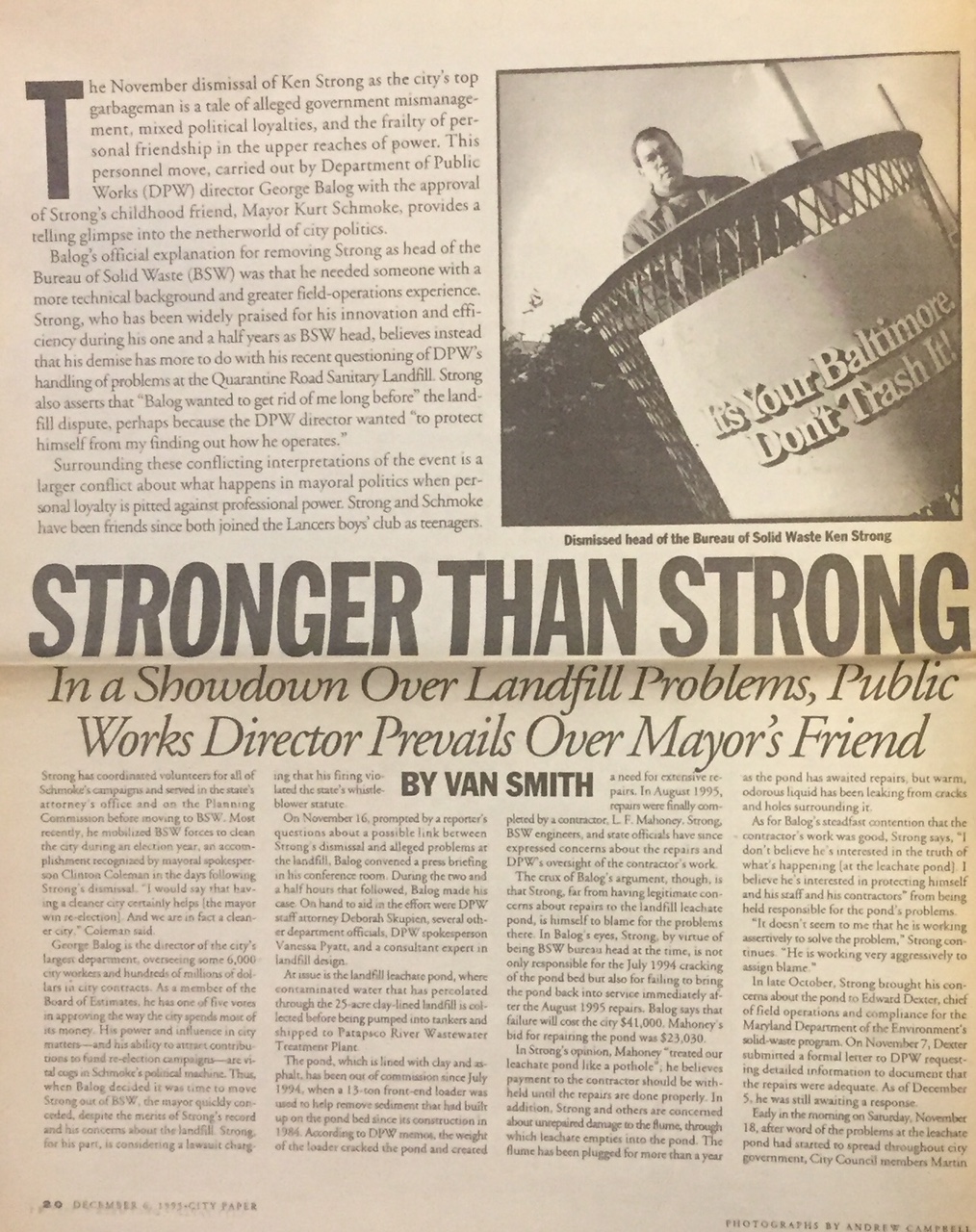
By Van Smith
Published in City Paper, Dec. 6, 1995
The November dismissal of Ken Strong as the city’s top garbageman is a tale of alleged government mismanagement, mixed political loyalties, and the frailty of personal friendship in the upper reaches of power. This personnel move, carried out by Department of Public Works (DPW) director George Balog with the approval of Strong’s childhood friend, Mayor Kurt Schmoke, provides a telling glimpse into the netherworld of city politics.
Balog’s official explanation for removing Strong as head of the Bureau of Solid Waste (BSW) was that he needed someone with a more technical background and greater field-operations experience. Strong, who has been widely praised for his innovation and efficiency during his one and a half years as BSW head, believes instead that his demise has more to do with his recent questioning of DPW’s handling of problems at the Quarantine Road Sanitary Landfill. Strong also asserts that “Balog wanted to get rid of me long before” the landfill dispute, perhaps because the DPW director wanted “to protect himself from my finding out how he operates.”
Surrounding these conflicting interpretations of the event is a larger conflict about what happens in mayoral politics when personal loyalty is pitted against professional power. Strong and Schmoke have been friend since both joined the Lancers boys’ club as teenagers.

Strong has coordinated volunteers for all of Schmoke’s campaigns and served in the state’s attorney’s office and on the Planning Commission before moving to BSW. Most recently, he mobilized BSW forces to clean the city during an election year, an accomplishment recognized by mayoral spokesperson Clinton Coleman in the days following Strong’s dismissal. “I would say that having a cleaner city certainly helps [the mayor with re-election]. And we are in fact a cleaner city,” Coleman said.
George Balog is the director of the city’s largest department, overseeing some 6,000 city workers and hundreds of millions of dollars in city contracts. As a member of the Board of Estimates, he has one of five votes in approving the way the city spends most of its money. His power and influence in city matters – and his ability to attract contributions to fund re-election campaigns – are vital cogs in Schmoke’s political machine. Thus, when Balog decided it was time to move Strong out of BSW, the mayor quickly conceded, despite the merits of Strong’s record and his concerns about the landfill. Strong, for his part, is considering a lawsuit charging that his firing violated the state’s whistleblower statute.
On November 16, prompted by a reporter’s questions about a possible link between Strong’s dismissal and alleged problems at the landfill, Balog convened a press briefing in his conference room. During the two and a half hours that followed, Balog made his case. On hand to aid in the effort were DPW staff attorney Deborah Skupien, several other department officials, DPW spokesperson Vanessa Pyatt, and a consultant expert in landfill design.
At issue is the landfill leachate pond, where contaminated water that has percolated through the 25-acre clay-lined landfill is collected before being pumped into tankers and shipped to Patapsco River Wastewater Treatment Plant.
The pond, which is lined with clay and asphalt, has been out of commission since July 1994, when a 13-ton front-end loader was used to help remove sediment that had built up on the pond bed since its construction in 1984. According to DPW memos, the weight of the loader cracked the pond and created a need for extensive repairs. In August 1995, repairs were finally completed by a contractor, L.F. Mahoney. Strong, BSW engineers, and state officials have since expressed concerns about the repairs and DPW’s oversight of the contractor’s work.
The crux of Balog’s argument, though, is that Strong, far from having legitimate concerns about repairs to the landfill leachate pond, is himself to blame for the problems there. In Balog’s eyes, Strong, by virtue of being BSW head at the time, is not only responsible for the 1994 cracking of the pond bed but also for failing to bring the pond back into service immediately after the August 1995 repairs. Balog says that failure will cost the city $41,000. Mahoney’s bid for repairing the pond was $23,030.
In Strong’s opinion, Mahoney “treated our leachate pond like a pothole”; he believes payment to the contractor should be withheld until the repairs are done properly. In addition, Strong and others are concerned about unrepaired damage to the flume, through which leachate empties into the pond. The flume has been plugged for more than a year as the pond has awaited repairs, but warm, odorous liquid has been leaking from cracks and holes surrounding it.
As for Balog’s steadfast contention that the contractor’s work was good, Strong says, “I don’t believe he’s interested in the truth of what’s happening [at the leachate pond]. I believe he’s interested in protecting himself and his staff and his contractors” from being held responsible for the pond’s problems.
“It doesn’t seem to me that he is working assertively to solve the problem,” Strong continues. “He is working very aggressively to assign blame.”
In late October, Strong brought his concerns about the pond to Edward Dexter, chief of field operations for the Maryland Department of the Environment’s sold-waste program. On November 7, Dexter submitted a formal letter to DPW requesting detailed information to document that the repairs were adequate. As of December 5, he was still awaiting a response.
Early in the morning on Sunday, November 18, after word of the problems at the leachate pond had started to spread throughout city government, City Council members Martin O’Malley (D-3rd District) and John Cain (D-1st District) led a fact-finding mission to the landfill. Joining the legislators were two environmental activists, Terry Harris of the Sierra Club and Dan Jerrems of the Baltimore Recycling Coaltion and the Baltimore Parks Coalition. The legislators inspected the pond, concentrating on the damage around the flume, and declared their intent to scrutinize the matter, further, possibly through a formal council investigation.
Schmoke’s position on the issue of the leachate pond has evolved somewhat. On November 19, he said, “I accept Mr. Balog’s explanation, pointing out that “I’ve seen memoranda back and forth about it and I think Mr. Balog has adequately described the problem and is dealing with it.” Ten days later, he reserved judgment: “Without having firsthand experience or being an expert on environmental matters, for me to reach a conclusion based on the memoranda themselves is certainly difficult, so I have asked the law department to look into the matter and provide me with their analysis of it.” Leslie Winner, a contracts specialist in the city solicitor’s office, has been assigned the case.
Balog maintains that he did not remove Strong as BSW head as a result of his adamant stance and crusade of memos about the pond repairs. Rather, Balog credits Schmoke with the inspiration for moving Strong out of the position.
“I met with the mayor and the mayor, in this term, he wants to emphasize doing things,” Balog says. “He said, ‘We’ve been doing planning and all, and I want all the emphasis to be put on doing things.’ So I have Ken Strong at solid waste. His background is in English and he’s like an environmentalist. He’s been involved in communities and stuff like that. … And I look around my department, I got a guy named Leonard Addison. He’s been with the department 25 years. A civil engineer, terrific field man … so that’s when I said to the mayor, ‘Look, I got somebody that I think’s really good and I think we should give him a chance of being a focal point with the hottest bureau and see what he can do.’ And that’s how it happened.”
Schmoke says he doesn’t recall such a conversation with Balog, but says he approves of Strong’s dismissal. On November 20, Strong met with Schmoke to discuss the situation, which both say has been a strain on their 31-year friendship.
“It has been a difficult experience,” Schmoke says. “It’s somewhat awkward anyway to be in an employer-employee relationship with somebody that you’ve been friends with for quite a long time.” The mayor adds that the episode hasn’t “irreparably damaged” his friendship with Strong “becauswe we’ve had some very frank conversations about this situation, and he understands that I have supported a lot of the work that he has done.”
Schmoke, who points out that Strong declined an offer of a civil-service position at DPW, has agreed to be a reference for Strong as he looks for new employment. “I identify [Strong] as a person with a real concern for community,” Schmoke remarks. “He’s a person that things that what happens in neighborhoods in this city is very important, that we ought to pay attention to people’s concerns neighborhood by neighborhood. He looks at both the big picture and the small blocks and has a great deal of concern about both.”

Schmoke’s high regard for Strong, along with Strong’s publicly recognized record of service for the mayor, has led many observers to wonder why the mayor would so easily defer to Balog in moving Strong out of city government. O’Malley, for one, sees the situation as “one big power struggle.” Cain sees it as “city politics in microcosm, a metaphor of the way things really are.” Both believe Strong’s dismissal got the nod from the mayor because Balog has a significant edge over Strong in terms of raw power in city government.
Although Strong mobilizes get-out-the-vote forces for Schmoke – a valuable contribution to the reelection process – his role was not powerful enough to help him prevail in a showdown with Balog, a critical rainmaker during the campaign season. O’Malley suggests further that Strong, whose support among community leaders is well known, presented a direct threat to Balog’s authority. “Maybe Ken was the heir apparent, moving up to be DPW director,” the council member contends.
There are no indication that Strong was in line to replace Balog as DPW director. Balog says he has never felt threatened by Strong’s special relationship with the mayor and long history of community involvement.
Records of campaign contributions show that DPW contractors and empoyees gave large amounts to the Schmoke reelection drive. Thirteen DPW contractors who were mentioned by Balog in interviews about the leachate pond or who made bids to repair the pond collectively have given $42,965 to the Schmoke campaign committee since July 1994. (According to the integrated financial report of the city, these 13 contractors got more than $16 million worth of business from the city in the first 11 months of the 1995 fiscal year.) A group of 24 DPW employees and five of their family members, identified in the campaign records by matching their names with the city telephone directory, has given $9,150 since August 1994. These amounts are just a small part of the total DPW-related fund-raising picture, which includes a large community of contractors and a potential giving pool of about 6,000 employees.
“I seriously doubt that these contractors contribute to incumbent mayors because of their political philosophy,” O’Malley contends. “They contribute because they receive contracts, and no person in city government has greater knowledge of that process than Mr. Balog.”
Asked about his role as a major impetus for political giving, Balog says, “I never asked anybody to give any money, if that is what you are asking. I’ll take a lie-detector test on that.”
Strong was extremely surprised by the large amount Schmoke raised from the 13 contractors related to the leachate pond. But he makes no specific allegations of Balog pressuring contractors and employees to give to the Schmoke campaign, noting, “It’s more by rumor and reputation that [Balog] brings money into the campaign.”
While Strong says he is dismayed by the role money plays in politics generally – “The outcomes of it are pretty well documented,” he says – he contends that the overarching theme of Balog’s leadership is not his role as a political fund-raiser, but “the ways in which he is working to maintain his own power rather than serving the interests of the city.” By way of illustration, Strong says he was “infuriated” when, during the inauguration of the Clean Sweep program (which targets specific areas of the city for regularly scheduled, intensive cleanups), Balog made a casual reference to a “Dirty Dozen” of the city most in need of the program. The Dirty Dozen idea was not a preplanned part of the press conference, so Strong says “we had to create that on the spot.” Strong, who had been heavily involved in planning Clean Sweep, concluded that Balog “was jealous of this program, so in the last minute he comes up with this oddball aspect, the Dirty Dozen, which was what the paper ended up writing about.”
Confirming reports from DPW staff who did not want to be quoted for this story, Strong says Balot’s ongoing reorganization of the department has many managers on edge, worried about their job security as successive waves of changes come down the chain of command. Balog states he’s been reorganizing the department for “several years,” while Schmoke says he’s satisfied that, in so doing, Balog’s building a better DPW.
But one manager says, “I don’t know why there’s all these changes being made. My hope is that it is to improve the department, but I’m not so sure that’s the case – not so sure at all.” Strong, who on December 3 attended a surprise birthday party held for him by many of his former DPW underlings, says he came away from the gathering feeling that “people seem to be under growing pressure back at the department,” in part because “every time you turn around there’s another reorganization.”
Strong recalls a moment early in his DPW career that to him defines the culture that Balog is breeding at the department. Balog denies the conversation ever took place, but Strong insists that it occurred during one of his first meetings with the director, in 1991. Strong had just made the jump from the state’s attorney’s office to DPW. “[Balog] said, ‘One of the problems with people like you who come over from the state’s attorney’s office is that you think in terms of right and wrong. We don’t do that here. We just get things done.’ To me,” Strong concludes, “that just explains a lot about how he operates the department.”
Strong is consulting with an attorney to assess his chances of proving in court that he was dismissed in retribution for his stance on the pond-repair problems; in the meantime, he vows to press on in publicizing his concerns about the landfill. At the December 6 Board of Estimates meeting, for example, he plans to protest the proposed approval of the $41,000 expenditure to complete the pond repairs. And he says he will cooperate fully with the proposed City Council review of the situation.
“I think this story provides some important lessons to be learned about how government operates and how it should operate,” Strong says. “I will support whatever will open it up to some deeper analysis.”
Body-sledding at the Pagoda
Cod cakes, reinvented.

A modified muffin recipe was a good vehicle for transporting a whole mess of leftover baked cod (pankoed, with lemon and capers) into something entirely different: cod cakes, reinvented.
Cop Out: In Rousting Officer Jacqueline Folio, The Baltimore Police Department Has Raised Questions About its Own Internal Affairs

By Van Smith
Published in City Paper, Apr. 6, 2005
At 6:08 p.m. on Thursday, March 27, 2003, an anonymous tipster calls Baltimore City 911 and describes a black man wearing a blue baseball cap, a white shirt, and blue jeans, dealing drugs at the corner of Pratt Street and Ellwood Avenue in East Baltimore. The stash, the caller says, is in a brown paper bag in some bushes next to a corner house there. Three minutes later, 41-year-old Baltimore City Police patrol officer Jacqueline Folio is the first to respond to the scene, where Patterson Park butts up to Highlandtown Middle School.
A 14-year veteran with two stints as a police academy instructor under her belt, Folio makes fleeting eye contact with a young man who fits the description, as he walks away from the area with two friends. Folio radios in the suspect’s location and proceeds to recover a brown paper bag from under the bushes. It contains money and suspected cocaine in baggies. A block away, on the opposite side of the school, other officers collar the suspect, 18-year-old Leon Burgess. A half-hour after the phone call, Burgess is on his way to Central Booking. Folio completes the paperwork, charging Burgess with possession with intent to distribute cocaine, then submits the evidence to headquarters at 9 p.m.
By all appearances, it’s a routine drug arrest, done with speed and efficiency, wrapped up neatly and ready for the courts in a matter of hours. But by midnight, it’s Folio, not Burgess, who’s in hot water. Two years later, she still is, because the whole incident was a setup, a police integrity sting designed and conducted by the BPD’s Internal Affairs Division to see if a cop fails to turn in abandoned drugs and money.
Folio properly submitted the contraband, but in her sworn statement charging Burgess with the crime, she seemed to state that she’d seen Burgess place the bag in the bushes. “Prior to the call being received by Agent Folio, the officer was patrolling that particular area and observed three B/M’s at the intersection of E. Pratt St. and S. Ellwood Ave.,” Folio wrote in her statement of probable cause to charge Burgess. “Agent Folio observed one of the B/M’s described as wearing a dark colored baseball cap, white T-shirt, and jean shorts place an object onto the ground behind a bush located against the NW wall of that corner. This individual is further identified as the def. Burgess.”
On March 28, 2003, Folio learned she was in trouble, and was immediately suspended. Although she had no obligation to do so, she wanted to give a statement about the incident because she believed she could convince investigators—or even a grand jury, if it came to that—that she was innocent. She got that opportunity on June 6, 2003, when she waived her rights under the Law Enforcement Officers Bill of Rights and provided a voluntary statement to Internal Affairs. The department wasn’t convinced; a week later, on June 12, the Baltimore City State’s Attorney’s Office indicted her criminally for perjury and misconduct, saying she’d purposefully lied under oath in order to maliciously pin false charges on Burgess.
The Folio indictment appeared to confirm a bad-cop stereotype—the aggressive enforcer who works poor, black neighborhoods and already has a good idea who’s guilty and who’s not, making it easy to pin false charges on a passer-by and rationalize it as removing trouble from the street before it actually happens. It’s offensive, it’s unconstitutional, it’s criminal, and it’s happened before. And Folio’s sworn statement of charges is what it is: Her statement reads that she saw Burgess “place” the stash behind the bush. In order to convict her, the state’s attorney was going to have to prove criminal intent—that Folio did it on purpose.
In December 2003, Folio was acquitted of the criminal charges by Baltimore City Circuit Court Judge Lynn Stewart, who didn’t explain her verdict but apparently bought Folio’s apologetic explanation. Folio testified that the allegedly false statement in Burgess’ charging documents was not intentional and malicious, as the prosecution argued, but the result of vagueness due to a run-on sentence.
“I know what happened that day was clearly in good faith on my part,” Folio said on the stand. “When I say ‘observed’ in my probable cause statement, I was trying to say that I observed the individual who was described by the caller. And when I use the word ‘describe,’ that was based upon the information I received from the caller—that this person, in fact, did fit the description that was given out.”
At the criminal trial, Folio’s long record of complaint-free service, her stints as an academy instructor (she estimates that 90 percent of the current force trained under her), and a stack of letters praising her character and professionalism all served to paint a picture of an officer beyond reproach. But the question of her guilt or innocence apparently remained open from the department’s point of view. Though Folio was found innocent of any criminal charges, nearly a year later, on or about Dec. 14, 2004, BPD decided to take its own crack at her, charging her administratively for her statement in the Burgess arrest papers. Folio could have volunteered to take a polygraph test in an effort to clear her name, but her attorney, Clarke Ahlers, says she never did because the tests are known to be “unreliable”—especially when used to gauge a person’s intent, which was the issue in her case. Nonetheless, “the police department,” Ahlers stresses, “had the right to order her to take one, and they never did.”
Folio’s administrative case would be heard by a police trial board, with three members of the department weighing each side’s arguments before deciding Folio’s professional fate. But the trial board didn’t happen. On March 11, 2005, one business day before the scheduled March 14 hearing, Police Commissioner Leonard Hamm signed a letter immediately ordering that Folio be “removed from her regular permanent position as a Baltimore Police Officer, without fault upon her part.”
Hamm’s move indefinitely postponed the trail-board hearing and forced Folio to retire, which she did officially on March 17. The next day, in order for Folio to be eligible for city health insurance, she and her roommate, Lisa Olszewski, also a city police officer, filed publicly as domestic partners—a decision that was not made lightly, since it officially outted them as a lesbian couple.
Suddenly, the department reversed course. On March 18, the department sent a letter to Ahlers stating that “Folio is under no direct order . . . to retire. In fact, as of this date she is still a member” of the force—despite the fact that Folio had signed retirement papers, as previously directed by the department, the day before.
On March 22, Hamm issued another letter, stating that his March 11 letter ordering Folio out of her job was signed and sent “in error” and that her “job has not been abolished and I am not authorizing a retirement.” As of press time, Folio’s status as a Baltimore City police officer remains in limbo, and she and her lawyer are outraged and baffled. Once you hear her side of this story, it’s not hard to imagine why.
Directly after signing her retirement papers on March 17, Folio and Ahlers arrived at City Paper’s offices to talk. It was the first time Folio had spoken to the press about the matter. Now that she was no longer a member of the force (or so she believed), she was finally free to talk.
“The cost of this case was devastating to me,” Folio lamented in a clear, even-toned Baltimore accent. Physically, she’s obviously strong—an attribute that explains her police academy stints, teaching defensive tactics and physical fitness. And like most cops, she’s practiced at masking her emotions when speaking. But her words themselves, more than her demeanor, gave away the depth of her feelings. “I live in the city, I’ve been a lifelong city resident, and I truly believe in the city. That’s why I’ve been here so long and had complete faith in the police department.
“I guess what hurts me most,” she continued, “is who really suffered here is the citizens of Baltimore—not having me on the street protecting their communities. And if you talk to anyone in the communities that I patrolled, they miss me. To me, that’s who I ultimately work for. And I like to know that when they saw me, for eight hours they at least felt safe at some point. That’s what meant the most to me, that I’m not going to be able to do that anymore.”
The police department has nothing to say about the Folio affair because, BPD spokesman Matt Jablow says, it expects to be sued.
In fact, Ahlers has so notified the department—not formally, but by implication. On March 22—the same day Hamm rescinded his order for Folio to retire—Ahlers sent a six-page letter to the department that, in closing, reviewed Folio’s “rights” in regards to her experience with the department’s internal-affairs bureaucracy. Among them were the rights to “take civil action” in the courts, to “request federal criminal and civil investigation of misconduct by her accusers,” and “to take effective public, political action through the mass media.” Ahlers dangled the prospect of negotiating a financial settlement, but pointed out that “Ms. Folio’s legal obligation to cooperate in any federal criminal investigation” was not negotiable. Reading between the lines, Ahlers was putting the department on the alert that Folio can give as good as she gets.
The banner reads HIGHLANDTOWN ‘DRUG-FREE’ MIDDLE SCHOOL. It hangs over a public school, next to a public park, as an early spring day turns to dusk, right when students and working people who live in the area are likely to be enjoying some free time outdoors. This is where and when Internal Affairs chose to place a fake drug stash under bushes next to a public sidewalk—where any youngster might pick up the bag, where any random person passing through might be swept up in the sting and arrested—as a ploy to tempt a cop to steal abandoned contraband.
As Folio experienced it, the “random integrity test”—Internal Affairs’ term for the operation—presented anomalies that raised eyebrows even as it unfolded. Folio says she and other cops who share her beat knew that Pratt and Ellwood is not a drug corner, so the tip itself (phoned in by an Internal Affairs detective) was out of the ordinary. Even Leon Burgess, the man Folio arrested, said as much during a police interrogation: “It’s not even a drug area that they was riding in. I have never even seen . . . drug[s] move through there.”
Stranger still was the condition of the recovered cash: $250 in clean, crisp, new bills, several of them with sequential serial numbers. Folio and another responding officer discussed the unusually fresh bills as soon as they first examined them, and Burgess, when he was interrogated by police officials while still in custody at Central Booking early the next morning, pointed out that “junkies don’t give you straight money like that. Junkies’ money’s sweaty and it’s balled up and all types of stuff.”
The Internal Affairs detectives’ sting also created a victim: Leon Burgess, who was falsely stopped, detained, and arrested as a direct result of the actions of the detectives, who did nothing to stop it. They were the only people on the scene other than Burgess and his friends who knew he was innocent, and the Internal Affairs detectives simply watched the arrest, recording it on tape. What’s more, the tape reveals that the detectives knew that they were watching trouble unfolding at the time.
Internal Affairs sergeants Terry Ressin and Robert Morris were sitting in a surveillance vehicle during the sting, and their video camera recorded their discussion as Burgess was accosted by the patrol officers. According to the transcript (which was provided by Ahlers to City Paper, along with the rest of Folio’s records of the case), Ressin remarked, “If they lock him up, we got problems.”
Morris responded that Folio is “supposed to be a decent girl. I think she’ll probably just get numbers for found property and lock him up for [inaudible], all we can hope that anyway.”
Ressin’s retort: “And if not, we’re all screwed.”
As it turned out, Internal Affairs was not screwed, but Folio was—with Burgess as collateral damage. “They know this is illegal,” Ahlers says of the detectives’ recorded conversation as they watched Folio arrest Burgess. “[Internal Affairs] had let a person be unconstitutionally stopped, detained, and arrested. He had no business being stopped because [Internal Affairs] knew, when they gave the description out [to 911], that it was a fiction. They know this is illegal,” he argues emphatically, growing visibly exercised. “Jackie doesn’t know that. She’s been dispatched to a felony in progress!”
What’s more, during Folio’s criminal trial it came to light that this particular test came with a heightened risk of a false arrest built in. Under cross-examination, the Internal Affairs detective who designed the sting, Brian Winder, admitted that the plan was to have Resin call 911 with a description “that mirrors persons in the area and advise . . . that the person described is dealing drugs” (emphasis added), almost guaranteeing the prospect of the false arrest of a passing civilian.
Elsewhere in Winder’s testimony at Folio’s trial, the detective acknowledged that he designed the test without a written manual to help him navigate potential pitfalls—what actions to take should someone be falsely stopped, detained, or arrested as a result of the test. (In July 2004, after Winder left Internal Affairs, he was shot and killed in the line of duty.) Indeed, a federal class-action discrimination lawsuit brought against the department in December 2004 by a large group of African-American officers asserts that “BPD has no written investigatory standards, policy, or training for members of [Internal Affairs].”
Folio says she has read a portion of a 1990s New York Police Department manual for doing internal-affairs stings, which explains what to do when faced with an unexpected problem, such as a false arrest. “It spells out, if it goes bad, what they need to do to stop it,” Folio pointed out.
“Suppose, for example,” Ahlers says, picking up on the theme, “if Officer Folio had pointed a gun at Burgess, would they then interrupt it? I mean, at what point were they willing to say, ‘Jeez, now things have deteriorated to the point that she may use deadly force, maybe now we ought to admit that the suspect is not the felon because it’s a fictitious felony.’”
Unprepared for the complications that arose from the sting gone wrong, BPD began tossing the problem up the chain of command like a hot potato. As Internal Affairs sergeants Ressin and Moore followed the police van that was transporting Burgess to Central Booking, Ressin phoned his supervisor, Lt. Ross Buzzuro. “We gave out a description,” Ressin explained, according to the surveillance-tape transcript, “and they, ah, actually stopped somebody a couple of blocks away, who fit the description and they locked him up.” (Emphasis in the original.)
Then Ressin called the lieutenant colonel in charge of Internal Affairs at the time, George Mitchell, to brief him on the situation. “They actually stopped somebody,” he recounted to Mitchell. “I don’t know yet if they found something on him while they were checking him or if they’re going to charge him with our stash. If it was our stuff,” Ressin added, “then we got problems.” Then, to an inaudible comment made by Mitchell, he responded, “Yeah, that’s what I’m hoping, but if not then we’ll do what we have to do.”
What had to be done, subsequent events make clear, was to stick the whole mess on Folio, based on her statement of charges against Burgess, which was completed by 8:30 p.m. At 10:30 p.m. on March 27, 2003, the evening of the arrest, the department’s then-chief of special projects, Sean Malone, was first contacted about the incident. Twenty minutes later, Mitchell briefed one of his Internal Affairs lieutenants, and sent another to the Southeastern District station house to await shift change, when Folio would be present. At 11:45 p.m., Folio arrived for shift change, and was immediately summoned to her shift commander’s office. By midnight, the Southeastern District commander, Maj. John Long, was advised by Mitchell of Folio’s “impropriety” in writing up an allegedly false report. Minutes later, two Internal Affairs detectives escorted Folio to the Internal Affairs offices to read her her Law Enforcement Officers Bill of Rights rights. Her police powers were suspended immediately, and she was assigned to work at the Baltimore City Juvenile Detention Center.
Burgess, meanwhile, was locked up at Central Booking, where the booking process was completed by about 8:15 p.m. At 12:45 a.m. on March 28—just as Folio, at Internal Affairs, was being read her Law Enforcement Officers Bill of Rights rights for having wrongfully arrested him, an innocent man—Burgess was taken out of a group cell at Central Booking and put in a room to be interrogated by Malone, Internal Affairs Lt. Joseph Smith, and Internal Affairs Det. Anthony Vaeth. The interview lasted for 35 minutes. Afterward, Burgess was returned to the cell and remained locked up until 2:45 a.m., when he was finally released and given a lift to his East Baltimore home by Malone, Smith, and Vaeth.
It’s clear from the transcript of that interview that Burgess believed he was officially under arrest when Malone, Smith, and Vaeth interrogated him. Smith even re-read him his Miranda rights on the record, an act that further veiled the fact that the police knew he was innocent, had been wrongfully arrested, and was now being wrongfully held and interrogated. It was then more than six hours after his false arrest, and no one had told him he was free to leave.
Ahlers, during the interview at City Paper right after Folio’s March 17 retirement, says he was particularly shocked at Malone’s conduct in handling Burgess: “His first concern, when he arrived at Central Booking that night, should have been to release Burgess. What he does instead is he scams Burgess by bringing him into a room and giving him Miranda. He knows, if he’s got an ounce of sense, that Internal Affairs has done something grossly unconstitutional here, and illegal, and that the city has liability. And so he takes what they’ve done, and he looks at Jackie Folio’s statement of charges, and he says, ‘Here’s the out. This ambiguous sentence here, we’ll put it on the officer.’
“The proof of that is that they never even call Jackie Folio to figure out the ambiguity. They never even asked her, ‘Is this accurate?’ She’s passed the test they designed. She’s turned in all the drugs, all the money. She has no history of ever getting a complaint. In fact, on the [Internal Affairs] tape one of them says she’s supposed to be a good officer.”
In fact, according to the case record, as the Burgess interrogation was winding down that night, the decision to criminally indict Folio had already been made. At 1:15 in the morning, Lt. Col. Mitchell of Internal Affairs notified Thomas Krehely, the assistant state’s attorney who handles police corruption cases; in turn, Krehely advised Mitchell to “gather info, interview people, and meet week of April 1, 2003 for an indictment.” Folio didn’t know her fate was sealed already. On June 6, 2003,when she waived her Law Enforcement Officers Bill of Rights rights and gave a voluntary statement, it was because she thought she could avoid indictment.
The morning after the sting, the press coverage began. “The Sunpapers breaks the story,” Ahlers recalls, “that Jackie Folio has committed a crime. That she put drugs on an innocent suspect. And if you compare the stories in the Sunpapers—there are two stories two days in a row—if you compare that, it’s verbatim [from] the Leon Burgess interrogation. Now, who would have leaked that? Well, the department runs this ridiculous theory by me—Leon Burgess called the reporter. The idea that he knows which reporter he should talk to at the Sunpapers to generate an article of interest, and that this was an [Internal Affairs] undercover operation—a fact that was not known to him—is absolutely absurd.”
Folio learned only earlier this year, in preparation for the trial board, that Burgess was interrogated by Malone the night of the sting—a fact that brings up another gripe from Ahlers about how the case was conducted. After the administrative charges were filed and the hearing approached, both sides shared information in a legal process called “discovery,” just as they had before the criminal trial. This time, though, Folio and Ahlers received evidence from the police department that hadn’t been provided to them, as required, during the earlier criminal proceedings. Some of the late-arriving evidence was proving helpful in preparing a strong defense for the trial board, but it also would have helped strengthen Folio’s successful defense before Judge Stewart.
“The transcript [of the Burgess interrogation] was one of the documents that was not produced by the police [before] the criminal trial,” Ahlers stresses. “And the person who makes the decision about what information the police department gives to the state’s attorneys office, who must provide it to the defense, is the chief of legal, Sean Malone. So he intentionally did not disclose that.”
Actually, Malone at that time was not chief of legal—a position department spokesman Matt Jablow says Malone had left in 2002—so the difficulties Ahlers had during the discovery process may not have been Malone’s fault. At the time, Jablow explains, Malone was chief of special projects, a job with vague and wide-ranging duties that even Jablow couldn’t summarize. And yet Malone was closely involved with the Folio case; when Ahlers phoned the department to speak to the chief of legal about Folio’s case, he says he found himself talking to Malone, who, Ahlers says, represented himself as chief of legal.
Malone, now the city’s labor commissioner, did not respond to phone calls or a letter hand-delivered and faxed to his office requesting comment for this story.
Clarke Ahlers has been a lawyer since 1986, but before that he had been with the Howard County Police Department since 1972—initially as a 17-year-old cadet, later as an officer. That helps explain why he was so taken aback when he first spoke with Sean Malone on the phone about the Folio case.
Ahlers says the conversation took place right after Folio had hired him. (Herbert Weiner, an attorney for the Fraternal Order of Police union, represented Folio when she was suspended, right after the incident, but Folio hired Ahlers shortly thereafter.) Having learned the details of Folio’s case, Ahlers decided the best course of action was to tell her side of the story to the department, which might decide that charges weren’t warranted. So he contacted the department’s legal affairs division, asked to talk to its chief, and ended up talking to Sean Malone.
“In my mind I’m picturing a 30-year salty veteran,” Ahlers recalls, “somebody who is a former police officer-turned-lawyer, been around the block, and knows everything there is to know.” In fact, at the time, Malone was 36. When he’d been selected as the BPD’s top attorney in 2000, he’d been a lawyer for 18 months. But he was a close friend and adviser of Mayor Martin O’Malley’s, having managed his election campaigns and been a bartender at McGinn’s (now Mick O’Shea’s) where O’Malley’s Irish rock band often played. Malone’s previous law-enforcement career before becoming BPD’s top legal authority consisted of an approximately six-month stint as a prosecutor in Baltimore County.
Ahlers says he began his initial telephone conversation with Malone by offering to give Folio’s side of the story in hopes of preventing criminal charges. He says Malone cut him off and insisted, in no uncertain terms, that Folio was at fault in wrongfully arresting Burgess, end of story. Ahlers says he countered that his client believed she was making a legitimate arrest thanks to the bogus anonymous tip describing a suspect; Ahlers says he was then shocked to hear the police department’s ostensible top legal expert counter that stopping a citizen under such pretenses was unconstitutional, when in fact, Ahlers points out, it is quite constitutional and standard police practice. Regardless, Ahlers says, Malone was apparently unmoved by the argument and cut the conversation short.
It all adds up, in Ahlers’ mind, to a Malone-inspired attempt to hide Internal Affairs misdeeds. Malone, Ahlers allows, “could fairly evaluate the case and say Jackie Folio did something wrong. Reasonable minds can disagree. And I respect if that’s his belief. And he has a job to do. What I didn’t understand, until recently, was he was engaged all along in protecting [Internal Affairs] from their misconduct. Reasonable minds can’t agree about that. That’s not his job.”
Folio was caught up in a “random integrity test,” ostensibly designed to create a situation that any cop in the vicinity could end up responding to, but she says she wonders how random her test actually was. About a month prior to the Burgess incident, Folio says, she responded as a backup to a very similar (and fruitless) call for drug activity a block from her Southeastern District post. And, she says, her girlfriend, Officer Lisa Olszewski, believes she was the target of a similar test set up two weeks after the Burgess sting. Since Internal Affairs won’t tell officers when or whether they’ve been tested, or if they passed, there’s no way to know for sure if the incidents were, in fact, Internal Affairs integrity tests.
Folio isn’t the only one with questions about the fairness and effectiveness of the methods the BPD uses to police its officers. A group of African-American officers filed a discrimination lawsuit last December against the city and the police department alleging that the department selectively uses disciplinary procedures to discriminate against certain types of officers. The lawsuit’s charges, which go all the way back to 1992, include allegations that Malone, as chief of legal from 2000 to 2002, discriminated by initiating investigations of officers, deciding which charges would be brought or dismissed, and influencing the outcomes of charges against them, including in trial-board matters.
The city’s response to the discrimination lawsuit casts off the allegations as an “attempt to undermine the disciplinary procedures” of the department, and claims that Malone enjoys “absolute immunity for any claim arising from their conduct in initiating and prosecuting disciplinary charges.”
Of course, problems with the department’s self-policing pre-date Malone. A 1996 study by the Baltimore City Community Relations Commission determined that 75 percent of terminated officers were black, even though black officers made up less than half the force. The study also found that 90 percent of black officers who went to department trial board were found guilty, while only 60 percent of white officers called before trial board met the same fate.
The commission’s report prompted a probe by the City Council’s Legislative Investigations Committee, headed at that time by then-Councilman Martin O’Malley. At its conclusion in 1998, O’Malley’s committee issued another report that confirmed widespread disparities in the disciplinary treatment of black and white officers, concluding that the most shameful aspect of the findings was “our failure to root out these problems when they are brought to our attention.”
Steve Kearney, the mayor’s director of policy and communications, says the police department under the O’Malley administration in 2000 started the integrity test program—the very one that netted Folio—as “a direct outcome” of the 1998 report, and that, in addition, the selection of trial board members has become random and less politicized than in the past. Department spokesman Jablow says that the IAD has conducted 460 integrity tests since 2000 and that four officers have failed them. He would not name the officers who failed; presumably, Jackie Folio is one of them.
“I’ve never seen stuff like this,” says a 30-plus-year BPD veteran who spent more than a decade doing internal investigations. He asked not to be named out of fear of retribution before his pending retirement. “It’s really gotten out of control, with the state’s attorney working as an instrument of [Internal Affairs], taking weak cases like Folio’s, indicting, and losing,” the BPD veteran says. “It’s done to harass, embarrass, and coerce [people] into resigning. But I’ve never, ever seen them do what they’re doing to Jackie—abolish some police officer’s position just to avoid letting them have a trial board. It’s profoundly befuddling.”
The “nucleus” of these problems, the veteran agrees, “is Malone, but he’s the mayor’s guy, so nobody steps up and objects.”
The way to make good police-corruption cases, he advises, is to “do them targeted, based on good intelligence—so-and-so’s dirty, so target him and find out. Maybe it takes three, four weeks to set up a targeted, but you end up with good, strong cases—and there are good cases out there to be made.
“But the mayor likes randoms, because it represents numbers,” the veteran continues. “With large numbers of randoms—which take a few days to set up—you can rack up the numbers and say you’re working hard to clean up the department, even though all you’re really doing is taking resources away from targeted cases. With randoms, more times than not, you end up with nothing.”
Former BPD sergeant Andre Street, a 25-year veteran who retired in 1995, remembers how random tests in the past had to be designed for total control of the environment. For example, Internal Affairs detectives might have planted a couple of joints in plain view on the floorboards of a patrol car: “They’d watch, do [the officers] follow procedures? Do they keep it, whether for personal use or as drop items to pin charges on a suspect? It was controlled because it didn’t put citizens at risk. Whatever you do you should do without involving the public. You have to plan for every contingency and be prepared to pull the plug at any time and say, ‘The gig’s up.’”
Ahlers, too, has a few ideas about how better to go about catching corrupt police. “Almost every study ever done about police corruption,” he asserts, “says that you look at the vice and narcotics units, not patrol. If you’re trying to find out if police officers get free coffee at 7-Eleven, yeah, maybe patrol officers are involved in that. But if you are looking for who is protecting organizations of criminals, you have to look at units that go after organized crime. At that level, what the criminal wants to know is, can they pay somebody for information or can they pay somebody for protection, and that’s really not going to happen at the uniformed officer patrol level.
“There are a lot of ways they could do this. Instead, they end up doing Jackie Folio and trying to cover up their own culpability.”
In the Folio case, a poorly planned and executed random sting netted a police officer allegedly lying in charging documents and inadvertently raised questions that cut right to the heart of how police are policed in this town. But what happened to Burgess, the falsely arrested suspect? His post-sting story suggests even more problems.
On April 15, 2003, about two weeks after the Folio sting, Burgess allegedly sold drugs to an undercover officer on the 3700 block of East Pratt Street and was charged with conspiracy theft. On July 24 of that year, the state’s attorney declined to prosecute the charges. On May 1, 2003, Burgess earned assault and deadly-weapon charges thanks to his alleged connection with a large, drug-related fracas in the 3600 block of Eastern Avenue, but the state’s attorney declined to prosecute those charges, either. On Aug. 28, 2003, Burgess was charged with indecent exposure when he allegedly tried to force his way—while openly masturbating—into a woman’s home on the 2000 block of East Baltimore Street as she tried to stop him. The state’s attorney declined to take those charges to court, as well. On Oct. 29, 2003, Burgess was stopped on Conkling Street in Highlandtown after police say they observed him throw suspected drugs to the ground, and then, after searching him, found more drugs. The possession charge against him resulting from the incident was not pursued by the state’s attorney’s office. Burgess accrued all of these charges prior to his giving testimony at the December 2003 criminal trial of Jackie Folio.
Burgess’ attorney, William Buie, tells City Paper he advises his client, who is currently locked up and awaiting trial on several violent charges, including rape, not to talk to the paper while the current charges are pending. Assistant State’s Attorney Thomas Krehely had not returned calls by press time requesting an interview regarding the past charges against Burgess, or any deal police and prosecutors may have struck with him.
Burgess seems to have enjoyed extraordinary luck in avoiding any recriminations for a time, but police and prosecutors have managed to force Folio to retire, even when they failed to prove she was criminally culpable for pinning false charges on Burgess. And now, with Commissioner Hamm having retracted his order forcing her to retire, it is possible Folio may be asked to return to duty and then fired by the department if she fails to comply.
On April 4, department spokesman Jablow told City Paper that, in fact, Folio’s trial board hearing had been rescheduled for later this month—and trial boards are only held in matters involving police officers, not retired police officers. Moreover, as this story was going to press on April 5, the spokesman issued a written statement denying that Folio’s being made the patsy for the department’s failures.
“Agent Folio’s allegations of a conspiracy are entirely untrue,” BPD’s statement reads. “The truth is that she has been charged administratively with making a false statement—a statement that resulted in an innocent man being arrested. The citizens of Baltimore demand and deserve better. In light of these charges, an internal hearing board will soon be convened to determine if Agent Folio violated police department policy.”
Folio laughs when told over the phone about the rescheduled hearing—BPD told the press about it before notifying her. “Isn’t that lovely?” she jokes. Then the laughter stops, and her voice turns serious and sad.
“I feel like I’m in an abusive domestic relationship,” she says. “I never thought I’d be going out like this.”
Living Statue
The Art of the Turkey Leg

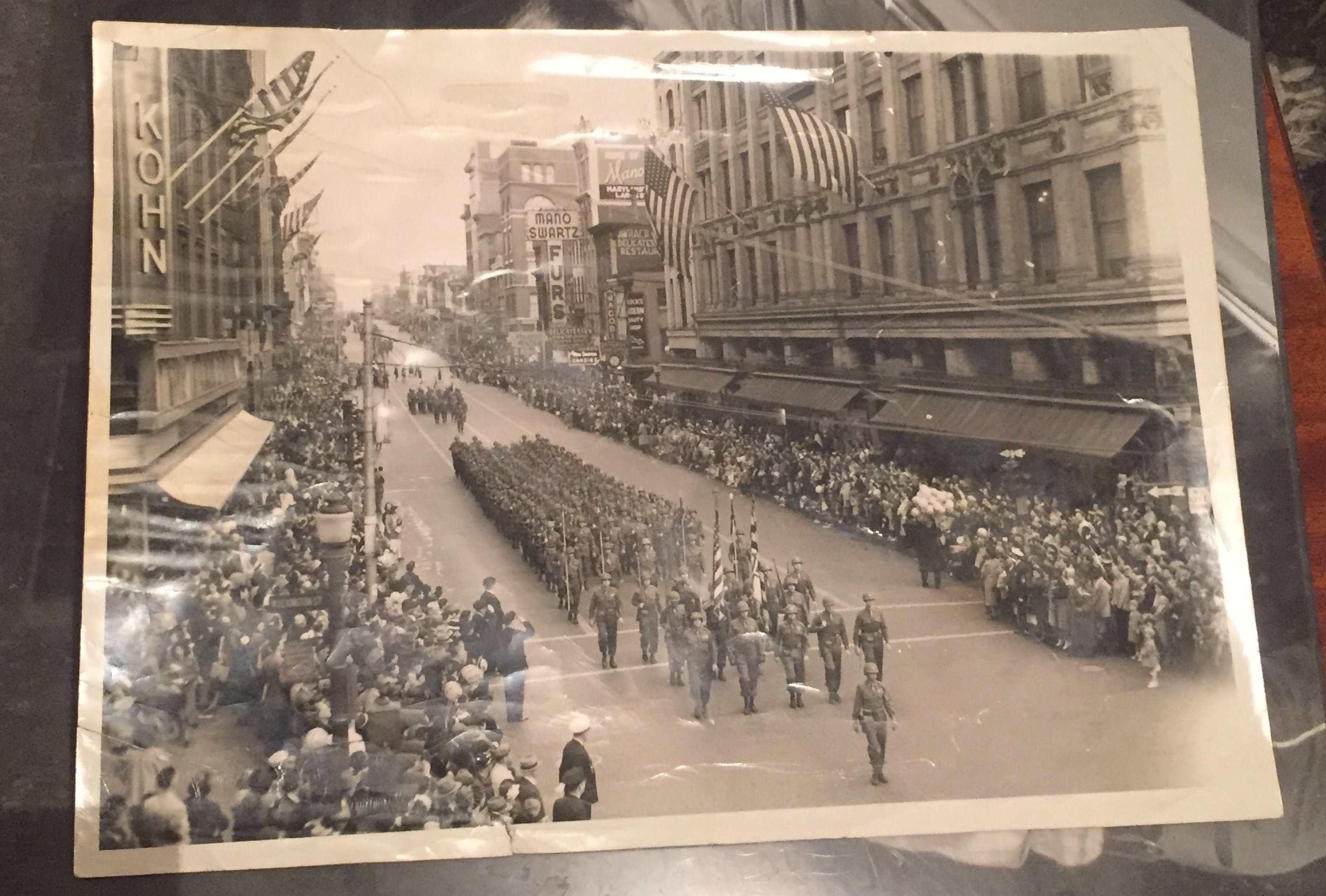
The Dandy 5th on Howard Street.
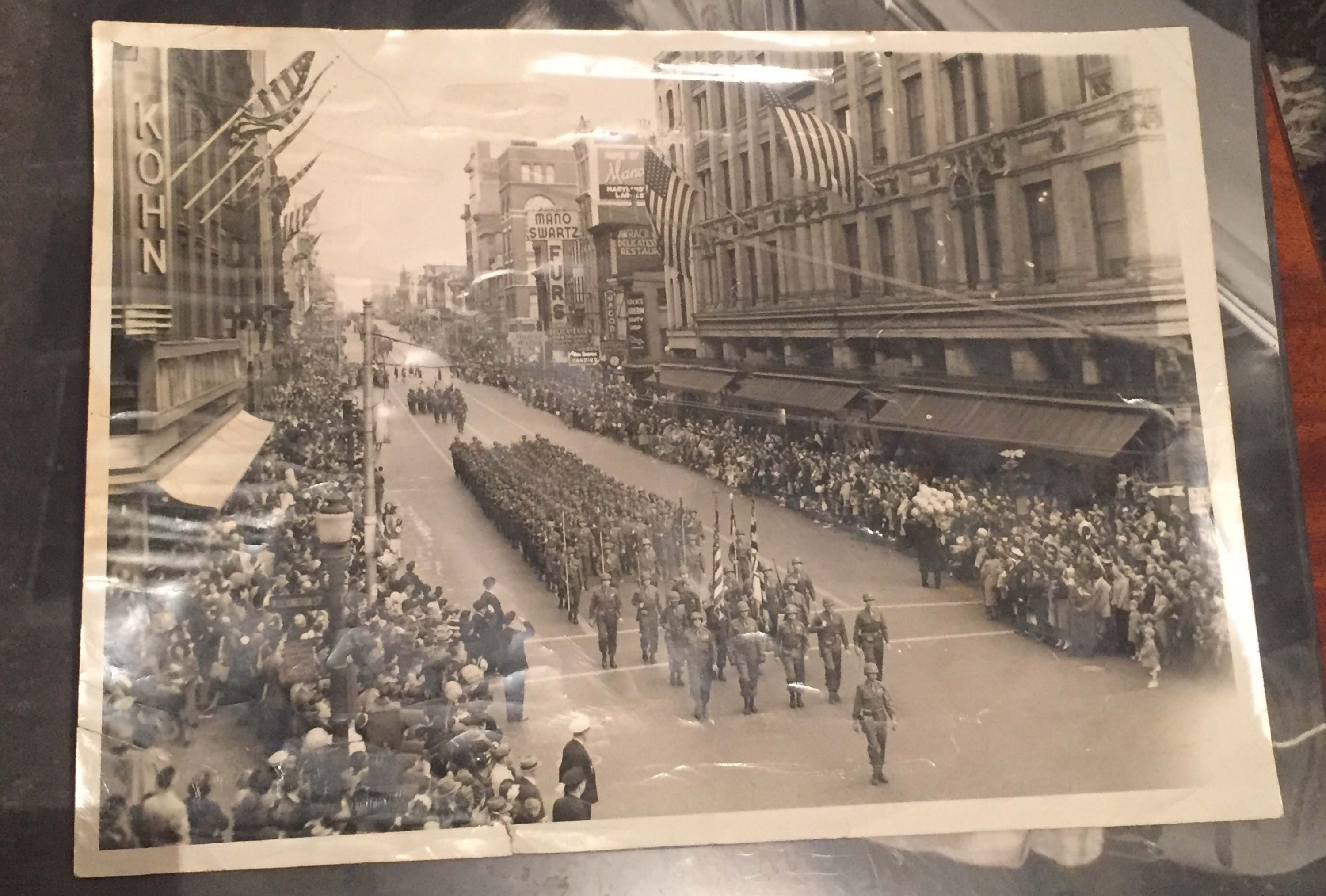
The Dandy 5th on Howard Street.
 Van Smith