

MAGA is the ruptured appendix of American politics. Its hold on Congress is a constitutional emergency that leaves only one way out: voting out as many as possible, pronto, in the November midterms.
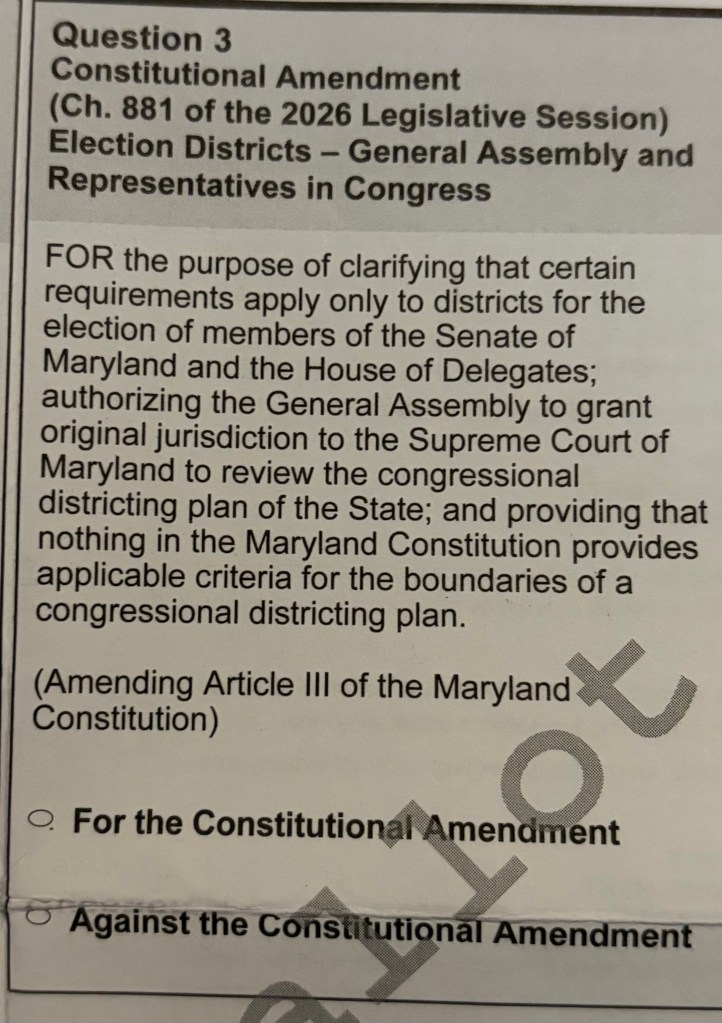
The redistricting question on Maryland’s statewide ballot – Question 3 – comes too late to help. It would allow gerrymandering the GOP out of its only seat in Maryland’s seven-member Congressional delegation, but only in time for the 2028 election, and then on into the future.
By law, districts must be drawn compactly, respecting boundaries set by nature and political leanings. Question 3 would remove these restrictions in order to allow blatantly partisan gerrymandering in Maryland’s Congressional districts.
Andy Harris holds the the sole GOP Congressional seat in Maryland, representing First District voters on the Eastern Shore and the eastern exurbs of Baltimore County. Despite his angry, combative, borderline-delusional public demeanor as the lock-step Trumpster in charge of the way-right Freedom Caucus, he keeps getting re-elected – eight terms, and counting.
It’s entirely possible that by 2028, with MAGA already in free-fall, most First District voters will have had enough of Trump – and therefore, Harris.
The reason Question 3 is on the ballot is because Maryland Democrats joined the nationwide cause of fighting a gerrymandering war started by MAGA and blessed by the U.S. Supreme Court. District maps have been redrawn to favor the GOP in some states, to favor Democrats in others – and the math shows the GOP won these battles leading up to the midterms. So Maryland, the thinking goes, needs to do it’s part going forward, removing its one GOP seat and putting it on the books for the Democrats.
The GOP’s gerrymanders do not guarantee electoral victories in all the targeted districts, by any means. The MAGA brand is tanking so badly that, as the election nears, it appears that important targeted districts will end up as wins for Democrats, nonetheless.
Meanwhile, reputable recent polling by UMBC found only a quarter of Marylanders support of Question 3, with 53 percent opposing.
Given the viscerally negative reaction most Marylanders have to anything the GOP likes, the fact that Maryland Republicans are loudly throwing fits to urge rejection of Question 3 may actually work in the measure’s favor.
That would be a shame. SCOTUS may have allowed the gloves to come off, but the blatant gerrymander has never been a good look, and Maryland’s current by-the-books approach to setting district boundaries is. As the country awakes from the MAGA fever dream, it’ll be nice to say Maryland stayed above the fray – and doing so will likely have the desired effect on Andy Harris’ future, to boot.

