Dream Team? Comptroller-Elect’s Transition Team Raises Eyebrows

By Van Smith

Published in City Paper, Nov. 29, 1995

Comptroller-elect Joan Pratt has chosen Julius Henson, her campaign manager, and state Senator Larry Young to help lead a team of about 25 people that will direct her transition from private life as a certified public accountant to the holder of the third-highest position in city government. Both men contributed to Pratt’s campaign. Henson is also widely believed to be Pratt’s choice for city real-estate officer, an appointment that has been vacant since Arthur Held’s term expired on June 30.

Henson, who chairs the transition team, ran Pratt’s campaign against retired state Senator Julian Lapides, the early favorite who lost the Democratic primary in September by nearly 10,000 votes. In addition to volunteering as campaign manager, Henson gave $1,400 to the Pratt campaign, plus another $1,065 that was donated by one of his companies, the Wild Geese Company. (These totals are based on campaign-finance reports covering the period up until two weeks before the September primary. As of November 24, Pratt had not filed a copy of her October 27 report in Baltimore, as she is required to do under state election laws.)

About the real-estate-office position, Henson says Pratt “has not made any decisions about that yet. If she does offer it to me, I’ll consider it.” The city real-estate officer is responsible for the disposition of all city real estate, including acquisitions and sales, leases, contracts, and tax sales of properties with delinquent accounts.

Pratt and Henson were business partners in a real-estate investment company, Henson & Pratt, Inc., and in 2112 Etting Street Limited Partnership, among other partnerships. Through these concerns, Pratt and Henson together owned nine residential properties. In August, Pratt transferred her stock in the partnership to Henson.

The properties were in various states of disrepair in August, when Pratt and Henson each owned a 50 percent stake in the businesses. A recent visit to three properties on the 2100 block of Etting Street found two of them occupied by tenants whjo complained of Henson’s unresponsiveness to problems at their houses, which included rat holes in the kitchen, holes in the ceiling, unrepaired fire damage, and a jury-rigged furnace. The third house is vacant.

Though neither Pratt nor Henson will confirm it for the press, sources close to both say they have been romantically involved for several years. Mary Henson, Julius’ mother, says the diamond ring worn by Joan Pratt is a gift from Henson and confirmed their romantic relationship.

Mary Henson’s own relationship with her son has been difficult; in February 1993, she filed battery and attempted-theft charges against Julius Henson. She was 63 at the time. Her son was acquitted of the charges in June of that year.

In 1974, at age 25, Henson ran in the Democratic primary for clerk of the circuit court. He got more than 17,000 votes in the citywide race, but lost to John Hubble. Asked whether he gained any lessons from the experience that helped him in managing the Pratt campaign, he says, “Not really.” Henson says he doesn’t remember why he sought the office, except that “it was winnable, I guess.”

Young, who chairs the team’s committee on the office of the comptroller, was an early backer of Pratt’s campaign (and a $250 contributor). Henson says, “He may have been the only [state] senator who did not support Jack Lapides, so he has been a friend of the campaign.”

Young came up in politics under the tutelage of U.S. Representative Parren Mitchell in the 1970s and has emerged as a powerful West Baltimore political figure whose campaign organization has delivered votes effectively for Bill Clinton, Parris Glendening, Kurt Schmoke, and now Joan Pratt (who is also from West Baltimore). He chairs the Senate Executive Nominations Committee and the Health Subcommittee of the Senate Finance Committee.

Along with his political prominence, Young has been the subject of Baltimore City police attention over the years. As chronicled in David Simon’s book Homicide: A Year on the Killing Streets, Young was involved in a series of odd incidents in 1988: He injured his political aide’s arm by beating him with a tree limb, and he falsely reported being kidnapped, a misdemeanor charge of which he was acquitted after much embarrassing publicity.

In 1990, Young became a central figure (though officially not a suspect) in the murder investigation of his close personal friend, the Reverend Marvin Moore. The murder case is still open.

More recently, Young was caught up in the Willie Runyon political-fund-raising scandal during last year’s legal battle over the gubernatorial election. Young did not disclose the fact that he was an employee of Runyon’s American Ambulance and Oxygen Service, Inc., in his financial-disclosure form on file with the state ethics commission in Towson, in spite of the fact that he sits on a subcommittee that considers healthcare legislation that might affect Runyon’s business. Young retired from American Ambulance in June.

According to Henson, Pratt’s transition team is staffed voluntarily with professionals who have expertise in the areas of human resources, audits, real estate, communication, insurance, ethics, governmental relationships, public relations, and the historical role of the comptroller, and it will help arrange a proposed conference on economic empowerment and a proposed citizens advisory review board to scrutinize waste, fraud, and abuse. Each of these “areas of perusal” is assigned to a committee of the team.

As an example of what expertise the transition-team members bring to the table, Henson explains that “the woman looking at the city’s paging system, which falls under communication, she sells pagers to area hospitals.”

No other members of Pratt’s transition team have been named. However, Henson confirmed that he and two other men have met with members of the city office of real estate to discuss its functions. One of the men identified by Henson, Arnold Hawkins, is an attorney with Harbor Title Guarantee Company, and gave $1,000 to the Pratt campaign before the September primary.

Asked why he was asked to chair the transition team, Henson says, “If I was smart enough to win the election, I guess the comptroller-elect thought I was smart enough to chair the transition team.” Pratt did not return phone calls seeking comment for this story, and Henson said the comptroller-elect would not speak to City Paper.
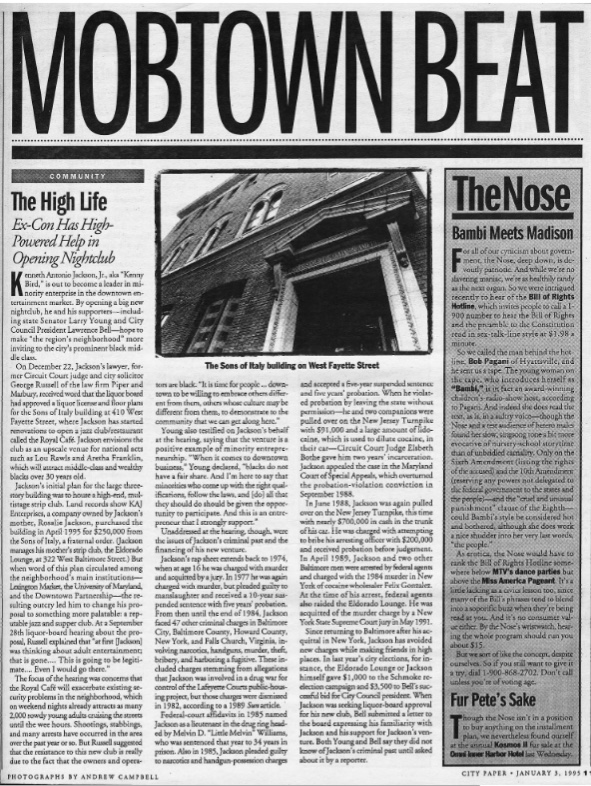
The High Life: Ex-Con Has High-Powered Help in Opening Nightclub

By Van Smith

Published in City Paper, Jan. 3, 1996

IMG_7492

Kenneth Antonio Jackson, Jr., aka “Kenny Bird,” is out to become a leader in minority enterprise in the downtown entertainment market. By opening a big new nightclub, he and his supporters – including state Senator Larry Young and City Council President Lawrence Bell – hope to make “the region’s neighborhood” more inviting to the city’s prominent black middle class.

On December 22, Jackson’s lawyer, former Circuit Court judge and city solicitor George Russell of the law firm Piper and Marbury, received word that the liquor board had approved a liquor license and floor plans for the Sons of Italy building at 410 West Fayette Street, where Jackson has started renovations to open a jazz club/restaurant called the Royal Café. Jackson envisions the club as an upscale venue for national acts such as Lou Rawls and Aretha Franklin, which will attract middle-class and wealthy blacks over 30 years old.

Jackson’s initial plan for the large three-story building was to house a high-end/multistage strip club. Land records show KAJ Enterprises, a company owned by Jackson’s mother, Rosalie Jackson, purchased the building in April 1995 for $250,000 from the Sons of Italy, a fraternal order. (Jackson manages his mother’s strip club, the Eldorado Lounge, at 322 West Baltimore Street.) But when word of his plan circulated among the neighborhood’s main institutions – Lexington Market, the University of Maryland, and the Downtown Partnership – the resulting outcry led him to change his proposal to something more palatable: a reputable jazz and supper club. At a September 28th liquor-board hearing about the proposal, Russell explained that “at first [Jackson] was thinking about adult entertainment; that is gone. … This is going to be legitimate. … Even I would go there.”

The focus of the hearing was concerns that the Royal Café will exacerbate existing security problems in the neighborhood, which on weekend nights already attracts as many as 2,000 rowdy young adults cruising the streets until the wee hours. Shootings, stabbings, and many arrests have occurred in the area over the past year or so. But Russell suggested that the resistance to this new club is really due to the fact that the owners and operators are black. “It is time for people … downtown to be willing to embrace others different from them, others whose culture may be different from them, to demonstrate to the community that we can get along here.”

Young also testified on Jackson’s behalf at the hearing, saying that the venture is a positive example of minority entrepreneurship. “When it comes to downtown business,” Young declared, “blacks to not have a fair share. And I’m here to say that minorities who come up with the right qualifications, follow the laws, and [do] all that they should do should be given the opportunity to participate. And this is an entrepreneur that I strongly support.”

Unaddressed at the hearing, though, were the issues of Jackson’s criminal past and the financing of his new venture.

Jackson’s rap sheet extends back to 1974, when at age 16 he was charged with murder and acquitted by a jury. In 1977 he was again charged with murder, but pleaded guilty to manslaughter and received a 10-year suspended sentence with five years’ probation. From then until the end of 1984, Jackson faced 47 other criminal charges in Baltimore City, Baltimore County, Howard County, New York, and Falls Church, Virginia, involving narcotics, handguns, murder, theft, bribery, and harboring a fugitive. These included charges stemming from allegations that Jackson was involved in a drug war for control of the Lafayette Courts public-housing project, but those charges were dismissed in 1982, according to a 1989 Sun article.

Federal-court affidavits in 1985 named Jackson as a lieutenant in the drug ring headed by Melvin D. “Little Melvin” Williams, who was sentenced that year to 34 years in prison. Also in 1985, Jackson pleaded guilty to narcotics and handgun-possession charges and accepted a five-year suspended sentence and five years’ probation. When he violated probation by leaving the state without permission – he and two companions were pulled over on the New Jersey Turnpike with $91,000 and a large amount of lidocaine, which is used to dilute cocaine, in their car – Circuit Court Judge Elsbethe Bothe gave him two years’ incarceration. Jackson appealed the case in the Maryland Court of Special Appeals, which overturned the probation-violation conviction in September 1988.

In June 1988, Jackson was again pulled over on the New Jersey Turnpike, this time with nearly $700,000 in cash in the trunk of his car. He was charged with attempting to bribe his arresting officer with $200,000 and received probation before judgement. In April 1989, Jackson and two other Baltimore men were arrested by federal agents and charged with the 1984 murder in New York of cocaine wholesaler Felix Gonzalez. At the time of his arrest, federal agents also raided the Eldorado Lounge. He was acquitted of the murder charge by a New York State Supreme Court jury in May 1991.

Since returning the Baltimore after his acquittal in New York, Jackson has avoided new charges while making friends in high places. In last year’s elections, for instance, the Eldorado Lounge or Jackson himself gave $1,000 to the Schmoke re-election campaign and $3,500 to Bell’s successful bid for City Council president. When Jackson was seeking liquor-board approval for his new club, Bell submitted a letter to the board expressing his familiarity with Jackson and his support for Jackson’s venture. Both Young and Bell say they did not know of Jackson’s criminal past until asked about it by a reporter.

George Russell would not comment for this article, but Jackson says of his criminal history, “I’m trying hard to put my past in the past.” As indication of his efforts to do so, Jackson points out several public-service awards he has received in recent years, including a 1994 Mayor’s Citation from Kurt Schmoke and a 1990 Congressional Achievement Award from Kweisi Mfume. He is active in the newly formed political-action committee, A Piece of JUICE, which works to get African American men involved in the political process.

Shortly before the April 1995 purchase of the Sons of Italy building, however, Jackson and the building both figured in an undercover FBI investigation into the drug-money-laundering operations of businessman Gregory Scroggins and attorney Zell Margolis, who were convicted in December 1995. First assistant United States attorney Gary Jordan, who prosecuted the case, says that in March 1995, Scroggins introduced Jackson to Edward Dickson, a man he though was a drug dealer but was actually an undercover FBI agent. The purpose was to convince Jackson to let Dickson in on the purchase as a “silent partner,” Jordan says. FBI transcripts of wiretapped conversations in the case document Scroggins’ opinion of Jackson, a childhood friend, as very wealthy, highly intelligent, and “the nicest guy in the world, but he’s a killer and he has killed.”

As for the nightclub’s financing, land records indicate that KAJ Enterprises obtained a $200,000 mortgage from Maryland Permanent Bank and Trust of Owings Mills to finance the $250,000 purchase of the Sons of Italy building. The mortgage calls for monthly payments of more than $2,300.

Meanwhile, court records indicate that Jackson’s employment at the Eldorado Lounge paid $325 a week in 1988, although he says he now makes substantially more than that. Since Jackson is a convicted felon, he cannot apply for a liquor license; Mary Collins, who refused interview requests, applied instead. She is a guidance counselor for Baltimore City Public Schools.

Regarding the financing for the new club, Jackson explains that all expenses not covered by the $200,000 mortgage so far have been covered by revenue from the Eldorado Lounge. The extensive renovations to the Sons of Italy building ultimately will require a sizable bank loan, he says, adding that the Eldorado Lounge has applied for a $500,000 loan from Nationsbank.

Asked why the liquor board did not inquire during the September 28th hearing about the club’s financing or whether Collins has the money to fund such a major investment, liquor-board executive secretary Aaron Stansbury explained that the board simply chose not to. He also stated that it is “obviously illegal” for a straw person to hold a liquor license on behalf of the actual owner of the club, but his understanding is that Collins is the club owner, while KAJ Enterprises is merely the landlord; Stansbury says that it is legal for a landlord to fund the building renovations on the club’s behalf. “It is presumed by the board that [the money for the club] comes from Mary Collins,” Stansbury said. Of Jackson’s criminal background, Stansbury said the board was not aware of it “to the extent that [Jackson] couldn’t manage the club.”

Harm City

By Van Smith

Published as a “Postmark: Baltimore” column in New York Press, 1998

IMG_7381

Back in August 1996, when I moved into the house I recently purchased, my next-door neighbors appeared to be a problem. A bullethole still marred a windowframe of their rented house, left there after a Sunday afternoon shootout on the street a few months earlier. They kept seven chows in the basement; you could hear the inbred curs barking in the dark, day and night. About a dozen people used the house as a temporary crash pad on a rotating basis – younger guys, mostly, with shiny Acuras and eye-fucking attitudes. The landlord lived in New York City and apparently was waiting for the bank to foreclose on the property so he wouldn’t have to be responsible for the shady scene going down on his property.

Within weeks of moving in, I noted a connection between my next-door neighbors and the barbershop around the corner. Fresh Cuttz, it was called. Open all night, its barber chairs were always full and lots of traffic moved through its doors. Late at night, flashy cars with out-of-state license plates were often double-parked before its entrance. Directly in front of the shop was a payphone, a well-placed utility for the high-volume retail drug trade spreading a half block in either direction. I regularly saw many of the guys who lived next door to me hanging in or around Fresh Cuttz.

I was curious, so I asked around. Although many neighborhood people said they had complained to the police about drug dealing they believed was originating from Fresh Cuttz, no one had any information about cops ever having busted the joint. The police, for their part, said three separate investigations had reached the same conclusions: Fresh Cuttz was a place where drug dealers went to get their haircuts, end of story. This made the neighborhood people laugh cynically. Some were of the honest opinion that police were connected to the drug dealing there.

Around this time, an FBI agent who works the press in Baltimore started warming up to me. He would call regularly, friendly as can be, probably in an attempt to get information about the things I look into as an investigative reporter. I never gave him anything that hadn’t already been printed, but he would call me anyway to chat about local politics. When he started offering personal information about himself – where he lives, where he went to high school – I figured he was extending a measure of trust. Not wanting to be needlessly paranoid in dealing with a federal agent, I returned this gesture by telling him the location of my new abode.

“That would be right around the corner from Fresh Cuttz, right?” the FBI guy asked. I was amazed that he would be aware of the place. After plugging him for more information, I learned that Fresh Cuttz caused a blip on the radar screen of a federal investigation of convicted money-launderer Gregory Scroggins. Court records show that Scroggins drove an undercover FBI agent posing a DC drug dealer looking to hide money in Baltimore real estate straight from the Downtown Athletic Club to Fresh Cuttz. Just as he was pulling up to the barbershop, ostensibly to meet with a potential co-investor, Scroggins noticed the suited white men tailing him in an unmarked car, so he took off. The operation failed, but my FBI guy, who was in charge of the investigation, was convinced Fresh Cuttz was somehow connected to the potential co-investor, who name was Kenneth Antonio “Bird” Jackson.

I got quite a rush from this information. Earlier that year, I had written about Jackson. I reported that he was a strip-club manager who, along with his mother, was trying to get a liquor license for a major new downtown nightclub apparently by using a surrogate applicant and the interventions of controversial state Sen. Larry Young. Jackson himself, an ex-con who says his violent days as a leading figure in Baltimore’s west-side drug trade are over, was not legally permitted to hold a liquor license, so he was attempting the next best thing: using a high school guidance counselor with a clean record as the licensee. The scandal exposed not only Jackson’s past crimes and current shenanigans with the liquor board, but also his shoulder-rubbing with some of Baltimore’s most powerful political leaders. If the folks living next to me were associated with Jackson – as it now seemed they were – I had good reason to be paranoid.

After the article ran, my publisher got a letter from New York attorney Robert Simels, who not only counsels jailed New York gangster Henry Hyde, but also my new-found nemesis, Kenny Jackson. On Jackson’s behalf, Simels was threatening to sue me and my employer, Baltimore’s City Paper, for libel. He never followed through, but I was very impressed that Jackson would have such an expensive attorney pen such a piss-poor letter to my publisher. I would have expected the threat to come from Jackson’s esteemed local attorney, Piper & Marbury’s George Russell, a former judge, city solicitor and president of the Maryland Bar Association. Jackson seemed to be saying, “See, I can afford the costliest – just like Henry Hyde.”

Jackson can afford more than expensive attorneys. He has given thousands to the campaign coffers of the city’s three top political leaders: Mayor Kurt L. Schmoke, City Council President Lawrence Bell (who got $3500 from Jackson, his largest contributor) and Comptroller Joan Pratt. He bankrolled a political action committee, called A Piece of J.U.I.C.E. (Justice, Unity, Integrity, Choice, Equality), which was formed to give people on the streets of Baltimore – many of whom can’t vote because they, like Jackson, have felony convictions – a voice in the political process. J.U.I.C.E. spends thousands among the city and state politicians.

Perhaps the contributions explain Jackson’s extraordinary access. At a birthday party for a politician’s mother last fall, Jackson was the only person there – other than the mother – who wasn’t either an elected official or an elected official’s employee or spouse, according to a person who was at the celebration. A plaque from former U.S. representative and now NAACP President Kweisi Mfume hangs over Jackson’s desk in his backroom office at his strip club, the Eldorado Gentlemen’s Club.

The existence of Kenny Jackson explains a lot about Baltimore’s political culture. He has everyone who knows him convinced that he’s just a businessman, an ex-con trying to redeem himself by making legal money in the entertainment business. And maybe that’s all he is. But then there’s the matter of Scroggins (who, by the way, is widely said to be the father of Mayor Schmoke’s adopted son), caught on a wiretap calling Jackson “the nicest guy in the world, but he’s a killer and he has killed.” (Jackson was once convicted of manslaughter, and later beat a murder charge in New York.) Meanwhile, Jackson is making cash overtures to the city’s political elite. And the elite is not shying away from him by any means.

“Mr. Jackson is a businessman, that’s all I have to say,” City Council President Bell told me after the scandal erupted.

The lingering question after hearing such a statement is, Which business is he in, entertainment or drugs? Even if Jackson no longer controls a sizeable chunk of the Baltimore drug trade, as law-enforcement officials speaking background insist he does, he has this very sinister history involving large sums of cash, guns and white powder. It seems that in Baltimore it is okay for politicians to be associated with people like Kenny Jackson. No one gets outraged about it; rather, folks generally seem fascinated by the details without having any sense that something is fundamentally amiss. Perhaps this numbness has been learned after living with generations of corrupt leaders. After all, this is the state that produced such stalwarts of integrity as Spiro Agnew and still displays his bust in the state Capitol.

If you run the numbers on the size of the local drug trade, you begin to understand why Baltimoreans might tend to write off their leaders as corrupt. The city health department says there are 50,000 daily users of heroin or cocaine in Baltimore city – a conservative estimate, I’d say. Let’s assume each of them spends $50 per day to support his habit – also a conservative estimate. And this goes on 365 days a year. That’s 50,000 times 50 times 365, or $912.5 million a year. Money is power, politicians love power, so people tend to presume some of this money must somehow be getting into some politicians’ pockets. The easiest way for average citizens to deal with this possibility is to accept it and go on with their lives. Who’s going to shut down a $912 million-a-year industry? An outraged citizenry? No way, especially since so much of the citizenry creates the demand that fuels that industry.

On Jan. 3, 1997, Fresh Cuttz made the news. James Smith, III, a three-year-old sitting in a barber chair to get his birthday haircut, was killed in the crossfire of a shootout inside the barbershop. The police investigation concluded that the violence was over stolen shirts. Smith’s death caused a widespread spasm of hand-wringing in a city that consistently rates in the top 10, per capita, for murders. Media coverage of the murder stressed the tragedy not only of Smith’s death, but of the barbershop owner’s victimization; these were legitimate businesspeople, the media reported, who had the misfortune of having senseless violence visit their innocent premises. Following the murder, Fresh Cuttz shut down, and so did the drug market in my neighborhood.

The guys next door with the chows, they moved out a few months before the Smith murder; the house is now owned by a bank and is vacant. Kenny Jackson is laying low at the Eldorado, where his butt-slapping variety show is shot on video for the city’s public-access cable channel. His buddy Larry Young – the state senator who tried to help Jackson negotiate the liquor board – was just expelled from the state Senate in early January for breaking ethics laws by using his public office for fun and profit. Schmoke, Bell and Pratt are all still in power, trying their level best – but to no good effect – to turn “Harm City” back into “Charm City.”

For my part, I own a fully functional, three-story, historic storefront row house with an oversized backyard located within 10 blocks of the city center for $34,500. I don’t think that kind of money would buy a parking space in Manhattan.