
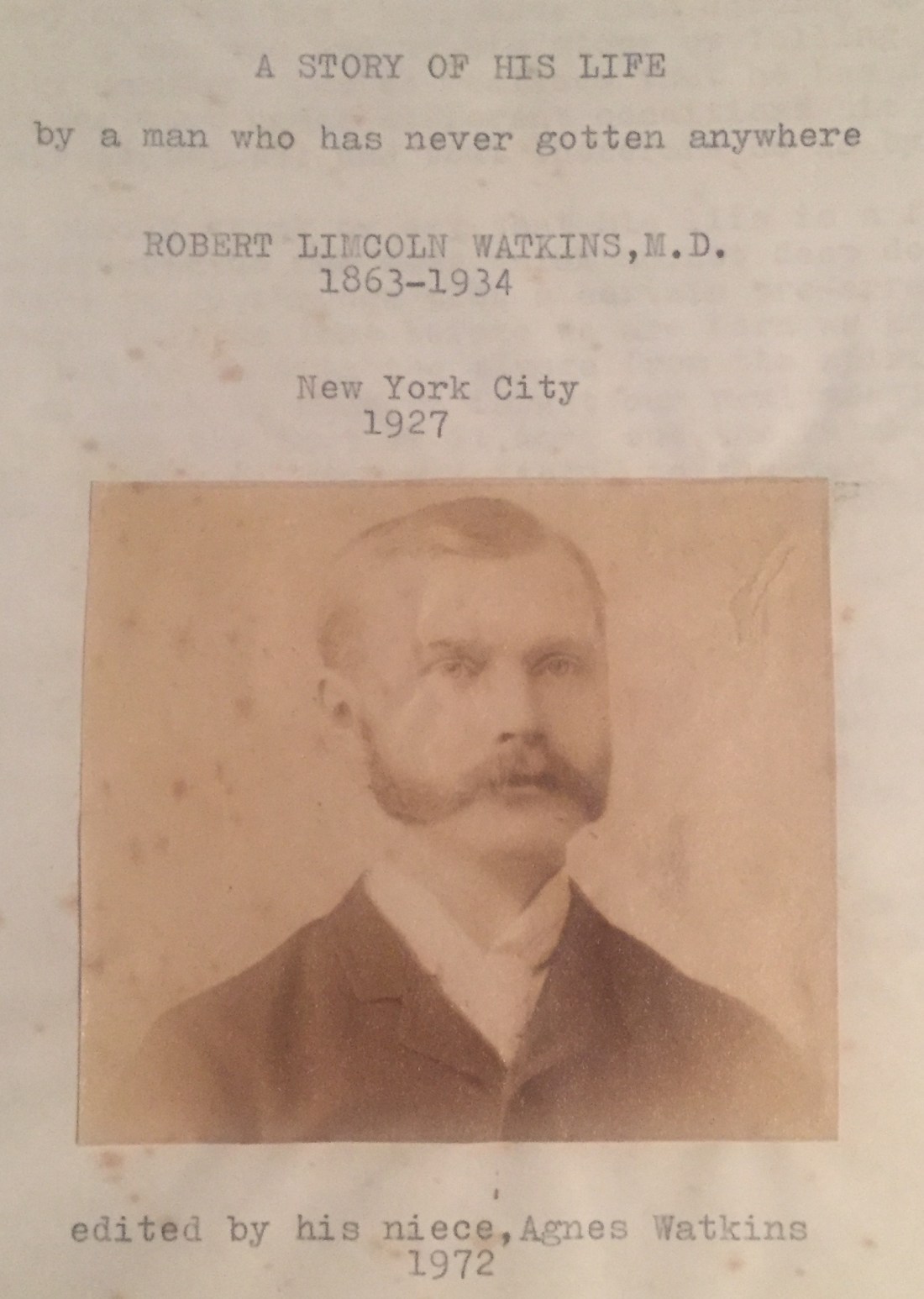
 I was born in Proctorsville, Vermont, in the month of May, 1863, into a family of long-standing New England extraction. The family consisted of three sons and one daughter, I being the second child. My father had deserted the farming life and was a mechanic and inventor. He was the owner of a factory for making chair seats – Black River Chair Factory – and held basic patents thereon. One night the spring freshet washed away the factory, and we youngsters were roused from sleep to see my father’s fortune completely destroyed by the Black River. Soon after I remember a grey-bearded, good-looking old gentleman came to town and bargained with father for his invention, and we moved when I was six to a factory town, Gardner, Massachusetts, (where father worked for Heywood-Wakefield), in which we all got our schooling and grew up.

My mother had been a school teacher in a Berkshire County hill town, Peru, Massachusetts. She was one of those dark-haired, dark-eyed beauties true to every virtue of womanhood. Her mother had thirteen children and lived to a ripe old age, visiting around with her children after they were grown and she was a widow. I remember her amusing us as we sat around her on our knees, singing as she knit, “There was a frog lived in a well, with a rink tun billy won’t you kimo,” etc. My earliest recollections are of a puritanical environment where family prayers were party of the daily calendar, and strict observance of the Sabbath was demanded of all.
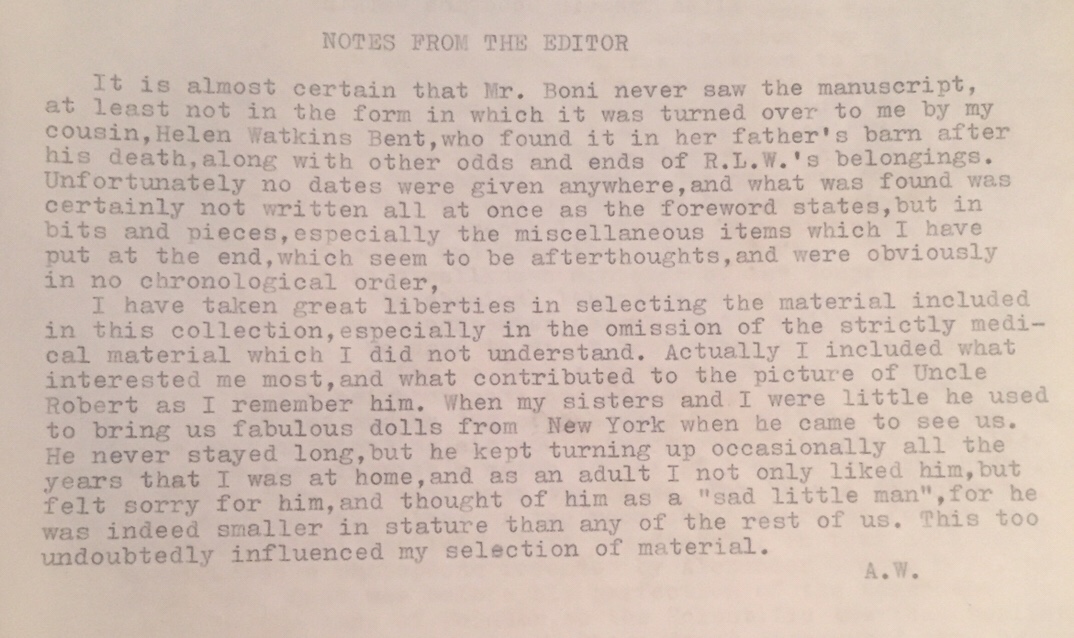
[Background: here’s the preface, forward, and notes from the editor of R.L.W.’s memoir, and here’s a piece I wrote for New York Press upon first reading it.]
My boyhood was uneventful, but at an early age I was restive under instruction. I had a horror of learning from books that were assigned me, but was eager to get information for myself from nature and from observation. I was one of those difficult boys whose face would get red if he walked before a crowd, and on Declamation Day at school I would run away to avoid getting up on the platform to recite The Nantucket Skipper, or some other simple piece. I recollect a minister’s son in the town who also ran away on those days, though for other reasons than what I did. One time the teacher called on him, and with his hair all over his face he recited: “Speaking pieces hard and tough, I’ve spoke two lines and that’s enough.” His name was Charles Herrick. I’ve often wondered what became of him, for he never seemed to care what he looked like. His parents I remember brought up and educated two Chinamen at home, Pan and Sing their names were.
No doubt Dr. Gates, a well-known minister of the Gospel in New York, will recollect the chemical laboratories we used to work in as boys, he in his father’s carpenter shop, I in the cellar of our house in an old coal box. We used to visit each other an make explosives and other things to which we took a notion.
One day my father was sick in bed and a neighbor came and stayed too long. By luck I went down to the cellar to see how my jug of hydrogen was getting along. Not considering that, on standing, air would trickle in, I touched the the glass painted tube therein with a match to see if I could get the hydrogen tones when a tube was held over the flame. But lo, the jug blew up, the cork striking the floor of the room above, where my father was. The neighbor, Dwight Warfield, left immediately.
In that coal box I had constructed a photophone invented by Alexander Graham Bell, the telephone man. That was before his perfection of the telephone. He and a man by the name of Painter – so the Scientific American published (I read that paper religiously in those days) – discovered this apparatus to talk over distances without a wire by means of a ray of light.
Then there was another man who claimed that diamonds could be made by heating in a tube iron filings, carbon, and nickel. For a tube, I used a piece of an old steam pipe, sealed it at both ends in the usual way, put it in the furnace, and left it there, forgetting all about it till a dull thud one day told the story.
My father often asked me what I wanted to be. I as often replied that I didn’t know, but I thought I would like to be a chemist or an electrical engineer. From high school I went to a Polytechnic Institute – Worcester Tech – where I studied for a chemist, and graduated from that institution. It naturally fell in line then, since I did not desire to continue as a chemist for a life profession – my father said, and induced me to believe, that there was only $900 a year in it – that I went to New York City and studied medicine, graduating from one of the best medical colleges in the country (New York University), a full-fledged M.D., and thinking myself lucky to get through.
One day Dr. Draper showed us pictures of blood cells in a small, red-covered English book. I dreamily said to myself, “That’s the place to look for disease, in the blood. When one’s face broke out with an eruption, the ‘old wives’ used to say, ‘It’s in the blood.’ So all disease must be in the blood.” But research work I realized must determine how to recognize it, how to tell abnormalities.
Recollecting that a physician came to our house in the country when I was a boy, to examine my sister who had consumption and died of it at the age of 18, and that he examined a drop of her blood, I scurried around, found that the old doctor lived in Boston, and went to see him. He said, “When you have finished your college come here and I will teach you what I know.” So I took lessons of his, borrowing the money to pay for them.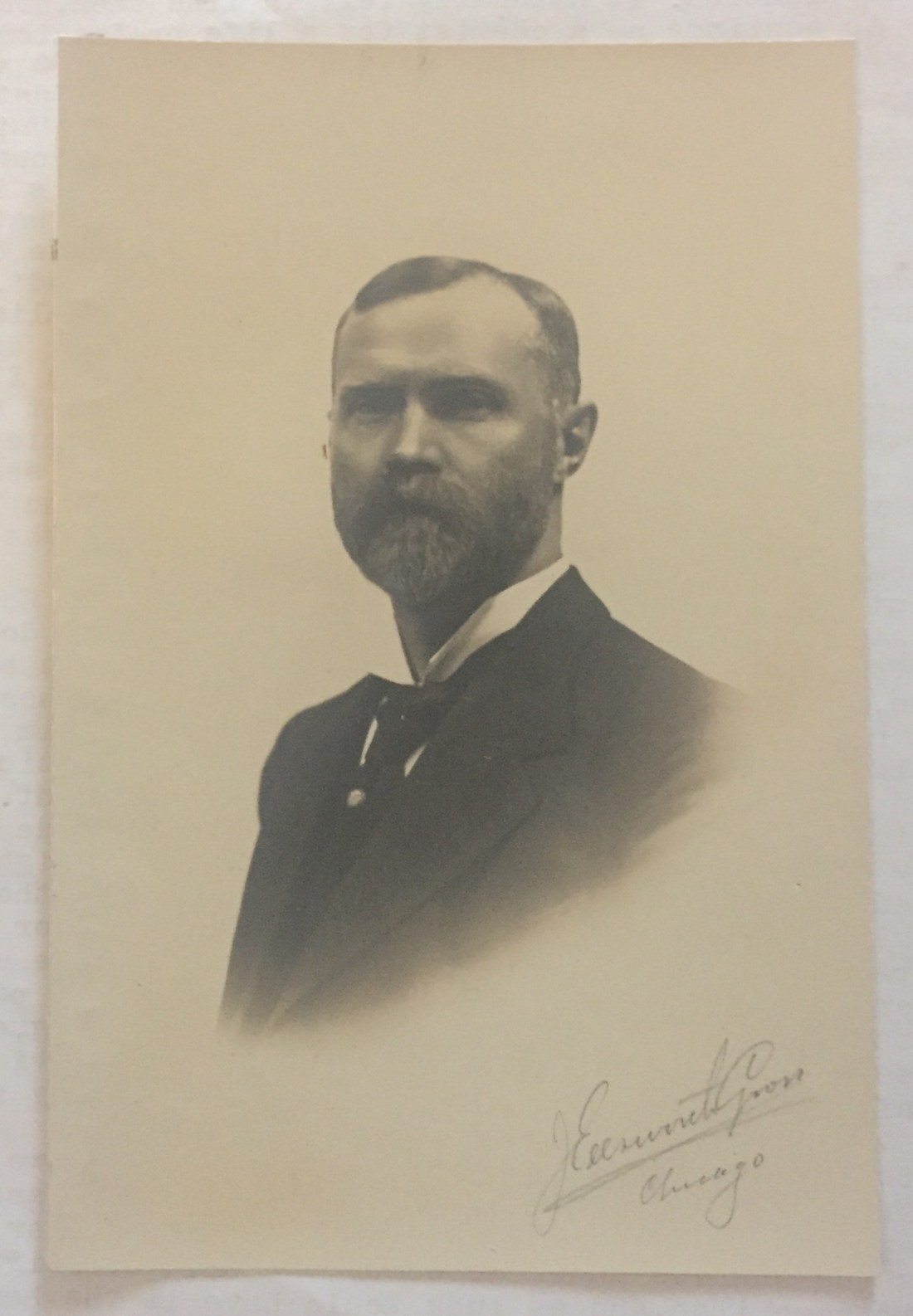
I was intern for a time in a big hospital – Newark Hospital – where the boys said I was always examining blood instead of doing regular duties. After which, my troubles began.
There was a man by the name of Sullivan, a saloon keeper, who was brought into the hospital unconscious one night. We interns began to try to bring him to by pouring hot and cold water alternately on him, and by flagellation. The operations caused some disturbances in the middle of the night. Some reporters being in the ward, and the man dying afterwards, made a good newspaper story – so the reporters thought. And they were right, for we were all arrested for killing, or for assisting a man into the next world.
We all imagined all kinds of things happening to us, for we were several months on parole, but when the truth was known we were of course liberated. Little did we know at the time that politics was more or less mixed up in the affair. We were all young, and inexperienced especially in political intrigue, which in this hospital was only waiting for a chance to get in its previously arranged schemes.
Practicing medicine out of a hospital, and in, are two different kinds of experience. The first middle-of-the-night case I had was a saloon keeper bleeding from at the lungs on a cold winter night. He lived among the wharves under McCombs Dam bridge. Frightened I was, but gave him some iron, and as luck would have it the hemorrhage soon stopped, and he was only too glad to pay me $2.00 – and respected the young doctor, to boot. I walked home a mile through the snow storm.

 Van Smith