One in a Million at the Million Man March

By Van Smith

Published in City Paper, Oct. 25, 1995

As a white guy, Im pretty much at the top of Minister Louis Farrakhan’s shit list. The Nation of Islam leader may hurl venom at Jews, Arabs, Catholics, gays, and any other group that his twisted, manipulative take on history and reality tells him to excoriate, but a large supply of his vast reservoir of hate is reserved for Caucasian men.

Knowing exactly where I stand in Farrakhan’s separatist vision – that is, sequestered from my African American friends and neighbors – I decided to attend the Million Man March to get a sense of the future of black-white relations. I do, after all, live happily in an integrated neighborhood of a majority-black city where race is constantly an issue. If my welcome is wearing thin, I’d prefer to find out earlier than later.

Being uninvited and considered part of the problem, I expected hostility. To my pleasant surprise, I was welcomed over the course of the day by hundreds of African American men, who politely acknowledged my presence even as they listened to blame-filled speeches that fingered me, a white male, for much of their plight. I was called “brother,” and clasped hands in an overwhelmingly positive spirit with black men in Farrakhan T-shirts. I quickly realized that, in the atmosphere of the march, race relations were much more complex and promising than the hype had led me to believe.

Race, it seems to me, is not a simple black-and-white issue, though many choose to see it that way. Its nuances are dizzying. As I tried to piece it together, I quickly grew to resent the words of Dan Berger, which I had read on the op-ed pages of The Sun that morning: “If you do not accept the leadership of Minister Farrakhan and Reverend [Benjamin] Chavis, you are not marching in Washington today. If you are, you did.” I now realize that Farrakhan’s leadership is a sideshow to the real strides toward multiethnic health that March participants took with great enthusiasm.

As I wandered the Mall, I listened to speeches and prayers, delivered by Nation of Islam ministers and Christian preachers, that reminded me repeatedly and in no uncertain terms that my European American forefathers were slave traders, or slave owners, and that they conspired – often with ruthless energy over a period of centuries – to enrich themselves at the expense of the inhabitants of much of the African continent. Strong cases were made, even without indulging the minister’s bizarre fantasies, that this white racist legacy against African American males continues in more subtle forms today.

Even without the reminders, I am fully conscious of my forefathers’ sins and those of today’s white-male establishment. And I know that they are not far removed, either in time or space, from my own experience. I will never forget Mining the Museum, an exhibit created by Fred Wilson at the Maryland Historical Society that included a Klansman’s hood found in a Towson attic in the late 1950s and a fugitive slave notice from a farm on Falls Road in Brooklandville (owned today by the same family, the Johnsons, who were listed on the notice) which included a description of how the runaway had been marked for identification purposes by mutilation.

I grew up in that same area, just north of the city. Cold, hard, violent racism is an unavoidable part of my heritage. Occasional conversations with some of my childhood friends never fail to remind me of its living, breathing effect; many of them cultivate a racist mentality even as they say they aren’t racists. They often try to tone it down in my presence, but their educated voices still resonate with destructive words and thoughts. I tolerate their company at these times with grim defiance and open discomfort; nonetheless, they are my friends, and I still like them.

A visit to almost any corner bar in the southern or eastern reaches of this city, where many of the city’s whites reside, is likely to reveal an innate animosity towards African Americans that, in a feat of logical gymnastics, is felt to be justified by the ongoing crisis of black-on-black drug violence. Overlooked is the obvious fact that the government’s drug war targets poor, urban black males even as white suburbanites feed the trade and traffic with little fear of arrest or prosecution. When I pass by a drug corner, the excitement among the black dealers is feverish: a white face means a quick sale without the haggle. Somehow the white role in black-on-black drug violence is lost on most whites.

Many whites in Baltimore, despite living under a legal system that matured to embrace civil rights generations ago, are still in infancy when it comes to race relations. As further evidence, one only needs to remember the Democratic primary for city council president. Joe DiBlasi captured many white voters’ imaginations by overtly seeking to exploit the potential split in the city’s black vote among three African-American candidates. As he sought citywide office, he rarely if ever campaigned in black communities.

Even as the city’s white community complained rightly and bitterly about Mayor Kurt Schmoke’s race-based campaign, hardly a white voice was raised against DiBlasi for the same tactic. To me, this mass hypocrisy is every bit as great as that of Schmoke and his campaign manager, Larry Gibson. It seems to me that the city’s black political leadership and much of its white minority population are on the same racist page: they are just reading different books. Both call for retribution. One side tries to undermine black leadership because those on that side feel ignored; the other proudly proclaims that the shoe is now on the other foot. The situation make productive communication all but impossible.

And the situation with Farrakhan doesn’t help matters. He is a racist, plain and simple, and he is emerging as the dominant voice – if not the acknowledged leader – of African American males. At the march, I witnessed hundreds of thousands raise their fists and make a vow: “We accept Louis Farrakhan as our leader across the world.” Needless to say, that spectacle worries me profoundly.

But I know I can live with the hostility that Farrakhan wants to spread. He’s taken the fore as a highly visible and controversial black leader, so I have little choice but to deal with it. The trick – as in any confrontational situation – is not to take it personally, to deflect any blows, and not to hit back. Most of all, love your brother anyway. Eventually, he backs down, the hatchet is buried, and everyone gets along famously. At last that’s how it is supposed to go.

The hostility-deflection method takes patience and practiced level-headedness, but it works in most situations, as any martial-arts instructor worth his or her salt can tell you. I have gotten rather practiced at it, as I face black-to-white hostility on nearly a daily basis on the streets of Baltimore (constant eye-fucking, the occasional “yo, white bitch,” and periodic attempts to run me down on the street). In fact, I had to deploy it almost immediately upon returning to Baltimore from the march.

As I crossed West Franklin Street heading north on Martin Luther King Jr. Boulevard (of all places), I found myself confronted with a baseball-bat-wielding youth, maybe 10 years old, backed up by four other kids. They came running across MLK from the Lexington Terrace projects, itching to kick my ass.

Unable to avoid them, I stopped my bike, stood up, faced the kid as he prepared to bash me with the bat, and said sternly with my arms crossed, “So you’re going to knock me around, huh?” He balked, smiled sheepishly, and then one of his accomplices shouted, “He’s a cop! Look, he’s packin’ a gun!”

That was their out. As they ran east on Franklin, I shouted after them, “You wouldn’t have pulled that shit if you had gone to the march today!” The last kid looked back and smiled knowingly.

I had disarmed them psychically, and each of us left undamaged and with something positive to think about. It occurred to me the march participants had managed the same thing with me earlier that day: I had gone expecting my presence to cause some level of hostility and confrontation, but I found only peace and brotherhood.

My hope is that Minister Louis Farrakhan, as he makes his rounds as a confrontational black leader, will find the same reception that I found at the march. If his hostility is met with hostility, I’m afraid we’re headed for a highly destructive showdown. If it is deflected with respectful defiance laced with genuine benevolence, maybe there’s hope, and blacks, whites, and everyone else can stop talking about blame and retribution and actually start building a common, mutually beneficial future. To rephrase the popular T-shirt, “It’s a people thing – we got to understand.”

Future of Sonar in Doubt: Shuttered Club’s New Ownership May Involve Milton Tillman III

By Van Smith

Published in City Paper, July 18, 2012

IMG_7382

Even before Baltimore’s Sonar nightclub suddenly closed after its July 8 show (“Death of a Rock and Roll Club,” Noise, July 9, 2012), plans for its future had already been put in place, public records show.

On June 27, the Baltimore City Liquor License Board received an application to transfer Sonar’s liquor license to Eagle Entertainment LLC, which disclosed in its application papers that it had put up a $10,000 down payment on the $65,000 price tag for the license, with the balance due at closing. The payee, Daniel McIntosh, would be the majority owner of Sonar’s current license. Whether that transaction will actually take place is unclear, though, since the company’s attorney, Neal Janey, told City Paper on July 16 that the application will be withdrawn and a new one will be submitted instead, possibly involving a separate company.

The application’s resubmission would likely delay the potential reopening of the club, which was going to take time and significant investment in any event, given what online photographs of the club last show—damage to the club’s bathroom, at the very least, and a sign announcing a “liquidation sale” of its contents.

Eagle Entertainment’s June 27 liquor-board application lists Brian L. Winfield as the anticipated licensee. Winfield is described in the application as an 80-percent stockholder in the company, with the other 20 percent held by Milton Tillman III.

Tillman III is the son and business partner of Baltimore bail bondsman and real-estate investor Milton Tillman Jr., a three-time federal convict who is currently serving a 51-month prison term for tax-and-insurance fraud and owes $120,000 in restitution. Tillman III was charged in the same 2010 indictment as his father (“Milton Tillman and Son Indicted in Bailbonds Conspiracy,” The News Hole, March 17, 2010) , but the charges against him were dismissed last year as part of a deal in which he pleaded guilty to failing to file tax returns and received five yeas of probation and a $12,500 restitution order, which he still owes, according to court records.

In 2000, Tillman III survived a gunshot wound after a botched drug deal spawned a violent dispute that left two other men dead, according to court records of the successful federal prosecution of the drug organization involved in the incident. During 2002 court proceedings in the case, Assistant U.S. Attorney Jonathan Luna stood up in court and called Tillman Jr. “one of the most notorious drug dealers in Baltimore City history,” adding that “there is no question that Mr. Tillman [III]’s father is a reputed drug dealer, a violent type of guy” (“Grave Accusations,” Mobtown Beat, April 23, 2008). Luna’s lifeless body was found face down in a Pennsylvania stream in 2003, a mysterious and controversial death that continues to haunt law enforcers.

Winfield, who has faced charges of petty theft and bouncing checks, has a history of business dealings with the Tillmans, including at Lucky’s Tavern at 1601 N. Milton Ave., a Tillman-owned property that has been in the Tillman family for years. In 2009, Winfield filed to take over Lucky’s liquor license (“Creative Licensing,” Mobtown Beat, April 9, 2008).

In the liquor-license transfer application for Sonar, Winfield says he worked in the mortgage business until 2009, when he went to work for the Baltimore City Department of Finance until Aug. 2010. Since 2006, according to the application, he’s also worked for Baltimore Winfield Showcase, which its website describes as a vending-machine and catering-equipment rental business.

Calls to Winfield and the attorney who filed the liquor-license application, Melvin Kodenski, were not returned. Tillman III, though, spoke briefly to CP on July 12, confirming that he’s “just a stakeholder” in Eagle Entertainment, and that “I’m not going on the license at all.” He then cut short the conversation, saying he wanted his lawyer, Neal Janey, to handle the interview. Later that day, Janey said that Tillman III “is not a 20-percent owner,” and that “the information in that application is incorrect.” Asked if Tillman III would have any involvement at all in the proposed club, Janey said “the only possible involvement would be as a contingent guarantor” on Eagle Entertainment’s debt.

On July 16, Janey informed CP that “the application will be withdrawn; a new application will be filed” that reflects that Tillman III “will have no interest in the business,” though he allowed that it is “still possible” that Tillman III will be a contingent guarantor. “It will probably even be a different LLC [than Eagle Entertainment] that will be involved in the transaction now.”

Under McIntosh, Sonar is alleged to have played a role in a massive, cross-country marijuana conspiracy, currently being prosecuted by the Maryland U.S. Attorney’s Office (“Feds Namedrop Baltimore’s Sonar Nightclub in New Pot-Conspiracy Indictment,” The News Hole, April 12, 2012). McIntosh is one of 16 people charged in the case, and, unlike most of his alleged co-conspirators, has not pleaded guilty; he is scheduled for trial in September. Baltimore developer Jeremy Landsman (“Smoked Out,” Mobtown Beat, February 29, 2012), a stakeholder in the LLC that owns Sonar’s building, pleaded guilty to his part in the conspiracy in June. In his plea, he admits that a number of his property-owning LLCs—including the one that owns the Hampden property where another McIntosh business, McCabe’s Tavern, is located—also played a role in the conspiracy.

Since shortly after Sonar closed July 8, McIntosh has been telling CP that he intends to post a prepared statement online to explain his ordeal with the club, including why it shut down, and that he would grant an interview about the situation once he had done so. As of press time, the statement had not been posted on Sonar’s website or Facebook page, and McIntosh has not responded to CP’s emails since July 13.

Harm City

By Van Smith

Published as a “Postmark: Baltimore” column in New York Press, 1998

IMG_7381

Back in August 1996, when I moved into the house I recently purchased, my next-door neighbors appeared to be a problem. A bullethole still marred a windowframe of their rented house, left there after a Sunday afternoon shootout on the street a few months earlier. They kept seven chows in the basement; you could hear the inbred curs barking in the dark, day and night. About a dozen people used the house as a temporary crash pad on a rotating basis – younger guys, mostly, with shiny Acuras and eye-fucking attitudes. The landlord lived in New York City and apparently was waiting for the bank to foreclose on the property so he wouldn’t have to be responsible for the shady scene going down on his property.

Within weeks of moving in, I noted a connection between my next-door neighbors and the barbershop around the corner. Fresh Cuttz, it was called. Open all night, its barber chairs were always full and lots of traffic moved through its doors. Late at night, flashy cars with out-of-state license plates were often double-parked before its entrance. Directly in front of the shop was a payphone, a well-placed utility for the high-volume retail drug trade spreading a half block in either direction. I regularly saw many of the guys who lived next door to me hanging in or around Fresh Cuttz.

I was curious, so I asked around. Although many neighborhood people said they had complained to the police about drug dealing they believed was originating from Fresh Cuttz, no one had any information about cops ever having busted the joint. The police, for their part, said three separate investigations had reached the same conclusions: Fresh Cuttz was a place where drug dealers went to get their haircuts, end of story. This made the neighborhood people laugh cynically. Some were of the honest opinion that police were connected to the drug dealing there.

Around this time, an FBI agent who works the press in Baltimore started warming up to me. He would call regularly, friendly as can be, probably in an attempt to get information about the things I look into as an investigative reporter. I never gave him anything that hadn’t already been printed, but he would call me anyway to chat about local politics. When he started offering personal information about himself – where he lives, where he went to high school – I figured he was extending a measure of trust. Not wanting to be needlessly paranoid in dealing with a federal agent, I returned this gesture by telling him the location of my new abode.

“That would be right around the corner from Fresh Cuttz, right?” the FBI guy asked. I was amazed that he would be aware of the place. After plugging him for more information, I learned that Fresh Cuttz caused a blip on the radar screen of a federal investigation of convicted money-launderer Gregory Scroggins. Court records show that Scroggins drove an undercover FBI agent posing a DC drug dealer looking to hide money in Baltimore real estate straight from the Downtown Athletic Club to Fresh Cuttz. Just as he was pulling up to the barbershop, ostensibly to meet with a potential co-investor, Scroggins noticed the suited white men tailing him in an unmarked car, so he took off. The operation failed, but my FBI guy, who was in charge of the investigation, was convinced Fresh Cuttz was somehow connected to the potential co-investor, who name was Kenneth Antonio “Bird” Jackson.

I got quite a rush from this information. Earlier that year, I had written about Jackson. I reported that he was a strip-club manager who, along with his mother, was trying to get a liquor license for a major new downtown nightclub apparently by using a surrogate applicant and the interventions of controversial state Sen. Larry Young. Jackson himself, an ex-con who says his violent days as a leading figure in Baltimore’s west-side drug trade are over, was not legally permitted to hold a liquor license, so he was attempting the next best thing: using a high school guidance counselor with a clean record as the licensee. The scandal exposed not only Jackson’s past crimes and current shenanigans with the liquor board, but also his shoulder-rubbing with some of Baltimore’s most powerful political leaders. If the folks living next to me were associated with Jackson – as it now seemed they were – I had good reason to be paranoid.

After the article ran, my publisher got a letter from New York attorney Robert Simels, who not only counsels jailed New York gangster Henry Hyde, but also my new-found nemesis, Kenny Jackson. On Jackson’s behalf, Simels was threatening to sue me and my employer, Baltimore’s City Paper, for libel. He never followed through, but I was very impressed that Jackson would have such an expensive attorney pen such a piss-poor letter to my publisher. I would have expected the threat to come from Jackson’s esteemed local attorney, Piper & Marbury’s George Russell, a former judge, city solicitor and president of the Maryland Bar Association. Jackson seemed to be saying, “See, I can afford the costliest – just like Henry Hyde.”

Jackson can afford more than expensive attorneys. He has given thousands to the campaign coffers of the city’s three top political leaders: Mayor Kurt L. Schmoke, City Council President Lawrence Bell (who got $3500 from Jackson, his largest contributor) and Comptroller Joan Pratt. He bankrolled a political action committee, called A Piece of J.U.I.C.E. (Justice, Unity, Integrity, Choice, Equality), which was formed to give people on the streets of Baltimore – many of whom can’t vote because they, like Jackson, have felony convictions – a voice in the political process. J.U.I.C.E. spends thousands among the city and state politicians.

Perhaps the contributions explain Jackson’s extraordinary access. At a birthday party for a politician’s mother last fall, Jackson was the only person there – other than the mother – who wasn’t either an elected official or an elected official’s employee or spouse, according to a person who was at the celebration. A plaque from former U.S. representative and now NAACP President Kweisi Mfume hangs over Jackson’s desk in his backroom office at his strip club, the Eldorado Gentlemen’s Club.

The existence of Kenny Jackson explains a lot about Baltimore’s political culture. He has everyone who knows him convinced that he’s just a businessman, an ex-con trying to redeem himself by making legal money in the entertainment business. And maybe that’s all he is. But then there’s the matter of Scroggins (who, by the way, is widely said to be the father of Mayor Schmoke’s adopted son), caught on a wiretap calling Jackson “the nicest guy in the world, but he’s a killer and he has killed.” (Jackson was once convicted of manslaughter, and later beat a murder charge in New York.) Meanwhile, Jackson is making cash overtures to the city’s political elite. And the elite is not shying away from him by any means.

“Mr. Jackson is a businessman, that’s all I have to say,” City Council President Bell told me after the scandal erupted.

The lingering question after hearing such a statement is, Which business is he in, entertainment or drugs? Even if Jackson no longer controls a sizeable chunk of the Baltimore drug trade, as law-enforcement officials speaking background insist he does, he has this very sinister history involving large sums of cash, guns and white powder. It seems that in Baltimore it is okay for politicians to be associated with people like Kenny Jackson. No one gets outraged about it; rather, folks generally seem fascinated by the details without having any sense that something is fundamentally amiss. Perhaps this numbness has been learned after living with generations of corrupt leaders. After all, this is the state that produced such stalwarts of integrity as Spiro Agnew and still displays his bust in the state Capitol.

If you run the numbers on the size of the local drug trade, you begin to understand why Baltimoreans might tend to write off their leaders as corrupt. The city health department says there are 50,000 daily users of heroin or cocaine in Baltimore city – a conservative estimate, I’d say. Let’s assume each of them spends $50 per day to support his habit – also a conservative estimate. And this goes on 365 days a year. That’s 50,000 times 50 times 365, or $912.5 million a year. Money is power, politicians love power, so people tend to presume some of this money must somehow be getting into some politicians’ pockets. The easiest way for average citizens to deal with this possibility is to accept it and go on with their lives. Who’s going to shut down a $912 million-a-year industry? An outraged citizenry? No way, especially since so much of the citizenry creates the demand that fuels that industry.

On Jan. 3, 1997, Fresh Cuttz made the news. James Smith, III, a three-year-old sitting in a barber chair to get his birthday haircut, was killed in the crossfire of a shootout inside the barbershop. The police investigation concluded that the violence was over stolen shirts. Smith’s death caused a widespread spasm of hand-wringing in a city that consistently rates in the top 10, per capita, for murders. Media coverage of the murder stressed the tragedy not only of Smith’s death, but of the barbershop owner’s victimization; these were legitimate businesspeople, the media reported, who had the misfortune of having senseless violence visit their innocent premises. Following the murder, Fresh Cuttz shut down, and so did the drug market in my neighborhood.

The guys next door with the chows, they moved out a few months before the Smith murder; the house is now owned by a bank and is vacant. Kenny Jackson is laying low at the Eldorado, where his butt-slapping variety show is shot on video for the city’s public-access cable channel. His buddy Larry Young – the state senator who tried to help Jackson negotiate the liquor board – was just expelled from the state Senate in early January for breaking ethics laws by using his public office for fun and profit. Schmoke, Bell and Pratt are all still in power, trying their level best – but to no good effect – to turn “Harm City” back into “Charm City.”

For my part, I own a fully functional, three-story, historic storefront row house with an oversized backyard located within 10 blocks of the city center for $34,500. I don’t think that kind of money would buy a parking space in Manhattan.


Weighty Issues: Garnett Smith Says Bringing a Ton of Cocaine to Baltimore Doesn’t Make Him a “Monster”

By Van Smith

Published in City Paper, Feb. 5, 2014

Assistant U.S. Attorney James Warwick had choice words for admitted drug trafficker Garnett Gilbert Smith on Jan. 30, when Smith appeared for sentencing before U.S. District Judge William Quarles. Warwick called Smith a “predator” who “perpetuated, encouraged,” and “fueled” Baltimore’s drug-driven violence by delivering to Baltimore’s streets “over a ton of cocaine” and “kilogram quantities of heroin” in 2010 and 2011.

But when Smith – a large, broad-shouldered 44-year-old who dropped out of school in eighth grade, the court was told, but later got a GED and two semesters of college under his belt – rose to speak on his own behalf, he said, “I am not the monster that I’m depicted to be.” Rather, Smith explained, “I wouldn’t hurt a soul,” adding that “you got to give good to get good” and “I’m on the path of righteousness.”

Smith ended his colloquy by saying, “I want to thank the prosecutor and the [Drug Enforcement Administration] agents” whose work was about to put him behind bars for decades.

Smith’s attorney, federal public defender Teresa Whalen, emphasized that Smith “has another side” to his character, referring to numerous letters written to the court on Smith’s behalf which describe him as “very generous” and “giving” in his “attempts to help other inner-city youth.” Whalen pointed out that Smith “was not just donating money, but was hands-on” in his support of community efforts to help those less fortunate.

Whalen also referred to the high regard in which Smith is held by Adrian Muldrow, who was the vice president of the Baltimore chapter of the NAACP and the program manager of the Druid Heights Community Development Corporation when he wrote a letter to the court saying he’s known Smith “all my life,” and that Smith, who is “very giving to various causes,” has worked “to genuinely help people, including me when I was incarcerated.”

Echoing the glowing review of Smith’s other side was Antonio Hendrickson, an ex-convict who started a prison program called Lead by Example and Reverse the Trend, which seeks to reform inmates. Hendrickson, testifying as a character witness for Smith during the hearing before Quarles, claimed the program has “brought down the violence” at the Chesapeake Detention Facility (CDF), where Smith has been held for 17 months since his arrest. He said that Smith helped him build up the program, which he credited with rehabilitating 400 inmates.

Smith “did do good things in that institution,” said Hendrickson, who in 2012 pleaded guilty in a federal heroin-trafficking conspiracy that included famed Baltimore gangster Walter Ingram, and who last fall was sentenced to time served since his 2010 arrest.

Warwick, though, cast a different light on Smith’s time at the CDF, saying he received $3,500 in money orders while in jail and that he “paid for thousands of dollars of consumer items which were delivered to the jail,” where he would “pay correctional officers to deliver lavish meals to him.” Warwick added that Smith “has engaged in significant harassment of former girlfriends” while in detention, and that his generosity in supporting community causes amounts to “a pittance compared to the money he made selling drugs.”

Warwick’s sentencing letter to Quarles adds that Smith, despite being under court order not to “transfer or diminish his assets,” “can be heard in numerous recorded jail calls encouraging third parties to help him hide and liquidate assets not already seized by law enforcement.”

The Maryland U.S. Attorney’s Office went to unusual lengths to alert the media to Smith’s sentencing, emailing to reporters copies of Warwick’s sentencing letter – a court document that typically is only publicly accessible at the courthouse computer terminals – and a Powerpoint presentation about Smith’s drug-derived assets. The presentation included photographs of $4,800-per-month condominiums Smith rented in McLean, Va., and Beverly Hills, Calif.; $1.6 million in jewelry seized from Smith’s Studio City, Calif., condominium and home in Gambrills, Md.; and vehicles he bought worth more than $1.1 million, including a $262,300 Lamborghini Murciélago and a $165,000 Aston Martin.

Smith’s seized jewelry and vehicles now belong to the government, pursuant to his guilty-plea agreement, along with more than $2.4 million in cash, the contents of four bank accounts, and his interest in two companies, described in court documents as “ASA Enterprises LLC” and a real-estate investment trust called “Tryad Group LLC (Ridge Goodman LLC).” Also in government hands are three pieces of real estate: a parcel in Durham, N.C.; a residential property in Georgia, south of Atlanta; and a condominium at 414 Water St. in downtown Baltimore.

(Federal authorities are currently seeking to take ownership of another 414 Water St. condominium owned by Paul Eugene Sessomes, who’s been indicted in New York for drug-money laundering involving Colombian heroin traffickers. Yet another condo there, meanwhile, is co-owned by former criminal defense attorney Robert Simels, who’s currently serving a 14-year prison sentence for witness intimidation, and Rosalie Jackson, the mother of Kenneth Antonio “Bird” Jackson, a longshoreman with a drug-world past who heads Four One Four LLC, which owns the strip club at 414 E. Baltimore St. on the nearby Block.)

The method they used-secreting cocaine and cash in hidden compartments in vehicles transported to and from Maryland and California by a truck car-carrier-mirror those in a separate case in which investigators allege George Sylvester Frink Jr. and Gerald Lamont Jones, the owner of Pimlico Motors and the Gold’s Gym in Owings Mills, moved between 2,050 and 2,990 kilograms of cocaine from California to Maryland between 2008 to late 2010.

Frink was charged last fall as a result of that investigation, while Jones has not been publicly charged-though prosecutors filed a lawsuit in December, seeking to let the government take ownership of 10 pieces of Jones’ real estate in Maryland, Pennsylvania, and Florida, claiming they are assets tied to drug trafficking or money laundering. Jones’ attorney in the forfeiture case, Kobie Flowers, declined to comment.

In addition to the two cases involving Smith and Frink, federal law enforcers took down several other high-volume cocaine-trafficking organizations that operated in the same time frame.

A cocaine conspiracy allegedly tied to Jones, and involving his fraternity brother Charles Dwight Ransom Jr., shipped 400 kilograms of cocaine to Baltimore from California in late 2010, when it was brought to an abrupt end with a California indictment. In early 2011, a conspiracy involving Richard Anthony “Richie Rich” Wilford was stopped with the seizure of 150 kilograms of cocaine brought to Baltimore from California. In the second half of 2009, meanwhile, a case with direct links to Mexican cartels-the men prosecuted in Baltimore included Wade Coats and Jose Cavazos-involved the delivery of between 240 and 360 kilograms of cocaine to Baltimore.

The sum totals of cocaine involved in these five cases are astounding: Between 2008 and late 2011, according to court documents, they accounted for between 3,920 to 5,340 kilograms of cocaine-the equivalent of between 110 to 150 kilograms per month. And that’s just the flow that was stemmed by law enforcers.

Still, the end of these operations must have had a significant impact on the availability of cocaine in Baltimore-and court documents indicate that in early 2012, a shortage was indeed in full effect. In January 2012, Edward Neal Ellis – who would soon, along with his co-conspirators, be charged for the attempted armed robbery of what he thought was a drug trafficker in what was actually a sting operation set up by law enforcers – explained to a cooperator involved in the sting “that cocaine was increasingly scarce in Baltimore City and, as a result, the opportunity to steal a bulk quantity of cocaine would be particularly lucrative.”

Smith’s piece of the cocaine-trafficking action leading up to this shortage was significant, with Warwick describing him in the sentencing letter as “one of the largest cocaine and heroin dealers to be prosecuted in Baltimore in recent history.” Smith put more than a ton of cocaine “in the hands of drug dealers and addicts in this city – and all of this occurred during a period of less than two years. Smith’s activities made him wealthy and arrogant, enabling him to support a lifestyle of luxury and excess.”

Quarles sentenced Smith to 25 years in prison, saying “he’s not a monster” but “an amalgam of good and bad.”

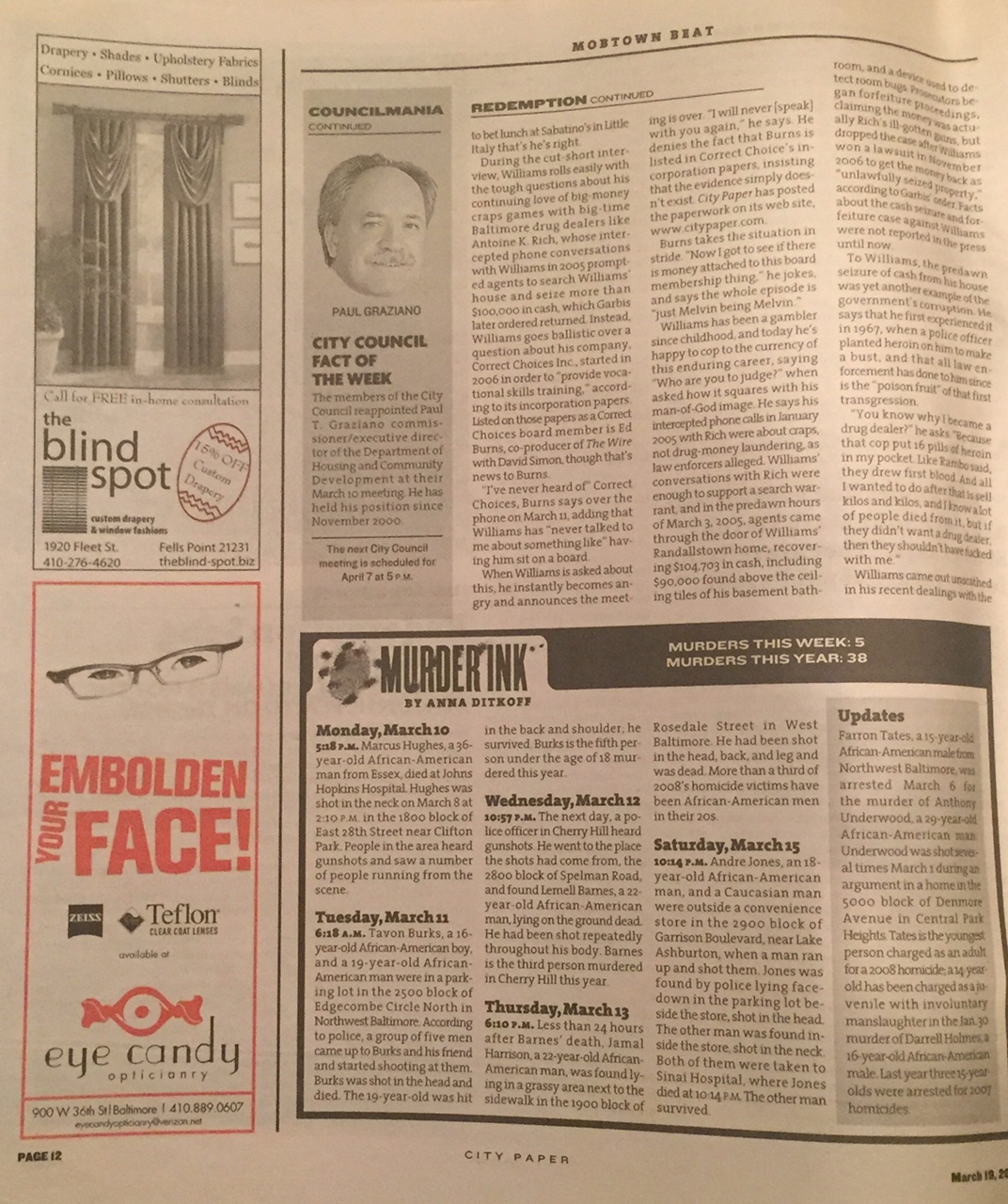
Redemption Song and Dance: Little Melvin Williams Is Not The Deacon He Played On “The Wire”

By Van Smith

Published in City Paper, Mar. 19, 2008

IMG_7345

“I’m sorry I let you in the door,” Melvin Williams says as he ushers a reporter out of his warehouse office to the sidewalk outside, where the conversation continues. The old gangster has long been called “Little Melvin,” and he’s dressed all in black, save a blue handkerchief wrapped around his ankle that peeks out from below the hem of his left pant leg. He quotes the Bible, chapter and verse, and condemns the visitor as a “troublemaker” and a “snoop,” and he casts himself as “a peacemaker.” Evidence of this last claim comes when he shakes an offered hand as the time comes to say goodbye.

Williams’ righteous indignation is entirely in keeping with his current reputation as the wizened, redeemed OG aiming to keep souls out of the drug game, an image he earned playing a church deacon on the HBO television series The Wire. He’d lived up to his prior persona–the fearsome drug kingpin–until 1996, when he confirms he “saw God.” He then was nearing the end of a lengthy federal prison sentence, begun in the 1980s, for his leadership role in introducing bulk shipments of heroin to Baltimore. Williams became a bail bondsman after his release, but caught a gun conviction in 2000, earning a new 22-year sentence from U.S. District Judge Marvin Garbis. In 2003, though, Garbis removed the career-criminal mantle he’d previously draped over Williams’ shoulders and set him free (“Little Melvin’s Holiday,” The Nose, Jan. 22, 2003). The old gangster’s public redemption was aided further by his Wire appearances as a man of God.

At 66 years old, Williams is boastful of his abilities in math, language, martial arts, and the law–especially the tax code. “I’m a world-class gambler,” he declares repeatedly during the two-hour visit on March 13, saying as well that he remains on federal parole and can’t go 40 miles from Baltimore without permission. It’s not illegal to gamble as long as any gambling income is declared for tax purposes, Williams asserts, offering to bet lunch at Sabatino’s in Little Italy that’s he’s right.

During the cut-short interview, Williams rolls easily with the tough questions about his continuing love of big-money craps games with big-time Baltimore drug dealers like Antoine K. Rich, whose intercepted phone conversations with Williams in 2005 prompted agents to search Williams’ house and seize more than $100,000 in cash, which Garbis later ordered returned. Instead, Williams goes ballistic over a question about his company, Correct Choices Inc., started in 2006 in order to “provide vocational skills training,” according to its incorporation papers. Listed on those papers as a Correct Choices board member is Ed Burns, co-producer of The Wire with David Simon, though that’s news to Burns.

“I’ve never heard of” Correct Choices, Burns says over the phone on March 11, adding that Williams has “never talked to me about something like” having him sit on a board.

When Williams is asked about this, he instantly becomes angry and announces the meeting is over. “I will never [speak] with you again,” he says. He denies the fact that Burns is listed in Correct Choice’s incorporation papers, insisting that the evidence simply doesn’t exist. City Paper has posted the paperwork here [136kb pdf no longer posted, but available in the public record].

Burns takes the situation in stride. “Now I got to see if there is money attached to this board membership thing,” he jokes, and says the whole episode is “just Melvin being Melvin.”

Williams has been a gambler since childhood, and today he’s happy to cop to the currency of this enduring career, saying “Who are you to judge?” when asked how it squares with his man-of-God image. He says his intercepted phone calls in January 2005 with Rich were about craps, not drug-money laundering, as law enforcers alleged. Williams’ conversations with Rich were enough to support a search warrant, and in the predawn hours of March 3, 2005, agents came through the door of Williams’ Randallstown home, recovering $104,703 in cash, including $90,000 found above the ceiling tiles of his basement bathroom, and a device used to detect room bugs. Prosecutors began forfeiture proceedings, claiming the money was actually Rich’s ill-gotten gains, but dropped the case after Williams won a lawsuit in November 2006 to get the money back as “unlawfully seized property,” according to Garbis’ order. Facts about the cash seizure and forfeiture case against Williams were not reported in the press until now.

To Williams, the predawn seizure of cash from his house was yet another example of the government’s corruption. He says that he first experienced it in 1967, when a police officer planted heroin on him to make a bust, and that all law enforcement has done to him since is the “poison fruit” of that first transgression.

“You know why I became a drug dealer?” he asks. “Because that cop put 16 pills of heroin in my pocket. Like Rambo said, they drew first blood. And all I wanted to do after that is sell kilos and kilos, and I know a lot of people died from it, but if they didn’t want a drug dealer, then they shouldn’t have fucked with me.”

Williams came out unscathed in his recent dealings with the government, but Rich was not so successful. Court records show he was indicted in October 2006 as a drug-dealing co-conspirator with the politically connected Rice Organization (“Wired,” Mobtown Beat, March 2, 2005). In August 2007, Rich was convicted under a superceding charge of a single count of drug dealing and sentenced to 87 months in the federal penitentiary.

“The Rice Organization?” Williams asks when Rich’s alleged ties to the notorious traffickers are mentioned. In the case, two brothers–Howard and Raeshio Rice–and a host of others, including Anthony B. Leonard, owner of the now-defunct Downtown Southern Blues restaurant on North Howard Street, were convicted of operating a violent drug business until they were indicted in 2005. Leonard’s landlord at Downtown Southern Blues was Kenneth Antonio “Bird” Jackson, who in the ’80s was a top lieutenant in Williams’ drug organization. Today, Jackson is a politically connected businessman with a strip club in East Baltimore and a sporting-goods store in Edgewood.

Williams maintains he was completely ignorant of any ties Rich and his associates had to the drug trade. “I didn’t know those young men from a can of paint,” Williams says of them, though he recalls joining them for craps games over a six-month period in 2004 and ’05.

“These kids had a lot of money, man,” Williams says. “I don’t care how they got their money and I don’t know. I met them at a filling station, and they said, `That’s the OG, and he’s got all kinds of old-time money.’ We played craps.”

Asked if he knows what Rich and the other craps players are doing today, he says, “I know some of them are in some form of federal confinement.”

At the end of the interview, on the way to the door, Williams changes his tune about his relationship with Rich. “We know each other–now,” he says. “If you’re still here in the next 15 minutes, Rich is going to call.”

Rich’s ties to the politically connected bail bondsman Milton Tillman Jr. were explored at length in a courtroom last fall. Tillman Jr., his son Milton Tillman III, and his business partner Bernard Dixon were acquitted by a Baltimore City Circuit Court jury of charges that they’d criminally manipulated the bond-writing system to get certain key criminal defendants out of jail. Rich was one of them, and the Tillmans admitted making honest mistakes in 2003 by double-posting property to help raise the funds to make Rich’s $2 million bail. But the jury decided no crimes had been committed. Last week City Paper described Tillman Jr.’s business ties to federal fugitive Shawn Michael Green, who has been on the run from a drug and money-laundering indictment for more than a year (“Flight Connections,” Mobtown Beat, March 12), and recapped Tillman Jr.’s criminal convictions for bribery and tax evasion.

Thus, Antoine K. Rich is a nexus to three of the best-known names in Baltimore’s annals of modern crime: Williams, Jackson, and Tillman Jr. Of the three, only Williams enjoys a deaconlike reputation, thanks to The Wire.

Burns, who was a key Baltimore Police Department investigator in sending Williams to prison in the 1980s, says he would be surprised if Williams was caught talking with Rich about how to launder drug proceeds, as federal prosecutors believed.

“They kicked in his door,” Burns says of the 2005 warrant and cash seizure at Williams’ house. “But if Melvin Williams is talking drugs on the phone, he’s either senile or not the man I know. When he talks on the phone, it’s tough to catch him, because he’s extremely cautious. Whether or not he’s in the game, I don’t know. I have no idea what Melvin is up to–though I guess I should,” Burns adds, laughing, “because I’m a board member” of Correct Choices.

David Simon, whose 1987 Sun series about Williams remains the most detailed treatment to date of the drug dealer’s career, says he too knows nothing of what Williams has been doing recently.

“I have not the slightest knowledge of Mr. Williams’ current affairs,” Simon writes in a March 13 e-mail. He explains that Williams’ theatrical skills won him a role in The Wire, and that he was cast as the deacon “because it seemed . . . that his involvement with Bethel African Methodist Church constituted a new phase in his life.” Simon adds that he has “no regrets whatsoever” for collaborating with Williams, and that he hopes that Williams’ “retirement from previous pursuits is an enduring one.”

IMG_7346IMG_7347IMG_7348

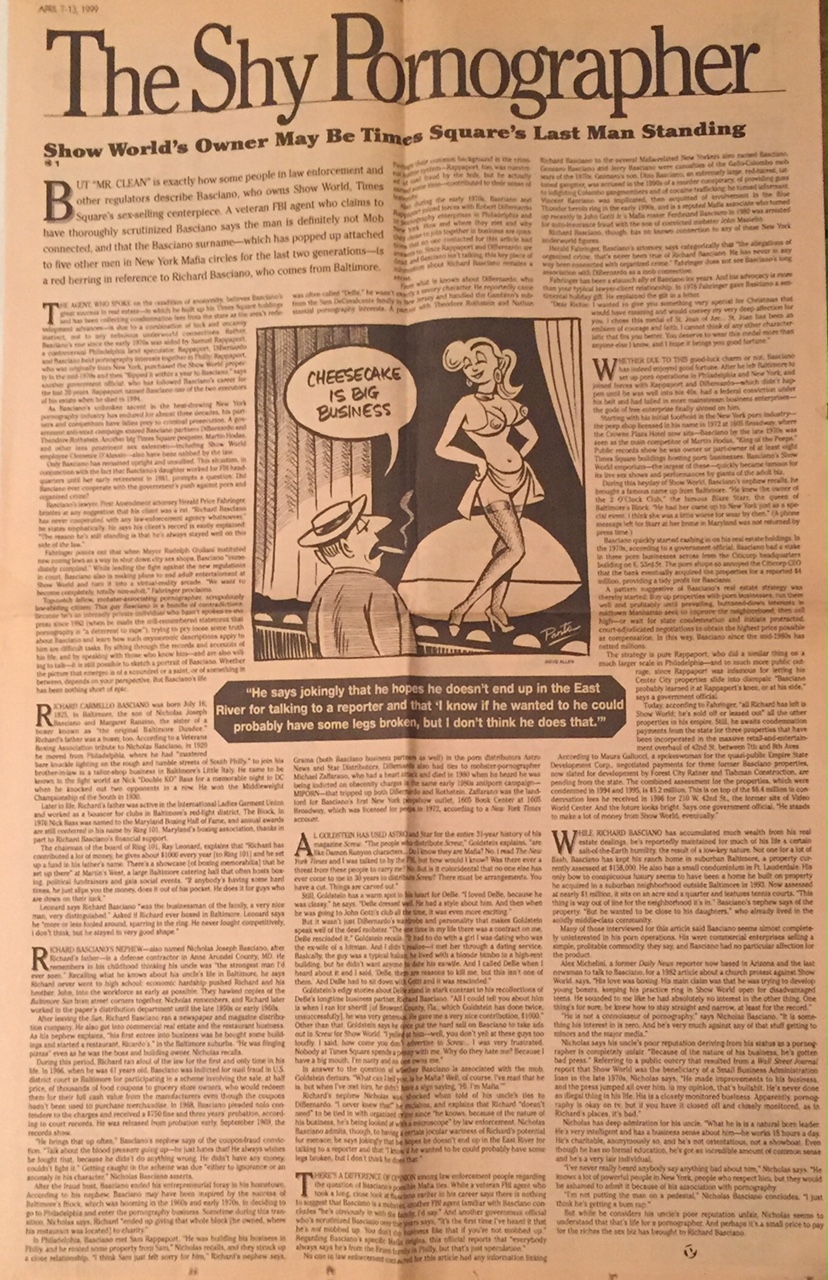
The Shy Pornographer: Show World’s Owner May Be Times Square’s Last Man Standing

By Van Smith

Published in New York Press, Apr. 7, 1999

IMG_7335

Richard Basciano, a 73-year-old Times Square real estate investor, is said to be a personable, intelligent, gracious and charitable gentleman, but he can’t seem to shake his sinister reputation. That’s because he’s also a wealthy pornographer whose longtime business partner, Robert DiBernardo, was a Gambino captain who was whacked by Sammy “The Bull” Graviano on John Gotti’s orders in 1986. With friends like that, it’s hard to be seen as Mr. Clean.

But “Mr Clean” is exactly how some people in law enforcement and other regulators describe Basciano, who owns Show World, Times Square’s sex-selling centerpiece. A veteran FBI agent who claims to have thoroughly scrutinized Basciano says the man is definitely not Mob connected, and that the Basciano surname – which has popped up attached to five other men in New York Mafia circles for the last two generations – is a red herring in reference to Richard Basciano, who comes from Baltimore.

The agent, who spoke on the condition of anonymity, believes Basciano’s great success in real estate – in which he built up his Times Square holdings and has been collecting condemnation fees from the state as the area’s redevelopment advances – is due to a combination of luck and uncanny instinct, not to any nebulous underworld connections. Rather, Basciano’s rise since the early 1970s was aided by Samuel Rappaport, a controversial Philadelphia land speculator. Rapport, DiBernardo and Basciano held pornography interests together in Philly; Rapport, who was originally from New York, purchased the Show World property in the mid-1970s and then “flipped it within a year to Basciano,” says another government official, who has followed Basciano’s career for the last 20 years. Rappaport named Basciano one of the two executors of his estate when he died in 1994.

As Basciano’s unbroken asent in the heat-drawing New York pornography industry has endured for almost three decades, his partners and competitors have fallen prey to criminal prosecution. A government anti-smut campaign snared Basciano partners DiBernardo and Theodore Rothstein. Another big Times Square peepster, Martin Hodas, and other less prominent sex salesmen – including Show World employee Clemente D’Alessio – also have been nabbed by the law.

Only Basciano has remained upright and unsullied. This situation, in conjunction with the fact that Basciano’s daughter worked for FBI headquarters until her early retirement in 1981, prompts a question: Did Basciano ever cooperate with the government’s push against porn and organized crime?

Basciano’s lawyer, First Amendment attorney Herald Price Fahringer, bristles at the suggestion that his client was a rat. “Richard Basciano has never cooperated with any law-enforcement agency whatsoever,” he states emphatically. He says his client’s record is easily explained: “The reason he’s still standing is that he’s always stayed well on this side of the law.”

Fahringer points out that when Mayor Rudoph Guiliani instituted new zoning laws as a way to shut down city sex shops, Basciano “immediately complied.” While leading the fight against the new regulations in court, Basciano is also making plans to end adult entertainment at Show World and turn it into a virtual-reality arcade. “We want to become completely, totally non-adult,” Fahringer proclaims.

Top-notch fellow, mobster-associating pornographer, scrupulously law-abiding citizen: This guy Basciano is a bundle of contradictions. Because he’s an intensely private individual who hasn’t spoken to the press since 1982 (when he made the still-remembered statement that pornography is “a deterrent to rape”), trying to pry loose some truth about Basciano and learn how such oxymoronic descriptions apply to him are difficult tasks. By sifting through the records and accounts of his life, and by speaking with those who know him – and are also willing to talk – it is still possible to sketch a portrait of Basciano. Whether the picture that emerges is of a scoundrel or a saint, or of something in between, depends on your perspective. But Basciano’s life has been nothing short of epic.

IMG_7336

Richard Carmello Basciano was born July 16, 1925, in Baltimore, the son of Nicholas Joseph Basciano and Margaret Ranzino, the sister of a boxer known as “the original Baltimore Dundee.” Richard’s father was a boxer, too. According to a Veterans Boxing Association tribute to Nicholas Basciano, in 1920 he moved from Philadelphia, where he had “mastered bare knuckle fighting on the rough and tumble streets of South Philly,” to join his brother-in-law in a tailor-shop business in Baltimore’s Little Italy. He came to be known in the fight world as Nick “Double KO” Bass for a memorable fight in DC when he knocked out two opponents in a row. He won the Middleweight Championship of the South in 1930.

Later in life, Richard’s father was active in the International Ladies Garment Union and worked as a bouncer for clubs in Baltimore’s red-light district, The Block. In 1976 Nick Bass was named to the Maryland Boxing Hall of Fame, and annual awards are still conferred in his name by Ring 101, Maryland’s boxing association, thanks in part to Richard Basciano’s financial support.

The chairman of the board of Ring 101, Ray Leonard, explains that “Richard has contributed a lot of money, he gives about $1000 every year [to Ring 101] and he set up a fund in his father’s name. There’s a showcase [of boxing memorabilia] that he set up there” at Martin’s West, a large Baltimore catering hall that often hosts boxing, political fundraisers and gala social events. “If anybody’s having some hard times, he just slips you the money, does it out of his pocket. He does it for guys who are down on their luck.”

Leonard says Richard Basciano “was the businessman of the family, a very nice man, very distinguished.” Asked if Richard ever boxed in Baltimore, Leonard says he “more or less fooled around, sparring in the ring. He never fought competitively, I don’t think, but he stayed in very good shape.”


Richard Basciano’s nephew – also named Nicholas Joseph Basciano, after Richard’s father – is a defense contractor in Anne Arundel County, MD. He remembers in his childhood thinking his uncle was “the strongest man I’d ever seen.” Recalling what he knows about his uncle’s life in Baltimore, he says Richard never went to high school; economic hardship pushed Richard and his brother, John, into the workforce as early as possible. They hawked copies of the Baltimore Sun from street corners together, Nicholas remembers, and Richard later worked in the paper’s distribution department until the late 1950s or early 1960s.

After leaving the Sun, Richard Basciano ran a newspaper and magazine distribution company. He also got into commercial real estate and the restaurant business. As his nephew explains, “his first entree into business was he bought some buildings and started a restaurant, Ricardo’s,” in the Baltimore suburbs. “He was flinging pizzas” even as he was the boss and building owner, Nicholas recalls.

During this period, Richard ran afoul of the law for the first and only time in his life. In 1966, when he was 41 years old, Basciano was indicted for mail fraud in U.S. district court in Baltimore for participating in a scheme involving the sale, at half price, of thousands of food coupons to grocery store owners, who would redeem them for their full cash value from the manufacturers even though the coupons hadn’t been used to purchase merchandise. In 1968, Basciano pleaded nolo contendere to the charges and received a $750 fine and three years’ probation, according to court records. He was released from probation early, September 1969, the records show.

“He brings that up often,” Basciano’s nephew says of the coupon-fraud conviction. “Talk about the blood pressure going up – he just hates that! He always wishes he fought that, because he didn’t do anything wrong. He didn’t have any money, couldn’t fight it.” Getting caught in the scheme was due “either to ignorance or an anomaly in his character,” Nicholas Basciano asserts.

After the fraud bust, Basciano ended his entrepreneurial foray in his hometown. According to his nephew, Basciano may have been inspired by the success of Baltimore’s Block, which was booming in the 1960s and early 1970s, in deciding to go to Philadelphia and enter the pornography business. Sometime during this transition, Nicholas says, Richard “ended up giving that whole block [he owned, where his restaurant was located] to charity.”

In Philadelphia, Basciano met Sam Rappaport. “He was building his business in Philly, and he rented some property from Sam,” Nicholas recalls, and they struck up a close relationship. “I think Sam just felt sorry for him,” Richard’s nephew says. Perhaps their common background in the criminal justice system – Rappaport, too, was convicted of mail fraud by the feds, but he actually served some time – contributed to their sense of fraternity.

Also during the early 1970s, Basciano and Rappaport joined forces with Robert DiBernardo in pornography enterprises in Philadelphia and New York. How and where they met and why they chose to join together in business are questions that no one contacted for this article had answers to. Since Rappaport and DiBernardo are dead, and Basciano isn’t talking, this key piece of information about Richard Basciano remains a secret.

From what is known about DiBernardo, who was often called “Debe,” he wasn’t exactly a savory character. He reportedly came from the Sam DeCavalcante family in New Jersey and handled the Gambino’s substantial pornography interests. A partner with Theodore Rothstein and Nathan Grama (both Basciano business partners as well) in the porn distributors Astro News and Star Distributors, DiBernardo also had ties to mobster-pornographer Michael Zaffarano, who had a heart attack and died in 1980 when he heard he was being indicted on obscenity charges in the same early 1980s antiporn campaign – MIPORN – that tripped up both DiBernardo and Rothstein. Zaffarano was the landlord for Basciano’s first New York peepshow outlet, 1605 Book Center at 1605 Broadway, which was licensed for peeps in 1972, according to a New York Times account.

Al Goldstein has used Astro and Star for the entire 31-year history of his magazine Screw. “The people who distribute Screw,” Goldstein explains, “are like Damon Runyon characters … Do I know they are Mafia? No. I read The New York Times and I was talked to by the FBI, but how would I know? Was there ever a threat from these people to carry me? No. But is it coincidental that no one else has ever come to me in 30 years to distribute Screw? There must be arrangements. You have a cut. Things are carved out.”

Still, Goldstein has a warm spot in his heart for DeBe. “I loved DeBe, because he was classy,” he says. “DeBe dressed well. He had a style about him. And then when he was going to John Gotti’s club all the time, it was even more exciting.”

But it wasn’t just DiBernardo’s wardrobe and personality that makes Goldstein speak well of the dead mobster. “The one time in my life there was a contract on me, DeBe rescinded it,” Goldstein recalls. “It had to do with a girl I was dating who was the ex-wife of a hitman. And I didn’t realize – I met her through a dating service. Basically, the guy was a typical Italian; he lived with a blonde bimbo in a high-rent building, but he didn’t want anyone to date his ex-wife. And I called DeBe when I heard about it and I said, ‘DeBe, there are reasons to kill me, but this isn’t one of them.’ And DeBe had to sit down with Gotti and it was rescinded.”

Goldstein’s edgy stories about DeBe stand in stark contrast to his recollections of DeBe’s longtime business partner, Richard Basciano. “All I could tell you about him is when I ran for sheriff [of Broward County, Fla., which Goldstein has done twice, unsuccessfully], he was very generous. He gave me a very nice contribution, $1000.” Other than that, Goldstein says he once put the hard sell on Basciano to take ads out in Screw for Show World. “I yelled at him – well, you don’t yell at these guys too loudly. I said, how come you don’t advertise in Screw … I was very frustrated. Nobody at Times Square spends a penny with me. Why do they hate me? Because I have a big mouth. I’m nasty and no one owns me.”

In answer to the question of whether Basciano is associated with the mob, Goldstein demurs. “What can I tell you? Is he Mafia? Well, of course, I’ve read that he is, but when I’ve met him, he didn’t have a sign saying, ‘Hi, I’m Mafia.'”

Richard’s nephew Nicholas was shocked when told of his uncle’s ties to DiBernardo. “I never knew that!” he exclaims, and explains that Richard “doesn’t need” to be tied in with organized crime since “he knows, because of the nature of his business, he’s being looked at with a microscope” by law enforcement. Nicholas Basciano admits, though, to having a certain jocular wariness of Richard’s potential for menace; he says jokingly that he hopes he doesn’t end up in the East River for talking to a reporter and that “I know if he wanted to he could probably have some legs broken, but I don’t think he does that.”


There’s a difference of opinion among law enforcement people regarding the question of Basciano’s possible Mafia ties. While a veteran FBI agent who took a long close look at Basciano earlier in his career says there is nothing to suggest that Basciano is a mobster, another FBI agent familiar with Basciano concludes “he’s obviously in with the family, I’d say.” And another government official who’s scrutinized Basciano over the years says, “It’s the first time I’ve heard it that he’s not mobbed up. You don’t do business like that if you’re not mobbed up.” Regarding Basciano’s specific Mafia origins, this official reports that “everybody always says he’s from the Bruno family in Philly, but that’s just speculation.”

No one in law enforcement contacted for this article had any information linking Richard Basciano to the several Mafia-related New Yorkers also named Basciano. Gennaro Basciano and Jerry Basciano were casualties of the Gallo-Colombo mob wars of the 1970s. Gennaro’s son, Dino Basciano, an extremely large, red-haired, tattooed gangster, was accused in the 1990s of a murder conspiracy, of providing guns to infighting Colombo gang members and of cocaine trafficking; he turned informant. Vincent Basciano was implicated, then acquitted of involvement in the Blue Thunder heroin ring in the early 1990s, and is a reputed Mafia associate who turned up recently in John Gotti Jr.’s Mafia roster. Ferdinand Basciano in 1980 was arrested for auto-insurance fraud with the son of convicted mobster John Masiello.

Richard Basciano, though, has no known connection to any of these New York underworld figures.

Herald Fahringer, Basciano’s attorney, says categorically that “the allegations of organized crime, that’s never been true of Richard Basciano. He has never in any way been connected with organized crime.” Fahringer does not see Basciano’s long association with DiBernardo as a mob connection.

Fahringer has been a staunch ally of Basciano for years. And his advocacy is more than your typical lawyer-client relationship. In 1978 Fahringer gave Basciano a sentimental holiday gift. He explained the gift in a letter.

“Dear Richie: I wanted to give you something very special for Christmas that would have meaning and would convey my very deep affection for you. I chose this medal of St. Joan of Arc … St. Joan has been an emblem of courage and faith. I cannot think of any other characteristic that fits you better. You deserve to wear this medal more than anyone else I know, and I hope it brings you good fortune.”


Whether due to this good-luck charm or not, Basciano has indeed enjoyed good fortune. After he left Baltimore to set up porn operations in Philadelphia and New York, and joined forces with Rappaport and DiBernardo – which didn’t happen until he was well into his 40s, had a federal conviction under his belt and had failed in more mainstream business enterprises – the gods of free enterprise finally shined on him.

Starting with his initial foothold in the New York porn industry – the peep show licensed in his name in 1972 at 1605 Broadway, where the Crowne Plaza Hotel now sits – Basciano by the late 1970s was seen as the main competitor of Martin Hodas, “King of the Peeps.” Public records show he was owner or part-owner of at least eight Times Square buildings hosting porn businesses. Basciano’s Show World emporium – the largest of these – quickly became famous for its live sex shows and performances by giants of the adult biz.

During this heyday of Show World, Basciano’s nephew recalls, he brought a famous name up from Baltimore. “He knew the owner of the 2 O’Clock Club,” the famous Blaze Starr, the queen of Baltimore’s Block. “He had her come up to New York just as a special event, I think she was a little worse for wear by then.” (A phone message left for Starr at her home in Maryland was not returned by press time.)

Basciano quickly started cashing in on his real estate holdings. In the 1970s, according to a government official, Basciano had a stake in three porn businesses across from the Citicorp headquarters building on E. 53rd St. The porn shops so annoyed the Citicorp CEO that the bank eventually acquired the properties for a reported $4 million, providing a tidy profit for Basciano.

A pattern suggestive of Basciano’s real estate strategy was thereby started: Buy up properties with porn businesses, run them well and profitably until prevailing, buttoned-down interests in midtown Manhattan seek to improve the neighborhood, then sell high – or wait for state condemnation and initiate protracted, court-adjudicated negotiations to obtain the highest price possible as compensation. In this way, Basciano since the mid-1980s has netted millions.

The strategy is pure Rappaport, who did a similar thing on a much larger scale in Philadelphia – and to much more public outrage, since Rappaport was infamous for letting his Center City properties slide into disrepair. “Basciano probably learned it at Rappaport’s knee, or at his side,” says a government official.

Today, according to Fahringer, “all Richard has left is Show World; he’s sold off or leased out” all the other properties in his empire. Still, he awaits condemnation payments from the state for three properties that have been incorporated in the massive retail-and-entertainment overhaul of 42nd St. between 7th and 8th Aves.

According to Maura Gallucci, a spokeswoman for the quasi-public Empire State Development Corp., negotiated payments for three former Basciano properties, now slated for development by Forest City Ratner and Tishman Construction, are pending from the state. The combined assessment for the properties, which were condemned in 1994 and 1995, is $5.2 million. This is on top of the $8.4 million in condemnation fees he received in 1996 for 210 W. 42nd St., the former site of Video World Center. And the future looks bright. Says one government official, “He stands to make a lot of money from Show World, eventually.”


While Richard Basciano has accumulated much wealth from his real estate dealings, he’s reportedly maintained for much of his life a certain salt-of-the-Earth humility, the result of a low-key nature. Not one for a lot of flash, Basciano has kept his ranch home in suburban Baltimore, a property currently assessed at $158,000. He also has a small condominium in Ft. Lauderdale. His only bow to conspicuous luxury seems to have been a home he built on property he acquired in a suburban neighborhood outside Baltimore in 1993. Now assessed at nearly $1 million, it sits on an acre and a quarter and features tennis courts. “This thing is way out of line for the neighborhood it’s in,” Basciano’s nephew says of the property. “But he wanted to be close to his daughters,” who already lived in the solidly middle-class community.

Many of those interviewed for this article said Basciano seems almost completely uninterested in his porn operations. His were commercial enterprises selling a simple, profitable commodity, they say, and Basciano had no particular affection for the product.

Alex Michelini, a former Daily News reporter now based in Arizona and the last newsman to talk to Basciano, for a 1982 article about a church protest against Show Worlds, says, “His love was boxing. His main claim was that he was trying to develop young boxers, keeping his practice ring in Show World open for disadvantaged teens. He sounded to me like he had absolutely no interest in the other thing. One thing’s for sure, he knew how to stay straight and narrow, at least for the record.”

“He is not a connoisseur of pornography,” says Nicholas Basciano. “It is something his interest in is zero. And he’s very much against any of that stuff getting to minors and the major media.”

Nicholas says his uncle’s poor reputation deriving from his status as a pornographer is completely unfair. “Because of the nature of his business, he’s gotten bad press.” Referring to a public outcry that resulted from a Wall Street Journal report that Show World was the beneficiary of a Small Business Administration loan in the late 1970s, Nicholas says, “He made improvements to his business, and the press jumped all over him. In my opinion, that’s bullshit. He’s never done an illegal thing in his life. His is a closely monitored business. Apparently, pornography is okay on tv, but if you have it closed off and closely monitored, as in Richard’s places, it’s bad.”

Nicholas has deep admiration for his uncle. “What he is is a natural born leader. He’s very intelligent and has a business sense about him – he works 18 hours a day. He’s charitable, anonymously so, and he’s not ostentatious, not a showboat. Even though he has no formal education, he’s got an incredible amount of common sense and he’s a very fair individual.

“I’ve never really heard anybody say anything bad about him,” Nicholas says. “He knows a lot of powerful people in New York, people who respect him, but they would be ashamed to admit it because of his association with pornography.

“I’m not putting the man on a pedestal,” Nicholas Basciano concludes. “I just think he’s getting a bum rap.”

But while he considers his uncle’s poor reputation unfair, Nicholas seems to understand that that’s life for a pornographer. And perhaps it’s a small price to pay for the riches the sex biz has brought to Richard Basciano.

Rendering Unto Oprah: How Dead Pets, Bad Brains, and Free Speech Landed Me in Amarillo

By Van Smith

Published in City Paper, Mar. 11, 1998

IMG_7332

Bored and listless in the morning heat of Labor Day 1994, I jumped on an opportunity to catch a Hagerstown Suns minor-league baseball game with a friend. Oddly enough, this spur-of-the-moment foray into Western Maryland marked the beginning of a saga that eventually led me, 3 1/2 years later, to Amarillo, Texas, where I testified last month in the U.S. District Court case of Texas Beef Group vs. Oprah Winfrey.

Sitting next to us that Labor Day afternoon in Hagerstown’s Municipal Stadium were two guys who said they were truck drivers for the local rendering plant, where, they explained, ingredients for dry pet food are made partly from dead pets they pick up from the local chapter of the Society for the Prevention of Cruelty to Animals (SPCA).

We were at once aghast, amused, and skeptical. “No, really, it’s true,” they said blandly, sensing our doubts. “We pick up dead pets from the SPCA and take them to the plant. The plant cooks up the carcasses and other things to make stuff that goes into pet food. Honest.”

I was deeply affected by this information. During the drive back to Baltimore I couldn’t stop talking about the horrid, poetic perversion of it all. “It’s soylent green for pets,” I exclaimed. Remorsefully I recalled that as a kid I was known to eat dry dog food–strictly on an experimental basis, of course. If I had known I might have been eating refried Rover, I’d have tamed my curiosity.

Over the ensuing months I started to gather what little documentation I could find about rendering. I learned it is a necessary and little-known industry that cooks and processes huge quantities of waste fats and proteins–mostly animal tissues and used restaurant grease. From the fat, renderers make yellow grease and tallow; from the protein comes meat-and-bone meal, which is used primarily in dry animal feed.

I visited Earl Watson, then the director of the Baltimore City Animal Shelter, and discovered that the city pays Valley Proteins, a rendering company with a plant in Curtis Bay, to cart off its euthanized pets and road kill. Then I spoke with Valley Proteins plant manager Neil Gagnon in the first of several conversations about rendering that eventually led to an August 1995 guided tour of the plant with City Paper photographer Michelle Gienow. She and I also spent a day following Valley Proteins truck driver Milt McCroy from the animal shelter to Parks Sausage to Ruppersberger Meats on Pennsylvania Avenue.

These experiences became the backbone of a September 1995 City Paper cover story titled, “Meltdown: What Happens to Dead Animals at Baltimore’s Only Rendering Plant.” Among other things, the story established that dead pets and road kill are part of the raw-materials mix at Valley Proteins’ Curtis Bay plant for meat-and-bone meal, some of which is sold to pet-food manufacturers.

I’ve had little peace on the rendering front since.

First, there were the horrified readers. People for the Ethical Treatment of Animals wrote in, concerned that sodium pentobarbital–the poison used to euthanize unwanted pets at the animal shelter–is getting into pet food. A fan of Gienow’s work was upset that the paper ran her photos of barrels full of dead pets waiting to be rendered. A critic even argued that I shouldn’t have written about pets going into pet food because Valley Proteins President J.J. Smith, interviewed for the article, said he doesn’t like to talk about it. One woman called me in tears, fearful that her dead pooch had ended up in dog food.

The initial aftermath was followed by a steady flow of interest from faraway places. Canadian journalists started contacting me after Anne Martin, a pet-food activist from Nova Scotia, used an excerpt of my article in her book Food Pets Die For. Local television news shows in Texas, Connecticut, and Kansas used the CP piece and Gienow’s photos to do their own stories. 20/20, the ABC newsmagazine, chewed up hours of my time trying to arrange a lengthy exposé of the pets-in-pet-food phenomenon, then quietly abandoned the effort.

Amid all of this, in March 1996, another wrinkle was added to what I knew about the rendering biz. The British government announced 10 people had died from new-variant Cruetzfeld-Jacobs disease (nvCJD), a human form of mad-cow disease. I soon learned that I had missed a very important point about rendering in “Meltdown”: infected meat-and-bone meal caused the spread of mad-cow disease in Great Britain. And now the disease appeared to be crossing the species line into humans. Suddenly rendering seemed to be an inadvertently insidious industry tied to a mysterious medical threat, not a sensible and profitable recycling measure, as I had previously reported. (In July of last year I made up for this oversight with another article, “Bad Brains: Maryland’s Role in the Mystery of Cannibal Brains, Mad Cows, and an Emerging Food Scare.”)

Enter Oprah. On the April 16, 1996, broadcast of The Oprah Winfrey Show, the Humane Society’s Howard Lyman, a former rancher turned food-safety advocate, declared that U.S. rendering practices are just like Britain’s, so one mad cow unwittingly rendered into feed for other cattle could cause an outbreak here just as it did there. Voluntary precautions the U.S. rendering industry had taken to prevent an outbreak in this country weren’t working, he said. And he pointed out that pets and road kill enter the cattle-feed mix. Winfrey swore off hamburgers after Lyman said a U.S. mad-cow epidemic would “make AIDS look like the common cold.”

Texas cattlemen were outraged. Four of them, led by Paul Engler of Cactus Feeders, sued under an untested law, the Texas False Disparagement of Perishable Food Products Act of 1995, that makes it easier for perishable-food producers to win libel suits over statements that criticize their products. (During the trial the judge dismissed that basis for the suit, leaving Engler to pursue the suit as a case of common-law business disparagement, which is very hard to prove.) Labeling Lyman’s statements “exaggerations, untruths, and innuendo,” Engler claimed to have lost $6.7 million as a result of lagging sales after Winfrey’s show aired.

Late last winter, I got a call from Leslie Ashby, one of Oprah’s lawyers. She said she had a copy of “Meltdown,” which seemed to corroborate some of Lyman’s statements about rendering. She flew up to Baltimore to meet with me and Michelle Gienow and obtain the negatives of Michelle’s numerous, gory photographs. She asked us if we would be willing to testify about what we saw of the rendering industry. “Sure,” we said.

Having been unsuccessfully sued for defamation myself, I felt it was important for my information and Michelle’s photos to be available to a jury–especially since the case involved a law that places new restrictions on speech. Besides, based on what I knew about rendering, Lyman’s statements appeared substantially accurate, if scant in some important details.

So I flew down to Amarillo to testify on Feb. 18 as the opening witness in Oprah Winfrey’s defense. Michelle unfortunately couldn’t make it, but her photographs were the main exhibit–about 50 of them, displayed one at a time on a big screen with my play-by-play commentary corroborating statements Lyman made on the show.

Cross-examining me, the cattlemen’s lawyers asked questions about Dykes to Watch Out For, a comic City Paper runs, perhaps believing the jury would think poorly of a journalist who works for a newspaper that carries a lesbian comic strip. Then they trotted out a copy of a satirical, self-deprecating sketch I wrote about myself that is tucked away somewhere on CP‘s Web site (“no respectable, buttoned-down company” would hire me “to do anything of significance,” it says). The jury thought it was funny.

But never did the attorneys try to discredit “Meltdown” or “Bad Brains.” In fact, Engler came up to me after my testimony, shook my hand, and said he thought I did a fine job on the stand and that my articles were topnotch. This from a guy whose lawsuit I’d just punched several holes in (and who went on to lose; the jury returned a verdict in Winfrey’s favor on Feb. 26).

Never say they aren’t good sports down in Texas.

Moving on Down: One Month in the Lives of a Homeless Couple Just Trying To Get By

By Van Smith

Published in City Paper, Apr. 12, 2006

IMG_7322

“Hello! Anybody home!” A second passes. No answer, but a flutter or two of the hanging blankets. “It’s the newspaper,” in a loud clear voice. “Was hoping to talk to you, but don’t want to just barge in.” More fluttering, and a man’s voice goes, “Yeah.” A woman’s goes, “Just a minute.” The blankets are the type used by moving companies to protect valuables. Rocks secure the tops of the blankets to the large metal beams of the overpass. The fast-moving cars and trucks above can’t be seen, but they’re heard—a constant, arhythmic racket, echoing off the cold, hard surfaces below. Together, the blankets square off room enough for a bed and some crouch space.

The blankets part and a man and a woman walk out into the early March chill. The man is much older than the woman, who looks barely out of her teens. He has a blackened right eye and a scrape on his forehead above it, both resulting, he says, from the lack of lighting under the overpass. She gave him the black eye with her elbow, a middle-of-the-night mistake in bed, and the low-hanging beams got his forehead. His gray fleece hooded jacket, black nylon pants, and lightweight hiking boots give him the appearance of being ready for action. But his thinning, graying hair, his missing teeth, his careful gait, and his dark brown eyes give away the hard miles he’s traveled to middle age. His name is Leonard, and this is his second foray into Baltimore homelessness.

“Eleven years ago, being here, things were a lot more accessible as far as outreach goes,” he says. “People seemed to be a lot more friendlier. But now it’s like people look [at us] as if we are nothing.”

Leonard talks pretty much nonstop for about five or six minutes. He explains what’s wrong with the homeless scene in Baltimore, and how it’s gotten worse since he last was here from New Hampshire more than a decade ago. He says a lot of homeless people choose to stay that way, working the system for years, but not him and his young wife. They’re willing to work hard to better themselves. A lot of circumstances have conspired to keep him out of work, but something’s bound to come up. It has to, since his wife is pregnant. She’s not showing, but she’s about four months along. She finally speaks.

“Actually,” she says, “I want to become a massage therapist.” That’s her area of expertise, based on what she’s been told by people whose backs she’s rubbed. Leonard nods. “I’ve massaged his back a lot and I actually make him fall asleep,” she says. “I can actually make him feel better.” She has bright blue eyes and long brown hair that falls down around her wide face from under a black winter hat. She’s wearing a green-and-white fleece pullover with a Nordic pattern and blue jeans. Her boots match Leonard’s. She introduces herself as Donna.

Donna says she’s “not totally through a GED class,” with a meek hint of pride, but “it’s going to take a while” to be job-ready in the massage industry. “And I just don’t have all the ability right now to be able to get to something like that while being on the streets.” She’ll need a manicure before she does.

It’s hard to say at first whether Leonard and Donna stand out in the homeless population, which is estimated at anywhere between 3,000 and 30,000 in Baltimore, depending on which of the various loose estimates you choose to believe. Lack of income and affordable housing are the root causes of homelessness, and health problems—whether physical or mental—exacerbate it. Their stories fall right in with that sad model, though they’re married and pregnant, which puts them in a particular subset of the indigent; most are single adults. That, though, is not what makes them remarkable.

What sets Leonard and Donna apart is that they shared their stories in a series of conversations spread out over a month full of surprises in their lives—many of them bad, but one good. And along the way, they revealed the details and causes of their problems and how they deal with them, or don’t face them at all, and what that could mean for their future.

Leonard and Donna call their place under the overpass “the spot,” and when they’re not there they worry about it. Somebody might be messing with it or stealing their stuff. When they’re at the spot, sometimes they sleep, sometimes they just hang out, but even there they feel the anxiety that somebody will show up to mess with them. Leonard and Donna say they were attacked in the middle of the night in mid-March and that they’ve chased off threatening intruders at other times.

At regular intervals, they make the rounds of the local homeless-service providers to get food, showers, mail, and changes of clothes. They go to the main public library on Cathedral Street to check their e-mail accounts. They scrounge up money wherever and however they can. Sometimes, they say, people just give it to them without being asked, and they really appreciate that. Sometimes people seem to get angry at them for no particular reason, just for being there, out on the streets. That, they don’t like at all.

They say they arrived in Baltimore from their native New Hampshire last Nov. 9 with several duffel bags packed with their belongings. Leonard, who turned 42 in March, says he’d toughed it out on the streets of Baltimore before, maybe 11, maybe 15 years ago—he’s not precise on the date. Donna will be 23 this August. She first laid eyes on Baltimore from the window of an arriving bus.

They left their part-time jobs working a daily newspaper delivery route on foot, abandoned the food stamps they’d been getting, and took the Greyhound south, away from a bad scene back home. They were homeless in New Hampshire. Winter was coming. Hard rains and record-setting floods struck the region. Now they’re living outdoors in Baltimore, one of the poorest, most violent cities in America.

They tied the knot last September in a discount ceremony in New Hampshire. (“You’re supposed to pay, like, $60 for the justice of the peace,” Leonard boasts. “We got it for, like, 30. It was pretty cool.”) They both have hepatitis, they say. They drink and smoke tobacco, but are adamant that they don’t do drugs. Leonard says he tried cocaine and pot each exactly once, long ago and at different times, and Donna proclaims proudly that she quit marijuana at his request after they met last August. They give polite cold shoulders to people who do drugs. They attend church at a local mission and profess a deep religious reverence. Once they get comfortable talking, they cuss like soldiers.

The first time Leonard used a profanity when talking to a reporter he was going through the story of getting attacked. A guy had shown up in the middle of the night March 12, saying that Leonard and Donna had taken his belongings from where he had them stored under the overpass.

“I said, ‘No, we didn’t take your eff-ing shit. OK?’” Leonard has had a chance to nurse his resentment, though his wounds—a bruised head, cheek, and throat, and cuts on his arms—have begun to heal, and he’s had a little bit of vodka to drink. “He turns around,” Leonard continues, “grabs [a] stick, and just—five times over my head.” Then, he says, he was punched in the face five times, choked almost unconscious, and cut in the arm by a vodka bottle that broke on a metal street-sign post Leonard was using to defend himself. He describes himself screaming in his underwear as he chased the attacker across a nearby street, cars filled with witnesses driving by, but no one stopped or called 911.

The stick was one of the many pieces of bamboo lying around the spot. They’d scavenged them out of an alley and brought them back, thinking they could find some use for them. But they hadn’t expected one of them to be cracked over Leonard’s head, or pushed into Donna’s pregnant stomach, which she says the attacker also punched. “He goes, ‘I don’t care if you’re pregnant, I’ll make you lose the kid,’” she says. “I’m still surprised he didn’t.”

Just over a week later, Leonard picks at his breakfast at a Charles Street eatery. (Over the course of a month, City Paper bought Leonard and Donna a few inexpensive meals, and gave them some small currency, a pair of two-for-one drugstore reading glasses, and an alarm clock.) Instead of eating, Leonard cracks open the nut of why they moved here. “I was living in an apartment up there,” he says of New Hampshire. “After we got married, she moved in with me, and then things went downhill. I lost my job at the restaurant. And then city welfare paid my rent for a little while. They stopped. So we had no choice [but eviction]. And she wanted to get away from all the turmoil.”

So it was back to Baltimore for Leonard, a place he thought he knew.

“Compared to up north, this here is big-time,” Leonard reflects. “Because up there it’s, like, laid back. Little bit of crime but nothing to speak of. Down here it’s a whole different situation.” The city is proving a change not only from bucolic New Hampshire but also from the way Leonard remembers it. The Greyhound station has moved since he was here, and their bus dropped them off in a part of town nowhere near the areas with which Leonard was familiar. Services for homeless people seemed more accessible then, he says, and people’s attitudes kinder.

“Maybe I didn’t plan as well as I thought,” he says. “But, you know, you make decisions every day and make the best of it.”

Making the best of Baltimore has been painful. In addition to the bamboo attack, Leonard says he was tossed, with bound wrists and ankles, into a paddy wagon and taking him to a local hospital, where he ended up in the psych ward with a blood-alcohol level of 0.15. He has no hospital paperwork on that, though; there were no charges, and with only a vague description of where and when, there’s no police report.

“To a lot of people, when you report things, you wonder whether it is true or not,” Leonard observes one morning at the spot, having given some thought about the fact that their experiences are going to be the subject of a lengthy article. “But when you come with the homeless, there’s sometimes a lot that you might not want to take for granted, because a lot of things are true. And this right here, what we’re going through, is very true.”
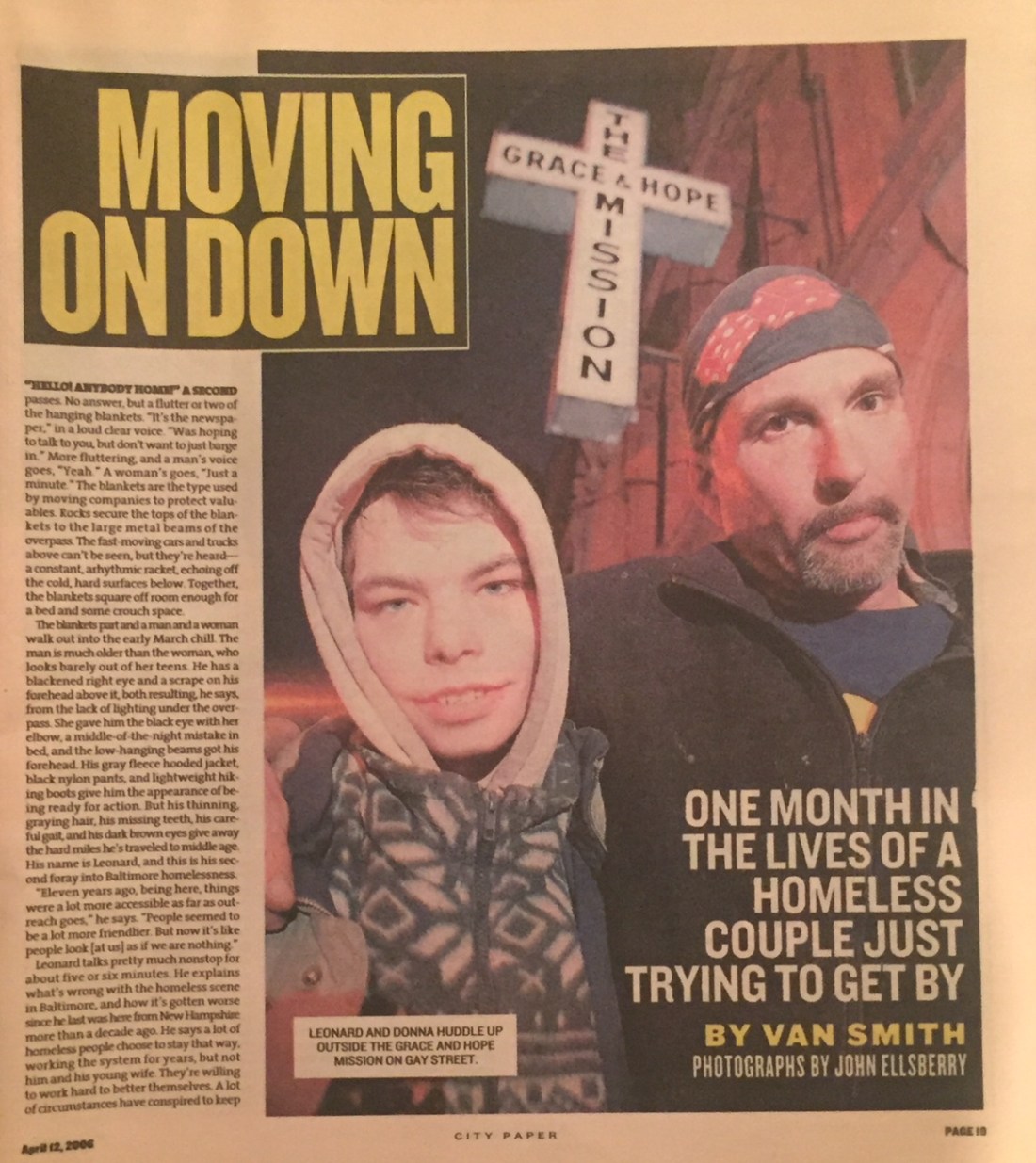
IMG_7323

When Donna gives birth, Leonard will become a father for the third time. He says his sons, aged 22 and 5, are back north with their respective mothers. The oldest is a part-time security guard, and Leonard wasn’t around as he grew up. He pines over the 5-year-old, but hasn’t been in touch with the child since leaving New Hampshire. Still, Leonard is rosy about his role in the boy’s future—especially if he wins the $10 million Publishers Clearing House sweepstakes he’s entered online.

“That’s a once in a lifetime dream right there,” Leonard enthuses. “That’d be cool. If I could put maybe $50,000, or even a million in there, you know, for his trust fund? The rest we could use to get a place, get our necessities.”

But Leonard isn’t sitting back waiting for pie in the sky. He’s willing to work hard for money, he says. When he talks about his work history, he describes prep-cooking and dishwashing at restaurants, working at pizza parlors, and a stint as a cab driver. He decries the difficulty of finding a job without a good education, which he lacks. He’s looked at the classifieds in Baltimore but acknowledges that he hasn’t really followed through on anything he thinks he could get.

Sitting in the small park just west of the Washington Monument, Leonard has a smoke and talks about his family. The stately mansions lining the park make for a picture about as pretty as his mood is dismal. He’s been morose all morning. On the walk from the restaurant, he complained of his various aches and pains, mentioned that maybe he should get his head examined, because he hasn’t felt the same since the attack. He muses about how he hasn’t treated his body well, how it is deteriorating, and how he’s paying the price for all his hard drinking. In the middle of this funk, he launches into his family history.

“I was the outcast of a small family,” he says quietly, intently. His mother died of bone cancer 15 years ago, and she was “a very pleasant woman, quiet, until you got her mad.” His father was a lout who beat them. He tells the story of the one time when his dad punched his mom and she actually fought back, bouncing a frying pan off his head. Leonard says he was next in line after his mom in the melee that followed. “I’m fucking small, I can’t do shit anyway,” he says. “I walk around the table, he starts chasing me with the goddamn knife. I’m like, whoa!

“Of course, being that age, how far can you run?” he laughs, with a shrug.

“He was a total abuser,” Leonard seethes, takes a drag, and coughs. “He’s the one that messed my life. He used to beat me up when I was 4, 5 years old. He’d be drunk off his ass, ram my head into the wall and shit. Oh, man, he tormented me hard. Looking at me, it’s like, why me? He never liked me, never liked me.

“My mom drank a lot, yeah, she did. And she used to get drunk, too, but she tried her best to put up with his shit. She used to have bruises all over her body. He used to cut her lip wide open, cut her head wide open and stuff. He was ruthless.”

Leonard sometimes refers to “stepbrothers,” who got some of the rough treatment he got, including being thrown down the stairs. But he stresses that they never got it as bad as he and his mom did.

Leonard brightens up when he speaks about his grandmother. “She was like a mom to me,” he remembers fondly. He recalls how she took custody of him when he was still a child, taking him out of his troubled home. She passed away late last August, of cancer and emphysema. She’d always been the only one to help him out in a jam. Not anymore.

IMG_7324

Over the weeks of conversations—many at the spot, others while walking somewhere or waiting in line for services—Donna has generally deferred to Leonard’s steady, staccato, sometimes slurred banter. She signals her agreement with the things he says by nodding, saying “yeah,” or telling a short, affirming anecdote that shores up whatever his point is at the time. Up until now, in the restaurant for breakfast, Leonard has been the chief press secretary for the couple. With a pair of haphazard new haircuts has come a new attitude. After she finishes eating, she refills her soda. Then Donna’s reticence suddenly falls away as she talks about her dad’s ex-girlfriend.

She says her father died in February 2005, leaving behind a 49-year-old girlfriend living on Social Security who smokes and has such serious emphysema that she’s tethered to an oxygen tank most of the time. “I hate to say it,” Donna declares with a resigned expression of resentment. “But now her and my brother are going out—living together. And, you know, her yelling, bitching, screaming, everything at me. Her even hitting me and stuff, pulling my hair, choking me. And she had the balls enough to be doing stuff with my brother while my dad was still alive!” Her brother, she adds, recently turned 21.

Her father’s girlfriend, Donna goes on, forced her to leave high school in 10th grade to do factory work, and generally has been a roadblock to her progress most every step of the way. While Donna says it’s the girlfriend’s fault that her schooling was cut short, she admits her grades were falling off.

Later, while walking up Park Avenue on the first day of spring, Donna talks about how her mother left the nest when she and her brother were children and gave up custody to her father.

“My mother went to court and she goes, ‘You can have them, I don’t want them. They’re a burden on me,’” Donna recounts bitterly. She pauses to light one of the half-smoked cigarette butts they collect and store in a Ziploc bag, then resumes, spitting out the story a mile a minute: “Last I heard, she moved to Alabama somewhere, and she didn’t even tell us—her ex-boyfriend’s the one who told us. Yeah, she’s my mom because I was born, but beyond that, I ain’t got no love for her.”

Leonard and Donna are inseparable. They hold hands while walking. When they’re sitting, he wraps an arm around her shoulders. When standing, hers goes around his waist. By all appearances, they’re soul mates. Before him, though, Donna says her boyfriends had failed her miserably. “This one particular one was an asshole,” she declares, then changes her mind. “You know? Actually all of my exes were.”

While living on her own away from her family, Donna has generally stayed at New Hampshire shelters, doing community service to keep her space. But that didn’t always go well. At one, she was kicked out after being accused of stealing $10, she says. She contends that the evidence was flimsy—the culprit was known to have used the money to buy Mountain Dew, she says, and she’s strictly a Pepsi drinker. She crashed at a series of friends’ apartments, and at times went home to be with her sick father. Eventually, she phoned her accuser, who helped manage the shelter. She says he acknowledged her innocence, because the real thief was later caught. But he never apologized, and she sees that as a powerful lesson about the arbitrary and capricious ways of so-called justice.

IMG_7325

Attempts to locate and contact Leonard and Donna’s family members failed, but other bits and pieces of information proved more accessible. Trying to track down any traces of Leonard’s past sojourn in Maryland led to records indicating that he was arrested in Worcester County on the Eastern Shore on May 28, 1992, as a fugitive from New Hampshire justice. Court papers show he pled guilty the next day, waived extradition, and on June 4 of that year was handed over to New Hampshire authorities.

The press coverage in his hometown paper at the time reported that Leonard had been picked up at the Cruising Café, a restaurant in Ocean City, and that he’d been wanted since 1990, when he failed to show up for a court appearance to enter a possible 10-year plea deal on charges that, on four occasions in 1988, he’d raped a child under the age of 4.

In 1992, after Leonard was tracked down and returned to New Hampshire to face the charges, the prosecutor declined to bring them because the alleged victim and her family had stopped cooperating. Instead, Leonard served one year in prison, and two on parole, for jumping bail. The accusation that he was a sex offender went away. No one can say that Leonard is a convicted child rapist.

When asked about this ordeal, Leonard speaks calmly and matter of factly as he denies the charges at length. “That was all my ex-girlfriend’s doing,” he says, asserting that he’s made Donna aware of this chapter in his past, and how it ended. The bruises on the child, he says, were not from him.

The detective on the New Hampshire case, James McLaughlin, a man with vast experience and broad respect in his field of sex-offender investigations, returns a phone message and immediately asks how Leonard’s doing, healthwise, and whether he’s in any kind of trouble. There is genuine concern in his voice.

“I remember him as a guy who had a really horrendous childhood,” McLaughlin says. “He was a parents-had-tied-him-up-in-a-basement kind of kid.”

After being told that Leonard is homeless with some hard miles on him but is otherwise fine, the detective contends that Leonard made a memorable videotaped confession before the ill-fated plea deal on the rape case. A short but shocking segment of the tape, the detective says, is used to train investigators, showing them an example of “distorted thinking” they may encounter when interviewing suspects.

Any lack of justice arising from the failed prosecution of Leonard “was rectified with him going to jail on the bail-jumping,” McLaughlin says. And, just to make sure, he checks to make sure there are no open warrants out on Leonard. There aren’t.

Leonard denies he confessed, and says he went on the lam to Maryland back then because he was scared of going to jail for something he didn’t do.

A record of the confession McLaughlin alleges Leonard made could not be made available by press time. A New Hampshire woman who said she is the alleged victim’s mother declined during a brief telephone conversation April 9 to say whether her daughter knows Leonard. “If she does,” the woman said curtly, “she’s not going to want to talk to you about it.”

The bottom line on all this, Leonard stresses, is that he’s “always been good with kids”—adding that that’s an important quality, since “I got one coming now.”
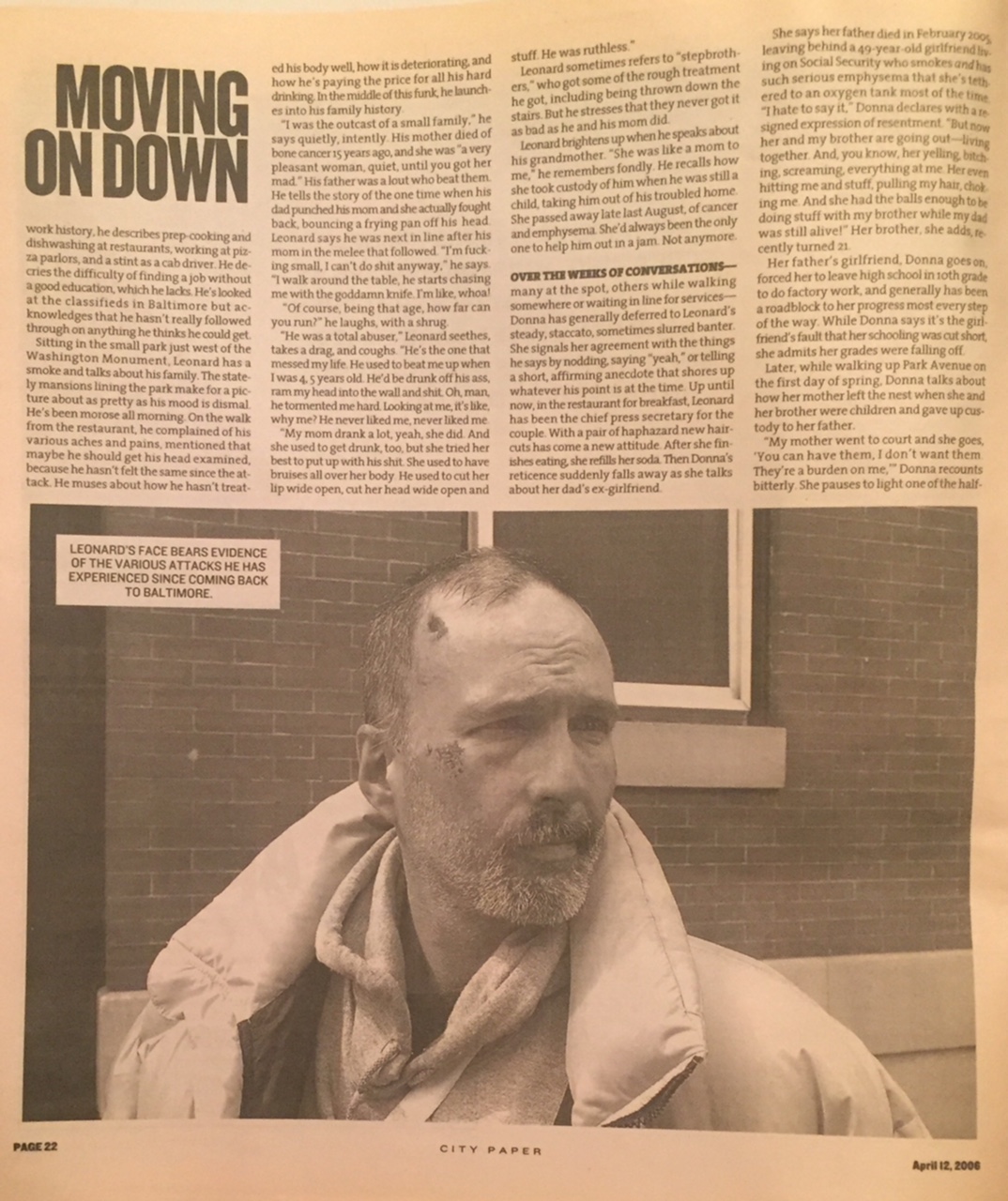
IMG_7326

Regardless of Leonard’s guilt or innocence—a matter already settled as far as the courts are concerned—he says he needs treatment for his childhood trauma. “All the turmoil I went through when I was that age I’ve carried up with me all these years,” he says. “It’s been like a bad scar of the mind, because when my temper goes off, it’s not just the temper of normally being mad. It’s just . . . I have flashbacks. I relive everything all over again. That’s what makes me 10 times worse. It’s not my fault. It’s just something that . . . I’ve dealt with some of it, but there’s a lot more I have to deal with.”

To illustrate, he tells a story, something that happened at the spot one night: “There was somebody under there, and actually I chased them off. I ripped my shirt right off, took my fucking stick right out there, said, ‘I’ll take your fucking head right off.’ And his other buddy started coming in, and I was like, ‘You don’t want to be doing that.’ Why? I swear, I hit him right in the fucking head with it. Got him on the ground, I started pushing his fucking head right in the ground. [Donna] had to pull me off him, too, ’cause I would’ve killed him. I just went off. I was actually starting to see a sense of red in my eyes. I was like, oh, no, no, we’re not going there. No, we can’t go there. If I’d’ve gone there, man, that guy’d’ve been dead. I’d have killed him. That, and something else, too.

“I know that in time, here, I’m going to have to deal with this, ’cause I’m going to need to get that out of my mind,” Leonard continues. “I can’t get it out of my mind, no, but at least learn to deal with it better. Because I do have a very, very vicious temper. And this one here [Donna], that’s why she’s unique, because nobody else has been able to deal with my temper the way she has been able to deal with it.

“She’s helped me out a lot. But I’ve also had to bring myself up a lot. And it hasn’t been easy. Still bringing myself up.”

Donna silently listens and nods throughout the soliloquy, nursing her cigarette. Now she says calmly and quietly, “Yep. We help each other now.”

IMG_7327

Donna looks away, silent, when it is suggested that she needs to see a doctor about her pregnancy. Leonard says they have visited Health Care for the Homeless, which does what it’s name says it does at 111 Park Ave., but Leonard and Donna are both pessimistic about approaching Baltimore’s social-services network. They talk about how they can’t find the help they need regularly—for her pregnancy, their hepatitis, his back pain, food stamps. That is part of what makes Baltimore seem so much different, and more difficult, to Leonard than it was previously.

The first social-services stumbling block for Leonard and Donna is their lack of identification. They don’t have state-issued IDs from New Hampshire or Maryland, or copies of their birth certificates and marriage license, all of which are useful in accessing proper social services. Getting these papers costs money, which they don’t have, except for the few dollars they occasionally come by. The only identification they have are MTA passes, library cards, and mail. That’s not going to cut it at a bank, where they hope to open accounts and save money, or at a leasing office, where they might want to put down some of that money on an apartment deposit.

There are public beds for homeless people in Baltimore, and Leonard and Donna could probably sleep in them, depending on how full the shelters get at night. But only a few, hard-to-find shelters here accommodate married people, so they’d have to split up at night, and they just won’t have that.

“Separated is not exactly the answer,” Leonard explains, as the two of them sit on their mattress-and-box spring set, which is set up on pallets inside their blanketed cubicle. A small door set up on a rickety chair serves as a table; a scavenged smoker-grill provides heat, but it makes a lot of smoke and they don’t use it much. There’s a single candle for light, sprouting out of plastic water bottle set inside an old coffee can. Their food, they’ve learned, is best stored up on the ledges of the overpass beam, to make it harder for the rats to get to it. “We’re a common bond and we should stay that way,” he adds.

“Especially with me being pregnant,” Donna chimes in. “That ain’t going to fly.”

Again, Leonard returns to his belief that life on the street in Baltimore has gotten harder. “You can’t get the necessities of health assistance that you used to be able to get,” he says. “They do need a lot of improvements. They ought to have more places around here to go eat that’s accessible, more bus-line accessibility. Shelters are overfilling. [The city Department of Social Services] ought to have more fundamental access to programs that help people that are on the streets to get off easier.”

To some extent, Health Care for the Homeless CEO Jeff Singer agrees with Leonard. Singer’s worked for the nonprofit since 1985 and now leads the organization; he’s sat on or chaired committees, task forces, and advisory boards on the homeless in Baltimore and statewide for decades. And despite a lot of ongoing lip service and growing funds to treat the symptoms of homelessness—temporary quarters, emergency food, limited access to health care—Singer says he’s seen nothing but a steady progression of policies that exacerbate poverty and the lack of affordable housing. Those two factors are the root causes of homelessness, he says, and they’ve gotten nothing but worse since 1980.

Indeed, Singer says he traces the tipping point back to President Jimmy Carter’s third budget in 1979, which put more money into foreign policy than domestic matters for the first time since World War II. Under subsequent presidents, up to and including George W. Bush, the federal government has made U.S. poverty less of a priority. At the same time, the gap between rich and poor in the United States has widened inexorably, median incomes have declined steadily, and there has been less and less investment in affordable housing. For example, Singer says, the tearing down of Baltimore’s high-rise projects in the 1990s resulted in 3,000 fewer units of affordable public housing in the city.

Federal policy-makers set the agenda on the homeless front, Singer explains, because nearly all the money for local homeless-services programs—as well as much of the money to fight poverty and provide affordable housing opportunities—comes from federal coffers. The city’s homeless budget has grown expansively over the last 20 years, from less than $500,000 in 1986 to an expected $27 million this year, but nearly all of that money is federal, with a small chunk coming from the state. But the funds go to stopgap measures, last-ditch efforts to help people already mired in trouble. The key, Singer says, is to set policy that will prevent people from landing on the streets, and that’s simply not happening.

Part of Leonard and Donna’s troubles accessing care, they believe, is how the system categorizes them when they approach it—married, with no documented disabilities, no drug addiction, no HIV. The system, it seems, is largely geared to help single disabled adults suffering from addictions and HIV/AIDS. But there’s a lot they don’t know about available services. By the end of March, while walking to the library and talking about the safety net again, Leonard is even willing to acknowledge, “There’s still a lot out there that we aren’t aware of.”

Singer is confident that Health Care for the Homeless can do something for Leonard and Donna. Speaking in his office on March 31, Singer acknowledges that married couples like Leonard and Donna have a harder time getting services. The system has shifted over the past two decades, he explains, from focusing on families to focusing primarily on the most populous segment of the homeless community—single adults. Nonetheless, Singer says, “we will get her pre-natal care, and we will assign a case manager to her who will help her find a place to live.” Donna’s marital status is a complication—most public-housing opportunities for indigents are for singles—but, Singer notes, “we work with couples all the time.”

“Homelessness is worse today than it has ever been,” Singer says. “The funding, if you factor in inflation, it’s a little bit more. But the context in which that funding is delivered has gotten worse and worse and worse, in terms of what they call the social safety net, or the support for public housing.” There are ever more people becoming homeless, he explains, as poverty grows and the number of cheap housing units, both public and private, declines. “But for any individual that we can get our hooks on, we’re here to help them. So if [they’re] willing, there’s a lot we could do.”

As for helping Leonard come to grips with the deep-seated legacy of childhood trauma, Singer says, “we have a whole mental health team that would be willing to work with him.”

IMG_7328

Leonard and Donna may be down on their luck, but they’re newlyweds in love, and fundamentally optimistic about their situation. And they recently found solid reason to be so: jobs, working together downtown, handing out free copies of the new daily newspaper in town, the Baltimore Examiner. It first hit the streets April 5, and Leonard and Donna were there, she in a company-issued cap and he in a company-issued vest, polite and beaming with confidence as papers flew out of their hands into the hands of rush-hour pedestrians. They’re looking at $1,600 per month between the two of them, before taxes: $10 an hour, four hours a day, five days a week. The fact that they have jobs might actually make it even harder to access some homeless services, but with money coming in that seems like less of a worry.

“Now we’re in business!” Donna exclaims. By banking half their paychecks, they figure they’ll be out from under the overpass and into their own apartment in two months. “That’d be nice,” remarks Leonard, back at the spot. “We’d be back on our feet, get a TV, get all of our necessities for the apartment, be able to escape here and be able to have our own privacy, and lock our door.”

If they can just keep it together until then, there’s a chance they’ll be housed when the baby comes. They haven’t spelled out plans for what happens if they can’t keep it together until then, other than that they’ll survive, as they have before. Their feeling is that it will all work out once they get some money and into housing, that their troubles are temporary. But their stories, both separately in the past, and together since they fell in love late last summer, are filled with unexpected twists and turns and complicating factors. Stability and predictability have been scarce for them.

Before dawn on April 10, Leonard and Donna are starting their fourth day of handing out Examiners. They’ll get their first paycheck later in the week, they say, and they look forward to being in a newspaper themselves. Their story, Leonard believes, is compelling enough for a whole book. “Maybe something like, Living Life as It Is,” he suggests as a title. “Yeah, that would be kinda cool.”
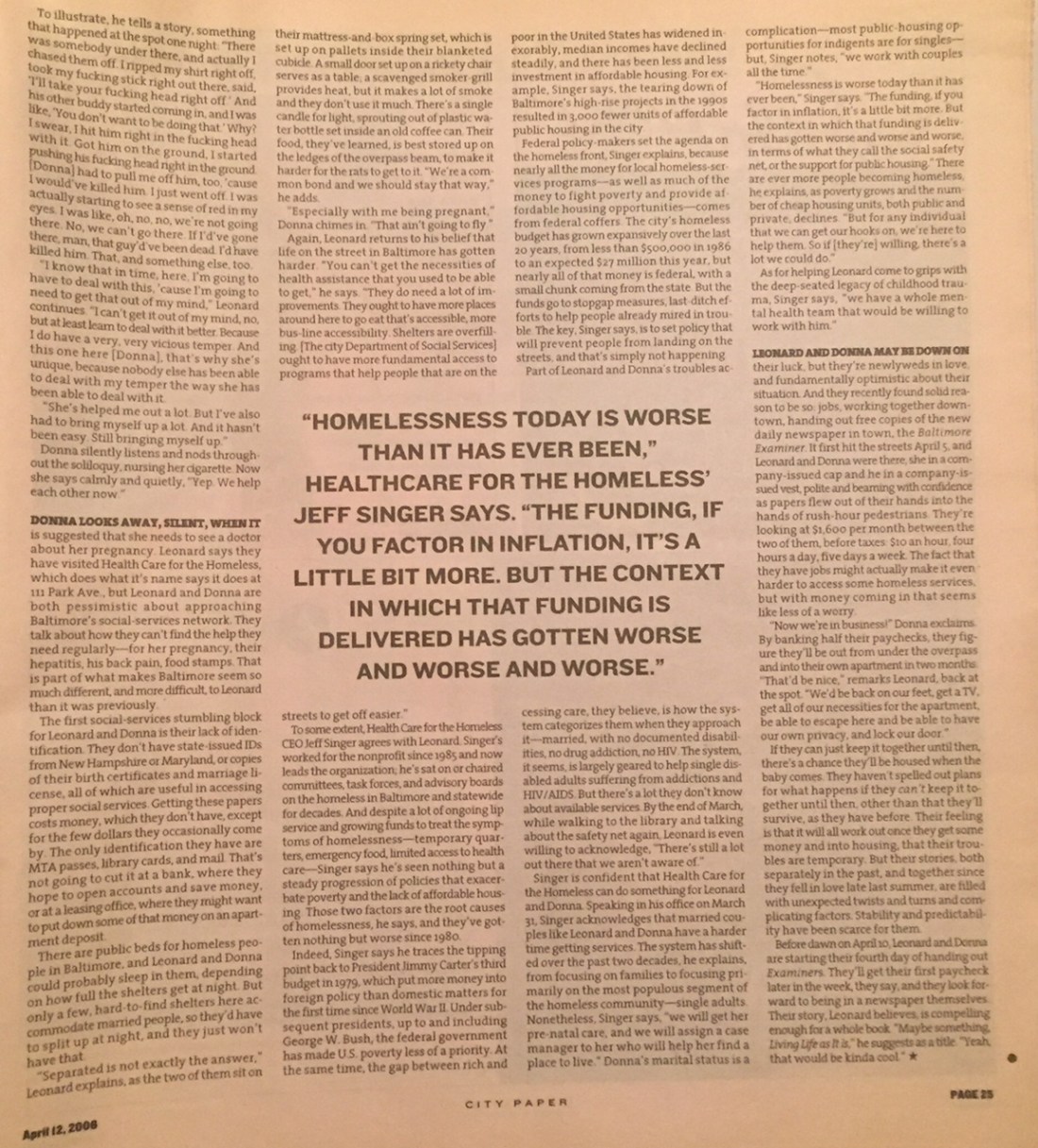
IMG_7329

Odd Man Out: Meet Spear Lancaster–Maryland’s Libertarian Candidate for Governor

By Van Smith

Published in City Paper, Oct. 23, 2002


For many months now, since long before the September primary elections, Maryland voters have been sizing up two candidates for governor: Republican Robert Ehrlich and Democrat Kathleen Kennedy Townsend. Few voters, though, are even aware that a third candidate’s name and party affiliation will be printed on November’s ballot: Spear Lancaster of the Libertarian Party. He was not included in the only televised gubernatorial debate; pollsters ignored him until mid-October, when they found he attracted 1 percent of voters; and a near absence of news coverage has relegated him to electoral obscurity.

Lancaster, though, harbors no resentment over the blackout. “I understand it,” he explains genially at a recent gathering of a couple dozen of the party faithful at Mike’s Crab House in Riva, near Annapolis. “I knew that coming out of the gate. From a pure business standpoint, I see why the media isn’t going to cover the guy who isn’t spending $15 million to get a $200,000 job.”

As of the last set of state campaign-finance reports filed in late August, Lancaster’s campaign had spent only $37,000–nearly two-thirds of it on a drive to gather the 27,000 valid signatures needed to meet the state’s stringent ballot-access requirements. “We just about ran through our money” to get on the ballot, he says, stretching the resources of his “hand-to-mouth organization” in the process. Still, Lancaster puts a positive spin on the effort: “A real camaraderie has been established,” he explains, which will help as the party grows in the future. And besides, he made history.

The last third-party candidate for Maryland’s governorship, Robert Woods Merkle of George Wallace’s segregationist American Party, ran in 1970 and received nearly 20,000 votes. His candidacy was so distasteful to the state’s political establishment that new laws were passed to make it harder for such candidates to make the ballot. The restrictions, though eased since, are still considered among the toughest in the nation. Third-party candidates in Maryland, once their party has gained state recognition by gathering 10,000 signatures of registered voters, must also collect the John Hancocks of at least 1 percent of the voters where they hope to run. According to Richard Winger, a Libertarian and publisher of the Ballot Access News newsletter, which covers such laws across the nation, two-thirds of states have less restrictive ballot-access laws than Maryland’s.

Today, about 6,300 Marylanders are registered as Libertarians–more than the three other state-recognized third parties (Green, Constitution, and Reform) combined–and 170 are dues-paying members. And Lancaster expects to attract many more voters to the Libertarian fold in the coming years, not just in Maryland but nationwide.

“We’ve become the center party,” he contends. “Believe it or not, we’ve become more of the old pragmatic, roll-up-your-sleeves-and-get-it-done party than the two major parties. And I think this is why we are going to start getting a lot of our pull, especially among young people. The young people, they are not about to go into the real radical right, and they are not too keen on going real radical left. I think they see our program as being pretty realistic and pretty functional.”

Lancaster’s claim that his party is a get-it-done outfit is belied by a glaring fact–the Libertarian Party has precious little experience in governance. Only one Libertarian currently holds elective office in Maryland–Joseph Harrington, a longtime city council member in Brunswick, a town of 5,000 in Frederick County. Three others hold appointed positions on various local boards and commissions. Nationwide, Libertarians have been elected state representatives and small-town mayors, but higher offices have been elusive. What they do best, so far, is sell their ideas by running for office. And for Lancaster–who at 69 is retired from a long career in sales–selling ideas is second nature. All he needs is an audience, be it of one or a thousand, and he’s more than happy to explain the party line.

Over chili and beer at Fuddrucker’s in Baltimore’s Inner Harbor, Spear Lancaster and his running mate, Lorenzo Gaztanaga, hold forth about libertarianism. The party’s bottom line, they explain, is right there in the Declaration of Independence: equal rights to life, liberty, the pursuit of happiness, and self-determination over governance. And these rights, Lancaster explains, must be protected for every individual. “That’s the key,” he explains. “You can’t protect selectively. You have to protect everybody–all the time, every time, no exceptions. The weak, the people you even detest, the people whose lifestyle you wouldn’t engage in for a million bucks–you have to protect their rights. This is the thing that the Founding Fathers signed onto. It is not what either of the major parties sign onto today. They have selective rights.”

Picking up on Lancaster’s train of thought, Gaztanaga declares, “They selectively apply which rights are important to them, and then they try to promote bills and laws and regulations selectively based on those rights they like.

“A real government would actually make it its business to apply equality under the law, number one, and number two, to protect individuals from the abuses of other individuals,” Gaztanaga says. “That’s the true role of government, that’s what it is supposed to do–and can do very well, if it sticks to it. The problem with government today is that it steps into arenas that it is not equipped for and becomes intrusive, restricting freedom and reducing personal responsibility.”

Libertarians, Lancaster explains, take the best ideas of both major parties and combine them under the overarching rubric of liberty.

“Most Republicans,” he says, “agree with us on the importance of maintaining free markets, but they just don’t think people’s personal rights are all that important. The Democrats, just the opposite. They are all for personal rights, but they don’t think people should have as much liberty in economic areas. We want economic liberty and personal liberty, both, and the responsibilities that go with them.”

The libertarian philosophy of individual liberty and personal responsibility, Gaztanaga explains, leads many people to think that libertarianism “means you can do whatever you want to do. And I stop them right there and say, yeah, as long as you are not hurting anybody else. You have to have ethics. If you hurt anybody else, the game’s up.” An axiom of this moral guidepost, Lancaster continues, is never to initiate violence in any form.

Maryland’s Libertarian Party was formed in 1972, shortly after the national party’s founding in 1971, says longtime party member Dean Ahmad, an astronomer and expert on Islam from the Washington suburbs. In 1980 the party first achieved official recognition by the state, and “a Libertarian presidential candidate has been on the Maryland ballot in every election since,” Ahmad explains. Due to Maryland’s restrictive ballot-access laws, the party has often resorted to the courts–with mixed success–in order to win places on ballots. Other than Brunswick City Councilman Harrington, only one other Libertarian has ever won elective office in Maryland: Steve Ziegler, who earned a seat on the Charles County school board in 1996 and served one four-year term, Ahmad recalls.

Applying libertarianism to some of the big issues of the current campaign season leads to some interesting platform planks. Income tax? Get rid of it. The war on drugs? It’s a failure, so end prohibition and stop unfairly criminalizing a large segment of society. Social Security? Privatize it. Homosexuality? Keep the government out of people’s sex lives. Abortion? It’s up to the individual. Guns? Citizens have a right to keep and bear arms.

“When we get into the gun issue,” Lancaster says of his stump speech, “I ask everybody in the audience, do you have the right to life, liberty, and the pursuit of happiness? ‘Yeah,’ they say. Then I say, ‘Well, then you have the right to defend them any way you can.'”

On taxes, Lancaster believes a national sales tax should replace income tax–the more you spend, the more taxes you pay, and no income tax would mean no Internal Revenue Service and no cumbersome tax law full of loopholes for the rich. On illegal drugs, Lancaster believes drug criminalization is what makes them so profitable and so prone to violence; legalize drugs, he says, and “you take the money out of it. If you don’t take the money out of it, you’re not going to have a choice to stop” the violence.

If he should win the governorship, Lancaster says he’ll immediately convene a panel of experts from nationally recognized think tanks, who would form an “efficiency committee” to assess and make recommendations for reducing “the size and redundancy” of state government. In working to get his bureaucracy-shrinking agenda through the Democrat-and-Republican-dominated legislature, Lancaster says he would use the governor’s considerable budgetary powers to persuade oppositionist legislators to back policy measures he supports.

Lancaster sees many, many faults with the way government approaches problems today, but he remains optimistic because he believes politics is opening up to new ideas.

“We need choices, and I’m working with the Greens, the Reforms, and anybody else to make sure that happens here in Maryland,” he says. “The major parties seem to think the public is too dumb, that we just have to walk them through it. But you need choices. And the way they do it here in Maryland, getting permission to get on the ballot once you’ve jumped through all these hoops, we don’t have many. I am free when I don’t have to get anybody’s permission.”

Spear Lancaster’s life story helps explain his do-it-yourself attitude. The grandson of a Maryland state senator, he was born on a small tobacco farm during the Great Depression in Leonardtown, St. Mary’s County; attended a one-room schoolhouse in Rock Point; and survived a typhoid epidemic that struck his community when he was 6 years old. After high school in La Plata, he attended the University of Maryland, started a small construction business with some colleagues, and met and married his wife, Doris (who’s affectionately known as “Dee”). He then embarked on a career in sales, working from 1961 to 1993 for Rubbermaid Corp. Since 1966, he and Doris have lived in Crownsville, near Annapolis, where they raised two sons in a house he built himself. In 1990 he started his own company, 4 Seasons Flooring, which he ran until 2000. All the while, he’s been a voracious reader, soaking up ideas–particularly on politics.

For most of his life, Lancaster was a Democrat–“a Harry Truman Democrat,” he likes to say–and even dabbled in far-left thought. “I stayed a Democrat so long because of the women’s-rights and civil-rights movements, and the fact that they claimed to be helping the poor people,” he says. “And for a while, I think they did.”

Eventually, in the late 1980s, he grew disillusioned with the failure of Democratic policies and switched to the Republican Party. This was a temporary home. In the mid-1990s he found the Libertarian Party and studied its ideas. “I said to Dee, ‘You know, I’ve been a libertarian all my life,'” he recalls. He officially joined the Libertarian Party in 1996 and has actively participated in the party organization ever since.

Libertarians, he explains, are “very tolerant” of diverse ideas and lifestyles–a quality he cherishes, since “I’ve always been suspicious of sanctimonious, self-righteous people.” As a man who likes his fun, he says, “I actually like to think of myself as a Jeffersonian-Jackson libertarian.” Thomas Jefferson, as the author of the Declaration of Independence, is a libertarian icon, but Andrew Jackson’s appeal to Lancaster lies in his wild ways. For instance, Lancaster says that, if elected, he plans to rent out the Governor’s Mansion on the weekends for parties and weddings: “Dee says, ‘Well, you can’t mess the place up.’ I say, ‘The hell I can’t. Hell, old Jackson had the crowd come in the White House. They stood on the furniture and drank whiskey and had a good time.”

Like Lancaster, Gaztanaga is also a self-made man. Born in Havana in 1949, he arrived in Miami as a 12-year-old, and by the time he was 14 he was sweeping floors and working as a gofer for the Jesuit Seminary Guild in Baltimore. Public schools in Cuba were followed by parochial schools in the States. He graduated from Cardinal Gibbons High School and has studied history and psychology at various Baltimore-area colleges. He and his wife of 27 years, Susan Gaztanaga, spent five years teaching English and Spanish in Haiti until 1984, and are very active in their church, Cliftmont Wesleyan Church in Belair-Edison. He’s had many jobs over the years and is currently a security officer at a building near Baltimore/Washington International Airport.

Also like Lancaster, Gaztanaga came to libertarianism from the left-wing side of the political spectrum–drawing from his family’s tradition in Cuba of being social democrats. When he first registered in Maryland, he was Democrat, then became an independent, and finally spent a few years as a Republican before joining the Libertarian fold in 1992, quickly rising through the ranks to become state chair later that year. In 1995, he tried to get on the ballot for the Baltimore City Council’s Third District race but fell short of the signature requirement–at that time, he needed signatures from 3 percent of the district’s voters. In 1999, he successfully made it onto the ballot and garnered 9 percent of the vote (almost 1,500 votes).

“I’m an idealistic pragmatist,” Gaztanaga proclaims. “I know that sounds like an oxymoron, but I’m very strong in my ideals. I understand that I cannot have it now, and that I have to find ways to get there, that I have to always try to persuade people and be willing to be proven wrong when I’m wrong.

“I’d like to serve in office one day. I really would. And it might happen. And then I can really see if all the stuff I’ve been talking about is really good or not.”

And at that, Gaztanaga puts forth a hearty laugh.

The Libertarian Party in Maryland is a big tent, which welcomes both youthful leftists who question authority and aging conservatives disillusioned with the Republican Party. While politically minded people in the midst of their careers who are interested in working within mainstream thought tend toward the major parties, pre- and post-career folks seem more willing to entertain third-party politics and ideas.

“Yep, yep,” confirms Lancaster when presented with these thoughts. “Absolutely right.”

Colin Boxall, a 30-year-old Curtis Bay resident who works as a systems administrator for the Associated Jewish Community Federation of Baltimore, became a Libertarian after voting as a Republican in the 1992 presidential election. Dissatisfied with the major parties, he “went shopping” for alternatives by doing research at the local public library until he “found the one that more or less matched my political ideas.”

In libertarianism, Boxall found comfort in an ideology that has as its “fundamental idea that people have a right to run their own lives,” a tenet that he says is “not well-expressed or defended by the major parties.” Still, Boxall notes, “there are certainly things I disagree with–some of their economic ideals. There is too much trust in laissez-faire capitalism–some libertarians just don’t understand how ruthless corporations, particularly large corporations, can be.”

After growing up in Catonsville, Boxall got married and moved first to Brooklyn, then to nearby Curtis Bay. “We were looking to move to the city, because we have an alternative lifestyle [an unorthodox marriage, the particulars of which he prefers to keep private],” he explains. “We are not members of the ‘Big Three’ religions, and we did not want to live where these things would be held against us. In Brooklyn and Curtis Bay, there are enough problems that, if you’re not causing problems, people will let you live your own life.”

Boxall’s excitement about Lancaster’s candidacy is palpable. “Spear is a particularly good candidate for the Libertarian Party to put forward. The fact that he was a Democrat for most of his life means that he has values that Maryland Democrats can identify with,” he says. “And he sells the concept of libertarianism very well.” Having a former Republican as a candidate, he says, would “frighten off” the 18- to 25-year-old demographic–a group that Boxall wants “to pull into the party because it has the energy necessary to push a third party forward.”

Ruth Andrasco, a 65-year-old medical receptionist from Bowie, was registered as an independent voter until finding the Libertarian Party several years ago.

“I’m very tired of the one-party system in this state,” she explains. “I don’t feel I belong. And things are not being fixed, but more and more money is being spent to fix them.”

In the early 1990s, when Newt Gingrich was on the rise in Washington, she thought there was hope, “but then he pooped out. And the Republican Party didn’t do what they said they would do. They act like Democrats, supporting farm subsidies and steel tariffs.” She wants “less government, less taxes,” and believes the government should sell off its land to pay down its debt.

Lancaster’s candidacy is “a long shot, but it gives me hope,” Andrasco admits. “He’s a very smart man, and very optimistic.”

She first met him when Gaztanaga was running for Baltimore City Council in 1999, and “he was very friendly and made me feel at home in the party, because it is mostly men. I’m very glad that we have someone like him to fill the candidacy. But it is very hard for him to get publicity. All we basically want is for people to know that there is an option, that you don’t have to vote for the major-party candidates if you don’t like them.”

Rock guitarist Chris Couture, 33, gave $100 to the Lancaster campaign, making him one of the Baltimore area’s biggest contributors. He has since moved away and now lives in New Hampshire, but Couture spent seven years living in Mount Vernon, Reservoir Hill, and Charles Village while performing in bands that played such venues as the 8 x 10 Club, Fletcher’s, and the Hard Rock Café. He got involved with the Libertarian Party of Maryland in the mid-1990s and strongly supported Gaztanaga’s 1999 City Council bid.

Before hooking up with the Libertarians, Couture says he “usually voted Democratic,” but came to believe the major parties were “actually two sides of the same coin” and wanted an alternative. The Libertarian Party, he says, “as a whole mimics my ideals–it is the best party to represent people who have an individualistic ideal. Libertarians respect people.”

Bill Buzzell of Dundalk joined the Libertarian Party in the early 1980s, after retiring from the Air Force. Previously, the 62-year-old Buzzell had been a Republican. Then his sister-in-law introduced him to the writings of Ayn Rand, whose views served as his “entrance point into libertarianism.” The problem with Republicans, he says, is that “they don’t vote the way they talk–as strict constitutionalists.”

In 1994, he worked on Ehrlich’s successful bid for Congress but quickly grew disheartened with him. “Once in office, he seemed to work at getting the government larger and more intrusive, so I never worked on another” Ehrlich campaign, he says.

Buzzell is excited about the Lancaster’s candidacy but is concerned that “we can’t get the word out.” He believes Lancaster can appeal to “both sides of the spectrum,” politically, and take advantage of what Buzzell views as the electorate’s innate libertarianism. “About a quarter of people are libertarian,” he says, “but they don’t know it.”

One of Lancaster’s biggest beefs with the prevailing body politic is what he likes to call its tendency to create “unintended consequences.”

“Politicians talk about doing stuff–they don’t have a clue about what the hell they’re doing,” he says. “They pass laws without any idea what it will cost or who it will cost. They create unrealistic expectations, and the quickest way to fail is to have unrealistic expectations. The politicians want to promise you miracles and talk wonders. And they’ve got to know that they are talking gibberish.”

Lancaster, though, is not prone to such “hogwash,” he says. He doesn’t expect to win the upcoming election and he isn’t holding out libertarianism as the answer to all the world’s problems. He just wants a diversity of views to inform the political debate–be it his, those of other libertarians who don’t share his opinions, or those of other third parties who similarly are shunned by the system. Infusing new voices into politics, Lancaster believes, will help reinvigorate the public’s interest in politics in an era of manifest apathy.

“A third of the voting-age public doesn’t register, and more than half of those who do don’t vote–and that’s in a good year,” he says. He is also quick to point out that more and more Maryland voters opt not to register with the major parties–from 7.8 percent in 1984, to 9.5 percent in 1994, to 13.7 percent in 2001–which indicates to him growing disillusionment with politics as usual. Thus, Lancaster offers himself as an alternative–the first one Maryland voters have been offered in a governor’s race in 32 years. Come election day, we’ll see if anybody’s buying it.

Grave Accusations: Dead Prosecutor Luna Dubbed Bondsman Tillman Jr. a “Violent Drug Dealer”

By Van Smith

Published in City Paper, Apr. 23, 2008

In May 2002, federal prosecutor Jonathan Paul Luna stood up in a Baltimore courtroom and called bail-bondsman Milton Tillman Jr. a “violent drug dealer,” even though Tillman Jr. hadn’t–and still hasn’t–been convicted of violent, drug-related crimes. Luna was not yet famous; that would come after his violent death in a rural Pennsylvania stream, in December 2003. But Tillman Jr. was and is famous, at least locally, a fact that was part of Luna’s point: In gangland Baltimore, he argued, Tillman Jr.’s role as the patriarch of a drug-dealing family strikes fear in the hearts of other gangsters.

The case at hand was against Eric Lamont Bennett’s drug organization, which had operated in the late 1990s in Baltimore and Westminster, and the crimes Luna was prosecuting included the East Baltimore shooting, in 2000, of Tillman Jr.’s son, Milton Tillman III, nicknamed “Mo.” The violence erupted over a drug deal gone bad, and though Mo survived, two other men were murdered before the night was out.

By May 2002, Luna had won convictions against men held responsible for these and other crimes, including Bennett, Solomon Jones, and Tavon Bradley. The three have since won appeals and Jones and Bradley been reconvicted and resentenced. Bennett was scheduled to be resentenced on April 18, but the hearing was postponed and has not yet been rescheduled.

The three convicts had been part of a team of drug dealers who had sold Mo and two other buyers a bag of baking soda for $3,000 on Jan. 18, 2000. Before Mo and his friends could learn they’d been burned, Bennett’s gang went gunning for them. Luna asserted that, having robbed Tillman Jr.’s son, they figured they were as good as dead unless they struck first.

Luna based his comments on the trial testimony of Damien Simmons, the man who shot Mo three times in the back and became a cooperating witness against Bennett and the others, and on a U.S. Drug Enforcement Administration memo. That document, dated March 2000, called Tillman Jr. the head of a crime family with a 20-year history in the East Baltimore heroin trade and warned that the then-imprisoned Tillman Jr. appeared to be conspiring to hit back at Bennett and his crew.

The portrait of Tillman Jr. painted by Luna at Bennett’s first sentencing hearing complicates Tillman Jr.’s public persona, which has been forged by years of press coverage. News consumers would think Tillman Jr. is simply a politically connected bail-bondsman, real-estate investor, and nightclub impresario with convictions in the 1990s for attempted bribery and tax evasion. Luna’s statements about Tillman Jr., which have not been disclosed in news reports until now, get at the Tillman family’s street-level reputation as a force to be reckoned with in Baltimore’s drug-fueled shadow economy.

Luna’s focus on Tillman Jr. does not discount the alleged criminal career of at least one other family member: Stanford Stansbury. After Tillman III was shot in 2000 and thought he might die from his injuries, court records show, he told detectives that his cousin Stanford Stansbury would know the last name of “Ericky,” the man Tillman III believed to be responsible for the shooting. Last March, Stansbury and two other men, Harry Burton and Allen Gill, were federally indicted for running a murderous, decade-long drug conspiracy based at the Latrobe Homes housing project in East Baltimore. Today, Stansbury has secured a guilty-plea agreement in which he is a cooperating witness against Burton and Gill, whom prosecutors are seeking to give the death penalty in a trial scheduled for June.

Stansbury’s lawyer, Stuart O. Simms, a former Baltimore City state’s attorney and former secretary of the Maryland Department of Public Safety and Correctional Services, did not return a call for comment. Simms, as city state’s attorney in the 1980s, oversaw probes into Tillman Jr.’s suspected criminal activities. In 2006, New Trend Development, Tillman Jr.’s main real-estate company, contributed money to Simms’ failed run for Maryland attorney general.

The Tillman family’s business dealings drew public attention during a trial last year in which a jury determined that Tillman Jr., his son, and the other defendant, Bernard Dixon, did not intend to post multiple bails on properties in order to spring high-bail defendants out of lockup, as state criminal charges had contended. Since March, City Paper has published five articles in which Tillman Jr. was part of the story. Two were about a fugitive drug trafficker (“Flight Connections,” Mobtown Beat, March 12; “One Angry Man,” Mobtown Beat, March 26); one was about a felonious, bounty-hunting minister (“Preacher, Teacher, Forger, Spy,” Feature, April 16); another covered the Baltimore City Board of Liquor License Commissioners’ scant control over criminals influencing the city’s bar business (“Creative Licensing,” Mobtown Beat, April 9); and one second-guessed the deaconlike image of a former heroin trafficker (“Redemption Song and Dance,” Mobtown Beat, March 19).

Tillman Jr.’s success in bail bonds and real estate appears to have soared since his release from prison in 2000. His Four Aces Bail Bonds has rapidly put a large dent in the dominance of the Baltimore City bail-bonds market traditionally enjoyed by Fred W. Frank Bail Bonds. “There is no question he has affected our business,” company President Barry Udoff confirms. New Trend Development, related businesses, and Tillman Jr. associates have acquired nearly $10 million in Baltimore-area real-estate holdings since 2000, according to property records. Meanwhile, Tillman Jr.’s political clout has also grown, as measured by the thousands of dollars in donations from Four Aces and New Trend to local politicians since his release from prison.

Luna’s career was cut short by his death in Pennsylvania in early December 2003. His body was found before dawn, drowned in a stream in Lancaster County, midway between Philadelphia and Harrisburg along the Pennsylvania Turnpike. He’d been stabbed dozens of times, though not deeply, and his car sat idling close by. He had last been seen late the night before at his downtown Baltimore office. The local authorities deemed it a homicide, while the FBI leaked information to the press suggesting it was suicide, but the case remains unsolved. A book has been written about it, The Midnight Ride of Jonathan Luna (“Plot Device,” Books, Feb. 23, 2005), and U.S. Sen. Arlen Specter, a Pennsylvania Republican, continues to press for progress in getting it solved.

The Bennett prosecution was but a piece of Luna’s caseload against violent drug dealers, and it was over a year and a half before Luna died. There is nothing to suggest that the mysteries surrounding Luna’s death are in any way tied to Tillman Jr. or members of his family.

Luna’s insights into the Tillmans in the Bennett case gives the public an evidentiary record that the family was in the drug game. “Let me speak very frankly,” Luna said, according to the court transcript. “It is not news to most people in this courtroom that Mr. Tillman is the son of one of the most notorious drug dealers in Baltimore City history. That is a fact.” Luna also said that “there is no question that Mr. Tillman’s father is a reputed drug dealer, a violent type of guy.”

Underscoring Luna’s contention was a March 2000 DEA memo stating that the agency’s “investigation into the Tillman family has revealed that the family has been active for the past 20 years in the Baltimore, East-side based, heroin traffic. Milton Tillman, Jr., the patriarch, is currently in the last six months of a Federal prison sentence in Butner, North Carolina for tax evasion. Phone conversations made by Tillman, Jr., from . . . Butner to his son and associates indicate that a retaliatory strike against the Bennett organization is imminent.”

The Bennett trial testimony of Damien Simmons, the man who shot Tillman III, also supported Luna’s statements that Tillman Jr. was known as a feared, high-level player in the drug game. The trial transcript shows that Simmons answered “Yes,” when asked if Bennett told him to shoot Tillman III and his associates because of whom Tillman III’s father is. Simmons pleaded guilty to his part in the Bennett organization’s crimes and is scheduled for release from federal prison in 2017.

“Jon Luna wasn’t just relying on the DEA memo when he said these things about Tillman Jr.,” recalls defense attorney Harvey Greenberg, who represented Jones in the Bennett case. “He also had Simmons’ testimony. Luna was trying to be frank about the background of the shooting and what prompted it. He was being open and honest, and telling what he knew to be true with evidence to back it up.”

Tillman Jr. did not respond to detailed messages left at his office and with his attorney, Greg Dorsey. U.S. Attorney’s Office spokeswoman Marcia Murphy says her agency would not comment about Luna’s statements regarding Tillman Jr., and also would not respond to questions involving the Bennett or Stansbury cases, because “we don’t discuss our charging decisions or prosecution strategy.”

Some of the politicians who have received campaign support from Tillman Jr.’s companies, however, did respond to City Paper‘s inquiries. “I did?!” Baltimore County Circuit Court Associate Judge Mickey Norman exclaims, when told his judicial campaign committee in 2005 got money from one of Tillman Jr.’s companies. “I honestly don’t know about that,” Norman says, explaining that judges’ campaigns are set up so the judges themselves are insulated from the fundraising process and have little, if any, knowledge of who’s supporting their candidacies.

“Did I?” Baltimore City Deputy Mayor and former state delegate Salima Siler Marriott asks when told about Tillman Jr.’s donation to her campaign. She says she doesn’t know the man, either by name or personally. Messages left with nine other politicians–eight of them Democrats, including Baltimore County Executive Jim Smith; House of Delegates Majority Whip Talmadge Branch (45th District); Maryland Comptroller Peter Franchot; former Republican Gov. Robert Ehrlich; and Sen. Nathaniel McFadden (45th District), the chairman of the Baltimore City state Senate delegation–were not returned by press time.

Greenberg, however, is intrigued by City Paper‘s inquiries, suggesting that what Luna had to say about Tillman Jr. is already widely recognized among lawyers, law enforcers, and others familiar with the local crime scene. “Do you find Luna’s comments remarkable?” he asks. “Because I don’t.”

Additional reporting by Jeffrey Anderson And Chris Landers