


Author: Van Smith
If These Boots Could Talk
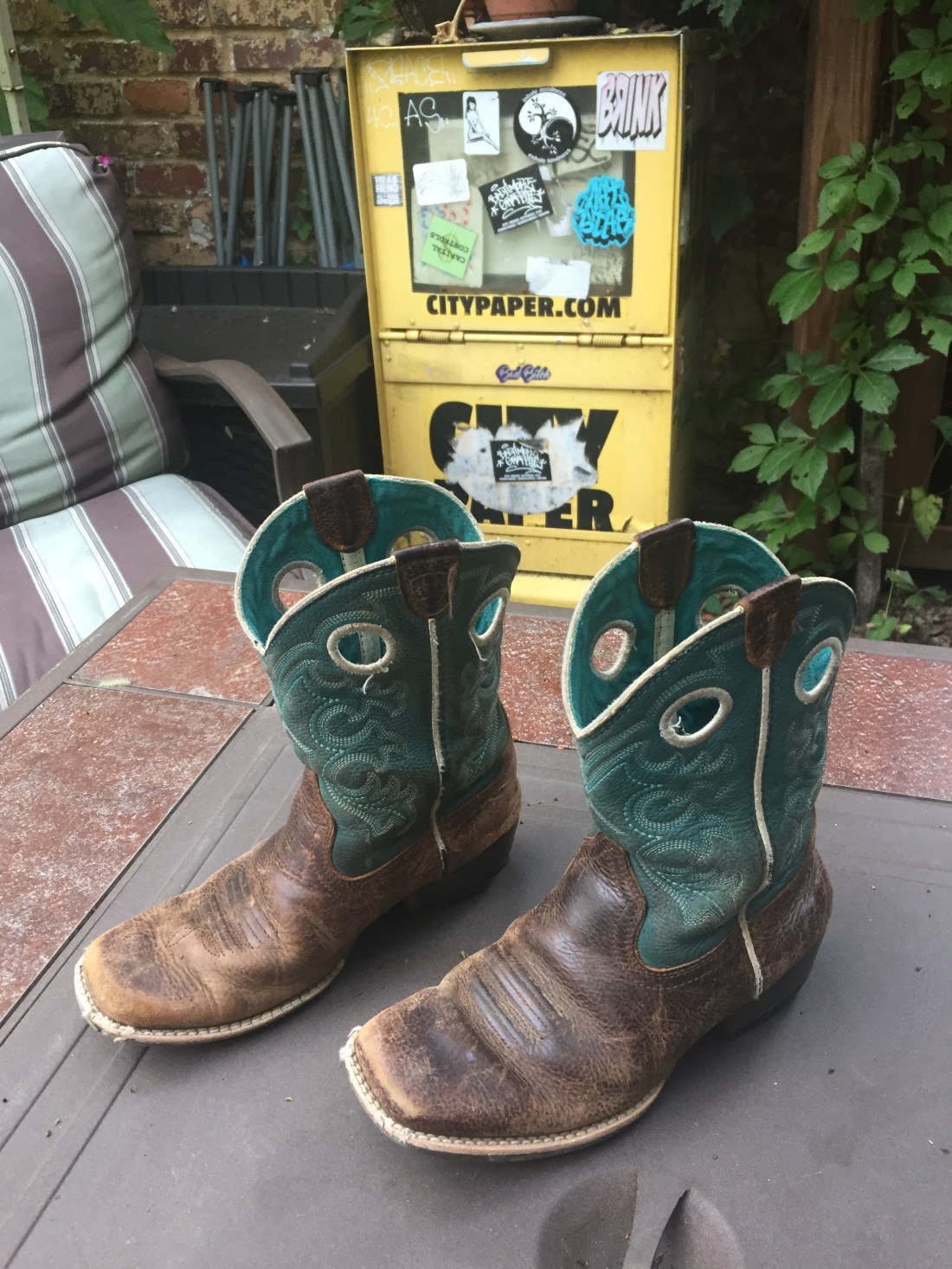
Thanks for the memories, Carol’s Western Wear.
The 7yo Channels Shel Silverstein
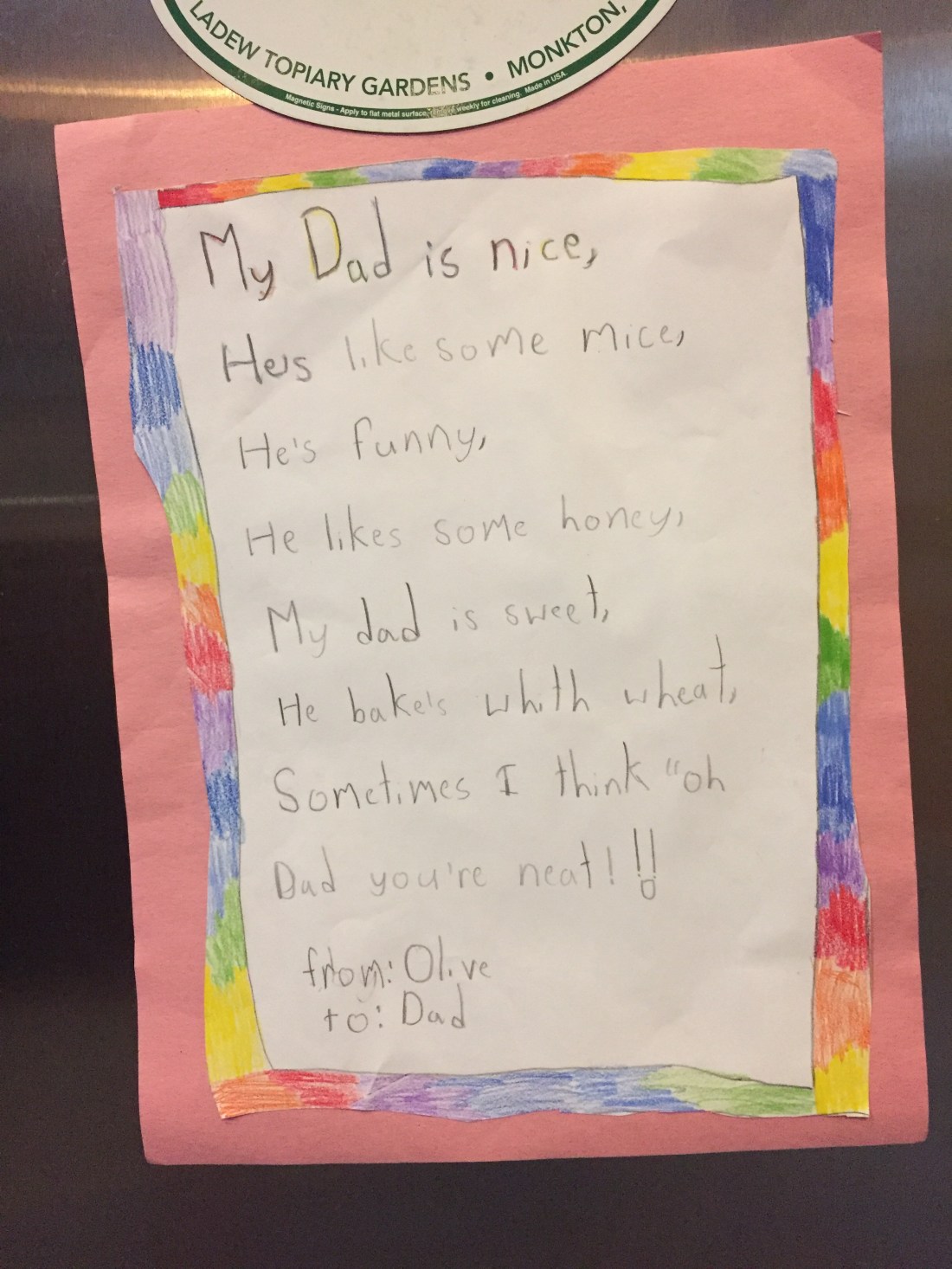
My dad is nice,
He’s like some mice,
He’s funny,
He likes some honey,
My dad is sweet,
He bakes with wheat,
Sometimes I think “Oh Dad you’re neat!”
Premium Swag

From 1995 Curtis Bay plant tour. After all that offal, I couldn’t resist the offering – the only time I took the soup on a story.
Gathering Dust

Found in the garage, at the bottom of a wicker drawer under a collection of odds and ends.
Good Morning, Manomet!
Old City Jewish Arts Center, Philly

On Mother’s Day, we’re here checking out Tremain Smith’s show, “The Art of Grief and What Follows,” which was created over the three years since our mother died. Much of the work and writing was not made for public viewing, but instead was created in the course of Tremain’s process of contending with the loss of Mom, which ultimately included joy. The collection became a show because OCJAC wanted it to be, after its rabbi connected with Tremain.
Fat Frogs Frolicking
Porno for Politicos: Adult-industry donors are well represented in campaign coffers
By Van Smith
Published in City Paper, Oct. 12, 2005
When state prosecutor Robert Rohrbaugh announced Oct. 5th that a Baltimore strip club had been fined for exceeding the maximum allowable donations to political campaigns, recipients of the contributions ran for cover. Jonathan Epstein, spokesman for Baltimore mayor and gubernatorial candidate Martin O’Malley, announced that the tainted contributions would be refunded, as did Gov. Robert Ehrlich’s campaign-finance director, John Reith.
“We have a policy not to accept these checks, but as a practical matter sometimes they slip through,” Epstein was quoted as saying in The Sun on Oct. 6. “In the future,” Reith announced in the same article, “we would not accept contributions from organizations like this.”
In fact, City Paper has found that political contributions from adult-entertainment interests are ubiquitous in the Baltimore area, found in more than 50 state and federal campaign committees. More than 225 donations from interests associated with Baltimore’s adult-entertainment industry found their way into state campaign committees between 1999 and 2004, for a total of nearly $110,000, according to campaign-finance records. On the federal level, nearly two dozen donations totaling close to $20,000 were given to Maryland political campaigns between 1998 and 2005. Those numbers include contributions from interests on the Block, Baltimore’s strip-club district near City Hall, as well as from other strip clubs and pornography interests. It also includes contributions from lawyers and accountants for the adult-entertainment industry, as well as from real-estate interests involved in the sex business.
City Paper’s study of donations from adult-entertainment interests included only those parties that could be connected readily to the industry in the Baltimore area. Actual totals, if the whole universe of donors could be ascertained, are likely much higher. Democrats were the overwhelming favorites of adult-entertainment contributors, perhaps due to the advantage Democrats have among elected officials in the Baltimore region.
While adult entertainment may be judged by some as inconsistent with mainstream political values, it is part of lawful, regulated commerce, and its practitioners enjoy the same rights of free speech as everyone else—including political expression in the form of campaign donations. Nonetheless, as the reactions by the O’Malley and Ehrlich camps make clear, the taint of money made from sex is strong enough for some politicians to want to steer clear. Still, thousands of sex-trade dollars have entered the campaign coffers of Baltimore-area politicians—perhaps because the campaigns didn’t know where the money was coming from, or perhaps because where the money was coming from wasn’t all that important as long as the public didn’t know about it.
Epstein says that the O’Malley campaign is trying hard to keep sex-industry money out of its accounts. “We’re continually updating our vetting system of campaign contributions, utilizing media, government, and other sources available to the public,” he says. “We are as thorough as possible, examining all the contributions we receive. However, as with any political vetting system, there can never be a foolproof way to catch everything.”
Indeed, neither the O’Malley campaign nor the campaigns of dozens of other Baltimore-area politicians have been able to keep away from adult-entertainment money. An illustrative case study involves two of Baltimore’s most prodigious sex-trade political donors: Jack Gresser and the now-deceased Samuel Boltansky.
Gresser and Boltansky were publicly outed as important figures in the porn business nearly two decades ago, with the 1986 release of the final report of the U.S. Attorney General’s Commission on Pornography. In the report’s chapter titled “Organized Crime,” detailed and extensive information was given about them. “Gresser and Boltansky distribute about $3,000,000 each year in pornographic material,” the report stated, and proceeded to spell out their parts in the national porn-distribution network, which was infamously riddled with organized-crime connections. Bon-Jay Sales was Gresser’s main porn-distribution company, and Komar Ltd. was Boltansky’s.
Neither Bon-Jay nor Komar are among the companies making political donations to Baltimore-area politicians today. Gresser, who owns the building that houses Larry Flynt’s Hustler Club on the Block, makes most of his contributions through BFC Realty Inc. Boltansky contributed in his own name until he passed away in late 2002. His widow and son also contribute in their own names, as well as in the names of several of their businesses. The Boltanskys’ corporate empire includes real-estate holdings, and they are celebrated philanthropists—though a survey of press coverage shows virtually no reference to their connections to the porn industry.
Gresser’s political donations on the state level between 1999 and 2004 totaled $11,690. The recipients, all Democrats, were O’Malley ($4,290), Baltimore City Council President Sheila Dixon ($2,500), state Sen. Joan Carter Conway ($1,000), state Del. Jon Cardin ($750), former Baltimore County executive Dutch Ruppersberger ($600), former state senator Perry Sfikas ($500), Senate President Thomas “Mike” Miller ($500), former Baltimore City councilwoman Lois Garey ($500), former state senator Thomas Bromwell ($450), former state senator Barbara Hoffman ($200), Baltimore City Sheriff John Anderson ($200), state Del. Jeffrey Paige ($100), and state Sen. Nathaniel McFadden ($100). On the federal level, Gresser made one $250 donation to U.S. Rep. Dutch Ruppersberger.
The Boltanskys’ $26,225 in state-level donations between ’99 and ’04 were made in their own individual names and via the following companies: 6401 York Road Associates, HLS Property, and 4-6-8 Property. Two Republicans received donations: Ehrlich ($3,000) and former Baltimore County councilman Wayne Skinner ($2,825). The rest were Democrats: O’Malley ($8,150), City Councilwoman Rikki Spector ($3,000), Ruppersberger ($2,150), former Baltimore County Council candidate Mel Mintz ($2,000), Baltimore County Councilman Kevin Kamenetz ($1,150), state Comptroller William Donald Schaefer ($1,000), Baltimore County Executive Jim Smith ($750), state Del. Jon Cardin ($650), state Attorney General J. Joseph Curran ($500), Baltimore County Councilman John Olszewski ($500), state Del. Bobby Zirkin ($300), and Senate President Miller ($250).
On the federal level, where corporate contributions aren’t allowed, the Boltanskys gave a total of $8,110. The campaigns of U.S. Sen. Barbara Mikulski and former candidate for U.S. Congress Mark Kennedy Shriver each got $500, and the rest went to the campaign of U.S. Rep. Ben Cardin, who is currently running to replace the outgoing Paul Sarbanes as U.S. senator. All are Democrats.
By press time, Larry Boltansky and Gresser had not responded to calls for comment. An employee who answered the phone at Gresser’s Custom House News on the Block told City Paper that “I don’t know how to reach him, either, even though I’ve been working for him for 10 years.” But he promised to relay the message to someone who could contact Gresser.
This is not the first time in recent history that Baltimore politicians drew scrutiny after receiving donations from adult-entertainment interests. In 2001 O’Malley announced that his campaign had returned a $2,000 donation from Rosalie Jackson, the mother of strip-club manager and convicted drug-and-gun felon Kenneth A. Jackson, after it was disclosed in a City Journal article. Jackson, his mother, and the strip-club company—K.A.J. Enterprises—have contributed to various state campaigns over the years, including Dixon’s, state Del. Salima Siler Marriott’s, and state Del. Talmadge Branch’s, all of them Democrats. In addition, on the federal level, Kenneth Jackson gave $500 to the National Republican Congressional Committee in 2003, and Rosalie Jackson contributed $1,000 to then-Vice President Al Gore’s presidential campaign in 1999.
Porn in the USA: The right to give the world its kink has long been exercised—and defended—from an old Baltimore warehouse
By Van Smith
Published in City Paper, Feb. 13, 2013
If ever there wasto be a Baltimore landmark noted for its ties to free-speech battles, it might well be the historic brick warehouse at 3300 Clipper Mill Road in Hampden-Woodberry, a building that once produced sails for the Baltimore clipper ships that ruled global trade in the early 19th century. Two of its more modern tenants fought government charges of peddling “obscenity” so that, today, the likes of D.H. Lawrence’s Lady Chatterley’s Lover and such adult-magazine titles as Wild ’n’Sassy can be sold and distributed without fear of legal prosecution.
When U.K.-based Penguin Books published Lady Chatterley’s Lover in 1960, the company’s U.S. distributor was moving 2 million books annually out of 3300 Clipper Mill—and business grew briskly after the company’s widely publicized 1959 acquittal of Obscene Publications Act charges in England for publishing Lawrence’s book. That same year, U.S. judges spurned government attempts to block U.S. distribution of the book, which is rife with taboo—if now outdated—terms depicting explicit sex. The shock over Lawrence’s prose seems quaint and misplaced now, thanks in part, perhaps, to the failure to stop its dissemination, allowing once-offensive words and phrases to become benignly commonplace and barely titillating.
But the censors were not done yet. In the U.S., they fixed their sights on the folks who distributed pornography, including Baltimore’s Samuel Boltansky, who ended up spending much of his career getting porn and sex toys out to the masses, despite government accusations of illegally distributing obscene material and having ties to organized crime. He did a pretty good job fighting back, winning acquittal in 1972 after a federal obscenity prosecution and mounting his own legal campaign trying to make sure prison inmates had proper access to pornography.
For decades, until his 2002 death, Boltansky ran his family-owned business, Komar Co., which distributes pornography, sex toys, and the like, out of 3300 Clipper Mill. A recent City Paper visit there, attempting to get an interview and tour from Komar’s current operator, Morton Hyatt, was not successful.
But the company’s long history and significance in free-speech battles is easily researched—as is its current sex-market prominence, reflected in a recent ad that features images of Rabbit brand dildos and the words: “Working like Rabbits . . . to Service the Adult Retailer with 13,000 Adult Toys and Novelties and counting.” The ad boasts of Komar’s “over 50 years supplying adult stores, home parties, online retail, and convenience stores with adult magazines, toys, novelties, and DVDs!”
In 1964, Boltansky was one of the incorporators of Central Magazine Sales, according to 1,960-page final report of the Attorney General’s Commission on Pornography, published in 1986 and known familiarly as “the Meese Report,” after then-U.S. Attorney General Edwin Meese. In 1971, the company was redubbed Komar Ltd.—essentially the same name it still uses today. Included in the Meese Report were the findings of a 1977 Department of Justice report entitled “Organized Crime Involvement in Pornography,” which provides details about Boltansky’s role in Komar and other porn-distribution companies, but says nothing about either’s alleged organized-crime ties.
Boltansky died in 2002, 30 years after his obscenity acquittal by then-Maryland U.S. District Judge R. Dorsey Watkins, who ruled that the 18 magazines his company distributed—including such titles as Party Pair, Double Pleasure, Wild’n’Sassy, Gay Mood, and Up Tight—while “clearly obscene in the ordinary sense of the word,” are not “constitutionally obscene under the Supreme Court’s interpretation of the First Amendment.”
Today, Boltansky is mostly remembered locally as a prominent real-estate developer and philanthropist. Among his and his family’s beneficiaries has been the Jewish Museum of Maryland, which, at its annual meetings, features a keynote speaker invited in Boltansky’s honor. But during Boltansky’s long porn-distribution career, he was a trailblazer in fending off police and prosecutorial witch hunts over porn—probes that are rarely heard of today.
Thanks to Komar and Penguin, 3300 Clipper Mill stands as a monument to the hard-fought right to provide people with the kink they want.

