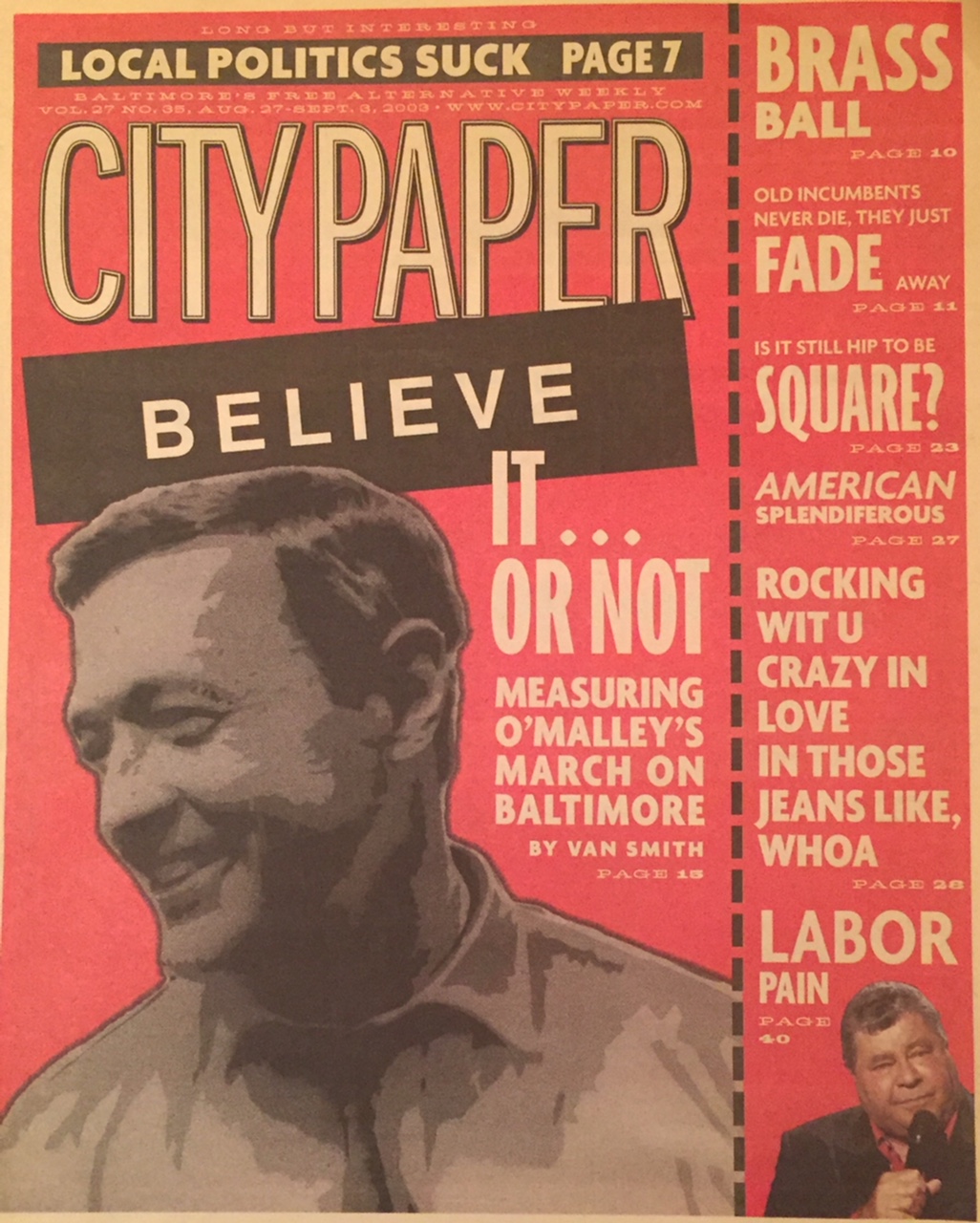
Believe It … Or Not: Measuring O’Malley’s March on Baltimore

By Van Smith

Published by City Paper, Aug. 27, 2003
IMG_7645

Good news is never hard to find when mayors seek re-election. Former Mayor Kurt Schmoke’s last political campaign in 1995 published a whole book of good news about his administration’s then-ongoing efforts in Baltimore. As is now widely recognized, though, the bad news far outweighed the good during the Schmoke years, which were marked by a cerebral approach to governance that produced paltry results and left the city’s psyche stigmatized by failure.

Schmoke’s charismatic successor, Martin O’Malley, was elected in 1999 on an ambitious anti-crime platform and a promising slogan, “For Reform and Change.” He won with a strong mandate that created high expectations and a refreshing sense of hope for the city. As he now runs for re-election as the distinct favorite in the six-way Democratic primary, O’Malley croons earnestly about the upturn Baltimore has seen during his four years in office. While his new campaign slogan–“Because Better Isn’t Good Enough”–suggests that his record has shortcomings he is willing to acknowledge, he’s still found plenty to boast about. Here’s a taste of some of the O’Malley campaign’s bragging points, lifted from its promotional materials:

  • “Baltimore has, in just a few years, achieved the largest [violent-crime] reduction of any major city in America.
  • “Baltimore’s per pupil spending increased by 15 percent [since 1999] . . . improving from 6th to 2nd highest in the state.
  • “In 2002 alone, the Baltimore Development Corporation’s efforts brought 6,000 jobs to Baltimore.”

Also available to help boost civic optimism during this election season is the Believe campaign, a multimillion-dollar advertising effort underwritten largely by the nonprofit Baltimore Police Foundation. The campaign aims to empower Baltimoreans to overcome the ravages of illegal drugs, and its most visible impact has been the thousands of images of the word “believe” that have placarded the city since last year. Believe’s latest media blitz, which started this summer and is ongoing, charts and celebrates the city’s progress since 1999. That’s the year before O’Malley took the reins of City Hall. Thus, Believe’s current feel-good message is not only about Baltimore’s efforts to tamp down its violent drug culture but also about O’Malley’s record as mayor.

Amid this propaganda, it’s hard to know what to trust. Critical thinking, after all, demands an innate skepticism of messages in advertising, because campaigns, whether political or commercial, are designed to make use of advantageous information rather than present a balanced picture.

IMG_7656

For instance, one could reason that Baltimore’s chart-topping reduction in violent crime is less remarkable than it sounds because, as the most violent city in the United States in 1999 (now the second most violent, behind Detroit), positive trends here have a greater statistical impact than in other, less violent cities. And while per-pupil spending increased 15 percent overall between 1999 and 2002, school enrollment during that period declined by almost 9 percent. With fewer students entering the system each year, per-student spending would increase naturally with a flat budget–and dramatically so with the modest budget increases that have been secured during O’Malley’s tenure in City Hall.

As for the 6,000 new jobs in 2002, attributed to the work of the city’s quasi-public economic development agency, that’s a lot of slots in a city where the number of unemployed people hovers around 25,000. The fact remains, though, that there were nearly 2,000 more unemployed people in the city’s labor force this June than there were in the beginning of 2002. And the unemployment rate has risen slightly rather than dropped during the same period. These facts strongly suggest that those 6,000 jobs were not filled predominantly by city residents but by commuters from surrounding areas.

Thus, the O’Malley camp’s upbeat take on the last four years begs other relevant ways to plumb Baltimore’s progress–different gauges than O’Malley’s people are emphasizing, ones that instead look at facets of city life not necessarily found in the campaign leaflets. The following results are mixed, and thus will please O’Malley supporters and detractors alike. And they show that O’Malley’s assertion that “better isn’t good enough” is dead-on in summing up his first term. The city’s stock has risen, but there’s room for improvement.

IMG_7646

On election day 1999, Martin O’Malley was the beneficiary of a very important statistic when he chalked up 53 percent of the votes in what had shaken down to be a three-way, racially charged Democratic Primary pitting him, a white guy, against former City Councilman Carl Stokes and then-City Council President Lawrence Bell, both of whom are black. “There is more that unites us than divides us,” O’Malley often said that summer–a sentiment that, along with his bold promises to reduce crime using New York City’s successful approach as a model, resonated with an electorate that seemed exhausted from years of decline, violence, and divisiveness.

After the votes were counted, even some of those who worked against him were ebullient. “Martin O’Malley has a clear mandate from the entire city,” said former City Council president, 1995 mayoral candidate, and current 14th District City Council candidate Mary Pat Clarke, who supported Bell in the 1999 race. “This city, black and white, voted for Martin O’Malley. And it was not marginal. It was resounding. He has a mandate to lead the whole city. It’s a wondrous thing to behold.”
IMG_7647

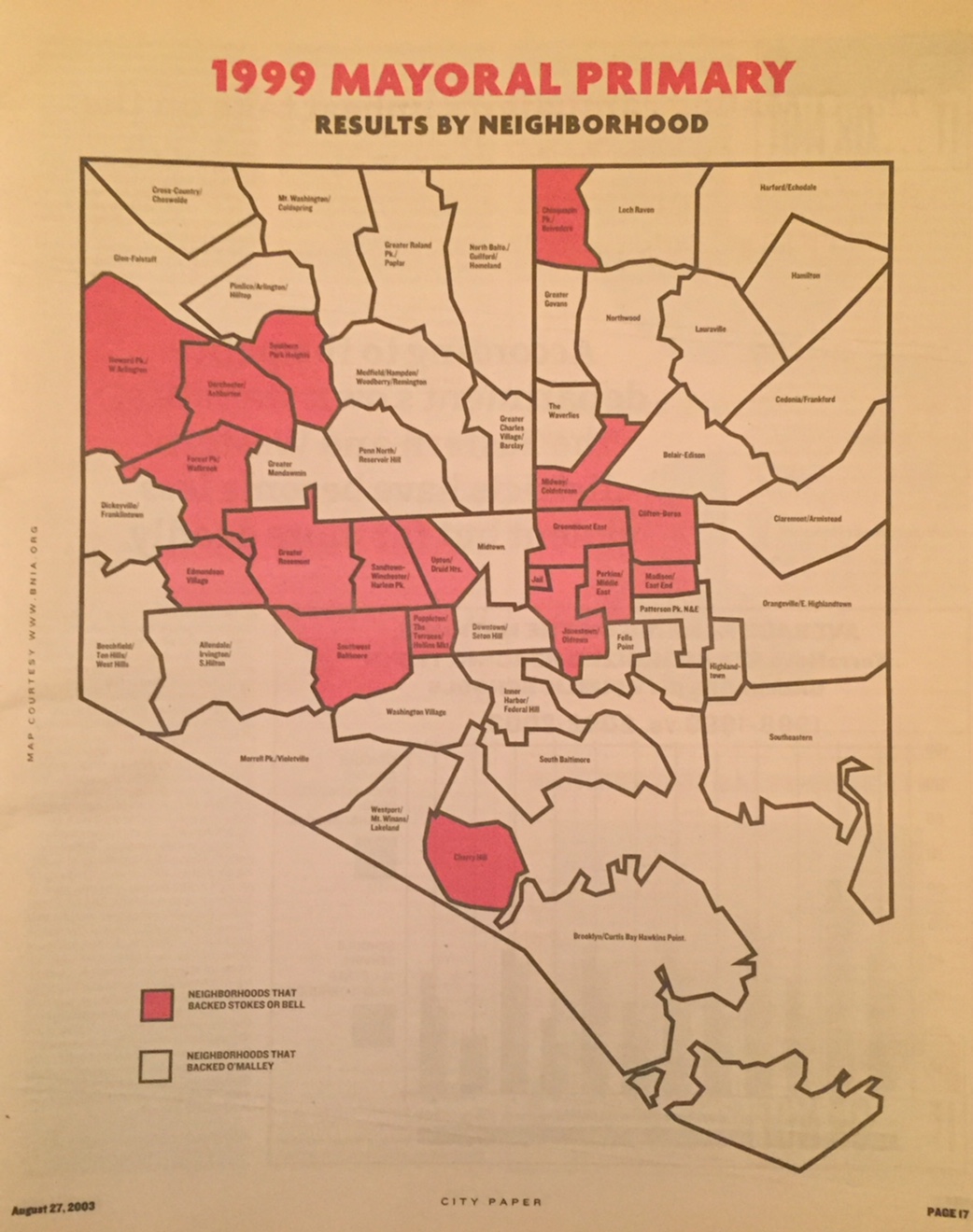
O’Malley’s votes in that race, nonetheless, reflected the realities of the city’s stark divide between poor African-Americans and everyone else. The precincts that supported O’Malley–including many predominantly black precincts–were spread thickly across the city, with the exception of two, hard-to-ignore areas: the blighted, poverty-stricken swaths on the east and west sides, which form a butterfly-wing pattern with midtown at the center. These neighborhoods–Upton, Druid Heights, Sandtown-Winchester, Harlem Park, Rosemont, Poppleton, Edmondson Village, and others on the west side, and Middle East, Berea, Clifton Park, Jonestown, Greenmount West, and others on the east side–did not buy into the O’Malley agenda as it was spelled out during the ’99 campaign. Stokes or Bell won most of the votes in these butterfly wings, which are overwhelmingly black and are home to about a third of the city’s population.

These neighborhoods, more than any others in the city, have the most to gain from City Hall’s policies since they suffer most from Baltimore’s famous ills. Here, according to data published by the Baltimore Neighborhood Indicators Alliance (www. bnia. org), a Charles Village-based nonprofit that has taken on the Herculean task of collecting and analyzing myriad measures of Baltimore’s communities, a fifth of all serious crime is violent, vs. a 10th in the rest of the city. Here, more than a third of family households are headed by single mothers, vs. a fifth in the rest of the city. Here, about 60 percent of mothers receive first-trimester pre-natal care, vs. three-quarters of the mothers in the rest of the city. Here, nearly 40 percent of working people don’t use cars to get to their jobs, vs. less than 25 percent in the rest of the city. And here, out of every 1,000 juveniles, an average of 124 were arrested in 2001, vs. 95 in the rest of the city; the rate of juvenile arrests in these neighborhoods jumped to 142 per 1,000 juveniles in 2002. The list of disparities is long and poignant.

If, as his 1999 campaign materials noted, New York City was O’Malley’s model for success, then Baltimore’s poorest neighborhoods would benefit most from his policies, as happened during New York’s renaissance in the 1990s. Mayor Rudolph Giuliani’s approach–while widely vilified, largely because of the man’s brusque personality and a few horrific incidents involving his police force–was to commit resources where they were most needed, and thus he helped spur revival in Gotham’s most hard-pressed areas as well as its most prosperous. And, despite opinions to the contrary, Giuliani achieved these gains while reducing the number of police-involved shootings compared to his predecessor. So, has the approach worked in Baltimore under O’Malley’s guiding hand? Yes and no.

IMG_7648

There’s just no arguing the gains made in the critical early grades of the Baltimore City public schools during the last five years. Scores in the nationwide TerraNova standardized tests rose dramatically across the board between the 1998-’99 and 2002-’03 school years in the city’s elementary-school grades. And those gains, reflected in a recently released school system report, have been greatest in schools serving the city’s poorest neighborhoods–though the situation is reversed in scores for sixth-graders. The greatest climb in average percentile rankings was in poor areas’ second-grade reading scores, which jumped an average of 23.2 points in the five-year period, while the scores rose 17.1 points for second-graders in the rest of the city’s schools. Sixth-graders scores in the poor schools, though, climbed an average of 9.6 points, compared to 19.6 at all the other city schools.

IMG_7655

O’Malley attributes this overall success in part to expanding programs that target kids before they enter first grade. “We have gone from 109 full-day kindergarten classes to 297, reaching that mandate five years ahead of when the state wanted us to,” he cited during a recent interview with City Paper in his City Hall office. “And we’ve gone from one full-day pre-K program to 91.” He also pointed out that the school system’s efforts to standardize course content have helped, too, given that “a lot of kids are in three or four or five different schools in the course of a year, [and are faced] with a different curriculum every time.”

Kids living in poverty, O’Malley observes, have to prevail over more severe obstacles in order to learn well, so the greater improvements in test scores at schools serving poor children are that much more impressive. “The neighborhood environment from which our poor children are drawn have a lot bigger societal problems . . . [such as] violent crime, drug addiction, and the sort of societal abandonment, familial abandonment, that those things fuel, than in other areas of our city,” he said. “Unfortunately, [these students] have to overcome a lot more of the baggage that we as a society still allow to be heaped upon them through no fault of their own.

“So I don’t think it’s accidental that our kids are doing better in school as the city’s becoming safer and as more parents are getting into drug treatment,” he continued. “I think all of this works together. And the expectations for their success I think are greater than maybe they’ve been in years past.”

Of any single area under city government’s bailiwick, though, the school system is the one over which the mayor has the least direct influence. This is the result of a partial state takeover of city schools during Schmoke’s last term–a negotiated outcome to settle a long-litigated lawsuit. Thus, while O’Malley has some say over schools policy by virtue of his control over nine appointments to the 18-member school board and the city’s 23.5 percent contribution to the system’s 2002 budget, he can’t take full credit for its success or failure. Nonetheless, his limited clout in the schools arena means he can tout–with a measure of modesty–the remarkable rise in test scores as part of his record as mayor.

IMG_7649

By and large, the city’s poorest neighborhoods fall in two of the city’s nine police districts, the Eastern and the Western. Examining the crime numbers in these two districts in 1999 and 2002, vs. the other seven districts, turns up mixed results. According to police department data, overall violent crime in the Eastern and Western districts combined has dropped 31 percent from 1999 to 2002, while nonfatal shootings have dropped almost 38 percent. But murders rose nearly 15 percent in 2002 compared to 1999–and the two districts’ share of the city’s total number of homicides has increased from nearly 30 percent in 1999 to more than 41 percent in 2002.

Running the same analysis on 2003’s year-to-date figures in the Eastern and Western districts as of Aug. 9, vs. 1999’s numbers on the same date, show that the disparity is even greater this year. Murders are up 50 percent from 1999, while violent crime has dropped more than 42 percent and shootings more than 18 percent. According to the police department’s own statistics, the Eastern and Western districts have become less violent but far more deadly.

IMG_7653

“I had never seen these murder numbers broken down like this before,” O’Malley commented while reviewing these statistics. “It’s an interesting way to break them down.” But his response was to repeat Giuliani’s mantra: “We apply our resources to where the problems are.” And then he opened his crime-numbers notebook and recited figures showing that violent crime is down dramatically in every district, including the Eastern and Western.

“You know,” he added, “all of this is a work in progress. I’m not happy with 253.” That’s the number of murders committed citywide in 2002–a far cry from the 175 he had promised by that date during the 1999 campaign and during the first two years of his administration. “We’re going to continue to go down from there.”

IMG_7654

And the mayor got exercised over projections of this year’s final murder tally, which as of press time is on track to reach about 285 by the end of December. “Everybody always wants to project that year-end number,” he said with palpable disgust. “I mean, they want to do it in July. And a half a year’s left. And it is awful and it’s morbid and it’s cold to talk statistics. One homicide is one homicide too many.

“But we deploy our resources to where the problems are,” O’Malley continued, getting back to the disproportionate violence in the Eastern and Western districts. “And all of this, it is still young. The open-air drug trade in this city was allowed to grow and flourish and develop and become as acute as it did over a 25-year slide. And so we are going to continue to hammer it.”

Another area that O’Malley has targeted is police corruption. It’s a ticklish subject, and one on which he mounted his bully pulpit starting in 1993, when he was a young councilman. “The few bad apples are just that–the few,” he said in an impassioned speech on the council floor 10 years ago. “But there is not a single knowledgeable person in federal, state, or local law enforcement today who will deny that we have a growing problem with street-level corruption.”

During the 1999 campaign, O’Malley repeatedly stressed the importance of “policing the police,” and continued to fuel the perception that the corruption problem in the department was acute. And he asserted that the problem had been swept under the rug for years. After he was elected, he hired a consulting firm, the Maple/Linder Group of New York City, to do a full assessment of the police department, including an internal survey of sworn officers. The findings on corruption were eye-popping. “While 48.7 percent of respondents believe that five percent or less of . . . officers are stealing money or drugs from drug dealers,” the report reads, “23.2 percent believe the number is greater than a quarter of the department.” Based on the buzz O’Malley sounded, many in Baltimore expected to see heads starting to roll.

It never really happened. There was one infamous case–Agent Brian Sewell, who was accused of planting drugs on an innocent suspect as a result of a sting operation. But the case tanked when the alleged evidence against him was pilfered by the lead investigator in the case from a secret internal-investigations office in Essex around Christmas 2000. (The department used its administrative procedures to fire Sewell. He appealed successfully, winning the right to a new trial-board hearing, but agreed to leave the force rather than go through another proceeding. Sewell recently died in an accident at Andrews Air force Base, where he had been assigned for duty with the Maryland National Guard.)

Other than Sewell, police department spokesman Matt Jablow says only three other officers–Jacqueline Folio, Scott Fullwood, and an unnamed member of the force–failed the 217 drug-related integrity stings staged by the department’s Internal Affairs Division since the beginning of 2000. The unnamed officer, Jablow explained, “struck a deal” and retired, so the department is unwilling to reveal his name.

“We’ve been doing 100 integrity stings a year for the last few years,” O’Malley explained, somewhat apologetically. “Some of them are targeted, a lot of them are random. Like everything else we do in this department, there is plenty of room for improvement as far as how we police our police. We’re doing more of it than we ever have. We have not come across that sort of beehive’s nest of every officer on a shift in a particular precinct [involved in corruption], like they had in New York, where they had a couple of celebrated cases. But [police Commissioner Kevin] Clark believes that we can do those targeted stings even more effectively than we have done them in the past.

“You don’t start a new effort like that and have it perfect overnight,” he continued. “And obviously from some of the problems that we had in some of those prosecutions [e.g., the Sewell case], it was pretty apparent that this was something new for us. But I had been somewhat surprised not to find more of that, given the way the drug trade took over big swaths of the city. But we’ll continue to be on the lookout for it and to improve the effectiveness of the investigations.”
IMG_7650

In 1999, as O’Malley was running for mayor on an anti-crime platform, critics sometimes complained that he was a one-trick pony. Even his economic development ideas were built on crime-fighting. When asked during an interview that summer what the government’s role is in creating jobs and improving the business climate, for instance, he responded that “you do both of those things by first accomplishing job one of any organized government, which is public safety. I think there is no way to create jobs or to improve the business environment if the only businesses expanding are these open-air drug markets.”

But there was more to his plan than boosting law-enforcement. It also involved “having a mayor more actively involved with our lending institutions and letting them know where opportunities exist in this city,” he continued, “where they can make a dollar and where they can help build this city again. Businesses, their knock on city government isn’t a whole helluva lot different than citizens. Nobody returns their phone calls and nobody listens. So that’s what it’s all about.”

Today, O’Malley likes to talk about the $1.6 billion in new construction that he says is underway in Baltimore. Apparently, by that measure, his one-two punch of crime-fighting and massaging the investing class has worked pretty well. While unemployment remains high–the June figure for the city was 8.8 percent, compared to 5.2 percent for the metro region and 4.3 percent for Maryland overall–that’s largely out of his control, given the national economic recession that took hold in 2000, just as he was getting traction as the new mayor.

“We haven’t taken as severe a hit to our overall job base [during this recession] as other cities,” says Anirban Basu, an economist who heads the Fells Point-based consulting firm Optimal Solutions. “And that’s a radical departure from the recession of the early 1990s, when Baltimore was a laggard in recovering compared to other cities, which tended to come out strong during the rest of the decade. A lot of people expected a repeat performance this time, and that never materialized.” Basu attributes that in part to the wealth in the region, which means more businesses and individuals qualify to take advantage of the historically low interest rates on bank loans: “That’s why we have had such a terrific housing market in Baltimore City, which has the cheapest housing stock in the region, so it is likely people are going to look there first for deals. And many would-be renters have been empowered to buy homes.”

Baltimore’s relative prosperity amid a recession is hard to attribute directly to O’Malley’s efforts. But his efforts have certainly helped. While several formal economic-development strategies have been conceived during O’Malley’s four years in office, two were much ballyhooed early on. First, and the one that was promised often during his 1999 campaign, was to leverage the power of the Community Reinvestment Act (CRA), the federal law requiring banks to make loans in poorer neighborhoods from which they draw depositors. And the second, adopted after he gained office, was to grow the local technology industry in a drive that was dubbed “The Digital Harbor.”

It’s hard to quantify how effectively O’Malley has wielded the CRA to bring new investment to Baltimore. But the extent to which he’s succeeded at all is an achievement, because the CRA has become an increasingly impotent tool in recent years. The main trend that has weakened the CRA is the fact that national mortgage-lending companies have increasingly become the lender of choice for many homebuyers and for those refinancing their mortgages. Such companies generally do not have local branches where consumers make deposits, and thus are not subject to the CRA’s provisions.

So, while O’Malley talked a big CRA game during the 1999 campaign–saying, for instance, that he would use “that hammer of monitoring the banks and the threat that you’ll mess up their business and their ability to merge and do what banks like to do in this era”–his tone has been much more conciliatory toward the banks since he took office. “A lot more of our banks were more savvy [on the CRA front] than we had anticipated,” he explained recently.

Despite the CRA’s increasingly limited reach, several local banks that do take deposits from Baltimore have outstanding CRA ratings, and they’ve stepped up to the plate with sizable CRA-eligible loans for local development efforts. Most impressive has been the Bank of America, which, by O’Malley’s tally, has financed or invested in ongoing local projects to the tune of approximately $170 million.

And O’Malley can take credit for getting banks to help underwrite the efforts of the Community Development Finance Corp., a quasi-public lending institution that makes risky loans for redevelopment in low-income areas and that was riddled with scandal under Schmoke. “Quite frankly,” he explained, “many of [the banks] were very reluctant to do it unless we put better checks and balances in place to safeguard the value of their loans. But I had several one-on-one meetings with them and lots of phone calls, lots of lobbying, begging, arm-twisting. We changed the rules at CDFC in terms of giving the banks some greater voice in the loans that we make and some greater oversight. But we got the banks to re-up, and that was to the tune of $26 million that they put into the CDFC.”

In the heady early days of his administration, Digital Harbor quickly became the most heralded piece of O’Malley’s economic-development package. “Our working waterfront,” O’Malley proclaimed in an early-2000 speech before a large gathering of the centrist Democratic Leadership Council, a national group that promotes results-oriented governance, “once again has become our port to a new economy with dozens of Digital Harbor companies filling revitalized space formerly occupied by manufacturing and warehouse equipment. We have made recruiting, supporting, and growing tech companies our highest economic-development priority because the Digital Harbor is Baltimore’s future.”

Digital Harbor was just getting up and running in 2000 when the tech-industry bubble burst. While little positive news has been heard about it since the tech collapse, local tech-industry leaders remain upbeat. “Baltimore City has done extraordinarily well” given the industry’s downturn, says Penny Lewandowski, who directs the Greater Baltimore Technology Council, a trade group based in the American Can Company complex in Canton. “I can name only three companies that did not survive–Cycle Shark, Gr8, and Tide Point LLC.” Her rosy take has required a slight shift in perspective. “Digital Harbor,” she explains, “is not just about companies that are exclusively technology, but how technology affects traditional businesses as well. So, did the mayor make the right bet? Absolutely.”

Basu gives a less optimistic appraisal of the tech industry’s status in the city today, but he backs Lewandowski’s basic conclusions. “The collapse hasn’t been quite the bloodbath it’s been nationally,” he says, pointing out that the large infusion of federal research dollars into the local economy and regional tech industry’s reliance on those federal contracts have helped. “Federal-government contracts account for about 40 percent of the state’s tech-industry revenues, versus about 10 percent in Silicon Valley.”

The main reason for tech’s resilience in Baltimore in the face of a national downturn, Basu says, is that Baltimore had less to lose than other cities. “Baltimore has not been a hotbed of private-sector technology in much of its history,” he explains. “It was late in coming to the table–and then, just as the momentum was building, the tech industry goes bust.”

O’Malley’s focus in the tech arena also has shifted since the tech collapse–from information technology and telecommunications, which were the hardest hit areas, to biotechnology, which is a less mercurial beast. “What we are trying to do,” he explained, “is to create the expectation that in our already fairly diverse economy, that we are ready and have the natural resources–the colleges and universities and research institutions–to be able to grow that sector of the economy which could be called the new economy. And I think our area, where we have greater strengths than others, is going to be in biotech.” To that end, the city is soon to become home to two biotechnology parks–one on the east side and affiliated with Johns Hopkins University; the other on the west side, being developed by the University of Maryland.

City government’s role in all of this is not so much “the bricks-and-mortar visibility,” O’Malley said, but work-force development–investing in programs that will prepare city residents to participate in the new economy. And he’s more than happy, along with his technology coordinator, Mario Armstrong, to recite a list of new initiatives. First and foremost, O’Malley and Armstrong explain, is the radical gain in the ratio of students to computers in the classroom. “We used to be at 10 to 1, now we’re at three-and-a-half to one,” Armstrong said enthusiastically. “That was us making it a priority,” O’Malley continues, “Carmen [Russo, the outgoing city schools chief] not fighting us on being involved in it, a million dollars of general funds, and 6,000 computers from the Social Security Administration, which we paid to have retrofitted.”

Armstrong’s list of other programs and accomplishments is long and sounds impressive. The Hewlett-Packard Digital Village program aims to train teachers to use computers and incorporate them into class curriculum so students learn in a tech-savvy environment. Digital Village Hubs, which are after-school centers that provide public access to computers, have been established at three locations on the east side. Many of the city’s public-housing projects now have computer centers, and about 1,200 people a month are using them. Five computer-oriented Youth Opportunity Centers have been opened around the city, giving children more occasions to use computers after school. And three Digital Learning Labs have opened, which provide computer-training courses that, in June, taught almost 500 people how to use the technology.

Whether all of this activity actually results in a more job-ready work force for the city’s still-fledgling new economy is the question. As Basu says of the city’s work force-development initiatives, “it will be interesting to see how well it works, but it’s good to see they’re trying.”

It’s less clear that the O’malley administration has been trying on another front where he promised progress when he first ran for mayor: maximizing budget efficiency by reducing the amount of money granted to contractors for “extra work” on city contracts. “I think there are areas where we spend too much [city] money,” he said during a campaign interview four years ago. “One of those is in the letting of public-works contracts through the Board of Estimates. I think that the additional work orders and the inflation on those contracts really needs to be checked.”

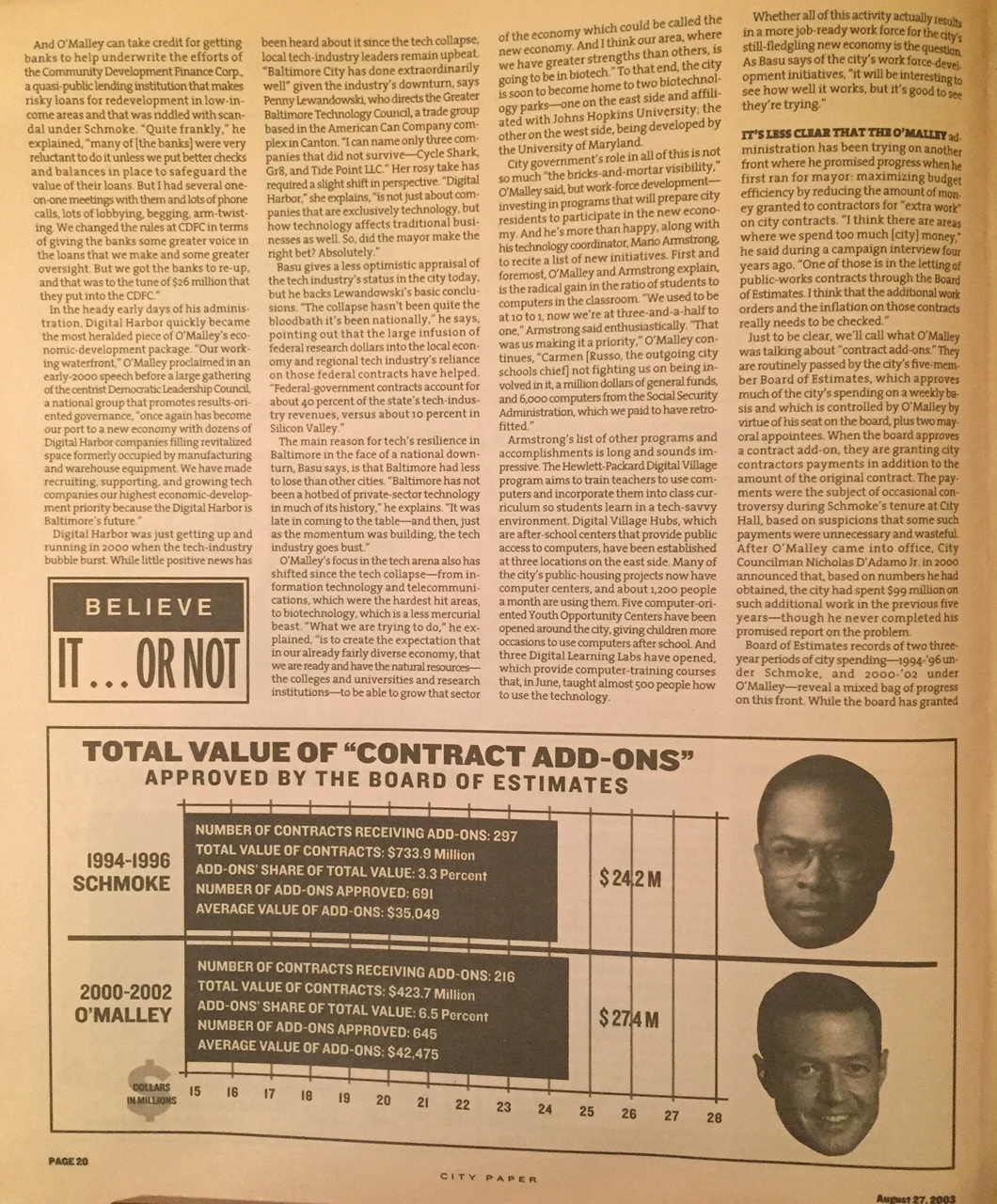
Just to be clear, we’ll call what O’Malley was talking about “contract add-ons.” They are routinely passed by the city’s five-member Board of Estimates, which approves much of the city’s spending on a weekly basis and which is controlled by O’Malley by virtue of his seat on the board, plus two mayoral appointees. When the board approves a contract add-on, they are granting city contractors payments in addition to the amount of the original contract. The payments were the subject of occasional controversy during Schmoke’s tenure at City Hall, based on suspicions that some such payments were unnecessary and wasteful. After O’Malley came into office, City Councilman Nicholas D’Adamo Jr. in 2000 announced that, based on numbers he had obtained, the city had spent $99 million on such additional work in the previous five years–though he never completed his promised report on the problem.

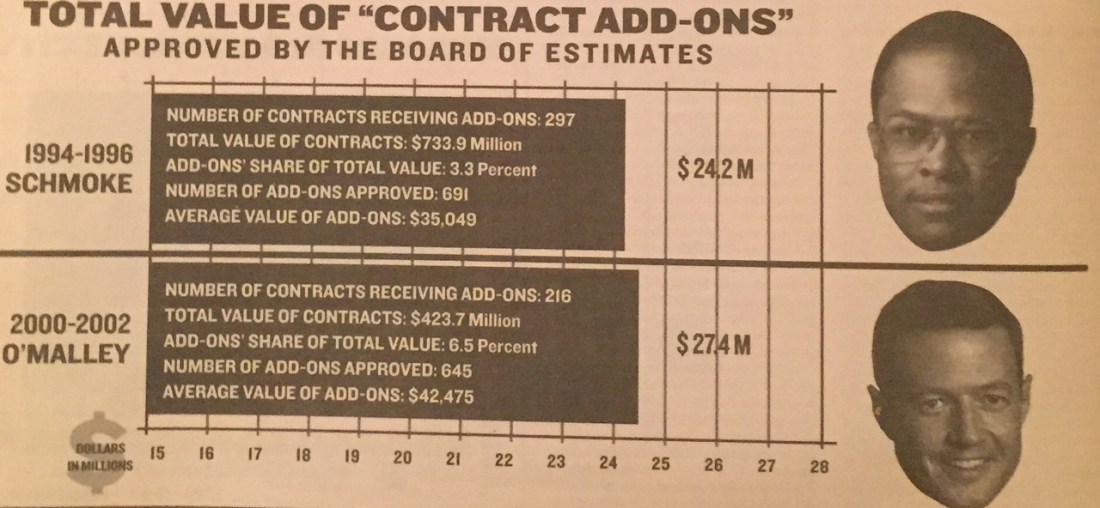
Board of Estimates records of two three-year periods of city spending–1994-’96 under Schmoke, and 2000-’02 under O’Malley–reveal a mixed bag of progress on this front. While the board has granted fewer add-ons under O’Malley than they did under Schmoke and has reduced the number of contracts receiving additional work, the amounts granted have grown–especially when measured as a share of the total value of city contracts receiving additional payments. While the city spent $24.2 million on add-ons during the three-year period under Schmoke, it spent $27.4 million on such additional payments under O’Malley–and the add-ons’ share of the total value of contracts rose from 3.3 percent to 6.5 percent.
IMG_7652

The mayor’s office provided alternative figures to City Paper, but they don’t square with the records of the Board of Estimates, which were the basis for City Paper‘s analysis and which are the only source available for the public to independently research city spending patterns. Raquel Guillory, the mayor’s chief spokeswoman, told City Paper the total value of contracts from 1994 through ’96 was $323,649,981, with add-ons comprising 8.4 percent of that total, while the figures for 2000 through ’02 were $379,340,369 and 7.2 percent, respectively. Thus, the O’Malley administration’s numbers show efficiency–add-ons as a percentage of total contract amounts–has increased under O’Malley, while City Paper shows greatly increased inefficiency under O’Malley.

City Paper asked Guillory to explain how city government arrived at their figures. She said that the city’s numbers were derived from the sum total of construction contracts that came before the Board of Estimates for contract add-ons. City Paper based its figures on the sum total of all city contracts–including everything from waste-water treatment improvements to consulting work to digital mapping of the city.

Guillory also explains that two projects worked on under the O’Malley administration–extensive and glitch-riddled contracts on the police headquarters building and Hopkins Plaza downtown–were held over from the Schmoke administration and made up for a large amount of the extra work passed by the Board of Estimates during O’Malley’s term. Also, O’Malley adds, city managers have “been trying to do a better job in terms of the degree of detail that’s in the contracts to begin with, when they go out for bid,” explaining that “if we put out better contracts, we might get the job done for less, without these expensive overages.” So far, the Board of Estimate records don’t reflect the improvements O’Malley suggested have had a money-saving effect, because both the amount and the share of additional work have risen markedly compared to the Schmoke administration in the mid-1990s.
IMG_7651

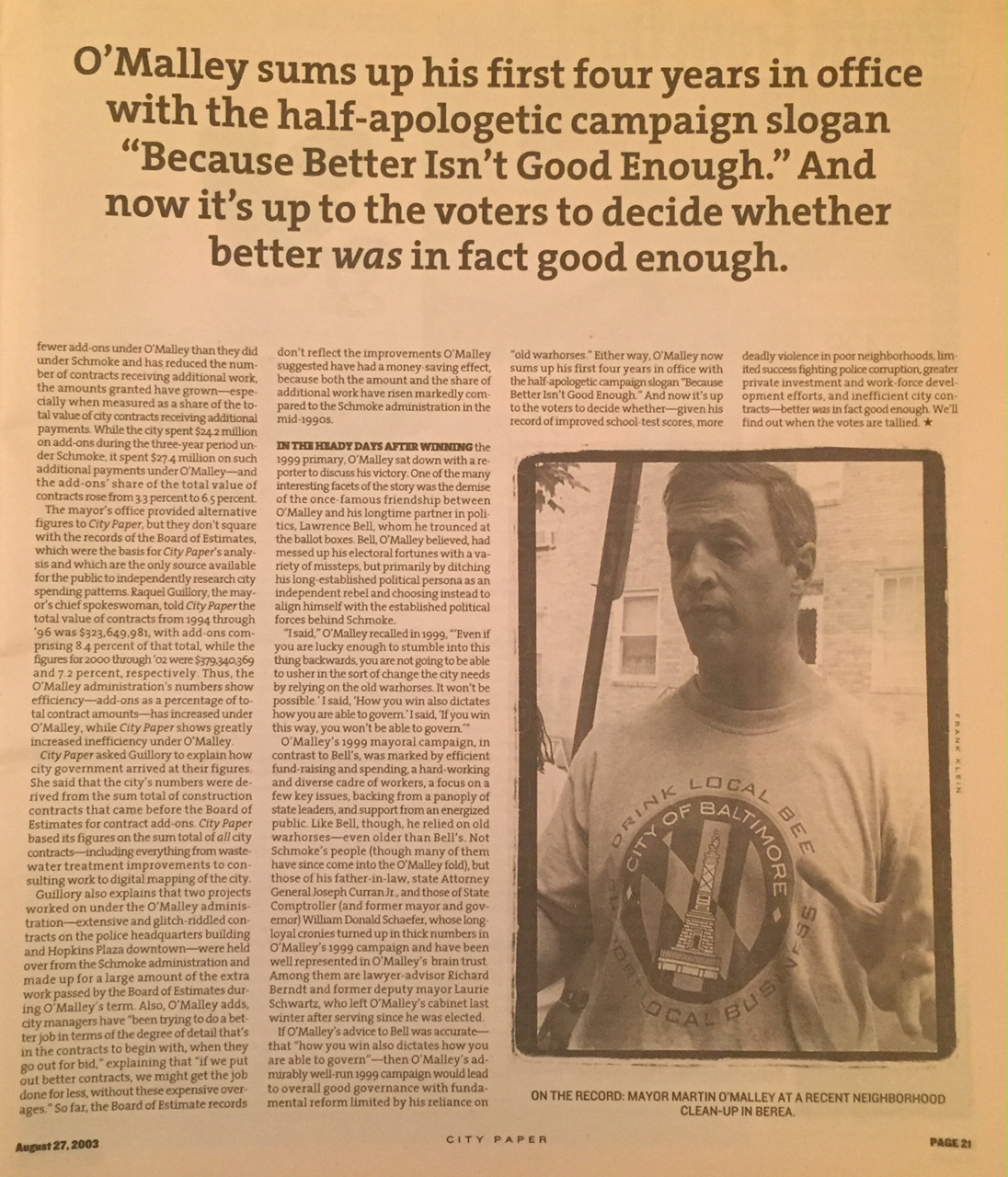
In the heady days after winning the 1999 primary, O’Malley sat down with a reporter to discuss his victory. One of the many interesting facets of the story was the demise of the once-famous friendship between O’Malley and his longtime partner in politics, Lawrence Bell, whom he trounced at the ballot boxes. Bell, O’Malley believed, had messed up his electoral fortunes with a variety of missteps, but primarily by ditching his long-established political persona as an independent rebel and choosing instead to align himself with the established political forces behind Schmoke.

“I said,” O’Malley recalled in 1999, “‘Even if you are lucky enough to stumble into this thing backwards, you are not going to be able to usher in the sort of change the city needs by relying on the old warhorses. It won’t be possible.’ I said, ‘How you win also dictates how you are able to govern.’ I said, ‘If you win this way, you won’t be able to govern.'”

O’Malley’s 1999 mayoral campaign, in contrast to Bell’s, was marked by efficient fund-raising and spending, a hard-working and diverse cadre of workers, a focus on a few key issues, backing from a panoply of state leaders, and support from an energized public. Like Bell, though, he relied on old warhorses–even older than Bell’s. Not Schmoke’s people (though many of them have since come into the O’Malley fold), but those of his father-in-law, state Attorney General Joseph Curran Jr., and those of State Comptroller (and former mayor and governor) William Donald Schaefer, whose long-loyal cronies turned up in thick numbers in O’Malley’s 1999 campaign and have been well represented in O’Malley’s brain trust. Among them are lawyer-advisor Richard Berndt and former deputy mayor Laurie Schwartz, who left O’Malley’s cabinet last winter after serving since he was elected.

If O’Malley’s advice to Bell was accurate–that “how you win also dictates how you are able to govern”–then O’Malley’s admirably well-run 1999 campaign would lead to overall good governance with fundamental reform limited by his reliance on “old warhorses.” Either way, O’Malley now sums up his first four years in office with the half-apologetic campaign slogan “Because Better Isn’t Good Enough.” And now it’s up to the voters to decide whether–given his record of improved school-test scores, more deadly violence in poor neighborhoods, limited success fighting police corruption, greater private investment and work-force development efforts, and inefficient city contracts–better was in fact good enough. We’ll find out when the votes are tallied.

Holy War: Inside the Crusade to Kill Maryland’s New Marriage-Equality Law

By Van Smith

Published by City Paper, Oct. 3, 2012

logo

Maryland holds a special place in the legal history of same-sex marriage in America. In 1973, Maryland lawmakers reacted to marriage attempts by same-sex couples by enacting the nation’s first state law defining marriage as occurring between one man and one woman—what has since been dubbed the Defense of Marriage Act (DOMA), which became federal law in 1996.

This year, nearly two generations later, Maryland reversed course and passed the Civil Marriage Protection Act (CMPA), legalizing same-sex marriages. While public polls show it is increasingly popular nationwide and in Maryland, same-sex marriage is anathema to many for whom the Bible, which frowns on homosexuality, is “The Word,” setting God’s laws for all people. And for them, the National Organization for Marriage (NOM) is the best hope for keeping the biblical basis for marriage on the law books in Maryland and wherever else it is threatened.

Since forming in 2007 to back California’s Proposition 8, the successful constitutional-amendment referendum to end same-sex marriages there, NOM has been the driving force to keep gays and lesbians from gaining or maintaining the legal right to marry in America. With the passage of the CMPA in Maryland, NOM’s well-honed organizational prowess has come to the state in the form of the Maryland Marriage Alliance (MMA), on whose three-member board sits NOM’s executive director, Brian S. Brown.

MMA and NOM donated more than four-fifths of the money raised to support the highly successful petition drive that landed the CMPA on the Nov. 6 ballot as Question 6, which will decide whether the law survives. And MMA is the main group—joined by one other, Jump the Broom for Marriages (JBM)—registered to raise and spend campaign funds to defeat Question 6. The first campaign-finance reports of the ballot battle are due in October, so who’s raising and spending how much, and where the money’s coming from, remains to be seen.

In each of the 32 times same-sex marriage questions were on state ballots around the country, they have failed, and those opposed are determined to make sure that happens again this year in Maryland, as well as in the other three states—Maine, Minnesota, and Washington—that have ballot questions on the issue on Nov. 6.

The question is: How far will NOM, MMA, and JBM go in their attempt to kill the new law, given that polling shows a majority of Marylanders support gay marriage and a dwindling number oppose it?

The answer may never be entirely clear, since NOM goes to great lengths in its attempts to protect how it raises and spends money from public scrutiny. But based on NOM’s past conduct, its time-tested partnerships with anti-gay-marriage leaders in Maryland, and JBM’s ties to a Maryland political mover-and-shaker with scandal in his past, expect anti-gay-marriage tactics to get ugly in Maryland.

The ugliness has already shown its face in the rhetoric of NOM-tied preachers in Maryland. Perhaps the boldest statements have come from Bishop Harry R. Jackson Jr., of Hope Christian Church in Beltsville, where MMA Executive Director Derek McCoy is associate pastor. Jackson has linked gay marriage with “a Satanic plot to destroy our seed.”

Among longtime opponents of gay marriage in Maryland, such as state Del. Donald Dwyer (R-Anne Arundel County)—who has introduced legislation each year for nearly a decade that would make DOMA an amendment to the Maryland Constitution—and Michael Peroutka of the Institute on the Constitution (IOTC), a longtime Dwyer supporter, the use of venom against gays and lesbians is particularly overt.

In a February column on the IOTC’s web site, the American View, Peroutka praises Dwyer “valiantly fighting the desperate efforts of the sodomite lobby in Annapolis to redefine the God-given and God-ordained institution of marriage.” He then goes on to thank Dwyer for the way he testified against the CMPA, since it helped Peroutka realize something “that had eluded me.” That something was this, as memorialized in Dwyer’s written testimony:

“The reason why it is so desperately important to homosexuals to redefine marriage has little to do with ‘fairness’ and much to do with gaining access to straight, normal, decent Maryland children. . . . You see, homosexuals can’t reproduce. So they must recruit. The best place to recruit is in schools where they can have unfettered access to children. . . . Stripped of all its phony ‘fairness’ language, what is being pushed is nothing short of government-authorized perversion of Maryland children. It’s a license for child abuse.”

In August, Bishop Jackson echoed this point at Glenn Beck’s “Under God: Indivisible” conference in Texas, saying, in connection with the gay marriage issue, that “folks who cannot reproduce want to recruit your kids.”

After the CMPA passed in Annapolis, Peroutka wrote a column entitled “Maryland Legislature Commits Suicide.” In it, he concluded that “no earthly government body can redefine marriage any more than it can redefine the law of gravity” and that “no matter how much ink gets spilled on paper in Annapolis, no change has occurred in either the laws of gravity or the definition of marriage. . . . Until this Governor is impeached and until this legislature is recalled and replaced with citizens who know the law and the limits of civil jurisdiction, there is no reason to consider this a valid legislature or this a legitimate governor. Other than fear, I can think of no reason to further obey their dictates.”

In this environment among opponents of gay marriage, it was hardly surprising when Dennis Leatherman, pastor of the Mountain Lake Independent Baptist Church in Oakland, Md., said of gays during a May sermon: “Kill them all. Right? I will be very honest with you. My flesh kind of likes that idea.” Then he backed off, noting that such a notion “violates Scripture. It is wrong.”

On the other side of the marriage-equality question, potent backing for Question 6 has been found among prominent African-American pastors who agree with the Maryland NAACP, as well as its branches in Baltimore and Prince George’s County, that marriage equality is a civil rights issue. Many of them gathered to speak in support of Question 6 at a Sept. 21 press conference at the National Press Club in Washington, D.C.

The roster of African-American luminaries from churches across the country who came to the event included well-known names among the faithful, such as Dr. Otis Moss III, of Trinity United Church of Christ in Chicago; Dr. Amos C. Brown of the Third Baptist Church in San Francisco; Dr. Frederick D. Haynes III, of Friendship-West Baptist Church in Dallas; and Dr. Howard-John Wesley of Alfred Street Baptist Church in Alexandria, Va. Their arguments invoked the “equal protection under the law” clause of the 14th Amendment of the U.S. Constitution—the same clause that undergirded the legal arguments for civil rights causes that were so bitterly fought in U.S. history—and stressed the tradition of separation of church and state, pointing out that civil laws and religious tenets best not intermingle, including in questions of marriage.

All spoke passionately, with concise, tightly hewn moral and theological logic. The marquee name at the event was Rev. Al Sharpton, who delivered a short homily, pointing out that he’s been for same-sex marriage since 2003. But perhaps the tightest, most moving statement came from someone who may not be a household name: Dr. Brad R. Braxton of the Open Church in Baltimore.

“My support of marriage equality is an endorsement of justice and love,” Braxton began. “Marriage can be a moral good,” he continued, and “denying access to the fullness of that moral good on the basis of sexual orientation is politically unjust and morally inappropriate.” After acknowledging the diversity of views on the issue and emphasizing that they “need to be discussed and debated in a respectful manner,” Braxton said, “my enthusiastic support of this legislation is rooted in a sense of political justice.” He invoked the past, saying that “as an African-American Christian pastor and theologian, I feel a moral obligation to advocate for marriage equality” because “in this country’s history, African-Americans were once denied the right to marry and form families. As a descendent of people who were denied these rights, why would I want to deny gay and lesbian people these rights?”

Finally, Braxton spoke of the power and goodness of love. “Marriage equality is a celebration of love,” he said, and “in light of the hatred and hostility in our world, we should celebrate and protect the political right of two consenting adults to unite in love to form a family. Surely, relationships rooted in love, irrespective of one’s sexual orientation, strengthen the body politic and enhance the common good. If we genuinely want liberty and justice for all, then it is crucial for voters in Maryland to vote ‘Yes’ on Question 6 on this year’s ballot. A ‘Yes’ vote affirms that the small word—‘all’—is really big enough to include everyone.”

Other than engaging in the battle of words that marks any policy debate, opponents of same-sex marriage also employ litigation, which NOM has undertaken readily in other states—and which MMA has already put to use in Maryland.

Though only five years old, NOM has sued five times in federal court: in California, Maine, New York, Rhode Island, and Florida. Each time, it sought to overturn aspects of the states’ election laws in order to avoid campaign-finance reporting requirements, and each time, it failed. On its legal team for each case was James Bopp, the attorney who started the successful Citizens United lawsuit that prompted the U.S. Supreme Court decision that led to super PACs, which are allowed to raise unlimited amounts of money in politics.

So far, NOM and MMA have not attempted to undermine Maryland’s campaign-finance laws in the courts. But in August, MMA filed a lawsuit in Anne Arundel County Circuit Court, seeking to replace the ballot language of Question 6 and replace it with its own proposed language. In addition to MMA, the plaintiffs were its executive director and board member, Derek McCoy, and state Del. Emmett C. Burns (D-10th District), a Baltimore pastor. They withdrew their complaint in September, but what it says reveals much about how anti-Question 6 forces feel about the law they want overturned.

The approved ballot language for Question 6 reads:

Establishes that Maryland’s civil marriage laws allow gay and lesbian couples to obtain a civil marriage license, provided they are not otherwise prohibited from marrying; protects clergy from having to perform any particular marriage ceremony in violation of their religious beliefs; affirms that each religious faith has exclusive control over its own theological doctrine regarding who may marry within that faith; and provides that religious organizations and certain related entities are not required to provide goods, services, or benefits to an individual related to the celebration or promotion of marriage in violation of their religious beliefs.

Here is the language MMA proposed in its lawsuit:

Redefines marriage as between one man and one woman to allow gay and lesbian couples to marry; exposes clergy and certain non-profit charitable organizations which are not operated, supervised, or controlled by a religious organization to liability for refusing to perform same-sex marriage against their religious convictions; only provides limited exceptions to clergy from having to perform any particular marriage ceremony in violation of their religious beliefs; provides no protection for religious or other non-profit organizations that receive State and/or Federal funding for its programs from having to perform any particular marriage ceremony in violation of their religious beliefs; provides for a criminal charge of misdemeanor and on conviction is subject to a fine of up to $500.00.

The differences between the two are stark. The approved language emphasizes that clergy and religious organizations are explicitly protected from liability should they choose not to marry gay and lesbian couples. But the proposed MMA language says that’s not so, claiming that the law “exposes” clergy and others who perform marriage ceremony to liability, including criminal prosecution.

The only provisions for criminal penalties in the CMPA, though, pertain to individuals who marry their relatives. There is nothing in the law suggesting clergy or others who conduct marriage ceremonies are liable for anything, criminally or otherwise. That hasn’t stopped MMA from suggesting otherwise by using rhetorical devices designed to shed doubt on anything Question 6 supporters say.

On Sept. 23, after MMA dropped its lawsuit over the Question 6 language, McCoy took the stage at Manna Bible Baptist Church in Baltimore to speak about the law and MMA’s drive to defeat it. In the speech, which was posted on YouTube, McCoy admitted that the new law won’t penalize pastors and churches that don’t perform same-sex marriage ceremonies.

“What you’re going to hear is, ‘Well, that bill does not force pastors to marry anybody in their pulpits. It gives churches the free rein to do whatever they want to do. You don’t have to worry, this is only a civil marriage license.’ Most of the stuff you are going to hear on the other side, saying, ‘It’s not going to do this, and it’s not going to do this, this is civil marriage, and da-da-da,’” McCoy said, “I just want you to know, it’s just not true.”

Thus, when McCoy declared, “That is true, they will not come tomorrow and handcuff Pastor Gaines,” Manna’s leader, he had already gone to such great lengths to sow doubt about the other side’s veracity that his listeners may well believe that, in fact, something like that could happen if Question 6 passes. It’s a time-tested trick—when faced with opposing facts that are unassailable, undermine them with blanket assaults on the opponent’s honesty. When it works, believers take it as a matter of faith that the other side is simply wrong on every score.

City Paper attempted to reach McCoy for comment, but did not hear back from him by press time.

The anti-Question 6 forces in Maryland face formidable, well-heeled opponents. Four pro-Question 6 groups have formed: Freedom to Marry Maryland PAC, Human Rights Campaign National Marriage Fund, Marylanders for Marriage Equality, and Human Rights Campaign Maryland Families PAC. Their efforts are supported by Maryland’s NAACP, many prominent religious leaders of a variety of faiths, unions, and a healthy cross-section of the state’s political establishment, led by Maryland Governor Martin O’Malley. They also, in spirit at least, have the backing of President Barack Obama, who in May cited his Christian faith in announcing his support for allowing gays and lesbians to marry.

Even before Obama’s announcement, national public-opinion polling had been trending in favor of same-sex marriage, with majorities first appearing in 2010. Analysis of the results indicates that older, more religious, less educated residents of the South and Midwest are more likely to be opposed to legalizing same-sex marriage, while younger, less religious, more educated residents of the Northeast and West are more likely to be supportive. Also, support is more prevalent among women than men.

Obama’s opinion on the matter had dramatic consequences among Marylanders. In January, Gonzales Research and Marketing Strategies found that 49 percent of Marylanders supported legalizing same-sex marriages, while 47 percent opposed it, with a much larger margin among African-Americans, with 33 percent in favor and 60 percent opposed. In September, Gonzales found 51 percent would vote in favor of Question 6 and 43 percent would vote against, with 44 percent of African-Americans in favor and 52 percent opposed.

“Although a majority of black voters say they’ll vote against Question 6,” Gonzales’ poll summary states, “support is up from our January survey when only 33% favored same-sex marriage, suggesting public pronouncements in the interim from the President and others have had an ameliorative impact for proponents.”

In May, two weeks after Obama’s announcement, Public Policy Polling, a North Carolina firm, found even greater support. Fifty-seven percent said they would vote for Question 6, including 55 percent of African-Americans. As for intensity, 46 percent said they would vote yes on the ballot question and feel strongly about it, compared to 36 percent who said they would vote no and feel strongly about it.

“Maryland voters were already prepared to support marriage equality at the polls this fall even before President Obama’s announcement,” the firm’s summary states. “But now it appears the passage will come by a much stronger margin.”

McCoy, though, dismisses the polling. “Every poll is nothing but propaganda,” he said in May while announcing MMA’s successful petition drive. More dispassionate observers also doubt how well the results gauge how people will actually vote on Election Day. Richard Vatz, a Towson University communications professor, wrote in a letter to The Baltimore Sun in August that “five of the eight public polls conducted in the two months before California voters decided on Proposition 8” in 2008 “suggested that the measure would be defeated, perhaps by a wide margin. Instead, voters outlawed gay marriage, 53-47.” And in Maine in 2009, he continues, “most polls showed that voters favored same-sex marriage, in one case by double digits. But it was defeated, also 53-47.”

Vatz ventured to pose a reason why polling on same-sex marriage has so widely diverged from the results on Election Day: “Gay marriage is an issue in which polls don’t necessarily reflect what voters will actually do at the ballot because it is increasingly politically incorrect to oppose such nuptials.”

The national zeitgeist on same-sex marriage has indeed seemed to be shifting in its favor, which may make those who harbor doubts about opening up marriage to gays and lesbians keep their true feelings to themselves, so as not to seem politically incorrect, as Vatz suggests. Celebrity support has been growing, most recently evidenced by a New York fundraiser to help pass Maryland’s Question 6, hosted by O’Malley and attended by Hollywood stars like Susan Sarandon and John Waters, and political leaders across the partisan divide.

The cost of political incorrectness on marriage equality was made abundantly clear in the case of Emmett Burns, the Maryland state delegate who joined MMA’s lawsuit over the Question 6 ballot language. Shortly after Burns sent a letter in late August to Baltimore Ravens owner Steve Bisciotti, writing, “I find it inconceivable that one of your players, Mr. Brendon Ayanbadejo, would publicly endorse Same-Sex marriage, specifically, as a Raven [sic] football player,” he quickly backed off amid overwhelming negative public reaction—and may have unwittingly helped the supporters’ cause.

The star-studded appeal of the same-sex marriage cause doesn’t stymie the zealous drive of its opponents in Maryland, though. Other than NOM, the MMA is supported by the Maryland Family Alliance, a nonprofit chaired by McCoy, and the Maryland Catholic Conference (MCC), which does public-policy advocacy on behalf of the Catholic Church. MCC spokeswoman Kathy Dempsey told The Sun recently that “our campaign is not about raising millions and millions from Hollywood and Madison Avenue,” an apparent dig at the fundraising strategy of Question 6 supporters.

While the opponents may not get fat checks from national celebrities, they do have prodigious resources. NOM’s involvement brings not only money but strategy—including, as revealed earlier this year, attempts to divide the African-American and gay-and-lesbian communities. The idea, according to a NOM memo that turned up as part of one of its federal lawsuits to evade campaign-finance disclosures, is to “drive a wedge between gays and blacks—two key Democratic constituencies. Find, equip, energize, and connect African American spokespeople for marriage; develop a media campaign around their objections to marriage as a civil right; provoke the gay marriage base into responding by denouncing these spokesmen and women as bigots.”

NOM’s strategy has been put in play in Maryland. McCoy has been “equipped” by NOM with direct employment as executive director of MMA—a salary he apparently needs, given the $32,586 federal tax lien filed against him by the IRS in 2011 in Prince George’s County Circuit Court. Jackson, too, has financial reasons to be “energized” about NOM’s agenda. NOM gave $20,000 to Jackson’s High Impact Leadership Coalition, which, along with NOM, bankrolled Jackson’s Stand4MarriageDC, which unsuccessfully sought to put Washington, D.C.’s law legalizing same-sex marriage up for referendum. (Stand4Marriage’s other donor, with a token amount, was Chuck Donovan of the Family Research Council, a conservative Christian lobbying group that the Southern Poverty Law Center has dubbed an anti-gay hate group.)

Evidence abounds of a media campaign objecting to the idea of same-sex marriage as a civil right, the second part of NOM’s three-part wedge strategy, as McCoy, Jackson, Burns, and many other African-American pastors have regularly turned to this theme in their public speaking.

As for the third element of NOM’s strategy, McCoy claimed at his speech at Manna Bible Baptist Church that “I’ve been told that I’m a racist, a bigot, a hater—and I said, ‘Wow, I never knew in my life that I’d be called those things.’” He did not, however, say who the name-callers were or where and when they made such statements.

Whether Jump the Broom for Marriages is also part of NOM’s Maryland operations remains to be seen: October’s campaign-finance reports should clarify whether NOM’s supporting the effort. JBM’s approach, though, will likely reflect the hardball political tactics of longtime Maryland political operative Julius Henson, who—after his May election-law conviction over the 2010 robo-calls scandal involving former Maryland governor Robert Ehrlich’s gubernatorial campaign—told the Maryland Gazette he’d be helping JBM. The group’s signs bear the telltale purple-and-yellow color scheme of many of Henson’s campaigns in the past, and its leadership includes many former Henson clients, including Lisa Joi Stancil, a former Baltimore City State’s Attorney candidate, and Deborah Claridy, who ran for Baltimore City sheriff in 2010.

Despite the positive polling, political clout, and celebrity backing Question 6 supporters are getting, NOM and MMA will continue to mount a memorable, combative campaign. Their motivation, after all, comes from above—as McCoy pointed out at his Manna speech.

“When we are in the Kingdom,” McCoy said, whipping himself and his audience into a fury, “we are supposed to be the third team on the field. We have a different rule book. This rule book is the Word of God,” so “our obligation is to be . . . the team that says no, we play by a different set of rules.” Just like “the prophets [who] spoke to the kings” in the Bible “about what God said, and what was good and what was bad, and what was right and what was wrong,” McCoy exhorted Manna’s congregation to “believe we have a voice of authority, and we can declare and decree.” Referring obliquely to Question 6 supporters, he said, “I get what they’re saying over here, but God says it differently,” adding, “we cannot let this go down on our watch.”

If Question 6 fails, McCoy will have reason to believe his words were prophetic.

Round Two: The feds take another whack at the Black Guerrilla Family prison gang in Baltimore

By Van Smith

Published in City Paper, Apr. 28, 2010

Image-1-2

Nearly a year to the day after 25 alleged members of the Black Guerrilla Family (BGF) prison gang were arrested under two federal indictments (“Guerrilla Warfare,” Mobtown Beat, Apr. 22, 2009), another 13 people were rounded up in Baltimore on April 12, accused of dealing drugs on the gang’s behalf. As with last year’s indictments (“Black-Booked,” Feature, Aug. 5, 2009), the government’s case includes accusations that BGF leaders in Maryland have attempted to cloak themselves in legitimacy as people who work to improve society, while actually conducting a criminal enterprise that includes selling drugs and stoking violence.

In the latest case (“Inside Out,” Mobtown Beat, Apr. 14), two of the defendants–Todd Duncan (pictured) and Ronald Scott–had jobs as anti-violence outreach workers for a West Baltimore nonprofit called Communities Organized to Improve Life (COIL). Baltimore Mayor Stephanie Rawlings-Blake reacted promptly: She announced on the same day as the arrests that city funding for Safe Streets, the anti-gang efforts undertaken by two Baltimore nonprofits, would be suspended immediately, pending an investigation into the program.

Though COIL had received Safe Streets government funding in 2007, the grants were not renewed; it nonetheless continued its gang-intervention efforts on its own. The city’s remaining Safe Streets programs are implemented by the Living Classrooms Foundation (in East Baltimore) and Family Health Centers of Baltimore (in South Baltimore).

Duncan, according to the 164-page search-warrant affidavit in the case, allegedly became “the overall commander for BGF operations throughout the entire Baltimore metropolitan area” last year. He ascended to the position, the affidavit says, “within months of the unsealing of the 2009 indictments,” which forced a change in the prison gang’s street-level structure in Baltimore.

By that time, Duncan already had two years under his belt as a COIL outreach worker, according to COIL Executive Director Stacy Smith’s statements in a video interview conducted the day of the arrests by BMore News (“COIL’s Director Reacts to Gang Indictment of Nonprofit’s Employees,” The News Hole, citypaper.com, April 22). The affidavit alleges that Duncan used his COIL cell phone to arrange heroin-dealing and other BGF-related activities, often while at his anti-gang job at COIL. Smith is referred to as “an active BGF member” in the affidavit, a contention she roundly denies in the video.

The Safe Streets program in East Baltimore has also been tarnished by the case, though no one connected to the organization has been charged. “Operation Safe Streets located in the McElderry Park and Madison East neighborhoods is controlled by the BGF, specifically Anthony Brown, aka ‘Gerimo,'” the affidavit states, relying on information from a confidential source. “BGF members released from prison can obtain employment from Operation Safe Streets.” Living Classrooms CEO/President James Piper Bond calls the inclusion of his group in the affidavit “disheartening” because “it’s been pretty impressive what these guys do to reduce violence in East Baltimore.

“I’ve never heard of Anthony Brown, and he has never worked for us and has nothing to do with Living Classrooms or Safe Streets,” Bond says. He calls the assertion that ex-inmates can get Safe Streets jobs upon their release “ridiculous.” He says his Safe Streets operation will be able to continue for “a few weeks” without city funding, and fears that the funding freeze is akin to “throwing out the baby with the bathwater.” Bond says that word of Safe Streets’ problems resulting from the indictment is traveling on the street, and that “it is not good” for the group’s ongoing anti-violence efforts.

Also listed in the affidavit as an “active BGF member” is Nathan “Bodie” Barksdale, whose nephew, Dante Barksdale, works for Safe Streets. Nathan Barksdale is a legendary Baltimore gangster whose exploits have become the subject of a film produced and directed by Kenneth Antonio “Bird” Jackson, also famous for his days in the drug game. “Hell, no!” says Barksdale, reached by phone at the number provided in the affidavit, when asked if he’s a BGF member.

“I ain’t no motherfuckin’ member,” he says. “When I was in prison, I mean, yeah–but that was 20 years ago. I’m a filmmaker. I’m pushing 50, man. I’m too old for that. That’s for teenagers.”

The probe into BGF’s criminal activities in Maryland, which court documents say started in September 2008 and has involved cooperators, physical surveillance, raids, and cell-phone monitoring, is being conducted by the U.S. Drug Enforcement Administration’s Special Investigations Group (DEA SIG). William Nickoles, a Baltimore Police Department detective assigned to DEA SIG, swore out the lengthy affidavit in last year’s BGF cases, as well as the current one.

The BGF’s attempts to appear legitimate by engaging in efforts to control the violence on Baltimore’s streets are detailed in the DEA SIG’s affidavit in the current case. One of the investigation’s sources says that, despite last year’s indictment of imprisoned BGF leader Eric Brown–which ceased the distribution of a self-improvement guide he published called The Black Book: Empowering Black Families and Communities–BGF has continued to gain the support and trust of civic leaders involved in trying to stem the bloodshed on Baltimore’s streets.

“Brown was able to convince several community leaders, including former Federal Bureau of Investigation agent Tyrone Powers, Andre Bundley, a former mayoral candidate, and Bridget Alston-Smith, who operated a nonprofit organization called Partners in Progress, of the message contained in the Black Book,” the affidavit states. “These individuals began assisting Eric Brown in teaching in prison the BGF and other prison gangs, the message of the Black Book.”

The Black Book was put out by Dee Dat Publishing, a company founded by Brown and co-defendant Deitra Davenport, a woman with no prior criminal record who had long worked as a nonprofit professional. The book espoused and expounded on the radical political tenets of BGF founder George Jackson, a Black Power proponent who was killed in a California prison incident in the early 1970s. But prosecutors say The Black Book was a propaganda tool used for BGF recruitment and that proceeds were used to underwrite the BGF’s criminal schemes. Brown and Davenport also founded a nonprofit, Harambee Jamaa, whose incorporation papers say it was formed to “liberate our people from poverty, crime, and prison.”

The affidavit adds that “Brown and other members hoped that, much in the same way BGF controlled prison violence through subtle coercion, control of the prison economy, extortion, and retaliation, members on the street could control the violence in Baltimore City. . .. [T]his would have the effect of legitimizing BGF, allow the enterprise to continue to earn money through drug trafficking, and taxing of others trafficking in drugs, as well as providing legitimate high-paying jobs to high-ranking members of the BGF funded by various government grants.”

Nationally, this isn’t the first time that nonprofit workers in anti-gang efforts have been implicated in gang-related crime. In Chicago in 2008, two anti-violence workers for CeaseFire, the model for Baltimore’s Safe Streets program, were indicted for drug dealing; the two, Juan Johnson and Harold Martinez, have since pleaded guilty. While working for CeaseFire, prosecutors said, Johnson “promoted controlled violence among gang members in an effort to avoid subsequent and random retaliatory murders.” In Los Angeles last year, Alex Sanchez, executive director of the gang-intervention group Homies Unidos, was indicted for murder in a gang RICO conspiracy; in court documents, prosecutors allege that Sanchez remained an active MS-13 gang leader, profiting from “the gang’s narcotics trafficking and regular extortion rackets,” even as he led Homies Unidos. In 2008 in Los Angeles, executive director of the anti-gang nonprofit No Guns, Hector Marroquin, pleaded guilty to gun-running, while Mario Corona, a gang interventionist with Communities in Schools, another nonprofit, pleaded no contest to drugs and firearms charges.

In Baltimore, the appearance of legitimacy among alleged BGF members doesn’t end with Duncan and Scott working for COIL. Several of the defendants in last year’s indictments had jobs: Four of them worked in the Maryland prison system. One, a recently released murder convict named Rainbow Williams, was a mentor for at-risk students at the Baltimore City Public Schools program run by Alston-Smith; another, Calvin Robinson, was a city Department of Public Works wastewater worker and the owner of a clothing store called the In and Out Boutique, located a block away from COIL near Baltimore’s historic Hollins Market. Tomeka Harris owned Club 410, a bar on Belair Road. Tyrone Dow, an alleged supplier of BGF drugs, was co-owner of a car-detailing shop next to the Belvedere Hotel in Mount Vernon.

But among the defendants in this year’s indictment, only Duncan, Scott, Sherice Foster, and Kimberly McIntosh appear to have been employed. Foster worked at the Safeway supermarket in Charles Village. McIntosh was a health-care worker at Total Health Care’s Larry Young Health Center in West Baltimore.

At first glance, according to information that came to light at McIntosh’s April 15 detention hearing (“Health-Care Worker Accused of Being at ‘Epicenter’ of Baltimore Crime as Shot-Caller for Black Guerrilla Family,” Mobtown Beat, citypaper.com, April 16), she cuts a sympathetic profile as a 41-year-old working mom raising four children. She has no criminal record, and though she admits to some casual pot smoking, she does not do hard drugs. But in Assistant U.S. Attorney James Wallner’s estimation, McIntosh is a stone-cold gangster who has been “at the epicenter of a substantial sector of criminal activity in Baltimore” on behalf of the BGF. He contends her home serves as a sort of BGF clubhouse, where large meetings are held and gang members mix up drugs for sale. He characterizes McIntosh as the gang’s financial manager, violence coordinator, and overseer of its heroin-distribution activities.

When DEA SIG agents raided McIntosh’s home on April 12, Wallner says they turned up “at least 18 gelatin capsules of heroin,” as well as BGF paperwork and other records, a police scanner, and a copy of The Black Book. At McIntosh’s desk at her Total Health Care job, they found more BGF documents and a set of “Second Chance body armor.” Wallner recounts evidence of McIntosh’s ties to incidents of violence, and of her being armed; he calls her an “undetectable bomb” should she be released pending trial, pointing out that DEA SIG’s unnamed sources could easily be identified and harmed.

McIntosh’s attorney, Marc Hall, does his best at the detention hearing to convey a law-abiding impression of his client, even while he calls the government’s evidence “compelling” and “very damning”–though he cautions that he hasn’t yet reviewed the wiretap recordings to look for frailties in the government’s contentions. But U.S. District Court magistrate judge Susan Gauvey deems McIntosh unfit for release.

“Eventually, your lawyer may say this is all blowing smoke,” Gauvey tells McIntosh, “but at this point it is impossible for us to be assured” that allowing McIntosh to await trail at home would not be dangerous.

The defendants in the current BGF indictment are awaiting arraignment. Their attorneys, as is usually the case, either didn’t return phone calls or declined to comment other than to assert their clients’ innocence.

New Black Guerrilla Family indictment shows inmates in charge of jails, adds to Maryland prison bureaucracy’s embarrassments

By Van Smith

Published in City Paper, Apr. 24, 2013

When the lat­est Black Guer­rilla Fam­ily (BGF) prison gang rack­e­teer­ing indict­ment was announced at an April 23 press con­fer­ence, detail­ing that 13 of the 25 defen­dants are Mary­land cor­rec­tional offi­cers (COs) who allegedly facil­i­tated the gang’s oper­a­tional takeover of two Bal­ti­more deten­tion facil­i­ties, their boss, Depart­ment of Pub­lic Safety and Cor­rec­tional Ser­vices (DPSCS) sec­re­tary Gary May­nard, noted the obvi­ous: that he had egg on his face.

It’s totally on me,” May­nard said, accord­ing to the Wash­ing­ton Post. “I don’t make any excuses,” he con­tin­ued, adding that “we will move up the chain of com­mand, and peo­ple will be held accountable.”

The last round of fed­eral BGF charges that included COs were handed down in 2009 and 2010, show­ing how DPSCS per­son­nel had worked to help the gang deal drugs, laun­der money, engage in extor­tion, and smug­gle con­tra­band into pris­ons. Despite the over­whelm­ing evi­dence of cor­rup­tion among COs that emerged in those cases, and other evi­dence emerg­ing from civil law­suits show­ing that, as far back as 2006, DPSCS had iden­ti­fied numer­ous COs as being mem­bers or affil­i­ates of gangs who helped facil­i­tate gang-related prison vio­lence, yet ordered the lieu­tenant who’d devel­oped the infor­ma­tion to stop writ­ing such reports, in 2010 the Mary­land Gen­eral Assem­bly passed a law giv­ing greater pro­tec­tions for COs accused of wrong­do­ing by estab­lish­ing a Cor­rec­tional Offi­cer Bill of Rights (COBR).

The cur­rent charges, spelled out in a 48-page indict­ment and detailed in a 67-page search-warrant affi­davit, are déjà vu all over again: drug-dealing, extor­tion, money laun­der­ing, smug­gling. The main dif­fer­ence seems to be that, this time, the BGF appar­ently has dropped all pre­tense of try­ing to be a pos­i­tive force for social change, as was its hall­mark in the 2009 and 2010 cases. Yet Maryland’s prison bureau­cracy under May­nard, who’s been in place since Gov. Mar­tin O’Malley (D) appointed him in 2007, has demon­strated rigid resis­tance to pos­i­tive reform, given its repeated his­tory of CO cor­rup­tion that has emerged in the courts. And, pre­dictably, the COBR has only made mat­ters worse — as the FBI makes clear in doc­u­ments filed in the most recent case.

Add the 13 COs charged fed­er­ally in the cur­rent BGF indict­ment to the 15 COs charged in an ongo­ing FBI civil-rights inves­ti­ga­tion into retal­ia­tory inmate beat­ings and sub­se­quent cover-up and obstruc­tion of jus­tice, alleged to be part of a cor­rupt cor­rec­tional cul­ture in Mary­land, and the total num­ber of COs cur­rently fac­ing fed­eral charges in Mary­land comes to 28. That’s not count­ing another CO fac­ing immigration-fraud charges, or the unknown num­ber of COs – includ­ing Michael McCain, charged with smug­gling drugs into prison – fac­ing state crim­i­nal charges tied to their offi­cial duties.

Maynard’s com­ments at the Apr. 23 press con­fer­ence sug­gest other shoes will drop in the BGF case, and how they drop will be intrigu­ing, since doc­u­ments in the cur­rent case sug­gest the accused COs merely car­ried out a scheme okayed by their supe­ri­ors. In the scheme, BGF leader Tavon White – an inmate and the lead defen­dant in the rack­e­teer­ing indict­ment – believed he, not DPSCS super­vi­sors, was the ulti­mate decider of what went down in the Bal­ti­more City Deten­tion Cen­ter (BCDC) and the Bal­ti­more City Book­ing Intake Cen­ter (BCBIC).

The search-warrant affi­davit in the case was signed by FBI spe­cial agent Sarah Lewis, whose boss, FBI spe­cial agent in charge Stephen Vogt, said in a state­ment that “in this case, the inmates lit­er­ally took over ‘the asy­lum,’ and the deten­tion cen­ters became safe havens for the BGF.” An “impor­tant cause” of this, Lewis writes in her affi­davit, “is the power that White and the BGF are granted by staff mem­bers at all levels.”

In in inter­cepted phone call White made to a friend, he claimed: “This is my jail, you under­stand that. I’m dead seri­ous. I make every final call in this jail, every­thing come to me.” On another call, White told co-defendant Adrena Rice, a CO: “I am the law. My word is law. So if I told any mother-fucking body they had to do this, hit a police, do this, kill a mother-fucker, any­thing, it got to get done. Period.”

Infor­ma­tion gleaned from inmates and DPSCS staff dur­ing the inves­ti­ga­tion “revealed that some prison offi­cials have infor­mal ver­bal under­stand­ings with White and other BGF lead­ers” that “BGF lead­ers reduce the vio­lence inside the prison, and, in exchange, the offi­cials turn a blind eye to con­tra­band smug­gling and actively pro­tect White and the BGF by warn­ing them of inves­ti­ga­tions and inter­dic­tion efforts.”

White’s heir-apparent as BGF leader in the deten­tion facil­i­ties was co-defendant Joseph Young, accord­ing to Lewis’ affi­davit, and on Nov. 12, 2012, Young spoke with another co-defendant, CO Kim­berly Den­nis, about a cor­rec­tions lieu­tenant. The call was inter­cepted on a wire­tap, and Lewis summed it up like this: “Recently the lieu­tenant pulled Young aside and told Young that the lieu­tenant knew Young would be tak­ing over con­trol of the prison if White was released from jail and agreed to let Young make money by sell­ing con­tra­band inside of BCDC if Young and BGF would keep down the inci­dence of prison violence.”

Lewis’ affi­davit also explains how the 2010 law estab­lish­ing COBR allowed cor­rup­tion to pro­lif­er­ate in an envi­ron­ment where bad con­duct goes on with rel­a­tive impunity. It estab­lished a dis­ci­pli­nary regime that “has proven to be very dif­fi­cult” to pur­sue within estab­lished dead­lines, “so cases are dropped,” she wrote, and thus “it is well known to COs that it is very unlikely that they will be fired or severely dis­ci­plined for smug­gling con­tra­band or frat­er­niz­ing with inmates.” Lewis con­cludes that “the inter­nal review process set up by COBR is inef­fec­tive as a deter­rent to COs smug­gling con­tra­band or get­ting sex­u­ally involved with BGF gang mem­bers at BCDC or BCBIC.”

An illus­tra­tive case is one of the co-defendants, Anto­nia Alli­son, a 27-year-old CO at BCDC. Alli­son was 20 when her alleged ties to inmate gangs were first doc­u­mented by DPSCS, in a Nov. 22. 2006, memo writ­ten by Lt. San­ti­ago Morales, then of the Crim­i­nal Intel­li­gence Unit of the DPSCS’ Divi­sion of Pre­trial and Deten­tion Ser­vices, to BCDC’s then-warden, William Fil­bert. Yet she remained employed at the same facil­ity, even though this was long before the COBR was estab­lished. Morales, on the other hand, was ordered to stop writ­ing reports about gang-tied COs, and ended up re-assigned shortly there­after to night shift at a non-investigative post.

Even after the Mary­land Attor­ney General’s Office defended Alli­son against charges that she’d facil­i­tated a bru­tal, gang-related attack against an inmate, Tashma McFad­den, who, when faced with threats of being killed by inmate gang-members for suing Alli­son, agreed to set­tle the case before trial, Alli­son remained on the job. The threat let­ter, which sur­faced in court fil­ings in 2010, described Alli­son as “our sis­ter” who is “doing right by us,” and “all she asked of her broth­ers was to keep her safe.”

Now, nearly seven years after Alli­son was first sus­pected by DPSCS as being cor­rupt, she’s finally fac­ing the real pos­si­bil­ity that she will no longer be allowed to carry the department’s badge.

Maynard’s pre­pared state­ment regard­ing the lat­est BGF indict­ment involv­ing COs says 99 per­cent of them “do their jobs with integrity, hon­esty, and respect,” and spins the embar­rass­ing turn of events by say­ing that “today’s indict­ment, along with those in the past, show that our Depart­ment will not stand idly by and let a few bad actors affect the secu­rity of our institutions.”

Yet his con­tention that only one per­cent of DPSCS staff is cor­rupt is belied by the FBI’s Lewis, whose inves­ti­ga­tion devel­oped an inmate source that described a very dif­fer­ent pic­ture: “the inmate esti­mated that 60 to 70% of the COs at BCDC are involved in con­tra­band smug­gling and/or hav­ing sex­ual rela­tion­ships with inmates.”

The Wash­ing­ton Post cov­er­age of the indict­ment says it “comes at a sen­si­tive time for” O’Malley, “who is weigh­ing a 2016 pres­i­den­tial bid” built in part by “his record as a ‘performance-driven’ man­ager of state gov­ern­ment,” and quoted a state­ment from O’Malley: “We have zero tol­er­ance for cor­rup­tion among cor­rec­tional offi­cers, and we will con­tinue striv­ing to make all cor­rec­tional facil­i­ties as secure as they can pos­si­bly be.”

Based on the avail­able court record of CO cor­rup­tion, it appears that Maryland’s “zero tol­er­ance” pol­icy hasn’t been working.

Ganging Up: Inmate’s lawsuit shows prison officials knew for years of guards’ suspected gang ties

By Van Smith

Published in City Paper, Oct. 21, 2009

IMG_7508

In 2008, 31-year-old prison inmate Tashma McFadden filed suit against 23-year-old correctional officer Antonia Allison. On Oct. 9, that suit survived Allison’s attempt to have it dismissed. McFadden, who is seeking $800,000 in damages, claims Allison is a member of the Bloods gang and arranged for his stabbing and beating while in pre-trial detention in 2006 at the Baltimore City Detention Center (BCDC).

Court documents in the case reveal that since at least 2006, prison authorities have been aware that correctional officers in Baltimore’s prison facilities were suspected of being gang members or having gang ties. The issue first emerged publicly in April, when 24 alleged members of the Black Guerrilla Family (BGF) prison gang, including three correctional officers, were indicted in federal court (“Black-Booked,” Feature, Aug. 5 ). U.S. District Court Judge William Quarles is presiding over both the BGF criminal case and McFadden’s civil case.

In his lawsuit, McFadden, who was convicted of drug-dealing after the attack and is serving a seven-year sentence, contends that after he had an argument with Allison, she unlocked his cell door to allow inmates who were Bloods members into his cell, resulting in an attack that inflicted 32 stab wounds on his upper body. He also claims that Allison withheld medical attention from him after the attack and that prison officials failed to investigate the incident properly. McFadden, who is represented by pro bono attorney Aaron Casagrande, said in a deposition that since the attack, he has become a Bloods member in an effort to enhance his safety as an inmate.

Allison, who is represented by Assistant Attorney General Beverly Hughes, denies McFadden’s claims, including the contention that she’s a Bloods member. She acknowledges, though, that if an inmate’s cell door was unlocked at the time of the attack, either she or a trainee who was with her, Tynisha Crew, must have unlocked it. Hughes declined to comment on the case.

Quarles’ ruling says that McFadden’s claims merit a jury trial. But what happened to McFadden is just the tip of the iceberg. Though this year’s BGF indictments drew public attention to the issue of prison guards suspected of aiding gangs, McFadden’s case reveals that the state Department of Public Safety and Correctional Services (DPSCS) has been aware of it for years–and that in 2007, the warden at BCDC, William Filbert, ordered that investigative reports of the problem cease. Evidence in the case–in particular, motions filed over the summer by both McFadden and Allison–also shows that the problem is believed to involve many more correctional officers than the three accused of working with the BGF, none of whose names appear in the McFadden case documents.

McFadden’s lawsuit has revealed that in late 2006 and early 2007, 16 correctional officers, including Allison, were identified as being gang members or having gang ties in two confidential DPSCS investigative reports. According to DPSCS spokesman Rick Binetti, six of the 16 COs named in the two reports no longer work for the department, though he adds that state personnel policy dictates that he can’t say why they left their jobs. The remaining 10, including Allison, still work for the department, he says.

“The brutal attack suffered by my client, while abhorrent in its own right,” Casagrande says in an e-mail, “is only a symptom of a much larger problem at the Baltimore City Detention Center–that gangs have been able to infiltrate the ranks of BCDC correctional officers. I would hope that the case leads to more stringent screening of correctional officers and a more thorough review of policies and procedures so that a similar attack does not occur again in the future, and if one does occur, that it is properly and timely investigated.”

While Binetti could not comment specifically about McFadden’s case, he says that generally the department’s “efforts to root out and stem corrupt behavior among staff actually begins before they are hired. We are committed to investigating and hiring the best, most qualified candidates. Over the last three years, 68 percent of correctional officer applicants were rejected because they didn’t pass through the DPSCS background checks and investigation process.” He adds that, in April of this year, “the Correctional Training Division voted to adopt new, more stringent regulations requiring agencies to include verifying gang membership into the applicant background check.”

As for the department’s record of firing bad actors, Binetti says that from 2007 through March 2009, 71 members of correctional staff “have been terminated because of criminal arrests, contraband, or fraternization with inmates.” Unless corrections employees break the law or are found to have violated the department’s code of conduct, however, he says, they “like normal U.S. citizens are free to associate with whomever they choose,” including gang members.

The department’s code of conduct does not specifically mention gang members, but it does include stringent requirements prohibiting correctional officers from all but officially sanctioned interaction with inmates or their family and friends, whether on or off duty.

The confidential investigative reports naming suspect correctional officers that came to light in McFadden’s lawsuit were written by Lt. Santiago Morales, who at the time they were written worked in the Criminal Intelligence Unit of the state Department of Pretrial and Detention Services. The reports do not specify evidence implicating the officers, but state that the “information was provided by several confidential informants whose information proved to be reliable in the past.” In some cases, Morales misspelled the correctional officers names, but City Paper confirmed their identities with Binetti and through court records.

Morales’ Nov. 22, 2006, report was addressed to Filbert, BCDC’s warden. It named 12 COs as “alleged to be gang members or affiliated with” either the Bloods or the BGF. Those suspected of Bloods ties were: Allison, Duwuane Crew (husband of Tynisha Crew, Allison’s trainee), April Rheubottom, Jamal Hinton, Dareus Burrell, Angie Bouyer, and Tracy Wallace. The remaining five–Laporcha Ezekiel, Tiara Adams, Tamela Barnes, Cheryl White, and Tiffani Curbeam–were suspected of BGF ties. Morales’ Jan. 26, 2007, report, also addressed to Filbert, named three officers as being allegedly involved with the Bloods: Tia Giles, Denise Williams, and Semelda Haynes.

Binetti says that of these 16 COs, six–Crew, Rheubottom, Barnes, Haynes, Burrell, and Hinton–are no longer employed by the department. He assured City Paper that he would contact the supervisors of those still employed to let them know that City Paperwould be reporting their names, based on the investigative documents that emerged in McFadden’s case. Binetti declined City Paper‘s request to interview Filbert and Morales.

In his Feb. 2009 deposition in McFadden’s case, Morales stated that Duwuane Crew was “terminated” because “he passed handcuff keys on to inmates to assist them stab BGF gang members.” He also stated that Jamal Hinton was “terminated for his activity in gangs” after law enforcement “found gang paraphernalia, gang garb, and pictures of him holding weapons, making gang signs in his home during a raid.” Tiffani Curbeam, Morales said, “is currently still under investigation, but there was numerous statements of her bringing contraband in the institution for the BGF.” He added that “the other members, from what I understand, because I’m not in the intelligence unit anymore, might still be under investigation.”

Court documents in the McFadden case state that the practice of making reports such as those prepared by Morales ceased in early 2007, “pursuant to Warden Filbert’s instructions.” In an attempt to contact Morales for this article, City Paper called the intelligence unit where Morales used to work, and confirmed that he no longer works there. The woman who answered the phone said, “He’s actually on the BCDC night shift now,” though Binetti could confirm only that Morales still works for the Department of Pretrial and Detention Services.

The three prison guards indicted in the BGF conspiracy case–Asia Burrus, Musheerah Habeebullah, and Takevia Smith–have entered guilty pleas before Quarles, and are due to be sentenced in the coming weeks and months. All three have admitted to contraband smuggling, which helped the BGF’s alleged narcotics-distribution conspiracy in the Maryland prison system.

Corrupt to the Core: The Black Guerrilla Family Scandal Shines Spotlight on the Prison System’s Culture of Corruption

By Van Smith

Published in City Paper, May 1, 2013

IMG_7507

The litany of evidence the feds have on Baltimore inmate Tavon White and his Black Guerrilla Family (BGF) prison gang describes a conspiracy of sex, drugs, money, and fancy cars involving a harem of correctional officers (COs) at a jail that White, dubbed a “Bushman” in the BGF hierarchy, believed he ruled. On April 29, White and CO Tiffany Linder pleaded not guilty, with arraignments of the 23 other co-defendants expected in the days and weeks to come.

Not surprisingly, with so many buttons pushed, the media firestorm over subsequent days tossed this narrative into national discussion, where it joined one that was already there: Maryland Governor Martin O’Malley’s potential presidential ambitions.

Prison-corruption stories have been a pretty regular feature of Maryland’s media mill, yet bureaucratic reaction to this one was swift. The national spotlight will do that.

By Friday, three days after allegations of White’s fabulous inmate lifestyle were exposed by the April 23 unsealing of the indictment and search-warrant affidavit in the BGF case, Gary Maynard, secretary of Maryland’s Department of Public Safety and Correctional Services (DPSCS), moved his office to the Baltimore City Detention Center (BCDC). He started a top-to-bottom integrity review of his staff, including lie-detector tests, as the Maryland General Assembly pounced, announcing a May 8 hearing and promising to set up a commission on correctional issues.

As the story settled in, with flames being fanned under the O’Malley angle, coverage shifted as the media spotlight panned for context. It was quickly found: White’s story is a virtual repeat of another series of BGF indictments, in 2009 and 2010, involving corruption among COs. What’s more, stories about gang-tied COs facilitating inmate crimes had been a consistent part of the Baltimore media landscape since then, including coverage that unearthed prison-agency documentation of gang-tied COs dating back to 2006. This background only made White’s story more embarrassing for those in charge, since it suggested the long-festering, well-documented problem of CO corruption wasn’t being solved by Maynard and O’Malley.

“I can’t believe that Maynard ignored this,” says a law-enforcement source familiar with the prior federal BGF investigation that ensnared COs. “The people in charge did nothing to change it,” says the veteran agent, who agreed to discuss the case in exchange for anonymity.

Maynard, however, claims some credit for White’s indictment. Though he admitted the situation was “on me” and said he didn’t “make any excuses” at the press conference when the indictment was announced, a few days later Maynard tweaked his tune, saying to the Daily Beast that “we asked for this investigation because we knew this was an issue” and that the feds “bring some power to the investigation, but once that investigation becomes public, people are going to look at it and say, ‘What is going on here?'”

So Maynard had every expectation that DPSCS would look bad, and that’s just part of fixing the problem – a new dynamic for Maynard, who’s accustomed to getting credit and praise as federal prosecutors continued to target CO corruption in recent years.

“I want to commend” Maynard “for his commitment to rooting out crime in his facilities,” Maryland U.S. Attorney Rod Rosenstein said at the April 2009 press conference announcing the first round of BGF indictments. A month later, Rosenstein, reporting progress in the case of a CO who helped run an extortion scheme involving contraband cellphones, was again lavish in his praise. “I am grateful to [DPSCS] for combatting contraband cellphones that allow jailed gang members to endanger public safety,” Rosenstein said in a statement, adding that “our ability to prosecute important cases has been enhanced” thanks to “Maynard making it a priority to increase the department’s intelligence capabilities.”

In July 2010, when another CO was indicted in the mushrooming BGF prosecution, bringing to light more details of the depth and breadth of corruption, Maynard promoted the idea that it was evidence of the department’s years-long track record of tackling the problem.

“Today’s indictment shows that developing our intelligence capabilities has become a top priority in the last three years,” he said in the 2010 statement, adding that while “our unprecedented cooperation and intelligence sharing with our local and federal partners has enabled us to root out illegal activities of a few bad apples, 99 percent of our correctional officers and custody staff continue to work hard, maintaining the high levels of integrity and honor standard among our employees.” Maynard also used the occasion to stress that it serves “notice to those employees who would break the law that you will be caught.”

Now it’s nearly three years later, with plenty of intervening news about COs getting caught for corruption, and 13 more are charged for conspiring with the BGF. So does Maynard deserve credit or scorn for the proliferation of corruption cases involving his department? Answers will emerge supporting each contention as this story continues to unfold, pulling public perception this way and that while Maynard’s overseers – O’Malley and the Maryland legislature – try to assess and shape repercussions as facts both newly alleged and already proven continue to inform the debate.

Many proven facts emerged in the 2009/2010 federal cases, showing how DPSCS personnel helped the BGF deal drugs, launder money, engage in extortion, and smuggle contraband into prisons – virtually the same conduct as this month’s indictment. Others come from court records showing that DPSCS, back in 2006 and 2007, had the names of 16 BCDC COs believed to be tied to gangs, and that some helped facilitate prison violence, yet the lieutenant who’d developed the intelligence was ordered to stop writing such reports. These facts emerged in a settled lawsuit brought against one of White’s co-defendants, Antonia Allison, and the fact that she stayed on as CO for seven more years is a measure of the problem’s stubborn fortitude.

More cases emerged – including the one involving Lynae Chapman, a CO who smuggled phones into prison to a BGF member accused of murder who was the father of her unborn child. Yet, despite the mounting evidence that DPSCS had an integrity problem, in 2010 the Maryland General Assembly passed a law giving COs a “Correctional Officer Bill of Rights” (COBR) to invoke when they are accused of wrongdoing. The FBI, in the affidavit against White, invokes the COBR as a factor that worked in favor of White’s “takeover” of BCDC.

The latest BGF charges add 13 more COs to the 15 already charged in another Maryland case being investigated by the FBI and prosecuted by the U.S. Department of Justice’s Civil Rights Division. While corruption in the White case surrounds the prison system’s black-market economy, the civil rights case has targeted a “culture” of illegal beatings and subsequent cover-ups in Maryland corrections, in which COs and their supervisors allegedly conspired to undermine efforts to prosecute the assaults. This adds to what the law-enforcement source familiar with the 2009-2010 BGF investigation calls a “culture of corruption” among COs that has been obvious in jails and prisons for years. The DPSCS became “so immune to it that they didn’t do anything about it” until now, when it’s suddenly become an urgent public-corruption emergency.

With court documents citing “the power that White and the BGF are granted by staff at all levels” as an “important cause” of the conspiracy and revealing details about a lieutenant who promised White’s heir-apparent as BGF’s ruler at BCDC that he would have the same arrangement that White had-free-flowing contraband in exchange for BGF’s efforts to keep prison violence down-Maynard’s top-down review seems likely to explode the careers of more than the 13 defendants charged.

“The investigation is ugly,” Maynard told the Daily Beast, adding, “it is not the end though-it is the beginning. It is where I start to take action.”

If so, then Tavon White’s emergence as a notorious public figure may have prompted what all that came before it couldn’t: a demonstrable, from-the-top effort to address the widely known and long-documented problem of corruption at Maryland’s prisons.

Reversal of Fortune: Two Years Ago, Martin O’Malley Was Lawrence Bell’s Political Sidekick. This Year, O’Malley Broke With Bell, Challenged Him for Mayor – and Won the Nomination. What Really Happened Between the Two That Led to Bell’s Downfall?

By Van Smith

Published in Baltimore magazine, Nov. 1999

It’s a June day in 1995, and Batman and Robin are doing what they do best: grandstanding.

As anti-administration members of a pro-administration City Council, Lawrence Bell III (a.k.a. Batman) and Martin O’Malley (a.k.a. Robin) have few weapons in their political arsenal. So when the duo has a bone to pick with Mayor Kurt L. Schmoke, they call a press conference. Today, they’re in front of City Hall, decrying Schmoke’s racially tinged re-election campaign.

“We’re disturbed about the escalating racial and religious tensions that plague our city,” proclaims Bell, a slim black man who swims in his too-large suit. “What good is victory if what you’ve won is destroyed in the process?” At 33, Bell’s looks belie his experience: He has represented the largely black and poor Fourth District for eight years, and he’s running for City Council president.

Now it’s O’Malley’s turn. “One of the things people say to me often s that they like the way Lawrence and I work together,” the lanky white man muses. “That is where the future of this city lies.” O’Malley is finishing his first four years representing Northeast Baltimore’s racially integrated, middle-class Third District; he’s running for re-election.

The bond that earned these two men their nicknames does seem extraordinary, given the race-tinged minefield that is Baltimore politics. No wonder the duo’s other joint tags are “Salt’n’Pepa” and “Miami Vice.”

O’Malley plays clear second fiddle to Bell at this event. But some believe that it is he, not Bell, who is driving the Batmobile.

IMG_7430

Today, “Batman and Robin” is no more. On June 22 of this year, O’Malley drove the final nail in the team’s coffin by announcing that he would run for mayor against his long-time ally.

One brutal primary campaign later, O’Malley is the Democratic nominee, a near sure thing to win in this Democratic town. And Bell – once the front-runner – is a distant third-place finisher, packing up his things to move out of City Hall.

In the aftermath of O’Malley’s victory, some questions remain. What really happened to the Bell/O’Malley team? How did their years-long friendship erode into political and personal rancor? And how did O’Malley rise so fast while Bell fell so hard?

Lawrence A. Bell is a career politician. The son of a prominent dentist and a public-school teacher, Bell grew up at a coveted address – Auchentoroly Terrace, a tree-lined stretch of beautiful porchfront rowhouses near Druid Hill Park. He went to the University of Maryland, College Park, majoring in government and politics and becoming the president of the Black Student Union. When Bell was elected to the City Council in 1987, he was 25, the youngest member ever. Bell was proud to follow in the footsteps of his mother’s first cousin, Kweisi Mfume, who had been Fourth District councilman before winning a seat in the U.S. House of Representatives in 1986.

The 1987 elections also ushered Kurt Schmoke into the mayor’s office. Schmoke’s victory was seen as the end of the William Donald Schaefer machine, which for 14 years had overseen a nationally recognized downtown revival. Schmoke cast himself as the anti-Schaefer, promising to bring prosperity to neighborhoods untouched by the waterfront renaissance.

But instead, many of Baltimore’s neighborhoods underwent shocking deterioration. A crisis in the city’s public schools combined with a national crack-cocaine epidemic to overwhelm the administration’s attempts at revival. By the early 1990s, the annual murder rate had topped 300. The city’s police commissioner, Edward V. Woods, refused to acknowledge the role of vicious New York-based drug dealers in the bloodletting. Faith in law enforcement plummeted.

During Schmoke’s 1991 re-election campaign against former state’s attorney William Swisher, the mayor’s effectiveness was questioned, but there were few Democratic voices of open opposition. Schmoke was re-elected. But on the City Council, the stage was set for an organized anti-Schmoke faction.

IMG_7431

Martin O’Malley first took his seat in the City Council in 1992, supplanting Bell as its youngest member. Then 29, O’Malley was steeped in politics. His suburban Montgomery County upbringing, education at Catholic University, and experience as an assistant state’s attorney for Baltimore City had been peppered with political involvement. He had worked on Gary Hart’s presidential bids in 1984 and 1988 and on Barbara Mikulski’s 1986 election to the U.S. Senate. And O’Malley himself nearly denied state Senator John Pica Jr. re-elction in 1990; Pica won by only a few dozen votes. Even O’Malley’s 1990 marriage to Catherine Curran, the daughter of Maryland Attorney General J. Joseph Curran, strengthened his political connections.

O’Malley found Bell harder to get to know than some of his other new colleagues on the council. But he saw that Bell was a courageous legislator, never ducking a rough vote. Plus, Bell was black, and in a majority black city, a white politician needs all the black friends he can get.

To Bell, who was entering his second term, O’Malley was a political comrade. He was only one year younger than Bell and shared Bell’s taste for grandstanding. O’Malley also had friends in high places. Each saw a political opportunity in the other.

O’Malley got the alliance going by helping Bell gain the chairmanship of the council’s public-safety subcommittee, giving Bell a bully pulpit from which to denounce Commissioner Woods.

IMG_7432

It’s January, 1993, and Bell is ready to issue a public ultimatum to Woods. O’Malley and councilman Anthony Ambridge are on board.

The three meet at City Hall to discuss how to proceed. Ambridge, who is white, says the city’s racial realities dictate how it must go: “This should be put by you, Lawrence, rather than us, because of the politics.” If the white councilmen take the lead in denouncing a black mayor’s black police chief, it might look racially motivated.

So Bell pulls the event together solo and gives the men 10 minutes’ notice. When O’Malley gets the call, he drops what he’s doing and runs to City Hall.

Bell calls for Woods’ resignation if he fails to reduce the violent crime rate within six months. Then he protests “the near-total silence emanating from the leadership of our city” when it comes to crime. O’Malley chimes in: “I’d just like to see a little progress,” he declares.

The announcement makes headlines in The Sun for two days running. And when the six months are up, Bell and O’Malley are in the newspaper again. Woods resigns shortly thereafter.

Score one for the dynamic duo.

IMG_7433

After the Eddie Woods victory, Bell and O’Malley applied themselves to opposing the mayor. Together, they fought tax increases and pushed for tax cuts. They scrutinized police spending, tried to attract talent to the police commissioner’s post by increasing its salary, criticized the private management of public schools, helped to push through a curfew for juveniles, and decried the housing department’s awarding of no-bid repair contracts. In spring of 1995, council president Mary Pat Clarke reactivated the dormant Legislative Investigations Committee and made O’Malley its chair.

When campaign season 1995 rolled around, O’Malley again helped Bell, who was running for City Council President against fellow City Councilmembers Carl Stokes, Vera Hall, and Joe DiBlasi. Bell’s West Side base would support him, but he needed significant backing in other parts of the city.

He found it in the Third District, where O’Malley was running for re-election on a ticket with first-time council candidates Joan Carter Conway and Robert Curran, the uncle of O’Malley’s wife. Their ticket oversaw the Third District’s effort to get Bell elected. Of the city’s six districts, Bell led in only two: his own and O’Malley’s. In a crowded field, that was the margin he needed.

So it was no surprise when the new City Council president treated O’Malley well, handing him the chairmanships of the Taxation and Finance and Legislative Investigations committees. These two key assignments gave O’Malley the watchdog role he relished. Using the platform Bell gave him, O’Malley was able to broaden his reputation as a reform-minded, populist outsider.

Bell also treated O’Malley’s Northeast Baltimore neighbors well: First District Councilwoman Lois Garey became head of the Land Use Committee, while First District Councilman Nick D’Adamo was named chair of the Budget Committee.

Within Schmoke’s inner circle, this preferential treatment made it look like O’Malley was controlling Bell. At one point, Daniel P. Henson III, Schmoke’s housing commissioner – and no friend of the dynamic duo – tried to warn Bell to watch his back.

“Don’t be so sure everybody who says they’re your friend is your friend,” Henson told Bell outside City Hall.

“What do you mean?” the president asked.

“O’Malley – he’s running your show,” Henson said.

“No,” Bell responded, “I’m calling the shots.”

IMG_7434

But if Schmoke’s friends worried about O’Malley’s influence on the new president, they weren’t above trying for some of that influence themselves. The city’s political rainmakers started making overtures. Baker-developer John Paterakis, a strong and dependable financial backer of Schmoke, bought a table at the Congressional Black Caucus’s Annapolis gala in the fall of 1995. In an augur of things to come, Bell sat at Paterakis’ table.

On Paterakis’ agenda was how to capitalize on his land holdings at Inner Harbor East, along the waterfront next to Little Italy. (Baltimore magazine’s offices are located in one of these properties.) A 50-story hotel at Inner Harbor East – though nearly a mile away from the newly expanded Convention Center – could help meet a growing demand for hotel rooms and also generate tremendous revenue for Paterakis. But such a large building was out of keeping with the community-developed plan for the area. Also, opponents of gambling feared that the hotel would one day be turned into a casino. To construct the building, Paterakis would need support from the mayor, approval from the Board of Estimates of which Bell was chair, and legislation from the Bell-led City Council.

Bell, meanwhile, had been left with a campaign debt of $111,000, so he kept his fundraising machine in gear. And Paterakis’ pro-hotel crowd ponied up. Between February 1996 and November 1997, more than $16,000 was contributed to the fund by Paterakis companies, members of the hotel-development team, or known supporters of Paterakis’s project.

“I’m in the big leagues now,” Bell told City Paper at the time. The donations, he said, represented his desire to garner support not only from his grass-roots base, but also from heavy-hitters.

The legislative battle was enormously controversial. The Sun played the hotel as a sweetheart deal for a privileged few. And while Little Italy residents were generally in favor of Paterakis’ project, Southeast Baltimore community leaders were adamantly opposed to it.

Ultimately, Bell and virtually all of the council, O’Malley included, approved the hotel project, though its height was reduced along the way to 31 stories. While it cannot be said that Bell sold his votes, the cash infusion into his coffers did signal the start of an inexorable process: his wooing by (and of) the city’s political moneybags.

Through all of this, Batman and Robin battled on. They opened 1996 with an attempt to derail the reconfirmation of Henson as housing chief, moved to stop Schmoke’s attempt to raise taxes, then devised a way the city could save money by offering workers retirement incentives. Bell sent O’Malley’s Legislative Investigations Committee to New York to study the city’s strict, “zero-tolerance” style of policing.

By 1997, O’Malley and then Bell turned on Commissioner Woods’ replacement, Thomas Frazier, and called for his dismissal over racial discrimination on the force.

Still, Bell seemed to be softening his stance against the mayor. “Bell, Schmoke Forge ‘Refreshing’ Relationship,” read a Sun headline from September of 1996. Many saw this as a detente – an agreement between superpowers to leave well enough alone.

IMG_7435

It’s spring of 1998. As usual, the council is faced with a budget proposal that cuts funding for city programs. The council cannot increase the mayor’s budget, but it can save programs by making cuts elsewhere. Ordinarily, the president takes the initiative, pushing individual amendments.

This time around, though, O’Malley suspects Bell isn’t with the program. It looks as if Bell has made a deal not to embarrass the mayor. O’Malley feels unsure about Bell, not knowing until the roll is called which way he will vote.

From Bell’s perspective, it feels like any other budget battle, with the president taking his share of the heat. The difference, if there is one, is that Bell has grown more presidential, compromising with the pro-Schmoke majority in order to gain ground. He isn’t just a councilman any longer; he is responsible for the work of the whole council. Lawrence thinks his friend Martin understands this.

The last day of the council session, after the final budget votes, O’Malley stays late in his city council office. Then he trundles under the City Hall dome.

He sees Bell walking his way. “Well, I think we did the best we could,” Bell says.

“No, Lawrence, I think I did the best I could,” O’Malley replies.

Bells seems incredulous. “What does that mean?” he asks.

“I really don’t f—in’ know,” O’Malley says before walking away. “Why don’t you take the summer and think about it?”

IMG_7436

During the summer of 1998, Bell’s list of backers started to look more like Schmoke’s. A prime example was attorney Claude Edward Hitchcock, who tried to protect the housing department during the no-bid repair scandal and later became executive director of the Empower Baltimore Management Corporation, which administers a $100 million federal project.

In 1998, Hitchcock lobbied for two main clients: Phipps Construction Contractors, which wanted permission to use a Northeast Baltimore site for a rubble-crushing operation, and Baltimore Entertainment Center, which wanted bars on The Block on East Baltimore Street to be allowed to serve liquor past 2 a.m. Hitchcock and these clients began donating to the Bell campaign fund that summer.

Another name to appear on Bell campaign finance reports then was Gia Blatterman, a Little Italy power broker who has long been a staunch supporter and energetic fundraiser for Schmoke. As word spread of Hitchcock’s and Blatterman’s donations, some O’Malley allies got nervous.

“It just appeared that he was surrounding himself with individuals that some of us believe weren’t in the best interests of the city – and/or Lawrence,” recalls Third District councilman Robert Curran. “And it just seemed that Lawrence was much, much less accessible to Martin.”

O’Malley agrees. In fact, he says Bell flat-out told him he’d been advised to distance himself from his old partner. “[Bell] said African-American opinion leaders would say to him things like, ‘You can’t appear to be controlled by people like Martin O’Malley and [former Bell aide] Jody Landers and Mary Pat Clarke,” he recalls. O’Malley remembers understanding this, telling himself, “He’s doing what he needs to do.”

Bell doesn’t remember it that way; in fact, he seems amazed at the suggestion. “He’s making that up,” says Bell. “Nobody ever said that.” As for his shutting O’Malley out, Bell says “it was always an open-door policy. He could call me at home whenever he wanted.”

Adds Bell’s brother Marshall, who worked on the campaign: “Martin wanted to think he could control Lawrence Bell in the presidency. Martin has a certain arrogance about him, a kind of paternalistic feel: ‘Sure, you’re my brother on the one hand, but I’m smarter than you, so do what I say.'”


Meanwhile, people close to O’Malley began to lose faith in Bell. “I broke camp probably July or August of last year,” recalls O’Malley’s old running mate Joan Carter Conway, who was appointed to the state Senate in 1997. “I knew something wasn’t right.” Conway warned O’Malley in the fall: “He’s gone, Martin, he’s sold out.”

With Bell seeming destined for a shot at the mayor’s office, O’Malley had his eye on the City Council presidency. He wanted to run on a ticket with Bell and suggested to Conway that the three of them sit down to work out their differences. But their meetings in November and December did not go well.

As O’Malley recalls it, “[Bell] said, ‘No, I don’t want you running for council president. Maybe some sort of public-safety liaison person.’ And I thought it was very strange that all of a sudden he wants me to take over some sort of middle-management duties.”

Bell recalls the meetings very differently. He never denied O’Malley a spot on his ticket, Bell says, because O’Malley never asked for one: “On many occasions, he was asked what he wanted, and he never would say.”

According to Marshall Bell, it would have been foolish for Bell to join forces with O’Malley so early, especially with city councilwoman Sheila Dixon contemplating a run for president of Bell’s West Side home base. Marshall says his brother told O’Malley, “Whatever you want, Martin, but as far as an endorsement goes, it would be political suicide.”


Then, Bell was buffeted by major changes in the political landscape. Schmoke announced in December that he would not run for re-election. Shortly afterward, Bell’s former colleague Carl Stokes entered the race, as did crusader A. Robert Kaufmann. Bell’s cousin Kweisi Mfume, rumored to be considering a run, announced that he would remain as head of the national NAACP. Almost immediately, important politicians began pleading with Mfume to reconsider. And it seemed like Mfume was doing so.

The impact of the “draft Mfume” effort on Bell was huge, says Mary Pat Clarke, who knows both men well: “This is a hero to Lawrence Bell, and a member of the family. And instead of helping Lawrence Bell, it turns out that he may run for the job du jour. That was the wound that would not heal for Lawrence Bell. He was never the same after that.”

Bell got caught up in legislative wrangling over whether to amend the city charter to allow an Mfume candidacy. (The NAACP chief had not lived within city limits for the required year.) Bell took heat first for failing to introduce the amendment and then for introducing it.

As Mfume mulled, Bell reeled, and his reputation for independence frayed. Word spread that Bell’s father was fielding political advice from his longtime friend Larry Gibson, an advisor to Schmoke, and that Bell himself was spotted at lunch with housing commissioner Henson, another Schmoke intimate. A look at Bell’s campaign-finance reports shows evidence that Schmoke’s Department of Public Works director George Balog, who made his name as a rainmaker by steering DPW contractor donations to political candidates, was actively raising funds on Bell’s behalf.

In March, before either man had announced his candidacy, O’Malley organized a fundraiser for himself at the Fraternal Order of Police headquarters in Hampden. As FOP president Gary McLhinney understood it, O’Malley was planning to run for city council president on a ticket with Bell and incumbent City Comptroller Joan Pratt.

But Bell’s personal relations with O’Malley continued to cool. O’Malley suspected that the Schmoke crowd was supporting Bell on the condition that he ditch his old friend.

The issue of Bell’s closeness to a Schmoke ally came to a head in April. The Phipps rubble-crusher proposal had been winding through the council process for more than a year. Expected to be a noisy and dusty enterprise in a residential area, the proposal angered environmentalists an Northeast Baltimore community groups – both important constituencies for O’Malley and his colleagues in the First and Third districts. On the other side was Phipps, a black-owned firm seeking to operate a business on its own land. In the end, the council split on the matter, and Bell cast the deciding vote. He voted in favor of Phipps – a stinging blow to some of his long-term allies.

“[Bell] was trying to be too much to too many people,” says city real-estate officer Anthony Ambridge, who supported Bell in the mayor’s race. “He called it the ‘big tent theory.’ He was trying to bring everybody into the tent. And by doing that he was excluding some of his closest friends.”

City Councilwoman Lois Garey describes her disappointment more pointedly: “[Bell] kicked every friend he had in the head.”

Marshall Bell says that his brother’s Phipps vote involved issues broader than the wishes of O’Malley and his neighbors. That it came to be seen as a breaking point between Bell and O’Malley reveals the assumptions behind the friendship, he adds: “These kind of people, if you don’t agree with them 100 percent of the time, they start saying you sold out.”


The day after Bell’s tie-breaking vote, Bell and O’Malley sit down to lunch at Chiapparelli’s Restaurant in Little Italy with the FOP’s McLhinney and Marshall Bell. Lawrence Bell is just about to announce his candidacy, and McLhinney has brokered a summit, hoping to mend the breach between them.

It’s the first time in about a year that McLhinney has seen to two men in a room together, and he senses major problems between them. Nevertheless, he lays out the case for a Bell-O’Malley-Pratt ticket. Then, he turns to Bell. “What do you think, Lawrence?” he asks.

“I don’t want to make any commitment until after the filing deadline,” Bell responds.

O’Malley goes on the offensive, asking Bell to explain his ties to Schmoke’s “old warhorses.” “How you win also dictates how you are able to govern,” he says, “and if you win this way, you won’t be able to govern.”

Bell gets defensive, asking why he’s not getting more support from O’Malley’s allies. Then he cuts to the chase. “What are you going to do?” Bell asks.

“Well, my sense is that you are dropping like a rock,” O’Malley says.

Marshall Bell chimes in: “See, there you go again, you’re always negative.”

Lawrence Bell agrees, saying O’Malley’s negativity is what cooled the friendship.

“I’ve always told you the truth, whether you wanted to hear it or not,” O’Malley retorts. “If you were my friend, you’d always tell me the truth.”

“It was how you said it,” Bell says. “I don’t need my friends being negative. All this stuff puts me under a lot of pressure.”

“Well, what do you think it will be like when you’re mayor?” O’Malley asks.

“I don’t need a lecture from you about what it’s going to be like to be mayor,” Bell shoots back.

At the end of the lunch, Bell asks O’Malley what office he’s planning to seek.

O’Malley says he doesn’t know. He’ll do a poll to see if he has a chance of winning the mayor’s race. If he can win, he’ll run; otherwise, he’ll run for City Council president if the polls show a win is possible. “And if I can’t win either of those things, then I’m going to get out altogether,” O’Malley says. “And I’ll let you know.”


In late May, cousin Kweisi finally announced that he definitely would not run. The Annapolis powers who had pursued him immediately switched their attentions to former city Police Commissioner Bishop Robinson. And a score of other candidates joined the Democratic race.

Meantime, O’Malley’s poll showed him at 7 percent in a mayor’s race, compared to Bell’s 36 and Stokes’s 27. It also indicated that most of Stokes’s supporters could also support Bell and vice versa. O’Malley concluded that voters weren’t committed to either one of them, meaning he could cut into their bases. O’Malley announced his candidacy in late June.

Even without an O’Malley candidacy to contend with, though, Bell’s campaign was in crisis. Powerful friends could fill his coffers, but they could not dictate how he ran his race. In the first three months of 1999, the Bell campaign took in nearly $200,000 and spent more than $130,000, paying out half that amount to five costly advisers: Marshall Bell, Tammy Hawley, Julius Henson, and fundraisers Lona Rhoades-Ba and James Cauley, who was on loan from O’Malley. Another $10,000 was spent on debt from his 1995 campaign.

O’Malley, by comparison, raised $45,000 and spent $35,000 from late March through late June. During these months of campaign-building, O’Malley had no paid advisors except for his long-time fundraiser Cauley, who received $4,096.

Matters other than money hurt Bell. His campaign was marked by missteps, such as the candidate’s propensity to arrive late to forums or not show up at all; his workers’ attempt to disrupt a rally at which Mfume’s Annapolis suitors endorsed O’Malley; and his workers’ copying racist flyers attributed to white supremacists. Every time Bell was embarrassed in the media – for example, by reports that he left his wrecked Mustang at the body shop until it was repossessed and that he failed to pay his Belvedere condo fees – he would disappear from the campaign trail. He seemed to take each setback to heart rather than letting it go.

When Bell did appear, he made race an issue in a way his opponents did not, explicitly offering himself as a role model for young African Americans. More than once, Bell attacked O’Malley for refusing the censure Baltimore-based Crown Central Petroleum, which had been accused of racist practices in Texas. (O’Malley’s response was that Crown had not been invited to defend itself.)

As if to symbolize how far he had traveled from his partnership with O’Malley, Bell spent election day with Marion Barry, the disgraced and redeemed former mayor of Washington, D.C.


In the end, O’Malley won 53 percent of the vote to Bell’s 17 percent. Carl Stokes came in second, with 28 percent of the vote.

If it’s true, as O’Malley said, that how you win also dictates how you govern, then an O’Malley administration would be marked by efficient fundraising and spending, a motivated and diverse cadre of workers, a focus on a few key issues, backing from state leaders, and support from an energized public.

But these aren’t the only factors that propelled O’Malley to victory.

Though he ran on the campaign pledge “for change and reform,” O’Malley’s campaign also relied on old warhorses, and his horses were even older than Bell’s. Some of O’Malley’s key change agents hail from the days of once-mayor, now state Comptroller William Donald Schaefer, whose endorsement also brought many Schaefer cronies into the O’Malley camp. Even the head of O’Malley’s transition team, Downtown Partnership’s Laurie Schwartz, began her career as one of Schaefer’s best and brightest.

Another old-fashioned factor in O’Malley’s win may have been the use of “walk-around money” – money paid to get “volunteers” to electioneer near polling places. It is against state law to pay workers on election day, and O’Malley denies that anyone was paid to electioneer for him on that day. Nevertheless, polling places throughout the city seemed to have multiple O’Malley workers for every Stokes or Bell worker, and word on the street was that they were being paid. One O’Malley poll worker said he received $35 to stand on the corner wearing an O’Malley T-shirt and handing out literature. Another worker, who said he had not been paid, said he’d heard that other were receiving $35 to $60 for their efforts, depending on the neighborhood. Whoever funds such payments funds them directly, without reporting them, so if O’Malley’s campaign did benefit from such largesse, persons unknown did him a big favor.

But if O’Malley needed old-time backers to win the primary, he also needed Bell. Without the high-profile alliance of Salt’n’Pepa, O’Malley might have been just another white Northeast Baltimore politician, not one of a new, race-blind generation of leaders. After his partnership with Bell crumbled, O’Malley used its rubble as the launching pad for his own ambitious campaign.

This month, O’Malley faces Republican underdog David Tufaro, a millionaire developer with strong credentials as a community builder. Unless Tufaro pulls off an upset immeasurably more stunning than O’Malley’s primary victory, Baltimore can look forward to Mayor O’Malley.

But can O’Malley govern independently? Is he more resistant than he thinks Bell was to the siren song of the city’s moneyed players?

When these questions are put to him, O’Malley’s answer is nearly identical to one of Bell’s stock campaign lines: “All I can say is, look at my record,” he says. “Look at what I’ve done on the council; look at my politics.”

The High Life: Ex-Con Has High-Powered Help in Opening Nightclub

By Van Smith

Published in City Paper, Jan. 3, 1996

IMG_7492

Kenneth Antonio Jackson, Jr., aka “Kenny Bird,” is out to become a leader in minority enterprise in the downtown entertainment market. By opening a big new nightclub, he and his supporters – including state Senator Larry Young and City Council President Lawrence Bell – hope to make “the region’s neighborhood” more inviting to the city’s prominent black middle class.

On December 22, Jackson’s lawyer, former Circuit Court judge and city solicitor George Russell of the law firm Piper and Marbury, received word that the liquor board had approved a liquor license and floor plans for the Sons of Italy building at 410 West Fayette Street, where Jackson has started renovations to open a jazz club/restaurant called the Royal Café. Jackson envisions the club as an upscale venue for national acts such as Lou Rawls and Aretha Franklin, which will attract middle-class and wealthy blacks over 30 years old.

Jackson’s initial plan for the large three-story building was to house a high-end/multistage strip club. Land records show KAJ Enterprises, a company owned by Jackson’s mother, Rosalie Jackson, purchased the building in April 1995 for $250,000 from the Sons of Italy, a fraternal order. (Jackson manages his mother’s strip club, the Eldorado Lounge, at 322 West Baltimore Street.) But when word of his plan circulated among the neighborhood’s main institutions – Lexington Market, the University of Maryland, and the Downtown Partnership – the resulting outcry led him to change his proposal to something more palatable: a reputable jazz and supper club. At a September 28th liquor-board hearing about the proposal, Russell explained that “at first [Jackson] was thinking about adult entertainment; that is gone. … This is going to be legitimate. … Even I would go there.”

The focus of the hearing was concerns that the Royal Café will exacerbate existing security problems in the neighborhood, which on weekend nights already attracts as many as 2,000 rowdy young adults cruising the streets until the wee hours. Shootings, stabbings, and many arrests have occurred in the area over the past year or so. But Russell suggested that the resistance to this new club is really due to the fact that the owners and operators are black. “It is time for people … downtown to be willing to embrace others different from them, others whose culture may be different from them, to demonstrate to the community that we can get along here.”

Young also testified on Jackson’s behalf at the hearing, saying that the venture is a positive example of minority entrepreneurship. “When it comes to downtown business,” Young declared, “blacks to not have a fair share. And I’m here to say that minorities who come up with the right qualifications, follow the laws, and [do] all that they should do should be given the opportunity to participate. And this is an entrepreneur that I strongly support.”

Unaddressed at the hearing, though, were the issues of Jackson’s criminal past and the financing of his new venture.

Jackson’s rap sheet extends back to 1974, when at age 16 he was charged with murder and acquitted by a jury. In 1977 he was again charged with murder, but pleaded guilty to manslaughter and received a 10-year suspended sentence with five years’ probation. From then until the end of 1984, Jackson faced 47 other criminal charges in Baltimore City, Baltimore County, Howard County, New York, and Falls Church, Virginia, involving narcotics, handguns, murder, theft, bribery, and harboring a fugitive. These included charges stemming from allegations that Jackson was involved in a drug war for control of the Lafayette Courts public-housing project, but those charges were dismissed in 1982, according to a 1989 Sun article.

Federal-court affidavits in 1985 named Jackson as a lieutenant in the drug ring headed by Melvin D. “Little Melvin” Williams, who was sentenced that year to 34 years in prison. Also in 1985, Jackson pleaded guilty to narcotics and handgun-possession charges and accepted a five-year suspended sentence and five years’ probation. When he violated probation by leaving the state without permission – he and two companions were pulled over on the New Jersey Turnpike with $91,000 and a large amount of lidocaine, which is used to dilute cocaine, in their car – Circuit Court Judge Elsbethe Bothe gave him two years’ incarceration. Jackson appealed the case in the Maryland Court of Special Appeals, which overturned the probation-violation conviction in September 1988.

In June 1988, Jackson was again pulled over on the New Jersey Turnpike, this time with nearly $700,000 in cash in the trunk of his car. He was charged with attempting to bribe his arresting officer with $200,000 and received probation before judgement. In April 1989, Jackson and two other Baltimore men were arrested by federal agents and charged with the 1984 murder in New York of cocaine wholesaler Felix Gonzalez. At the time of his arrest, federal agents also raided the Eldorado Lounge. He was acquitted of the murder charge by a New York State Supreme Court jury in May 1991.

Since returning the Baltimore after his acquittal in New York, Jackson has avoided new charges while making friends in high places. In last year’s elections, for instance, the Eldorado Lounge or Jackson himself gave $1,000 to the Schmoke re-election campaign and $3,500 to Bell’s successful bid for City Council president. When Jackson was seeking liquor-board approval for his new club, Bell submitted a letter to the board expressing his familiarity with Jackson and his support for Jackson’s venture. Both Young and Bell say they did not know of Jackson’s criminal past until asked about it by a reporter.

George Russell would not comment for this article, but Jackson says of his criminal history, “I’m trying hard to put my past in the past.” As indication of his efforts to do so, Jackson points out several public-service awards he has received in recent years, including a 1994 Mayor’s Citation from Kurt Schmoke and a 1990 Congressional Achievement Award from Kweisi Mfume. He is active in the newly formed political-action committee, A Piece of JUICE, which works to get African American men involved in the political process.

Shortly before the April 1995 purchase of the Sons of Italy building, however, Jackson and the building both figured in an undercover FBI investigation into the drug-money-laundering operations of businessman Gregory Scroggins and attorney Zell Margolis, who were convicted in December 1995. First assistant United States attorney Gary Jordan, who prosecuted the case, says that in March 1995, Scroggins introduced Jackson to Edward Dickson, a man he though was a drug dealer but was actually an undercover FBI agent. The purpose was to convince Jackson to let Dickson in on the purchase as a “silent partner,” Jordan says. FBI transcripts of wiretapped conversations in the case document Scroggins’ opinion of Jackson, a childhood friend, as very wealthy, highly intelligent, and “the nicest guy in the world, but he’s a killer and he has killed.”

As for the nightclub’s financing, land records indicate that KAJ Enterprises obtained a $200,000 mortgage from Maryland Permanent Bank and Trust of Owings Mills to finance the $250,000 purchase of the Sons of Italy building. The mortgage calls for monthly payments of more than $2,300.

Meanwhile, court records indicate that Jackson’s employment at the Eldorado Lounge paid $325 a week in 1988, although he says he now makes substantially more than that. Since Jackson is a convicted felon, he cannot apply for a liquor license; Mary Collins, who refused interview requests, applied instead. She is a guidance counselor for Baltimore City Public Schools.

Regarding the financing for the new club, Jackson explains that all expenses not covered by the $200,000 mortgage so far have been covered by revenue from the Eldorado Lounge. The extensive renovations to the Sons of Italy building ultimately will require a sizable bank loan, he says, adding that the Eldorado Lounge has applied for a $500,000 loan from Nationsbank.

Asked why the liquor board did not inquire during the September 28th hearing about the club’s financing or whether Collins has the money to fund such a major investment, liquor-board executive secretary Aaron Stansbury explained that the board simply chose not to. He also stated that it is “obviously illegal” for a straw person to hold a liquor license on behalf of the actual owner of the club, but his understanding is that Collins is the club owner, while KAJ Enterprises is merely the landlord; Stansbury says that it is legal for a landlord to fund the building renovations on the club’s behalf. “It is presumed by the board that [the money for the club] comes from Mary Collins,” Stansbury said. Of Jackson’s criminal background, Stansbury said the board was not aware of it “to the extent that [Jackson] couldn’t manage the club.”

Future Vote: Computerized Balloting is Taking Over Elections In Maryland–But Can We Trust the Results?

By Van Smith

Published in City Paper, Dec. 11, 2002

On Nov. 21, a computer programmer for Autotote, an electronic-wagering company, admitted in court that he was the “inside man” in a computer-based scheme that manipulated horse-racing stakes, culminating in an Oct. 23 Breeders’ Cup wager that would have yielded $3 million in winnings for a Baltimore man had the bet not raised suspicions.

The scandal prompted the National Thoroughbred Racing Association to convene a panel headed by former New York mayor Rudolph Giuliani to review the industry’s computer-betting system. It also spawned a lawsuit: Gambler Jimmy “the Hat” Allard accuses Autotote of negligence, claiming in a statement made through his law firm that the “betting public may have been cheated out of countless millions of dollars for possibly the past eight years” due to lapses in the company’s computer security.

This fall, voters in four Maryland counties for the first time cast ballots on computerized voting machines using a technology called “direct recording electronic” (DRE), a system that Baltimoreans have been using since 1998. The whole state is scheduled to switch over to a unified computer voting system by 2006, but DRE system skeptics question the system’s security because, just like the Breeders’ Cup betting scandal, it could be rigged using computer code.

Imagine a computer programmer at Diebold Election Systems or Sequoia Pacific Systems, the two companies that manufacture computer voting machines used in Maryland, manipulating the software code used to run the machines to tweak the results in favor of some candidate, some party, some agenda. Imagine that he or she gets caught overreaching. Losers and voters in computerized elections nationwide would mull lawsuits and question the integrity of their races’ results, just as Allard questions whether bettors have been cheated all along by the Autotote system.

“If you can fix the Breeders’ Cup, I guess it’s certainly possible to do the same with computer elections,” says former Maryland U.S. Attorney George Beall, who also headed the state task force that investigated voting irregularities in the 1994 Baltimore City election. Given the potential stakes in politics vs. gambling–a hand on the purse strings of the public agenda, compared to a winning Pick Six ticket worth $3 million–the possibility seems worthy of consideration.

The potential stakes are even higher than the outcome of a few political campaigns. An actual incident of computer-voting fraud, should one ever be discovered, would cause a crisis of democracy. In addition to criminal charges being brought and state panels being convened to investigate, a shadow of doubt would fall over the legitimacy of all those who gained office with votes cast through computers, and the electorate’s confidence in how we choose our leadership would fall further. There’s never been a proven case, but what’s to prevent it from happening?

Precious little, nationally recognized computer-security experts say. First and foremost among them are Peter Neumann, principal scientist at SRI International’s computer-science lab in Menlo Park, Calif., and Rebecca Mercuri, computer-science professor at Bryn Mawr College outside Philadelphia. Despite their well-aired warnings over at least the past 15 years and a few minor scandals involving the three companies that make most of the voting machines, simple steps that would abate the risk of tampering have not been implemented as counties and states across the country–and governments around the world–increasingly switch to computers for holding elections.

Federal legislation passed this fall, the Help America Vote Act (HAVA), includes $3.9 billion to help jurisdictions pay for election-technology upgrades, so, barring any changes in the trend, many more voters can look forward to casting digital ballots in the years ahead.

Diebold Election spokesman Joe Richardson says the security concerns that Neumann and Mercuri raise about DRE voting systems are moot. The level of security precautions already taken are sufficient to provide “what the voters are looking for,” which, he says, is “peace of mind” that their votes were accurately recorded and counted. So why not give it to them by implementing the additional security that the skeptics say will prevent fraudulent outcomes while protecting ballot secrecy? Because the existing security “does not necessitate it,” Richardson says.

In the coming months, the new HAVA regulations governing election technology will be written, and skeptics hope adequate security measures will be included. Even if they are, though, there’s no way to be assured of the integrity of computer elections already held. A look at some of those outcomes in light of the security risks posed by electronic voting gives cause for concern.

When all was said and done, the Maryland elections on Nov. 5 were good to Bob Urosevich. As the president of North Canton, Ohio-based Diebold Election Systems, his reputation was riding on the performance of the AccuVote-TS computer-voting system, which got its first workout in Maryland during the fall elections. The state and Montgomery, Prince George’s, Dorchester, and Allegany counties split the $13 million price tag for nearly 5,000 of Diebold’s touch-screen units, which resemble the ubiquitous ATMs manufactured by Diebold Election’s parent company, Diebold Inc. “We are pleased all four counties had successful general elections,” Urosevich said in a press release the next day, “and look forward to working on the statewide implementation of this secure voting technology.”

This fast-emerging way to vote appears at first glance to be manifestly better than what it is replacing. Lasting memories of past election debacles involving punch cards or lever machines–Florida in 2000, say, or Baltimore City in 1994–strengthen the allure of voting via a central device in most Americans’ daily lives: the computer. So governments worldwide are increasingly relying on this privately owned technology to run public elections.

The rub, though, is in what can’t be seen when the computers are recording and tabulating the votes–the proprietary software code that runs the system.

Like any voting system–and despite Urosevich’s emphasis on its secure nature–DRE is not fraud-proof. With computers, security experts say, the method of committing election fraud is, in theory, insidiously simple. Here’s how it would work: A company insider who knows how to write computer code surreptitiously inserts some nefarious programming language into the election software, causing votes on Election Day to be recorded and tabulated in whatever fashion achieves his or her purpose–for example, redirecting a small percentage of votes cast for Candidate A to Candidate B’s total. Such a piece of code could run without otherwise obviously affecting the machine’s operation or the outcome of other races.

Since nearly all computer elections are paperless, there is no independent, voter-verified record with which to compare the computer-generated outcome in the event of a recount. Computer-voting recounts, therefore, are merely a matter of taking another look at the same data that was stored in the computer’s memory after the polls closed, and are therefore unlikely to produce any changes in the results. As long as the outcome is not patently bizarre–a complete unknown beats a popular incumbent in a landslide, for example, or more votes are cast than there are voters–it would be exceedingly difficult to question it. Knowing that the industry considers each election software code to be a trade secret, and won’t let anyone examine it without a court order, the corrupt insider is able to commit the crime without fear of detection.

Neumann, the computer-security expert with SRI International, says the Breeders’ Cup scandal aptly illustrates core security problems with electronic voting. The difference in the security precautions taken in electronic wagering vs. computer voting lies in what he calls the “desire for accountability.” In betting, “you want complete accountability,” he explains. “Everything’s on the record, and there’s no anonymity.” Someone places a computer bet, and information associated with that bet is maintained so a name and a face can later be connected to it, if need be. With voting, though, “you want to maintain a level of secrecy, of anonymity, in the ballot. So the desire for accountability is less. And vendors, when selling these systems, essentially say, ‘If you want ballot secrecy, we’re not going to be able to give you accountability.'” The result: vastly less stringent safeguards in protecting computer elections from fraud than exist in protecting online wagering from fraud.

Clearly, this potential risk is not registering with decision-makers, at least not to the point where they demand a more secure system. The only example of a jurisdiction changing its mind about purchasing a DRE voting system, Neumann says, is from the mid-1990s, when New York City canceled a contract with Sequoia because of the concerns he continues to voice today. Otherwise, the trend is clear: Elections officials across the country–in Florida, Georgia, California, Texas, and Louisiana, to name but a few states–and officials as far away as Brazil and Belgium are opting to buy DRE systems. And when Maryland Secretary of State John Willis announced earlier this year that 2006 is the target date for all state elections to be entirely electronic, he did so fully aware of these risks. Today, he defends the decision, saying the state “felt that the advantages outweighed the disadvantages.”

“An absolute disaster.” That’s how Neumann characterizes Maryland’s decision to go with a unified, statewide DRE system without an independently verified audit trail. Neumann is not some loopy conspiracy nut who happens to have a lot of letters after his name. With his double-doctorate and 50 years as a computer scientist, he is the widely respected principal scientist at SRI, where he has worked since 1971. Earlier this year, he received the highest honor in information security: the Computer System Security Award from the U.S. Commerce Department’s National Institute of Standards and Technology and the National Security Agency. When Neumann uses words like “absolute disaster,” they carry some authority.

“He’s being totally cynical about the process,” retorts Willis, who chaired the Special Committee on Voting Systems and Procedures in Maryland, which recommended a unified DRE system. “It was the intent of the commission and of the governor and state legislature to capture as much voter intent as possible as efficiently as possible. And with Diebold’s system, we are capturing more voter intent–assuming we believe the codes are right and nobody’s manipulating them.”

How does Willis know that’s not happening? “Well, one, you have to have confidence in the vendor,” he says. “And then you have testing before, during, and after the election, and the source codes are kept in escrow so they can’t be changed. And then if something looks odd in the outcome, there are experienced people around who are going to notice aberrations from historical voting patterns at the precinct level. And if it could be empirically demonstrated that something there does not make sense, then a court could order a look at the code and the outcome would be challenged with technical expertise.

“So if somebody tried to rig a computer election here, it would require a good deal of sophistication. I think we’d be able to detect it,” Willis continues. “But if they can beat all of that, how would we detect it and what would be do about it? Well, the academics are right–some of those questions are still unaddressed. We were aware of the risks, and I have no objection to raising theoretical concerns, and I can’t say that those risks aren’t there, but they were outweighed by the advantages of capturing as much voter intent as possible.”

Neumann and Mercuri have some simple advice on how to get around the security problems that Willis describes: After a vote is cast, they say, the computer should issue a physical record of the choices made by the voter, not unlike an ATM receipt. The voter would then review the record for accuracy and drop it into a precinct lockbox. That way, in the event of a recount, the computer-generated outcome can be compared to the independently verified record contained in the lockbox. Absent such voter-verified receipts, Neumann says, “there is absolutely zero accountability.”

Given this apparently simple solution, why are states buying DRE systems that don’t provide such independent auditability? Maryland’s commission weighed the option but decided against it, Willis says.

“We went through this philosophical debate over the whole idea of having paper records and putting them in a drop box,” he says. “But at that point, it starts to seem like, ‘So why not just go back to paper ballots?’ And there are all sorts of problems with paper ballots.” Willis acknowledges that providing such receipts would only require reconfiguring the printers already inside each Diebold machine in Maryland, but adds that “it’s very labor intensive” to do manual recounts with receipts–“and there are going to be recounts.”

Mercuri says she suspects election administrators like the potentially vulnerable computer systems because the recounts are so orderly and predictable–you always get the same outcome from the computer’s memory. No messy manual recounts, no legal arguments over voter intent–no Florida 2000 debacles.

Diebold Election’s voting industry director, Mark Radke, points out that his company’s system offers an audit-trail option: the ability to print out each and every ballot, if the need arises. They’re called “ballot images,” and Mercuri says they “prove nothing” because voters do not see them at the time they vote and thus can’t verify that the ballot accurately reflects their intended votes.

Asked repeatedly, “Is a ballot image a voter-verified receipt?” Radke refuses to give a yes or no answer. Instead, he repeatedly stresses the “overall security of the software,” pointing out that testing, data scrambling, and encryption all work to secure the system to insure it produces accurate outcomes. As for the idea that a lack of voter-verified receipts may be sufficient to undermine voter confidence, Radke responds, “At that point, I guess we’ll just have to agree to disagree,” adding that, to date, no jurisdiction has asked for receipts.

Another factor to consider in trying to explain the rush to DRE technology is the influence of lobbyists. In Maryland this year, Diebold competitor Election Systems & Software hired a team of four lobbyists from the Annapolis firm Alexander & Cleaver. During the current election cycle, the company and the lobbyists combined have given nearly $30,000 to Maryland political campaigns–including to those of state senators Michael Collins (D-6th) and Joan Carter Conway (D-43rd), both members of the commission that recommended the new DRE systems. That kind of expenditure buys access to lawmakers, who (short of meddling in the procurement process) can help lobbyists influence state officials as they decide what election technology to buy.

At the federal level, the lobbying activity by Election.com is notable. Billing itself as “the global election company,” Election.com provides computer election services and aims to talk the federal government into staging a national online computer election. With capital and a line of credit secured by Saudi investors, and former Republican congressman, cabinet member, and vice-presidential candidate Jack Kemp on its five-member board, Election.com has substantial political clout. An extra push was provided in 2000, when the company spent $100,000 to further its cause by hiring two lobbyists who specialize in representing the information-technology industry. Apparently, it paid off: In late October, Newsday reported that Election.com’s federal contract to administer online electronic elections for the military in 2004 “appears on track.”

Election Systems, of Omaha, Neb., doesn’t have far to go for friends in high places. Major shareholder Michael McCarthy serves as the campaign treasurer for conservative Republican Nebraska Sen. Chuck Hagel, who is sure to answer the company’s calls.

For Neumann, though, the rapid switch to DRE systems boils down to a simple explanation: “Inertia. There is simply no recognition on the part of the voting public as to how vulnerable the systems are,” he says. “Nobody’s listening, because voters, by and large, don’t understand the technology. And the vendors stonewall any attempt to drive them into accountability, and I can only assume it’s because then [the vendors] can’t rig anything. I have no hard evidence that they do, but I don’t know what else it could be.”


It’s one thing to theorize about the possibilities of computer-election fraud. It is quite another to ponder whether or not it has already happened. But that is the problem with election technology: Once it is understood that it can be rigged and detection is unlikely under the current level of security and oversight, people are free to doubt the integrity of any outcome. When upsets occur in computer elections, or when a series of tight contests all fall in favor of one party, security-savvy observers who doubt the safety of the technology are going to wonder whether someone has manipulated the code. Results across the country on Nov. 5, which were tabulated and announced without the expected benefit of exit polling, cause Rebecca Mercuri to suspect fraud might have occurred.

“All I have [to go on] is races across the country that looked to be close that were all won by candidates of the same party,” Mercuri says. “OK, that could happen. But we have no real way to know whether the races were manipulated. And in states with computer voting, there were very surprising outcomes.”

Voter News Service is an exit-polling outfit funded by the major TV networks and the Associated Press. After its analysis mistakenly prompted networks to call Florida for Al Gore on election night 2000, great effort was put into revamping VNS’s data services, which provide much valuable information about how people vote–and also serve as a soft check to see if vote counts don’t square up with how people say they voted. VNS’s database broke down due to a computer glitch on this year’s election night, and the data still aren’t available. “Where is that data?” an exasperated Mercuri asks. “All they do . . . is Election Day exit polling. We rely on that for error-check, and without it there is no real way to know that something’s amiss.”

The results in Georgia, in particular, worry Mercuri. That’s because it is the only state with a unified, statewide DRE system–similar to the one Maryland has decided to implement. And in Georgia, the results favored the Republican Party with unexpected decisiveness. The U.S. Senate race in Georgia helped clinch majority status in the U.S. Senate for the Republicans, and the Democratic governor was tossed out in favor of the Peach State’s first Republican chief executive since Reconstruction.

Are any of the results in Georgia so surprising that they raise questions about election integrity in light of the security problems with computer voting? The answer is a matter of perspective.

Incumbent Sen. Max Cleland, a first-term Democrat who lost three limbs in the Vietnam War and was the youngest-ever head of the Veterans Administration, ran unchallenged in the August primary. Saxby Chambliss, a four-term Republican congressman from central-south Georgia whose bad knee got him a deferment from serving in Vietnam, won a three-way GOP primary with President Bush’s endorsement. During the general-election campaign, Chambliss aired a TV ad with an image of Osama bin Laden and a voice-over that questioned Cleland’s commitment to national security, and another in which the Veterans of Foreign Wars endorsed Chambliss over the Democrat. The Republican consistently put out the message that Cleland is too liberal for Georgia. Cleland was stoic about the attacks, but also fought back, questioning Chambliss’ voting record on issues important to senior citizens and students, among others. Between the primary and general elections, polling consistently showed Cleland in a double-digit lead over Chambliss, but slipping as Election Day approached; one election-eve poll had Chambliss in the lead by one point.

On Election Day, the conservative weekly magazine National Review published its predictions for Senate races nationwide. “Republicans may be disappointed if they don’t capture the Senate tonight, but they should put things in perspective,” national political reporter John Miller wrote. “Midterm elections usually lead to big-time losses for the party that controls the White House. At most, it appears the GOP will lose a seat or two.” In Georgia, National Review predicted that Cleland would win. However, Chambliss’ astounding 53 percent to 46 percent win over the Democrat helped the GOP win back the Senate, a clincher in a string of victories in races that had been too close to call before Nov. 5.

For those inclined to believe that the results in Georgia were legitimately recorded and counted–and other than Mercuri, no one spoken with for this article would do so on the record–the results are perfectly believable. Even without exit polling, it is clear that the influx of prominent national Republican leaders, including Bush, in Georgia prior to Election Day gave the party’s statewide candidates a lift in the final stretch of the campaign. Georgia’s Senate delegation historically tends to be Democratic, but, as was pointed out by in-state observers after the election, Georgia has been trending Republican for some time now. Election Day manifested the trend, as right-leaning voters came out in droves, due in part to the much-lauded get-out-the-vote effort engineered by former Christian Coalition leader Ralph Reed, who now heads the Georgia GOP, with substantial assistance from the national party and White House senior adviser Karl Rove. The GOP’s success in Georgia was simply the result of the party’s concentrated effort to win.

For those inclined to share Mercuri’s worries about the Georgia outcome, the GOP’s extraordinary effort only goes so far in explaining voter performance. A close look at county-level data for the primary and general elections, for instance, shows remarkably shifts in voter loyalties in unlikely areas of the state. Code manipulation or not, the results are unusual enough to stump, at least partially, the head of the University of Georgia’s political science department. But first, some background on the race.

Voters in Georgia don’t register as party members; they choose which primary to participate in when they show up at the polls. Thus, how voters cast their ballots in the primary serves as a leading indicator of the state’s partisan patterns and provides a good comparison to general-election patterns, says Charles Bullock, the University of Georgia professor. With 3.7 million registered voters in 159 counties (by comparison, Maryland’s 22 counties have 2.7 million voters), county-by-county analysis gives a pretty high level of definition as to how those patterns are distributed.

August’s primary results reinforce Georgia political wisdom that there is a partisan wall separating the Republican-dominated northwest segment of the state–the 58 counties surrounding Atlanta, where two-thirds of the registered voters reside–and the other 101 counties to the south and east, which combined have half the population, but a greater number who cast Democratic ballots in August. Within each of these two regions are islands of renegade counties. DeKalb, Fulton, and Clayton counties in the Atlanta metro area, for instance, are heavily populated with Democratic voters; several areas in the rest of the state, including Chambliss’ south-central Georgia base, show heavier Republican participation than Democratic. Overall, though, as Bullock confirms, North Georgia tends to lean Republican, South Georgia tends to lean Democrat.

In the 58 northern counties, in spite of the heavy rain that fell all day Nov. 5, turnout was higher than expected, at a little more than 55 percent. The official results had Chambliss with 53.3 percent of the vote to Cleland’s 45.1 percent, with the rest going to the Libertarian candidate. In South Georgia, where turnout was slightly below average, voters also picked Chambliss, 51 percent to 47.4 percent. Unfortunate for Cleland, but not the sort of thing totally unexpected in politics.

What’s interesting, though, is how the counties’ party loyalties shifted between the primary and the general election. Voters in 58 counties spread throughout the state (accounting for 40 percent of the state’s electorate) voted more as less as they did in the primary. In the other 101 counties, the results were a little odd. In 27 counties in the Republican-dominated North, voters supported Republican Chambliss as expected, but Democrat Cleland won 14 percent more of the vote than he did in the primary. Likewise in 74 counties in the traditionally Democratic South, Cleland carried the day, but Chambliss won 22 percent more of the ballots than he could have expected based on the primary results.

So in the end, 60 percent of Georgia’s electorate live in counties which dramatically shifted partisan loyalties between the primary and general elections. Yet the final tally didn’t follow those shifts. In addition to his stable power base, Cleland won those anomalous Southern counties that shifted toward the GOP in the primary by an 18 percent margin. Unfortunately for him, Chambliss won the Northern counties that veered towards the Dems in the primary by a whopping 29 percent of the vote. What happened?

“Good question,” Bullock says over the phone, agreeing that it is a puzzling outcome. After mulling it over for a few days, he e-mails to suggest that the disparity in the number might be partially explained by voters in the minority party–say, Democrats in a heavily Republican county–casting ballots in the majority party’s primary in order to influence local races, then switching back to their true allegiances for the general election. While he cautions that it would take a much deeper statistical analysis to determine exactly what went on in the 2002 Georgia Senate race, Bullock agrees that the vote swings are acute and intuitively don’t make sense, especially since they occurred in county after county.

How would a programmer bent on throwing the Georgia Senate election go about using software code to create this outcome? Jason Kitcat, a British programmer who recently abandoned his long-pursued goal of designing a secure Internet-voting system because he now feels it is an impossibility, considered the question and explained his reasoning in an e-mail to City Paper:

“Where the system is entirely DRE [like Georgia’s], then you have many problems and potential points of failure. The system could be compromised at the ballot station by informing voters that they have voted Republican and storing Democrat,” Kitcat writes. “This can be done quite intelligently with randomisers, statistical analysers, etc., so that only a useful but hard-to-detect portion of the votes are manipulated. Depending on the system of transferring the sub-totals from each DRE ‘ballot box’ to intermediary and final counting systems, there are an incredible number of opportunities to compromise the vote.”

Using Kitcat’s suggested methods, theoretically it would be possible to, say, select counties where the outcome is expected to favor the Democrats by wide margins and target them for vote manipulation in favor of the GOP. That way, the outcome would still favor the Democrats, the Republicans would pick up the necessary votes, and no one would be the wiser.

“While computer audit tools allow you to track down changes to hard disks even after they have been erased, they would be useless in systems of the scale used for any serious public election,” he continues. “If a few votes are changed here and there, it would be basically undetectable. This could be done at operating system, database, communications, or applications level. The final counting system can also modify the results in a huge number of clever ways using techniques mentioned above.”

Given the potential for breaching DRE systems and manipulating codes, Kitcat, like Neumann and Mercuri, cannot comprehend why states are buying them. “While the technologies will always be flawed to some extent, the amount of trust election administrators put in the suppliers of DRE systems is shocking,” he writes. “They provide closed, proprietary systems which have never been assessed by independent third parties–we have no reliable assurances of the security or privacy they claim to provide!”

And are the vendors worthy of the level of trust they get from election officials? That, like the integrity of the Georgia Senate election, is a matter of perspective. Maryland Secretary of State Willis says he trusts Diebold, in part, because it is experienced with this technology in the ATM market, which requires a very high level of security. But other observers point to ethics scandals involving the industry and wonder whether private companies should be entrusted with the voting process.

Taken as a whole, the voting-machine industry is tightly knit and has a decidedly right-wing flavor, according to well-documented research by public-relations executive Bev Harris and Philadelphia journalist Lynn Landes, who question the soundness of putting private-sector partisans in charge of secretive vote counts.

Harris and Landes point to a bribery scheme involving the purchase of Sequoia machines in Louisiana, which was uncovered in 1999 and netted convictions against state elections commissioner Jerry Fowler and Sequoia’s exclusive agent there, David Philpot. A vice president of Election Systems, which makes absentee-ballot-counting machines in use in Maryland, received immunity in exchange for his cooperation in a successful corruption case against the Arkansas secretary of state in 1995. Given the taint of bribery surrounding voting-machine companies, Mercuri says, “you have to wonder what’s going on” as more and more states purchase DRE systems.


Whether or not you believe computer elections have already been tampered with, the risk remains. As long as there is no voter-verified audit trail, results that seem bizarre can be questioned only in theory. Mercuri sees an opportunity to close this credibility gap as regulations are written pursuant to HAVA, Congress’ new voting-system legislation.

“The legislation calls for an audit trail,” Mercuri says. “But it’s clear that the computer-voting companies interpret that as meaning ballot images–the post-election printouts of how each vote was recorded. Ballot images don’t prove anything. The voter never sees it, never checks it for accuracy. This can be fixed, though, as the regulations are written by making sure the words ‘voter-verified audit trail’ are included. So we’ll see if that makes it in there.”

Either way, Mercuri is not impressed with the new technology–voter-verified audit trail or not. As she monitored the Election Day performance of DRE voting systems in states across the country, she noted problems cropping up. “These things are programmed incorrectly, or the screens and push-buttons are misaligned,” she says, pointing out cases in Texas, Florida, and Georgia where voters selected one candidate and the computer screen kept indicating they had selected a different candidate. “And then it’s reported that a programmer came in and fixed the problem,” Mercuri says. “How do we know he fixed it? Why should we trust these results? No one’s going to notice that mistakes were made unless the outcome is completely weird.

“Everyone was saying it was fine, it went well on Election Day for new computer-voting machines, and I don’t understand why the news covered it that way,” she continues. “It didn’t go well. There were major news reports about these problems, yet the whole thing was spun as if they never happened. We don’t accept this level of bad performance in other products that are time-critical and have to be accurate, but we accept it when it’s voting machines.”

Diebold’s Radke says voters “have accepted the new technology,” pointing to Georgia, where polling for “positive remarks” found a 97 percent acceptance rate. “It went very, very smoothly in Georgia, ” he concludes. “People accepted the new technology.”

In Maryland on Election Day, software problems did occur in Montgomery County with the new DRE units. One Washington Post reporter summed it up by writing that “confusion reigned” in the use of the new machines. Despite the fact that the two main parties don’t have separate ballots in a general election, programming errors caused the word “Democrat” to be displayed at the top of some ballots, “Republican” on others. One voter, a Silver Spring computer consultant, told the Post reporter, “there something wrong. I could check ‘Ehrlich’ and I could check ‘Morella,’ but I’m not sure those answers went into the database. . . . It’s hard for me to believe.”

Despite these problems, Maryland Secretary of State Willis says the state studied voter acceptance of the new technology and found it to be very high. “Most of the voters adapted to it pretty well,” he says. As for whether or not the problems in Montgomery may have altered outcomes, Willis is confident that they didn’t. “We have looked hard at the results, and we know that they comport with historical voting patterns,” he says. “So if anyone’s rigging computer elections, they didn’t mess with Maryland.”

Given the risks of undetected manipulation, though, voters will have to trust computer elections won’t be messed with in the future.

Mobtown Confidential: Thirty Years After His Mysterious Disappearance, Gentleman Racketeer and Block Kingpin Julius “The Lord” Salsbury Still Haunts Baltimore

By Van Smith

Published in Baltimore magazine, April 2000

IMG_7417

“Little Melvin” Williams is shouting through a thick sheet of Plexiglas at the Prince George’s County Detention Center. The burly owner of the recently defunct Scrapp Bail Bonds is awaiting sentencing on a federal conviction for possessing a handgun while on parole for earlier federal crimes related to his career as a major heroin trafficker. Williams has spent 22 of his 58 years in jail; he claims, among other things, to be an accomplished chess player, a martial arts expert, and a speaker of five languages. What he isn’t, he says, is a snitch.

“Mr. Levinson has made a devastating mistake!” he exclaims. “I’m known as ‘Iron Jaws’!”

The source of Little Melvin’s indignation is Liberty Heights, filmmaker Barry Levinson’s latest nostalgic ode to Baltimore. In the film, released last fall, an amiable, soft-spoken racketeer named Nate Kurtzman (Joe Mantegna) juggles his family life, his illegal gambling operation, and his burlesque business on the Block in the 1950s. His downfall comes via a gambling payoff owed to a villainous dope peddler named Little Melvin (Orlando Jones), who first kidnaps Kurtzman’s son and then rats on a bookie. Kurtzman is targeted for prosecution by the Feds and arrested on Rosh Hashanah at a Cadillac dealership. “You know,” Nate says to his lawyer, “over the years in my business, you watch enough shows, you learn. A good performer knows when to get off the stage.” Nate quits the game and gets eight-to-10 years in the Big House.

The movie is fiction, of course, but the real-life Little Melvin knows that the shuckin’, jivin’, bug-eyed bungler in the movie is supposed to be him. And anyone who remembers the Baltimore of a few generations ago can tell that the doomed gentleman racketeer is drawn from the man Williams says once “called me his godson” – Julius “The Lord” Salsbury.

Salsbury, like Levinson’s Kurtzman, was a Block kingpin who was hunted down by the Feds. Unlike his fictional alter ego, though, Salsbury was never caught. After appealing a gambling conviction, he jumped bail and fled the country in 1970, eluding capture ever since. Legend has it that he went to Israel to enjoy the protections afforded Jewish-American criminals under the 1965 U.S.-Israeli extradition treaty. The grapevine says Salsbury died a few years ago, probably in 1995; if he were still alive, he would be 84 years old.

But the Lord never really left town; in his long absence, Salsbury’s legend took on a life of its own. Novelists and filmmakers have mined his tale for material; journalists have told and retold what is known of his tenure as Lord of the Block and entertained speculative reports of Salsbury sightings. In the process, Julius Salsbury became Mobtown’s outlaw hero.

The Salsbury myth holds the Lord up as the benevolent peacekeeping patriarch of the Block-based numbers rackets, an honorable man in a rogue industry that – like the East Baltimore Street nightclub district itself during its fondly remembered heyday – was tinged with menace but basically harmless. The nostalgia-driven take on Salsbury  and the Block during its salad days remains common among Baltimoreans. History – at least the popular version of it – has been good to the Lord.

Little Melvin Williams knows all about that, because right now it is being less kind to him: When he’s sentenced in March, Williams will get almost 22 years without parole. He’s locked up, probably for the rest of his life, and cast as the villain in the latest retelling of his fugitive godfather’s story. And the Lord, as always, has escaped without a scratch.

IMG_7418

Born in Norfolk, Virginia, in 1915, Julius Salsbury was 12 years old when his parents, Isadore and Sarah, moved the family up the Chesapeake Bay to Baltimore and opened a lunch counter on Pratt Street downtown. At 16, Julius dropped out of Edgar Allan Poe school on West Fayette to start earning a living full-time. His first vocation – cab driver – began by the time he was 18. By 21, he already lived on the Block and was getting initiated in the rackets.

Salsbury’s education as a gambler was interrupted by World War II. His draft number was picked soon after Pearl Harbor, and he served as a military policeman in Europe. But before the war ended, he accompanied a prisoner back stateside and went AWOL. Salsbury was caught and did six months of hard labor. When he returned to Baltimore in 1945, he was a 29-year-old veteran with a dishonorable discharge and nothing much to do.

In short order, Salsbury was back in the bookmaking business. In between day jobs lending his father a hand re-treading tires, bottling soda, and running a bar, he began to build up a gambling network. He eloped to Miami with Susan Clara Wellman, a young waitress who had moved to Baltimore from Pennsylvania, because his parents didn’t approve of him marrying a gentile. And he took his lumps in the profession – a bookmaking conviction in 1948 was followed by another in 1950. But the battle scars from his run-ins with the law readied him for bigger and better things.

By the early 1950s, the lowdown on the Block was attracting out-of-town press. In Washington Confidential, the bestselling pulp expose from 1951, Baltimore’s red-light strip was described as “one of the most vicious and lawless areas in the world” by muckraking authors Jack Lait and Lee Mortimer. “At this writing,” they concluded, “any and all forms of vice are tolerated and protected. There is a price for everything and it’s not much.”

That same year, the U.S. Senate’s Special Committee to Investigate Organized Crime sent its investigators to root out the Baltimore underworld. Long-established racketeers cooled their heels to avoid trouble from the out-of-town heat. And into the vacuum rose the Lord.

The nickname came serendipitously. At a wrestling match at Carlin Park one night, a grappler called “Lord Salsbury” entered the ring; Julius Salsbury and his cohort, who were there to watch the fights, adopted the moniker on the spot.

It fit like a glove. Salsbury’s demeanor was soft-spoken, aristocratic, and confident – a good match with his distinctive, sharp-featured countenance.

His gambling organization, however, suffered its early setbacks. In 1952, Anne Arundel County police raided his Glen Burnie bunker in a case that Salsbury took to the U.S. Supreme Court and lost; he got six months in jail and a $1,000 fine. In 1954, he was nabbed for keeping a disorderly house and putting on an indecent show at Kay’s Cabaret, the Block bar he managed at the time. And in 1955, the Feds fined him $2,000 for failing to buy a required $50 gambling stamp.

But once Salsbury gained title to the Oasis Nite Club in 1956, he troubles with the law eased. Located at East Baltimore and Frederick streets, the club provided Salsbury with a way to wash his gambling proceeds. It also served as a home base from which to run a burgeoning empire. He bought a nice house in Cheswolde in Northwest Baltimore for his wife and three daughters. A fancy car and yacht rounded out the life of the late-1950s racketeer.

As a gambling kingpin and a Block bigwig, Salsbury was well-connected not only in the criminal world, but also with politicians and lawmen. The Lord operated in a carefully guarded region of society where criminal, political, and law-enforcement interests interweave – an area where corruption and cover-up put down deep and hidden roots.

People who worked for Salsbury remember politicians partying with Oasis girls on Salsbury’s boat. He was close friends with Baltimore political boss Jack Pollack. Pollack’s son, Morton, a lawyer and erstwhile Block habitué, says that “a lot of politicians, judges, and commissioners would go down to the Oasis at night.”

Retired Baltimore police lieutenant George Andrew, who headed the vice squad on the Block during the 1960s, suspected that Salsbury had high-up friends in the police department. “He really had somebody tied up,” Andrew recalls. “He knew somebody, but I don’t know who. But if I went on the Block, nobody would be there when I hit it. I wish I’d known – I’d have sent somebody to jail.”

Even Salsbury’s staunchest detractors admit that the man was a civilized racketeer. He shunned violence as an inducement for debt repayment; rather, he punished debtors by not allowing them to bet again until the account was settled. He was known as a generous philanthropist. And he didn’t hold grudges. When a drugstore owner on the Block was compelled to testify against Salsbury, the Lord stayed friendly with him and continued to eat at his lunch counter throughout the trial, just as he had done regularly for years.

But the image of the Lord as charitable rogue was marred by the reality of life on the Block during his ostensibly nonviolent rule: Murder, strong-arming, kidnapping, and intimidation were regular tactics of the Baltimore underworld in that era. In 1961, a troubling crime spree spurred a grand-jury probe of Block rackets, and the probe in turn set in motion the forces that would eventually bring down the Lord.

The trouble started in October of 1960, when Block restaurant manager Frank Corbi was shot at outside his house. The following May, his nephew Ed was ambushed by three masked gunmen; his bodyguard, Earl Fifer, was abducted and held for six days. In June, a Miami Club waitress was found murdered in a stream near Bowley’s Lane after being questioned by police investigating rackets on the Block; a car salesman named Edward Castranda was shot dead as he sat in his car outside the Dixie Diner in July. The three men arrested – brothers Orlando and Angelo Perrera and Benjamin “Hittie” Wildstein – were all major players on the Block and, as Morton Pollack recalls today, friends of Salsbury.

By September, eight Block club owners – including Salsbury – were indicted for various offenses involving the operation of their establishments. A fearful suspect in a numbers-writing case told the judge, “I can’t help you catch the big wheels. These syndicate people would do away with you.” Maryland’s U.S. Attorney, Joseph Tydings, announced that gambling profits were so great that racketeers nationwide spent an estimated $4 billion annually to bribe law-enforcement officers and sports figures. “Organized rackets are disciplined and able to rid themselves of people they no longer want in very efficient ways,” Tydings said.

In November 1961, Salsbury’s case came up for trial: He was charged in city court for pandering and maintaining a disorderly house. The judge and a state witness both reported receiving threats and received police protection. The witness, an Oasis dancer, testified that Salsbury once beat her up when she asked for a loan and that she and her children were told their lives wouldn’t be worth a “plugged nickel” if she took the stand. Still other witnesses were roughed up, left town, or changed their testimony. During a trial recess, a state’s witness in the custody of police was taken out drinking at the Oasis. Three police officers who patrolled the Block testified at trial that they’d never seen any problems at Salsbury’s club. Ultimately, after a retrial, Salsbury won acquittal. The Lord had slipped off the hook again.

In June 1962, the U.S. Senate had taken testimony about organized crime based on the Block as part of its investigation into corruption in the showgirls’ union. Salsbury – already fingered by the U.S. Attorney General as one of the nation’s top racketeers – was called to testify before the Senate committee, but under questioning asserted his Fifth Amendment right against self-incrimination. Based on the information about the Block gathered during the hearings, Senator Karl Mundt of South Dakota dubbed Baltimore one of the nation’s “great metropolitan fleshpots” and said its citizens have “the kind of city they want … the kind of city they deserve.”

IMG_7421

After Salsbury’s photo was on the front page of the newspapers during the 1962 Senate hearings, he was fixed in the public imagination – and in the sights of federal law-enforcement – as an organized criminal of national proportions. From that point on, his fortunes started to change. The year 1963 brought Salsbury a federal conviction for tax evasion, for which he served eight months in federal prison. In 1965, $745,000 in tax liens were filed against him by the IRS. And from 1963 to 1965, the FBI bugged the Oasis (illegally, it was later revealed) and picked up all sorts of nefarious activities: graft among city police and vice detectives and bribes to IRS agents, according to Paul Kramer, who as an assistant U.S. attorney later prosecuted Salsbury.

“There were people coming in and out of his office and getting picked up on the wiretap – payoffs taking place in his office, exchanges of information, and the women back there with them,” Kramer recalls today as he sits in his memento-crammed office. He now runs a criminal-defense practice. “It did show the corruption that was associated with this kind of behavior. I assume it’s probably worse today, with all the narcotics money involved, than we had with gambling.”

Kramer was in zealous pursuit of Salsbury for much of the 1960s. As one of Salsbury’s defense attorneys, Arnold Weiner – himself a former federal prosecutor – recalls, Kramer “was Captain Ahab and Julius was his white whale.”

Success didn’t come easily. After a 1968 raid on the Oasis, Kramer charged Salsbury with failing to purchase a required $50 wagering-tax stamp; hours later, the U.S. Supreme Court struck down the law on which the case was based. Kramer came back at him in 1969 with a new harpoon – the Travel Act, which prohibits interstate transport of ill-gotten gains. That one connected: Salsbury was convicted and slapped with a 15-year sentence.

“For a guy who got convicted as a nonviolent gambler,” Kramer asserts, “the judge really threw the book at him.” The main rationale for the severity of the sentence Salsbury received, Kramer explains, was the public corruption bred by the Lord’s activities. “What made it was the amount of corruption that was associated with him: law-enforcement corruption, whether it’s the liquor board or federal agents or police officers. He even asked me if I could be corrupted, which I took as flattery.”

Salsbury appealed the conviction and – despite strident warnings by Kramer that the Lord would slip away – was allowed to remain free on bail pending the outcome. Days before the appellate court upheld the conviction, Salsbury fled. Given the high level of corruption surrounding the Lord, suspicions abounded that he had some high-powered help in making his escape.

“Where was the leak in the U.S. Court of Appeals when the decision came down?” asks E. Thomas Maxwell, a former assistant state’s attorney in Baltimore who prosecuted Salsbury in 1961. His raised eyebrows concerning the circumstances of Salsbury’s disappearance are common among afficionados of the Lord. Maxwell speculates that, if Salsbury had not fled and instead been imprisoned, information the racketeer had about public corruption could have erupted in scandal.

Kramer, however, says the question of whether someone leaked word of the appellate court’s decision in order to give Salsbury the opportunity to run is settled. “A lot of people thought that,” Kramer recalls. “There was an investigation and we determined that we do not believe that there is any evidence showing that there was any kind of leak out of the Fourth Circuit Court of Appeals.” Instead, Kramer believes Salsbury “was just playing the odds” on when and how the appeal would come down and fled town just in time.

The Lord took with him everything he knew about criminally culpable public officials, and in his wake he left a red-faced federal law-enforcement community. “The government was just embarrassed for many, many years” after the escape, says Maxwell. George Beall, who was U.S. Attorney for Maryland when Salsbury escaped, agrees. “It was an embarrassment to the FBI, to the government, that he was gone,” he explains. “They turned themselves inside out to try to solve the mystery.”

According to Kramer, Salsbury left his Horizon House apartment on Calvert Street and “went directly to Canada. We later determined that there was a safe deposit box in Canada. We finally got the search warrant for it and found it empty. The best we could determine was that he took a gambling junket to England, probably under an assumed name, and later we could prove he was in South Africa. Money was being funneled [to Salsbury] through Germany, we believe, from businesses being sold in Maryland.”

Besides the government, the other big loser when Salsbury fled was his friend and gambling colleague, the bail bondsman Robert “Fifi” London, who had posted a total of $80,000 bail that had to be forfeited, according to Morton Pollack. “I know for a fact that he was paid back” on Salsbury’s behalf by a third party, Pollack says. Fifi London died in the 1970s after a lengthy prison term for tax evasion, but his bailbonds firm lives on. In fact, Melvin Williams’ Scrapp Bail Bonds was (until it tanked due to Williams’ recent legal troubles) a subagency of London Bonding Agency.

Homicide author David Simon investigated the Salsbury case as a Sun reporter in the 1980s and early 1990s and concluded that the Lord ended up in Israel, living in a townhouse in Tel Aviv. Melvin Williams is full of insinuations that he had been in communication with Salsbury since his flight, has information about the Lord’s whereabouts over the years, and knows the truth about the man’s mysterious fugitive years. But, like any good gambler, Little Melvin plays that card close to his vest.

IMG_7422

Back in 1969, as the net closed in around Salsbury, Fred Motz served as co-counsel to lead prosecutor Kramer. Now the chief judge of the U.S. District Court of Maryland, Motz was one of the men who helped hunt Salsbury down, and he understands well why the Lord still haunts the Block. “As you get older, you can romanticize,” he says. “It is an overstatement to say that the Salsbury people were sort of like Damon Runyon characters. [But] there’s a certain poignancy to the fact that that is now gone.”

Never mind that the real-life Salsbury helped cement Mobtown’s still-thriving reputation as a hopelessly corrupt and dangerous town. Forget that, during his reign, the Block was wracked with shocking violence, and the widespread public corruption Salsbury instigated to protect his rackets undermined the public trust in honest government. From the perspective of modern Baltimore, the Salsbury era still inspires a certain nostalgia for the days of honorable outlaws and crime that seemed at least to be organized. Maybe, Motz guesses, it’s only because corruption and violence grew so much worse after he left.

“[Salsbury] was really in quite strong control of the Block, and … after he was taken out, rough people came in and there were a lot more murders,” Motz says. “Nobody’s saying that crime is appropriate, but you are going to have crime. There’s almost a sense of longing for [Salsbury’s brand of crime], as opposed to what you see out on the streets today. I think that’s one of the appeals of the Salsbury story. It is something from a different era. And one senses that things are different now than they were then.”

IMG_7423