Fouled Nests: The bust of a local poker club uncovers all sorts of messy connections

By Van Smith

Published by City Paper, Nov. 23, 2005

When Baltimore City Police Sgt. Craig Gentile’s vice enforcement unit arrested 95 people for illegal gambling at the Owls Nest poker club in South Baltimore near M&T Bank Stadium on the evening of Nov. 2, it opened up a can of worms. Gentile, a veteran vice cop who routinely busts strip joints and nightspots, wouldn’t discuss the raid or the ongoing investigation of the Owls Nest for this article. But the public record, law-enforcement sources who spoke to City Paper on the condition of anonymity, and interviews with people close to the action at the Owls Nest and in the local poker world show that it is more than just a refurbished warehouse hosting charity gambling.

At its core, the Owls Nest is an illegal poker den with political, criminal, and law-enforcement ties.

The situation at the Owls Nest revolves first and foremost around the relationship between its principals—Joseph Anthony Cary, 50, and Gerald Curtis Dickens, 65—and Frank Darby Moran Sr., 76, a man dubbed by some as “the king of Arbutus.”

Cary and Dickens worked for Moran’s Arbutus-based charity gambling outfit, the Orioles Nest, before they split from him about a year ago and started the competing Owls Nest. Both private clubs are chapters of national fraternal organizations, similar to Elks or Moose lodges; the Owls have been around since 1904. Both the Owls and Orioles (nothing to do with the baseball team) have seen a renaissance in recent years. Chapters open their doors and people become members, often in order to gamble, ostensibly to raise money for charitable causes.

Despite Cary and Dickens’ split from Moran, ties remain. Cary’s Statewide Amusement vending company’s web site (www.statewideamusements.com) lists its address as 5404 East Drive in downtown Arbutus—a commercial property owned by Moran. It’s also the address of record for the Orioles Nest, which has operated at several locations since at least 2003.

Right around front, in the same strip of small businesses that houses the Orioles Nest, are the 12th Legislative District office of state Sen. Edward Kasemeyer, Del. Steven Deboy, and Del. James Malone, all Democrats.

Deboy is a retired Baltimore County cop who now works as a warrant investigator for the Howard County Police Department, while Malone is a lieutenant in the Baltimore County Fire Department.

Next door to the district office is Sport Cuts, a barbershop and clothing store owned by Andre Fozard, a federally convicted ecstasy dealer, former bail bondsman, and former strip-club co-owner on the Block in downtown Baltimore.

Delegates Malone and Deboy both say they do not know Fozard, but admit they were aware that the Orioles Nest was based out of the same small commercial building where their district office is located. Deboy denies being a member of the Orioles Nest.

“This is actually bizarre,” he says of the contention, made by City Paper’s sources, that he belonged to the private club, and suggests that anyone who says that he was a member may be engaging in “politics of destruction.” Malone, however, says “to be very, very honest, I don’t know whether I’m a member or not,” adding that he’d been to one Orioles Nest event, years ago. “I’d be very surprised if I was a member,” he says, adding, “I don’t gamble, period.”

Baltimore County Councilman Sam Moxley (D-1st District) was also named by City Paper’s sources as being an Orioles Nest member.

“No, not that I know of,” he responds. “I don’t think that I’ve ever been at any of their events, though I talked to [Frank] Moran about the situation [with the club]. He wanted to know about the gambling laws in the county.”

According to a law-enforcement source who has seen the Orioles Nest membership list, Fozard was a member of the organization. Several sources say Thomas Wayne Damron, a drug convict with a violent record, was too. So was Naylor Harrison, a convicted drug dealer who reportedly runs an asphalt paving business, according to Orioles Nest manager William Sachse and a law-enforcement source, though they say he was suspended for misbehaving in the club.

Fozard, Damron, and Harrison, law-enforcement sources say, have also been frequent habitués of the Owls Nest, which hired retired and off-duty cops from local jurisdictions as security for its tournaments. According to the police report of the Owls Nest raid, Barry Lee Boone, a retired Howard County cop, was armed and working for the tournament’s organizers that night, taking money from players.

Attempts to contact Fozard and Damron for comment were unsuccessful, but Harrison was reached. He denied ever being a member of either the Orioles or Owls, adding, “I stopped going to those places a long time ago.”

Though Moran, Cary, and Dickens could not be reached to interview them for this article, Orioles Nest manager William Sachse could. In a telephone interview, he explains that Cary and Moran go way back, through Cary’s vending-machine business, Statewide Amusements, which other associates of Cary, including John Leroy Long Jr., confirm.

“Joe Cary was pretty much raised and taken care of by Frank Moran,” Sachse says. “He taught Joe everything he needed to know in the vending business.”

The two also worked together running Moran’s club, the Orioles Nest, in a business park on Vero Road in Arbutus, a stone’s throw from the city line. Once inside the innocuous business-suite door, patrons paid a nominal fee—sometimes $20, sometimes $50, sometimes more, depending on the night’s event—to gamble, with the proceeds ostensibly going to various charities. But in late 2004, the club’s management experienced a falling out.

Sachse says Moran suspected that Orioles Nest money was being “misappropriated” by Cary and Dickens, and a “very ugly breakup” ensued. Sachse says Moran brought in Kimberly Acton, Sachse’s fiancé, late last year to clean up the Orioles Nest operations. After a couple of months, Sachse continues, Acton “got tired of the drama” of running the place, and he took over for her about eight months ago.

After the split, Sachse says, the “drama” continued, but he didn’t elaborate. A law-enforcement source familiar with the situation did. When Cary and Dickens left the Orioles Nest, the source says, they took a lot of the club’s assets with them.

“That night in November [2004], when the establishment closed, Joe Cary backed a truck up and cleaned the place out,” the source alleges. “He took TVs, poker chips, poker tables, food, soap dispensers, cigarette machines—everything except the pool table.” Cary and Dickens, the source continues, didn’t go far to start their own charity-gambling club—they set up in the next suite over.

Cary and Dickens “hung a cardboard sign up with the owls nest on it,” the source continues, adding that Moran purchased new amenities and kept his club open. “They were running side by side, wide open. [Cary and Dickens] were there through Christmas, maybe into January, while they were refurbishing the Worscester Street warehouse”—the location that was raided by Gentile and his squad on Nov. 2.

Meanwhile, the source says, Moran tried to roust Cary and Dickens from their location next door to his by starting his own Owls Nest chapter.

“There’s something with these fraternal organizations that two with the same name have to be at least six or eight miles apart,” the law-enforcement source says. “[Moran] was hell-bent on getting his own Owls Club established, because then [Cary and Dickens’] club couldn’t stay.”

While state records do not show Moran incorporating another Owls Club, a sign on a rear door to his East Drive property in Arbutus read, as of press time: “Owls Nest 4535—Private Club. The awning of Cary and Dickens’ establishment in South Baltimore announces it as, “Owls Club 4525.” (The door reads, “Owls Nest 4525.”)

After Moran’s falling out with Cary and Dickens, the source says, Baltimore County police paid a visit to the Orioles Nest: “The police said the Orioles Nest had all the proper paperwork and everything, but [that] it cannot play Texas hold-’em. They told Sachse and Kim [Acton], ‘This is it. It’s over.’”

Sachse confirmed the police visit to City Paper. Baltimore County Police Department spokesman Bill Toohey couldn’t confirm the visit but explains the county police practice involving charity poker events: “The gambling unit goes there, proactively, and reminds the operators of the county law—you can only hold [poker tournaments and other charitable gambling events] once a year, you can’t give cash as prizes—only merchandise of less than $1,000 in value—and everybody who plays has to be a [club] member.”

Shortly after the county police laid down the law to the Orioles Nest, both clubs’ promotional materials show that they relocated to Baltimore City.

According to a flier obtained by City Paper, Owls Nest 4525—Cary and Dickens’ outfit—opened in Baltimore City on Jan. 22, 2005, at 1800 Worscester St., sandwiched between the Russell Street overpass and the railroad tracks near M&T Bank Stadium.

“During the time I was with the Orioles Club, I had the pleasure of meeting many of you and invite you to come visit our new facility,” reads the flier, which bore a signature line for “Jerry,” secretary/treasurer of the Owls Nest. It politely adds that “we encourage you to continue to support the Orioles Club, as it is a fine organization.”

After Cary and Dickens split from Moran’s Orioles and started the Owls Nest, “we didn’t want our organization to be associated in any way with the Owls,” Sachse says, citing Moran’s bitterness over Cary’s disloyalty and the Owls’ indiscretion in holding widely publicized games on a regular basis.

“I mean,” Sachse adds incredulously, “they were advertising in the Sunpapers!”

The police report of the Owls Nest raid mentions an Oct. 18 advertisement in The Sun, which revealed that the Owls Nest was holding a nine-night tournament, and that winners would get seats at the World Poker Challenge tables on Nov. 13 at a Foxwoods, Conn., casino, airfare included.

Which is not to say the Orioles Nest didn’t continue hosting games of chance, ostensibly for charity. In April, Moran’s Orioles Nest distributed a flier, also obtained by City Paper: “We are proud to announce our grand re-opening at our new location . . . less than a mile from our old location.” The event’s date was April 14, and the address—where the club is still operating—was 2930 Washington Boulevard, Suite A, in Southwest Baltimore “next to the Warehouse bar and grill.”

The flier offered a “re-union promotion,” thanking members “for their patience and loyalty” by “giving away $50 in free chips with your first $100 buy-in to be used in any of our games. To the first sixty members to come to the window.”

The flier doesn’t mention any charities, though Sachse makes a point of saying that it would be “unethical if we don’t have a specific beneficiary” for the club’s fundraisers. “You need to deem one charity for that event, so to speak,” he explains, adding that “you don’t tell the charity what kind of event it was. Just give checks.”

By the time the Orioles Nest reopened in Morrell Park in April, the Owls Nest had a calendar of events reflecting twice-a-week poker tournaments. For April 29, the club’s calendar announced “A Special Tournament for Pi Kappa Phi,” a fraternity at UMBC.

According to a flier for the tournament, the event’s beneficiary was Push America, an organization “to serve persons with disabilities.” The cost to participants, the flier reads, was $55, plus $10 for “re-buys”—more chips if players run out. It adds: “All are invited.”

The charitable result of the fraternity tournament was $150, as reflected by a copy of an April 29 check made out by the Owls Nest to Pi Kappa Phi obtained by City Paper. If only three people paid to play, the $150 donation would have been recouped by the event.

In an effort to determine how many people paid to play, City Paper contacted the fraternity’s treasurer at the time, Chris Manger, and its vice “archon,” Greg Quigley. Both asked if they could call back. Neither did, and neither returned repeated subsequent messages.

Since the Baltimore Police Department busted the Owls Nest Nov. 2, the Orioles Nest has continued to host fundraising events. Baltimore City Councilman Edward Reisinger (D-10th District) tells City Paper that he’s not happy about it.

“After the Owls Nest gets busted, this Orioles Nest is still in operation!” Reisinger exclaims. “I called the police on that.” \

Sachse, though, tells City Paper that the Orioles Nest has stopped holding poker tournaments. Furthermore, he contends, the Orioles Nest has been run well and properly on the charity front since Cary and Dickens left.

“I’ll show you exactly where the money goes,” he says, offering to show City Paper the organization’s checkbook. “At the end of each quarter, monies are given out.” When asked if he would demonstrate how the Orioles Nest’s charitable giving has changed from when Cary and Dickens ran the show, Sachse balks: “I mean, if we get audited, that would be a skeleton in [our] closet. I’ll ask Frank [Moran] and get back to you.” He never did, and subsequent calls went unanswered as of press time.

There are other skeletons in the Orioles Nest’s closet, though. Sachse, the man who was brought in to bring order and propriety back to the Orioles Nest, was jailed in the early 1990s for a Howard County drug-distribution conviction, court records show.

Joseph Cary’s skeletons have been coming out of the closet in recent days, as well. First, the Owls Nest got busted Nov. 2, and Gentile says he expects to file criminal charges against Cary soon. Then on Nov. 14, the Comptroller of Maryland’s office announced that it has filed a $953,515.58 tax lien in the Anne Arundel County courts against Statewide Amusements, Cary, and his wife, Deborah Cary (the couple being the officers of Statewide).

“Sticker shock,” is how state comptroller spokesman Kevin Kane characterizes the amount. “There is no appealing this,” he adds.

Comprising the total are $412,507.58 in unpaid taxes, $180,530.55 in interest, and $360,477.45 in penalties. Kane says it is “a case of intentional fraud” in which Statewide underrepresented its gross sales, uncovered by an audit that started in February of this year and examined the period between February 1999, when the company was formed, and November 2004.

Cary is no stranger to financial stress, though. In 2001, he sought and received Chapter 7 bankruptcy protection from creditors including the state of Maryland, a California company that makes monitors for vending machines, the city of Baltimore, Anne Arundel County, and the University of Maryland Medical System.

He’s also no stranger to the criminal courts. Court records show Cary has had criminal charges filed against him at least once in nearly every year since 1978.

Many of the charges have involved alleged violent disputes with his wife (she sometimes, but not always, refused to testify against him during the trials), and he also has faced charges of, among other things, arson, assault, malicious destruction of property, battery, escape from confinement, breaking and entering, resisting arrest, drug possession, and gambling.

He often avoided convictions when prosecutors declined to bring cases to trial, but there are a few guilty findings—for battery, assault, resisting arrest, malicious destruction of property, and failure to appear at court, for instance. Cary also took probation before judgment in many cases, including an arson charge.

Criminal charges against Dickens are not reflected in a court-record search, but he, too, filed for bankruptcy in 2001. He gained protection from the Internal Revenue Service, the state of Maryland, Prince George’s County, various banks, and an accountant.

Based on their records, Cary and Dickens aren’t exactly the model proprietors of a charitable enterprise that specializes in raising funds through gambling events. Cary, however, manages his money well enough to own a 2003 Hummer H2, a 2001 Chevy Corvette convertible, a large RV, and a 2001 Chrysler PT Cruiser, among other vehicles, all registered in his, his business’, or his family’s names. It’s an impressive automotive fleet for someone who recently emerged from bankruptcy.

Nonetheless, the charitable company Cary and Dickens started—Fraternal Order of Owls 4525 Inc., incorporated two weeks before it was busted, according to the Maryland State Department of Assessments and Taxation—appears to be a proper charity. That is, if the documentation provided to the Baltimore City Zoning Board in April, when the Owls Nest applied for a variance to put its club in a manufacturing district, is reliable.

(The Owls Nest was given its variance in July, though, according to city housing department records, it received no permits for the $50,000 in renovations stated in the zoning application.)

A signed letter purporting to be from Diane Meader, the supreme secretary of the Home Nest, Order of Owls, located in the “Owl Building, Hartford, Conn.,” includes an undated enclosure to the IRS “to certify that Nest #4525 a duly constituted body of the Fraternal Order Of Owls operating under the lodge system.”

The Home Nest, Order of Owls letterhead in the zoning file gives no street address or phone number for the organization, and the Hartford Public Library couldn’t unearth any information about the “Owl Building” or the “Home Nest, Order of Owls” in Hartford or Connecticut. City Paper could not locate a Diane Meader in Connecticut. According to GuideStar.org, a nonprofit information service, there is no charitable enterprise operating in Connecticut using that name. Nor does GuideStar turn up Cary and Dickens’ Fraternal Order of Owls 4525—although it does show Moran’s Orioles Nest.

The Owls Nest in Baltimore does make charitable donations, though. The zoning file includes copies of numerous checks cut to various entities for charitable purposes, including Pi Kappa Phi ($150), the Church of the Redemption in Locust Point ($150), the Linda Whelan Fund ($150), Toni Aguilar ($500), Seniors Helping Seniors ($250), the American Breast Cancer Foundation ($150), the Boys Home Society of Baltimore ($150), Carol Reyes ($100), Maryland Food Bank ($150), the Baltimore City Fire Fighters Widows and Orphans Fund ($200), the Baltimore Child Abuse Center ($200), and the Associated Black Charities ($200).

The amount donated totals $2,350 and was given between February and July of this year. By way of comparison, on the night of the Nov. 2 raid, a Wednesday, more than $25,000 was seized from the Owls Nest tournament then in progress, including more than $6,600 from Cary’s pants pocket.

These numbers make another letter in the zoning file that much more interesting. It’s from Edward Reisinger, and it states that the city councilman supports the zoning variance for the Owls Nest, pointing out that “all money raised is donated to local charities.”

Reisinger says he supported the zoning change for the Owls Nest and wrote the letter based on the word of the building’s owner, Gilda Johnson, “who’s a respected member of the community,” he says. “I wish I could take that [letter] back, but it’s too late now.”

Johnson says she was convinced the Owls Nest was a charitable enterprise: “There was nothing that would have allowed me to think otherwise. It was done strictly by the books.”

The Nov. 2 vice-squad raid on the Owl’s Nest was historic. According to The Sun, it was the largest gambling bust since the Prohibition era, although prosecutors dropped their charges against nearly everyone arrested Nov. 10 (charges are still pending against 15 accused event organizers).

The prosecutors said the wrong law was used in citing them, and that if so many cases were brought to court they would unnecessarily clog up the docket. While especially large, however, the Owls Nest bust was not unique—even in the past year.

On Feb. 25, Jimmy’s Famous Seafood Restaurant on Holabird Avenue in Southeast Baltimore was busted for a Texas hold-’em tournament (“Game Sharks,” City Paper, March 9), and Peter’s Pour House on Mercer Street near Camden Yards was raided this past spring. Eugene Lovito of Fund Raisers Unlimited was charged with gambling in the Peter’s case, but the charges were shelved by the prosecutor.

Nor was the Owls Nest raid the most recent gambling bust. A week later, on Nov. 10, Gentile’s vice squad nabbed another game, at the Aces High Club on the second floor above the B.J. Mattheiss Insurance Agency at 6716 Harford Road. (Bruce Mattheiss, the building’s owner, did not respond to a call for comment.)

Arrested there on gambling charges, according to court documents, were Baltimore City police officer Vicki Mengel, allegedly hired to provide security, and Brad Lukens, who also was cited at the Owls Nest raid. (Charges against Lukens relating to the Owls Nest were dropped; Mengel and Lukens are scheduled to be tried on charges relating to the Aces High in January 2006.)

Law-enforcement sources say another Owls Nest player from the night of the Nov. 2 raid tipped Gentile off to the Aces High game, setting it up for the bust.

In April, Anne Arundel County got into the poker-raid action. Police there hit a place called Tykie’s Lodge, a Texas hold-’em hot spot housed in an emergency-services contractor’s building right next to the Maryland State Police post in Glen Burnie.

Among those arrested was an 18-year Howard County Police Department veteran, Michael Thorn, who’s accused by Anne Arundel County authorities of helping to organize the game. According to Thorn’s attorney, Clarke Ahlers, the game wasn’t for money, but was an instructional event intended to teach people how to play and deal poker. The case is set for trial next March.

In Baltimore City, even nonprofits are barred from holding poker tournaments for charity. (Laws vary from jurisdiction to jurisdiction, but in Baltimore County, for example, charities are permitted to hold one gambling event a year, including card games.) As Nathan Irby, executive secretary of the Baltimore City Board of Liquor License Commissioners, wrote in a Nov. 5, 2004, letter to liquor licensees, “although specific types of organizations may conduct gambling after obtaining a permit from the Baltimore City Police Department, there are no permits issued for a poker tournament.”

Copies of Irby’s letter were found at the Owls Nest when it was raided, according to law-enforcement sources. Brian Clark, the owner of online poker forum MD-Poker.com, says simply that “poker is illegal in Maryland.”

Clark says he has become an expert on poker laws and thinks charity poker tournaments are giving his game a bad name. “These places that are getting busted, they were asking for it,” he says. “I don’t allow them to advertise on my site. They may give a small portion to charity, but they’re holding games multiple times a week. They’re not doing anything to help our cause, only hurt it. Most of my members were warned beforehand—watch out for places like this.”

Clark’s cause is to legalize poker in Maryland, but “in small baby steps,” he explains. “People should be allowed to have their own friendly poker games with no raking,” he says, referring to the practice of game organizers taking money off the top from players. Ultimately, he’d like to see Maryland copy the Golden State. “In California, where there are legal poker halls, the state reaps a ton of revenue from them, and the state recognizes it for what it is—a game of skill, not a game of chance, like slots or roulette.”

Clark says he is “trying to start a lobbying group” to influence lawmakers in Annapolis on the subject. “We’ve been in the planning stages for about a year now.”

On Nov. 4, immediately after The Sun first covered the Owls Nest raid, Clark posted on MD-Poker.com’s home page a statement to his members: “To put it simple the Owl’s Club got busted because they are idiots.” He added that the club’s organizers “were running a near full time poker room” and “keeping the profits” for themselves. “They advertised and promoted an already illegal game, they rented a business facility to hold the game, they served alcohol without a license. . . . It is their own fault they got busted and this should not scare the average member who enjoys a good low stakes game with 10 or so friends.”

Not all local players agree with Clark that the Owls Nest was a disreputable place.

“I don’t see why they’re outlawing it,” says Joseph Cary associate John Leroy Long Jr., who says he’s been friends with the Owls Nest principal “for many years.”

While law-enforcement sources say Long has been Cary’s driver and has worked for him in other ways over the years, Long, a 56-year-old Southwest Baltimore resident, is adamant: “I never worked for him. I never drove for him.” But he sure enjoyed the Owls Nest. “I played there every day that I could. It’s a shame they closed it down. It was a nice, clean, respectable place, and they weren’t hurting nobody, and they’re honest.”

(Long was sentenced to 34 months in federal prison in 1994 for a cocaine-distribution conviction.)

Toni Aguilar, who received a $500 donation from the Owls Nest to help with her medical expenses while she cared for her terminally ill son earlier this year, says she’s known Owls principal Gerald Dickens since she used to play in and work at poker games in Prince George’s County firehouses, until they were outlawed in 1997. She says Baltimore and Maryland are hurting themselves by keeping poker illegal. Aguilar was among those cited during the Nov. 2 raid (charges against her were dropped).

“The time is ripe to take the lead in regulating it, so it’s legal,” she says. “It’s so hypocritical. The state has keno, the lottery—all games of chance, not skill like poker—and they take money from people who can least afford it. With poker, I know some very prominent lawyers and people in politics who play the games. Any night of the week, you can find a house game, so why not make it legal?”

As for the Owls Nest, Aguilar says that “they set it up very nice. It was a nice atmosphere, and they went out of their way to decorate it with lamps hanging over the tables, neon signs, pictures of poker chips from casinos around the world hanging on the wall, a pool table, a dart board, chess games, video machines with word puzzles and challenge games on them. There were video slot machines in the back, but it was rare to see somebody back there.”

Aguilar’s comments echo those of Sun columnists Dan Rodricks and Michael Olesker, who both wrote about the Owls Nest raid. “With problems as serious as . . . addiction and violence,” Rodricks contended in a Nov. 6 piece, “maybe we could tolerate a little poker and keep the cops on the important stuff.” Olesker chimed in Nov. 11: “Beautiful. The crack dealers stand on nearby street corners, and the cops bust up a poker game. The homicide count climbs, and we turn card players into criminals. Could we have a little perspective please?”

What Aguilar, Rodricks, and Olesker may not appreciate, however, is that clubs like the Owls and Orioles nests, where cops and criminals and perhaps even politicians appear to flock together, are among the reasons why anti-gambling laws are on the books—to prohibit potential corrupting influences on public officials and law enforcement.

The alternative, perhaps, is the Owls motto, found on the mysterious letterhead from the Home Nest in Connecticut: “There’s so much bad in the best of us, and so much good in the worst of us, it hardly behooves any of us, to speak ill of the rest of us.” In other words, leave well enough alone.

Gentile, the city vice cop, appears unwilling to do so. And that’s his job. Given what he’s tapped into with the recent raids, his job’s not over yet.

Balling The ‘Jack: Ex-con aims to reopen Hammerjacks as Heaven

By Van Smith

Published by City Paper, Jan. 30, 2008

“The law is very clear that the licensee can’t be a convicted felon,” explains Douglas Paige, spokesman for the Baltimore City Board of Liquor License Commissioners. He’s fielding questions about a newly filed application to transfer a liquor license from the closed Red Lyon Tavern in Canton to the old Hammerjacks nightclub property, downtown at 316 Guilford Ave. The plan is to open a large club called Heaven, but a convicted felon who is not the proposed licensee is listed in the application as its full-time operator. Felons are barred from holding liquor licenses, Paige says, but full-time operators of liquor-licensed businesses can have a felony background, as long as they’re not on the liquor license.

Having paid the $400 filing fee and filled out the necessary paperwork, he says, “the applicants are entitled to a hearing.” Valentine’s Day is the scheduled date of the hearing in the Pressman Board Room in City Hall, Paige says, and the three-member Liquor Board then will decide what to do about the proposed transfer.

“The board would have grave concerns about this, I’m sure,” he predicts. “They will have to look over this application closely to see how this is going to be operated.”

The application lists Leroy M. Brown, 50, and Joanne Giorgilli, 63, as the would-be owners of Heaven’s liquor license, and the full-time operator of Heaven would be Joanne Giorgilli’s 41-year-old son, John Americo Giorgilli.

Known to many as “Johnny G,” Giorgilli’s career as a nightlife impresario includes Club 101 in Towson, which closed in the mid-1990s amid controversy, and the China Room, a downtown club that operated at Uncle Lee’s Szechuan Restaurant and closed down in the early 2000s. He is currently under indictment in Baltimore County for first- and second-degree assault and false imprisonment, and since the mid-1990s he’s racked up charges and convictions for drugs and violence and served at least one stint in jail. The state’s online court-case database lists 85 cases dating back to 1993 in which Giorgilli was a criminal defendant.

On Jan. 25, Liquor Board Chairman Stephan Fogleman told City Paper that “the Liquor Board, in addition to making sure that licensees aren’t felons, wants to make sure the actual operators aren’t felons, too. . . . There are numerous ways we can look at applications such as this, and we will do just that at the hearing.”

One issue raised by information in the Heaven liquor-license application is the source of funds for starting up the club. The application shows that Brown has no money in it, but, since the Giorgillis live in Baltimore County, he satisfies board requirements that a resident city taxpayer be on the license. Joanne Giorgilli, a 29-year employee of Maryland School for the Blind, is listed as 100 percent owner, with the money for the club coming from her Bank of America savings account. Not mentioned in the application is the fact that Joanne Giorgilli is listed as co-debtor in her husband’s 2005 filing for bankruptcy protection. Two others listed in the license application–John Goertler and Ron Jones–are named as each having $200,000 available to pay for remodeling, should the club need financial assistance.

“If the question is, do I have that kind of money, the answer is yes,” says Goertler, one of John Giorgilli’s former partners in the China Room. “If the question is, have I committed fully to [putting $200,000 into Heaven], the answer is, not at this time. I’m thinking about it.”

Jones declined to be interviewed, but sources who spoke to him about it say he, like Goertler, is considering the Heaven proposal. Jones, a former Baltimore City police officer whose interests over the years include for-amusement-only gambling devices, dry cleaning, used cars, bars, and strip clubs. (“Mob Rules,” Oct. 6, 2004).

The Hammerjacks property is owned by 316 Guilford Avenue LLC, controlled by Richard W. Naing, and is on the footprint of a proposed skyscraper. Lonnie Fisher, project manager for RWN Development Group, says “we do not care to make any comment on the liquor application at this time.” The license application states Heaven has a three-year lease on the building for $15,000 per month.

John Giorgilli would not answer questions about Heaven during a phone interview on Jan. 28 unless, he said, City Paper gave him “final proof and approval of whatever is written” about the deal. When asked if he had a financial stake in the proposed club, his response was, “No, not at this time.”

Brown says the plan for Heaven is for it to be like Hammerjacks was–a place for large crowds to gather for a good time. “It’s going to be just basically like it was before,” he explains, “for enjoyment, for partying.” Brown refuses to say whether he has a monetary stake in the club, stating only that “I’m going to be a part of it. As for John Giorgilli, Brown says, “we’re friends, business friends.”

For 12 years, Brown’s job has been, as he explains it, to “assist, teach, and counsel mildly mentally challenged adults” for the National Center on Institutions and Alternatives, a Woodlawn-based nonprofit that promotes ways other than incarceration and institutionalization to help troubled people. Brown says he’s never before been on a liquor license and is not entirely familiar with what the requirements are.

“As a juvenile, there was some stuff,” Brown says of his own criminal record. “But I thought that was expunged.” When reminded that public records indicate that a man with his name and birthday was convicted of breaking and entering, in 1986, and of theft, twice, in 1993–long after Brown passed his juvenile years–he exclaims, “You have a computer there and you can look that up?” He asks for the web address, says, “I’m going to look that up,” and abruptly ends the phone call.

Subsequent attempts to reach Brown for this article were unsuccessful. Whether his record of criminal convictions came up in the Liquor Board’s required review of his background was unclear as of press time, as was the question of whether Brown’s theft-related background, which includes a history of incarceration, bars him from being on a liquor license.

“Leroy Brown, I didn’t know he didn’t have a clean record, and that pisses me off,” Giorgilli says. As for his own background, Girogilli owns up to having one felony conviction–“and that’s under appeal,” he says, “so that doesn’t even really count, according to my lawyer. I served jail time, I paid restitution, I paid my debt to society, and it’s under appeal.”

Giorgilli refused to discuss or confirm details of his criminal charges and declined to have an attorney explain any possible discrepancies in the online court records, which show he was guilty of second-degree assault and false imprisonment in 1997, drug possession and telephone misuse in 1998, a traffic violation with $14,000 in court costs and fines in 2000, and theft and passing a bad check in 2005. A pending sentence-modification motion was filed in the drug case in 2005. His arraignment on the open assault charges was held on Jan. 7, though no court date had been set as of Jan. 28.

Melvin Kodenski, a veteran lawyer for clients appearing before the Liquor Board, is the attorney for both parties in the license transfer for Heaven. At a Jan. 24 hearing, Kodenski appeared before the board with Craig Stanton, the current owner of the Red Lyon liquor license that owners are hoping to move to Heaven. The Red Lyon shut its doors last July, Kodenski told the board. Since inactive licenses die for good after 180 days of disuse, unless a 180-day “hardship extension” is granted, Kodenski asked the board to extend the license’s life for another six months.

“This is the license that’s up for transfer to John Giorgilli for the old Hammerjacks,” Kodenski said. “So while the board’s mulling that, we’re asking you to give [Stanton] an extension.”

The board agreed, pushing back the deadline for transferring the license to July 9. Thus, if Stanton’s Red Lyon license does not go to Giorgilli, as proposed, Stanton still has time to find another buyer.

In the Liquor Board’s conference room the day after the Red Lyon’s extension, board spokesman Paige is reminded that the circumstances surrounding Giorgilli’s application for Heaven are similar to a case uncovered by City Paper 12 years ago. That situation involved a large club called the Royal Café slated for the old Sons of Italy Building on West Fayette Street downtown. In that case (“The High Life,” Jan. 3, 1996), Kenneth Antonio “Bird” Jackson, owner of the Eldorado Gentleman’s Club and a felon and former lieutenant in “Little Melvin” Williams’ drug organization, appeared to be the co-owner (with his mother, Rosalie Jackson) of the proposed club, but a high-school guidance counselor named Mary Collins applied for the license. Though the Liquor Board approved the Sons of Italy license, the club never opened and Jackson eventually sold the building to the University of Maryland.

Why, Paige is asked, is there a prohibition on felons being on liquor licenses when felons are permitted to own and operate liquor-licensed businesses? Isn’t the point to keep felons from owning and running nightclubs, whether they are on the license or not?

“That’s a matter for the legislature,” Paige responds. “The law is the law. We just administer it.”

Star-Crossed: Property co-owned by Jada Pinkett Smith tied to alleged Baltimore drug conspiracy

By Van Smith

Published in City Paper, Feb. 16, 2005

A Feb. 2 indictment of 13 men who federal prosecutors say are involved in a violent Baltimore drug conspiracy called the “Rice Organization” seeks forfeiture of co-conspirators’ assets—including an East Baltimore property that state records show is co-owned by actress Jada Pinkett Smith. The property, 1538 N. Caroline St., is a three-story corner building on a 1,440-square-foot lot in the heart of Oliver, a neighborhood long ravaged by the illegal-drug economy. The indictment does not mention what role the property played in the alleged conspiracy, only that the government would seek “all of the right, title and interest of Chet Pajardo, the defendant, in the real property and appurtenances” there.

The $22,000 purchase of the house by Pinkett Smith (listed as “Jada K. Pinkett” in the property records; her middle name is Keran) and Chet Pajardo, a 36-year-old Owings Mills man named as a defendant in the case, was recorded with the Maryland Department of Assessments and Taxation on Nov. 17, 1994. At the time, Pinkett Smith was 23, had already appeared in her feature-film debut, Menace II Society, and was on theater screens co-starring with Keenan Ivory Wayans in A Low Down Dirty Shame. Less than three years later, in 1997, she married fellow actor Will Smith in a ceremony at the Cloisters in Baltimore County.

Ken Hertz, senior partner of the Beverly Hills, Calif., law firm Goldring, Hertz, and Lichtenstein, who represents Pinkett Smith, told City Paper on Feb. 10 that the actress, who grew up in Baltimore and was living here in 1994, met Pajardo about 10 years ago, when Pajardo was working for United Parcel Service. “He was an acquaintance,” Hertz says, explaining that Pinkett Smith split the down payment with Pajardo and has been paying her share of the monthly mortgage payments ever since. She’s had no contact with Pajardo in many years, Hertz contends, and she’d forgotten she owned the building because her accountant made the monthly payments.

Despite the neighborhood’s plight—two blocks away in 2003, for example, all seven members of the Dawson family were burned to death in their home by one of the drug dealers they’d been trying to run off—Hertz says Pinkett Smith’s was “not a dumb investment, because it was so little money.” The Sun reported on Feb. 12 that Hertz also said it was “very important to note that we’ve been assured that she is not a target of the investigation.” (City Paper first reported on its web site that Pajardo and Pinkett Smith co-own the Caroline Street property on Feb 10.)

Pajardo’s defense attorney in the federal conspiracy case, James Gitomer, told City Paper that “I don’t speak to reporters about my clients” when asked if he would be willing to answer some questions about Pajardo.

Members of the Rice Organization, according to the federal indictment, are charged with murders in connection with a drug-trafficking conspiracy that yielded at least $27 million since 1995. Prosecutors allege the group has brought at least 3,000 pounds of cocaine and heroin to the streets of Baltimore. Chet Pajardo faces one conspiracy count, though the details of his alleged crimes are not given.

One Rice member appears in the locally produced Stop Fucking Snitching DVD that drew widespread attention late last fall as an unusual example of witness intimidation doubling as entertainment. Another of those indicted as an ostensible part of the Rice Organization, Anthony B. Leonard, co-owned the former Antique Row restaurant Downtown Southern Blues, which was housed in a North Howard Street property owned by the family of Kenneth Antonio Jackson. Jackson is a strip-club owner and an ex-con who, in the 1980s, became famous as a top lieutenant for the heroin-trafficking organization of Melvin Williams, a major figure in Baltimore’s drug underworld of the 1960s, ’70s, and ’80s.

Pajardo has a noteworthy connection to city politics. On Sept. 8, 2003, he gave $200 to the re-election campaign of city Comptroller Joan Pratt (D) at a fund raiser catered by Downtown Southern Blues; the event brought in a total of $11,500. Four days later, on Sept. 12, 2003, Pajardo donated $100 to the campaign of Democrat Charese Williams, who challenged incumbent City Councilwoman Stephanie Rawlings Blake (D-6th District) and lost in the September 2003 primary. Pratt also donated to Williams’ upstart campaign, giving $1,500 of the $22,500 it raised. Pratt did not respond to requests for comment by press time; attempts to reach Williams were unsuccessful.

During a Feb. 9 visit to the Caroline Street property co-owned by Pajardo and Pinkett Smith, the building was boarded up but had a fresh coat of paint on the entrance. It appeared structurally sound and well-maintained, though its property-tax assessment dropped from $14,100 to $3,000 this year, according to state records. A pay phone was attached to its outside wall. When a photographer visited the building the next day, a woman driving by in a car shouted out, “Is that Jada’s place?” On another Feb. 10 visit, an unidentified man was seen locking up and leaving the property.

Baltimore City Board of Municipal and Zoning Appeals records indicate that Everton Allen applied in April 2003 to use a portion of the building as a grocery store, though housing records indicate that the property has been vacant since 2000. A phone number could not be found for Allen at the Randallstown address given in his application.

The previous zoning application for the Caroline Street property was filed in 1996 by Brian E. Macklin, who wanted to open a convenience store at the site. A Polaroid of the building contained in the zoning file shows a Pepsi-Cola sign hanging over the entrance that reads andy’s grocery. A copy of Macklin’s application was sent by the zoning board to “C&J Inc., c/o Chet Pajardo,” and the file notes that in 1993 Pajardo and Jay Anderson pulled an occupancy permit for the address. Court records indicate that Macklin’s current address is on Kentbury Court in the Lyonswood subdivision of Owings Mills, the same small cul-de-sac as another Pajardo property that is under federal forfeiture as part of the Rice Organization indictment. The listed phone number for Macklin’s home-improvement company, Sorgen LLC, is disconnected, and no other contact information for him could be found.

An internet search of the Caroline Street address turns up the name of a business, Peaceful Image Inc., located there. Its corporate charter was forfeited for failure to file tax returns for 1998, according to state records, and it was incorporated by Pajardo on Aug. 15, 1995, “to engage in the business of retailing, wholesaling, manufacturing, and distributing clothing and accessories.” The founding board members were Pajardo, Leon Dickerson, and Michelle Narrington. A year earlier, on Aug. 3, 1994, these three and another individual, Condessa Tucker, registered Peaceful Image as a trade name, and stated its business as “silkscreen, embroidery, T-shirts, and hats.” The company’s principal office was in a building Pajardo owned between 1992 and 2000, on the 1000 block of West 43rd Street in Medfield.

Leon R. Dickerson was identified on the Peaceful Image trade-name application as Leon Dickerson III. An obituary for Leon R. Dickerson III was published in The Sun on Dec. 21, 2001, after he was killed in a stabbing. He was 31 years old and described as a social worker and basketball coach who worked with students struggling with learning disabilities and emotional challenges. According to Baltimore County Police records, Dickerson, who was married, was killed in a lovers’ triangle when the estranged husband of his girlfriend entered her Cockeysville apartment and stabbed both of them; only Dickerson died from his wounds. Dickerson’s parents are neighbors of Pajardo and Macklin in the Owings Mills subdivision of Lyonswood.

When Pajardo and Pinkett Smith purchased the Caroline Street property in 1994, the address given for property-tax mailings was in the 2300 block of North Monroe Street in West Baltimore. The owner, then and now, is listed as Wahseeola C. Pajardo. City Paper’s attempts to reach her at her listed phone number were unsuccessful.


Sweet Deal: Reptilian Records’ Chris X pleads guilty, gets probation on drug charges

By Van Smith

Published on March 23, 2011 in City Paper

On March 15, 44-year-old Christopher Neu, better known as “Chris X,” owner of Reptilian Records in Baltimore, started five years of probation during which he could face up to 60 years of incarceration if he is found to be in violation.

As Baltimore City Circuit Judge Lawrence Fletcher-Hill explained from the bench that day, after Neu pleaded guilty to possession with intent to distribute cocaine, hydrocodone, and oxycodone, “I’m going to strike the convictions and enter probation before judgment” on all three counts, each of which carries a maximum 20-year prison sentence.

The outcome was hammered out during a bench conference between the judge, Neu’s attorney Andrew Cooper, and Baltimore City Assistant State’s Attorney Staci Pipkin. If Neu is convicted of new crimes or violates the terms of his probation during the next five years, Fletcher-Hill said he can “enter the convictions without any further proceedings” and Neu will face “the possibility of 60 years” in prison.

Neu, who was busted last summer as a result of a narcotics investigation, said in a post-hearing phone interview that “I feel damn good not to be in jail, and you can quote me on that.”

Cooper, also reached by phone after the hearing, explains that Pipkin’s plea-deal offers for Neu had come in a succession of proposals carrying ever-lighter sentences. At first, she offered 10 years in prison, with all but five years suspended; then she dangled the prospect of suspending all but one year. In the end, Cooper says, probation before judgment “was a good result for everyone involved,” but was “a big benefit” for Neu.

Cooper predicts that Neu, who has no prior criminal record, is unlikely to violate the terms of his probation. He also points out that two other people charged in the investigation received probation before judgment despite the fact that one of them, whose past included prior run-ins with the law, had a gun seized when the police arrested him. Cooper also says he believes that the police conducted an illegal search when they came for Neu. Had the prosecutor continued to press the charges, Cooper contends, the case may have fallen apart before trial with a ruling that the seized drugs could not be used as evidence.

Baltimore City State’s Attorney’s Office spokesperson Mark Cheshire, in an e-mail, says that “the defense claim that this case involved an illegal search is baseless and played absolutely no role in the outcome.” Cheshire also took issue with Cooper’s assertion that Pipkin offered anything short of “prison time for the defendant. The presiding judge sentenced him to five years of probation, which is [the judge’s] prerogative and a decision we respect.”

Reptilian Records has long received coverage from City Paper, including awards in the annual Best of Baltimore issue in 1996 (“Best Open/Closed Store Sign”), 2001 (“Best Punk Rock Bastion”), 2004 (“Best Record Label”), and 2007 (“Best Relocation”). The store had operated on South Broadway in Fells Point for 17 years until 2007, when it relocated to North Howard Street, next to Ottobar, and then shuttered in 2009 (“Vinyl Destination,” Music, Jan. 14, 2009), opting for online-only sales. In addition to noting Chris X’s book-publishing foray (Q&A, June 22, 2005), CP marked two of Reptilian’s anniversaries with coverage: in 2003 (“Noise to the World,” No Cover, Nov. 26, 2003) and in 2010, when it was described as “Baltimore’s cornerstone underground heavy music outlet and record label” (“Chris X,” Music, Nov. 24, 2010). In the latter piece, Neu’s legal name was given incorrectly as Christopher Xavier Donovan; confusion over Neu’s identity delayed CP’s ability to obtain records of his legal troubles.

Neu was arrested on the night of July 30 last year, after Baltimore City police arrived at his closed record store at 2545 N. Howard St. They came there after having served a search-and-seizure warrant at 4903 Harford Road in Waltherson, where they arrested two men—38-year-old Michael Deming and 37-year-old Daniel Mersheck—and seized about 7 ounces of cocaine, 4 ounces of marijuana, 27 oxycodone pills, a loaded 9mm handgun, and other contraband.

Deming, court records state, told the police “that he and his friend, later identified as Christopher Neu, ‘went halfs’ on a brick of cocaine” and “that a significant amount of cocaine was located” at Neu’s Howard Street business. As a result of this information, “two uniform officers were sent” there “to secure the location pending an investigation.”

After the uniformed officers arrived at Reptilian Records, court records state, a search turned up a pharmacopeia of mind-altering substances. In all, about 13 ounces of cocaine (street value: $16,740), more than 21 ounces of marijuana (street value: $3,635), 14 grams of psilocybin mushrooms, and hundreds of pills—mostly hydrocodone and oxycodone, but also Valium, Oxycontin, methadone, and muscle relaxers—were seized, along with other contraband.

“Neu advised he had borrowed more than $12,000 from a friend to purchase the amount of cocaine which he had possession of,” the court records state, noting that Neu “was cooperative throughout the entire investigation.”

Neu is also cooperative with CP, openly discussing his charges and the context in which he was caught. He is anxious to explain that he’d entered the coke-dealing arena only recently, in an attempt to dig himself out of debt, and that he had obtained the pills by purchasing monthly prescriptions from elderly public-housing residents who had come to rely on his cash payments to supplement their meager household incomes.

“I sold weed for years,” Neu says—something that this writer, as a patron of Reptilian Records and acquaintance of Chris X’s, had known, having purchased small quantities of marijuana at the store more than 10 years ago while working as a freelance journalist and bartender. “But I always said I’d never sell coke,” Neu explains, adding, “I broke my own rule and that’s basically why I fell. I never would have done that had I not been so desperate” financially, due to unpaid mortgage and property-tax payments. “Now I’m more in the hole than I was before,” he says, and “my first concern is paying [family and friends] all back for helping with my bail and my lawyer.”

Neu’s Howard Street property is currently listed for sale, he explains, which “is the only reason it hasn’t been foreclosed on.” He has been selling off belongings, and says he still has “plenty of stuff to sell,” including comics, posters, records, and other collectibles.

As for the pills, Neu says, “The truth is, I got them from older people who live in public housing, who got by by selling me their prescriptions. But I’m not running around selling this stuff—that’s why [the pills] were stockpiled. I was kind of loaded up on them, because I only sold them to a few people I trusted who had drug problems, so they wouldn’t run out and buy heroin off the streets. It was a way for them to stop putting needles in their arms.”

Regarding the police search, Neu says the officers “lied to get in the door. They said they had an anonymous tip of a woman screaming” inside his business. Cooper adds that, when the case was first brought in Baltimore City District Court last summer, “The officers admitted this in discussions outside the courtroom, that they made up the reason to go in to begin with. They needed a warrant, but instead they used a ruse to get into his place of business.”

Furthermore, Cooper says, having already found the drugs, the police secured Neu’s consent to a search. To be lawful, such consent must be given beforehand and voluntarily, but Cooper and Neu say it was tendered after-the-fact and under duress. “They told me,” Neu recalls, “that if I didn’t sign the consent, they’d get a warrant and tear the place apart.”

“It was a horrible search,” Cooper concludes. In the end, though, Cooper did not have to argue these legal points before a judge, since Neu agreed to probation in return for a guilty plea without a trial.

The experience prompts Neu to offer cautionary words for others who may be tempted to try to turn a quick buck in the drug game: “Hey kids,” he says, “don’t do what I did. Pay your taxes and keep your noses clean.”

Hysteria: In Maryland and Across the Country, the Federal Designer-Drug Crackdown Takes Prisoners, Cash, and a Legal Backlash

By Van Smith

Published in City Paper, Oct. 13, 2013

Photo: commons.wikimedia.org

Dev Bahadur Hamal worked behind the counter of the Tobacco Stop in Bel Air, one of those ubiquitous shops that sell legal smokables and accessories for illegal ones, like bongs, hookahs, rolling papers, pot grinders, and glass pipes.

On Sept. 22, 2011, a customer stepped up to the counter and asked whether the Tobacco Stop sold “Hysteria.” Hamal nodded and sold him a 1-gram packet of the stuff, labeled “potpourri” that is “not for human consumption,” for $21.20. The customer held his hand to his mouth while pinching together his thumb and index finger, and asked if “you smoke this stuff.” Hamal said, “Yes.” Pointing out that his pipe wasn’t working properly, the customer asked for rolling papers, and Hamal said the stuff was “very strong,” urging caution if smoking it that way.

Hamal’s helpfulness has been memorialized in numerous federal court documents in the years since, causing no end of trouble.

The customer, it turned out, was an undercover officer working for the U.S. Drug Enforcement Administration (DEA). Hysteria, subsequent testing confirmed, was a kind of illegal designer drug popularly known as “K2” or “Spice,” said to mimic the effects of pot. Hamal had unwittingly spawned a cross-country probe into an alleged illegal Spice supply line to Maryland from California.

Now, though, after the headlines about the arrests, seizures, and successful prosecutions resulting from Operation Log Jam and Project Synergy, one thing should be abundantly clear: It’s a risky proposition to sell anything exotic that’s construed as a legal high.


Nine months after Hamal’s Hysteria sale to the undercover officer and nearly 2,700 miles away, on June 12, 2012, Ratchanee McAuley was at M&C Wholesale. The business occupied three suites in a one-story, block-long commercial building in Laguna Niguel, Calif., in Orange County, south of Los Angeles. Around noon, the 40-year-old from Arizona and four others unloaded a Rapid Express truck delivering packages to M&C. Then McAuley took her small white dog for a walk.

As the day wore on, pallets of white canvas bags about the size of sandbags were moved around M&C’s suites, and more deliveries arrived, including boxes filled with black foil packaging. The business made and received lots of deliveries – its FedEx bill for a four-month period that year was over $100,000. Just after 6 p.m., McAuley put her dog in a silver Land Rover, drove to a house in nearby San Juan Capistrano, checked the mail, and walked toward the front door.

These glimpses of McAuley and M&C come courtesy of David Metzler, a Howard County cop assigned as a task-force officer to DEA’s Tactical Diversion Squad 59. He went to Laguna Niguel and observed them himself, then meticulously described what he saw in numerous sworn court documents. He also swore out the details of Hamal’s Hysteria sale-and much more, involving others at M&C and at another Baltimore smoke shop, the Dragon’s Den on Fleet Street in Fells Point.

At the Dragon’s Den in the fall and winter of 2011, Carlo D’Addario of Timonium had sold bath salts to people from Virginia, and federal authorities there indicted him for it in early 2012. D’Addario’s co-defendant, Holly Renae Sprouse of Craigsville, Va., near Shenandoah National Park, helped build evidence against him, and both would later plead guilty and receive relatively short sentences-a year in prison for D’Addario, and 20 months for Sprouse.

Shortly after D’Addario’s indictment, under the supervision of Metzler’s crew, orders for Spice were placed from the Dragon’s Den to M&C, where the Tobacco Stop had gotten its Hysteria.

By June 2012, after serving search warrants for email accounts and making the controlled buys orchestrated at the Dragon’s Den, Metzler’s team had good reason to suspect M&C supplied Spice products, branded with names such as “Hysteria,” “Brain Freeze,” “Dr. Feelgood,” and “Black Sabbath,” to the Tobacco Stop, the Dragon’s Den, and other such shops in Indiana, Kentucky, and New York.

On July 25, 2012, M&C Wholesale was raided and its bank accounts emptied. The next day, the DEA announced Operation Log Jam, explaining in its press release that the AEA “allows these drugs to be treated as controlled substances if they are proven to be chemically and/or pharmacologically similar to a Schedule I or Schedule II controlled substance,” including anything from pot and heroin to prescription painkillers and methadone.

The raid on M&C turned up several thousand pounds of suspected Spice, several kilograms of suspected analogue chemicals used in making Spice, and several thousand packets of Hysteria, Brain Freeze, and other brands of Spice.

Metzler had good cause to suspect they’d find such a haul. On July 17, about a week before the raid, he’d spoken with a courier who’d made deliveries at M&C and described seeing “8-10 individuals seated around a table handling piles of a green herb-like substance”-“no other sort of activity seemed to be ongoing.”

These observations, Metzler wrote in court records, “are entirely consistent [with] M&C Wholesale being exclusively devoted to the manufacture and distribution of analogue substances.”

No federal criminal charges have yet been filed publicly against anyone involved with M&C’s operation. Nor have charges been filed against Hamal or the Tobacco Stop’s owner, Kyu Tae Yi.

Others have not been so fortunate.


In September, federal prosecutors in Maryland moved to keep $105,574 seized from Bruce Lloyd Bradburn and his business, the Dundalk smoke shop Up in Flamez, in part because “large quantities of synthetic marijuana” were found in the store and in Bradburn’s nearby home. As a result of the probe, Bradburn is currently scheduled for a December trial on narcotics and gun charges in Baltimore County Circuit Court.

Earlier, in August, federal prosecutors filed suit to keep $259,988.61 seized in a synthetic-drug investigation of three Puff & Stuff smoke shops in the Cumberland area of Western Maryland. Puff & Stuff’s owners, Traci Lynn and Charles Casey, have filed claims in the matter, asserting “a legitimate and lawful interest” in the cash, which they say they “earned, saved, and acquired through lawful employment and enterprises.” But the probe prompted drug-conspiracy indictments against the Caseys in Allegany Circuit Court, and both are scheduled for separate trials later this year.

Also this year, three men – Nathaniel Petit, Andrew Burger, and Joshua Sylvia – were charged and pleaded guilty in a conspiracy to distribute methylone shipped here from China. Methylone is used to make bath salts, and though banned temporarily under the DEA in 2011, it was only in April of this year that methylone was listed as a drug banned by the CSA. Shortly thereafter, Petit, Burger, and Sylvia were charged in Maryland federal court, though they were caught in June 2012 and initially charged in state court. They are scheduled to be sentenced later this year.

These new Maryland cases show how effectively synthetic-drug laws can be enforced to punish accused Maryland criminals and to try to take their ill-gotten gains. Sprouse’s lawyer, Fred Heblich, a veteran federal public defender in Virginia and a lecturer at the University of Virginia School of Law, says criminal cases involving analogues are hard for defendants to beat.

“The way that the statute is written is very broad,” Heblich says, “so that the legal definition of an analogue is not specifically the same as the scientific definition.” This means cases are “easy to prosecute because the courts don’t require scientific accuracy.” So, in a typical case in which a prosecutor is trying to prove a chemical is an analogue of a banned substance, the prosecutor simply calls to the stand a “DEA chemist who testifies they’re similar,” Heblich explains, “and then brings in a user, who says it’s similar – ‘I’ve used that stuff and it’s a lot like meth.'”

Heblich says Spice cases are “a little different animal than the bath salts-like pot and meth are different.” Law enforcers might find “Spice is less worthwhile to pursue because it doesn’t have the cachet of bath salts – there are no stories of people eating people on Spice,” Heblich says, referring to a story last year in Miami that went viral with the false information that a man who attacked another man by chewing his face was on bath salts. And bath salts, more than Spice, pose a greater law-enforcement problem, he adds, because “there are hundreds of them, and you could create thousands of analogues of this stuff.”

In bringing analogue cases to criminal court, though, the defendant is at a distinct disadvantage, Heblich says, because “the judges let the government put in whatever evidence they want, and the jury is going to convict.”

When asked about probes that have resulted not in criminal charges but in asset-forfeiture cases, Heblich says law enforcers “will go after you if you have money – that’s all they care about now.”


Analogue cases that go after alleged manufacturers’ assets have shown some potential to reveal the AEA’s frailties – such as the forfeiture case against M&C, filed in November 2012, which seeks to keep the $2.2 million seized from the company’s bank accounts, along with 34 money orders and 102 checks made out to the company. Like other Operation Log Jam forfeiture cases elsewhere, this one has not been easily concluded.

This summer, after Maryland Assistant U.S. Attorney Evan Shea filed an amended complaint in the case with U.S. District Judge Ellen Hollander, M&C’s attorneys, Randall Skeen and William Feldman, moved to dismiss it. They argued that the government failed to establish a fundamental common-law principle: mens rea, which is Latin for “guilty mind.” No evidence, they claimed, had been produced to show that M&C and its operators “actually knew that the substances at issue were unlawful.”

The reason the government hadn’t shown this, the lawyers continued, is that the AEA is so “unconstitutionally vague” that “a person of ordinary intelligence would have no way to reasonably learn that these substances are unlawful and thus have an opportunity to conform their conduct to the requirements of law.”

Shea swatted down these arguments in a brief filed in August, citing abundant precedent that the AEA-even when applied to recently banned substances and their analogues-consistently has been ruled not unconstitutionally vague.

Then M&C attorneys’ reply cut to the core of the matter: money. Any proceeds derived from M&C’s sale of Spice before March 1, 2011, the date the compounds involved were temporarily banned by the DEA, should not be forfeitable, they argued, nor should any proceeds that haven’t been shown to be connected to sales of banned substances. This, they claim, comes to $1,829,784.50 plus interest “based upon the government’s improper seizure.”

While M&C’s motion to dismiss the Maryland forfeiture is awaiting a ruling by Hollander – and while a related suit M&C filed in Utah, where some of its money was seized, has been put on hold pending Hollander’s decision – in Florida, a whale of an Operation Log Jam forfeiture fight is underway.

In Operation Log Jam’s Tampa-area takedown, over $18 million, a handful of homes, and a brand-new Infiniti belonging to Timothy Hummel and his family were seized. Hummel, his family, and his colleagues in an alleged Spice-manufacturing operation have not been charged criminally, and they want their property back – but the government has moved to keep it. In working to have the case thrown out of court, Hummel’s lawyers, James Felman and Katherine Yanes, have tossed around some weighty rhetoric and strong claims.

Calling the Hummel forfeiture and Operation Log Jam “the latest installment of the modern American assault on the bedrock principle of mens rea” and “the first instance in the history of the Republic in which the government has sought to seize assets – and potentially imprison its citizens – based on conduct that it literally would not have been possible for the citizenry to know was unlawful,” the lawyers argued that, in Hummel’s case, the government is doing this based on “a single man-a chemist employed by the DEA named Terrance Boos.”

Boos, according to court records, testified in February at another federal proceeding in Wisconsin, offering his scientific opinion that two compounds-XLR11 and UR-144-are banned analogues under the AEA’s standards, and that he was not aware of anyone at DEA who disagreed with that conclusion.

But Hummel later obtained government documents showing that wasn’t the case-that, in fact, as Hummel’s lawyers put it, “an entire Section of the DEA disagreed not only with Dr. Boos’ conclusion that UR-144 is an unlawful analogue, but also with his authority to reach such a conclusion on behalf of the agency.”

Thus, Hummel has unearthed dissent within DEA over whether certain substances do, in fact, meet the AEA’s “substantially similar” standard.

The Wisconsin case Boos testified in was heard by veteran U.S. District Judge Rudolph Randa, a Vietnam War veteran who was appointed by President George H.W. Bush and served until 2009 as the chief judge of the state’s eastern district. It involved $100,000 worth of “herbal incense” that was seized in September 2012 from The Smoke Shop in Delavan, Wis., by law enforcers who wanted to test it for illegal analogues. When they wouldn’t give it back, the owner sued for its return.

After late-winter hearings and briefings, Randa noted that “the overwhelming weight of opinion in the scientific community” is that the substances found in the incense, UR-144 and XLR-11, “are not substantially similar to the chemical structure” of an already-banned substance, JWH-018, and therefore could not be ruled analogues.

On May 16, though, in the midst of the litigation, DEA put UR-144 and XLR-11 on the list of temporarily banned analogues.

Less than a week later, on May 21, Randa concluded in an order that, given DEA’s new ban, he had no choice but to dismiss the Smoke Shop’s suit. In doing so, though, he leveled some blunt criticism of the way this complicated law is being enforced.

“Under this scenario,” Randa wrote, “it seems unfair for a federal agency to seize the property of a small business owner and then keep it until it is declared illegal.”

There you have it: a federal judge saying what defense attorneys have been arguing, so far without success – that law enforcers’ approach to leveraging the AEA’s significant powers in expanding the menu of banned analogues, in one instance at least, “seems unfair.”

MDPV

Attorneys attacking the AEA often turn to a memorable critique penned in 2008, well before the recent spate of analogue bans: the act’s definition of an analogue is an “unholy union of legalese and chemistry jargon [that] is probably enough to bewilder even the most studious individuals,” Gregory Kau concluded in “Flashback to the Federal Analog Act of 1986: Mixing Rules and Standards in the Cauldron,” an article in the University of Pennsylvania Law Review.

Still, arguing that the AEA is so vague that people can’t reasonably be expected to know whether or not they are breaking it has not been received well by courts. Over and over again, the argument has been rejected.

A high-profile Operation Log Jam defendant in Arizona, Michael “Rocky” Lane, for instance, got nowhere in pre-trial motions on this question and ended up convicted by a jury this summer. Afterwards, in September, his attorney asked for a new trial-again, in part, based on claims the AEA is unconstitutionally vague. As the prosecutor’s response makes clear, the argument is not likely to win-but the attorney, Bruce Feder, scored rhetorical points in trying.

In addition to quoting Kau’s “unholy union” commentary, Feder reached back in time to invoke the words of Supreme Court Justice Oliver Wendell Holmes Jr. in a 1931 opinion. “Although it is not likely that a criminal will carefully consider the text of the law before he murders or steals,” Holmes wrote, “it is reasonable that a fair warning should be given to the world in language that the common world will understand, of what the law intends to do if a certain line is passed. To make the warning fair, so far as possible the line should be clear.”

Sometimes, the line may not be sufficiently clear even to the law enforcers themselves. In one 2011 case in Maryland, for instance, a designer-drug prosecution was abandoned until a judge officially dismissed the charges – and the defendant proceeded to successfully sue for the return of property seized in the probe. This rare instance, perhaps, is more telling of the vagaries of the designer-drug crackdown than any protests of those targeted.

The man’s name is Mohd Abujamous, and his saga began on May 3, 2011, when a suspicious box containing five packages of an off-white powder arrived from China at a Howard County UPS store. Investigators, thanks to information from the people who arranged to have the package picked up, quickly got a search warrant to raid a warehouse in New Market, near Frederick. They found it operated “as a manufacturer, packager, and distributor of various designer drug products including bath salts and Spice,” according to court documents, and determined Abujamous ran it.

The warehouse was filled with incriminating evidence, including barrels and boxes of chemicals used in Spice and barrels of powder, an envelope in one of them labeled MDPV, which is used to make bath salts, along with lots of substance-filled packets labeled “not for human consumption.”

On May 27, 2011, Abujamous was charged with manufacturing and possessing with intent to distribute chemicals used in Spice, JWH-018, and JWH-073, which the DEA had temporarily banned under the AEA on March 1, 2011. The case languished for months, and Abujamous’ attorney, Richard Karceski, asked for it to be dismissed, pointing out that the “Government has done nothing, to include refusing to respond to defense counsel’s calls and e-mails.”

In November 2011, Abujamous instead was indicted for a different crime-introducing misbranded drugs into commerce-and shortly thereafter the Spice charges were dismissed by the prosecutor, Philip Jackson. The misbranding indictment was based on the “not for human consumption” Spice labeling and the fact that the bath salts packages did not say they contained MDPV.

Nearly a year passed after the indictment without any activity by the government. So in October 2012, Karceski moved to dismiss the indictment, pointing out that Abujamous’ right to a speedy trial was being violated. Jackson never responded, so, in late November, U.S. District Judge Catherine Blake ordered the indictment dismissed.

Abujamous was off the hook, after about 18 months of prosecutorial silence and inactivity. But his property taken during the raid-about $36,000 of industrial equipment, including a truck, cement mixers, and some packaging machines-was being kept by the government, and he wanted it back. Not getting any response to his requests, he ended up suing-and winning.

Judge Blake ordered the government to return Abujamous’ seized equipment in June. In doing so, she also denied attempts by Assistant U.S. Attorney Stefan Cassella, an expert on asset-forfeiture law, to have the case dismissed or put on hold – which, in the latter instance, was filed under seal, so Cassella’s arguments remained shrouded from public view.

Neither Karceski nor the U.S. Attorneys’ Office will provide insights as to what went on with this case. However, an August 2011 letter from Karceski to Jackson, included in case documents, sheds some light on the circumstances.

“My client has always said that he was never in violation of any federal law regarding the compounds with which he is charged,” Karceski wrote. “I request that you provide me with a detailed chemical analysis conducted by the forensic division of the DEA. A fair evaluation will show that the banned chemicals were not contained in the product seized, nor were they seized in bulk from my client.”

Apparently, there was some confusion over the law.

Room Service: Morgan student charged after heroin “pellets” found in Marriott Waterfront Hotel

By Van Smith

Published in City Paper, Mar. 25, 2009

mobs-1

To hear his attorney tell it, Edward Aboagye is an immigrant success story. The slight, bespectacled 27-year-old Morgan State University senior, majoring in finance and accounting, came to the United States from Ghana nine years ago, and married in 2005. The Laurel couple became the parents of twins in January. He’s a resident alien with a green card who owns a lawfully obtained handgun and a car-dealing business in Pigtown. He has no prior record of criminal behavior.

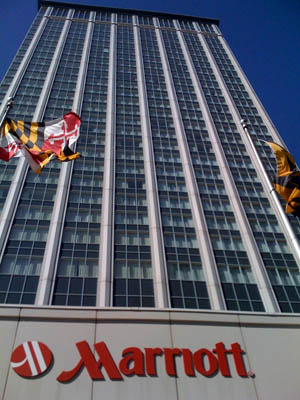
But according to U.S. Attorney Albert David Copperthite, Aboagye is believed to be part of a heroin-smuggling conspiracy that used a courier to swallow five “pellets” of the drug, which were delivered on March 14 “by natural processes” to co-conspirators at a Marriott Waterfront Hotel room (pictured) rented by Aboagye.

In all, the hotel housekeeping crew found a half-kilogram of heroin worth about $45,000 in Aboagye’s room safe and $6,200 in cash behind the counter in the bathroom. Another $4,900 was recovered from a jacket and a purse. A later search of Aboagye’s Pigtown business address turned up more heroin, some marijuana, a .40-caliber pistol registered to Aboagye, and 28 bullets in two magazines.

In open court on March 19, Aboagye’s attorney, Ivan Bates, tells U.S. District Court judge Paul Grimm that his client is not someone who should be locked up pending trial on federal drug-conspiracy charges.

“He’s a family man that is trying to be a student,” Bates says, adding that aspects of the government’s case require a “leap and a stretch” to be believable.

“He leads two lives,” the prosecutor contends. One “with his wife and children in Laurel–and they don’t know what he’s doing in Baltimore.”

Noting that the government’s contentions are as yet “untested,” and that the defense maintains that Aboagye was at the hotel “to sell a man a car”–not to engage in a drug transaction–Judge Grimm allows Aboagye to be on monitored home detention with $50,000 in unsecured bond put up by his wife.

“There are a number of factual matters that [Aboagye] intends to challenge at trial,” the judge notes.

Another Ghanian living in Elizabeth, N.J., Mohammed Marga, also was charged in the conspiracy with Aboagye. Both, according to the charging papers, were interviewed by law enforcers after their arrests, as was a woman–20-year-old Stanina Akonnor–who was initially detained with them, but later released without charges.

Whereas Aboagye denied knowledge of the recovered heroin and money, and claimed he was at the hotel to conduct a car sale, Marga told investigators that he met with Aboagye at the hotel room, where Aboagye told him to call a man named Malik to arrange a heroin sale. On March 13, Marga says, Aboagye drove him to meet and set up the transaction with Malik, who Marga described as a stocky, dreadlocked black male, about 5 feet 9 inches, driving a black Range Rover.

Once the two were arrested the next day, though, the alleged drug deal never went through. Malik was displeased, as was evident from a voicemail he left on Marga’s phone. The voicemail, the charging papers contend, “showed that Malik was upset that they did not show up to deliver the heroin and did not call him to let him know what was going on. Additionally, Malik said that he was not going to deal with them anymore.”

Aboagye’s Baltimore car business, Asco Global Company LLC, is based at 824 Washington Blvd. Its incorporation papers describe it as a “wholesale automobile/vehicle dealer” also engaged in the “import and export of general goods.” At 3:13 a.m. on Jan. 22, Aboagye was clocked by police in Howard County going 85 miles per hour in a 1991 Acura with Pennsylvania plates, heading south on I-95. He is scheduled for a March 25 trial on the resulting speeding ticket.

The Marriott Waterfront’s director of sales and marketing, Rob McCulloch, tells City Paper the hotel does “not have any official comment” on the incident. When asked if large amounts of heroin had been found at the hotel before, McCulloch says, “Not that I’m aware of.”

Straight Outta Accra: West Africa looms large in Baltimore heroin-trafficking cases

By Van Smith

Published in City Paper, May 23, 2012

Unknown-2

Last April, thousands of miles from Baltimore in the West African country of Ghana, a man known as “Wagba” got on the phone and mediated a Baltimore heroin-dealing dispute.

Nana Boateng, who supplied Baltimore dealers with heroin shipped under Wagba’s direction by couriers traveling to the United States on commercial flights leaving West Africa, was in a heated argument with another Ghanaian, Krist Koranteng, who also supplied Baltimore heroin dealers with courier-carried heroin from West Africa.

The two were threatening one another, with Koranteng saying he’d arrange for men to come from Ghana to kill Boateng if he didn’t pay up for short-changing Koranteng’s friend, Moses Appram, on a 200-gram heroin deal. Boateng, in response, vowed to come to Ghana and kill Koranteng himself.

Since Boateng’s phones were wiretapped as part of a U.S. Drug Enforcement Administration (DEA) investigation, his conversations with Wagba were recorded for posterity. As a result of the probe, Boateng, Koranteng, Appram, and three others were indicted last year in Maryland federal court for participating in a heroin conspiracy. All of them pleaded guilty except Appram, whose three-day trial in Baltimore’s federal courthouse ended on May 2 with a jury conviction. Koranteng testified as a government cooperator, and Wagba’s name, as well as the recorded, translated, and transcribed phone conversations he had with Boateng, came up often during the trial.

Ultimately, no one was killed or attacked as a result of the dispute, and Koranteng testified that he ended up taking the loss on Appram’s ill-fated deal with Boateng. But Wagba’s dealings with Boateng did not end there. In late May 2011, according to court documents, Wagba coordinated a courier shipment of heroin to Boateng, who waited for six hours at Washington Dulles International Airport as the courier, who was caught by law enforcers as she arrived with 3.3 kilograms of heroin in her luggage, was detained and questioned by authorities. At the agents’ direction, the courier called Wagba, who told her “someone would get back to her. Shortly thereafter, a call from Boateng was received” on the courier’s phone, the court documents state.

That a phantom, faraway figure like Wagba could play such an intimate role in Baltimore’s heroin trade, both by managing a street-level flap like Appram’s flimflamming at the hands of Boateng and by orchestrating a subsequent intercepted delivery, speaks volumes about how closely tied Baltimore’s heroin trade is to West Africa, even though the two are thousands of miles apart. And that Koranteng, who was in Ghana as he argued over the phone with Boateng, suggested he could send Ghanaian killers to do his dirty work in Baltimore further emphasizes how small a world the global heroin trade sometimes can be.

But when looked at from a broader perspective, the heroin trade involving West Africa can seem immense, complex, and highly geopolitical, since the region is considered by the United Nations, the United States and other countries, and an array of nongovernmental organizations to be currently one of the world’s foremost transshipment points for narcotics from Asia and Latin America.

The reason for this, DEA special agent Todd Edwards explained on the stand at Appram’s trial, is that it is “difficult” for producers to ship directly to the United States from the source countries—Afghanistan, Pakistan, Laos, Cambodia, Colombia, and Mexico—because “everyone knows” they are source countries, so law-enforcement scrutiny will be greater. Heroin producers, therefore, prefer to “go to other countries to have the heroin shipped to the U.S.,” Edwards continued, “and Africa is one of those places, and Ghana and Nigeria are two of the major ones.”

Thus, criminals in West Africa not only get lucrative narco-business serving the transportation needs of the world’s heroin producers; they may also become strategically important to the producer’s larger strategic agendas. And increasingly, the United States is presenting evidence that those agendas have turned West Africa into a key locale for terrorists’ drug-trafficking and money-laundering activities.

In 2009, the same year the DEA opened an office in Accra, Ghana, three al Qaeda-linked men from Mali were arrested in Ghana and charged by U.S. authorities with drug trafficking in aid of terrorism—the first use of a new federal law passed in 2006. West African drug trafficking is also implicated in two other terror-financing cases filed recently in New York, one involving the Taliban and the other Hezbollah, a militant Muslim group and political party based in Lebanon that the United States and a handful of other Western and Middle Eastern countries regard as a terrorist group.

The Taliban case, filed in February 2011, accuses seven men, two of them U.S. citizens, of conspiring to help the Afghan religious movement’s heroin- and cocaine-trafficking enterprises and to sell weapons, including surface-to-air missiles, that the Taliban would use to protect its heroin-processing facilities in Afghanistan from attacks by U.S. forces. The lead co-conspirator, Maroun Saade, is described in the indictment as a “narcotics trafficker operating in West Africa” who agreed to transport “multi-ton shipments of Taliban-owned heroin” to Ghana, where “portions of those shipments would be sent by commercial airplane to the United States to be sold for the financial benefit of the Taliban.” Saade and the others allegedly believed they were dealing with the Taliban, but in fact they were dealing with confidential sources working on behalf of the DEA.

The other case is a civil forfeiture suit in which the U.S. government seeks to take ownership of the assets of businesses and banks involved in an alleged half-billion-dollar drug-money-laundering scheme to aid Hezbollah.

The central drug-trafficking figure accused in the Hezbollah case is Ayman Joumaa, a Lebanese man who is currently a fugitive from U.S. justice in a Virginia federal case charging him with bringing 85,000 kilograms of cocaine into the United States and laundering more than $850 million in Mexican drug-cartel money. Saade, from the Taliban case, also figures in this case, allegedly helping to move laundered cash derived from used-car sales in West Africa to Lebanon.

Though no prosecution brought so far in Maryland has drawn connections between Baltimore heroin dealers and West Africans tied to terrorism, the Hezbollah forfeiture case in New York includes two Maryland car dealers—one in Columbia, the other in Burtonsville, a small Montgomery County town of about 10,000 people, near Laurel—whose assets are being targeted for forfeiture because of evidence they helped launder Hezbollah drug money by accepting millions of dollars in wire transfers to buy cars and ship them to West Africa, where they were sold for cash bound for Lebanon.

In essence, the 65-page Hezbollah complaint describes an alleged scheme in which drug-derived cash was temporarily converted into cars. This would eliminate the risks of detection and headaches of shipping bulk cash back across the Atlantic Ocean to West Africa. Once the cars arrive there, though, they can quickly be converted back to cash—with a profit margin, given the higher prices the cars fetch in West Africa.

Both Appram and Koranteng were in the cars-to-West-Africa business, according to evidence in Appram’s trial. So were other co-conspirators who testified at Appram’s trial, as well as defendants in several other Maryland cases involving heroin from West Africa. In each instance, there is nothing to suggest the car-shipping enterprises were anything but legitimate. The coincidence is striking, however—especially in light of the fact that Appram and Koranteng are both residents of Burtonsville, where one of the car dealers with alleged Hezbollah ties is located.

IMG_7512

Though heroin comes almost entirely from poppies grown in Asia and South America, as special agent Edwards explained during Appram’s trial, criminal trade routes of varying geography and sophistication convey it across the world. Judging by the Appram case, and numerous other recent cases in federal court here and in Virginia, law enforcers are mounting a sustained, multi-front assault on the West African route to Baltimore, especially through Ghana and Nigeria.

Commercial-air travelers entering the United States from West Africa as paid heroin couriers are a key element of the supply chain, court records show. With practice, so-called “internal smugglers” ingest “pellets”—finger-sized, egg-shaped packages of heroin—in seemingly impossible numbers. Adding to the flow are couriers who pack heroin not in their stomachs, but in their luggage, clothing, or wigs.

How much of this heroin smuggled from West Africa is bound for Baltimore’s streets is hard to say, but judging from the pace and scope of recent prosecutions, it’s significant. Here’s a chronological sampling:

Edward Aboagye, a Baltimore-based Ghanaian car dealer who exported vehicles to West Africa while enrolled as a student at Morgan State University, was charged in a heroin conspiracy, along with two others, after a half-kilogram of heroin in pellets was found in the safe of his hotel room at the Marriott Waterfront Hotel in downtown Baltimore on March 14, 2009. He pleaded guilty and testified against one of his co-conspirators, who was found guilty by a jury.

Two weeks later, Frank Aidoo, a Ghana-born Dutch citizen, was caught at Baltimore Washington International Airport (BWI) with 100 heroin pellets in his stomach; his business, according to court records, was buying clothing abroad to resell in Ghana. He pleaded guilty, but recently won an appeal of his sentence.

In January 2010, Suleiman Zakaria arrived at BWI on a flight that originated in Ghana, and three kilograms of heroin were found within the lining of his luggage. He was convicted at a jury trial after mounting a defense that included facts about his business: shipping used cars purchased in the United States to resell in Ghana.

In April 2011 in Virginia, eight people were indicted for a heroin-importation conspiracy that supplied Baltimore, along with other areas, with heroin that was brought by couriers from West Africa to the United States. Nearly all of the defendants have pleaded guilty.

In July 2011, Baltimore City Police officer Daniel Redd was among five indicted in a heroin conspiracy supplied from West Africa. One of the co-conspirators in the case, Abdul Zakaria, aka Tamim Mamah, is Suleiman Zakaria’s brother. He testified as a government cooperator at Appram’s trial, where, in explaining his work history, he said he “was buying cars and shipping them to Africa.” All five defendants in the Redd case have pleaded guilty.

Just after Christmas 2011, two men, Nana Bartels-Riverson and Awal Mohammad, were arrested on I-95 in Howard County after nearly a kilogram of heroin was found in the car they were driving. When interviewed by DEA agents, Mohammad explained that the heroin had come from Ghana via courier, and that they were taking it to Baltimore to sell to a dealer. Their case is still in court.

On Dec. 29, 2011, a wiretap investigation by DEA investigators targeting three alleged drug traffickers suspected of having couriers smuggle heroin into Maryland from Africa—Eddie Patrick, Kenneth Ukoh, and Chrisanti Ignass, who, court documents state, conducted heroin transactions at the InterContinental Harbor Court Hotel in Baltimore—culminated with an African courier in a Maryland hotel room, expelling what eventually turned out to be 80 heroin-filled condoms from his gastrointestinal tract. Their case is still in court.

In March, a Nigerian woman, Ngozi Helen Omokoh, and two Maryland men—David Shenard Merritte of Baltimore and Larry Deen Hutchinson of Prince George’s County—were charged after all three were found in a Maryland hotel room where Omokoh had delivered 725 grams of heroin pellets. Their case is still in court.

On May 3, after a 15-month wiretap investigation, the DEA arrested Joseph Osiomwan, a 51-year-old car dealer who lives in idyllic Monkton, near the posh Manor Tavern five-star restaurant, and owns Woodland Motors, a used-car dealership on Reisterstown Road in Baltimore City. He was arrested as he left an alleged stash house in Northeast Baltimore, and when the agents searched him, they found what they described in court documents as three “fingers” or “eggs” of heroin, commonly used for “heroin to be smuggled into the United States via an internal body carrier.”

One of the common themes running through the stories of the defendants in many of these West African-tied heroin cases in Maryland is that many of them are not solely drug dealers, but also pursue legitimate-looking enterprises—especially buying cars in the United States for resale in West Africa.

How illegitimate such enterprises allegedly can be is illustrated in the Taliban and Hezbollah cases filed in New York. In the absence of any such accusations involving West Africa’s heroin trade in Maryland, though, all the public can know is that people like Wagba in Ghana coordinate shipments of heroin to Baltimore and mediate street beefs—or perhaps settle them—from afar, and that the heroin couriers will continue to come, supplying Baltimore’s streets with heroin.

Special Treatment: Tracy Love’s killing snuffs out a snitch-filled Baltimore life

By Van Smith

Published in City Paper, Nov. 20, 2013

image-1

When 29-year-old Tracy Robin Love (pictured) bit the bullets in West Baltimore shortly after midnight on Nov. 9, he was nearly two years out of federal prison. How he got there—and the reason he was freed so much earlier than some of his co-defendants—says volumes about the carnage crime causes in a city whose street culture condones assassinating those who cooperate with law enforcers.

Between 2002 and 2006, the “Special” drug organization worked the area just east of where Loch Raven Road approaches Greenmount Avenue, taking in about $25,000 a day selling cocaine and heroin and protecting their enterprise with violence. As the law came down on the crew, which was headed by Melvin Gilbert, suspected snitches were shot dead in hails of bullets—including John Dowery, who, after surviving the shots he took in a 2005 hit attempt, was murdered on Thanksgiving Day in 2006 at the Kozy Korner bar on Bartlett Avenue, smack in the middle of Special territory.

Dowery had testified previously against Love and his younger half-brother, Tamall Parker, two top Special lieutenants who were on trial in state court for murdering James Wise in 2004 after Wise and an accomplice robbed their drug crew.

The Baltimore City jury didn’t convict Love and Parker—but in 2009 the two became snitches themselves, cooperating with authorities. Love testified before a federal jury against their Special co-defendants, fingering them for murder, shootings, and drug dealing.

For cooperating, Love and Parker earned an eventual return to the streets, with Love regaining his freedom in December 2011 and Parker set to follow in November 2016. Those they testified against—Gilbert and the other Special co-defendants who went to trial, James Dinkins and Darron Goods—escaped the government’s desire to put them to death but instead were sentenced to life in prison. (Gilbert, meanwhile, surfaced on wiretaps in the 2009 Drug Enforcement Administration investigation into the Black Guerrilla Family [BGF] prison gang, which recorded his cellphone conversations with BGF leader Eric Brown about corrupt correctional officer Alicia Simmons.)

Back in April 2007, photographs of Love and Parker appeared in The Atlantic magazine’s lengthy, award-winning article by Jeremy Kahn, “The Story of a Snitch.” The piece went deep into Dowery’s tragic experience, detailing how his interactions with Love and Parker ended with bloody retribution for snitching on them, and drove a national discussion prompted initially by the 2004 release of a Baltimore street-culture documentary, Stop Fucking Snitching, which advocated deadly violence to silence witnesses.

Love’s silence, like Dowery’s before him, now is permanent. Shortly after midnight on Nov. 9, detectives found him in a car on North Athol Avenue, where it separates the new Uplands housing development and Edmondson West-Side High School. He’d taken numerous shots to the head. A survivor, unidentified by police other than to confirm his name is “Allen,” took bullets in the belly.

Prior to this, Love in September had been arrested by Baltimore police and charged with trespassing, disorderly conduct, and escape. He had been scheduled to appear in federal court on Nov. 14 so a judge could review whether his charged conduct amounted to a violation of his supervised release.

U.S. probation officer Toni Duncan, though, on Oct. 22 had advised the court that Love “was found Not Guilty” of the charges, according to court records, and requested that “the pending alleged violations of supervised release be withdrawn.”

That’s the tail end of what had been an intriguing and dramatic series of events.

Love’s arrest occurred on Sept. 19 at the Madison Park North Apartments on North and Park avenues in West Baltimore, and the circumstances were described in court documents written by police officer Peter Johncox.

Johncox and two other officers were in a patrol car near the apartment complex at about 7 p.m., and “observed a large group of persons standing in the open area between the apartment buildings,” Johncox wrote. Among them, “the officers observed a light skinned black male wearing a gray jogging suit and gray hat who the officers know as Tracy Love Jr.,” and Johncox added, “Mr. Love does not live in the apartment complex.”

When Love spied the other two officers coming, he ran—around a corner and right into Johncox, who arrested him and put him in handcuffs, telling him “he was under arrest for trespassing,” Johncox wrote. Then Johncox “noticed a clear plastic bag containing various multi-colored topped vials containing white rock substance, suspected cocaine,” and when he “reached down to pick up” the drugs, Love “pulled away” and “ran.”

Johncox ran after Love, telling him to stop, but Love kept going—even as Johncox “drew his taser and fired” it at Love, but “the probes did not make contact,” so Love “continued the foot chase.”

When Johncox “was finally able to catch up to Mr. Love and drive stunned him in the torso” (“drive stun” means to hold the taser against the body, without projectiles), Love “fell to the ground where he started kicking his legs and flailing,” so Johncox “drive stunned Mr. Love again in the torso” and “was successful in taking him into custody.”

The drama did not end there, though. “Mr. Love was screaming and yelling and a large group of people began crowding around,” Johncox wrote, and as Love was escorted to a police wagon and taken away, his “yelling incited more of a crowd.”

Love was taken to the Central District, according to Johncox’s report, “where he was debriefed by homicide detectives.”

Three days later, Love made $25,000 bail and was released pending trial, when he was exonerated. Despite the drug evidence described by Johncox, Love did not face drug charges.

An unnamed source—the person asked not to be named “due to the caliber of the dudes” in the picture of Love’s life—says the mother of both Love and Parker is Mayreda Henderson, who court records confirm has shared an address with Parker in Essex, where the police say Love lived. Attempts to reach Henderson, including by leaving detailed messages on cellphones believed to be hers and a relative of hers, to ask her for comment on Love’s recent arrest and violent death were unsuccessful.

The mother of Love and Parker has been an important part of their public lives, though, as she was part of their alibi the night James Wise was killed—according to The Atlantic article, they claimed they were at their mother’s hair salon in West Baltimore, across the city from where Wise was murdered. Henderson, court records show, as recently as last year was doing business as Mayreda’s Hair and Nail Salon. It was located at 736 W. North Ave.—an address at the Madison Park North Apartments, where Love was arrested. The 45-year-old is also a federal drug convict herself, having been released in 1999 after a prison sentence for her part in a massive 1980s conspiracy headed by Tommy Lee Canty Jr.

By the time Love testified in federal court against his Special co-defendants on May 26, 2009, his and Parker’s culpability for the Wise murder was clear, exposing the falsity of their alibi. Yet, perhaps to avoid implicating his mother, while on the stand, Love would not admit it had been concocted.

“No,” Love said, according to the court transcript, when Dinkins’ attorney asked him, “You didn’t have your mother say, ‘Oh, the time Mr. Wise got killed, he was at the hair salon with me?’” When pressed, Love said, “not as I recall, no,” adding “that was a long time ago.”

During his testimony, Love also tried to limit his role in Wise’s murder, saying that he only pointed the direction Wise had run so his brother could go do the deed. This scenario, though, conflicts with the version told in The Atlantic article—that right after Wise was shot dead, “I got that motherfucker, six times in the chest,” Dowery heard Love yell down the street for all to hear, including his Special crew. “Next time, one of y’all gonna do it. I’m tired of doing this shit.”

Either way, now that someone else has done it to Love, he’ll never have to do it again.

The Game Remains The Same: Nathan “Bodie” Barksdale’s new charges ring familiar

By Van Smith

Published in City Paper, Dec. 10, 2013

Over the last half-decade or so, City Paper has done in-depth reporting about how Baltimore’s drug game is tied to heroin arriving from Africa, gangsters who double as gang interventionists, the Black Guerrilla Family (BGF) gang’s broad reach in prisons and the streets, and legendary old felons getting charged anew. Now, with federal drug-and-gun charges unsealed Nov. 26 against Nathan “Bodie” Barksdale, one man embodies all four themes.

The case involves Barksdale’s alleged dealings with co-defendant Suraj Tairu, a man with a 1990s New York conviction for helping to import heroin from Africa, and involves heroin contained in an “egg-shaped object”—a type of heroin packaging that is commonly swallowed and later excreted by so-called “internal smugglers” from Africa who bring them to the U.S. on commercial airline flights. Initially, only Tairu was charged in the case, on Sept. 12, and court documents state that he was supplying heroin to “a long-time, high ranking member of the BGF”—who, once the indictment was unsealed, was revealed to be Barksdale.

Barksdale grew up hustling in West Baltimore’s since-demolished Lexington Terrace projects in the 1970s and 1980s, and by the end of that decade he had become a local criminal legend whose violent exploits were depicted in a 2009 docu-drama project spearheaded by Kenneth Antonio “Bird” Jackson, a stevedore and strip club manager with his own outsize past in Baltimore’s drug game. The project, The Baltimore Chronicles: Legends of the Unwired, claimed Barksdale was the inspiration for Avon Barksdale, a key character on the HBO series The Wire—a claim The Wire’s co-creator David Simon rejects. Two other old school Baltimore gangsters whose identities were used to create Wire characters—Savino Braxton and Walter Lee “Stinkum” Powell, whose names were applied to characters who were enforcers for Avon Barksdale, Savino Bratton, and Anton “Stinkum” Artis—have also faced federal drug charges in recent years and are now in federal prison.

The Baltimore Sun’s reporting on Barksdale’s latest arrest revealed that he’d been working as a gang interventionist for Safe Streets, a publicly funded project managed by local nonprofits that seek to employ ex-felons to diffuse street violence before it happens. The Sun’s coverage quoted Safe Streets’ Delaino Johnson, director of the outfit’s branch in Mondawmin, as saying Barksdale “had a large impact on reducing violence in our targeted area.”

In a wide-ranging City Paper interview in 2009 for a feature about Unwired, Barksdale described how, at that time, he worked “informally” with his nephew, Dante Barksdale, a Safe Streets worker, to help stem violence among the younger generation.

“I try to keep some of them from traveling the same path I’ve traveled,” Barksdale said, noting that, “when I show up, it keeps some stuff from happening.”

Hiring ex-felons as street-violence mitigators has long been proposed and carried out, with mixed results. Radio talk-show host Marc Steiner in 2008, for instance, urged “cities, states, philanthropies, and businesses” to “spend millions” to “hire, train, and supervise hundreds of ex-felons to work in the streets with youth and families.” That year in Chicago, two anti-violence workers for the program after which Safe Streets was modeled, CeaseFire, were indicted and later pleaded guilty to drug dealing, and one of them, according to prosecutors, “promoted controlled violence among gang members in an effort to avoid subsequent and random retaliatory murders.” Also in 2008, the executive director of an anti-gang nonprofit in Los Angeles, No Guns, admitted to gun-running charges and another gang-interventionist pleaded no contest to drugs and firearms charges.

Subsequently, Safe Streets emerged in prior federal BGF cases in Maryland in 2009 and 2010. “Operation Safe Streets located in the McElderry Park and Madison East neighborhoods is controlled by the BGF, specifically Anthony Brown, aka ‘Gerimo,’” court documents in those cases state, adding that “BGF members released from prison can obtain employment from Operation Safe Streets.” Another Baltimore anti-violence nonprofit that previously had received Safe Streets funding, Communities Organized to Improve Life (COIL), employed two men who were convicted in that round of BGF cases: youth counselor Todd Andrew Duncan, who prosecutors described as the BGF’s “city-wide commander” at the time, and outreach worker Ronald “Piper” Scott.

Still, Baltimore’s Safe Streets program is credited with having stopped much bloodshed. A 2012 Johns Hopkins University evaluation of the program concluded that its workers mediated 276 incidents between July 2007 and December 2010, 88 percent of which “involved individuals with a history of violence” and three-quarters of which “involved gang members.”

Barksdale’s name emerged in the 2010 round of BGF indictments, which were investigated by the U.S. Drug Enforcement Administration. He was described in court documents as “an active BGF member” and a “B. Barksdale” was thanked in the acknowledgements section of The Black Book, a 122-page, soft-bound self-help guide published by BGF leader Eric Brown that authorities portrayed as a gang-recruitment tool whose sales helped finance the BGF.

“Hell, no!” Barksdale told City Paper at the time, when reached by phone at the number listed in the court documents and asked if he was an active BGF member. “I ain’t no motherfuckin’ member,” he says. “When I was in prison, I mean, yeah—but that was 20 years ago. I’m a filmmaker. I’m pushing 50, man. I’m too old for that. That’s for teenagers.”

In the current case, the heroin-possession charge against Barksdale and Tairu arises from their alleged interactions on June 22—when Barksdale allegedly tried to hoodwink Tairu after a police stop for a seatbelt violation resulted in the seizure of 1 ounce of heroin in the egg-shaped package. The stop occurred shortly after the two met at a Rite Aid parking lot off Martin Luther King Jr. Boulevard, court documents say, though Barksdale was not arrested. About a half-hour later, Barksdale called Tairu to explain what had happened and told Tairu that the police “took both of them.”

“Based upon that conversation,” a federal agent wrote in court papers, “I surmised that” Barksdale “had actually been in possession of two ‘eggs’ of heroin and that the second ‘egg’ was still” in Barksdale’s possession, but that he “misled Tairu into believing that both ‘eggs’ were seized.”

On Nov. 27, Barksdale pleaded not guilty to the charges, which are being prosecuted by assistant U.S. Attorney James Wallner, who handled the complex series of cases filed against the BGF in 2009 and 2010. Barksdale’s court-appointed attorney, Nicholas Vitek, declined to comment. The case was initially assigned to U.S. District Judge William Quarles, who scheduled a three-to-five-day trial starting Feb. 24, but on Dec. 6, the case was reassigned to U.S. District Judge George Levi Russell III.

Rather than life in prison, 51 months is sought for Baltimore cocaine trafficker and money launderer George Frink

By Van Smith

Published by City Paper, July 29, 2014

After being caught red-handed with kilograms of cocaine, and after bank records showed him repeatedly laundering money, prosecutors last fall said George Sylvester Frink, Jr. of Baltimore was looking at a maximum sentence of life in prison. Now, though, under the terms of a guilty-plea agreement filed on July 25, Frink is likely to get just 51 months at his sentencing hearing, scheduled for Oct. 31, for his part in a vast, sophisticated conspiracy that law enforcers say was responsible for bringing in as much as 3,000 kilograms of coke from California.

The alleged leader of the scheme in Baltimore, body builder Gerald Lamont Jones, has not been charged with any crimes. But court documents in Frink’s case and in a civil suit, in which the government seeks to take title to numerous pieces of real estate, describe Jones as a sophisticated high-volume drug trafficker and prolific money launderer whose criminal conduct remained hidden behind his legitimate business pursuits. Jones, a real-estate and construction entrepreneur, also owns a Gold’s Gym in Owings Mills and Rami Bros., a chain of Baltimore car dealerships that trades under the name Pimlico Motors. Frink, according to court records, was employed by Golds Gym and Pimlico Motors, in addition to having his own real-estate company, GSF Enterprises.

Jones and Frink came to law enforcers’ attention as a result of a high-volume California coke-conspiracy case with glitzy Hollywood ties involving Baltimore natives Charles Dwight Ransom, Jr., Darrin Ebron, Ricky James Brascom, and others, who used private jets to move drugs and money across the country. Indicted in 2011, the case resulted in convictions for all three Baltimoreans, though Ransom is not yet sentenced, while the conspiracy’s alleged leader – Heriberto “Eddie” Lopez, with whom law enforcers say Jones had dealings – remains a fugitive.

Since Frink’s arrest last fall, when he was found with 14 kilograms of cocaine in front of Jones’ Pikesville office, Pimlico Motors has fallen into hard times financially, being sued successfully by a bank, while some of Jones’ real estate, including 141 acres of land in Reisterstown that is one of the assets the federal government is seeking to forfeit, has fallen into foreclosure. Frink, meanwhile, on July 14 filed for bankruptcy protection, listing nearly $500,000 in assets and nearly $1.2 million in liabilities.

Jones and the government have been engaged in settlement discussions in the forfeiture case, according to July 16 letter filed in court by assistant U.S. attorney Richard Kay, who wrote that “our discussions are now including criminal implications and a potential global resolution.” In other words, charges against Jones may still be coming.

Frink’s case, though, has been resolved already. Among the factors weighing for his light treatment is the U.S. Department of Justice’s support of anticipated changes to federal drug-sentencing guidelines by the United States Sentencing Commission, which are expected to result in the early release of tens of thousands of federal inmates around the country in coming years. The Maryland U.S. Attorney’s Office in recent months has been agreeing not to oppose downward departures from the sentencing guidelines for drug defendants, including Frink, based on how the guidelines are expected to change.

To get a sense of how lenient Frink’s anticipated punishment is, consider how some repeat low-level drug-offenders have been treated in federal court in Maryland. One, Barry Green — a low-level, non-violent repeat drug offender in Baltimore — in 2011 got more than a dozen years in prison for possessing three vials of cocaine and $214 in cash. While Green was a hand-to-hand dealer in the streets of Baltimore, Frink was caught up in a sophisticated, cross-country conspiracy involving the movement of hundreds of kilos of coke and millions of dollars in cash in airplanes and trucks.  While Frink’s admitted role was a fraction of the overall scheme — he’s copped to 14 kilograms of coke and laundering nearly $100,000 — his punishment is likely to be a fraction of Green’s.