Friends of Milton Tillman Jr.: Raided Businessman’s Political Beneficiaries Discuss Donations

By Van Smith

Published in City Paper, Aug. 27, 2008

“I know of him, but I don’t know him,” Keiffer Mitchell Jr., former Baltimore city councilman and 2007 mayoral candidate, says when asked about Milton Tillman Jr., the Baltimore bondsman and real-estate investor whose business interests were targeted in Aug. 18 federal law-enforcement raids at seven Baltimore locations. Mitchell’s 2007 campaign last August received a total of $1,000 from Tillman Jr.’s companies–$500 each from 4 Aces Bail Bonds and New Trend Development. Mitchell acknowledges that his family–a political dynasty that includes civil-rights pioneers and U.S. congressmen–goes way back with Tillman Jr. While he doesn’t know him, he says he’s “appreciative of his campaign contribution.”

Mitchell is nonplussed with the idea that it might look bad politically to have received political donations from a man with two federal convictions in his background, and who now, along with his son Milton Tillman III, is being targeted again. “There were members of my family who were convicted and sent to jail,” Mitchell points out during the Aug. 21 phone interview, referring to Clarence Mitchell III and Michael Mitchell, both former elected officials who fell from grace in the 1980s. “Do I kick them out?” he asks, adding that his ex-con cousins “worked on my campaign.”

Altogether, 13 Maryland politicians gathered $8,250 from three Tillman companies since 2001. Most politicians contacted about the donations they received from Tillman enterprises are not as candid as Mitchell. Many of them–state Del. Talmadge Branch (D-45st District), state Sen. Nathaniel McFadden (D-45th District), former Baltimore City Council President Lawrence Bell (D), and former Baltimore City State’s Attorney Stuart Simms (D), who ran for Maryland attorney general in 2006–did not respond to inquiries at all.

Henry Fawell, spokesman for former Gov. Robert Ehrlich (R), writes in an e-mail that “we’ll decline to comment.” Baltimore County Executive Jim Smith couldn’t respond due to illness. A returned phone call from Baltimore City Councilwoman Belinda Conaway (D-7th District) was missed. Baltimore County Circuit Court Associate Judge Mickey Norman spoke to City Paper in April (“Grave Accusations,” Mobtown Beat, April 23), explaining that judicial campaigns are set up to buffer the candidate from knowledge of donors, so he was not aware of the donation from Tillman Jr. State Comptroller Peter Franchot’s campaign spokesman, Tim Daly, says the campaign will be returning Tillman’s money. “We just felt it was the right thing to do,” Daly says.

Two of Tillman Jr.’s beneficiaries–state Sen. Catherine Pugh (D-40th District) and former state Del. Salima Siler Marriott, who is now a Baltimore City deputy mayor–claim never before to have heard the Milton Tillman name. “Nope,” Pugh says repeatedly when asked if she knew him, his name, or anything about him, insisting that “I’ve never heard of him.” Marriott did not return messages for this article, but in April she told City Paper she, too, had never heard of Tillman (“Grave Accusations”).

One recipient of Tillman campaign money is Baltimore City Councilman Bernard “Jack” Young (D-12th District), who is not shy about knowing Tillman Jr. “We grew up in the same community, East Baltimore,” Young explains. “He’s a nice guy.” Asked about indications that Tillman Jr. is tied to the drug trade, Young says, “I’ve heard about the drug allegations before. Any response I make, the government can come after me. So I have no comment.”

Additional reporting by Jeffrey Anderson

Milton’s Till: Donations From Tillman Family Companies to Political Figures

Aug. 23, 2006: $1,000 from Xpress Bail Bonds, to Lawrence Bell (D), former Baltimore City Council President, 1999 candidate for Baltimore Mayor

June 16, 2006: $1,200 from 4 Aces Bail Bonds, to Talmadge Branch, D-45th District, House of Delegates, Majority Whip

Nov. 6, 2007: $100 from 4 Aces Bail Bonds, to Belinda Conaway, D-7th District, Baltimore City Council

Aug. 26, 2002: $500 from 4 Aces Bail Bonds, to Robert Ehrlich (R), former Maryland Governor

Jan. 8, 2008: $1,000 from 4 Aces Bail Bonds, to Peter Franchot (D), Maryland Comptroller

July 29, 2006: $500 from 4 Aces Bail Bonds, to Salima Siler Marriott (D), Baltimore Deputy Mayor, former 40th District Delegate

Jan. 4, 2008: $500 from 4 Aces Bail Bonds, to Nathaniel McFadden, D-45th District, Maryland Senate

Aug. 23, 2007: $1,000 from 4 Aces Bail Bonds ($500) and New Trend Development ($500), to Keiffer Mitchell Jr. (D), former Baltimore City Councilman, 2007 candidate for Baltimore Mayor

March 1, 2005: $500 from 4 Aces Bail Bonds, to Mickey Norman, Baltimore County Circuit Court Associate Judge

Aug. 22, 2003: $250 from 4 Aces Bail Bonds, to Catherine Pugh, D-40th District, Maryland Senate

May 4, 2006: $500 from New Trend Development, to Stuart Simms (D), former Baltimore State’s Attorney, 2006 candidate Maryland Attorney General

July 27, 2004: $1,000 from New Trend Development, to Jim Smith (D), Baltimore County Executive

Sept. 6, 2001: $200 from 4 Aces Bail Bonds, to Bernard “Jack” Young, D-12th District, Baltimore City Council

Wired: Alleged Drug-World Figures Tied to Local Politics

By Van Smith

Published in City Paper, Mar. 2, 2005

Anthony B. Leonard’s Downtown Southern Blues restaurant on North Howard Street’s Antique Row had a meteoric run starting in 2002, drawing a clientele of local notables, including many in politics. But today, the Howard Street location is closed, and Leonard and his restaurant businesses (Leonard’s Southern Blues carry-out in Randallstown remains open) are allegedly part of a violent drug conspiracy called the Rice Organization, which prosecutors say operated in Baltimore for the past decade. The federal trial in the case is scheduled for next January.

Shades of politics color the background of the Rice Organization case, but they are not spelled out in the 41-page indictment, which was made public on Feb. 2. In fact, very little detail is revealed in that document, other than names and some addresses associated with those charged. From campaign-finance and other public records, though, it’s clear that Leonard, Downtown Southern Blues, and at least two other Rice Organization defendants played the political game, and, in Leonard’s case, entered it on the heels of an earlier chapter in Baltimore’s history of overlapping political and drug-world cultures.

That earlier chapter centered on Leonard’s Howard Street landlord, K.A.J. Enterprises, Kenneth Antonio Jackson’s family company. Jackson is an ex-con strip-club owner whose drug-world past has made his political activities controversial. This time, though, the political dealings of Leonard and others allegedly involved in the Rice Organization occurred while prosecutors say they were running drugs.

The indictment claims that 35-year-old Leonard and his 12 co-defendants, including brothers Howard and Raeshio Rice, ages 38 and 32, raked in $27 million as they distributed more than 3,000 pounds of cocaine and heroin to Baltimore’s streets since 1995. Other co-conspirators include 30-year-old George Butler, a character from the now-infamous Stop Fucking Snitching DVD, which warns viewers against cooperating with law enforcement, and Chet Pajardo, 36, co-owner with movie actress Jada Pinkett Smith of an East Baltimore corner-store property (“Star Crossed,” Mobtown Beat, Feb. 16). The federal government seeks forfeiture of defendants’ assets, including vehicles, the Pajardo-Pinkett property, other real estate, and whatever is left of Leonard’s two restaurant businesses.

The Rice Organization allegations make the political ties of Leonard, Downtown Southern Blues, Pajardo, and 26-year-old co-defendant Eric Clash symbols of how the drug economy is embedded in modern civic life. When Downtown Southern Blues sought a liquor license in 2002, then-state Sen. Clarence Mitchell IV (D-44th District) and former state senator Larry Young (D-44th District) were copied on administrative correspondence. Shortly after the restaurant opened that year, political business came its way. The financial details show only that political money changed hands in ’02 and ’03 involving businesses and people who only recently were accused of being part of the Rice Organization. There is nothing to suggest that any of the parties to the transactions have any other links to the drug world. Here the are details:

> In ’02 Antonio Hayes, the legislative-affairs director for City Council President Sheila Dixon (D), ran and lost in the race for the 40th District Democratic State Central Committee seat; he spent $1,200 on a June 2002 fund raiser at Downtown Southern Blues.

> Democrats for Ehrlich, a campaign committee supporting then-Republican Congressman Robert Ehrlich’s successful 2002 bid for governor, spent $4,000 at Downtown Southern Blues in November of that year for a post-victory reception in honor of Ehrlich’s running mate, Michael Steele.

> In 2002, Leonard and the restaurant made donations to the campaign committees of Mitchell ($250) and Rodney Orange Sr. ($200), the former head of the NAACP’s Baltimore chapter. Mitchell and Orange were running primary campaigns for senator and delegate, respectively, for the West Baltimore’s 44th District. Orange’s campaign also received $80 from Eric Clash. Mitchell and Orange both lost.

> In 2003, the campaign of City Comptroller Joan Pratt, who was running uncontested in the city’s Democratic primary, spent $2,200 on catering from Downtown Southern Blues. Pratt’s campaign also received $200 from Pajardo. The committee of then-City Councilwoman Catherine Pugh (D), who was mounting an unsuccessful campaign to unseat council President Sheila Dixon (D), spent $600 on a party for Larry Young at Downtown Southern Blues.

> Also in 2003, Pajardo donated $100 to the campaign of Democrat Charese Williams, who challenged incumbent City Councilwoman Stephanie Rawlings Blake (D-6th District) and lost in the September 2003 primary.

In a Feb. 28 phone call with City Paper, Rodney Orange Sr. said Leonard and Clash are related to him—they are both second cousins, he explained—so he is not surprised that they donated to his campaign in 2002. At the time of the donations, he continued, “there was no knowledge on my part of any activity on their part that was illegal.” Hayes said he’d booked his fundraiser with Downtown Southern Blues’ predecessor, Britton’s, and he went ahead with the scheduled event anyway. “Fortunately,” he added, “he didn’t contribute to my campaign.”

The other politicians or campaigns whose ties are disclosed above could not be reached for comment by press time.

By 2002, when Leonard leased the space for Downtown Southern Blues from K.A.J. Enterprises, the property’s ties to 47-year-old Kenny “Bird” Jackson were already well known. From 2001 until Leonard took over, the location was used by another Jackson-related company, Universal LLC, to house Britton’s, a restaurant where politicians spent nearly $1,500 in ’01 and ’02 combined, according to state campaign-finance reports. The manager of Britton’s, James Britton, owns Class Act Catering, which has gotten $120,000 worth of business from Maryland political committees since 1999. Britton, like Jackson, earned a drug-related criminal record when he was younger: He pled guilty in 1983 to pot and handgun charges in Baltimore city.

Jackson’s days in the drug business in the 1980s were summed up by The Wire producer David Simon, a former newspaper reporter, in a 1987 Sun series about a famous Baltimore drug trafficker, “Little” Melvin Williams.

“Wholesale exchanges of narcotics were carefully controlled, according to detectives,” Simon wrote, “with Williams represented by tested lieutenants such as Glen Hawkins or Kenny ‘Bird’ Jackson—men identified in court papers as Williams’ most trusted surrogates, men who allegedly had the authority and knowledge to carry large amounts of cash and make purchases without being cheated. The loyalty of such lieutenants was unquestioned.”

Jackson’s convictions in 1978 (manslaughter), 1979 (resisting arrest), and 1984 (a gun charge) were accompanied by dozens of other criminal charges in numerous jurisdictions that didn’t stick. In 1992, Jackson faced bribery charges in New Jersey, but pleaded down to one count of giving false information to a state trooper who had stopped him with nearly $700,000 in cash in his car. Meanwhile, Jackson sought to establish himself as a legitimate manager of his family’s strip club, the Eldorado Lounge, and as an accepted figure in the city’s political circles. In 1995, Jackson was a major backer of a short-lived political-action committee called A Piece of J.U.I.C.E., which was run by one of Orange’s sons. A Piece of J.U.I.C.E., which sought to give political voice to inner-city residents, made a total of $8,000 in contributions to city candidates in 1995, including Pratt, Dixon, Orange, and then-Mayor Kurt L. Schmoke (D).

Later, after the 1999 city elections, as the city’s plans for redeveloping the west side of downtown forced the Eldorado to move, Jackson’s contributions to politicians again became a public issue. Dixon got $2,500 and Mayor Martin O’Malley (D), ducking controversy, returned $2,000 he’d received from Jackson’s mother, Rosalie Jackson. In 1999, Jackson had former governor Marvin Mandel represent him in a paternity case, a measure of Jackson’s access to politically connected help. Meanwhile, donations from Jackson and those tied to him continued at the federal level. In 1999, Rosalie Jackson gave $1,000 to then-Vice President Al Gore’s committee in the 2000 Democratic presidential primary. More recently, in 2003, Kenneth Jackson gave $500 to the National Republican Congressional Committee. And in 2004 Universal LLC, which operated Britton’s, donated $250 to Lt. Gov. Steele’s campaign.

Leonard, in his 2002 city liquor-license application to fill the vacancy left by the closing of Britton’s, wrote that he had been self-employed since 1999, and had previously worked from ’95 to ’99 at the Starlite Lounge, a West Baltimore bar. The sources of funds for starting Downtown Southern Blues were disclosed as proceeds from the Southern Blues carry-out in Randallstown and from Raphael Barber Shop, also in Randallstown Plaza. The purchase price for the restaurant was $350,000, with $3,394-per-month payments to K.A.J. Enterprises. Under Leonard’s proprietorship, violence struck at Downtown Southern Blues in October 2003, when an argument that started in the restaurant spilled outside, resulting in four men shot and another stabbed. Today, a new restaurant called Gambrino’s of Spain is preparing to open up there, with owners who moved here recently from Elizabeth, N.J., and a letter in the files on the property kept by the Baltimore Board of Liquor License Commissioners indicates that K.A.J. Enterprises is considering selling building.

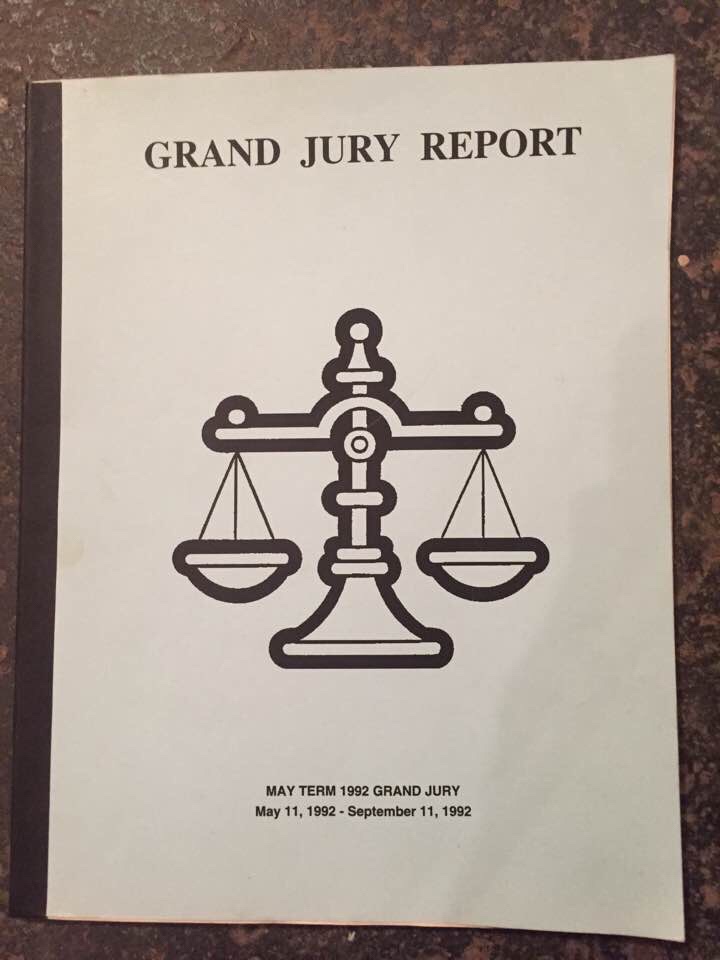
Hung Jury: Circuit Court Expunges Controversial 1992 Grand-Jury Report

By Van Smith

Published in City Paper, June 5, 1996

The report of the May Term 1992 Baltimore City Grand Jury, which called for a state investigation of the city police department and the state’s attorney’s office after alleging “gross misconduct” on the part of members of both agencies, was expunged by order of Circuit Court Judge Edward Angeletti January 18. The order was signed without a hearing because no opposition to the expungement petition was filed with the court. The outcome of the proceeding in January drew little public notice, even from people involved in the jury process.

State Department of Juvenile Justice Secretary Stuart Simms, who was the Baltimore City state’s attorney when the grand jury issued its report in March 1993, teamed up with current city State’s Attorney Patricia Jessamyn to enter the expungement petition last November. Angeles, who was assigned the case by Circuit Court Administrative Judge Joseph H.H. Kaplan, concluded that the grand jury, in violation of its common-law authority, “exceeded its powers” by criticizing the local criminal-justice establishment without handing down indictments.

The 23-member grand jury found that the evidence produced during its six-month investigation (including testimony from 50 law-enforcement officials and prosecutors) “clearly demonstrates a hands-off approach when the targets were certain well-connected members of the community … . There is an organized structured effort of some present and former members of each agency to perpetuate the protection of a select few to further obvious illicit gains.” A follow-up probe by the state prosecutor’s office determined that the allegations were “unsubstantiated.”

The report specifically mentioned Simms in connection with some of its corruption allegations, according to Angeletti’s decision. A sealed version of the report, which was submitted to Kaplan in early 1993, named individuals targeted by the grand jury. The publicly released version, though, was purged of names, including Simms’. Angeletti says the expungement order calls for an effort to recover and destroy copies of the report.

The jury, which was asked by Circuit Court Judge Kenneth Lavon Johnson to look into why Baltimore’s  “war on drugs” wasn’t working, unleashed a litany of scathing criticisms in its report. It claimed that the police department’s rotation policy, in which officers are reassigned to other police units, was used to thwart criminal investigations; it noted a pattern of investigations halted by the upper echelons of the police department and the state’s attorney’s office; it alleged there was abuse of the police overtime-pay system and that there were racially discriminatory employment practices; and it claimed the police department mismanaged its criminal investigation division’s drug-enforcment section (CID-DES), which was said to operate “on its own terms with little control or direction.”

Furthermore, the grand-jury report criticized the police department brass for failing to recognize or try to stop the advance of New York drug organizations into Baltimore. And it said “contempt” and “resistance” was displayed by the state’s attorney’s office while the grand-jury investigation was conducted.

The jury made several recommendations based on its findings, including that a special prosecutor investigate the police department and the state’s attorney’s office. The jury asked that a prosecutor look into several particular allegations: selective enforcement and prosecution to protect well-connected people and drug activity in particular geographic areas; abuse and misappropriation of police overtime funds, and discriminatory police employment practices. It also called for an independent audit of the police department’s budget, focusing specifically on the fiscal accounts of CID-DES, and the jury concluded that drug drug-enforcement-section supervisors should be reassigned. Finally, the jury suggested that the police department invest in a computer-networking system and a centralized database.

State Prosecutor Stephen Montanarelli conducted the recommended investigation. In his August 1994 final report, he wrote that “the allegations in the report have been found to be unsubstantiated. We hope that whatever damage has been done to the reputation of innocent persons has been repaired to some extent.”

In his decision, Angeletti argued that, because Montanarelli’s investigation found that the grand jury leveled unsubstantiated accusations without indictments, the officials named in the report had “no procedural safeguards to protect against loss of reputation.” To correct this, Angeletti expunged both versions of the grand jury’s report.

Simms vehemently attacked the grand jury’s work after its report was released in March 1993. He called the report “amateurish” and, in a letter published in The Sun, its process “flawed,” and its judge “misinformed.” The jury’s allegations came just as Simms was said to be on the Clinton Administration’s short list of a high-level position with the U.S. Justice Department, according to press accounts. He didn’t get the job, and nearly two years later he was appointed by Governor Parris Glendening to head the newly renamed Department of Juvenile Justice. Repeated calls from City Paper to Simms for comment on the expungement went unanswered.

Judge Johnson had no comment on the report’s expungement. Robert Massey, the foreperson of the grand jury that released the report, says he didn’t know that expungement proceedings had been initiated, but he’s not surprised the courts are quashing the report. He says he doesn’t understand the point of expungement, though.

“I don’t really see how once something has been released to the public, it can be expunged,” Massey says, pointing out that the jury’s findings were debated in the press for months after the report was issued. He says the report was “all over the place” and “a lot of tangential things” were included in it. “If anything was ever going to happen with it, it would have happened before now,” he concludes.

Montanarelli was not available to comment on the expungement order. Another prosecutor from his office, Jim Cabezas, explains that “commenting about the expungement would violate the spirit of the expungement” order.

City Council member Martin O’Malley (D-Third District), who, as a member of the council’s public-safety committee watched the grand jury’s activities closely, says he believes the report may have implicated some people unfairly but that Judge Johnson’s charge was “courageous” and “raised very relevant issues.”

“When you don’t have prosecution of corruption [in Baltimore] that you do have in other cities on the East Coast,” O’Malley says, “… it make you wonder, especially as the [drug-crime] problem continues to worsen. The problem is that there is a hell of a lot of discretion within the police department and the state’s attorney’s office, so we should be extra vigilant in making sure it isn’t abused.”

Out of Reach: The Black Guerrilla Family Gang Aimed to Show a Way Out of the Criminal Lifestyle – Until Its Criminal Activities Brought It Down

By Van Smith

Published in City Paper, Feb. 15, 2012

IMG_7394

“It’s hard to promote black nationalism when you have a black man in the White House,” Thomas Bailey said on Jan. 6, 2009, weeks before Barack Obama was sworn in as the first African-American President of the United States. Bailey, a Maryland inmate serving life for murder, couldn’t have known at the time how prophetic his words were, or that they would end up memorialized in court documents.

As Obama was moving into the White House, court documents show that federal investigators with the U.S. Drug Enforcement Agency in Maryland—a unit dubbed the Special Investigations Group (DEA-SIG)—were kicking into gear a sprawling probe of the Black Guerrilla Family (BGF), the black-nationalist prison gang for which Bailey ran “the day-to-day operations” at North Branch Correctional Institution (NBCI), a maximum-security prison near Cumberland.

When Bailey uttered those prescient words, he was talking over a prison phone at NBCI with Eric Marcell Brown (“Eric Marcell Brown,” Mobtown beat, May 7, 2009), who was on a cell phone at the Maryland Transition Center (MTC), a correctional facility in Baltimore, where Brown was close to finishing a lengthy prison stint for a 1992 drug-dealing conviction. Brown, DEA-SIG investigators wrote in court documents, was “in command of day-to-day operations” in Maryland for the BGF, a national prison gang founded in California in the 1960s by inmate/radical George Jackson, a Black Panther Party member who espoused the black-nationalist view that African-Americans needed to build separate economic and social structures for themselves.

Numerous conversations between Bailey and Brown were intercepted by DEA-SIG, unbeknownst to them at the time, and they show that the two, and their many BGF comrades, seemed to have a genuine desire to promote a better, less violent, more productive path for ex-cons and street hustlers. They weren’t the first. Jackson’s ideas were wrapped up with the Panthers’, and few would question that at least some of their intentions were good. It was their tactics and internal contradictions—along with the machinations of law enforcers—that quashed their ambitions. The same, it now appears, could be said of the BGF in Maryland.

As the DEA-SIG’s probe began in late 2008, Eric Brown had already established himself as a soon-to-be-released inmate prepped to become a force for economic and social good, both in prisons and on the streets.

Brown and his wife, Deitra Davenport (“Deitra Davenport,” Mobtown Beat, May 27, 2009), had started a nonprofit, Harambee Jamaa Inc., “to improve the lives of our people who are living under sub standard conditions here in Baltimore” and “to educate, invigorate and liberate our people from poverty, crime, and prison,” according to its incorporation papers. They had formed DeeDat Publishing Inc., which had printed and distributed The Black Book: Empowering Black Families and Communities, a “living policy book” intended to serve as “a deterrent to continued criminal behavior and prison recidivism.”

The Black Book condemned drug dealing as “genocide” and “chemical warfare,” and promoted a vision for “Jamaa”—the Swahili word for “family,” which The Black Bookuses to refer to the BGF—to build “legitimate and organized ventures” and to “establish Jamaa in a positive light in the prison system and in the streets.”

The rhetoric was persuasive. The Black Book’s back cover featured glowing blurbs from Andrey Bundley, a Baltimore City Public Schools administrator and two-time mayoral candidate; two Anne Arundel Community College professors; former FBI agents Tyrone Powers and Leslie Parker Blyther; Bridget Alston-Smith, executive director of the nonprofit Partners in Progress, which works with at-risk children in Baltimore City’s public schools; and Michael Curtis Jones, an author and youth counselor based in Washington, D.C.

“Kudos, to Eric Brown (E.B.) for not accepting the unhealthy traditions of street organizations aka gangs,” Bundley’s blurb stated. “He has availed his leadership capacity in Jamaa to guide his comrades toward truth, justice, freedom and equality.” Blyther’s blurb called Brown “an extraordinary human” who “deserves our respect,” and said that “what he has to say” is “life changing!”

But DEA-SIG’s success torpedoed the love-fest. Scores of Bailey’s “comrades”—the term BGF members use to address one another—would plead guilty to a host of federal charges brought in 2009 (“Black-Booked,” Feature, Aug. 5, 2009) and 2010 (“Round Two,” Mobtown Beat, April 28, 2010), including racketeering, heroin trafficking, extortion, assault, money laundering, and smuggling contraband into prison. Those convicted include inmates (though not Bailey, who, like many of the investigation’s targets, ultimately wasn’t charged), prison personnel, and previously law-abiding citizens.

The presence of prison staff in the scheme prompted City Paper to look at the issue of corrupt correctional officers in Maryland, in connection both with the BGF and other gangs (“Inside Job,” Feature, May 12, 2010), but there were other defendants with legitimate-looking careers. Todd Duncan was a gang-interventionist for a government-funded nonprofit (“Inside Out,” Mobtown Beat, April 14, 2010). Rainbow Williams was a youth mentor for Baltimore City Public Schools students (“Rainbow Lee Williams,” Mobtown Beat, May 1, 2009). Kimberly McIntosh was a health care worker (“Health Care Worker Accused,” Mobtown Beat, April 16, 2010). Tomeka Harris was a mortgage broker (“Day of Reckoning,” Mobtown Beat, Dec. 22, 2010). And Calvin Robinson was a Baltimore City wastewater worker with a clothing boutique (“Calvin Renard Robinson,” Mobtown Beat, June 10, 2009).

In all, as much as City Paper could determine from federal court records, 40 people were charged in connection with the probe, and at least 28 of them—maybe more; the court docket is vague on the fates of some defendants—have pleaded guilty so far. According to a Jan. 12 press release issued by the Maryland U.S. Attorney’s Office, “all the indicted high ranking members of BGF, and their associates, including four employees of state prisons, have pleaded guilty to charges relating to their BGF activities.”

In reality, the problem for Bailey and the BGF was not “a black man in the White House.” It was their hubris and hypocrisy in promoting themselves as a legitimate alternative to the criminal lifestyle, when, in reality, they were committing crimes like any other prison gang. And they got caught.

Though Brown and his BGF comrades claimed to be engaging potential re-offenders in an effort to set them on a more productive path in life, court documents show they were, in fact, engaged with a who’s-who in Baltimore’s underworld as they carried on like common gangsters.

“You are trying to do good,” explains a BGF member who wasn’t charged as a result of DEA-SIG’s investigation, but who knows many of the now convicted BGF leaders and members well, “but you are doing so much fucked-up shit at the same time.” The member, who asked that his real name not be published (in this article, he’ll be called Sam) so that he could speak freely and stay safe from retribution, identifies what may be the BGF’s central contradiction: “You [can’t] tell people about uplifting your people but you’re one of the biggest drug dealers around. There’s no gray area in the struggle. You’re either in it, or you’re not. You can’t say you’re a revolutionary and you’re in the struggle, but you’re a dope-slinging, gangbanging, shooting motherfucker. That ain’t what the struggle is about.”


Because there was no trial in the prosecution of the BGF racketeering probe, the full scope of the evidence that yielded the long cascade of guilty pleas is not publicly available. What is available, though, is abundant. DEA-SIG’s affidavits supporting search warrants and wiretap orders provide hundreds of pages of detailed information about what the investigators were finding. A host of them, attached to a motion filed in the case last year by Assistant U.S. Attorney James Wallner, show that investigators linked BGF leaders—especially its main heroin trafficker, Kevin Glasscho, who has prior convictions for murder, handgun possession, and drug trafficking—to a roster of suspected and convicted drug traffickers, some of whom have been the focus of City Paper articles in recent years.

Glasscho ended up on DEA-SIG’s radar thanks to a confidential informant, identified in court documents as “CS1” and described as a BGF member incarcerated at NBCI. On March 3, 2009, CS1 told the investigators that Glasscho “is a major Baltimore drug trafficker and a drug-trafficking associate of Melvin Williams, a/k/a ‘Little Melvin,’ a notorious convicted drug dealer from Baltimore who is now back on the streets of Baltimore.”

Williams is a legendary figure in Baltimore, and his alleged ties to Glasscho add perspective to the extent of the BGF’s reach in the city’s streets—as well as its affinity to people who suffer their own contradictions.

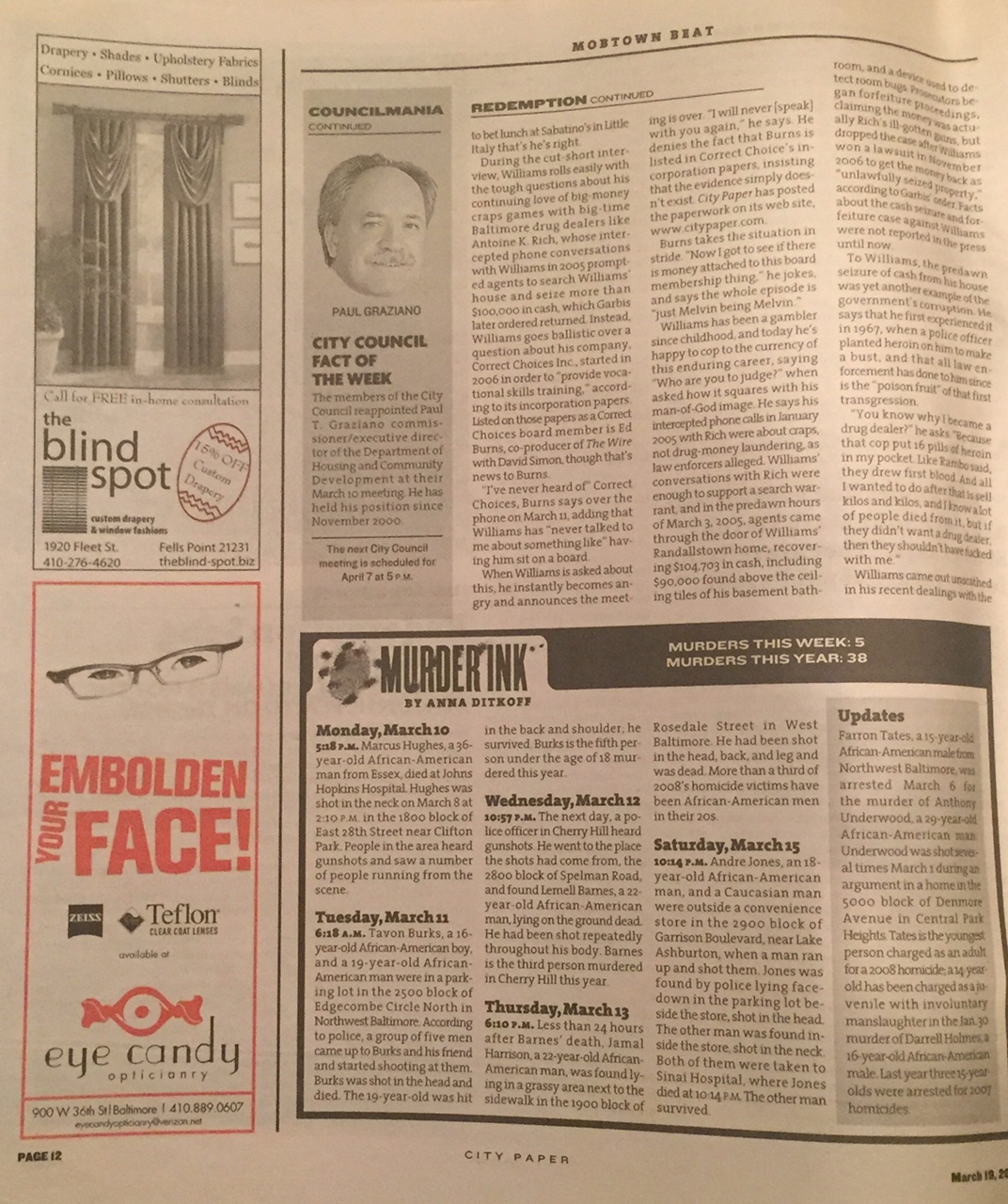
Williams had an acting role in the HBO series The Wire, playing a church deacon who tries to draw hustlers out of “the game.” In real life, he served a lengthy federal prison sentence, starting in the 1980s, for bringing heroin to the streets of Baltimore in bulk. He says he put his gangster ways behind him in 1996, when God appeared to him in a vision (“Little Melvin’s Holiday,” The Nose, Jan. 22, 2003). After his release from prison, he became a bail bondsman, and in 2000 was convicted of possessing a firearm, but his 22-year sentence for that crime was reduced in 2003 to time served, courtesy of U.S. District Judge Marvin Garbis. In 2005, Williams’ house in Randallstown was raided after investigators intercepted phone conversations he’d had with Antoine K. Rich, a major Baltimore drug trafficker with whom Williams claimed to play high-stakes craps (“Redemption Song and Dance,” Mobtown Beat, March 19, 2008). The raid turned up more than $100,000 in cash, including $90,000 stashed in the ceiling of his basement bathroom. Ultimately, though, Garbis in 2006 ordered the money returned to Williams, calling it “unlawfully seized property.”

Two days before CS1 described Glasscho’s alleged relationship with Little Melvin Williams, investigators intercepted a phone conversation between Eric Brown and Glasscho. According to the affidavits, the two discussed the then recent murder of Frederick Jeffrey Archer, a 68-year-old who had been stabbed and bludgeoned with a brick inside a Harlem Park apartment complex for senior citizens. They referred to Archer as “Archie,” and talked about how “Melvin”—a reference to Williams, according to DEA-SIG—was upset about the murder, because Archer had been a “close associate” of his. They agreed that Glasscho, who was already investigating the murder, would handle the punishment. In another call later the same day, Brown told Davenport that “when they find out who did it, I know they going to torture his ass. That whole West Baltimore love old man Archie, boy.”

(Baltimore police say the murder of Archer, who in 2002 was charged in a cocaine and heroin conspiracy and received a three-year federal prison sentence, remains unsolved.)

During their conversation, according to the affidavit, Glasscho also told Brown that “Melvin want some trees. I got to get him some damn trees.”

“Some what?” Brown asked.

“Trees,” Glasscho responded.

“What the hell is that?” Brown asked.

“That weed shit,” Glasscho said.

“Oh, oh, oh, the trees,” Brown said.

The DEA-SIG investigators believed the two were referring to Little Melvin Williams, according to court documents.

When City Paper told Williams over the phone about how he was described in the affidavit, and what Glasscho and Brown had said while DEA-SIG was listening in, he said, “I don’t have a clue who Glasscho is, and you do what you want to do” with the information. Asked if he knew Archer, Williams said, “I don’t know none of these people. Whatever the U.S. attorney wants to do they can go ahead and do. I’m through with this.” After a short pause, he hung up the phone.


DEA-SIG’s probe into Glasscho’s criminal activities monitored his phones to develop evidence tying him to 27 people who had figured in DEA investigations in recent years. Investigators came up with this list of people by tracking back which phones his phones had called, and which phones those phones had called, thereby mapping a network of contacts linked to Glasscho.

Perhaps Glasscho was working his network in order to draw them into BGF’s path of greater legitimacy, or perhaps he was leveraging his high-level criminal contacts in order to boost the gang’s standing as a drug-trafficking enterprise. Either way, the picture that emerges from this list is that the BGF was fully embedded with Baltimore’s underworld on the streets.

Some of those named in the affidavit have no record of being charged with crimes, though many have been convicted in federal court. Among the latter are:

• Sherman Kemp, who made an appearance in the famous Stop Fucking Snitching DVD (“Skinny Suge Presents Stop Fucking Snitching Vol. 1,” Film, Jan. 19, 2005). Kemp pleaded guilty in Maryland in 2008 to federal cocaine and firearms charges, receiving 180 months in prison (“Return Flight,” Mobtown Beat, Dec. 24, 2008), and in 2010 in Pennsylvania, after a months-long jury trial, he was found guilty for his part in the massive Phillips Cocaine Organization conspiracy, and received a 30-year federal prison sentence.

• David Funderburk, a co-defendant in Frederick Archer’s 2002 coke and heroin case. Funderburk’s bail documents were found in bailbondsman and stevedore Milton Tillman Jr.’s car (“Another Tillman Court Document Comes Available,” The News Hole, Aug. 28, 2008) during the high-profile 2008 federal raids that led to Tillman’s indictment on tax and fraud charges (“Milton Tillman and Son Indicted in Bailbonds Conspiracy,” The News Hole, March 17, 2010), to which he has since pleaded guilty.

• James Henderson, who in 2008 was sentenced to five years in federal prison for his part in a heroin conspiracy centered at Fat Cats Variety (“All the Emperor’s Men,”Mobtown Beat, Aug. 27, 2008) in Southwest Baltimore, a business that was co-owned by one of Tillman Jr.’s bailbonds agents.

• Duane Truesdale, a co-defendant in 1990 with Savino Braxton (“The Wire Meets Baltimore Reality, Redux,” Mobtown Beat, Sept. 10, 2009) in the legendary Baltimore heroin conspiracy headed by Linwood Rudolph Williams.

• David Zellars, who last year was sentenced to 70 months in federal prison for his part in a large cocaine conspiracy.

• Richard Cherry, who in 2009 was sentenced to 60 months in federal prison for a cocaine conspiracy.

• Tahlil Yasin, who in 2007 received a 92-month federal prison sentence for a heroin conspiracy.

Among those whom DEA-SIG tied to Glasscho is Noel Liverpool, who, despite having a clean criminal record, is described in the affidavit as “a multi-kilogram cocaine trafficker operating the Baltimore area.” When the Tillman Jr. raids went down in 2008, the feds seized evidence involving Liverpool (“All Around Player,” Mobtown Beat, Oct. 8, 2008), whose business ties to Tillman Jr. and his son, Milton Tillman III, (“Creative Licensing,” Mobtown Beat, April 9, 2008) have been reported by City Paper. Another Liverpool associate is Shawn Green (“Flight Connections,” Mobtown Beat, March 12, 2008), a former federal fugitive now serving time for drug trafficking and money laundering; court documents also link Green to the Phillips Cocaine Organization in Pennsylvania, though he was never charged in that prosecution.

Attempts to reach Liverpool, who was a basketball and football star at Morgan State University in the 1980s, were unsuccessful. His attorney, Jeffrey Chernow, did not return phone calls, as was the case in prior City Paper articles that mentioned Liverpool.


Drug dealing, money laundering, violence—this was far from the image Brown was trying to project through The Black Book and Harambee Jamaa. Rather than ushering ex-cons and hustlers to their redemptions, with hopes for productive lives to come, the BGF was organizing and executing crimes, undermining the very communities it was ostensibly trying to build up. What were they thinking?

BGF members are supposed to operate in secrecy, but City Paper was able to get incisive perspective from Sam, a BGF member who wasn’t charged in the investigation. He spoke at length about the gang’s mentality, potential, and shortcomings.

From Sam’s perspective, very few of BGF’s members in Maryland are even faintly aware of the gang’s ideological underpinnings. “Do dudes get involved in it because of the revolutionary aspect and the struggle?” he asks, rhetorically, then answers: “Hell, no. Two-thirds of them never even heard of that shit, nor do they care. Not even a fucking clue. Because if they did, and they had any understanding of it, [the BGF] wouldn’t be where it is now, and never would have went where it went.”

Asked whether the BGF prosecution had any impact, Sam at first says, “None at all. It actually probably made it worse for the simple fact of this: The few people that actually had the ability to steer and think and really, truly put some shit in motion are gone. The only people left keep it on a street level, the motherfuckers who can’t think bigger than this corner or this neighborhood.” Later in the conversation, though, Sam says DEA-SIG’s investigation put a stop to something that could have become truly insidious—a gang masquerading as a do-gooding organization supported by the city’s political class.

“We were getting ready to take it to a whole different level,” he recalls. “We were ready to come on the street and really try and put that Black Book to work and be able to make money and make some changes in the way shit was going.”

The wherewithal to effect change, though, required that some damage be done, Sam says. “You might have one neighborhood selling drugs and the next neighborhood over you have rotating food kitchens,” he says. “The streets would have provided the money. We would have got the city to provide grant money. If it had worked,” Sam speculates, “that shit would have gone in the fucking history books, and Baltimore would have been a city where every fucking mayor and every fucking councilman is corrupt. That’s what that shit would have been. That’s the direction it was going.

“There’s a duality to it, though,” Sam continues. “In [the gang’s] laws, it says you’re not even supposed to use drugs, not just [not] sell them. But here’s the biggest level of hypocrisy—you have so many motherfuckers that are up here [in charge], who violate all that shit, and then you got motherfuckers down here, and I’m trying to discipline you for the same shit these motherfuckers up top are doing? Come on, man. You can’t get more hypocritical than that.”

The BGF’s efforts to become an “organization,” not a gang, were bound to fail, whether or not DEA-SIG dismantled its ambitions, Sam says, because its members never rose above their ingrained street-level mentality.

“Baltimore’s a fucked-up city,” he observes, “and these dudes are a product of the streets, a product of what they know. They always do what they’re comfortable doing. Motherfuckers comfortable with that street shit, so why not join something that’s going to keep you in the street? That’s what it comes down to.” Many ostensible BGF members “ain’t even official,” he says. They might think they’ve been made members because someone initiated them, but often it’s actually a farce. “OK, here’s the oath,” he says, pretending to be a BGF recruiter. “You got it. It’s yours. You’re a comrade. Alright, go shoot him. You’re a comrade, you gotta do what I tell you to.

“The real struggle,” Sam continues, “is about overcoming the condition, the situation, learning from it, and bettering that situation—whether it be yourself, your family, your neighborhood, your whole community and all that shit. And it’s a fucking shame that the blueprint is there—George [Jackson] and them laid that shit out in the ’60s. But [many BGF members in Baltimore] are a product of what George tried to fight against—you become an actual enemy of your own fucking people.

“Do people have to die in a revolution? Sure, absolutely, but they die for a cause, not because he owed me $100 or he called my girl a bitch. There’s got to be a purpose to it. A revolution is a full and complete change. It’s a turnaround. None of these motherfuckers are doing that shit. You come from [prison], being a part of classes and learning [about Jamaa], and now all of the sudden you’re out and you’re running a regime uptown and you guys have the highest crime rate in the fucking city. How the fuck are you in the struggle?

“They don’t know the difference between the animal ‘gorilla’ and the revolutionary freedom-fighter ‘guerrilla,’” Sam says. “They get tattoos of gorillas on them—that’s how fucking stupid they are.”


Though Eric Brown and the BGF’s positive spin may have been utterly discredited by the DEA-SIG probe, at least one man—Tyrone Powers, the ex-FBI agent who endorsed The Black Book—doesn’t blame the message. “I still believe that much of The Black Book can provide positives,” he writes in an e-mail. “Endorsing the book does not endorse the criminal behavior of Eric Brown.”

To drive home his point, Powers draws an analogy to this country’s founding documents, the Declaration of Independence and the Constitution of the United States. Endorsing the messages of those documents, he says, does not endorse “the criminal and genocidal racist actions of those that owned slaves, such as Thomas Jefferson and others who were involved in authoring these historic documents that called for justice.” He points out that Jefferson wrote that African-Americans “are inferior to the whites in the endowments both of body and mind,” yet “Jefferson has a monument in Washington, D.C., and not one president has denounced him—not even our current black president.

“I do suggest that that damage done to Blacks and the ‘Black Community’ of that time by Jefferson was more detrimental than what Eric Brown pled guilty to,” Powers writes. “This does not exonerate Eric Brown, but it does say that his written work can have merit even if he lived a contradiction.” Powers explains that he continues to engage gang members in unorthodox ways in order to get them to stop the violence, and Brown facilitated his ability to do that work.

Powers was “able to have access to gang members via Eric Brown,” he writes, and that fact “may still change the deeds of at least one of them, in spite of Eric Brown.”

Corner Cartel: A Federal Trial Shows How Mexican Cartel Drugs Get to Baltimore Street Corners

By Van Smith

Published in City Paper, Feb. 23, 2011

Photo-illustration by Frank Hamilton

IMG_7393

Ronald Eugene Brown was a natural target for Baltimore narcotics investigators. The 6-foot-6-inch, 240-pound man, nicknamed “Truck,” had already served many years in prison for 1990s drug-dealing and robbery convictions, and his rehabilitation after getting out was, well, dubious. The 44-year-old had lost his low-paying job as a forklift operator, yet he somehow could afford to have two Baltimore County residences (in Overlea and Ten Hills), a BMW, a Mercedes, and a Dodge Ram pickup truck. His comfortable, middle-class lifestyle defied explanation—but for the fact that he was a habitué of the drug-infested Monument Street corridor near Baltimore City’s Northeast Market.

When the probe into Brown began, it was standard Baltimore cop fare: A confidential source arranged to buy a small amount of drugs from Brown on the evening of April 27, 2009, and the cops followed Brown to see where he would lead them. Before the sun rose the next morning, they had about $750,000 in heat-sealed, aluminum-wrapped cash at the Marriott Waterfront Hotel and two men suspected of being Brown’s suppliers. The case’s significance snowballed, and by February 2010, it had unearthed mammoth shipments of Mexican cartel cocaine and marijuana coming to Baltimore from Texas every two weeks.

Indications of drug cartel ties to Baltimore are not new. The 1991 assassination of Baltimore shipping executive John Shotto outside a Broening Highway warehouse, for instance, was ordered by the Cali cartel after Shotto crossed them on a deal involving a drug-transporting ship. More recently, in 2008, federal defendants in Baltimore with ties to the Black Guerrilla Family prison gang and the politically connected Rice Organization cocaine ring (“Wired,” Mobtown Beat, March 2, 2005) were nabbed for bringing drugs to Baltimore from the Sinaloa cartel in Mexico (“Mexican Connection,” Mobtown Beat, March 4, 2009; “Stuck in the Middle,” Mobtown Beat, Aug. 26, 2009). And last year, a Mexican drug trafficker was caught by law enforcers unpacking cocaine from a car he was dismantling in a secure garage in Owings Mills (“Direct Connections,” Mobtown Beat, March 3, 2010).

What’s different about this case is how thoroughly and publicly it connects the dots between Baltimore players and the cartels. For reasons only they know, Brown’s suppliers—45-year-old Wade Conroy Coats of Baltimore and 43-year-old Jose Roberto Cavazos of Midlothian, Texas—decided not to plead guilty. Perhaps it was due to the fact that one of the investigators in the case, former Baltimore Police Detective Mark Lunsford, is serving prison time for theft and lying after pleading guilty to crimes tied, in part, to this investigation (“Costly Charges,” Mobtown Beat, Nov. 11, 2009). But since Coats and Cavazos fought the charges, the evidence against them was paraded before a jury, who listened, riveted, to five days of testimony in February.

To help persuade the jury, assistant U.S. attorneys James Wallner and Peter Nothstein debuted a government cooperator named Alex Noel Mendoza-Cano, who detailed how he got hundreds of pounds of cartel drugs to Cavazos, Coats, and their co-conspirators until he was arrested in December 2009. Combined with the mountains of other evidence in the case, including phone and financial records and step-by-step accounts of investigators’ work, Mendoza-Cano’s testimony revealed how sophisticated and skilled high-level drug traffickers are in cloaking their high-volume dealings behind appearances of legitimate business activity. The jury apparently believed what it heard, since it convicted the two men on Feb. 7, after deliberating for about an hour.

While law enforcers say this was the first time Mendoza-Cano testified in open court, it is likely not the last. As the man who, for five years prior to his arrest in Texas on drug charges, coordinated massive shipments of drugs and cash across the United States on behalf of the Gulf and Los Zetas cartels in Mexico, Mendoza-Cano “knows too much,” he told the Baltimore jury. Mexican cartels’ drug-fueled violence is deemed responsible for 34,000 murders in Mexico over the past four years, and Mendoza-Cano says he intends to share what he knows about cartel operations—not just in this case, but others as well—in a bid for leniency when he is sentenced eventually.

Mendoza-Cano’s testimony was a rare public moment in law enforcement. It gave the cross-continental context for the drugs that change hands on countless street corners every day in Baltimore and other cities. But the trial is also a striking example of how law enforcers, with some luck and persistence—and despite mistakes along the way, including corruption in their ranks—can turn a penny-ante probe into a major case that rattles the cartels’ supply chain.


Coats and Cavazos entered the courtroom as if  entering a boardroom. With their stylish suits and eyeglasses and casual confidence, they had the look and bearing of lawyers, not drug defendants escorted by U.S. marshals. It’s hard to believe they’d been chilling in prison ever since their arrests 21 months ago; rather than a bunk behind bars, they look as if they’d slept in a nice bed in a nice house in a nice part of town. They’re both stocky, though Cavazos is taller than Coats, and both had well-groomed hair and mustaches.

Until they were charged, neither one had a criminal record. They were the picture of legitimate businessmen, plying their trades. Coats had a cell phone store called Keeping it in the Community, on Duncan Street near the Northeast Market. Cavazos, who testified under direct examination by his defense attorney, Marc Zayon, that he helped found a Hispanic business association in Dallas, was a car dealer and pawnshop owner. They met, according to Cavazos, in the late 1990s at a small-business convention in Dallas, and struck up a friendship based on Cavazos’ desire—never realized—to add cell phones to the mix of products he sold.

Coats, according to court filings by his attorney, Ivan Bates, was born in Jamaica, though he has lived in Baltimore since coming here as a youngster. Until his arrest, he’d believed he was a U.S. citizen, and has since applied to become one. He’s a political donor, having given $500 to Republican Michael Steele’s unsuccessful campaign to become a Maryland U.S. senator and another $800 to the Republican National Committee (“Armed Drug Dealer for Steele?” Mobtown Beat, June 17, 2009). He is the father of four; two, from a previous marriage, are now adults and live in Ohio, and two are children, living in Baltimore with Coats’ fiancee.

Cavazos described himself to the jury as a hard-working businessman who bootstrapped himself up from humble beginnings in Mexico. He came to the United States in 1975, became a legal U.S. resident in 1979, and in 1980, when he was 12 years old, moved with his family to Dallas from San Bernardino, Calif. He attended school “until my father pulled me out in 10th grade,” he said, since in his culture “the oldest child usually has to help the father with his siblings.” After years of working a variety of jobs—at a Denny’s Restaurant, at a pawnshop, in lawn-care, and as a security guard—he ended up as a pawnshop owner, and then started selling used cars bought at auctions and fixed up. The businesses flourished, and, as the years rolled by, he became a business leader in his community. He married in 1987, and has five children and three grandchildren.

So how did these two men, with longstanding success in running small businesses and no criminal records, end up accused of being cartel drug traffickers? It started on a Wednesday night, April 27, 2009, when the police watched “Truck” Brown meet a man in front of Milan restaurant and nightclub in Little Italy and slip a package of what they suspected was cash into the man’s car. They then watched the man drive to the nearby Baltimore Marriott Inner Harbor hotel, enter the hotel with luggage, and, about half an hour later, leave empty-handed. The man then went briefly to Mo’s Seafood House in Little Italy and on to a cell phone store on Duncan Street. He parked his car and entered the store.

At 1:35 a.m. on April 28, when the man exited the cell phone store, he was calmly and cordially interviewed by the police, who learned his name was Wade Coats. It was the beginning of the end for Coats and Cavazos, whose legitimacy quickly started to unravel.


Brian Shutt has clocked in on some serious cases since he first became a Baltimore cop in 2002. But this investigation, which he led as a task-force officer assigned to the Drug Enforcement Administration’s (DEA) High Intensity Drug Trafficking Area Group 54 Major Drug Trafficker Initiative (HIDTA Group 54), is huge. Before the jury, his eyes often beamed and flashed beneath his short-cropped blond hair, belying the emotional and professional investment he has in convincing them that, despite its problems, this case is solid.

There were several moments during Shutt’s testimony that revealed his guilelessness about how the investigation progressed, warts and all. Embarrassing, yes, but he owned them—though he wasn’t going to play up the missteps as all that important, either. When they arose in the course of the trial, he addressed them, and looked at the jury as if to say, “I wish it wasn’t so, but it is what it is.”

The first misstep put him and his Group 54 colleagues in danger, though no one was harmed. It happened during the arrest of Wade Coats.

Their interaction with Coats on Duncan Street had resulted in a host of reasons to suspect that criminal activity was afoot. The detectives had observed Coats entering and leaving the hotel earlier, yet when Shutt interviewed him, Coats denied he’d been there. So Shutt called a K-9 unit to the scene, which alerted police to the odor of drugs in Coats’ rented car, giving the detectives the right to search the vehicle. They found no drugs, but they did find a scanner set to monitor Baltimore Police and DEA frequencies and two Maryland drivers’ licenses in Coats’ name—in addition to the one Coats had already shown Shutt when they first spoke.

While searching Coats’ car, Shutt told the jury, he started “watching Mr. Coats’ body language because it had changed. I saw him start blading himself”—“blading” being a “characteristic of an armed person,” in which they keep the side of the body where a gun is turned away from the police. That’s when Shutt realized “no one had patted down Mr. Coats.” Now there wasn’t going to be a pat-down.

“I reach right in, I feel the gun, and I scream, ‘Gun!’” Shutt testified. Coats was tackled, cuffed, and read his Miranda rights. He’d had a loaded .40-caliber handgun in his waistband the whole time. He also had $7,000 in cash on him, $5,000 of it stuffed in his sock.

“It was a bad move on my part,” Shutt told the jury, regarding his failure to pat Coats down. “I should have done it as soon as we suspected criminal activity was afoot, especially when the dog hit.” It was a “very, very scary” and “potentially very violent” situation, he said.

As for the scanner, Shutt testified that Coats said, “’I got it from K-Mart and it came with those frequencies,’” adding, “We kind of laugh at that, because that’s not true.”

Later, as Coats was being loaded onto the police transport to take him to lockup, Shutt told the jury, “He stops, turns around, and says, ‘There’s your side of the story, there’s my side of the story, and there’s the truth. We’ll see what the judge believes.’”

Shutt and his crew hightail it to the hotel, Coats’ three IDs in hand. When they get there, the hotel staff checks the registry and finds that Coats has rented Room 943. Shutt, his crew, and hotel security go up to the floor and walk down the hallway toward the room—a “fatal funnel,” Shutt explained, since “we don’t have any place to hide to shield ourselves from being shot.” His “senses are heightened” and he believes “we need to act swiftly and tactfully at this point,” but the hotel security staff balk at letting them in without a warrant. So they knock on the door, screaming “Police!” Cavazos answers it, and “could not have been” more cooperative and agreeable in what was a very tense situation.

Shutt’s second mistake was harmless, but telling. According to Cavazos, Shutt screamed “We got kilos! We got kilos!” after he’d found a bag of vacuum-packed, heat-sealed blocks wrapped in aluminum foil in Cavazos’ room. “He was jumping up and down,” Cavazos recalled on the stand, and “people next door were complaining about the noise.”

Shutt’s account was more muted. “I get very excited, because I think I just found kilos,” he told the jury.

But Shutt was wrong.

After reading Cavazos his Miranda rights, Shutt testified, “Mr. Cavazos informs me it’s not drugs, it’s money,” adding that Cavazos admitted to him that “he is just the money counter,” “that there are no drugs here yet,” and that “I count the money to make sure it’s right, and then the drugs come.” And there was a lot of money—all told, about three-quarters of a million dollars, found in the hotel room and in Cavazos’ minivan, parked in the hotel garage.

Cavazos, however, testified that all he told Shutt was, “That’s my money,” and nothing else.

Shutt’s third mistake, though, goes to his credibility. Shutt admitted under cross-examination that, in June 2009, he misled a federal grand jury about the case. Contrary to his trial testimony, he told the grand jury that neither Coats nor Cavazos made any statements after being read their Miranda rights. Confronted on this by Coats’ defense attorney, Ivan Bates, Shutt meekly contended that he “may have been confused by the question from the grand jury.”


The most acute vulnerability of the case against Coats and Cavazos was not Shutt’s conflicting testimony or his tactical errors. It was, instead, the case’s most hard-fought legal issue during the many months before it came to trial: former HIDTA Group 54 detective Mark Lunsford’s involvement in the investigation, and to what extent information about Lunsford’s crimes—in which he falsely credited information to a paid informant, with whom he would split the proceeds, and stole valuables from suspects—should be available for the jury’s consideration.

The question even led to the cancellation of a previously scheduled trial in the case, for which a jury was seated and then dismissed in October 2010. Ultimately, U.S. District Judge William Quarles, who presided over the trial, blocked defense attorneys’ efforts to have Lunsford take the stand before the jury. But, on the last day of testimony, the two sides agreed to stipulate for the jury that Lunsford was in prison after a conviction for theft and lying, that a watch belonging to Coats had been found in his possession, and that he had given clothing that belonged to Cavazos to a cooperating source in the FBI investigation that ultimately led to the September 2009 charges against him.

The defense team exploited the Lunsford factor as best it could. Since there were discrepancies in the investigative record about the amount of money recovered from Cavazos’ hotel room and minivan, there was room to create doubt about whether Lunsford had helped himself to some of it. Shutt had testified, after all, that Lunsford was left alone for hours in the hotel room and with the minivan. This meant that when Cavazos testified, and told the jury that all that money was not for cartel drugs, but was actually his winnings in an illegal Texas Hold ’em poker game that took place over a four-day period in Baltimore just prior to his arrest, he could boldly state that he’d been robbed by the police.

“They stole over $200,000,” Cavazos told the jury. “It was taken by the police. . . . They lied and they stole.”

Shutt shared his feelings about Lunsford’s crimes with the jury. After a long, thoughtful pause, he said: “I don’t lie, cheat, or steal, and I don’t tolerate anyone who does. It was a black mark on my police career because someone I worked with, without my knowledge, was committing criminal acts. It has taken a toll on me personally and professionally.”


After arresting Coats, Cavazos, and Brown, and conducting search warrants all over town in connection with their suspected drug-dealing scheme, Shutt knew there was more yet to find. The first order of business was to try to secure Brown’s cooperation. That was obtained immediately; given Brown’s serious criminal background, which would expose him to a severe sentence in this case, he was eager to help himself in any way he could in order to gain the possibility of leniency. But Brown’s help only went so far—he could say he had gone into business with Coats, selling about five to 10 kilograms of cocaine Coats had provided him in 2008 and 2009, but he didn’t know who Coats’ supplier was, and he’d never even heard of Cavazos. Based solely on the fact that Cavazos was a Hispanic male from Texas, Shutt suspected cartels in the picture, but he had nothing to prove it.

So Shutt started going through what he had so far. He had a flash drive from Coats’ briefcase that contained photos of two people Brown did know: associates of Coats, whom Brown called “Jimmy” and “B.” By following other clues—records of phone calls, text messages, financial dealings, airline flights, and the like—he established numerous links between Coats and Cavazos. But who were “Jimmy” and “B”?

Shutt told the jury that communications are drug dealers’ “weakest link,” and narcotics investigators such as himself are trained to exploit them. In Coats’ phone, he found something to exploit: phone calls and a text message from James Bostic, all right around the time Cavazos was staying at the Baltimore Inner Harbor Marriott. The text message read: “Home boy is alright. I’m about to head up.” Shutt’s interpretation of this, he explained to the jury, is that Bostic is letting Coats know that Cavazos has arrived at the hotel, and that Bostic is taking the elevator up to meet him.

The Bostic angle was tantalizing. Shutt was able to learn that Bostic owned a house in Dover, Pa., outside of York, two doors down from one owned by Coats and his fiancee, Shannon Best. He was able to determine that the man Brown called “Jimmy” was, in fact, Bostic. He knew Bostic was involved somehow, but he needed a break.

Shutt’s big break came in December 2009, when the FBI in Dallas called him shortly after they’d arrested a man in Texas with nine kilos of cocaine. This man, the FBI said, had immediately begun to cooperate, and had provided intelligence that James Bostic was Wade Coats’ partner. This man, of course, was Mendoza-Cano, and Bostic did not yet know Mendoza-Cano had been arrested. Neither did the Mexican cartel for whom he had been working. The investigation suddenly kicked into high gear to nab Bostic—and to establish with unexpected clarity that, despite its origins as a routine drug bust of a run-of-the-mill Baltimore drug dealer nicknamed “Truck,” this case was really about the far reach of ruthless Mexican cartels.


Like Coats and Cavazos, 34-year-old Mendoza-Cano did not look like a stereotypical drug dealer. Unlike the defendants, though, he didn’t look like a businessman, either. Instead, he looked like someone who could easily pass by unnoticed—a useful trait, given his chosen profession. A small man with dark hair, he wore a dark blue tunic and pants with a long-sleeved white T-shirt underneath. Over the course of his translator-interpreted testimony, his eager, matter-of-fact candor seemed not to match the shocking words coming out of his mouth. Despite the trouble he’s in—with U.S. law enforcers, with the cartel—he seemed not to have a care in the world. In fact, he seemed to be enjoying himself.

Mendoza-Cano said he was one of the Gulf cartel’s Houston-based distributors, orchestrating regular, large-scale shipments of Mexican drugs to points in the United States. Sometimes the drugs arrived from Mexico “in trailers,” he said; other times “in a car, between six and nine kilos in a car, five to 10 cars per day.” Thus, counting only the amounts brought in by cars, Mendoza-Cano’s outfit was receiving up to 3 tons of cocaine each month, not including whatever came in trailers. Marijuana, he explained, came in “refrigerator truck trailers, 2,000 pounds per truck.”

Once in Houston, the drugs were transferred to other large vehicles, which delivered them across the country. “My line,” Mendoza-Cano said, “was [from] Houston to the central region [of the United States] and east. There are other people who work the West.”

Every two weeks, Mendoza-Cano would leave Houston in a motor home or moving van packed with 150 to 200 kilos of cocaine, make deliveries in Arkansas, Wisconsin, Illinois, Pennsylvania, New York, New Jersey, and Delaware, then fill the vehicle with his customers’ cash on the return trip. Once back in Houston, he and the other route drivers would unload the cash for counting, re-packaging, and shipping to Mexico in tractor-trailers and cars—or sometimes jet skis and small boats crossing lakes along the border.

When Coats and Cavazos were arrested, the money Cavazos owed the cartel for 24 kilos of cocaine ended up in law enforcers’ hands. At $23,000 per kilo, Mendoza-Cano testified, Cavazos’ debt came to about $552,000, and someone needed to answer for it. James Bostic stepped up to the plate, offering to work it off by selling in Baltimore the cartel’s drugs that his now-incarcerated partners could no longer sell. Every two weeks during the second half of 2009, Mendoza-Cano delivered to Bostic 20 to 30 kilos of cocaine, or 600 to 700 pounds of marijuana, for distribution in Baltimore.

As Mendoza-Cano was dealing with Bostic, meanwhile, his cartel world was shaken. Los Zetas, which had previously operated as “the armed force” of the Gulf cartel, protecting its distribution routes, morphed into a cartel itself. Mendoza-Cano’s Gulf cartel boss, “Charlie,” met an untimely demise—“he was killed and he was cooked,” he testified—and was replaced by a Zetas called “Munchie,” who became Mendoza-Cano’s new boss. Then Mendoza-Cano was arrested.

When he was first charged, Mendoza-Cano said “the cartel provided me with” a lawyer, “but I refused that attorney, because any and everything I did would be provided as information to the cartel in Mexico. The reality was, I know too much. I was between a rock and a hard place. I’ve seen others go down and meet their end, and their families. In the type of work we did, it was either jail or death.” He took a Spanish-speaking public defender, who persuaded him to plead guilty and cooperate. First on the agenda? “I turned Jimmy in.”

Shutt and the FBI worked quickly. They wired a hotel room in White Marsh, and on Dec. 29, 2009—a mere 20 days after Mendoza-Cano’s arrest—played host to a pre-arranged meeting there between Bostic, a Zetas named Ismael Zamarro Villareal, and an American woman named Jessica, who had long served as Mendoza-Cano’s interpreter and aide-de-camp and now was his partner in cooperating with the government.

The resulting video was played for the jury, showing Bostic entering the room and bantering with Jessica as he opens a suitcase filled with approximately $590,000 in cash. The heat-sealing machine comes out, and the task of packaging the money for shipment—the same way Cavazos’ money was packaged when Shutt found it at the hotel—takes hours.

Later that night, Shutt watched as Villareal stashed the cash in a Ford Explorer parked outside. The next day, Jessica and Villareal left in the Explorer, which was pulled over on I-95 south of Baltimore. The money was seized, but Villareal was allowed to leave in order to protect Jessica’s cooperation.

Bostic, too, was not arrested after making this cartel payment. Instead, Shutt and the FBI set up another pre-arranged meeting, in a different wired hotel room in White Marsh, on Feb. 2, 2010. Jessica was there again, but this time the Zetas representative was not Villareal, but an undercover FBI agent. And this time, the purpose was not for Bostic to pay the cartel, but for the cartel to deliver drugs—actually 12 kilos of DEA cocaine, packaged in cartel fashion—to Bostic. The meeting didn’t last long. As a raid team moved in to arrest Bostic, he dropped a drug-laden suitcase and ran outside the hotel. After a short chase, Shutt tackled him into a snowbank.


The coup de grace in the investigation wasn’t aided by Mendoza-Cano. It was another stroke of luck for Shutt.

Earlier in the investigation, he’d figured out who the other guy was in the photo found on Coats’ flash drive, the guy Brown had called “B.” It was Brandon Isiah Barnes of Columbia, Md. Earlier, Shutt had been tracking phone communications between Bostic and Barnes, but with all the activity resulting from Mendoza-Cano’s cooperation, Barnes had gotten lost in the shuffle. Now that Bostic was arrested, Shutt checked his e-mails and noticed that the GPS coordinates of Barnes’ phone were still being sent to his inbox. They showed the phone was moving across the country, towards Midlothian, Texas, the Dallas suburb where Cavazos was from.

Shutt hustled out to Midlothian to look for Barnes, to no avail. So he kept watching the phone. Its GPS coordinates showed it traveling back to Baltimore. As Barnes drove up I-81 in Virginia, Shutt and his team eyeballed him when he passed them—they actually saw him at the wheel. When Barnes’ car entered Howard County in the wee hours of March 10, 2010, a Maryland State Police trooper who’d been alerted by Shutt clocked it speeding, pulled it over, and called for a K-9 scan. Lo and behold, about one and a half kilos of cartel coke was inside.

Barnes faces cocaine conspiracy charges in a separate federal case, scheduled for trial in August. Brown pleaded guilty, and his trial testimony established for the jury that Coats was his cocaine supplier; his sentencing hearing has not yet been scheduled. Bostic also pleaded guilty and received a 210-month prison sentence last year.

As for Mendoza-Cano, well, after his testimony ended he was whisked out of the courtroom, bound for parts unknown to help the government prosecute cartel cases elsewhere.

On Dec. 16, though, as the Coats-Cavazos case was gearing up for trial, a new drug-conspiracy indictment was filed against Mendoza-Cano, his Texas co-defendant, and two other men, in federal court in Ohio. The docket there indicates he didn’t show up for his arraignment in that case, scheduled for Feb. 10, eight days after he testified in Baltimore. Of Mendoza-Cano’s failure to appear, the Ohio court docket says this: “U.S. Marshal is unable to transport the defendant to Court as he is in Federal Custody in another District.”

It’s a safe bet the judge won’t hold it against him.

Future of Sonar in Doubt: Shuttered Club’s New Ownership May Involve Milton Tillman III

By Van Smith

Published in City Paper, July 18, 2012

IMG_7382

Even before Baltimore’s Sonar nightclub suddenly closed after its July 8 show (“Death of a Rock and Roll Club,” Noise, July 9, 2012), plans for its future had already been put in place, public records show.

On June 27, the Baltimore City Liquor License Board received an application to transfer Sonar’s liquor license to Eagle Entertainment LLC, which disclosed in its application papers that it had put up a $10,000 down payment on the $65,000 price tag for the license, with the balance due at closing. The payee, Daniel McIntosh, would be the majority owner of Sonar’s current license. Whether that transaction will actually take place is unclear, though, since the company’s attorney, Neal Janey, told City Paper on July 16 that the application will be withdrawn and a new one will be submitted instead, possibly involving a separate company.

The application’s resubmission would likely delay the potential reopening of the club, which was going to take time and significant investment in any event, given what online photographs of the club last show—damage to the club’s bathroom, at the very least, and a sign announcing a “liquidation sale” of its contents.

Eagle Entertainment’s June 27 liquor-board application lists Brian L. Winfield as the anticipated licensee. Winfield is described in the application as an 80-percent stockholder in the company, with the other 20 percent held by Milton Tillman III.

Tillman III is the son and business partner of Baltimore bail bondsman and real-estate investor Milton Tillman Jr., a three-time federal convict who is currently serving a 51-month prison term for tax-and-insurance fraud and owes $120,000 in restitution. Tillman III was charged in the same 2010 indictment as his father (“Milton Tillman and Son Indicted in Bailbonds Conspiracy,” The News Hole, March 17, 2010) , but the charges against him were dismissed last year as part of a deal in which he pleaded guilty to failing to file tax returns and received five yeas of probation and a $12,500 restitution order, which he still owes, according to court records.

In 2000, Tillman III survived a gunshot wound after a botched drug deal spawned a violent dispute that left two other men dead, according to court records of the successful federal prosecution of the drug organization involved in the incident. During 2002 court proceedings in the case, Assistant U.S. Attorney Jonathan Luna stood up in court and called Tillman Jr. “one of the most notorious drug dealers in Baltimore City history,” adding that “there is no question that Mr. Tillman [III]’s father is a reputed drug dealer, a violent type of guy” (“Grave Accusations,” Mobtown Beat, April 23, 2008). Luna’s lifeless body was found face down in a Pennsylvania stream in 2003, a mysterious and controversial death that continues to haunt law enforcers.

Winfield, who has faced charges of petty theft and bouncing checks, has a history of business dealings with the Tillmans, including at Lucky’s Tavern at 1601 N. Milton Ave., a Tillman-owned property that has been in the Tillman family for years. In 2009, Winfield filed to take over Lucky’s liquor license (“Creative Licensing,” Mobtown Beat, April 9, 2008).

In the liquor-license transfer application for Sonar, Winfield says he worked in the mortgage business until 2009, when he went to work for the Baltimore City Department of Finance until Aug. 2010. Since 2006, according to the application, he’s also worked for Baltimore Winfield Showcase, which its website describes as a vending-machine and catering-equipment rental business.

Calls to Winfield and the attorney who filed the liquor-license application, Melvin Kodenski, were not returned. Tillman III, though, spoke briefly to CP on July 12, confirming that he’s “just a stakeholder” in Eagle Entertainment, and that “I’m not going on the license at all.” He then cut short the conversation, saying he wanted his lawyer, Neal Janey, to handle the interview. Later that day, Janey said that Tillman III “is not a 20-percent owner,” and that “the information in that application is incorrect.” Asked if Tillman III would have any involvement at all in the proposed club, Janey said “the only possible involvement would be as a contingent guarantor” on Eagle Entertainment’s debt.

On July 16, Janey informed CP that “the application will be withdrawn; a new application will be filed” that reflects that Tillman III “will have no interest in the business,” though he allowed that it is “still possible” that Tillman III will be a contingent guarantor. “It will probably even be a different LLC [than Eagle Entertainment] that will be involved in the transaction now.”

Under McIntosh, Sonar is alleged to have played a role in a massive, cross-country marijuana conspiracy, currently being prosecuted by the Maryland U.S. Attorney’s Office (“Feds Namedrop Baltimore’s Sonar Nightclub in New Pot-Conspiracy Indictment,” The News Hole, April 12, 2012). McIntosh is one of 16 people charged in the case, and, unlike most of his alleged co-conspirators, has not pleaded guilty; he is scheduled for trial in September. Baltimore developer Jeremy Landsman (“Smoked Out,” Mobtown Beat, February 29, 2012), a stakeholder in the LLC that owns Sonar’s building, pleaded guilty to his part in the conspiracy in June. In his plea, he admits that a number of his property-owning LLCs—including the one that owns the Hampden property where another McIntosh business, McCabe’s Tavern, is located—also played a role in the conspiracy.

Since shortly after Sonar closed July 8, McIntosh has been telling CP that he intends to post a prepared statement online to explain his ordeal with the club, including why it shut down, and that he would grant an interview about the situation once he had done so. As of press time, the statement had not been posted on Sonar’s website or Facebook page, and McIntosh has not responded to CP’s emails since July 13.

Harm City

By Van Smith

Published as a “Postmark: Baltimore” column in New York Press, 1998

IMG_7381

Back in August 1996, when I moved into the house I recently purchased, my next-door neighbors appeared to be a problem. A bullethole still marred a windowframe of their rented house, left there after a Sunday afternoon shootout on the street a few months earlier. They kept seven chows in the basement; you could hear the inbred curs barking in the dark, day and night. About a dozen people used the house as a temporary crash pad on a rotating basis – younger guys, mostly, with shiny Acuras and eye-fucking attitudes. The landlord lived in New York City and apparently was waiting for the bank to foreclose on the property so he wouldn’t have to be responsible for the shady scene going down on his property.

Within weeks of moving in, I noted a connection between my next-door neighbors and the barbershop around the corner. Fresh Cuttz, it was called. Open all night, its barber chairs were always full and lots of traffic moved through its doors. Late at night, flashy cars with out-of-state license plates were often double-parked before its entrance. Directly in front of the shop was a payphone, a well-placed utility for the high-volume retail drug trade spreading a half block in either direction. I regularly saw many of the guys who lived next door to me hanging in or around Fresh Cuttz.

I was curious, so I asked around. Although many neighborhood people said they had complained to the police about drug dealing they believed was originating from Fresh Cuttz, no one had any information about cops ever having busted the joint. The police, for their part, said three separate investigations had reached the same conclusions: Fresh Cuttz was a place where drug dealers went to get their haircuts, end of story. This made the neighborhood people laugh cynically. Some were of the honest opinion that police were connected to the drug dealing there.

Around this time, an FBI agent who works the press in Baltimore started warming up to me. He would call regularly, friendly as can be, probably in an attempt to get information about the things I look into as an investigative reporter. I never gave him anything that hadn’t already been printed, but he would call me anyway to chat about local politics. When he started offering personal information about himself – where he lives, where he went to high school – I figured he was extending a measure of trust. Not wanting to be needlessly paranoid in dealing with a federal agent, I returned this gesture by telling him the location of my new abode.

“That would be right around the corner from Fresh Cuttz, right?” the FBI guy asked. I was amazed that he would be aware of the place. After plugging him for more information, I learned that Fresh Cuttz caused a blip on the radar screen of a federal investigation of convicted money-launderer Gregory Scroggins. Court records show that Scroggins drove an undercover FBI agent posing a DC drug dealer looking to hide money in Baltimore real estate straight from the Downtown Athletic Club to Fresh Cuttz. Just as he was pulling up to the barbershop, ostensibly to meet with a potential co-investor, Scroggins noticed the suited white men tailing him in an unmarked car, so he took off. The operation failed, but my FBI guy, who was in charge of the investigation, was convinced Fresh Cuttz was somehow connected to the potential co-investor, who name was Kenneth Antonio “Bird” Jackson.

I got quite a rush from this information. Earlier that year, I had written about Jackson. I reported that he was a strip-club manager who, along with his mother, was trying to get a liquor license for a major new downtown nightclub apparently by using a surrogate applicant and the interventions of controversial state Sen. Larry Young. Jackson himself, an ex-con who says his violent days as a leading figure in Baltimore’s west-side drug trade are over, was not legally permitted to hold a liquor license, so he was attempting the next best thing: using a high school guidance counselor with a clean record as the licensee. The scandal exposed not only Jackson’s past crimes and current shenanigans with the liquor board, but also his shoulder-rubbing with some of Baltimore’s most powerful political leaders. If the folks living next to me were associated with Jackson – as it now seemed they were – I had good reason to be paranoid.

After the article ran, my publisher got a letter from New York attorney Robert Simels, who not only counsels jailed New York gangster Henry Hyde, but also my new-found nemesis, Kenny Jackson. On Jackson’s behalf, Simels was threatening to sue me and my employer, Baltimore’s City Paper, for libel. He never followed through, but I was very impressed that Jackson would have such an expensive attorney pen such a piss-poor letter to my publisher. I would have expected the threat to come from Jackson’s esteemed local attorney, Piper & Marbury’s George Russell, a former judge, city solicitor and president of the Maryland Bar Association. Jackson seemed to be saying, “See, I can afford the costliest – just like Henry Hyde.”

Jackson can afford more than expensive attorneys. He has given thousands to the campaign coffers of the city’s three top political leaders: Mayor Kurt L. Schmoke, City Council President Lawrence Bell (who got $3500 from Jackson, his largest contributor) and Comptroller Joan Pratt. He bankrolled a political action committee, called A Piece of J.U.I.C.E. (Justice, Unity, Integrity, Choice, Equality), which was formed to give people on the streets of Baltimore – many of whom can’t vote because they, like Jackson, have felony convictions – a voice in the political process. J.U.I.C.E. spends thousands among the city and state politicians.

Perhaps the contributions explain Jackson’s extraordinary access. At a birthday party for a politician’s mother last fall, Jackson was the only person there – other than the mother – who wasn’t either an elected official or an elected official’s employee or spouse, according to a person who was at the celebration. A plaque from former U.S. representative and now NAACP President Kweisi Mfume hangs over Jackson’s desk in his backroom office at his strip club, the Eldorado Gentlemen’s Club.

The existence of Kenny Jackson explains a lot about Baltimore’s political culture. He has everyone who knows him convinced that he’s just a businessman, an ex-con trying to redeem himself by making legal money in the entertainment business. And maybe that’s all he is. But then there’s the matter of Scroggins (who, by the way, is widely said to be the father of Mayor Schmoke’s adopted son), caught on a wiretap calling Jackson “the nicest guy in the world, but he’s a killer and he has killed.” (Jackson was once convicted of manslaughter, and later beat a murder charge in New York.) Meanwhile, Jackson is making cash overtures to the city’s political elite. And the elite is not shying away from him by any means.

“Mr. Jackson is a businessman, that’s all I have to say,” City Council President Bell told me after the scandal erupted.

The lingering question after hearing such a statement is, Which business is he in, entertainment or drugs? Even if Jackson no longer controls a sizeable chunk of the Baltimore drug trade, as law-enforcement officials speaking background insist he does, he has this very sinister history involving large sums of cash, guns and white powder. It seems that in Baltimore it is okay for politicians to be associated with people like Kenny Jackson. No one gets outraged about it; rather, folks generally seem fascinated by the details without having any sense that something is fundamentally amiss. Perhaps this numbness has been learned after living with generations of corrupt leaders. After all, this is the state that produced such stalwarts of integrity as Spiro Agnew and still displays his bust in the state Capitol.

If you run the numbers on the size of the local drug trade, you begin to understand why Baltimoreans might tend to write off their leaders as corrupt. The city health department says there are 50,000 daily users of heroin or cocaine in Baltimore city – a conservative estimate, I’d say. Let’s assume each of them spends $50 per day to support his habit – also a conservative estimate. And this goes on 365 days a year. That’s 50,000 times 50 times 365, or $912.5 million a year. Money is power, politicians love power, so people tend to presume some of this money must somehow be getting into some politicians’ pockets. The easiest way for average citizens to deal with this possibility is to accept it and go on with their lives. Who’s going to shut down a $912 million-a-year industry? An outraged citizenry? No way, especially since so much of the citizenry creates the demand that fuels that industry.

On Jan. 3, 1997, Fresh Cuttz made the news. James Smith, III, a three-year-old sitting in a barber chair to get his birthday haircut, was killed in the crossfire of a shootout inside the barbershop. The police investigation concluded that the violence was over stolen shirts. Smith’s death caused a widespread spasm of hand-wringing in a city that consistently rates in the top 10, per capita, for murders. Media coverage of the murder stressed the tragedy not only of Smith’s death, but of the barbershop owner’s victimization; these were legitimate businesspeople, the media reported, who had the misfortune of having senseless violence visit their innocent premises. Following the murder, Fresh Cuttz shut down, and so did the drug market in my neighborhood.

The guys next door with the chows, they moved out a few months before the Smith murder; the house is now owned by a bank and is vacant. Kenny Jackson is laying low at the Eldorado, where his butt-slapping variety show is shot on video for the city’s public-access cable channel. His buddy Larry Young – the state senator who tried to help Jackson negotiate the liquor board – was just expelled from the state Senate in early January for breaking ethics laws by using his public office for fun and profit. Schmoke, Bell and Pratt are all still in power, trying their level best – but to no good effect – to turn “Harm City” back into “Charm City.”

For my part, I own a fully functional, three-story, historic storefront row house with an oversized backyard located within 10 blocks of the city center for $34,500. I don’t think that kind of money would buy a parking space in Manhattan.


Weighty Issues: Garnett Smith Says Bringing a Ton of Cocaine to Baltimore Doesn’t Make Him a “Monster”

By Van Smith

Published in City Paper, Feb. 5, 2014

Assistant U.S. Attorney James Warwick had choice words for admitted drug trafficker Garnett Gilbert Smith on Jan. 30, when Smith appeared for sentencing before U.S. District Judge William Quarles. Warwick called Smith a “predator” who “perpetuated, encouraged,” and “fueled” Baltimore’s drug-driven violence by delivering to Baltimore’s streets “over a ton of cocaine” and “kilogram quantities of heroin” in 2010 and 2011.

But when Smith – a large, broad-shouldered 44-year-old who dropped out of school in eighth grade, the court was told, but later got a GED and two semesters of college under his belt – rose to speak on his own behalf, he said, “I am not the monster that I’m depicted to be.” Rather, Smith explained, “I wouldn’t hurt a soul,” adding that “you got to give good to get good” and “I’m on the path of righteousness.”

Smith ended his colloquy by saying, “I want to thank the prosecutor and the [Drug Enforcement Administration] agents” whose work was about to put him behind bars for decades.

Smith’s attorney, federal public defender Teresa Whalen, emphasized that Smith “has another side” to his character, referring to numerous letters written to the court on Smith’s behalf which describe him as “very generous” and “giving” in his “attempts to help other inner-city youth.” Whalen pointed out that Smith “was not just donating money, but was hands-on” in his support of community efforts to help those less fortunate.

Whalen also referred to the high regard in which Smith is held by Adrian Muldrow, who was the vice president of the Baltimore chapter of the NAACP and the program manager of the Druid Heights Community Development Corporation when he wrote a letter to the court saying he’s known Smith “all my life,” and that Smith, who is “very giving to various causes,” has worked “to genuinely help people, including me when I was incarcerated.”

Echoing the glowing review of Smith’s other side was Antonio Hendrickson, an ex-convict who started a prison program called Lead by Example and Reverse the Trend, which seeks to reform inmates. Hendrickson, testifying as a character witness for Smith during the hearing before Quarles, claimed the program has “brought down the violence” at the Chesapeake Detention Facility (CDF), where Smith has been held for 17 months since his arrest. He said that Smith helped him build up the program, which he credited with rehabilitating 400 inmates.

Smith “did do good things in that institution,” said Hendrickson, who in 2012 pleaded guilty in a federal heroin-trafficking conspiracy that included famed Baltimore gangster Walter Ingram, and who last fall was sentenced to time served since his 2010 arrest.

Warwick, though, cast a different light on Smith’s time at the CDF, saying he received $3,500 in money orders while in jail and that he “paid for thousands of dollars of consumer items which were delivered to the jail,” where he would “pay correctional officers to deliver lavish meals to him.” Warwick added that Smith “has engaged in significant harassment of former girlfriends” while in detention, and that his generosity in supporting community causes amounts to “a pittance compared to the money he made selling drugs.”

Warwick’s sentencing letter to Quarles adds that Smith, despite being under court order not to “transfer or diminish his assets,” “can be heard in numerous recorded jail calls encouraging third parties to help him hide and liquidate assets not already seized by law enforcement.”

The Maryland U.S. Attorney’s Office went to unusual lengths to alert the media to Smith’s sentencing, emailing to reporters copies of Warwick’s sentencing letter – a court document that typically is only publicly accessible at the courthouse computer terminals – and a Powerpoint presentation about Smith’s drug-derived assets. The presentation included photographs of $4,800-per-month condominiums Smith rented in McLean, Va., and Beverly Hills, Calif.; $1.6 million in jewelry seized from Smith’s Studio City, Calif., condominium and home in Gambrills, Md.; and vehicles he bought worth more than $1.1 million, including a $262,300 Lamborghini Murciélago and a $165,000 Aston Martin.

Smith’s seized jewelry and vehicles now belong to the government, pursuant to his guilty-plea agreement, along with more than $2.4 million in cash, the contents of four bank accounts, and his interest in two companies, described in court documents as “ASA Enterprises LLC” and a real-estate investment trust called “Tryad Group LLC (Ridge Goodman LLC).” Also in government hands are three pieces of real estate: a parcel in Durham, N.C.; a residential property in Georgia, south of Atlanta; and a condominium at 414 Water St. in downtown Baltimore.

(Federal authorities are currently seeking to take ownership of another 414 Water St. condominium owned by Paul Eugene Sessomes, who’s been indicted in New York for drug-money laundering involving Colombian heroin traffickers. Yet another condo there, meanwhile, is co-owned by former criminal defense attorney Robert Simels, who’s currently serving a 14-year prison sentence for witness intimidation, and Rosalie Jackson, the mother of Kenneth Antonio “Bird” Jackson, a longshoreman with a drug-world past who heads Four One Four LLC, which owns the strip club at 414 E. Baltimore St. on the nearby Block.)

The method they used-secreting cocaine and cash in hidden compartments in vehicles transported to and from Maryland and California by a truck car-carrier-mirror those in a separate case in which investigators allege George Sylvester Frink Jr. and Gerald Lamont Jones, the owner of Pimlico Motors and the Gold’s Gym in Owings Mills, moved between 2,050 and 2,990 kilograms of cocaine from California to Maryland between 2008 to late 2010.

Frink was charged last fall as a result of that investigation, while Jones has not been publicly charged-though prosecutors filed a lawsuit in December, seeking to let the government take ownership of 10 pieces of Jones’ real estate in Maryland, Pennsylvania, and Florida, claiming they are assets tied to drug trafficking or money laundering. Jones’ attorney in the forfeiture case, Kobie Flowers, declined to comment.

In addition to the two cases involving Smith and Frink, federal law enforcers took down several other high-volume cocaine-trafficking organizations that operated in the same time frame.

A cocaine conspiracy allegedly tied to Jones, and involving his fraternity brother Charles Dwight Ransom Jr., shipped 400 kilograms of cocaine to Baltimore from California in late 2010, when it was brought to an abrupt end with a California indictment. In early 2011, a conspiracy involving Richard Anthony “Richie Rich” Wilford was stopped with the seizure of 150 kilograms of cocaine brought to Baltimore from California. In the second half of 2009, meanwhile, a case with direct links to Mexican cartels-the men prosecuted in Baltimore included Wade Coats and Jose Cavazos-involved the delivery of between 240 and 360 kilograms of cocaine to Baltimore.

The sum totals of cocaine involved in these five cases are astounding: Between 2008 and late 2011, according to court documents, they accounted for between 3,920 to 5,340 kilograms of cocaine-the equivalent of between 110 to 150 kilograms per month. And that’s just the flow that was stemmed by law enforcers.

Still, the end of these operations must have had a significant impact on the availability of cocaine in Baltimore-and court documents indicate that in early 2012, a shortage was indeed in full effect. In January 2012, Edward Neal Ellis – who would soon, along with his co-conspirators, be charged for the attempted armed robbery of what he thought was a drug trafficker in what was actually a sting operation set up by law enforcers – explained to a cooperator involved in the sting “that cocaine was increasingly scarce in Baltimore City and, as a result, the opportunity to steal a bulk quantity of cocaine would be particularly lucrative.”

Smith’s piece of the cocaine-trafficking action leading up to this shortage was significant, with Warwick describing him in the sentencing letter as “one of the largest cocaine and heroin dealers to be prosecuted in Baltimore in recent history.” Smith put more than a ton of cocaine “in the hands of drug dealers and addicts in this city – and all of this occurred during a period of less than two years. Smith’s activities made him wealthy and arrogant, enabling him to support a lifestyle of luxury and excess.”

Quarles sentenced Smith to 25 years in prison, saying “he’s not a monster” but “an amalgam of good and bad.”

Redemption Song and Dance: Little Melvin Williams Is Not The Deacon He Played On “The Wire”

By Van Smith

Published in City Paper, Mar. 19, 2008

IMG_7345

“I’m sorry I let you in the door,” Melvin Williams says as he ushers a reporter out of his warehouse office to the sidewalk outside, where the conversation continues. The old gangster has long been called “Little Melvin,” and he’s dressed all in black, save a blue handkerchief wrapped around his ankle that peeks out from below the hem of his left pant leg. He quotes the Bible, chapter and verse, and condemns the visitor as a “troublemaker” and a “snoop,” and he casts himself as “a peacemaker.” Evidence of this last claim comes when he shakes an offered hand as the time comes to say goodbye.

Williams’ righteous indignation is entirely in keeping with his current reputation as the wizened, redeemed OG aiming to keep souls out of the drug game, an image he earned playing a church deacon on the HBO television series The Wire. He’d lived up to his prior persona–the fearsome drug kingpin–until 1996, when he confirms he “saw God.” He then was nearing the end of a lengthy federal prison sentence, begun in the 1980s, for his leadership role in introducing bulk shipments of heroin to Baltimore. Williams became a bail bondsman after his release, but caught a gun conviction in 2000, earning a new 22-year sentence from U.S. District Judge Marvin Garbis. In 2003, though, Garbis removed the career-criminal mantle he’d previously draped over Williams’ shoulders and set him free (“Little Melvin’s Holiday,” The Nose, Jan. 22, 2003). The old gangster’s public redemption was aided further by his Wire appearances as a man of God.

At 66 years old, Williams is boastful of his abilities in math, language, martial arts, and the law–especially the tax code. “I’m a world-class gambler,” he declares repeatedly during the two-hour visit on March 13, saying as well that he remains on federal parole and can’t go 40 miles from Baltimore without permission. It’s not illegal to gamble as long as any gambling income is declared for tax purposes, Williams asserts, offering to bet lunch at Sabatino’s in Little Italy that’s he’s right.

During the cut-short interview, Williams rolls easily with the tough questions about his continuing love of big-money craps games with big-time Baltimore drug dealers like Antoine K. Rich, whose intercepted phone conversations with Williams in 2005 prompted agents to search Williams’ house and seize more than $100,000 in cash, which Garbis later ordered returned. Instead, Williams goes ballistic over a question about his company, Correct Choices Inc., started in 2006 in order to “provide vocational skills training,” according to its incorporation papers. Listed on those papers as a Correct Choices board member is Ed Burns, co-producer of The Wire with David Simon, though that’s news to Burns.

“I’ve never heard of” Correct Choices, Burns says over the phone on March 11, adding that Williams has “never talked to me about something like” having him sit on a board.

When Williams is asked about this, he instantly becomes angry and announces the meeting is over. “I will never [speak] with you again,” he says. He denies the fact that Burns is listed in Correct Choice’s incorporation papers, insisting that the evidence simply doesn’t exist. City Paper has posted the paperwork here [136kb pdf no longer posted, but available in the public record].

Burns takes the situation in stride. “Now I got to see if there is money attached to this board membership thing,” he jokes, and says the whole episode is “just Melvin being Melvin.”

Williams has been a gambler since childhood, and today he’s happy to cop to the currency of this enduring career, saying “Who are you to judge?” when asked how it squares with his man-of-God image. He says his intercepted phone calls in January 2005 with Rich were about craps, not drug-money laundering, as law enforcers alleged. Williams’ conversations with Rich were enough to support a search warrant, and in the predawn hours of March 3, 2005, agents came through the door of Williams’ Randallstown home, recovering $104,703 in cash, including $90,000 found above the ceiling tiles of his basement bathroom, and a device used to detect room bugs. Prosecutors began forfeiture proceedings, claiming the money was actually Rich’s ill-gotten gains, but dropped the case after Williams won a lawsuit in November 2006 to get the money back as “unlawfully seized property,” according to Garbis’ order. Facts about the cash seizure and forfeiture case against Williams were not reported in the press until now.

To Williams, the predawn seizure of cash from his house was yet another example of the government’s corruption. He says that he first experienced it in 1967, when a police officer planted heroin on him to make a bust, and that all law enforcement has done to him since is the “poison fruit” of that first transgression.

“You know why I became a drug dealer?” he asks. “Because that cop put 16 pills of heroin in my pocket. Like Rambo said, they drew first blood. And all I wanted to do after that is sell kilos and kilos, and I know a lot of people died from it, but if they didn’t want a drug dealer, then they shouldn’t have fucked with me.”

Williams came out unscathed in his recent dealings with the government, but Rich was not so successful. Court records show he was indicted in October 2006 as a drug-dealing co-conspirator with the politically connected Rice Organization (“Wired,” Mobtown Beat, March 2, 2005). In August 2007, Rich was convicted under a superceding charge of a single count of drug dealing and sentenced to 87 months in the federal penitentiary.

“The Rice Organization?” Williams asks when Rich’s alleged ties to the notorious traffickers are mentioned. In the case, two brothers–Howard and Raeshio Rice–and a host of others, including Anthony B. Leonard, owner of the now-defunct Downtown Southern Blues restaurant on North Howard Street, were convicted of operating a violent drug business until they were indicted in 2005. Leonard’s landlord at Downtown Southern Blues was Kenneth Antonio “Bird” Jackson, who in the ’80s was a top lieutenant in Williams’ drug organization. Today, Jackson is a politically connected businessman with a strip club in East Baltimore and a sporting-goods store in Edgewood.

Williams maintains he was completely ignorant of any ties Rich and his associates had to the drug trade. “I didn’t know those young men from a can of paint,” Williams says of them, though he recalls joining them for craps games over a six-month period in 2004 and ’05.

“These kids had a lot of money, man,” Williams says. “I don’t care how they got their money and I don’t know. I met them at a filling station, and they said, `That’s the OG, and he’s got all kinds of old-time money.’ We played craps.”

Asked if he knows what Rich and the other craps players are doing today, he says, “I know some of them are in some form of federal confinement.”

At the end of the interview, on the way to the door, Williams changes his tune about his relationship with Rich. “We know each other–now,” he says. “If you’re still here in the next 15 minutes, Rich is going to call.”

Rich’s ties to the politically connected bail bondsman Milton Tillman Jr. were explored at length in a courtroom last fall. Tillman Jr., his son Milton Tillman III, and his business partner Bernard Dixon were acquitted by a Baltimore City Circuit Court jury of charges that they’d criminally manipulated the bond-writing system to get certain key criminal defendants out of jail. Rich was one of them, and the Tillmans admitted making honest mistakes in 2003 by double-posting property to help raise the funds to make Rich’s $2 million bail. But the jury decided no crimes had been committed. Last week City Paper described Tillman Jr.’s business ties to federal fugitive Shawn Michael Green, who has been on the run from a drug and money-laundering indictment for more than a year (“Flight Connections,” Mobtown Beat, March 12), and recapped Tillman Jr.’s criminal convictions for bribery and tax evasion.

Thus, Antoine K. Rich is a nexus to three of the best-known names in Baltimore’s annals of modern crime: Williams, Jackson, and Tillman Jr. Of the three, only Williams enjoys a deaconlike reputation, thanks to The Wire.

Burns, who was a key Baltimore Police Department investigator in sending Williams to prison in the 1980s, says he would be surprised if Williams was caught talking with Rich about how to launder drug proceeds, as federal prosecutors believed.

“They kicked in his door,” Burns says of the 2005 warrant and cash seizure at Williams’ house. “But if Melvin Williams is talking drugs on the phone, he’s either senile or not the man I know. When he talks on the phone, it’s tough to catch him, because he’s extremely cautious. Whether or not he’s in the game, I don’t know. I have no idea what Melvin is up to–though I guess I should,” Burns adds, laughing, “because I’m a board member” of Correct Choices.

David Simon, whose 1987 Sun series about Williams remains the most detailed treatment to date of the drug dealer’s career, says he too knows nothing of what Williams has been doing recently.

“I have not the slightest knowledge of Mr. Williams’ current affairs,” Simon writes in a March 13 e-mail. He explains that Williams’ theatrical skills won him a role in The Wire, and that he was cast as the deacon “because it seemed . . . that his involvement with Bethel African Methodist Church constituted a new phase in his life.” Simon adds that he has “no regrets whatsoever” for collaborating with Williams, and that he hopes that Williams’ “retirement from previous pursuits is an enduring one.”

IMG_7346IMG_7347IMG_7348

Grave Accusations: Dead Prosecutor Luna Dubbed Bondsman Tillman Jr. a “Violent Drug Dealer”

By Van Smith

Published in City Paper, Apr. 23, 2008

In May 2002, federal prosecutor Jonathan Paul Luna stood up in a Baltimore courtroom and called bail-bondsman Milton Tillman Jr. a “violent drug dealer,” even though Tillman Jr. hadn’t–and still hasn’t–been convicted of violent, drug-related crimes. Luna was not yet famous; that would come after his violent death in a rural Pennsylvania stream, in December 2003. But Tillman Jr. was and is famous, at least locally, a fact that was part of Luna’s point: In gangland Baltimore, he argued, Tillman Jr.’s role as the patriarch of a drug-dealing family strikes fear in the hearts of other gangsters.

The case at hand was against Eric Lamont Bennett’s drug organization, which had operated in the late 1990s in Baltimore and Westminster, and the crimes Luna was prosecuting included the East Baltimore shooting, in 2000, of Tillman Jr.’s son, Milton Tillman III, nicknamed “Mo.” The violence erupted over a drug deal gone bad, and though Mo survived, two other men were murdered before the night was out.

By May 2002, Luna had won convictions against men held responsible for these and other crimes, including Bennett, Solomon Jones, and Tavon Bradley. The three have since won appeals and Jones and Bradley been reconvicted and resentenced. Bennett was scheduled to be resentenced on April 18, but the hearing was postponed and has not yet been rescheduled.

The three convicts had been part of a team of drug dealers who had sold Mo and two other buyers a bag of baking soda for $3,000 on Jan. 18, 2000. Before Mo and his friends could learn they’d been burned, Bennett’s gang went gunning for them. Luna asserted that, having robbed Tillman Jr.’s son, they figured they were as good as dead unless they struck first.

Luna based his comments on the trial testimony of Damien Simmons, the man who shot Mo three times in the back and became a cooperating witness against Bennett and the others, and on a U.S. Drug Enforcement Administration memo. That document, dated March 2000, called Tillman Jr. the head of a crime family with a 20-year history in the East Baltimore heroin trade and warned that the then-imprisoned Tillman Jr. appeared to be conspiring to hit back at Bennett and his crew.

The portrait of Tillman Jr. painted by Luna at Bennett’s first sentencing hearing complicates Tillman Jr.’s public persona, which has been forged by years of press coverage. News consumers would think Tillman Jr. is simply a politically connected bail-bondsman, real-estate investor, and nightclub impresario with convictions in the 1990s for attempted bribery and tax evasion. Luna’s statements about Tillman Jr., which have not been disclosed in news reports until now, get at the Tillman family’s street-level reputation as a force to be reckoned with in Baltimore’s drug-fueled shadow economy.

Luna’s focus on Tillman Jr. does not discount the alleged criminal career of at least one other family member: Stanford Stansbury. After Tillman III was shot in 2000 and thought he might die from his injuries, court records show, he told detectives that his cousin Stanford Stansbury would know the last name of “Ericky,” the man Tillman III believed to be responsible for the shooting. Last March, Stansbury and two other men, Harry Burton and Allen Gill, were federally indicted for running a murderous, decade-long drug conspiracy based at the Latrobe Homes housing project in East Baltimore. Today, Stansbury has secured a guilty-plea agreement in which he is a cooperating witness against Burton and Gill, whom prosecutors are seeking to give the death penalty in a trial scheduled for June.

Stansbury’s lawyer, Stuart O. Simms, a former Baltimore City state’s attorney and former secretary of the Maryland Department of Public Safety and Correctional Services, did not return a call for comment. Simms, as city state’s attorney in the 1980s, oversaw probes into Tillman Jr.’s suspected criminal activities. In 2006, New Trend Development, Tillman Jr.’s main real-estate company, contributed money to Simms’ failed run for Maryland attorney general.

The Tillman family’s business dealings drew public attention during a trial last year in which a jury determined that Tillman Jr., his son, and the other defendant, Bernard Dixon, did not intend to post multiple bails on properties in order to spring high-bail defendants out of lockup, as state criminal charges had contended. Since March, City Paper has published five articles in which Tillman Jr. was part of the story. Two were about a fugitive drug trafficker (“Flight Connections,” Mobtown Beat, March 12; “One Angry Man,” Mobtown Beat, March 26); one was about a felonious, bounty-hunting minister (“Preacher, Teacher, Forger, Spy,” Feature, April 16); another covered the Baltimore City Board of Liquor License Commissioners’ scant control over criminals influencing the city’s bar business (“Creative Licensing,” Mobtown Beat, April 9); and one second-guessed the deaconlike image of a former heroin trafficker (“Redemption Song and Dance,” Mobtown Beat, March 19).

Tillman Jr.’s success in bail bonds and real estate appears to have soared since his release from prison in 2000. His Four Aces Bail Bonds has rapidly put a large dent in the dominance of the Baltimore City bail-bonds market traditionally enjoyed by Fred W. Frank Bail Bonds. “There is no question he has affected our business,” company President Barry Udoff confirms. New Trend Development, related businesses, and Tillman Jr. associates have acquired nearly $10 million in Baltimore-area real-estate holdings since 2000, according to property records. Meanwhile, Tillman Jr.’s political clout has also grown, as measured by the thousands of dollars in donations from Four Aces and New Trend to local politicians since his release from prison.

Luna’s career was cut short by his death in Pennsylvania in early December 2003. His body was found before dawn, drowned in a stream in Lancaster County, midway between Philadelphia and Harrisburg along the Pennsylvania Turnpike. He’d been stabbed dozens of times, though not deeply, and his car sat idling close by. He had last been seen late the night before at his downtown Baltimore office. The local authorities deemed it a homicide, while the FBI leaked information to the press suggesting it was suicide, but the case remains unsolved. A book has been written about it, The Midnight Ride of Jonathan Luna (“Plot Device,” Books, Feb. 23, 2005), and U.S. Sen. Arlen Specter, a Pennsylvania Republican, continues to press for progress in getting it solved.

The Bennett prosecution was but a piece of Luna’s caseload against violent drug dealers, and it was over a year and a half before Luna died. There is nothing to suggest that the mysteries surrounding Luna’s death are in any way tied to Tillman Jr. or members of his family.

Luna’s insights into the Tillmans in the Bennett case gives the public an evidentiary record that the family was in the drug game. “Let me speak very frankly,” Luna said, according to the court transcript. “It is not news to most people in this courtroom that Mr. Tillman is the son of one of the most notorious drug dealers in Baltimore City history. That is a fact.” Luna also said that “there is no question that Mr. Tillman’s father is a reputed drug dealer, a violent type of guy.”

Underscoring Luna’s contention was a March 2000 DEA memo stating that the agency’s “investigation into the Tillman family has revealed that the family has been active for the past 20 years in the Baltimore, East-side based, heroin traffic. Milton Tillman, Jr., the patriarch, is currently in the last six months of a Federal prison sentence in Butner, North Carolina for tax evasion. Phone conversations made by Tillman, Jr., from . . . Butner to his son and associates indicate that a retaliatory strike against the Bennett organization is imminent.”

The Bennett trial testimony of Damien Simmons, the man who shot Tillman III, also supported Luna’s statements that Tillman Jr. was known as a feared, high-level player in the drug game. The trial transcript shows that Simmons answered “Yes,” when asked if Bennett told him to shoot Tillman III and his associates because of whom Tillman III’s father is. Simmons pleaded guilty to his part in the Bennett organization’s crimes and is scheduled for release from federal prison in 2017.

“Jon Luna wasn’t just relying on the DEA memo when he said these things about Tillman Jr.,” recalls defense attorney Harvey Greenberg, who represented Jones in the Bennett case. “He also had Simmons’ testimony. Luna was trying to be frank about the background of the shooting and what prompted it. He was being open and honest, and telling what he knew to be true with evidence to back it up.”

Tillman Jr. did not respond to detailed messages left at his office and with his attorney, Greg Dorsey. U.S. Attorney’s Office spokeswoman Marcia Murphy says her agency would not comment about Luna’s statements regarding Tillman Jr., and also would not respond to questions involving the Bennett or Stansbury cases, because “we don’t discuss our charging decisions or prosecution strategy.”

Some of the politicians who have received campaign support from Tillman Jr.’s companies, however, did respond to City Paper‘s inquiries. “I did?!” Baltimore County Circuit Court Associate Judge Mickey Norman exclaims, when told his judicial campaign committee in 2005 got money from one of Tillman Jr.’s companies. “I honestly don’t know about that,” Norman says, explaining that judges’ campaigns are set up so the judges themselves are insulated from the fundraising process and have little, if any, knowledge of who’s supporting their candidacies.

“Did I?” Baltimore City Deputy Mayor and former state delegate Salima Siler Marriott asks when told about Tillman Jr.’s donation to her campaign. She says she doesn’t know the man, either by name or personally. Messages left with nine other politicians–eight of them Democrats, including Baltimore County Executive Jim Smith; House of Delegates Majority Whip Talmadge Branch (45th District); Maryland Comptroller Peter Franchot; former Republican Gov. Robert Ehrlich; and Sen. Nathaniel McFadden (45th District), the chairman of the Baltimore City state Senate delegation–were not returned by press time.

Greenberg, however, is intrigued by City Paper‘s inquiries, suggesting that what Luna had to say about Tillman Jr. is already widely recognized among lawyers, law enforcers, and others familiar with the local crime scene. “Do you find Luna’s comments remarkable?” he asks. “Because I don’t.”

Additional reporting by Jeffrey Anderson And Chris Landers