CannaPress: DOJ has a smart guy – who reads smart cannabis coverage – in charge of studying the cannabis industry’s nettlesome externalities

By Van Smith

Baltimore, Feb. 13, 2019

Last fall, Cannabis Wire ran a wake-up-call article by a close-to-the-ground writer with a big-picture sensibility, Melissa Matthewson, that exposed what Oregon’s legal-weed boom had wrought: a lax and overtaxed regulatory system allowing bad actors to saturate the market and poison the environment. Not long after, Oregon U.S. Attorney Billy Williams, who had read the article, became chair of the Justice Department’s Marijuana Working Group, and pronounced, “There is one thing everyone agrees on: a broad need for stronger regulation.”

Today, Cannabis Wire is running a lengthly interview of Williams by its co-founder, Alyson Martin – another birds-eye scribe with her feet firmly on the ground. If you’re involved or interested in – and especially if you’re overseeing – anything to do with legal weed, you’d help yourself by reading it, because these are smart people who are shaping the future.

Here’s a teaser:  “I think other states need to pay attention to those that have been in this experiment now for a few years and haven’t done a good job of regulating it. It’s a battle cry, as it’s been here in Oregon, of tax revenue and job creation. And my challenge to that continues to be: At what cost? What are all these collateral damage issues that are real to this state?”


CannaBuzz: Bipartisan bill would clarify that med-pot jobs don’t make Maryland cops unfit for duty

By Van Smith

Baltimore, Feb. 13, 2019

If you want to be a cop in Maryland, or are one, then cannabis-related employment with an enterprise licensed by the state’s Medical Marijuana Commission can’t be a reason to withhold your police certification or recertification should House Bill 1176 become law this General Assembly session.

Such employment “does not constitute involvement in the illegal distribution” of drugs, and thus would not affect police certification, as long as “the individual’s employment was not terminated for illegal or improper conduct,” the bill states, or “the business was not subject to legal action arising from illegal or improper trade practices.”

Sponsored by Allegany County state Del. Jason Buckel (R-District 1B), who currently spearheads a GOP proposal to have all Maryland legislative districts represented by one delegate, and cosponsored Montgomery County state Del. David Moon (D-District 20, Montgomery County), a self-professed “opinionated, progressive Democrat and a civil libertarian,” the bipartisan bill is scheduled for a 1pm hearing on March 5 before the House Judiciary Committee.

CannaBuzz: Grant fund proposed for women and minorities entering Maryland med-pot industry

By Van Smith

Baltimore, Feb. 11, 2019

A new state fund would provide grants to women- and minority-owned businesses seeking participation in the state’s fast-growing medical cannabis program, if Baltimore City state Del. Nick Mosby‘s House Bill 1156 (HB 1156) becomes law this General Assembly session.

The Maryland Medical Marijuana Commission (MCC), which licenses cannabis growers, processors, and dispensaries, already has the Medical Cannabis Educational and Business Development Grant Program disbursing grants of up to $45,000 to “reduce barriers to entry into the medical cannabis industry faced by small, minority-, and women-owned businesses,” as stated on the program page.

FSC did not immediately hear back from Mosby today about how his proposal, creating a Medical Cannabis Business Development Fund, would fit in with MCC’s existing grant program, and will update this post with his response.

According to the bill’s text, the new fund would be underwritten by two percent of the cannabis taxes collected by the State of Maryland and would be administered by the Maryland Department of Housing and Community Development, which would disburse no more than 15 percent of the fund annually.

Maryland’s $100 million medical-cannabis industry is growing fast, and analysts envision a $440-million industry by 2024. Efforts to boost entry by women and minorities have been undertaken broadly, especially after this 2017 report by Marijuana Business Daily, and at the national level have spawned organizations such as the Minority Cannabis Business Association.


CannaCrime: Big drop in Baltimore City pot-possession arrests, but not in the suburbs

By Van Smith

Baltimore, Feb. 8, 2019

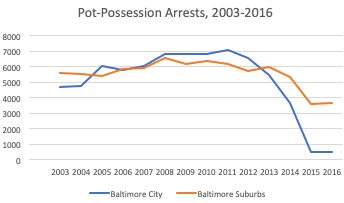
The statewide phenomenon of police in Maryland disproportionately arresting African Americans on drug charges is profoundly clear in FSC’s analyses of Maryland State Police (MSP) crime data. (And it’s an ongoing problem in Baltimore City, starkly reported by Baltimore Fishbowl in December.) But in the Baltimore region, another disparity also leaps out from the data – while city police are only occasionally arresting people for cannabis possession now, suburban cops have hardly reined in their pot-arrest instincts.

Screen Shot 2019-02-08 at 2.48.27 PM

What’s more, Baltimore City and the surrounding suburban counties have switched places when it comes to the prevalence of cannabis-possession arrests since 2010. The city saw one such arrest for every 90 residents in 2010, while in the suburbs the figure was one in every 320 residents. In 2016, the surburban number had inched up to one in every 580 residents – but in the city, it had climbed precipitously to one pot-possession arrest for every 1,280 residents, a striking change.

The chart above shows the switch started to occur around 2013, when roughly the same number of pot-possession arrests occurred in the city versus the suburbs. After that, the city’s number of such arrests dropped to below 500 a year, while in the suburbs – the data are for Anne Arundel, Baltimore, Carroll, Harford, and Howard counties – they remained in the high 3000s.

Pot-possession enforcement in Baltimore City has become almost rare, with a rapid drop in the proportion of all drugs arrests that were for pot possession starting in 2014 – and falling to below 10 perent thereafter. In the surrounding counties and statewide, though, enforcement intensity remains high – nearly 50 percent in the suburbs, which is high by the counties’ historical standards, even as statewide it dropped below 50 percent after consistently hovering around 60 percent since 2003.

Screen Shot 2019-02-08 at 2.03.54 PM

Here’s the usual caveat: arrest data are blunt, missing critical nuances that come only with knowing the particular facts and circumstances of each arrest. A pot-possession arrest, for instance, could be counted as such even though the arrestee was also being charged with assault and handgun violations. Or a pot-possession arrest could arise from only one charge, brought by a cop who wanted to take a problem citizen off the streets. The MSP data don’t tell such stories, but FSC still has found them to be a handy source for unearthing big-picture arrest trends.


CannaPress: Jen Wieczner nails the big-biz culture of cannabis investment

By Van Smith

Baltimore, Feb. 8, 2019

The inevitability of fully legal cannabis everywhere is a newfound canon, potent enough that Big Business seems to be taking it to heart, reports Jen Wieczner in Fortune.

Her carefully constructed and impeccably researched long-form profile of billionaire Brendan Kennedy, the Canadian who took his cannabis company, Tilray, public last summer, makes this key observation: “U.S. industries, including Big Beer, Big Tobacco, and Big Pharma, have made bets on cannabis companies, observing that consumers are increasingly turning to the drug as an alternative to booze, cigarettes, and painkillers.”

Envisioning the resulting future, captured by Big Everything, is a reminder that home cultivation is the key to resisting the coming cannabis overlords.

CannaCrime: Maryland arrest data measure impact of cannabis decriminalization

By Van Smith

Baltimore, Feb. 8, 2019

Thirteen years of available Maryland State Police (MSP) data show dramatic changes in statewide drug-arrest trends as the era of cannabis decriminalization and medical pot approached, arrived in 2014, and thence became the new normal. The result: tens of thousands fewer arrests for drug crimes, including a dramatic drop in the number of drug arrests of African-American Marylanders. More resistant to change, though, is law enforcers’ drug-fighting focus on arrests for cannabis possession and on disproportionately arresting African-Americans for drug crimes generally.

Screen Shot 2019-02-07 at 1.59.32 PM

FSC compiled MSP data for analysis from the annual “Crime in Maryland” reports, which are available online from 2004 to 2016. The data reveal a dramatic reduction in drug-crime arrests – about 20,000 less in 2016 than the 2004-2010 average of 53,500. African-Americans, in particular, have been subjected to far few arrests – 17,500 in 2016, about half the 2004-2010 annual average of 34,500.

Screen Shot 2019-02-08 at 9.13.31 AM

The proportion of drug-crime arrests that were for cannabis possession, though, remains elevated in the era of decriminalization and medically prescribed weed in Maryland – and in fact, after dropping to 44 percent in 2015 from 52 percent in 2014, crept up to 48 percent in 2016. This is historically high; the 2004-2010 average was 41 percent. Thus, drug-crime policing in Maryland – while far less intense in terms of the raw numbers of arrests – remains wed to an increasingly anachronistic inclination to bust people for possessing pot.

The proportion of all drug-crime arrests in which the people charged were African-Americans has dropped moderately with the advent of decriminalization, but remains starkly disproportionate in a state where less than a third of the population is African American. Whereas the average proportion of African-American drug-crime arrests between 2004 and 2010 was 65 percent of all drug-crime arrests in Maryland, in 2015 the figure was 56 percent, and in 2014 it dropped to 53 percent.

It should be pointed out that drug-crime arrests, along with the subset of pot-possession arrests, are blunt data points, obscuring the factual nuances of each arrest’s circumstances. Some such charges could be just one a host brought against, say, a violent drug-dealer, or they could be the one and only charge against an otherwise law-abiding citizen who dissed the wrong cop. Blunt as they are, though, the “Crime in Maryland” data comprise a nice, long, consistent record.

The next “Crime in Maryland” report, covering 2017 data, should be out in the next month or two, at which point FSC will update these analyses.

Out of Storage: Lifestyles of the lowly bankrupt bureaucrats

By Van Smith

Baltimore, Jan. 7, 2019

When the Feds came down on the Baltimore-based Rice Organization in 2005, the politically connected violent drug-dealing enterprise had been operating largely with impunity for about a decade. As the facts unfolded in drips and drabs with successive court filings in the hotly contested RICO case that ensued in U.S. District Court in Baltimore, and real-life parallels to themes in the then-running HBO series The Wire became apparent, I took notes.

There was George Butler, already a star on the streets for his appearances in the Stop Fucking Snitching DVD. There was actress Jada Pinkett Smith, co-owning an East Baltimore property with Rice Organization co-conspirator Chet Pajardo. There was the backstory on the multiple stabbing that had occurred during Kevin Liles’ birthday bash at Hammerjacks nightclub in 2002. There was Robert Simels, the bigshot NYC attorney who kept showing up in connection with players I was writing about, and who ended up going to prison himself, for witness-tampering in connection with a Guyanese death-squad drug-dealer he was defending. There was Eric Clash, cooperating with the government and living to tell about it. The story just kept on giving, and kept on connecting to other matters I was pursuing.

So when I picked up some old investigative records of mine from storage earlier today, the name “Raeshio Rice” popped up off the page. Back in the day, I’d poured over bankruptcy filings that I’d connected, through various other public records, to Rice Organization players. People go bankrupt for any number of reasons, but sometimes when a crime figure suddenly loses income as the law enforcers close in, people close to them may start to suffer sudden financial hardship.

Brothers Howard Rice and Raeshio Rice, ages 38 and 32 when the indictment came down in 2005, were the leaders of the outfit, and Raeshio’s name appeared in connection with his mother’s 2004 bankruptcy case. Her listed occupation was “program coordinator” for “the City of Baltimore” since 1994, earning less than $50,000 annually. Her 1999 Bentley Arnage had already been repossessed early in 2004, but she still had payments to make on the 1998 Mercedes Benz E320 station wagon that was titled in Raeshio Rice’s name.

Another 2004 bankruptcy case tied via public records to the Rice Organization featured a woman who’d worked for 29 years as a case worker for the Maryland Department of Social Services, earning a little over $35,000 a year. Among her assets: times shares in Massanutten Resort in Virginia and St. Martin Island in the Caribbean.

A Bentley and vacations at the Friendly Island – not bad for a couple of low-level civil servants.

Star-Crossed: Property co-owned by Jada Pinkett Smith tied to alleged Baltimore drug conspiracy

By Van Smith

Published in City Paper, Feb. 16, 2005

A Feb. 2 indictment of 13 men who federal prosecutors say are involved in a violent Baltimore drug conspiracy called the “Rice Organization” seeks forfeiture of co-conspirators’ assets—including an East Baltimore property that state records show is co-owned by actress Jada Pinkett Smith. The property, 1538 N. Caroline St., is a three-story corner building on a 1,440-square-foot lot in the heart of Oliver, a neighborhood long ravaged by the illegal-drug economy. The indictment does not mention what role the property played in the alleged conspiracy, only that the government would seek “all of the right, title and interest of Chet Pajardo, the defendant, in the real property and appurtenances” there.

The $22,000 purchase of the house by Pinkett Smith (listed as “Jada K. Pinkett” in the property records; her middle name is Keran) and Chet Pajardo, a 36-year-old Owings Mills man named as a defendant in the case, was recorded with the Maryland Department of Assessments and Taxation on Nov. 17, 1994. At the time, Pinkett Smith was 23, had already appeared in her feature-film debut, Menace II Society, and was on theater screens co-starring with Keenan Ivory Wayans in A Low Down Dirty Shame. Less than three years later, in 1997, she married fellow actor Will Smith in a ceremony at the Cloisters in Baltimore County.

Ken Hertz, senior partner of the Beverly Hills, Calif., law firm Goldring, Hertz, and Lichtenstein, who represents Pinkett Smith, told City Paper on Feb. 10 that the actress, who grew up in Baltimore and was living here in 1994, met Pajardo about 10 years ago, when Pajardo was working for United Parcel Service. “He was an acquaintance,” Hertz says, explaining that Pinkett Smith split the down payment with Pajardo and has been paying her share of the monthly mortgage payments ever since. She’s had no contact with Pajardo in many years, Hertz contends, and she’d forgotten she owned the building because her accountant made the monthly payments.

Despite the neighborhood’s plight—two blocks away in 2003, for example, all seven members of the Dawson family were burned to death in their home by one of the drug dealers they’d been trying to run off—Hertz says Pinkett Smith’s was “not a dumb investment, because it was so little money.” The Sun reported on Feb. 12 that Hertz also said it was “very important to note that we’ve been assured that she is not a target of the investigation.” (City Paper first reported on its web site that Pajardo and Pinkett Smith co-own the Caroline Street property on Feb 10.)

Pajardo’s defense attorney in the federal conspiracy case, James Gitomer, told City Paper that “I don’t speak to reporters about my clients” when asked if he would be willing to answer some questions about Pajardo.

Members of the Rice Organization, according to the federal indictment, are charged with murders in connection with a drug-trafficking conspiracy that yielded at least $27 million since 1995. Prosecutors allege the group has brought at least 3,000 pounds of cocaine and heroin to the streets of Baltimore. Chet Pajardo faces one conspiracy count, though the details of his alleged crimes are not given.

One Rice member appears in the locally produced Stop Fucking Snitching DVD that drew widespread attention late last fall as an unusual example of witness intimidation doubling as entertainment. Another of those indicted as an ostensible part of the Rice Organization, Anthony B. Leonard, co-owned the former Antique Row restaurant Downtown Southern Blues, which was housed in a North Howard Street property owned by the family of Kenneth Antonio Jackson. Jackson is a strip-club owner and an ex-con who, in the 1980s, became famous as a top lieutenant for the heroin-trafficking organization of Melvin Williams, a major figure in Baltimore’s drug underworld of the 1960s, ’70s, and ’80s.

Pajardo has a noteworthy connection to city politics. On Sept. 8, 2003, he gave $200 to the re-election campaign of city Comptroller Joan Pratt (D) at a fund raiser catered by Downtown Southern Blues; the event brought in a total of $11,500. Four days later, on Sept. 12, 2003, Pajardo donated $100 to the campaign of Democrat Charese Williams, who challenged incumbent City Councilwoman Stephanie Rawlings Blake (D-6th District) and lost in the September 2003 primary. Pratt also donated to Williams’ upstart campaign, giving $1,500 of the $22,500 it raised. Pratt did not respond to requests for comment by press time; attempts to reach Williams were unsuccessful.

During a Feb. 9 visit to the Caroline Street property co-owned by Pajardo and Pinkett Smith, the building was boarded up but had a fresh coat of paint on the entrance. It appeared structurally sound and well-maintained, though its property-tax assessment dropped from $14,100 to $3,000 this year, according to state records. A pay phone was attached to its outside wall. When a photographer visited the building the next day, a woman driving by in a car shouted out, “Is that Jada’s place?” On another Feb. 10 visit, an unidentified man was seen locking up and leaving the property.

Baltimore City Board of Municipal and Zoning Appeals records indicate that Everton Allen applied in April 2003 to use a portion of the building as a grocery store, though housing records indicate that the property has been vacant since 2000. A phone number could not be found for Allen at the Randallstown address given in his application.

The previous zoning application for the Caroline Street property was filed in 1996 by Brian E. Macklin, who wanted to open a convenience store at the site. A Polaroid of the building contained in the zoning file shows a Pepsi-Cola sign hanging over the entrance that reads andy’s grocery. A copy of Macklin’s application was sent by the zoning board to “C&J Inc., c/o Chet Pajardo,” and the file notes that in 1993 Pajardo and Jay Anderson pulled an occupancy permit for the address. Court records indicate that Macklin’s current address is on Kentbury Court in the Lyonswood subdivision of Owings Mills, the same small cul-de-sac as another Pajardo property that is under federal forfeiture as part of the Rice Organization indictment. The listed phone number for Macklin’s home-improvement company, Sorgen LLC, is disconnected, and no other contact information for him could be found.

An internet search of the Caroline Street address turns up the name of a business, Peaceful Image Inc., located there. Its corporate charter was forfeited for failure to file tax returns for 1998, according to state records, and it was incorporated by Pajardo on Aug. 15, 1995, “to engage in the business of retailing, wholesaling, manufacturing, and distributing clothing and accessories.” The founding board members were Pajardo, Leon Dickerson, and Michelle Narrington. A year earlier, on Aug. 3, 1994, these three and another individual, Condessa Tucker, registered Peaceful Image as a trade name, and stated its business as “silkscreen, embroidery, T-shirts, and hats.” The company’s principal office was in a building Pajardo owned between 1992 and 2000, on the 1000 block of West 43rd Street in Medfield.

Leon R. Dickerson was identified on the Peaceful Image trade-name application as Leon Dickerson III. An obituary for Leon R. Dickerson III was published in The Sun on Dec. 21, 2001, after he was killed in a stabbing. He was 31 years old and described as a social worker and basketball coach who worked with students struggling with learning disabilities and emotional challenges. According to Baltimore County Police records, Dickerson, who was married, was killed in a lovers’ triangle when the estranged husband of his girlfriend entered her Cockeysville apartment and stabbed both of them; only Dickerson died from his wounds. Dickerson’s parents are neighbors of Pajardo and Macklin in the Owings Mills subdivision of Lyonswood.

When Pajardo and Pinkett Smith purchased the Caroline Street property in 1994, the address given for property-tax mailings was in the 2300 block of North Monroe Street in West Baltimore. The owner, then and now, is listed as Wahseeola C. Pajardo. City Paper’s attempts to reach her at her listed phone number were unsuccessful.


Cannabuzz: Maryland eyes referendum on cannabis legalization

By Van Smith

Baltimore, Feb. 7, 2019

House Bill 632, to put to voters the question of whether to amend the Maryland constitution to legalize all cannabis, and House Bill 656, to establish a tax-and-regulate scheme for fully legalized cannabis, were introduced yesterday in the Maryland General Assembly by state delegates David Moon (D-20th District) and Eric Luedtke (D-14th District), both of Montgomery County.

Statewide public-opinion polling in Maryland has been tracking pro-legalization majorities for a while, and the most recent one – Goucher College’s Sept. 2018 “Goucher Poll” – found it to be quite pronounced: 62 percent for, 33 percent against. The political hurdles remaining before a referendum could be held, though, remain high: the legislative process, a gubernatorial signature, and a contest of campaigns for and against.

A pipe dream, some might say – and so far, an effort is driven purely by Democrats. (Here is some historical context for the Maryland GOP’s resistance to legalization.) Thirty sponsors back the referendum bill, all Democrats, comprising more than a fifth of the House of Delegates’ 141 members. The tax-and-regulate bill has nine sponsors, also all Democrats. Its cross-filed Senate version, Senate Bill 771, has only one sponsor: Sen. William C. Smith, Jr. (D-Montgomery County), who yesterday announced he’d been deployed to Afghanistan, leaving in March.

The Senate Judicial Proceedings Committee, of which Smith is vice chair, has scheduled a hearing on SB 771 at 12pm on Feb. 26. House hearings have yet to be scheduled for HB 632 and HB 656. Both bills have been assigned to the Judiciary Committee, and HB 656 also has been sent to the Ways and Means Committee.