Meltdown: What Happens to Dead Animals at Baltimore’s Only Rendering Plant

By Van Smith

Published in City Paper, Sept. 25, 1995

Consider these items: Bozman, the Baltimore City Police Department quarter horse who died last summer in the line of duty. The grill grease and used frying oil from Camden Yards, the city’s summer ethnic festivals, and nearly all Baltimore-area and Ocean City restaurants and hotels. A baby circus elephant who died while in Baltimore this summer. Millions of tons of waste meat and inedible animal parts from the region’s supermarkets and slaughterhouses. Carcasses from the Baltimore Zoo. The thousands of dead dogs, cats, raccoons, possums, deer, foxes, snakes, and the rest that local animal shelters and road-kill patrols must dispose of each month.

These are the raw materials of Baltimore’s fat-and-protein economy, which are processed into remarketable products for high profit at the region’s only rendering plant, in Curtis Bay. In a gruesomely ironic twist, most inedible dead-animal parts, including dead pets, end up in feed used to fatten up future generations of their kind. Others are transmogrified into paint, car wax, rubber, and industrial lubricants. Until the mid-1980s, some of the plant’s products were used in soap and cosmetics as well.

Like the use of human placenta in cosmetics and eating Rocky Mountain oysters, rendering is a phenomenon that many have heard of but few are tempted to ponder. Unlike those odd human practices, though, rendering answers a vital societal question: What to do with the prodigious amounts of carrion, offal, and fat that our society leaves in its dietary wake? Rather than classifying it as foul waste and incinerating it or burying it in a landfill, why not cook it into its constituent parts – fat and protein – and make a pretty penny doing it?

Valley Proteins does. The Winchester, Virginia-based company owns and runs Baltimore’s only rendering plant, tucked along the grassy shores of Cabin Branch, a tributary of Curtis Bay in the extreme southern tip of the city. Although a few out-of-state rendering plants attempt to compete in Baltimore, Valley Proteins’ Curtis Bay plant has a regional lock on the profitable recycling of dead animal matter and kitchen grease into ingredients for feed and industrial products.

Based on estimates from Neil Gagnon, general manager of the Curtis Bay plant, about 150 million pounds of rotting flesh and used kitchen grease from around Baltimore are fed into the plant’s grinders and cookers each year, resulting in about 80 million pounds of the plant’s three products:  meat and bone meal, tallow, and yellow grease. Most is reconstituted as chicken feed for North Carolina and Eastern Shore poultry farmers. Some goes for dry pet food. And some of the tallow is used by chemical “splitters,” who turn the fat into fatty acids, which in turn are used in thousands of products.


During a midsummer day’s visit to the plant, I gag upon first contact with the hot, putrescent air. My throat immediately becomes coated with the suety taste of decayed, frying flesh.

“You picked a bad day to visit a rendering plant,” Gagnon says, emphasizing the effect of the summer heat by describing the typical state of the “deadstock” picked up from Pimlico Race Course, which is delivered to Valley Proteins’ pet-food operations in Pennsylvania. “By the time we get them, they’re soup,” he says. “Summertime is bad around here.”

Gagnon himself is far from offended by the overwhelming miasma, though. “It smells like money to me,” he likes to say. Later in the visit, back in his office, he estimates Valley Proteins’ profit margin at somewhere in the neighborhood of 30 percent.

A load of guts, heads, and legs, recently retrieved from a local slaughterhouse, sits stewing in one of the raw-materials bins at the plant’s receiving bay. “That’s very fresh offal,” Gagnon says. He explains how it will be fed into “the hogger,” a shredder that grinds up the tissues and filters out trash, before it is deep-fried in cookers charged with spent restaurant grease and blood.

After being thoroughly fried, the solid protein is centrifuged, pressed, run through a magnet to remove metals, ground up, sifted, cooled, and stored in a silo. Today mid-way through the process, cooker operator Bud Kellner smiles, grabs a warm, brown, fibrous thatch of cooked tissues out of the production line in the cook room and shouts out above the mechanical din: “That’s all protein material! I could eat that right now!”

The liquid fat is cleaned, filtered, cooled, and stored in five tanks – two for tallow, a higher-grade fat product, and three for yellow grease. Kellner doesn’t mention whether he considers the fat potable.

The rendering processes at Valley Proteins’ Curtis Bay plant create three byproducts:  waste water, which goes into the city’ Patapsco Waste Water Treatment Plant at nearby Wagners Point; the stray fat and protein molecules in the air that generate the plant’s horrid stench; and reclaimed dirt, metal, plastics, and other trash, which go to the nearby Quarantine Road Landfill. Two boilers, which jointly generate 2,000 horsepower, run the whole operation.

While waiting at the receiving bay to watch another truckload of offal (this one from Baltimore County slaughterer J.W. Treuth & Sons, Inc.) tumble into a raw-materials bin, Kellner sums up why rendering is important. “If it don’t go here, it’d be laying on the side of the street somewhere.”

Blood and body fluids leak out from under the trailer gate. “Cranberry juice,” Gagnon remarks as we gaze at the repulsive pale-red effluvium. Suddenly a hot gust of wind blows droplets of it on our bare legs. As the bloated stomachs and broken body parts slide en masse from the trailer bed to the bin, Bud shouts out, “Watch out for the splatter!” After the load is delivered, a single jawbone rest on the pavement amid the bloody-liquid. Bud adds a final piece of sage advice, “Make sure you take a shower.”


Valley Proteins didn’t always have a virtual monopoly over the rendering business in Baltimore. In 1927, The National Provisioner, a meat-industry newsletter, published a map and list showing the geographical distribution of the nation’s renderers and slaughterhouses. At that time, Baltimore had 15 of Maryland’s 21 rendering plants, and there were 913 plants in the nation.

Today, according to Gagnon, Baltimore has one of the state’s six to 10 plants, which are concentrated on the Eastern Shore to serve the poultry industry. The nationwide figure has dropped to 286, according to Gary G. Pearl of the Fats and Oils Research Foundation. (Affiliated with the National Renderers Association, the foundation supports “increased utilization and new uses for products that are produced with the 50 percent of the animal that is not acceptable for human consumption,” Pearl says.)

Valley Proteins’ eight plants draw raw materials from the entire mid-Atlantic region, according to J.J. Smith, president of the company.  Smith describes the company’s territory as “from Newark [New Jersey] to Savannah [Georgia], and 300 miles inland.”  Its three-generation mini empire began in 1949 with company patriarch Clyde Smith’s buyout of an existing plant in Winchester, Virginia.

According to Baltimore City land records, Valley Proteins purchased the Curtis Bay plant in 1984 for $2 million from Benedict K. Hudson, president of another rendering company, Kavanaugh Products, which had purchased the property in the 1960s. Five of Valley Proteins’ eight plants were originally owned by other renderers, Gagnon says.

J.J. Smith says the industry’s trend toward concentration of ownership picked up momentum about 20 or 30 years ago with the creation of a market for “boxed beef.”

“Whereas cattle used to be sent to market in halves or quarters, and every community had its own slaughter facilities,” the company president explains, “now the slaughtering is consolidated in the Midwest, and they ship [the meat] out in boxes of 20- or 25-pound chunks.”

Boxed beef reduced the need for the neighborhood slaughterhouse, or abattoir.  According to Smith, “a new movement toward close-trim meat and tray-ready beef” similarly is eliminating the need for butchers and meat cutters in supermarkets because even more of the meat preparation occurs in Midwest slaughter plants.

“Baltimore used to have abattoirs all over the place,” Smith says.  Now Baltimore City has only one, a kosher slaughterhouse in the Penn-North area.  The 1927 Biennial Census of Manufactures, cited in the 1929 industry classic Inedible Animal Fats in the United Statesby Food Research Institute economist L.B. Zapoleon, indicates there were 40 slaughterers and meat packers in Baltimore at that time.

The decline of Baltimore’s slaughterers and butchers has meant less raw material for rendering.

“In 1965, at any given supermarket, we used to pick up [waste meat] three to five times a week at 1,000 pounds each.  Now we do it once a week at 600 pounds,” Smith says.  That’s an 80 to 90 percent drop in volume, and, as Smith often points out, “volume is what we thrive on in this business.”

Thirty years ago, according to Smith, 85 to 90 percent of renderers’ materials came from supermarkets and slaughterhouses.  Today, he estimates that a little more than half of the raw material for the Curtis Bay plant is from those sources.  The other half is kitchen grease and frying oils from restaurants, the proliferation of which he believes has made up for about a third of the loss resulting from the boxed-beef phenomenon.

“People used to eat at home more often,” Smith says.  “But now there are many, many restaurants, and people eat out all the time, so there has been an explosive growth at that level over the last 30 or 40 years.”

During this same period, the industry also underwent a technology shift.  In 1965, Dupps, a Germantown, Ohio, equipment manufacturer, started to make “continuous cookers,” which quickly replaced “batch cookers’” as the industry standard.

Batch cookers restricted the rate of processing because after each batch was cooked the cookers had to be emptied and prepared for the next load.  Continuous cookers made nonstop rendering possible, and the quantities the plants could handle grew greater over the ensuing years.  Today Dupps makes a continuous cooker that can handle the equivalent of 22 batch cookers, according to Smith.

“The change in technology was not a matter of new ways to cook,” Smith explains.  “It was a matter of bigger and bigger scales.  It was more efficient, but it was also more competitive for raw material.”

In Baltimore’s rendering industry, lower volumes of meat-packing and supermarket waste and higher production capacities combined with another factor – the dramatic rise of the poultry industry – to spell an end to all but one plant in the region.  Baltimore was a red-meat-packing town caught completely off guard by the continuing surge in chicken consumption, which began about 20 years ago.

“There were very few poultry-eviscerating plants in the 1960s,” Smith says.  But as the poultry industry expanded in the South and on Maryland’s Eastern Shore, those regions’ need for rendering increased. Baltimore City, meanwhile, was left with closed-down meat-packing plants, slaughterhouses, and rendering plants.  Only one of each remains.

Finally, the proliferation of environmental regulations has further encouraged ownership concentration in the rendering business. “Environmental requirements got expensive, so it became a trend to sell out to competitors who can handle the changes,” Smith explains. For the remaining firms, he says, increased regulation “was a two-edged sword.  It was expensive because it required high capital investments, but it was also a barrier for a startup company to compete with you.”

The changes amount to a classic case of “the bigger fish swallows the smaller fish,” Smith says. Pearl of the Fats and Oils Research Foundation agrees: “The general rule has been fewer and larger, with individual plants covering larger geographic areas and the investment per plant becoming much greater in order to meet environmental and water-quality standards.”


The use of dead pets, work animals, and wildlife as raw material is an aspect of the rendering business that neither Gagnon, Smith, nor Pearl likes to discuss. When they do address it, they emphasize its limited role and contend it is more a public service than a profitable practice.

“This is a very small part of the business that we don’t like to advertise,” Smith says. His main worry is bad publicity from animal-rights activists, who complain about the use of animal corpses for profit.

“We provide that as a service, not for profit, he says, pointing out that “there is not a lot of protein and fat” in dead pets and wildlife, “just a lot of hair you have to deal with somehow.” Smith believes that “shaming the American public into taking care of their pets is the way to combat the problem the animal-rights people talk about, not hassling the companies that manage the waste the pet industry produces in terms of dead animals.”

Smith says that while Valley Proteins sells inedible animal parts and rendered material to Alpo, Heinz, and Ralston-Purina, among other pet-food makers, dead-pet products are not among the products sold to these companies. “They are all very sensitive to the recycled-pet potential,” he explains. “They want no pets in the food they sell.  We guarantee them that the product we sell to them does not come from the pets we collect.  We handle them separately.”

A tiny amount of pet byproducts does get into the material sold to pet-food makers, however, according to plant general manager, Gagnon. Valley Proteins does have two production lines: one that uses only clean, fresh fat and bones from supermarkets and butcher shops and another that includes the use of dead pets and wildlife. However, the protein material is a mix from both production lines. Thus the meat and bone meal made at the plant includes materials from pets and wildlife, and about five percent of that product goes to dry-pet-food manufacturers, Gagnon says.

The higher end production line – the one without pets – makes tallow, fats whose “light colors give good consumer appeal,” Smith says. The low-end line makes yellow grease, which goes mostly for poultry and swine feed; as Smith notes, “the chicken doesn’t give a shit what it’s eating.”  Local feed makers that buy Valley Proteins’ products include Southern States in Locust Point. Gagnon says there are no longer any local purchasers of the plant’s tallow products.


Most of the dead pets that end up in Valley Proteins’ Curtis Bay plant originate from the city animal shelter in Southwest Baltimore. Earl Watson, administrator of the city Health Department’s Animal Control Division, is very aware of the use of dead pets and wildlife in Baltimore’s fat-and-protein economy, and he knows Valley Proteins’ overarching role in it. “Anywhere there are dead animals, they pick them up,” he says.  “They have a monopoly on that because no one else does it.  That means they can charge what they want for the service.”

An average of 1,824 dead animals per month pass through the freezer at the city animal shelter and onto trucks bound for Valley Proteins’ Curtis Bay plant, according to shelter statistics for April, May, and June of this year. Most of them were euthanized (three-month average: 1,339), though many were DOAs (three month average:  485). (DOA’s went up significantly in July and August, with 655 and 815 respectively, because of the hot weather and the city’s Clean Sweep program that targeted specific areas for cleanup.)

Here at the animal shelter, a staff of 10 wardens works every day but Sunday, picking up animals and bringing them to the shelter, while the shelter’s two veterinary technicians euthanize animals to make room for the newcomers.

“Having to euthanize animals all day is not pleasant,” Watson says, “especially if you like animals.”  He and shelter attendant Edward Rigney lead the way to Room 162 – Euthanasia – and Watson bows out after Rigney pulls open the door to the freezer, in which a dead fox lies stretched out on a table surrounded by barrels filled mostly with dead dogs and cats.  Fleas leap among the carcasses.

“Ten or 12 were euthanized this morning,” Rigney says. “Sometimes it’s thirtysome that get it. “Things get backed up over the holidays.”

Outside the freezer, atop another table, lie a bottle of the poison product Fatal-Plus, several syringes, a medical-waste container, and a hacksaw resting on a towel.  The hacksaw is for rabies testing:  “When people get bit, we have to cut the dogs’ heads off and test their brains,” Rigney explains, adding that the veterinary technician “never uses that – she just twists them off.”  Fatal-Plus is sodium pentobarbital; the warning label reads:  “Do not use in animals intended for food.”  This warning apparently does not apply for animals intended for pet food which is where the protein from these euthanized animals ends up.


Following Valley Proteins route driver Milton McCroy on his rounds is a colorful tour of Baltimore’s fat and protein sources.  Every Monday, Wednesday, and Friday, McCroy enters the STAFF & DELIVERIES entrance of the city animal shelter and loads dead animals into his truck. He then continues his rounds to Parks Sausage, the city’s lone remaining meat-packing plant, where he picks up waste meat, and to the slaughterhouse in Penn-North, where he loads up with offal, before taking the shipment back to the Curtis Bay plant and dumping it in the raw materials bin.

“It’s a dirty, smelly job, yeah – but that’s all it is, dirty and smelly,” he say philosophically, leaving someone wondering what could be worse.

At the animal shelter, McCroy hefts two dogs stiffened by rigor mortis into the trailer of his truck, which is rigged for the rendering business with a lift, a catwalk, and a barrel cleaner. He then empties and cleans 11 barrels of assorted animals.  As he works, he describes where his load is bound. “Chicken feed, cosmetics, fertilizer, dog food, whatever – the way they cook that bad boy [the Curtis Bay plant] up, it don’t make no difference what’s in there,” he says, then pauses and adds: “When they start putting human bodies in there, that’s when I quit.”

After a brief stop at Parks Sausage, where McCroy empties 10 or so barrels of rancid meat and grease, he heads off to the slaughterhouse, next to a long-defunct animal-hospital building. He backs the truck up to a storage shed, hauls a bloated sheep carcass onto the lift, and dumps it in the trailer, then starts preparing to empty many barrels full of heads, legs, hides, and guts. Joking, he starts to make the jaws of a cow’s head clack, then gives up on the puppet how. He hoists two sheep’s heads in the air, one in each hand, and asks, “Which one do you want?” He punctures a stomach with a pocket knife and squeezes out the brown ooze inside.

The jocularity ends when the plant’s owner catches wind that the press has entered the property. As we explain that we are following McCroy on his run for a story on rendering, he ushers us off to the adjacent sidewalk. “With all our problems with OSHA [Occupational Safety and Health Administration], MOSHA [Maryland OSHA], EPA [Environmental Protection Agency], and the rest, there just is no good publicity for us right now,” he explains.

A plant employee explained later that tightening environmental regulations and concerns about the bacteria E. coli are coming down hard on slaughterhouses; any attention would just mean more problems. (A subsequent check with state and local regulators did not reveal any outstanding cases or suspected violations at the city slaughterhouse.) Disappointed in being shunted from the property, we leave without a proper good-bye to the good-natured McCroy.


Baltimore’s fat-and-protein economy has changed dramatically over the decades, but it remains essentially a profitable form of recycling.  The National Renderers Association sums up the industry nicely in its 12-minute video, Food for Life:

The rendering industry provides many needed services to the community at large; it safely recycles materials that otherwise would be a nightmare to dispose of; it creates products that are essential to modern life; it provides the needed to nutrition for our livestock and fisheries, so that a hungry world can be efficiently fed; and it supplies our pets with a healthy diet for longer, better lives.

So the next time you munch on fast-food fries (often cooked in grease the restaurants subsequently sell to Valley Proteins) or let your unfettered pet roam the city streets and backyards, or apply a little makeup to your face, or wax your car, or barbecue some chicken breasts, pause a second to think: Is this somehow connected to the Valley Proteins rendering plant in Curtis Bay, either on the donating or receiving end? Chances are it is.


The Diary of Doc Watkins

By Van Smith

Published in New York Press, Oct. 28, 1998

IMG_7502

Until recently, New York City wasn’t on my life’s itinerary. So far as I expected, I would stay in Baltimore, where my mother’s father’s family had settled in the early part of the century and where I had lived (other than a few short forays and travels) since I was a four-year-old in 1970. I was quite comfortable with the idea of riding a lifelong learning curve as an obscure observer and chronicler of a waning, eccentric city. But, alas, 1998 has so far proven a pivotal year for me, and suddenly I’m living in Queens.

IMG_7501

The first 10 months of this year took a lot out of me. I started out by purchasing a charming Civil War-era house in a forsaken Baltimore neighborhood, then flew to Amarillo, TX, to testify as the lead defense witness in Oprah Winfrey’s libel trial over disparaging statements made on her show about the poor eating habits of cows. What landed me in Amarillo was a piece I wrote about what goes on inside a rendering plant, where animal tissues are boiled into their constituent parts of fats and proteins and some of the proteins were (until the feds stepped in with new regulations in 1997) used in cattle feed. I was the only reporter Oprah’s attorneys could find who had actually observed the workings of a rendering plant, and my firsthand observations, it turns out, substantially supported alleged false statements made on Oprah’s show.

This was followed in May by my own libel trial, in which a consultant for Baltimore city tried unsuccessfully to convince a jury that I had written false facts about him in my investigative coverage of a contracting scandal at the city landfill. Over the summer, between filing stories (at City Paper, Baltimore’s weekly) about the state elections, I helped my parents move from Baltimore to an island in Maine. Then I succumbed to the lure of a job at NYPress, abandoned my newly purchased home to a fellow Baltimore writer and shacked up with my girlfriend in Sunnyside.

The breakneck pace of these events proved quite stressful – so, after unloading and unpacking our vanload of belongings, my girlfriend and I were ripe for an extended fall-foliage trip through New England in my 1981 piss-yellow Dodge Diplomat.

Properly stocked with food, music and vices, the Diplomat made for a comfortable ride. While hopelessly passe, especially when chugging up 95 in Connecticut and Rhode Island amid the Volvos and the Land Rovers, the vehicle to me remains esthetically pleasing, particularly when outfitted as it was on this trip with two bikes and a large plastic trunk attached to the roof rack. Being in no hurry, and acutely aware that our gypsy boat was a powerful cop magnet, we went the speed limit and conscientiously avoided road Cokes in an effort to prevent legal trouble – or a dose of wood shampoo from New England’s finest.

The first leg of the trip ended in Manomet, MA, between Plymouth and Cape Cod on the south shore of the Massachusetts Bay. The town is a few coves east of the Pilgrim Station nuclear power plant and, due to its existence, the entire region is ominously served by an antiquated emergency-warning system consisting of huge air-raid sirens.

In Manomet, my great-aunt, the late Agnes Watkins, a classics teacher at Windsor School in Boston who never married and whose exceptional frugality allowed her to travel the world, had owned a small cottage – perfect size for one or two people – near some bluffs leading down to the ocean. On her death some years ago, the cottage came into the possession of my father and his sister and it is now enjoyed by family and friends throughout the summer season as a quiet, phoneless getaway. We spent our first night of vacation there and were off for the Maine coast in the morning.

After staying a few days with my parents and observing their somewhat hyperactive efforts to get their waterfront home in a proper state of readiness before the coming winter storms, we headed inland to Andover, ME, for some outdoor recreation and backwoods relaxation at my girlfriend’s family’s ancestral camp in the woods of the White Mountains. This was the shank of the trip, and it effectively assuaged our nerves and restored our shrunken bellies to fullness.

It was back at Manomet, however, on the last few days of our 12-day New England junket, that we were treated unexpectedly to the most noteworthy discovery of the trip: the memoirs of my great-great-uncle, Robert Lincoln Watkins, as typed, single-space, by his niece Agnes in 1972. The document, found in a bookcase containing numerous family archives, was in a green three-ring binder and was titled: A Story of His Life, by a man who has never gotten anywhere. The cover page indicates it was written in 1927 in New York City.

IMG_7502

As we learned on reading the memoirs, Robert Watkins, a medical doctor and inventor who died in 1934 at the age of 71, was a curious, stubborn man who was inexorably attracted to charismatic characters and con men and who tragically coveted elusive fame and fortune, for which he strove with opportunistic abandon, but to no avail. In the process, he racked up a riotous collection of anecdotes, a large number of which ended in a description of the deaths of those involved. The glimpses of his life were made all the more interesting by the fact that, though I had heard mention of him in family dinner conversations, I had no idea such an engrossing, romantic figure inhabited my family’s history or that his involvement in turn-of-the-century New York life was so fascinating.

We found ourselves completely absorbed in Watkins’ memoirs, belly-laughing at his fantastic misadventures and touched by his loneliness late in life. Born in 1863 in Proctorsville, VT, of an inventor/capitalist who was financially ruined by a Black River flood that washed out his factory and a school teacher from the Berkshires, he was raised, he wrote, in “a puritanical environment” in which regular prayer and strict observance of the sabbath were practiced. A terrible book-learner, he turned instead to experimentation, building a boyhood chemistry lab in the basement where he blew up a jug of hydrogen, constructed a photophone (“to talk over distances without a wire by means of a ray of light”) and tried to make diamonds by heating in a sealed tube iron filings, carbon and nickel.

Rather than become a chemist (“my father said, and induced me to believe, that there was only $900 a year in it”), Watkins graduated from New York University’s medical college. He interned in Newark Hospital, where he and his inexperienced colleagues treated a passed-out saloon keeper “by pouring hot and cold water alternately on him, and by flagellation.” The drunkard died in the process and when the newspapers ran with the story, they all found themselves “arrested for killing, or for assisting a man into the next world,” but after several months were absolved of the alleged crime.

Apparently unsated by this small taste of fame, Watkins found another angle to get his name in the papers: self-inoculation. Fancying himself a player in the day’s scientific debate over the causes of disease, Watkins opposed the view that germs themselves are infectious agents, believing instead that they are the “result of degenerated tissue” in the course of disease progression. So he set out to prove his point by injecting himself with “the pure cultured tubercle bacillus,” believed to be the disease agent in tuberculosis. He was proven wrong, but didn’t die, though his reputation suffered. The experiment got “into the papers [and] caused a furor and much worry and innumerable letters.”

But Watkins’ determination to serve as an experimental subject didn’t stop there. While in Paris with his uncle during a cholera outbreak, he read in the papers that a “Dr. Hafkin at the Pasteur Institute had discovered a serum for the cure of cholera, had tried it out successfully on rats and guinea pigs, and wanted to try it on humans beings, I decided to lend myself for the purpose immediately.” After being injected with live cholera germs, Watkins fell unconscious in a doctor’s office and was already being called a martyr for science when he came to.

He quickly recovered from the self-inflicted cholera and proceeded to urge his uncle, who was suffering jittery nerves, to take a substance called “Testicular Juice, good for nervous diseases and especially Locomotor Ataxia; the name implies the source of the remedy,” which was bull testicles. I can only presume the “juice” was sperm. For $20 an injection, Watkins’ uncle took the juice and “used it till he got the chills and could not see that it was doing any good. He remarked that he was sick of having that stuff stuck in his backside.”

A few years after his hijinks in Paris with his uncle, Watkins returned there with a  Southerner named Brodnax, an NYU classmate whose medical career was floundering but whose social charms Watkins believed would help scare up Parisian interest in Watkins’ inventions and theories for studying blood. It turned out Brodnax was a complete fraud, and the six-week Paris trip a $600 loss. Later Brodnax, who had contracted syphilis, looked Watkins up in New York. “The last time I saw him was on the corner of Broadway and 34th St. He was crossing with a fine looking woman who he introduced to me as his wife … I never saw him again, but understand he gave the disease to his wife and both died in the insane asylum.”

When typhoid fever raged through New York, Watkins went to live on North Brother Island, next to Rikers Island, to study and treat victims of the disease. “I did not learn much of practical value, but the fact that I saw the dead being carried away in cart-loads, and learned to identify the peculiar sweetness of the smell of all who had the disease.”

Considering himself a social klutz, Watkins sought to  improve matters with dance lessons. He found an instructor named McGregor on 55th St. near 5th Ave., who “gave me a cane which he told me to put across my back, hooking my arms over it at the elbow to hold it, standing perfectly erect and by myself. With a circus whip in his hand he went to the other end of the hall, giving me orders how to step with the snap of his whip. I got it in about three lessons.”

He also tried makeshift experiments in his office, using animals, like when he tried “to make Siamese twins with guinea pigs by cutting out the flesh on the sides of two and sewing them together to see if they would grow. They never stayed bandaged together for more than ten days at the most, and then on taking off the bandage I found that the wound had sloughed … I experimented with that considerably and concluded it was not for me.”

As an inventor, he found a measure of success, but nothing at all in the way of financial returns. He obtained patents for a storage battery, a bullet probe (to help locate metal missiles lodged inside the body), a type of rheostat (for regulating electrical currents), a “micromotoscope” (which he called his “little moving picture camera, the first small one ever constructed up to that time, I think, 4X5X6 inches”) and a device he called a migraf – his greatest invention, into which he sank much of his savings to produce, but of which he only managed to sell four. The migraf was “a machine to photograph microscopic objects” that he eventually sold to “the Brewer’s Academy at 23rd and 9th Ave.,” to “the Norwegian Hospital” and to “the Mayo Brothers in Rochester, Minn.” He also donated a goldplated migraf to “the Vassar Brothers Hospital in Poughkeepsie.”

To help manage Watkins’ affairs as an inventor, he formed a partnership with a man named Heinson, who Watkins believed to be “a natural-born executive.” Heinson did nothing once the contracts were signed, but demanded a share of the money nevertheless. Heinson, Watkins points out, later “died of tuberculosis in Philadelphia.”

In publishing, Watkins also tried hard, but without much success. His motives were good (“My mind was always on the idea of driving my views [on medicine] down the throats of the profession whether they wanted them or not”), but his methods faulty. After Harper & Brothers (among others) rejected his manuscript, he self-published 1000 copies and claimed to have gotten rid of the whole batch, some of them sent as far as China and Malta.

Watkins’ delusions of grandeur in medical research once led him to the door of the Carnegie household on 54th St. near 5th Ave. A reporter friend named St. Clair, of the New York Herald, was off to interview the rich man, and Watkins asked St. Clair to ask Carnegie if he would meet with him; “perhaps I can get him to build me an institution.” When St. Clair failed at the request, Watkins knocked on the door himself, and persisted when his petition was declined until it appeared he would have to be forcibly removed.

His private practice consistently failed to bring him much business, especially later in life, but some of his patients were fascinating folks. He treated an old sot, a prominent (or once so) lawyer from DC who claimed to have been a confidential messenger for top military brass during the Civil War and, afterward, an assistant U.S. treasurer under President Grant. A binge drinker and sometimes chloroform addict, the fellow, named A.A. Brooke, was an impeccable dresser, drunk or sober, and slowly deteriorated over the years until dying in Bellevue at the age of 75, which he said he dreaded because they treated him with morphine. “Never give a drunken man morphine, it makes him crazy,” Watkins remembers Brooke telling him.

One of Watkins’ friends was Joe Norcross, an aging vaudeville actor and singer who performed with his wife and who had started out in minstrel shows. Norcross had Watkins (whose obsession with music was insatiable) onstage to sing with him at the Bushwick Theater in Brooklyn. The performer’s wife “came from a nervous, erratic family, and while he watched her closely … she managed to cut her throat one day and died before his eyes in their home in Springfield, Mass. That broke the old man all up. He acted one year alone, and then passed away with the asthma which he had been fighting all his life.”

Watkins’ interest in studying blood brought him in contact with other such researchers including one Ephraim Cutter. “The Cutter family were erratic geniuses and good musicians: the doctor played the bass viol, his wife the piano. They had a son who was a musician to the court of the Emperor of Japan; another son, a boy of 21 with bright red hair, was an expert electrician. One day he stood before his mother, exclaimed ‘I’m no good and father’s a crank,’ took a drop of Prussic acid on his tongue, and dropped dead at his mother’s feet.”

Watkins’ tales are populated by a magician, an idiot-savant cripple and Charles Ottman, the Fulton Market butcher. While in his 50s, he tried to “get in the game” of World War I and went to Washington, where he met Charles Scrivener, the chief of that city’s detectives who, in 1926, was mysteriously murdered along with his fiancee on the eve of their nuptials. He went to work for the DuPont Powder Works, where he “was dumped into a camp of 4000 workmen of all nationalities making black powder and nitro-glycerine.” He then, under government orders, went to another powdermaking plant in Penniman, VA, where, on his second day on the job, there was an explosion. “We found only pieces of clothing and flesh parts. 25 men had been blown to nothing … It was kept out of print.”

IMG_7503

While reading Watkins’ unpolished prose, so rich with facts and innuendo, I happened upon a short anecdote that jerked me quickly back to the present day. “I had been treating for three or four years,” Watkins wrote, “a man named Clinton, for syphilis … He acquired the disease in the usual manner when on a political spree, had given it to the girl he loved …” Somehow, it sounded hauntingly like an item on the Drudge Report.

My girlfriend and I read aloud to each other much of the memoirs, then made a copy of it at the Manomet library and brought it home to Sunnyside, where we continued reading it late into the night. Watkins’ profound loneliness, excruciatingly communicated in a short essay entitled “The Man with the Bulldog Jaw” by one “Wayne Sniktaw” (Watkins spelled backwards), perplexes me. Given his remarkable experiences and acquaintances, I find it acutely ironic that he felt oppressive solitude amid the New York bustle. Watkins solution to his affliction? “Stick to your job,” he wrote.

And that’s exactly what I plan to do.

Bell Tightening: State Senate Hopeful Lawrence Bell III Has Money Problems

By Van Smith

Published in City Paper, Aug. 2, 2006

After then-City Council President Lawrence Bell III came in third in the 1999 mayoral race, his future career became a matter of public speculation. The Daily Record, Baltimore’s legal newspaper, predicted private-sector success for the then-37-year-old.

“By just about any standard,” the paper observed, “Bell is a very young man with very significant experience. He should have no trouble parlaying his résumé into a comfortable private-sector career. Trading the power and the spotlight for a much bigger paycheck without all the scrutiny isn’t so bad.”

Over the ensuing years, Bell traded the power and spotlight of public office for the cloak of anonymity, but the paychecks apparently never got any bigger. In fact, as far as his creditors can tell, the paychecks never came at all. Meanwhile, his debts mounted. City Paper‘s investigation turned up three Maryland court judgments totaling just over $56,000 owed to Bell’s creditors. Each of the judgments is three years old or more, and each has been accruing interest ever since.

“None,” says attorney John Olivieri when asked if, in the course of six years of tracking Bell in the hopes of collecting a court judgment, he ever saw any evidence that Bell was employed. “We’d heard he was working at the NAACP in Atlanta, and at radio stations, but never got any confirmation,” Olivieri adds. In another creditor’s case, private investigators stated in a 2003 report to attorney Jordan Spivok that “we developed no employment on the part of your subject.” A July 18 Sun article reports Bell claims he had been “chairman of a nonprofit organization responsible for protecting crime witnesses,” but adds that Bell was “vague about his recent past.”

Bell wants a job, though. On July 3, the filing deadline for this year’s elections, he entered the race for the city’s 40th District state Senate seat. The incumbent senator, Ralph Hughes, is retiring, and five other candidates–prisoner-rights activist Tara Andrews, City Councilwoman Belinda Conaway, state Del. Salima Siler Marriott, Park Circle resident Timothy Mercer, and Del. Catherine Pugh–are running in the Democratic primary. The winner will face Bolton Hill Republican Stephen George in November’s general election.

The 40th District includes one of Bell’s creditors: the Belvedere Condominium Council of Unit Owners. He owned a unit in Mount Vernon’s Belvedere Hotel from February 1996 until November 2000, when he lost it in a foreclosure case. His failure to pay condo fees resulted in a $15,218 judgment that Olivieri–the condo association’s lawyer–estimates at $17,000, once interest is included.

“He needs a job,” Olivieri says. “Don’t ruin it for me,” he adds, saying that if 40th District voters “want to elect him, great.”

The condo association’s president, Ken Pippin, declined to voice his thoughts about a Belvedere debtor running to represent Belvedere residents in Annapolis because Bell might win the election and hold a grudge. Pippin would, however, say that “when people don’t pay their condo fees, it handicaps the association because that’s the only money that the association has, and it means we have to raise fees for the other owners.”

Spivok, whose client, Mortgage Guaranty Insurance Corp., won a $34,643 judgment against Bell in December 2003 in connection with the foreclosure of his erstwhile Belvedere unit, is cynical about Bell’s current political aspirations. “It’s nice to know he’s running for state office while owing debts,” he says acidly in a phone interview. “I’d be happy to work out an arrangement with him,” Spivok adds earnestly, “if he would give us a call.” The amount owed has been accruing interest at 10 percent per year since the judgment, Spivok points out.

Another judgment against Bell arose from a $6,000 loan he took out in March 1999, when he was still president of the City Council. His failure to repay the loan led, in November 2003, to a $6,461 court judgment against him in favor of Mercantile Safe Deposit and Trust Co. Jay Strong, the collection attorney on the case, has attempted to garnish the amount owed from Bell’s father, Lawrence Bell Jr., a dentist. Records on the case show that Bell Jr.’s failure to respond to the matter resulted in a body attachment, a court order issued May 10 that requires him to either show up in court or be escorted there by law enforcement.

Another case against Bell is the foreclosure of his former residential property, three blocks away from his father’s dental office on Auchentoroly Terrace near Druid Hill Park, that he purchased from his father in 1992 with a $39,920 mortgage. According to court records on the case, even after the property was auctioned off three years ago for $30,000, Bell still owed $14,069 on the mortgage, after attorney fees and other foreclosure costs were added in.

Bell also has tickets for driving a vehicle with expired tags. Last Sept. 2 at 12:30 a.m., according to court records, Bell was cited in the 3000 block of East Monument Street for driving a 2000 Jeep with expired tags. After failing to pay the fine or show up at the April 17 trial, his license was suspended. Then, in the early afternoon of May 17, he got another ticket for the same offense in the same vehicle, this time in the 4800 block of Liberty Heights Avenue. On July 10, his license suspension was recalled after he paid a fine. He is scheduled for trial on Aug. 16 for the September 2005 offense, and on Aug. 18 for the May offense.

Reached by phone on Aug. 1 and informed that an account of his financial troubles was soon to be published, Bell said, “Let me call you back in about an hour, because I’m in the middle of something right now.” He didn’t call back, and subsequent attempts to reach him at the same number were unsuccessful.

Arthur Murphy, a political consultant recently hired by Bell, was available for an interview, however. Murphy explains that he was aware of his money problems before he took Bell on as a client. Asked if the financial problems would raise questions about Bell’s personal responsibility as a candidate for public office, Murphy contends that “the other candidates are going to have to raise that issue,” adding that “it is something that [Bell] is going to have to deal with.” He said that his client has “had a few” other jobs since leaving his $65,000-a-year post as City Council president, but that “it hasn’t been easy” for Bell since then.

Despite his money woes, Murphy contends that Bell “is a factor” in the 40th District Senate race, “because he’s a proven vote-getter and he is going to spend the requisite amount of money to bring back his name.” Bell’s campaign fundraising machine is active, Murphy says, and can rely on the same well-heeled sources that supported his past electoral efforts. “The message,” Murphy explains, “will be, `He’s back, and he served us well before, and give him another shot.'”

Reversal of Fortune: Two Years Ago, Martin O’Malley Was Lawrence Bell’s Political Sidekick. This Year, O’Malley Broke With Bell, Challenged Him for Mayor – and Won the Nomination. What Really Happened Between the Two That Led to Bell’s Downfall?

By Van Smith

Published in Baltimore magazine, Nov. 1999

It’s a June day in 1995, and Batman and Robin are doing what they do best: grandstanding.

As anti-administration members of a pro-administration City Council, Lawrence Bell III (a.k.a. Batman) and Martin O’Malley (a.k.a. Robin) have few weapons in their political arsenal. So when the duo has a bone to pick with Mayor Kurt L. Schmoke, they call a press conference. Today, they’re in front of City Hall, decrying Schmoke’s racially tinged re-election campaign.

“We’re disturbed about the escalating racial and religious tensions that plague our city,” proclaims Bell, a slim black man who swims in his too-large suit. “What good is victory if what you’ve won is destroyed in the process?” At 33, Bell’s looks belie his experience: He has represented the largely black and poor Fourth District for eight years, and he’s running for City Council president.

Now it’s O’Malley’s turn. “One of the things people say to me often s that they like the way Lawrence and I work together,” the lanky white man muses. “That is where the future of this city lies.” O’Malley is finishing his first four years representing Northeast Baltimore’s racially integrated, middle-class Third District; he’s running for re-election.

The bond that earned these two men their nicknames does seem extraordinary, given the race-tinged minefield that is Baltimore politics. No wonder the duo’s other joint tags are “Salt’n’Pepa” and “Miami Vice.”

O’Malley plays clear second fiddle to Bell at this event. But some believe that it is he, not Bell, who is driving the Batmobile.

IMG_7430

Today, “Batman and Robin” is no more. On June 22 of this year, O’Malley drove the final nail in the team’s coffin by announcing that he would run for mayor against his long-time ally.

One brutal primary campaign later, O’Malley is the Democratic nominee, a near sure thing to win in this Democratic town. And Bell – once the front-runner – is a distant third-place finisher, packing up his things to move out of City Hall.

In the aftermath of O’Malley’s victory, some questions remain. What really happened to the Bell/O’Malley team? How did their years-long friendship erode into political and personal rancor? And how did O’Malley rise so fast while Bell fell so hard?

Lawrence A. Bell is a career politician. The son of a prominent dentist and a public-school teacher, Bell grew up at a coveted address – Auchentoroly Terrace, a tree-lined stretch of beautiful porchfront rowhouses near Druid Hill Park. He went to the University of Maryland, College Park, majoring in government and politics and becoming the president of the Black Student Union. When Bell was elected to the City Council in 1987, he was 25, the youngest member ever. Bell was proud to follow in the footsteps of his mother’s first cousin, Kweisi Mfume, who had been Fourth District councilman before winning a seat in the U.S. House of Representatives in 1986.

The 1987 elections also ushered Kurt Schmoke into the mayor’s office. Schmoke’s victory was seen as the end of the William Donald Schaefer machine, which for 14 years had overseen a nationally recognized downtown revival. Schmoke cast himself as the anti-Schaefer, promising to bring prosperity to neighborhoods untouched by the waterfront renaissance.

But instead, many of Baltimore’s neighborhoods underwent shocking deterioration. A crisis in the city’s public schools combined with a national crack-cocaine epidemic to overwhelm the administration’s attempts at revival. By the early 1990s, the annual murder rate had topped 300. The city’s police commissioner, Edward V. Woods, refused to acknowledge the role of vicious New York-based drug dealers in the bloodletting. Faith in law enforcement plummeted.

During Schmoke’s 1991 re-election campaign against former state’s attorney William Swisher, the mayor’s effectiveness was questioned, but there were few Democratic voices of open opposition. Schmoke was re-elected. But on the City Council, the stage was set for an organized anti-Schmoke faction.

IMG_7431

Martin O’Malley first took his seat in the City Council in 1992, supplanting Bell as its youngest member. Then 29, O’Malley was steeped in politics. His suburban Montgomery County upbringing, education at Catholic University, and experience as an assistant state’s attorney for Baltimore City had been peppered with political involvement. He had worked on Gary Hart’s presidential bids in 1984 and 1988 and on Barbara Mikulski’s 1986 election to the U.S. Senate. And O’Malley himself nearly denied state Senator John Pica Jr. re-elction in 1990; Pica won by only a few dozen votes. Even O’Malley’s 1990 marriage to Catherine Curran, the daughter of Maryland Attorney General J. Joseph Curran, strengthened his political connections.

O’Malley found Bell harder to get to know than some of his other new colleagues on the council. But he saw that Bell was a courageous legislator, never ducking a rough vote. Plus, Bell was black, and in a majority black city, a white politician needs all the black friends he can get.

To Bell, who was entering his second term, O’Malley was a political comrade. He was only one year younger than Bell and shared Bell’s taste for grandstanding. O’Malley also had friends in high places. Each saw a political opportunity in the other.

O’Malley got the alliance going by helping Bell gain the chairmanship of the council’s public-safety subcommittee, giving Bell a bully pulpit from which to denounce Commissioner Woods.

IMG_7432

It’s January, 1993, and Bell is ready to issue a public ultimatum to Woods. O’Malley and councilman Anthony Ambridge are on board.

The three meet at City Hall to discuss how to proceed. Ambridge, who is white, says the city’s racial realities dictate how it must go: “This should be put by you, Lawrence, rather than us, because of the politics.” If the white councilmen take the lead in denouncing a black mayor’s black police chief, it might look racially motivated.

So Bell pulls the event together solo and gives the men 10 minutes’ notice. When O’Malley gets the call, he drops what he’s doing and runs to City Hall.

Bell calls for Woods’ resignation if he fails to reduce the violent crime rate within six months. Then he protests “the near-total silence emanating from the leadership of our city” when it comes to crime. O’Malley chimes in: “I’d just like to see a little progress,” he declares.

The announcement makes headlines in The Sun for two days running. And when the six months are up, Bell and O’Malley are in the newspaper again. Woods resigns shortly thereafter.

Score one for the dynamic duo.

IMG_7433

After the Eddie Woods victory, Bell and O’Malley applied themselves to opposing the mayor. Together, they fought tax increases and pushed for tax cuts. They scrutinized police spending, tried to attract talent to the police commissioner’s post by increasing its salary, criticized the private management of public schools, helped to push through a curfew for juveniles, and decried the housing department’s awarding of no-bid repair contracts. In spring of 1995, council president Mary Pat Clarke reactivated the dormant Legislative Investigations Committee and made O’Malley its chair.

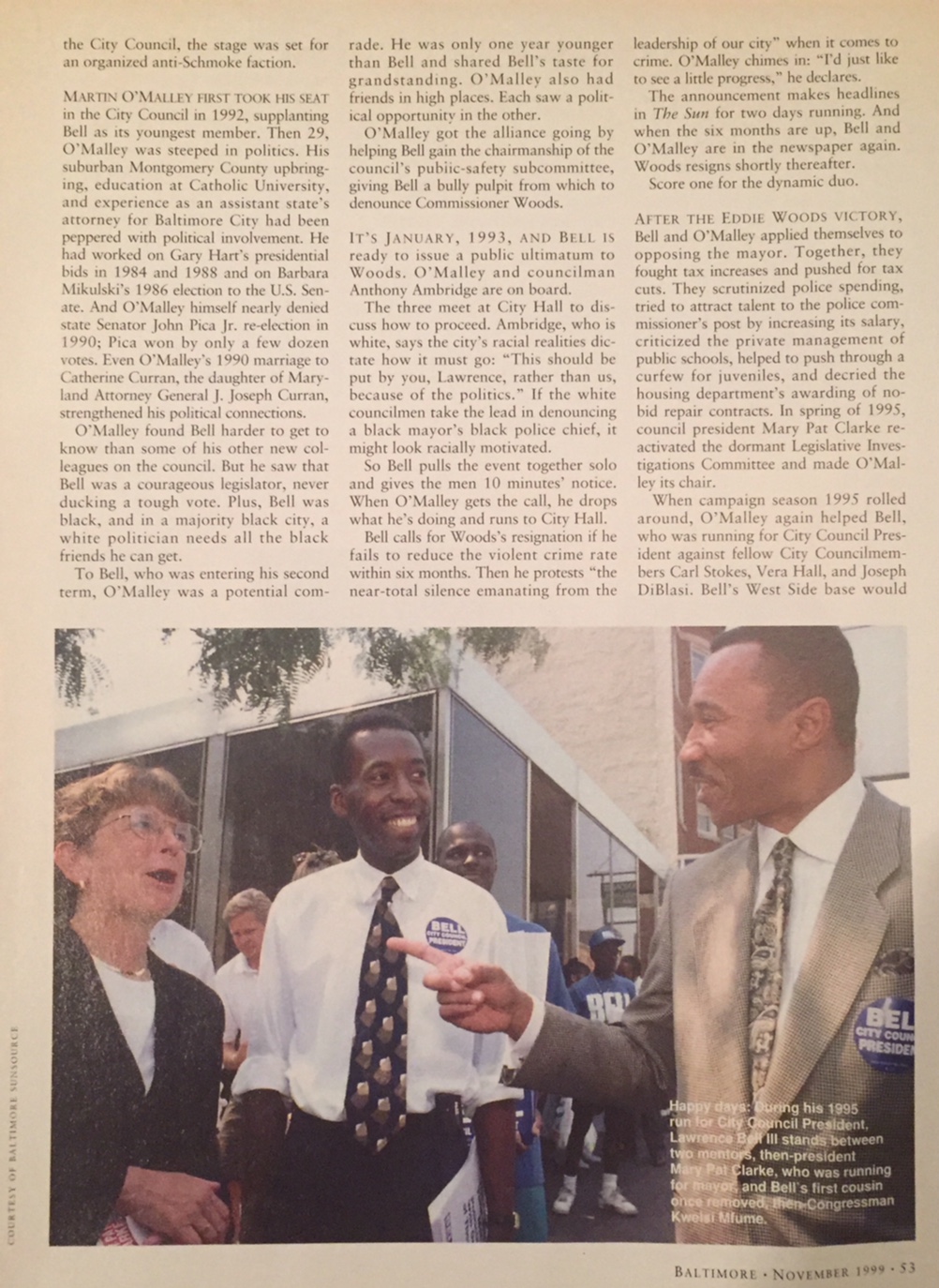
When campaign season 1995 rolled around, O’Malley again helped Bell, who was running for City Council President against fellow City Councilmembers Carl Stokes, Vera Hall, and Joe DiBlasi. Bell’s West Side base would support him, but he needed significant backing in other parts of the city.

He found it in the Third District, where O’Malley was running for re-election on a ticket with first-time council candidates Joan Carter Conway and Robert Curran, the uncle of O’Malley’s wife. Their ticket oversaw the Third District’s effort to get Bell elected. Of the city’s six districts, Bell led in only two: his own and O’Malley’s. In a crowded field, that was the margin he needed.

So it was no surprise when the new City Council president treated O’Malley well, handing him the chairmanships of the Taxation and Finance and Legislative Investigations committees. These two key assignments gave O’Malley the watchdog role he relished. Using the platform Bell gave him, O’Malley was able to broaden his reputation as a reform-minded, populist outsider.

Bell also treated O’Malley’s Northeast Baltimore neighbors well: First District Councilwoman Lois Garey became head of the Land Use Committee, while First District Councilman Nick D’Adamo was named chair of the Budget Committee.

Within Schmoke’s inner circle, this preferential treatment made it look like O’Malley was controlling Bell. At one point, Daniel P. Henson III, Schmoke’s housing commissioner – and no friend of the dynamic duo – tried to warn Bell to watch his back.

“Don’t be so sure everybody who says they’re your friend is your friend,” Henson told Bell outside City Hall.

“What do you mean?” the president asked.

“O’Malley – he’s running your show,” Henson said.

“No,” Bell responded, “I’m calling the shots.”

IMG_7434

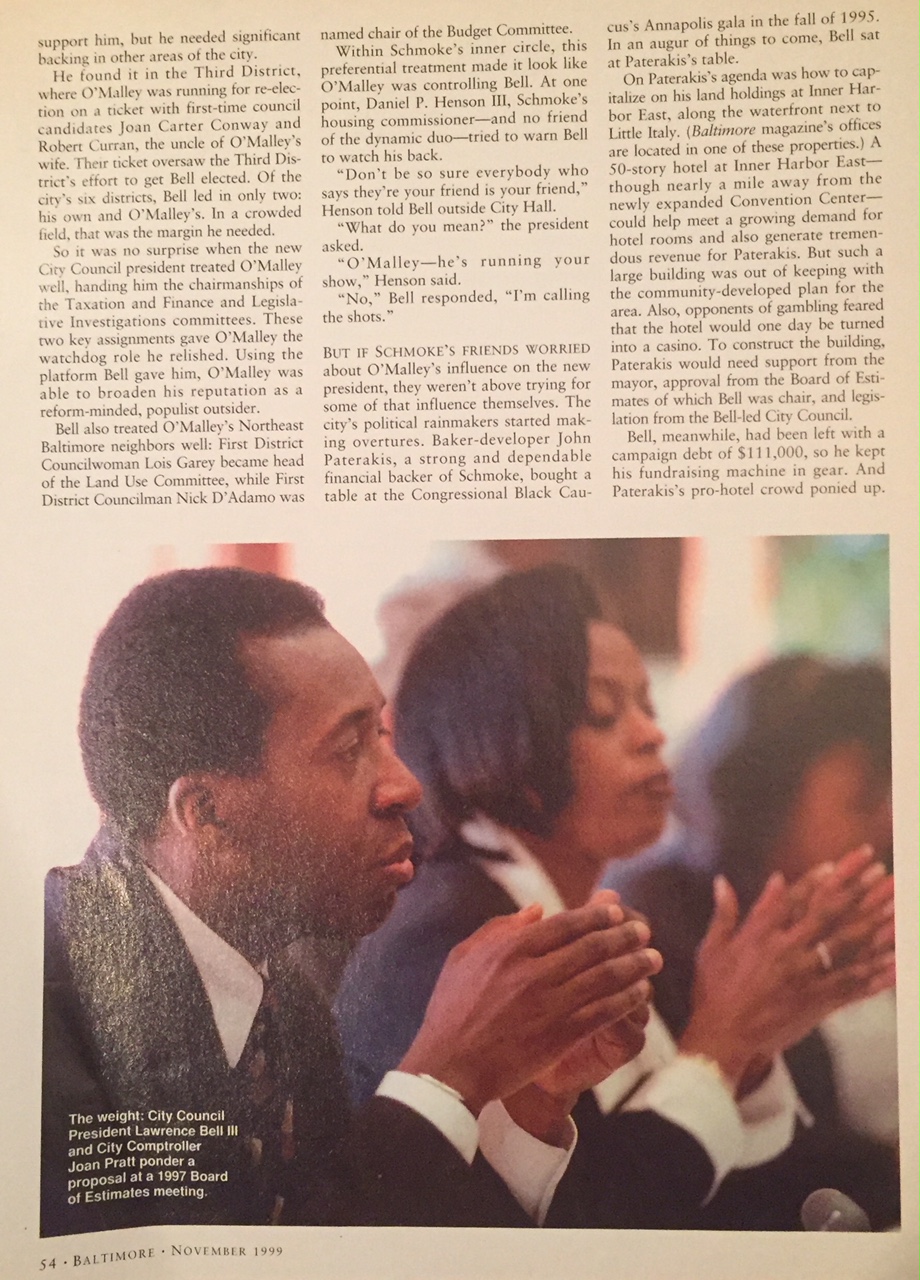
But if Schmoke’s friends worried about O’Malley’s influence on the new president, they weren’t above trying for some of that influence themselves. The city’s political rainmakers started making overtures. Baker-developer John Paterakis, a strong and dependable financial backer of Schmoke, bought a table at the Congressional Black Caucus’s Annapolis gala in the fall of 1995. In an augur of things to come, Bell sat at Paterakis’ table.

On Paterakis’ agenda was how to capitalize on his land holdings at Inner Harbor East, along the waterfront next to Little Italy. (Baltimore magazine’s offices are located in one of these properties.) A 50-story hotel at Inner Harbor East – though nearly a mile away from the newly expanded Convention Center – could help meet a growing demand for hotel rooms and also generate tremendous revenue for Paterakis. But such a large building was out of keeping with the community-developed plan for the area. Also, opponents of gambling feared that the hotel would one day be turned into a casino. To construct the building, Paterakis would need support from the mayor, approval from the Board of Estimates of which Bell was chair, and legislation from the Bell-led City Council.

Bell, meanwhile, had been left with a campaign debt of $111,000, so he kept his fundraising machine in gear. And Paterakis’ pro-hotel crowd ponied up. Between February 1996 and November 1997, more than $16,000 was contributed to the fund by Paterakis companies, members of the hotel-development team, or known supporters of Paterakis’s project.

“I’m in the big leagues now,” Bell told City Paper at the time. The donations, he said, represented his desire to garner support not only from his grass-roots base, but also from heavy-hitters.

The legislative battle was enormously controversial. The Sun played the hotel as a sweetheart deal for a privileged few. And while Little Italy residents were generally in favor of Paterakis’ project, Southeast Baltimore community leaders were adamantly opposed to it.

Ultimately, Bell and virtually all of the council, O’Malley included, approved the hotel project, though its height was reduced along the way to 31 stories. While it cannot be said that Bell sold his votes, the cash infusion into his coffers did signal the start of an inexorable process: his wooing by (and of) the city’s political moneybags.

Through all of this, Batman and Robin battled on. They opened 1996 with an attempt to derail the reconfirmation of Henson as housing chief, moved to stop Schmoke’s attempt to raise taxes, then devised a way the city could save money by offering workers retirement incentives. Bell sent O’Malley’s Legislative Investigations Committee to New York to study the city’s strict, “zero-tolerance” style of policing.

By 1997, O’Malley and then Bell turned on Commissioner Woods’ replacement, Thomas Frazier, and called for his dismissal over racial discrimination on the force.

Still, Bell seemed to be softening his stance against the mayor. “Bell, Schmoke Forge ‘Refreshing’ Relationship,” read a Sun headline from September of 1996. Many saw this as a detente – an agreement between superpowers to leave well enough alone.

IMG_7435

It’s spring of 1998. As usual, the council is faced with a budget proposal that cuts funding for city programs. The council cannot increase the mayor’s budget, but it can save programs by making cuts elsewhere. Ordinarily, the president takes the initiative, pushing individual amendments.

This time around, though, O’Malley suspects Bell isn’t with the program. It looks as if Bell has made a deal not to embarrass the mayor. O’Malley feels unsure about Bell, not knowing until the roll is called which way he will vote.

From Bell’s perspective, it feels like any other budget battle, with the president taking his share of the heat. The difference, if there is one, is that Bell has grown more presidential, compromising with the pro-Schmoke majority in order to gain ground. He isn’t just a councilman any longer; he is responsible for the work of the whole council. Lawrence thinks his friend Martin understands this.

The last day of the council session, after the final budget votes, O’Malley stays late in his city council office. Then he trundles under the City Hall dome.

He sees Bell walking his way. “Well, I think we did the best we could,” Bell says.

“No, Lawrence, I think I did the best I could,” O’Malley replies.

Bells seems incredulous. “What does that mean?” he asks.

“I really don’t f—in’ know,” O’Malley says before walking away. “Why don’t you take the summer and think about it?”

IMG_7436

During the summer of 1998, Bell’s list of backers started to look more like Schmoke’s. A prime example was attorney Claude Edward Hitchcock, who tried to protect the housing department during the no-bid repair scandal and later became executive director of the Empower Baltimore Management Corporation, which administers a $100 million federal project.

In 1998, Hitchcock lobbied for two main clients: Phipps Construction Contractors, which wanted permission to use a Northeast Baltimore site for a rubble-crushing operation, and Baltimore Entertainment Center, which wanted bars on The Block on East Baltimore Street to be allowed to serve liquor past 2 a.m. Hitchcock and these clients began donating to the Bell campaign fund that summer.

Another name to appear on Bell campaign finance reports then was Gia Blatterman, a Little Italy power broker who has long been a staunch supporter and energetic fundraiser for Schmoke. As word spread of Hitchcock’s and Blatterman’s donations, some O’Malley allies got nervous.

“It just appeared that he was surrounding himself with individuals that some of us believe weren’t in the best interests of the city – and/or Lawrence,” recalls Third District councilman Robert Curran. “And it just seemed that Lawrence was much, much less accessible to Martin.”

O’Malley agrees. In fact, he says Bell flat-out told him he’d been advised to distance himself from his old partner. “[Bell] said African-American opinion leaders would say to him things like, ‘You can’t appear to be controlled by people like Martin O’Malley and [former Bell aide] Jody Landers and Mary Pat Clarke,” he recalls. O’Malley remembers understanding this, telling himself, “He’s doing what he needs to do.”

Bell doesn’t remember it that way; in fact, he seems amazed at the suggestion. “He’s making that up,” says Bell. “Nobody ever said that.” As for his shutting O’Malley out, Bell says “it was always an open-door policy. He could call me at home whenever he wanted.”

Adds Bell’s brother Marshall, who worked on the campaign: “Martin wanted to think he could control Lawrence Bell in the presidency. Martin has a certain arrogance about him, a kind of paternalistic feel: ‘Sure, you’re my brother on the one hand, but I’m smarter than you, so do what I say.'”


Meanwhile, people close to O’Malley began to lose faith in Bell. “I broke camp probably July or August of last year,” recalls O’Malley’s old running mate Joan Carter Conway, who was appointed to the state Senate in 1997. “I knew something wasn’t right.” Conway warned O’Malley in the fall: “He’s gone, Martin, he’s sold out.”

With Bell seeming destined for a shot at the mayor’s office, O’Malley had his eye on the City Council presidency. He wanted to run on a ticket with Bell and suggested to Conway that the three of them sit down to work out their differences. But their meetings in November and December did not go well.

As O’Malley recalls it, “[Bell] said, ‘No, I don’t want you running for council president. Maybe some sort of public-safety liaison person.’ And I thought it was very strange that all of a sudden he wants me to take over some sort of middle-management duties.”

Bell recalls the meetings very differently. He never denied O’Malley a spot on his ticket, Bell says, because O’Malley never asked for one: “On many occasions, he was asked what he wanted, and he never would say.”

According to Marshall Bell, it would have been foolish for Bell to join forces with O’Malley so early, especially with city councilwoman Sheila Dixon contemplating a run for president of Bell’s West Side home base. Marshall says his brother told O’Malley, “Whatever you want, Martin, but as far as an endorsement goes, it would be political suicide.”


Then, Bell was buffeted by major changes in the political landscape. Schmoke announced in December that he would not run for re-election. Shortly afterward, Bell’s former colleague Carl Stokes entered the race, as did crusader A. Robert Kaufmann. Bell’s cousin Kweisi Mfume, rumored to be considering a run, announced that he would remain as head of the national NAACP. Almost immediately, important politicians began pleading with Mfume to reconsider. And it seemed like Mfume was doing so.

The impact of the “draft Mfume” effort on Bell was huge, says Mary Pat Clarke, who knows both men well: “This is a hero to Lawrence Bell, and a member of the family. And instead of helping Lawrence Bell, it turns out that he may run for the job du jour. That was the wound that would not heal for Lawrence Bell. He was never the same after that.”

Bell got caught up in legislative wrangling over whether to amend the city charter to allow an Mfume candidacy. (The NAACP chief had not lived within city limits for the required year.) Bell took heat first for failing to introduce the amendment and then for introducing it.

As Mfume mulled, Bell reeled, and his reputation for independence frayed. Word spread that Bell’s father was fielding political advice from his longtime friend Larry Gibson, an advisor to Schmoke, and that Bell himself was spotted at lunch with housing commissioner Henson, another Schmoke intimate. A look at Bell’s campaign-finance reports shows evidence that Schmoke’s Department of Public Works director George Balog, who made his name as a rainmaker by steering DPW contractor donations to political candidates, was actively raising funds on Bell’s behalf.

In March, before either man had announced his candidacy, O’Malley organized a fundraiser for himself at the Fraternal Order of Police headquarters in Hampden. As FOP president Gary McLhinney understood it, O’Malley was planning to run for city council president on a ticket with Bell and incumbent City Comptroller Joan Pratt.

But Bell’s personal relations with O’Malley continued to cool. O’Malley suspected that the Schmoke crowd was supporting Bell on the condition that he ditch his old friend.

The issue of Bell’s closeness to a Schmoke ally came to a head in April. The Phipps rubble-crusher proposal had been winding through the council process for more than a year. Expected to be a noisy and dusty enterprise in a residential area, the proposal angered environmentalists an Northeast Baltimore community groups – both important constituencies for O’Malley and his colleagues in the First and Third districts. On the other side was Phipps, a black-owned firm seeking to operate a business on its own land. In the end, the council split on the matter, and Bell cast the deciding vote. He voted in favor of Phipps – a stinging blow to some of his long-term allies.

“[Bell] was trying to be too much to too many people,” says city real-estate officer Anthony Ambridge, who supported Bell in the mayor’s race. “He called it the ‘big tent theory.’ He was trying to bring everybody into the tent. And by doing that he was excluding some of his closest friends.”

City Councilwoman Lois Garey describes her disappointment more pointedly: “[Bell] kicked every friend he had in the head.”

Marshall Bell says that his brother’s Phipps vote involved issues broader than the wishes of O’Malley and his neighbors. That it came to be seen as a breaking point between Bell and O’Malley reveals the assumptions behind the friendship, he adds: “These kind of people, if you don’t agree with them 100 percent of the time, they start saying you sold out.”


The day after Bell’s tie-breaking vote, Bell and O’Malley sit down to lunch at Chiapparelli’s Restaurant in Little Italy with the FOP’s McLhinney and Marshall Bell. Lawrence Bell is just about to announce his candidacy, and McLhinney has brokered a summit, hoping to mend the breach between them.

It’s the first time in about a year that McLhinney has seen to two men in a room together, and he senses major problems between them. Nevertheless, he lays out the case for a Bell-O’Malley-Pratt ticket. Then, he turns to Bell. “What do you think, Lawrence?” he asks.

“I don’t want to make any commitment until after the filing deadline,” Bell responds.

O’Malley goes on the offensive, asking Bell to explain his ties to Schmoke’s “old warhorses.” “How you win also dictates how you are able to govern,” he says, “and if you win this way, you won’t be able to govern.”

Bell gets defensive, asking why he’s not getting more support from O’Malley’s allies. Then he cuts to the chase. “What are you going to do?” Bell asks.

“Well, my sense is that you are dropping like a rock,” O’Malley says.

Marshall Bell chimes in: “See, there you go again, you’re always negative.”

Lawrence Bell agrees, saying O’Malley’s negativity is what cooled the friendship.

“I’ve always told you the truth, whether you wanted to hear it or not,” O’Malley retorts. “If you were my friend, you’d always tell me the truth.”

“It was how you said it,” Bell says. “I don’t need my friends being negative. All this stuff puts me under a lot of pressure.”

“Well, what do you think it will be like when you’re mayor?” O’Malley asks.

“I don’t need a lecture from you about what it’s going to be like to be mayor,” Bell shoots back.

At the end of the lunch, Bell asks O’Malley what office he’s planning to seek.

O’Malley says he doesn’t know. He’ll do a poll to see if he has a chance of winning the mayor’s race. If he can win, he’ll run; otherwise, he’ll run for City Council president if the polls show a win is possible. “And if I can’t win either of those things, then I’m going to get out altogether,” O’Malley says. “And I’ll let you know.”


In late May, cousin Kweisi finally announced that he definitely would not run. The Annapolis powers who had pursued him immediately switched their attentions to former city Police Commissioner Bishop Robinson. And a score of other candidates joined the Democratic race.

Meantime, O’Malley’s poll showed him at 7 percent in a mayor’s race, compared to Bell’s 36 and Stokes’s 27. It also indicated that most of Stokes’s supporters could also support Bell and vice versa. O’Malley concluded that voters weren’t committed to either one of them, meaning he could cut into their bases. O’Malley announced his candidacy in late June.

Even without an O’Malley candidacy to contend with, though, Bell’s campaign was in crisis. Powerful friends could fill his coffers, but they could not dictate how he ran his race. In the first three months of 1999, the Bell campaign took in nearly $200,000 and spent more than $130,000, paying out half that amount to five costly advisers: Marshall Bell, Tammy Hawley, Julius Henson, and fundraisers Lona Rhoades-Ba and James Cauley, who was on loan from O’Malley. Another $10,000 was spent on debt from his 1995 campaign.

O’Malley, by comparison, raised $45,000 and spent $35,000 from late March through late June. During these months of campaign-building, O’Malley had no paid advisors except for his long-time fundraiser Cauley, who received $4,096.

Matters other than money hurt Bell. His campaign was marked by missteps, such as the candidate’s propensity to arrive late to forums or not show up at all; his workers’ attempt to disrupt a rally at which Mfume’s Annapolis suitors endorsed O’Malley; and his workers’ copying racist flyers attributed to white supremacists. Every time Bell was embarrassed in the media – for example, by reports that he left his wrecked Mustang at the body shop until it was repossessed and that he failed to pay his Belvedere condo fees – he would disappear from the campaign trail. He seemed to take each setback to heart rather than letting it go.

When Bell did appear, he made race an issue in a way his opponents did not, explicitly offering himself as a role model for young African Americans. More than once, Bell attacked O’Malley for refusing the censure Baltimore-based Crown Central Petroleum, which had been accused of racist practices in Texas. (O’Malley’s response was that Crown had not been invited to defend itself.)

As if to symbolize how far he had traveled from his partnership with O’Malley, Bell spent election day with Marion Barry, the disgraced and redeemed former mayor of Washington, D.C.


In the end, O’Malley won 53 percent of the vote to Bell’s 17 percent. Carl Stokes came in second, with 28 percent of the vote.

If it’s true, as O’Malley said, that how you win also dictates how you govern, then an O’Malley administration would be marked by efficient fundraising and spending, a motivated and diverse cadre of workers, a focus on a few key issues, backing from state leaders, and support from an energized public.

But these aren’t the only factors that propelled O’Malley to victory.

Though he ran on the campaign pledge “for change and reform,” O’Malley’s campaign also relied on old warhorses, and his horses were even older than Bell’s. Some of O’Malley’s key change agents hail from the days of once-mayor, now state Comptroller William Donald Schaefer, whose endorsement also brought many Schaefer cronies into the O’Malley camp. Even the head of O’Malley’s transition team, Downtown Partnership’s Laurie Schwartz, began her career as one of Schaefer’s best and brightest.

Another old-fashioned factor in O’Malley’s win may have been the use of “walk-around money” – money paid to get “volunteers” to electioneer near polling places. It is against state law to pay workers on election day, and O’Malley denies that anyone was paid to electioneer for him on that day. Nevertheless, polling places throughout the city seemed to have multiple O’Malley workers for every Stokes or Bell worker, and word on the street was that they were being paid. One O’Malley poll worker said he received $35 to stand on the corner wearing an O’Malley T-shirt and handing out literature. Another worker, who said he had not been paid, said he’d heard that other were receiving $35 to $60 for their efforts, depending on the neighborhood. Whoever funds such payments funds them directly, without reporting them, so if O’Malley’s campaign did benefit from such largesse, persons unknown did him a big favor.

But if O’Malley needed old-time backers to win the primary, he also needed Bell. Without the high-profile alliance of Salt’n’Pepa, O’Malley might have been just another white Northeast Baltimore politician, not one of a new, race-blind generation of leaders. After his partnership with Bell crumbled, O’Malley used its rubble as the launching pad for his own ambitious campaign.

This month, O’Malley faces Republican underdog David Tufaro, a millionaire developer with strong credentials as a community builder. Unless Tufaro pulls off an upset immeasurably more stunning than O’Malley’s primary victory, Baltimore can look forward to Mayor O’Malley.

But can O’Malley govern independently? Is he more resistant than he thinks Bell was to the siren song of the city’s moneyed players?

When these questions are put to him, O’Malley’s answer is nearly identical to one of Bell’s stock campaign lines: “All I can say is, look at my record,” he says. “Look at what I’ve done on the council; look at my politics.”

All in the Family: An annotated roster of defendants in the Black Guerrilla Family indictment, alleged crimes, and notable quotes

By Van Smith

Published by City Paper, June 4, 2013

IMG_7407

The April 23 unsealing of a federal indictment of 25 people, including 13 Maryland correctional officers (COs), alleged to have participated in a racketeering conspiracy centered around the Black Guerrilla Family (BGF) prison gang, was as much a renewed impeachment of the integrity of Maryland’s prison system, which has been repeatedly exposed for serious corruption problems, as it was of the defendants’ alleged conduct. Nonetheless, it is the defendants who are on the dock, not the bureaucracy.

Here’s a run-down of who they are and what they’re alleged to have done, based on court records, other public documents, and information from the Maryland U.S. Attorney’s Office (MD-USAO). The co-defendants are listed in the same order in which their names appear in the indictment, and the ages given are those provided by the MD-USAO – which today, after City Paper raised questions about the accuracy of ages given for some co-defendants, said it had inaccurately reported the ages of two of the defendants, as clarified below.

(Note: All “notable quotes” are republished exactly as transcribed in the affidavit)

Tavon White, aka “Bulldog” and “Tay,” 36-year-old inmate, of Baltimore

As the BGF’s leader at the Baltimore City Detention Center (BCDC), who held the title of “Bushman” within the larger BGF hierarchy in Maryland and nationwide, White allegedly became the de facto ruler of everything that happened there. Since he first arrived as an inmate in 2009, he is said to have fathered at least five children by at least four different COs who aided the conspiracy. His cousin and co-defendant, Tyesha Mayo, is accused of having helped supply drugs and launder money for the BGF, and his half-brother and co-defendant, Ralph Timmons, Jr., who allegedly helped set up smuggling operations and financial transactions for the BGF, was killed in a robbery hours before the grand jury handed down the sealed indictment on Apr. 2. In the FBI-led investigation, calls on two of White’s phones – “Target Telephone 6” and “Target Telephone 11” – were intercepted. Among the trove of information the wiretap turned up about White was that he made so much money while running the prison – approximately $16,000, in a slow month – that he shoveled proceeds into buying luxury cars for his harem of COs to use.

Notable quote: “Like, I am the law. My word is law. So if I told any mother-fucking body they had to do this, hit a police, do this, kill a mother-fucker, anything, it got to get done. Period.”

Antonia Allison, 27-year-old correctional officer, of Baltimore

Allison is accused of working with another co-defendant CO, Katera Stevenson, to smuggle prescription pills and marijuana for Tavon White. Her West Baltimore residence at 3047 Arunah Ave. was raided just before the indictment was unsealed on April 23.City Paper in 2009 and 2010 dedicated much coverage to a federal lawsuit filed against Allison by an inmate who accused her of facilitating a brutal, gang-related attack on him, because the case exposed documentation of unaddressed gang-related corruption among COs. The following articles reported developments in the case against Allison, which ended up in 2010 with a settlement agreed to by plaintiff Tashma McFadden: “Ganging Up,” Mobtown Beat, Oct. 21, 2009; “A Big No-No,” Mobtown Beat, Nov. 4, 2009; “Inside Job,” Feature, May 12, 2010; and “The Big Hurt,” Mobtown Beat, Aug. 4, 2010.

Notable quote: “Alright, well do those first, pills [presciption pills] and the strips [Suboxone strips], they the easiest, get them out the way. You know they gonna sell fast.”

Jamar Anderson, aka “Hammer” and “Hamma Head,” 23-year-old inmate (MD-USAO inaccurately reported he was 26), of Baltimore 

Anderson’s girlfriend, co-defendant Teshawn Pinder, allegedly conspired with CO Jasmin Jones, another co-defendant, to smuggle pot into prison on Anderson’s behalf. Anderson also allegedly conspired with CO Jasmine Thornton – a paramour, according to a wiretapped conversation between White and CO Jennifer Owens, another co-defendant, in which Anderson is reported to have said, “we did it eight times last night” – to smuggle cellphones and launder money. Anderson was forewarned of impending prison-cell searches when White relayed a message about them he received from CO Tiffany Linder, another co-defendant.Anderson was recently convicted of murder in the double-shooting that killed 17-year-old John Person in 2008. According to City Paper‘s Murder Ink column, “at about 4 P.M. on Aug. 6, 2008, a woman saw Anderson, who was 18 at the time, committing a burglary in her apartment complex in the 2900 block of Garrison Boulevard and called the police. Anderson said he would come back and kill the woman for what she had done. Around midnight, Anderson came back and shot at her, firing 10 rounds from a semi-automatic gun. He missed the woman but hit her cousin, Person, in the back. Person died on Aug. 17, 2008.”

Ebonee Braswell, 26-year-old correctional officer, of Baltimore

An alleged smuggler, including of prescription pills, Braswell’s phone – “Target Telephone 8” – was tapped, and she was heard telling an unknown male that pills are worth much more in jail than they are on the streets. In November, she allegedly obtained an ounce of pot with the help of co-defendant CO Kimberly Dennis.

Notable quote: “Like, say, even if I buy 15’s [prescription pills] up here for $10, right? I could sell them in there for $25. You know what I’m saying? So you still make a $15 off of it. See, they would sell faster if I leave them in there with a nigger. But I don’t trust them niggers, so I take them in there every day myself. Get the money myself. You feel me? So that’s how I do it.”

Chania Brooks, 27-year-old correctional officer, of Baltimore

On Jan. 1, Brooks and White allegedly discussed how co-defendant Steven Loney had been attacked by another BGF member that day; Brooks witnessed the attack, but left her post to consult with White about what to do about it. She is one of 14 COs listed on prison-wall graffiti as willing to have oral sex for $150, and is one of at least four COs who has had sex and become pregnant by White. An alleged pill-smuggler, in Dec. 2012 Brooks filed assault charges in state court against CO Katera Stevenson, another co-defendant in the BGF case who White impregnated. Brooks’ Cockeysville residence, at 511 Lake Vista Circle, was raided shortly before the indictment was unsealed on April 23.

Notable quote: In a conversation with co-defendant CO Tiffany Linder about the baby Linder was having with Tavon White, Brooks said: “I don’t give a fuck about that baby. That’s y’all baby, not mine. We having one too. So what?”

Kimberly Dennis, 26-year-old correctional officer, of Baltimore

Dennis’ “Target Telephone 1” was tapped during the investigation, and in October 2012 she allegedly told co-defendant inmate Derious Duncan, with whom she coordinated smuggling runs, that she intended to make $2,000 that week from moving contraband into prison. Also in October, she allegedly called another CO to learn whether an internal investigator was at the prison entrance, so that she could avoid him. And in December, she allegedly explained to an unknown male that an inmate was stabbed by the BGF because the inmate was smuggling without paying the required 10-percent tax the BGF charges. Dennis also allegedly smuggled with inmate co-defendant Joseph Young. Her Gwynn Oak residence at 2231 Wheatley Dr. was raided shortly before the indictment was unsealed on April 23.

Notable quote: On Dec. 3, 2012, the day the inmate was stabbed for not paying the smuggling tax to the BGF, Dennis said to an unknown male: “Yeah, them niggas banged him. It was like six of them. Because when he first got over there he was catching or whatever. It was a, umm, issue ‘cause you know, like, whoever catch, you gotta pay a bill.”

Derius Duncan, 23-year-old inmate (MD-USAO inaccurately reported he was 26), of Baltimore

Duncan, who allegedly coordinated smuggling runs with co-defendant CO Kimberly Dennis, had cellphones and drugs stolen from him by other inmates, and, in retribution, White ordered the punishment of the suspected thieves. A BGF “floor boss,” co-defendant inmate Joseph Young, was directed by White to mete out the punishment, and in October, White ordered the beating of inmate David Warren, aka “Meshawn.” Co-defendant CO Jasmin Jones in November allegedly “stood guard outside a closet” so that Duncan and Dennis could have sex, according to court documents. Last summer, Duncan was charged in state court with murder, conspiracy, witness intimidation, and obstruction of justice, along with three other men – Keyon Beads, Clifford Butler, Jr., and David Johnson – after they allegedly attempted to bribe, and later killed, 55-year-old Ronald Givens, a potential state witness in a guns-and-drugs case against Duncan.

Jasmin Jones, aka “J.J.,” 24-year-old correctional officer, of Baltimore

Jones allegedly helped co-defendant inmate Jamar Anderson launder BGF proceeds by putting $500 onto a Money Pak card “that is used to load money onto Green Dot Visa cards.” She also allegedly picked up pot from Anderson’s girlfriend, Teshawn Pinder, to smuggle into prison for Anderson. Her West Baltimore residence, 401 Nottingham Rd., was raided shortly before the indictment was unsealed on April 23.

Taryn Kirkland, 23-year-old correctional officer, of Baltimore

One of 14 COs listed on prison-wall graffiti as willing to have oral sex for $150, Kirkland allegedly coordinated with co-defendant CO Katrina LaPrade to smuggle pot for co-defendant inmate Steven Loney, and coordinated with co-defendant Jennifer Owens to smuggle contraband for Tavon White. Her Woodlawn residence at 5 Greenbury Ct. was raided shortly before the indictment was unsealed on April 23.

Notable quote: “So them dogs ain’t shit,” she tells co-defendant inmate Steven Loney after co-defendant CO Katrina LaPrade manages to walk a lot of pot past the jail’s drug-sniffing dogs.

Katrina LaPrade, aka “Katrina Lyons,” 31-year-old correctional officer, of Baltimore

Allegedly by coordinating with co-defendant Taryn Kirkland, LaPrade managed to smuggle pot past the jail’s drug-sniffing dogs and get it to Steven Loney. Her residence near the West Coldspring Metro Station, 2821 Ridgewood Ave., was raided shortly before the indictment was unsealed on April 23.

Tiffany Linder, 27-year-old correctional officer, of Baltimore

In January, Linder allegedly did something of great service to Tavon White and his BGF comrades: she tipped him to a planned shakedown at the jail, during which cells would be searched for contraband and other signs of criminal activity. An alleged contraband smuggler, she is one of at least four co-defendant COs who had sex with and became pregnant by White. Her Severn residence, 1858 Eagle Court, was raided shortly before the indictment was unsealed on April 23.

Notable quote: “I just want to know what it is between us,” Linder told White, “and what are you going to do about the baby ‘cause I’m definitely keeping him. I don’t have time for games.”

Steven Loney, aka “Stevie,” 24-year-old inmate, of Baltimore

An allegedly active distributor of prison contraband, Loney relied on co-defendant CO Taryn Kirkland to manage and record Green Dot transactions involving Loney’s drug customers. On Jan. 1, Loney was attacked by another BGF member, and co-defendant CO Chania Brooks, who witnessed the incident, left her post to consult with Tavon White about what should be done about it. Loney’s phone, “Target Telephone 10,” was tapped from Jan. 10 to Jan. 30.

Notable quote: Loney tells Kirkland that co-defendant CO Katrina LaPrade is getting nervous because of all the smuggling LaPrade been doing, saying, “Man now she talking about too many people coming to her, she about to chill that’s why she changed her number. Folks keep calling her from all these different numbers. She don’t want to make her hot.”

Vivian Matthews, 25-year-old correctional officer, of Essex

Matthews declined requests to smuggle drugs for the BGF, but she did procure them – Xanax and Percocet pills, which she gave to others to arrange delivery into prison. She is one of 14 COs listed on prison-wall graffiti as willing to have oral sex for $150. A Gardenville residence associated with her, 4522 Hamilton Ave., was raided just before the indictment was unsealed on April 23.

Notable quote: Describing to Tavon White the drugs she has available, she says, “Man I just told you what I got. I got one hundred Xanax’s, ninety of them white and then the ten of them. They orange. They the footballs. No, all of them footballs. And I got twelve Percocets.”

Tyesha Mayo, 29-year-old outside supplier, of Baltimore

Tavon White’s cousin, Mayo allegedly helped him launder money with Green Dot pre-paid debit cards and she allegedly delivered pot to co-defendent Katera Stevenson to take to White. Her West Baltimore residence, at 1021 Pennsylvania Ave., was raided just before the indictment was unsealed on April 23.

Jermaine McFadden, aka “Maine,” 24-year-old inmate, of BaltimoreCo-defendant CO Katera Stevenson allegedly smuggled cellphones and drugs into prison for McFadden, who currently is facing drug charges in state court and was recently convicted for possessing contraband in a place of confinement.

Notable quote: “You say you going to bring that grass and shit today right?” he asks Stevenson, describing pot and other contraband. When Stevenson says yes, he gives her the details of the smuggling run: “Aight I am a have that nigga on the out for you. Not the one with the glasses but the other that work in the same kitchen.”

Jennifer Owens, aka “O” and “J.O.,” 31-year-old correctional officer, of Randallstown

Owens allegedly has two children fathered by co-defendant inmate Tavon White, has a “Tavon” tattoo on her neck, and is one of 14 COs listed on prison-wall graffiti as willing to have oral sex for $150. Her phone, “Target Cellphone 3,” was tapped from Oct. 12 to Dec. 8, 2012, and her Randallstown residence, at 3926 Noyes Circle, was raided shortly before the indictment was unsealed on April 23.

Notable Quote: “I understand you stressed out, cuz you locked up, ok, but I am too. You locked up, and I’m fucking pregnant again. Like really, who the fuck does that? Only my dumb ass do shit like that, for real. I can accept that I fucked up. I know I did, but I did that shit cuz I wanted to. I don’t regret it.”

Kenneth Parham, 23-year-old inmate, of Baltimore

Parham allegedly helped with the smuggling into prison of pot, prescription pills, and SIM cards for cellphones. He currently faces gun-and-drugs charges in state court, where he has a lengthy record of criminal convictions.

Teshawn Pinder, 24-year-old outside supplier, of Baltimore

Jamar Anderson’s girlfriend, who coordinated smuggling on Anderson’s behalf with co-defendant CO Jasmin Jones, Pinder faced pot-possession charges that were tabled by state prosecutors in early April. Her West Baltimore residence, at 2512 Edgecomb Circle North, was raided just before the indictment was unsealed on April 23.

Adrena Rice, 25-year-old correctional officer, of Baltimore

Rice’s alleged dealings with Tavon White, which included smuggling marijuana to him in BCDC, were complicated – White believed she stole an ounce off a package he received. Her Randallstown residence, 9 Mainview Ct., was raided just before the indictment was unsealed on April 23.

Notable Quote: “When I came back in the jail, I’m like, shit, I’m not going to stop making my money. You feel me? I seen what the fuck was going on, asked a few people, what was up and who was who, and what was what. I am just about my money. You hear me? I got to get it.”

Katera Stevenson, aka “KK,” 24-year-old correctional officer, of Baltimore

Stevenson, whose “Target Telephone 7” was tapped from Dec. 11, 2012, to Jan. 9, 2013, has “Tavon” tattooed on her wrist, in honor of the father of her child, co-defendant inmate Tavon White, for whom she allegedly smuggled prescription pills and pot into prison. She is accused of smuggling for co-defendant inmate Jermaine McFadden, who she told she would smuggle every day. She is one of at least four COs who had sex and was impregnated by White. One Jan. 10, she was arrested after trying to smuggle a vacuum-packed bag of pot into prison, and the case is scheduled for trial in May. Her Northeast Baltimore residence, at 5919 Chinquapin Parkway, was raided just before the indictment was unsealed on April 23.

Notable quote: Tavon White “think I’m one of the most crazy baby mother’s he has. He said he gonna pay my rent. He gonna pay my rent. 284 every month. That’s what he said.”

Tyrone Thompson, aka “Henry,” 36-year-old outside supplier, of Baltimore

Thompson allegedly delivered pills to co-defendant CO Jennifer Owens and co-defendant Ralph Timmons, Jr., on behalf of Tavon White. His West Baltimore residence, 2920 West Walbrook Ave., was raided just before the indictment was unsealed on April 23.

Jasmine Thornton, aka “J.T.,” 26-year-old CO, of Glen Burnie

Thornton’s phone, “Target Telephone 9,” was tapped from Jan. 10 to Feb. 8, 2013, and she is accused of smuggling contraband into prison for numerous inmates. In February, Tavon White and CO Jennifer Owens discussed Thornton having sex in jail with co-defendant inmate Jamar Anderson. Thornton was assigned to guard White’s tier, which meant that other co-defendant COs could easily deliver contraband directly to White. Her Glen Burnie residence, 336 Adams Ct., was raided shortly before the indictment was unsealed on April 23.

Notable quote: After Anderson’s girlfriend, Teshawn Pinder, was pulled over by police with pot in her car, Thornton, who witnessed the incident, reported to Anderson: “I was pulling in the, um, Royal Farms the police was behind her, so I called her like did they pull you over. Their lights wasn’t on and she like, ‘yea,’ and then they were just sitting there for a long ass time, so I went and got some gas and all that. Then somebody else came with a dog, and then they brung the dog to the car.”

Ralph Timmons, Jr., aka “Boosa,” 34-year-old outside supplier (deceased), of Baltimore

Timmons’ phone, “Target Telephone 2,” was tapped from Sept. 10 to Oct. 9, 2012, and from Dec. 11, 2012 to Jan. 9, 2013. Investigators say he facilitated criminal activities for his half-brother, co-defendant inmate Tavon White, by coordinating smuggling operations with co-defendant CO Jennifer Owens and handling financial transactions.The MD-USAO reports that Timmons was murdered during a robbery, hours before the indictment was handed down on April 2. City Paper’s Murder Ink column reported that at 9:20pm on April 1, “an 11-year-old boy ran to police patrolling near the 1900 block of Bentalou Street to lead them back to the house where he had been shot,” and responding officers found Timmons, the boy’s father, shot dead in the house. Two men – John Knox, 21, of the 4800 block of Woodmere Avenue, and Joseph Oglesby, 37, of the 1100 block of Greenwood Road in Princess Anne County – were later arrested and charged with first-degree murder as a result of the killing.

James Yarborough, aka “J.Y.,” 26-year-old outside supplier, of Baltimore

Yarborough, who currently has an open state drug charge, alleged helped smuggle pot and pills into prison. Investigators recently saw him with co-defendant CO Kimberly Dennis, walking out of her house, getting into her Camaro, and the two of them driving away.

Joseph Young, aka “Monster,” 30-year-old inmate, of Baltimore

Young’s phone, “Target Telephone 5,” was tapped from Nov. 9 to Dec. 4, 2012, revealing that he’s allegedly an active BGF member with a leadership role as a “floor boss” at BCDC who coordinates smuggling activities with COs and outside suppliers. Young is also alleged to be Tavon White’s heir apparent, should White leave the jail. A unindicted and unnamed lieutenant told Young that, when and if that occurs, Young would enjoy the same agreement White had with prison authorities: smuggle freely in exchange for keeping down prison violence.

Scouting Report: Going for the Poolitzer

By Van Smith

Published in New York Press, Mar. 10, 1999

IMG_7500

I got a phone message from a close friend, a school teacher in the Bronx, who for good or ill keeps up with the nitty-gritties of my life. “I’m just curious as to how far that rod got jammed up your asshole, Van,” my friend said. “And, you know, what kind of roughage – what kind of whatever you call it, excess – you had. … So please give me the details when you can. Thank you.”

Ah, the details. It started a few weeks ago when another friend of mine, an artist and photographer from Baltimore, came to town to keep an appointment with Maya Goldenberg, a certified iridologist and colon therapist who runs the Natural Health & Nutrition Center in the Homecrest neighborhood of Brooklyn. My friend ponied up $50 to use Goldenberg’s Libbe colonic hydrotherapy machine. This convenient device is, as my friend described it, essentially a self-service colon-cleanser. Plug yourself in, let the water work its magic and watch huge volumes of effluvial night soil parade through clear and backlit plastic plumbing.

He said it was supposed to be good for you. Knowing that he’s a scatalogically obsessed Virgo, I had other, more psychological theories about why he might go for radical bowel treatment, but I kept them to myself.

That’s about all I kept to myself, though, since I myself am somewhat scatalogically obsessed, and there’s nothing I like more than telling a good story involving the GI tract. So on a recent Saturday afternoon I crossed the threshold of Goldenberg’s office, gripped with mild, butt-clenching anxiety over the impending penetration of my rectum. Accompanying me for moral support was a close companion. The first thing I noticed about Goldenberg’s office, on the second floor of a rowhouse on Ocean Ave., was that its walls are pink. Like the inside of a newly flushed colon. New-age music floated quietly through the air in rhythmic drips and drops. The atmosphere was conducive to the peaceful release of whatever’s binding you up.

Goldenberg, a prim and proper white-clad Russian immigrant reminiscent of a young Dr. Ruth, greeted me warmly and handed me a questionnaire. I answered all the usuals – name, address, date of birth, height, weight, etc. – and then came to the one question that I briefly thought might put the kibosh on the assignment. “Have you ever had surgery? If so, where?”

When I was 18, I perforated my intestines in a moped accident. Massive infection had resulted, so the doctors had opened me up like a baked potato to clean out the pus and stitch up the cut. I thought that that session under the knife might cause Goldenberg to cancel on me. But she just perused my questionnaire, made a few asides (“A writer? I get writers, movie stars …”) and proceeded to explain the procedure, without once asking me about my intestinal surgery. With the preliminaries out of the way, she escorted me through a door that bore a sign: “Colonic irrigation.”

Inside was the Libbe machine. Goldenberg kept up a singsong banter about the device, which is made of blue molded plastic and looks like a combination of a La-Z-Boy and a bidet. As she spoke, she ripped open a packet of lube, greased up a nozzle sticking up out of the bowl and fitted a clear, disposable plastic tube over it. Then she handed me the packet and told me I would need to take off my pants, lubricate the tip of the tube and my anus, and insert the former into the latter while making myself comfortable in the Libbe’s reclining seat. She placed a folded sheet and a blue splatter-cover on the table next to the machine. Then she instructed me to cover my private parts with the sheet, and the Libbe’s bowl with the splatter-cover, once everything was in place. When I was ready, she said, I was to push the buzzer, and she’d come in and kick the Libbe into gear.

Now, some people say it’s a playground down there, but I’m not one to make fun with my brown eye. Except for some routine care and maintenance, I’m pretty adamant about leaving the sucker alone. Thus, as I probed a greasy finger around the ring and tried to relax and let the tip of the tube make its entry, I felt profoundly embarrassed, even a touch humiliated. I took small comfort in knowing that Maya Goldenberg wasn’t taking care of this end of things, at least.

Once all the parts were in their proper places and I was decent according to such dictates of modesty as still apply when you’re plugged in for a colonic, I buzzed for Goldenberg to enter. On the wall next to me was a cabinet, which she opened to reveal a series of clear tubes filled with filtered water. She explained that the water was warmed to just below body temperature for cleansing comfort. She turned a knob and, as the water level in the tube descended, by bowels distended.

According to Goldenberg, the Libbe’s great advance in colon-cleansing technology is that it ends the need to insert a painfully oversized tube in order to carry away the flushed bowels’ contents. Instead, the built-up mess just rushes out of the anus around the slim, inserted tube. This, she explained, makes for a much more comfortable ride, since the patient controls the rate and timing of release.

Having explained all this while my guts were slowly filling, Goldenberg left me in peace to contemplate the strange sensations and to worry about the inevitably loud sounds that would result from the release. The waiting room, after all, is just outside the thin door. As if reading my mind, Goldenberg offered to turn up the new-age music before she left.

Then came the deluge. I watched the clear drainpipe with great anticipation and fascination. Wave after wave of effluent left my body, but all I saw was fecal matter in suspension, some dark – some of it even black – and some of it shades of light brown to yellow. One thought dominated my mind as I watched: God, if all that was inside me, I really needed this.

I spent a little over a half-hour in the room. After I cleaned myself up with some paper towels (despite the splatter-cover, a little backwash tends to hit you in the cheeks and thighs) and got my pants and boots back on. I opened the door. Another patron awaiting use of the machine successfully avoided looking at me. It dawned on me that the music doesn’t quite cut it. What Goldenberg needs to play is a little G.G. Allin or some other shitty punk music. As my companion said later, “I heard the whole thing – every bit of it.”


The Black Guerrilla Family’s Maryland Chapter Is All About ‘Ben’

By Van Smith

Published by City Paper, Dec. 9. 2014

IMG_7394

Back in 2011, two years before Tavon White and 43 others were indicted in Maryland for running a Black Guerrilla Family (BGF) gang conspiracy in Baltimore’s jails, someone going by the moniker “fire water air” posted a comment on the forum of assatashakur.org, the website of American cop-killer fugitive Assata Shakur. What “fire water air” wrote cut to the core of a central dilemma for the BGF: How can it pursue what it calls “cambone,” a concept that promotes community dignity in a racist society, while actively carrying out what it calls “ben,” the tactics, often criminal, for financially supporting the pursuit of that dignity?

The BGF’s dual roles of cambone and ben were explained in the “Black Book,” a revolutionary self-help guide collectively written by BGF inmates in Baltimore and published by Eric Marcell Brown, the Maryland BGF leader who was convicted in 2011 in a prior racketeering prosecution. In Brown’s case, cambone was a strong factor, as he sought legitimacy while an inmate nearing his release date by appearing to work for good, offering the BGF’s black-separatist ideology as an antidote to the pathology of criminal lifestyles. The fact of the matter, though, as Brown’s case proved, is that ben reigned supreme, and “fire water air” seemed to understand and worry about this in 2011.

“Well the bgf here in baltimore run every aspect of the streets and hold major weight in the prison system,” the post stated, adding that “cambone holds no weight here” and “its run under the b.e.n.” It called the BGF “all love,” but said “the machine is down,” possibly referring to Brown’s take-down, and rued the fact that there are “no more old heads to lead” the “young comrades,” so “it looks like a gang now” and “im very sad about that shit.” The government, meanwhile, “know everything now after they took away our fathers,” it continued, and “i guess everybody want to be a g instead of pushing the revolution,” so “comrades like me are lost now.”

“BROTHERS KILLING AND ROBING BROTHERS EVERYWHERE,” the post concluded, switching to capitalization for emphasis, adding that “THE CODE OF CONDUCT HOLDS NO MORE POWER” and “ITS ALL ABOUT WHO GOT MORE STREET CREDIT AND RANK IN PRISON AND THAT ONE PERSON WILL BE LOOKED AT AS THE BIG GUY FOR THAT REGION OF BALTIMORE.”

It would be interesting to know what “fire water air” thinks about the White case, now being tried before a jury in Baltimore’s federal courthouse, with White himself as the state’s star witness. What White has described from the stand—that, even though he wasn’t a “bushman,” or high-ranking BGF member, he was able to take command of the jail because the BGF hierarchy on the streets believed in his ability to run the jail’s lucrative contraband economy, using correctional officers to smuggle prohibited goods such as pot, painkillers, tobacco, and phones to sell inside at exorbitant, sometimes fraudulent mark-ups in order to make boatloads of money for himself and the BGF, even as he had to deal with rival Joseph “Monster” Young, a bushman who wanted to unseat White—is pure ben.

If White has testified about anything having to do with cambone, it was a reference from the stand to a man named Cleo “Gutter” Blue, who he described as the BGF’s “minister of education” inside the jail. Blue, White explained, would “teach and educate the members” by giving them “quizzes dealing with the literature,” such BGF documents as the “33 constitutions,” the “22 laws,” the “eight morals,” the “11 characteristics,” and the “10 components” of “J,” which is short for “jamaa,” the Swahili word for “family.” According to the Black Book, “jamaa” is “an organization geared towards revitalizing our people and our hoods.” The BGF uses Swahili words, White explained, because “it’s supposed to be the original language of the black man.”

On the ben side of the equation, meanwhile, White testified that a man named “Michael Grey” is the BGF’s “head of street ops.” A BGF member of the same name was described in court documents in Brown’s case, surrounding events in 2010 that are decidedly ben. Grey was suspected of murdering Asia Carter, who was believed to have helped rob the drug operation Grey then ran with David “Oakie” Rich, who, while an inmate awaiting trial on federal armed drug-trafficking charges, also earned a mention in other BGF-related court documents. But Grey, in conversations caught on Drug Enforcement Administration wiretaps, sought to dissuade the notion that he was responsible for the demise of Carter, who was found on 25th Street in Charles Village, slumped over the wheel of his crashed car with several gunshot wounds.

As “fire water air” suggested, the BGF’s cambone-versus-ben dilemma appears to have been solved in Baltimore, and ben won. Thanks to that victory, the BGF continues to find itself among law enforcers’ highest priorities here.

The Zippo Kid: I’ve Quit Smoking … Many Times

By Van Smith

Published in New York Press, Feb. 17, 1999

IMG_7499

I wish I could remember what was going on in my mind when I decided to start smoking. My reasoning escapes recollection, though, perhaps because I was too young and those memories are lost somewhere in my mind’s dark and dusty attic. The circumstances, though, I recall.

I was in third grade at the time and attending a public elementary school in suburban Baltimore. I would pilfer packs of Kent Multifilters from my dad (who apparently made no attempt at keeping an inventory) and take said contraband to school, where I and a small group of similarly bad-minded tykes would stoke up as many as possible in the nearby woods during recess or while playing hooky. If we lacked matches or a lighter, we would intensify the sun’s rays though a magnifying glass to light up.

We rarely inhaled, just held the smoke in our mouths the requisite second or two before blowing it out. When I on occasion did inhale, though, the rush of narcotic sensations to my brain would cause exquisite disorientation and numbness. This high spurred me to continue smoking experimentally. By sixth grade, unbeknownst to my parents (they must have been in denial), I was a regular, though secret, smoker.

Perhaps it was the Ritalin that contributed to my enjoyment of preteen smoking. Since I was loath to sit through an entire elementary-school period without causing some sort of disruption, the school officials, my parents and a psychologist conspired to put me on a regular regime of the potent antihyperactivity drug. These doses, I presume, inured me to the shock of chemically induced altered states; in fact, I grew to desire them. Somewhere I still have a school picture from those early years. I looked like a seven-year-old pothead, heavy lidded and mouth agape. I looked like I could use a cigarette.

Even at my young and confused age, though, I probably should have recognized the ravaging effects smoking has on the lungs. One of my grandfathers, a college track star in the 1920s and a World War II hero, died of emphysema brought on by a lifetime of smoking. He smoked right up to his dying breath. The other was given to wheezy, cough-ridden fits of laughter between sips of cocktails and drags of non-filter Chesterfields until he quit the habit when his wife died, a year before his own quiet, lonely and purposeful demise in the early 1980s. His wife, too, smoked Chesterfields. The two would buy boxes of cartons, rip them open for the coupons and stuff the bounty of fresh butts into tin cans they kept in each room of their house. That way they never had to know the unpleasant reality of precisely how many they smoked each day.

Despite my grandparents’ ill health from smoking, though, I persisted. My habit became an adventure, almost a competition with myself to see how far I would go. In junior high,  I got into smoking clove cigarettes. Swisher Sweet cigars, even pipes. I’d buy fancy European cigarettes like Gauloises. In high school, I got to know the tobacco geeks who worked at the three fancy tobacco stores in the Baltimore area. I tried to participate fully in the local tobacco culture and economy behind my parents’ backs and, for the most part, I succeeded.

My father, a physician and for much of his life an avid smoker, was acutely aware of the health risks of smoking. But he continued to puff away happily until after I moved out of the house at the legal age of 18, by which time I was already a hopeless addict. Dad successfully kicked the habit in the mid-1980s, using a combination of nicotine gum and increasingly clean filters in a special cigarette holder designed for quitting. After he quit and once he realized that I had picked up the habit, he became relentlessly self-righteous about my smoking problem. A visit with him was never complete without a zealous admonition to fight my addiction.

When I was 19, shortly after moving out of my parents’ house, I had a little scare that caused me to quit for a while. My first year of college had been a doozy, with lots of hard drinking and drugging that lead to weight loss, freaky hairstyles, perpetual bags under my eyes and – this was the puzzler – a voice that degenerated over a period of a couple of months into nothing more than sequences of raspy, guttural sounds.

Before my voice became so mysteriously afflicted, I had been smoking Merits in the morning (setting my alarm clock to an hour early just to have a pre-waking cigarette), Marlboro reds in the afternoons and evenings, and any of a number of brands of non-filters while carousing late at night. When short on cash, I sometimes rolled my own from tobacco scavenged out of discarded butts. To regain that nicotine rush I had come to love in elementary school, I learned to do ‘chillums,’ the popular name of a clay tube with a fluted, ribbed core that was used to smoke an entire cigarette in one hit. The doctor’s diagnosis was infected cysts on my left vocal cord, a problem that required corrective surgery.

After the vocal-cord surgery, I was told not to speak for a month. That wasn’t the hard part, though. The hard part was following the doctor’s instructions not to smoke. The surgeon told me my chances of throat cancer had gone up exponentially with the arrive of the vocal-cord cysts, so any more smoking and I might as well start digging an early grave. I believed him and quit.


And I stayed quit for about two years until I had spent three months in Bologna – in Italy, where it seems everyone smokes without any apparent adverse affect on their health. What the hell, I figured, and settled happily and comfortably back into a moderate habit of about a pack a day, which habit I brought with me back to Baltimore months later.

My father was supremely disappointed in me and continued his campaign to shame my addiction back to the penalty box for the duration of the game. Eventually, he found a line of argument that worked with me. He told me that men who smoke have a pretty good chance of rejuvenating their smoke-ravaged lungs as long as they quit while their bodies are still developing, which happens, he said, up until you turn 27. Once you turn 27, he said, your body will start its inevitable decline toward the Great Hereafter and your lungs will never really pink up again even if you quit.

His theory sounded like a bunch of well-intentioned balderdash to me. It reminded me of a theory his mother, also a doctor, had conveniently invented to justify her continued habit of smoking non-filtered Chesterfields; once she reached her 70s, she would say with great authority that it had been scientifically proven that it is not healthy for women over 70 who smoke to quit their addiction. Despite my misgivings about Dad’s facts, I took his advice to heart. On my 27th birthday I quit again, cold turkey.

Once again, I quit for about two years. This time, though, it wasn’t the fashionable smokers of Northern Italy who wooed me back. It was merely this: the sight of my good friend’s Swedish girlfriend having a long drag from a delicious-looking Marlboro red – the first taken from a freshly opened pack – in the dark, angst-ridden atmosphere of the now-defunct D.C. Space in Washington, D.C., where a group of us had gone after a many-course meal with lots of wine. While watching her smoke, I ordered a shot of whiskey, which I gulped down before asking her for a drag. Then I asked the bartender to please give me change for the cigarette machine, which he obligingly did. I was back where I began.


Round three of the quitting game was on my 30th birthday, when I hinged my hopes of staying quit on the idea that smoking was something I did before I turned 30 – an idea that I thought would become more precious to me the longer I stayed quit. Lo and behold, after about 18 months, I took a drag off a friend’s cigarette during the course of a long night of cavorting around Baltimore. Within two weeks I was buying packs again.

Now I’m into round four. It started early last November, shortly after moving to New York. My lungs already hurt and thoughts of quitting had already been nagging at me when I grew sick from an upper respiratory infection. The pain and suffering from this sickness were bad enough that I couldn’t smoke a cigarette. As I got better, my desire to smoke lessened, so I decided to just quit.

I can’t say I have much confidence anymore that I won’t start smoking again, but in the meantime I take comfort in the fact that I’m taking some time off. At the very least, resuming smoking will be a pleasure worth the wait.

IMG_7498

The High Life: Ex-Con Has High-Powered Help in Opening Nightclub

By Van Smith

Published in City Paper, Jan. 3, 1996

IMG_7492

Kenneth Antonio Jackson, Jr., aka “Kenny Bird,” is out to become a leader in minority enterprise in the downtown entertainment market. By opening a big new nightclub, he and his supporters – including state Senator Larry Young and City Council President Lawrence Bell – hope to make “the region’s neighborhood” more inviting to the city’s prominent black middle class.

On December 22, Jackson’s lawyer, former Circuit Court judge and city solicitor George Russell of the law firm Piper and Marbury, received word that the liquor board had approved a liquor license and floor plans for the Sons of Italy building at 410 West Fayette Street, where Jackson has started renovations to open a jazz club/restaurant called the Royal Café. Jackson envisions the club as an upscale venue for national acts such as Lou Rawls and Aretha Franklin, which will attract middle-class and wealthy blacks over 30 years old.

Jackson’s initial plan for the large three-story building was to house a high-end/multistage strip club. Land records show KAJ Enterprises, a company owned by Jackson’s mother, Rosalie Jackson, purchased the building in April 1995 for $250,000 from the Sons of Italy, a fraternal order. (Jackson manages his mother’s strip club, the Eldorado Lounge, at 322 West Baltimore Street.) But when word of his plan circulated among the neighborhood’s main institutions – Lexington Market, the University of Maryland, and the Downtown Partnership – the resulting outcry led him to change his proposal to something more palatable: a reputable jazz and supper club. At a September 28th liquor-board hearing about the proposal, Russell explained that “at first [Jackson] was thinking about adult entertainment; that is gone. … This is going to be legitimate. … Even I would go there.”

The focus of the hearing was concerns that the Royal Café will exacerbate existing security problems in the neighborhood, which on weekend nights already attracts as many as 2,000 rowdy young adults cruising the streets until the wee hours. Shootings, stabbings, and many arrests have occurred in the area over the past year or so. But Russell suggested that the resistance to this new club is really due to the fact that the owners and operators are black. “It is time for people … downtown to be willing to embrace others different from them, others whose culture may be different from them, to demonstrate to the community that we can get along here.”

Young also testified on Jackson’s behalf at the hearing, saying that the venture is a positive example of minority entrepreneurship. “When it comes to downtown business,” Young declared, “blacks to not have a fair share. And I’m here to say that minorities who come up with the right qualifications, follow the laws, and [do] all that they should do should be given the opportunity to participate. And this is an entrepreneur that I strongly support.”

Unaddressed at the hearing, though, were the issues of Jackson’s criminal past and the financing of his new venture.

Jackson’s rap sheet extends back to 1974, when at age 16 he was charged with murder and acquitted by a jury. In 1977 he was again charged with murder, but pleaded guilty to manslaughter and received a 10-year suspended sentence with five years’ probation. From then until the end of 1984, Jackson faced 47 other criminal charges in Baltimore City, Baltimore County, Howard County, New York, and Falls Church, Virginia, involving narcotics, handguns, murder, theft, bribery, and harboring a fugitive. These included charges stemming from allegations that Jackson was involved in a drug war for control of the Lafayette Courts public-housing project, but those charges were dismissed in 1982, according to a 1989 Sun article.

Federal-court affidavits in 1985 named Jackson as a lieutenant in the drug ring headed by Melvin D. “Little Melvin” Williams, who was sentenced that year to 34 years in prison. Also in 1985, Jackson pleaded guilty to narcotics and handgun-possession charges and accepted a five-year suspended sentence and five years’ probation. When he violated probation by leaving the state without permission – he and two companions were pulled over on the New Jersey Turnpike with $91,000 and a large amount of lidocaine, which is used to dilute cocaine, in their car – Circuit Court Judge Elsbethe Bothe gave him two years’ incarceration. Jackson appealed the case in the Maryland Court of Special Appeals, which overturned the probation-violation conviction in September 1988.

In June 1988, Jackson was again pulled over on the New Jersey Turnpike, this time with nearly $700,000 in cash in the trunk of his car. He was charged with attempting to bribe his arresting officer with $200,000 and received probation before judgement. In April 1989, Jackson and two other Baltimore men were arrested by federal agents and charged with the 1984 murder in New York of cocaine wholesaler Felix Gonzalez. At the time of his arrest, federal agents also raided the Eldorado Lounge. He was acquitted of the murder charge by a New York State Supreme Court jury in May 1991.

Since returning the Baltimore after his acquittal in New York, Jackson has avoided new charges while making friends in high places. In last year’s elections, for instance, the Eldorado Lounge or Jackson himself gave $1,000 to the Schmoke re-election campaign and $3,500 to Bell’s successful bid for City Council president. When Jackson was seeking liquor-board approval for his new club, Bell submitted a letter to the board expressing his familiarity with Jackson and his support for Jackson’s venture. Both Young and Bell say they did not know of Jackson’s criminal past until asked about it by a reporter.

George Russell would not comment for this article, but Jackson says of his criminal history, “I’m trying hard to put my past in the past.” As indication of his efforts to do so, Jackson points out several public-service awards he has received in recent years, including a 1994 Mayor’s Citation from Kurt Schmoke and a 1990 Congressional Achievement Award from Kweisi Mfume. He is active in the newly formed political-action committee, A Piece of JUICE, which works to get African American men involved in the political process.

Shortly before the April 1995 purchase of the Sons of Italy building, however, Jackson and the building both figured in an undercover FBI investigation into the drug-money-laundering operations of businessman Gregory Scroggins and attorney Zell Margolis, who were convicted in December 1995. First assistant United States attorney Gary Jordan, who prosecuted the case, says that in March 1995, Scroggins introduced Jackson to Edward Dickson, a man he though was a drug dealer but was actually an undercover FBI agent. The purpose was to convince Jackson to let Dickson in on the purchase as a “silent partner,” Jordan says. FBI transcripts of wiretapped conversations in the case document Scroggins’ opinion of Jackson, a childhood friend, as very wealthy, highly intelligent, and “the nicest guy in the world, but he’s a killer and he has killed.”

As for the nightclub’s financing, land records indicate that KAJ Enterprises obtained a $200,000 mortgage from Maryland Permanent Bank and Trust of Owings Mills to finance the $250,000 purchase of the Sons of Italy building. The mortgage calls for monthly payments of more than $2,300.

Meanwhile, court records indicate that Jackson’s employment at the Eldorado Lounge paid $325 a week in 1988, although he says he now makes substantially more than that. Since Jackson is a convicted felon, he cannot apply for a liquor license; Mary Collins, who refused interview requests, applied instead. She is a guidance counselor for Baltimore City Public Schools.

Regarding the financing for the new club, Jackson explains that all expenses not covered by the $200,000 mortgage so far have been covered by revenue from the Eldorado Lounge. The extensive renovations to the Sons of Italy building ultimately will require a sizable bank loan, he says, adding that the Eldorado Lounge has applied for a $500,000 loan from Nationsbank.

Asked why the liquor board did not inquire during the September 28th hearing about the club’s financing or whether Collins has the money to fund such a major investment, liquor-board executive secretary Aaron Stansbury explained that the board simply chose not to. He also stated that it is “obviously illegal” for a straw person to hold a liquor license on behalf of the actual owner of the club, but his understanding is that Collins is the club owner, while KAJ Enterprises is merely the landlord; Stansbury says that it is legal for a landlord to fund the building renovations on the club’s behalf. “It is presumed by the board that [the money for the club] comes from Mary Collins,” Stansbury said. Of Jackson’s criminal background, Stansbury said the board was not aware of it “to the extent that [Jackson] couldn’t manage the club.”

Archie Bunker’s Taverns: Down in Curtis Bay, The Bars Say it All

By Van Smith

Published in City Paper, Feb. 12, 2003

IMG_7495

The main drag of Curtis Bay enjoys what may be the city’s highest concentration of liquor establishments outside of Fells Point. Eleven bars, two social clubs, two packaged-good stores, and a strip club line a sliver of this historic neighborhood in the city’s industrial far-southern reaches. Its two north-south boulevards–Pennington and Curtis avenues, both one-way streets since the 1960s, after the nearby Harbor Tunnel was built–form an important portal for the city, one well-traveled by truckers and commuters. They also frame the neighborhood’s bar culture, where Curtis Bay’s long legacy is told over beer, cigarettes, and pool amid the sights and sounds of video poker, jukeboxes, and televisions.

An outpost among city neighborhoods, Curtis Bay feels the part. It’s been so since it first was developed by industrial interests at the end of the 19th century, when the B&O Railroad’s coal pier and car shops were built there–at that point the only major industrial investment along the city’s waterfront south of Fort McHenry. Before then, the area had been a quaint way station for farmers bringing produce and supplies to and from Baltimore. With a stroke of a pen in 1918, Curtis Bay was annexed to the growing city from Anne Arundel County, and has remained a hive of industry ever since–less job-heavy and less polluting now than during the peak spasms of 20th-century production, perhaps, but still humming at a steady clip.

Yet Curtis Bay in many ways is at odds with the rest of the city, and at times seems to rue its Baltimore citizenship. When lit up at night, the elevated conveyances that serve the piers form a gradually sloping “V” that is visible from downtown–a beacon marking the distance between Curtis Bay and the city at large.

The isolation, though, is far from complete. State Sen. George Della, who has represented Curtis Bay for two decades in Annapolis, says that back in its post-World War II heyday the area was a “very active, very vibrant community–even up into the ’70s. There were a ton of big employers there, and that’s why the bars prospered, because of all the workers.” In the decades since, Curtis Bay has been tossed about by the same problems that beset the city at large–violence, poor school performance, high poverty, high teen-birth rates, and child abuse and neglect, to name a few. Della notes that in recent years “a lot of effort has gone into chasing the hookers away and chasing the druggies away,” as well as “landlords who don’t maintain the homes.”

Despite the sometimes heart-wrenching reminders of these ills, Curtis Bay remains at home with itself. A tenuously comfortable order rules day-to-day life. Kids, white and black, can be seen playing in the neighborhood streets, careful to avoid the truck traffic. Relative calm and safety and an adequate measure of prosperity seem to prevail.

Originally created with downtown capital, Curtis Bay has always been bright on the radar screen of powerful interests. The plants, tank farms, and piers that give residents jobs also supply prodigious amounts of revenue both to industrialists and the government till, so the pull of politics is ever at Curtis Bay’s sleeve. The bar district, too, has its far-flung webs of influence.

Curtis Bay’s bars serve as a cluster of community gathering places, homes away from nearby homes. The timeworn tavern district makes perfect sense: to the east is an unbroken wall of industry, which still dips into the local labor pool, and to the west homes nestle on a quickly rising hill. Between work and bed, then, there’s always a corner pub. And there always has been since 1934, after Prohibition was lifted.

At Taylor’s 5000 Tavern, where a red-headed matriarch named Ann Taylor has been running the show since 1945, knowing patrons openly muse on the neighborhood. Many words are spoken, but the essential point is clear: In nearby Brooklyn it’s all about the churches, but here in Curtis Bay it’s all about the bars. And the smoky prism of the neighborhood’s saloons casts a colorful light on the neighborhood’s proud past and downtrodden but hopeful present.


The small Friday-night crowd in Pennington Station is split over whether it would be a good idea to warm up to a couple visiting members of the press. A bar mirror is hand-painted colorfully with the homely slogan there are no strangers here, only friends you haven’t met, but it’s corollary–we’ll stay strangers if we never meet–seems the rule tonight. Credentials are checked, and a hushed debate ensues. A jolly, mustachioed fellow finally breaks the embargo and saunters up to introduce himself as Ray Reed, former oil-company service manager. “Born and raised” here, he says proudly as he sticks out his hand. “Sixty years in the neighborhood. What do you want to know? Ask me some questions.”

Reed hooks his thumbs in his belt loops and proceeds to explain the lay of the land. A rapid recitation of neighborhood trivia is followed by a call for yet more grilling: “What else do you want to know?” he implores, like an ace student who knows all the answers. This prompts an open-ender: “Well, what would you like to have a newspaper say about your neighborhood?” “It’s a nice area,” he says without hesitation. “This neighborhood’s good. Strictly Polish. The problem is when they tore the old buildings down and moved the blacks in. I’m not against blacks, but they move blacks in here. What are you going to do?”

Up Pennington Avenue at the Rave Inn, a younger, mixed-race crowd enjoys the jukebox, chatting and laughing in small groups as a few loners sip and smoke alone between trips to the video-poker machines. “Tainted Love” comes on, singing breaks out. Then a hip-hop song, and a few couples stand and dance around the pool table. A middle-aged white woman, alone at the bar, gets solitarily angry at the urban beat: “Songs for niggers to jig to, that all it is,” she says in a quiet, venomous monotone. When the pregnant pause between songs ends, the opening strains of “Stairway to Heaven” change the room’s mood entirely. The couples sit down again. The angry woman, suddenly happy, proclaims it a “good song” and proceeds to sing every word.

The issue of race is unavoidable in Curtis Bay. Racial diversity has been slow to come to the area–and in the heavily populated bar district, it’s only just begun to arrive. For the greater Brooklyn-Curtis Bay area, the demographic shift has been pronounced: The minority population comprised nearly a third of the population in 2000, compared to a 10th in 1990. In the 16 populated census blocks that make up the Curtis Bay bar district, however, the proportion of minorities–primarily African-Americans–increased from less than one percent to a mere 11 percent over the same period. (African-American residents of Curtis Bay approached for this article declined to comment; messages left with 6th District City Councilperson Melvin Stukes’ office were not returned by press time.)

Some of the more vocal white locals presume a cause-and-effect relationship between the presence of minorities and neighborhood decline (census data indicates that homeownership has dropped, while housing vacancies have soared). “I used to try to run them out, but I’ve given up–but I got friends who still do,” says one tavern habitué who asked not to be named. (“If you put my name in there, I’ll be shot tomorrow,” he explains with mock-seriousness.) The attitude seems akin to a generations-old blood feud: The fighting is long over, but it’s still a matter of pride and duty to express your traditional disdain. On a personal level, though, the bar scene seems to resemble the neighborhood as a whole: Reserved open-mindedness quickly turns to full-on affability once newcomers have proven themselves innocuous.

Down at the Eagle’s Nest on Curtis Avenue, a black man and a white man play game after amiable game of pool as they pull from their beers, and the round-robin at the shuffleboard-bowling table is integrated, too. The only sign of discord comes not from culture clash but from a broken car window up Curtis Avenue at Cheyenne’s, another neighborhood joint. “Somebody busted out my passenger window,” an irate guy with a beard roars as he bursts through the door. “Three hundred dollars. If it was a Grand Am or something, it would be $50. But it’s an El Camino. They don’t make that shit anymore. I just want to find somebody to hurt. But I can’t do that anymore. I ain’t going back to jail anymore.”


At Cheyenne’s Smokehouse Pub, a few police officers grab some grub near the kitchen door as a DJ plays country and rock tunes for a paltry Thursday-night crowd. The long menu lists standard pub fare, but the kitchen’s all out of most everything–steamed shrimp will have to do tonight. The pool table is jealously held by two one-on-one players who won’t accept a challenge, but the bartender is sweet and the DJ is friendly as can be: “Whatch’ya like? Country or rock ‘n’ roll? Both? How about some George Jones?”

A visitor would never guess that a friendly place like this would have once been a lair for a cocaine ring, but in 1995, when it was called Marty’s and under previous ownership, police seized 15 weapons and $10,000 in cash here as they arrested the owner and an employee for possession and distribution of drugs. The bust stands as a testament to how things have changed in Curtis Bay’s bar district. With notable exceptions, the storied walls of many local taverns have given way to fast-grab entrepreneurship–sometimes of the shady sort–after a long legacy of stable family ownership.

Before Cheyenne’s was Cheyenne’s or Marty’s or any of its other incarnations, it was Garpstas Tavern. From 1934 to 1980, sons and siblings of the Garpstas family held the liquor license. Anne Taylor, of Taylor’s 5000 Tavern, remembers it as a “stag bar” with no chairs to sit on–except in the dining area, where women were allowed. After 46 years of calm and stability under the Garpstases’ steady hands, the place became Archie Bunker’s Tavern in 1980. At the time, the CBS sitcom All in the Family had just become Archie Bunker’s Place, transplanting the show’s titular working-class angry white male out of the Bunker household and into the bar business; the new owners of the old Garpstas presumably were trying to capitalize on Hollywood. It stayed open as long as the sitcom’s brief run, collapsing in debt in 1984. City Liquor Board files reflect nearly 20 years of turmoil and confusion ever since.

The former Garpstas Tavern then became the Spiral Staircase, Joe’s Pub, Marty’s, and Chubby’s Pub before the Cheyenne’s sign went up a couple years ago. When Joseph Laumann owned it in the mid-’80s, Joe’s Pub was raided for illegal video-poker payoffs and suffered the indignity of a patron’s wallet being stolen by a prostitute. As Marty’s, when Michael Chiles and Betty Ellis were on the license, there was another gambling raid–plus busts for sales to minors, assaults, and a drug-dealing patron–before Chiles was arrested on dope charges in 1995. Since then, one man was picked up for assaulting the new licensee, another came in and threatened the bartender and two patrons, there was another bust for video-poker payoffs, and a disorderly patron broke the establishment’s glass door.

When the Garpstases ruled the roost, it was clear who the owners were. Since then, actual ownership of the bar has sometimes been hard to ascertain. Taylor says the three gentlemen on the liquor license when it was Archie Bunker’s Tavern were surrogates for a ghost owner. In 1986, in the aftermath of a gambling raid, according to Liquor Board files, “one Wilbur Martindale alleged he was the actual owner of the business although licensees and Board’s files do not reflect same.”

Martindale actually did own the property where Cheyenne’s operates–until last December, when it transferred to a company named after the pub’s address, 4314 Curtis LLC, which is headed by former Cheyenne’s licensee Paul Rothenberg. The new licensee, meanwhile, is listed in the Liquor Board files as “Gail P. Leslie,” whose listed residence in Brooklyn is co-owned, according to property records, by Gale Patrick Leslie and Carol Mosack–a former co-licensee with Rothenberg.

When Mosack and Rothenberg held the old Garpstas license in 2000 and 2001, the corporate owner was P. Roth Inc., a dissolved company whose affairs were wound down by attorney Frank Shaulis. Shaulis, of West Friendship in Howard County, is one of three licensees for Fantasies, the spacious strip club 10 blocks south on Pennington. Shaulis’ name also appears on the incorporation papers of Leslie’s newly formed company, Cheyenne’s Inc.–the current owner listed with the Liquor Board. Shaulis did not return calls for comment.


The twisted fate of the old Garpstas Tavern is a microcosm of the neighborhood at large: Many years of familiar faces and trusted connections have given way to a shaky era of rapid and complex change that challenges the old ways. Some places have stayed in clear, consistent hands for decades at a time, and thus exude a certain permanence and a strong sense of locality–much like segments of the local populace. Still others have been in a state of entropy from the start, switching hands and changing names at a steady clip for most all the decades since Prohibition. The stories of such bars weave Curtis Bay into a broad cloth of connections and characters.

The Fantasies liquor license has been tossed around like a hot potato. Taylor recalls that, until it became a strip club, the location had been “a colored place.” In 1934, it was called Brownie’s Café. Then, in succession, it became Chester’s Lunch, Lil’s Café, Andersons Inn, Bayard Lunch Room, Cleve’s Lounge, and Mingo’s. As Bay East in 1982, it first won approval for go-go dancers, and adult entertainment has been the staple ever since. Shaulis, listing a South Baltimore address as his residence, took over the license in 1991, calling it the House of Class. Two others–Marc Rosenberg of Owings Mills and Lorraine Cummings of Pikesville–joined him as it switched ownership in 1995 to Kimmico Inc., under which it was first called the Platinum Club, and now Fantasies.

Kimmico Inc. is a player in political circles, showing up in the campaign-finance reports of key state senators–George Della, in whose district the club is located, and Nathaniel McFadden, the chairman of the city’s Senate delegation. It also hires topnotch lobbyists from Semmes, Bowen, and Semmes to forward its interests in Annapolis.

Fantasies has high connections but has also seen its fair share of trouble under Shaulis. In 1995 the establishment was found guilty by the Liquor Board of prostitution, nudity, gambling, and selling to a minor. Most of the problems arose from a bull roast featuring naked dancers–although one was reported to be wearing Baltimore City police uniform shirt with an official baltimore police patch on the upper sleeves. Since then, the establishment has had a few reports to the Liquor Board–two assaults and a robbery in 2000–but only one guilty ruling in 2001 for illegal nudity.

But Shaulis is not the only figure behind Kimmico according to the paper trail. The company contact for Kimmico in the State Ethics Commission lobbyist list for 2002 is “Cal Brockdorff,” who also is resident agent for the company that owns high-dollar property where Fantasies sits–Jaguar Asset Management Inc. of Laurel. Jaguar purchased this prime piece of real estate for $750,000 in 1994.

Calvin T. Brockdorff is an intriguing character. In 1983, when he was 26 years old, he was arrested in D.C. with $1 million’s worth of cocaine, according to Washington Postcoverage of the bust. During the 1990s, he built a company called the National Fitness Network, which often does business as the Mid-Atlantic Fitness Network, signing up corporations and health insurers to offer discounted health-club memberships to their employees and customers. And in 2001, he briefly made waves in South Florida, where he opened Orbit, a 2,000-capacity nightclub, over the protests of the club’s posh Boynton Beach neighbors. The club is now called Ovation and is under new management, according to its Web site. Attempts to reach Brockdorff, including a faxed letter, were unsuccessful.

On the Fantasies liquor license, Shaulis lists his home residence as 1649 S. Hanover St., a property he and his wife own in South Baltimore. At that address is a pub, Covahey’s Tavern. A few blocks east, on Bend Street, is the Friendship Inn. Shaulis owned this, too, until he sold it in 1998 to Raymond Makarovich, who transferred it Monica Makarovich last year.

The Makarovich name is a familiar one in the Curtis Bay bar district. The patriarch, Raymond Makarovich, is said by locals to have passed away, but his offspring and in-laws continue the family tradition of owning bars, vending-machine companies, and racehorses–concerns that put them all over the map, not just in Curtis Bay.

Ann Taylor doesn’t charge a penny to play songs on the jukebox at Taylor’s Tavern. “Don’t need a license for it because I don’t charge,” she explains. She says she got it years ago from Makarovich: “He owed me $500, so I just kept the jukebox.” Where the license would normally be displayed is a business card, browning with age: Cadillac Amusements, 3729 S. Hanover St. The address is for Norma Jeans, a bar in the heart of Brooklyn’s business district that is still in the Makarovich family. Cadillac Amusements is gone, but a new Makarovich vending-machine company, DRM Inc., is alive and well at that address, and dutifully paying its political dues by contributing to Sen. Della’s campaign coffers.

The Backstretch, the Rave Inn, and the now-defunct Sports Inn (whose license now belongs to a packaged-goods store on Pennington, the Soda Pop Shop) are all Curtis Bay establishments to which the Makarovich family has been tied through Liquor Board records. Outside of Curtis Bay, the Makarovich name is on the properties where the venerated Scallio’s (now called the Hollins Street Pub) sits in Sowebo. And over near the Westside Shopping Center on South Bentalou Street, a Makarovich is on the liquor license for Rosie’s Pub, whose property is owned by Joseph Laumann, the former licensee of the old Garpstas Tavern when it was Joe’s Pub.

The picture that emerges is one of a fiefdom–a city enclave where power courses through the hands of a few local burghers who have surprising and far-flung ties to the larger world. Shaulis and the Makaroviches are obviously well-connected people. Theodore Sanford, the owner of another Curtis Bay establishment, is, too. The Sanford name appears on a number of liquor licenses over the years, and local community activists say they are going to keep a close eye on the newly added second floor of his bar, Thumpers. He maintains the addition will contain office space, but more than a few locals murmur suspicions about what the red light out front suggests about the true nature of the expansion.

Between them, Shaulis, Makarovich, and Sanford appear to have a lot of pull. Their supporters say that’s good. “If you need something taken care of, they can take care of it,” one barfly who’s friends with Sanford says. But others in the neighborhood question the wisdom of having a strip-club lawyer, a poker-machine man, and a bar owner broker so much of the local power.

It would be nice to know what the old owners of Garpstas Tavern would have to say about the changes in Curtis Bay bar scene since their bygone era of seatless stag bars, when pubs tended to stay the same for decades and you always knew who was in charge. But the last of Garpstas Tavern’s owners, Anthony Edward “Cookie” Garpstas, a World War II veteran and Curtis Bay native, died at 85 last year, having spent his final years in Riviera Beach in Anne Arundel County.


At Annie’s Pub–a glistening, newly renovated place on Curtis, rebuilt after an extensive fire–owner Anna George has called the shots since 1964, and other members of her family did so before her. On a Friday afternoon, the bartender, Diane Smith, keeps up a good-natured banter with two regular patrons, Jack Allman and Mike Kitchner. George is napping, but those on hand are more than happy to share their thoughts about the neighborhood.

“Years ago you could leave your doors open down here,” says Allman. Those days are long gone, he explains, and goes on to tell a story about almost running over a prostitute on a recent, freezing cold night. “Must’ve been some kind of pimp to have her working in that cold,” he remarks, adding that “all those streets used to be cobblestone” in Curtis Bay. “Wouldn’t that be nice if they still were,” Smith chimes in with a chuckle. “The hookers would have a hell of a time walking the streets.”

Crime, while bad, is not as threatening now as it was only two years ago, explain two patrons of Taylor’s who asked that their names not be used. “A guy was shot dead, right in the head, across from my house two years ago,” says one. “He was a druggie anyhow. Deserved it,” the other retorts, adding that “things have gotten better since. There have been a lot more patrols–thanks to our mayor. You gotta give credit where credit is due. And these undercover narcs have been working hard. Let me put it this way–they’re good at their jobs.”

At the Gas Light, a stack of community newsletters sits on the bar. The “Eyes on Crime” section lists Curtis Bay police data for November 2002. Here’s the bar district’s tally: four aggravated assaults, a burglary, two thefts, and a stolen auto. With a new Communities on Patrol block-watch program getting started, hopes are high that a heightened sense of community-driven safety will prevail.

Either way, there’s still Taylor’s Tavern, where the same ornamental paper bell that was hung for the grand opening in 1945 hangs from the ceiling today, dusty and fragile but unmoved and unchanged except by age for almost 60 years. The old-timers, who gather here to talk about the news and the neighborhood and the glory days, play video poker before putting in early. They seem much the same as that paper bell–unmoved, unchanged for years, and quite content.

Ann Taylor, remembers putting up injured veterans on cots on the pub’s floor after WWII. She remembers visits from late mayor and governor Theodore McKeldin and late state Sen. Harry McGuirk–baseball great Micky Mantle even paid a call once. And she remembers Sen. Della as a youngster. “He used to run with my son, Lindy,” she explains, chuckling as she tells a few anecdotes. The only trouble the bar has ever been in, according to Liquor Board records, was connected to politics; under previous ownership in 1936, alcoholic beverages were served on Election Day–an illegal act then, drawing a $25 fine plus administrative costs. That’s a long time to keep a bar’s nose clean.

Taylor’s “workshop”–the kitchen–is open for lunch and dinner and is known for serving the fattest fried-oyster sandwiches around. And the beef-and-noodle soup is homemade, right down to the noodles.

“I’m chief cook and bottle washer,” Taylor says. “It’s all family here–the same old place, the same old people.”