Future Vote: Computerized Balloting is Taking Over Elections In Maryland–But Can We Trust the Results?

By Van Smith

Published in City Paper, Dec. 11, 2002

On Nov. 21, a computer programmer for Autotote, an electronic-wagering company, admitted in court that he was the “inside man” in a computer-based scheme that manipulated horse-racing stakes, culminating in an Oct. 23 Breeders’ Cup wager that would have yielded $3 million in winnings for a Baltimore man had the bet not raised suspicions.

The scandal prompted the National Thoroughbred Racing Association to convene a panel headed by former New York mayor Rudolph Giuliani to review the industry’s computer-betting system. It also spawned a lawsuit: Gambler Jimmy “the Hat” Allard accuses Autotote of negligence, claiming in a statement made through his law firm that the “betting public may have been cheated out of countless millions of dollars for possibly the past eight years” due to lapses in the company’s computer security.

This fall, voters in four Maryland counties for the first time cast ballots on computerized voting machines using a technology called “direct recording electronic” (DRE), a system that Baltimoreans have been using since 1998. The whole state is scheduled to switch over to a unified computer voting system by 2006, but DRE system skeptics question the system’s security because, just like the Breeders’ Cup betting scandal, it could be rigged using computer code.

Imagine a computer programmer at Diebold Election Systems or Sequoia Pacific Systems, the two companies that manufacture computer voting machines used in Maryland, manipulating the software code used to run the machines to tweak the results in favor of some candidate, some party, some agenda. Imagine that he or she gets caught overreaching. Losers and voters in computerized elections nationwide would mull lawsuits and question the integrity of their races’ results, just as Allard questions whether bettors have been cheated all along by the Autotote system.

“If you can fix the Breeders’ Cup, I guess it’s certainly possible to do the same with computer elections,” says former Maryland U.S. Attorney George Beall, who also headed the state task force that investigated voting irregularities in the 1994 Baltimore City election. Given the potential stakes in politics vs. gambling–a hand on the purse strings of the public agenda, compared to a winning Pick Six ticket worth $3 million–the possibility seems worthy of consideration.

The potential stakes are even higher than the outcome of a few political campaigns. An actual incident of computer-voting fraud, should one ever be discovered, would cause a crisis of democracy. In addition to criminal charges being brought and state panels being convened to investigate, a shadow of doubt would fall over the legitimacy of all those who gained office with votes cast through computers, and the electorate’s confidence in how we choose our leadership would fall further. There’s never been a proven case, but what’s to prevent it from happening?

Precious little, nationally recognized computer-security experts say. First and foremost among them are Peter Neumann, principal scientist at SRI International’s computer-science lab in Menlo Park, Calif., and Rebecca Mercuri, computer-science professor at Bryn Mawr College outside Philadelphia. Despite their well-aired warnings over at least the past 15 years and a few minor scandals involving the three companies that make most of the voting machines, simple steps that would abate the risk of tampering have not been implemented as counties and states across the country–and governments around the world–increasingly switch to computers for holding elections.

Federal legislation passed this fall, the Help America Vote Act (HAVA), includes $3.9 billion to help jurisdictions pay for election-technology upgrades, so, barring any changes in the trend, many more voters can look forward to casting digital ballots in the years ahead.

Diebold Election spokesman Joe Richardson says the security concerns that Neumann and Mercuri raise about DRE voting systems are moot. The level of security precautions already taken are sufficient to provide “what the voters are looking for,” which, he says, is “peace of mind” that their votes were accurately recorded and counted. So why not give it to them by implementing the additional security that the skeptics say will prevent fraudulent outcomes while protecting ballot secrecy? Because the existing security “does not necessitate it,” Richardson says.

In the coming months, the new HAVA regulations governing election technology will be written, and skeptics hope adequate security measures will be included. Even if they are, though, there’s no way to be assured of the integrity of computer elections already held. A look at some of those outcomes in light of the security risks posed by electronic voting gives cause for concern.

When all was said and done, the Maryland elections on Nov. 5 were good to Bob Urosevich. As the president of North Canton, Ohio-based Diebold Election Systems, his reputation was riding on the performance of the AccuVote-TS computer-voting system, which got its first workout in Maryland during the fall elections. The state and Montgomery, Prince George’s, Dorchester, and Allegany counties split the $13 million price tag for nearly 5,000 of Diebold’s touch-screen units, which resemble the ubiquitous ATMs manufactured by Diebold Election’s parent company, Diebold Inc. “We are pleased all four counties had successful general elections,” Urosevich said in a press release the next day, “and look forward to working on the statewide implementation of this secure voting technology.”

This fast-emerging way to vote appears at first glance to be manifestly better than what it is replacing. Lasting memories of past election debacles involving punch cards or lever machines–Florida in 2000, say, or Baltimore City in 1994–strengthen the allure of voting via a central device in most Americans’ daily lives: the computer. So governments worldwide are increasingly relying on this privately owned technology to run public elections.

The rub, though, is in what can’t be seen when the computers are recording and tabulating the votes–the proprietary software code that runs the system.

Like any voting system–and despite Urosevich’s emphasis on its secure nature–DRE is not fraud-proof. With computers, security experts say, the method of committing election fraud is, in theory, insidiously simple. Here’s how it would work: A company insider who knows how to write computer code surreptitiously inserts some nefarious programming language into the election software, causing votes on Election Day to be recorded and tabulated in whatever fashion achieves his or her purpose–for example, redirecting a small percentage of votes cast for Candidate A to Candidate B’s total. Such a piece of code could run without otherwise obviously affecting the machine’s operation or the outcome of other races.

Since nearly all computer elections are paperless, there is no independent, voter-verified record with which to compare the computer-generated outcome in the event of a recount. Computer-voting recounts, therefore, are merely a matter of taking another look at the same data that was stored in the computer’s memory after the polls closed, and are therefore unlikely to produce any changes in the results. As long as the outcome is not patently bizarre–a complete unknown beats a popular incumbent in a landslide, for example, or more votes are cast than there are voters–it would be exceedingly difficult to question it. Knowing that the industry considers each election software code to be a trade secret, and won’t let anyone examine it without a court order, the corrupt insider is able to commit the crime without fear of detection.

Neumann, the computer-security expert with SRI International, says the Breeders’ Cup scandal aptly illustrates core security problems with electronic voting. The difference in the security precautions taken in electronic wagering vs. computer voting lies in what he calls the “desire for accountability.” In betting, “you want complete accountability,” he explains. “Everything’s on the record, and there’s no anonymity.” Someone places a computer bet, and information associated with that bet is maintained so a name and a face can later be connected to it, if need be. With voting, though, “you want to maintain a level of secrecy, of anonymity, in the ballot. So the desire for accountability is less. And vendors, when selling these systems, essentially say, ‘If you want ballot secrecy, we’re not going to be able to give you accountability.'” The result: vastly less stringent safeguards in protecting computer elections from fraud than exist in protecting online wagering from fraud.

Clearly, this potential risk is not registering with decision-makers, at least not to the point where they demand a more secure system. The only example of a jurisdiction changing its mind about purchasing a DRE voting system, Neumann says, is from the mid-1990s, when New York City canceled a contract with Sequoia because of the concerns he continues to voice today. Otherwise, the trend is clear: Elections officials across the country–in Florida, Georgia, California, Texas, and Louisiana, to name but a few states–and officials as far away as Brazil and Belgium are opting to buy DRE systems. And when Maryland Secretary of State John Willis announced earlier this year that 2006 is the target date for all state elections to be entirely electronic, he did so fully aware of these risks. Today, he defends the decision, saying the state “felt that the advantages outweighed the disadvantages.”

“An absolute disaster.” That’s how Neumann characterizes Maryland’s decision to go with a unified, statewide DRE system without an independently verified audit trail. Neumann is not some loopy conspiracy nut who happens to have a lot of letters after his name. With his double-doctorate and 50 years as a computer scientist, he is the widely respected principal scientist at SRI, where he has worked since 1971. Earlier this year, he received the highest honor in information security: the Computer System Security Award from the U.S. Commerce Department’s National Institute of Standards and Technology and the National Security Agency. When Neumann uses words like “absolute disaster,” they carry some authority.

“He’s being totally cynical about the process,” retorts Willis, who chaired the Special Committee on Voting Systems and Procedures in Maryland, which recommended a unified DRE system. “It was the intent of the commission and of the governor and state legislature to capture as much voter intent as possible as efficiently as possible. And with Diebold’s system, we are capturing more voter intent–assuming we believe the codes are right and nobody’s manipulating them.”

How does Willis know that’s not happening? “Well, one, you have to have confidence in the vendor,” he says. “And then you have testing before, during, and after the election, and the source codes are kept in escrow so they can’t be changed. And then if something looks odd in the outcome, there are experienced people around who are going to notice aberrations from historical voting patterns at the precinct level. And if it could be empirically demonstrated that something there does not make sense, then a court could order a look at the code and the outcome would be challenged with technical expertise.

“So if somebody tried to rig a computer election here, it would require a good deal of sophistication. I think we’d be able to detect it,” Willis continues. “But if they can beat all of that, how would we detect it and what would be do about it? Well, the academics are right–some of those questions are still unaddressed. We were aware of the risks, and I have no objection to raising theoretical concerns, and I can’t say that those risks aren’t there, but they were outweighed by the advantages of capturing as much voter intent as possible.”

Neumann and Mercuri have some simple advice on how to get around the security problems that Willis describes: After a vote is cast, they say, the computer should issue a physical record of the choices made by the voter, not unlike an ATM receipt. The voter would then review the record for accuracy and drop it into a precinct lockbox. That way, in the event of a recount, the computer-generated outcome can be compared to the independently verified record contained in the lockbox. Absent such voter-verified receipts, Neumann says, “there is absolutely zero accountability.”

Given this apparently simple solution, why are states buying DRE systems that don’t provide such independent auditability? Maryland’s commission weighed the option but decided against it, Willis says.

“We went through this philosophical debate over the whole idea of having paper records and putting them in a drop box,” he says. “But at that point, it starts to seem like, ‘So why not just go back to paper ballots?’ And there are all sorts of problems with paper ballots.” Willis acknowledges that providing such receipts would only require reconfiguring the printers already inside each Diebold machine in Maryland, but adds that “it’s very labor intensive” to do manual recounts with receipts–“and there are going to be recounts.”

Mercuri says she suspects election administrators like the potentially vulnerable computer systems because the recounts are so orderly and predictable–you always get the same outcome from the computer’s memory. No messy manual recounts, no legal arguments over voter intent–no Florida 2000 debacles.

Diebold Election’s voting industry director, Mark Radke, points out that his company’s system offers an audit-trail option: the ability to print out each and every ballot, if the need arises. They’re called “ballot images,” and Mercuri says they “prove nothing” because voters do not see them at the time they vote and thus can’t verify that the ballot accurately reflects their intended votes.

Asked repeatedly, “Is a ballot image a voter-verified receipt?” Radke refuses to give a yes or no answer. Instead, he repeatedly stresses the “overall security of the software,” pointing out that testing, data scrambling, and encryption all work to secure the system to insure it produces accurate outcomes. As for the idea that a lack of voter-verified receipts may be sufficient to undermine voter confidence, Radke responds, “At that point, I guess we’ll just have to agree to disagree,” adding that, to date, no jurisdiction has asked for receipts.

Another factor to consider in trying to explain the rush to DRE technology is the influence of lobbyists. In Maryland this year, Diebold competitor Election Systems & Software hired a team of four lobbyists from the Annapolis firm Alexander & Cleaver. During the current election cycle, the company and the lobbyists combined have given nearly $30,000 to Maryland political campaigns–including to those of state senators Michael Collins (D-6th) and Joan Carter Conway (D-43rd), both members of the commission that recommended the new DRE systems. That kind of expenditure buys access to lawmakers, who (short of meddling in the procurement process) can help lobbyists influence state officials as they decide what election technology to buy.

At the federal level, the lobbying activity by Election.com is notable. Billing itself as “the global election company,” Election.com provides computer election services and aims to talk the federal government into staging a national online computer election. With capital and a line of credit secured by Saudi investors, and former Republican congressman, cabinet member, and vice-presidential candidate Jack Kemp on its five-member board, Election.com has substantial political clout. An extra push was provided in 2000, when the company spent $100,000 to further its cause by hiring two lobbyists who specialize in representing the information-technology industry. Apparently, it paid off: In late October, Newsday reported that Election.com’s federal contract to administer online electronic elections for the military in 2004 “appears on track.”

Election Systems, of Omaha, Neb., doesn’t have far to go for friends in high places. Major shareholder Michael McCarthy serves as the campaign treasurer for conservative Republican Nebraska Sen. Chuck Hagel, who is sure to answer the company’s calls.

For Neumann, though, the rapid switch to DRE systems boils down to a simple explanation: “Inertia. There is simply no recognition on the part of the voting public as to how vulnerable the systems are,” he says. “Nobody’s listening, because voters, by and large, don’t understand the technology. And the vendors stonewall any attempt to drive them into accountability, and I can only assume it’s because then [the vendors] can’t rig anything. I have no hard evidence that they do, but I don’t know what else it could be.”


It’s one thing to theorize about the possibilities of computer-election fraud. It is quite another to ponder whether or not it has already happened. But that is the problem with election technology: Once it is understood that it can be rigged and detection is unlikely under the current level of security and oversight, people are free to doubt the integrity of any outcome. When upsets occur in computer elections, or when a series of tight contests all fall in favor of one party, security-savvy observers who doubt the safety of the technology are going to wonder whether someone has manipulated the code. Results across the country on Nov. 5, which were tabulated and announced without the expected benefit of exit polling, cause Rebecca Mercuri to suspect fraud might have occurred.

“All I have [to go on] is races across the country that looked to be close that were all won by candidates of the same party,” Mercuri says. “OK, that could happen. But we have no real way to know whether the races were manipulated. And in states with computer voting, there were very surprising outcomes.”

Voter News Service is an exit-polling outfit funded by the major TV networks and the Associated Press. After its analysis mistakenly prompted networks to call Florida for Al Gore on election night 2000, great effort was put into revamping VNS’s data services, which provide much valuable information about how people vote–and also serve as a soft check to see if vote counts don’t square up with how people say they voted. VNS’s database broke down due to a computer glitch on this year’s election night, and the data still aren’t available. “Where is that data?” an exasperated Mercuri asks. “All they do . . . is Election Day exit polling. We rely on that for error-check, and without it there is no real way to know that something’s amiss.”

The results in Georgia, in particular, worry Mercuri. That’s because it is the only state with a unified, statewide DRE system–similar to the one Maryland has decided to implement. And in Georgia, the results favored the Republican Party with unexpected decisiveness. The U.S. Senate race in Georgia helped clinch majority status in the U.S. Senate for the Republicans, and the Democratic governor was tossed out in favor of the Peach State’s first Republican chief executive since Reconstruction.

Are any of the results in Georgia so surprising that they raise questions about election integrity in light of the security problems with computer voting? The answer is a matter of perspective.

Incumbent Sen. Max Cleland, a first-term Democrat who lost three limbs in the Vietnam War and was the youngest-ever head of the Veterans Administration, ran unchallenged in the August primary. Saxby Chambliss, a four-term Republican congressman from central-south Georgia whose bad knee got him a deferment from serving in Vietnam, won a three-way GOP primary with President Bush’s endorsement. During the general-election campaign, Chambliss aired a TV ad with an image of Osama bin Laden and a voice-over that questioned Cleland’s commitment to national security, and another in which the Veterans of Foreign Wars endorsed Chambliss over the Democrat. The Republican consistently put out the message that Cleland is too liberal for Georgia. Cleland was stoic about the attacks, but also fought back, questioning Chambliss’ voting record on issues important to senior citizens and students, among others. Between the primary and general elections, polling consistently showed Cleland in a double-digit lead over Chambliss, but slipping as Election Day approached; one election-eve poll had Chambliss in the lead by one point.

On Election Day, the conservative weekly magazine National Review published its predictions for Senate races nationwide. “Republicans may be disappointed if they don’t capture the Senate tonight, but they should put things in perspective,” national political reporter John Miller wrote. “Midterm elections usually lead to big-time losses for the party that controls the White House. At most, it appears the GOP will lose a seat or two.” In Georgia, National Review predicted that Cleland would win. However, Chambliss’ astounding 53 percent to 46 percent win over the Democrat helped the GOP win back the Senate, a clincher in a string of victories in races that had been too close to call before Nov. 5.

For those inclined to believe that the results in Georgia were legitimately recorded and counted–and other than Mercuri, no one spoken with for this article would do so on the record–the results are perfectly believable. Even without exit polling, it is clear that the influx of prominent national Republican leaders, including Bush, in Georgia prior to Election Day gave the party’s statewide candidates a lift in the final stretch of the campaign. Georgia’s Senate delegation historically tends to be Democratic, but, as was pointed out by in-state observers after the election, Georgia has been trending Republican for some time now. Election Day manifested the trend, as right-leaning voters came out in droves, due in part to the much-lauded get-out-the-vote effort engineered by former Christian Coalition leader Ralph Reed, who now heads the Georgia GOP, with substantial assistance from the national party and White House senior adviser Karl Rove. The GOP’s success in Georgia was simply the result of the party’s concentrated effort to win.

For those inclined to share Mercuri’s worries about the Georgia outcome, the GOP’s extraordinary effort only goes so far in explaining voter performance. A close look at county-level data for the primary and general elections, for instance, shows remarkably shifts in voter loyalties in unlikely areas of the state. Code manipulation or not, the results are unusual enough to stump, at least partially, the head of the University of Georgia’s political science department. But first, some background on the race.

Voters in Georgia don’t register as party members; they choose which primary to participate in when they show up at the polls. Thus, how voters cast their ballots in the primary serves as a leading indicator of the state’s partisan patterns and provides a good comparison to general-election patterns, says Charles Bullock, the University of Georgia professor. With 3.7 million registered voters in 159 counties (by comparison, Maryland’s 22 counties have 2.7 million voters), county-by-county analysis gives a pretty high level of definition as to how those patterns are distributed.

August’s primary results reinforce Georgia political wisdom that there is a partisan wall separating the Republican-dominated northwest segment of the state–the 58 counties surrounding Atlanta, where two-thirds of the registered voters reside–and the other 101 counties to the south and east, which combined have half the population, but a greater number who cast Democratic ballots in August. Within each of these two regions are islands of renegade counties. DeKalb, Fulton, and Clayton counties in the Atlanta metro area, for instance, are heavily populated with Democratic voters; several areas in the rest of the state, including Chambliss’ south-central Georgia base, show heavier Republican participation than Democratic. Overall, though, as Bullock confirms, North Georgia tends to lean Republican, South Georgia tends to lean Democrat.

In the 58 northern counties, in spite of the heavy rain that fell all day Nov. 5, turnout was higher than expected, at a little more than 55 percent. The official results had Chambliss with 53.3 percent of the vote to Cleland’s 45.1 percent, with the rest going to the Libertarian candidate. In South Georgia, where turnout was slightly below average, voters also picked Chambliss, 51 percent to 47.4 percent. Unfortunate for Cleland, but not the sort of thing totally unexpected in politics.

What’s interesting, though, is how the counties’ party loyalties shifted between the primary and the general election. Voters in 58 counties spread throughout the state (accounting for 40 percent of the state’s electorate) voted more as less as they did in the primary. In the other 101 counties, the results were a little odd. In 27 counties in the Republican-dominated North, voters supported Republican Chambliss as expected, but Democrat Cleland won 14 percent more of the vote than he did in the primary. Likewise in 74 counties in the traditionally Democratic South, Cleland carried the day, but Chambliss won 22 percent more of the ballots than he could have expected based on the primary results.

So in the end, 60 percent of Georgia’s electorate live in counties which dramatically shifted partisan loyalties between the primary and general elections. Yet the final tally didn’t follow those shifts. In addition to his stable power base, Cleland won those anomalous Southern counties that shifted toward the GOP in the primary by an 18 percent margin. Unfortunately for him, Chambliss won the Northern counties that veered towards the Dems in the primary by a whopping 29 percent of the vote. What happened?

“Good question,” Bullock says over the phone, agreeing that it is a puzzling outcome. After mulling it over for a few days, he e-mails to suggest that the disparity in the number might be partially explained by voters in the minority party–say, Democrats in a heavily Republican county–casting ballots in the majority party’s primary in order to influence local races, then switching back to their true allegiances for the general election. While he cautions that it would take a much deeper statistical analysis to determine exactly what went on in the 2002 Georgia Senate race, Bullock agrees that the vote swings are acute and intuitively don’t make sense, especially since they occurred in county after county.

How would a programmer bent on throwing the Georgia Senate election go about using software code to create this outcome? Jason Kitcat, a British programmer who recently abandoned his long-pursued goal of designing a secure Internet-voting system because he now feels it is an impossibility, considered the question and explained his reasoning in an e-mail to City Paper:

“Where the system is entirely DRE [like Georgia’s], then you have many problems and potential points of failure. The system could be compromised at the ballot station by informing voters that they have voted Republican and storing Democrat,” Kitcat writes. “This can be done quite intelligently with randomisers, statistical analysers, etc., so that only a useful but hard-to-detect portion of the votes are manipulated. Depending on the system of transferring the sub-totals from each DRE ‘ballot box’ to intermediary and final counting systems, there are an incredible number of opportunities to compromise the vote.”

Using Kitcat’s suggested methods, theoretically it would be possible to, say, select counties where the outcome is expected to favor the Democrats by wide margins and target them for vote manipulation in favor of the GOP. That way, the outcome would still favor the Democrats, the Republicans would pick up the necessary votes, and no one would be the wiser.

“While computer audit tools allow you to track down changes to hard disks even after they have been erased, they would be useless in systems of the scale used for any serious public election,” he continues. “If a few votes are changed here and there, it would be basically undetectable. This could be done at operating system, database, communications, or applications level. The final counting system can also modify the results in a huge number of clever ways using techniques mentioned above.”

Given the potential for breaching DRE systems and manipulating codes, Kitcat, like Neumann and Mercuri, cannot comprehend why states are buying them. “While the technologies will always be flawed to some extent, the amount of trust election administrators put in the suppliers of DRE systems is shocking,” he writes. “They provide closed, proprietary systems which have never been assessed by independent third parties–we have no reliable assurances of the security or privacy they claim to provide!”

And are the vendors worthy of the level of trust they get from election officials? That, like the integrity of the Georgia Senate election, is a matter of perspective. Maryland Secretary of State Willis says he trusts Diebold, in part, because it is experienced with this technology in the ATM market, which requires a very high level of security. But other observers point to ethics scandals involving the industry and wonder whether private companies should be entrusted with the voting process.

Taken as a whole, the voting-machine industry is tightly knit and has a decidedly right-wing flavor, according to well-documented research by public-relations executive Bev Harris and Philadelphia journalist Lynn Landes, who question the soundness of putting private-sector partisans in charge of secretive vote counts.

Harris and Landes point to a bribery scheme involving the purchase of Sequoia machines in Louisiana, which was uncovered in 1999 and netted convictions against state elections commissioner Jerry Fowler and Sequoia’s exclusive agent there, David Philpot. A vice president of Election Systems, which makes absentee-ballot-counting machines in use in Maryland, received immunity in exchange for his cooperation in a successful corruption case against the Arkansas secretary of state in 1995. Given the taint of bribery surrounding voting-machine companies, Mercuri says, “you have to wonder what’s going on” as more and more states purchase DRE systems.


Whether or not you believe computer elections have already been tampered with, the risk remains. As long as there is no voter-verified audit trail, results that seem bizarre can be questioned only in theory. Mercuri sees an opportunity to close this credibility gap as regulations are written pursuant to HAVA, Congress’ new voting-system legislation.

“The legislation calls for an audit trail,” Mercuri says. “But it’s clear that the computer-voting companies interpret that as meaning ballot images–the post-election printouts of how each vote was recorded. Ballot images don’t prove anything. The voter never sees it, never checks it for accuracy. This can be fixed, though, as the regulations are written by making sure the words ‘voter-verified audit trail’ are included. So we’ll see if that makes it in there.”

Either way, Mercuri is not impressed with the new technology–voter-verified audit trail or not. As she monitored the Election Day performance of DRE voting systems in states across the country, she noted problems cropping up. “These things are programmed incorrectly, or the screens and push-buttons are misaligned,” she says, pointing out cases in Texas, Florida, and Georgia where voters selected one candidate and the computer screen kept indicating they had selected a different candidate. “And then it’s reported that a programmer came in and fixed the problem,” Mercuri says. “How do we know he fixed it? Why should we trust these results? No one’s going to notice that mistakes were made unless the outcome is completely weird.

“Everyone was saying it was fine, it went well on Election Day for new computer-voting machines, and I don’t understand why the news covered it that way,” she continues. “It didn’t go well. There were major news reports about these problems, yet the whole thing was spun as if they never happened. We don’t accept this level of bad performance in other products that are time-critical and have to be accurate, but we accept it when it’s voting machines.”

Diebold’s Radke says voters “have accepted the new technology,” pointing to Georgia, where polling for “positive remarks” found a 97 percent acceptance rate. “It went very, very smoothly in Georgia, ” he concludes. “People accepted the new technology.”

In Maryland on Election Day, software problems did occur in Montgomery County with the new DRE units. One Washington Post reporter summed it up by writing that “confusion reigned” in the use of the new machines. Despite the fact that the two main parties don’t have separate ballots in a general election, programming errors caused the word “Democrat” to be displayed at the top of some ballots, “Republican” on others. One voter, a Silver Spring computer consultant, told the Post reporter, “there something wrong. I could check ‘Ehrlich’ and I could check ‘Morella,’ but I’m not sure those answers went into the database. . . . It’s hard for me to believe.”

Despite these problems, Maryland Secretary of State Willis says the state studied voter acceptance of the new technology and found it to be very high. “Most of the voters adapted to it pretty well,” he says. As for whether or not the problems in Montgomery may have altered outcomes, Willis is confident that they didn’t. “We have looked hard at the results, and we know that they comport with historical voting patterns,” he says. “So if anyone’s rigging computer elections, they didn’t mess with Maryland.”

Given the risks of undetected manipulation, though, voters will have to trust computer elections won’t be messed with in the future.

Wonder Woman: The Life, Death, and Life After Death of Henrietta Lacks, Unwitting Heroine of Modern Medical Science

By Van Smith

Published in City Paper, Apr. 17, 2002

henrietta-lacks

On Feb. 1, 1951, Henrietta Lacks–mother of five, native of rural southern Virginia, resident of the Turner Station neighborhood in Dundalk–went to Johns Hopkins Hospital with a worrisome symptom: spotting on her underwear. She was quickly diagnosed with cervical cancer. Eight months later, despite surgery and radiation treatment, the Sparrows Point shipyard worker’s wife died at age 31 as she lay in the hospital’s segregated ward for blacks.

Not all of Henrietta Lacks died that October morning, though. She unwittingly left behind a piece of herself that still lives today.

While she was in Hopkins’ care, researchers took a fragment of Lacks’ tumor and sliced it into little cubes, which they bathed in nutrients and placed in an incubator. The cells, dubbed “HeLa” for Henrietta Lacks, multiplied as no other cells outside the human body had before, doubling their numbers daily. Their dogged growth spawned a breakthrough in cell research; never before could investigators reliably experiment on such cell cultures because they would weaken and die before meaningful results could be obtained. On the day of Henrietta’s death, the head of Hopkins’ tissue-culture research lab, Dr. George Gey, went before TV cameras, held up a tube of HeLa cells, and announced that a new age of medical research had begun–one that, someday, could produce a cure for cancer.

When he discovered HeLa could survive even shipping via U.S. mail, Gey sent his prize culture to colleagues around the country. They allowed HeLa to grow a little, and then sent some to their colleagues. Demand quickly rose, so the cells were put into mass production and traveled around the globe–even into space, on an unmanned satellite to determine whether human tissues could survive zero gravity.

In the half-century since Henrietta Lacks’ death, her tumor cells–whose combined mass is probably much larger than Lacks was when she was alive–have continually been used for research into cancer, AIDS, the effects of radiation and toxic substances, gene mapping, and countless other scientific pursuits. Dr. Jonas Salk used HeLa to help develop his polio vaccine in the early ’50s. The cells are so hardy that they took over other tissue cultures, researchers discovered in the 1970s, leading to reforms in how such cultures are handled. In the biomedical world, HeLa cells are as famous as lab rats and petri dishes.

Yet Henrietta Lacks herself remains shrouded in obscurity. Gey, of course, knew HeLa’s origins, but he believed confidentiality was paramount–so for years, Henrietta’s family didn’t know her cells still lived, much less how important they had become. After Gey died in 1970, the secret came out. But it was not until 1975, when a scientifically savvy fellow dinner-party guest asked family members if they were related to the mother of the HeLa cell, that Lacks’ descendants came to understand her critical role in medical research.

The concept was mind-blowing–in a sense, it seemed to Lacks’ family, she was being kept alive in the service of science. “It just kills me,” says Henrietta’s daughter, Deborah Lacks-Pullum, now 52 and still living in Baltimore, “to know my mother’s cells are all over the world.”

In the 27 years since the Lacks family serendipitously learned of Henrietta’s unwitting contribution, little has been done to honor her. “Henrietta Lacks Day” is celebrated in Turner Station each year on Feb. 1. In 1996, prompted by Atlanta’s Morehouse College, that city’s mayor proclaimed Oct. 11 Henrietta Lacks Day. The following year, Congress passed a resolution in her memory sponsored by Rep. Robert Ehrlich (R-Md.), whose 2nd District includes Turner Station, and the British Broadcasting Corp. produced a documentary on her remarkable story. Beyond that, however, virtually nothing has been done to celebrate Lacks’ contribution–not even by Hopkins, which gained immeasurable prestige from Gey’s work with her cells.

Lacks-Pullum is bitter about this. “We never knew they took her cells, and people done got filthy rich [from HeLa-based research], but we don’t get a dime,” she says. The family can’t afford a reputable lawyer to press its case for some financial stake in the work. She says she has appealed to Hopkins for help, and “all they do is pat me on my shoulder and put me out the door.”

Hopkins spokesperson Gary Stephenson is quick to point out that Hopkins never sold HeLa, so it didn’t make money from Henrietta’s contribution. Still, he says, “there are people here who would like something done, and I’m hoping that at some point something will be done in a formal way to note her very, very important contribution.”

Lacks-Pullum shares those hopes, but she is pessimistic. “Hopkins,” she says, “they don’t care.”

Lost in the acrimony over ethical and financial issues stemming from Henrietta Lacks’ cells, though, is Henrietta Lacks herself. A descendant of slaves and slaveholders, she grew up farming the same land on which her forebears toiled–and that her relatives still farm today. As part of an aspiring black middle class with rural roots, she left her childhood home to join a migration to Baltimore, where Bethlehem Steel was eager to hire hard workers from the country. She was in the midst of realizing an American dream when her life was cut short. And her cells helped realize society’s larger dreams for health and knowledge. As such, she’s been called a hero, a martyr, even a saint. But during her life, as Ehrlich said to his colleagues in Congress, Henrietta Lacks “was known as pleasant and smiling, and always willing the lend a helping hand.” That she did, in more ways than she ever knew.


Trying to find Henrietta Lacks’ grave is a lesson in irony. She is now a world-famous woman, yet her body rests in an unmarked plot in a family burial ground next to her childhood house, now long abandoned and close to falling down. No one, not even her relatives, knows precisely which grave plot is hers.

The search starts in Clover, Va., where Henrietta grew up farming tobacco on her family’s land. It’s a small town of about 200 people in a region southwest of Richmond known as Southside. The first stop–Clover Cemetery, on the outskirts of town–is fruitless; plenty of Lackses but no Henrietta. A quick visit to the post office yields a clue, offered with matter-of-fact bluntness by a man at the copy machine.

“What did you say her name was? Henrietta Lacks? Was she black or white?”

Hearing the answer, he continues: “The cemeteries you can see from the road, they’re mostly for whites. You got to go back off the road to get to the black cemetery. So go back up that road and make a right on Lacks Town Road. A lot of blacks live up there. You can’t see the cemetery from the road, so you’ll have to ask people. But someone up there should be able to help you.”

Lacks Town is not really a town but a tiny community of relatives living along a one-mile dead-end road. Trailers, shacks, old log homes, and a ranch house or two are surrounded by small plots of farmland, barns, and machinery, with woods filling in the gaps. It’s part of Clover, but Lacks Town clearly has a distinct identity. “They stick together down there,” a local woman from the other side of Clover explains later.

In short order, someone helps me out: Otis Ferrell Jr., a young man, probably in his 30s, who immediately recognizes the proffered name.

“Oh, the lady with the cancer cells,” he exclaims. “Yeah, she’s buried up there.” Ferrell points to the top of a hill in a tree-cluttered cow pasture, gesturing toward two downed trees, clearly visible from the road, giant gray hulks lying on their sides next to a large rusty-roofed abandoned building.

“That’s where they whupped the slaves,” he says candidly (though falsely, his elders later explain). “And one day the trees just came down. The cemetery is just past them and that old house. Yeah, she’s up there, but the grave’s unmarked. Uncle Clifton knows which one it is.”

Clifton Garrett is Henrietta Lacks’ cousin, now in his 80s. He lives nearby, about a quarter mile down from Lacks Town Road, and he’s burning the leaves in his yard while heating up the barbecue grill. “What, you going to build a memorial?” he retorts when asked if he knows which grave is Henrietta’s, in a tone that suggests it’s high time someone did. As smoke and embers billow around, he says he’s not exactly sure which grave is hers. “I know where her mother is buried,” he says. “She must be close by.”

Garrett gives a poignant tour of the land where Henrietta Lacks is buried. The property, he says, belonged to Tommy Lacks, who, along with his two brothers, was a patriarch of Clover’s African-American Lackses. Tommy was Henrietta’s grandfather, and he cared for her and her siblings after their mother died.

“Henrietta was raised up in that house, and her mother was born in it,” Garrett says as he strolls past the dilapidated building. “It’s called the Old Home House. It was built in slave times. Hadn’t nobody lived in this house in many years. Ain’t nobody to take care of it, and it just started falling down. But back then, they kept everything clean. When we was children, we played together here. There was a henhouse, an icehouse, a corn silo, a stable. But now there’s nothing left of anything.”

It’s hard to say how many ancestors are laid to rest in the burial ground; many of the graves are unmarked, and the sites have long been trampled by cows. “They knocked the rocks away when they came in and cleaned up with a bulldozer,” Garrett explains. “This was a big family,” he continues. “Everybody in this cemetery is related one way or another. When they die, they bring them here because this is the family cemetery.”

Henrietta’s mother, Eliza Pleasant, was buried here in 1924 after she died in Roanoke, Va., giving birth to her 10th child. “I remember when they brought her here,” Garrett says. “I was only about 2 or 3 years old, but I remember it. She had a coffin and they opened it, and a little light in the coffin came on. My memory’s good.”

Eliza’s husband, John Randall Pleasant, worked for the railroad in Roanoke, where Henrietta was born in 1920. When Eliza passed away, John moved their children back to the Old Home House to be raised by their grandfather, Tommy. Eliza’s grave has a headstone: eliza, wife of j.r. pleasant. jul 12, 1886.-oct. 28, 1924. gone but not forgotten. Indentations in the earth indicate five other unmarked graves in two rows behind the headstone. One of them is John’s. One of them is Henrietta’s. Neither Garrett nor any other family members I was able to find in Clover or in Baltimore knows which is which.

Clifton Garrett did know Henrietta, though, and remembers her fondly. “She was just an average child. A nice friendly girl and everything. That’s all I can tell you. We would play out in the yard, go to school.” Going to Clover School, which was for black children and offered instruction through seventh grade, meant a two-mile walk, taking shortcuts through fields, forests, and backyards–and right past Clover Elementary School, then white-only. Garrett still remembers the names of his teachers and the school’s principal, and that the principal’s son was killed during the attack on Pearl Harbor.

“Henrietta helped on the farm until she went up to Baltimore,” Garrett says. That happened in 1943, a short while after her husband moved there for work for Beth Steel. Garrett moved north too, for a job at Beth Steel making nails in the wire mill. “After I got grown, then I went up there. A lot of people from around here did. There were company barracks to stay in, so we used to live in Sparrows Point until we moved to Turner Station. Henrietta’s husband, David, worked on the shipyard. He was a hard worker. And Henrietta, she was a nice lady. Nice as she could be. Very friendly. Very friendly, she was.”

The dredged-up memories lead Garrett to muse aloud, about how some part of his cousin still thrives. “Her cells are still living,” he says, gazing at the ground near her grave. He shakes his head. “She’s dead, but her cells are still living,” he says again, and then is silent.


Gary Lacks, Henrietta’s nephew, cares for his elderly mother, Gladys Lacks, in Lacks Town. Like many in Clover, he’s a religious man, which gives him a unique perspective on his aunt’s story.

“I go back to the Book of Genesis when God created man,” he says, his voice quickly rising in a crescendo of fervor. “He created him to live forever, really, but man ate up what God told him he couldn’t eat, and a process of death took over his body. But the possibility was in man that he could live–and if he could live, then his parts could live.” In Gary Lacks’ eyes, his aunt’s immortal cells are realizing God’s original intent for the human race.

Roberta Brooks’ view of Henrietta is more down to earth. “I worked in the field with Henrietta and Tommy and most of the Lacks Town folks when I was young,” recalls Brooks, another relative who lives near Clover. “I used to hang around more at the Old Home House than at my own house. We’d walk six miles to play together. We used to play on the creek, be teenagers together. Singing, playing horseshoes and ball games, shucking corn. There was lots to do. Children today come home and watch TV, but we had everything to do.”

As Brooks’ contemporaries got older, many took jobs in Baltimore. “A bunch of them in Lacks Town were working at Sparrows Point,” she says. “They were good jobs, about the best jobs paying, and they hired you quick there. They’d stay at the barracks, work all week, then return back to Clover for the weekend. And a lot of them stayed–and are living there still.”

Then Brooks touches on a sensitive subject–how Clover’s black Lackses and white Lackses are related. “When you get over in Lacks Town, oh, you don’t know who’s who,” she says. “It’s a big screwed-up thing. All the white Lackses and all the black Lackses, they’re all the same people. We all came up like family together, worked together and everything. And nobody married. Had bunches of children here and there and never married. It’s how it is. It’s a mess. And it’s just so deep, you can’t separate it.”

The family history informs Brooks’ perspective on race relations: “That why I say, we’re all just human beings. Not black, not white. Just human beings. So it’s all about respect. That’s it. Respect.”

Gladys Lacks suffered a stroke last year. Her mind and eyes are as clear as day, but she has difficulty communicating. When it comes to the family’s tangled history, though, her two words speak volumes. “Master Ben,” she says, and leaves it at that.

Records at the Halifax County courthouse offer further explanation. Ben Lacks and Albert Lacks, who were white (and related, although the African-American Lackses no longer recall how), owned the land Henrietta’s family worked and her descendants work still. When her grandfather, Tommy, married in 1903, he listed his parents as “Albert and Maria.” Tommy’s brother, James Lacks, married twice; the first time, he lists “Ben and Maria” as his parents, but the second time his parents are listed as “Albert and Maria.” Both white Lacks willed land to their black children. Albert’s 1888 will gave 10 acres each “from what is known as the Home Tract” to Tommy, James, and their brother Peter; Ben’s will of 1907 gave more land to Tommy and James.

“All of them hooked up together. They’re kin,” says William Morton, Peter Lacks’ grandson. Morton lives near Clover, having moved back after several decades in Baltimore, working at Sparrows Point (“Practically all of these fellows around here worked on the Point,” he says) and later for Morgan State University. Although records do not indicate Peter’s parentage, Morton says his grandfather “got land because he was kin to the owners.” Among Clover’s Lackses, he says, echoing his cousin Roberta Brooks, “that’s just the way it is.”


In Deborah Lacks-Pullum’s estimation, her parent’s middle-class aspirations in coming to Baltimore were realized. “We weren’t poor,” she says. “We were living comfortably.”

Henrietta held down the home on New Pittsburgh Avenue in Turner Station while her husband, David, earned decent wages at the shipyard. Folks from Clover, in town to start jobs on the Point, would stay over until they could find their own housing. Before he came to Baltimore, David Lacks “was the hardest working man in Clover, working 15 acres by himself,” Lacks-Pullum says. Once here, he and Henrietta enjoyed a sterling reputation in the community as gracious, generous people.

“The door was always open for new arrivals from Clover,” says Barbara Wyche, a Morgan State lecturer who has dedicated much time and effort to studying Henrietta Lacks. The link to the family’s Virginia roots stayed strong, Wyche says–“Henrietta went home every summer and farmed.” It’s still strong: Deborah Lacks-Pullum frequently visits relatives in Clover.

After Henrietta died, David Lacks raised the children–Lawrence, Elsie (who died at the age of 15, a few years after Henrietta passed away), David Jr., Deborah, and Zakariyya–by himself, just as Henrietta’s grandfather had done after his wife died. They remained a happy family, though they missed their mother.

The news that Henrietta’s cells had been taken and used for research without their knowledge, though, cast a cloud over the family. David Lacks, Henrietta’s husband, doesn’t even like to talk about it. “He’s tired of talking–it’s the same thing, over and over,” she says. By default, Lacks-Pullum has become the family spokesperson when it comes to Henrietta–and she herself is getting weary. “I’m just tired of my family getting walked over,” she says. “It hurts.”

Recognition has been slow in coming, but the future holds some promise. Rebecca Skloot, a Pittsburgh-based science writer, has spent the last three years researching and writing a comprehensive book, HeLa: The Immortal Cells of Henrietta Lacks, that’s due to be published by Times Books next year. And Charlene Gilbert, a Washington, D.C.-based filmmaker, is hard at work on a documentary titled Colored Bodies: Henrietta Lacks and the HeLa Cells.

Back in Clover, Gary Lacks is roaming the Old Home House, trying to avoid the holes in the floorboards. He’s explaining how the house and the family burial ground have fallen into disrepair. “There’s no one to keep it up,” he says. “People only think about it when they come up here to bury someone, then they forget about it until the next time. They let the cows come in, and the cows keep it clean, keep the bushes down.”

It wouldn’t take much money to save the Old Home House, he says, and even less to keep up the cemetery, find Henrietta’s grave, give it a headstone. But people don’t have much money in Lacks Town. He hopes that with the attention generated by the book and the film–and with all the millions of dollars at Johns Hopkins’ disposal–resources will become available to give his aunt’s final resting place the honor it deserves. He’s hopeful, but he isn’t holding his breath.

Mobtown Confidential: Thirty Years After His Mysterious Disappearance, Gentleman Racketeer and Block Kingpin Julius “The Lord” Salsbury Still Haunts Baltimore

By Van Smith

Published in Baltimore magazine, April 2000

IMG_7417

“Little Melvin” Williams is shouting through a thick sheet of Plexiglas at the Prince George’s County Detention Center. The burly owner of the recently defunct Scrapp Bail Bonds is awaiting sentencing on a federal conviction for possessing a handgun while on parole for earlier federal crimes related to his career as a major heroin trafficker. Williams has spent 22 of his 58 years in jail; he claims, among other things, to be an accomplished chess player, a martial arts expert, and a speaker of five languages. What he isn’t, he says, is a snitch.

“Mr. Levinson has made a devastating mistake!” he exclaims. “I’m known as ‘Iron Jaws’!”

The source of Little Melvin’s indignation is Liberty Heights, filmmaker Barry Levinson’s latest nostalgic ode to Baltimore. In the film, released last fall, an amiable, soft-spoken racketeer named Nate Kurtzman (Joe Mantegna) juggles his family life, his illegal gambling operation, and his burlesque business on the Block in the 1950s. His downfall comes via a gambling payoff owed to a villainous dope peddler named Little Melvin (Orlando Jones), who first kidnaps Kurtzman’s son and then rats on a bookie. Kurtzman is targeted for prosecution by the Feds and arrested on Rosh Hashanah at a Cadillac dealership. “You know,” Nate says to his lawyer, “over the years in my business, you watch enough shows, you learn. A good performer knows when to get off the stage.” Nate quits the game and gets eight-to-10 years in the Big House.

The movie is fiction, of course, but the real-life Little Melvin knows that the shuckin’, jivin’, bug-eyed bungler in the movie is supposed to be him. And anyone who remembers the Baltimore of a few generations ago can tell that the doomed gentleman racketeer is drawn from the man Williams says once “called me his godson” – Julius “The Lord” Salsbury.

Salsbury, like Levinson’s Kurtzman, was a Block kingpin who was hunted down by the Feds. Unlike his fictional alter ego, though, Salsbury was never caught. After appealing a gambling conviction, he jumped bail and fled the country in 1970, eluding capture ever since. Legend has it that he went to Israel to enjoy the protections afforded Jewish-American criminals under the 1965 U.S.-Israeli extradition treaty. The grapevine says Salsbury died a few years ago, probably in 1995; if he were still alive, he would be 84 years old.

But the Lord never really left town; in his long absence, Salsbury’s legend took on a life of its own. Novelists and filmmakers have mined his tale for material; journalists have told and retold what is known of his tenure as Lord of the Block and entertained speculative reports of Salsbury sightings. In the process, Julius Salsbury became Mobtown’s outlaw hero.

The Salsbury myth holds the Lord up as the benevolent peacekeeping patriarch of the Block-based numbers rackets, an honorable man in a rogue industry that – like the East Baltimore Street nightclub district itself during its fondly remembered heyday – was tinged with menace but basically harmless. The nostalgia-driven take on Salsbury  and the Block during its salad days remains common among Baltimoreans. History – at least the popular version of it – has been good to the Lord.

Little Melvin Williams knows all about that, because right now it is being less kind to him: When he’s sentenced in March, Williams will get almost 22 years without parole. He’s locked up, probably for the rest of his life, and cast as the villain in the latest retelling of his fugitive godfather’s story. And the Lord, as always, has escaped without a scratch.

IMG_7418

Born in Norfolk, Virginia, in 1915, Julius Salsbury was 12 years old when his parents, Isadore and Sarah, moved the family up the Chesapeake Bay to Baltimore and opened a lunch counter on Pratt Street downtown. At 16, Julius dropped out of Edgar Allan Poe school on West Fayette to start earning a living full-time. His first vocation – cab driver – began by the time he was 18. By 21, he already lived on the Block and was getting initiated in the rackets.

Salsbury’s education as a gambler was interrupted by World War II. His draft number was picked soon after Pearl Harbor, and he served as a military policeman in Europe. But before the war ended, he accompanied a prisoner back stateside and went AWOL. Salsbury was caught and did six months of hard labor. When he returned to Baltimore in 1945, he was a 29-year-old veteran with a dishonorable discharge and nothing much to do.

In short order, Salsbury was back in the bookmaking business. In between day jobs lending his father a hand re-treading tires, bottling soda, and running a bar, he began to build up a gambling network. He eloped to Miami with Susan Clara Wellman, a young waitress who had moved to Baltimore from Pennsylvania, because his parents didn’t approve of him marrying a gentile. And he took his lumps in the profession – a bookmaking conviction in 1948 was followed by another in 1950. But the battle scars from his run-ins with the law readied him for bigger and better things.

By the early 1950s, the lowdown on the Block was attracting out-of-town press. In Washington Confidential, the bestselling pulp expose from 1951, Baltimore’s red-light strip was described as “one of the most vicious and lawless areas in the world” by muckraking authors Jack Lait and Lee Mortimer. “At this writing,” they concluded, “any and all forms of vice are tolerated and protected. There is a price for everything and it’s not much.”

That same year, the U.S. Senate’s Special Committee to Investigate Organized Crime sent its investigators to root out the Baltimore underworld. Long-established racketeers cooled their heels to avoid trouble from the out-of-town heat. And into the vacuum rose the Lord.

The nickname came serendipitously. At a wrestling match at Carlin Park one night, a grappler called “Lord Salsbury” entered the ring; Julius Salsbury and his cohort, who were there to watch the fights, adopted the moniker on the spot.

It fit like a glove. Salsbury’s demeanor was soft-spoken, aristocratic, and confident – a good match with his distinctive, sharp-featured countenance.

His gambling organization, however, suffered its early setbacks. In 1952, Anne Arundel County police raided his Glen Burnie bunker in a case that Salsbury took to the U.S. Supreme Court and lost; he got six months in jail and a $1,000 fine. In 1954, he was nabbed for keeping a disorderly house and putting on an indecent show at Kay’s Cabaret, the Block bar he managed at the time. And in 1955, the Feds fined him $2,000 for failing to buy a required $50 gambling stamp.

But once Salsbury gained title to the Oasis Nite Club in 1956, he troubles with the law eased. Located at East Baltimore and Frederick streets, the club provided Salsbury with a way to wash his gambling proceeds. It also served as a home base from which to run a burgeoning empire. He bought a nice house in Cheswolde in Northwest Baltimore for his wife and three daughters. A fancy car and yacht rounded out the life of the late-1950s racketeer.

As a gambling kingpin and a Block bigwig, Salsbury was well-connected not only in the criminal world, but also with politicians and lawmen. The Lord operated in a carefully guarded region of society where criminal, political, and law-enforcement interests interweave – an area where corruption and cover-up put down deep and hidden roots.

People who worked for Salsbury remember politicians partying with Oasis girls on Salsbury’s boat. He was close friends with Baltimore political boss Jack Pollack. Pollack’s son, Morton, a lawyer and erstwhile Block habitué, says that “a lot of politicians, judges, and commissioners would go down to the Oasis at night.”

Retired Baltimore police lieutenant George Andrew, who headed the vice squad on the Block during the 1960s, suspected that Salsbury had high-up friends in the police department. “He really had somebody tied up,” Andrew recalls. “He knew somebody, but I don’t know who. But if I went on the Block, nobody would be there when I hit it. I wish I’d known – I’d have sent somebody to jail.”

Even Salsbury’s staunchest detractors admit that the man was a civilized racketeer. He shunned violence as an inducement for debt repayment; rather, he punished debtors by not allowing them to bet again until the account was settled. He was known as a generous philanthropist. And he didn’t hold grudges. When a drugstore owner on the Block was compelled to testify against Salsbury, the Lord stayed friendly with him and continued to eat at his lunch counter throughout the trial, just as he had done regularly for years.

But the image of the Lord as charitable rogue was marred by the reality of life on the Block during his ostensibly nonviolent rule: Murder, strong-arming, kidnapping, and intimidation were regular tactics of the Baltimore underworld in that era. In 1961, a troubling crime spree spurred a grand-jury probe of Block rackets, and the probe in turn set in motion the forces that would eventually bring down the Lord.

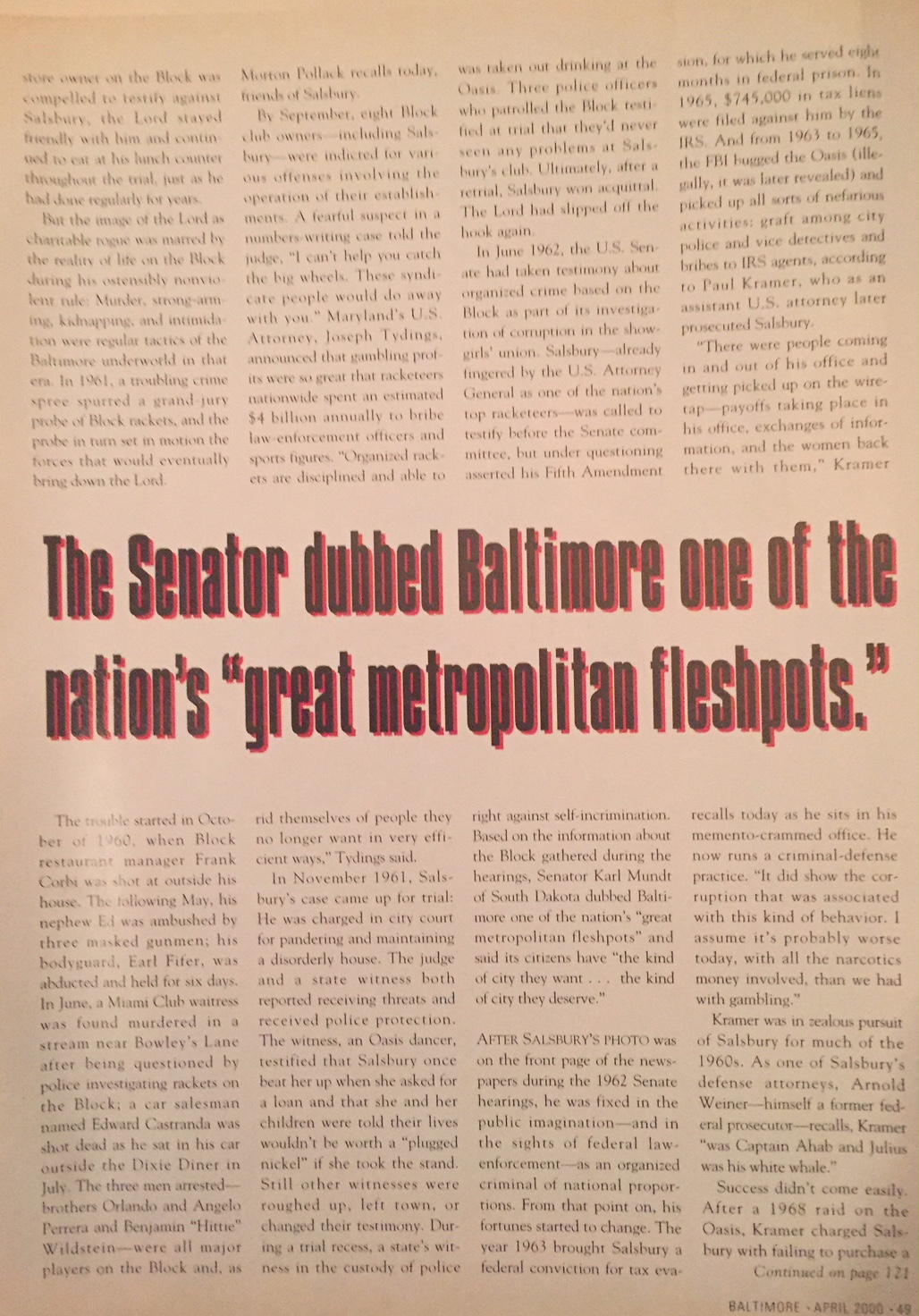
The trouble started in October of 1960, when Block restaurant manager Frank Corbi was shot at outside his house. The following May, his nephew Ed was ambushed by three masked gunmen; his bodyguard, Earl Fifer, was abducted and held for six days. In June, a Miami Club waitress was found murdered in a stream near Bowley’s Lane after being questioned by police investigating rackets on the Block; a car salesman named Edward Castranda was shot dead as he sat in his car outside the Dixie Diner in July. The three men arrested – brothers Orlando and Angelo Perrera and Benjamin “Hittie” Wildstein – were all major players on the Block and, as Morton Pollack recalls today, friends of Salsbury.

By September, eight Block club owners – including Salsbury – were indicted for various offenses involving the operation of their establishments. A fearful suspect in a numbers-writing case told the judge, “I can’t help you catch the big wheels. These syndicate people would do away with you.” Maryland’s U.S. Attorney, Joseph Tydings, announced that gambling profits were so great that racketeers nationwide spent an estimated $4 billion annually to bribe law-enforcement officers and sports figures. “Organized rackets are disciplined and able to rid themselves of people they no longer want in very efficient ways,” Tydings said.

In November 1961, Salsbury’s case came up for trial: He was charged in city court for pandering and maintaining a disorderly house. The judge and a state witness both reported receiving threats and received police protection. The witness, an Oasis dancer, testified that Salsbury once beat her up when she asked for a loan and that she and her children were told their lives wouldn’t be worth a “plugged nickel” if she took the stand. Still other witnesses were roughed up, left town, or changed their testimony. During a trial recess, a state’s witness in the custody of police was taken out drinking at the Oasis. Three police officers who patrolled the Block testified at trial that they’d never seen any problems at Salsbury’s club. Ultimately, after a retrial, Salsbury won acquittal. The Lord had slipped off the hook again.

In June 1962, the U.S. Senate had taken testimony about organized crime based on the Block as part of its investigation into corruption in the showgirls’ union. Salsbury – already fingered by the U.S. Attorney General as one of the nation’s top racketeers – was called to testify before the Senate committee, but under questioning asserted his Fifth Amendment right against self-incrimination. Based on the information about the Block gathered during the hearings, Senator Karl Mundt of South Dakota dubbed Baltimore one of the nation’s “great metropolitan fleshpots” and said its citizens have “the kind of city they want … the kind of city they deserve.”

IMG_7421

After Salsbury’s photo was on the front page of the newspapers during the 1962 Senate hearings, he was fixed in the public imagination – and in the sights of federal law-enforcement – as an organized criminal of national proportions. From that point on, his fortunes started to change. The year 1963 brought Salsbury a federal conviction for tax evasion, for which he served eight months in federal prison. In 1965, $745,000 in tax liens were filed against him by the IRS. And from 1963 to 1965, the FBI bugged the Oasis (illegally, it was later revealed) and picked up all sorts of nefarious activities: graft among city police and vice detectives and bribes to IRS agents, according to Paul Kramer, who as an assistant U.S. attorney later prosecuted Salsbury.

“There were people coming in and out of his office and getting picked up on the wiretap – payoffs taking place in his office, exchanges of information, and the women back there with them,” Kramer recalls today as he sits in his memento-crammed office. He now runs a criminal-defense practice. “It did show the corruption that was associated with this kind of behavior. I assume it’s probably worse today, with all the narcotics money involved, than we had with gambling.”

Kramer was in zealous pursuit of Salsbury for much of the 1960s. As one of Salsbury’s defense attorneys, Arnold Weiner – himself a former federal prosecutor – recalls, Kramer “was Captain Ahab and Julius was his white whale.”

Success didn’t come easily. After a 1968 raid on the Oasis, Kramer charged Salsbury with failing to purchase a required $50 wagering-tax stamp; hours later, the U.S. Supreme Court struck down the law on which the case was based. Kramer came back at him in 1969 with a new harpoon – the Travel Act, which prohibits interstate transport of ill-gotten gains. That one connected: Salsbury was convicted and slapped with a 15-year sentence.

“For a guy who got convicted as a nonviolent gambler,” Kramer asserts, “the judge really threw the book at him.” The main rationale for the severity of the sentence Salsbury received, Kramer explains, was the public corruption bred by the Lord’s activities. “What made it was the amount of corruption that was associated with him: law-enforcement corruption, whether it’s the liquor board or federal agents or police officers. He even asked me if I could be corrupted, which I took as flattery.”

Salsbury appealed the conviction and – despite strident warnings by Kramer that the Lord would slip away – was allowed to remain free on bail pending the outcome. Days before the appellate court upheld the conviction, Salsbury fled. Given the high level of corruption surrounding the Lord, suspicions abounded that he had some high-powered help in making his escape.

“Where was the leak in the U.S. Court of Appeals when the decision came down?” asks E. Thomas Maxwell, a former assistant state’s attorney in Baltimore who prosecuted Salsbury in 1961. His raised eyebrows concerning the circumstances of Salsbury’s disappearance are common among afficionados of the Lord. Maxwell speculates that, if Salsbury had not fled and instead been imprisoned, information the racketeer had about public corruption could have erupted in scandal.

Kramer, however, says the question of whether someone leaked word of the appellate court’s decision in order to give Salsbury the opportunity to run is settled. “A lot of people thought that,” Kramer recalls. “There was an investigation and we determined that we do not believe that there is any evidence showing that there was any kind of leak out of the Fourth Circuit Court of Appeals.” Instead, Kramer believes Salsbury “was just playing the odds” on when and how the appeal would come down and fled town just in time.

The Lord took with him everything he knew about criminally culpable public officials, and in his wake he left a red-faced federal law-enforcement community. “The government was just embarrassed for many, many years” after the escape, says Maxwell. George Beall, who was U.S. Attorney for Maryland when Salsbury escaped, agrees. “It was an embarrassment to the FBI, to the government, that he was gone,” he explains. “They turned themselves inside out to try to solve the mystery.”

According to Kramer, Salsbury left his Horizon House apartment on Calvert Street and “went directly to Canada. We later determined that there was a safe deposit box in Canada. We finally got the search warrant for it and found it empty. The best we could determine was that he took a gambling junket to England, probably under an assumed name, and later we could prove he was in South Africa. Money was being funneled [to Salsbury] through Germany, we believe, from businesses being sold in Maryland.”

Besides the government, the other big loser when Salsbury fled was his friend and gambling colleague, the bail bondsman Robert “Fifi” London, who had posted a total of $80,000 bail that had to be forfeited, according to Morton Pollack. “I know for a fact that he was paid back” on Salsbury’s behalf by a third party, Pollack says. Fifi London died in the 1970s after a lengthy prison term for tax evasion, but his bailbonds firm lives on. In fact, Melvin Williams’ Scrapp Bail Bonds was (until it tanked due to Williams’ recent legal troubles) a subagency of London Bonding Agency.

Homicide author David Simon investigated the Salsbury case as a Sun reporter in the 1980s and early 1990s and concluded that the Lord ended up in Israel, living in a townhouse in Tel Aviv. Melvin Williams is full of insinuations that he had been in communication with Salsbury since his flight, has information about the Lord’s whereabouts over the years, and knows the truth about the man’s mysterious fugitive years. But, like any good gambler, Little Melvin plays that card close to his vest.

IMG_7422

Back in 1969, as the net closed in around Salsbury, Fred Motz served as co-counsel to lead prosecutor Kramer. Now the chief judge of the U.S. District Court of Maryland, Motz was one of the men who helped hunt Salsbury down, and he understands well why the Lord still haunts the Block. “As you get older, you can romanticize,” he says. “It is an overstatement to say that the Salsbury people were sort of like Damon Runyon characters. [But] there’s a certain poignancy to the fact that that is now gone.”

Never mind that the real-life Salsbury helped cement Mobtown’s still-thriving reputation as a hopelessly corrupt and dangerous town. Forget that, during his reign, the Block was wracked with shocking violence, and the widespread public corruption Salsbury instigated to protect his rackets undermined the public trust in honest government. From the perspective of modern Baltimore, the Salsbury era still inspires a certain nostalgia for the days of honorable outlaws and crime that seemed at least to be organized. Maybe, Motz guesses, it’s only because corruption and violence grew so much worse after he left.

“[Salsbury] was really in quite strong control of the Block, and … after he was taken out, rough people came in and there were a lot more murders,” Motz says. “Nobody’s saying that crime is appropriate, but you are going to have crime. There’s almost a sense of longing for [Salsbury’s brand of crime], as opposed to what you see out on the streets today. I think that’s one of the appeals of the Salsbury story. It is something from a different era. And one senses that things are different now than they were then.”

IMG_7423

God • Family • Republic: Pasadena Attorney Michael Peroutka is the Constitution Party’s Favored Candidate for President of the United States. Is it a Match Made in Heaven?

By Van Smith

Published in City Paper, Mar. 17, 2004

IMG_7415

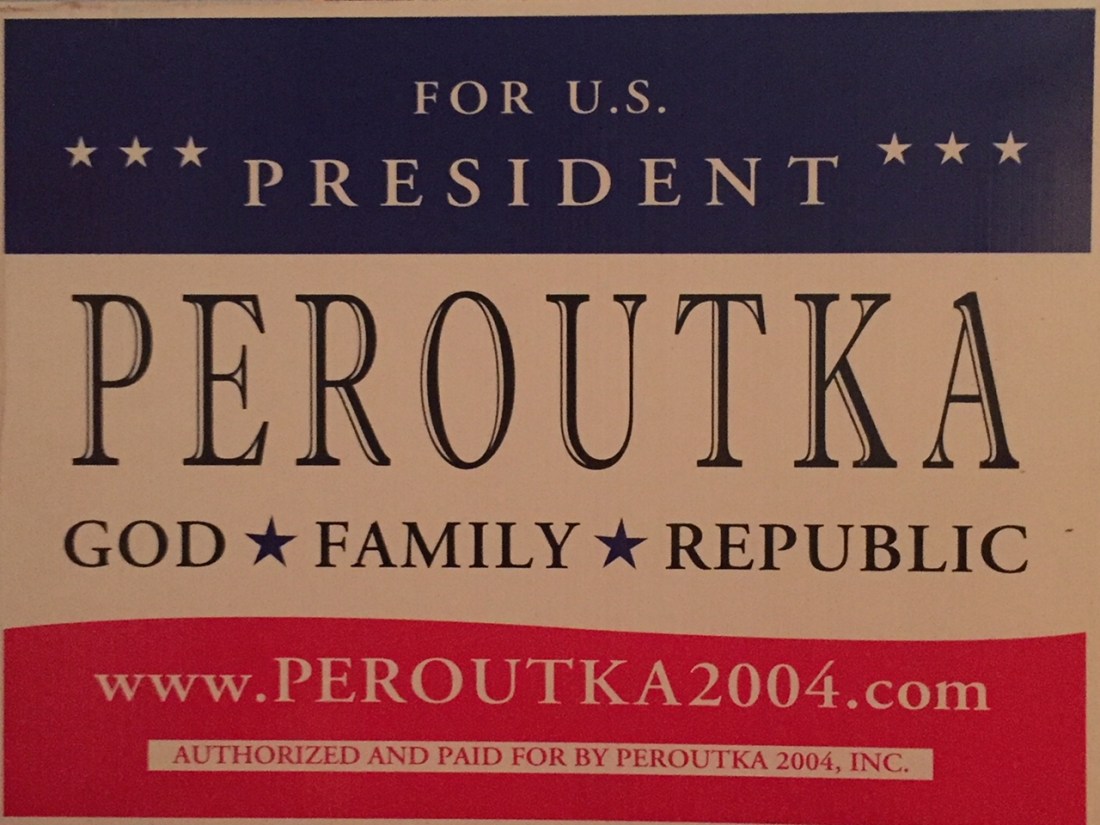
Michael’s Eighth Avenue, the Glen Burnie catering hall, is famous for drawing thirsty crowds to such earthy attractions as its regular “Ballroom Boxing” night, a sweaty mix of bouts, babes, and beer. On the afternoon Saturday, Feb. 21, though, it hosted a decidedly more devout affair: the announcement that Michael Anthony Peroutka, a Pasadena attorney, is seeking the 2004 presidential nomination of the 12-year-old arch-conservative Constitution Party. The party has secured a spot on November’s ballot in a dozen states so far, though not in Maryland, and Peroutka won nearly 25,000 votes in California’s March 2 primary.

Peroutka, with his brother Stephen G. Peroutka, runs the debt-collections law firm Peroutka and Peroutka, as well as the firm’s educational-outreach arm, the Institute on the Constitution, which sells 12-week seminar kits about the biblical perspective on the U.S. Constitution for $145. If he is voted the party’s nominee at its late-June convention in Valley Forge, Pa., the history books say he’ll be the first third-party presidential candidate from Maryland on general election ballots since Joshua Levering of the Prohibition Party in 1896.

“If the foundations be destroyed, what can the righteous do?” Peroutka rhetorically asked the Michael’s Eighth Avenue gathering of about 300 faithful, his dark suit and well-groomed sandy-gray hair lending a sensible air to his fundamentalist zeal. “We must not flee to the mountains,” he answered, citing a verse from Psalms, but instead “stand and fight” and “rebuild the foundations,” as did King David in the Old Testament.

“This is not a time for despair and discouragement,” he railed. “This is a time for discernment and decisive action! . . . This is why I am seeking the presidential nomination of the Constitution Party. I want, with your help, to call this country back to its original, godly constitutional greatness!”

Peroutka, like the Constitution Party itself, toes a well-defined line when it comes to matters of dogma. As his 20-minute speech made clear, he believes that the federal government routinely ignores the dictates of the U.S. Constitution, which he contends is a biblically grounded document written by divinely inspired Founding Fathers. Chronic, long-term erosion of these godly constitutional foundations, he believes, is advancing society’s moral decay, a trend made especially evident in what he calls “attacks” on the family, such as abortion, homosexuality, and gay marriage. The task for Peroutka and the Constitution Party, he says, is to fight the forces of decay and to present a loud, growing, and unwavering political voice to challenge the major parties. Taking jabs at President George W. Bush for his “failure to lead” on abortion, his “reckless” government spending, and his “unconstitutional” war on Iraq is a current staple of Constitution Party oratory.

“People may say, ‘Don’t you know you can’t win, don’t have a chance?'” Peroutka declared earnestly from Michael’s balloon-adorned stage. “But I just don’t believe in chance. I believe in divine providence. . . . With God, all things are possible.”

“The themes of our campaign are God, family, republic,” he continued. “In short, we are called to honor the sovereignty of God, defend the American family, and restore the American republic. The God of the Bible must be first because–well, because He says so.”

After God, Peroutka continued, comes family–an issue of central importance to the Peroutka campaign and the Constitution Party as a whole. Before Peroutka’s speech, party luminary William Shearer, a lapsed Republican who founded late presidential candidate and Alabama governor George Wallace’s American Independent Party in 1968, had praised the Peroutkas for having “created that thing which we stand for as a party–the family.” Shearer admired the couple’s “three lovely children”–Beth, Patrick, and Timothy, all teenagers, who took the stage with their father and mother. Spear Lancaster, the 2002 Libertarian Party candidate for Maryland’s governorship, was there and commented afterward that the Peroutkas “seem like the archetypal Christian-type family”–an image that is reinforced by a family portrait on the Peroutka’s campaign Web site.

So, up on the stage, Peroutka put particular emphasis on family issues. Whereas government exists simply and exclusively to “secure and protect God-given rights” of citizens, he said, most politicians fail to comprehend this, suggesting instead that government exists for a myriad of other, extraneous reasons: “to create a level playing field” in society, or “to maintain the infrastructure,” or “to take care of people who can’t take care of themselves.”

Or to “take care of the children of the state,” Peroutka added. He then paused as Albion Knight, a retired U.S. Army general and conservative radio commentator from Gaithersburg who was sitting in the audience after having made an earlier speech, suddenly shouted, “Not mine!” Approving chuckles rippled across the room.

“We love that one, don’t we?” Peroutka continued, remarking sarcastically that “I didn’t know the state had any children.”

The crowd was audibly amused. The reaction, though, may have been different had it been known that in the early 1990s Peroutka and his wife, Diane, forced her two teenaged daughters from an earlier marriage–Dawn and Holly Hubbard–to become wards of the state foster-care system until the age of 18. (Diane Peroutka’s previous husband died of cancer in 1978.) This happened after Dawn told members of her Catholic youth group and her basketball coach at McDonogh School that she recalled sexual abuse at the hands of Michael Peroutka from when she was 9–memories that were not substantiated in an ensuing state investigation, and which she later recanted. And it happened after Holly, who suffered from learning disabilities and a troubled relationship with her stepfather, displayed behavioral problems.

The Peroutkas transferred parental responsibilities for Dawn Hubbard to the State of Maryland on her 17th birthday, May 1, 1992, and Holly met the same fate on the day after Thanksgiving 1992, when she was 15. The sisters, now in their late 20s and living outside of Maryland, say they never wanted to be estranged from their mother and have tried without success to reconcile with her several times since being removed from the Peroutka household more than a decade ago.


Many of these facts were uncovered when a cursory Google search led to a 1997 Maryland Court of Special Appeals opinion that rejected Michael and Diane Peroutka’s libel claims against Dawn and Holly Hubbard’s state social worker, Marsha Streng. The alleged defamatory statement was made by Streng in her Towson office on Jan. 12, 1995, when Diane Peroutka showed up, Dawn Hubbard in tow, and angrily and repeatedly demanded to know whether Streng thought she was an emotionally abused spouse. Diane Peroutka had been moved to confront Streng when, during a conciliatory lunch with Dawn Hubbard earlier that day in Towson, she saw that her daughter had an informational packet about emotional abuse that Streng had mailed her daughter, then in college and majoring in psychology. Confronted by Diane Peroutka, Streng at first repeatedly refused to answer the question, but ultimately said yes. Diane Peroutka told her husband what Streng had said, and Dawn Hubbard told Holly about it as well. Nine months later, in October 1995, the couple sued Streng for libel.

The libel case was rejected at the first opportunity by the Baltimore County Circuit Court a year later, when the judge held that Streng’s statement was “an opinion . . . given at specific request to give an opinion. That cannot constitute defamation.” The Peroutkas appealed, and lost again. The appellate court opinion, filed in June 1997, said that “because all the persons who received the alleged defamatory statement knew the underlying facts of the conflicts within this family . . . Streng is not subject to liability, although, as with any opinion, [the Peroutkas are] free to disagree. We hold that the statement . . . was not defamatory.” The court also ordered the Peroutkas to pay the state’s costs for the year and a half it spent defending Streng from the claims.

Since Streng’s statement was about the Peroutkas’ family life, by suing her they opened up their family history to public examination via documents, affidavits, and depositions gathered for Peroutka v. Streng. According to those case records, on May 13, 1992, two weeks after the Peroutkas placed Dawn Hubbard in state custody, Michael Peroutka petitioned for a court order barring Dawn from having any further contact with the Peroutka family or from approaching their Baltimore County townhouse. When Dawn’s state-appointed lawyer, Anna Davis, successfully warded off the attempted restraining order by arguing that Michael Peroutka had no standing to petition the court because he had never adopted Dawn and was not her natural father, he filed an amended petition, this time with his wife, and won.

Dawn Hubbard, once in the hands of the state, had to rely on Social Security for financial support. At first, her checks were sent to the Peroutkas’ home, and Streng, in late June 1992, sent Diane Peroutka a letter asking for them. Diane Peroutka responded in writing that the money was used to pay bills, especially attorneys fees, “which have escalated far beyond the income I received for Dawn. . . . This expense was accrued because of the lies and problems caused by Dawn, and her Social Security check must pay for this.”

In the summer of that year, the case record reflects that Diane Peroutka, with her husband’s help and guidance, launched a letter-writing campaign. She sent approximately 1,000 letters to anyone who may have heard about Dawn Hubbard’s sexual abuse allegations–the Peroutkas’ friends and neighbors, for instance, as well as parents and neighbors of Dawn’s schoolmates–alerting them to her daughter’s mental and emotional condition and implying that her daughter might pose a threat to the community. That fall, when Dawn was hospitalized for a severe eating disorder, neither of her parents visited her.

The following spring, as she was being treated by Johns Hopkins Medical psychiatrist Dr. Paul McHugh, Dawn Hubbard began to doubt the veracity of her memories of sexual abuse. By the fall of 1993, she was convinced they weren’t real, but the result of a phenomenon known as false-memory syndrome. When Dawn attempted to deliver a letter to that effect to her parents, Diane Peroutka had her arrested for trespassing; Diane Peroutka had tried to do the same to to a visiting Holly Hubbard in June 1993, but the police wouldn’t charge Holly. Shortly thereafter, Dawn appeared on the Phil Donohue Show with representatives from the False Memory Syndrome Foundation, and recanted her sexual abuse allegations to a national television audience. Still, the Peroutkas have rebuffed Dawn and Holly Hubbard’s subsequent attempts at reconciliation.

The family crisis, while quieted since the libel suit ended in 1997, is still unresolved. Dawn Hubbard, now 28 with bachelor’s and master’s degrees from Bucknell University, works as a guidance counselor for female minors in the Pennsylvania correctional system. She explained when contacted recently that she and her sister, now a waitress living in Connecticut who is preparing for her August wedding, remain estranged from the Peroutkas.

Holly Hubbard submitted affidavits in Peroutka v. Streng that reflect the emotional toll exacted by her experiences with Michael Peroutka, who she believed controlled Diane Peroutka’s actions toward her daughters and forced his wife to end relationships with her family and friends from before their marriage. In the sworn statements, Holly recalled “several occasions when my stepfather would mash my face into the floor, sit on me to restrain me, push me against a wall, and pull my hair while demanding that I call myself a ‘slut.'” “I believe,” Holly continued, “that when my mother put me in foster care and refused to visit me or talk to me, it was because of pressure from my stepfather.”

In the past, Michael Peroutka has sidestepped any personal responsibility for the couple’s handling of Diane’s stepdaughters, whom he never legally adopted. “Certainly I discussed it with my wife, but it wasn’t my decision to make,” he explained in a 1996 deposition. “They were her daughters.”

A decidedly different take on Michael Peroutka’s role in his stepdaughters’ treatment was expressed by McHugh, the psychiatrist who helped Dawn Hubbard determine that her memories were false and the only doctor with whom the Peroutkas agreed to consult with during Dawn’s care at Hopkins. In a 1996 affidavit, McHugh stated that in his opinion Diane Peroutka “has been subjected to excessive emotional pressure by her husband to act in ways she otherwise would not act . . . contrary to her own best interests and those of her daughters.”

In a 1993 telephone conversation with the Hubbard sisters’ attorney, Anna Davis, case records show, McHugh was even more condemning, saying he was “disgusted by the Peroutkas’ behavior,” particularly that of Michael Peroutka, whom he described as “brutish.” “The truth will come out,” McHugh is recorded as saying. “It always does.”

In an e-mail response to written questions provided by City Paper, Peroutka maintains that the family turmoil as Dawn and Holly Hubbard were forced out of the house “was exasperated by the prejudicial attitude and professional incompetence of certain employees of our local social services department. I joined my wife in filing a lawsuit for defamation against one of the social workers that we believed acted with intent to harm our reputations and our family relationships. All of this was long ago.

“I fully support and appreciate my wife’s decisions and actions during that most difficult time, and ever since. Her desire to protect and defend our family, and to restore her troubled children, is fully shared by me. We have both, long ago, forgiven her daughters and others who, we believed, sought to harm them and us, and we pray and hope for their restoration.”


The traditional family values, limited-government platform of Michael Peroutka and the Constitution Party appears to clash headlong with the reality that he stood by, and possibly encouraged, his wife as she forced her daughters out of their home and transferred parental responsibilities for them to Maryland’s social services bureaucracy–an entity whose very existence is questionable under Constitution Party doctrine about the role of government. “Parents have the fundamental right and responsibility to nurture, educate, and discipline their children,” the party’s platform states. “Assumption of any of these responsibilities by any governmental agency usurps the role of the parents.”

Meanwhile, the libel case record of Peroutka’s alleged abusive behavior toward his wife and stepdaughters seems to flout the Constitution Party’s platform on “Character and Moral Conduct,” which states that “our party leaders and public officials must display exemplary qualities of . . . moral uprightness . . . self-restraint . . . kindness, and compassion. If they cannot be trusted in private life, neither can they be trusted in public life.”

“I don’t believe that my personal views diverge from the Constitution Party’s platform or mission,” reads Peroutka’s e-mailed response to a question about these apparent inconsistencies. “As a believer in the Lordship of Christ I know that there is a fixed and eternal standard of right and wrong and that I am a fallible, fallen creature who falls short every day. Alone, I am not capable of ‘reconciling’ any chapter, or moment of my life. I believe that it is through the saving work of Christ that we are reconciled to Him and each other.”

Peroutka’s potential image problems as a candidate for the nation’s top elected office don’t end with his home life, though. There’s also the matter of his legally questionable political donations over the past few years.

The issue first surfaced on Oct. 6, 2003, when the public interest group Common Cause Maryland issued a report on political donors from Anne Arundel County who illegally exceeded the state limits on political contributions: no more than $4,000 to any one campaign committee and no more than $10,000 overall from any given contributor during a four-year reporting cycle. Peroutka was one of four individuals, and his firm one of 10 businesses, that had given more than the limits, Common Cause reported.

Shortly after Common Cause released its report, State Prosecutor Stephen Montanarelli’s office opened a criminal investigation. The prosecutor opted not to bring charges against Michael Peroutka or its firm. “They brought themselves into compliance,” senior assistant state prosecutor Steven Trostle explained to City Paper, adding that on Dec. 8 he sent them letters closing the case and “warning them” that more violations would be treated more seriously.

In order to come into compliance, Peroutka and his firm relied on the good graces of the Maryland Constitution Party, which on Nov. 17, according to state campaign finance records, returned $3,230 of the $3,500 Michael Peroutka had given the party, and $2,200 of the $2,500 Peroutka and Peroutka had contributed. These transactions brought the total amount Peroutka and his firm had contributed to all state campaign committees to below the $10,000 limit. Though several other campaign committees–those of state senators Alex Mooney (R-3rd District) and Andrew Harris (R-7) and state delegates Emmett Burns (D-10) and Carmen Armedori (R-5A)–had also received substantial financial support from Peroutka and his law firm, only the Maryland Constitution Party returned contributions to make things right again under the law for them.

Montanarelli may have more in store for Michael Peroutka on the campaign finance front. On Aug. 22, 2002, Michael and Diane Peroutka’s three children, then between the ages of 11 and 15, donated $4,000 each to the campaign of state Sen. Nancy Jacobs (R-34), one of the state GOP’s staunchest conservatives, who at the time was facing a tough race in her Harford County district. “It’s never come up before,” Montanarelli said recently of the scenario. “But I have a problem with that one. You can’t evade the donation limits by having children making donations. It would probably be a violation, and we could probably prove that it came from their parent or parents.”

Asked by e-mail whether the money his children donated was theirs, whether or not he gave the money to them, and whether or not he prompted them to make the donations, Michael Peroutka responded, “I am confident that my children followed the law.”

Public records reveal another foible of a sort that has proved thorny for politicians in the past. In December 1991, Michael Peroutka was caught driving with an illegally high concentration of alcohol in his system. The result: probation before judgment and a month of restricted driving privileges. When asked if the episode was in any way inconsistent with the Constitution Party’s platform, which calls for its leaders to practice “temperance,” Peroutka gave the same answer as that regarding his relationship with his stepdaughters–that he is “fallible,” and that reconciliation of his personal behavior with party doctrine can only be accomplished “through the saving work of Christ.”


The evolution of Michael Peroutka from a dozen years ago, when he was struggling with his stepdaughters and living in a townhouse, into a prominent arch-conservative politician with a house on a half-acre in Millersville’s Brittingham development, a property assessed at $580,000, is a hard subject to nail down. But the changes have been marked.

Perhaps the most fundamental change in Peroutka is the fact that he is no longer with the Roman Catholic Church. The Peroutka v. Streng libel case records indicate that Catholicism was once a central part of his life. Many of Dawn Hubbard’s conflicts with her stepfather had been over religion, her 1996 deposition revealed, including a “confrontational problem” over her resistance to becoming a confirmed Catholic, a church ceremony to which she ultimately submitted after Peroutka “chastised” her. Since then, though, he joined the Cornerstone Evangelical Free Church, which worships at a Seventh-day Adventist facility in Pasadena.

Like many fundamentalist churches, the Free Evangelical Church of America, of which Cornerstone is a part, is known for its strict prohibitive stances on abortion and homosexuality and for its very literal reading of the Bible. And Cornerstone’s ties to politics are strong. The state Constitution Party’s Web site promotes Cornerstone as a “Constitutionally aware church” and provides a link to the church’s Web site. Cornerstone’s pastor, David Whitney, ran unsuccessfully in 2002 for Republican State Central Committee in Maryland’s 30th District and is also a donor to the state Constitution Party. Prior to running for public office, he had become locally renowned for helping to organize anti-abortion protests, replete with a woman in a Grim Reaper costume and poster-sized pictures of aborted fetuses, in front of a clinic on Ritchie Highway in Severna Park that provides abortion services.

Whitney also edits and writes for the monthly newsletter of the Peroutkas’ Institute on the Constitution, for which he penned a lengthy treatise titled “The Most Misused and Abused Amendment of the Constitution,” denouncing the U.S. government’s application of the 14th Amendment, which ended slavery and codified the principles of due process and equal protection under the law.

Alongside Peroutka’s evolving beliefs has come greater wealth. Peroutka and Peroutka’s Anne Arundel County personal property tax payments, records of which are available on the state’s online database, indicates that the law firm has been growing fast. In 1995, Peroutka and Peroutka owed $6,300 in such taxes, which are levied on a business’ furniture, equipment, inventory, and the like. By 2003, the amount had increased to $180,000.

Another indication of Peroutka’s improved cash flow is the amount he has invested in politics. Since 1999, Peroutka has given nearly $80,000 to Maryland and federal campaign committees. Much of it–nearly $55,000–went to federal Constitution Party accounts, with the rest allotted to various local and national politicians from both the Republican and Constitution parties. In addition, during the same time frame Peroutka and Peroutka gave $15,000, and Stephen Peroutka gave $50,000, to Maryland and federal campaign committees, $36,000 of it to the Constitution Party National Committee. Diane Peroutka, too, chipped in just over $5,000, $2,500 of it to the anti-gay-rights activist group Take Back Maryland. In all, the three Peroutkas and the firm have given about $150,000 to political campaigns since 1999. And that amount doesn’t include the $12,000 the three Peroutka children gave to Nancy Jacobs’ re-election effort in 2002. Nor does it take into account the $87,000 the Peroutka brothers and their firm spent underwriting a 2002 television and print advertising campaign urging Maryland voters to “vote pro-life.”

To put these sums in perspective, the Peroutkas are nowhere near Peter Angelos’ league–the Orioles owner and super-lawyer has made just over $3 million in federal-level donations since 1997–but surpass Baltimore bakery magnate and real-estate developer John Paterakis, who has given just shy of $35,000 to federal campaign accounts since 1997.

Asked about the origins of his wealth and consequent ability to make large political donations, Peroutka writes, “I am thankful to God from whom all blessings flow.”


Peroutka’s earliest political investment speaks volumes of where he was heading: into a tightly knit world of right-wing political activity on the outer edge of the Republican Party and, ultimately, a very small circle of rainmaking Constitution Party backers.

On the federal level, Peroutka’s first recorded donation was on Oct. 15, 1999, when $250 sent from his Ritchie Highway office–it was entered in the ledger-books as having come from “Peroutka P.A.”–arrived in Katy, Texas, where it landed in the short-lived and little-used bank account of the Draft Steve Stockman for Congress Committee. “I vaguely remember this donation,” Peroutka explains in his e-mail, “but do not remember what prompted it.”

Stockman, an accountant and former one-term Republican congressman who lost a bid for re-election in 1996, was known for his defense of the militia movement and his adamant pro-gun stance. In the fall of 1999, after having lost a bid for a seat on the Texas Railroad Commission a year earlier, Stockman was working as a highly paid consultant, earning $250,000 in fees advising the congressional campaign of Texas Republican Mark Brewer, who lost the following spring’s primary. But Peroutka and a small group of like-minded Stockman supporters were hoping to draw Stockman back into running for federal office again.

Other than Peroutka, 15 individuals from around the country donated $7,000 in itemized contributions (an equal amount was collected in small, unitemized amounts) to the draft-Stockman campaign based in Katy, which raised funds only for a single month in the fall of 1999. (A defining moment for Katy, population 10,000, came the following summer, when seven local men held a cross-burning on the property of one of the town’s few black families, and were subsequently convicted of federal hate crimes.) Among Peroutka’s co-donors to the low-profile campaign were three individuals whose backgrounds place them on the extreme edge of conservative politics–a place where Peroutka, nearly five years later, is now established as a leader and benefactor.

Joining Peroutka in the draft-Stockman campaign was James R. Lightner, a wealthy Dallas businessman who in the spring of 2000 joined an elite club of about 100 people who contributed to former Ku Klux Klan leader David Duke’s flash-in-the-pan stab at an open congressional seat in Louisiana. Another name on the list of contributors was Chris Cupit, a right-wing political functionary from Louisiana who gained notoriety as a partner in GOP Marketplace, a Virginia-based consulting firm that was caught undermining Democrats’ get-out-the-vote efforts in New Hampshire on Election Day 2002 by subcontracting with an Idaho phone-calling firm to jam the Democrats’ phone-bank lines with continuous hang-ups. Also on the list was Robert G. Wheaton of San Antonio, who in 1995 was elected to the seven-member Committee of Safety of the Southern Region of the Texas Constitutional Militia, one of Texas’ two main militia organizations. (According to the Austin-based pro-militia Constitution Society, the Texas Constitutional Militia ‘s Committee of Safety is “no longer operative.”)

Lightner and Cupit are both active in GOP causes, and Wheaton is a regular contributor to the Libertarian Party. But all three, by virtue of their political activities, are iconoclasts outside the political mainstream, a fact that seems to drive their zeal–and open their wallets–for fundamental cultural change. The Constitution Party has been calling for such change since its founding in 1992, when it picked up what was left of the George Wallace movement–the American Independent Party and its various offshoots–to form what was originally known as the U.S. Taxpayers Party. And Peroutka, with his deep pockets and apparently growing doctrinal zeal, fits in quite well.

Now that he’s the party’s presumed presidential hope, Peroutka has started to answer candidate questionnaires, such as the one at vote-smart.org, that give an idea of his stands on the issues, such as:

· Eliminate all taxes except tariffs on imports, which should be slightly increased.

· Eliminate all federal government funding for everything except defense, whose budget should be maintained at current levels–except for one item, a national missile defense, whose funding should be greatly increased.

· Except under special circumstances, expel all illegal aliens and place a moratorium on immigration.

· End all government aid to foreign interests, be it other countries or international organizations.

Getting in a position to make such fundamental changes to the federal government requires money. The Constitution Party National Committee’s cash on hand, as most recently reported on Jan. 31, is a little more than $8,200–barely enough to throw a decent bull roast–while Peroutka 2004, the presidential campaign committee, has nearly $22,000 on hand. The fact that either outfit has any cash at all, though, is thanks mostly to a small group of big donors, including Peroutka himself, who has chipped in nearly $57,000 to the national committee since 2000, and has lent $40,000 to his own presidential campaign committee. Only two other individuals have given more than $50,000 to the party’s federal accounts: the chairman of the Constitution Party National Committee, Jim Clymer, and a retiree from Dallas, Julie Lauer-Leonardi, who’s the party’s most prodigious benefactor, having given more than $80,000.

Lauer-Leonardi and Lightner are among dozens of conservative activists who sit on the leadership council of the Conservative Caucus, a 30-year-old Vienna, Va.-based political organization whose founder and chairman is Howard Phillips, a former Nixon administration official who has been the Constitution Party’s presidential candidate in the last three elections, and who helped found it in 1992 as the U.S. Taxpayers Party. (The party changed to its current name when it was trying in 1999 to woo Patrick Buchanan to be its presidential candidate.) Phillips is backing Peroutka and gave a rousing pro-Peroutka speech at the candidate’s announcement ceremony at Michael’s Eighth Avenue.

Lauer-Leonardi may be the biggest individual donor to the Constitution Party, but Peroutka, if you add to his contributions those made by his brother and wife, comes out on top: All together, they’ve given more than $95,000 to the party. As Richard Winger, editor of Ballot Access News and a close observer of U.S. third-party politics, says, “Peroutka really wants to be the party’s candidate for president.”


Only 307 Marylanders were registered as Constitution Party voters in March 2003, the last time the state board of elections did a head count before the party lost its status as a recognized party here because it didn’t garner enough votes in the 2002 state elections. Howard Phillips garnered sparse support from Maryland voters in his three presidential bids: 919 in 2000, 3,402 in 1996, and 22 in 1992. Nonetheless, Maryland has a special place in the Constitution Party’s heart. After all, the Free State backed the Constitution Party’s ancestor, George Wallace, in the 1964 presidential primary, and handed him nearly 180,000 votes in the 1968 general election.

A number of key Constitution Party players are based in or around Maryland. Clymer, the party’s chairman, is a lawyer in nearby Lancaster County, Pa. Phillips’ Conservative Caucus is based in the Virginia suburbs of Washington. Radio commentator and Constitution Party donor Albion Knight only had a short commute from his Gaithersburg home to give his homily at the Peroutka announcement. And Peroutka 2004’s $800-a-week communications director, John Lofton, a fixture of hard-right journalism since the rise of Ronald Reagan, lives in Laurel. The Save-a-Patriot Foundation, an anti-government, anti-tax organization based in Hagerstown, is scheduled to have Peroutka address one of its weekly Saturday-night gatherings in April. Two Maryland pastors–Cornerstone’s David Whitney and Michael Chastain of Christ Presbyterian Church in Elkton, who gave the prayer at Peroutka’s announcement–have emerged as important religious voices for the Constitution Party’s doctrines.

And, of course, Peroutka is a native Marylander, born in Baltimore in 1953. He and his brother Stephen Peroutka gave their first big donations to the Constitution Party National Committee–a combined sum of $30,000–between June and August of 2000. The Peroutka brothers’ Institute on the Constitution has caught on, and its Web site is a commonly encountered link on far-right political and religious Web sites. Michael and Stephen Peroutka both take their messages to the airwaves on local Christian radio stations.

More than 300 people came to Peroutka’s Feb. 21 event in Glen Burnie–a much better turnout than the 50 or so people who attended Ralph Nader’s August 2000 announcement in Annapolis that he would be the Green Party’s presidential candidate that year. Onstage at Michael’s Eighth Avenue, Michael Peroutka mentioned another manifestation of the party’s local influence when he thanked “members of the General Assembly here present” for coming to the event. Freshman state Del. Donald H. Dwyer Jr. (R-31) was there, but City Paper was unable to spot any other elected officials celebrating Peroutka’s announcement. Spear Lancaster said later that state Republicans whose campaigns Peroutka has supported financially “don’t want to be seen at another party’s event.” In his e-mail, Peroutka said that he had “sent notes to a few of my friends in the General Assembly and wanted to make sure I welcomed any who might have come. So I used the plural. I cannot remember seeing other Delegates except for my good friend Don Dwyer.”

Dwyer has teamed up with Peroutka, who put $4,000 in the delegate’s campaign kitty last May, in other ways recently. As reported by Dwyer in a Feb. 16 letter posted on the Institute on the Constitution’s Web site, the two joined other conservative luminaries–Howard Phillips, Alan Keyes, and Phyllis Schlafley among them–on a two-day visit in February to impeached Alabama Supreme Court Chief Justice Judge Roy Moore, who lost his job last fall after refusing to remove a sculpture of the Ten Commandments from his courthouse. And Dwyer told The Sun in a Feb. 3 article that he decided to run for delegate in 2002, his first bid for public office, after attending an Institute on the Constitution seminar. Ever since he arrived in Annapolis in 2003, he’s been rustling feathers–even yanking them on occasion by, for instance, suing the leader of the Anne Arundel legislative delegation over rule changes and questioning the patriotism of fellow lawmakers.


Peroutka’s budding influence in Annapolis and among some Christian Right Marylanders, along with his fund-raising ties to national far-right leaders, suggests he’s got some traction as a political player. Still, it almost goes without saying that he can forget about the White House.

“I don’t remember them, offhand,” University of Maryland political science professor Paul Herrnson jokes when asked what role the Constitution Party could play this election season. “Hold on, let me look them up in one of my books.”

His point, he says with a touch of hyperbole, is that “no one’s ever heard of them or cares about them, and that’s the problem with third-party politics in general.”

Others, such as Bob Moser, senior writer for civil-rights organization the Southern Poverty Law Center, who covered a Constitution Party gathering last April in Clackamas, Ore., think the party has legs, even if they’re spindly. “They’ve been reasonably successful–they’re still around,” Moser argues, distinguishing them from Ross Perot’s Reform Party, which has disintegrated since it nominated Buchanan for president in 2000. “A lot of the Perot people and Buchanan people have landed in the Constitution Party.”

But Moser says he isn’t impressed with Peroutka. The party, he explains, has in the past tried to draw big-name candidates–Marylander Alan Keyes, for instance, who ran for the GOP presidential nomination in 2000, or Buchanan–but has always ended up with Howard Phillips at the top of the ticket. And Peroutka, despite his wealth and organizational capabilities, is not a big name either.

“If they nominate somebody like Peroutka, they’re not going to get any votes,” Moser says. “But if they nominate Judge Moore,” whose name has been bandied about for the nomination, and who Peroutka has said he would step aside for, “they’d get some votes. Moore could draw as many votes this time as Nader.”

As it is, Moser says, the party is so far “the only catch basin for disaffected conservatives” in the 2004 presidential elections. How many of those will bother to vote for the Constitution Party candidate is hard to ascertain, but he contends there is a “large element of really conservative Christians who might support the Constitution Party, but who cling to not getting involved in politics, as well as the militia and anti-government people who are not going to participate in the system in any way.”

“I can’t really confirm or deny the extent to which some people may ‘drop out’ due to disillusionment” with the system, Peroutka responds in his e-mail. But he believes that public interest in the Constitution Party’s ideas “is increasing as folks recognize that we have abandoned the worldview of our founders, disregarded the plain meaning of the Constitution, and drastically centralized power in Washington to the detriment of the common good.”

The Constitution Party, “like all organizations that stand for something, will not attract those who stand against that same something,” he continues. While Christian at its core, and thus not likely to attract non-Christian voters, “the Constitution Party welcomes those who support its platform and its mission to restore Constitutional government.”

What’s more, the party’s religious base is not at all unique in politics, Peroutka contends. “The ideology of all parties and organizations and individuals is inherently tied to religion,” he states, because “we act out what we believe.”

If that’s the case–that “we act out what we believe”–then Peroutka’s actions toward Dawn and Holly Hubbard suggest his beliefs may be out of whack with the Constitution Party’s stated platform. How that affects the party faithful’s support for his candidacy remains to be seen.

Subversive Cure: Guerrilla Stencilers Say Local Art Is Lacking at the BMA

By Van Smith

Published in City Paper, June 12, 1996

From under a veil of anonymity, a group of Baltimoreans is running a satirical propaganda campaign called “Gene Therapy” to cure the Baltimore Museum of Art (BMA) of its alleged lack of “localness.”

So far, the group – which is thought to consist of local artists with a history of subversive collaboration – has painted stencils near the BMA building and other locations in the city. It has also distributed press releases that wittily explain the project and criticize the museum for what local artists have long perceived as an unwillingness to showcase and support the Baltimore arts scene.

The Cultural Cryptanalysts Collective (CCC), as the group calls itself, claims one of its stencils, which bears the word “local” on an image resembling a drill or injection device, will improve the BMA’s “institutional health” by transmitting “genetic materials encrypted with the aesthetic locality of Baltimore” into the institution’s “DNA,” according to the group’s first press release, dated May 13.

“An independent team of scientists, cryptanalysts, and folk mathematicians say that this newly discovered form of gene therapy via stenciled art will revive the moribund museum from its decades-long coma,” the release continues.

The stencil was applied to a concrete walkway next to the original BMA building’s southeastern facade in early May, but the images have since been removed. The group also takes credit for stencils that have appeared at various locations in the Remington, Charles Village, Abell, and Greenmount West neighborhoods.

No one has stepped forward to publicly represent the Cryptanalysts, and the group’s makeup remains a mystery. A member of Western Cell Division, another anonymous arts groups that is curating a stencil-art exhibit for this summer’s Artscape festival, believes the likely suspects include five or 10 people who have conducted street-stencil campaigns before.  (Stencil artists often operate in secrecy because their work is considered vandalism.) Gary Kachadourian, the visual-arts coordinator of the Mayor’s Advisory Committee on Art and Culture (MACAC), agrees with the Western Cell Division member, putting the number of possible CCC members at eight to 10.

Brenda Richardson, the BMA’s curator of modern painting and sculpture, issued a written statement to the press in response to the CCC campaign: “We are still struggling – along with the rest of the international art world – to distinguish between graffiti as a valid art expression and graffiti as vandalism of public property. … Setting that issue aside, however, we enjoy hearing from CCC! The group’s mailings are inventive and articulate … and I’ve come to look forward to the mail each day to see what they have to say.”

The CCC effort began about two months before the unveiling of a stencil-work exhibit entitled On the Street/Off the Street, set to open at Maryland Art Place during Artscape in late July. Preparations for that stencil show and other recent research into collaborative performance-art activities in Baltimore in the 1970s and 80s have brought to light largely undocumented chapters in Baltimore’s arts history. The Western Cell Division member believes this recent revival of interest in the history of local subversive art may have inspired the CCC.

That revival began at the 1992 Artscape, which included a show called Humor as a Subversive Act: An Exhibition Propagandizing Baltimore Art. The exhibit included references to the early 1980s stenciling craze in Baltimore, when five to 10 artists left their work on the city’s streets, alleys, and other public spaces.

For this year’s festival, Artscape ’92 curator Peter Walsh is preparing a written essay entitled “Mapping Social and Cultural Space: The Ramifications of the Street Stencil” which will chronicle several stencil projects in the city over the last 15 years – including the CCC campaign – and illustrate the way street-stencil artists transmit information through coded messages directed at specific parties.

Megan Hamilton, the Fells Point Creative Alliance’s program director, documented the cultural context for Baltimore’s street-stenciling heyday in “The Banquet Years: Baltimore Performance Art, 1979-1985,” a paper she completed in May for a University of Maryland-Baltimore County art-criticism course. Hamilton’s paper chronicles a previously undocumented flurry of local collaborative arts activity, including stencil campaigns.

As Hamilton points out, most of the people involved in such activities did not consider what they were doing to be art; they did it for kicks, and because they had no access to mainstream outlets of expression. In fact, Michael Tolsen, aka tENTATIVELY, a cONVENIENCE, refused to be included in the ’92 Artscape humor exhibit because he did not want his work to be considered art.

A central part of the CCC’s message is that the BMA has spurned local artists for decades. The CCC says in its press releases that the city’s main public art museum has chose to showcase work of prominent, proven contemporary artists who are already exhibited around the world. According to a CCC press release: “The BMA allows us to consume our cut-rate McWarhols, McGustons, Chicken McPollocks, Cajun BBQ McKrugers, and Fillet McKelleys.”

The response to the BMA’s exclusiveness, the Cryptanalysts argue, has been the creation of new institutions such as the American Visionary Art Museum, the Contemporary, Maryland Art Place, the Fells Point Creative Alliance, Diverse Works, Artscape, and the School 33 Art Center.

Local artists have achieved recognition in other parts of the mid-Atlantic region. The Delaware Art Museum (DAM) in Wilmington, for example, currently has the work of more than 30 Maryland artists in its biennial regional-art exhibition, which runs until July 7. Nancy Batty, the museum’s chief curator, says Baltimore artists were invited to compete for inclusion in the show because “I was aware that Baltimore has a lot of terrific artists that deserve to be in a museum biennial. Their work strengthens our show and made it much more competitive.”

Batty says DAM recently bought two works by Baltimore artists for its permanent collection, and the local work selected for the biennial, she adds, “truly can hold up on a national or international level.”

While the Delaware museum shows increasing interest in Baltimore art, the city’s own art museum stopped holding its biennial exhibit of local work more than 10 years ago, effectively ending opportunities for local artists to have their work shown under the museum’s auspices. The BMA’s reputation for spurning local artists was buttressed when Arnold Lehman, the BMA’s director, was quoted in a 1991 interview in the now-defunct monthly newspaper Harry as saying, “I don’t really believe that there is this overwhelming obligation to show Maryland artists just because they live in Maryland.” Lehman was not available for comment for this article.

The BMA’s Richardson says she disagrees with CCC’s assertion that the museum doesn’t support local art. In her written response to the CCC campaign, she explains: “At the BMA we relish art in all its myriad forms and styles, and we welcome the Cryptanalysts’ communications with us as part of the broad and varies spectrum of regional art that we include as a prominent aspect of our collection, exhibition, and performing-arts programs.” According to Richardson, since 1980, a third of the BMA’s exhibits have included some regional art.

The BMA’s reputation, whether deserved or not, for ignoring local art is deeply ingrained among local artists, and the Cryptanalysts’ message resonates among those contacted by City Paper. “I’m totally sympathetic,” Walsh says. “The BMA is notorious, and not even just in Baltimore. It is seen as this provincial dinosaur that has refused a great opportunity to be involved in a local art scene that is quickly gaining recognition.” Hamilton is more diplomatic in supporting the CCC campaign: “I’m glad that tradition is still around and still vital in the Baltimore art community.”

Crunch Time: Cicadas Do Not Taste Like Chicken

By Van Smith

Published in City Paper, May 26, 2004

At first, back in the early spring when I proposed it, I thought it’d be a good idea: cooking cicadas at a campfire, photographing the fun, and printing the results in the paper. Sort of an experiential guide to cicada eating. But as the appointed day approached for the shoot–May 15, two days before copy deadline for this issue–I was discouraged by the media glut of cicada-eating stories. The only saving grace for my piece, as far as I was concerned, was that no one was yet eating any from this batch of cicadas, which arrive here only every 17 years.

The week of the big event, to my growing consternation, I was told that a young Roland Park fellow had been cooking and eating them for two weeks already. He’d gotten the jump on me, presumably by digging up the subterranean nymphs before they’d emerged to shed their shells. For I had found from my own surveillance that, while some early birds had already crawled out–including about a dozen in mid-April that left their shells in my backyard, within earshot of Camden Yards–the infestation had not yet started in earnest.

Cicada eating on the scale I wanted was going to have to wait for the series of nights when successive legions of the little buggers rose from the soil all across the region, like oversized ants from a giant, kicked-up anthill, and affixed themselves to any available surface in order to shed their underground attire. And the freshest cicada eating was going to have to happen in the middle of the night, when they break free of their shells and glisten new and white in the moonlight.

The experts call these “tenerals,” and their moist, tender abdomens and undeveloped wings make for the best eating. Within hours, as the sun starts to rise, they’ll morph into their most familiar form–hardened adults, with red eyes and plump black bodies, who periodically burst from the foliage into slow, unsteady flight. You can still eat them then, but they’re crunchier, and you’d best pluck the wings off before snacking. It’s kind of like the difference between soft- and hard-shelled crabs; tenerals, like soft-shells among crab enthusiasts, are the bomb.

So it all came down to timing and location: Would the legions arrive by May 15 at Patapsco Valley State Park’s Hollofield Area, just east of Ellicott City, where I’d made camping reservations? If so, we’d have a story. If not, I’d be having my own private party after deadline. The cicadas complied–at the last possible moment.

While waiting, I researched and planned various feasts. I learned that you can “blanch” the tenerals for a minute or two in boiling water, then refrigerate and save them for later use in recipes. Alternately, you can dry-roast cicadas on cookie sheets in the oven at 275 degrees until they’re brittle, and use them like nuts or pound them into flour. Whole bugs, chopped bugs, or cicada-based dough can replace other ingredients to make a range of dishes from any cookbook.

Cooking outdoors with adult cicadas is another kettle of fish. Females are preferable for their protein-filled abdomens, while males offer little substance. When hunting them, though, I found it nearly impossible to tell the difference–until cooking, when the males’ bodies shrivel up. Marinating live bugs in Worcestershire sauce also helps weed out guys (the vinegar in the sauce slow-cooks them, so they start to collapse) while tenderizing the ladies.

Given the logistical challenges of campfire cooking, I made simplicity the rule. In the end, it came down to two approaches: deep-frying and spice-boiling. For the first, I got some Old Bay, cornmeal, flour, eggs, and corn oil. For the second, I got some Old Bay, salt, beer, water, potatoes, onions, corn on the cob, green beans, and smoked sausage. Round out the supplies with Worcestershire sauce, sealable plastic containers, an iron skillet, a five-gallon steamer, a sharp knife, a cutting board, some large bowls, and some dishes and silverware, and you’re outfitted for a cicada cookout.

A few friends and I ran around the park on Saturday, May 15, collecting adult cicadas, but we only found a few dozen. I de-winged the marinated catch, males included (given the slim pickings), and started the deep-fry production line by the fire: a bowl of beaten eggs, a bowl of flour and cornmeal mixed with Old Bay, and a hot skillet of oil.

I deep-fried a couple dozen individually, then added the remaining dozen or so to the leftover beaten eggs, threw in some of the Old Bay-flour mix, and fashioned a sort-of cicada pancake, which bubbled rigorously in the oil. A hot-sauce aficionado arrived just in time with a wide selection (and tortillas), saving the day since I’d neglected to get any in the morning rush.

They say you can deep fry anything and it’ll taste good with hot sauce. It’s true with cicadas. Even the pancake, drenched in hot sauce and held between two tortillas, was a hit. A 1-year-old girl smiled as she slowly chewed on a fried cicada. “We couldn’t get her to eat anything before coming out here,” her mother exclaimed. It’s also said cicadas taste somewhat like a cross between asparagus and walnuts. I say it’s hard to tell if you cook them right.

The next round–the spice boil–had to wait until the wee hours of May 16, for I was determined to bag me some tenerals. But long before then, the small day-time crowd thinned to one, as the photographer said he’d return around midnight. I was left to nap in my tent during a rainstorm. Shortly before midnight, the storm slowed enough for me to wake and jump-start the fire.

I stepped out into the damp, drippy woods with my flashlight, walking no more than 20 yards before seeing them–tenerals, all over the place. I immediately got busy, filling the steamer with water, beer, and Old Bay and setting it on the campfire. I grabbed some Tupperware, poured a few ounces of Worcestershire in, and had just started gathering the juicy white bugs when the photographer showed up, as promised.

Within a half-hour, between the two of us we’d gathered maybe 150 cicadas. The pot was boiling, and I went through the succession of ingredients: first the garlic, then the potatoes (halved), then onions (wedged), then corn (halved), then smoked sausage (sliced into short pieces), then green beans (snapped), and finally, the cicadas, drained of marinade. I boiled the mixture for a minute or two more, then drained everything into a large bowl.

It was 2:30 in the morning and time to eat spice-boiled teneral cicadas–and, like the deep-fried adults, they were a hit. The photographer shoveled rapid-fire forkfuls of bugs into his mouth, relishing them with contented chewing, and washing them down with cold canned beer. He commented on my timidity as I concentrated mostly on the sausage and potatoes. The bugs, I knew, were delicious. But when I swallowed a bite of that pancake earlier, a leg snagged on my esophagus and raked its way down as I chugged some beer. That memory hung on, just like the cicada leg had. Tenerals don’t do that, I knew. Still, I was timid.

The next morning, the leftovers made for a delicious omelette. It came off the fire, ready to eat, just as a few more friends arrived. We ate–again it was good–and then we hiked down to the river, took a dip, broke camp, and went home. I immediately called for pizza delivery. And I thought, Hey, I bet cicadas would be good on pizza. Once every 17 years, you can give it a try.

Going Gay With Age: A Short History of Gay Rights in Baltimore

By Van Smith

Published in City Paper, June 9, 2004

Gay rights got off to a rocky start in Maryland. When Lord Baltimore was granted his charter for the colony of Maryland in 1632, he adopted English common law, which outlawed sodomy. This legal tradition viewed the biblical crime as nonprocreative sexual acts, such as anal and oral sex, be it hetero- or homosexual (or involving animals). Common-law penalties included live burial or burning. Their threat helped to quash any notion that colonial gays and lesbians had rights to assert; they were criminals, plain and simple, and were to be treated as such when caught–though apparently not many were, as the historical record is sparse on colonial sodomy prosecutions in Maryland.

After gaining statehood, according to sodomy-law historian George Painter’s Web site (www.sodomylaws.org), Maryland in 1793 passed a sodomy statute that set a sentence of up to seven years of hard labor in irons on bread-and-water rations, with lashings for misconduct. Slaves convicted of sodomy would get the death penalty or, if lucky, 14 years of the same rough handling. In 1809 the penalty was changed to one to 10 years’ confinement, with slaves getting equal treatment. Then, in the first published sodomy case in the nation, the Maryland Court of Appeals in 1810 upheld an indictment for “that most horrid and detestable crime (among christians not to be named), called Sodomy.” The law, with its religious undertones, stood unchanged for more than a century but resulted in few recorded cases.

Taking its cue again from England, where Victorian moralists had spurred public obsession with sex, Maryland in 1915 issued a Vice Commission Report about some of its residents’ sexual adventures. Seven of the report’s thousand-plus pages addressed homosexuality. The following year, a new sodomy law was passed, outlawing oral sex and other unspecified “unnatural or perverted sexual practices” with a penalty of up to 10 years in prison and a $1,000 fine. Three published cases in the 1940s-’60s involved heterosexuals, establishing that the law was not designed to target gay behavior alone.

Thus, gay sex, and straight sex venturing somewhere into the vast realm beyond the missionary position, were criminal acts in Maryland from the very beginning. In a sense, they still are; the 1916 statute, after the last effort to repeal it failed in 1988, was found unconstitutional in two late-’90s decisions, but sodomy in theory is still a common-law crime in Maryland. In practice, presumably judges would frown on any attempts to prosecute it.

The struggle for gay rights in Maryland since the 1960s, though, has been about much more than the right to practice same-sex intimacy. It’s been about protection from discrimination, achieving recognition for same-sex partners who want to share employment benefits or visitation rights at hospitals, and allowing gay or lesbian couples to marry, or adopt, or split up but still retain custody rights over children. It has also involved blocking proposed anti-gay measures.

Not everyone sees the point in grappling with the system. Betsy Brown of western Oregon became like a young Malcolm X in a world of Martin Luther King Jr. lesbians with her mid-1990s “lesbian separatism” manifestos, inspired in part by the black-separatist economic model of self-reliance. “Participationists work for legal recognition of same-sex marriages and other gay-rights legislation,” Brown wrote in Off Our Backsin 1995, but “as a separatist, I recognize marriage as an institution created by men in order to control wimmin, children, and female sexuality.” Marriage and every other invention of civil society are tools of political repression, she argued, so why fight for them? Instead, she urged lesbians to direct their collective energy into building and strengthening “wimmin-only zones.”

The history of the gay-rights movement, however, is populated not by the few who opted out of the system, but by the many who grappled with it. Here’s a short, abridged version of their story here in Maryland, compiled from interviews, contemporary news accounts, and legal sources.

The 1970s

The 1969 New York City police raid on Greenwich Village’s Stonewall Inn is credited with inspiring the national gay-rights movement, but the higher profile also brought more hostility. “Despite the excellent work being done by gay activists around the world,” writer Alan Payne mused in a 1980 City Paper essay titled “Gay Gloom,” “I look around me at the general community and realize that 15 years ago gays were pitied and now . . . we are hated.” While the young movement managed to elbow its way into the national civil-rights discussion and gain broader acceptance in the 1970s, its opposition fought back hard.

Evidence of the new tolerance–and the strident opposition–mounted throughout the decade. In 1973, the American Psychiatric Association, which had classified homosexuality as a mental illness, recommended the stigma be lifted; in 1975, the American Medical Association urged that sodomy laws be repealed. Many churches were taken aback by the outburst of open-mindedness; in 1976, the Vatican was moved to remind the Catholic world that homosexuality is a “serious depravity” that “can in no way be approved of.”

Washington, D.C., San Francisco, Miami, Los Angeles, and Detroit passed laws extending civil-rights protections to gays. But the sunset of Jimmy Carter’s term as president loomed without passage of a federal gay civil-rights bill–an unfulfilled promise he’d made in his 1976 campaign. In a moment that demonstrated the intensity of emotions the gay-rights cause could inspire, San Francisco’s mayor, George Moscone, and its openly gay city supervisor, Harvey Milk, were gunned down in 1978 by Dan White, Milk’s anti-gay predecessor. Still, a fall 1979 gay-rights march in Washington drew an estimated 50,000 to 150,000 people.

In Maryland, though, gay rights lost ground in the 1970s, and leading politicians weren’t shy about openly dismissing the gay agenda. In 1973, reacting to attempts by gay and lesbian couples to marry in Maryland, the Free State became the first in the nation to legally define marriage as only between a man and a woman–what has since come to be known as the Defense of Marriage Act. Democrat Blair Lee, the acting governor from 1977 to ’79, famously announced that he had “more important things to do” than worry about gay rights, while one of the state’s Republican members of Congress, Marjorie Holt, quipped, “That’s stupid,” to the suggestion that feminists should support gay rights. Meanwhile, religious arguments against repealing the state’s sodomy law won out regularly in Annapolis.

In the city, the gay movement since the 1960s had revolved around the Baltimore Gay Alliance, the progenitor of today’s Gay, Lesbian, and Transgender Community Center of Baltimore and Central Maryland (GLCCB). And the alliance’s main political thespian was Harvey Schwartz, a woolly, streetwise activist who was as quick with a witty comeback as he was with raising a crowd for a rally.

“Harvey was a 24-hour-a-day queer,” recalls Pat Moran, a local TV and movie casting director with longstanding ties to the gay community. “It was always, ‘Here comes Harvey with another sign.’ And the Sunpapers, every time there was a gay issue to cover, they always called only Harvey. You’d have thought they could have found three other gays to talk to somewhere in town.”

Part of the problem, Moran speculates, was that so many gay people were in the closet. “Schoolteachers had it the worst, but it was everybody,” she recalls. “They’d lose their jobs if they showed up at a party with their actual partners, so they’d have a woman come with them–the beard syndrome was rife. People couldn’t be themselves.”

But some local gays were willing to be vocal and out-front. “We were young, crazy activists,” remembers Louis Hughes, now retired after decades of involvement in the local gay movement, though he still volunteers here and there. “We would meet in peoples’ apartments, their basements, and form various splinter groups. That’s where the Chase-Brexton clinic came from, and what’s now called Gay Life newspaper. And we had the first Gay Pride Festival on 31st Street in Waverly, before it moved to Wyman Park.” (It’s now held in Druid Hill Park.)

“Other than Harvey, there were myself and Paulette Young, an African-American lesbian who was the Baltimore Gay Alliance’s first president, and many others,” Hughes says. “We would go down to Annapolis, starting in the 1970s, to get gay-rights legislation passed in Annapolis, but it always went nowhere.”

The gay and lesbian community’s hopes for a gay civil-rights law in Baltimore were backed by members the city’s Community Relations Commission, whose chair, Antonya Keane, began feeling out then-mayor William Donald Schaefer for possible support. She found none; Schaefer “didn’t commit himself either way,” Keane told CP in 1978. But support was gelling among four sympathetic members of the City Council–Mary Pat Clarke, Wally Orlinsky, Victorine Adams, and Thomas Waxter. After returning from the 1979 march on Washington, Schwartz and the Baltimore Gay Alliance kept the momentum going with a rally at the Inner Harbor.

Area college campuses stirred with gay controversy, too. The Towson State University Student Government Association in 1978 denied a gay student group’s $84 budget because of “moral qualms” over the criminality of its members’ presumed sexual behavior. At the University of Maryland, in College Park, on the other hand, the SGA backed gay-friendly amendments to the university code. And at Johns Hopkins University, the Gay Caucus president boldly told CP that “if a campus doesn’t have a faggot group, it’s nowhere.”

The 1980s

The era of Ronald Reagan, who in 1984 proclaimed that he would “resist the efforts of some to obtain government endorsement of homosexuality,” offered an unfriendly political climate for gays and lesbians, and it coincided with the dawn of HIV/AIDS. The disease was quickly recognized as spreading fastest among gay males, a fact that contributed to a what many saw as a rise in homophobia.

“There are a large number of people who are afraid of homosexuals,” Baltimore psychotherapist Ernestine Maben told City Paper in 1983. “Have always been. But more so [recently] because of AIDS.” Five years later, The New York Times reported about a “hostile world” for gays, citing a study by Baltimore psychiatrist Kenneth Morgen, who found that 16 percent of gays in Baltimore had been harassed or assaulted at least once by someone who mentioned AIDS. “This is a crime that is coming out of the closet,” Morgen told the Times.

AIDS, meanwhile, took its toll on the burgeoning gay-rights movement. “It was quite a blow,” Hughes says. “We lost people early on from AIDS, so they could no longer be there to be activists. We had to raise a new generation.” In particular, he remembers Eddie King, who was involved in the Health Education Resource Center and helped build bridges between local AIDS sufferers and groups such as the Urban League before he died in the mid-’80s.

The ’80s also brought unavoidable recognition that gays and lesbians are ubiquitous–a message that was delivered with keen irony in 1980 when Congressman Bob Bauman, a conservative Eastern Shore Republican and a vocal foe of gays, was charged with soliciting a 16-year-old male for sex. Harvey Schwartz gleefully joked to CP at the time that the Bauman case did “more for [gay] liberation” than activism.

The inadvertent outing was followed in 1983 by another: Massachusetts Rep. Gerry Studds (D), facing a congressional reprimand for a sexual relationship a decade earlier with a teenage male, admitted he was homosexual. Not since the 1972 death of FBI director J. Edgar Hoover, who left much of his estate to his lifelong male companion, had so many in the country wink-winked so heartily. Actor Rock Hudson’s death from AIDS further ushered in a growing realization in mainstream America that gays and lesbians were more a part of society’s fabric than a threat to it.

By 1983, Bauman had transformed himself into a gay advocate, telling The Washington Post that gay civil rights “is a concept whose time has come. I don’t think it is politically damaging to the right or the left to support that.” Still, while gay-friendly laws came to pass in Maryland and around the country, so did setbacks.

Baltimore City’s gay and lesbian civil-rights bill was introduced first in 1980, then in 1984, and finally in 1988 before it passed. “It helped when Kurt Schmoke became mayor and Mary Pat [Clarke] became City Council president” in 1988, says Tony Ambridge. The local real-estate developer is a former City Council member who was the measure’s chief sponsor in ’84 and ’88.

When he first put the bill before the City Council in 1984, Ambridge recalls, “Schaefer was not happy with it, and neither were many of my colleagues on the council. Waxter and Kweisi Mfume, I remember, were with me. Other than that, though, people weren’t happy.

“Remember, I’d only been in there maybe three months, and then this?” Ambridge continues. “Schaefer just didn’t think it was germane that they were a special class of people. And I said, ‘But that’s the whole point. They’re not a special class of people. They’re another group of people who need the same protections from discrimination as everyone else.’

“I bet we had 200 people at the hearings each time. People don’t remember now how vociferous the opposition could be–it was the only time in my life that I saw Muslims, Orthodox Jews, and born-again Christians at the same table on the same issue.”

John Hannay, now a public-health consultant in Columbia, lobbied hard in support of the city’s 1988 gay-rights bill. He has similar memories. “The key was that a large number of people involved in nongay and nonlesbian groups came to support it, like community groups and other human-rights groups,” Hannay says. “An important one was the NAACP, which had shown some hesitancy until then because they didn’t want to offend one of their strong bases of support–a number of African-American clergy who were conservative on this issue.” And, he adds, winning the neutrality of the local Roman Catholic archdiocese, whose Archbishop William Borders had previously lobbied against the bill, didn’t hurt either.

A good portion of the opposition was cultural rather than religious. In the middle of the 1980 City Council battle over gay rights, for instance, then-councilman Joseph P. Murphy told CP the bill was “a joke,” and that machinists and factory workers he knows told him they would deliberately mistrain gay co-workers so they would be injured in industrial accidents.

Ambridge recalls that, during the 1988 wrangling over the bill, Councilman Mimi DiPietro–the voice of Southeast Baltimore’s working-class neighborhoods–was told by a CP reporter that one in 10 people are gay. “He looked around and started counting out the people around him,” Ambridge says. “‘One, two, three . . . ,’ on up to 10. And then asks them, ‘OK, so which one of you’s guys is gay?” DiPietro echoed a common blue-collar belief about the bill: “If you open the door to gays in Baltimore,” he told The Sun, “they’ll come from everywhere.”

Moran recalls DiPietro’s ilk with scorn. “Those people were buffoons,” she says. “They didn’t recognize that gay people are everywhere–everywhere–and they always have been.”

Early on in the fight for the city’s gay-rights ordinance, in 1983, Harvey Schwartz was booted from his post as head of the Gay Community Center of Baltimore (the early-’80s iteration of the Baltimore Gay Alliance). He explained to CP at the time that it resulted from a split between “streetwise” activists such as himself and “bureaucratic” gays, many of them professionals, who represented an emerging new leadership. By the time the battle over the 1988 bill began, this new generation–which included, among others, Hannay, AIDS activist Gary Lambert, and Curt Decker, who helped lead the city’s Gay and Lesbian Democratic Club–were politely building political bridges across the city and state. To present a united front in pressing for change, the gay and lesbian community also coalesced around a civil-rights group called the Free State Justice Campaign (now named Maryland Equality).

“There were a lot of new folks getting involved, including myself,” Hannay says. “Green faces, relatively inexperienced. We learned a lot.” (A lot of the strategy sessions back then, Hannay recalls, were held in the home offices of architect Stephen Glassman, which were located in what is now City Paper‘s offices at 812 Park Ave.) With a city gay-rights bill gained, a fuller agenda was in the offing–including not only more legislative efforts, but also through the courts and the mayor’s office.

The 1990s

The decade opened with two important 1990 court decisions. Baltimore City Circuit Court Judge Kathleen O’Ferrall Friedman, ruling in a custody case involving a lesbian couple’s daughter, found that the woman who hadn’t given birth to the daughter still retained limited custody rights. The decision was innovative, creating new boundaries for the legal concept of parenthood–an important issue for the many gays and lesbians who raise families.

Also in 1990, the Maryland Court of Appeals decided Schochet v. State, ruling that the state’s sodomy and unnatural- and perverted-sex laws could not be applied to consenting heterosexuals. The ruling flew in the face of the appeals court’s own precedents and appeared to deprive gays of equal protection under the law. Nonetheless, until 1998 and 1999, when new court rulings legalized consensual sodomy for everyone, Schochet was used to argue that gay and lesbian parents shouldn’t have child custody because acting on their sexual preferences was a crime, explains Mark Scurti, president of the Gay and Lesbian Bar Association of Maryland.

The effect of these court decisions, and other around the country, was to recognize same-sex couples under family law–a legal shift that fed into another national debate raging throughout the 1990s, and up to the present: same-sex marriage.

A case in Hawaii shuttled around its state courts throughout the decade, turning on the question of whether or not the state’s constitution allowed it to ban gay marriage. The case touched off discussions in legislatures around the country about whether or not to recognize gay marriages allowed in other states. Maryland politicians battled it out, with bills to allow gay marriage in this state going as far as bills not to recognize other states’ gay marriages–nowhere.

Meanwhile, President Bill Clinton–who over the course of his two terms was wishy-washy on gay issues–signed a federal Defense of Marriage Act in 1996, saying he “has long opposed same-sex marriage.” Maryland’s Democratic U.S. senators, Barbara Mikulski and Paul Sarbanes, both voted for the measure, disappointing their gay supporters.

The repeatedly defeated statewide gay civil-rights bill also didn’t make it out of the state legislature during the 1990s, despite its endorsement by Gov. Parris Glendening, a Democrat. He took matters into his own hands upon gaining office in 1995 by ordering the state government to enforce an explicit policy of nondiscrimination against gay and lesbian employees. In 1991 and 1994, meanwhile, the Baltimore City Council rejected domestic partnership proposals that would have established a registry for same-sex or heterosexual nonmarried couples; by signing up and gaining recognition as domestic partners, it was hoped such couples could appeal to their employers to extend benefits to their partners. Mayor Schmoke and several council members–Ambridge, Clarke, and Wilbur “Bill” Cunningham, among them–backed the bill, and in 1993 Schmoke had extended benefits to same-sex partners of city employees. But local clergy came on strong, and got it defeated.

“It was the same reaction from them as to the gay-rights bill,” Ambridge says. “All this biblical rhetoric and irrational fears about pedophiles. I always pointed out that the Bible also says that some people should be stoned to death, and that the studies show that most pedophiles are men going after little girls, not little boys.”

“Schmoke had a task force to study the domestic-partnership registry idea,” Hughes recalls. “And he found that it cost almost nothing. So when the legislature failed to act, he saw it as a no-cost no-brainer to do as an executive order. A lot of positive things came out of the Schmoke administration–especially in terms of how to apply the 1988 law extending protections to gays and lesbians. He set up the complaint and appeals procedures, and made sure it was all well-studied and done properly. It was good to know that city government was on our side.”

The private sector, meanwhile, started to budge on gay issues. In 1999, the same year that Montgomery County followed Baltimore City’s and Takoma Park’s leads in instituting benefits for same-sex partners of its government employees, the Johns Hopkins family of educational, medical, and research institutions–one of Maryland’s largest employers–did the same. The groundwork for that move actually had been laid out 10 years earlier, when the Montgomery County Human Relations Commission brokered a deal with a local company to provide limited job benefits to same-sex partners. But Hopkins’ move was in a whole nother league, and was a harbinger of more progressive corporate decisions to come.

2000 and Onward

Baltimore mayor Martin O’Malley enjoyed energetic support from the gay and lesbian community in the 1999 mayoral race, but in December 2000 one of his key appointees got him into trouble. Housing Commissioner Paul Graziano was arrested for disorderly conduct after an outburst of verbal gay-bashing at a Fells Point bar. O’Malley kept Graziano at his post, over the protests of gay activists, after ordering him to enter alcohol treatment and sensitivity training. Promises of regular meetings between gay leaders and the mayor, along with discussions of appointing gays and lesbians to administration jobs, repaired the rift–as did O’Malley’s June 2001 announcement that a Gay and Lesbian Task Force would be appointed to address activists’ concerns. As an added bonus, the City Council passed and O’Malley signed a bill in December 2002 extending civil-rights protections to the city’s transgendered population.

On the statewide front, Glendening and gay and lesbian lobbyists finally negotiated a gay civil-rights bill into law in 2001.

“I was there the day when Glendening came in as a citizen to testify,” Hughes remembers. “And then the bill passed–it was a real shock. His testimony was very effective in getting people to understand gay rights affected everybody.” (Glendening’s late brother Bruce, an Air Force veteran, died of AIDS in 1988 after keeping his homosexuality hidden during his 19-year military career.)

The bill even garnered the “yes” vote of conservative Cecil County Democratic Sen. Walter Baker (since ousted at the polls), who a decade earlier had remarked that gays and lesbians are “sick” and “messed up sexually,” and suggested that property owners should be allowed to discriminate against them.

Plenty of opposition to gay rights still existed, though. In fact, the state bill’s passage spurred anti-gay forces to form a political campaign committee called Take Back Maryland, which organized grass-roots support for putting the new law up for a referendum on the 2002 ballot. Their efforts to get the referendum on the ballot fell short, and the law stands.

At the beginning of the 2002 legislative session, longtime Democratic state Del. Maggie McIntosh, of Baltimore City, came out–the first Maryland legislator to do so. Since then, Montgomery County voters elected in 2002 an openly gay delegate, Richard Madaleno, and another delegate, Ann Kaiser, came out as a lesbian while giving testimony in support of a statewide domestic-partner registry during the 2004 session in Annapolis.

Kaiser says her decision to announce her same-sex preference in such a public forum helps push society’s evolution toward more acceptance of gays and lesbians. “The face of gay America is very much the same as the rest of America,” she says, “and people are learning that.”

The past General Assembly session hosted more than Kaiser’s surprise. It was a replay of the gay-issue gridlock of the 1990s, with religiously motivated anti-gay-rights measures competing for attention and support with pro-gay-rights bills. Thus, while gay activists sought approval of a bill to allow same-sex couples to make medical decisions for one another, and another to add gays and lesbians to the list of minorities protected under the state’s hate-crime laws, they had to work to kill two separate bills that would have made it illegal for Maryland to recognize same-sex marriages from other states.

“There’s not enough support either to ban or approve same-sex marriage right now,” Kaiser observes. But she believes that will change with time. “I’m convinced to my core that we will move in the direction of gay marriage and civil unions. Unfortunately, it might be in another generation that that happens, because what seems shocking in one generation seems acceptable in the next. But we’ve already come a long way.”

“As far as I’m concerned, people should be flipping out that they aren’t allowed to be married,” an exasperated Pat Moran exclaims. “I mean, if I was tormented by health-care workers and insurance people right on down, as gays so often are, and if I lived with someone for 20 years who died and I had no rights to anything, I’d be ready to tear some buildings down. One out of two straight marriages end in divorce, so where do they get off telling anyone what to do? I say it’s time not to be polite about going after the rights they’re due.”

Mob Rules: Ex-Gangster Charlie Wilhelm is Making a Different Kind of Book These Days, and it’s Opening Up a Lot of the City’s Secrets

By Van Smith

Published in City Paper, Oct. 6, 2004

Mobtown is not, by reputation, a mob town. Baltimore’s nickname derives from its citizens’ proclivity to riot, not from its role as a home to organized crime—a role that until very recently has been little recognized, much less resisted. Sure, there was Julius “The Lord” Salsbury, who hobnobbed with city pols and lawmen as he ruled Baltimore’s rackets in the 1950s and ’60s, until he skipped bail and fled the country in 1970, never to be heard from again. (Barry Levinson’s Liberty Heights in 1999 retold the Salsbury story). And sure, there’s a 16-month-old outfit in the Baltimore City Police Department called the Organized Crime Division, but it claims to target low-level drug dealers, not racketeers involved in loansharking, narcotics-running, gambling, arson, and murder. Poker-machine guys and titty-bar owners with ties to police and politicians, rogues who maybe bring some coke in from Ocean City or Miami or New York every now and then—they’re not The Sopranos. They’re more like Jimmy Breslin’s The Gang that Couldn’t Shoot Straight.

But with the release this week of Wised Up (Pinnacle Press), by gangster-turned-informant Charlie Wilhelm and ex-Sun reporter Joan Jacobson, Mobtown’s long-held denial of its own entrenched organized-crime problem may start to dissolve. Recognition and frank discussion of a problem, as everyone knows, are the first steps on the road to recovery. And Wised Up—Wilhelm’s story, fully corroborated and retold by Jacobson, almost entirely in Wilhelm’s voice, as if he were regaling the reader over rounds of beer at Showalter’s Saloon in Hampden—promises to let that process begin.

The recovery process for Wilhelm—a longtime loan shark, bookmaker, arsonist, drug dealer, and extortionist—started when he hit bottom in the summer of 1995. The police staged an early-morning raid on his house on Keswick Road in Hampden, and Wilhelm’s gut wrenched as he saw his youngest son, a 7-year-old, scared and crying while the house was searched. Wilhelm wasn’t arrested, though, and a few days later his partner in crime, Billy Isaacs, with whom Wilhelm had run for nearly 20 years, appeared at his front door, fresh out of prison after a federal stint for witness tampering. Wilhelm knew Isaacs had gotten away with a murder in 1978. He also knew Isaacs wanted him to kill two men who Isaacs believed were stealing from their operation. Wilhelm, who had never killed, didn’t want to do the job, and was quickly getting sick of the gangster life. Within a week, Wilhelm went to Washington to tell an FBI agent—a childhood acquaintance of his, Wilhelm’s brother’s best friend—that he wanted to turn informant. He brought no lawyer, sought no deal for the crimes he’d committed, and had no pending charges hanging over him. It was the only way Wilhelm saw to get out.

And it worked. Ultimately, Wilhelm’s dicey errands as an undercover informant led to the arrest of 23 people, including Isaacs, who went to prison for the 1978 murder. Wilhelm supported his family on government funds—$2,500 per month, for a total of $140,000—until he could land a legitimate job as a Baltimore-area carpenter, a career he still has. He never entered the federal witness-protection program, instead leaving town in 1996 to live quietly in Alabama, until homesickness drew him and his family back in 1998. Meanwhile, Wilhelm kept a journal to help beat back chronic anxiety, and eventually was diagnosed with post-traumatic stress disorder, from which he still suffers. But the journal became the basis for a four-part series by Jacobson in The Sun, published in November 2001, as well as for Wised Up.

“It’s the only thing I ever did right in my life,” Wilhelm said recently during a sit-down at City Paper’s offices, with Jacobson in tow. “Why should I be the one persecuted for doing something right? Even though all that stuff I did before was wrong—if they told me I had to do 30 years, I’m perfectly happy with that. But why should I have to run? You know what I mean? Why can’t the guys that I dealt with be on the run? Why can’t regular people, hard-working people say, ‘Hey, those guys don’t run. He’s right, he did the right thing, let them run off,’ and get them to run away?”

That, in a nutshell, is the central message from Wised Up: Baltimore has to recognize that organized-crime henchmen live and do their dirty work in its neighborhoods, and it needs to reject them, just like Wilhelm rejected his earlier life. “The general public has to make these guys the criminals—the bad cops, the bad politicians, the wise guys,” Wilhelm says excitedly. “Make them be the wrong guys. The public has to say, ‘That’s not right, what you’re doing.’ Like Billy [Isaacs]. Billy goes into Hampden, everybody looks up to him. He’s a murderer! Why don’t you have a problem with that? Why can’t people’s opinions change? That’s the problem. Billy will come out of jail, and everybody will think he’s a hero. That has to change.”

A crucial turning point in Wised Up comes in that pivotal 1995 encounter, when Isaacs ordered Wilhelm to murder the two men, and he balked. Wilhelm figured it would only be a matter of time before a contract would be out on him, too. But what’s most interesting, in terms of the larger lesson of Wised Up about the presence of organized-crime figures in city life, is the identity of one of the men Isaacs wanted killed: a fellow named in the book as Ronnie Jones, whom Wilhelm and Jacobson do not describe further.

City Paper, during the mid- to late 1990s, published numerous stories involving Ronald David Jones, an ex-city cop with a history of involvement in vending machines, bars, real estate, and strip clubs. The paper’s interest in Jones was due to his political ties to then-City Councilman, now Mayor Martin O’Malley. Those ties apparently ended not long after O’Malley was elected mayor in the fall of 1999, according to Jones and others interviewed during the intervening years. But during O’Malley’s formative years as a Baltimore politician, Jones was one of his earliest and most generous financial backers. Jones made donations through his wife, ex-wife, and businesses to O’Malley’s campaigns, and the sum reported in campaign-finance records approaches $10,000. (O’Malley isn’t the only political pony Jones has backed. State Sen. George Della, outgoing City Councilwoman Lois Garey, former City Council President Lawrence Bell, and former state Senators Tommy Bromwell and Vernon Boozer all have campaign ties to Jones, and the full list is likely longer.)

During the decade that Jones was betting on O’Malley and others, he was also involved with Joe’s Tavern, an infamous Dundalk Avenue bar that looms large in Wised Up as Wilhelm and Isaacs’ base of operations. Joe’s took its name from its earlier owner, the late state senator, Joseph Staszak, who died in a mysterious boating accident in 1979 on Old Road Bay near Sparrows Point, three months after pleading guilty to federal charges of mail fraud and filing false tax returns. In 1990, Isaacs and Wilhelm were taking over Joe’s, and Jones was at the table with them from the start—though, in a series of Oct. 1 telephone conversations with City Paper, Jones discounted his involvement with the bar, and the Isaacs-Wilhelm crew, and questioned the truth of the claims Wilhelm makes in Wised Up.

Jones says that “because I lent [Isaacs] money at one point, [Wilhelm] said I had something to do with [Joe’s], but I was never a partner, nothing like that. I lent him 7 or 8 thousand dollars for setting up Joe’s, and that was it.” As for whether there was a contract that Isaacs put on his life, Jones says, “It was bullshit. If Billy had killed all the people he said he wanted killed, you’d have to put [all the names] in a phone book.”

Also, he says, Wilhelm wanted out of the gangster life not because of his unwillingness to do the killings Isaacs ordered but because he had “no money. [Wilhelm and another Isaacs associate] put their own hits in—they were robbing the book and blowing [the money] all over town.” In other words, Jones contends that Wilhelm was stealing from his and Isaacs’ own bookmaking operation, and spending so much money that he was running out of juice, so he ran to the feds in order to make government cash as an informant. “The guy wrote a book,” Jones concludes. “To me, it’s fiction.”

“I robbed all the bookmakers—that’s the way it was,” Wilhelm explains in a follow-up interview, while at his carpentry job. “In July of 1995 [when Wilhelm offered himself as a federal informant], I still had $60,000. I did it for money? Who would put their whole family what I had to put them through for $2,500 a month? That little piece of shit.”

When told of Jones’ contention that Jones had virtually nothing to do with Joe’s Tavern, Wilhelm went ballistic: “He’s an absolute liar—I’ve got the paper on that!” And then he left his job site to retrieve a document, which he shortly delivered to City Paper. It was a handwritten promissory note (apparently in Jones’ hand) for $71,000, with a promise to spend $15,000 more on equipment, lent to Joe’s Tavern by Jones, who signed the document along with Isaacs associate Richard A. Payne (the other man Isaacs later ordered Wilhelm to murder) on behalf of Joe’s. Wilhelm signed the note as witness to the December 1990 transaction, which also secured a 50-50 split between Joe’s Tavern and Ron Jones for all the tavern’s vending-machine business for 10 years. Wilhelm says the document was drawn up and signed at the offices of Baltimore criminal-defense attorney Michael Marr.

“I don’t recall anything like that,” Jones responds, adding, “I never got a dime out of” Joe’s vending-machine revenues. Then he remarked about the promissory note, “Goddamn, I gotta get a hold of that—I could collect on it. If you find anybody else who owes me money, call me.” In a phone message left at City Paper later the same day, he said that his wife at the time, Lois Arreguin, was on the Maryland State Lottery license for Joe’s Tavern for one year in 1990.

The absolute truth of the matter is hard to ascertain, despite the documentation. It’s still possible that the money was never loaned, and that Jones never shared the vending-machine take at Joe’s. But Jones freely admits to a long-term relationship with O’Malley. “I’ve known Martin for 14 years, going back to when he ran against [former state Sen. John] Pica” in 1990. Jones recalls being introduced to O’Malley through John Hubble, a real-estate investor who later, in 2001, served for three months as real-estate officer for Baltimore City government. “Once [O’Malley] became mayor, he got a different life,” Jones says. “I don’t want to be in that circle. If you need the mayor, you’re in trouble.”

In response to questions about the mayor’s relationship with Jones, O’Malley spokesman Steve Kearney would only say that “the mayor’s office has nothing to say other than there have been over 10,000 donors to the mayor’s campaigns over the years.” With Wised Up hitting bookstores on Oct. 9 and also available online (www. wisedupthebook.com), though, one of the mayor’s longtime—though erstwhile—political benefactors is now fingered in print as having been in business with organized-crime figures. Journalists, voters, and other political observers are sure to notice, and it’s safe to predict that a discussion about organized-crime ties to Baltimore politics will enter the civic debate.

Despite Wised Up’s remarkable disclosures and descriptions of mob life in Baltimore, it remains at its core a story about a man who made a change. “I really wrote the book because I thought it was a great story about how [Wilhelm] changed his life,” Jacobson says. “And I understood that there needed to be chapters about loansharking and bookmaking, and it was fascinating, but I really see this as a book about a guy who really turned his life around. And that’s what I think is the most interesting part about this book. That’s what really kept moving me along. I’d never written a book before, and it’s a big, long process. And that’s what kept me going—it’s a great story. It’s a story of hope.”

Stung By Honey: Viryta Is Hard To Know, Easy To Like

By Van Smith

Published in City Paper, Sept. 21, 2005

I was force-fed a little Latin as a tyke, so when I see a word like “viryta” I’m reminded of “veritas,” Latin for “truth.” And as someone who’s known to be, on occasion, a bit of a tippler, when I see “viryta” on a liquor label, I think, “in vino veritas”—in wine is truth. But when it comes to viryta, a sweet and potent honey liqueur popular at the city’s Lithuanian gathering places, the truth is hard to come by.

My first encounter with viryta was in early 1996, when a series of snow and ice storms incapacitated the city. My piss-yellow Dodge Diplomat was encased in the tundralike mixture, and the city’s snow-removal effort had seemingly lost my address, so I was walking to work. As I passed Hollins Market trudging east one of those mornings, a familiar face poked out of an open window on the second floor above the Corner Coffee House. It was a young fellow from the neighborhood, of proud Lithuanian stock, and he was beckoning me upstairs for a taste of ethnic pride.

“Hey, Van!” he shouted out. “Come on up! My grandmother’s cooking up a batch of vitatis.” That’s what I thought he said—“vitatis”—and that was how I referred to his grandma’s potion until just recently, when I finally was schooled about viryta within the bounds beyond which outsiders aren’t welcome to venture.

At first, I balked at my friend’s kind invitation, claiming to be duty-bound to my waiting desk at the paper, but he cajoled me until I relented, propelled as much by curiosity as his browbeating. At the very least, I wanted to see what had made this normally reticent gent so upbeat and red in the face this early in the morning.

Upstairs, in the family kitchen, his nana, robed in a flower-printed housedress, was using a long wooden spoon to stir something in a large pot on the stove. Empty jars and bottles of honey and grain alcohol were scattered on the counter, along with various spices and some dried grassy-looking vegetation. Everyone there—three generations, maybe a half-dozen people total—was ebullient, excited about the snow, and happily expectant about the product of the old lady’s labor, which they’d already tasted prematurely.

“It’s just about ready,” my friend said, “but we couldn’t wait.” The simmering batch of viryta scented the room like a Christmas candle, and the grandmother shooshed sniffing faces away from the lip of the pot. Then the ladle came out, and the teacups, and I had my first taste of viryta—and my only taste of it hot. When I finally did make it to the office, no work got done.

Since then, I’ve taken many opportunities to introduce people to viryta, and to enjoy it, cold or at room temperature, with wizened aficionados. Mum’s, a bar in South Baltimore, has it, drawn from a bottle labeled “Evil.” At the Harbor Way Inn in Ridgely’s Delight, they try to keep viryta in stock, but the supply-and-demand chart is a little out of whack. The Lithuanian Hall in the Hollins Market neighborhood is, of course, a hotbed for viryta tasting, but its management tends to have a Soviet bloc-type attitude when it comes to answering questions about the shots that have made Baltimore’s Lithuanians quasi-famous. And J-Ray’s Tavern at the corner of Carey and Herkimer streets—a watering hole frequented by city cops—has it, too. There, the stuff’s reputedly mixed using whiskey—and cheap whiskey, at that. To each his own.

For those intimidated by such hostelries, I suggest awaiting the annual Lithuanian Festival, held mid-May at the Catonsville Armory. Next year’s will be the 34th festival, and each year plenty of viryta washes desra (Lithuanian sausage) and koputsai (sauerkraut) down many gullets.

Though I can’t claim to be a wizened aficionado myself, I thought, with nearly a decade as a viryta taster under my belt, that I’d imbibed some knowledge about the stuff. At the very least, I believed the label that dubbed it “Lithuanian Nectar of the Gods.” But then photographer John Ellsberry, a man with a drop or two of Lithuanian blood in his veins, returned from a trip to Lithuania a few falls ago with the news that no one he spoke to there had ever heard of viryta. Turns out, it’s strictly a Baltimore thing, hon. Well, maybe Chicago, too. Both cities have a strong Lithuanian presence.

“It was the Lithuanian community in the United States that discovered viryta, using their own ingenuity,” explains Vytautas “Vito” Makauskas, the 78-year-old erstwhile proprietor of the Harbor Way, who in 2003 gave the bar—which his mother had given to him in 1952—to his 32-year-old daughter, Anna “Spooky” Makauskas. “So it is not Lithuanian—though the botanicals in it come from Lithuania.”

These rare “botanicals,” found only in certain swampy areas of Lithuania, are the secret ingredients in viryta, the identities of which, Makauskas explains, cannot be shared with outsiders, “on pain of death. I would no longer be welcome in the Lithuanian community if I told you.” And these leaves of grass are not cheap. A bundle, about eight inches long and the diameter of a beer can, costs on the order of $90 and is shipped here by suppliers in the mother country. He declines to provide a list of other ingredients, but recipes available online list cinnamon, nutmeg, allspice, ginger, cardamom, and caraway, among other spices. The honey used in the best viryta, Makauskas says, is from the linden tree.

Given the ingredients, no wonder viryta is supposed to be good for you. “It’s quite effective on coughs and colds,” Makauskas deadpans. “I strained my back once, and drank some viryta, and that cleared it right up,” Spooky Makauskas adds, apparently neglecting to give the grain alcohol (or vodka, or whiskey, or whatever liquor the maker uses) any credit for sparing her some pain.

Vito Makauskas dates the invention of viryta to, oh, sometime around 1913. “Everybody was experimenting,” he says. “It started out like a hot toddy, and at picnic time everybody brings their own. And then they found somebody who made the best. I got the original recipe of it, but it’s a pinch of this, a pinch of that. How much is a pinch? But my mother made her own in a big kettle, and would always keep a bottle around.” And where did Makauskas’ mother make viryta? “Washington Boulevard,” he says, “just around the corner from here.”

Makauskas may have been born in Lithuania, but he’s very much of his neighborhood. His path to becoming the Harbor Way’s patriarch was via war-torn Poland and Germany, as a boy, and it involved a lot of walking and border-crossing red tape. But here he sits, in his daughter’s tavern that was his for decades and, before that, his mother’s, and cheerily points out three bullet gouges on the bar’s coral-colored linoleum surface and a stuccoed-over bullet hole from his own .45 next to the front door. These scars are from a shootout in 1972, he recalls, when armed invaders stormed the place, then quickly turned and ran off at the sight and explosive sound of an itchy-trigger-fingered Makauskas in a cloud of gun smoke. His stories are hard-earned but happily shared—and often shed light on the shaky ground on which the truth sits.

Like this one: “Two drunks are sitting on a bench,” he gleams as he starts in on a favorite joke. They’re beholding a glowing orb, hovering in the sky. “One says it’s the moon rising. The other says it’s the sun setting. And they can’t agree. So a third drunk comes along, and they ask him, is that the moon rising or the sun setting? And the third drunk says, ‘I don’t know. I’m not from this neighborhood.’” This sends me and my friends into fits of laughter. I know, you had to be there. It was all in the delivery. But the point’s well taken. What is truth, when it all depends on how you look at it?

So, many thanks to Makauskas for dispensing some semblance of truth about viryta, including the meaning of the name. It has nothing to do with truth—except, perhaps, as a truth serum, in which case it doesn’t work on local Lithuanians, because they generally declined to give me many sought-after truths about it. The Lithuanian word means “cooked” or “stewed,” appropriately enough, given its effect on people who drink too much of it. And given my introduction to viryta—being stirred on a stove by an old Lithuanian lady—the literal name fits like a glove.

Still, one source of viryta lore eluded me. The reputed local master of viryta-making, who lives near the Lithuanian Hall, was suspicious of a reporter’s requests for an interview. She, along with the hall’s leadership, distrusts my motives for wanting to introduce the spirit to the general public. Makauskas says she once was approached by a large liquor company who wanted to purchase her recipe for a goodly sum, but she declined in a huff. For fear of alienating myself from all the Lithuanians in town, I’ll decline to give her name, even if I could spell it. After all, I still want my viryta, even if I still don’t know all that much about it. I suppose that’s as it should be.

D. Day: The Bengies Drive-In Theatre Turns 50

By Van Smith

Published in City Paper, May 31, 2006

The original 1956 marquee at the Bengies Drive-In Theatre, which is named after its Middle River neighborhood, had a misplaced apostrophe in the name—“Bengie’s.” Proprietor D. Edward Vogel says there is a “very controversial” story behind the stray punctuation mark. He lights a cigarette in the bright May sun, stands on the asphalt before a newly repainted replica of the bygone sign affixed to the drive-in’s concessions building, and starts to tell it: “My natural father was A. Fred Serrao. You need to know this. He Americanized his Italian name. His father never forgave him.”

Hours pass. The apostrophe story still isn’t finished. By the time the punch line is delivered, the sun is sinking below the top of the Bengies’ 6,240-square-foot movie screen, the biggest on the East Coast, and Vogel (who goes by D.) has nearly emptied his pack of smokes. As it turns out, the apostrophe and the size of the screen are related—an epic story that takes an epoch for fast-talking D. to tell.

“You asked me about the Bengies,” Vogel explains. “The Bengies is my favorite subject, and I answered your question.” (While many patrons refer to the theater as “Bengies,” as if it belonged to a guy named Bengie, à la the original marquee, Vogel always includes the definite article—“the Bengies.”)

It’s easy to forgive Vogel’s multi-stranded yarn. First off, on June 6 the Bengies will turn 50 years old, a proper occasion for a full oral history of the place given by the guy who owns the business, books the slate of current-release movies that screen each weekend night, runs the projector, and handles the PA announcements. Secondly, after years of uncertainty over the theater’s fate, Vogel is about to own the land his business sits on, so—for the first time in decades—he believes the end of the Bengies is not near. Finally, Vogel was raised to talk endlessly, so he can hardly help it if his stories get away from him.

D. Vogel was born in Pennsylvania, the son of Serrao, a movie-theater developer who died when Vogel was 3. His mother, Aileen, then married an acquaintance of Serrao’s, Jack Vogel of Ohio, an architect-engineer who designed and helped build movie theaters, including more than 300 drive-ins. Thus, Jack Vogel (known in the business as the Frank Lloyd Wright of drive-ins, but known to D. as Dad) was often on the road checking in on his far-flung projects. Young D.—the youngest of the six Serrao children Jack Vogel adopted—was his father’s co-pilot on many such trips, assigned by his mother an important task: to talk nonstop in order to keep his dad alert at the wheel.

By the time Vogel was honing his storytelling skills in his dad’s car, the Bengies was already up and running. Jack Vogel was in business with his brothers, Hank and Paul, and they came to Maryland to build theaters for Durkee Enterprises—the company that gave Baltimore many theaters, of which only the Senator survives. Then, in 1954, they designed and built the erstwhile Edmondson Drive-In on Route 40 West in Catonsville for developer George Brehm. Two years later, after Hank Vogel found the Bengies property, the brothers bought it and built their own drive-in.

“Hank is the one that I really got close to,” D. Vogel says. Paul Vogel was an Army colonel, and the military was his life’s focus, though he had a stake in the business. Hank Vogel’s role was to build the drive-ins that Jack Vogel designed. “Once the Bengies was built, Uncle Hank chose to stay here,” Vogel continues. “And I started to work for him in the summers,” in the mid-1970s, staying in a rented apartment in a house right behind the Bengies’ screen. When Hank died in 1978, “we were all devastated,” Vogel remembers, but the Bengies never skipped a beat.

Vogel took a break from college after Hank died, to run the Bengies and two indoor Vogel-owned theaters nearby. But he soon grew resentful about his lack of a say in how the family business was run by Jack Vogel, who was in Ohio. So D. Vogel quit and resumed college while his older brother Fred took over the Bengies, which after a few years was leased to R/C Theatres. “The Bengies had left the Vogels’ hands,” Vogel says sadly. “And I refused to set foot in there.” The bitterness ran deep, and Vogel virtually stopped talking with his brother and father. In the meantime, he worked at the city’s old movie theaters—the Towne, Mayfair, New, and Hippodrome—and sold cars for Smith Motors.

Eventually, Vogel ran into the Bengies’ concessions manager around town, and she asked him to visit the eastern Baltimore County drive-in. “I did not like what I saw,” he says. “The place looked like a dump—sound poles were missing, the grass was knee-high.” The concessions manager asked Vogel to lease it. After much family debate and in-fighting, Vogel fulfilled her request in 1988 with a year-to-year lease.

He immediately set about trying to buy the land from his family. The heartache and haggling over this issue almost buried the Bengies in the late 1990s. But just before Vogel’s dad died in the fall of 2004, the last issue holding up the property sale—changing the zoning from residential to commercial—was approved, with a covenant restricting the land’s use to entertainment purposes. Today, D. awaits the final settlement papers to sign.

So why the apostrophe on the original marquee? That, after all, is how Vogel started this story. “Because Dad thought it was cute!” he exclaims.

Jack Vogel ordered it built that way—with his brothers’ blessings, though they hadn’t noticed the apostrophe in the marquee drawings. The sign arrived for installation just as the brothers were in the middle of a dispute over the size of the screen, causing the argument to escalate. Jack had designed the screen large; Hank wanted it that big, but Paul thought it was too expensive. “Everything’s big around here,” Hank argued. Just then, as D. Vogel recounts, a very large horse fly landed on Paul’s arm, so big that Paul didn’t know what it was. After Hank whacked it with a spade, smashing it into a gooey mess on Paul’s arm, he sealed the deal: “See,” he repeated, “everything’s big around here.”

“At that moment, it was all settled,” Vogel says. “There was an apostrophe on the marquee, and there would be a big screen. And that screen is one of the reasons I’m just hellbent the Bengies is going to stay here. No, the Bengies wasn’t the nicest theater the Vogels ever built, most certainly. But the screen is exactly right.” And today the marquee, which was replaced in 1973 without the apostrophe, is too.