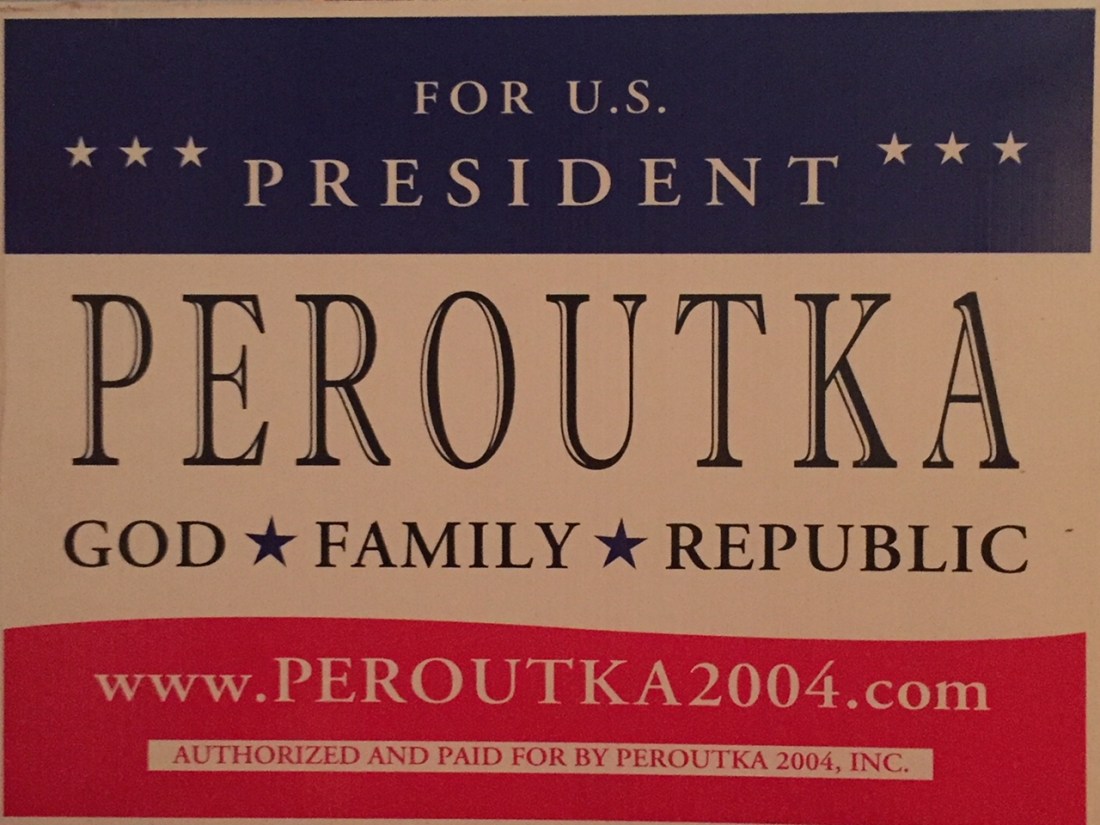
God • Family • Republic: Pasadena Attorney Michael Peroutka is the Constitution Party’s Favored Candidate for President of the United States. Is it a Match Made in Heaven?

By Van Smith

Published in City Paper, Mar. 17, 2004
IMG_7415

Michael’s Eighth Avenue, the Glen Burnie catering hall, is famous for drawing thirsty crowds to such earthy attractions as its regular “Ballroom Boxing” night, a sweaty mix of bouts, babes, and beer. On the afternoon Saturday, Feb. 21, though, it hosted a decidedly more devout affair: the announcement that Michael Anthony Peroutka, a Pasadena attorney, is seeking the 2004 presidential nomination of the 12-year-old arch-conservative Constitution Party. The party has secured a spot on November’s ballot in a dozen states so far, though not in Maryland, and Peroutka won nearly 25,000 votes in California’s March 2 primary.

Peroutka, with his brother Stephen G. Peroutka, runs the debt-collections law firm Peroutka and Peroutka, as well as the firm’s educational-outreach arm, the Institute on the Constitution, which sells 12-week seminar kits about the biblical perspective on the U.S. Constitution for $145. If he is voted the party’s nominee at its late-June convention in Valley Forge, Pa., the history books say he’ll be the first third-party presidential candidate from Maryland on general election ballots since Joshua Levering of the Prohibition Party in 1896.

“If the foundations be destroyed, what can the righteous do?” Peroutka rhetorically asked the Michael’s Eighth Avenue gathering of about 300 faithful, his dark suit and well-groomed sandy-gray hair lending a sensible air to his fundamentalist zeal. “We must not flee to the mountains,” he answered, citing a verse from Psalms, but instead “stand and fight” and “rebuild the foundations,” as did King David in the Old Testament.

“This is not a time for despair and discouragement,” he railed. “This is a time for discernment and decisive action! . . . This is why I am seeking the presidential nomination of the Constitution Party. I want, with your help, to call this country back to its original, godly constitutional greatness!”

Peroutka, like the Constitution Party itself, toes a well-defined line when it comes to matters of dogma. As his 20-minute speech made clear, he believes that the federal government routinely ignores the dictates of the U.S. Constitution, which he contends is a biblically grounded document written by divinely inspired Founding Fathers. Chronic, long-term erosion of these godly constitutional foundations, he believes, is advancing society’s moral decay, a trend made especially evident in what he calls “attacks” on the family, such as abortion, homosexuality, and gay marriage. The task for Peroutka and the Constitution Party, he says, is to fight the forces of decay and to present a loud, growing, and unwavering political voice to challenge the major parties. Taking jabs at President George W. Bush for his “failure to lead” on abortion, his “reckless” government spending, and his “unconstitutional” war on Iraq is a current staple of Constitution Party oratory.

“People may say, ‘Don’t you know you can’t win, don’t have a chance?'” Peroutka declared earnestly from Michael’s balloon-adorned stage. “But I just don’t believe in chance. I believe in divine providence. . . . With God, all things are possible.”

“The themes of our campaign are God, family, republic,” he continued. “In short, we are called to honor the sovereignty of God, defend the American family, and restore the American republic. The God of the Bible must be first because–well, because He says so.”

After God, Peroutka continued, comes family–an issue of central importance to the Peroutka campaign and the Constitution Party as a whole. Before Peroutka’s speech, party luminary William Shearer, a lapsed Republican who founded late presidential candidate and Alabama governor George Wallace’s American Independent Party in 1968, had praised the Peroutkas for having “created that thing which we stand for as a party–the family.” Shearer admired the couple’s “three lovely children”–Beth, Patrick, and Timothy, all teenagers, who took the stage with their father and mother. Spear Lancaster, the 2002 Libertarian Party candidate for Maryland’s governorship, was there and commented afterward that the Peroutkas “seem like the archetypal Christian-type family”–an image that is reinforced by a family portrait on the Peroutka’s campaign Web site.

So, up on the stage, Peroutka put particular emphasis on family issues. Whereas government exists simply and exclusively to “secure and protect God-given rights” of citizens, he said, most politicians fail to comprehend this, suggesting instead that government exists for a myriad of other, extraneous reasons: “to create a level playing field” in society, or “to maintain the infrastructure,” or “to take care of people who can’t take care of themselves.”

Or to “take care of the children of the state,” Peroutka added. He then paused as Albion Knight, a retired U.S. Army general and conservative radio commentator from Gaithersburg who was sitting in the audience after having made an earlier speech, suddenly shouted, “Not mine!” Approving chuckles rippled across the room.

“We love that one, don’t we?” Peroutka continued, remarking sarcastically that “I didn’t know the state had any children.”

The crowd was audibly amused. The reaction, though, may have been different had it been known that in the early 1990s Peroutka and his wife, Diane, forced her two teenaged daughters from an earlier marriage–Dawn and Holly Hubbard–to become wards of the state foster-care system until the age of 18. (Diane Peroutka’s previous husband died of cancer in 1978.) This happened after Dawn told members of her Catholic youth group and her basketball coach at McDonogh School that she recalled sexual abuse at the hands of Michael Peroutka from when she was 9–memories that were not substantiated in an ensuing state investigation, and which she later recanted. And it happened after Holly, who suffered from learning disabilities and a troubled relationship with her stepfather, displayed behavioral problems.

The Peroutkas transferred parental responsibilities for Dawn Hubbard to the State of Maryland on her 17th birthday, May 1, 1992, and Holly met the same fate on the day after Thanksgiving 1992, when she was 15. The sisters, now in their late 20s and living outside of Maryland, say they never wanted to be estranged from their mother and have tried without success to reconcile with her several times since being removed from the Peroutka household more than a decade ago.


Many of these facts were uncovered when a cursory Google search led to a 1997 Maryland Court of Special Appeals opinion that rejected Michael and Diane Peroutka’s libel claims against Dawn and Holly Hubbard’s state social worker, Marsha Streng. The alleged defamatory statement was made by Streng in her Towson office on Jan. 12, 1995, when Diane Peroutka showed up, Dawn Hubbard in tow, and angrily and repeatedly demanded to know whether Streng thought she was an emotionally abused spouse. Diane Peroutka had been moved to confront Streng when, during a conciliatory lunch with Dawn Hubbard earlier that day in Towson, she saw that her daughter had an informational packet about emotional abuse that Streng had mailed her daughter, then in college and majoring in psychology. Confronted by Diane Peroutka, Streng at first repeatedly refused to answer the question, but ultimately said yes. Diane Peroutka told her husband what Streng had said, and Dawn Hubbard told Holly about it as well. Nine months later, in October 1995, the couple sued Streng for libel.

The libel case was rejected at the first opportunity by the Baltimore County Circuit Court a year later, when the judge held that Streng’s statement was “an opinion . . . given at specific request to give an opinion. That cannot constitute defamation.” The Peroutkas appealed, and lost again. The appellate court opinion, filed in June 1997, said that “because all the persons who received the alleged defamatory statement knew the underlying facts of the conflicts within this family . . . Streng is not subject to liability, although, as with any opinion, [the Peroutkas are] free to disagree. We hold that the statement . . . was not defamatory.” The court also ordered the Peroutkas to pay the state’s costs for the year and a half it spent defending Streng from the claims.

Since Streng’s statement was about the Peroutkas’ family life, by suing her they opened up their family history to public examination via documents, affidavits, and depositions gathered for Peroutka v. Streng. According to those case records, on May 13, 1992, two weeks after the Peroutkas placed Dawn Hubbard in state custody, Michael Peroutka petitioned for a court order barring Dawn from having any further contact with the Peroutka family or from approaching their Baltimore County townhouse. When Dawn’s state-appointed lawyer, Anna Davis, successfully warded off the attempted restraining order by arguing that Michael Peroutka had no standing to petition the court because he had never adopted Dawn and was not her natural father, he filed an amended petition, this time with his wife, and won.

Dawn Hubbard, once in the hands of the state, had to rely on Social Security for financial support. At first, her checks were sent to the Peroutkas’ home, and Streng, in late June 1992, sent Diane Peroutka a letter asking for them. Diane Peroutka responded in writing that the money was used to pay bills, especially attorneys fees, “which have escalated far beyond the income I received for Dawn. . . . This expense was accrued because of the lies and problems caused by Dawn, and her Social Security check must pay for this.”

In the summer of that year, the case record reflects that Diane Peroutka, with her husband’s help and guidance, launched a letter-writing campaign. She sent approximately 1,000 letters to anyone who may have heard about Dawn Hubbard’s sexual abuse allegations–the Peroutkas’ friends and neighbors, for instance, as well as parents and neighbors of Dawn’s schoolmates–alerting them to her daughter’s mental and emotional condition and implying that her daughter might pose a threat to the community. That fall, when Dawn was hospitalized for a severe eating disorder, neither of her parents visited her.

The following spring, as she was being treated by Johns Hopkins Medical psychiatrist Dr. Paul McHugh, Dawn Hubbard began to doubt the veracity of her memories of sexual abuse. By the fall of 1993, she was convinced they weren’t real, but the result of a phenomenon known as false-memory syndrome. When Dawn attempted to deliver a letter to that effect to her parents, Diane Peroutka had her arrested for trespassing; Diane Peroutka had tried to do the same to to a visiting Holly Hubbard in June 1993, but the police wouldn’t charge Holly. Shortly thereafter, Dawn appeared on the Phil Donohue Show with representatives from the False Memory Syndrome Foundation, and recanted her sexual abuse allegations to a national television audience. Still, the Peroutkas have rebuffed Dawn and Holly Hubbard’s subsequent attempts at reconciliation.

The family crisis, while quieted since the libel suit ended in 1997, is still unresolved. Dawn Hubbard, now 28 with bachelor’s and master’s degrees from Bucknell University, works as a guidance counselor for female minors in the Pennsylvania correctional system. She explained when contacted recently that she and her sister, now a waitress living in Connecticut who is preparing for her August wedding, remain estranged from the Peroutkas.

Holly Hubbard submitted affidavits in Peroutka v. Streng that reflect the emotional toll exacted by her experiences with Michael Peroutka, who she believed controlled Diane Peroutka’s actions toward her daughters and forced his wife to end relationships with her family and friends from before their marriage. In the sworn statements, Holly recalled “several occasions when my stepfather would mash my face into the floor, sit on me to restrain me, push me against a wall, and pull my hair while demanding that I call myself a ‘slut.'” “I believe,” Holly continued, “that when my mother put me in foster care and refused to visit me or talk to me, it was because of pressure from my stepfather.”

In the past, Michael Peroutka has sidestepped any personal responsibility for the couple’s handling of Diane’s stepdaughters, whom he never legally adopted. “Certainly I discussed it with my wife, but it wasn’t my decision to make,” he explained in a 1996 deposition. “They were her daughters.”

A decidedly different take on Michael Peroutka’s role in his stepdaughters’ treatment was expressed by McHugh, the psychiatrist who helped Dawn Hubbard determine that her memories were false and the only doctor with whom the Peroutkas agreed to consult with during Dawn’s care at Hopkins. In a 1996 affidavit, McHugh stated that in his opinion Diane Peroutka “has been subjected to excessive emotional pressure by her husband to act in ways she otherwise would not act . . . contrary to her own best interests and those of her daughters.”

In a 1993 telephone conversation with the Hubbard sisters’ attorney, Anna Davis, case records show, McHugh was even more condemning, saying he was “disgusted by the Peroutkas’ behavior,” particularly that of Michael Peroutka, whom he described as “brutish.” “The truth will come out,” McHugh is recorded as saying. “It always does.”

In an e-mail response to written questions provided by City Paper, Peroutka maintains that the family turmoil as Dawn and Holly Hubbard were forced out of the house “was exasperated by the prejudicial attitude and professional incompetence of certain employees of our local social services department. I joined my wife in filing a lawsuit for defamation against one of the social workers that we believed acted with intent to harm our reputations and our family relationships. All of this was long ago.

“I fully support and appreciate my wife’s decisions and actions during that most difficult time, and ever since. Her desire to protect and defend our family, and to restore her troubled children, is fully shared by me. We have both, long ago, forgiven her daughters and others who, we believed, sought to harm them and us, and we pray and hope for their restoration.”


The traditional family values, limited-government platform of Michael Peroutka and the Constitution Party appears to clash headlong with the reality that he stood by, and possibly encouraged, his wife as she forced her daughters out of their home and transferred parental responsibilities for them to Maryland’s social services bureaucracy–an entity whose very existence is questionable under Constitution Party doctrine about the role of government. “Parents have the fundamental right and responsibility to nurture, educate, and discipline their children,” the party’s platform states. “Assumption of any of these responsibilities by any governmental agency usurps the role of the parents.”

Meanwhile, the libel case record of Peroutka’s alleged abusive behavior toward his wife and stepdaughters seems to flout the Constitution Party’s platform on “Character and Moral Conduct,” which states that “our party leaders and public officials must display exemplary qualities of . . . moral uprightness . . . self-restraint . . . kindness, and compassion. If they cannot be trusted in private life, neither can they be trusted in public life.”

“I don’t believe that my personal views diverge from the Constitution Party’s platform or mission,” reads Peroutka’s e-mailed response to a question about these apparent inconsistencies. “As a believer in the Lordship of Christ I know that there is a fixed and eternal standard of right and wrong and that I am a fallible, fallen creature who falls short every day. Alone, I am not capable of ‘reconciling’ any chapter, or moment of my life. I believe that it is through the saving work of Christ that we are reconciled to Him and each other.”

Peroutka’s potential image problems as a candidate for the nation’s top elected office don’t end with his home life, though. There’s also the matter of his legally questionable political donations over the past few years.

The issue first surfaced on Oct. 6, 2003, when the public interest group Common Cause Maryland issued a report on political donors from Anne Arundel County who illegally exceeded the state limits on political contributions: no more than $4,000 to any one campaign committee and no more than $10,000 overall from any given contributor during a four-year reporting cycle. Peroutka was one of four individuals, and his firm one of 10 businesses, that had given more than the limits, Common Cause reported.

Shortly after Common Cause released its report, State Prosecutor Stephen Montanarelli’s office opened a criminal investigation. The prosecutor opted not to bring charges against Michael Peroutka or its firm. “They brought themselves into compliance,” senior assistant state prosecutor Steven Trostle explained to City Paper, adding that on Dec. 8 he sent them letters closing the case and “warning them” that more violations would be treated more seriously.

In order to come into compliance, Peroutka and his firm relied on the good graces of the Maryland Constitution Party, which on Nov. 17, according to state campaign finance records, returned $3,230 of the $3,500 Michael Peroutka had given the party, and $2,200 of the $2,500 Peroutka and Peroutka had contributed. These transactions brought the total amount Peroutka and his firm had contributed to all state campaign committees to below the $10,000 limit. Though several other campaign committees–those of state senators Alex Mooney (R-3rd District) and Andrew Harris (R-7) and state delegates Emmett Burns (D-10) and Carmen Armedori (R-5A)–had also received substantial financial support from Peroutka and his law firm, only the Maryland Constitution Party returned contributions to make things right again under the law for them.

Montanarelli may have more in store for Michael Peroutka on the campaign finance front. On Aug. 22, 2002, Michael and Diane Peroutka’s three children, then between the ages of 11 and 15, donated $4,000 each to the campaign of state Sen. Nancy Jacobs (R-34), one of the state GOP’s staunchest conservatives, who at the time was facing a tough race in her Harford County district. “It’s never come up before,” Montanarelli said recently of the scenario. “But I have a problem with that one. You can’t evade the donation limits by having children making donations. It would probably be a violation, and we could probably prove that it came from their parent or parents.”

Asked by e-mail whether the money his children donated was theirs, whether or not he gave the money to them, and whether or not he prompted them to make the donations, Michael Peroutka responded, “I am confident that my children followed the law.”

Public records reveal another foible of a sort that has proved thorny for politicians in the past. In December 1991, Michael Peroutka was caught driving with an illegally high concentration of alcohol in his system. The result: probation before judgment and a month of restricted driving privileges. When asked if the episode was in any way inconsistent with the Constitution Party’s platform, which calls for its leaders to practice “temperance,” Peroutka gave the same answer as that regarding his relationship with his stepdaughters–that he is “fallible,” and that reconciliation of his personal behavior with party doctrine can only be accomplished “through the saving work of Christ.”


The evolution of Michael Peroutka from a dozen years ago, when he was struggling with his stepdaughters and living in a townhouse, into a prominent arch-conservative politician with a house on a half-acre in Millersville’s Brittingham development, a property assessed at $580,000, is a hard subject to nail down. But the changes have been marked.

Perhaps the most fundamental change in Peroutka is the fact that he is no longer with the Roman Catholic Church. The Peroutka v. Streng libel case records indicate that Catholicism was once a central part of his life. Many of Dawn Hubbard’s conflicts with her stepfather had been over religion, her 1996 deposition revealed, including a “confrontational problem” over her resistance to becoming a confirmed Catholic, a church ceremony to which she ultimately submitted after Peroutka “chastised” her. Since then, though, he joined the Cornerstone Evangelical Free Church, which worships at a Seventh-day Adventist facility in Pasadena.

Like many fundamentalist churches, the Free Evangelical Church of America, of which Cornerstone is a part, is known for its strict prohibitive stances on abortion and homosexuality and for its very literal reading of the Bible. And Cornerstone’s ties to politics are strong. The state Constitution Party’s Web site promotes Cornerstone as a “Constitutionally aware church” and provides a link to the church’s Web site. Cornerstone’s pastor, David Whitney, ran unsuccessfully in 2002 for Republican State Central Committee in Maryland’s 30th District and is also a donor to the state Constitution Party. Prior to running for public office, he had become locally renowned for helping to organize anti-abortion protests, replete with a woman in a Grim Reaper costume and poster-sized pictures of aborted fetuses, in front of a clinic on Ritchie Highway in Severna Park that provides abortion services.

Whitney also edits and writes for the monthly newsletter of the Peroutkas’ Institute on the Constitution, for which he penned a lengthy treatise titled “The Most Misused and Abused Amendment of the Constitution,” denouncing the U.S. government’s application of the 14th Amendment, which ended slavery and codified the principles of due process and equal protection under the law.

Alongside Peroutka’s evolving beliefs has come greater wealth. Peroutka and Peroutka’s Anne Arundel County personal property tax payments, records of which are available on the state’s online database, indicates that the law firm has been growing fast. In 1995, Peroutka and Peroutka owed $6,300 in such taxes, which are levied on a business’ furniture, equipment, inventory, and the like. By 2003, the amount had increased to $180,000.

Another indication of Peroutka’s improved cash flow is the amount he has invested in politics. Since 1999, Peroutka has given nearly $80,000 to Maryland and federal campaign committees. Much of it–nearly $55,000–went to federal Constitution Party accounts, with the rest allotted to various local and national politicians from both the Republican and Constitution parties. In addition, during the same time frame Peroutka and Peroutka gave $15,000, and Stephen Peroutka gave $50,000, to Maryland and federal campaign committees, $36,000 of it to the Constitution Party National Committee. Diane Peroutka, too, chipped in just over $5,000, $2,500 of it to the anti-gay-rights activist group Take Back Maryland. In all, the three Peroutkas and the firm have given about $150,000 to political campaigns since 1999. And that amount doesn’t include the $12,000 the three Peroutka children gave to Nancy Jacobs’ re-election effort in 2002. Nor does it take into account the $87,000 the Peroutka brothers and their firm spent underwriting a 2002 television and print advertising campaign urging Maryland voters to “vote pro-life.”

To put these sums in perspective, the Peroutkas are nowhere near Peter Angelos’ league–the Orioles owner and super-lawyer has made just over $3 million in federal-level donations since 1997–but surpass Baltimore bakery magnate and real-estate developer John Paterakis, who has given just shy of $35,000 to federal campaign accounts since 1997.

Asked about the origins of his wealth and consequent ability to make large political donations, Peroutka writes, “I am thankful to God from whom all blessings flow.”


Peroutka’s earliest political investment speaks volumes of where he was heading: into a tightly knit world of right-wing political activity on the outer edge of the Republican Party and, ultimately, a very small circle of rainmaking Constitution Party backers.

On the federal level, Peroutka’s first recorded donation was on Oct. 15, 1999, when $250 sent from his Ritchie Highway office–it was entered in the ledger-books as having come from “Peroutka P.A.”–arrived in Katy, Texas, where it landed in the short-lived and little-used bank account of the Draft Steve Stockman for Congress Committee. “I vaguely remember this donation,” Peroutka explains in his e-mail, “but do not remember what prompted it.”

Stockman, an accountant and former one-term Republican congressman who lost a bid for re-election in 1996, was known for his defense of the militia movement and his adamant pro-gun stance. In the fall of 1999, after having lost a bid for a seat on the Texas Railroad Commission a year earlier, Stockman was working as a highly paid consultant, earning $250,000 in fees advising the congressional campaign of Texas Republican Mark Brewer, who lost the following spring’s primary. But Peroutka and a small group of like-minded Stockman supporters were hoping to draw Stockman back into running for federal office again.

Other than Peroutka, 15 individuals from around the country donated $7,000 in itemized contributions (an equal amount was collected in small, unitemized amounts) to the draft-Stockman campaign based in Katy, which raised funds only for a single month in the fall of 1999. (A defining moment for Katy, population 10,000, came the following summer, when seven local men held a cross-burning on the property of one of the town’s few black families, and were subsequently convicted of federal hate crimes.) Among Peroutka’s co-donors to the low-profile campaign were three individuals whose backgrounds place them on the extreme edge of conservative politics–a place where Peroutka, nearly five years later, is now established as a leader and benefactor.

Joining Peroutka in the draft-Stockman campaign was James R. Lightner, a wealthy Dallas businessman who in the spring of 2000 joined an elite club of about 100 people who contributed to former Ku Klux Klan leader David Duke’s flash-in-the-pan stab at an open congressional seat in Louisiana. Another name on the list of contributors was Chris Cupit, a right-wing political functionary from Louisiana who gained notoriety as a partner in GOP Marketplace, a Virginia-based consulting firm that was caught undermining Democrats’ get-out-the-vote efforts in New Hampshire on Election Day 2002 by subcontracting with an Idaho phone-calling firm to jam the Democrats’ phone-bank lines with continuous hang-ups. Also on the list was Robert G. Wheaton of San Antonio, who in 1995 was elected to the seven-member Committee of Safety of the Southern Region of the Texas Constitutional Militia, one of Texas’ two main militia organizations. (According to the Austin-based pro-militia Constitution Society, the Texas Constitutional Militia ‘s Committee of Safety is “no longer operative.”)

Lightner and Cupit are both active in GOP causes, and Wheaton is a regular contributor to the Libertarian Party. But all three, by virtue of their political activities, are iconoclasts outside the political mainstream, a fact that seems to drive their zeal–and open their wallets–for fundamental cultural change. The Constitution Party has been calling for such change since its founding in 1992, when it picked up what was left of the George Wallace movement–the American Independent Party and its various offshoots–to form what was originally known as the U.S. Taxpayers Party. And Peroutka, with his deep pockets and apparently growing doctrinal zeal, fits in quite well.

Now that he’s the party’s presumed presidential hope, Peroutka has started to answer candidate questionnaires, such as the one at vote-smart.org, that give an idea of his stands on the issues, such as:

· Eliminate all taxes except tariffs on imports, which should be slightly increased.

· Eliminate all federal government funding for everything except defense, whose budget should be maintained at current levels–except for one item, a national missile defense, whose funding should be greatly increased.

· Except under special circumstances, expel all illegal aliens and place a moratorium on immigration.

· End all government aid to foreign interests, be it other countries or international organizations.

Getting in a position to make such fundamental changes to the federal government requires money. The Constitution Party National Committee’s cash on hand, as most recently reported on Jan. 31, is a little more than $8,200–barely enough to throw a decent bull roast–while Peroutka 2004, the presidential campaign committee, has nearly $22,000 on hand. The fact that either outfit has any cash at all, though, is thanks mostly to a small group of big donors, including Peroutka himself, who has chipped in nearly $57,000 to the national committee since 2000, and has lent $40,000 to his own presidential campaign committee. Only two other individuals have given more than $50,000 to the party’s federal accounts: the chairman of the Constitution Party National Committee, Jim Clymer, and a retiree from Dallas, Julie Lauer-Leonardi, who’s the party’s most prodigious benefactor, having given more than $80,000.

Lauer-Leonardi and Lightner are among dozens of conservative activists who sit on the leadership council of the Conservative Caucus, a 30-year-old Vienna, Va.-based political organization whose founder and chairman is Howard Phillips, a former Nixon administration official who has been the Constitution Party’s presidential candidate in the last three elections, and who helped found it in 1992 as the U.S. Taxpayers Party. (The party changed to its current name when it was trying in 1999 to woo Patrick Buchanan to be its presidential candidate.) Phillips is backing Peroutka and gave a rousing pro-Peroutka speech at the candidate’s announcement ceremony at Michael’s Eighth Avenue.

Lauer-Leonardi may be the biggest individual donor to the Constitution Party, but Peroutka, if you add to his contributions those made by his brother and wife, comes out on top: All together, they’ve given more than $95,000 to the party. As Richard Winger, editor of Ballot Access News and a close observer of U.S. third-party politics, says, “Peroutka really wants to be the party’s candidate for president.”


Only 307 Marylanders were registered as Constitution Party voters in March 2003, the last time the state board of elections did a head count before the party lost its status as a recognized party here because it didn’t garner enough votes in the 2002 state elections. Howard Phillips garnered sparse support from Maryland voters in his three presidential bids: 919 in 2000, 3,402 in 1996, and 22 in 1992. Nonetheless, Maryland has a special place in the Constitution Party’s heart. After all, the Free State backed the Constitution Party’s ancestor, George Wallace, in the 1964 presidential primary, and handed him nearly 180,000 votes in the 1968 general election.

A number of key Constitution Party players are based in or around Maryland. Clymer, the party’s chairman, is a lawyer in nearby Lancaster County, Pa. Phillips’ Conservative Caucus is based in the Virginia suburbs of Washington. Radio commentator and Constitution Party donor Albion Knight only had a short commute from his Gaithersburg home to give his homily at the Peroutka announcement. And Peroutka 2004’s $800-a-week communications director, John Lofton, a fixture of hard-right journalism since the rise of Ronald Reagan, lives in Laurel. The Save-a-Patriot Foundation, an anti-government, anti-tax organization based in Hagerstown, is scheduled to have Peroutka address one of its weekly Saturday-night gatherings in April. Two Maryland pastors–Cornerstone’s David Whitney and Michael Chastain of Christ Presbyterian Church in Elkton, who gave the prayer at Peroutka’s announcement–have emerged as important religious voices for the Constitution Party’s doctrines.

And, of course, Peroutka is a native Marylander, born in Baltimore in 1953. He and his brother Stephen Peroutka gave their first big donations to the Constitution Party National Committee–a combined sum of $30,000–between June and August of 2000. The Peroutka brothers’ Institute on the Constitution has caught on, and its Web site is a commonly encountered link on far-right political and religious Web sites. Michael and Stephen Peroutka both take their messages to the airwaves on local Christian radio stations.

More than 300 people came to Peroutka’s Feb. 21 event in Glen Burnie–a much better turnout than the 50 or so people who attended Ralph Nader’s August 2000 announcement in Annapolis that he would be the Green Party’s presidential candidate that year. Onstage at Michael’s Eighth Avenue, Michael Peroutka mentioned another manifestation of the party’s local influence when he thanked “members of the General Assembly here present” for coming to the event. Freshman state Del. Donald H. Dwyer Jr. (R-31) was there, but City Paper was unable to spot any other elected officials celebrating Peroutka’s announcement. Spear Lancaster said later that state Republicans whose campaigns Peroutka has supported financially “don’t want to be seen at another party’s event.” In his e-mail, Peroutka said that he had “sent notes to a few of my friends in the General Assembly and wanted to make sure I welcomed any who might have come. So I used the plural. I cannot remember seeing other Delegates except for my good friend Don Dwyer.”

Dwyer has teamed up with Peroutka, who put $4,000 in the delegate’s campaign kitty last May, in other ways recently. As reported by Dwyer in a Feb. 16 letter posted on the Institute on the Constitution’s Web site, the two joined other conservative luminaries–Howard Phillips, Alan Keyes, and Phyllis Schlafley among them–on a two-day visit in February to impeached Alabama Supreme Court Chief Justice Judge Roy Moore, who lost his job last fall after refusing to remove a sculpture of the Ten Commandments from his courthouse. And Dwyer told The Sun in a Feb. 3 article that he decided to run for delegate in 2002, his first bid for public office, after attending an Institute on the Constitution seminar. Ever since he arrived in Annapolis in 2003, he’s been rustling feathers–even yanking them on occasion by, for instance, suing the leader of the Anne Arundel legislative delegation over rule changes and questioning the patriotism of fellow lawmakers.


Peroutka’s budding influence in Annapolis and among some Christian Right Marylanders, along with his fund-raising ties to national far-right leaders, suggests he’s got some traction as a political player. Still, it almost goes without saying that he can forget about the White House.

“I don’t remember them, offhand,” University of Maryland political science professor Paul Herrnson jokes when asked what role the Constitution Party could play this election season. “Hold on, let me look them up in one of my books.”

His point, he says with a touch of hyperbole, is that “no one’s ever heard of them or cares about them, and that’s the problem with third-party politics in general.”

Others, such as Bob Moser, senior writer for civil-rights organization the Southern Poverty Law Center, who covered a Constitution Party gathering last April in Clackamas, Ore., think the party has legs, even if they’re spindly. “They’ve been reasonably successful–they’re still around,” Moser argues, distinguishing them from Ross Perot’s Reform Party, which has disintegrated since it nominated Buchanan for president in 2000. “A lot of the Perot people and Buchanan people have landed in the Constitution Party.”

But Moser says he isn’t impressed with Peroutka. The party, he explains, has in the past tried to draw big-name candidates–Marylander Alan Keyes, for instance, who ran for the GOP presidential nomination in 2000, or Buchanan–but has always ended up with Howard Phillips at the top of the ticket. And Peroutka, despite his wealth and organizational capabilities, is not a big name either.

“If they nominate somebody like Peroutka, they’re not going to get any votes,” Moser says. “But if they nominate Judge Moore,” whose name has been bandied about for the nomination, and who Peroutka has said he would step aside for, “they’d get some votes. Moore could draw as many votes this time as Nader.”

As it is, Moser says, the party is so far “the only catch basin for disaffected conservatives” in the 2004 presidential elections. How many of those will bother to vote for the Constitution Party candidate is hard to ascertain, but he contends there is a “large element of really conservative Christians who might support the Constitution Party, but who cling to not getting involved in politics, as well as the militia and anti-government people who are not going to participate in the system in any way.”

“I can’t really confirm or deny the extent to which some people may ‘drop out’ due to disillusionment” with the system, Peroutka responds in his e-mail. But he believes that public interest in the Constitution Party’s ideas “is increasing as folks recognize that we have abandoned the worldview of our founders, disregarded the plain meaning of the Constitution, and drastically centralized power in Washington to the detriment of the common good.”

The Constitution Party, “like all organizations that stand for something, will not attract those who stand against that same something,” he continues. While Christian at its core, and thus not likely to attract non-Christian voters, “the Constitution Party welcomes those who support its platform and its mission to restore Constitutional government.”

What’s more, the party’s religious base is not at all unique in politics, Peroutka contends. “The ideology of all parties and organizations and individuals is inherently tied to religion,” he states, because “we act out what we believe.”

If that’s the case–that “we act out what we believe”–then Peroutka’s actions toward Dawn and Holly Hubbard suggest his beliefs may be out of whack with the Constitution Party’s stated platform. How that affects the party faithful’s support for his candidacy remains to be seen.
Going Gay With Age: A Short History of Gay Rights in Baltimore

By Van Smith

Published in City Paper, June 9, 2004

Gay rights got off to a rocky start in Maryland. When Lord Baltimore was granted his charter for the colony of Maryland in 1632, he adopted English common law, which outlawed sodomy. This legal tradition viewed the biblical crime as nonprocreative sexual acts, such as anal and oral sex, be it hetero- or homosexual (or involving animals). Common-law penalties included live burial or burning. Their threat helped to quash any notion that colonial gays and lesbians had rights to assert; they were criminals, plain and simple, and were to be treated as such when caught–though apparently not many were, as the historical record is sparse on colonial sodomy prosecutions in Maryland.

After gaining statehood, according to sodomy-law historian George Painter’s Web site (www.sodomylaws.org), Maryland in 1793 passed a sodomy statute that set a sentence of up to seven years of hard labor in irons on bread-and-water rations, with lashings for misconduct. Slaves convicted of sodomy would get the death penalty or, if lucky, 14 years of the same rough handling. In 1809 the penalty was changed to one to 10 years’ confinement, with slaves getting equal treatment. Then, in the first published sodomy case in the nation, the Maryland Court of Appeals in 1810 upheld an indictment for “that most horrid and detestable crime (among christians not to be named), called Sodomy.” The law, with its religious undertones, stood unchanged for more than a century but resulted in few recorded cases.

Taking its cue again from England, where Victorian moralists had spurred public obsession with sex, Maryland in 1915 issued a Vice Commission Report about some of its residents’ sexual adventures. Seven of the report’s thousand-plus pages addressed homosexuality. The following year, a new sodomy law was passed, outlawing oral sex and other unspecified “unnatural or perverted sexual practices” with a penalty of up to 10 years in prison and a $1,000 fine. Three published cases in the 1940s-’60s involved heterosexuals, establishing that the law was not designed to target gay behavior alone.

Thus, gay sex, and straight sex venturing somewhere into the vast realm beyond the missionary position, were criminal acts in Maryland from the very beginning. In a sense, they still are; the 1916 statute, after the last effort to repeal it failed in 1988, was found unconstitutional in two late-’90s decisions, but sodomy in theory is still a common-law crime in Maryland. In practice, presumably judges would frown on any attempts to prosecute it.

The struggle for gay rights in Maryland since the 1960s, though, has been about much more than the right to practice same-sex intimacy. It’s been about protection from discrimination, achieving recognition for same-sex partners who want to share employment benefits or visitation rights at hospitals, and allowing gay or lesbian couples to marry, or adopt, or split up but still retain custody rights over children. It has also involved blocking proposed anti-gay measures.

Not everyone sees the point in grappling with the system. Betsy Brown of western Oregon became like a young Malcolm X in a world of Martin Luther King Jr. lesbians with her mid-1990s “lesbian separatism” manifestos, inspired in part by the black-separatist economic model of self-reliance. “Participationists work for legal recognition of same-sex marriages and other gay-rights legislation,” Brown wrote in Off Our Backsin 1995, but “as a separatist, I recognize marriage as an institution created by men in order to control wimmin, children, and female sexuality.” Marriage and every other invention of civil society are tools of political repression, she argued, so why fight for them? Instead, she urged lesbians to direct their collective energy into building and strengthening “wimmin-only zones.”

The history of the gay-rights movement, however, is populated not by the few who opted out of the system, but by the many who grappled with it. Here’s a short, abridged version of their story here in Maryland, compiled from interviews, contemporary news accounts, and legal sources.

The 1970s

The 1969 New York City police raid on Greenwich Village’s Stonewall Inn is credited with inspiring the national gay-rights movement, but the higher profile also brought more hostility. “Despite the excellent work being done by gay activists around the world,” writer Alan Payne mused in a 1980 City Paper essay titled “Gay Gloom,” “I look around me at the general community and realize that 15 years ago gays were pitied and now . . . we are hated.” While the young movement managed to elbow its way into the national civil-rights discussion and gain broader acceptance in the 1970s, its opposition fought back hard.

Evidence of the new tolerance–and the strident opposition–mounted throughout the decade. In 1973, the American Psychiatric Association, which had classified homosexuality as a mental illness, recommended the stigma be lifted; in 1975, the American Medical Association urged that sodomy laws be repealed. Many churches were taken aback by the outburst of open-mindedness; in 1976, the Vatican was moved to remind the Catholic world that homosexuality is a “serious depravity” that “can in no way be approved of.”

Washington, D.C., San Francisco, Miami, Los Angeles, and Detroit passed laws extending civil-rights protections to gays. But the sunset of Jimmy Carter’s term as president loomed without passage of a federal gay civil-rights bill–an unfulfilled promise he’d made in his 1976 campaign. In a moment that demonstrated the intensity of emotions the gay-rights cause could inspire, San Francisco’s mayor, George Moscone, and its openly gay city supervisor, Harvey Milk, were gunned down in 1978 by Dan White, Milk’s anti-gay predecessor. Still, a fall 1979 gay-rights march in Washington drew an estimated 50,000 to 150,000 people.

In Maryland, though, gay rights lost ground in the 1970s, and leading politicians weren’t shy about openly dismissing the gay agenda. In 1973, reacting to attempts by gay and lesbian couples to marry in Maryland, the Free State became the first in the nation to legally define marriage as only between a man and a woman–what has since come to be known as the Defense of Marriage Act. Democrat Blair Lee, the acting governor from 1977 to ’79, famously announced that he had “more important things to do” than worry about gay rights, while one of the state’s Republican members of Congress, Marjorie Holt, quipped, “That’s stupid,” to the suggestion that feminists should support gay rights. Meanwhile, religious arguments against repealing the state’s sodomy law won out regularly in Annapolis.

In the city, the gay movement since the 1960s had revolved around the Baltimore Gay Alliance, the progenitor of today’s Gay, Lesbian, and Transgender Community Center of Baltimore and Central Maryland (GLCCB). And the alliance’s main political thespian was Harvey Schwartz, a woolly, streetwise activist who was as quick with a witty comeback as he was with raising a crowd for a rally.

“Harvey was a 24-hour-a-day queer,” recalls Pat Moran, a local TV and movie casting director with longstanding ties to the gay community. “It was always, ‘Here comes Harvey with another sign.’ And the Sunpapers, every time there was a gay issue to cover, they always called only Harvey. You’d have thought they could have found three other gays to talk to somewhere in town.”

Part of the problem, Moran speculates, was that so many gay people were in the closet. “Schoolteachers had it the worst, but it was everybody,” she recalls. “They’d lose their jobs if they showed up at a party with their actual partners, so they’d have a woman come with them–the beard syndrome was rife. People couldn’t be themselves.”

But some local gays were willing to be vocal and out-front. “We were young, crazy activists,” remembers Louis Hughes, now retired after decades of involvement in the local gay movement, though he still volunteers here and there. “We would meet in peoples’ apartments, their basements, and form various splinter groups. That’s where the Chase-Brexton clinic came from, and what’s now called Gay Life newspaper. And we had the first Gay Pride Festival on 31st Street in Waverly, before it moved to Wyman Park.” (It’s now held in Druid Hill Park.)

“Other than Harvey, there were myself and Paulette Young, an African-American lesbian who was the Baltimore Gay Alliance’s first president, and many others,” Hughes says. “We would go down to Annapolis, starting in the 1970s, to get gay-rights legislation passed in Annapolis, but it always went nowhere.”

The gay and lesbian community’s hopes for a gay civil-rights law in Baltimore were backed by members the city’s Community Relations Commission, whose chair, Antonya Keane, began feeling out then-mayor William Donald Schaefer for possible support. She found none; Schaefer “didn’t commit himself either way,” Keane told CP in 1978. But support was gelling among four sympathetic members of the City Council–Mary Pat Clarke, Wally Orlinsky, Victorine Adams, and Thomas Waxter. After returning from the 1979 march on Washington, Schwartz and the Baltimore Gay Alliance kept the momentum going with a rally at the Inner Harbor.

Area college campuses stirred with gay controversy, too. The Towson State University Student Government Association in 1978 denied a gay student group’s $84 budget because of “moral qualms” over the criminality of its members’ presumed sexual behavior. At the University of Maryland, in College Park, on the other hand, the SGA backed gay-friendly amendments to the university code. And at Johns Hopkins University, the Gay Caucus president boldly told CP that “if a campus doesn’t have a faggot group, it’s nowhere.”

The 1980s

The era of Ronald Reagan, who in 1984 proclaimed that he would “resist the efforts of some to obtain government endorsement of homosexuality,” offered an unfriendly political climate for gays and lesbians, and it coincided with the dawn of HIV/AIDS. The disease was quickly recognized as spreading fastest among gay males, a fact that contributed to a what many saw as a rise in homophobia.

“There are a large number of people who are afraid of homosexuals,” Baltimore psychotherapist Ernestine Maben told City Paper in 1983. “Have always been. But more so [recently] because of AIDS.” Five years later, The New York Times reported about a “hostile world” for gays, citing a study by Baltimore psychiatrist Kenneth Morgen, who found that 16 percent of gays in Baltimore had been harassed or assaulted at least once by someone who mentioned AIDS. “This is a crime that is coming out of the closet,” Morgen told the Times.

AIDS, meanwhile, took its toll on the burgeoning gay-rights movement. “It was quite a blow,” Hughes says. “We lost people early on from AIDS, so they could no longer be there to be activists. We had to raise a new generation.” In particular, he remembers Eddie King, who was involved in the Health Education Resource Center and helped build bridges between local AIDS sufferers and groups such as the Urban League before he died in the mid-’80s.

The ’80s also brought unavoidable recognition that gays and lesbians are ubiquitous–a message that was delivered with keen irony in 1980 when Congressman Bob Bauman, a conservative Eastern Shore Republican and a vocal foe of gays, was charged with soliciting a 16-year-old male for sex. Harvey Schwartz gleefully joked to CP at the time that the Bauman case did “more for [gay] liberation” than activism.

The inadvertent outing was followed in 1983 by another: Massachusetts Rep. Gerry Studds (D), facing a congressional reprimand for a sexual relationship a decade earlier with a teenage male, admitted he was homosexual. Not since the 1972 death of FBI director J. Edgar Hoover, who left much of his estate to his lifelong male companion, had so many in the country wink-winked so heartily. Actor Rock Hudson’s death from AIDS further ushered in a growing realization in mainstream America that gays and lesbians were more a part of society’s fabric than a threat to it.

By 1983, Bauman had transformed himself into a gay advocate, telling The Washington Post that gay civil rights “is a concept whose time has come. I don’t think it is politically damaging to the right or the left to support that.” Still, while gay-friendly laws came to pass in Maryland and around the country, so did setbacks.

Baltimore City’s gay and lesbian civil-rights bill was introduced first in 1980, then in 1984, and finally in 1988 before it passed. “It helped when Kurt Schmoke became mayor and Mary Pat [Clarke] became City Council president” in 1988, says Tony Ambridge. The local real-estate developer is a former City Council member who was the measure’s chief sponsor in ’84 and ’88.

When he first put the bill before the City Council in 1984, Ambridge recalls, “Schaefer was not happy with it, and neither were many of my colleagues on the council. Waxter and Kweisi Mfume, I remember, were with me. Other than that, though, people weren’t happy.

“Remember, I’d only been in there maybe three months, and then this?” Ambridge continues. “Schaefer just didn’t think it was germane that they were a special class of people. And I said, ‘But that’s the whole point. They’re not a special class of people. They’re another group of people who need the same protections from discrimination as everyone else.’

“I bet we had 200 people at the hearings each time. People don’t remember now how vociferous the opposition could be–it was the only time in my life that I saw Muslims, Orthodox Jews, and born-again Christians at the same table on the same issue.”

John Hannay, now a public-health consultant in Columbia, lobbied hard in support of the city’s 1988 gay-rights bill. He has similar memories. “The key was that a large number of people involved in nongay and nonlesbian groups came to support it, like community groups and other human-rights groups,” Hannay says. “An important one was the NAACP, which had shown some hesitancy until then because they didn’t want to offend one of their strong bases of support–a number of African-American clergy who were conservative on this issue.” And, he adds, winning the neutrality of the local Roman Catholic archdiocese, whose Archbishop William Borders had previously lobbied against the bill, didn’t hurt either.

A good portion of the opposition was cultural rather than religious. In the middle of the 1980 City Council battle over gay rights, for instance, then-councilman Joseph P. Murphy told CP the bill was “a joke,” and that machinists and factory workers he knows told him they would deliberately mistrain gay co-workers so they would be injured in industrial accidents.

Ambridge recalls that, during the 1988 wrangling over the bill, Councilman Mimi DiPietro–the voice of Southeast Baltimore’s working-class neighborhoods–was told by a CP reporter that one in 10 people are gay. “He looked around and started counting out the people around him,” Ambridge says. “‘One, two, three . . . ,’ on up to 10. And then asks them, ‘OK, so which one of you’s guys is gay?” DiPietro echoed a common blue-collar belief about the bill: “If you open the door to gays in Baltimore,” he told The Sun, “they’ll come from everywhere.”

Moran recalls DiPietro’s ilk with scorn. “Those people were buffoons,” she says. “They didn’t recognize that gay people are everywhere–everywhere–and they always have been.”

Early on in the fight for the city’s gay-rights ordinance, in 1983, Harvey Schwartz was booted from his post as head of the Gay Community Center of Baltimore (the early-’80s iteration of the Baltimore Gay Alliance). He explained to CP at the time that it resulted from a split between “streetwise” activists such as himself and “bureaucratic” gays, many of them professionals, who represented an emerging new leadership. By the time the battle over the 1988 bill began, this new generation–which included, among others, Hannay, AIDS activist Gary Lambert, and Curt Decker, who helped lead the city’s Gay and Lesbian Democratic Club–were politely building political bridges across the city and state. To present a united front in pressing for change, the gay and lesbian community also coalesced around a civil-rights group called the Free State Justice Campaign (now named Maryland Equality).

“There were a lot of new folks getting involved, including myself,” Hannay says. “Green faces, relatively inexperienced. We learned a lot.” (A lot of the strategy sessions back then, Hannay recalls, were held in the home offices of architect Stephen Glassman, which were located in what is now City Paper‘s offices at 812 Park Ave.) With a city gay-rights bill gained, a fuller agenda was in the offing–including not only more legislative efforts, but also through the courts and the mayor’s office.

The 1990s

The decade opened with two important 1990 court decisions. Baltimore City Circuit Court Judge Kathleen O’Ferrall Friedman, ruling in a custody case involving a lesbian couple’s daughter, found that the woman who hadn’t given birth to the daughter still retained limited custody rights. The decision was innovative, creating new boundaries for the legal concept of parenthood–an important issue for the many gays and lesbians who raise families.

Also in 1990, the Maryland Court of Appeals decided Schochet v. State, ruling that the state’s sodomy and unnatural- and perverted-sex laws could not be applied to consenting heterosexuals. The ruling flew in the face of the appeals court’s own precedents and appeared to deprive gays of equal protection under the law. Nonetheless, until 1998 and 1999, when new court rulings legalized consensual sodomy for everyone, Schochet was used to argue that gay and lesbian parents shouldn’t have child custody because acting on their sexual preferences was a crime, explains Mark Scurti, president of the Gay and Lesbian Bar Association of Maryland.

The effect of these court decisions, and other around the country, was to recognize same-sex couples under family law–a legal shift that fed into another national debate raging throughout the 1990s, and up to the present: same-sex marriage.

A case in Hawaii shuttled around its state courts throughout the decade, turning on the question of whether or not the state’s constitution allowed it to ban gay marriage. The case touched off discussions in legislatures around the country about whether or not to recognize gay marriages allowed in other states. Maryland politicians battled it out, with bills to allow gay marriage in this state going as far as bills not to recognize other states’ gay marriages–nowhere.

Meanwhile, President Bill Clinton–who over the course of his two terms was wishy-washy on gay issues–signed a federal Defense of Marriage Act in 1996, saying he “has long opposed same-sex marriage.” Maryland’s Democratic U.S. senators, Barbara Mikulski and Paul Sarbanes, both voted for the measure, disappointing their gay supporters.

The repeatedly defeated statewide gay civil-rights bill also didn’t make it out of the state legislature during the 1990s, despite its endorsement by Gov. Parris Glendening, a Democrat. He took matters into his own hands upon gaining office in 1995 by ordering the state government to enforce an explicit policy of nondiscrimination against gay and lesbian employees. In 1991 and 1994, meanwhile, the Baltimore City Council rejected domestic partnership proposals that would have established a registry for same-sex or heterosexual nonmarried couples; by signing up and gaining recognition as domestic partners, it was hoped such couples could appeal to their employers to extend benefits to their partners. Mayor Schmoke and several council members–Ambridge, Clarke, and Wilbur “Bill” Cunningham, among them–backed the bill, and in 1993 Schmoke had extended benefits to same-sex partners of city employees. But local clergy came on strong, and got it defeated.

“It was the same reaction from them as to the gay-rights bill,” Ambridge says. “All this biblical rhetoric and irrational fears about pedophiles. I always pointed out that the Bible also says that some people should be stoned to death, and that the studies show that most pedophiles are men going after little girls, not little boys.”

“Schmoke had a task force to study the domestic-partnership registry idea,” Hughes recalls. “And he found that it cost almost nothing. So when the legislature failed to act, he saw it as a no-cost no-brainer to do as an executive order. A lot of positive things came out of the Schmoke administration–especially in terms of how to apply the 1988 law extending protections to gays and lesbians. He set up the complaint and appeals procedures, and made sure it was all well-studied and done properly. It was good to know that city government was on our side.”

The private sector, meanwhile, started to budge on gay issues. In 1999, the same year that Montgomery County followed Baltimore City’s and Takoma Park’s leads in instituting benefits for same-sex partners of its government employees, the Johns Hopkins family of educational, medical, and research institutions–one of Maryland’s largest employers–did the same. The groundwork for that move actually had been laid out 10 years earlier, when the Montgomery County Human Relations Commission brokered a deal with a local company to provide limited job benefits to same-sex partners. But Hopkins’ move was in a whole nother league, and was a harbinger of more progressive corporate decisions to come.

2000 and Onward

Baltimore mayor Martin O’Malley enjoyed energetic support from the gay and lesbian community in the 1999 mayoral race, but in December 2000 one of his key appointees got him into trouble. Housing Commissioner Paul Graziano was arrested for disorderly conduct after an outburst of verbal gay-bashing at a Fells Point bar. O’Malley kept Graziano at his post, over the protests of gay activists, after ordering him to enter alcohol treatment and sensitivity training. Promises of regular meetings between gay leaders and the mayor, along with discussions of appointing gays and lesbians to administration jobs, repaired the rift–as did O’Malley’s June 2001 announcement that a Gay and Lesbian Task Force would be appointed to address activists’ concerns. As an added bonus, the City Council passed and O’Malley signed a bill in December 2002 extending civil-rights protections to the city’s transgendered population.

On the statewide front, Glendening and gay and lesbian lobbyists finally negotiated a gay civil-rights bill into law in 2001.

“I was there the day when Glendening came in as a citizen to testify,” Hughes remembers. “And then the bill passed–it was a real shock. His testimony was very effective in getting people to understand gay rights affected everybody.” (Glendening’s late brother Bruce, an Air Force veteran, died of AIDS in 1988 after keeping his homosexuality hidden during his 19-year military career.)

The bill even garnered the “yes” vote of conservative Cecil County Democratic Sen. Walter Baker (since ousted at the polls), who a decade earlier had remarked that gays and lesbians are “sick” and “messed up sexually,” and suggested that property owners should be allowed to discriminate against them.

Plenty of opposition to gay rights still existed, though. In fact, the state bill’s passage spurred anti-gay forces to form a political campaign committee called Take Back Maryland, which organized grass-roots support for putting the new law up for a referendum on the 2002 ballot. Their efforts to get the referendum on the ballot fell short, and the law stands.

At the beginning of the 2002 legislative session, longtime Democratic state Del. Maggie McIntosh, of Baltimore City, came out–the first Maryland legislator to do so. Since then, Montgomery County voters elected in 2002 an openly gay delegate, Richard Madaleno, and another delegate, Ann Kaiser, came out as a lesbian while giving testimony in support of a statewide domestic-partner registry during the 2004 session in Annapolis.

Kaiser says her decision to announce her same-sex preference in such a public forum helps push society’s evolution toward more acceptance of gays and lesbians. “The face of gay America is very much the same as the rest of America,” she says, “and people are learning that.”

The past General Assembly session hosted more than Kaiser’s surprise. It was a replay of the gay-issue gridlock of the 1990s, with religiously motivated anti-gay-rights measures competing for attention and support with pro-gay-rights bills. Thus, while gay activists sought approval of a bill to allow same-sex couples to make medical decisions for one another, and another to add gays and lesbians to the list of minorities protected under the state’s hate-crime laws, they had to work to kill two separate bills that would have made it illegal for Maryland to recognize same-sex marriages from other states.

“There’s not enough support either to ban or approve same-sex marriage right now,” Kaiser observes. But she believes that will change with time. “I’m convinced to my core that we will move in the direction of gay marriage and civil unions. Unfortunately, it might be in another generation that that happens, because what seems shocking in one generation seems acceptable in the next. But we’ve already come a long way.”

“As far as I’m concerned, people should be flipping out that they aren’t allowed to be married,” an exasperated Pat Moran exclaims. “I mean, if I was tormented by health-care workers and insurance people right on down, as gays so often are, and if I lived with someone for 20 years who died and I had no rights to anything, I’d be ready to tear some buildings down. One out of two straight marriages end in divorce, so where do they get off telling anyone what to do? I say it’s time not to be polite about going after the rights they’re due.”

Mob Rules: Ex-Gangster Charlie Wilhelm is Making a Different Kind of Book These Days, and it’s Opening Up a Lot of the City’s Secrets

By Van Smith

Published in City Paper, Oct. 6, 2004

Mobtown is not, by reputation, a mob town. Baltimore’s nickname derives from its citizens’ proclivity to riot, not from its role as a home to organized crime—a role that until very recently has been little recognized, much less resisted. Sure, there was Julius “The Lord” Salsbury, who hobnobbed with city pols and lawmen as he ruled Baltimore’s rackets in the 1950s and ’60s, until he skipped bail and fled the country in 1970, never to be heard from again. (Barry Levinson’s Liberty Heights in 1999 retold the Salsbury story). And sure, there’s a 16-month-old outfit in the Baltimore City Police Department called the Organized Crime Division, but it claims to target low-level drug dealers, not racketeers involved in loansharking, narcotics-running, gambling, arson, and murder. Poker-machine guys and titty-bar owners with ties to police and politicians, rogues who maybe bring some coke in from Ocean City or Miami or New York every now and then—they’re not The Sopranos. They’re more like Jimmy Breslin’s The Gang that Couldn’t Shoot Straight.

But with the release this week of Wised Up (Pinnacle Press), by gangster-turned-informant Charlie Wilhelm and ex-Sun reporter Joan Jacobson, Mobtown’s long-held denial of its own entrenched organized-crime problem may start to dissolve. Recognition and frank discussion of a problem, as everyone knows, are the first steps on the road to recovery. And Wised Up—Wilhelm’s story, fully corroborated and retold by Jacobson, almost entirely in Wilhelm’s voice, as if he were regaling the reader over rounds of beer at Showalter’s Saloon in Hampden—promises to let that process begin.

The recovery process for Wilhelm—a longtime loan shark, bookmaker, arsonist, drug dealer, and extortionist—started when he hit bottom in the summer of 1995. The police staged an early-morning raid on his house on Keswick Road in Hampden, and Wilhelm’s gut wrenched as he saw his youngest son, a 7-year-old, scared and crying while the house was searched. Wilhelm wasn’t arrested, though, and a few days later his partner in crime, Billy Isaacs, with whom Wilhelm had run for nearly 20 years, appeared at his front door, fresh out of prison after a federal stint for witness tampering. Wilhelm knew Isaacs had gotten away with a murder in 1978. He also knew Isaacs wanted him to kill two men who Isaacs believed were stealing from their operation. Wilhelm, who had never killed, didn’t want to do the job, and was quickly getting sick of the gangster life. Within a week, Wilhelm went to Washington to tell an FBI agent—a childhood acquaintance of his, Wilhelm’s brother’s best friend—that he wanted to turn informant. He brought no lawyer, sought no deal for the crimes he’d committed, and had no pending charges hanging over him. It was the only way Wilhelm saw to get out.

And it worked. Ultimately, Wilhelm’s dicey errands as an undercover informant led to the arrest of 23 people, including Isaacs, who went to prison for the 1978 murder. Wilhelm supported his family on government funds—$2,500 per month, for a total of $140,000—until he could land a legitimate job as a Baltimore-area carpenter, a career he still has. He never entered the federal witness-protection program, instead leaving town in 1996 to live quietly in Alabama, until homesickness drew him and his family back in 1998. Meanwhile, Wilhelm kept a journal to help beat back chronic anxiety, and eventually was diagnosed with post-traumatic stress disorder, from which he still suffers. But the journal became the basis for a four-part series by Jacobson in The Sun, published in November 2001, as well as for Wised Up.

“It’s the only thing I ever did right in my life,” Wilhelm said recently during a sit-down at City Paper’s offices, with Jacobson in tow. “Why should I be the one persecuted for doing something right? Even though all that stuff I did before was wrong—if they told me I had to do 30 years, I’m perfectly happy with that. But why should I have to run? You know what I mean? Why can’t the guys that I dealt with be on the run? Why can’t regular people, hard-working people say, ‘Hey, those guys don’t run. He’s right, he did the right thing, let them run off,’ and get them to run away?”

That, in a nutshell, is the central message from Wised Up: Baltimore has to recognize that organized-crime henchmen live and do their dirty work in its neighborhoods, and it needs to reject them, just like Wilhelm rejected his earlier life. “The general public has to make these guys the criminals—the bad cops, the bad politicians, the wise guys,” Wilhelm says excitedly. “Make them be the wrong guys. The public has to say, ‘That’s not right, what you’re doing.’ Like Billy [Isaacs]. Billy goes into Hampden, everybody looks up to him. He’s a murderer! Why don’t you have a problem with that? Why can’t people’s opinions change? That’s the problem. Billy will come out of jail, and everybody will think he’s a hero. That has to change.”

A crucial turning point in Wised Up comes in that pivotal 1995 encounter, when Isaacs ordered Wilhelm to murder the two men, and he balked. Wilhelm figured it would only be a matter of time before a contract would be out on him, too. But what’s most interesting, in terms of the larger lesson of Wised Up about the presence of organized-crime figures in city life, is the identity of one of the men Isaacs wanted killed: a fellow named in the book as Ronnie Jones, whom Wilhelm and Jacobson do not describe further.

City Paper, during the mid- to late 1990s, published numerous stories involving Ronald David Jones, an ex-city cop with a history of involvement in vending machines, bars, real estate, and strip clubs. The paper’s interest in Jones was due to his political ties to then-City Councilman, now Mayor Martin O’Malley. Those ties apparently ended not long after O’Malley was elected mayor in the fall of 1999, according to Jones and others interviewed during the intervening years. But during O’Malley’s formative years as a Baltimore politician, Jones was one of his earliest and most generous financial backers. Jones made donations through his wife, ex-wife, and businesses to O’Malley’s campaigns, and the sum reported in campaign-finance records approaches $10,000. (O’Malley isn’t the only political pony Jones has backed. State Sen. George Della, outgoing City Councilwoman Lois Garey, former City Council President Lawrence Bell, and former state Senators Tommy Bromwell and Vernon Boozer all have campaign ties to Jones, and the full list is likely longer.)

During the decade that Jones was betting on O’Malley and others, he was also involved with Joe’s Tavern, an infamous Dundalk Avenue bar that looms large in Wised Up as Wilhelm and Isaacs’ base of operations. Joe’s took its name from its earlier owner, the late state senator, Joseph Staszak, who died in a mysterious boating accident in 1979 on Old Road Bay near Sparrows Point, three months after pleading guilty to federal charges of mail fraud and filing false tax returns. In 1990, Isaacs and Wilhelm were taking over Joe’s, and Jones was at the table with them from the start—though, in a series of Oct. 1 telephone conversations with City Paper, Jones discounted his involvement with the bar, and the Isaacs-Wilhelm crew, and questioned the truth of the claims Wilhelm makes in Wised Up.

Jones says that “because I lent [Isaacs] money at one point, [Wilhelm] said I had something to do with [Joe’s], but I was never a partner, nothing like that. I lent him 7 or 8 thousand dollars for setting up Joe’s, and that was it.” As for whether there was a contract that Isaacs put on his life, Jones says, “It was bullshit. If Billy had killed all the people he said he wanted killed, you’d have to put [all the names] in a phone book.”

Also, he says, Wilhelm wanted out of the gangster life not because of his unwillingness to do the killings Isaacs ordered but because he had “no money. [Wilhelm and another Isaacs associate] put their own hits in—they were robbing the book and blowing [the money] all over town.” In other words, Jones contends that Wilhelm was stealing from his and Isaacs’ own bookmaking operation, and spending so much money that he was running out of juice, so he ran to the feds in order to make government cash as an informant. “The guy wrote a book,” Jones concludes. “To me, it’s fiction.”

“I robbed all the bookmakers—that’s the way it was,” Wilhelm explains in a follow-up interview, while at his carpentry job. “In July of 1995 [when Wilhelm offered himself as a federal informant], I still had $60,000. I did it for money? Who would put their whole family what I had to put them through for $2,500 a month? That little piece of shit.”

When told of Jones’ contention that Jones had virtually nothing to do with Joe’s Tavern, Wilhelm went ballistic: “He’s an absolute liar—I’ve got the paper on that!” And then he left his job site to retrieve a document, which he shortly delivered to City Paper. It was a handwritten promissory note (apparently in Jones’ hand) for $71,000, with a promise to spend $15,000 more on equipment, lent to Joe’s Tavern by Jones, who signed the document along with Isaacs associate Richard A. Payne (the other man Isaacs later ordered Wilhelm to murder) on behalf of Joe’s. Wilhelm signed the note as witness to the December 1990 transaction, which also secured a 50-50 split between Joe’s Tavern and Ron Jones for all the tavern’s vending-machine business for 10 years. Wilhelm says the document was drawn up and signed at the offices of Baltimore criminal-defense attorney Michael Marr.

“I don’t recall anything like that,” Jones responds, adding, “I never got a dime out of” Joe’s vending-machine revenues. Then he remarked about the promissory note, “Goddamn, I gotta get a hold of that—I could collect on it. If you find anybody else who owes me money, call me.” In a phone message left at City Paper later the same day, he said that his wife at the time, Lois Arreguin, was on the Maryland State Lottery license for Joe’s Tavern for one year in 1990.

The absolute truth of the matter is hard to ascertain, despite the documentation. It’s still possible that the money was never loaned, and that Jones never shared the vending-machine take at Joe’s. But Jones freely admits to a long-term relationship with O’Malley. “I’ve known Martin for 14 years, going back to when he ran against [former state Sen. John] Pica” in 1990. Jones recalls being introduced to O’Malley through John Hubble, a real-estate investor who later, in 2001, served for three months as real-estate officer for Baltimore City government. “Once [O’Malley] became mayor, he got a different life,” Jones says. “I don’t want to be in that circle. If you need the mayor, you’re in trouble.”

In response to questions about the mayor’s relationship with Jones, O’Malley spokesman Steve Kearney would only say that “the mayor’s office has nothing to say other than there have been over 10,000 donors to the mayor’s campaigns over the years.” With Wised Up hitting bookstores on Oct. 9 and also available online (www. wisedupthebook.com), though, one of the mayor’s longtime—though erstwhile—political benefactors is now fingered in print as having been in business with organized-crime figures. Journalists, voters, and other political observers are sure to notice, and it’s safe to predict that a discussion about organized-crime ties to Baltimore politics will enter the civic debate.

Despite Wised Up’s remarkable disclosures and descriptions of mob life in Baltimore, it remains at its core a story about a man who made a change. “I really wrote the book because I thought it was a great story about how [Wilhelm] changed his life,” Jacobson says. “And I understood that there needed to be chapters about loansharking and bookmaking, and it was fascinating, but I really see this as a book about a guy who really turned his life around. And that’s what I think is the most interesting part about this book. That’s what really kept moving me along. I’d never written a book before, and it’s a big, long process. And that’s what kept me going—it’s a great story. It’s a story of hope.”

Star Power: Frank M. Conaway Jr. Won an Election, Baggage and All

By Van Smith

Published in City Paper, Oct. 25, 2006

State delegate candidate Frank Melvin Conaway Jr., who with 5,889 votes was the top vote-getter in the 40th District Democratic primary in September, doesn’t want this story published. His father, Baltimore City Clerk of the Circuit Court Frank M. Conaway Sr., doesn’t either. In separate interviews, both used the same, emphatic words: “You don’t have to write the story.”

The story, though, may be of interest for 40th District voters, who on Nov. 7 will decide which three of the four candidates will go to Annapolis to represent approximately 110,000 city residents living from Pimlico and Rosemont to Woodberry and Mount Vernon. Simply put, Conaway Jr. isn’t a delegate yet, but he likely will be soon–despite having a decidedly thin résumé and embarrassing problems: a drug convict chairs his campaign committee, and his wife swore in 2003 that Conaway Jr. is mentally ill and abusive, prompting Baltimore County courts to step in for her protection.

Conaway Jr.’s campaign-finance committee is chaired by Adonis Sanchez Johnson, 26, who in 2003 was convicted for possessing six quarter-sized chunks of crack cocaine with a street value of several hundred dollars. He received an 18-month suspended sentence and 18 months of supervised probation. At his sentencing, court records show, Johnson was an unemployed community-college student who previously worked construction.

Conaway Jr.’s longtime wife, Latesa Elaine Thomas, 44, has had a Baltimore County domestic-violence protective order against her husband for more than three years. The order, dated Aug. 25, 2003, states that Conaway Jr. “threatened to kill” Thomas, placing her “in fear of imminent serious bodily harm,” and that “one year ago [he] pushed her face through back door window.” Thomas also convinced the court that Conaway Jr., 43, was a threat to himself and others as a diagnosed sufferer of bipolar disorder who had stopped taking his prescribed medications, so the court ordered police escorts to deliver Conaway Jr. to two emergency hospital evaluations in the summer of 2003. Thomas is in the process of divorcing Conaway Jr.

“We knew this day would come,” Conaway Jr. says. It’s an unseasonably warm early-October afternoon, and he’s standing at the foot of the Battle Monument, in the middle of Calvert Street between the two circuit courthouses. “Somebody’s going to ask that question,” he remarks, “and it’s none of your business.” At the time, City Paper did not know what had happened to prompt the protection order.

Conaway Jr. dismisses the drug conviction of his committee chairman by asking, “Can’t a guy get a second chance?” He remarks that “in order to be one of the people, you have to help the people. I gave a person a chance.”

Conaway Sr., when asked about Johnson’s criminal record and committee chairmanship, says simply that “it is what it is.” Attempts to reach Johnson were unsuccessful.

Bringing up Conaway Jr.’s own court record prompts the candidate to assume a don’t-go-there attitude. “My children’s mother is a decent woman,” he says. “That’s all you need to know. People understand that things happen between man and woman and the rearing of children.”

Conaway Sr., interviewed later over the phone after his son’s domestic violence record had been examined, says, “I don’t know about [Conaway Jr.’s] diagnosed disorder.” He adds that he doesn’t “get into [his children’s] marital affairs” and therefore was unaware of the domestic-violence issues. He cautions that his son once took his wife to court, too, so “you should take what she says with a grain of salt.”

In addition to the injuries described in the protective order, Thomas, in her sworn statement in the case, mentioned a “tooth chip” and “bruises all over the body.” She wrote that Conaway Jr. was “having a bi-polar accident. He has not taken his medicine for several months.” She asked the court to help, writing that she and the three children she’s had with Conaway Jr. are “living in fear” because “he is bi-polar and I can’t deal or control his behavior,” which she described as “unstable,” “talking threats, keeping son in garage in fear. My entire family is afraid. He is in a manic state and is unreasonable.”

Bipolar disorder, which is also known as manic-depressive illness, is described by the National Institute of Mental Health as “a brain disorder that causes unusual shifts in a person’s mood, energy, and ability to function” that “can result in damaged relationships, poor job or school performance, and even suicide.” It estimates that 2.6 percent of the U.S. adult population suffers from the biochemical illness. In September, the Harvard Medical School published a NIMH-funded study that found that the economic impact of bipolar disorder is measurable: “each U.S. worker with bipolar disorder averaged 65.5 lost workdays in a year.” But it is treatable with medication–as long as sufferers stay on their medication.

Keeping on the medication, Thomas swore to the court, was what Conaway Jr. failed to do. The result was abuse allegations severe enough for the court to order him to stay away from his wife, children, and in-laws, and their respective homes, schools, and workplaces, or be charged with a misdemeanor crime that could bring jail time.

In the ongoing divorce case, Thomas no longer alleges abuse by her husband, and asks for divorce on the grounds that they’ve been separated since July 2003. Conaway Jr., though, brought up the issue of violence himself, writing in his response to her divorce filing that Thomas “failed to list when she was charged with domestic violence.” That occurred in 1993, when Conaway Jr. swore out a complaint against her for assault, but prosecutors dropped the charge.

Conaway Sr., when informed of his daughter-in-law’s sworn statements, says quietly, “I don’t believe these things. I don’t think he would lay a hand on her. And I know him.”

Thomas initially said she would meet with a reporter for this article but then stopped returning phone calls. “I’m just an ordinary woman looking out for my children,” she said during a brief phone conversation.

Conaway Jr. is a mail clerk in the Baltimore City Municipal Post Office, a job he says he’s had for about three years. For about six or seven years before that, he says he worked for his father’s travel agency. Back in the 1980s for three or four years, he says he had an insurance broker’s license while working for Conaway Sr.’s now-defunct insurance business. In the meantime, Conaway Jr. says he received an education–three years at Howard University, one year at Morgan State University, then three years at Sojourner-Douglass College, graduating in 1999 with a degree in business administration. He also wrote books, and started a replica kit-car business called “F” Dreams Inc. The business fell victim, he says, to the North American Free Trade Agreement of 1994. His book Baptist Gnostic Christian Eubonic Kundalinion Spiritual Ki Do Hermeneutic Metaphysics, which combines biblical theology and martial arts, was published in 2001, and was followed by the ’04 release of his The 20 Pennies a Day Diet Plan. Both are available online.

Conaway Jr.’s political committee, which was formed in May, raised and spent exactly nothing to get him elected in the primary. Yet at the polls he bettered all others–one well-liked, well-funded incumbent (freshman legislator Marshall Goodwin) and a number of other challengers with serious jobs and respectable campaign kitties. How? Conaway Jr. explains it this way.

“I have been in this community all my life,” he asserts. “I was raised up to have respect for everyone, to greet people every day–police officers, teachers, businesspeople–so every day I say good morning to people. I speak to people in the supermarkets, gas stations, whatever. That’s how I know people. That’s how I pulled it off, because I’m one of the people.

“I covered the whole district,” he continues, defensive at the suggestion that he was a no-show candidate, often missing at primary-season events. “I went door to door, I gave out toys, I gave out whistles, I gave out brooms, I spoke at forums. I tried to tell the truth. I tried to give a different answer than just rhetoric. I separated myself from the pack, because most of the people I was running against, they sound the same. You know, they sound good, but there are no answers [when they speak]. I spoke my mind.”

Conaway Sr. fills in the rest. “Everybody that gets elected gets elected by name recognition–everybody,” he proclaims, explaining that voters tend not to vote for people whose names they don’t know. “If you don’t have it, you have to buy it, and it just so happened that [Conaway Jr.] didn’t have to buy name recognition because his name was well-known.”

The Conaway name has graced Baltimore ballots since the 1970s, when Conaway Sr. was himself elected a state delegate. He rose to chair the Legislative Black Caucus before his star arched into a scandalous investigation of his insurance business. By 1982, he’d vacated his seat in Annapolis and declared bankruptcy. The same year, his wife, Mary Conaway, was elected the city’s register of wills, a position she’s held ever since–though she’s made stabs for other offices, including for Congress and mayor. Since Conaway Sr. gained the clerkship of the city Circuit Court in 1998, he’s run for mayor, too. Conaway Jr.’s sister Belinda Conaway is the 7th District’s city councilwoman, and just ran and lost for state Senate in the 40th District. Conaway Jr. himself tried for a City Council seat in 1999. That’s a lot of Conaways on a lot of ballots over a long period of time.

In order to keep the family legacy going, Conaway Sr. started Three Bears Slate, the campaign committee that raises and spends money on any and all of the family’s races for public office–including Conaway Jr.’s primary victory. Formed in July 2005, it had raised nearly $60,000 and spent nearly $50,000 as of late August.

“All of those votes for four people with so little money,” Conaway Sr. says, admiring the electoral efficiency of the family machine. “It’s not for power,” he insists–though he allows that another organization he formed this year with a bevy of local political and business leaders, Metro Political Organization, is “about power–what else would it be?” But when it comes to the family slate and public service, “I’m in it to help people,” he says.

In this case, Conaway Sr.’s help came in the form of Conaway Jr. The son, since he hasn’t followed former Democratic gubernatorial candidate Doug Duncan’s recent example of withdrawing after confessing to a mental-health problem, is on the November ballot along with fellow Democrats Barbara Robinson and Shawn Tarrant. Green Party candidate Jan Danforth is on the list, too. While Danforth’s vote-drawing potential is as yet untested, she has made a name for herself by fighting vocally in recent years against Loyola College’s decision to develop forestland in Woodberry and serving on the boards of the Greater Homewood Community Development Corp. and Jones Falls Watershed Association. If Danforth, 56, comes in fourth, Conaway Jr. will be elected, making his father proud.

“He’s not going to do anything bad,” Conaway Sr. predicts of his son’s likely future in the state legislature. “He’s fine. He’s going to be a star.”

Working Overtime: Drug Conspirator Eric Clash Says Cooperating Rehabilitated Him

By Van Smith

Published in City Paper, Apr. 1, 2009

His well-fitted gray suit and good-natured confidence lend 30-year-old Eric Clash the look of an earnest young professional as he stands behind the defense table on March 9 in U.S. District Court Judge William Quarles’ courtroom in Baltimore. With bright eyes shining under his clean-shaven dome and a light, trimmed beard on his chin, Clash doesn’t look like what he is: a second-generation drug dealer who, after agreeing to plead guilty to charges in a massive drug conspiracy, has spent the past three years helping the government make criminal cases. He appeared before Quarles on March 9 to ask for leniency, saying he left the thug life for good when he became a cooperator.

When Clash was first charged in 2005 as a member of the violent, politically connected Rice Organization drug conspiracy, which operated in Baltimore from the mid-1990s until the mid-2000s (“Wired,” Mobtown Beat, March 2, 2005), prosecutors seized about $150,000 from his bank account and said he “occupied a high level” in the group’s hierarchy. Today, with Quarles set to sentence him, Clash is projecting the image of a changed man in grave danger, due to his cooperation with authorities.

Of the 13 Rice Organization co-defendants, Clash is one of three who remains to be sentenced. The other two are Steven Campbell and Anthony Leonard, who also have been revealed in open court to have cooperated with the government. The remaining 10 Rice Organization co-defendants–brothers Howard Rice and Raeshio Rice, Chet Pajardo, Eric Hall, Robert Lee Baker, Michael Felder, Keenan Dorsey, George Butler, Oreese Stevenson, and James Jones Jr.–are serving prison sentences, with release dates ranging from two or three years from now until 2030.

In addition to bringing a steady stream of cocaine to Baltimore, the Rice Organization was responsible for violence, including murder. Among the businesses associated with the crew was Downtown Southern Blues, a restaurant on Howard Street’s Antique Row whose landlord was Kenneth Antonio Jackson, an ex-con and strip-club owner with a long history in the drug game and local politics (“The High Life,” Mobtown Beat, Jan. 3, 1995). Several Rice Organization members gave campaign funds to local politicians, some of whom held fundraisers at Downtown Southern Blues.

One of the Rice Organization members, Pajardo, co-owned an East Baltimore corner-store property with Hollywood actress Jada Pinkett-Smith, the wife of actor Will Smith (“Star-Crossed,” Mobtown Beat, Feb. 9, 2005). Another, Butler, was featured in 2005’s infamous Stop Fucking Snitching DVD, produced in Baltimore to warn off potential cooperators. Clash, who bought and sold Baltimore real estate including a westside bar called the Red Door during his drug-dealing years, is the son of Edward Clash, who himself was convicted of drug dealing in 1994.

Four Rice Organization rivals–Willie Mitchell, Shelly Martin, Shelton Harris, and Shawn Gardner–were convicted of numerous federal organized-crime charges last fall. Among them were murder charges arising from the 2002 stabbing of three Rice Organization members, including Clash and Raeshio Rice, outside the now-defunct Hammerjack’s nightclub in downtown Baltimore, after a birthday party for Baltimore-born rap mogul Kevin Liles. In February and March, three rivals received life prison sentences while Martin received a 400-month sentence.

Both Clash’s lawyer, Robert Simels, and his prosecutor, assistant U.S. attorney Jason Weinstein, tell Quarles that Clash is over and done with his former life in the game, and that he holds promise in lawful pursuits in the future.

Weinstein says Clash is an “extremely bright man” with “impressive potential.” He says Clash’s sentence reduction will be “richly deserved,” since “‘exemplary’ is the word I’d use to describe Mr. Clash’s cooperation.” He reminds the judge that Clash had “less of a role in the conspiracy” than two other indicted Rice Organization members, Steven Campbell and Anthony Leonard, who also cooperated as part of their pending pleas.

Simels’ job is easy, given the prosecutor’s lavish praise for his client: “It is rare in my experience that I have heard an assistant [U.S. attorney] speak as glowingly as Mr. Weinstein has of Mr. Clash,” he says. And Simels, a New York attorney with a decades-long history of representing major drug figures in Maryland (“Team Player,” Mobtown Beat, Sept. 24, 2008), who himself is currently under indictment in New York for witness tampering in a Guyanese cocaine case (“Big Target,” Mobtown Beat, Feb. 12), has plenty of experience.

Simels tells the court that Clash’s cooperation has been “remarkable in terms of his assistance to this community, and the United States as a whole,” as “set forth fully” in a sealed letter to the judge. He says Clash is married now, has professional expertise in real estate and construction, is taking classes, and has “adopted his faith as his guiding light.

“He’s not going to be in trouble again in the future,” Simels says. “At some point we have to demonstrate the sacrifice that he’s made” and “make sure the reward is an appropriate sentence.” The attorney recalls that at one point putting Clash in the witness-protection program was discussed. He says that Clash’s cooperation puts him in danger, and “to incarcerate him at this stage puts a burden not only on the [U.S.] Bureau of Prisons, but also on Mr. Clash, who will be looking behind his back at all times.”

Simels suggests that Quarles impose a “non-incarceration form of sentence.”

“I am pleading for leniency to save my life,” Clash tells Quarles on his own behalf. “I have put my family in jeopardy, myself in jeopardy. . . . I am here to better myself.” Clash says he now plans to help steer people away from crime. “When I was living that lifestyle, I knew it was wrong,” he says. “Nobody forced me into the decisions I made.” He says he wants to write a book to help others, especially children, get the direction he lacked when he was younger.

Clash tells the judge that while he was cooperating with the government, he spent three months working as a mortgage broker in New York, and that he went to Detroit, where he learned about educational broadcasting while working on a documentary for a major cable channel.

Quarles tells Clash that his cooperation “goes some distance to correcting some of the damage you and your cohorts inflicted on this community [by] bringing in more than 3,000 pounds of cocaine.” Instead of the 10-year sentence the federal guidelines call for, Quarles gives Clash 48 months, with credit for 16 months already served.

After the sentencing, U.S. Attorney Rod Rosenstein explains that Clash received an extraordinary break. As a matter of policy, Rosenstein says, his office recommends a two-level departure for cooperators who help prosecutors in the case they are charged in, and two more levels if they help in other cases. In Clash’s case, he says, Weinstein recommended that Clash get the standard four-level departure for cooperators that helped in cases other than their own, but Quarles tacked on two more, for a total of six years shaved off the sentence.

“You really have to do a lot to get recommendations for departures of more than four levels,” Rosenstein says, but in cases of cooperators who go the extra mile, “we increasingly make exceptions to it. Ultimately, the judge decides.”

In this case, Quarles decided that Clash’s work helping prosecutors was valuable enough to schedule him for release from prison in late 2011, and, in order to enhance his safety, to have him assigned to prisons that maximize protection from the expected threats of other inmates.

It may not be all the leniency Clash was hoping for, but it’s a pretty good deal compared to the long, hard time his old Rice Organization running buddies are serving.

Friends of Milton Tillman Jr.: Raided Businessman’s Political Beneficiaries Discuss Donations

By Van Smith

Published in City Paper, Aug. 27, 2008

“I know of him, but I don’t know him,” Keiffer Mitchell Jr., former Baltimore city councilman and 2007 mayoral candidate, says when asked about Milton Tillman Jr., the Baltimore bondsman and real-estate investor whose business interests were targeted in Aug. 18 federal law-enforcement raids at seven Baltimore locations. Mitchell’s 2007 campaign last August received a total of $1,000 from Tillman Jr.’s companies–$500 each from 4 Aces Bail Bonds and New Trend Development. Mitchell acknowledges that his family–a political dynasty that includes civil-rights pioneers and U.S. congressmen–goes way back with Tillman Jr. While he doesn’t know him, he says he’s “appreciative of his campaign contribution.”

Mitchell is nonplussed with the idea that it might look bad politically to have received political donations from a man with two federal convictions in his background, and who now, along with his son Milton Tillman III, is being targeted again. “There were members of my family who were convicted and sent to jail,” Mitchell points out during the Aug. 21 phone interview, referring to Clarence Mitchell III and Michael Mitchell, both former elected officials who fell from grace in the 1980s. “Do I kick them out?” he asks, adding that his ex-con cousins “worked on my campaign.”

Altogether, 13 Maryland politicians gathered $8,250 from three Tillman companies since 2001. Most politicians contacted about the donations they received from Tillman enterprises are not as candid as Mitchell. Many of them–state Del. Talmadge Branch (D-45st District), state Sen. Nathaniel McFadden (D-45th District), former Baltimore City Council President Lawrence Bell (D), and former Baltimore City State’s Attorney Stuart Simms (D), who ran for Maryland attorney general in 2006–did not respond to inquiries at all.

Henry Fawell, spokesman for former Gov. Robert Ehrlich (R), writes in an e-mail that “we’ll decline to comment.” Baltimore County Executive Jim Smith couldn’t respond due to illness. A returned phone call from Baltimore City Councilwoman Belinda Conaway (D-7th District) was missed. Baltimore County Circuit Court Associate Judge Mickey Norman spoke to City Paper in April (“Grave Accusations,” Mobtown Beat, April 23), explaining that judicial campaigns are set up to buffer the candidate from knowledge of donors, so he was not aware of the donation from Tillman Jr. State Comptroller Peter Franchot’s campaign spokesman, Tim Daly, says the campaign will be returning Tillman’s money. “We just felt it was the right thing to do,” Daly says.

Two of Tillman Jr.’s beneficiaries–state Sen. Catherine Pugh (D-40th District) and former state Del. Salima Siler Marriott, who is now a Baltimore City deputy mayor–claim never before to have heard the Milton Tillman name. “Nope,” Pugh says repeatedly when asked if she knew him, his name, or anything about him, insisting that “I’ve never heard of him.” Marriott did not return messages for this article, but in April she told City Paper she, too, had never heard of Tillman (“Grave Accusations”).

One recipient of Tillman campaign money is Baltimore City Councilman Bernard “Jack” Young (D-12th District), who is not shy about knowing Tillman Jr. “We grew up in the same community, East Baltimore,” Young explains. “He’s a nice guy.” Asked about indications that Tillman Jr. is tied to the drug trade, Young says, “I’ve heard about the drug allegations before. Any response I make, the government can come after me. So I have no comment.”

Additional reporting by Jeffrey Anderson

Milton’s Till: Donations From Tillman Family Companies to Political Figures

Aug. 23, 2006: $1,000 from Xpress Bail Bonds, to Lawrence Bell (D), former Baltimore City Council President, 1999 candidate for Baltimore Mayor

June 16, 2006: $1,200 from 4 Aces Bail Bonds, to Talmadge Branch, D-45th District, House of Delegates, Majority Whip

Nov. 6, 2007: $100 from 4 Aces Bail Bonds, to Belinda Conaway, D-7th District, Baltimore City Council

Aug. 26, 2002: $500 from 4 Aces Bail Bonds, to Robert Ehrlich (R), former Maryland Governor

Jan. 8, 2008: $1,000 from 4 Aces Bail Bonds, to Peter Franchot (D), Maryland Comptroller

July 29, 2006: $500 from 4 Aces Bail Bonds, to Salima Siler Marriott (D), Baltimore Deputy Mayor, former 40th District Delegate

Jan. 4, 2008: $500 from 4 Aces Bail Bonds, to Nathaniel McFadden, D-45th District, Maryland Senate

Aug. 23, 2007: $1,000 from 4 Aces Bail Bonds ($500) and New Trend Development ($500), to Keiffer Mitchell Jr. (D), former Baltimore City Councilman, 2007 candidate for Baltimore Mayor

March 1, 2005: $500 from 4 Aces Bail Bonds, to Mickey Norman, Baltimore County Circuit Court Associate Judge

Aug. 22, 2003: $250 from 4 Aces Bail Bonds, to Catherine Pugh, D-40th District, Maryland Senate

May 4, 2006: $500 from New Trend Development, to Stuart Simms (D), former Baltimore State’s Attorney, 2006 candidate Maryland Attorney General

July 27, 2004: $1,000 from New Trend Development, to Jim Smith (D), Baltimore County Executive

Sept. 6, 2001: $200 from 4 Aces Bail Bonds, to Bernard “Jack” Young, D-12th District, Baltimore City Council

Wired: Alleged Drug-World Figures Tied to Local Politics

By Van Smith

Published in City Paper, Mar. 2, 2005

Anthony B. Leonard’s Downtown Southern Blues restaurant on North Howard Street’s Antique Row had a meteoric run starting in 2002, drawing a clientele of local notables, including many in politics. But today, the Howard Street location is closed, and Leonard and his restaurant businesses (Leonard’s Southern Blues carry-out in Randallstown remains open) are allegedly part of a violent drug conspiracy called the Rice Organization, which prosecutors say operated in Baltimore for the past decade. The federal trial in the case is scheduled for next January.

Shades of politics color the background of the Rice Organization case, but they are not spelled out in the 41-page indictment, which was made public on Feb. 2. In fact, very little detail is revealed in that document, other than names and some addresses associated with those charged. From campaign-finance and other public records, though, it’s clear that Leonard, Downtown Southern Blues, and at least two other Rice Organization defendants played the political game, and, in Leonard’s case, entered it on the heels of an earlier chapter in Baltimore’s history of overlapping political and drug-world cultures.

That earlier chapter centered on Leonard’s Howard Street landlord, K.A.J. Enterprises, Kenneth Antonio Jackson’s family company. Jackson is an ex-con strip-club owner whose drug-world past has made his political activities controversial. This time, though, the political dealings of Leonard and others allegedly involved in the Rice Organization occurred while prosecutors say they were running drugs.

The indictment claims that 35-year-old Leonard and his 12 co-defendants, including brothers Howard and Raeshio Rice, ages 38 and 32, raked in $27 million as they distributed more than 3,000 pounds of cocaine and heroin to Baltimore’s streets since 1995. Other co-conspirators include 30-year-old George Butler, a character from the now-infamous Stop Fucking Snitching DVD, which warns viewers against cooperating with law enforcement, and Chet Pajardo, 36, co-owner with movie actress Jada Pinkett Smith of an East Baltimore corner-store property (“Star Crossed,” Mobtown Beat, Feb. 16). The federal government seeks forfeiture of defendants’ assets, including vehicles, the Pajardo-Pinkett property, other real estate, and whatever is left of Leonard’s two restaurant businesses.

The Rice Organization allegations make the political ties of Leonard, Downtown Southern Blues, Pajardo, and 26-year-old co-defendant Eric Clash symbols of how the drug economy is embedded in modern civic life. When Downtown Southern Blues sought a liquor license in 2002, then-state Sen. Clarence Mitchell IV (D-44th District) and former state senator Larry Young (D-44th District) were copied on administrative correspondence. Shortly after the restaurant opened that year, political business came its way. The financial details show only that political money changed hands in ’02 and ’03 involving businesses and people who only recently were accused of being part of the Rice Organization. There is nothing to suggest that any of the parties to the transactions have any other links to the drug world. Here the are details:

> In ’02 Antonio Hayes, the legislative-affairs director for City Council President Sheila Dixon (D), ran and lost in the race for the 40th District Democratic State Central Committee seat; he spent $1,200 on a June 2002 fund raiser at Downtown Southern Blues.

> Democrats for Ehrlich, a campaign committee supporting then-Republican Congressman Robert Ehrlich’s successful 2002 bid for governor, spent $4,000 at Downtown Southern Blues in November of that year for a post-victory reception in honor of Ehrlich’s running mate, Michael Steele.

> In 2002, Leonard and the restaurant made donations to the campaign committees of Mitchell ($250) and Rodney Orange Sr. ($200), the former head of the NAACP’s Baltimore chapter. Mitchell and Orange were running primary campaigns for senator and delegate, respectively, for the West Baltimore’s 44th District. Orange’s campaign also received $80 from Eric Clash. Mitchell and Orange both lost.

> In 2003, the campaign of City Comptroller Joan Pratt, who was running uncontested in the city’s Democratic primary, spent $2,200 on catering from Downtown Southern Blues. Pratt’s campaign also received $200 from Pajardo. The committee of then-City Councilwoman Catherine Pugh (D), who was mounting an unsuccessful campaign to unseat council President Sheila Dixon (D), spent $600 on a party for Larry Young at Downtown Southern Blues.

> Also in 2003, Pajardo donated $100 to the campaign of Democrat Charese Williams, who challenged incumbent City Councilwoman Stephanie Rawlings Blake (D-6th District) and lost in the September 2003 primary.

In a Feb. 28 phone call with City Paper, Rodney Orange Sr. said Leonard and Clash are related to him—they are both second cousins, he explained—so he is not surprised that they donated to his campaign in 2002. At the time of the donations, he continued, “there was no knowledge on my part of any activity on their part that was illegal.” Hayes said he’d booked his fundraiser with Downtown Southern Blues’ predecessor, Britton’s, and he went ahead with the scheduled event anyway. “Fortunately,” he added, “he didn’t contribute to my campaign.”

The other politicians or campaigns whose ties are disclosed above could not be reached for comment by press time.

By 2002, when Leonard leased the space for Downtown Southern Blues from K.A.J. Enterprises, the property’s ties to 47-year-old Kenny “Bird” Jackson were already well known. From 2001 until Leonard took over, the location was used by another Jackson-related company, Universal LLC, to house Britton’s, a restaurant where politicians spent nearly $1,500 in ’01 and ’02 combined, according to state campaign-finance reports. The manager of Britton’s, James Britton, owns Class Act Catering, which has gotten $120,000 worth of business from Maryland political committees since 1999. Britton, like Jackson, earned a drug-related criminal record when he was younger: He pled guilty in 1983 to pot and handgun charges in Baltimore city.

Jackson’s days in the drug business in the 1980s were summed up by The Wire producer David Simon, a former newspaper reporter, in a 1987 Sun series about a famous Baltimore drug trafficker, “Little” Melvin Williams.

“Wholesale exchanges of narcotics were carefully controlled, according to detectives,” Simon wrote, “with Williams represented by tested lieutenants such as Glen Hawkins or Kenny ‘Bird’ Jackson—men identified in court papers as Williams’ most trusted surrogates, men who allegedly had the authority and knowledge to carry large amounts of cash and make purchases without being cheated. The loyalty of such lieutenants was unquestioned.”

Jackson’s convictions in 1978 (manslaughter), 1979 (resisting arrest), and 1984 (a gun charge) were accompanied by dozens of other criminal charges in numerous jurisdictions that didn’t stick. In 1992, Jackson faced bribery charges in New Jersey, but pleaded down to one count of giving false information to a state trooper who had stopped him with nearly $700,000 in cash in his car. Meanwhile, Jackson sought to establish himself as a legitimate manager of his family’s strip club, the Eldorado Lounge, and as an accepted figure in the city’s political circles. In 1995, Jackson was a major backer of a short-lived political-action committee called A Piece of J.U.I.C.E., which was run by one of Orange’s sons. A Piece of J.U.I.C.E., which sought to give political voice to inner-city residents, made a total of $8,000 in contributions to city candidates in 1995, including Pratt, Dixon, Orange, and then-Mayor Kurt L. Schmoke (D).

Later, after the 1999 city elections, as the city’s plans for redeveloping the west side of downtown forced the Eldorado to move, Jackson’s contributions to politicians again became a public issue. Dixon got $2,500 and Mayor Martin O’Malley (D), ducking controversy, returned $2,000 he’d received from Jackson’s mother, Rosalie Jackson. In 1999, Jackson had former governor Marvin Mandel represent him in a paternity case, a measure of Jackson’s access to politically connected help. Meanwhile, donations from Jackson and those tied to him continued at the federal level. In 1999, Rosalie Jackson gave $1,000 to then-Vice President Al Gore’s committee in the 2000 Democratic presidential primary. More recently, in 2003, Kenneth Jackson gave $500 to the National Republican Congressional Committee. And in 2004 Universal LLC, which operated Britton’s, donated $250 to Lt. Gov. Steele’s campaign.

Leonard, in his 2002 city liquor-license application to fill the vacancy left by the closing of Britton’s, wrote that he had been self-employed since 1999, and had previously worked from ’95 to ’99 at the Starlite Lounge, a West Baltimore bar. The sources of funds for starting Downtown Southern Blues were disclosed as proceeds from the Southern Blues carry-out in Randallstown and from Raphael Barber Shop, also in Randallstown Plaza. The purchase price for the restaurant was $350,000, with $3,394-per-month payments to K.A.J. Enterprises. Under Leonard’s proprietorship, violence struck at Downtown Southern Blues in October 2003, when an argument that started in the restaurant spilled outside, resulting in four men shot and another stabbed. Today, a new restaurant called Gambrino’s of Spain is preparing to open up there, with owners who moved here recently from Elizabeth, N.J., and a letter in the files on the property kept by the Baltimore Board of Liquor License Commissioners indicates that K.A.J. Enterprises is considering selling building.

Inside Job: Evidence of Corruption in Maryland Prisons Has Been Mounting. Can Current Reform Measures Clean Things Up?

By Van Smith

Published in City Paper, May 12, 2010 (Illustration by Mel Guapo)

IMG_7407

At about 9 p.m. on March 8, 2009, Musheerah Habeebullah called Eric Brown to dish about people they know. Three things were notable about the call. First, Habeebullah was a correctional officer at the Metropolitan Transition Center (familiarly known as “the Pen”) where Brown was, and is, an inmate. Second, even though they were talking on cell phones, not prison landlines, the call was being recorded. Third, the people they discussed were fellow corrections officers (COs) and inmates in the Maryland prison system who were doing business together.

They got to talking about one inmate who had recently transferred to the Pen from another institution, where he had monopolized the market for smuggled goods among inmates. He was finding the prison economy at the Pen much more competitive.

“You know down there, there are so many people who doing shit, you know it’s impossible, it’s impossible to be the only one,” Habeebullah said of the Pen.

“Right, right, everybody going to get their thing on,” Brown responded.

Habeebullah said that at the inmate’s prior prison, only a small number of corrections officers helped smuggle goods to inmates–“like one on each shift that be really making moves.” But at the Pen, “you got like seven, eight people. Soon it’s the whole damn shift,” she continued, so how “is it possible for you to take over” as the only inmate with contraband for sale?

“You ain’t gonna be on top like you was down there,” she went on, “cause it’s too many horses. Too many ways” to bring in contraband.

“Yeah,” Brown agreed, “ain’t nobody going to be the only game in town. . . . They ain’t just gonna let a motherfucker take over.”

Habeebullah told Brown how she’d provided another inmate, nicknamed “Baby,” with smuggled cell-phone parts, and how other prison guards smuggle contraband for inmates, identifying four correctional officers (COs) by name.

Inmates are not supposed to have cell phones, and, obviously, COs are not supposed to smuggle contraband into prisons. Nor are they supposed to have relationships with inmates outside of the normal routine of their official duties. But based on this conversation–and many others that were intercepted by U.S. Drug Enforcement Administration Special Investigations Group (DEA-SIG) investigators as they built a drug-trafficking case against the Black Guerrilla Family (BGF) prison gang in Maryland, which Brown is alleged to head–contraband-smuggling by COs and extracurricular relationships between COs and inmates are rife in most Maryland prisons.

Habeebullah got caught. So did two other COs–Terry Robe and Asia Burrus–and a prison kitchen worker, Takevia Smith. They were among 25 defendants indicted by a federal grand jury in April 2009 for taking part in the BGF’s drug-dealing scheme; all later pleaded guilty to knowingly aiding the BGF by smuggling contraband, including cell phones. Robe, Burrus, and Smith are currently serving federal prison time, set to be released next year; Habeebullah awaits her sentence.

Last year’s BGF indictments were not alone in uncovering suspected or confirmed integrity issues among state corrections officers. Evidence has surfaced that a prison investigator was ordered to stop a probe into gang-affiliated COs; that a veteran CO shared a house and a bank account with a murderous Baltimore drug dealer; that COs have been running extortion schemes on behalf of gangs; that COs have been having sex and becoming pregnant with inmates; and that COs have smuggled drugs and cell phones into the prison system–including to a man awaiting trial for murder who had just learned whether or not his codefendant had given a police statement about the case. In a capital murder case over the killing of a CO, lawyers for the two inmates charged have maintained that the stabbing was over a contraband-smuggling ring among COs that the victim–who was nicknamed “Homeland Security” by inmates due to his by-the-book approach to his job–wouldn’t tolerate.

The list of recent CO scandals is long, but it only includes circumstances in which the details have reached the light of day through the courts. These instances may well point to more widespread problems, though the reality inside prison facilities–where fear, stress, the potential for violence, and power struggles among and between staff and inmates are part of the day-to-day grind, and where the flow of information is tightly controlled–is hard to gauge.

During the past year, City Paper has been contacted by COs concerned about corruption within their ranks, offering to help get the public a truer picture of the depth and breadth of the situation, but their fears over the potential for harm to themselves or their families got the better of them. Attempts to reach out to COs and other prison staff–outside of official channels, so they can speak freely on background–have gone nowhere.

But a December 2009 letter to City Paper from an inmate, responding to coverage of the BGF indictments, provided a shocking glimpse of the environment within one of the prison system’s facilities in Baltimore. (The writer’s name and place of incarceration will be withheld, to protect the inmate’s safety.)

“I just wanted to correct the thought that is was [sic] just Eric Brown and a few accomplices,” the inmate wrote of corruption inside prison walls, “because it’s bigger and more widespread than printed [in the paper].” The letter contended that “I can honestly say that I am a witness to the ‘BGF’ running the correctional system here in Baltimore. Seriously, there are some [sic] many correctional officers working here associated with either the ‘Bloods’ or ‘BGF,’ it almost tallies [sic] the inmate population. And what unnerves me is that they openly flaunt it.”

The letter explained that COs’ “tattoos of ‘stars’ on wrists, behind ears, on arms, necks, and even faces, ‘butterflies’ and ‘beetles,’ help to tell . . . [the] level of their affiliation. They offer sex, money, and drugs to ‘move’ up in their rank or affiliations. There really has not been a day that I have spent here, where these things are not witnessed. It amazes me how the older correctional officers turn a blind eye to these occurances [sic] . . . a thorough purging of this system and investigation is necessary immediately.”


Rick Binetti, director of communications for the Maryland Department of Public Safety and Correctional Service (DPSCS), urges that corruption problems be kept in perspective. “There is no systemic issue” with corruption among COs, he says. Despite overwhelming evidence of widespread problems, he asserts that “there is an ugly case here or there coming out, but it’s not necessarily all gang-related.”

Binetti points out that of the nearly 7,000 COs statewide, 70 were fired last year. Twenty of those firings were for fraternizing with inmates and another four were for possessing contraband. Currently, Binetti says, the department is investigating three COs for having contraband cell phones. Binetti adds that, under current law, firing COs can prove difficult due to a 30-day timeframe for completing an investigation into wrongdoing. “You can’t build a solid case in that amount of time,” he says.

Meanwhile, Binetti adds, “our efforts in identifying these gangmembers [who are COs] is so much better than it was three years ago. We’re figuring out who those people are, and they are getting the chop.” New state regulations put in place late last year by the Maryland Police and Correctional Officer Training Commission require that CO applicants answer specific questions about gang ties and that DPSCS background investigators scour law-enforcement gang databases to see if applicants are listed. “If there is any sort of gang affiliation in your background, you could be out,” Binetti says.

“The department is trying” to confront the integrity challenges among its staff, Binetti concludes, “and we’re doing a hell of a lot more than we were three or four years ago.”

Last November, to mark Terry Robe’s conviction for her role in the BGF drug-dealing conspiracy, DPSCS Secretary Gary Maynard issued a statement to buttress the case that the department is getting better–and succeeding–in combating gang influences and contraband smuggling in prisons. He noted that gang-intelligence efforts had yielded a 35 percent increase in identifying gang members among prison inmates, that improved security had yielded a one-third increase in the number of cell phones recovered from inmates (to a total of 1,658 in fiscal year 2009), and that 24 Body Orifice Security Scanners (highly sensitive metal detectors known as BOSS chairs) installed in the state’s prison facilities had provided new opportunities to detect and prevent contraband from getting in.

The department’s confidence in its anti-corruption efforts is bold, and it is getting legislative help. During this year’s General Assembly session in Annapolis, which ended in April, two bills addressing the hiring and firing of COs were passed and will soon be incorporated into departmental regulations.

One, House Bill 1402, entitled Public Safety–Preemployment Polygraph Examinations for Correctional Officer Applicants, allows DPSCS to order lie-detector tests to screen applicants. Already, Binetti says, nearly 70 percent of applicants–which number 4,000 to 4,500 per year–are rejected because they don’t pass the background check. Ordering polygraphs on a selective basis may make it even harder to gain employment as a CO.

The other bill, Senate Bill 887, Correctional Services–State Correctional Officers’ Bill of Rights, affords new protections and procedures for COs accused of wrongdoing. It was backed by unions representing COs, and Binetti says DPSCS also supported it. “It establishes procedures for correctional officers to be interrogated and investigated, and it gives them a trial board, like police officers have, when they are accused” he explains. A strong plus, he adds, is that it extends the 30-day period for conducting investigations to 90 days, allowing more thorough work before investigators have to either file formal charges or drop the case.

Patrick Moran, director of the American Federation of State, County, and Municipal Employees (AFSCME) in Maryland, praised the bill-of-rights measure on a number of fronts. “Correctional officers accused of wrongdoing are now innocent until proven guilty, just like the prisoners they are surrounded by every day,” he says. “It gives people solid due process, where they didn’t have that before.”

As for bad actors, Moran says the new bill-of-rights law won’t protect them if the evidence is tight. “The vast majority of correctional officers are honest, solid citizens, working in a very stressful environment unlike any other job in the world. But there are always exceptions to the rule, and those who are found to be corrupt ought to be dealt with roundly and sharply, because it affects everybody,” he says. Now, he adds, the department “will have more time to investigate those situations, so they’ll find the evidence if it’s there, and the wrongly accused will have their opportunity to fight the charges if it’s not there. Before, the department was prosecutor, judge, and jury all at once.”

The bill’s chief sponsor, state Sen. Donald Munson (R-Washington County), says his main concern in bringing the legislation was a troubling case of COs getting railroaded by the existing disciplinary process over charges of inmate abuse a couple of years ago. When asked how it will affect the department’s efforts to rid itself of gang-tied COs assisting inmates in criminal schemes, Munson says, “I’ve never thought of this measure in this context. My guess is that the correctional officers who are going to be judges are going to be very hard on those cases.” He adds, “If it doesn’t work, we’ll fix it in the future.”

Robert Walker, a veteran law enforcer whose long career began as a correctional officer with the Maryland Department of Corrections in the 1950s, knows a thing or two about gangs and corrupt COs. After leaving Maryland, he began a decades-long career in federal law enforcement (including for the DEA). He retired to return to prison work in the South Carolina penal system, doing internal investigations and running the gang unit, where he developed a gang identification and tracking system in order to monitor inmates. Today, he is a gang consultant, serving as an expert witness in trials and teaching law enforcers and prison personnel the ins and outs of gangs.

Walker is a strong supporter of COs, and, just as strongly, has antipathy for corrupt ones. When told that Maryland is grappling with CO integrity problems, he says, “I hope they are really going into heavy penalties for that. To turn to the other side and try to make a buck is truly outrageous. You have got to have some honest people–and most of them will be honest. There are maybe 10, 15 percent, at the most, who are on the other side.” Given the litany of revelations about CO corruption coming out of Maryland courts, though, he adds, “I may have to change my assessment of the percentage . . . the worst thing that can happen is to engage in denial, because that means the problem will get bigger and bigger.”

As for the proposed reform measures, Walker likes them all–except for the selective pre-employment polygraph law, which he believes should be universal, not only among prospective COs, but among all staff. To save money, he says the state should hire its own polygraph examiners and lie-detecting equipment. “With so many concerns about so much wrongdoing, you have got to find the money to do it right,” he says.


Whether DPSCS’ ongoing efforts to combat corruption will have any significant effect will become evident as time passes. In the meantime, integrity cases keep popping up.

In February, two COs were arrested, one in Western Maryland and another in Baltimore City. In the Western Maryland case, Correctional Dietary Officer Justin Wayne Smith was caught trying to bring a balloon filled with heroin and a syringe to an inmate at the maximum-security Western Correctional Institution in Cumberland. In Baltimore, CO Shanika Johnson’s bag was searched as she entered the Baltimore City Detention Center and was found to contain an ounce of marijuana and two cell phones. She told investigators that an inmate, who she refused to name, was going to pay her $1,000 for delivering the contraband.

A serious case was brought against CO Lynae Chapman in October 2009. The father of her unborn child, BGF member and murder suspect Ray Donald Lee, was detained pending trial at the Baltimore City Detention Center when his prison cell was searched in late September, turning up marijuana, tobacco, and a cell phone that investigators quickly determined had been procured by Chapman. When confronted about the phone, Chapman promptly confessed to delivering it to Lee. At the time, discovery in Lee’s murder case had reached the point when he would learn whether or not his codefendant, Quinard Henson, had given a statement to police. Recovering the phone Chapman had provided Lee may have forestalled the potential for Lee to use it to arrange for retaliating against Henson. Chapman is scheduled for a June trial, after having been re-indicted in March for misconduct, contraband delivery, and–with Lee as her codefendant–drug dealing.

Also last fall, a federal civil-rights case brought against CO Antonia Allison by inmate Tashma McFadden brought to light DPSCS internal documents, supported by depositions, showing that a prison investigator, Santiago Morales, had developed evidence in 2006 and 2007 of 16 COs at the BCDC who had gang ties. Morales had named the 16 COs in written reports to BCDC’s warden at the time, William Filbert, who promptly ordered him to stop writing the reports.

McFadden’s case alleges that Allison is a Bloods gang member, and that, after a verbal argument with McFadden, she unlocked his cell to allow fellow Bloods members who were inmates to attack him, resulting in 32 stab wounds. Allison, who is represented by the Maryland Attorney General’s Office, denies the allegations. Recent activity in the case includes a motion by the defense to keep jurors from hearing testimony about Allison’s alleged gang ties, as well as Morales’ suspicions of gang-tied COs.

Meanwhile, McFadden’s attorney, Aaron Casagrande, on Apr. 27 filed a motion to re-open discovery in the case. The reason, the motion explains, is that McFadden was recently put in administrative segregation at the Eastern Correctional Institution to protect him because other inmates there, who are Bloods members, have ordered him murdered for bringing the case against Allison. Attached to the motion is an inmate’s letter that alleges McFadden’s murder has been ordered and describes Allison as “doing right by us . . . all she asked from her brothers was to keep her safe . . . that’s what we did.”

Nothing beats last year’s BGF case in federal court for suggesting that dirty COs are a major and ongoing problem for the DPSCS. Habeebullah, Robe, Burrus, and Smith may have been indicted and convicted, but the evidence in the case includes troubling references to other COs in on the gang-related action.

One of the DEA’s sources for building the BGF case provided details of a BGF extortion scheme that relies on the assistance of corrupt COs. The scheme–similar to a case from 2007 involving a former CO, Fonda White, who also pleaded guilty–was described in a lengthy affidavit.

“Several guards with the Department of Corrections are assisting BGF members with an extortion scheme under which BGF offers ‘protection’ while in jail to newly arrested persons who are not BGF members,” the affidavit states. It continues:

In exchange for this “protection,” an arrested person is required to pay money to BGF. Specifically, BGF supplies the person to be protected with a credit card number of a prepaid credit card (sometimes referred to as a “Green Dot” card), and the person to be protected is required to have family members or friends place money onto the card when periodically directed to do so by BGF. The credit card is often held by one of the corrections officers who are assisting BGF or by BGF members on the street. The credit card is then used to pay for items for BGF members. If the newly arrested inmate does not agree to pay for the “protection,” then he or she is targeted for violent crimes while in prison.

The affidavit also describes CO corruption at the Supermax, as described in intercepted cell phone conversations among inmates. Eric Brown, on the same day he spoke with Habeebullah about COs smuggling at the Pen, talked on a cell phone with a Supermax inmate, Melvin Gilbert, who was awaiting a federal trial on charges of drug-dealing and murdering a witness. They discussed the difficulties they were facing in getting contraband cell phones due to a crackdown by prison authorities. Though Brown had been able to get three phones recently, there were still “holes”–meaning dirty COs–to be discussed.

“If we don’t open a hole up by the end of this month, it probably don’t be no more than about 20 phones left in this motherfucker. I’m telling you. They’re tearing our ass up, Melvin,” Brown said.

“Yeah, they heavy over here, too,” Gilbert responded.

Later in the conversation, Gilbert asked Brown if he knew a CO named “Simmons,” and Brown said he did. “Man,” Gilbert said, “holler at that bitch for us. She over here [at the Supermax] and she working, but she’s staying away from me.” Gilbert complained that “Simmons” was instead doing favors for other inmates, whom Gilbert called “low budget.” Then Gilbert talked about another CO he thought was smuggling contraband into the Supermax, and another who was carrying his child. This last CO, Gilbert said, was suspected of snitching on inmates and had been threatened for it recently, but Gilbert said he told her: “Don’t you ever call me and tell me, like, you’re worried about another motherfucker. Them niggers be bluffing. I’m not a bluffer. I’m the one that you gotta worry about.”

Later last year, Gilbert was convicted on drug-dealing, witness murder, and other murder charges, and was sentenced to life in prison. He is currently housed at the high-security United State Penitentiary–Canaan, in Northeast Pennsylvania.

What Gilbert and Brown were discussing–and what facts in other corrupt-CO cases describe–suggest a prison culture where COs smuggling for inmates, having sex with them, and having other inappropriate contact with them are a given. However, as Gilbert and Brown noted, a crackdown on cell-phone smuggling was working–and still is, according to Binetti, who points out that “we may have a reached a tipping point” since fewer cell phones are being found in prisons this year than in prior years. If a bill currently before the U.S. Congress passes, allowing prison systems to employ cell-phone jamming technology, any phones that remain may become useless.

But perhaps the best indicator that DPSCS’ attempts to thwart corruption are taking hold is the most recent federal indictment of alleged BGF drug dealers: No COs were among the defendants in the case, indicted in mid-April, which was built on a continuing investigation from last year’s indictments. That’s not to say the new BGF case doesn’t reference CO corruption, though.

In a Feb. 18 conversation that DEA investigators intercepted between one of the defendants, Duconze Chambers, and a drug dealer known as “Chips,” reveals that Chambers knows a CO at Brockbridge Correctional Facility that could smuggle something in for Chips’ cousin, Bug, who’s an inmate there. Other than that, the only evidence in the case so far is that one of DEA’s sources gave up a cell phone number for a “female correctional officer” said to be “an active BGF member.”

If that’s all the DEA-SIG investigators turned up this time around, well, that’s improvement over last year. One has to wonder, though, if such a problem can be eradicated so quickly.

Hung Jury: Circuit Court Expunges Controversial 1992 Grand-Jury Report

By Van Smith

Published in City Paper, June 5, 1996

The report of the May Term 1992 Baltimore City Grand Jury, which called for a state investigation of the city police department and the state’s attorney’s office after alleging “gross misconduct” on the part of members of both agencies, was expunged by order of Circuit Court Judge Edward Angeletti January 18. The order was signed without a hearing because no opposition to the expungement petition was filed with the court. The outcome of the proceeding in January drew little public notice, even from people involved in the jury process.

State Department of Juvenile Justice Secretary Stuart Simms, who was the Baltimore City state’s attorney when the grand jury issued its report in March 1993, teamed up with current city State’s Attorney Patricia Jessamyn to enter the expungement petition last November. Angeles, who was assigned the case by Circuit Court Administrative Judge Joseph H.H. Kaplan, concluded that the grand jury, in violation of its common-law authority, “exceeded its powers” by criticizing the local criminal-justice establishment without handing down indictments.

The 23-member grand jury found that the evidence produced during its six-month investigation (including testimony from 50 law-enforcement officials and prosecutors) “clearly demonstrates a hands-off approach when the targets were certain well-connected members of the community … . There is an organized structured effort of some present and former members of each agency to perpetuate the protection of a select few to further obvious illicit gains.” A follow-up probe by the state prosecutor’s office determined that the allegations were “unsubstantiated.”

The report specifically mentioned Simms in connection with some of its corruption allegations, according to Angeletti’s decision. A sealed version of the report, which was submitted to Kaplan in early 1993, named individuals targeted by the grand jury. The publicly released version, though, was purged of names, including Simms’. Angeletti says the expungement order calls for an effort to recover and destroy copies of the report.

The jury, which was asked by Circuit Court Judge Kenneth Lavon Johnson to look into why Baltimore’s  “war on drugs” wasn’t working, unleashed a litany of scathing criticisms in its report. It claimed that the police department’s rotation policy, in which officers are reassigned to other police units, was used to thwart criminal investigations; it noted a pattern of investigations halted by the upper echelons of the police department and the state’s attorney’s office; it alleged there was abuse of the police overtime-pay system and that there were racially discriminatory employment practices; and it claimed the police department mismanaged its criminal investigation division’s drug-enforcment section (CID-DES), which was said to operate “on its own terms with little control or direction.”

Furthermore, the grand-jury report criticized the police department brass for failing to recognize or try to stop the advance of New York drug organizations into Baltimore. And it said “contempt” and “resistance” was displayed by the state’s attorney’s office while the grand-jury investigation was conducted.

The jury made several recommendations based on its findings, including that a special prosecutor investigate the police department and the state’s attorney’s office. The jury asked that a prosecutor look into several particular allegations: selective enforcement and prosecution to protect well-connected people and drug activity in particular geographic areas; abuse and misappropriation of police overtime funds, and discriminatory police employment practices. It also called for an independent audit of the police department’s budget, focusing specifically on the fiscal accounts of CID-DES, and the jury concluded that drug drug-enforcement-section supervisors should be reassigned. Finally, the jury suggested that the police department invest in a computer-networking system and a centralized database.

State Prosecutor Stephen Montanarelli conducted the recommended investigation. In his August 1994 final report, he wrote that “the allegations in the report have been found to be unsubstantiated. We hope that whatever damage has been done to the reputation of innocent persons has been repaired to some extent.”

In his decision, Angeletti argued that, because Montanarelli’s investigation found that the grand jury leveled unsubstantiated accusations without indictments, the officials named in the report had “no procedural safeguards to protect against loss of reputation.” To correct this, Angeletti expunged both versions of the grand jury’s report.

Simms vehemently attacked the grand jury’s work after its report was released in March 1993. He called the report “amateurish” and, in a letter published in The Sun, its process “flawed,” and its judge “misinformed.” The jury’s allegations came just as Simms was said to be on the Clinton Administration’s short list of a high-level position with the U.S. Justice Department, according to press accounts. He didn’t get the job, and nearly two years later he was appointed by Governor Parris Glendening to head the newly renamed Department of Juvenile Justice. Repeated calls from City Paper to Simms for comment on the expungement went unanswered.

Judge Johnson had no comment on the report’s expungement. Robert Massey, the foreperson of the grand jury that released the report, says he didn’t know that expungement proceedings had been initiated, but he’s not surprised the courts are quashing the report. He says he doesn’t understand the point of expungement, though.

“I don’t really see how once something has been released to the public, it can be expunged,” Massey says, pointing out that the jury’s findings were debated in the press for months after the report was issued. He says the report was “all over the place” and “a lot of tangential things” were included in it. “If anything was ever going to happen with it, it would have happened before now,” he concludes.

Montanarelli was not available to comment on the expungement order. Another prosecutor from his office, Jim Cabezas, explains that “commenting about the expungement would violate the spirit of the expungement” order.

City Council member Martin O’Malley (D-Third District), who, as a member of the council’s public-safety committee watched the grand jury’s activities closely, says he believes the report may have implicated some people unfairly but that Judge Johnson’s charge was “courageous” and “raised very relevant issues.”

“When you don’t have prosecution of corruption [in Baltimore] that you do have in other cities on the East Coast,” O’Malley says, “… it make you wonder, especially as the [drug-crime] problem continues to worsen. The problem is that there is a hell of a lot of discretion within the police department and the state’s attorney’s office, so we should be extra vigilant in making sure it isn’t abused.”

The Nose

By The Nose

Published in City Paper, June 29, 1994

IMG_7395.jpg

Baltimore Confidential

It wasn’t so long ago that the Nose was unemployed and had time to waste on weekdays. A favorite afternoon activity, after reconnaissance missions by bicycle through Baltimore’s lesser-traveled neighborhoods, was dropping by the Second Chance Shop, which occasionally operates out of the basement of the Greek Orthodox Cathedral of the Annunciation, to check out the dusty wares.

The Nose felt quite lucky to find a $2 ramshackle bar set with a light on top that read “Whisky Bar” and felt marginally literary for having purchased a 50-cent copy of a time-worn classic: Washington Confidential, by the wonderfully sleazy pseudojournalists Jack Lait and Lee Mortimer.

The cover jacket touts Lait and Mortimer as “famous newspapermen” who print “the whole truth as they saw it.” The Nose found this sales job quite appealing, and, surprised to find a chapter entitled “Baltimore Confidential,” eagerly turned to see what the poop in Baltimore was in 1951, when Lait and Mortimer got the lowdown on our Mobtown.

Having some knowledge of Baltimore’s corrupt past, the Nose was not surprised to learn that ours was “a perfect boss-run burg” where “most citizens are openly on the side of the law-breakers” and “the concepts of liberty and non-interference play into the hands of the hoodlums and the harpies.” Even better, “any and all forms of vice are tolerated and protected.” Finally, “there’s a price to pay for everything, and it’s not much.” This was a town the Nose, with our yen for jobbery, intrigue, and excess, could learn to love. No wonder Baltimoreans drip nostalgia like sweat off a whore’s back in August.

Lait and Mortimer made much of the sex shops, gambling houses, and dirty politics that made the Block/City Hall area “one of the most vicious and lawless areas in the world.” These were the days of Mayor Thomas D’Alesandro, Jr., a Democrat who was cozy with the kingmaking Mafia but also headed the U.S. Attorney General’s Continuing Conference on Crime and Corruption. Councilman Jack Pollack, at that time a kingmaker in his own right, was a former bootlegger and had once been arrested, but not indicted, on murder charges.

The Nose’s job would be so much more entertaining if strait-laced Mayor Schmoke had such nebulous connections, or if council members had such colorful pasts. Too bad our legislators have since brought corruption aboveboard, where it is regulated and obscured by campaign-finance laws and scrutinized by the public according to sunshine laws. But the Nose expects there is still plenty of viciousness and lawlessness in and around Holliday Street.

Nasty Noise in the Council

Viciousness, indeed. The Nose recently smelled burning flesh in the City Council chambers, where a bill to kill the two-year incinerator moratorium and approve a replacement incinerator on Pulaski Highway singed a few council members’ fingers. In the midst of the legislative posturing over the issue, innuendo regarding council member Wilbur “Bill” Cunningham, whose health-and-environment committee was to hear the bill, was aired.

Anti-incinerator council member Perry Sfikas suggested that Cunningham, who is an employee of the Johns Hopkins Institute for Policy Studies, had a conflict of interest over the issue because incinerator owner Willard Hackerman is a major Hopkins donor with a healthy measure of pull at the university.

Once Cunningham – known for his feistiness – caught wind of the accusation, he cornered Sfikas, moments before the gavel came down to start the June 6 council meeting, and bared his prominent incisors. “You piece of shit,” Cunningham seethed. “That was a low, fucking, shitty thing to do.”

Sfikas bore the insult silently, perhaps because he was at the time afflicted with a painful-looking virus that pocked his gums and mouth with open sores, a situation that left the usually logorrheic legislator with the ability only to make guttural noises that barely resembled speech. Sympathetic but always ready for a good story, the Nose felt privileged to be privy to such a display of legislative personality.