Family Matters: Black Guerrilla Family prison-gang case nets four guilty pleas

By Van Smith

Published by City Paper, Sept. 30, 2009

IMG_7520-2

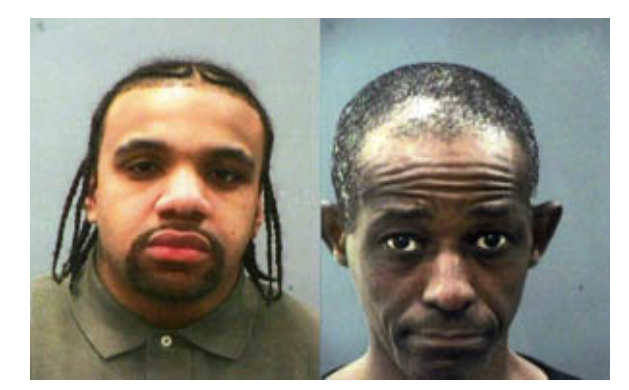
Four of the two-dozen alleged Black Guerrilla Family (BGF) prison-gang members indicted in Maryland federal court in April pleaded guilty recently before U.S. District Court Judge William Quarles. Lakia Hatchett was the first to do so, pleading on Aug. 27, followed by Marlow Bates (pictured on left) on Aug. 28, Darryl Dawayne Taylor on Sept. 9, and, most recently, former prison guard Asia Burrus, who pled on Sept. 16.

One of the BGF co-defendants remains a federal fugitive: 60-year-old Roosevelt Drummond (pictured on right), charged with robbery and drug-dealing.

The BGF indictments–one for a drug-dealing conspiracy headed by Kevin Glasscho, who is charged as the BGF drug distributor, and the other, led by imprisoned Maryland BGF leader Eric Brown, for drug dealing, robbery, and firearms–have heightened awareness of the extent to which an alleged prison gang can insinuate itself in civic life (“Black-Booked,” Feature, Aug. 5). The government’s case, as revealed thus far, paints a picture of Brown as a drug-dealing extortionist who doubles as a budding gang-interventionist with a book, a nonprofit, and the endorsements of local educators. Co-conspirators include a recently released murderer who worked as a public-school mentor for troubled students, a city wastewater technician who owns a clothing boutique, and an erstwhile bar owner and mortgage broker with separate federal bank-fraud and identity-theft charges against her. Mount Vernon, the midtown Baltimore neighborhood known for its cultural institutions and historic buildings, is the setting for some of Glasscho’s drug-dealing, according to court documents, and it’s where accused BGF heroin supplier Tyrone Dow operates a luxury-car detailing business.

The first to plead guilty in the Glasscho indictment was 29-year-old Lakia Hatchett, who Judge Quarles is set to sentence on Nov. 13. When Hatchett was arrested in April, agents searched her Charles Village apartment at 2735 St. Paul St. and seized a “bag containing brown powder” and two scales, court records show. Hatchett’s plea agreement, which reveals that the seized bag contained 10 grams of heroin, describes her as “a wholesale customer of heroin from Kevin Glasscho” and states that she “conspired to distribute more than 20 grams” of the drug.

Marlow Bates’ agreement states that he conspired with Brown and others to distribute heroin, and that Bates “was determined to be engaged in the distribution of narcotics,” both in the prison system and on Baltimore’s streets. The agreement puts the specific amount of heroin involved at 40 to 60 grams, much less than the multiple kilograms that often show up in federal cases. At his April 24 court hearing, Bates fist-bumped his attorney, Christie Needleman, when she arrived at the defense table, but when he pleaded guilty in late August, he had a different lawyer, Christopher Michael Davis. Bates’ state criminal record includes convictions in gun-and-drug cases. Bates, 23, is scheduled to be sentenced on Nov. 17.

Shortly after Bates, 41-year-old Darryl Dawayne Taylor, who is scheduled to receive his sentence on Dec. 19, pleaded as well. In court in April, assistant U.S. attorney Thomas Wallner explained that Taylor is the son of co-defendant Joe Taylor-Bey, who has spent more than 30 years in prison on a murder conviction. Taylor is accused of smuggling heroin into prison by putting it in balloons and “hiding it in his rear end, or in his cheeks,” Wallner said. According to Taylor’s guilty plea, he “was intercepted discussing and arranging transactions involving the wholesale distribution of heroin, and the smuggling of heroin into various prisons” on behalf of Glasscho. As in Hatchett’s case, Taylor admits to dealing in at least 20 grams of heroin.

Asia Burrus, a 22-year-old whose sentencing is scheduled for Dec. 7, admits to helping smuggle contraband into prison that “facilitated the distribution of narcotics inside the Maryland Correctional System” by Brown and others. She also admits she “was aware that Eric Brown was the leader” of the BGF in Maryland and “that the BGF is a violent, nationwide gang that has established a powerful presence within the Maryland Correctional System and on the streets of Baltimore City.” She was arrested in April at downtown Baltimore’s Maryland Transition Center, where she worked as a guard.

Meanwhile, on Sept. 3, a federal forfeiture case was filed against $4,659 in cash taken from Dow, and state prosecutors have already forfeited a 2005 Acura belonging to Glasscho. On Sept. 24, Glasscho’s girlfriend, BGF co-defendant Cassandra Adams, filed a motion to be severed from the case, claiming the evidence produced so far fails to put her in the conspiracy.

Black-Booked: The Black Guerrilla Family prison gang sought legitimacy, but got indictments

By Van Smith

Published in City Paper, Aug. 5, 2009

“I’m a responsible adult,” 41-year-old Avon Freeman says to Baltimore U.S. District Court Magistrate Judge James Bredar. The gold on his teeth glimmers as he speaks, his weak chin holding up a soul patch. He’s a two-time drug felon facing a new federal drug indictment, brought by a grand jury in April as part of the two conspiracy cases conducted by the U.S. Drug Enforcement Administration (DEA) in Maryland involving the Black Guerrilla Family (BGF) prison gang (“Guerrilla Warfare,” Mobtown Beat, April 22). Now it’s July 27, and Freeman, standing tall in his maroon prison jumpsuit, believes himself to be a safe bet for release. He’s being detained, pending an as-yet unscheduled trial, at downtown Baltimore’s Supermax prison facility, where he says he fears for his safety.

The particulars of Freeman’s fears are not made public, though Bredar, defense attorney Joseph Gigliotti, and Assistant U.S. Attorney Clinton Fuchs have discussed them already during an off-the-record bench conference. Danger signs from prison first cropped up in the case immediately after it was filed, though, when Fuchs’ colleague on the case, James Wallner, told a judge on Apr. 21 that the BGF had allegedly offered $10,000 for a “hit placed out on several correctional officers” and “all others involved in this investigation, and that would include prosecutors” (“BGF Offers $10,000 for Hits, Prosecutor Says,” The News Hole, April 23).

In open court, though, Gigliotti has said only that Freeman feels “endangered” by “conditions” at the Supermax, that “several of his co-defendants” also are housed there, and that “at a minimum,” Bredar should “put him in a halfway house, or at home with his sister under electronic monitoring.” The judge disagrees, but Freeman–against Judge Bredar’s adamant warning that it’s a “bad idea” and that “any statement you make could be used against you”–still wants to speak.

“I did have a job–I was working,” Freeman says of his days before his BGF arrest, and says of his family and friends, about 20 of whom are watching from the benches of the courtroom gallery, “I got the kids here, responsible adults here.” He declares he’s “not a flight risk” and says he “always come[s] to court when I’m told.” He stresses, “I am a responsible adult.”

Freeman’s doing what many people in his shoes do. He may be accused of being caught on wiretaps arranging drug transactions and of being witnessed by investigators participating in one. The prosecutor may say a raid of Freeman’s home turned up scales and $2,000 in alleged drug cash. But Freeman is still claiming to be a hard-working family man, a legitimate citizen, as safe and reliable as the next guy.

The details of the more than two dozen defendants indicted in the BGF case, filed against a Maryland offshoot of BGF’s national organization, suggest Freeman is not the only one among them who craves legitimacy. Information from court records, public documents, and the defendants’ court appearances over the past three months make some appear as “responsible adults” leading productive lives–or at least, like Freeman, as wanting to be seen that way.

Bredar sides with the government on the question of letting Freeman out of the Supermax. “There’s a high probability of conviction” based on the evidence against Freeman, Bredar says, adding that, given Freeman’s well-established criminal past, he poses a danger to society. So back Freeman goes to face his BGF fears. “I love you all,” he calls out to his 20-or-so family members and friends in the gallery, as U.S. marshals escort him out of the courtroom. “Love you, too,” some call back.


Take, for instance, Deitra Davenport. For 20 years, until her April arrest, the 37-year-old single mom worked as an administrator for a downtown Baltimore association management firm. Or 42-year-old Tyrone Dow, who with his brother has been running a car detailing shop on Lovegrove Street, behind Mount Vernon’s Belvedere Hotel, ostensibly for nearly as long. Mortgage broker and reported law student Tomeka Harris, 33, boasts of having toy drives and safe-sex events at her Belair Road bar, Club 410. Baltimore City wastewater technician Calvin Renard Robinson, 53 years old and a long-ago ex-con, owns a clothing boutique next to Hollins Market. Even 30-year-old Rainbow Lee Williams, a recently released murderer, managed to get a job working as a mentor for at-risk public-school youngsters.

The trappings of legitimacy are most elaborate, though, with Eric Marcell Brown, the lead defendant in the BGF prison-gang indictment. By the time the DEA started tapping his illegal prison cell phones in February, the 40-year-old inmate and author, who was nearing the end of a lengthy sentence for drug dealing, had teamed up with his wife, Davenport, to start a non-profit, Harambee Jamaa, which aims to promote peace and community betterment. His The Black Book: Empowering Black Families and Communities came out last year and, until the BGF indictments shut down the publishing operation, it was distributed to inmates and available to the public online from Dee Dat Publishing, a company formed by Brown and Davenport. Court documents indicate that at least 700 to 900 copies sold, at $15 or $20 a pop. The book has numerous co-authors, including Rainbow Williams.

According to the BGF case record, though, they’re all shams. Davenport, for instance, helps smuggle contraband into prison, prosecutors say, and serves as a “conduit of information” to support Brown’s violent, drug-dealing, extortion, and smuggling racket. The Black Book and Harambee Jamaa, the government’s version continues, are fronts for Brown’s ill-gotten BGF gains, which, thanks to complicit correctional employees, are derived from operating both in prisons and on the outside. As a result, the government contends, Brown appears to have had access to cigars, good liquor and Champagne, and high-end meals in his prison cell.

The alleged scheme has Dow supplying drugs to 46-year-old Kevin Glasscho, the lead defendant in the BGF drug-dealing indictment and the only one of the co-defendants who is named in both indictments. Freeman and Robinson, meanwhile, are accused of selling Glasscho’s drugs. Williams, the school mentor, is said to oversee the BGF’s street-level dealings for Brown, including violence. Harris is described as Brown’s girlfriend (even while her murder-convict husband, inmate Vernon Harris, is said by investigators to be helping Brown, too); among other things, she helps with the BGF finances. Most of the rest were inmates already, or accused drug dealers, smugglers, and armed robbers, except for the three corrections employees and one former employee who are accused as corrupt enablers, betraying public trust to help out in Brown and Glasscho’s criminal world. Only one, 59-year-old Roosevelt Drummond, accused of robbery and drug-dealing, remains at large.

Looking legit allows underworld players to insinuate themselves into the shadow economy, where the black market, lawful enterprise, and politics come together. Sometimes, though, people look legit simply because they are legit, even though they’re criminally charged. If that’s the case with any of the BGF co-defendants, they’re going to have their chance to prove it, just as the prosecutors will have theirs to prove otherwise. An adjudicated version of what happened with the BGF–be it at trial or in guilty pleas–eventually will substantiate who among them, if any, are “responsible adult[s].”


Glimpses of Brown’s leadership style are documented in the criminal evidence against him, including a conference call last Nov. 18 between Brown and two other inmates, “Comrade Doc” and Thomas Bailey, each on the line from different prisons.

“Listen, man, we [are] on the verge of big things,” Brown said, and Bailey assured him that “whatever you need me to do, man, I’m there.” “This positive movement that we are embarking upon now . . . is moving at a rapid pace,” Brown continued, and is “happening on almost every location.” He exhorted Bailey with a slogan, “Revolution is the only solution, brother,” and promised to send copies of his book, explaining how to use it as a classroom study guide.

The Black Book is a self-described “changing life styles living policy book” intended to help inmates, ex-cons, and their families navigate life successfully. Its ideological basis is rooted in the 1960s radical politics of BGF founder George Jackson, the inmate revolutionary in California who, until his death in 1971, pitched the same self-sufficient economic and social separatism that The Black Book preaches. Throughout, despite rhetorical calls for defiance against perceived oppression and injustice, it promotes what appears to be lawful behavior–with the notable exception of domestic abuse, given its instructions that the husband of a disobedient wife should “beat her lightly.”

The BGF is not mentioned by name in The Black Book, which instead refers to “The Family” (or “Jamaa,” the Swahili equivalent), explaining that it is not a “gang” but an “organization.” The back cover features printed kudos from local educators, including two-time Democratic candidate for Baltimore mayor Andrey Bundley, now a high-ranking Baltimore City public-schools official in charge of alternative-education programs. His blurb praises Brown for “not accepting the unhealthy traditions of street organizations aka gangs” and for trying “to guide his comrades toward truth, justice, freedom, and equality.”

Tyrone Powers, director of the Anne Arundel Community College’s Homeland Security and Criminal Justice Institute, and a former FBI agent, offers back-cover praise for The Black Book, describing it as an “extraordinary volume” and calling Brown and his co-authors “extraordinary insightful men and leaders.”

Powers says in a phone interview that he knows Brown “by going into the prison system as part of an effort to deal with three or four different gangs.” Powers is “totally unapologetic” about endorsing The Black Book.

“The gang problem is increasing,” Powers explains, “and we need to have direct contact with the people involved, or who have been involved. We need to be bringing the gang members together and tell them there’s no win in that, except for prison or the cemetery. Gang members can be influential in anti-gang efforts, and we have got to utilize them. Are we calling them saints? No, we are not. My objective is to reduce the violence, and I don’t think sterile academic programs work as well as engaging some of our young people, like Eric, as part of a program.”

In early May, nearly a month after Brown was indicted, Bundley explained his ties to the inmate to The Baltimore Sun. “I’ve seen [rival gangs] come together in one room and work on the lessons in The Black Book to get themselves together,” he was quoted as saying. “I know Eric Brown was a major player inside the prison doing that work. The quote on the back of the book is only about the work that I witnessed: no more, no less.”


The DEA’s original basis for tying Brown to BGF violence came from a confidential informant called “CS1” in court documents. A BGF member who’s seeking a reduced sentence, CS1 starting late last year gave a series of “debriefings” that lasted into early 2009. The investigators say in court records that CS1’s information has a track record of reliability, and the story checked out well enough to convince a grand jury to indict and a handful of judges to sign warrants as the case has progressed.

“BGF is extremely violent both inside and outside prison,” investigators recounted CS1 saying, “and is responsible for numerous crimes of violence and related crimes, including robbery, extortion, and murder for hire.” But “historically BGF has not been well-organized outside of prison,” CS1 asserted, and now the BGF “is attempting to change this within Baltimore, Maryland by becoming more organized and effective on the streets.” Brown “is coordinating and organizing BGF’s activities on the streets of Baltimore” and The Black Book “is a ploy by Brown to make BGF in Maryland appear to be a legitimate organization and not involved in criminal activity,” CS1 said, even though “Brown is a drug trafficker” and the BGF “funds its operations primarily by selling drugs.”

If CS1 is correct, then Brown is not as he was perceived by his supporters. Could it be that yet another purported peacemaker is actually prompting violence? It happened in Los Angeles last year, when a so-called “former” gangmember who headed a publicly funded non-profit called No Guns pleaded guilty to gun-running for the Mexican Mafia prison gang. It may have happened in Chicago last year, when two workers for the anti-violence group Ceasefire, which uses ex-gangmembers as street mediators, were charged in a 31-defendant gang prosecution.

Brown, with his book and his non-profit organization, wasn’t up and running at nearly the same scale as No Guns and Ceasefire, and there’s no evidence he was grant-funded. He was only just beginning to set up his self-financed positive vibe from inside his prison cell. But his is the same street-credibility pitch as in Los Angeles and Chicago: redeemed gangsters make effective gang-interventionists because the target audience will respect them more. Clearly, the approach has its risks, and Brown may end up being another example of that.

“It’s a dilemma,” Powers says of the question of how to prevent additional crimes from being committed by gang leaders who claim redemption and profess to work for reductions in gang-related violence and crime. “It has to be closely monitored.” As for Brown’s indictment, the lessons remain to be seen: “I don’t know if I can make it make sense,” Powers says.


For dramatic loss of legitimate appearances, Tomeka Harris may take the cake among the BGF co-defendants. She’s been on the ropes since late last year, when in December she caught federal bank-fraud and identity-theft charges in Maryland, in a case involving Green Dot prepaid debit cards that turned up later as the currency for the BGF’s prison-based economy. But from then until her April arrest in the BGF case, Harris had been out on conditional release–and making a good impression in public.

Media attention had been focused on Club 410, at 4509 Belair Road in Northeast Baltimore near Herring Run Park, because the police, having noted that violence was on the rise in its immediate vicinity, were trying to shut it down. At a March 26 hearing on the matter, Harris fought back, and The Sun‘s crime columnist, Peter Hermann, wrote that she “handled the case pretty well, calling into question some police accounts of the violence.” Herman described her as a “law student representing the owners,” and Sun reporter Justin Fenton, in his coverage, called her “the operator and manager” of the club. Not in the stories was the fact that she’s out on release, pending trial in a federal financial-fraud case in Baltimore.

Club 410’s liquor-board file lists as its licensees not Harris, but city employee Andrea Huff and public-schools employee Scott Brooks. Harris is referred to as its “owner” only in a March 3 police report, in which she “advised that she and her husband are the current owners of Club 410” and that “she has no dealings with the previous owners for several years.” Making matters murkier is the fact that “Andrea Huff,” whose name is on the liquor license is Harris’ alias in her BGF indictment. No wonder Sun writers were confused–Harris seems to have wanted it that way.

Harris made another public appearance before the BGF indictment came down in April. This time, it was in connection with John Zorzit, a local developer whose Nick’s Amusements, Inc., supplies “for amusement only” gaming devices to bars, taverns, restaurants, and other cash-oriented retail businesses around the region. The feds weren’t buying Zorzit’s non-gambling cover, though, and, based on a pattern of evidence that suggests he’s running a betting racket, in late January they filed a forfeiture suit and sought to seize as many of Zorzit’s assets as they could find. In the process, they raided his office on Harford Road, and there in the files were documents pertaining to Tomeka Harris and Club 410. Turns out, a Zorzit-controlled company owns Club 410, and ongoing lawsuits indicate Harris and Zorzit have had a falling out (“The 410 Factor,” Mobtown Beat, April 22).

Meanwhile, Harris still found the time to be Eric Brown’s girlfriend, according to the BGF court documents, in addition to helping the BGF smuggle, communicate, and arrange its finances. While her husband, alleged BGF member Vernon Harris (who has not been indicted in the BGF conspiracies), was in jail for murder, Tomeka Harris is said by investigators to have conducted “financial transactions involving ‘Green Dot’ cards on behalf of BGF members.” Court documents also say “one of her other business ventures was establishing bogus corporations for close associates so that they could obtain loans from banks in order to purchase high-priced items such as vehicles.”

Despite the vortex of drama that has been Harris’ life of late, she seems calm and collected at her first appearance in the BGF case on April 16. Her straight, highlighted hair hangs down the back of her black hoodie, heading south toward the tattoos peeking out from her low-hanging black hiphuggers; she’s wearing furry boots. She’s unflappable when a parole officer wonders about her claims of being a mortgage broker, when the conditions of her release in the fraud case don’t allow it.

But on June 4, a court hearing is called to try to untangle the various issues involved in Harris’ two federal indictments, and she comes undone. Her wig is gone, as are the boots and street clothes. She’s wringing her hands and holding her forehead as she talks with her lawyer, looking both exhausted and agitated. Finally, as the judge orders her detained pending trial, Harris starts crying.


The historic Belvedere Hotel has had its troubles over the years since is past glories, but it remains a highly visible symbol, like the Washington Monument, of the grandeur of Baltimore’s Mount Vernon neighborhood. Its presence in the BGF picture is a statement as to how far a prison gang’s reach may extend.

Club 410’s liquor board file contains records of 2007 drug raids carried out at Club 410 and Room 1111 at the Belvedere Hotel in Mount Vernon. The records state that evidence taken from Club 410 (a scale, razor blades, and a strainer, all with residue of suspected heroin) match evidence taken from the secure, controlled-access Belvedere Hotel condominium (a handgun, heroin residue, face masks, a heat sealer). That evidence was traced to a suspect, Michael Holman, with ties to both the Belvedere Hotel room and Club 410. Though it is unclear what, if any, ties the raids have to BGF’s currently indicted dealings, they call to mind instances in the BGF case where the Belvedere Hotel appears.

BGF court documents say Tyrone Dow, drug supplier for Kevin Glasscho’s BGF drug dealing conspiracy, “is the owner of Belvedere Detailers,” which is “located at 1014 Lovegrove Street” in Baltimore. A late-July visit there reveals that it is still operating, and that the property is right next to the rear entrance of the Belvedere Hotel parking garage.

In June 2008, Dow and his brother were highlighted in a Baltimore Examiner business article about the fortunes of Baltimore-area “garage-based premium car-wash services” during an economic downturn. Credited for Belvedere Detailers’ ongoing success is “client loyalty for the business,” which the article says Dow and his brother have operated “out of the same brick garage for more than 15 years.”

Public records of car-detailing shops operating at the Lovegrove Street location, though, don’t list Belvedere Detailers, despite the Examiner article’s claim that it’s been there for so long. In fact, no company by that name exists in Maryland’s corporate records. Instead, Mount Vernon Auto Spa LLC, headed by Hadith Demetrius Smith, has been operating there. Smith, court records show, was found guilty in Baltimore County of drug dealing in 2007, a conviction that brought additional time on a federal-drug dealing conviction from 2000, which itself violated a 1993 federal drug-dealing conviction in Washington, D.C.

City Paper‘s attempts to establish clear ties, if any exist, between Belvedere Detailers and Mount Vernon Car Wash, were unsuccessful. But the BGF investigators maintain in court records that Dow’s detailing shop at that location is tied to the prison gang’s narcotics dealings.

The Belvedere Hotel also figured in BGF investigators’ wiretap of a conversation between two BGF co-defendants, Glasscho and Darien Scipio, about a drug deal they were arranging to hold there on March 24, according to court documents.

“Yeah you gotta come down to the Belvedere Hotel, homey,” Glasscho told Scipio, who said, “Alright, I’m gonna call you when I’m close.” Just before they met there, though, Scipio called back and told Glasscho to “get the fuck away from there” because “it’s on the [police] scanner” that “the peoples is on you,” referring to law enforcers. The alleged drug deal was quickly aborted.

Glasscho, who has a 1981 murder conviction and drug-dealing and firearms convictions from the early 1990s, is accused of being the leader of a drug-trafficking operation that smuggled drugs into prison for the BGF. As the only BGF co-defendant named in both indictments, he alone bridges both the drug-dealing and the prison-gang conspiracies that the government alleges. The contention that Glasscho was a Belvedere Hotel habitu while dealing drugs for the BGF suggests that, until the indictments came down, the prison gang was becoming quite comfortable in mainstream Baltimore life.


CS1, when laying out the BGF leadership structure for DEA investigators in late 2008 and early 2009, gave special treatment to Rainbow Williams and Gregory Fitzgerald. Williams is “an extremely violent BGF member” who has “committed multiple murders” and “numerous assaults/stabbings while in prison,” CS1 contended, while Fitzgerald “has killed people in the past” and carried out “multiple stabbings on behalf of BGF while in prison.” CS1 wouldn’t actually say they were “Death Angels,” the alleged name for BGF hitmen whose identities “only certain people know,” pointing out as well that the BGF sometimes “will employ others to act as hitmen who may or may not be ‘Death Angels.'” Nonetheless, CS1 said Williams and Fitzgerald “are loyal to and take orders from” Eric Brown.

Fitzgerald was not indicted in the BGF case, and though recently released from prison on prior charges, he has since been arrested in a separate federal drug-dealing case. Williams’ fortunes, though, had been rising since he was released from prison last fall after serving out time for a murder conviction.

When Williams was named in the BGF prison-gang conspiracy, he had a job. As his lawyer, Gerald Ruter, explained in court on April 21, Williams was working for the nonprofit Partners in Progress Resource Center, a four-day-a-week gig for $1,200 a month he’d had since he left prison. Partners in Progress works with the city’s public-schools system at the Achievement Academy at Harbor City, located on Harford Road. Ruter told the judge he’d learned from Partners in Progress’ executive director, Bridget Alston-Smith (a major financial backer of Bundley’s political campaigns), that Williams “works on the campus itself as a mentor to individuals who have behavioral difficulties and is hands-on with all of the students.”

The contrast between Williams’ post-prison job, working with at-risk kids, and his alleged dealings as a top BGF leader is striking. In early April, for instance, he’s caught on the wiretap talking with Lance Walker, an alleged BGF member whose recent 40-year sentence on federal drug-dealing charges was compounded in July by a life sentence on state murder charges. Williams confides in Walker, telling him that rumors that Williams ordered the Apr. 1 stabbing murder of an inmate are putting him in danger with higher-ups in the BGF. The next day, Williams is again on the phone with an inmate, discussing how Williams is suspected of passing along Eric Brown’s order to hurt another inmate named “Coco.” Court documents also have Williams aiding in BGF’s smuggling operation and mediating beefs among BGF rivals.

And yet, Williams, with his job, was starting to appear legitimate. When law enforcers searched his apartment in April, Williams’ dedication to Brown’s cause was in evidence. Gang literature, “a large amount of mail to and from inmates,” photos of inmates and associates, and a “handwritten copy of the BGF constitution” were found, according to court documents. But they also found 38 rounds of .357 ammo. Now, Williams is back in jail, awaiting trial.


If proven right, either at trial or by guilty pleas, the accusations against the BGF in Maryland would mean not only that Brown’s legitimate-looking “movement” is a criminal sham. It would mean that the prison gang, while insinuating itself so effectively within the sprawling correctional system as to make a mockery of prison walls, was also able to embed itself in ordinary Baltimore life. If not for the indictments, should they be proved true, one can only imagine how long it could have lasted.

Calvin Robinson might have gone undetected. But the city waste-water worker, who owns real estate next to the Baltimore Police Department’s Western District station house and next to the city’s historic Hollins Market, where his In and Out Boutique clothing store continues to operate, instead was heard on the BGF wiretap talking with Glasscho about suspected drug deals. And he was observed conducting them. And when his house was raided, two guns turned up.

Robinson at least made a good show at legitimacy during court appearances in the BGF case, unlike Freeman’s performance before Judge Bredar. His lawyer played up Robinson’s city job, and even had his supervisor, Dorothy Harris, on hand in the courtroom to attest to his reliability at work. He looked poised and professional, with his clean-shaven head, trimmed mustache, and designer glasses. But just like Freeman, Robinson, who has drug convictions from the early 1990s, lost his plea to be released and was detained pending trial.

Of the 25 BGF defendants, five were granted conditional release. All of them women, they include three former prison guards, Davenport, suspected drug dealer Lakia Hatchett, and Cassandra Adams, who is Glasscho’s girlfriend and alleged accomplice. All were deemed sufficiently “responsible adults” to avoid being jailed before trial, so long as they continue to meet strict conditions. They, unlike the rest of their co-defendants, were found neither to be a threat to public safety nor a risk of flight, should they await trial outside of prison walls. Given the sprawling conspiracies, one can imagine why Freeman’s in fear at the Supermax–and why the released women should be breathing a sigh of relief.

The Black Book: Feds say prison gang’s self-improvement guide is a money-laundering recruitment tool

By Van Smith

Published by City Paper, May 27, 2009

IMG_7394

An overarching presence in the Black Guerilla Family (BGF) prison-gang conspiracies indicted in April by the U.S. Attorney’s Office in Maryland is not a person, but a book.

Entitled The Black Book: Empowering Black Families and Communities, the 122-page softbound publication is a revolutionary call for economic and political liberation for blacks. Eric Marcell Brown, a 40-year-old inmate of the Maryland correctional system, is the author of much of its contents, and he, along with his wife, Deitra Davenport (see “Family Portraits,” Mobtown Beat, May 27, 2009), last year incorporated Dee Dat Publishing to get The Black Book printed and distributed for sale.

Brown, Davenport, and 23 other co-defendants named in the two BGF indictments are accused of drug dealing, prison smuggling, violence, and extortion. Prosecutors say The Black Book served as a propaganda tool for gang recruitment while its sales also helped finance the BGF’s criminal activities.

The feds’ assertions about the nefarious functions of The Black Book, though, are considered over-the-top by at least one educator: Tyrone Powers, the director of Anne Arundel County Community College’s Homeland Security and Criminal Justice Institute and an advisory board member of the Maryland Department of Juvenile Services’ Thomas J.S. Waxter Children’s Center, a detention facility for young women. A former FBI agent and Maryland State Police trooper, Powers has a Ph.D. in sociology and justice from American University and hosts a radio show called “The Powers Report.”

The back cover of The Black Book has the following endorsement from Powers:

These are difficult days that require concrete, specific, effective solutions. This book provides that and more. If we want to win, to change our condition, our situation and the life chances of this generation, of our children and of our children’s children then we must read, analyze, think, learn and apply the lessons, concepts and practical solutions that are apart [sic] of this extraordinary volume written by four extraordinary insightful men and leaders.

Powers, in a mid-May phone interview, explains that “I met Eric [Brown] by going into the prison system as part of an effort to deal with three or four different gangs. Eric and others decided to put together this book, and it was all positive. I endorsed it because it could have some impact on the increasing gang problem, because people would read and understand this, as opposed to more academic writing that doesn’t connect with young people.

“I am totally unapologetic about endorsing this book and totally unapologetic about meeting Eric Brown,” Powers continues, “because it serves a positive purpose–to reduce the violence. This book is a means to that end. I don’t know anything about the financing end of it, and as for it being used for gang recruitment–I don’t know how it could be used for recruitment. It is all about building peace and tranquility.”

Also endorsing The Black Book on its back cover is former two-time Baltimore City mayoral candidate Andrey Bundley, a Baltimore City Public Schools administrator who oversees the city’s alternative education programs. “Kudos, to Eric Brown (E.B.) for not accepting the unhealthy traditions of street organizations aka gangs,” Bundley wrote. “He has availed his leadership capacity in Jamaa to guide his comrades toward truth, justice, freedom and equality.”

Jamaa, according to The Black Book, is a Swahili word for “family” that is defined as “an organization geared towards revitalizing our people and our hoods.” Brown and Davenport last year formed a non-profit organization called Harambee Jamaa Inc., which, according to its incorporation papers, intends “to education, invigorate and liberate our people from poverty, crime, and prison.”

“I’ve seen [rival gangs] come together in one room and work on the lessons in The Black Book to get themselves together,” Bundley told The Baltimore Sun in early May. “I know Eric Brown was a major player inside the prison doing that work. The quote on the back of the book is only about the work that I witnessed: no more, no less.”

The Black Book, according to its introduction, “is designed to make our people aware of the vision of Comrade George Jackson and the struggle that he lived and died for.” Jackson, a Black Panther Party member, founded the BGF as a Marxist prison gang in 1966, while serving time at San Quentin State Prison in California for an armed robbery conviction. Jackson was shot to death at San Quentin in 1971, in an incident that also left five others dead; Jackson was armed with a pistol when he was killed. At the time, he was awaiting trial on charges that he murdered a prison guard.

The four chapters of The Black Book include study guides and poems venerating a value system that seeks to uplift black communities, including incarcerated people. It invokes revolutionary ideals from the Black Power, Black Liberation, and Black Nationalism movements of the 1960s and melds them with instructions on how to live life. It calls itself a “living policy book,” and includes lessons on civics, economics, and gender roles. The book says, for instance, that a Jamaa woman is to be a “firearm expert,” who has “gun in hand, ready to take on all transgressors.” When a wife is disobedient, The Black Book says the husband first should “verbally reprimand her,” then “refuse to sleep with her,” “beat her lightly,” and “if these are not effective, the next step is divorce.”

During court proceedings in the BGF indictments, Assistant U.S. Attorney James Wallner has claimed that The Black Book generates profits used to underwrite BGF crimes. But Davenport’s defense attorney, Thomas Saunders, has questioned that contention. “There is no profit, considering what printing costs are,” Saunders said, adding that Davenport “used her own money” to get the book published and was not using it as a “front to funnel money” to the BGF.

Calvin Renard Robinson: City Wastewater Worker Accused of Selling BGF Drugs

By Van Smith

Published in City Paper, June 10, 2009

The phone rang at 6:59 a.m. on a Friday morning, just as 53-year-old Baltimore City wastewater plant technician Calvin Renard Robinson was heading for the shower, court records show. The March 20 call was from 46-year-old Kevin Glasscho, an ex-con now accused in Maryland as the Black Guerilla Family (BGF) prison gang’s heroin broker.

“You wanted a whole dollar or the half?” Glasscho asked. “Uh, it don’t matter,” Robinson answered, adding, “You can bring me the, um—bring it to me in two halves.” When Glasscho explained that it would be less work if he gave Robinson the “whole dollar.” Robinson agreed, and the two planned to meet after Robinson got out of the shower.

At the time, neither man knew that this exchange, and similarly cryptic phone calls this past spring between Robinson and Glasscho, was being recorded by law enforcers, who believed the men were using code to arrange drug deals. But in mid-April, the conversations wound up as part the evidence for two federal criminal conspiracy cases against 25 alleged members of the BGF. The gang is accused of a variety of crimes, including violence, drug-dealing, smuggling contraband, and extortion. Robinson, thanks to the intercepted phone conversations with Glasscho and the resulting surveillance, is charged with buying drugs wholesale from Glasscho.

At his first court appearances in April, Robinson had the unassuming look of the workaday bureaucrat he is, with his clean-shaven head, trimmed mustache, and glasses. Robinson’s defense attorney, Steven Wrobel, had on hand Robinson’s city Department of Public Works (DPW) supervisor, Dorothy Harris, ready to testify in support of letting Robinson go free pending trial. But the judge decided that Robinson, who has drug convictions dating from the early 1990s and was found with two handguns and ammunition when he was arrested April 15 in the BGF take-down (“Guerrilla Warfare,” Mobtown Beat, April 22, 2009), poses too much of a risk to public safety should he leave jail.

In addition to the guns—a Smith & Wesson .357 with six cartridges and a North American Arms .22 with four cartridges—court records show agents took from Robinson’s home three cell phones, a Blackberry mobile device, three sets of keys, and numerous photographs.

Robinson has owned his North Mount Street home—1102, right across Riggs Avenue from the Baltimore Police Department’s Western District station house—since 2000. Land records show his principal residence is not there, but south by about a dozen or so blocks, at 1223 Hollins St., a half-block west of Hollins Market. Robinson purchased the Hollins Street property in 2008; open for business there is the In and Out Boutique, the trade name for a clothing shore owned by Robinson’s company, Jo-Cal LLC.

Robinson’s In and Out Boutique opened on a block of Hollins Street that has long been known for drug-dealing activity (“Best Open-Air Drug Market,” Mobtown Beat, Sept. 16, 2003). In 2007 it was targeted in a major federal enforcement effort called Operation Smackdown, which closed down a $20,000 per day heroin operation there.

Randolph Edison: With hard time already under his belt, “Uncle Rudy” accused as violent BGF leader

By Van Smith

Published in City Paper, May 5, 2009

IMG_7518

With the slow gait of the aged, 51-year-old Randolph “Uncle Rudy” Edison shuffles into a federal courtroom in Baltimore on April 22 to face charges that he helped commit violent crimes for the Black Guerilla Family prison gang in Maryland. The wear and tear of a lengthy prison stint he served in the 1990s and early 2000s (with an extra year tacked on in 2000 for assaulting a Department of Corrections employee), appears to have taken its toll on him.

In 2007, Edison was out of jail and back on the streets, and he racked up new charges–loitering, drug possession (including a state case brought in January)–that show him residing in Dundalk, where he’d been living before his 1993 murder sentence was imposed. Edison’s world-weary air in the courtroom reveals little, if any, worry about the future – except, perhaps, when it comes to getting his twice-a-day insulin shots for diabetes, something for his high blood pressure, and a doctor to take a look at the abscess on his hand.

Nonetheless, the feds have evidence portraying Edison as a plugged-in leader of the BGF, working energetically on the outside for imprisoned BGF ringleader Eric Brown.

On March 13, BGF court documents show, Edison and two other BGF co-defendants-52-year-old Zachary Norman and 59-year-old Roosevelt Drummond-were in a car that was pulled over by police in Baltimore City. Drummond had a gun and was arrested; also taken from the car were handcuffs, rubber gloves, and a mask.

Hours later, Brown used a cell phone to call Edison, initiating a conversation that was intercepted by investigators. “We just had some bad luck man,” Edison told Brown, according to court documents. “We was in the car, yeah and they pulled us over, right. You know we gonna do something, but the coon that was setting the whole degree up, he’s the rat. He set all us up.” Edison explained that Drummond had a gun, adding, “Just lucky I ain’t carry that thing,” to which Brown responded, “that’s the last thing you need boy.”

Investigators concluded from this conversation that Edison was reporting to Brown what happened with the police while he and his co-defendants were “en route to commit a drug-related armed robbery,” according to court documents.

Edison had no lawyer for his first appearance in court, but two days later, on April 24, Richard Bittner is appointed to him. After asking around the courtroom for Edison’s sister, who’s not there, and meeting briefly with an older gentleman who says he’s Edison’s friend, Bittner decides not to fight the prosecutor’s request that Edison remain in jail until after the trial. U.S. District Court magistrate judge Beth Gesner orders Edison detained, reminding him that if he chooses, he can later request a hearing over whether or not he can be conditionally released.

Rainbow Lee Williams: Murder Convict Who Mentors Schoolchildren Called a BGF Shot-Caller

By Van Smith

Published in City Paper, May 1, 2009

When defense attorney Gerald Ruter was first appointed on Apr. 16 to represent Rainbow Lee Williams, a 30-year-old co-defendant in the Black Guerilla Family prison-gang federal-conspiracy case, Ruter sounded like he thought there was more to Williams than met the government’s eye.

“I have him working for a nonprofit, helping kids,” Ruter told assistant U.S. attorney James Wallner, just before Williams’ first court appearance began.

“That may be,” Wallner responds, “but he’s still indicted as a leader of the BGF.”

Five days later, Ruter said he had the verified facts about Williams’ employment, and presented them to U.S. District Court magistrate judge Beth Gesner while arguing for Williams’ conditional release pending trial. Williams, he explained, works for the nonprofit Partners in Progress Resource Center. Since shortly after his release from prison last September, when his murder sentence ended, Ruter said, Williams had been working for Partners in Progress four days a week, from 9:30 a.m. to 4 p.m., for $1,200 per month. Partners in Progress, he explained, serves a high school called the Achievement Academy at Harbor City High School, located on Harford Road.

Ruter said he got all of these facts confirmed by Partners in Progress’ director, Bridget Alston-Smith, who, he said, is “aware of Williams’ criminal history, and she says he works on the campus itself as a mentor to individuals who have behavioral difficulties and is hands-on with all of the students.”

City Paper‘s attempts to reach Alston-Smith at the phone number Ruter gave in open court were unsuccessful. According to Baltimore City Public Schools’ guide to high schools, the Achievement Academy at Harbor City is “an alternative school designed to provide under-credited students with an accelerated program of study,” has an enrollment of 383 students in 9th through 12th grade, and Partners in Progress is listed among the schools partnerships.

The Black Book, a locally published self-improvement guide for those involved in the BGF movement, features a back-cover blurb written by Alston-Smith, in which she states that men in the movement “lead well because they listen well. As they continue on the path of self-improvement they will help improve the conditions of our families and communities.”

“I find it ironic that Mr. Williams is a mentor for disaffected youth,” Wallner told judge Gesner. Wallner’s prosecutorial assessment is based on what federal investigators found out about Williams in the course of their wire-tap probe into the BGF, which provided enough evidence to support a raid of Williams residence, as well as the grand jury’s charges against him. Wallner also told the judge that Williams was in possession of ammunition for a .357 caliber firearm when he was arrested.

Williams is “one of the leaders of BGF,” court documents state, and “is a lieutenant who handles the day-to-day drug distribution network and is also involved in the smuggling of contraband into correctional facilities.” A confidential source described Williams as “an extremely violent BGF member” who “has committed multiple murders, including numerous assaults/stabbings while in prison,” and he’s “loyal to, and takes orders from, [imprisoned BGF leader Eric] Brown.”

The court documents also recount intercepted phone conversations with other alleged BGF members, in which crimes-from hits to smuggling to drug-dealing-are discussed. In one, co-defendant Marlow Bates calls Brown in March, and the two discuss how Williams failed in his attempt to transfer tennis shoes, which allegedly contained contraband, to Brown while visiting him in prison. Williams kept the shoelaces untied, to facilitate the transfer, but they were so lose that “you could see that shoe lace, like hanging. That just look like a dead give-away,” Brown explained, and as a result a guard “knocked off” the shoe transfer. “Rainbow fucked that up,” he says.

In early April, phone calls between Williams and prison inmates were intercepted, in which prison violence and the rules of BGF conduct were discussed. In one, Williams calls inmate Lance Walker to talk about the Apr. 1 stabbing murder of inmate Nathaniel King, for which inmate Kelly Toomer is the suspect, according to court documents. But Williams tells Walker that Toomer is saying he did it under orders from Williams. Williams denies this, and says the rumor puts him in danger with BGF higher-ups.

The next day, Apr. 5, Williams is called by an unidentified prison inmate, who tells him that Willliams is believed to have passed on Eric Brown’s order to hurt another inmate named “Coco.” A conference call with other BGF members ensued, to go over the rules of the BGF, and the penalties for breaking them. In other calls, Williams acts as a mediator, trying to settle beefs between rivals in the BGF drug game.

Wallner also fingers Williams as “one of the leaders” of the BGF meeting in Druid Hill Park, held on Apr. 13 and attended, according to court documents, by about 100 people described as BGF members. “Following this incident,” court documents state, “calls were intercepted over the wiretaps in which Eric Brown chastised Rainbow Williams for holding the meeting in such a manner as to draw the attention of law enforcement. Brown stated in a scolding manner, `I been tellin’ you and tellin’ you, and you ain’t listenin.’ In reference to being stopped by the police, Brown added, `Ain’t nothin’ good about that, yo.'”

All of these activities ascribed by investigators to Williams occurred while, according to Ruter, Williams was employed by Partners in Progress as a youth mentor. Despite Ruter’s best efforts–and despite Williams’ boyish, fresh-faced looks, which he indignantly flashed in response to Wallner’s allegations–judge Gesner ordered Williams detained pending trial.

Nelson Arthur Robinson: Unemployed Truck Driver Said to be Caught Holding Bag of BGF Drugs

By Van Smith

Published in City Paper, Apr. 30, 2009

IMG_7517

It’s not clear whether 45-year-old Nelson Arthur Robinson recognizes his prosecutor, but he should. As Robinson is ushered into a federal courtroom in Baltimore on Apr. 15 by U.S. marshals, set to be arraigned on accusations that he’s part of the sprawling Black Guerilla Family prison-gang conspiracy, assistant U.S. attorney James Wallner is there at the prosecution table. A decade ago, in 1999, Wallner was the assistant Baltimore City state’s attorney who secured Robinson’s guilty plea on a pot-possession charge, for which Robinson got a one-year sentence, all but a day suspended. This time, Wallner’s stone-faced demeanor belies a grim determination to get a bigger piece of Robinson.

When asked by the court clerk to raise his right hand to take an oath, Robinson instead raises his left and has to be corrected. His obliviousness doesn’t fit the profile of a stone-cold gangster, and, in fact, Robinson didn’t even rate enough to make it into the BGF indictments. Instead, he’s a collateral catch.

Robinson was arrested Apr. 15 while agents were busy raiding 12 BGF-linked locations. He was seen leaving an apartment at 1617 Bluffdale Road in Woodlawn, according to the government’s case. The location was under surveillance as part of the BGF take-down because it was associated with Tyrone Dow, a BGF co-defendant believed to be a supplier of drugs for another co-defendant, Kevin Glasscho. Robinson started to get into a truck parked nearby when, as agents approached him, he tossed aside a bag that was found to contain 175 grams of heroin. Robinson had left his keys in the door of the apartment, which was searched and found to contain another 225 grams of heroin, along with pressers and grinders used to process and package the drug.

The charges “smack of a lack of probable cause,” protested Robinson’s lawyer, David Solomon, during Robinson’s Apr. 20 detention hearing before U.S. District Court magistrate judge James Bredar. Solomon added that, though an “indictment may be imminent” against his client, as it stands a grand jury has yet to accuse him, and there “may be problems” with the case. Solomon urged the judge to take into account Robinson’s “relative good standing within the justice system,” given his recently ended “11-year hiatus” from criminal charges, and allow him to be released to the custody of his wife, Florence Robinson, until after the trial.

Instead, Bredar ordered Robinson on 24/7 lock-down at a half-way house, once a bed becomes available. “He gets in line” for half-way house placement, Bredar said. “Until then, he stays locked up.”

One week later, on April 22, the grand jury indicted Robinson.

New Black Guerrilla Family indictment shows inmates in charge of jails, adds to Maryland prison bureaucracy’s embarrassments

By Van Smith

Published in City Paper, Apr. 24, 2013

When the lat­est Black Guer­rilla Fam­ily (BGF) prison gang rack­e­teer­ing indict­ment was announced at an April 23 press con­fer­ence, detail­ing that 13 of the 25 defen­dants are Mary­land cor­rec­tional offi­cers (COs) who allegedly facil­i­tated the gang’s oper­a­tional takeover of two Bal­ti­more deten­tion facil­i­ties, their boss, Depart­ment of Pub­lic Safety and Cor­rec­tional Ser­vices (DPSCS) sec­re­tary Gary May­nard, noted the obvi­ous: that he had egg on his face.

It’s totally on me,” May­nard said, accord­ing to the Wash­ing­ton Post. “I don’t make any excuses,” he con­tin­ued, adding that “we will move up the chain of com­mand, and peo­ple will be held accountable.”

The last round of fed­eral BGF charges that included COs were handed down in 2009 and 2010, show­ing how DPSCS per­son­nel had worked to help the gang deal drugs, laun­der money, engage in extor­tion, and smug­gle con­tra­band into pris­ons. Despite the over­whelm­ing evi­dence of cor­rup­tion among COs that emerged in those cases, and other evi­dence emerg­ing from civil law­suits show­ing that, as far back as 2006, DPSCS had iden­ti­fied numer­ous COs as being mem­bers or affil­i­ates of gangs who helped facil­i­tate gang-related prison vio­lence, yet ordered the lieu­tenant who’d devel­oped the infor­ma­tion to stop writ­ing such reports, in 2010 the Mary­land Gen­eral Assem­bly passed a law giv­ing greater pro­tec­tions for COs accused of wrong­do­ing by estab­lish­ing a Cor­rec­tional Offi­cer Bill of Rights (COBR).

The cur­rent charges, spelled out in a 48-page indict­ment and detailed in a 67-page search-warrant affi­davit, are déjà vu all over again: drug-dealing, extor­tion, money laun­der­ing, smug­gling. The main dif­fer­ence seems to be that, this time, the BGF appar­ently has dropped all pre­tense of try­ing to be a pos­i­tive force for social change, as was its hall­mark in the 2009 and 2010 cases. Yet Maryland’s prison bureau­cracy under May­nard, who’s been in place since Gov. Mar­tin O’Malley (D) appointed him in 2007, has demon­strated rigid resis­tance to pos­i­tive reform, given its repeated his­tory of CO cor­rup­tion that has emerged in the courts. And, pre­dictably, the COBR has only made mat­ters worse — as the FBI makes clear in doc­u­ments filed in the most recent case.

Add the 13 COs charged fed­er­ally in the cur­rent BGF indict­ment to the 15 COs charged in an ongo­ing FBI civil-rights inves­ti­ga­tion into retal­ia­tory inmate beat­ings and sub­se­quent cover-up and obstruc­tion of jus­tice, alleged to be part of a cor­rupt cor­rec­tional cul­ture in Mary­land, and the total num­ber of COs cur­rently fac­ing fed­eral charges in Mary­land comes to 28. That’s not count­ing another CO fac­ing immigration-fraud charges, or the unknown num­ber of COs – includ­ing Michael McCain, charged with smug­gling drugs into prison – fac­ing state crim­i­nal charges tied to their offi­cial duties.

Maynard’s com­ments at the Apr. 23 press con­fer­ence sug­gest other shoes will drop in the BGF case, and how they drop will be intrigu­ing, since doc­u­ments in the cur­rent case sug­gest the accused COs merely car­ried out a scheme okayed by their supe­ri­ors. In the scheme, BGF leader Tavon White – an inmate and the lead defen­dant in the rack­e­teer­ing indict­ment – believed he, not DPSCS super­vi­sors, was the ulti­mate decider of what went down in the Bal­ti­more City Deten­tion Cen­ter (BCDC) and the Bal­ti­more City Book­ing Intake Cen­ter (BCBIC).

The search-warrant affi­davit in the case was signed by FBI spe­cial agent Sarah Lewis, whose boss, FBI spe­cial agent in charge Stephen Vogt, said in a state­ment that “in this case, the inmates lit­er­ally took over ‘the asy­lum,’ and the deten­tion cen­ters became safe havens for the BGF.” An “impor­tant cause” of this, Lewis writes in her affi­davit, “is the power that White and the BGF are granted by staff mem­bers at all levels.”

In in inter­cepted phone call White made to a friend, he claimed: “This is my jail, you under­stand that. I’m dead seri­ous. I make every final call in this jail, every­thing come to me.” On another call, White told co-defendant Adrena Rice, a CO: “I am the law. My word is law. So if I told any mother-fucking body they had to do this, hit a police, do this, kill a mother-fucker, any­thing, it got to get done. Period.”

Infor­ma­tion gleaned from inmates and DPSCS staff dur­ing the inves­ti­ga­tion “revealed that some prison offi­cials have infor­mal ver­bal under­stand­ings with White and other BGF lead­ers” that “BGF lead­ers reduce the vio­lence inside the prison, and, in exchange, the offi­cials turn a blind eye to con­tra­band smug­gling and actively pro­tect White and the BGF by warn­ing them of inves­ti­ga­tions and inter­dic­tion efforts.”

White’s heir-apparent as BGF leader in the deten­tion facil­i­ties was co-defendant Joseph Young, accord­ing to Lewis’ affi­davit, and on Nov. 12, 2012, Young spoke with another co-defendant, CO Kim­berly Den­nis, about a cor­rec­tions lieu­tenant. The call was inter­cepted on a wire­tap, and Lewis summed it up like this: “Recently the lieu­tenant pulled Young aside and told Young that the lieu­tenant knew Young would be tak­ing over con­trol of the prison if White was released from jail and agreed to let Young make money by sell­ing con­tra­band inside of BCDC if Young and BGF would keep down the inci­dence of prison violence.”

Lewis’ affi­davit also explains how the 2010 law estab­lish­ing COBR allowed cor­rup­tion to pro­lif­er­ate in an envi­ron­ment where bad con­duct goes on with rel­a­tive impunity. It estab­lished a dis­ci­pli­nary regime that “has proven to be very dif­fi­cult” to pur­sue within estab­lished dead­lines, “so cases are dropped,” she wrote, and thus “it is well known to COs that it is very unlikely that they will be fired or severely dis­ci­plined for smug­gling con­tra­band or frat­er­niz­ing with inmates.” Lewis con­cludes that “the inter­nal review process set up by COBR is inef­fec­tive as a deter­rent to COs smug­gling con­tra­band or get­ting sex­u­ally involved with BGF gang mem­bers at BCDC or BCBIC.”

An illus­tra­tive case is one of the co-defendants, Anto­nia Alli­son, a 27-year-old CO at BCDC. Alli­son was 20 when her alleged ties to inmate gangs were first doc­u­mented by DPSCS, in a Nov. 22. 2006, memo writ­ten by Lt. San­ti­ago Morales, then of the Crim­i­nal Intel­li­gence Unit of the DPSCS’ Divi­sion of Pre­trial and Deten­tion Ser­vices, to BCDC’s then-warden, William Fil­bert. Yet she remained employed at the same facil­ity, even though this was long before the COBR was estab­lished. Morales, on the other hand, was ordered to stop writ­ing reports about gang-tied COs, and ended up re-assigned shortly there­after to night shift at a non-investigative post.

Even after the Mary­land Attor­ney General’s Office defended Alli­son against charges that she’d facil­i­tated a bru­tal, gang-related attack against an inmate, Tashma McFad­den, who, when faced with threats of being killed by inmate gang-members for suing Alli­son, agreed to set­tle the case before trial, Alli­son remained on the job. The threat let­ter, which sur­faced in court fil­ings in 2010, described Alli­son as “our sis­ter” who is “doing right by us,” and “all she asked of her broth­ers was to keep her safe.”

Now, nearly seven years after Alli­son was first sus­pected by DPSCS as being cor­rupt, she’s finally fac­ing the real pos­si­bil­ity that she will no longer be allowed to carry the department’s badge.

Maynard’s pre­pared state­ment regard­ing the lat­est BGF indict­ment involv­ing COs says 99 per­cent of them “do their jobs with integrity, hon­esty, and respect,” and spins the embar­rass­ing turn of events by say­ing that “today’s indict­ment, along with those in the past, show that our Depart­ment will not stand idly by and let a few bad actors affect the secu­rity of our institutions.”

Yet his con­tention that only one per­cent of DPSCS staff is cor­rupt is belied by the FBI’s Lewis, whose inves­ti­ga­tion devel­oped an inmate source that described a very dif­fer­ent pic­ture: “the inmate esti­mated that 60 to 70% of the COs at BCDC are involved in con­tra­band smug­gling and/or hav­ing sex­ual rela­tion­ships with inmates.”

The Wash­ing­ton Post cov­er­age of the indict­ment says it “comes at a sen­si­tive time for” O’Malley, “who is weigh­ing a 2016 pres­i­den­tial bid” built in part by “his record as a ‘performance-driven’ man­ager of state gov­ern­ment,” and quoted a state­ment from O’Malley: “We have zero tol­er­ance for cor­rup­tion among cor­rec­tional offi­cers, and we will con­tinue striv­ing to make all cor­rec­tional facil­i­ties as secure as they can pos­si­bly be.”

Based on the avail­able court record of CO cor­rup­tion, it appears that Maryland’s “zero tol­er­ance” pol­icy hasn’t been working.

Collateral Catch: Investigation into indicted bailbondsman snared other members of troubled waterfront union

By Van Smith

Published in City Paper, Mar. 31, 2010

The International Longshoremen’s Association (ILA), the nation’s largest union of maritime workers with some 43,500 members stationed along U.S. and Canadian coasts, has deep roots in Baltimore. Baltimore native Richard Hughes Jr. has been its president since 2007, and he is also the business agent for ILA Local 953, based in Locust Point. Del. Brian McHale (D-46th District), who represents Baltimore’s waterfront in the state House of Delegates, is on Local 953’s roster as a steamship clerk. One of the ILA’s vice presidents, Horace Alston, heads the union’s Baltimore District Council. He and former ILA general vice president John Shade are trustees of Baltimore’s ILA Local 333.

But amid the well-connected ILA members in Baltimore, one longshoreman in particular raised the union’s profile recently: Milton Tillman Jr.

A politically connected ex-con and real-estate investor who is the dominant force in Baltimore’s bailbonds industry, Tillman Jr. is also a member of ILA Local 333. On March 17, a federal indictment charging Tillman Jr. and his son, Milton “Moe” Tillman III, with tax fraud, wire fraud, and unlawful bailbonds practices, was unsealed (“Milton Tillman and Son Indicted in Bailbonds Conspiracy,” The News Hole, March 17). It includes charges that Tillman Jr. was paid for unloading ships at Baltimore’s docks on shifts when he was in Brazil, Argentina, Spain, and Las Vegas, among other places.

The Tillman investigation, court records show, also helped prosecutors nab three other ILA members in Baltimore–William Zichos Jr., Dale Kowalewski, and Joseph Bell–who were indicted on wire-fraud conspiracy charges last November. The three men are union timekeepers who record the hours clocked by dockworkers for payroll purposes. They are members of ILA Local 953, which represents clerical workers in Baltimore’s maritime industry. The case against them alleges they also got paid for no-show work by the stevedoring company Ports America, including at times when they were in France, Costa Rica, Iceland, Las Vegas, and Florida.

The trial in the timekeepers’ case, which had been scheduled to begin in April, was recently postponed until September. The Tillmans’ trial is expected to take four to five weeks, and is currently scheduled to start on May 24, though at a March 26 arraignment hearing in the case, Tillman III’s attorney, Steven Allen, questioned whether that’s a “realistic date.”

The U.S. Attorney’s Office in Maryland declines to confirm a connection between the Tillman investigation and the timekeepers’ indictment. “We can’t go beyond what’s in the public record,” spokeswoman Marcia Murphy says in an e-mail. “And there is nothing in the public record connecting those cases.”

But records in both cases show a nexus: an Aug. 18, 2008, raid on Building 1200A at Dundalk Marine Terminal.

Building 1200A, known as the “timekeepers shack,” was one of seven locations raided as part of a multi-agency probe into the Tillmans (“Tillman Properties Raided by Feds,” The News Hole, Aug. 20, 2008). The other locations–residences, a vehicle, and business offices associated with the Tillmans–were searched because agents expected to turn up proof of tax fraud and unlawful bailbonds practices. The timekeepers shack was targeted, according to the 65-page search warrant affidavit, because investigators expected to find evidence of Tillman Jr.’s suspected “‘no-show’ or ‘ghost worker’ scam.” Investigators on Tillman Jr.’s trail seized payroll documents and computer records from Building 1200A, including from the desks of Zichos, Kowalewski, and Bell.

Tillman Jr. was convicted of a similar scam in the 1990s, when he used a straw employee to work hours in his stead, so he could get paid without actually working.

After the raid, court records show, Zichos was called to testify before a federal grand jury. He met with prosecutors Martin Clarke and Stephen Schenning leading up to that grand-jury testimony, and his answers to their questions raised suspicions.

According to a Feb. 17, 2010, government filing in the timekeepers’ case, the prosecutors asked Zichos if he had ever received “no-show” pay. The filing says that initially, Zichos said “he had received pay for a no-show shift only once in his career . . . and that was when he attended his father’s funeral. In giving his answer, he appeared to be very nervous and overly emotional.”

Then Zichos owned up to “other times when people covered for him, such as when he had a doctor’s appointment or important personal business.”

“There were other times when he was paid for work he did not do, including when he went on vacation,” the filing states. “He was reluctant to give details or say who covered for him and he appeared nervous and upset while giving his answers.” The prosecution’s filing says that Zichos admitted to more occasions when he received no-show pay, though he is “still not clear on some of the details, especially who had covered for him.

“The government later learned that Zichos’ grand-jury testimony was inconsistent with evidence . . . from other sources regarding the scope of his involvement in a no-show scheme involving the timekeepers,” the filing says, “especially the extent to which he covered for others so they could receive no-show wages.”

The ILA’s problems in Baltimore got worse in January when Local 333’s members sued its leadership. Among those leaders are ILA vice president Alston and former general vice president Shade, who gained control of Local 333 in 2005 when the national union placed it in trusteeship due to alleged improprieties. The suit, filed in federal court, alleges that since Local 333 entered trusteeship, unlawful conduct has pervaded its leadership. It cites missing money, unapproved salary increases, shifting Local 333’s jurisdiction over port jobs to another newly formed local, and negotiating with employers behind the membership’s back. The lawsuit also claims that Local 333 is close to bankruptcy.

Shade has other problems, as well. Last year, he lost his position as ILA general vice president after the Waterfront Commission of New York Harbor, which polices the New York/New Jersey docks for organized-crime ties, concluded that he was prohibited from holding the position due to his criminal history. According to a New York Supreme Court ruling from Oct. 2009, which upheld the commission’s decision, Shade has “convictions for felonies, all dating between 1970 and 1990 and relating to illegal gambling.”

Since 2005, the union’s bosses in New York have been fighting prosecutors who, in a civil Racketeer Influenced and Corrupt Organizations (RICO) case, say the union is captive to organized crime. Hughes and Alston are named as defendants in the case, which includes allegations of no-show jobs. “We’re still waiting for a decision on our motion to dismiss,” says Don Buchwald, Alston’s New York lawyer.

Attempts to reach Shade, Alston, and Hughes to comment for this article were unsuccessful. McHale, who is busy tending to legislative business during the ongoing General Assembly session, also could not be reached for comment. Lawyers for the Tillmans, Zichos, Kowalewski, and Bell either declined to comment or did not return phone calls.

Ronald Barkhorn, one of Local 333’s members and a plaintiff in the lawsuit against the local’s leadership, offered his perspective on the ILA’s problems in Baltimore in a recent interview.

“The Tillman thing was just something the feds could use to get the door open,” he says. “To get that warrant to get the payroll records and prove the ‘ghosting,’ when they pad the payroll with fictitious people, just like in the RICO case in New York.” As further evidence of dockside intrigue, he points to another federal criminal case involving embezzlement of pension funds from the Waterfront Guard Association Local 1852, in which two union officers pleaded guilty last year.

“It’s all ongoing,” he says of the government’s waterfront probe, “so you’re not going to find the real deal because it’s all secret.”

Barkhorn’s contention appears to be confirmed in the court record of the timekeepers’ case. The Feb. 17 filing by prosecutors says that the “underlying investigation” is “still ongoing,” though it’s not clear if it refers to just the Tillman case or something more far-reaching.

Ganging Up: Inmate’s lawsuit shows prison officials knew for years of guards’ suspected gang ties

By Van Smith

Published in City Paper, Oct. 21, 2009

IMG_7508

In 2008, 31-year-old prison inmate Tashma McFadden filed suit against 23-year-old correctional officer Antonia Allison. On Oct. 9, that suit survived Allison’s attempt to have it dismissed. McFadden, who is seeking $800,000 in damages, claims Allison is a member of the Bloods gang and arranged for his stabbing and beating while in pre-trial detention in 2006 at the Baltimore City Detention Center (BCDC).

Court documents in the case reveal that since at least 2006, prison authorities have been aware that correctional officers in Baltimore’s prison facilities were suspected of being gang members or having gang ties. The issue first emerged publicly in April, when 24 alleged members of the Black Guerrilla Family (BGF) prison gang, including three correctional officers, were indicted in federal court (“Black-Booked,” Feature, Aug. 5 ). U.S. District Court Judge William Quarles is presiding over both the BGF criminal case and McFadden’s civil case.

In his lawsuit, McFadden, who was convicted of drug-dealing after the attack and is serving a seven-year sentence, contends that after he had an argument with Allison, she unlocked his cell door to allow inmates who were Bloods members into his cell, resulting in an attack that inflicted 32 stab wounds on his upper body. He also claims that Allison withheld medical attention from him after the attack and that prison officials failed to investigate the incident properly. McFadden, who is represented by pro bono attorney Aaron Casagrande, said in a deposition that since the attack, he has become a Bloods member in an effort to enhance his safety as an inmate.

Allison, who is represented by Assistant Attorney General Beverly Hughes, denies McFadden’s claims, including the contention that she’s a Bloods member. She acknowledges, though, that if an inmate’s cell door was unlocked at the time of the attack, either she or a trainee who was with her, Tynisha Crew, must have unlocked it. Hughes declined to comment on the case.

Quarles’ ruling says that McFadden’s claims merit a jury trial. But what happened to McFadden is just the tip of the iceberg. Though this year’s BGF indictments drew public attention to the issue of prison guards suspected of aiding gangs, McFadden’s case reveals that the state Department of Public Safety and Correctional Services (DPSCS) has been aware of it for years–and that in 2007, the warden at BCDC, William Filbert, ordered that investigative reports of the problem cease. Evidence in the case–in particular, motions filed over the summer by both McFadden and Allison–also shows that the problem is believed to involve many more correctional officers than the three accused of working with the BGF, none of whose names appear in the McFadden case documents.

McFadden’s lawsuit has revealed that in late 2006 and early 2007, 16 correctional officers, including Allison, were identified as being gang members or having gang ties in two confidential DPSCS investigative reports. According to DPSCS spokesman Rick Binetti, six of the 16 COs named in the two reports no longer work for the department, though he adds that state personnel policy dictates that he can’t say why they left their jobs. The remaining 10, including Allison, still work for the department, he says.

“The brutal attack suffered by my client, while abhorrent in its own right,” Casagrande says in an e-mail, “is only a symptom of a much larger problem at the Baltimore City Detention Center–that gangs have been able to infiltrate the ranks of BCDC correctional officers. I would hope that the case leads to more stringent screening of correctional officers and a more thorough review of policies and procedures so that a similar attack does not occur again in the future, and if one does occur, that it is properly and timely investigated.”

While Binetti could not comment specifically about McFadden’s case, he says that generally the department’s “efforts to root out and stem corrupt behavior among staff actually begins before they are hired. We are committed to investigating and hiring the best, most qualified candidates. Over the last three years, 68 percent of correctional officer applicants were rejected because they didn’t pass through the DPSCS background checks and investigation process.” He adds that, in April of this year, “the Correctional Training Division voted to adopt new, more stringent regulations requiring agencies to include verifying gang membership into the applicant background check.”

As for the department’s record of firing bad actors, Binetti says that from 2007 through March 2009, 71 members of correctional staff “have been terminated because of criminal arrests, contraband, or fraternization with inmates.” Unless corrections employees break the law or are found to have violated the department’s code of conduct, however, he says, they “like normal U.S. citizens are free to associate with whomever they choose,” including gang members.

The department’s code of conduct does not specifically mention gang members, but it does include stringent requirements prohibiting correctional officers from all but officially sanctioned interaction with inmates or their family and friends, whether on or off duty.

The confidential investigative reports naming suspect correctional officers that came to light in McFadden’s lawsuit were written by Lt. Santiago Morales, who at the time they were written worked in the Criminal Intelligence Unit of the state Department of Pretrial and Detention Services. The reports do not specify evidence implicating the officers, but state that the “information was provided by several confidential informants whose information proved to be reliable in the past.” In some cases, Morales misspelled the correctional officers names, but City Paper confirmed their identities with Binetti and through court records.

Morales’ Nov. 22, 2006, report was addressed to Filbert, BCDC’s warden. It named 12 COs as “alleged to be gang members or affiliated with” either the Bloods or the BGF. Those suspected of Bloods ties were: Allison, Duwuane Crew (husband of Tynisha Crew, Allison’s trainee), April Rheubottom, Jamal Hinton, Dareus Burrell, Angie Bouyer, and Tracy Wallace. The remaining five–Laporcha Ezekiel, Tiara Adams, Tamela Barnes, Cheryl White, and Tiffani Curbeam–were suspected of BGF ties. Morales’ Jan. 26, 2007, report, also addressed to Filbert, named three officers as being allegedly involved with the Bloods: Tia Giles, Denise Williams, and Semelda Haynes.

Binetti says that of these 16 COs, six–Crew, Rheubottom, Barnes, Haynes, Burrell, and Hinton–are no longer employed by the department. He assured City Paper that he would contact the supervisors of those still employed to let them know that City Paperwould be reporting their names, based on the investigative documents that emerged in McFadden’s case. Binetti declined City Paper‘s request to interview Filbert and Morales.

In his Feb. 2009 deposition in McFadden’s case, Morales stated that Duwuane Crew was “terminated” because “he passed handcuff keys on to inmates to assist them stab BGF gang members.” He also stated that Jamal Hinton was “terminated for his activity in gangs” after law enforcement “found gang paraphernalia, gang garb, and pictures of him holding weapons, making gang signs in his home during a raid.” Tiffani Curbeam, Morales said, “is currently still under investigation, but there was numerous statements of her bringing contraband in the institution for the BGF.” He added that “the other members, from what I understand, because I’m not in the intelligence unit anymore, might still be under investigation.”

Court documents in the McFadden case state that the practice of making reports such as those prepared by Morales ceased in early 2007, “pursuant to Warden Filbert’s instructions.” In an attempt to contact Morales for this article, City Paper called the intelligence unit where Morales used to work, and confirmed that he no longer works there. The woman who answered the phone said, “He’s actually on the BCDC night shift now,” though Binetti could confirm only that Morales still works for the Department of Pretrial and Detention Services.

The three prison guards indicted in the BGF conspiracy case–Asia Burrus, Musheerah Habeebullah, and Takevia Smith–have entered guilty pleas before Quarles, and are due to be sentenced in the coming weeks and months. All three have admitted to contraband smuggling, which helped the BGF’s alleged narcotics-distribution conspiracy in the Maryland prison system.