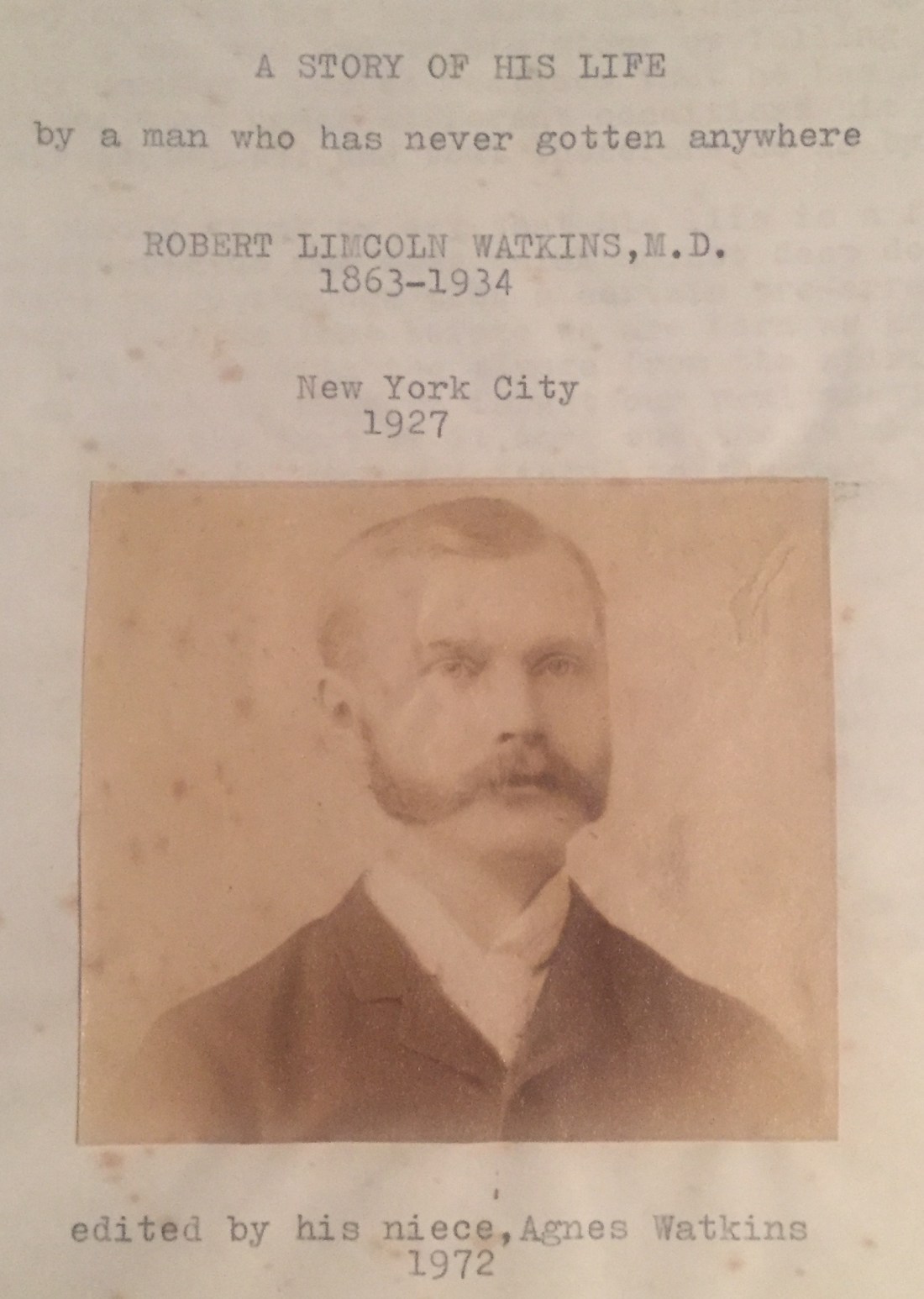
A Story of His Life By a Man Who Has Never Gotten Anywhere: Robert Lincoln Watkins, M.D., 1863-1934. When WWI Breaks Out, The Doc Treats DuPont Explosives Workers, Some of Whom are Vaporized in an Unreported Accident.

IMG_8434

The World War broke out. My business was at a low ebb, as it was summertime, and I was not “in” with the powers that be in my profession. I was not on the outs especially, but was not particularly on the ins.

After dreaming around for a while, I decided to try to get into the game, although my age was against me. I closed the office and left the keys with Dr. Mears, a neighboring physician, an started sorth. I thought the chance of getting into the Navy were better away from home, so I landed at Portsmouth, Va., and took a room near the Navy Yard. I took some of Dr. Steiner’s books alone, and read them every day, especially trying to digest his Philosophy of Freedom.

I visited the Navy Yard, and the surgeon in charge, Dr. Smitt, was very nice to me, as he was to all physicians. But I saw no chance of getting into the Navy because of my age.

From here it was not far to Washington, where I went one day to see what I could do there, but with no greater success. On the way up the boat was full, many sleeping on the cabin floors.

[Background: here’s the preface, forward, and notes from the editor of R.L.W.’s memoir; here’s his account of his upbringing through medical school;  here’s when he self-inoculated with tuberculosis and went off to Paris with a charlatan; here’s where he  treated typhoid, learned to dance, theorized, and sutured guinea pigs together; here’s where he contracts cholera and hooks his uncle up with testicular juice; here’s his misadventures in self-publishing while treating a slow-motion suicide-by-drinking; here’s where he hangs out with a magician and a vaudevillian; here’s where he recounts his singing career; here’s his ode to a Fulton Market butcher; here’s where he explains his profound love of music; here’s an account of a hard-partying man named Emrich; here are his escapades with a reporter take him to Carnegie’s house; here’s where he gets rooked by a crook of a partner; here’s where he loses his shirt working on an invention for 15 years; and here’s a piece I wrote for New York Press upon first reading the memoir.]

I saw a Marine trying to sleep on a settee with his head sticking out under the arm, and asked him if he wanted to take one of the bunks in my stateroom. He replied that perhaps the man he was with could take the lower bunk, which was wider, and I the upper.

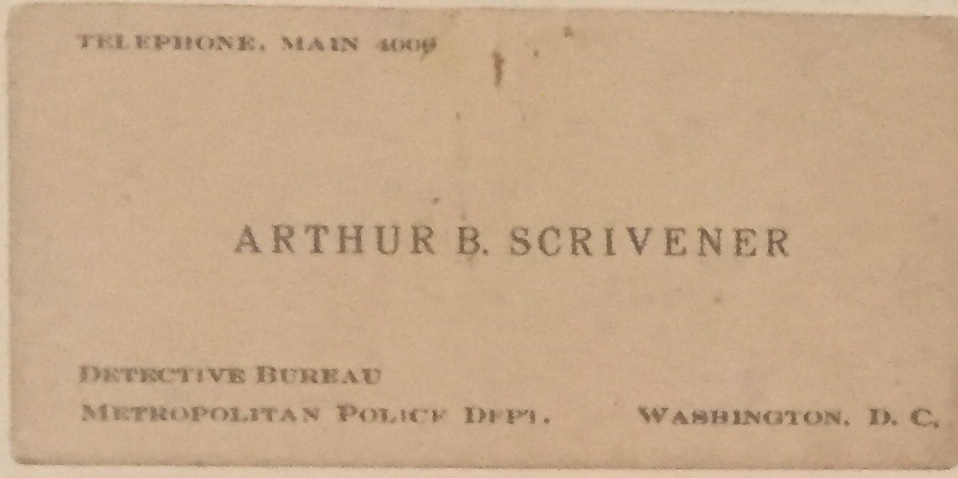
I learned when retiring, and he opened his grip full of guns, that the man the Marine was with was chief of the Washington police Detective Bureau, had taken the Marine with him to Baltimore to round up some deserters, and been unable to get a stateroom.

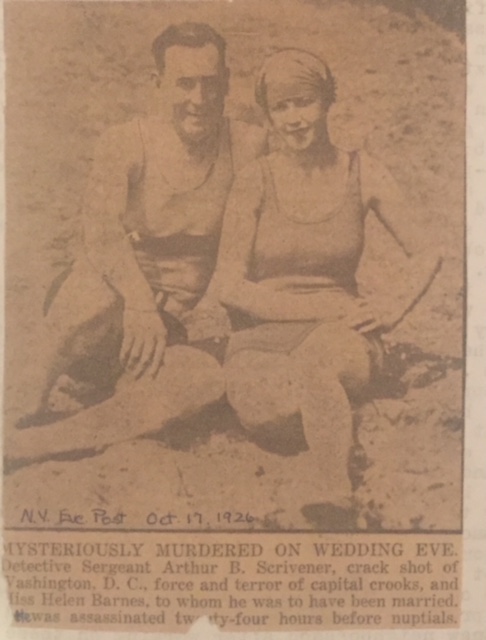
His name was Scrivener. We got breakfast in Washington, and the Marine whispered to me that he hoped the Chief liked him well enough to give him a job, as the pay would be more and he didn’t like his present job. When we parted, the Chief said, “If I can do anything for you, let me know.”

I was unable on that day to do all I had in mind, and at night, being unable to get hotel reservations, I began to think I’d have to sleep on the grass in the park, like many others.

But I happened to think of Scrivener, and called Police Headquarters, who advised me to call the Chief’s house. To my surprise, when I gave my name, although he was not in at the time, the answer was that he had expected to hear from me, and that I was to come to the house.

He came in later, and I shared his room with him, for he was a bachelor and roomed with an Irish family who were musical. While I waited for him to come in, we had Irish songs which I drummed out on the piano.

He left in the middle of the night to go to a neighboring city to arrest some thieves who made it a business to steal automobiles. [He and his soon-to-be-wife were murdered just before their wedding.]
IMG_5936IMG_5935

That day, I went to see my cousin, Col. Paul M. Goodrich, in the War College, and found he could get me into the Army. But I was afraid of the examinations, and besides I only wanted the Navy which he had not at first understood was my desire.

I went back to Norfolk, stopping on the way at Old Point Comfort, where by accident I met a young man in the Aviation Corps, Paul Pryable, whose father was a member of the Liederkranz bowling club in New York, as I was. And by the way, this club was loyal to the U.S.A. and had posters all over its rooms saying, “Anyone caught criticizing the Government will be promptly reported to the authorities.” Paul used to fly down close to the windows of his parents hotel when they came down to see him.

One night, when I was back at the Monroe Hotel in Portsmouth, a man in the Navy uniform brought up my suit of clothes that I had left to be pressed at the tailor’s. His room was opposite mine. He was Commodore Phelps.

We became well acquainted, for he was an expert mathematician and I used to try to algebraic problems on him in connection with things I was studying up. He said he took the prize in that subject when at Annapolis. He certainly could do the most difficult ones quickly, and by short-cut methods. He showed me many.

He was on the retired list, but had volunteered for service in the legal department, and went to court every day, taking off his uniform as soon as he got the hotel, for he said he didn’t like to wear it off duty.

I asked him if they ever had any of the guilty ones shot. “Well,” he said, “we have orders from the President to word the judgments so that the President could give pardons.” So I understood his explanation.

By the way, across from the Monroe Hotel a lady lived, 86 years old, who used to keep house for me in New York. She lived with a relative who was an architect in the Navy Yard. It was queer, and I have often thought of it since, she never asked me to a single meal, although I used to see her often.
IMG_5929

After staying there to no purpose, I saw an ad in the paper for a reporter on the Baltimore Sun, one who had no experience, it said. So I went to Baltimore, to the Sun office. I noticed a lot of women here, apparently reporters. But word was given to me that, not being familiar with the city, I was not eligible.

Again, one Sunday, I went to Virginia Beach and stayed at a hotel there where the water one night washed up into some of the rooms, although they seemed to think nothing of it. It was an old hotel.

When I went to pay the bill, I found I had no money in my pocket, impulsively exclaiming, “Someone must have stolen it.” I offered to leave my watch. Then I though I might have left it in my clothes in Portsmouth. To my surprise, the proprietor said, “Send it down when you get it. I won’t take your watch.” He knew I was from New York, and it is said in the South that people from there are not to be trusted.

I found my money in Portsmouth, and took it down. It wasn’t far on the electric road. The waitresses at Virginia Beach were young ladies working their way through South Carolina Sectarian College. Talking with one of them, I said that the Navy, or anyway down south here, used different words to the chorus of that popular song, “The Long, Long Trail,” but I couldn’t catch them all. So she wrote them off for me and handed them to me the next morning. Here they are:

There’s a big convoy a-sailing

Into the war zone of France,

Where the submarines are waiting,

But we’ll take a chance;

There’ll be lots of fight and sinkings

Until our ships all come through,

But we will show those U boats

What the U.S. Navy can do.

Well, I went to Wilmington, Del., for I was bound to get into the war game now, and applied to the DuPont Powder Works office. The doctor’s name was Hudson, who was at one time in practice near me in New York, but I did not know him.

“When do you want to go to work?” he said, “Now?”

I said, “Yes.”

“All right, there is a boat for Carney’s Point at one o’clock.”

I had then the greatest sensation of my life, for I was dumped into a camp of 4000 workmen of all nationalities making black powder and nitro-glycerine. The hospital supported 16 doctors, and all slept in one room. I was told to look around and go to work when I felt like it.

It was 8 hours on duty, but we preferred to work 16 rather than loaf around in such narrow quarters. The flu broke out and I was sent by government orders on duty outside the camp, into the town.

I had charge of some gypsies, for the men were compelled to work, something they had never done. Workers were getting big wages, however. The oldest girl in the gypsy camp, 19, would keep saying, “Our mother is dead, and we don’t know what to do.” For the queen, her mother, had dropped dead, and her sister also, both big, handsome, healthy-looking women.

Their bodies were in the morgue and they didn’t look as if they were dead. The young children had the flu, and I ordered fires to be made in the tents. And the youngsters, pretty, curly-haired children, arranged in circles on their rude beds so that this girl might give them menthol and eucalyptus as medicine, and look after them. She fed them lightly and kept them clean. They all recovered, though I did not use the cold air treatment.

All the doctors but two, of whom I was one, had the flu. I slept with a German doctor, and it had been noised about that he had made slurring remarks about the hospital. I was advised to report him, but he was a good doctor and a hard worker, had come there against the wishes of his wife, was along in years. He lived nearby and went home every Sunday. Many thought, “What is he here for?”

So one Saturday I went to Wilmington to follow out the suggestion, but the doctor in charge was in New York. So I took the train for New York. When I arrived, I found he had three addresses, but by luck I selected the right one first. He was located in a high building on 34th St. with his wife, and was surprised to see me because he thought I had been ordered to Virginia.

I told him my story and made him understand that the German doctor was suspect. He quietly removed a telegraph instrument from under a small table, ticked it a while, and said, “Thank you.” I said, “I sleep with the man. What can I do?” He said, “Nothing. There are three secret service men on his track right now.”

I didn’t see anything different in the doctor’s actions when I got back, except that tone day he showed me his photo and quietly remarked, “They made me get a picture last pay day. Did you have to?” All the government did was watch him. He was all right.

Soon I was sent to Penniman, Virginia. Here things were as still as death, a clayey soil, and full of small, tall pine trees, quite different from the noisy, dirty gun powder place. Here I was working for the government only, and TNT was the explosive that was being made.

The doctor, solvency dressed, apparently a young farmer, said, “We are going hunting today. Before you go to work, wouldn’t you like to shoot?” I said, “What do you kill?” He replied, “Birds.” I said, “If I could shoot at some lions or Germans, I might go, but I guess I prefer to work.”

I went on night duty, the second night, for it was a small 35-bed hospital, and an awfully quiet and still place. I said to the nurse, “Do they have any explosions here?” She said, “I’ve been here ever since the war started, and not since I’ve been here.” I said, “I’m going to look up the phone numbers of the staff. I don’t feel comfortable here alone with nothing doing.”

We had no more than got the numbers looked up than the phone rang and a woman said, “Come down to Calibre 4 and bring all the nurses and doctors you can get a hold of.”  We had heard a noise like a pistol shot, but thought nothing of it except to remark, “What’s that?”

I called the chief. He was still hunting. Then I called the assistant. He said, “Who phoned?” I said, “A woman.” He said, “Did it sound genuine? Did you hear anything?” I told him I heard something slightly and thought the voice was genuine. He replied, “Take the ambulance and go. We will be down right away.”

A young woman ambulance driver was immediately ready. She drove like mad it seemed to me, over stumps and rocks, at 2 A.M. in the pitch dark night. She said she was from Missouri.

They manufacture TNT in high round tower-like buildings. I looked them over my first day there. We stopped at No. 4 and I ran up the winding stairway, which was  left, though much of the side of the building was blown off, to the very top. I saw nothing to do, and as I started back, right behind me was the ambulance driver. Her job was with me, and she was Johnny on the spot.

We found only pieces of clothing and flesh parts. 25 men had been blown to nothing. On the way back we met those who had received the shock, and when we got the to hospital there were many wounded lying around, and many more came in afterwards, stragglers suffering from the shock.

Ten of the staff later came filing in between the lines of wounded that the nurses and orderlies had arranged on the floor. They walked in Indian file, heads down, as if it were a funeral, and they not doctors, but people attending the service, for it was the first explosion at this place. And it was kept out of print.

When Armistice Day came, I was back in Wilmington, and one of the banners in the procession said, “DuPont’s Pills Made the Kaiser Sick.” I stepped into the Y.M.C.A., it was completely deserted. A woman came in with a banner in her hand which she said she had taken from someone in the procession. She was saying, “What shall I do with it? What shall I do with it?” Then I read the banner, which said, “Uncle Sam did it all,” and at the same time noticed she had in her other hand a Union Jack.

“That banner is not right,” she said. “Oh,” I said, taking the banner from her, “it’s near enough right.” She tried to stop me from going out with the banner, but I kept on, though she tried to hinder me as I handed it to someone in the procession. Then I left her, saying as I went, “If you don’t run along, the mob will be after you.”

When I got back to New York, like everybody else, I had to start business all over again. Dr. Benton came to my office to ask if I could do anything for him, for he had been in a camp in the south all through the war. I told him we were all in the same box, having to notify our old patients, in an attempt to resume practice.

Some years after the war, business was most always very slow. I wasn’t at all well, and at times was lonesome in this great city. New York is one of the worst places in which to be alone. I lay on my couch in the office all alone for two or three days. The pain in my chest kept me from getting to the phone.

Finally my nephew [Curtis Watkins, son of brother Edward in Gardner, presumably studying at Columbia] came in and got me something to eat, which made me feel better – well enough to go to my usual haunt in an adjoining city.

But over there I got worse after the first day, and calling Dr. Benton from New York, he said I had pneumonia and was too sick to go back to New York. He had called in several local physicians, and on their promising me that they would not let anyone give me serum, I let them take me to the Presbyterian Hospital in that city.

I was dreaming all right. There was a red book with moving hieroglyphics, Egyptian or Babylonian. There seemed to be ancient horses, and men mounted on them, and occasionally the pages of the book were being turned.

My temperature was 105, but I knew what I was about, for the nurse tried to give me an injection of serum which I fought. The next time she tried it, I said to her, “Do you see that little window up there?” – there was one, high up – “Well, you are going out there if you don’t stop trying that.” I know I attempted, as if she were a man, to seize her by the back of the trousers and shove her out. She afterward told me I gave her a terrible fright.

The next day there filed into the room three men, and the doctors. Dr. Crane said to me, “What do you know about these men?” pointing to my two brothers and my nephew. One had been in before, but the one I referred to was six feet two, a surgeon from Worcester. I said, “How’d you find time to come here?” He said nothing. I went on: “I know two things about him. When he was born he knew that he wanted to be a surgeon. And  he knew the girl he wanted for a wife. And I”ll bet he has written her every day he has been away on this trip.”

Arrangements were then made to give me no serums, and my brother and the physician-in-chief agreed to it. I always remember the physician-in-chief’s daily visits. He would listen to my heart with his stethoscope, say nothing, and go off. Till the day he finally said, “All right.”

I have not seen him since, though I called at his house one Sunday long afterwards. The lady who came to the door said, “The doctor sees no one on Sundays,” and shut the door in my face so quick that I had no time to answer.

I made a quick recovery and was out in four weeks. In two months, I was back on the job. They say I was the surprise of the institution. The nurse said I fooled them all.
 

A Story of His Life By a Man Who Has Never Gotten Anywhere: Robert Lincoln Watkins, M.D., 1863-1934. An Invention 15 Years in the Making Puts the Doc Off Machine-Making for Good.

IMG_8434

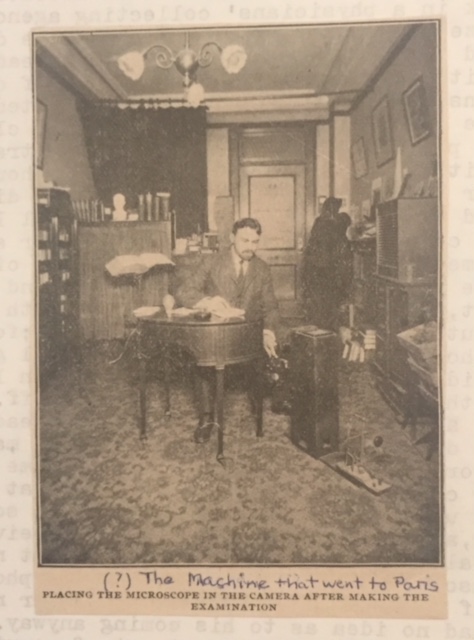
My next patent was for the MIGRAF, a copyrighted word coined from photo-micrograph. A copyrighted name has to mean nothing, but this one really means a machine to photograph microscopic objects. Its object was to bring germs, blood, etc., under two-eyed vision so as to point out definite microscopic features to students and beginners in any such line of work, and to make photographic records of same for preservation.

This apparatus was several years in construction. When completed, it consisted of an arc lamp, a rheostat, a microscope, and a viewing mirror. They had to be made small, compact, light-weight, for the apparatus had to be portable, and able to be attached to any 110 volt light circuit.

There must have been about 15 patents covering it. One of the many patent attorneys I employed was an old classmate in chemistry. For some reason, he held one of my patents for years in the patent office. He nearly drove me crazy with his delays for it seemed as if capital was on the point o f investment many times, but I had no real patent, and none was allowed while he had that one tied up. I finally had to take it away from him.

[Background: here’s the preface, forward, and notes from the editor of R.L.W.’s memoir; here’s his account of his upbringing through medical school;  here’s when he self-inoculated with tuberculosis and went off to Paris with a charlatan; here’s where he  treated typhoid, learned to dance, theorized, and sutured guinea pigs together; here’s where he contracts cholera and hooks his uncle up with testicular juice; here’s his misadventures in self-publishing while treating a slow-motion suicide-by-drinking; here’s where he hangs out with a magician and a vaudevillian; here’s where he recounts his singing career; here’s his ode to a Fulton Market butcher; here’s where he explains his profound love of music; here’s an account of a hard-partying man named Emrich; here are his escapades with a reporter take him to Carnegie’s house; here’s where he gets rooked by a crook of a partner; and here’s a piece I wrote for New York Press upon first reading the memoir.]

To get back to the Migraf, I had an awful time getting that machine constructed. I got it nearly completed by one mechanic after another. The first one failed in business when it was partly done. Another was a good workman, but erratic. I fitted him up with a lathe in his house so he could spend extra time on it. He ran off with another man’s wife and I had deuce of a time convincing his family that the partially completed job was mine to take away. Most of these men I paid in advance, or from day to day.

Finally I got a genius to work on it, an artist as well as a mechanic, But he would get woozy spells, and sometimes work all night, then not work for three months at a stretch. I had fitted up his flat with machinery so as to get my ideas just as I wanted them. One day he left the machine nearly completed and would budge no further. But the lines were as desired, and I considered it a beautiful, as well as a practical, machine.

I obtained a contract with a  manufacturer of mathematical instruments on Fulton St.. for the completion of the one and six more, but by this time I was running very short of cash. I didn’t know what to do.

But going past the Union League Club one hot July night, I spied in the window an old patient. I went in and told him my predicament, and made arrangements for the mechanic from the company where I had obtained the contract to see him with me the next day. There I demonstrated the machine as far as I had got it done, and he put up $100 and said he would finance it.

When the machine was not finished on contract time, it worried me. Pushing matters, the constructor said the bill was $500 or so, and the Union League Club man could not be seen either by more or by the contractor.

I managed to “steal” the nearly completed machine. There was an important part not finished, which I thought I could do myself at my house – this being my excuse for taking it, that I wanted to try it. The contractor chased me and threatened a sheriff to bring it back.

IMG_5930

I could think of nothing else to do, and worried as could be, I walked into the office of the son of the Union League Club man, who I understood was now in business for himself in Wall St. He was glad to see me, said he was wondering the other day whether I had ever completed the machine I used to talk about when treating his  mother. At that time, I was using a rough one made of wood, which always reminded me of the country hunter who had a rickety gun and every time he shot a bird, the gun flew to pieces. So he would find the pieces and put it together again for another shot. So did I, with the machine he was referring to.

But setting this one up in his office tickled him so that he said, “I’ve plenty of money and am retiring from business. I’ll put $500 in to it.”

“Well,” I said, hesitatingly, “you father is already in it, but I can’t find him.”

“Oh,” he said, “he’s down at Oyster Bay. I’ll take care of Dad.”

I explained things to him, and he phoned to the factory nearby where the machine was constructed, saying to me, “Come on, Doctor, I’ve got to  watch a train but I’ll go over there with you.”

He did. When they told him the amount of the bill had reached $700, he was mad. He said, “You G– damn bitches. Here’s my card. Look me up in Bradstreet.” And, pulling out his checkbook, wrote out a check for the full amount.

Then, taking me by the arm, we walked quickly out, he damning them all the way out the door for not sticking to their contract.

This man afterward gave me $3,000 cash, without security at first, but called me up in a few days and asked me to see his lawyer, who induced me to assign three valuable patents to him as security.

The machine was then taken to another mechanic, and a contract made to make up a dozen. It was awfully slow work, and my understanding was that I should get these made up and marketed before any more money was advanced.

It was a nip and tuck away and night, and was especially hard on my nerves because the rheostat, perhaps the most ingenious part of the apparatus, was not compete. One mechanic I had working on that alone, with promises that were never fulfilled. So I finally had to work it out myself, taking time out from my business.

IMG_5929

In the end, I got it made right by an Alsatian machine down on Gold St. He made them like little Tin Lizzies, so they have not worn out to this day, 20 years afterward.

The Migraf was light, would fold up like a fan, and could be carried in the vest pocket. This was one of the patents assigned. I would step down 110 or 115 volt circuits so as to get 5 to 10 amperes through it, and from 500 to 800 candle power in the arc light.

I had previously worked a year getting that arc light so it would not sputter, and would remain steady for long enough to get a good view of the object, and a photo.

Old Bob Willis, a thorough mechanic and a friend, I allowed to work on the shutter of this apparatus a whole year, and then found one on the market that could do the trick. But there was a patent on it over which the Eastman Company had control, and they would not sell, or allow them to be sold for use, except on their own cameras – although I had already bought six of them.

Since I had some patients in Rochester, I went out there and took my little moving picture camera – the first small one ever constructed up to that time, I think, 4X5X6 inches  – to George Eastman.

I had no trouble seeing him, just called him up on the phone and he said come over. He looked it all over carefully. I called it a micromotoscope, and said that it would go well in their toy department. I had patents on it, and it could be used either for the microscope or otherwise.

Just then, Mr. Lovejoy, one of his top men, passing through the room, stopped and took a look. He just shook his head, and that was the end of that. But the Migraf, which Mr. Eastman came afterward to my hotel and looked over, he said was the most valuable instrument of the two.

After getting six of the Migrafs complete, the company making them failed in business. But as I had paid for each as they came out, I was not so much affected. Then I had to get them on the market.

After letting several of my friends try it as agents, I concluded that it could only be done by myself, and decided to get orders from the Government at Washington. So thither I went. Left my business and stuck to Washington for three months.

One hour after getting there, I had one set up in the Department of Agriculture. Dr. Wiley saw it and wanted one, and the workers all appeared to be interested.

One I had gold-plated, and that was given to the financier, who tried to dispose of it to his doctor, as well as amusing his family in the country with it. They talked of it to everybody, But I made no sales there.

In Washington, I made photos for the Carnegie Institute of mica, plants, and thin stones, as well as some for the Government pathological and bacteriological laboratories – and even then some doubted if it would take photographs or not. I then got a hold of the government photographer, a Mr. Williams. He made photographs for me with the Migraf and told me I could refer anyone to him as to its capabilities.

But I could not land a sale, could not get a single order in black and white, though they said they wanted them.

One day on the street car, I sat next to a man who, seeing my box, asked me what I was handling. I told him, and he said “Have you any competition?” I said no, and explained the situation to him when I found he was the salesman for the Burroughs adding machine company. As he left he said, “If I can be of any service, let me know. I sell adding machines d\sometimes where they don’t have any use for them, don’t even want them.”

After a few more days of failure to sell the government people, friends with whom I had taken rooms advised me to go and see this man, as I was not a good talker.

I went to the house where he said he lived with his mother, and a curious thing happened here, which made his mother interested. When I came to the house, there was a front yard with a big tree in it. Their pet cat was at the top of the tree, mewing to get down. I climbed the tree and brought down the cat. And the mother let me in the house, where I waited for the son to get out of bed, for I got there bright and early.

I forgot his name, but recollect that he was one of our Hebrew friends, and must have been a very capable man, for the company had a big office in Washington. I offered him $20 a day if he would go with me and do the talking. I would demonstrate, and he would do the selling, with commission.

Well, to make a long story short, he sold none. He said he did not know the reason.

I tried the offer of cash, as my Washington friends had urged, to a man in one department. It seemed ab out to work, but with the money in one hand, while with the other I tried to get in to sign the contract, I saw that while he would take the money, the contract would be doubtful. So I concluded that it was more costly to find the right way to use graft than to play the game straight.

I left Washington a poor man again. And my financier was getting anxious about me, for I didn’t even write him.

When I got back to New York, one day I walked into the Brewers’ Academy at 23rd St. and Ninth Ave. and showed the Migraf to the man in the office. He said, “Take it out to the chemist. I think he wants one.”

He did, said it was just what he was looking for. So we made a picture on the spot. I went back to the office and said the chemist said it was all right. “Good,” he said. “Leave it here, and I’ll send you a check tomorrow.” He did, $300. And thus I landed my first sale myself. I know they used the machine for years.

Dr. James Moore, a doctor in New York in my own line, one day said, “Go and try Mr. Skogard. He lives in the old Clark house on 22nd St. and was a patient of mine.”

Moore told me that Mr. Clark of the Singer sewing machine company was very musical, and had fitted up a musical apartment in his Dakota Flats on West 72nd. St.; that he found a man by the name of Miner as bass, Bourne, another singer, Skogard another, and himself. They formed a musical combination to use the musical apartment any time they felt like it. He had put each one of them in a way of easily and surely making it. Everybody has heard of Commodore Bourne, who was at the time a librarian and amateur singer. Skogard he gave money enough to live on the rest of this life, some say a million.

Anyway, I went to see him. He had not been married long, I judged, and received me all right. He thought favorably of the migrate and told me to go to the Norwegian Hospital and present it to them from him.

I went there, but they wouldn’t take it. I went to the Xray department, and they said they didn’t know whether it would work or not, even after I showed them. Finally, I was told that if Dr. Powell of the Hoagland Laboratory said it was all right, they would take it.

So I found Dr. Powell, who looked at it and said, “What have I got to do with it?” I told him it was a present to the Norwegian Hospital, but they didn’t now whether it would work or not. He replied, “Of course it will work.”

So I asked him to write “O.K.” on the back of my card and sign it, which he did. Then I took the machine back to the doctor in charge of the hospital, and he gave me a note to Mr. Skogard, who gave me the money a few days later.

The gold-plated machine my backer had me afterward present to the Vassar Brothers Hospital in Poughkeeplsie.

The Mayo Brothers in Rochester, Minn., were interested when I showed  it to them, and their pathologist, Dr. Wilson, bought a special rheostat which he considered the most ingenious thing about it.

In Pittsburgh at the Penn Laboratory, a German was consulted by the Elizabeth Magee Hospital authorities to see if it would work before they considered purchase. I remember well his reply: “Any damn fool knows it will work. Any box with a hole and a lens will take a picture.” They didn’t get one, even then.

At the Rockefeller Institute, Mr. Jerome rang a bell for three different experts to come down to the office and view it. Each said it was all right, and Mr. Jerome asked me to leave my card and he would let me know. But he never did.

Many others I tried, but I was broke and had to get back to business. My backer was discouraged, would put up no more, and began to hound me for the return of his money.

The patents being tied up, I was never able to do anything more with the Migraf. I remember one night showing it at the County Medical Society meeting, but I had operated it and got off the platform so quickly that I was told afterward no one had a chance to see an interesting apparatus. I suppose I unconciously did, because I would have to explain my personal views on certain things which I could not do there.

I have two machines today, and they are in fairly good order – and in constant use by me. The Migraf has not been copied entirely, although the patents on it have expired.

It had long  been my desire to make a demonstration of mycrozymas in the blood stream by moving pictures. The apparatus used, which is the one I showed George Eastman, though a later and better machine, I claim to be the first to make application of for small objects.

Since this microzyma measures less than a twenty-five thousandth of an inch in diameter, a high powered lens is required. I had made them, but not satisfactorily for a clean demonstration. And I wanted to construct an attachment for the apparatus so that a continual focus could be kept while the picture was being made. (I hold patents for such an attachment.)

My dentist sent me to a skillful man, Mr. Carter, and I showed him what I wanted: a sliding telescopic apparatus, one end of which could be attached over any moving picture machine, and the other provided with a pair of spectacles which were to be set in vulcanized rubber fitted to my face and eyes so that no light would leak in.

Mr. Carter said he could do it, and we made an arrangement, I paying him something on account. It required a skillful workman, and he was that. But the next appointment I had with him he did not keep. I afterward learned he was on a spree. Then I was laid up with pneumonia for two months. When I went to see him again, we had some words, and he remarked if I had got drunk I would not have had pneumonia.

He started again on the job. I went to see him one night at the office he had hired outside his day-place, since it was a special job and he didn’t want his boss to receive any part of the price he was to get, to find if the apparatus fitted my face and eyes. If this worked, it would do away with any dark back to stick one’s head into, and have many other advantages.

It was a good job, well and skillfully done, and was all complete but one small thing. And was it absolutely light-tight, was my query to him. I wanted to try it on. He couldn’t see that, so after some argument I fond that he wanted the rest of his money before I could take it away, or even try it on.

I was upset, told him we would call it off, and he could keep the thing. He didn’t know what I wanted it for, and I didn’t tell him. But when he seemed willing to give back my deposit if I left the apparatus, I decided to take a chance on his finishing the job, and pay him the balance of the price contracted for.

Still not knowing what it was for, he said it was worth much more, but I paid him the balance and felt good. He said he would send it up complete in a few days, and add something else which I had not contracted for, but which would be an advantage, without extra expense.

Well, I’ve never seen the man or the fixture since. He went on another drunk.

So no more machines for me, but back to business again. Here are the ideas, let someone else do it. My work has always been done with direct light, not reflected light. So I was gradually  forced to settle down to the use of my apparatus, all of which were finished, practical machines, in my private practice only, and let the world whirl around. I moved into a new neighborhood, after working on these machines fifteen years or more.

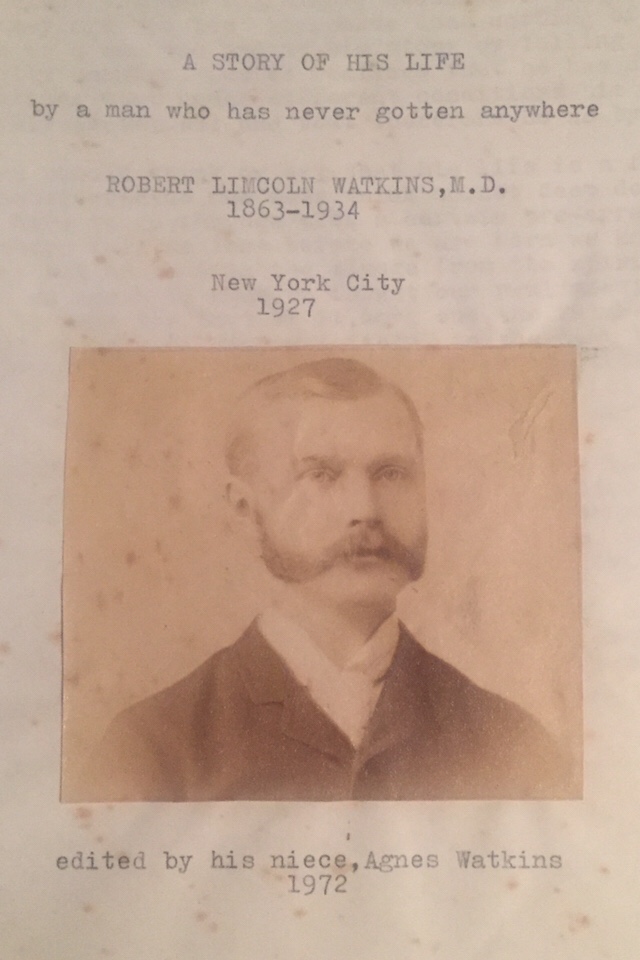
A Story of His Life By a Man Who Has Never Gotten Anywhere: Robert Lincoln Watkins, M.D., 1863-1934. Early Life through Medical School.

IMG_8434I was born in Proctorsville, Vermont, in the month of May, 1863, into a family of long-standing New England extraction. The family consisted of three sons and one daughter, I being the second child. My father had deserted the farming life and was a mechanic and inventor. He was the owner of a factory for making chair seats – Black River Chair Factory – and held basic patents thereon. One night the spring freshet washed away the factory, and we youngsters were roused from sleep to see my father’s fortune completely destroyed by the Black River. Soon after I remember a grey-bearded, good-looking old gentleman came to town and bargained with father for his invention, and we moved when I was six to a factory town, Gardner, Massachusetts, (where father worked for Heywood-Wakefield), in which we all got our schooling and grew up.

IMG_8437

My mother had been a school teacher in a Berkshire County hill town, Peru, Massachusetts. She was one of those dark-haired, dark-eyed beauties true to every virtue of womanhood. Her mother had thirteen children and lived to a ripe old age, visiting around with her children after they were grown and she was a widow. I remember her amusing us as we sat around her on our knees, singing as she knit, “There was a frog lived in a well, with a rink tun billy won’t you kimo,” etc. My earliest recollections are of a puritanical environment where family prayers were party of the daily calendar, and strict observance of the Sabbath was demanded of all.

[Background: here’s the preface, forward, and notes from the editor of R.L.W.’s memoir, and here’s a piece I wrote for New York Press upon first reading it.]

My boyhood was uneventful, but at an early age I was restive under instruction. I had a horror of learning from books that were assigned me, but was eager to get information for myself from nature and from observation. I was one of those difficult boys whose face would get red if he walked before a crowd, and on Declamation Day at school I would run away to avoid getting up on the platform to recite The Nantucket Skipper, or some other simple piece. I recollect a minister’s son in the town who also ran away on those days, though for other reasons than what I did. One time the teacher called on him, and with his hair all over his face he recited: “Speaking pieces hard and tough, I’ve spoke two lines and that’s enough.” His name was Charles Herrick. I’ve often wondered what became of him, for he never seemed to care what he looked like. His parents I remember brought up and educated two Chinamen at home, Pan and Sing their names were.

No doubt Dr. Gates, a well-known minister of the Gospel in New York, will recollect the chemical laboratories we used to work in as boys, he in his father’s carpenter shop, I in the cellar of our house in an old coal box. We used to visit each other an make explosives and other things to which we took a notion.

One day my father was sick in bed and a neighbor came and stayed too long. By luck I went down to the cellar to see how my jug of hydrogen was getting along. Not considering that, on standing, air would trickle in, I touched the the glass painted tube therein with a match to see if I could get the hydrogen tones when a tube was held over the flame. But lo, the jug blew up, the cork striking the floor of the room above, where my father was. The neighbor, Dwight Warfield, left immediately.

In that coal box I had constructed a photophone invented by Alexander Graham Bell, the telephone man. That was before his perfection of the telephone. He and a man by the name of Painter – so the Scientific American published (I read that paper religiously in those days) – discovered this apparatus to talk over distances without a wire by means of a ray of light.

Then there was another man who claimed that diamonds could be made by heating in a tube iron filings, carbon, and nickel. For a tube, I used a piece of an old steam pipe, sealed it at both ends in the usual way, put it in the furnace, and left it there, forgetting all about it till a dull thud one day told the story.

My father often asked me what I wanted to be. I as often replied that I didn’t know, but I thought I would like to be a chemist or an electrical engineer. From high school I went to a Polytechnic Institute – Worcester Tech – where I studied for a chemist, and graduated from that institution. It naturally fell in line then, since I did not desire to continue as a chemist for a life profession – my father said, and induced me to believe, that there was only $900 a year in it – that I went to New York City and studied medicine, graduating from one of the best medical colleges in the country (New York University), a full-fledged M.D., and thinking myself lucky to get through.

One day Dr. Draper showed us pictures of blood cells in a small, red-covered English book. I dreamily said to myself, “That’s the place to look for disease, in the blood. When one’s face broke out with an eruption, the ‘old wives’ used to say, ‘It’s in the blood.’ So all disease must be in the blood.” But research work I realized must determine how to recognize it, how to tell abnormalities.

Recollecting that a physician came to our house in the country when I was a boy, to examine my sister who had consumption and died of it at the age of 18, and that he examined a drop of her blood, I scurried around, found that the old doctor lived in Boston, and went to see him. He said, “When you have finished your college come here and I will teach you what I know.” So I took lessons of his, borrowing the money to pay for them.IMG_5898

I was intern for a time in a big hospital – Newark Hospital – where the boys said I was always examining blood instead of doing regular duties. After which, my troubles began.

There was a man by the name of Sullivan, a saloon keeper, who was brought into the hospital unconscious one night. We interns began to try to bring him to by pouring hot and cold water alternately on him, and by flagellation. The operations caused some disturbances in the middle of the night. Some reporters being in the ward, and the man dying afterwards, made a good newspaper story – so the reporters thought. And they were right, for we were all arrested for killing, or for assisting a man into the next world.

We all imagined all kinds of things happening to us, for we were several months on parole, but when the truth was known we were of course liberated. Little did we know at the time that politics was more or less mixed up in the affair. We were all young, and inexperienced especially in political intrigue, which in this hospital was only waiting for a chance to get in its previously arranged schemes.

Practicing medicine out of a hospital, and in, are two different kinds of experience. The first middle-of-the-night case I had was a saloon keeper bleeding from at the lungs on a cold winter night. He lived among the wharves under McCombs Dam bridge. Frightened I was, but gave him some iron, and as luck would have it the hemorrhage soon stopped, and he was only too glad to pay me $2.00 – and respected the young doctor, to boot. I walked home a mile through the snow storm.


A Story of His Life By a Man Who Has Never Gotten Anywhere: Robert Lincoln Watkins, M.D., 1863-1934. Preface, Forward, and Notes from the Editor.

Preface.

This is the story of a man who has never reached his goal. Today many stories are written about men in high positions, but when we examine closely under the highly seasoned stories, we find that though they are “on top” they have done nothing of any great merit. Now here is a man who begins his story by telling you that he is practically unknown. But he realizes that he has done much good in his lifetime; that under different conditions his work would have been highly acclaimed; and that therefore he is by no means a failure.

No man should think or say his life is a failure; and, when all is considered, no man does think so, not deep down inside. We are all put here to go through with a certain pre-arranged plan, and philosophers tell us that before we are born we know what our life is to be; but as soon as the plunge from the spiritual life into the life on earth is made, we forget our real mission. Life’s duty is then to make the best of it, work out the future with what we have; and perhaps if we are faithful to the best that is in our understanding, and labor sincerely at the task that our hands find to do, it may be given to us to sense that mission that was arranged for us in our pre-natal state, and to come into our real heritage on earth.

This story merely relates the workings of a life striving to reach its goal, and if the reader senses a kindred spirit as he follows these reminiscences, the telling of them will have been justified. The first person singular is used as in no other way could the facts be put on paper in a true and interesting shape.

Forward.

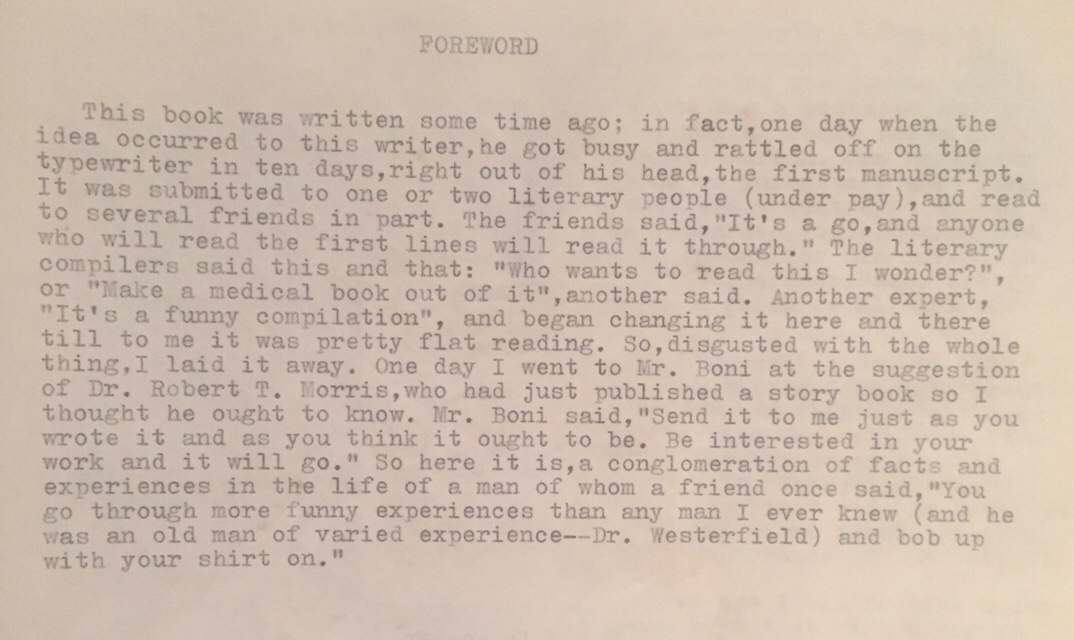
This book was written some time ago; in fact, one day when the idea occurred to this writer, he got busy and rattled off on the typewriter in 10 days, right out of his head, the first manuscript. It was submitted to one or two literary people (under pay), and read to several friends in part. The friends said, “It’s a go, and anyone who will read the first lines will read it through.” The literary compilers said this and that: “Who wants to read this, I wonder?”, or “Make a medical book out of it,” another said. Another expert, “It’s a funny compilation,” and began changing it here and there till to me it was pretty flat reading. So, disgusted with the whole thing, I laid it away. One day I went to Mr. Boni at the suggestion of Dr. Robert T. Morris, who had just published a story book so I thought he ought to know. Mr. Boni said “Send it to me just as you wrote it and as you think it ought to be. Be interested in your work and it will go.” So here it is, a conglomeration of facts and experiences in the life of a man of whom a friend once said, “you go through more funny experiences than any man I ever knew (and he was an old man of varied experience–Dr. Westerfield) and bob up with your shirt on.”

Notes from the Editor, Agnes Watkins, his niece, in 1972.

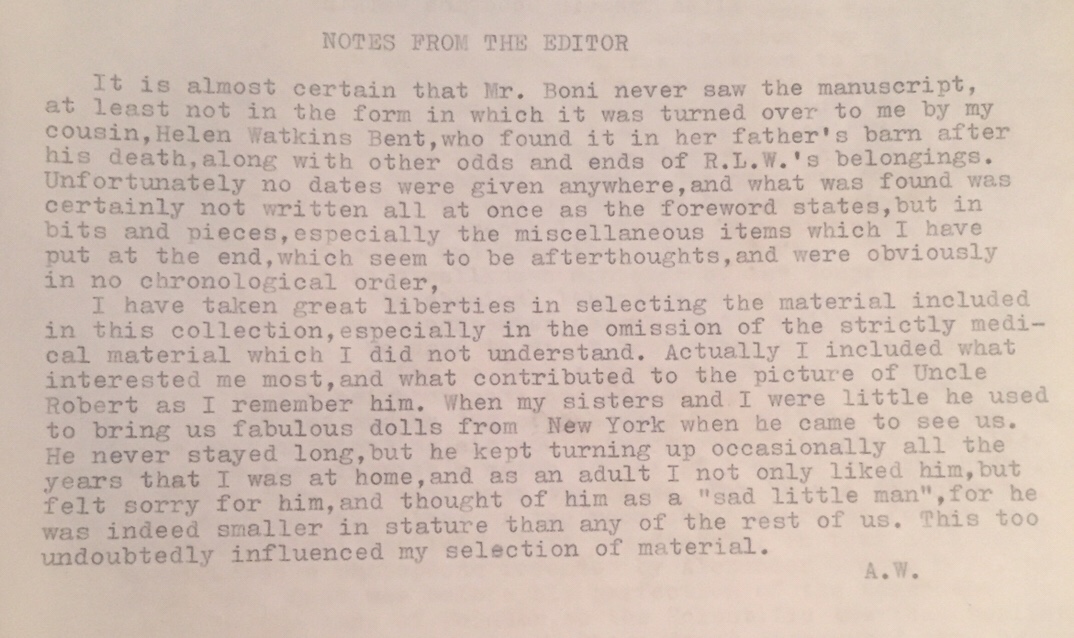
It is almost certain that Mr. Boni never saw the manuscript, at least not in the form in which it was turned over to me by my cousin, Helen Watkins Bent, who found it in her father’s barn after his death, along with other odds and ends of R.L.W.’s belongings. Unfortunately no dates were given anywhere, and what was found was certainly not written all at once as the forward states, but in bits and pieces, especially the miscellaneous items which I have put at the end which seem to be afterthoughts, and obviously in no chronological order.

I have taken great liberties in selecting the material included in this collection, especially in the omission of the strictly medical material which I did not understand. Actually I included what interested me most, and what contributed to the picture of Uncle Robert as I remember him. When my sisters and I were little he used to bring us fabulous dolls from New York when he came to see us. He never stayed long, but he kept turning up occasionally all the years that I was at home, and as an adult I not only liked him, but felt sorry for him, and thought of him as a “sad little man,” for he was indeed smaller in stature than any of the rest of us. This too undoubtedly influenced my selection of material. A.W.