Confessions of a Junkie Tracker: The Nose Follows a Dope Fiend to His Suburban Home

By The Nose

Published in City Paper, May 30, 2007

Drugs were being dealt all around the Nose as we got in our car on a recent Saturday afternoon in West Baltimore. Bad drugs, if a young dealer’s overheard admonition to his slightly older re-up man was true: “Man,” he said to his supplier, “that shit is dirty. Niggers around here are laughing about how dirty that shit is.”

Dirty or not, the shit was moving. The driver of the vehicle in front of us–a Ford Explorer with a Baltimore Ravens sticker–copped some junk from the dealer. We followed when the Explorer pulled off. Got to get to know the geography of The Game.

The Explorer drove slowly and erratically until, half an hour later, it stopped in front of a well-kept house in Hillendale, with a freshly mowed yard adorned with lawn ornaments. It was the picture of suburban bliss, safely north of the city line.

The Nose approached and asked the man whether he scores regularly at that particular drug market.

“Nah, I don’t go much,” he said. He was white and looked a decade older than his late 40s. He’s a pipe fitter, he explained. Records show he owns the house with a woman who shares his last name. They purchased the 1,300-square-foot home on a quarter-acre lot a couple of years ago for nearly $200,000. Prior to that, the man had sold his 1,150-square-foot South Baltimore rowhouse for about the same price.

We asked him about the notion that the city’s poor drive demand in the city’s billion-dollar drug trade.

“Nah, it ain’t like that,” he said. “It’s a business down there.” A drug corner, in other words, that doesn’t discriminate based on race or class or anything other than ready cash in small denominations. When told about the dealer’s earlier conversation with his supplier about the dirty shit they were selling that day–the same shit the junkie bought–he shrugged and said, “I don’t doubt that.”

Follow a junkie home and end up in the burbs. Maybe the burbs, which so generously share demand for city drugs, should have more of their own drug corners. The closer the market is to the junkie, the less the junkie will drive. Hell, city junkies hardly drive at all, so few own cars. And if our junkie is any indication–he never even noticed the Nose was on his tail until he was out of his Explorer and walking across his lawn–junkies really shouldn’t drive.

Collateral Catch: Investigation into indicted bailbondsman snared other members of troubled waterfront union

By Van Smith

Published in City Paper, Mar. 31, 2010

The International Longshoremen’s Association (ILA), the nation’s largest union of maritime workers with some 43,500 members stationed along U.S. and Canadian coasts, has deep roots in Baltimore. Baltimore native Richard Hughes Jr. has been its president since 2007, and he is also the business agent for ILA Local 953, based in Locust Point. Del. Brian McHale (D-46th District), who represents Baltimore’s waterfront in the state House of Delegates, is on Local 953’s roster as a steamship clerk. One of the ILA’s vice presidents, Horace Alston, heads the union’s Baltimore District Council. He and former ILA general vice president John Shade are trustees of Baltimore’s ILA Local 333.

But amid the well-connected ILA members in Baltimore, one longshoreman in particular raised the union’s profile recently: Milton Tillman Jr.

A politically connected ex-con and real-estate investor who is the dominant force in Baltimore’s bailbonds industry, Tillman Jr. is also a member of ILA Local 333. On March 17, a federal indictment charging Tillman Jr. and his son, Milton “Moe” Tillman III, with tax fraud, wire fraud, and unlawful bailbonds practices, was unsealed (“Milton Tillman and Son Indicted in Bailbonds Conspiracy,” The News Hole, March 17). It includes charges that Tillman Jr. was paid for unloading ships at Baltimore’s docks on shifts when he was in Brazil, Argentina, Spain, and Las Vegas, among other places.

The Tillman investigation, court records show, also helped prosecutors nab three other ILA members in Baltimore–William Zichos Jr., Dale Kowalewski, and Joseph Bell–who were indicted on wire-fraud conspiracy charges last November. The three men are union timekeepers who record the hours clocked by dockworkers for payroll purposes. They are members of ILA Local 953, which represents clerical workers in Baltimore’s maritime industry. The case against them alleges they also got paid for no-show work by the stevedoring company Ports America, including at times when they were in France, Costa Rica, Iceland, Las Vegas, and Florida.

The trial in the timekeepers’ case, which had been scheduled to begin in April, was recently postponed until September. The Tillmans’ trial is expected to take four to five weeks, and is currently scheduled to start on May 24, though at a March 26 arraignment hearing in the case, Tillman III’s attorney, Steven Allen, questioned whether that’s a “realistic date.”

The U.S. Attorney’s Office in Maryland declines to confirm a connection between the Tillman investigation and the timekeepers’ indictment. “We can’t go beyond what’s in the public record,” spokeswoman Marcia Murphy says in an e-mail. “And there is nothing in the public record connecting those cases.”

But records in both cases show a nexus: an Aug. 18, 2008, raid on Building 1200A at Dundalk Marine Terminal.

Building 1200A, known as the “timekeepers shack,” was one of seven locations raided as part of a multi-agency probe into the Tillmans (“Tillman Properties Raided by Feds,” The News Hole, Aug. 20, 2008). The other locations–residences, a vehicle, and business offices associated with the Tillmans–were searched because agents expected to turn up proof of tax fraud and unlawful bailbonds practices. The timekeepers shack was targeted, according to the 65-page search warrant affidavit, because investigators expected to find evidence of Tillman Jr.’s suspected “‘no-show’ or ‘ghost worker’ scam.” Investigators on Tillman Jr.’s trail seized payroll documents and computer records from Building 1200A, including from the desks of Zichos, Kowalewski, and Bell.

Tillman Jr. was convicted of a similar scam in the 1990s, when he used a straw employee to work hours in his stead, so he could get paid without actually working.

After the raid, court records show, Zichos was called to testify before a federal grand jury. He met with prosecutors Martin Clarke and Stephen Schenning leading up to that grand-jury testimony, and his answers to their questions raised suspicions.

According to a Feb. 17, 2010, government filing in the timekeepers’ case, the prosecutors asked Zichos if he had ever received “no-show” pay. The filing says that initially, Zichos said “he had received pay for a no-show shift only once in his career . . . and that was when he attended his father’s funeral. In giving his answer, he appeared to be very nervous and overly emotional.”

Then Zichos owned up to “other times when people covered for him, such as when he had a doctor’s appointment or important personal business.”

“There were other times when he was paid for work he did not do, including when he went on vacation,” the filing states. “He was reluctant to give details or say who covered for him and he appeared nervous and upset while giving his answers.” The prosecution’s filing says that Zichos admitted to more occasions when he received no-show pay, though he is “still not clear on some of the details, especially who had covered for him.

“The government later learned that Zichos’ grand-jury testimony was inconsistent with evidence . . . from other sources regarding the scope of his involvement in a no-show scheme involving the timekeepers,” the filing says, “especially the extent to which he covered for others so they could receive no-show wages.”

The ILA’s problems in Baltimore got worse in January when Local 333’s members sued its leadership. Among those leaders are ILA vice president Alston and former general vice president Shade, who gained control of Local 333 in 2005 when the national union placed it in trusteeship due to alleged improprieties. The suit, filed in federal court, alleges that since Local 333 entered trusteeship, unlawful conduct has pervaded its leadership. It cites missing money, unapproved salary increases, shifting Local 333’s jurisdiction over port jobs to another newly formed local, and negotiating with employers behind the membership’s back. The lawsuit also claims that Local 333 is close to bankruptcy.

Shade has other problems, as well. Last year, he lost his position as ILA general vice president after the Waterfront Commission of New York Harbor, which polices the New York/New Jersey docks for organized-crime ties, concluded that he was prohibited from holding the position due to his criminal history. According to a New York Supreme Court ruling from Oct. 2009, which upheld the commission’s decision, Shade has “convictions for felonies, all dating between 1970 and 1990 and relating to illegal gambling.”

Since 2005, the union’s bosses in New York have been fighting prosecutors who, in a civil Racketeer Influenced and Corrupt Organizations (RICO) case, say the union is captive to organized crime. Hughes and Alston are named as defendants in the case, which includes allegations of no-show jobs. “We’re still waiting for a decision on our motion to dismiss,” says Don Buchwald, Alston’s New York lawyer.

Attempts to reach Shade, Alston, and Hughes to comment for this article were unsuccessful. McHale, who is busy tending to legislative business during the ongoing General Assembly session, also could not be reached for comment. Lawyers for the Tillmans, Zichos, Kowalewski, and Bell either declined to comment or did not return phone calls.

Ronald Barkhorn, one of Local 333’s members and a plaintiff in the lawsuit against the local’s leadership, offered his perspective on the ILA’s problems in Baltimore in a recent interview.

“The Tillman thing was just something the feds could use to get the door open,” he says. “To get that warrant to get the payroll records and prove the ‘ghosting,’ when they pad the payroll with fictitious people, just like in the RICO case in New York.” As further evidence of dockside intrigue, he points to another federal criminal case involving embezzlement of pension funds from the Waterfront Guard Association Local 1852, in which two union officers pleaded guilty last year.

“It’s all ongoing,” he says of the government’s waterfront probe, “so you’re not going to find the real deal because it’s all secret.”

Barkhorn’s contention appears to be confirmed in the court record of the timekeepers’ case. The Feb. 17 filing by prosecutors says that the “underlying investigation” is “still ongoing,” though it’s not clear if it refers to just the Tillman case or something more far-reaching.

Ganging Up: Inmate’s lawsuit shows prison officials knew for years of guards’ suspected gang ties

By Van Smith

Published in City Paper, Oct. 21, 2009

IMG_7508

In 2008, 31-year-old prison inmate Tashma McFadden filed suit against 23-year-old correctional officer Antonia Allison. On Oct. 9, that suit survived Allison’s attempt to have it dismissed. McFadden, who is seeking $800,000 in damages, claims Allison is a member of the Bloods gang and arranged for his stabbing and beating while in pre-trial detention in 2006 at the Baltimore City Detention Center (BCDC).

Court documents in the case reveal that since at least 2006, prison authorities have been aware that correctional officers in Baltimore’s prison facilities were suspected of being gang members or having gang ties. The issue first emerged publicly in April, when 24 alleged members of the Black Guerrilla Family (BGF) prison gang, including three correctional officers, were indicted in federal court (“Black-Booked,” Feature, Aug. 5 ). U.S. District Court Judge William Quarles is presiding over both the BGF criminal case and McFadden’s civil case.

In his lawsuit, McFadden, who was convicted of drug-dealing after the attack and is serving a seven-year sentence, contends that after he had an argument with Allison, she unlocked his cell door to allow inmates who were Bloods members into his cell, resulting in an attack that inflicted 32 stab wounds on his upper body. He also claims that Allison withheld medical attention from him after the attack and that prison officials failed to investigate the incident properly. McFadden, who is represented by pro bono attorney Aaron Casagrande, said in a deposition that since the attack, he has become a Bloods member in an effort to enhance his safety as an inmate.

Allison, who is represented by Assistant Attorney General Beverly Hughes, denies McFadden’s claims, including the contention that she’s a Bloods member. She acknowledges, though, that if an inmate’s cell door was unlocked at the time of the attack, either she or a trainee who was with her, Tynisha Crew, must have unlocked it. Hughes declined to comment on the case.

Quarles’ ruling says that McFadden’s claims merit a jury trial. But what happened to McFadden is just the tip of the iceberg. Though this year’s BGF indictments drew public attention to the issue of prison guards suspected of aiding gangs, McFadden’s case reveals that the state Department of Public Safety and Correctional Services (DPSCS) has been aware of it for years–and that in 2007, the warden at BCDC, William Filbert, ordered that investigative reports of the problem cease. Evidence in the case–in particular, motions filed over the summer by both McFadden and Allison–also shows that the problem is believed to involve many more correctional officers than the three accused of working with the BGF, none of whose names appear in the McFadden case documents.

McFadden’s lawsuit has revealed that in late 2006 and early 2007, 16 correctional officers, including Allison, were identified as being gang members or having gang ties in two confidential DPSCS investigative reports. According to DPSCS spokesman Rick Binetti, six of the 16 COs named in the two reports no longer work for the department, though he adds that state personnel policy dictates that he can’t say why they left their jobs. The remaining 10, including Allison, still work for the department, he says.

“The brutal attack suffered by my client, while abhorrent in its own right,” Casagrande says in an e-mail, “is only a symptom of a much larger problem at the Baltimore City Detention Center–that gangs have been able to infiltrate the ranks of BCDC correctional officers. I would hope that the case leads to more stringent screening of correctional officers and a more thorough review of policies and procedures so that a similar attack does not occur again in the future, and if one does occur, that it is properly and timely investigated.”

While Binetti could not comment specifically about McFadden’s case, he says that generally the department’s “efforts to root out and stem corrupt behavior among staff actually begins before they are hired. We are committed to investigating and hiring the best, most qualified candidates. Over the last three years, 68 percent of correctional officer applicants were rejected because they didn’t pass through the DPSCS background checks and investigation process.” He adds that, in April of this year, “the Correctional Training Division voted to adopt new, more stringent regulations requiring agencies to include verifying gang membership into the applicant background check.”

As for the department’s record of firing bad actors, Binetti says that from 2007 through March 2009, 71 members of correctional staff “have been terminated because of criminal arrests, contraband, or fraternization with inmates.” Unless corrections employees break the law or are found to have violated the department’s code of conduct, however, he says, they “like normal U.S. citizens are free to associate with whomever they choose,” including gang members.

The department’s code of conduct does not specifically mention gang members, but it does include stringent requirements prohibiting correctional officers from all but officially sanctioned interaction with inmates or their family and friends, whether on or off duty.

The confidential investigative reports naming suspect correctional officers that came to light in McFadden’s lawsuit were written by Lt. Santiago Morales, who at the time they were written worked in the Criminal Intelligence Unit of the state Department of Pretrial and Detention Services. The reports do not specify evidence implicating the officers, but state that the “information was provided by several confidential informants whose information proved to be reliable in the past.” In some cases, Morales misspelled the correctional officers names, but City Paper confirmed their identities with Binetti and through court records.

Morales’ Nov. 22, 2006, report was addressed to Filbert, BCDC’s warden. It named 12 COs as “alleged to be gang members or affiliated with” either the Bloods or the BGF. Those suspected of Bloods ties were: Allison, Duwuane Crew (husband of Tynisha Crew, Allison’s trainee), April Rheubottom, Jamal Hinton, Dareus Burrell, Angie Bouyer, and Tracy Wallace. The remaining five–Laporcha Ezekiel, Tiara Adams, Tamela Barnes, Cheryl White, and Tiffani Curbeam–were suspected of BGF ties. Morales’ Jan. 26, 2007, report, also addressed to Filbert, named three officers as being allegedly involved with the Bloods: Tia Giles, Denise Williams, and Semelda Haynes.

Binetti says that of these 16 COs, six–Crew, Rheubottom, Barnes, Haynes, Burrell, and Hinton–are no longer employed by the department. He assured City Paper that he would contact the supervisors of those still employed to let them know that City Paperwould be reporting their names, based on the investigative documents that emerged in McFadden’s case. Binetti declined City Paper‘s request to interview Filbert and Morales.

In his Feb. 2009 deposition in McFadden’s case, Morales stated that Duwuane Crew was “terminated” because “he passed handcuff keys on to inmates to assist them stab BGF gang members.” He also stated that Jamal Hinton was “terminated for his activity in gangs” after law enforcement “found gang paraphernalia, gang garb, and pictures of him holding weapons, making gang signs in his home during a raid.” Tiffani Curbeam, Morales said, “is currently still under investigation, but there was numerous statements of her bringing contraband in the institution for the BGF.” He added that “the other members, from what I understand, because I’m not in the intelligence unit anymore, might still be under investigation.”

Court documents in the McFadden case state that the practice of making reports such as those prepared by Morales ceased in early 2007, “pursuant to Warden Filbert’s instructions.” In an attempt to contact Morales for this article, City Paper called the intelligence unit where Morales used to work, and confirmed that he no longer works there. The woman who answered the phone said, “He’s actually on the BCDC night shift now,” though Binetti could confirm only that Morales still works for the Department of Pretrial and Detention Services.

The three prison guards indicted in the BGF conspiracy case–Asia Burrus, Musheerah Habeebullah, and Takevia Smith–have entered guilty pleas before Quarles, and are due to be sentenced in the coming weeks and months. All three have admitted to contraband smuggling, which helped the BGF’s alleged narcotics-distribution conspiracy in the Maryland prison system.

Corrupt to the Core: The Black Guerrilla Family Scandal Shines Spotlight on the Prison System’s Culture of Corruption

By Van Smith

Published in City Paper, May 1, 2013

IMG_7507

The litany of evidence the feds have on Baltimore inmate Tavon White and his Black Guerrilla Family (BGF) prison gang describes a conspiracy of sex, drugs, money, and fancy cars involving a harem of correctional officers (COs) at a jail that White, dubbed a “Bushman” in the BGF hierarchy, believed he ruled. On April 29, White and CO Tiffany Linder pleaded not guilty, with arraignments of the 23 other co-defendants expected in the days and weeks to come.

Not surprisingly, with so many buttons pushed, the media firestorm over subsequent days tossed this narrative into national discussion, where it joined one that was already there: Maryland Governor Martin O’Malley’s potential presidential ambitions.

Prison-corruption stories have been a pretty regular feature of Maryland’s media mill, yet bureaucratic reaction to this one was swift. The national spotlight will do that.

By Friday, three days after allegations of White’s fabulous inmate lifestyle were exposed by the April 23 unsealing of the indictment and search-warrant affidavit in the BGF case, Gary Maynard, secretary of Maryland’s Department of Public Safety and Correctional Services (DPSCS), moved his office to the Baltimore City Detention Center (BCDC). He started a top-to-bottom integrity review of his staff, including lie-detector tests, as the Maryland General Assembly pounced, announcing a May 8 hearing and promising to set up a commission on correctional issues.

As the story settled in, with flames being fanned under the O’Malley angle, coverage shifted as the media spotlight panned for context. It was quickly found: White’s story is a virtual repeat of another series of BGF indictments, in 2009 and 2010, involving corruption among COs. What’s more, stories about gang-tied COs facilitating inmate crimes had been a consistent part of the Baltimore media landscape since then, including coverage that unearthed prison-agency documentation of gang-tied COs dating back to 2006. This background only made White’s story more embarrassing for those in charge, since it suggested the long-festering, well-documented problem of CO corruption wasn’t being solved by Maynard and O’Malley.

“I can’t believe that Maynard ignored this,” says a law-enforcement source familiar with the prior federal BGF investigation that ensnared COs. “The people in charge did nothing to change it,” says the veteran agent, who agreed to discuss the case in exchange for anonymity.

Maynard, however, claims some credit for White’s indictment. Though he admitted the situation was “on me” and said he didn’t “make any excuses” at the press conference when the indictment was announced, a few days later Maynard tweaked his tune, saying to the Daily Beast that “we asked for this investigation because we knew this was an issue” and that the feds “bring some power to the investigation, but once that investigation becomes public, people are going to look at it and say, ‘What is going on here?'”

So Maynard had every expectation that DPSCS would look bad, and that’s just part of fixing the problem – a new dynamic for Maynard, who’s accustomed to getting credit and praise as federal prosecutors continued to target CO corruption in recent years.

“I want to commend” Maynard “for his commitment to rooting out crime in his facilities,” Maryland U.S. Attorney Rod Rosenstein said at the April 2009 press conference announcing the first round of BGF indictments. A month later, Rosenstein, reporting progress in the case of a CO who helped run an extortion scheme involving contraband cellphones, was again lavish in his praise. “I am grateful to [DPSCS] for combatting contraband cellphones that allow jailed gang members to endanger public safety,” Rosenstein said in a statement, adding that “our ability to prosecute important cases has been enhanced” thanks to “Maynard making it a priority to increase the department’s intelligence capabilities.”

In July 2010, when another CO was indicted in the mushrooming BGF prosecution, bringing to light more details of the depth and breadth of corruption, Maynard promoted the idea that it was evidence of the department’s years-long track record of tackling the problem.

“Today’s indictment shows that developing our intelligence capabilities has become a top priority in the last three years,” he said in the 2010 statement, adding that while “our unprecedented cooperation and intelligence sharing with our local and federal partners has enabled us to root out illegal activities of a few bad apples, 99 percent of our correctional officers and custody staff continue to work hard, maintaining the high levels of integrity and honor standard among our employees.” Maynard also used the occasion to stress that it serves “notice to those employees who would break the law that you will be caught.”

Now it’s nearly three years later, with plenty of intervening news about COs getting caught for corruption, and 13 more are charged for conspiring with the BGF. So does Maynard deserve credit or scorn for the proliferation of corruption cases involving his department? Answers will emerge supporting each contention as this story continues to unfold, pulling public perception this way and that while Maynard’s overseers – O’Malley and the Maryland legislature – try to assess and shape repercussions as facts both newly alleged and already proven continue to inform the debate.

Many proven facts emerged in the 2009/2010 federal cases, showing how DPSCS personnel helped the BGF deal drugs, launder money, engage in extortion, and smuggle contraband into prisons – virtually the same conduct as this month’s indictment. Others come from court records showing that DPSCS, back in 2006 and 2007, had the names of 16 BCDC COs believed to be tied to gangs, and that some helped facilitate prison violence, yet the lieutenant who’d developed the intelligence was ordered to stop writing such reports. These facts emerged in a settled lawsuit brought against one of White’s co-defendants, Antonia Allison, and the fact that she stayed on as CO for seven more years is a measure of the problem’s stubborn fortitude.

More cases emerged – including the one involving Lynae Chapman, a CO who smuggled phones into prison to a BGF member accused of murder who was the father of her unborn child. Yet, despite the mounting evidence that DPSCS had an integrity problem, in 2010 the Maryland General Assembly passed a law giving COs a “Correctional Officer Bill of Rights” (COBR) to invoke when they are accused of wrongdoing. The FBI, in the affidavit against White, invokes the COBR as a factor that worked in favor of White’s “takeover” of BCDC.

The latest BGF charges add 13 more COs to the 15 already charged in another Maryland case being investigated by the FBI and prosecuted by the U.S. Department of Justice’s Civil Rights Division. While corruption in the White case surrounds the prison system’s black-market economy, the civil rights case has targeted a “culture” of illegal beatings and subsequent cover-ups in Maryland corrections, in which COs and their supervisors allegedly conspired to undermine efforts to prosecute the assaults. This adds to what the law-enforcement source familiar with the 2009-2010 BGF investigation calls a “culture of corruption” among COs that has been obvious in jails and prisons for years. The DPSCS became “so immune to it that they didn’t do anything about it” until now, when it’s suddenly become an urgent public-corruption emergency.

With court documents citing “the power that White and the BGF are granted by staff at all levels” as an “important cause” of the conspiracy and revealing details about a lieutenant who promised White’s heir-apparent as BGF’s ruler at BCDC that he would have the same arrangement that White had-free-flowing contraband in exchange for BGF’s efforts to keep prison violence down-Maynard’s top-down review seems likely to explode the careers of more than the 13 defendants charged.

“The investigation is ugly,” Maynard told the Daily Beast, adding, “it is not the end though-it is the beginning. It is where I start to take action.”

If so, then Tavon White’s emergence as a notorious public figure may have prompted what all that came before it couldn’t: a demonstrable, from-the-top effort to address the widely known and long-documented problem of corruption at Maryland’s prisons.

All in the Family: An annotated roster of defendants in the Black Guerrilla Family indictment, alleged crimes, and notable quotes

By Van Smith

Published by City Paper, June 4, 2013
IMG_7407

The April 23 unsealing of a federal indictment of 25 people, including 13 Maryland correctional officers (COs), alleged to have participated in a racketeering conspiracy centered around the Black Guerrilla Family (BGF) prison gang, was as much a renewed impeachment of the integrity of Maryland’s prison system, which has been repeatedly exposed for serious corruption problems, as it was of the defendants’ alleged conduct. Nonetheless, it is the defendants who are on the dock, not the bureaucracy.

Here’s a run-down of who they are and what they’re alleged to have done, based on court records, other public documents, and information from the Maryland U.S. Attorney’s Office (MD-USAO). The co-defendants are listed in the same order in which their names appear in the indictment, and the ages given are those provided by the MD-USAO – which today, after City Paper raised questions about the accuracy of ages given for some co-defendants, said it had inaccurately reported the ages of two of the defendants, as clarified below.

(Note: All “notable quotes” are republished exactly as transcribed in the affidavit)

Tavon White, aka “Bulldog” and “Tay,” 36-year-old inmate, of Baltimore

As the BGF’s leader at the Baltimore City Detention Center (BCDC), who held the title of “Bushman” within the larger BGF hierarchy in Maryland and nationwide, White allegedly became the de facto ruler of everything that happened there. Since he first arrived as an inmate in 2009, he is said to have fathered at least five children by at least four different COs who aided the conspiracy. His cousin and co-defendant, Tyesha Mayo, is accused of having helped supply drugs and launder money for the BGF, and his half-brother and co-defendant, Ralph Timmons, Jr., who allegedly helped set up smuggling operations and financial transactions for the BGF, was killed in a robbery hours before the grand jury handed down the sealed indictment on Apr. 2. In the FBI-led investigation, calls on two of White’s phones – “Target Telephone 6” and “Target Telephone 11” – were intercepted. Among the trove of information the wiretap turned up about White was that he made so much money while running the prison – approximately $16,000, in a slow month – that he shoveled proceeds into buying luxury cars for his harem of COs to use.

Notable quote: “Like, I am the law. My word is law. So if I told any mother-fucking body they had to do this, hit a police, do this, kill a mother-fucker, anything, it got to get done. Period.”

Antonia Allison, 27-year-old correctional officer, of Baltimore

Allison is accused of working with another co-defendant CO, Katera Stevenson, to smuggle prescription pills and marijuana for Tavon White. Her West Baltimore residence at 3047 Arunah Ave. was raided just before the indictment was unsealed on April 23.City Paper in 2009 and 2010 dedicated much coverage to a federal lawsuit filed against Allison by an inmate who accused her of facilitating a brutal, gang-related attack on him, because the case exposed documentation of unaddressed gang-related corruption among COs. The following articles reported developments in the case against Allison, which ended up in 2010 with a settlement agreed to by plaintiff Tashma McFadden: “Ganging Up,” Mobtown Beat, Oct. 21, 2009; “A Big No-No,” Mobtown Beat, Nov. 4, 2009; “Inside Job,” Feature, May 12, 2010; and “The Big Hurt,” Mobtown Beat, Aug. 4, 2010.

Notable quote: “Alright, well do those first, pills [presciption pills] and the strips [Suboxone strips], they the easiest, get them out the way. You know they gonna sell fast.”

Jamar Anderson, aka “Hammer” and “Hamma Head,” 23-year-old inmate (MD-USAO inaccurately reported he was 26), of Baltimore 

Anderson’s girlfriend, co-defendant Teshawn Pinder, allegedly conspired with CO Jasmin Jones, another co-defendant, to smuggle pot into prison on Anderson’s behalf. Anderson also allegedly conspired with CO Jasmine Thornton – a paramour, according to a wiretapped conversation between White and CO Jennifer Owens, another co-defendant, in which Anderson is reported to have said, “we did it eight times last night” – to smuggle cellphones and launder money. Anderson was forewarned of impending prison-cell searches when White relayed a message about them he received from CO Tiffany Linder, another co-defendant.Anderson was recently convicted of murder in the double-shooting that killed 17-year-old John Person in 2008. According to City Paper‘s Murder Ink column, “at about 4 P.M. on Aug. 6, 2008, a woman saw Anderson, who was 18 at the time, committing a burglary in her apartment complex in the 2900 block of Garrison Boulevard and called the police. Anderson said he would come back and kill the woman for what she had done. Around midnight, Anderson came back and shot at her, firing 10 rounds from a semi-automatic gun. He missed the woman but hit her cousin, Person, in the back. Person died on Aug. 17, 2008.”

Ebonee Braswell, 26-year-old correctional officer, of Baltimore

An alleged smuggler, including of prescription pills, Braswell’s phone – “Target Telephone 8” – was tapped, and she was heard telling an unknown male that pills are worth much more in jail than they are on the streets. In November, she allegedly obtained an ounce of pot with the help of co-defendant CO Kimberly Dennis.

Notable quote: “Like, say, even if I buy 15’s [prescription pills] up here for $10, right? I could sell them in there for $25. You know what I’m saying? So you still make a $15 off of it. See, they would sell faster if I leave them in there with a nigger. But I don’t trust them niggers, so I take them in there every day myself. Get the money myself. You feel me? So that’s how I do it.”

Chania Brooks, 27-year-old correctional officer, of Baltimore

On Jan. 1, Brooks and White allegedly discussed how co-defendant Steven Loney had been attacked by another BGF member that day; Brooks witnessed the attack, but left her post to consult with White about what to do about it. She is one of 14 COs listed on prison-wall graffiti as willing to have oral sex for $150, and is one of at least four COs who has had sex and become pregnant by White. An alleged pill-smuggler, in Dec. 2012 Brooks filed assault charges in state court against CO Katera Stevenson, another co-defendant in the BGF case who White impregnated. Brooks’ Cockeysville residence, at 511 Lake Vista Circle, was raided shortly before the indictment was unsealed on April 23.

Notable quote: In a conversation with co-defendant CO Tiffany Linder about the baby Linder was having with Tavon White, Brooks said: “I don’t give a fuck about that baby. That’s y’all baby, not mine. We having one too. So what?”

Kimberly Dennis, 26-year-old correctional officer, of Baltimore

Dennis’ “Target Telephone 1” was tapped during the investigation, and in October 2012 she allegedly told co-defendant inmate Derious Duncan, with whom she coordinated smuggling runs, that she intended to make $2,000 that week from moving contraband into prison. Also in October, she allegedly called another CO to learn whether an internal investigator was at the prison entrance, so that she could avoid him. And in December, she allegedly explained to an unknown male that an inmate was stabbed by the BGF because the inmate was smuggling without paying the required 10-percent tax the BGF charges. Dennis also allegedly smuggled with inmate co-defendant Joseph Young. Her Gwynn Oak residence at 2231 Wheatley Dr. was raided shortly before the indictment was unsealed on April 23.

Notable quote: On Dec. 3, 2012, the day the inmate was stabbed for not paying the smuggling tax to the BGF, Dennis said to an unknown male: “Yeah, them niggas banged him. It was like six of them. Because when he first got over there he was catching or whatever. It was a, umm, issue ‘cause you know, like, whoever catch, you gotta pay a bill.”

Derius Duncan, 23-year-old inmate (MD-USAO inaccurately reported he was 26), of Baltimore

Duncan, who allegedly coordinated smuggling runs with co-defendant CO Kimberly Dennis, had cellphones and drugs stolen from him by other inmates, and, in retribution, White ordered the punishment of the suspected thieves. A BGF “floor boss,” co-defendant inmate Joseph Young, was directed by White to mete out the punishment, and in October, White ordered the beating of inmate David Warren, aka “Meshawn.” Co-defendant CO Jasmin Jones in November allegedly “stood guard outside a closet” so that Duncan and Dennis could have sex, according to court documents. Last summer, Duncan was charged in state court with murder, conspiracy, witness intimidation, and obstruction of justice, along with three other men – Keyon Beads, Clifford Butler, Jr., and David Johnson – after they allegedly attempted to bribe, and later killed, 55-year-old Ronald Givens, a potential state witness in a guns-and-drugs case against Duncan.

Jasmin Jones, aka “J.J.,” 24-year-old correctional officer, of Baltimore

Jones allegedly helped co-defendant inmate Jamar Anderson launder BGF proceeds by putting $500 onto a Money Pak card “that is used to load money onto Green Dot Visa cards.” She also allegedly picked up pot from Anderson’s girlfriend, Teshawn Pinder, to smuggle into prison for Anderson. Her West Baltimore residence, 401 Nottingham Rd., was raided shortly before the indictment was unsealed on April 23.

Taryn Kirkland, 23-year-old correctional officer, of Baltimore

One of 14 COs listed on prison-wall graffiti as willing to have oral sex for $150, Kirkland allegedly coordinated with co-defendant CO Katrina LaPrade to smuggle pot for co-defendant inmate Steven Loney, and coordinated with co-defendant Jennifer Owens to smuggle contraband for Tavon White. Her Woodlawn residence at 5 Greenbury Ct. was raided shortly before the indictment was unsealed on April 23.

Notable quote: “So them dogs ain’t shit,” she tells co-defendant inmate Steven Loney after co-defendant CO Katrina LaPrade manages to walk a lot of pot past the jail’s drug-sniffing dogs.

Katrina LaPrade, aka “Katrina Lyons,” 31-year-old correctional officer, of Baltimore

Allegedly by coordinating with co-defendant Taryn Kirkland, LaPrade managed to smuggle pot past the jail’s drug-sniffing dogs and get it to Steven Loney. Her residence near the West Coldspring Metro Station, 2821 Ridgewood Ave., was raided shortly before the indictment was unsealed on April 23.

Tiffany Linder, 27-year-old correctional officer, of Baltimore

In January, Linder allegedly did something of great service to Tavon White and his BGF comrades: she tipped him to a planned shakedown at the jail, during which cells would be searched for contraband and other signs of criminal activity. An alleged contraband smuggler, she is one of at least four co-defendant COs who had sex with and became pregnant by White. Her Severn residence, 1858 Eagle Court, was raided shortly before the indictment was unsealed on April 23.

Notable quote: “I just want to know what it is between us,” Linder told White, “and what are you going to do about the baby ‘cause I’m definitely keeping him. I don’t have time for games.”

Steven Loney, aka “Stevie,” 24-year-old inmate, of Baltimore

An allegedly active distributor of prison contraband, Loney relied on co-defendant CO Taryn Kirkland to manage and record Green Dot transactions involving Loney’s drug customers. On Jan. 1, Loney was attacked by another BGF member, and co-defendant CO Chania Brooks, who witnessed the incident, left her post to consult with Tavon White about what should be done about it. Loney’s phone, “Target Telephone 10,” was tapped from Jan. 10 to Jan. 30.

Notable quote: Loney tells Kirkland that co-defendant CO Katrina LaPrade is getting nervous because of all the smuggling LaPrade been doing, saying, “Man now she talking about too many people coming to her, she about to chill that’s why she changed her number. Folks keep calling her from all these different numbers. She don’t want to make her hot.”

Vivian Matthews, 25-year-old correctional officer, of Essex

Matthews declined requests to smuggle drugs for the BGF, but she did procure them – Xanax and Percocet pills, which she gave to others to arrange delivery into prison. She is one of 14 COs listed on prison-wall graffiti as willing to have oral sex for $150. A Gardenville residence associated with her, 4522 Hamilton Ave., was raided just before the indictment was unsealed on April 23.

Notable quote: Describing to Tavon White the drugs she has available, she says, “Man I just told you what I got. I got one hundred Xanax’s, ninety of them white and then the ten of them. They orange. They the footballs. No, all of them footballs. And I got twelve Percocets.”

Tyesha Mayo, 29-year-old outside supplier, of Baltimore

Tavon White’s cousin, Mayo allegedly helped him launder money with Green Dot pre-paid debit cards and she allegedly delivered pot to co-defendent Katera Stevenson to take to White. Her West Baltimore residence, at 1021 Pennsylvania Ave., was raided just before the indictment was unsealed on April 23.

Jermaine McFadden, aka “Maine,” 24-year-old inmate, of BaltimoreCo-defendant CO Katera Stevenson allegedly smuggled cellphones and drugs into prison for McFadden, who currently is facing drug charges in state court and was recently convicted for possessing contraband in a place of confinement.

Notable quote: “You say you going to bring that grass and shit today right?” he asks Stevenson, describing pot and other contraband. When Stevenson says yes, he gives her the details of the smuggling run: “Aight I am a have that nigga on the out for you. Not the one with the glasses but the other that work in the same kitchen.”

Jennifer Owens, aka “O” and “J.O.,” 31-year-old correctional officer, of Randallstown

Owens allegedly has two children fathered by co-defendant inmate Tavon White, has a “Tavon” tattoo on her neck, and is one of 14 COs listed on prison-wall graffiti as willing to have oral sex for $150. Her phone, “Target Cellphone 3,” was tapped from Oct. 12 to Dec. 8, 2012, and her Randallstown residence, at 3926 Noyes Circle, was raided shortly before the indictment was unsealed on April 23.

Notable Quote: “I understand you stressed out, cuz you locked up, ok, but I am too. You locked up, and I’m fucking pregnant again. Like really, who the fuck does that? Only my dumb ass do shit like that, for real. I can accept that I fucked up. I know I did, but I did that shit cuz I wanted to. I don’t regret it.”

Kenneth Parham, 23-year-old inmate, of Baltimore

Parham allegedly helped with the smuggling into prison of pot, prescription pills, and SIM cards for cellphones. He currently faces gun-and-drugs charges in state court, where he has a lengthy record of criminal convictions.

Teshawn Pinder, 24-year-old outside supplier, of Baltimore

Jamar Anderson’s girlfriend, who coordinated smuggling on Anderson’s behalf with co-defendant CO Jasmin Jones, Pinder faced pot-possession charges that were tabled by state prosecutors in early April. Her West Baltimore residence, at 2512 Edgecomb Circle North, was raided just before the indictment was unsealed on April 23.

Adrena Rice, 25-year-old correctional officer, of Baltimore

Rice’s alleged dealings with Tavon White, which included smuggling marijuana to him in BCDC, were complicated – White believed she stole an ounce off a package he received. Her Randallstown residence, 9 Mainview Ct., was raided just before the indictment was unsealed on April 23.

Notable Quote: “When I came back in the jail, I’m like, shit, I’m not going to stop making my money. You feel me? I seen what the fuck was going on, asked a few people, what was up and who was who, and what was what. I am just about my money. You hear me? I got to get it.”

Katera Stevenson, aka “KK,” 24-year-old correctional officer, of Baltimore

Stevenson, whose “Target Telephone 7” was tapped from Dec. 11, 2012, to Jan. 9, 2013, has “Tavon” tattooed on her wrist, in honor of the father of her child, co-defendant inmate Tavon White, for whom she allegedly smuggled prescription pills and pot into prison. She is accused of smuggling for co-defendant inmate Jermaine McFadden, who she told she would smuggle every day. She is one of at least four COs who had sex and was impregnated by White. One Jan. 10, she was arrested after trying to smuggle a vacuum-packed bag of pot into prison, and the case is scheduled for trial in May. Her Northeast Baltimore residence, at 5919 Chinquapin Parkway, was raided just before the indictment was unsealed on April 23.

Notable quote: Tavon White “think I’m one of the most crazy baby mother’s he has. He said he gonna pay my rent. He gonna pay my rent. 284 every month. That’s what he said.”

Tyrone Thompson, aka “Henry,” 36-year-old outside supplier, of Baltimore

Thompson allegedly delivered pills to co-defendant CO Jennifer Owens and co-defendant Ralph Timmons, Jr., on behalf of Tavon White. His West Baltimore residence, 2920 West Walbrook Ave., was raided just before the indictment was unsealed on April 23.

Jasmine Thornton, aka “J.T.,” 26-year-old CO, of Glen Burnie

Thornton’s phone, “Target Telephone 9,” was tapped from Jan. 10 to Feb. 8, 2013, and she is accused of smuggling contraband into prison for numerous inmates. In February, Tavon White and CO Jennifer Owens discussed Thornton having sex in jail with co-defendant inmate Jamar Anderson. Thornton was assigned to guard White’s tier, which meant that other co-defendant COs could easily deliver contraband directly to White. Her Glen Burnie residence, 336 Adams Ct., was raided shortly before the indictment was unsealed on April 23.

Notable quote: After Anderson’s girlfriend, Teshawn Pinder, was pulled over by police with pot in her car, Thornton, who witnessed the incident, reported to Anderson: “I was pulling in the, um, Royal Farms the police was behind her, so I called her like did they pull you over. Their lights wasn’t on and she like, ‘yea,’ and then they were just sitting there for a long ass time, so I went and got some gas and all that. Then somebody else came with a dog, and then they brung the dog to the car.”

Ralph Timmons, Jr., aka “Boosa,” 34-year-old outside supplier (deceased), of Baltimore

Timmons’ phone, “Target Telephone 2,” was tapped from Sept. 10 to Oct. 9, 2012, and from Dec. 11, 2012 to Jan. 9, 2013. Investigators say he facilitated criminal activities for his half-brother, co-defendant inmate Tavon White, by coordinating smuggling operations with co-defendant CO Jennifer Owens and handling financial transactions.The MD-USAO reports that Timmons was murdered during a robbery, hours before the indictment was handed down on April 2. City Paper’s Murder Ink column reported that at 9:20pm on April 1, “an 11-year-old boy ran to police patrolling near the 1900 block of Bentalou Street to lead them back to the house where he had been shot,” and responding officers found Timmons, the boy’s father, shot dead in the house. Two men – John Knox, 21, of the 4800 block of Woodmere Avenue, and Joseph Oglesby, 37, of the 1100 block of Greenwood Road in Princess Anne County – were later arrested and charged with first-degree murder as a result of the killing.

James Yarborough, aka “J.Y.,” 26-year-old outside supplier, of Baltimore

Yarborough, who currently has an open state drug charge, alleged helped smuggle pot and pills into prison. Investigators recently saw him with co-defendant CO Kimberly Dennis, walking out of her house, getting into her Camaro, and the two of them driving away.

Joseph Young, aka “Monster,” 30-year-old inmate, of Baltimore

Young’s phone, “Target Telephone 5,” was tapped from Nov. 9 to Dec. 4, 2012, revealing that he’s allegedly an active BGF member with a leadership role as a “floor boss” at BCDC who coordinates smuggling activities with COs and outside suppliers. Young is also alleged to be Tavon White’s heir apparent, should White leave the jail. A unindicted and unnamed lieutenant told Young that, when and if that occurs, Young would enjoy the same agreement White had with prison authorities: smuggle freely in exchange for keeping down prison violence.

The Black Guerrilla Family’s Maryland Chapter Is All About ‘Ben’

By Van Smith

Published by City Paper, Dec. 9. 2014

IMG_7394

Back in 2011, two years before Tavon White and 43 others were indicted in Maryland for running a Black Guerrilla Family (BGF) gang conspiracy in Baltimore’s jails, someone going by the moniker “fire water air” posted a comment on the forum of assatashakur.org, the website of American cop-killer fugitive Assata Shakur. What “fire water air” wrote cut to the core of a central dilemma for the BGF: How can it pursue what it calls “cambone,” a concept that promotes community dignity in a racist society, while actively carrying out what it calls “ben,” the tactics, often criminal, for financially supporting the pursuit of that dignity?

The BGF’s dual roles of cambone and ben were explained in the “Black Book,” a revolutionary self-help guide collectively written by BGF inmates in Baltimore and published by Eric Marcell Brown, the Maryland BGF leader who was convicted in 2011 in a prior racketeering prosecution. In Brown’s case, cambone was a strong factor, as he sought legitimacy while an inmate nearing his release date by appearing to work for good, offering the BGF’s black-separatist ideology as an antidote to the pathology of criminal lifestyles. The fact of the matter, though, as Brown’s case proved, is that ben reigned supreme, and “fire water air” seemed to understand and worry about this in 2011.

“Well the bgf here in baltimore run every aspect of the streets and hold major weight in the prison system,” the post stated, adding that “cambone holds no weight here” and “its run under the b.e.n.” It called the BGF “all love,” but said “the machine is down,” possibly referring to Brown’s take-down, and rued the fact that there are “no more old heads to lead” the “young comrades,” so “it looks like a gang now” and “im very sad about that shit.” The government, meanwhile, “know everything now after they took away our fathers,” it continued, and “i guess everybody want to be a g instead of pushing the revolution,” so “comrades like me are lost now.”

“BROTHERS KILLING AND ROBING BROTHERS EVERYWHERE,” the post concluded, switching to capitalization for emphasis, adding that “THE CODE OF CONDUCT HOLDS NO MORE POWER” and “ITS ALL ABOUT WHO GOT MORE STREET CREDIT AND RANK IN PRISON AND THAT ONE PERSON WILL BE LOOKED AT AS THE BIG GUY FOR THAT REGION OF BALTIMORE.”

It would be interesting to know what “fire water air” thinks about the White case, now being tried before a jury in Baltimore’s federal courthouse, with White himself as the state’s star witness. What White has described from the stand—that, even though he wasn’t a “bushman,” or high-ranking BGF member, he was able to take command of the jail because the BGF hierarchy on the streets believed in his ability to run the jail’s lucrative contraband economy, using correctional officers to smuggle prohibited goods such as pot, painkillers, tobacco, and phones to sell inside at exorbitant, sometimes fraudulent mark-ups in order to make boatloads of money for himself and the BGF, even as he had to deal with rival Joseph “Monster” Young, a bushman who wanted to unseat White—is pure ben.

If White has testified about anything having to do with cambone, it was a reference from the stand to a man named Cleo “Gutter” Blue, who he described as the BGF’s “minister of education” inside the jail. Blue, White explained, would “teach and educate the members” by giving them “quizzes dealing with the literature,” such BGF documents as the “33 constitutions,” the “22 laws,” the “eight morals,” the “11 characteristics,” and the “10 components” of “J,” which is short for “jamaa,” the Swahili word for “family.” According to the Black Book, “jamaa” is “an organization geared towards revitalizing our people and our hoods.” The BGF uses Swahili words, White explained, because “it’s supposed to be the original language of the black man.”

On the ben side of the equation, meanwhile, White testified that a man named “Michael Grey” is the BGF’s “head of street ops.” A BGF member of the same name was described in court documents in Brown’s case, surrounding events in 2010 that are decidedly ben. Grey was suspected of murdering Asia Carter, who was believed to have helped rob the drug operation Grey then ran with David “Oakie” Rich, who, while an inmate awaiting trial on federal armed drug-trafficking charges, also earned a mention in other BGF-related court documents. But Grey, in conversations caught on Drug Enforcement Administration wiretaps, sought to dissuade the notion that he was responsible for the demise of Carter, who was found on 25th Street in Charles Village, slumped over the wheel of his crashed car with several gunshot wounds.

As “fire water air” suggested, the BGF’s cambone-versus-ben dilemma appears to have been solved in Baltimore, and ben won. Thanks to that victory, the BGF continues to find itself among law enforcers’ highest priorities here.

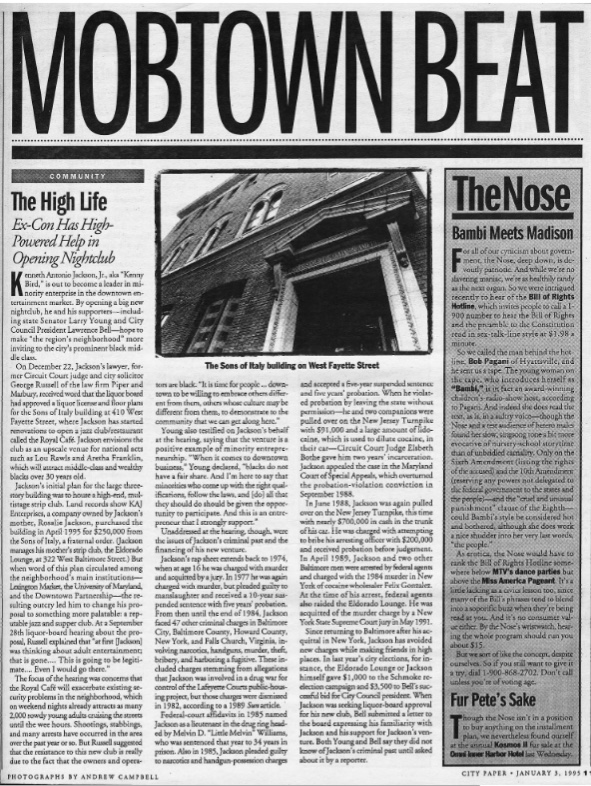
The High Life: Ex-Con Has High-Powered Help in Opening Nightclub

By Van Smith

Published in City Paper, Jan. 3, 1996

IMG_7492

Kenneth Antonio Jackson, Jr., aka “Kenny Bird,” is out to become a leader in minority enterprise in the downtown entertainment market. By opening a big new nightclub, he and his supporters – including state Senator Larry Young and City Council President Lawrence Bell – hope to make “the region’s neighborhood” more inviting to the city’s prominent black middle class.

On December 22, Jackson’s lawyer, former Circuit Court judge and city solicitor George Russell of the law firm Piper and Marbury, received word that the liquor board had approved a liquor license and floor plans for the Sons of Italy building at 410 West Fayette Street, where Jackson has started renovations to open a jazz club/restaurant called the Royal Café. Jackson envisions the club as an upscale venue for national acts such as Lou Rawls and Aretha Franklin, which will attract middle-class and wealthy blacks over 30 years old.

Jackson’s initial plan for the large three-story building was to house a high-end/multistage strip club. Land records show KAJ Enterprises, a company owned by Jackson’s mother, Rosalie Jackson, purchased the building in April 1995 for $250,000 from the Sons of Italy, a fraternal order. (Jackson manages his mother’s strip club, the Eldorado Lounge, at 322 West Baltimore Street.) But when word of his plan circulated among the neighborhood’s main institutions – Lexington Market, the University of Maryland, and the Downtown Partnership – the resulting outcry led him to change his proposal to something more palatable: a reputable jazz and supper club. At a September 28th liquor-board hearing about the proposal, Russell explained that “at first [Jackson] was thinking about adult entertainment; that is gone. … This is going to be legitimate. … Even I would go there.”

The focus of the hearing was concerns that the Royal Café will exacerbate existing security problems in the neighborhood, which on weekend nights already attracts as many as 2,000 rowdy young adults cruising the streets until the wee hours. Shootings, stabbings, and many arrests have occurred in the area over the past year or so. But Russell suggested that the resistance to this new club is really due to the fact that the owners and operators are black. “It is time for people … downtown to be willing to embrace others different from them, others whose culture may be different from them, to demonstrate to the community that we can get along here.”

Young also testified on Jackson’s behalf at the hearing, saying that the venture is a positive example of minority entrepreneurship. “When it comes to downtown business,” Young declared, “blacks to not have a fair share. And I’m here to say that minorities who come up with the right qualifications, follow the laws, and [do] all that they should do should be given the opportunity to participate. And this is an entrepreneur that I strongly support.”

Unaddressed at the hearing, though, were the issues of Jackson’s criminal past and the financing of his new venture.

Jackson’s rap sheet extends back to 1974, when at age 16 he was charged with murder and acquitted by a jury. In 1977 he was again charged with murder, but pleaded guilty to manslaughter and received a 10-year suspended sentence with five years’ probation. From then until the end of 1984, Jackson faced 47 other criminal charges in Baltimore City, Baltimore County, Howard County, New York, and Falls Church, Virginia, involving narcotics, handguns, murder, theft, bribery, and harboring a fugitive. These included charges stemming from allegations that Jackson was involved in a drug war for control of the Lafayette Courts public-housing project, but those charges were dismissed in 1982, according to a 1989 Sun article.

Federal-court affidavits in 1985 named Jackson as a lieutenant in the drug ring headed by Melvin D. “Little Melvin” Williams, who was sentenced that year to 34 years in prison. Also in 1985, Jackson pleaded guilty to narcotics and handgun-possession charges and accepted a five-year suspended sentence and five years’ probation. When he violated probation by leaving the state without permission – he and two companions were pulled over on the New Jersey Turnpike with $91,000 and a large amount of lidocaine, which is used to dilute cocaine, in their car – Circuit Court Judge Elsbethe Bothe gave him two years’ incarceration. Jackson appealed the case in the Maryland Court of Special Appeals, which overturned the probation-violation conviction in September 1988.

In June 1988, Jackson was again pulled over on the New Jersey Turnpike, this time with nearly $700,000 in cash in the trunk of his car. He was charged with attempting to bribe his arresting officer with $200,000 and received probation before judgement. In April 1989, Jackson and two other Baltimore men were arrested by federal agents and charged with the 1984 murder in New York of cocaine wholesaler Felix Gonzalez. At the time of his arrest, federal agents also raided the Eldorado Lounge. He was acquitted of the murder charge by a New York State Supreme Court jury in May 1991.

Since returning the Baltimore after his acquittal in New York, Jackson has avoided new charges while making friends in high places. In last year’s elections, for instance, the Eldorado Lounge or Jackson himself gave $1,000 to the Schmoke re-election campaign and $3,500 to Bell’s successful bid for City Council president. When Jackson was seeking liquor-board approval for his new club, Bell submitted a letter to the board expressing his familiarity with Jackson and his support for Jackson’s venture. Both Young and Bell say they did not know of Jackson’s criminal past until asked about it by a reporter.

George Russell would not comment for this article, but Jackson says of his criminal history, “I’m trying hard to put my past in the past.” As indication of his efforts to do so, Jackson points out several public-service awards he has received in recent years, including a 1994 Mayor’s Citation from Kurt Schmoke and a 1990 Congressional Achievement Award from Kweisi Mfume. He is active in the newly formed political-action committee, A Piece of JUICE, which works to get African American men involved in the political process.

Shortly before the April 1995 purchase of the Sons of Italy building, however, Jackson and the building both figured in an undercover FBI investigation into the drug-money-laundering operations of businessman Gregory Scroggins and attorney Zell Margolis, who were convicted in December 1995. First assistant United States attorney Gary Jordan, who prosecuted the case, says that in March 1995, Scroggins introduced Jackson to Edward Dickson, a man he though was a drug dealer but was actually an undercover FBI agent. The purpose was to convince Jackson to let Dickson in on the purchase as a “silent partner,” Jordan says. FBI transcripts of wiretapped conversations in the case document Scroggins’ opinion of Jackson, a childhood friend, as very wealthy, highly intelligent, and “the nicest guy in the world, but he’s a killer and he has killed.”

As for the nightclub’s financing, land records indicate that KAJ Enterprises obtained a $200,000 mortgage from Maryland Permanent Bank and Trust of Owings Mills to finance the $250,000 purchase of the Sons of Italy building. The mortgage calls for monthly payments of more than $2,300.

Meanwhile, court records indicate that Jackson’s employment at the Eldorado Lounge paid $325 a week in 1988, although he says he now makes substantially more than that. Since Jackson is a convicted felon, he cannot apply for a liquor license; Mary Collins, who refused interview requests, applied instead. She is a guidance counselor for Baltimore City Public Schools.

Regarding the financing for the new club, Jackson explains that all expenses not covered by the $200,000 mortgage so far have been covered by revenue from the Eldorado Lounge. The extensive renovations to the Sons of Italy building ultimately will require a sizable bank loan, he says, adding that the Eldorado Lounge has applied for a $500,000 loan from Nationsbank.

Asked why the liquor board did not inquire during the September 28th hearing about the club’s financing or whether Collins has the money to fund such a major investment, liquor-board executive secretary Aaron Stansbury explained that the board simply chose not to. He also stated that it is “obviously illegal” for a straw person to hold a liquor license on behalf of the actual owner of the club, but his understanding is that Collins is the club owner, while KAJ Enterprises is merely the landlord; Stansbury says that it is legal for a landlord to fund the building renovations on the club’s behalf. “It is presumed by the board that [the money for the club] comes from Mary Collins,” Stansbury said. Of Jackson’s criminal background, Stansbury said the board was not aware of it “to the extent that [Jackson] couldn’t manage the club.”

Mobtown Confidential: Thirty Years After His Mysterious Disappearance, Gentleman Racketeer and Block Kingpin Julius “The Lord” Salsbury Still Haunts Baltimore

By Van Smith

Published in Baltimore magazine, April 2000

IMG_7417

“Little Melvin” Williams is shouting through a thick sheet of Plexiglas at the Prince George’s County Detention Center. The burly owner of the recently defunct Scrapp Bail Bonds is awaiting sentencing on a federal conviction for possessing a handgun while on parole for earlier federal crimes related to his career as a major heroin trafficker. Williams has spent 22 of his 58 years in jail; he claims, among other things, to be an accomplished chess player, a martial arts expert, and a speaker of five languages. What he isn’t, he says, is a snitch.

“Mr. Levinson has made a devastating mistake!” he exclaims. “I’m known as ‘Iron Jaws’!”

The source of Little Melvin’s indignation is Liberty Heights, filmmaker Barry Levinson’s latest nostalgic ode to Baltimore. In the film, released last fall, an amiable, soft-spoken racketeer named Nate Kurtzman (Joe Mantegna) juggles his family life, his illegal gambling operation, and his burlesque business on the Block in the 1950s. His downfall comes via a gambling payoff owed to a villainous dope peddler named Little Melvin (Orlando Jones), who first kidnaps Kurtzman’s son and then rats on a bookie. Kurtzman is targeted for prosecution by the Feds and arrested on Rosh Hashanah at a Cadillac dealership. “You know,” Nate says to his lawyer, “over the years in my business, you watch enough shows, you learn. A good performer knows when to get off the stage.” Nate quits the game and gets eight-to-10 years in the Big House.

The movie is fiction, of course, but the real-life Little Melvin knows that the shuckin’, jivin’, bug-eyed bungler in the movie is supposed to be him. And anyone who remembers the Baltimore of a few generations ago can tell that the doomed gentleman racketeer is drawn from the man Williams says once “called me his godson” – Julius “The Lord” Salsbury.

Salsbury, like Levinson’s Kurtzman, was a Block kingpin who was hunted down by the Feds. Unlike his fictional alter ego, though, Salsbury was never caught. After appealing a gambling conviction, he jumped bail and fled the country in 1970, eluding capture ever since. Legend has it that he went to Israel to enjoy the protections afforded Jewish-American criminals under the 1965 U.S.-Israeli extradition treaty. The grapevine says Salsbury died a few years ago, probably in 1995; if he were still alive, he would be 84 years old.

But the Lord never really left town; in his long absence, Salsbury’s legend took on a life of its own. Novelists and filmmakers have mined his tale for material; journalists have told and retold what is known of his tenure as Lord of the Block and entertained speculative reports of Salsbury sightings. In the process, Julius Salsbury became Mobtown’s outlaw hero.

The Salsbury myth holds the Lord up as the benevolent peacekeeping patriarch of the Block-based numbers rackets, an honorable man in a rogue industry that – like the East Baltimore Street nightclub district itself during its fondly remembered heyday – was tinged with menace but basically harmless. The nostalgia-driven take on Salsbury  and the Block during its salad days remains common among Baltimoreans. History – at least the popular version of it – has been good to the Lord.

Little Melvin Williams knows all about that, because right now it is being less kind to him: When he’s sentenced in March, Williams will get almost 22 years without parole. He’s locked up, probably for the rest of his life, and cast as the villain in the latest retelling of his fugitive godfather’s story. And the Lord, as always, has escaped without a scratch.

IMG_7418

Born in Norfolk, Virginia, in 1915, Julius Salsbury was 12 years old when his parents, Isadore and Sarah, moved the family up the Chesapeake Bay to Baltimore and opened a lunch counter on Pratt Street downtown. At 16, Julius dropped out of Edgar Allan Poe school on West Fayette to start earning a living full-time. His first vocation – cab driver – began by the time he was 18. By 21, he already lived on the Block and was getting initiated in the rackets.

Salsbury’s education as a gambler was interrupted by World War II. His draft number was picked soon after Pearl Harbor, and he served as a military policeman in Europe. But before the war ended, he accompanied a prisoner back stateside and went AWOL. Salsbury was caught and did six months of hard labor. When he returned to Baltimore in 1945, he was a 29-year-old veteran with a dishonorable discharge and nothing much to do.

In short order, Salsbury was back in the bookmaking business. In between day jobs lending his father a hand re-treading tires, bottling soda, and running a bar, he began to build up a gambling network. He eloped to Miami with Susan Clara Wellman, a young waitress who had moved to Baltimore from Pennsylvania, because his parents didn’t approve of him marrying a gentile. And he took his lumps in the profession – a bookmaking conviction in 1948 was followed by another in 1950. But the battle scars from his run-ins with the law readied him for bigger and better things.

By the early 1950s, the lowdown on the Block was attracting out-of-town press. In Washington Confidential, the bestselling pulp expose from 1951, Baltimore’s red-light strip was described as “one of the most vicious and lawless areas in the world” by muckraking authors Jack Lait and Lee Mortimer. “At this writing,” they concluded, “any and all forms of vice are tolerated and protected. There is a price for everything and it’s not much.”

That same year, the U.S. Senate’s Special Committee to Investigate Organized Crime sent its investigators to root out the Baltimore underworld. Long-established racketeers cooled their heels to avoid trouble from the out-of-town heat. And into the vacuum rose the Lord.

The nickname came serendipitously. At a wrestling match at Carlin Park one night, a grappler called “Lord Salsbury” entered the ring; Julius Salsbury and his cohort, who were there to watch the fights, adopted the moniker on the spot.

It fit like a glove. Salsbury’s demeanor was soft-spoken, aristocratic, and confident – a good match with his distinctive, sharp-featured countenance.

His gambling organization, however, suffered its early setbacks. In 1952, Anne Arundel County police raided his Glen Burnie bunker in a case that Salsbury took to the U.S. Supreme Court and lost; he got six months in jail and a $1,000 fine. In 1954, he was nabbed for keeping a disorderly house and putting on an indecent show at Kay’s Cabaret, the Block bar he managed at the time. And in 1955, the Feds fined him $2,000 for failing to buy a required $50 gambling stamp.

But once Salsbury gained title to the Oasis Nite Club in 1956, he troubles with the law eased. Located at East Baltimore and Frederick streets, the club provided Salsbury with a way to wash his gambling proceeds. It also served as a home base from which to run a burgeoning empire. He bought a nice house in Cheswolde in Northwest Baltimore for his wife and three daughters. A fancy car and yacht rounded out the life of the late-1950s racketeer.

As a gambling kingpin and a Block bigwig, Salsbury was well-connected not only in the criminal world, but also with politicians and lawmen. The Lord operated in a carefully guarded region of society where criminal, political, and law-enforcement interests interweave – an area where corruption and cover-up put down deep and hidden roots.

People who worked for Salsbury remember politicians partying with Oasis girls on Salsbury’s boat. He was close friends with Baltimore political boss Jack Pollack. Pollack’s son, Morton, a lawyer and erstwhile Block habitué, says that “a lot of politicians, judges, and commissioners would go down to the Oasis at night.”

Retired Baltimore police lieutenant George Andrew, who headed the vice squad on the Block during the 1960s, suspected that Salsbury had high-up friends in the police department. “He really had somebody tied up,” Andrew recalls. “He knew somebody, but I don’t know who. But if I went on the Block, nobody would be there when I hit it. I wish I’d known – I’d have sent somebody to jail.”

Even Salsbury’s staunchest detractors admit that the man was a civilized racketeer. He shunned violence as an inducement for debt repayment; rather, he punished debtors by not allowing them to bet again until the account was settled. He was known as a generous philanthropist. And he didn’t hold grudges. When a drugstore owner on the Block was compelled to testify against Salsbury, the Lord stayed friendly with him and continued to eat at his lunch counter throughout the trial, just as he had done regularly for years.

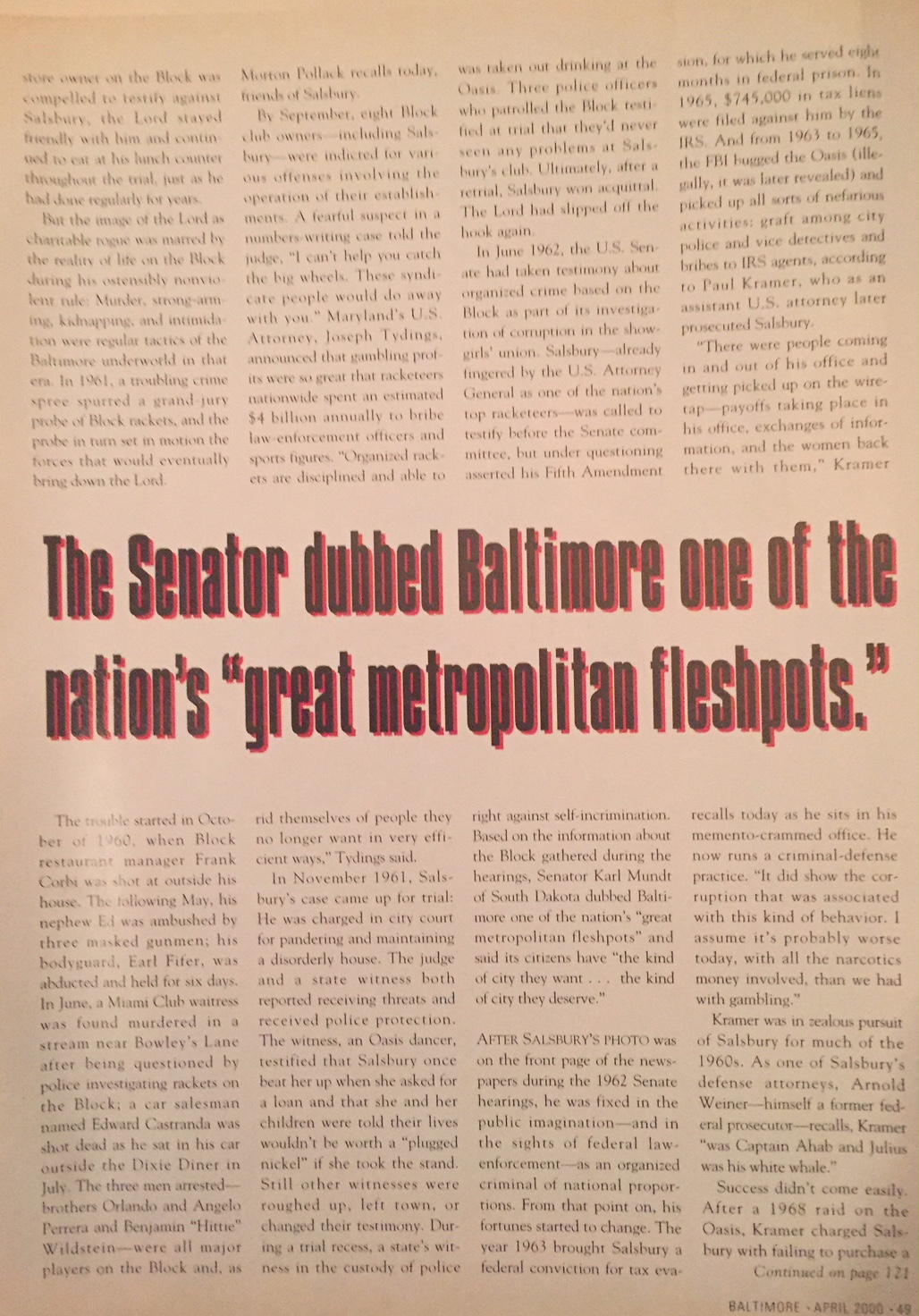
But the image of the Lord as charitable rogue was marred by the reality of life on the Block during his ostensibly nonviolent rule: Murder, strong-arming, kidnapping, and intimidation were regular tactics of the Baltimore underworld in that era. In 1961, a troubling crime spree spurred a grand-jury probe of Block rackets, and the probe in turn set in motion the forces that would eventually bring down the Lord.

The trouble started in October of 1960, when Block restaurant manager Frank Corbi was shot at outside his house. The following May, his nephew Ed was ambushed by three masked gunmen; his bodyguard, Earl Fifer, was abducted and held for six days. In June, a Miami Club waitress was found murdered in a stream near Bowley’s Lane after being questioned by police investigating rackets on the Block; a car salesman named Edward Castranda was shot dead as he sat in his car outside the Dixie Diner in July. The three men arrested – brothers Orlando and Angelo Perrera and Benjamin “Hittie” Wildstein – were all major players on the Block and, as Morton Pollack recalls today, friends of Salsbury.

By September, eight Block club owners – including Salsbury – were indicted for various offenses involving the operation of their establishments. A fearful suspect in a numbers-writing case told the judge, “I can’t help you catch the big wheels. These syndicate people would do away with you.” Maryland’s U.S. Attorney, Joseph Tydings, announced that gambling profits were so great that racketeers nationwide spent an estimated $4 billion annually to bribe law-enforcement officers and sports figures. “Organized rackets are disciplined and able to rid themselves of people they no longer want in very efficient ways,” Tydings said.

In November 1961, Salsbury’s case came up for trial: He was charged in city court for pandering and maintaining a disorderly house. The judge and a state witness both reported receiving threats and received police protection. The witness, an Oasis dancer, testified that Salsbury once beat her up when she asked for a loan and that she and her children were told their lives wouldn’t be worth a “plugged nickel” if she took the stand. Still other witnesses were roughed up, left town, or changed their testimony. During a trial recess, a state’s witness in the custody of police was taken out drinking at the Oasis. Three police officers who patrolled the Block testified at trial that they’d never seen any problems at Salsbury’s club. Ultimately, after a retrial, Salsbury won acquittal. The Lord had slipped off the hook again.

In June 1962, the U.S. Senate had taken testimony about organized crime based on the Block as part of its investigation into corruption in the showgirls’ union. Salsbury – already fingered by the U.S. Attorney General as one of the nation’s top racketeers – was called to testify before the Senate committee, but under questioning asserted his Fifth Amendment right against self-incrimination. Based on the information about the Block gathered during the hearings, Senator Karl Mundt of South Dakota dubbed Baltimore one of the nation’s “great metropolitan fleshpots” and said its citizens have “the kind of city they want … the kind of city they deserve.”

IMG_7421

After Salsbury’s photo was on the front page of the newspapers during the 1962 Senate hearings, he was fixed in the public imagination – and in the sights of federal law-enforcement – as an organized criminal of national proportions. From that point on, his fortunes started to change. The year 1963 brought Salsbury a federal conviction for tax evasion, for which he served eight months in federal prison. In 1965, $745,000 in tax liens were filed against him by the IRS. And from 1963 to 1965, the FBI bugged the Oasis (illegally, it was later revealed) and picked up all sorts of nefarious activities: graft among city police and vice detectives and bribes to IRS agents, according to Paul Kramer, who as an assistant U.S. attorney later prosecuted Salsbury.

“There were people coming in and out of his office and getting picked up on the wiretap – payoffs taking place in his office, exchanges of information, and the women back there with them,” Kramer recalls today as he sits in his memento-crammed office. He now runs a criminal-defense practice. “It did show the corruption that was associated with this kind of behavior. I assume it’s probably worse today, with all the narcotics money involved, than we had with gambling.”

Kramer was in zealous pursuit of Salsbury for much of the 1960s. As one of Salsbury’s defense attorneys, Arnold Weiner – himself a former federal prosecutor – recalls, Kramer “was Captain Ahab and Julius was his white whale.”

Success didn’t come easily. After a 1968 raid on the Oasis, Kramer charged Salsbury with failing to purchase a required $50 wagering-tax stamp; hours later, the U.S. Supreme Court struck down the law on which the case was based. Kramer came back at him in 1969 with a new harpoon – the Travel Act, which prohibits interstate transport of ill-gotten gains. That one connected: Salsbury was convicted and slapped with a 15-year sentence.

“For a guy who got convicted as a nonviolent gambler,” Kramer asserts, “the judge really threw the book at him.” The main rationale for the severity of the sentence Salsbury received, Kramer explains, was the public corruption bred by the Lord’s activities. “What made it was the amount of corruption that was associated with him: law-enforcement corruption, whether it’s the liquor board or federal agents or police officers. He even asked me if I could be corrupted, which I took as flattery.”

Salsbury appealed the conviction and – despite strident warnings by Kramer that the Lord would slip away – was allowed to remain free on bail pending the outcome. Days before the appellate court upheld the conviction, Salsbury fled. Given the high level of corruption surrounding the Lord, suspicions abounded that he had some high-powered help in making his escape.

“Where was the leak in the U.S. Court of Appeals when the decision came down?” asks E. Thomas Maxwell, a former assistant state’s attorney in Baltimore who prosecuted Salsbury in 1961. His raised eyebrows concerning the circumstances of Salsbury’s disappearance are common among afficionados of the Lord. Maxwell speculates that, if Salsbury had not fled and instead been imprisoned, information the racketeer had about public corruption could have erupted in scandal.

Kramer, however, says the question of whether someone leaked word of the appellate court’s decision in order to give Salsbury the opportunity to run is settled. “A lot of people thought that,” Kramer recalls. “There was an investigation and we determined that we do not believe that there is any evidence showing that there was any kind of leak out of the Fourth Circuit Court of Appeals.” Instead, Kramer believes Salsbury “was just playing the odds” on when and how the appeal would come down and fled town just in time.

The Lord took with him everything he knew about criminally culpable public officials, and in his wake he left a red-faced federal law-enforcement community. “The government was just embarrassed for many, many years” after the escape, says Maxwell. George Beall, who was U.S. Attorney for Maryland when Salsbury escaped, agrees. “It was an embarrassment to the FBI, to the government, that he was gone,” he explains. “They turned themselves inside out to try to solve the mystery.”

According to Kramer, Salsbury left his Horizon House apartment on Calvert Street and “went directly to Canada. We later determined that there was a safe deposit box in Canada. We finally got the search warrant for it and found it empty. The best we could determine was that he took a gambling junket to England, probably under an assumed name, and later we could prove he was in South Africa. Money was being funneled [to Salsbury] through Germany, we believe, from businesses being sold in Maryland.”

Besides the government, the other big loser when Salsbury fled was his friend and gambling colleague, the bail bondsman Robert “Fifi” London, who had posted a total of $80,000 bail that had to be forfeited, according to Morton Pollack. “I know for a fact that he was paid back” on Salsbury’s behalf by a third party, Pollack says. Fifi London died in the 1970s after a lengthy prison term for tax evasion, but his bailbonds firm lives on. In fact, Melvin Williams’ Scrapp Bail Bonds was (until it tanked due to Williams’ recent legal troubles) a subagency of London Bonding Agency.

Homicide author David Simon investigated the Salsbury case as a Sun reporter in the 1980s and early 1990s and concluded that the Lord ended up in Israel, living in a townhouse in Tel Aviv. Melvin Williams is full of insinuations that he had been in communication with Salsbury since his flight, has information about the Lord’s whereabouts over the years, and knows the truth about the man’s mysterious fugitive years. But, like any good gambler, Little Melvin plays that card close to his vest.

IMG_7422

Back in 1969, as the net closed in around Salsbury, Fred Motz served as co-counsel to lead prosecutor Kramer. Now the chief judge of the U.S. District Court of Maryland, Motz was one of the men who helped hunt Salsbury down, and he understands well why the Lord still haunts the Block. “As you get older, you can romanticize,” he says. “It is an overstatement to say that the Salsbury people were sort of like Damon Runyon characters. [But] there’s a certain poignancy to the fact that that is now gone.”

Never mind that the real-life Salsbury helped cement Mobtown’s still-thriving reputation as a hopelessly corrupt and dangerous town. Forget that, during his reign, the Block was wracked with shocking violence, and the widespread public corruption Salsbury instigated to protect his rackets undermined the public trust in honest government. From the perspective of modern Baltimore, the Salsbury era still inspires a certain nostalgia for the days of honorable outlaws and crime that seemed at least to be organized. Maybe, Motz guesses, it’s only because corruption and violence grew so much worse after he left.

“[Salsbury] was really in quite strong control of the Block, and … after he was taken out, rough people came in and there were a lot more murders,” Motz says. “Nobody’s saying that crime is appropriate, but you are going to have crime. There’s almost a sense of longing for [Salsbury’s brand of crime], as opposed to what you see out on the streets today. I think that’s one of the appeals of the Salsbury story. It is something from a different era. And one senses that things are different now than they were then.”

IMG_7423

Working Overtime: Drug Conspirator Eric Clash Says Cooperating Rehabilitated Him

By Van Smith

Published in City Paper, Apr. 1, 2009

His well-fitted gray suit and good-natured confidence lend 30-year-old Eric Clash the look of an earnest young professional as he stands behind the defense table on March 9 in U.S. District Court Judge William Quarles’ courtroom in Baltimore. With bright eyes shining under his clean-shaven dome and a light, trimmed beard on his chin, Clash doesn’t look like what he is: a second-generation drug dealer who, after agreeing to plead guilty to charges in a massive drug conspiracy, has spent the past three years helping the government make criminal cases. He appeared before Quarles on March 9 to ask for leniency, saying he left the thug life for good when he became a cooperator.

When Clash was first charged in 2005 as a member of the violent, politically connected Rice Organization drug conspiracy, which operated in Baltimore from the mid-1990s until the mid-2000s (“Wired,” Mobtown Beat, March 2, 2005), prosecutors seized about $150,000 from his bank account and said he “occupied a high level” in the group’s hierarchy. Today, with Quarles set to sentence him, Clash is projecting the image of a changed man in grave danger, due to his cooperation with authorities.

Of the 13 Rice Organization co-defendants, Clash is one of three who remains to be sentenced. The other two are Steven Campbell and Anthony Leonard, who also have been revealed in open court to have cooperated with the government. The remaining 10 Rice Organization co-defendants–brothers Howard Rice and Raeshio Rice, Chet Pajardo, Eric Hall, Robert Lee Baker, Michael Felder, Keenan Dorsey, George Butler, Oreese Stevenson, and James Jones Jr.–are serving prison sentences, with release dates ranging from two or three years from now until 2030.

In addition to bringing a steady stream of cocaine to Baltimore, the Rice Organization was responsible for violence, including murder. Among the businesses associated with the crew was Downtown Southern Blues, a restaurant on Howard Street’s Antique Row whose landlord was Kenneth Antonio Jackson, an ex-con and strip-club owner with a long history in the drug game and local politics (“The High Life,” Mobtown Beat, Jan. 3, 1995). Several Rice Organization members gave campaign funds to local politicians, some of whom held fundraisers at Downtown Southern Blues.

One of the Rice Organization members, Pajardo, co-owned an East Baltimore corner-store property with Hollywood actress Jada Pinkett-Smith, the wife of actor Will Smith (“Star-Crossed,” Mobtown Beat, Feb. 9, 2005). Another, Butler, was featured in 2005’s infamous Stop Fucking Snitching DVD, produced in Baltimore to warn off potential cooperators. Clash, who bought and sold Baltimore real estate including a westside bar called the Red Door during his drug-dealing years, is the son of Edward Clash, who himself was convicted of drug dealing in 1994.

Four Rice Organization rivals–Willie Mitchell, Shelly Martin, Shelton Harris, and Shawn Gardner–were convicted of numerous federal organized-crime charges last fall. Among them were murder charges arising from the 2002 stabbing of three Rice Organization members, including Clash and Raeshio Rice, outside the now-defunct Hammerjack’s nightclub in downtown Baltimore, after a birthday party for Baltimore-born rap mogul Kevin Liles. In February and March, three rivals received life prison sentences while Martin received a 400-month sentence.

Both Clash’s lawyer, Robert Simels, and his prosecutor, assistant U.S. attorney Jason Weinstein, tell Quarles that Clash is over and done with his former life in the game, and that he holds promise in lawful pursuits in the future.

Weinstein says Clash is an “extremely bright man” with “impressive potential.” He says Clash’s sentence reduction will be “richly deserved,” since “‘exemplary’ is the word I’d use to describe Mr. Clash’s cooperation.” He reminds the judge that Clash had “less of a role in the conspiracy” than two other indicted Rice Organization members, Steven Campbell and Anthony Leonard, who also cooperated as part of their pending pleas.

Simels’ job is easy, given the prosecutor’s lavish praise for his client: “It is rare in my experience that I have heard an assistant [U.S. attorney] speak as glowingly as Mr. Weinstein has of Mr. Clash,” he says. And Simels, a New York attorney with a decades-long history of representing major drug figures in Maryland (“Team Player,” Mobtown Beat, Sept. 24, 2008), who himself is currently under indictment in New York for witness tampering in a Guyanese cocaine case (“Big Target,” Mobtown Beat, Feb. 12), has plenty of experience.

Simels tells the court that Clash’s cooperation has been “remarkable in terms of his assistance to this community, and the United States as a whole,” as “set forth fully” in a sealed letter to the judge. He says Clash is married now, has professional expertise in real estate and construction, is taking classes, and has “adopted his faith as his guiding light.

“He’s not going to be in trouble again in the future,” Simels says. “At some point we have to demonstrate the sacrifice that he’s made” and “make sure the reward is an appropriate sentence.” The attorney recalls that at one point putting Clash in the witness-protection program was discussed. He says that Clash’s cooperation puts him in danger, and “to incarcerate him at this stage puts a burden not only on the [U.S.] Bureau of Prisons, but also on Mr. Clash, who will be looking behind his back at all times.”

Simels suggests that Quarles impose a “non-incarceration form of sentence.”

“I am pleading for leniency to save my life,” Clash tells Quarles on his own behalf. “I have put my family in jeopardy, myself in jeopardy. . . . I am here to better myself.” Clash says he now plans to help steer people away from crime. “When I was living that lifestyle, I knew it was wrong,” he says. “Nobody forced me into the decisions I made.” He says he wants to write a book to help others, especially children, get the direction he lacked when he was younger.

Clash tells the judge that while he was cooperating with the government, he spent three months working as a mortgage broker in New York, and that he went to Detroit, where he learned about educational broadcasting while working on a documentary for a major cable channel.

Quarles tells Clash that his cooperation “goes some distance to correcting some of the damage you and your cohorts inflicted on this community [by] bringing in more than 3,000 pounds of cocaine.” Instead of the 10-year sentence the federal guidelines call for, Quarles gives Clash 48 months, with credit for 16 months already served.

After the sentencing, U.S. Attorney Rod Rosenstein explains that Clash received an extraordinary break. As a matter of policy, Rosenstein says, his office recommends a two-level departure for cooperators who help prosecutors in the case they are charged in, and two more levels if they help in other cases. In Clash’s case, he says, Weinstein recommended that Clash get the standard four-level departure for cooperators that helped in cases other than their own, but Quarles tacked on two more, for a total of six years shaved off the sentence.

“You really have to do a lot to get recommendations for departures of more than four levels,” Rosenstein says, but in cases of cooperators who go the extra mile, “we increasingly make exceptions to it. Ultimately, the judge decides.”

In this case, Quarles decided that Clash’s work helping prosecutors was valuable enough to schedule him for release from prison in late 2011, and, in order to enhance his safety, to have him assigned to prisons that maximize protection from the expected threats of other inmates.

It may not be all the leniency Clash was hoping for, but it’s a pretty good deal compared to the long, hard time his old Rice Organization running buddies are serving.

Meet the Neighbors: 2000: My First Mistake–Calling the Cops About the Shady Characters Next Door

By Van Smith

Published in City Paper, Dec. 23, 2009

At first, in early spring, the business that took over the vacant garage on the alley behind my house seemed like it’d make a good neighbor. Evidently, it required only a blow torch and an air wrench powered via an illegal hook-up off the utility pole. The place hummed: zzzztch-zzzztch, vvvvt-vvvvt, all day long and sometimes into the night. I could see into the garage from my third-floor window, and learned that it worked on cars. With its door yawning open most of the time, it seemed not to have anything to hide.

But soon a fever prompted a series of events that started to change my attitude about the garage. Two o’clock in the morning rolled around and, sleepless blob of warm pus that I was, the ongoing racket boiled me over. One guy was working–zzzztch, vvvvt–and three or four others were playing music and generally having a cussin’ good time. I marched over, ducked under the arm of a guy who tried to block me, and became the textbook definition of the crazy white guy.

They quickly talked me down. The main guy–a giant of a man–was smiling, all mellow, and holding a fat wad of high-denomination cash in his hand, doubled over a finger. “I’m in charge, and I’m telling you right now, if you got a problem, you come to me, and I’ll take care of it.” He introduced himself as Blood, and his sidekick as Red. I went home, thinking, well, that went well.

The cash struck me, though, since I never saw any paying patrons. I put my long-lens camera on a tripod and watched. They were working on nondescript, second-hand cars, installing hidden compartments with electronically activated hydraulic lifts. I started to snap pictures and write down license-plate numbers of cars that frequented the place. I didn’t know what I would do with the information, but I was the homeowner here, and the criminal-renters would have to go.

I drove home in the wee hours one night to find there was no place to park, so I took an illegal space. Blood and Red’s completed inventory had taken over the neighborhood’s once-plentiful parking. I got up to re-park before dawn, and found the inventory–maybe 30 cars in all–was gone. They were doing a brisk business.

One late night in May, the crew was hanging out in front of the garage, smoking blunts and drinking and having a rowdy good time playing craps. The garage door was open, the cars lined up behind them. I called 9-1-1 and gave the operator the address, explaining that they were smoking blunts and gambling in plain view, but the true crime was inside, where they were refitting cars with hidden compartments for delivery of drugs, cash, and probably guns. A passing cop would end up with a major case instead of minor charges. I hung up and went out to my stoop to watch the show.

About a half-hour after the call, a patrol car pulled up to the intersection of the alley, slowed down, turned around, and drove off. That was it.

The next morning, an unmarked police car arrived, and two uniformed cops with portable radios got out and fist-bumped Blood. The three chatted a bit, then the cops got back in their car and drove off.

I realized I couldn’t call the cops on the garage anymore. Though no longer naive, I was very, very scared.

Soon, I contacted the FBI. I met with two agents. I gave them photographs and described what I’d been observing. They tried to persuade me to become a cooperator, to infiltrate the garage, to exploit the friendly terms I’d established with Blood and Red. I went ballistic and profanely refused. They told me that, absent that, it’d be two or three years before they could dismantle the operation.

Meanwhile, Blood and Red menacingly invited me to their Memorial Day cook-out, saying I would be the “guest of honor.” My spacious back yard–once a happy place, with a colorful picnic table and a fire-pit over which many sumptuous meals had been prepared, and where my cats often lounged–became mysteriously and repeatedly bombarded with cinder blocks. For an entire weekend, Blood and Red tried psychological warfare on me, playing one song–“Charlie Brown, Charlie Brown, why is everybody always picking on me”–over and over and over again. Good grief.

I called a retired cop I know, who referred me to a veteran at the High Intensity Drug Trafficking Area task force. The HIDTA guy was enthusiastic, and so was I when he said, “Based on what you’re telling me, we can go in there tomorrow.” Then he asked if I’d shared the information with anyone else. When I told him about the FBI, he said, “You told the frat boys? Well, that’ll probably shut us down.” And it did.

So I called a prosecutor I know, who referred me to a Drug Enforcement Administration guy, who told me they’d maybe get to it on a rainy day someday.

At that point, I wasn’t eating properly, I was hardly sleeping, and I was chain-smoking. I had set up a comfortable chair by the tripod on the third floor, along with an oversized ashtray, a glass, and a bottle of Pikesville rye. I was obsessed with the garage, and it wasn’t healthy.

In July, I told a friend in New York about my nightmare, and he suggested I take over his apartment in August while he and his family vacationed. I did, but on the way out of town, I called the neighborhood association president. “At the next meeting,” I begged, “pass a motion that a letter be sent to zoning enforcement about what’s going on at that garage. I don’t think it’s zoned for what’s going on there.”

When I got back in September, zoning had rousted Blood and Red. The garage was empty again, and the alley had returned to safe, familiar normalcy as a comfortable haven for hand-to-hand drug-dealing and strung-out junkies. I breathed a long sigh of relief.