Talking Machinations: Vending Machine Co. Owner Wants Talking Head Property

By Van Smith

Published in City Paper, Jan. 24, 2007

In late December, Dan McIntosh erupted with expletives over the phone at the mention of Michael J. DePasquale Jr.’s name. McIntosh, who managed and co-owned the since-closed Talking Head Club on Davis Street, said he was mad because he believed DePasquale, who operates Millionaire Vending LLC, screwed him out of an opportunity to buy the building where the Talking Head operated. The deal would have saved the failing club, McIntosh thought, but when DePasquale stepped in and got a contract with the seller last fall, it was the final nail in the coffin.

“That fuckin’ cocksucker,” raged McIntosh, who is on probation in Baltimore County for drug dealing and has open Baltimore City criminal charges against him for harassment filed in November by DePasquale, who alleges McIntosh has left phone messages threatening to kill him and his wife (“Talking Head,” Jan. 3). The case is scheduled for trial on Feb. 20.

“He came into the Talking Head as a vendor, overheard me discussing the purchase, and two days later he puts in a contract on the building,” McIntosh said last month of DePasquale. “And then he didn’t buy it! He called me recently, left a nasty message, said he’d found out about my past and he’s going to ruin my life.”

DePasquale, whose company has had a jukebox, pool table, game machines, and bill changer in the Talking Head since the fall of 2005, recalled events differently in a phone call to City Paper on Jan. 5. “Those guys wanted me to come in with them on the club,” he said, referring to the group McIntosh was pulling together to pool resources for the purchase. “But they didn’t have anything to bring to the table – no money at all. Nothing. So I went on without them.”

DePasquale added that his contract to purchase the building was extended until Feb. 17, a contention that Jim Turner, the real-estate agent for the seller, Jae Y. Hwang, confirmed over the phone on Jan. 18. Turner would not disclose the agreed-upon price, saying that it is privileged information that he’s not free to share even though he’d like to. McIntosh said he’d paid for an appraisal that put a value of $270,000 on the building and contended that DePasquale’s bid was $312,000. Records show that the last time the building switched hands, in 2004, it went for $450,000.

On Jan. 5 DePasquale urgently wanted to share more information about his dealings with McIntosh, saying “your readers would find all of this very interesting” and setting up a plan to meet during the second week in January. But he abruptly stopped talking to City Paper after that phone call. His last communication was a phone message left on the evening of Jan. 5: “Got some news for you,” he said. “We’re actually going down tonight to the Talking Head with the police. They’re repossessing equipment that Mr. Daniel McIntosh is trying to steal, and he’s been trying to sell it on the streets. . . . And I’ve got the evidence for it. So Mr. McIntosh might be put in jail tonight.”

According to David Goldberg, DePasquale’s attorney, the repossession of Millionaire Vending’s equipment from the Talking Head went swimmingly. After filing a complaint in Baltimore City District Court on Jan. 2 against the Talking Head over the return of Millionaire’s machines, which the complaint asserted are worth nearly $27,000, DePasquale went to the club to claim them. “At this particular moment in time, [McIntosh] was a cooperative guy,” Goldberg says. “He was very congenial. There weren’t any fistfights or bombs thrown or anything like that.” The complaint, Goldberg explains, “was nothing sophisticated or sexy. It’s simply that Millionaire Vending requested the machines back and [Talking Head] wouldn’t give the machines back. Now that [DePasquale] has them back, the issue may have become moot.” McIntosh did not respond to messages asking for comment for this article, and neither did his business partner Roman Kuebler.

Goldberg says he advised DePasquale not to talk to City Paper any longer. “I told him not to talk to reporters,” he recalls. “I said that, based on my experience, they don’t write what you tell them to say, they write what they want to say.”

Like McIntosh, DePasquale has a tumultuous history in the courts. He was convicted of assault in Dorchester County on the Eastern Shore in 2001 and received a four-year sentence, with three years and four days suspended. He’s been charged with a number of other crimes, including impersonating a police officer, theft, writing bad checks, a battery charge, and another assault charge. In several of the cases the prosecutors declined to pursue the charges, and in the others he received probation before judgment.

DePasquale’s attorney in many of the criminal matters is from a Baltimore-based law firm, Silverman, Thompson, and White, that is now suing him for nearly $3,000 that it claims he owes; the case is scheduled for trial in February. The dispute is over services the firm provided in negotiating a lease for one of DePasquale’s companies, Vicious Boutique, which operated a sex shop out of the same address – 6506 Ridge Road in Rosedale – that is listed as the principal office of Millionaire Vending.

Vicious Boutique’s short existence–the public record indicates it was open for about a year starting in the fall of 2003–generated a handful of other lawsuits for unpaid bills. In particular, Jack Gresser, who owns real estate on the Block, including the old Gayety Theater, where the Hustler Club now operates, sued Vicious in 2004 and won judgments totaling more than $4,500 over pornographic DVDs and sex toys that weren’t paid for. Baltimore County Councilman Douglas B. Riley, Gresser’s lawyer in those cases, says, “We got a judgment, and when we tried to collect it had gone out of business. When we got to the store to seize the property, it was empty.” The case file indicates that neighbors said DePasquale had moved to Florida.

In Dania Beach, Fla., near Fort Lauderdale, DePasquale owns another vending machine company called Tripleblaster Vending. That company was recently dissolved due to its failure to file an annual report with the state of Florida. In 2005, DePasquale used Tripleblaster checks to pay for about $2,500 in veterinarian services from the Academy Animal Hospital on Belair Road. The first check was drawn from a closed account, according to the court file of the criminal bad-check charge that the vet filed, while the other was returned for insufficient funds. Also in 2005, DePasquale was charged in Baltimore County with cutting a bad check to Komar Co., a pornography wholesaler in Hampden, but prosecutors declined to pursue the case.

These and other cases of DePasquale coming up short on the bills, or not paying off court judgments, raise the question of whether or not he can make good on his contract to buy the Talking Head real estate. The building’s current owner, Jae Hwang, repeatedly says, “I have no idea,” or, “I really don’t know,” when asked about DePasquale and his troubles.

February will be the month when many of these issues will be resolved. That’s when DePasquale’s contract to purchase the Davis Street building expires, when the law firm’s suit against him goes to trial, and when his criminal harassment charge against McIntosh will be adjudicated. What remains unclear is how DePasquale’s contract to buy the building contributed to the already-failing Talking Head’s ultimate demise. To DePasquale, it was all just business-rejecting an offer to come in with cashless partners and instead pursuing the deal on his own. McIntosh, though, said, “All the shit that he put us through, it was a lot to deal with.”

Talking Head: “Talking Dan” And The Demise Of A Davis Street Nightclub

By Van Smith

Published in City Paper, Jan. 3, 2007

Daniel Gerard Joaquin McIntosh Sr. manages the Talking Head Club downtown on Davis Street, where he’s better known as “Talking Dan.” In the run-up to the club’s announced Dec. 31 closing, though, McIntosh and the club’s president and liquor license holder, Roman Kuebler, kept mum, declining to talk with City Paper music editor Jess Harvell. Working on a story about the closing, Harvell consulted City Paper‘s news side, searching for ways to hunt up the current owner of the building where the business is located. Ten minutes of internet searching later, and it began to look like Talking Dan–who has a lengthy record of criminal charges, including a 2005 pot conviction–might be part of the Talking Head’s problem. Once McIntosh was informed of the findings on Dec. 28, he addressed such concerns at length over the phone.

“I sold some pot, I got into trouble for it,” McIntosh, 31, says of his criminal record. “Apparently now everything I’ve done in my past is going to be an issue with the Talking Head.”

McIntosh says that Kuebler was aware of McIntosh’s troubled past with the law before bringing him in as a partner in the business a few years ago, and that Kuebler was understanding when McIntosh was convicted in 2005 in Baltimore County of possession with intent to distribute marijuana.

“He said, `I know you’re a good person,'” McIntosh recalls Kuebler saying, “`I’m your friend, and I’m not going to hold this against you.'” Kuebler did not return phone calls for this article.

McIntosh asserts that his legal entanglements have nothing to do with the Talking Head closing, which instead is due to a recent financial coup de grace. “We were beating a horse for four years, to make it move,” McIntosh says of the club’s struggling operations, “and then stuff like that happens.” The “stuff,” McIntosh explains, revolves around preparations he and others had made recently to purchase the Talking Head building at 203 Davis St. Their efforts, which McIntosh says included paying for a $2,600 appraisal, came to naught when the club’s vending machine provider, Michael J. DePasquale, Jr., got a contract to buy the place from under the Talking Head. Compounding this wrinkle, McIntosh adds, was the club’s ongoing inability to make timely rent payments and the status of its lease under changing property owners.

What McIntosh didn’t know was that DePasquale filed criminal harassment and telephone misuse charges against him on Nov. 12, 2006, and that a trial date in the case is scheduled for Jan. 4. “I had no idea about that,” McIntosh responds when told. “Wow. That’s very interesting. I’m on probation for my other shit. My next call will be to my attorney.”

DePasquale’s complaint states that McIntosh was “threatening me and my wife” because “he objects to me purchasing a property, that we are settling on 11-17-06–he is a tenant there.” The complaint says DePasquale has saved recordings of threatening messages from McIntosh. “I have told him to stop,” the complaint ends, but McIntosh “continues to threaten our lives and violence [sic].”

DePasquale, reached by phone on Dec. 28, declined to comment, saying the criminal complaint against McIntosh speaks for itself. As for McIntosh’s claim that DePasquale sought to snatch the property up from under the Talking Head, DePasquale says, “you’re a reporter, you know not to believe that.” McIntosh says that DePasquale’s contract to buy the building has since lapsed.

McIntosh, meanwhile, says he would prefer the Talking Head go out gracefully, with prospects for re-opening elsewhere. “I wanted to end it on a happy note,” he says. “I tell you, I just like rocking and rolling, and I’m trying to end it on a nice, exciting note. We’ve discussed a few locations–in a neighborhood of some kind, maybe Hampden.

“I grew up in Hampden, and I’d be into bringing something back, to go back and offer something of pure substance,” McIntosh continues. “I know the names of a lot of those junkies on those corners in Hampden, ’cause I’m a very rare case, one of the few who I came up with who did not wind up junkies or in jail.”

Actually, McIntosh acknowledges, he’s been both a junkie and in jail. In the late 1990s, he did time in York, Pa., on drug charges, and earlier in the 1990s “I was a straight-up fucking junkie–but I don’t see what that has to do with the Talking Head,” McIntosh says. Since then, his troubles have continued, though he says his “intent is pure” and that his more recent legal imbroglios amount to “a few questionable things in the eyes of some,” as opposed to his earlier misdeeds, which were “questionable things in the eyes of everyone.”

The 2005 Baltimore County pot conviction, McIntosh says, wasn’t as big a deal as it appeared. “They had a tip that I was some kind of drug kingpin and came in looking for 100 pounds of weed,” he recalls of the Nov. 3, 2004, raid on his Pikesville home. “And they walked away with an ounce and a half.”

According to the court file, the raid also turned up lights for growing pot and $4,800 in cash. On the same day, police followed McIntosh to another location in Baltimore City, where they recovered 36 live pot plants, six pounds of pot, $41,742 in cash, and two guns.

“They followed me to his house and busted his house,” McIntosh recalls, adding that “it was kind of my fault” the location was raided.

McIntosh was not convicted in connection with the Baltimore City haul, only with what was at his Pikesville home, and he pleaded guilty. The court noted his prior convictions–a 1993 assault and a 1997 drug possession with intent to distribute–and gave him a three-year suspended sentence, 80 hours of community service, and two years of supervised probation.

Just before midnight on Nov. 15, 2004–the day before he was indicted in Baltimore County as a result of the raid–McIntosh was pulled over on Calvert Street in Mount Vernon for having a headlight out. He was found to have a suspended license for outstanding child-support commitments; the arresting officer searched McIntosh and found six Valium pills in his pocket. For that, on Feb. 14, 2005–two days before his Baltimore County pot conviction–McIntosh earned a drug-possession conviction with a 90-day suspended sentence and one year of probation.

Since 2002, when the Talking Head first opened, McIntosh has been embroiled in a series of legal battles with the mothers of two of his three children. McIntosh’s need for legal representation on these matters (not to mention the criminal cases), on top of the responsibilities of being a father providing for his children, translate into a need for income that the Talking Head hasn’t met recently, he says.

The club, McIntosh says, “doesn’t pay anybody anymore, and hasn’t been for six months, and I essentially stopped working there.” Instead, he says he “does a lot of construction work,” and collects rent on properties that he’s involved in. “I come from poor,” he stresses, “so I just roll around and get it where I can–it’s all just money in my pocket.” Things are looking up, financially, he says, since he moved recently to Sparks in Baltimore County.

Since McIntosh’s problems overlap with the Talking Head’s problems–at least insofar as the pending charges filed by DePasquale are concerned–McIntosh seeks to distance himself from the club. “I’m not actually the owner of the company,” McIntosh asserts. But the 2005 renewal application for the club’s liquor license, which was filled out by Kuebler, the licensee, lists McIntosh as 25 percent owner, with the rest belonging to Kuebler. “That’s roughly true,” McIntosh says, “but that’s just something that Roman said–there’s nothing in the company’s corporate charter about that.” Kuebler did not respond to requests to clear up the questions about the club’s ownership structure.

McIntosh, meanwhile, decries City Paper‘s interest in his problems. “This is not something the alternative press should be doing,” he says, adding that “you’re going after the wrong side here.” His complaints about City Paper aren’t new. In the 2005 Best of Baltimore issue, the club was designated “Best Rock Club,” and, while praising its esoteric bookings of local and traveling bands, the write-up included an unsupported observation about Talking Head Club’s “laissez-faire approach to underage drinking.” The paper apologized in print for the misstep, but McIntosh was agitated by the insinuation.

In talking about his problems and the end of the Talking Head for this article, though, McIntosh speaks at length, in reasoned tones, with an it-is-what-it-is attitude.

“I just felt the need to call you and say a few things because it would be a shame for all who are involved with the club to be tarnished by me,” he says. “I’ve looked at my [court] record before, and said, `That guy’s a fucking killer,’ so I can understand” why it’s newsworthy. “But, as crazy as [the record] looks, every single one of those things is easily explained. It’s all been blown out of proportion.”

Talking Trash

I couldn’t believe my eyes. Baltimore loses one of its only small venues promoting indie/avant music and you eulogize the loss with a smear piece (“Talking Head,” Mobtown Beat, Jan. 3). Dan McIntosh’s criminal record has absolutely nothing to do with his management of the Talking Head. If anybody at City Paper really got to know the guy, they would realize his heart is in the right place. As 2007 dawns the future looks grim–no Talking Head and an alternative weekly that has descended journalistically to the level of a shitrag.

Matthew Selander
Baltimore

“Travesty” sums up Van Smith’s recent pulp schlock, ostensibly on the long-anticipated closure of the Talking Head Club, but more so a hatchet job of sensationalist journalism. I’d imagine it would be more than a little embarrassing for CP‘s senior editors to concoct apologia for Smith’s giddy voyeurism masquerading as investigative reporting.

The irony, however, is at our voyeur’s expense. His breathless expose of the seedy inner workings of this fringe club confuses a “scoop” with public knowledge. Didn’t he find it a little striking how unabashedly candid Dan McIntosh would be with a reporter, and on the record? Besides, anyone with even a pedestrian familiarity with the goings-on of the Davis Street building over the past decade-plus, including years long before McIntosh ever made his mark, might find the prudish swoon of the piece a little sigh-inducing. “Vice in a dive bar!? Well, I NEVER…!”

With questions about a third incarnation of the Head remaining just that, I think we can do without the boring kind of rock-scene hagiography we’d often get at a time like this. However, I can’t help but lament a wasted opportunity to give voice to the thoughts of the many Davis Street faithful that damn near grew up in that weird Tudor hovel, or at least give a decent account of its time as the Talking Head with some sense of context and history for the younger crowd.

But then again, maybe it’s kudos for Smith over on Park Avenue; his muckrake has caught whiff of just the kind of juicy poot that CP intends for the Annals of Baltimore Scene Legend! Or maybe they could just dig a little deeper into that DePasquale guy for some truly buff stuff….

Michael Baier
Baltimore

So City Paper did a bit on Dan from the Talking Head in regard to its closing. Whereas an article on the history of the building, who’s been in there–Talking Head, Ottobar, pre my time, etc.–and all the great stuff the place has done would have been rad, instead City Paper decided to smear Dan across the page.

I pretty much think that is horseshit.

Are you going to tell me everyone has a clean past with no screwups? Hell…I was arrested at the age of 14 for possession and attempt to distribute with marijuana and speed and subsequently expelled from high school for a year. I have had many an unpleasantly ending relationship that you could dig some dirt up on, I’ve stolen, got in fights, did my share of property destruction here and there, played the I-don’t-care-about-anyone-but-myself gig…but you know, that is what got me to here, where I am today: operating the Baltimore Free Store and really being able to make an impact on Baltimore.

Running Dan into the ground was a low blow and really put a bad taste in my mouth with regard to City Paper. We all have skeletons in our closet. I don’t see why it is necessary to display them to the world, especially when it seems like all it is is a back and fourth between City Paper staff and one individual. I don’t see how his past has anything to do with the Talking Head. If you were trying to pass judgment on his managing abilities as reasoning for the closing of the Talking Head, then you need to bring up issues that relate to business practices, not drug use or issues within his personal life.

I love you, City Paper, but sometimes you make me want to use you for kindling rather than reading.

Matt Warfield
Baltimore

Your story about the closing of the Talking Head nightclub sounded more like an episode of America’s Almost Wanted than it did a story about a group of Baltimore artists, entertainers, restaurateurs, and impresarios who came together earlier in this millennium to successfully establish and run an extraordinary music, social, and beverage venue by, of, and for the people of Baltimore.

And despite your insinuations to the contrary and your largely irrelevant information about the club, the folks who kept the Talking Head going these years (including the “president and liquor license holder” Roman “Guitar” Kuebler) in my view have consistently behaved conscientiously and even scrupulously with regard to their legal and dare-I-say social responsibilities and obligations under the law; this continuing attitude on your part to suggest otherwise borders on libel, and if not that, at least dickheadism of the worst kind.

I for one would rather know how the joint came to be, who played there, who went there, and where they will go now in Baltimore for a true alternative venue.

Frankly, the building on Davis Street, in my opinion, is a not-quaint, disgusting firetrap with dysfunctional plumbing, poor acoustics, and not nearly enough “liebensraum” for the rockers and rollers and movers and groovers who happily congregated there and supported the noteworthy tunesmanship of the Talking Headers.

Its new owner would do well to erect a nice little parking structure or another “badly needed” law office building. Seriously.

Hopefully, the TH folks will find new permanent quarters and continue bringing the Baltimore experience to music lovers from around the globe and beyond.

And why don’t you investigative journalists down at City Paper cut the Chris Hansen-esque bullshit and do something productive with your talents like reviewing my album.

Walter T. Kuebler
Lutherville

The writer is Talking Head co-owner Roman Kuebler’s father.

I was shocked and appalled at the article this week about the end of the Talking Head. I can only hope anyone who knows anything about that place, its owners, and their ongoing feud with your paper sees right through the thinly veiled final stab you took at Dan McIntosh now that you don’t need to coax him for his advertising. However, that actually isn’t why I was so angered. What has angered me is you chose to print a pointless story, when the real story there was about the building itself, and its place in Baltimore music history. I came across that history in the late ’80s, performing some of my first gigs in a band at the club called Chambers, and from that point on in my life, that building became synonymous with good underground music and a place where Baltimore’s underground could come and be their freaky selves. From those days of Chambers, to the birthplace of the Ottobar, to its last incarnation as the Talking Head, 203 Davis St. has been an integral part of the music scene in this town for over a quarter of a century. What occurred on New Year’s Eve, when the Head shut its doors for good, was not the death of one club, it was the death of an era. Instead of eulogizing it properly, you spit on the grave, and for that you should be ashamed.

Lonnie Fisher
Baltimore

The writer is the proprietor of Sonar, where Dan McIntosh now works as a manager.

Editor Lee Gardner responds: For the record, there is no ongoing feud with the Talking Head, at least on City Paper‘s part. I’ve known co-owner Roman Kuebler for at least a decade; I like him and respect him. My only encounter with Dan McIntosh was essentially an extended argument, but he impressed me as a passionate guy. In the wake of dust-up regarding the 2005 Best of Baltimore issue–an incident, speaking personally, that I regret–City Paper employees continued to frequent the club and we continued to write about its shows. We were a media sponsor of its Reverent Fog Festival last September and awarded it Best Rock Club again in the Best of Baltimore issue that same month.

As explained in Van’s story, we fully intended to do a fairly standard farewell-to-the-Talking Head story in our No Cover space. Noncooperation from the club’s principals led to some cursory internet research to try to confirm some basic facts, which lead us to information about McIntosh’s criminal record, and the still-pending complaint from Michael DePasquale. Given the paper’s lengthy history of reporting on the junctures where crime and nightlife intersect, whether benignly or otherwise, it seemed necessary to follow up on that information. Under similar circumstances, we would have done the same with any club.

Believe it or not, I’m sorry the Talking Head is closing, and I sincerely hope that the folks behind it can re-establish a sustainable version of the club elsewhere. For better or worse, we will continue to write about it then, too.

Wetlands: Exploring the Shrinking, Sinking Islands of the Chesapeake Bay

By Van Smith

Published in City Paper, May 23, 2007

Taylor's Island House 7

The white strip along the Barren Island shoreline looks like a sand beach nestled in front of a stand of pine trees, a perfect place to rest after the two-mile crossing of Tar Bay by kayak from the Eastern Shore’s Upper Hooper Island. Upon arrival, though, the beach turns out to be an eroding, wave-battered heap of old oyster shells that’s been spread along the island’s edge. The Chesapeake Bay has been licking away at the shell mound, unearthing its contents. Ten minutes of beachcombing yields a handful of weathered pottery shards and an arrowhead with a broken-off tip, likely artifacts of the Nanticoke Indians who once feasted here. Not bad for a brief and unexpected treasure hunt.

In time–a time that’s likely not far off–the treasures of Barren Island will be buried again, this time a yard or so beneath the surface of the bay. The island is going the way of Atlantis, sinking in rising seas like the rest of the Chesapeake coast. Scenes of destruction are dramatic where land is swallowed up in big bites: remnants of old buildings and bulkheads succumbed to storm and tide, forest edges tumbling directly into the bay, small soil cliffs formed at the water’s edge where fields and salt marshes surrender chunks of acreage to Neptune. This inexorable process, seen up close from the low-lying comfort of a shallow-draft paddling craft like a kayak or canoe, is eerily fascinating.

At Barren Island, which has historically lost an average of five acres a year, the seas have claimed tracts that the maps still show as part of the island, and visitors can paddle over what had been land just prior to the last heavy storm. The land loss here and elsewhere along the bay, seen firsthand from the water, is more palpable than on the many TV shows and documentaries that have been made about the effects of the Chesapeake’s rapid rise. One can literally reach out and touch the evidence, or stand on the bay’s bottom where, until recently, dry land had been.

Submerging islands like Barren and its northward neighbor, James Island (pictured), eventually will join sunken ones, like Sharps Island. North of James and a few miles west of the Choptank River’s wide mouth, Sharps used to house a hotel, a small farm, and a steamboat pier. For about 50 years now, the erstwhile island has been underwater, nothing but a shallow stretch of the bay marked on the charts as a nautical obstruction. (Which it is, judging by the 712-foot cargo ship that was stuck in Sharp’s shallow muck for a week this past winter.) Barren Island’s last human residents abandoned its farms, stores, school, and church a century ago; if nature continues its course, Barren, too, soon will be a patch of shoals.

A vessel, a destination, and a willingness to negotiate the logistics of getting there are all one needs for an outing to witness the action of the Chesapeake’s diluvial tendencies. The first part is the easiest for those who own or can borrow a kayak or canoe. Others must seek outfitters, a list of which can be found on the Maryland Department of Natural Resources web site at dnr.state.md.us/outdooradventures/guideeast.html. The last two parts–picking a destination and reaching it–are where the adventures begin.

William Cronin’s The Disappearing Islands of the Chesapeake is a good place to start when thinking about where to go. The book chronicles the histories of 42 bay islands as they’ve grown smaller and is illustrated with A. Aubrey Bodine photographs showing how things looked a half-century or so ago, more recent images of coastal destruction, and maps new and old to demonstrate erosion’s unrelenting hand. For more inspiration, Bodine’s books of photography, especially 1954’s Chesapeake Bay and Tidewater, are worthy companions when choosing a spot to head for. Having narrowed it down to an enticing destination or two, a copy of Delorme’s Maryland-Delaware Atlas and Gazetteer (Delorme.com, [800] 561-5105) will help pinpoint what roads to take to the closest boat ramp, and the location of a nearby campground to use as a base.

Once on the water, a portable, waterproof GPS device is useful. Not only can it (along with a handheld marine-frequency radio) serve as a crucial tool for nautical safety, but it will mark paths on its map screen to show the routes traveled. When kayaking around James and Barren islands, the GPS bread-crumb trails dotting the topographic map will appear largely over land. Paddlers using a GPS while hugging an island’s perimeter function as amateur cartographers, drawing its most up-to-date boundaries and thereby creating striking imagery of the impacts of sea-level rise on the bay’s coastline. Lacking a GPS, a nautical chart is an essential co-pilot.

The Eastern Shore’s Dorchester County is an obvious destination, as the effects of sea-level rise there are particularly dramatic. Blackwater National Wildlife Refuge is Dorchester’s main outdoors attraction, where extensive salt marshes are rapidly giving way to open water, and many old homes lining the county’s low-lying roads have been abandoned due to the Chesapeake’s intrusion. Just west of the county’s bay-facing shoreline are Barren and James islands, which are relatively easy to paddle to, weather conditions permitting.

Camping in Dorchester County is limited to three private campgrounds that mostly function as trailer parks, and two of them are on Taylor’s Island. Given its tiny marina–a mere notch on the coastline–the Taylor’s Island Family Campground ([410] 397-3275) is most convenient for a trip to nearby James Island, and it’s but a short drive to the put-in for paddling to Barren Island. Its small area for tent camping is in the marshy pine woods behind the last row of trailers, a short walk to the showers, a convenient store with a liquor license, a pool room, and a shack filled with video-poker machines. The most prevalent patrons here are beer-drinking men in baseball caps telling fish tales by fire pits, their boats nearby, hitched to pickup trucks. But paddlers are more than welcome to join in the fun.

The bay regularly beats up on Taylor’s Island, with land-moving equipment and piles of rubble along the campground’s battered bulkhead serving as reminders of the constant effort to hold back the tides. Just south of the campground, the coast is rimmed with pine trees fallen out of the woods hugging the high-tide line. North of the campground, miniature coves have been gouged out of the tide marsh by the lapping waves. At the end of the peninsula at the mouth of Oyster Bay, another mile northward, an abandoned, weather-beaten house is awaiting a storm to carry it away, and the farm fields next to it end at the water, with a sharp precipice: a smaller, darker cousin of the famous White Cliffs of Dover.

Bald eagles seem to like this stretch of Taylor’s Island coastline. They perch in high, dead pine trees, or on a ramshackle pier near a crude duck blind, pulling apart rockfish. When visitors get too close, they fly off, wheeling majestically in the air. Eagles are so abundant here, they quickly become a dime a dozen, and a pair of diving loons soon surpasses them as a more unusual sight.

James Island is about a mile into the bay from Oyster Cove, and from that distance, it looks to be forested. Author William Cronin found that it had first been settled in the 1660s, when it covered 1,350 acres and was attached to Taylor’s Island, but as of 1998, James was split up into three small remnants totaling less than 100 acres. It’s even smaller today, as becomes apparent while crossing the passage to it at the mouth of the Little Choptank River. Its remaining pine stands are sparse, and a recent storm knocked many of them into the bay, their needles still green as they soak on their sides in the brackish water. Some of the still-standing trees are gray and dead. Where the island’s salt marshes have fallen away en masse, one can imagine that the embedded pilings and timbers at the edges are all that remain of what was once a pier. So little remains today that it takes an active imagination to envision the island as having been inhabited once.

One of the James Island maps available on-line at Maptech.com shows a cemetery, and Cronin reports that 20 families lived on James in 1892. But the burial plots likely are underwater now, or the grave markers have sunken into a marshy area. The remaining landmass is too small to support the Sitka deer population that was imported to James in the early 20th century.

Gunkholing the coasts of the three little islands that now make up James is a telling erosion tour, but also part of the story are former pieces of the island that are now submerged off the coasts. The waves washing over them call them to attention, and one, a couple hundred yards offshore, is extensive and shallow enough to stand on. A sand-and-shell crescent beach on the north-facing side of the middle remnant is a draw for picnicking locals, and for beachcombers it yields occasional pottery shards and “mermaid’s tears,” pieces of sea glass worn by the waves.

Barren Island’s storied history involves family farms and commerce, like James’ does, but adds the dash of modern politics. The late, long-term Maryland comptroller Louis Goldstein, who died in 1998, once owned the island, and former Maryland governor Marvin Mandel was entertained at the since-submerged Barren Island Clubhouse. Cronin’s book has two photographs of the hunting lodge, one taken around 1950, looking grand with two tall pines standing as sentries at the base of the wide staircase at its entrance. The other, taken in 1987, shows it collapsing into the bay. He reports that its foundation still lives on, underwater, though so much of the island is now submerged it is hard to say where to find it.

Barren, which is home to heron rookeries and is visited by scads of migrating ducks, is now owned by the U.S. Fish and Wildlife Service. The federal government has designs on Barren and James islands–a plan to save them from Sharp’s fate by building new bulkheads and filling the shallows behind them with dredging spoils from the Chesapeake’s shipping channels. The U.S. Army Corps of Engineers last fall advertised its latest report on the plan, which would create a combined total of more than 2,100 acres of new land at James and Barren.

If the government’s plans end up forestalling the ultimate submergence of these islands for a while, Cronin’s book still describes 40 other disappearing bay islands to tour. Paddlers won’t soon run out of stops on an erosion tour. And someday, the rising tides will create new islands to explore in what today are uplands. In the meantime, the archeologically inclined can still try to claim those arrowheads before Neptune does.

Thanks for Sharing

By Van Smith

Published in City Paper, Nov. 14, 2007

IMG_7516

My father seemed every bit the academic surgeon he was. His patient, professorial airs, strikingly polite and unpretentious, draped over him like the well-tailored suits he usually wore for work and family occasions. One Thanksgiving in the mid-1990s, just after my mother called out that dinner was about ready, Dad announced that he had something he wanted to show us.

“Before we sit down to eat, I’d like everyone to come into the TV room and see a VCR from my very successful doctor’s visit,” Dad said. “It’s very short, but it’s very important, and it’s a very good sign that Grandpa’s in good shape inside,” he explained as his grandchildren, all of them old enough to understand (and very much like) the words “VCR” and “TV,” expectantly gathered around the screen.

I don’t know about the rest of the adults present, but I thought what was to come would be something quite clinical and inscrutable, like blood cells moving around with running commentary by Dad, partly in Latin. That’s the type of thing that usually happened when he waxed about medical topics.

When I heard the word “colonoscopy,” my jaw dropped. It was too late to stop what was already happening. Nearly a dozen brains tried to process the hazy pink, gray, and brown images a tiny lens and light had recorded earlier that week, while traveling up Dad’s bum. “See how pink it is?” he cooed. “Now that’s a healthy-looking colon.”

Everyone watched, paralyzed and silent, as Dad explained that the camera was now bumping up against an interior sphincter muscle, now passing through it, and now, after traveling as far up as it could go, backtracking. Thwoop, back through a muscle ring, back, back, more pinkish tissue until . . . thwoop, back through another muscle ring . . . and there it was. A picture of my father’s anus, flashed up on the TV screen. It was up there for a second or two, a still image at the end of the tape.

As soon as it was over, I told Dad in no uncertain terms that he’d just done something that I was going to tell people about over and over again for years, and he just chuckled. “I’m proud of it,” he explained, “and I wanted to share it.”

Somehow, Thanksgiving dinner went on as normal. As far as I can tell, all the grandchildren have grown up to be quite normal, too. Perhaps it is I–the one who’s committing this story to print in a newspaper–who still has issues to work out over what happened. I think not. I think, just like Dad, I simply like to share.

Confessions of a Junkie Tracker: The Nose Follows a Dope Fiend to His Suburban Home

By The Nose

Published in City Paper, May 30, 2007

Drugs were being dealt all around the Nose as we got in our car on a recent Saturday afternoon in West Baltimore. Bad drugs, if a young dealer’s overheard admonition to his slightly older re-up man was true: “Man,” he said to his supplier, “that shit is dirty. Niggers around here are laughing about how dirty that shit is.”

Dirty or not, the shit was moving. The driver of the vehicle in front of us–a Ford Explorer with a Baltimore Ravens sticker–copped some junk from the dealer. We followed when the Explorer pulled off. Got to get to know the geography of The Game.

The Explorer drove slowly and erratically until, half an hour later, it stopped in front of a well-kept house in Hillendale, with a freshly mowed yard adorned with lawn ornaments. It was the picture of suburban bliss, safely north of the city line.

The Nose approached and asked the man whether he scores regularly at that particular drug market.

“Nah, I don’t go much,” he said. He was white and looked a decade older than his late 40s. He’s a pipe fitter, he explained. Records show he owns the house with a woman who shares his last name. They purchased the 1,300-square-foot home on a quarter-acre lot a couple of years ago for nearly $200,000. Prior to that, the man had sold his 1,150-square-foot South Baltimore rowhouse for about the same price.

We asked him about the notion that the city’s poor drive demand in the city’s billion-dollar drug trade.

“Nah, it ain’t like that,” he said. “It’s a business down there.” A drug corner, in other words, that doesn’t discriminate based on race or class or anything other than ready cash in small denominations. When told about the dealer’s earlier conversation with his supplier about the dirty shit they were selling that day–the same shit the junkie bought–he shrugged and said, “I don’t doubt that.”

Follow a junkie home and end up in the burbs. Maybe the burbs, which so generously share demand for city drugs, should have more of their own drug corners. The closer the market is to the junkie, the less the junkie will drive. Hell, city junkies hardly drive at all, so few own cars. And if our junkie is any indication–he never even noticed the Nose was on his tail until he was out of his Explorer and walking across his lawn–junkies really shouldn’t drive.

Shut Your Pie Hole: Mouthy Judge Faces Rare Suspension

By Van Smith

Published in City Paper, Sept. 12, 2007

Baltimore County District Court Judge Bruce Lamdin is known for telling it like it is (“Bench Talk,” Mobtown Beat, April 18), but the rhetorical boundaries he crossed on the bench may end up unseating him for a spell. On Aug. 28, 10 members of the Maryland Commission on Judicial Disabilities (CJD), which is responsible for holding judges accountable for their conduct, unanimously ruled that Lamdin’s pattern of making inappropriate comments from the bench were “actionable conduct” for a judge. The CJD’s order recommended to the Maryland Court of Appeals, the state’s highest court, that Lamdin be suspended for 30 work days without pay and that his courtroom behavior be monitored regularly by CJD staff.

If the Court of Appeals accepts the commission’s recommendation, Lamdin, who was appointed in 2002 by then-Gov. Parris Glendening, will become the first Maryland judge to be suspended without pay as a result of the 41-year-old commission’s work since 1996. That’s the year the CJD was reconstituted after public outcry over its toothless leniency in disciplining judges who made outrageous comments about crimes against women. Since then, its public cases normally have resulted in reprimands. In some instances, judges have resigned rather than face the commission’s charges in public hearings.

Lamdin’s case looked like it was headed to a reprimand, too, but was ratcheted up to a recommendation for suspension after the June 18 hearing on the matter before the commission. The CJD’s counsel, Peter Keith, and Lamdin’s attorney, Alvin Franklin, had mutually agreed to a public reprimand, the written decision explains, but the commission felt that wasn’t sufficient. “The imposition of a public reprimand,” the commissioners wrote, “is not commensurate with the serious pattern of misconduct in office committed by Judge Lamdin and does not not reassure the public that Judge Lamdin will be deterred from making similar comments in the future.”

Now that the CJD has sent it recommendation to the Court of Appeals, Lamdin’s legal options are spelled out in the Maryland Rules of Procedure. He has 30 days from the date he received the commission’s order to file “exceptions” to it with the high court, and, if he does so, the commissioners have another 15 days to respond to them. Then a hearing is scheduled, after which the Court of Appeals may do one of three things: impose sanctions (either those recommended by the CJD, or any others permitted by law), dismiss the case, or send it back for more proceedings. If Lamdin chooses not to file exceptions, then the Court of Appeals may reach its decision without a hearing.

Lamdin stipulated to the commissioners that his courtroom speech in 14 cases before him violated the state’s Canons of Judicial Conduct, and the commissioners found his comments to be “undignified, discourteous, and disparaging.” His offensive speech included comments about children, the Baltimore City judiciary, the Maryland correctional system, the state of Pennsylvania, the Baltimore County Circuit Court and its judges, and drug treatment. “Do you think I just came in on the watermelon truck today?” he asked one defendant. To another, he declared that “if there is a pile of shit there you’ll step in it,” according to the CJD’s findings of fact in the case.

Lamdin failed to impress the commissioners during the June 18 hearing, according to the written order. “During his sworn testimony at the Hearing,” the order reads, “Judge Lamdin admitted that his stipulated comments were ‘wrong,’ but never indicated any appreciation of exactly what was ‘wrong’ about those comments. … Judge Lamdin expressed no remorse for his comments; instead, he attempted to justify his comments through explanations and excuses. In response to questions from members of the Commission, Judge Lamdin was generally defensive, sometimes evasive, and, on at least one occasion, arrogant and hostile.”

The hearing was lively, if transcripts set down in the order are any indication. Lamdin grew combative with commissioner Paul Shelton, for example, who had asked Lamdin whether he would still tell “a person that appeared before you that the Circuit Court judges are spending the afternoon drinking cocktails?” Though Lamdin was stipulating that his from-the-bench comments broke rules of judicial behavior, he sometimes tried to defend them. For instance, when he had asked a lawyer whether his client’s head was “out of where he had it inserted earlier today,” Lamdin told the commissioners, “I think the comment fit the situation quite frankly at the time.”

Lamdin told the commissioners that, in some instances when his speech turned offensive, he was attempting humor. Such was the case, he explained, when he had described himself to a defendant as “a merciless SOB” – a comment he told the commissioners had been taken “out of context” in CJD’s charges. Another attempt at humor, which he admitted was “a mistake,” was when he said this in open court: “I get in trouble because I told some lady we confiscate cell phones and we put the cell phones in plastic bags and send them down to Annapolis. I suggested maybe we ought to do the same thing with children except poke holes in the bag.” In regard to this, the commissioners wrote that Lamdin “never expressed remorse, nor did he acknowledge that his disparaging comments about children in [that instance] might lead the public to believe that he was biased or prejudiced against children.”

The general excuse Lamdin offered regarding his offensive speech was that he was trying to communicate to defendants in “terms [they] could understand.” When the commissioner’s chairman, Court of Special Appeals Judge Patrick L. Woodward, asked what Lamdin was doing now that was different from before the charges arose, Lamdin said he was taking defendants back to his chambers to talk because “I can find out where their true desire is and whether they really want treatment or help, of if they’re a lost cause. And if they’re a lost cause there’s not much time to be wasted on talking to them.” The commissioners wrote about this answer: “Did he intend to continue using profanity, vulgarity, and name-calling, only now ‘back in chambers,’ or did he simply want a setting more conducive to finding out whether he could help a particular defendant? The commission truly hopes that it is the latter. Nevertheless, Judge Lamdin’s answer is disturbing to the Commission.”

Reached by phone at his court office in Towson on Sept. 7, Lamdin was characteristically feisty: “Why would you think I would want to talk to you?” he asked. When told a reporter must attempt to contact the subject of a story, he added, “I have nothing to say.” Asked whether he intended to file exceptions to the CJD’s order, Lamdin referred questions to his attorney, Alvin Frederick. As of press time, Frederick had not returned messages. Keith and staff at the CJD declined to comment on the case.

The CJD’s business is done largely in private, and only enters the public domain when the matter rises to a level of severity that calls for a hearing by the commission. Approximately 53 cases taken by the commission since 1996 resulted in measures that fell short of the public-hearing threshold, such as warning letters, private reprimands, or probationary terms. Eleven cases involved public outcomes – a dismissal, nine reprimands, ad a recommendation for removal from the bench.

Nationwide in 2006, only 18 judges were suspended without pay, according to Cynthia Gray, who tracks such things as director of the Center for Judicial Ethics of the American Judicature Society.

Lamdin has backers, including attorney David Irwin, who says he wrote a character letter to the commission to defend the judge. Irwin has in the past served as co-counsel with Lamdin before Lamdin became a judge. “I’ve just known and admired Judge Lamdin for a long time, and I hope it’s not over for him,” Irwin says, adding that “he’s a really good judge, and it saddens me” to hear of the recommended suspension.

Train Wreck: One Man’s Dreams of a Local Freight Line Run Smack Into Reality

By Van Smith

Published in City Paper, Oct. 10, 2007
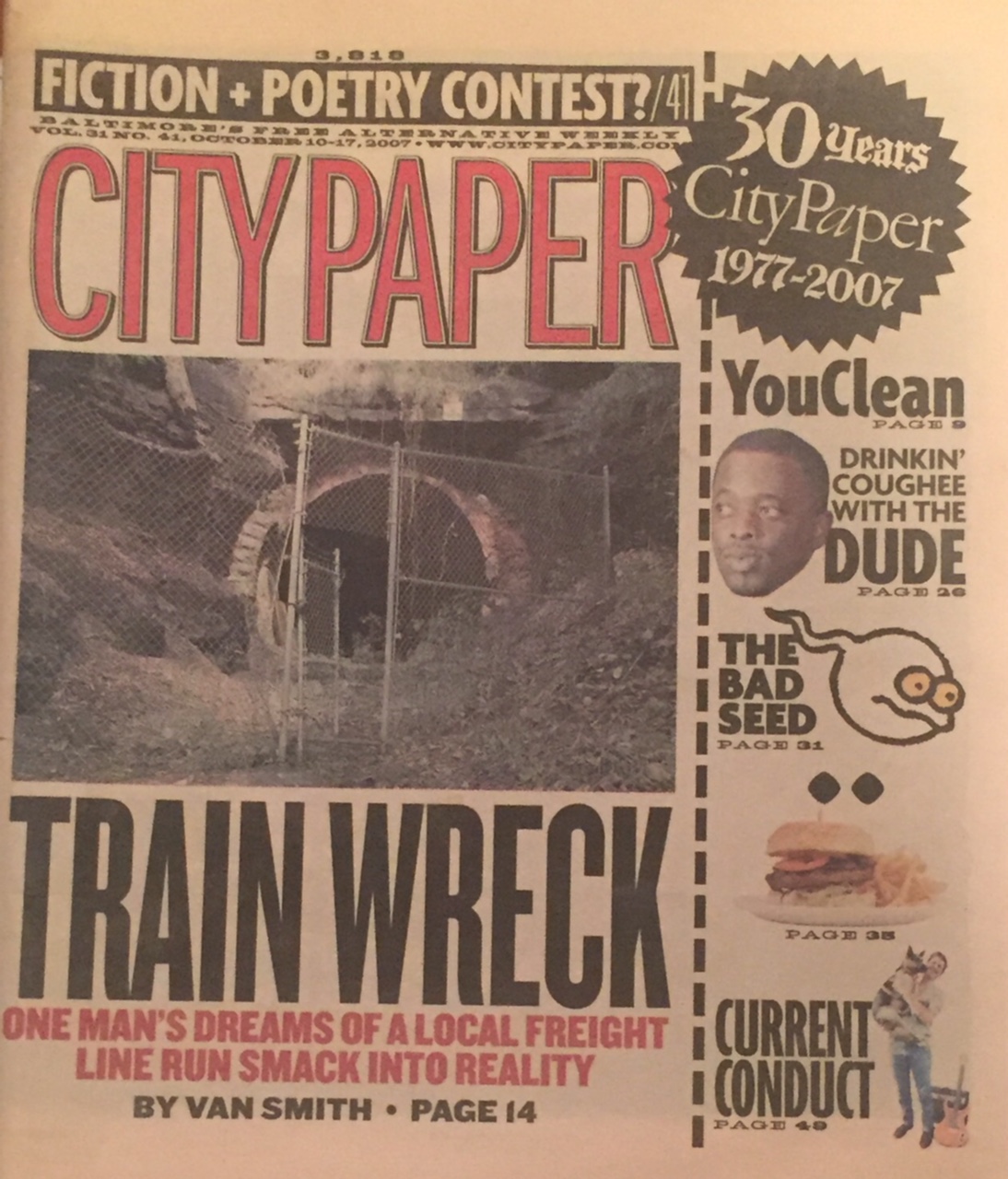
IMG_7311

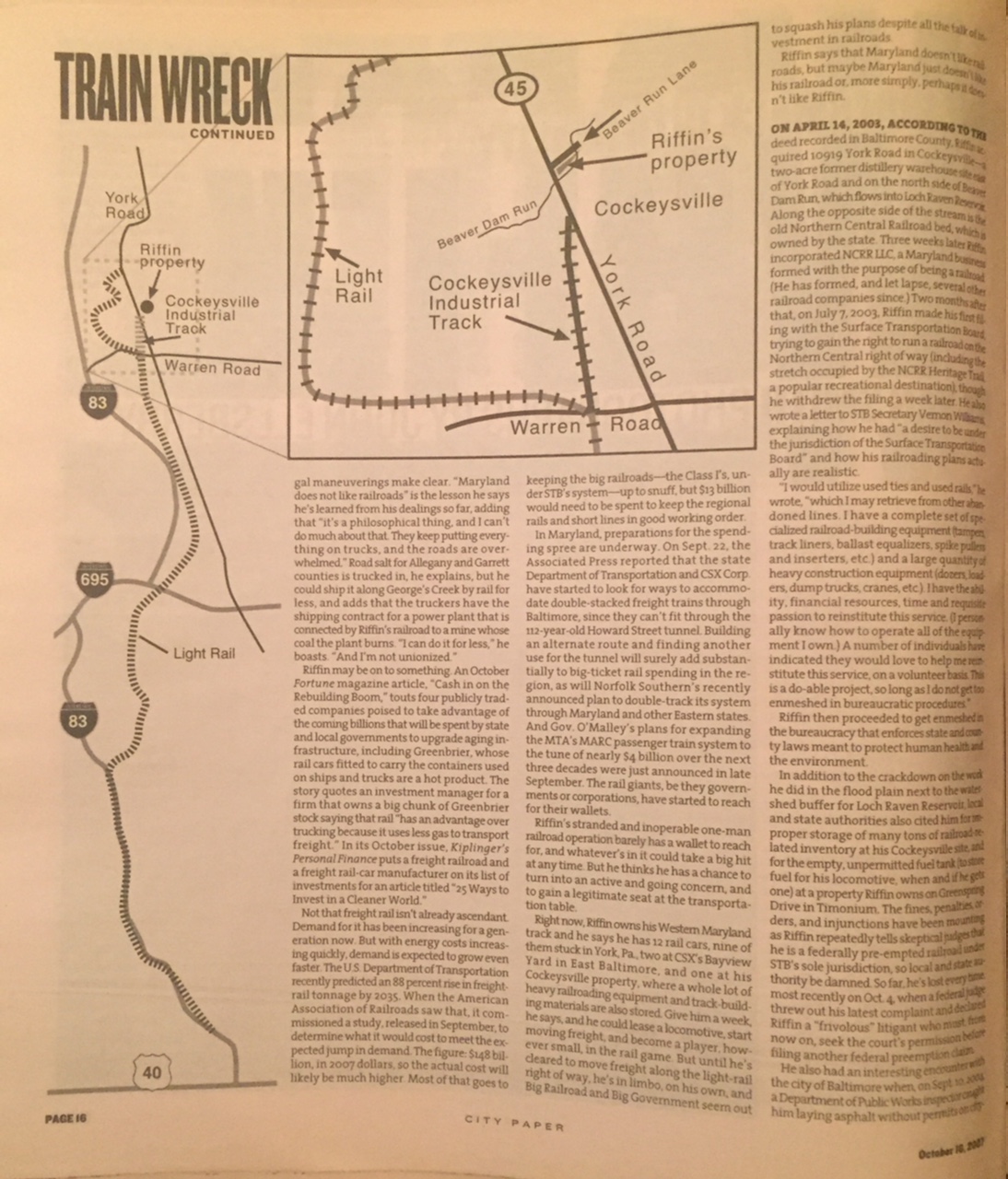
If the law goes his way, a man who calls himself James Riffin says he’ll run freight on railroad tracks between a property he owns in Cockeysville and the nationwide rail network that converges on Baltimore, and at all possible points in between, using a section of light-rail tracks to do it. He’ll do this even though the Maryland Transit Administration (MTA), which has about a billion dollars invested in the light-rail system, and Norfolk Southern, which holds the freight-carrying rights along the line, oppose him. That’s because, if it all goes Riffin’s way, he says that light-rail right of way will be his.

To get to the point where Riffin can make such an outrageous claim, he has boned up on railroad law and used it–with some success, so far–to tangle with transportation giants like the MTA and Norfolk Southern before the federal Surface Transportation Board (STB), which regulates railroads. Since he first began his campaign to start freight-rail service to his Cockeysville property in 2003, James Riffin has become a name a number of state and local officials and several important lawyers know very well, even if they can’t talk about him because he is, was, or could be in litigation with them. MTA spokesman Richard Solli confirms the magnitude of the legal problems Riffin has caused the agency, agreeing that the right of way’s status is “an open question until the board decides.”

If Riffin is going to run freight cars along what used to be the Northern Central Railroad’s right of way in Cockeysville, he faces more than legal challenges. The tracks are largely impassable and, in many areas, nonexistent, so essentially they would have to be completely replaced; pieces of the right of way have been rented out to become parking lots or sold off in real-estate deals. But railroad right of ways, and the laws that regulate them, are long-established and complex things. If the Surface Transportation Board found in Riffin’s favor, it could compel the state and Norfolk Southern to accommodate his claims and his fledgling freight line. The right-of-way property would need to be sorted out and reclaimed. A small railroad bridge would have to be replaced and a new crossing at York Road would have to be installed, disrupting traffic. And if, as Riffin says he wants to do, he interchanges with CSX’s tracks coming out of the Howard Street tunnel in Baltimore, it could theoretically jeopardize the Baltimore Streetcar Museum, which is situated along an old CSX spur. At the very least, Riffin will need to have a large railroad bridge constructed across the Jones Falls. Who’s going to spend all this money? Riffin says he’s willing to bear some reasonable costs, but the MTA damaged the tracks, he argues, so it should repair them.

Lawyers have written in many motions over the past several years that Riffin is abusing the process, that he’s insinuating himself into railroad matters by making unfounded claims to railroad rights, that he’s given to making misleading statements, that he’s a sham. But Riffin doesn’t seem to mind. He just keeps plugging along, preparing for the day when he’ll be driving the locomotive of his own active freight-rail operation, accessing the national rail system via the light-rail tracks that ordinarily ferry passengers between the heart of Baltimore and its northern suburbs. He’s never been entirely sure his dreams would come true, but today it seems more likely than ever before.

Riffin has been behaving as much like a railroad as he can, in the meantime, and that has gotten him into some hot water over his insistence that, like any railroad, he doesn’t have to comply with local and state laws, only federal ones. State authorities didn’t like it, for instance, when in 2004 he started moving large quantities of earth in the Beaver Dam Run flood plain, where his property lies, in order to grade to a higher elevation for the railroad tracks he wants to install. In case the STB and the courts back him, he wants to be ready to start operating.

Riffin continues to pursue this grandiose–some would say impossible–plan because “I have a personal bias against losing railroad right of ways,” he explains. “And I want freight service returned to my property in Cockeysville.”

Meeting with Riffin is difficult to arrange. He’s busy, ever on the move in his worse-for-wear Honda minivan, and often out of cell-phone range. When reached and asked about a convenient time to get together, he says he’s rarely sure what each day will hold, that he has legal research and reading to do, evidence to gather, support from shippers to solicit, and about 8.5 miles of railroad track in Western Maryland that he bought from CSX in August 2006 to tend to, and the best thing is to call him between 8:30 and 9 in the morning on any given day and see whether he has any free time before or after his mid-day meal, which is the only one he eats each day. He’s a one-man operation, and that’s an especially demanding task when the state of Maryland and Baltimore County are both out to shut him down.

Besides, Riffin doesn’t want press. “I’ve actively made attempts to keep this out of the media,” he says, though he doesn’t explain how. When first contacted on Sept. 11 by phone for this article, Riffin immediately asks, “How did you find out about me?” Once it is explained that the discovery was complete happenstance, made while looking for something else entirely in the federal courts, he acquiesces, indicating that, well, if the press is interested, there’s nothing anybody can do about it because it’s all a matter of public record anyway. And he did, as he says, “hit the jackpot” by getting as far as he has unnoticed. But he acknowledges he would prefer it if the matter stays within the tight circle of involved parties: the STB, the MTA, Norfolk Southern, CNJ Rail Corp. of New Jersey (which may want to operate Riffin’s railroad, if it ever gets rolling), and Riffin himself.

His opponents are loath to comment on him, since there is so much active litigation and the likelihood of more. Paul Mayhew, a Baltimore County government attorney who’s been contending for years with Riffin’s federal pre-emption argument, was nice enough to send up the municipal chain of command a list of City Paper‘s questions, but comes back with: “We feel it is best simply to decline comment.” His statement echoes those of other lawyers and spokespeople.

Riffin guesses that his opponents would say this about him, if they felt free to: “Some people would say `eccentric,’ some people would say `kook,’ and some people would say, `Christ, I’d like to see that guy dead.’ If I was in Jersey, I’d be wearing concrete boots at the bottom of some river.”

There are ways short of murder to bring Riffin’s plans to a halt. He could be slapped with liens on his Cockeysville property over outstanding fines and penalties for developing in the flood plain, which he admits he did. He could be forced, at great expense, to move the massive pieces of railroading equipment and machinery from his property, which he’s been ordered to do repeatedly and hasn’t, risking arrest. He could run out of money. But none of that has happened yet.

While Riffin is still very much a Don Quixote with his railroading campaign, his impressive stake in the matter of the light-rail right of way gives him the potential to become David facing Goliath. “It’s about to get real dicey,” he says darkly during one of several hours of phone interviews. When his late-afternoon schedule on Sept. 26 allows for a field trip to point out the route he’d like to use to link with the light rail, Riffin declines to be photographed, saying he doesn’t want to be recognized by Gov. Martin O’Malley. That’s how he sees the magnitude of the forces he’s up against. (Later he agrees to let City Paper publish a photograph in which he walked into the frame while it was being taken, once he’s assured that he’s unrecognizable.)

His black slacks and tucked-in button-down shirt bring the word “professorial” to mind. Work boots suggest an academic area requiring time in the field. His half-glasses are cocked a little on his nose, and his dark hair shows less gray than one would expect for someone in his 60s. He speaks rapidly, imparting with exacting recall his detailed knowledge of railroad case law and the technical aspects of moving freight. Pointing to a section of Cockeysville track overgrown with trees, or where a railroad bridge has been removed, he recites precisely why that’s wrong under STB rules and what it would take to fix it and about how much it would cost. He’s compact, energetic, fast-thinking, and, as if in front of a classroom, he’ll call on you: “Remember what I told you about whether you become a common carrier if you buy a line of railroad?” The man’s in full command of the subject matter, and many others besides, and he likes to test attentive students to make sure they’re still following.

Towson University confirms that James Riffin was an assistant professor of business administration in what is now the College of Business and Economics from August 1978 to June 1981. There were other teaching gigs, too, Riffin recalls, while he was studying graduate law and industrial relations at University of Pennsylvania, continuing an academic career that began during the Vietnam War at the University of California, Berkeley. Later, he made some money developing the Timonium Road property now owned by the Maryland Athletic Club, and he describes crafting money-saving deals to reduce corporate lighting costs. Only after he acquired the Cockeysville tract in 2003, he says, did he start to look closely at the possibilities of railroads.

“Until I came along,” Riffin observes smugly, “no one paid any attention. And then I said, `I’d like some freight-rail service in Cockeysville.'”
IMG_7314

Then, in a sense, Riffin became a railroad. A little over a year ago, he bought some track in Allegany County along George’s Creek south of Frostburg on down to Westernport, about 8.5 miles in all, on a right of way anywhere from 30 to 100 feet wide–44 acres of dirt, rocks, and rail. The George’s Creek Subdivision, it’s called in the STB records; after CSX sold it to Riffin, the STB classified him as a Class III railroad, commonly known as a short line.

“Someone suggested I buy it,” Riffin explains about the track purchase. “And I did, pretty much sight unseen. And then I went about finding out what it was I bought. It has the potential to have a lot of freight traffic, but there’s also a lot of politics.”

Riffin has run into a lot of that in his short railroading career, as the records of his legal maneuverings make clear. “Maryland does not like railroads” is the lesson he says he’s learned from his dealings so far, adding that “it’s a philosophical thing, and I can’t do much about that. They keep putting everything on trucks, and the roads are overwhelmed.” Road salt for Allegany and Garrett counties is trucked in, he explains, but he could ship it along George’s Creek by rail for less, and adds that the truckers have the shipping contract for a power plant that is connected by Riffin’s railroad to a mine whose coal the plant burns. “I can do it for less,” he boasts. “And I’m not unionized.”

Riffin may be on to something. An October Fortune magazine article, “Cash in on the Rebuilding Boom,” touts four publicly traded companies poised to take advantage of the coming billions that will be spent by state and local governments to upgrade aging infrastructure, including Greenbrier, whose rail cars fitted to carry the containers used on ships and trucks are a hot product. The story quotes an investment manager for a firm that owns a big chunk of Greenbrier stock saying that rail “has an advantage over trucking because it uses less gas to transport freight.” In its October issue, Kiplinger’s Personal Finance puts a freight railroad and a freight rail-car manufacturer on its list of investments for an article titled “25 Ways to Invest in a Cleaner World.”

Not that freight rail isn’t already ascendant. Demand for it has been increasing for a generation now. But with energy costs increasing quickly, demand is expected to grow even faster. The U.S. Department of Transportation recently predicted an 88 percent rise in freight-rail tonnage by 2035. When the American Association of Railroads saw that, it commissioned a study, released in September, to determine what it would cost to meet the expected jump in demand. The figure: $148 billion, in 2007 dollars, so the actual cost will likely be much higher. Most of that goes to keeping the big railroads–the Class I’s, under STB’s system–up to snuff, but $13 billion would need to be spent to keep the regional rails and short lines in good working order.

In Maryland, preparations for the spending spree are underway. On Sept. 22, the Associated Press reported that the state Department of Transportation and CSX Corp. have started to look for ways to accommodate double-stacked freight trains through Baltimore, since they can’t fit through the 112-year-old Howard Street tunnel. Building an alternate route and finding another use for the tunnel will surely add substantially to big-ticket rail spending in the region, as will Norfolk Southern’s recently announced plan to double-track its system through Maryland and other Eastern states. And Gov. O’Malley’s plans for expanding the MTA’s MARC passenger train system to the tune of nearly $4 billion over the next three decades were just announced in late September. The rail giants, be they governments or corporations, have started to reach for their wallets.

Riffin’s stranded and inoperable one-man railroad operation barely has a wallet to reach for, and whatever’s in it could take a big hit at any time. But he thinks he has a chance to turn into an active and going concern, and to gain a legitimate seat at the transportation table.

Right now, Riffin owns his Western Maryland track and he says he has 12 rail cars, nine of them stuck in York, Pa., two at CSX’s Bayview Yard in East Baltimore, and one at his Cockeysville property, where a whole lot of heavy railroading equipment and track-building materials are also stored. Give him a week, he says, and he could lease a locomotive, start moving freight, and become a player, however small, in the rail game. But until he’s cleared to move freight along the light-rail right of way, he’s in limbo, on his own, and Big Railroad and Big Government seem out to squash his plans despite all the talk of investment in railroads.

Riffin says that Maryland doesn’t like railroads, but maybe Maryland just doesn’t like his railroad or, more simply, perhaps it doesn’t like Riffin.

IMG_7315

On April 14, 2003, according to the deed recorded in Baltimore County, Riffin acquired 10919 York Road in Cockeysville–a two-acre former distillery warehouse site east of York Road and on the north side of Beaver Dam Run, which flows into Loch Raven Reservoir. Along the opposite side of the stream is the old Northern Central Railroad bed, which is owned by the state. Three weeks later Riffin incorporated NCRR LLC, a Maryland business formed with the purpose of being a railroad. (He has formed, and let lapse, several other railroad companies since.) Two months after that, on July 7, 2003, Riffin made his first filing with the Surface Transportation Board, trying to gain the right to run a railroad on the Northern Central right of way (including the stretch occupied by the NCRR Heritage Trail, a popular recreational destination), though he withdrew the filing a week later. He also wrote a letter to STB Secretary Vernon Williams, explaining how he had “a desire to be under the jurisdiction of the Surface Transportation Board” and how his railroading plans actually are realistic.

“I would utilize used ties and used rails,” he wrote, “which I may retrieve from other abandoned lines. I have a complete set of specialized railroad-building equipment (tampers, track liners, ballast equalizers, spike pullers and inserters, etc.) and a large quantity of heavy construction equipment (dozers, loaders, dump trucks, cranes, etc.). I have the ability, financial resources, time and requisite passion to reinstitute this service. (I personally know how to operate all of the equipment I own.) A number of individuals have indicated they would love to help me reinstitute this service, on a volunteer basis. This is a do-able project, so long as I do not get too enmeshed in bureaucratic procedures.”

Riffin then proceeded to get enmeshed in the bureaucracy that enforces state and county laws meant to protect human health and the environment.

In addition to the crackdown on the work he did in the flood plain next to the watershed buffer for Loch Raven Reservoir, local and state authorities also cited him for improper storage of many tons of railroad-related inventory at his Cockeysville site, and for the empty, unpermitted fuel tank (to store fuel for his locomotive, when and if he gets one) at a property Riffin owns on Greenspring Drive in Timonium. The fines, penalties, orders, and injunctions have been mounting as Riffin repeatedly tells skeptical judges that he is a federally pre-empted railroad under STB’s sole jurisdiction, so local and state authority be damned. So far, he’s lost every time, most recently on Oct. 4, when a federal judge threw out his latest complaint and declared Riffin a “frivolous” litigant who must, from now on, seek the court’s permission before filing another federal preemption claim.

He also had an interesting encounter with the city of Baltimore when, on Sept. 10, 2004, a Department of Public Works inspector caught him laying asphalt without permits on city-owned watershed property behind his Cockeysville warehouse. Riffin told the city he’d done the work “inadvertently” and promised to restore the site to its prior condition. On the same day, Riffin pulled out a sheet of Northern Central Railroad letterhead and typed out a letter to DPW director George Winfield, informing him that he’d like to “construct a railroad right-of-way across a portion of Baltimore City’s watershed property.” It took almost three weeks for Winfield to send out a letter denying the proposal.

Baltimore County Councilman T. Bryan McIntire recalls that, a few years ago, Riffin approached him about plans to turn the distillery warehouse into a railroad-themed restaurant with a dinner train leaving from a second-floor railroad queue. That was part of his hope to link with York, Pa., along the old Northern Central right of way and, while he was at it, he said he wanted to arrange to move Blue Mount Quarry’s stone by rail south to Cockeysville–something he still talks about. The idea caught some attention, including an October 2004 Baltimore Smart CEO article that concluded, “It doesn’t look like Riffin’s dream of being a railroad tycoon has much chance to succeed.”

Riffin ran into obstacles at every turn, but he kept making more proposals and filing more notices with the STB. Sometimes they’d be denied, sometimes he’d withdraw them, but in going through the paces, he kept open his lines of communication with the board as he learned its ways.

On Dec. 22, 2006, the MTA asked the STB to rule that federal approval wasn’t needed for the MTA’s 1990 purchase of 14.2 miles of right of way from Conrail to build the light rail north of North Avenue in Baltimore. In the same filing, the MTA also asked the board to confirm that freight rights and obligations that would have placed the MTA under the board’s authority were not transferred to MTA when the 1990 sale took place. Ordinarily, such a deal would entail that the purchaser maintain the right of way for “common carriers”–that is, the MTA would have had to keep all the track intact and ready for use in the event that Norfolk Southern wanted to use the line.

The reason the MTA was asking for clarification about the matter in 2006, 17 years after it bought the right of way, is that in 2005 Norfolk Southern applied to officially “abandon” the section of its track used by the light-rail line. A railroad officially abandoning a track involves attesting that it no longer uses it, and would therefore like the STB to relieve the railroad of its track maintenance responsibilities, which is a requirement of railroad law. The MTA had been maintaining the track, and Norfolk Southern had been running freight on it between midnight and 5 a.m., when the light rail doesn’t run. When the MTA shut down that light rail line to install a second track in 2004, Norfolk Southern stopped running freight on it and soon started abandonment proceedings to completely dissolve its responsibility for the line.

In response, Riffin filed an offer with the STB to take over Norfolk Southern’s freight-carrying rights. This bought him some time to dig into the board’s records and uncover the MTA’s failure to clarify with the board that it had no need to worry about maintaining the tracks for “common carriers” in 1990.

Riffin pointed this out to the STB, and Norfolk Southern’s request for abandonment was denied in 2006 because, thanks to Riffin, the right of way’s ownership had been called into question and needed to be properly established. When the MTA filed its petition to clear it all up, Riffin protested, and the federal board will issue a ruling on the matter when it is good and ready. The validity of the 1990 right-of-way transaction and all that hinges on it appear to be hanging in the balance, as is the question of whether the MTA has an obligation to maintain the entire right of way–not just the parts it uses–for freight traffic.

“Because of the uncertainty created by the issues raised related to MTA’s acquisition, use and ownership of this line,” wrote Charles Spitulnik, the MTA’s outside counsel on the case, in an Aug. 21 letter to the STB, “MTA is prevented from using and improving this asset for its intended passenger transit purposes and from making changes that will further enhance the safety of operations on this line.”

When asked about this letter, Spitulnik apologetically says he is “not authorized to talk to you because the matter is in litigation.” MTA spokesman Richard Solli agrees that the board’s answers to the MTA’s questions about the 1990 right-of-way purchase should have been sought 17 years ago, rather than today, but “everybody back then thought that everything they were doing was being done properly, and until we’re told differently, we think the actions we’ve taken since 1990 were appropriate. We’re just asking [the STB] to move things along so all the parties can go ahead and do the things that all the parties need to do. As for how the STB decides, we’ll cross that bridge when we get to it.”

If the board rules that the MTA’s 1990 purchase did not fall under STB authority, and that the MTA was not responsible under federal law for maintaining the line for freight use, then Riffin’s enterprise will remain trapped piecemeal on the unconnected properties he owns. But if the board rules that the MTA’s purchase did fall under its authority, then the fact that the MTA appears to have dismantled and sold off portions of a disused section of the right of way known as the Cockeysville Industrial Track, Riffin argues, could make the MTA responsible for repairing that damage, to the tune of millions of dollars. Riffin has letters from shippers along the right of way supporting the prospect of renewed freight service, including Packard Fence Co., SealMaster Paving Products, and Buschemi Stone Masonry. If the Cockeysville Industrial Track reopens, then Riffin’s property, which is across York Road from it, will be that much closer to getting rail access.

If the current light-rail right of way ends up back in Norfolk Southern’s hands, then Norfolk Southern will likely apply again to abandon freight service on the line, giving Riffin another chance to offer to provide the freight service instead. If Riffin’s offer is accepted by the federal board, then the MTA would have to negotiate light-rail rights with Riffin, who says his first order of business would be restoring freight service to Cockeysville.

IMG_7316

After Riffin purchased the George’s Creek line and found the MTA’s weak spot with the light rail right-of-way issue, things kicked into high gear. He sought STB approval to obtain short-line rights on old railroad beds in Virginia, New Jersey, New York, and Maine. On Jan. 12, the world learned for the first time that he intended to operate a railroad on 2.2 miles of the old abandoned Maryland and Pennsylvania (aka Ma & Pa) right of way that runs through city-owned property along Falls Road that is currently occupied by the Baltimore Streetcar Museum and a newly-constructed bike trail. CSX, the MTA, the museum, and the city of Baltimore opposed Riffin with strongly worded pleadings. The museum’s interpretation of Riffin’s proposal was that it would supplant the museum’s operations and shut down the bike trail.

Museum board member Christopher McNally, who is also serving as its counsel in this as-yet-undecided matter, in his filing told the federal board that Riffin’s railroad plan “would likely obliterate [the museum]’s entire operation in the Jones Falls Valley.” McNally declines to be quoted for this article, except to say this of Riffin: “We will fight him to the legal bitter end in terms of any effort to build a railroad in the Jones Falls Valley.”

Riffin’s STB filings often jangle the nerves of opposing parties, but in the Ma & Pa case, he says he has no actual use for the ripped-up and paved-over line, and no intention of disrupting the Baltimore Streetcar Museum operation or the bike trail whatsoever. All he wants, he says–and he says this is “on hold until I figure out what’s going to happen with the Cockeysville line”–is to build a $20 million railroad bridge over Falls Road from the light-rail right of way to the CSX tracks, and to do so, he has to cross the Ma & Pa right of way. Hence the STB filing that caused McNally and everyone else involved such grief.

But, Riffin adds, McNally’s filing was helpful. In the event that Riffin wants access to the line in the future, he says he needs to show it was used to move freight after its official 1958 abandonment. McNally’s STB filings state that the Baltimore Streetcar Museum was the last to get rail service on the line when it “received railroad ties delivered on flatcars in the 1970s.”

Riffin was tickled with that. But he filed something recently in an STB case involving light-rail plans in Norfolk, Va., that tickled him even more because of the response it prompted from Norfolk Southern. Riffin says the company’s lawyer on the case, James Paschall, wrote an “unflattering biography” of Riffin in a Sept. 6 filing that sought to sanction him and bar him from appearing in any future STB matters involving Norfolk Southern.

“It was a personal attack, really,” Riffin says. “I wanted to push his sensitive button, and I did, and I guess I hit it pretty hard.” The lawyerless novice gets one over on Big Railroad’s experienced counsel here and there, and Riffin delights in it, and in the reaction. “Sometimes I have fun playing with people’s minds,” he says.

Paschall wrote in his 42-page filing: “In an astonishing, but perhaps not surprising, display of misinterpretation, misrepresentation and illogic, Riffin has filed a frivolous Comment and sham Notice” in the city of Norfolk’s light-rail matter, and thereby “again abuses the Board’s processes and harasses parties who appear before the Board for legitimate purposes.” Paschall proceeded to recite Riffin’s entire history of participating in STB matters, casting it all in the worst light possible.

On Oct. 1, Riffin filed his reply to Paschall. The conclusion of the 18-page document read, in part: “For the foregoing reasons, Riffin would ask that the Board deny NS’ Motion for Sanctions, and Riffin would further ask that the Board admonish Mr. Paschall for his unprofessional behavior in this proceeding. . . . Perhaps next time, Mr. Paschall will consider walking down the smooth path, rather than the thorny path.”

Riffin’s enemies have said many negative things about his railroading aspirations, but he has at least one friend: Eric Strohmeyer, vice president and chief operating officer of CNJ Rail Corp. of New Jersey. Strohmeyer calls Riffin “a very nice guy, and an extremely smart guy. He’s arguing the case extremely well. It’s an amazing transformation from having an interest in railroads to being a full-fledged railroader.”

“Our interest,” Strohmeyer continues, “is we have rail properties up in New Jersey, and we control some New Jersey track, and we got involved with James Riffin when Norfolk Southern had tried to abandon the Baltimore light-rail line to Cockeysville. Our firm would be an independent, third party to operate the line, should it be returned to freight service under Riffin.

“We estimate we could move 3,600 car-loads of freight per year over the [Cockeysville Industrial Track], and that would take 12,000 truckloads per year off the Baltimore Beltway,” Strohmeyer adds. “Right now, there are ethanol trucks rolling through Baltimore streets. If we moved 150 to 200 rail cars of ethanol per year instead, that would be 600 to 800 fewer truckloads, and it would take an explosive substance off the public streets. And remember, railroads pay for their own track maintenance, but trucks rely on publicly maintained roadways.”

Strohmeyer begins to talk about how Riffin’s case fits in with the larger transportation-planning picture. He points out that “as cities grow, we can’t build brand-new railroads for freight, we’ve got to share these corridors. The MTA does not believe they have to co-exist with freight, but there needs to be smart transportation planning, and excluding freight is shortsighted transportation policy.

“What Riffin’s started is a major battle, and right now it’s just Riffin and the state,” he says. “But if the STB’s decision runs afoul of the law, all hell will break loose because the MTA has unlawfully ended freight service on the Cockeysville line even though shippers along the line want service, and the MTA knows it. This is going to go to the courts unless everybody agrees to agree. The MTA is playing Russian roulette with the taxpayers of the state of Maryland.

“They can scream `Jim Riffin’s a kook’ until they’re blue in the face,” Strohmeyer concludes. “But the law’s on his side.”
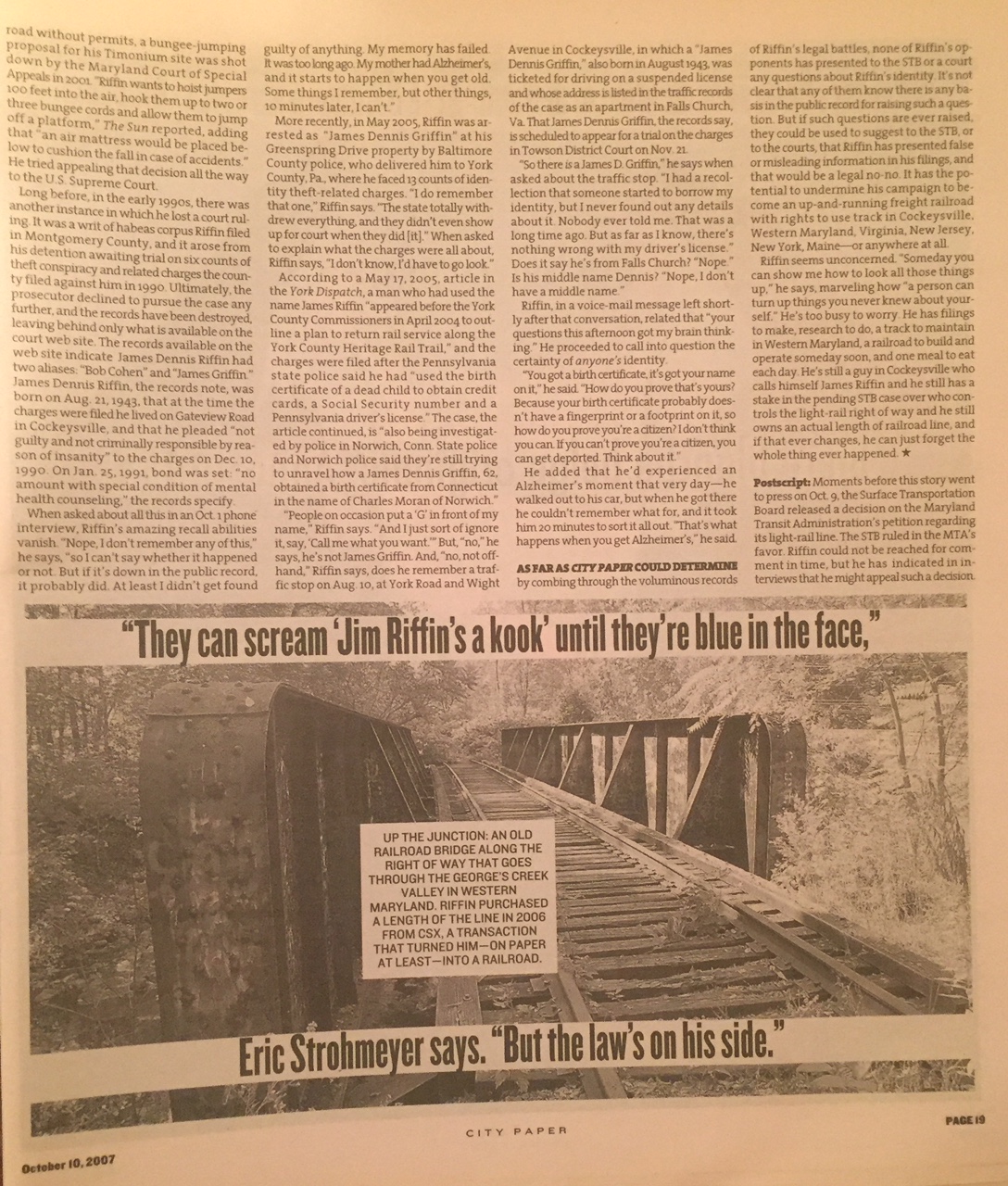
IMG_7317

The law hasn’t always been on Riffin’s side. Even before he started to build his railroad without permits, a bungee-jumping proposal for his Timonium site was shot down by the Maryland Court of Special Appeals in 2001. “Riffin wants to hoist jumpers 100 feet into the air, hook them up to two or three bungee cords and allow them to jump off a platform,” The Sun reported, adding that “an air mattress would be placed below to cushion the fall in case of accidents.” He tried appealing that decision all the way to the U.S. Supreme Court.

Long before, in the early 1990s, there was another instance in which he lost a court ruling. It was a writ of habeas corpus Riffin filed in Montgomery County, and it arose from his detention awaiting trial on six counts of theft conspiracy and related charges the county filed against him in 1990. Ultimately, the prosecutor declined to pursue the case any further, and the records have been destroyed, leaving behind only what is available on the court web site. The records available on the web site indicate James Dennis Riffin had two aliases: “Bob Cohen” and “James Griffin.” James Dennis Riffin, the records note, was born on Aug. 21, 1943, that at the time the charges were filed he lived on Gateview Road in Cockeysville, and that he pleaded “not guilty and not criminally responsible by reason of insanity” to the charges on Dec. 10, 1990. On Jan. 25, 1991, bond was set: “no amount with special condition of mental health counseling,” the records specify.

When asked about all this in an Oct. 1 phone interview, Riffin’s amazing recall abilities vanish. “Nope, I don’t remember any of this,” he says, “so I can’t say whether it happened or not. But if it’s down in the public record, it probably did. At least I didn’t get found guilty of anything. My memory has failed. It was too long ago. My mother had Alzheimer’s, and it starts to happen when you get old. Some things I remember, but other things, 10 minutes later, I can’t.”

More recently, in May 2005, Riffin was arrested as “James Dennis Griffin” at his Greenspring Drive property by Baltimore County police, who delivered him to York County, Pa., where he faced 13 counts of identity theft-related charges. “I do remember that one,” Riffin says. “The state totally withdrew everything, and they didn’t even show up for court when they did [it].” When asked to explain what the charges were all about, Riffin says, “I don’t know, I’d have to go look.”

According to a May 17, 2005, article in the York Dispatch, a man who had used the name James Riffin “appeared before the York County Commissioners in April 2004 to outline a plan to return rail service along the York County Heritage Rail Trail,” and the charges were filed after the Pennsylvania state police said he had “used the birth certificate of a dead child to obtain credit cards, a Social Security number and a Pennsylvania driver’s license.” The case, the article continued, is “also being investigated by police in Norwich, Conn. State police and Norwich police said they’re still trying to unravel how a James Dennis Griffin, 62, obtained a birth certificate from Connecticut in the name of Charles Moran of Norwich.”

“People on occasion put a `G’ in front of my name,” Riffin says. “And I just sort of ignore it, say, `Call me what you want.'” But, “no,” he says, he’s not James Griffin. And, “no, not offhand,” Riffin says, does he remember a traffic stop on Aug. 10, at York Road and Wight Avenue in Cockeysville, in which a “James Dennis Griffin,” also born in August 1943, was ticketed for driving on a suspended license and whose address is listed in the traffic records of the case as an apartment in Falls Church, Va. That James Dennis Griffin, the records say, is scheduled to appear for a trial on the charges in Towson District Court on Nov. 21.

“So there is a James D. Griffin,” he says when asked about the traffic stop. “I had a recollection that someone started to borrow my identity, but I never found out any details about it. Nobody ever told me. That was a long time ago. But as far as I know, there’s nothing wrong with my driver’s license.” Does it say he’s from Falls Church? “Nope.” Is his middle name Dennis? “Nope, I don’t have a middle name.”

Riffin, in a voice-mail message left shortly after that conversation, related that “your questions this afternoon got my brain thinking.” He proceeded to call into question the certainty of anyone’s identity.

“You got a birth certificate, it’s got your name on it,” he said. “How do you prove that’s yours? Because your birth certificate probably doesn’t have a fingerprint or a footprint on it, so how do you prove you’re a citizen? I don’t think you can. If you can’t prove you’re a citizen, you can get deported. Think about it.”

He added that he’d experienced an Alzheimer’s moment that very day–he walked out to his car, but when he got there he couldn’t remember what for, and it took him 20 minutes to sort it all out. “That’s what happens when you get Alzheimer’s,” he said.


As far as City Paper could determine by combing through the voluminous records of Riffin’s legal battles, none of Riffin’s opponents has presented to the STB or a court any questions about Riffin’s identity. It’s not clear that any of them know there is any basis in the public record for raising such a question. But if such questions are ever raised, they could be used to suggest to the STB, or to the courts, that Riffin has presented false or misleading information in his filings, and that would be a legal no-no. It has the potential to undermine his campaign to become an up-and-running freight railroad with rights to use track in Cockeysville, Western Maryland, Virginia, New Jersey, New York, Maine–or anywhere at all.

Riffin seems unconcerned. “Someday you can show me how to look all those things up,” he says, marveling how “a person can turn up things you never knew about yourself.” He’s too busy to worry. He has filings to make, research to do, a track to maintain in Western Maryland, a railroad to build and operate someday soon, and one meal to eat each day. He’s still a guy in Cockeysville who calls himself James Riffin and he still has a stake in the pending STB case over who controls the light-rail right of way and he still owns an actual length of railroad line, and if that ever changes, he can just forget the whole thing ever happened.


Postscript: Moments before this story went to press on Oct. 9, the Surface Transportation Board released a decision on the Maryland Transit Administration’s petition regarding its light-rail line. The STB ruled in the MTA’s favor. Riffin could not be reached for comment in time, but he has indicated in interviews that he might appeal such a decision.