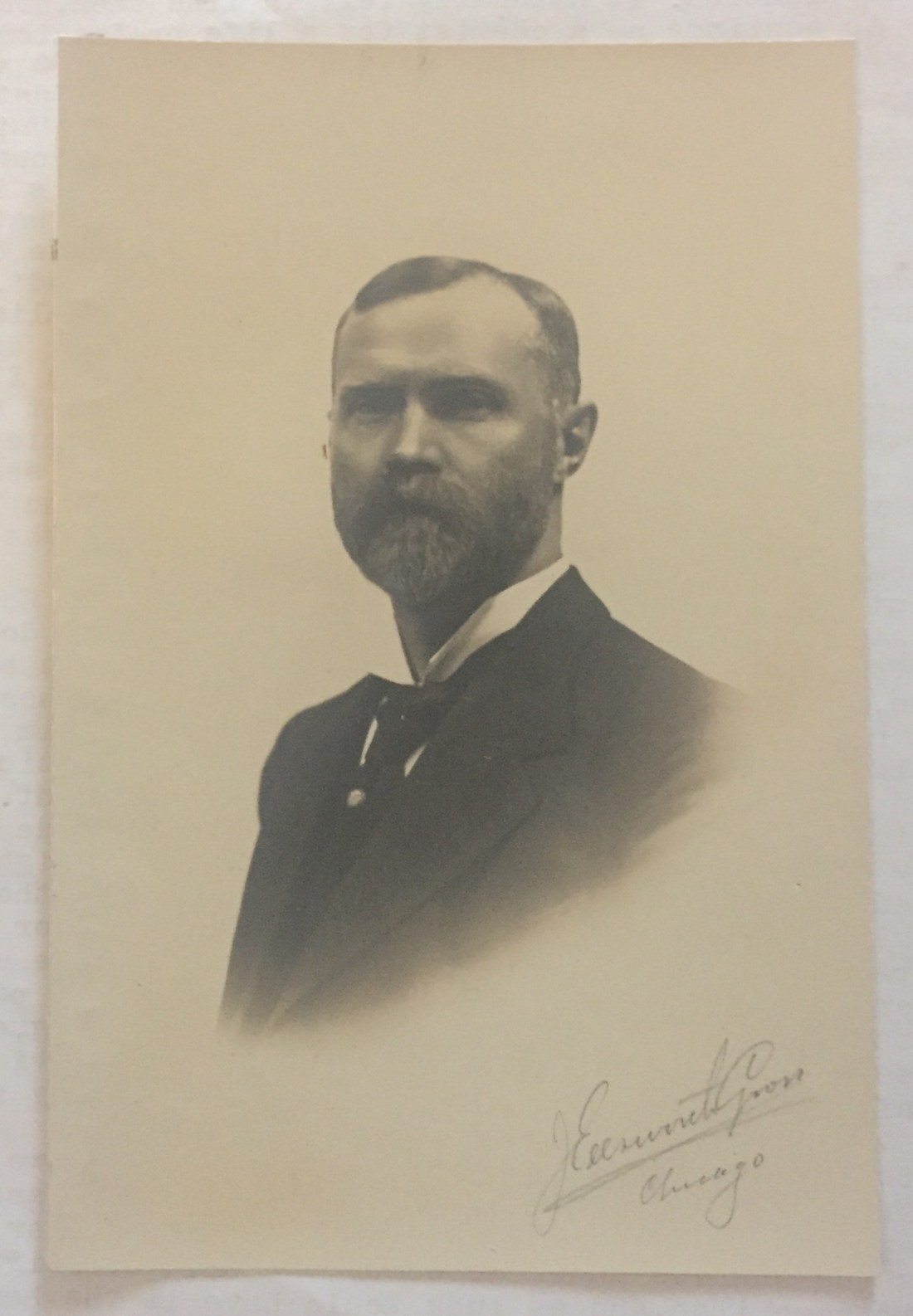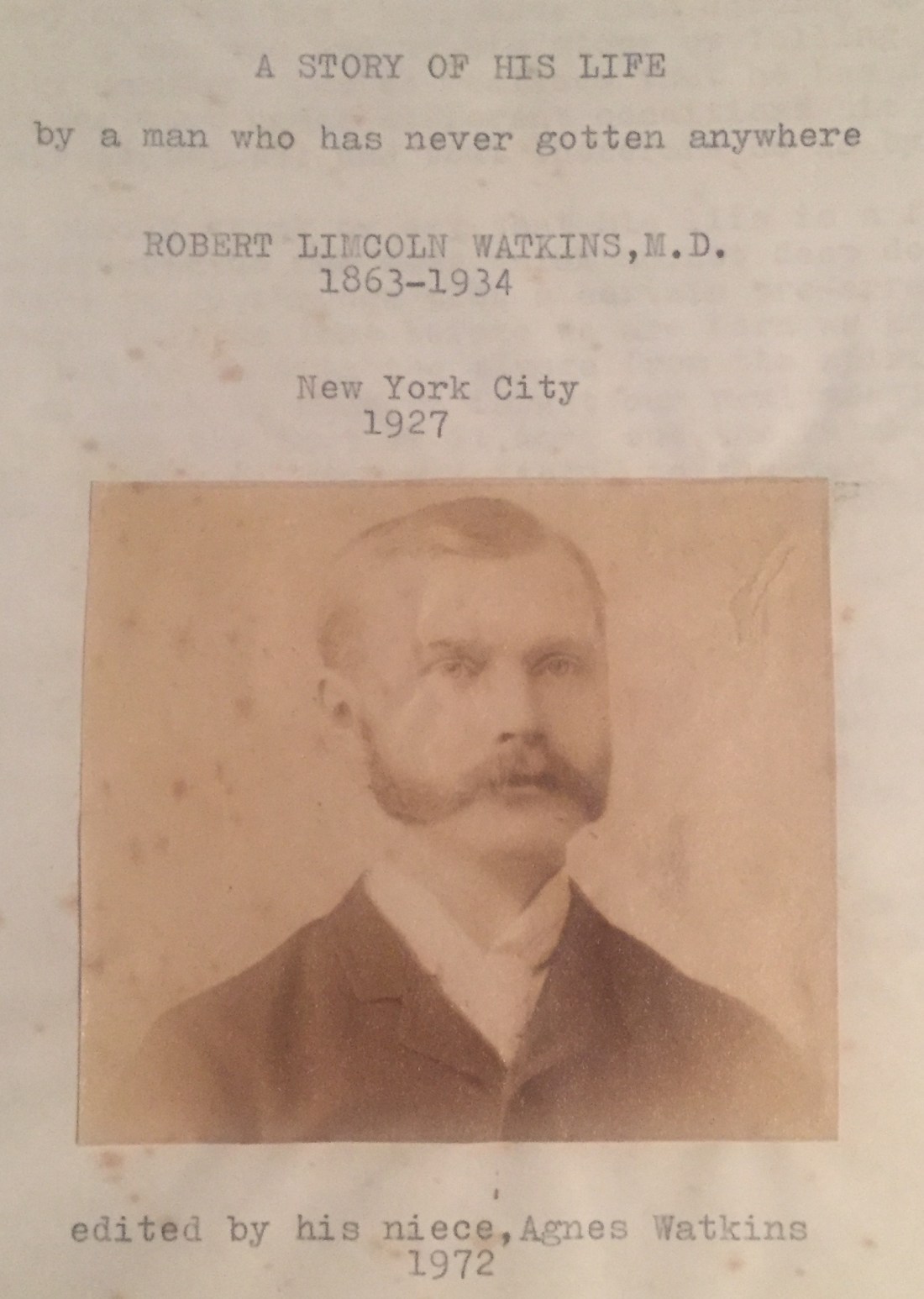
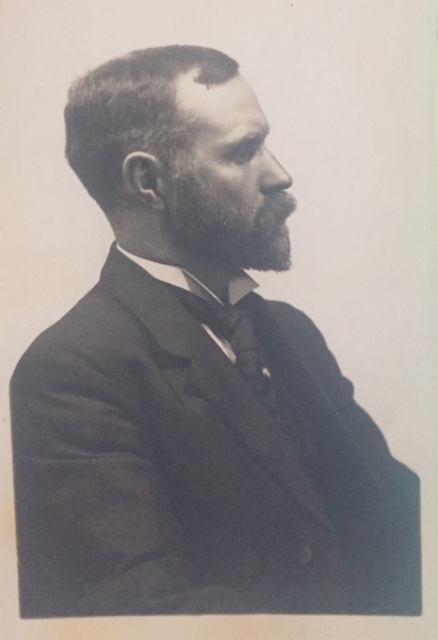
A Story of His Life By a Man Who Has Never Gotten Anywhere: Robert Lincoln Watkins, M.D., 1863-1934. An Invention 15 Years in the Making Puts the Doc Off Machine-Making for Good.

IMG_8434

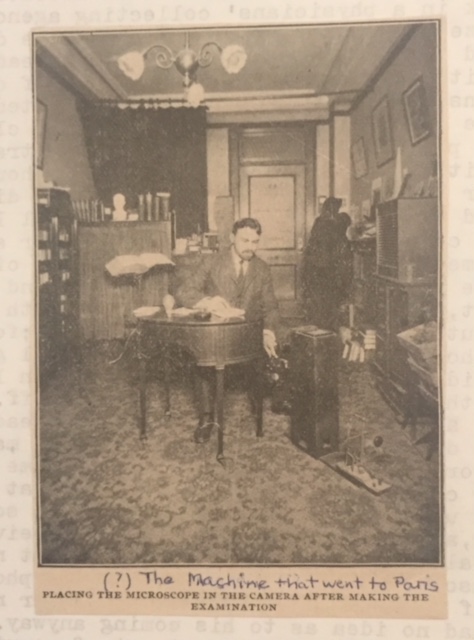
My next patent was for the MIGRAF, a copyrighted word coined from photo-micrograph. A copyrighted name has to mean nothing, but this one really means a machine to photograph microscopic objects. Its object was to bring germs, blood, etc., under two-eyed vision so as to point out definite microscopic features to students and beginners in any such line of work, and to make photographic records of same for preservation.

This apparatus was several years in construction. When completed, it consisted of an arc lamp, a rheostat, a microscope, and a viewing mirror. They had to be made small, compact, light-weight, for the apparatus had to be portable, and able to be attached to any 110 volt light circuit.

There must have been about 15 patents covering it. One of the many patent attorneys I employed was an old classmate in chemistry. For some reason, he held one of my patents for years in the patent office. He nearly drove me crazy with his delays for it seemed as if capital was on the point o f investment many times, but I had no real patent, and none was allowed while he had that one tied up. I finally had to take it away from him.

[Background: here’s the preface, forward, and notes from the editor of R.L.W.’s memoir; here’s his account of his upbringing through medical school;  here’s when he self-inoculated with tuberculosis and went off to Paris with a charlatan; here’s where he  treated typhoid, learned to dance, theorized, and sutured guinea pigs together; here’s where he contracts cholera and hooks his uncle up with testicular juice; here’s his misadventures in self-publishing while treating a slow-motion suicide-by-drinking; here’s where he hangs out with a magician and a vaudevillian; here’s where he recounts his singing career; here’s his ode to a Fulton Market butcher; here’s where he explains his profound love of music; here’s an account of a hard-partying man named Emrich; here are his escapades with a reporter take him to Carnegie’s house; here’s where he gets rooked by a crook of a partner; and here’s a piece I wrote for New York Press upon first reading the memoir.]

To get back to the Migraf, I had an awful time getting that machine constructed. I got it nearly completed by one mechanic after another. The first one failed in business when it was partly done. Another was a good workman, but erratic. I fitted him up with a lathe in his house so he could spend extra time on it. He ran off with another man’s wife and I had deuce of a time convincing his family that the partially completed job was mine to take away. Most of these men I paid in advance, or from day to day.

Finally I got a genius to work on it, an artist as well as a mechanic, But he would get woozy spells, and sometimes work all night, then not work for three months at a stretch. I had fitted up his flat with machinery so as to get my ideas just as I wanted them. One day he left the machine nearly completed and would budge no further. But the lines were as desired, and I considered it a beautiful, as well as a practical, machine.

I obtained a contract with a  manufacturer of mathematical instruments on Fulton St.. for the completion of the one and six more, but by this time I was running very short of cash. I didn’t know what to do.

But going past the Union League Club one hot July night, I spied in the window an old patient. I went in and told him my predicament, and made arrangements for the mechanic from the company where I had obtained the contract to see him with me the next day. There I demonstrated the machine as far as I had got it done, and he put up $100 and said he would finance it.

When the machine was not finished on contract time, it worried me. Pushing matters, the constructor said the bill was $500 or so, and the Union League Club man could not be seen either by more or by the contractor.

I managed to “steal” the nearly completed machine. There was an important part not finished, which I thought I could do myself at my house – this being my excuse for taking it, that I wanted to try it. The contractor chased me and threatened a sheriff to bring it back.
IMG_5930

I could think of nothing else to do, and worried as could be, I walked into the office of the son of the Union League Club man, who I understood was now in business for himself in Wall St. He was glad to see me, said he was wondering the other day whether I had ever completed the machine I used to talk about when treating his  mother. At that time, I was using a rough one made of wood, which always reminded me of the country hunter who had a rickety gun and every time he shot a bird, the gun flew to pieces. So he would find the pieces and put it together again for another shot. So did I, with the machine he was referring to.

But setting this one up in his office tickled him so that he said, “I’ve plenty of money and am retiring from business. I’ll put $500 in to it.”

“Well,” I said, hesitatingly, “you father is already in it, but I can’t find him.”

“Oh,” he said, “he’s down at Oyster Bay. I’ll take care of Dad.”

I explained things to him, and he phoned to the factory nearby where the machine was constructed, saying to me, “Come on, Doctor, I’ve got to  watch a train but I’ll go over there with you.”

He did. When they told him the amount of the bill had reached $700, he was mad. He said, “You G– damn bitches. Here’s my card. Look me up in Bradstreet.” And, pulling out his checkbook, wrote out a check for the full amount.

Then, taking me by the arm, we walked quickly out, he damning them all the way out the door for not sticking to their contract.

This man afterward gave me $3,000 cash, without security at first, but called me up in a few days and asked me to see his lawyer, who induced me to assign three valuable patents to him as security.

The machine was then taken to another mechanic, and a contract made to make up a dozen. It was awfully slow work, and my understanding was that I should get these made up and marketed before any more money was advanced.

It was a nip and tuck away and night, and was especially hard on my nerves because the rheostat, perhaps the most ingenious part of the apparatus, was not compete. One mechanic I had working on that alone, with promises that were never fulfilled. So I finally had to work it out myself, taking time out from my business.
IMG_5929

In the end, I got it made right by an Alsatian machine down on Gold St. He made them like little Tin Lizzies, so they have not worn out to this day, 20 years afterward.

The Migraf was light, would fold up like a fan, and could be carried in the vest pocket. This was one of the patents assigned. I would step down 110 or 115 volt circuits so as to get 5 to 10 amperes through it, and from 500 to 800 candle power in the arc light.

I had previously worked a year getting that arc light so it would not sputter, and would remain steady for long enough to get a good view of the object, and a photo.

Old Bob Willis, a thorough mechanic and a friend, I allowed to work on the shutter of this apparatus a whole year, and then found one on the market that could do the trick. But there was a patent on it over which the Eastman Company had control, and they would not sell, or allow them to be sold for use, except on their own cameras – although I had already bought six of them.

Since I had some patients in Rochester, I went out there and took my little moving picture camera – the first small one ever constructed up to that time, I think, 4X5X6 inches  – to George Eastman.

I had no trouble seeing him, just called him up on the phone and he said come over. He looked it all over carefully. I called it a micromotoscope, and said that it would go well in their toy department. I had patents on it, and it could be used either for the microscope or otherwise.

Just then, Mr. Lovejoy, one of his top men, passing through the room, stopped and took a look. He just shook his head, and that was the end of that. But the Migraf, which Mr. Eastman came afterward to my hotel and looked over, he said was the most valuable instrument of the two.

After getting six of the Migrafs complete, the company making them failed in business. But as I had paid for each as they came out, I was not so much affected. Then I had to get them on the market.

After letting several of my friends try it as agents, I concluded that it could only be done by myself, and decided to get orders from the Government at Washington. So thither I went. Left my business and stuck to Washington for three months.

One hour after getting there, I had one set up in the Department of Agriculture. Dr. Wiley saw it and wanted one, and the workers all appeared to be interested.

One I had gold-plated, and that was given to the financier, who tried to dispose of it to his doctor, as well as amusing his family in the country with it. They talked of it to everybody, But I made no sales there.

In Washington, I made photos for the Carnegie Institute of mica, plants, and thin stones, as well as some for the Government pathological and bacteriological laboratories – and even then some doubted if it would take photographs or not. I then got a hold of the government photographer, a Mr. Williams. He made photographs for me with the Migraf and told me I could refer anyone to him as to its capabilities.

But I could not land a sale, could not get a single order in black and white, though they said they wanted them.

One day on the street car, I sat next to a man who, seeing my box, asked me what I was handling. I told him, and he said “Have you any competition?” I said no, and explained the situation to him when I found he was the salesman for the Burroughs adding machine company. As he left he said, “If I can be of any service, let me know. I sell adding machines d\sometimes where they don’t have any use for them, don’t even want them.”

After a few more days of failure to sell the government people, friends with whom I had taken rooms advised me to go and see this man, as I was not a good talker.

I went to the house where he said he lived with his mother, and a curious thing happened here, which made his mother interested. When I came to the house, there was a front yard with a big tree in it. Their pet cat was at the top of the tree, mewing to get down. I climbed the tree and brought down the cat. And the mother let me in the house, where I waited for the son to get out of bed, for I got there bright and early.

I forgot his name, but recollect that he was one of our Hebrew friends, and must have been a very capable man, for the company had a big office in Washington. I offered him $20 a day if he would go with me and do the talking. I would demonstrate, and he would do the selling, with commission.

Well, to make a long story short, he sold none. He said he did not know the reason.

I tried the offer of cash, as my Washington friends had urged, to a man in one department. It seemed ab out to work, but with the money in one hand, while with the other I tried to get in to sign the contract, I saw that while he would take the money, the contract would be doubtful. So I concluded that it was more costly to find the right way to use graft than to play the game straight.

I left Washington a poor man again. And my financier was getting anxious about me, for I didn’t even write him.

When I got back to New York, one day I walked into the Brewers’ Academy at 23rd St. and Ninth Ave. and showed the Migraf to the man in the office. He said, “Take it out to the chemist. I think he wants one.”

He did, said it was just what he was looking for. So we made a picture on the spot. I went back to the office and said the chemist said it was all right. “Good,” he said. “Leave it here, and I’ll send you a check tomorrow.” He did, $300. And thus I landed my first sale myself. I know they used the machine for years.

Dr. James Moore, a doctor in New York in my own line, one day said, “Go and try Mr. Skogard. He lives in the old Clark house on 22nd St. and was a patient of mine.”

Moore told me that Mr. Clark of the Singer sewing machine company was very musical, and had fitted up a musical apartment in his Dakota Flats on West 72nd. St.; that he found a man by the name of Miner as bass, Bourne, another singer, Skogard another, and himself. They formed a musical combination to use the musical apartment any time they felt like it. He had put each one of them in a way of easily and surely making it. Everybody has heard of Commodore Bourne, who was at the time a librarian and amateur singer. Skogard he gave money enough to live on the rest of this life, some say a million.

Anyway, I went to see him. He had not been married long, I judged, and received me all right. He thought favorably of the migrate and told me to go to the Norwegian Hospital and present it to them from him.

I went there, but they wouldn’t take it. I went to the Xray department, and they said they didn’t know whether it would work or not, even after I showed them. Finally, I was told that if Dr. Powell of the Hoagland Laboratory said it was all right, they would take it.

So I found Dr. Powell, who looked at it and said, “What have I got to do with it?” I told him it was a present to the Norwegian Hospital, but they didn’t now whether it would work or not. He replied, “Of course it will work.”

So I asked him to write “O.K.” on the back of my card and sign it, which he did. Then I took the machine back to the doctor in charge of the hospital, and he gave me a note to Mr. Skogard, who gave me the money a few days later.

The gold-plated machine my backer had me afterward present to the Vassar Brothers Hospital in Poughkeeplsie.

The Mayo Brothers in Rochester, Minn., were interested when I showed  it to them, and their pathologist, Dr. Wilson, bought a special rheostat which he considered the most ingenious thing about it.

In Pittsburgh at the Penn Laboratory, a German was consulted by the Elizabeth Magee Hospital authorities to see if it would work before they considered purchase. I remember well his reply: “Any damn fool knows it will work. Any box with a hole and a lens will take a picture.” They didn’t get one, even then.

At the Rockefeller Institute, Mr. Jerome rang a bell for three different experts to come down to the office and view it. Each said it was all right, and Mr. Jerome asked me to leave my card and he would let me know. But he never did.

Many others I tried, but I was broke and had to get back to business. My backer was discouraged, would put up no more, and began to hound me for the return of his money.

The patents being tied up, I was never able to do anything more with the Migraf. I remember one night showing it at the County Medical Society meeting, but I had operated it and got off the platform so quickly that I was told afterward no one had a chance to see an interesting apparatus. I suppose I unconciously did, because I would have to explain my personal views on certain things which I could not do there.

I have two machines today, and they are in fairly good order – and in constant use by me. The Migraf has not been copied entirely, although the patents on it have expired.

It had long  been my desire to make a demonstration of mycrozymas in the blood stream by moving pictures. The apparatus used, which is the one I showed George Eastman, though a later and better machine, I claim to be the first to make application of for small objects.

Since this microzyma measures less than a twenty-five thousandth of an inch in diameter, a high powered lens is required. I had made them, but not satisfactorily for a clean demonstration. And I wanted to construct an attachment for the apparatus so that a continual focus could be kept while the picture was being made. (I hold patents for such an attachment.)

My dentist sent me to a skillful man, Mr. Carter, and I showed him what I wanted: a sliding telescopic apparatus, one end of which could be attached over any moving picture machine, and the other provided with a pair of spectacles which were to be set in vulcanized rubber fitted to my face and eyes so that no light would leak in.

Mr. Carter said he could do it, and we made an arrangement, I paying him something on account. It required a skillful workman, and he was that. But the next appointment I had with him he did not keep. I afterward learned he was on a spree. Then I was laid up with pneumonia for two months. When I went to see him again, we had some words, and he remarked if I had got drunk I would not have had pneumonia.

He started again on the job. I went to see him one night at the office he had hired outside his day-place, since it was a special job and he didn’t want his boss to receive any part of the price he was to get, to find if the apparatus fitted my face and eyes. If this worked, it would do away with any dark back to stick one’s head into, and have many other advantages.

It was a good job, well and skillfully done, and was all complete but one small thing. And was it absolutely light-tight, was my query to him. I wanted to try it on. He couldn’t see that, so after some argument I fond that he wanted the rest of his money before I could take it away, or even try it on.

I was upset, told him we would call it off, and he could keep the thing. He didn’t know what I wanted it for, and I didn’t tell him. But when he seemed willing to give back my deposit if I left the apparatus, I decided to take a chance on his finishing the job, and pay him the balance of the price contracted for.

Still not knowing what it was for, he said it was worth much more, but I paid him the balance and felt good. He said he would send it up complete in a few days, and add something else which I had not contracted for, but which would be an advantage, without extra expense.

Well, I’ve never seen the man or the fixture since. He went on another drunk.

So no more machines for me, but back to business again. Here are the ideas, let someone else do it. My work has always been done with direct light, not reflected light. So I was gradually  forced to settle down to the use of my apparatus, all of which were finished, practical machines, in my private practice only, and let the world whirl around. I moved into a new neighborhood, after working on these machines fifteen years or more.


A Story of His Life By a Man Who Has Never Gotten Anywhere: Robert Lincoln Watkins, M.D., 1863-1934. Of Patents, and a Problematic Partner.

IMG_8434

The writer’s first patent was a storage battery, the idea being lead powder or shavings or filings inside of cylindrical sheets of lead. My father and his old-time patent lawyer, George Plympton, induced me to take out this patent after constructing the battery. It did not amount to anything, but the lawyer used an old argument, “A patent is property.” I learned afterward that all property can’t be turned into cash.

The next one I recollect was a bullet probe. The search for the missile in President Garfield suggested the idea. It consisted of two long needles insulated by vulcanized rubber, the two exposed and continuous ends being connected with two pieces of metal, one zinc, the other copper. These were placed in the mouth, one on either side of the tongue, and when metal was touched by the tip of the probe, the electric current produced was tasted by the tongue. Or a telephone could be used, and the click of the contact heard.

This invention was no sooner out than my afterward-friend Dr. Girdner invented the telephonic probe with the assistance of Alexander Graham Bell, the inventor of the telephone. This of course was far better than mine, though not so simple. But mine was buried beneath the noise, public and professional, naturally produced by such celebrities.

[Background: here’s the preface, forward, and notes from the editor of R.L.W.’s memoir; here’s his account of his upbringing through medical school;  here’s when he self-inoculated with tuberculosis and went off to Paris with a charlatan; here’s where he  treated typhoid, learned to dance, theorized, and sutured guinea pigs together; here’s where he contracts cholera and hooks his uncle up with testicular juice; here’s his misadventures in self-publishing while treating a slow-motion suicide-by-drinking; here’s where he hangs out with a magician and a vaudevillian; here’s where he recounts his singing career; here’s his ode to a Fulton Market butcher; here’s where he explains his profound love of music; here’s an account of a hard-partying man named Emrich; here his escapades with a reporter take him to Carnegie’s house; and here’s a piece I wrote for New York Press upon first reading the memoir.]

One of my first crude machines was built while I was on 37th St. but the rheostat was clumsy and heavy. I even made a camera here long enough to reach from the ground in the back yard to the first story, where my office was located. And thus, by means of a strong arc light, I made a photograph of a red blood cell which measured, when magnified, 3 inches across.

Here I became acquainted, in a boarding house, with a man by the name of Heinson, and we discussed an association for the introduction of my work. He was a natural-born executive, had formerly been the chief clerk in a physicians’ collecting agency, probably the largest ever organized in the city. They went to the doctors’ offices, kept their books, and collected fees. Thompson, the head of the agency, ran away, they say, with some hundreds of thousands of dollars, and the concern failed.

Heinson, myself, and others incorporated an association, for he claimed to be honest and certainly had first-class recommendations. He was to be paid so much a week, under a contract drawn in such a wise that neither of us could draw money without the other being present.

After the association was set up, he did nothing. I sent him on the road temporarily on another job till I could think what to do. When he came back, I took him to task, for a boarder in the house had told me some observations he had made of him.

“Heinson,” I said, “they tell me you are nothing but a loafer and crook. Now if you are all right, you will go with me to the Fifth Ave. safe deposit vaults, take out that contract, and burn it up.” For he had signed me up, foolishly I thought, for life.

He replied, “I’ll go. I’m not whether say.”

I now said, foolishly again, “Heinson, when I get the money, I will pay you for the rest of the year.” He went off.

IMG_5929

Some year or two after, a detective from the Police Headquarters called at my office with a description and the name of the man. He said, “He is in the army at Fort Preble, Maine, and has sent some stolen goods to New York in your care. We intercepted the goods at Springfield, and want you to let us know when he arrives in town so we can catch him.”

I said,  I would and produced a letter I had received from him a day or so before. Talking it over with a friend that night, he advised me not to give Heinson away. So the next morning I phoned Police Headquarters and said if I didn’t have to, I would prefer not to notify them, and besides, I had no idea as to his coming anyway. They replied that they were only helping the Government out of courtesy, and that I didn’t have to notify them, but that they would have to watch me.

My office was then in an office building, and every time I went down the elevator I noticed a man would follow me. Heinson never came and after two or three weeks I was followed no more. In the meantime, someone had told me he was in Amherst, and I sent word to him to stay out of new York.

A long time after this, when I had collected some money, I thought I should keep my word even if he was a crook. So I put an ad under Personals in the New York Herald: “A man promised A. Adams Heinson some money years ago. Heinson should communicate with him.”

After two weeks a reply came from Philadelphia. I wrote and told him to meet me at the Waldorf a certain day at 11 o’clock, and asked him how much it was I owed him as a test for his memory. He replied very selfishly, saying it was much more than it was, and if I had been an honest man I would have paid it before.

I went to the hotel at the appointed time and saw him come through the opposite door. He walked up to me as if he were half afraid of the police.

I took his hand as he passed and said, “Heinson, you are a damned liar. You can go to hell,” and passed on.

I never saw him again, but some years later I was at the house of friend where I used to room. I had a new machine with me and was showing it. The phone rang and the brother of the friend whom I was visiting said it was his business partner in Mt. Vernon, who, by the way, had plenty of money, and perhaps I could get him interested in my machine.

He tried to explain over the phone what I had, and finally told me to come to the phone myself, for his partner said he knew someone years ago who was working on such an apparatus, but had forgotten his name.

I went, and as he talked it dawned on me that he was the chum of Heinson, and so he turned out to be. He said Heinson had died of tuberculosis in Philadelphia, and he was going over for the funeral, or to get the body, I forget which. I closed off because I knew this fellow and Heinson were in the same game. So I enlightened my friend’s brother and it turned out that the two soon broke up the partnership.


A Story of His Life By a Man Who Has Never Gotten Anywhere: Robert Lincoln Watkins, M.D., 1863-1934. The Doc Befriends a Reporter and Tries to Meet Carnegie.

IMG_8434

One night a reporter I knew named St. Clair stepped into my office with his dilapidated grip in his hand and said, “Doctor, give me the loan of $2.”

I replied, “I am not a money lender.”

He said, “Then I’ll have to sleep in Bryant Park.”

“Oh,” I replied, “go upstairs and go to bed.”

There was a hall bedroom up there, and as it turned out, I had to pay for that room a long time before he got a job and paid himself. He would sleep day and night. He did so for a long time, and I could never make out the cause.

He was a graduate of Charlotte University in the south. I found him of service to me on my book and, after the publishing of that, I got out a medical paper entitled “Journal of Hematology,” which I kept up 3 or 4 years and which never paid, and he helped me with that.

[Background: here’s the preface, forward, and notes from the editor of R.L.W.’s memoir; here’s his account of his upbringing through medical school;  here’s when he self-inoculated with tuberculosis and went off to Paris with a charlatan; here’s where he  treated typhoid, learned to dance, theorized, and sutured guinea pigs together; here’s where he contracts cholera and hooks his uncle up with testicular juice; here’s his misadventures in self-publishing while treating a slow-motion suicide-by-drinking; here’s where he hangs out with a magician and a vaudevillian; here’s where he recounts his singing career; here’s his ode to a Fulton Market butcher; here’s where he explains his profound love of music; here’s an account of a hard-partying man named Emrich; and here’s a piece I wrote for New York Press upon first reading the memoir.]

One time he and I went on a milk diet exclusively. Two weeks was my limit. Some can do it, I couldn’t. And a vegetarian diet exclusively, too, was not long for me. I longed for a steak.

Looking for something in the way of “Knowledge,” I ran across Vivakhanda, the Hindu Vedantist, and so did St. Clair. I said, “You go and see what it is, and I will follow later perhaps.”

We looked into the subject for some time, and after a while it was found that he was getting pretty deep into it. But he said, “I’m going to keep in the middle of the road.”

Vivakhanda had made a big hit at the Columbian Exposition and World’s Fair, and, although brown-skinned, he was of course of the Aryan race and was becoming very popular at the time.

St. Clair some time later obtained a good job on the Literary Digest. But a so-called Hindu mystic got hold of him after he left me and had saved up a few thousand dollars, and induced him to publish a book on the reincarnation of Napoleon Bonaparte. He never told me who the man was that was Napoleon once.

Before the book came out, although it was written, he was induced by this Hindu to go to Boston with the prospect of marriage, for he was a bachelor of 35. But he awoke from his hypnosis, and on finding out by his visit that the woman was a demi-mondaine, he turned square about face, went down south to his home town, and married an old acquaintance – who, but the way, had the same name as this writer –  and tried to settle down.

I never learned just how much of his savings the Hindu got, but I know some ten years later I met him at 181st St. one evening, apparently in the same predicament as when he threatened to sleep in the park.

He was a very bright man. He inserted into the Standard dictionary the word “Micromotoscope,” a name I coined for an instrument I invented, and it’s there today.

IMG_5929

One night, after St. Clair had gotten a good position on the Herald, I met him on the way to interview Carnegie. I said, “Ask him when you get there if he will see me. Perhaps I can get him to build me an Institution.” After a bit of persuading, he said he would, and I waited in front of Carnegie’s residence, then on 54th St. near Fifth Ave.

When he came out, I said, “Will he see me?”

He replied, “I didn’t ask him. You try yourself the same as I did.”

I said, “That’s quite different. You present the card of the New York Herald, and it’s easy.”

He went on and I tried it anyway. Rang the bell, the butler took my card up, but soon returned with the word that Mr. Carnegie wished to be excused. I thought I would try the reporters’ racket, as St. Clair had told me, so I persisted. But I soon heard the gongs ring all about he house in different parts, and knew if I did’t go, I would be put out as a crank, so I left.


A Story of His Life By a Man Who Has Never Gotten Anywhere: Robert Lincoln Watkins, M.D., 1863-1934. A Quick Sketch of a Man Named Emrich.

IMG_8434

Some years back, in a boarding house, I met a natural-to-get-acquainted-with man whose name was Emrich. He was a teacher of mathematics in a private school. He certainly had a lot of friends, and held them well.

I won’t say he neglected his work, but he was forever going out socially. I would call him homely, at that, but he certainly got along with the ladies amazingly well.

He claimed to have been engaged to a fine young lady in his college days, a graduate from Bates, but he neglected her. And after a long time she found someone else. He seemed he could not keep an appointment, which was often, we could safely say there was a woman in the case.

Often I refused to make any dates with him, and even got mad, but I never saw him ruffled in my life. He would always come back. Even years after this, when he obtained a better position as a traveling man with headquarters in Pittsburg, when he was in town he would call me up at 2 A.M. to come out somewhere nearby and dine, and none could ever pay the bill.

My lawyer friend used to say that we had a fund of information that he liked to get out of us in that way, and in later years would have nothing to do with him except in a strictly business transaction. We both were of the opinion that he was the cause of a certain married man’s committing suicide, by familiarities with his wife, though nothing of the kind was even whispered about.

[Background: here’s the preface, forward, and notes from the editor of R.L.W.’s memoir; here’s his account of his upbringing through medical school;  here’s when he self-inoculated with tuberculosis and went off to Paris with a charlatan; here’s where he  treated typhoid, learned to dance, theorized, and sutured guinea pigs together; here’s where he contracts cholera and hooks his uncle up with testicular juice; here’s his misadventures in self-publishing while treating a slow-motion suicide-by-drinking; here’s where he hangs out with a magician and a vaudevillian; here’s where he recounts his singing career; here’s his ode to a Fulton Market butcher; here’s where he explains his profound love of music; and here’s a piece I wrote for New York Press upon first reading the memoir.]

One day I received a call from Pittsburgh to go there, for he was sick. When I arrived, he was sitting on a couch with a half-lit cigar in his mouth. He could neither walk nor stand. He could understand, but not express himself. His wife, for he had been married about 9 months, explained things.

I stayed three nights and days, and saw considerable improvement. I corrected his diet and habits and put him on a regular treatment. He had a strong will, and while I was there did exactly as directed.

His wife remarked, “If he doesn’t get well, it will look bad for me.”

I said, “You had nothing to do with this.” And to myself, but not to her, “Wine, women, and song.”

After my second visit some two weeks later, he consulted a neighborhood physician, since I was far away, who called a professor from the university, who told him that nothing more could be done. The next I heard was that he was no more. I really believe he realized the predicament all would be in, even if he had partially recovered and purposely took an overdose of medicine.

At one of those 2 A.M. diners, this man once told that his sister, a maiden advanced the usual marriageable age, who had apparently just recovered from tuberculosis, was engaged to a young minister who had been installed in a church a year or two. Later he told me in his usual unruffled eway that the minister had been caught sensually playing with little girls in his parish, and run away. When my friend heard of it, he reached out and found the man and through the influence of his father, a minister out west, the church let him off easily and another parish was procured for him. When his sister still wished  to keep the engagement, his father married them in at the new country parish.

My friend was a good-hearted man. He had practically brought up little boy of a large family whose parents were poor. The boy grew up to be a fine man, married, and was never at all like his benefactor in sporting proclivities. He is much respected in his successful business and by his neighbors.


A Story of His Life By a Man Who Has Never Gotten Anywhere: Robert Lincoln Watkins, M.D., 1863-1934. The Doc Recalls a Lifetime of “Musical Fits.”

IMG_8434

If I had any recreation, music was it.

When a boy in a country town, my sister was sick, and my parents bought a piano, thinking to have her amused by taking lessons. The night it came and was unpacked, a neighbor, Mr. Jones, came in and struck a few chords, and the impression the notes of that piano made on me was lasting.

I was always crazy for music, but didn’t tell anybody. My sister proved to be too sick to take lessons, so I kept thinking to myself they will give them to me, when lo, instead, my younger brother [Royal Phillips Watkins] was the lucky man. He learned quick anyhow, and now is a celebrated surgeon in his vicinity. He can play today what he learned then, but no more. I never saw that boy mad.

[Agnes Watkins notes: “Undoubtedly one of these pieces was the one that younger brother, R.P.W., used to play for everybody to march into the dining room to on birthdays or other festive occasions when his children were growing up. He never used any music, and it was always the same piece.”]

I went to work and by myself began to pick out with one finger gospel hymns. So that, as the years went by, gradually, I got so that I could play the piano fairly well, although I never took any lessons from a teacher. In later years, when selecting a rooming house or a boarding place, if I did not see a piano somewhere in a convenient spot, I would never think of stopping there.

[Background: here’s the preface, forward, and notes from the editor of R.L.W.’s memoir; here’s his account of his upbringing through medical school;  here’s when he self-inoculated with tuberculosis and went off to Paris with a charlatan; here’s where he  treated typhoid, learned to dance, theorized, and sutured guinea pigs together; here’s where he contracts cholera and hooks his uncle up with testicular juice; here’s his misadventures in self-publishing while treating a slow-motion suicide-by-drinking; here’s where he hangs out with a magician and a vaudevillian; here’s where he recounts his singing career; here’s his ode to a Fulton Market butcher; and here’s a piece I wrote for New York Press upon first reading the memoir.]

These things were in my soul, and I have never thought of mentioning them to anyone. One night when I was about 14, the age a boy’s voice changes, we had company. And Mother asked me to start a hymn, with which we always started family prayers after supper. I motioned to my sister to start it, but Mother made me do it. My voice cracked and I made a mess of it. I told her I would never sing again, and it was years before I did – although I used to work at the piano.

I was a spunky, obstinate lad. I used to learn songs to myself, but would not utter a word out loud.

My sister died of tuberculosis when she was 18. I remember well the morning she died. (She was the oldest of us four children.) We were all awakened from sleep by Mother and taken into the room where my sister lay. All my mother said was, “Be good boys.” My younger brother answered, “We will.” We older two were so choked up we could not speak.

The first vocal lessons I took were from a Dr. Dossiert in Carnegie Hall. I was perhaps thirty-five then, and they were the first notes I had tried to utter since a boy. The way it came about what that he was sent to me for professional services, and I learned he was a music instructor. I paid him $100 in advance to give me lessons. One day he was sick and his wife gave the lessons, as was her custom, in his stead. She put me through some stunts and physical exercises and gave me to understand that I had no voice and never could sing. I never went back for the remaining lessons.

Some years later a doctor friend who claimed he had a fatherly interest in me, sent a woman to me to give me a course she had invented, I think in etiquette, or something of the kind. I turned her down, but she came back. The third time she said this doctor had told her I was a rough diamond and needed polishing up.

IMG_5898

I found out during our conversations that she used to be the crack contralto singer in the Broadway Tabernacle during the time of Dr. Thompson‘s ministry, and that she could, and was willing to, give me lessons for a dollar a lesson.

She was then 63 years old, had lost her voice by taking lessons of a poor teacher. She came from the Hutchinson family of natural singers, had married a homeopathic doctor when in the Tabernacle in her prime (getting $1,000 a year salary, pretty good for those days), was divorced, and now lived in an Italian quarter on the East Side, looking after the accounts for the Italian owner for her room rent.

She was a very emotional character, but brainy with all her faults. Her faults and virtues came out as we got better acquainted and I hired her for her musical and executive ability, and her genius as well.

I hired a room from some German patients I had over in Hoboken, where we could make all the noise necessary without disturbing anyone, bought a little portable organ, and we went at it every afternoon. For weeks, even months, I think, we kept it up. She would get terribly exhausted, playing and pumping that little organ for hours, and have to quit at times and lie down. We had an upper room, and we surely did make some noise. The old lady, we called her the “soap woman,” for she occasionally went from house to house when hard broke, selling soap. She claimed to be a jack-of-all-trades, made her own dresses by fixing over old ones, etc.

One day, I had to have a carpenter to make a peculiar wooden structure for one of my inventions. I thought a drawing was necessary or I would have to go to him often to show him. She spoke up and said, “I don’t know about that, why not describe it on paper?” She claimed we could do it, for I often, as time went on, employed her in the office to fix up lectures, etc.

Well, we went at it with paper and typewriter. She drew out of me by questions what I wanted and in time, sure thing, we had a written description which was exactly the thing, and by it later the box was constructed without a flaw but the carpenter.

But to get back to the music. She had a little song I found a copy of stowed away the other day, for she died long ago on the streets of Pittsburgh while canvassing books, the only time she ever went out of the vicinity of New York where she was born. She always feared to leave New York for this very reason. The song was a transposition of Marguerite:

“I dread the you’ll forget me, Marguerite, And I still know it will come; The festive dance, the rich, the gay, So different from our town, Marguerite, I would not chide thee, Marguerite, Nor mar one joy of thine so sweet, But oft the thought you’ll not be mine Will break my heart, Marguerite, Marguerite.”

She had worked this out in her Italian quarters set to a physical exercise, and claimed that if anyone could learn to sing this song and act it, their success in life would be assured. I never could or did get it, but the family where I had the room all got it, expecially the man of the family, Mr. Clausing.

I worked long with her, must have paid out about $500 all told for music. She so often would say, “If I only had got you ten years ago,” which has since been said to me many times.

As I said above, I often employed here in the office to compile lectures and so on, for she was a good executive – until we got into a row over the income from my business. When she began to talk of claiming part of my income, we split.

She was a great believer in astrology, said that her husband had taught her. (His name was Winterburn, and long afterward I accidentally ran across him in a Masonic lodge. He was a past master and way up in the ritualistic work; he died suddenly in a cheap room house on 12th St., at the age of 87.) She claimed that when Saturn was up, i.e., overhead, it was bad luck for her.

One day, when she did not show up when she was due, I went to her quarters; she said I was the only one who knew where she lived. I found her suffering with the asthma in her squalid room – clean, but mussed up. She could hardly sit up. She asked me to go to see her doctor, a certain Dr. Miller, and ask him for a powder. She said it would cure her immediately.

“And ask him,” she said, “where Saturn is. He will claim to nothing about such things, but ask him for me.”

I went somewhere in the vicinity of 57th St., if I remember correctly. The doctor gave me the powder and I said, “She want to know where Saturn is.” He replied, “What the Hell do I know about Saturn?”

I took the powder to her that night, and as she swallowed it, she said, “I feel it going now.” It did not go, just the same. She was sick some time, but would not take any advice from me. I never saw her again, but learned of her death from Dr. Varcoe’s wife. According to astrology, her ship was always just bout to come, but it never came.

The writer was long past 40 when, as of old, he would occasionally get what he called “Musical Fits.” Sometimes in the middle of night, or any time, by spells, like a drunkard’s spree, he would get music-crazy, want to learn a song with the piano as his guide. He had no place to satisfy this desire, no piano in his rooms.

So it had been through the courtesy of J. Warren Andrews, the well-known organist, that I was allowed at any time during the day to use the piano in the church where he plyed the organ and was chorister. They had three or hour Steinway pianos in quiet rooms in this church, and I had been able for some years to amuse myself musically here.

But if a “musical spree” seized me when the church was closed, I was up against it. Through Mr. Andrews I became a communicant of this church, and both he and the sexton said if the minister had no objection I could have a key. The minister was a patient of mine. I had succeeded, in so far as I observed him afterwards, in curing him of eczema, which he said London doctors were unable to do. It’s very commonly associated with rheumatism. So I put it up to the minister, and he said he would take care of it, but he never did. I waited at least a year, with occasional gentle reminders. But I got nasty, then resigned from his church, giving no reason.

He, too, was very fond of music, but could neither sing nor play. I used to go to his house to dine and he would request me to play something. So I would sit and play, sometimes sing hymns for him. He would never utter a word, just sit and listen. His wife said he liked to do that to the sound of music. His favorite tune was Pentecost, “The Spacious Firmament on High.”

I had asked for a letter to Dr. Cadman’s church, and the minister brought it to me himself. But in the meantime, I had gone to a nearby church, and while the piano there was in one room and not nearly so satisfactory as the other, it would do.

This minister gave me to understand that if I would sing in his choir, which had about 30 voices, and I had sung there years before he came to the chinch, he would see about a key. Well, he never did, although I stayed with him several months.

Therefore I was without a piano to practice on at all, for I would not go back to the first church under the circumstances. After that minister left some two years or so later, I did go back, however. Being a bachelor, my office, in which I also lived, would not accommodate a piano. Any space in New York costs money. So I got along musically the best I could without a piano – though after a while I did get a small organ that would go in the office.

Mr. Andrews, the organist mentioned above, was taken with sciatica, and his blood showed, beside the rheumatic cells and thick fibrin, many foreign products such as crystals and bile.

He was under treatment for many months, and after making a good recovery, he invited me to go to a dinner of the Organists’ Guild at the McAlpin Hotel. I desired to go for the novelty of it more than any other reason, perhaps just to see how a dinner of organists looked and behaved in comparison to a physicians’ feast, to which most of my outings had been confined.

At the dinner, I was placed between women. On my right was a rather homely, tall and lank young woman dressed in a calico dress. On my left was an elderly woman in a dark dress. Few, if any, men or women had on evening dress, quite a contrast to the doctors’ dinner gatherings. But to me, for the first time at such a gathering, they were all a curiosity, to use an impolite expression.

Anyway, there were all certain sure that Mr. Andrews, the president and presiding genius, was a wonder. The woman on my right was a pupil of the president, and a teacher in a small town in Pennsylvania. I’m sure she was of Dutch descent. She said she played the organ in the church, and ran the Sunday School, and I judged she was a woman “runner” of the whole town.

The lady on my left [Mary Turner Salter] was a celebrity whose name I will not mention, but I never heard of her before. She was perhaps 70 years old, and said that her husband [Sumner Salter] was the organist at Williams College. When they moved there, the children were all grown up, and she was over sixty at the time. So for want of something to do, she began to write music. She sent it to Shirmer, he took the first and published it, and it went. Since then she had written much music, and Shumann-Heink had sung her Rachel at the opera house. So it’s never too late to do things.

I am writing this book in hopes it will pan out as her songs did, but Mr. Hawn says it will be of little interest to anyone, and probably will not attract the attention of a publisher.


A Story of His Life By a Man Who Has Never Gotten Anywhere: Robert Lincoln Watkins, M.D., 1863-1934. An Appreciation of a Butcher, Charlie Ottman.

IMG_8434

One day after moving uptown to a new neighborhood, an old friend accosted me on the street. I recognized him right away as Mr. Charles Ottman, one of the firm Ottman & Co., well-known butchers of Fulton Market.

He said, “I saw you before, but wasn’t sure it was you.” He always spoke with a slight German accent. “Come in anytime, I live around the corner; I’ll be glad to see you.” Thereafter I spent many a pleasant evening there.

I was gloomy, had lost out every turn made, it seemed to me, but I never told him. Long afterward his brother-in-law, who had charge of his business affairs as secretary, and with whom I became acquainted, used to spend much of his time on his rounds sitting in my office and telling me stories. And he could tell them – though the Germans tell a story just like the Irish.

[Background: here’s the preface, forward, and notes from the editor of R.L.W.’s memoir; here’s his account of his upbringing through medical school;  here’s when he self-inoculated with tuberculosis and went off to Paris with a charlatan; here’s where he  treated typhoid, learned to dance, theorized, and sutured guinea pigs together; here’s where he contracts cholera and hooks his uncle up with testicular juice; here’s his misadventures in self-publishing while treating a slow-motion suicide-by-drinking; here’s where he hangs out with a magician and a vaudevillian; here’s where he recounts his singing career; and here’s a piece I wrote for New York Press upon first reading the memoir.]

When I explained the failure of the Migraf [a machine to photograph microscopic objects on which R.L.W. worked for many years], he said, “Well, why don’t you tell Mr. Charles about that?”

I never did, but one evening when I went to his house he had a Catholic priest as a visitor, and as I entered, the priest said, “Here is your doctor, I will go.”

“No,” said Mr. Ottman, “he is only a friend.”

“Yes, Mr. Ottman,” I replied, “you have never given me a chance at you yet.”

“Well,” he said, “I didn’t now you cured people, I thought you examined for doctors. You come over here tomorrow. My doctor has discharged me as cured. He came and measures my chest, goes away, comes and measures again. Two weeks ago he says I am well, and I’m not better, but worse.”

He was coughing, and breathing with difficulty, and had not been out in a long time. When I went back he said, “You examine me all over, I’ve got plenty of money. Tell me what to do and I’ll do it. Don’t tell me what’s the matter with me, nor when I’m well. When I feel better, I’ll tell you.”

I followed his instructions, and by hook or crook he made a quick recovery. Finances never bothered us. I told him if my bills were not right to let me know. I never sent him a bill except by request, and there were never any remarks, they were always promptly paid.

I remember some time after this, his wife got pneumonia and recovered quickly. On opening a letter from him containing the check for the bill, there was also a note, saying, “Enclosed find check for the bill and $50 for saving the life of my wife.”

After he got well enough to go about, I used to go with him. I liked it, and would have gone more often, but my finances would not allow me to dress any too well, and socially I had never been much good. Besides, after being despondent for so long, it was difficult for me to work into any kind of society. But he liked to go to the Liederkranz Club and to bowl at the Turnverein.

After going awhile to the Liederkranz, it was decided that I should join. I feared I could not get in, could not pass, and my friend had not been aware before of my fondness for music. But I got in all right, as second bass, and have never regretted it.

I have acted, suing a solo “Old Black Joe” in a minstrel show there, as well as singing with the chorus on the phonograph. I love those German folk songs, always in German, of course.

IMG_5907

Charlie Ottman was one of the finest men, German or otherwise, I ever knew. And when one morning after shaving, without warning, he fell dead of apoplexy as he walked from the bath to the living room, I felt as bad as anyone.  but a doctor has no business to show feeling at such times.

He was buried from the Lutheran church, and at the grave the Masonic lodge, of which fraternity I was a member, performed the ceremony.

He was always, as best his health would allow, trying to do something for somebody, making somebody happy. He would bring people to me and say, if they happened to be apparently poor, “Be easy on them, if they don’t pay, I will.” He never had to pay for any, for his judgment of people was good.

Everybody liked him. He had friends everywhere.

I remember going to the tailor with him one summer day while he tried on a new suit. It was light grey, and he was a fine-looking man. We walked up Broadway, he with his new suit and cane, proud as the younger man he looked. Someone saw us, for the next day Mrs. Backhous, whom we met with her husband at the Club (these two were always at the Club together; he was the manager of Ruppert’s brewery), remarked, “I saw you going up Broadway yesterday with your little doctor.” Such remarks always pleased him.

A Story of His Life By a Man Who Has Never Gotten Anywhere: Robert Lincoln Watkins, M.D., 1863-1934. An Ode to Music Teacher Max Treumann.

IMG_8434

At this point I will say something of one of my singing instructors and a very close friend, Max Treumann. We came home from the Liederkranz one Tuesday evening at 11 o’clock, after stopping at a restaurant for some flapjacks. The next night but one his wife phone me that he’d died sitting in his chair that Wednesday night.

Since I could not attend the funeral in the morning, I went to the undertaker’s that night at one o-clock to view the remains, which were to be cremated at his request.

The last song he played as my instructor, and we sang together, was “Pagliacci.” He always insisted that we had the same range of voice, baritone, wide range, two and a half octaves, depending on the weather and how much we had been singing the day before. I could sing lower if I had been singing the day before.

[Background: here’s the preface, forward, and notes from the editor of R.L.W.’s memoir; here’s his account of his upbringing through medical school;  here’s when he self-inoculated with tuberculosis and went off to Paris with a charlatan; here’s where he  treated typhoid, learned to dance, theorized, and sutured guinea pigs together; here’s where he contracts cholera and hooks his uncle up with testicular juice; here’s his misadventures in self-publishing while treating a slow-motion suicide-by-drinking; here’s where he hangs out with a magician and a vaudevillian; and here’s a piece I wrote for New York Press upon first reading the memoir.]

The way I became acquainted with Max was this: we both sang second bass in the Liederkranz. He had been a member years before, had dropped out and come back again. I noticed that the seemed to sing everything that come down the pike, and I nudged along till I got next to him one night and whispered, “How’s this, you sing everything right off the reel?”

He replied, “Why shouldn’t I? That’s my business.” I said, “Where’s your office and what’s your price.” He said, “Metropolitan Opera House, and (rather hesitatingly) if you’re not a Vanderbilt – well, suit your own pocketbook.” I said, “I’ll be down next Sunday.”

IMG_5907

I went down and found he could sing anything in any language. I said, “I’m twelve or thirteen years your junior and can only sing hymns and nigger songs; teach me an opera,” at the same time handing him the sheet music of “Vision Fugitive” from the opera “Herodias” in French.

We lost no time discussing things, but started right in, for Treumann was no windbag, but modest and an artist. And his system, at least for me, was as I desired: imitation. He would sing and then I would sing, Chinese style, copying him. We would keep it up for two hours, more often longer than that, occasionally all day at a stretch. When the phone would ring he’d say, “My girl wants to speak to me.” That was before I knew he had a wife.

He said that Theodore Thomas induced him to come over here from Germany years ago and then turned him down. He was out of a job, and after a time became discouraged and was going to shoot himself when a young lady came along and, noticing his depression, asked him in German (for he spoke no English, and she, although English, was fluent in several languages) what was the matter. Well, they got married – and lived happy ever after. She looked after him well all his life, and he used to tell me that she was a better musician than he, though I never heard her play or sing.

He must have taught me ten or twenty songs in different languages. Perhaps the prettiest one I learned purely from memory, using no copy, but just going over it repeatedly. This was “Musica Proibita” in Italian, the only one he said he never learned, or could remember to sing, without the music.

The story is about a young girl who hears a young fellow singing in the street, or going through nearby woods (as I understand him to explain it, for I not understand Italian, but can sing it), and the girl goes out on the porch to see and hear him. Her mother remonstrates and tells her it is not a nice song, but before long the mother herself goes out, she likes the music as well. I got the song all right after a while, but I’ll bet the folks in the house were sick of it long before that. And Treumann died before I learned the accompaniment.

It seems Thomas advised him to change his name from Knitel to Treumann, thinking it would take better. He was a short, stout, jolly man, in his youth – and even at the time of his death – very muscular. He served his time in the German Army – and was called by the Gymnasium students Hercules, because, he said, there was a tree in front of the building that obstructed the view, so the boys could not see the girls as they passed in the street below, so one day he went out and pulled the tree up by its roots.

At the time of his death he was 69 years old, and had a head that made one think of Darwin. Those who knew him in his younger days say he was a handsome, red-faced, jovial fellow. I never knew him to get tired of teaching.

One of his great stunts was Russian Bass. When he’d get on that subject it was hard to stop him. I have told many a music teacher about his Russian Bass – they all laugh and say there is no such thing. In fact, some teachers so scoffed at the idea that I was really ashamed to to tell who told me about it. But Max knew there was, and so did his pupils.

He liked to sing better than anyone I ever heard of, with one exception. He was almost like a child. He would sing a song over with me so much that I would sometimes have to stop him and say, “Give me a chance at it alone, and see if I really have got it.” He always said when he got so he couldn’t sing, he would want to die. But he could sing, and teach too, for he was teaching the very day he died, which was as he would have had it.