Prove It: Judge Still Not Satisfied That Drug-Dealer’s Mercedes Is Drug-Related Property

By Van Smith

Published by City Paper, Oct. 8, 2013

Maryland U.S. District judge Paul Grimm spent more than 15 years as a federal magistrate judge before being elevated to his current perch in 2012. That’s a lot of time to gain a nuanced understanding of the rules of evidence that must be met before law enforcers can lawfully seize or search property – one of a magistrate’s key bailiwicks.

So now that Grimm is a district judge with a docket that includes civil proceedings, called forfeitures, in which the government seeks to keep criminally derived property it has seized, he has a sensitive nose for the required legal thresholds – and in one case this year, he’s twice cited a dearth of evidence in denying the government’s move to keep convicted drug-dealer John Edward Butler Jr.’s 2003 Mercedes Benz CL500.

Butler was a St. Mary’s County drug dealer who pleaded guilty in a large federal cocaine conspiracy, and in 2011, the government filed a forfeiture case to keep his seized Mercedes. Grimm’s second denial, issued on Oct. 2, was in response to the government’s motion for reconsideration of his first, which was handed down in July. What’s clear from the second is that Grimm’s patience with the government’s arguments is wearing quite thin.

Grimm recapped his July decision by explaining that, “although the Government had shown that” Butler purchased the Mercedes from Gaunzie Hart for $4,000 up front, with the promise of another $9,500 over time, and that “the vehicle was seized in front of a location” that Butler used for drug-dealing, “the Government had not shown that Mr. Butler’s payment to Ms. Hart was proceeds from drug transactions” or that Butler “drove the Mercedes to and from the drug distribution location or that he drove it to distribute drugs, rather than to visit his mother.”

“Significantly,” Grimm continues, “the Government has not alleged that the Mercedes was Mr. Butler’s only vehicle at the time or that he never visited his mother’s residence without engaging in cocaine distribution. If either were the case, then I could reasonably believe that, on at least some of the occasions that Mr. Butler drove the Mercedes to his mother’s residence, he drove it there to engage in drug trafficking.”

Grimm aimed stinging criticism at the prosecutor in the case, assistant U.S. attorney Stefan Cassella – who, as CP has noted before, is considered the nation’s top asset-forfeiture prosecutor, having written a 950-page book on the intricacies of seizing and forfeiting criminally derived property.

In essence, Grimm accuses Cassella of making disingenuous pleadings in the case of Butler’s Mercedes because his arguments ignored the court’s contrary position in prior forfeiture cases Cassella had brought since he was hired in 2009 by Maryland U.S. Attorney Rod Rosenstein.

“While I do not find Counsel’s failure to disclose this history of directly contrary rulings to be a violation of his duty of candor to the Court,” Grimm wrote, “it comes uncomfortably close.”

In order for the government to keep Butler’s Mercedes, Grimm explained, Cassella will need to put on the record enough detailed evidence to support a reasonable belief that “at trial, the Government will be able to prove the nexus between the Mercedes and Mr. Butler’s criminal activity by a preponderance of the evidence.”

Cassella had argued that this threshold could be sidestepped because, despite the fact that all the required public notifications had been made about the impending forfeiture of Butler’s Mercedes, no one came forward with a timely and legitimate court claim to it. Grimm acknowledged that Cassella, citing precedents in various districts, had found “some instances” in which that was sufficient to grant forfeiture – but he implied that Cassella was again being disingenuous by leaving out important elements of the cited cases that cut the other way.

“It appears that the Government has cited these cases selectively to support the proposition that I should reconsider my denial,” Grimm wrote, adding that “far more significant is what the Government has omitted from its discussion of the cited cases.” Looking at them “in their entireties,” Grimm continued, “supports the conclusion reached here, that, at least in this district and perhaps more broadly, the Government has the obligation to provide sufficient facts to support a reasonable belief that the Government will be able to demonstrate a substantial connection between the defendant property and the alleged criminal conduct by a preponderance of the evidence at trial.”

Grimm has invited Cassella, again, to present such facts. Absent that, though, it’s looking like Butler may someday be able to drive his Mercedes to his mother’s house again. Either way, given Grimm’s stern admonishments, it’s a safe bet that the U.S. Attorney’s Office in Maryland will be seeking to tighten up its evidence in future forfeiture cases – and certainly so in cases that come before Grimm, whose name must seem especially poetic these days to Cassella.

Rather than life in prison, 51 months is sought for Baltimore cocaine trafficker and money launderer George Frink

By Van Smith

Published by City Paper, July 29, 2014

After being caught red-handed with kilograms of cocaine, and after bank records showed him repeatedly laundering money, prosecutors last fall said George Sylvester Frink, Jr. of Baltimore was looking at a maximum sentence of life in prison. Now, though, under the terms of a guilty-plea agreement filed on July 25, Frink is likely to get just 51 months at his sentencing hearing, scheduled for Oct. 31, for his part in a vast, sophisticated conspiracy that law enforcers say was responsible for bringing in as much as 3,000 kilograms of coke from California.

The alleged leader of the scheme in Baltimore, body builder Gerald Lamont Jones, has not been charged with any crimes. But court documents in Frink’s case and in a civil suit, in which the government seeks to take title to numerous pieces of real estate, describe Jones as a sophisticated high-volume drug trafficker and prolific money launderer whose criminal conduct remained hidden behind his legitimate business pursuits. Jones, a real-estate and construction entrepreneur, also owns a Gold’s Gym in Owings Mills and Rami Bros., a chain of Baltimore car dealerships that trades under the name Pimlico Motors. Frink, according to court records, was employed by Golds Gym and Pimlico Motors, in addition to having his own real-estate company, GSF Enterprises.

Jones and Frink came to law enforcers’ attention as a result of a high-volume California coke-conspiracy case with glitzy Hollywood ties involving Baltimore natives Charles Dwight Ransom, Jr., Darrin Ebron, Ricky James Brascom, and others, who used private jets to move drugs and money across the country. Indicted in 2011, the case resulted in convictions for all three Baltimoreans, though Ransom is not yet sentenced, while the conspiracy’s alleged leader – Heriberto “Eddie” Lopez, with whom law enforcers say Jones had dealings – remains a fugitive.

Since Frink’s arrest last fall, when he was found with 14 kilograms of cocaine in front of Jones’ Pikesville office, Pimlico Motors has fallen into hard times financially, being sued successfully by a bank, while some of Jones’ real estate, including 141 acres of land in Reisterstown that is one of the assets the federal government is seeking to forfeit, has fallen into foreclosure. Frink, meanwhile, on July 14 filed for bankruptcy protection, listing nearly $500,000 in assets and nearly $1.2 million in liabilities.

Jones and the government have been engaged in settlement discussions in the forfeiture case, according to July 16 letter filed in court by assistant U.S. attorney Richard Kay, who wrote that “our discussions are now including criminal implications and a potential global resolution.” In other words, charges against Jones may still be coming.

Frink’s case, though, has been resolved already. Among the factors weighing for his light treatment is the U.S. Department of Justice’s support of anticipated changes to federal drug-sentencing guidelines by the United States Sentencing Commission, which are expected to result in the early release of tens of thousands of federal inmates around the country in coming years. The Maryland U.S. Attorney’s Office in recent months has been agreeing not to oppose downward departures from the sentencing guidelines for drug defendants, including Frink, based on how the guidelines are expected to change.

To get a sense of how lenient Frink’s anticipated punishment is, consider how some repeat low-level drug-offenders have been treated in federal court in Maryland. One, Barry Green — a low-level, non-violent repeat drug offender in Baltimore — in 2011 got more than a dozen years in prison for possessing three vials of cocaine and $214 in cash. While Green was a hand-to-hand dealer in the streets of Baltimore, Frink was caught up in a sophisticated, cross-country conspiracy involving the movement of hundreds of kilos of coke and millions of dollars in cash in airplanes and trucks.  While Frink’s admitted role was a fraction of the overall scheme — he’s copped to 14 kilograms of coke and laundering nearly $100,000 — his punishment is likely to be a fraction of Green’s.


Dream Team? Comptroller-Elect’s Transition Team Raises Eyebrows

By Van Smith

Published in City Paper, Nov. 29, 1995

Comptroller-elect Joan Pratt has chosen Julius Henson, her campaign manager, and state Senator Larry Young to help lead a team of about 25 people that will direct her transition from private life as a certified public accountant to the holder of the third-highest position in city government. Both men contributed to Pratt’s campaign. Henson is also widely believed to be Pratt’s choice for city real-estate officer, an appointment that has been vacant since Arthur Held’s term expired on June 30.

Henson, who chairs the transition team, ran Pratt’s campaign against retired state Senator Julian Lapides, the early favorite who lost the Democratic primary in September by nearly 10,000 votes. In addition to volunteering as campaign manager, Henson gave $1,400 to the Pratt campaign, plus another $1,065 that was donated by one of his companies, the Wild Geese Company. (These totals are based on campaign-finance reports covering the period up until two weeks before the September primary. As of November 24, Pratt had not filed a copy of her October 27 report in Baltimore, as she is required to do under state election laws.)

About the real-estate-office position, Henson says Pratt “has not made any decisions about that yet. If she does offer it to me, I’ll consider it.” The city real-estate officer is responsible for the disposition of all city real estate, including acquisitions and sales, leases, contracts, and tax sales of properties with delinquent accounts.

Pratt and Henson were business partners in a real-estate investment company, Henson & Pratt, Inc., and in 2112 Etting Street Limited Partnership, among other partnerships. Through these concerns, Pratt and Henson together owned nine residential properties. In August, Pratt transferred her stock in the partnership to Henson.

The properties were in various states of disrepair in August, when Pratt and Henson each owned a 50 percent stake in the businesses. A recent visit to three properties on the 2100 block of Etting Street found two of them occupied by tenants whjo complained of Henson’s unresponsiveness to problems at their houses, which included rat holes in the kitchen, holes in the ceiling, unrepaired fire damage, and a jury-rigged furnace. The third house is vacant.

Though neither Pratt nor Henson will confirm it for the press, sources close to both say they have been romantically involved for several years. Mary Henson, Julius’ mother, says the diamond ring worn by Joan Pratt is a gift from Henson and confirmed their romantic relationship.

Mary Henson’s own relationship with her son has been difficult; in February 1993, she filed battery and attempted-theft charges against Julius Henson. She was 63 at the time. Her son was acquitted of the charges in June of that year.

In 1974, at age 25, Henson ran in the Democratic primary for clerk of the circuit court. He got more than 17,000 votes in the citywide race, but lost to John Hubble. Asked whether he gained any lessons from the experience that helped him in managing the Pratt campaign, he says, “Not really.” Henson says he doesn’t remember why he sought the office, except that “it was winnable, I guess.”

Young, who chairs the team’s committee on the office of the comptroller, was an early backer of Pratt’s campaign (and a $250 contributor). Henson says, “He may have been the only [state] senator who did not support Jack Lapides, so he has been a friend of the campaign.”

Young came up in politics under the tutelage of U.S. Representative Parren Mitchell in the 1970s and has emerged as a powerful West Baltimore political figure whose campaign organization has delivered votes effectively for Bill Clinton, Parris Glendening, Kurt Schmoke, and now Joan Pratt (who is also from West Baltimore). He chairs the Senate Executive Nominations Committee and the Health Subcommittee of the Senate Finance Committee.

Along with his political prominence, Young has been the subject of Baltimore City police attention over the years. As chronicled in David Simon’s book Homicide: A Year on the Killing Streets, Young was involved in a series of odd incidents in 1988: He injured his political aide’s arm by beating him with a tree limb, and he falsely reported being kidnapped, a misdemeanor charge of which he was acquitted after much embarrassing publicity.

In 1990, Young became a central figure (though officially not a suspect) in the murder investigation of his close personal friend, the Reverend Marvin Moore. The murder case is still open.

More recently, Young was caught up in the Willie Runyon political-fund-raising scandal during last year’s legal battle over the gubernatorial election. Young did not disclose the fact that he was an employee of Runyon’s American Ambulance and Oxygen Service, Inc., in his financial-disclosure form on file with the state ethics commission in Towson, in spite of the fact that he sits on a subcommittee that considers healthcare legislation that might affect Runyon’s business. Young retired from American Ambulance in June.

According to Henson, Pratt’s transition team is staffed voluntarily with professionals who have expertise in the areas of human resources, audits, real estate, communication, insurance, ethics, governmental relationships, public relations, and the historical role of the comptroller, and it will help arrange a proposed conference on economic empowerment and a proposed citizens advisory review board to scrutinize waste, fraud, and abuse. Each of these “areas of perusal” is assigned to a committee of the team.

As an example of what expertise the transition-team members bring to the table, Henson explains that “the woman looking at the city’s paging system, which falls under communication, she sells pagers to area hospitals.”

No other members of Pratt’s transition team have been named. However, Henson confirmed that he and two other men have met with members of the city office of real estate to discuss its functions. One of the men identified by Henson, Arnold Hawkins, is an attorney with Harbor Title Guarantee Company, and gave $1,000 to the Pratt campaign before the September primary.

Asked why he was asked to chair the transition team, Henson says, “If I was smart enough to win the election, I guess the comptroller-elect thought I was smart enough to chair the transition team.” Pratt did not return phone calls seeking comment for this story, and Henson said the comptroller-elect would not speak to City Paper.

Missing Evidence: Possibly Exculpatory Documents Not Given to Defense Team in Child Rapist/Murderer Case

By Van Smith

Published in City Paper, Aug. 6, 2008

“Absolutely not,” Sandra Goldthorpe says when asked if she’s seen an annotated, front-and-back diagram of a human form, describing the head-to-knee external injuries to 4-year-old Ja’niya Ebony Williams’ body, as observed by the Baltimore medical examiner at her autopsy on June 24, 2006. “That would have been useful to have from the get-go,” she says, because it shows that “there are way too many bruises on her for what Ronald confessed to doing.”

Goldthorpe is talking about her client, Ronald Albert Hinton*, who is serving a life sentence, plus 25 years, for raping and murdering Williams. A Baltimore City jury decided in May that Hinton’s false-confession defense and the prosecutors’ flawed DNA evidence at trial did not raise reasonable doubts about his guilt. Hinton, who was Williams’ baby sitter and had just turned 15 when the child was killed, maintains his innocence and has filed an appeal.

Goldthorpe and her law partner, Janice Bledsoe, are in their downtown law office on July 30, looking at Baltimore Police Department (BPD) records of the investigation that led to Hinton’s conviction. City Paper‘s recent feature article about the case (“Puzzling Evidence,” Feature, July 30) was based largely on these documents, and showed how Hinton’s jury was not privy to available evidence that some of Williams’ many injuries–including bite marks that Hinton confessed to giving her–were described as “old” or “faded” at the time of the June 21, 2006, incident that led to her death several days later. But Hinton’s lawyers say they haven’t seen some of the documents before, which they would have liked to use for his defense at trial since doubts about his guilt could be raised by the existence of prior injuries at the hands of others.

“That’s the first I have heard of that,” Bledsoe says, when shown a detective’s notes of efforts to compare the bite marks on Williams’ body to Hinton’s teeth. BPD homicide detective Todd Corriveau, who attended Williams’ autopsy, had the medical examiner prepare to-scale photographs of the marks with the hope of comparing them to molds of Hinton’s teeth. Corriveau’s notes show that on June 28, 2006, he conferred with an expert, University of Maryland forensic dentist Warren Tewes, who told him a comparison could not be made because the marks lacked the necessary definition.

“I would have called up Tewes,” Goldthorpe says, especially in light of the fact that Corriveau’s notes say that “Tewes provided general, basic information regarding the bite marks on the victim’s skin that may or may not be of relevance” at trial, and that “details” of that information were not included in the notes. “I would want to know more about that,” Goldthorpe says. “And we didn’t get the to-scale photographs of the bite marks, which would have been very helpful” Bledsoe says.

“In fact, I had never seen any of Corriveau’s notes concerning the autopsy,” which showed that the detective described “faded” bite marks on Williams’ buttocks. “I would have wanted to ask him about that when he was on the stand,” Bledsoe says, adding that “I’m a little concerned about [Corriveau] saying [in his notes] there were prior bite marks and then [prosecutors Joanne Stanton and Temmi Rollock] not giving that [information] to us.”

Baltimore City State’s Attorney’s Office spokeswoman Margaret Burns says “prosecutors followed the law and complied with Maryland’s discovery rules and disclosed all evidence” to Hinton’s defense attorneys. Though the office has what’s called an “open file policy,” in which defense attorneys have access to everything the prosecution has, it has nonetheless long been criticized for failures to provide exculpatory information. Bledsoe, in fact, is representing another Baltimore defendant, Kenneth Perry, who won a new murder trial because of the state’s failure to provide exculpatory evidence at his first trial when he was convicted in 2001.

Bledsoe is hesitant to argue, based on what documents she knows she did not have at trial, that Stanton and Rollock failed to provide her with exculpatory evidence, as required. “Is it exculpatory? It’s right on the line,” she asserts. “It might be a cumulative thing,” in which, taken altogether, documentation not provided to the defense could have been used to persuade the jury to have reasonable doubts about Hinton’s guilt.

Hinton confessed to biting Williams, for instance, but the jury knew that DNA recovered from the bite wounds did not come from Hinton; in fact, female DNA was recovered from bite marks on the upper thigh. Thus, the dental expert’s conclusions about the size of the bite marks, as documented in Corriveau’s to-scale photographs, may have been useful to the defense in further suggesting to the jury that Hinton could not have bitten Williams, despite his confession. But Hinton’s lawyers didn’t know about the dental expert, so they didn’t know to explore the possibilities of what he might say in front of a jury.

City Paper attempted to contact Tewes to ask him what he told Corriveau about the photographs of the bite marks. E-mails including detailed questions sent to him and the University of Maryland Dental School media office got no response, and neither did multiple phone messages.

Bledsoe acknowledges that the prosecutors did provide her with some documentation of older injuries on Williams’ body that the jury never saw because she was frustrated in her efforts to elicit corroborating testimony.

“I’m trying to be self-critical,” she says. Bledsoe, despite her evidentiary frustrations, emphasized the prior injury theory in her closing arguments at trial.

In particular, Bledsoe’s files contain documentation that the doctor who cared for Williams at the hospital observed “old bites on chest, and left thigh,” and that one of the medics at the scene of the incident noted “bruises were older” than indicated by Hinton’s interpretation of what injured her–that she had just fallen off the bed.

The doctor’s observations appeared in the search-warrant application in the case that was filed before Hinton’s confession, but not in the one filed afterward, perhaps, Bledsoe suggests, “because his confession was not consistent with old bruises and bite marks,” so the phrase was omitted from the second application. The medic’s comment, Bledsoe continues, were contained in a transcript that was provided to the defense after the start of the trial, so she missed it in the rush to prepare.

Goldthorpe takes a phone call while Bledsoe continues to go through City Paper‘s documents from the BPD files. It’s Steven Drizin calling for Bledsoe. Goldthorpe takes a message: Drizin is the legal director of the Center on Wrongful Convictions at Northwestern University School of Law in Chicago, and he has just read the City Paperarticle about Hinton.

Drizin specializes in juvenile false confessions. As of press time, Drizin and Bledsoe had not yet had the opportunity to discuss the case. But Hinton’s mother, Francine Toney, who is convinced by the DNA evidence that her son falsely confessed, says any attention to the case by a specialist such as Drizin “is hope, and we need hope.”

*Ronald Hinton is the son of the late Baltimore Police Department trainee Sean Hinton , whose body in 1992 was found floating off Manhattan with his wrists tied in front of him by the drawstrings of his jacket, and whose death was ruled a suicide despite allegations of police corruption immediately prior.

On the Rocks: Baltimore businessmen in federal crosshairs for massive cocaine conspiracy

By Van Smith

Published in City Paper, Dec. 18, 2013

image

Gerald Lamont Jones of Randallstown is a “self-made entreprenuer [sic] who clearly understands hard work, commitment, and discipline,” according to his bodybuilding website, joethebodybuilder.com (pictured). But if federal authorities are correct in the allegations they’ve recently disclosed about Jones, who owns Gold’s Gym in Owings Mills, the Pimlico Motors chain of auto dealerships, and JBL Construction, among other companies, then his entrepreneurial success has a secret ingredient: large-scale cocaine trafficking.

Jones has not been publicly charged with any crimes and has no prior criminal record in Maryland. But on Oct. 28, just days before Jones took second place at the International Drug Free Athletics bodybuilding championships in Ontario, one of his employees, George Sylvester Frink Jr., was charged in Maryland U.S. District Court with possessing 15 kilograms of cocaine while in the parking lot of the nerve center of Jones’ business affairs, a small Pikesville office building at 8 Church Lane.

In the ensuing weeks, more details emerged in Frink’s case, including court documents implicating Jones. A search-and-seizure warrant affidavit signed Oct. 25 by DEA special agent Robert Blanchard and docketed in the court record on Nov. 12 says that a California drug organization’s cocaine shipments to Jones and others came in 24 shipments of between 50 and 60 kilograms of cocaine, 10 shipments of between 50 and 120 kilos, a 150-kilo shipment, and a 200-kilo shipment. That means that, if Blanchard’s affidavit is to be believed, Jones and others—the affidavit suggests the bulk of it was bound for Jones—received between 2,050 and 2,990 kilograms of cocaine, eye-popping amounts whose wholesale value comes to about $60 million to $90 million.

The probe is being conducted by DEA and the Internal Revenue Service’s Criminal Investigation Division. Part of Blanchard’s 21-page affidavit—which supported an application for a warrant to raid two properties associated with Frink, including 8 Church Lane—describes alleged patterns of money laundering in records of Jones’ personal and business banking accounts, which showed 380 cash deposits totaling more than $2.6 million between 2008 and 2012.

Attempts to reach Jones by phone and email were unsuccessful, as were efforts to determine whether he is represented by a criminal defense attorney. Jones’ civil attorney, Diane Leigh Davison, who manages legal aspects of many of his business dealings, wrote in an email to City Paper that “I have no comment as I know nothing about any of these allegations.”

Blanchard’s affidavit dubs Jones’ alleged California suppliers the “Lopez-Brascom DTO,” short for drug-trafficking organization, and notes its members were indicted in California in 2010. City Paper covered the case (“Bringing It Back Home,” Mobtown Beat, Feb. 2, 2011), since it involved Baltimore-bound cocaine and three defendants—Ricky James Brascom, Charles Dwight Ransom Jr., and Darrin Ebron—who originally hailed from Baltimore.

In that case, which involved shipments of 400 kilograms of cocaine and more than $4 million in cash during a six-week period, DEA wiretaps recorded conversations between Brascom and his alleged girlfriend, the actress and singer Drew Sidora Jordan, while Ebron—a star-tied fashion designer and deejay who performed at Eddie Murphy and Tracey Edmonds’ 2008 wedding on the island of Bora Bora—claimed his wiretapped conversations were not about drugs but about music-industry work he was doing for Brascom and Ransom’s company, Behind Da Scenes Entertainment, which produced the rapper Paypa.

At the time, City Paper determined that Behind Da Scenes was actually Jones’ company and that Jones had given two pieces of Baltimore real estate to Ransom in 2007. When reached for comment, Davison said Jones had “has no involvement in or awareness of” the allegations in the “unfortunate” California indictment and explained that “the real estate transactions have no relation to the recent allegations,” adding that Jones “has always tried to assist and mentor family and friends in business, and tried to do the same for his former college fraternity brother, Charles Ransom.”

While Ebron—convicted and currently in prison, set to be released in 2017—and Brascom—with a 2019 release date—met the same fate, Ransom escaped from a South Carolina jail shortly after the indictment and remained on the lam until his arrest in California in March. He pleaded guilty in September and is scheduled to be sentenced in January. The indicted head of the DTO Heriberto Lopez remains a fugitive, according to Blanchard’s affidavit.

The investigation into Frink and Jones began in October and November 2010—just as the California indictment was handed down—when a “cooperating defendant” that Blanchard’s affidavit calls “CS1” told DEA agents that he or she “routinely got kilograms of cocaine” from a man named Paul Alexander at “On the Rocks” bar on Liberty Road in Randallstown, and that Frink, who owned the place and was Alexander’s cocaine partner, would be present at the meetings. According to business records, Frink’s bar was actually On the Roxx, located in the Randallstown Plaza Shopping Center.

CS1’s information paled in comparison to that provided by CS2, a “cooperating source” interviewed by DEA agents in February 2011, according to Blanchard’s affidavit. The Lopez-Brascom DTO brought hundreds of kilos per month from California to Maryland, CS2 explained, and in 2008, shortly after CS2 introduced Ransom to Lopez, Jones flew to California to meet with them. Ransom told CS2 that Jones was his “partner in the cocaine distribution business.”

When the scheme got up and running in 2008, the affidavit continues, Jones allegedly received 10 shipments of 50 to 120 kilograms of cocaine hidden in secret compartments in cars that Jones and Ransom had provided to Brascom and Lopez. The coke-laden cars would then be placed on “tractor-trailer auto-carriers that were destined for Baltimore,” the affidavit states, and once the coke was sold, the cars’ secret compartments would be filled with cash for shipment back to Brascom and Lopez in California. Then the cross-country circuit would begin again.

But in May 2009, the affidavit continues, after law enforcers stopped a Honda Ridgeline being transported from California to Pimlico Motors’ Liberty Road location and seized cocaine, the DTO switched up, opting instead to ship the coke hidden amidst legitimate cargo carried by tractor-trailers.

Other than information provided by the two cooperators, much of Blanchard’s affidavit is filled with observations gleaned from surveillance, which circumstantially links Jones to criminal conduct—if the agents’ conclusions based on what they saw were accurate.

They noted, for instance, that on July 2 Jones moved items from one vehicle to a minivan in the parking lot of 8 Church Lane, and concluded that “Jones was moving bundles of cash into the minivan, preparing it for transportation out of state to purchase more kilograms of cocaine,” since “Jones and his coconspirators in the drug business have a long history of moving drugs and money in this fashion.”

While Jones has not been charged, Frink is facing a maximum sentence of life in prison, according to the prosecutor on the case, Assistant U.S. Attorney Richard Kay, speaking at a Nov. 21 court hearing. Frink had initially been ordered detained pending trial, but at the hearing he won supervised release after his attorney, Kenneth Ravenell, pointed out that what the government had called Frink’s lies—about his employment at Gold’s Gym, for instance, and where he resided—were, in fact, true.

“You were given information that was not accurate,” Ravenell told U.S. Magistrate Judge Beth Gesner at the hearing, “by a less than stellar investigation.”

Jones must be hoping the same is true of the affidavit calling him a high-volume cocaine trafficker.

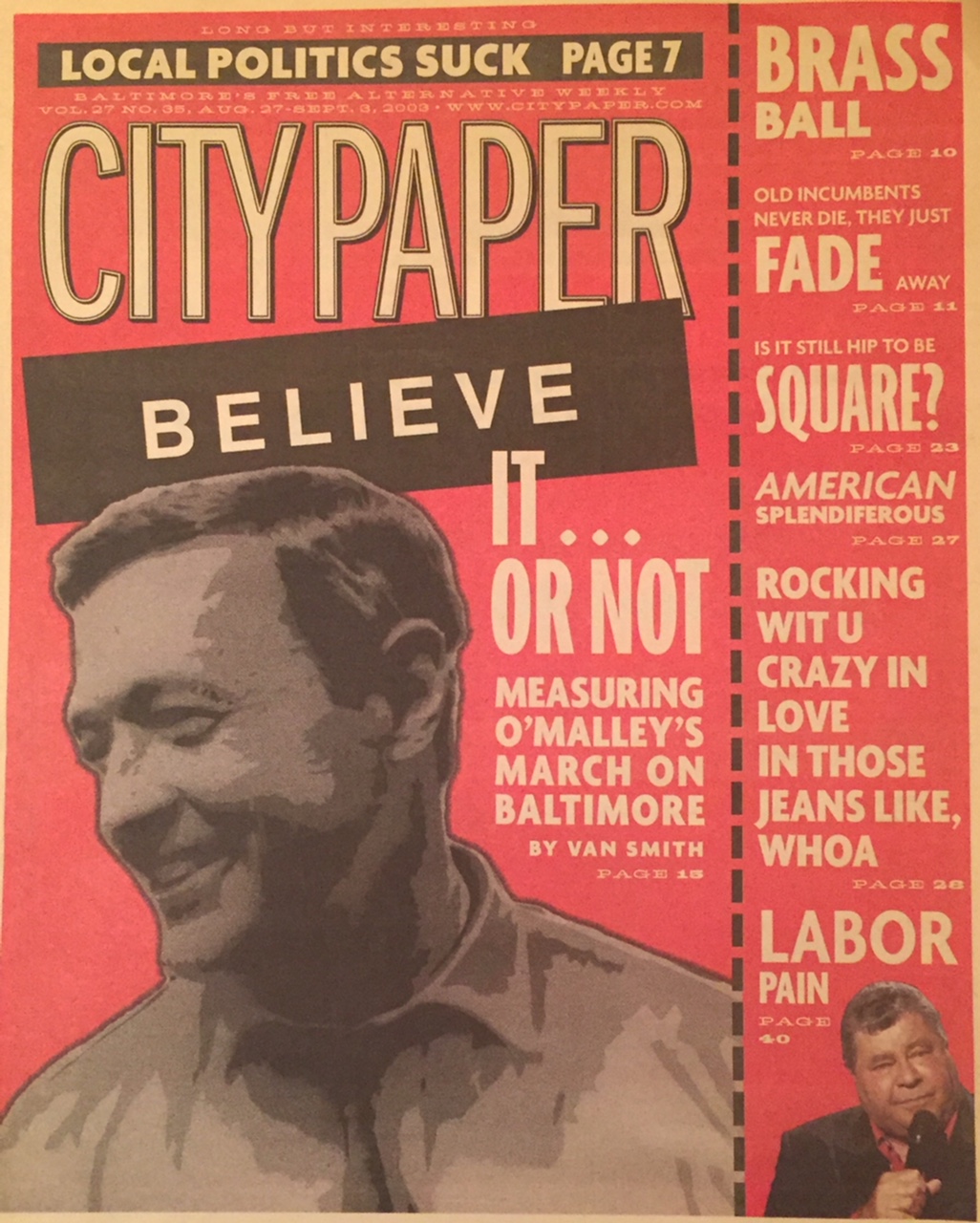
Believe It … Or Not: Measuring O’Malley’s March on Baltimore

By Van Smith

Published by City Paper, Aug. 27, 2003
IMG_7645

Good news is never hard to find when mayors seek re-election. Former Mayor Kurt Schmoke’s last political campaign in 1995 published a whole book of good news about his administration’s then-ongoing efforts in Baltimore. As is now widely recognized, though, the bad news far outweighed the good during the Schmoke years, which were marked by a cerebral approach to governance that produced paltry results and left the city’s psyche stigmatized by failure.

Schmoke’s charismatic successor, Martin O’Malley, was elected in 1999 on an ambitious anti-crime platform and a promising slogan, “For Reform and Change.” He won with a strong mandate that created high expectations and a refreshing sense of hope for the city. As he now runs for re-election as the distinct favorite in the six-way Democratic primary, O’Malley croons earnestly about the upturn Baltimore has seen during his four years in office. While his new campaign slogan–“Because Better Isn’t Good Enough”–suggests that his record has shortcomings he is willing to acknowledge, he’s still found plenty to boast about. Here’s a taste of some of the O’Malley campaign’s bragging points, lifted from its promotional materials:

  • “Baltimore has, in just a few years, achieved the largest [violent-crime] reduction of any major city in America.
  • “Baltimore’s per pupil spending increased by 15 percent [since 1999] . . . improving from 6th to 2nd highest in the state.
  • “In 2002 alone, the Baltimore Development Corporation’s efforts brought 6,000 jobs to Baltimore.”

Also available to help boost civic optimism during this election season is the Believe campaign, a multimillion-dollar advertising effort underwritten largely by the nonprofit Baltimore Police Foundation. The campaign aims to empower Baltimoreans to overcome the ravages of illegal drugs, and its most visible impact has been the thousands of images of the word “believe” that have placarded the city since last year. Believe’s latest media blitz, which started this summer and is ongoing, charts and celebrates the city’s progress since 1999. That’s the year before O’Malley took the reins of City Hall. Thus, Believe’s current feel-good message is not only about Baltimore’s efforts to tamp down its violent drug culture but also about O’Malley’s record as mayor.

Amid this propaganda, it’s hard to know what to trust. Critical thinking, after all, demands an innate skepticism of messages in advertising, because campaigns, whether political or commercial, are designed to make use of advantageous information rather than present a balanced picture.

IMG_7656

For instance, one could reason that Baltimore’s chart-topping reduction in violent crime is less remarkable than it sounds because, as the most violent city in the United States in 1999 (now the second most violent, behind Detroit), positive trends here have a greater statistical impact than in other, less violent cities. And while per-pupil spending increased 15 percent overall between 1999 and 2002, school enrollment during that period declined by almost 9 percent. With fewer students entering the system each year, per-student spending would increase naturally with a flat budget–and dramatically so with the modest budget increases that have been secured during O’Malley’s tenure in City Hall.

As for the 6,000 new jobs in 2002, attributed to the work of the city’s quasi-public economic development agency, that’s a lot of slots in a city where the number of unemployed people hovers around 25,000. The fact remains, though, that there were nearly 2,000 more unemployed people in the city’s labor force this June than there were in the beginning of 2002. And the unemployment rate has risen slightly rather than dropped during the same period. These facts strongly suggest that those 6,000 jobs were not filled predominantly by city residents but by commuters from surrounding areas.

Thus, the O’Malley camp’s upbeat take on the last four years begs other relevant ways to plumb Baltimore’s progress–different gauges than O’Malley’s people are emphasizing, ones that instead look at facets of city life not necessarily found in the campaign leaflets. The following results are mixed, and thus will please O’Malley supporters and detractors alike. And they show that O’Malley’s assertion that “better isn’t good enough” is dead-on in summing up his first term. The city’s stock has risen, but there’s room for improvement.

IMG_7646

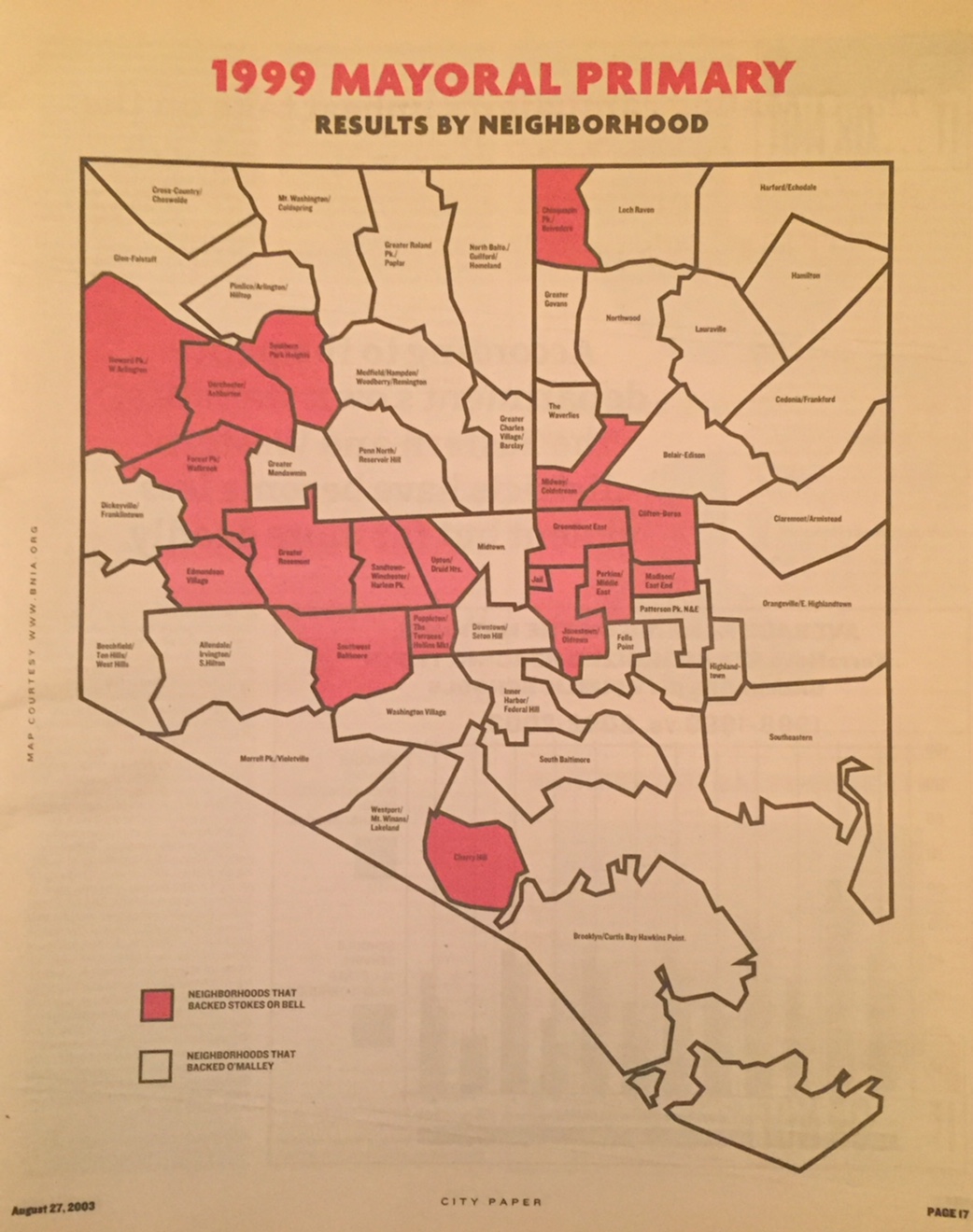
On election day 1999, Martin O’Malley was the beneficiary of a very important statistic when he chalked up 53 percent of the votes in what had shaken down to be a three-way, racially charged Democratic Primary pitting him, a white guy, against former City Councilman Carl Stokes and then-City Council President Lawrence Bell, both of whom are black. “There is more that unites us than divides us,” O’Malley often said that summer–a sentiment that, along with his bold promises to reduce crime using New York City’s successful approach as a model, resonated with an electorate that seemed exhausted from years of decline, violence, and divisiveness.

After the votes were counted, even some of those who worked against him were ebullient. “Martin O’Malley has a clear mandate from the entire city,” said former City Council president, 1995 mayoral candidate, and current 14th District City Council candidate Mary Pat Clarke, who supported Bell in the 1999 race. “This city, black and white, voted for Martin O’Malley. And it was not marginal. It was resounding. He has a mandate to lead the whole city. It’s a wondrous thing to behold.”
IMG_7647

O’Malley’s votes in that race, nonetheless, reflected the realities of the city’s stark divide between poor African-Americans and everyone else. The precincts that supported O’Malley–including many predominantly black precincts–were spread thickly across the city, with the exception of two, hard-to-ignore areas: the blighted, poverty-stricken swaths on the east and west sides, which form a butterfly-wing pattern with midtown at the center. These neighborhoods–Upton, Druid Heights, Sandtown-Winchester, Harlem Park, Rosemont, Poppleton, Edmondson Village, and others on the west side, and Middle East, Berea, Clifton Park, Jonestown, Greenmount West, and others on the east side–did not buy into the O’Malley agenda as it was spelled out during the ’99 campaign. Stokes or Bell won most of the votes in these butterfly wings, which are overwhelmingly black and are home to about a third of the city’s population.

These neighborhoods, more than any others in the city, have the most to gain from City Hall’s policies since they suffer most from Baltimore’s famous ills. Here, according to data published by the Baltimore Neighborhood Indicators Alliance (www. bnia. org), a Charles Village-based nonprofit that has taken on the Herculean task of collecting and analyzing myriad measures of Baltimore’s communities, a fifth of all serious crime is violent, vs. a 10th in the rest of the city. Here, more than a third of family households are headed by single mothers, vs. a fifth in the rest of the city. Here, about 60 percent of mothers receive first-trimester pre-natal care, vs. three-quarters of the mothers in the rest of the city. Here, nearly 40 percent of working people don’t use cars to get to their jobs, vs. less than 25 percent in the rest of the city. And here, out of every 1,000 juveniles, an average of 124 were arrested in 2001, vs. 95 in the rest of the city; the rate of juvenile arrests in these neighborhoods jumped to 142 per 1,000 juveniles in 2002. The list of disparities is long and poignant.

If, as his 1999 campaign materials noted, New York City was O’Malley’s model for success, then Baltimore’s poorest neighborhoods would benefit most from his policies, as happened during New York’s renaissance in the 1990s. Mayor Rudolph Giuliani’s approach–while widely vilified, largely because of the man’s brusque personality and a few horrific incidents involving his police force–was to commit resources where they were most needed, and thus he helped spur revival in Gotham’s most hard-pressed areas as well as its most prosperous. And, despite opinions to the contrary, Giuliani achieved these gains while reducing the number of police-involved shootings compared to his predecessor. So, has the approach worked in Baltimore under O’Malley’s guiding hand? Yes and no.

IMG_7648

There’s just no arguing the gains made in the critical early grades of the Baltimore City public schools during the last five years. Scores in the nationwide TerraNova standardized tests rose dramatically across the board between the 1998-’99 and 2002-’03 school years in the city’s elementary-school grades. And those gains, reflected in a recently released school system report, have been greatest in schools serving the city’s poorest neighborhoods–though the situation is reversed in scores for sixth-graders. The greatest climb in average percentile rankings was in poor areas’ second-grade reading scores, which jumped an average of 23.2 points in the five-year period, while the scores rose 17.1 points for second-graders in the rest of the city’s schools. Sixth-graders scores in the poor schools, though, climbed an average of 9.6 points, compared to 19.6 at all the other city schools.

IMG_7655

O’Malley attributes this overall success in part to expanding programs that target kids before they enter first grade. “We have gone from 109 full-day kindergarten classes to 297, reaching that mandate five years ahead of when the state wanted us to,” he cited during a recent interview with City Paper in his City Hall office. “And we’ve gone from one full-day pre-K program to 91.” He also pointed out that the school system’s efforts to standardize course content have helped, too, given that “a lot of kids are in three or four or five different schools in the course of a year, [and are faced] with a different curriculum every time.”

Kids living in poverty, O’Malley observes, have to prevail over more severe obstacles in order to learn well, so the greater improvements in test scores at schools serving poor children are that much more impressive. “The neighborhood environment from which our poor children are drawn have a lot bigger societal problems . . . [such as] violent crime, drug addiction, and the sort of societal abandonment, familial abandonment, that those things fuel, than in other areas of our city,” he said. “Unfortunately, [these students] have to overcome a lot more of the baggage that we as a society still allow to be heaped upon them through no fault of their own.

“So I don’t think it’s accidental that our kids are doing better in school as the city’s becoming safer and as more parents are getting into drug treatment,” he continued. “I think all of this works together. And the expectations for their success I think are greater than maybe they’ve been in years past.”

Of any single area under city government’s bailiwick, though, the school system is the one over which the mayor has the least direct influence. This is the result of a partial state takeover of city schools during Schmoke’s last term–a negotiated outcome to settle a long-litigated lawsuit. Thus, while O’Malley has some say over schools policy by virtue of his control over nine appointments to the 18-member school board and the city’s 23.5 percent contribution to the system’s 2002 budget, he can’t take full credit for its success or failure. Nonetheless, his limited clout in the schools arena means he can tout–with a measure of modesty–the remarkable rise in test scores as part of his record as mayor.

IMG_7649

By and large, the city’s poorest neighborhoods fall in two of the city’s nine police districts, the Eastern and the Western. Examining the crime numbers in these two districts in 1999 and 2002, vs. the other seven districts, turns up mixed results. According to police department data, overall violent crime in the Eastern and Western districts combined has dropped 31 percent from 1999 to 2002, while nonfatal shootings have dropped almost 38 percent. But murders rose nearly 15 percent in 2002 compared to 1999–and the two districts’ share of the city’s total number of homicides has increased from nearly 30 percent in 1999 to more than 41 percent in 2002.

Running the same analysis on 2003’s year-to-date figures in the Eastern and Western districts as of Aug. 9, vs. 1999’s numbers on the same date, show that the disparity is even greater this year. Murders are up 50 percent from 1999, while violent crime has dropped more than 42 percent and shootings more than 18 percent. According to the police department’s own statistics, the Eastern and Western districts have become less violent but far more deadly.

IMG_7653

“I had never seen these murder numbers broken down like this before,” O’Malley commented while reviewing these statistics. “It’s an interesting way to break them down.” But his response was to repeat Giuliani’s mantra: “We apply our resources to where the problems are.” And then he opened his crime-numbers notebook and recited figures showing that violent crime is down dramatically in every district, including the Eastern and Western.

“You know,” he added, “all of this is a work in progress. I’m not happy with 253.” That’s the number of murders committed citywide in 2002–a far cry from the 175 he had promised by that date during the 1999 campaign and during the first two years of his administration. “We’re going to continue to go down from there.”

IMG_7654

And the mayor got exercised over projections of this year’s final murder tally, which as of press time is on track to reach about 285 by the end of December. “Everybody always wants to project that year-end number,” he said with palpable disgust. “I mean, they want to do it in July. And a half a year’s left. And it is awful and it’s morbid and it’s cold to talk statistics. One homicide is one homicide too many.

“But we deploy our resources to where the problems are,” O’Malley continued, getting back to the disproportionate violence in the Eastern and Western districts. “And all of this, it is still young. The open-air drug trade in this city was allowed to grow and flourish and develop and become as acute as it did over a 25-year slide. And so we are going to continue to hammer it.”

Another area that O’Malley has targeted is police corruption. It’s a ticklish subject, and one on which he mounted his bully pulpit starting in 1993, when he was a young councilman. “The few bad apples are just that–the few,” he said in an impassioned speech on the council floor 10 years ago. “But there is not a single knowledgeable person in federal, state, or local law enforcement today who will deny that we have a growing problem with street-level corruption.”

During the 1999 campaign, O’Malley repeatedly stressed the importance of “policing the police,” and continued to fuel the perception that the corruption problem in the department was acute. And he asserted that the problem had been swept under the rug for years. After he was elected, he hired a consulting firm, the Maple/Linder Group of New York City, to do a full assessment of the police department, including an internal survey of sworn officers. The findings on corruption were eye-popping. “While 48.7 percent of respondents believe that five percent or less of . . . officers are stealing money or drugs from drug dealers,” the report reads, “23.2 percent believe the number is greater than a quarter of the department.” Based on the buzz O’Malley sounded, many in Baltimore expected to see heads starting to roll.

It never really happened. There was one infamous case–Agent Brian Sewell, who was accused of planting drugs on an innocent suspect as a result of a sting operation. But the case tanked when the alleged evidence against him was pilfered by the lead investigator in the case from a secret internal-investigations office in Essex around Christmas 2000. (The department used its administrative procedures to fire Sewell. He appealed successfully, winning the right to a new trial-board hearing, but agreed to leave the force rather than go through another proceeding. Sewell recently died in an accident at Andrews Air force Base, where he had been assigned for duty with the Maryland National Guard.)

Other than Sewell, police department spokesman Matt Jablow says only three other officers–Jacqueline Folio, Scott Fullwood, and an unnamed member of the force–failed the 217 drug-related integrity stings staged by the department’s Internal Affairs Division since the beginning of 2000. The unnamed officer, Jablow explained, “struck a deal” and retired, so the department is unwilling to reveal his name.

“We’ve been doing 100 integrity stings a year for the last few years,” O’Malley explained, somewhat apologetically. “Some of them are targeted, a lot of them are random. Like everything else we do in this department, there is plenty of room for improvement as far as how we police our police. We’re doing more of it than we ever have. We have not come across that sort of beehive’s nest of every officer on a shift in a particular precinct [involved in corruption], like they had in New York, where they had a couple of celebrated cases. But [police Commissioner Kevin] Clark believes that we can do those targeted stings even more effectively than we have done them in the past.

“You don’t start a new effort like that and have it perfect overnight,” he continued. “And obviously from some of the problems that we had in some of those prosecutions [e.g., the Sewell case], it was pretty apparent that this was something new for us. But I had been somewhat surprised not to find more of that, given the way the drug trade took over big swaths of the city. But we’ll continue to be on the lookout for it and to improve the effectiveness of the investigations.”
IMG_7650

In 1999, as O’Malley was running for mayor on an anti-crime platform, critics sometimes complained that he was a one-trick pony. Even his economic development ideas were built on crime-fighting. When asked during an interview that summer what the government’s role is in creating jobs and improving the business climate, for instance, he responded that “you do both of those things by first accomplishing job one of any organized government, which is public safety. I think there is no way to create jobs or to improve the business environment if the only businesses expanding are these open-air drug markets.”

But there was more to his plan than boosting law-enforcement. It also involved “having a mayor more actively involved with our lending institutions and letting them know where opportunities exist in this city,” he continued, “where they can make a dollar and where they can help build this city again. Businesses, their knock on city government isn’t a whole helluva lot different than citizens. Nobody returns their phone calls and nobody listens. So that’s what it’s all about.”

Today, O’Malley likes to talk about the $1.6 billion in new construction that he says is underway in Baltimore. Apparently, by that measure, his one-two punch of crime-fighting and massaging the investing class has worked pretty well. While unemployment remains high–the June figure for the city was 8.8 percent, compared to 5.2 percent for the metro region and 4.3 percent for Maryland overall–that’s largely out of his control, given the national economic recession that took hold in 2000, just as he was getting traction as the new mayor.

“We haven’t taken as severe a hit to our overall job base [during this recession] as other cities,” says Anirban Basu, an economist who heads the Fells Point-based consulting firm Optimal Solutions. “And that’s a radical departure from the recession of the early 1990s, when Baltimore was a laggard in recovering compared to other cities, which tended to come out strong during the rest of the decade. A lot of people expected a repeat performance this time, and that never materialized.” Basu attributes that in part to the wealth in the region, which means more businesses and individuals qualify to take advantage of the historically low interest rates on bank loans: “That’s why we have had such a terrific housing market in Baltimore City, which has the cheapest housing stock in the region, so it is likely people are going to look there first for deals. And many would-be renters have been empowered to buy homes.”

Baltimore’s relative prosperity amid a recession is hard to attribute directly to O’Malley’s efforts. But his efforts have certainly helped. While several formal economic-development strategies have been conceived during O’Malley’s four years in office, two were much ballyhooed early on. First, and the one that was promised often during his 1999 campaign, was to leverage the power of the Community Reinvestment Act (CRA), the federal law requiring banks to make loans in poorer neighborhoods from which they draw depositors. And the second, adopted after he gained office, was to grow the local technology industry in a drive that was dubbed “The Digital Harbor.”

It’s hard to quantify how effectively O’Malley has wielded the CRA to bring new investment to Baltimore. But the extent to which he’s succeeded at all is an achievement, because the CRA has become an increasingly impotent tool in recent years. The main trend that has weakened the CRA is the fact that national mortgage-lending companies have increasingly become the lender of choice for many homebuyers and for those refinancing their mortgages. Such companies generally do not have local branches where consumers make deposits, and thus are not subject to the CRA’s provisions.

So, while O’Malley talked a big CRA game during the 1999 campaign–saying, for instance, that he would use “that hammer of monitoring the banks and the threat that you’ll mess up their business and their ability to merge and do what banks like to do in this era”–his tone has been much more conciliatory toward the banks since he took office. “A lot more of our banks were more savvy [on the CRA front] than we had anticipated,” he explained recently.

Despite the CRA’s increasingly limited reach, several local banks that do take deposits from Baltimore have outstanding CRA ratings, and they’ve stepped up to the plate with sizable CRA-eligible loans for local development efforts. Most impressive has been the Bank of America, which, by O’Malley’s tally, has financed or invested in ongoing local projects to the tune of approximately $170 million.

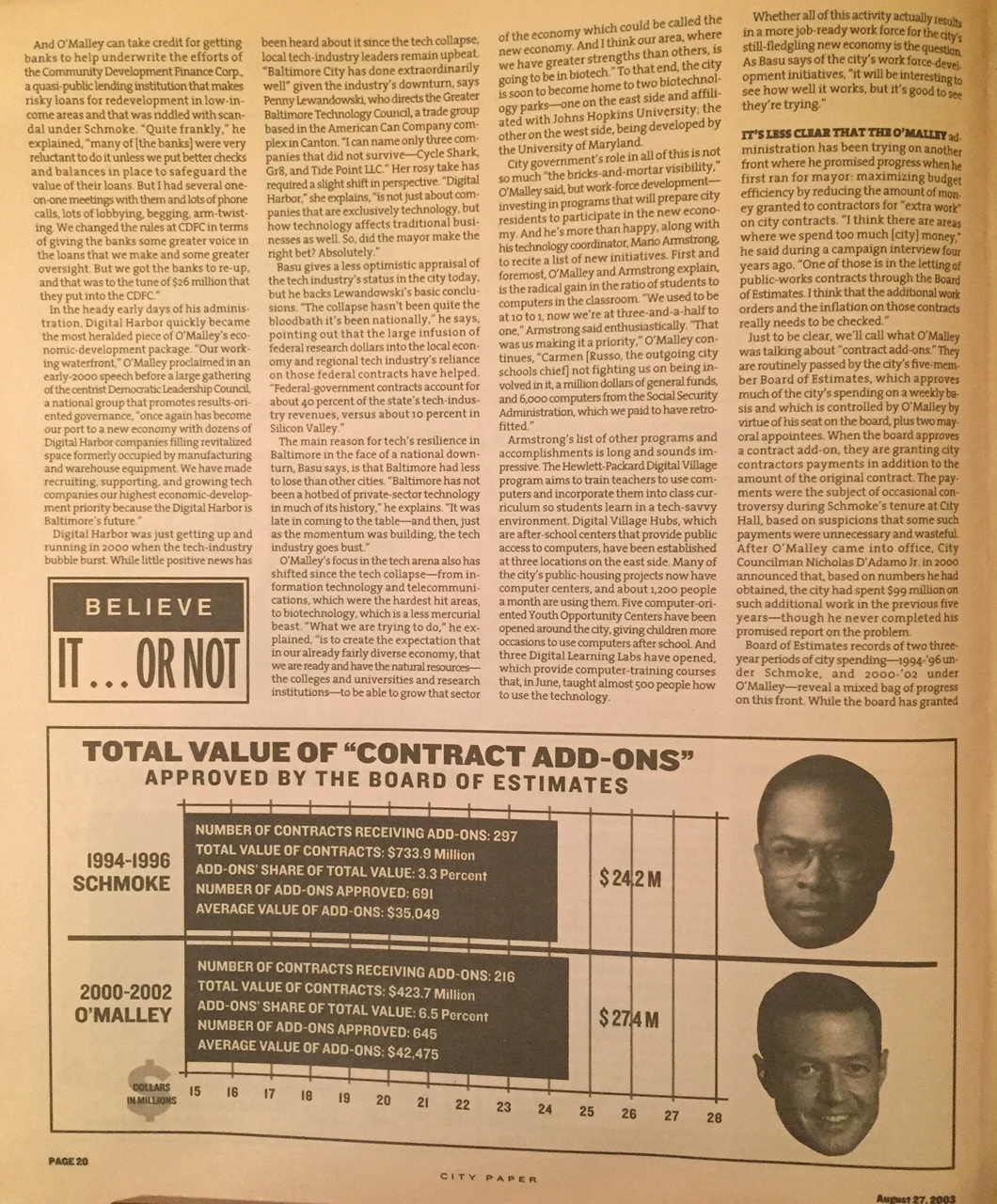
And O’Malley can take credit for getting banks to help underwrite the efforts of the Community Development Finance Corp., a quasi-public lending institution that makes risky loans for redevelopment in low-income areas and that was riddled with scandal under Schmoke. “Quite frankly,” he explained, “many of [the banks] were very reluctant to do it unless we put better checks and balances in place to safeguard the value of their loans. But I had several one-on-one meetings with them and lots of phone calls, lots of lobbying, begging, arm-twisting. We changed the rules at CDFC in terms of giving the banks some greater voice in the loans that we make and some greater oversight. But we got the banks to re-up, and that was to the tune of $26 million that they put into the CDFC.”

In the heady early days of his administration, Digital Harbor quickly became the most heralded piece of O’Malley’s economic-development package. “Our working waterfront,” O’Malley proclaimed in an early-2000 speech before a large gathering of the centrist Democratic Leadership Council, a national group that promotes results-oriented governance, “once again has become our port to a new economy with dozens of Digital Harbor companies filling revitalized space formerly occupied by manufacturing and warehouse equipment. We have made recruiting, supporting, and growing tech companies our highest economic-development priority because the Digital Harbor is Baltimore’s future.”

Digital Harbor was just getting up and running in 2000 when the tech-industry bubble burst. While little positive news has been heard about it since the tech collapse, local tech-industry leaders remain upbeat. “Baltimore City has done extraordinarily well” given the industry’s downturn, says Penny Lewandowski, who directs the Greater Baltimore Technology Council, a trade group based in the American Can Company complex in Canton. “I can name only three companies that did not survive–Cycle Shark, Gr8, and Tide Point LLC.” Her rosy take has required a slight shift in perspective. “Digital Harbor,” she explains, “is not just about companies that are exclusively technology, but how technology affects traditional businesses as well. So, did the mayor make the right bet? Absolutely.”

Basu gives a less optimistic appraisal of the tech industry’s status in the city today, but he backs Lewandowski’s basic conclusions. “The collapse hasn’t been quite the bloodbath it’s been nationally,” he says, pointing out that the large infusion of federal research dollars into the local economy and regional tech industry’s reliance on those federal contracts have helped. “Federal-government contracts account for about 40 percent of the state’s tech-industry revenues, versus about 10 percent in Silicon Valley.”

The main reason for tech’s resilience in Baltimore in the face of a national downturn, Basu says, is that Baltimore had less to lose than other cities. “Baltimore has not been a hotbed of private-sector technology in much of its history,” he explains. “It was late in coming to the table–and then, just as the momentum was building, the tech industry goes bust.”

O’Malley’s focus in the tech arena also has shifted since the tech collapse–from information technology and telecommunications, which were the hardest hit areas, to biotechnology, which is a less mercurial beast. “What we are trying to do,” he explained, “is to create the expectation that in our already fairly diverse economy, that we are ready and have the natural resources–the colleges and universities and research institutions–to be able to grow that sector of the economy which could be called the new economy. And I think our area, where we have greater strengths than others, is going to be in biotech.” To that end, the city is soon to become home to two biotechnology parks–one on the east side and affiliated with Johns Hopkins University; the other on the west side, being developed by the University of Maryland.

City government’s role in all of this is not so much “the bricks-and-mortar visibility,” O’Malley said, but work-force development–investing in programs that will prepare city residents to participate in the new economy. And he’s more than happy, along with his technology coordinator, Mario Armstrong, to recite a list of new initiatives. First and foremost, O’Malley and Armstrong explain, is the radical gain in the ratio of students to computers in the classroom. “We used to be at 10 to 1, now we’re at three-and-a-half to one,” Armstrong said enthusiastically. “That was us making it a priority,” O’Malley continues, “Carmen [Russo, the outgoing city schools chief] not fighting us on being involved in it, a million dollars of general funds, and 6,000 computers from the Social Security Administration, which we paid to have retrofitted.”

Armstrong’s list of other programs and accomplishments is long and sounds impressive. The Hewlett-Packard Digital Village program aims to train teachers to use computers and incorporate them into class curriculum so students learn in a tech-savvy environment. Digital Village Hubs, which are after-school centers that provide public access to computers, have been established at three locations on the east side. Many of the city’s public-housing projects now have computer centers, and about 1,200 people a month are using them. Five computer-oriented Youth Opportunity Centers have been opened around the city, giving children more occasions to use computers after school. And three Digital Learning Labs have opened, which provide computer-training courses that, in June, taught almost 500 people how to use the technology.

Whether all of this activity actually results in a more job-ready work force for the city’s still-fledgling new economy is the question. As Basu says of the city’s work force-development initiatives, “it will be interesting to see how well it works, but it’s good to see they’re trying.”

It’s less clear that the O’malley administration has been trying on another front where he promised progress when he first ran for mayor: maximizing budget efficiency by reducing the amount of money granted to contractors for “extra work” on city contracts. “I think there are areas where we spend too much [city] money,” he said during a campaign interview four years ago. “One of those is in the letting of public-works contracts through the Board of Estimates. I think that the additional work orders and the inflation on those contracts really needs to be checked.”

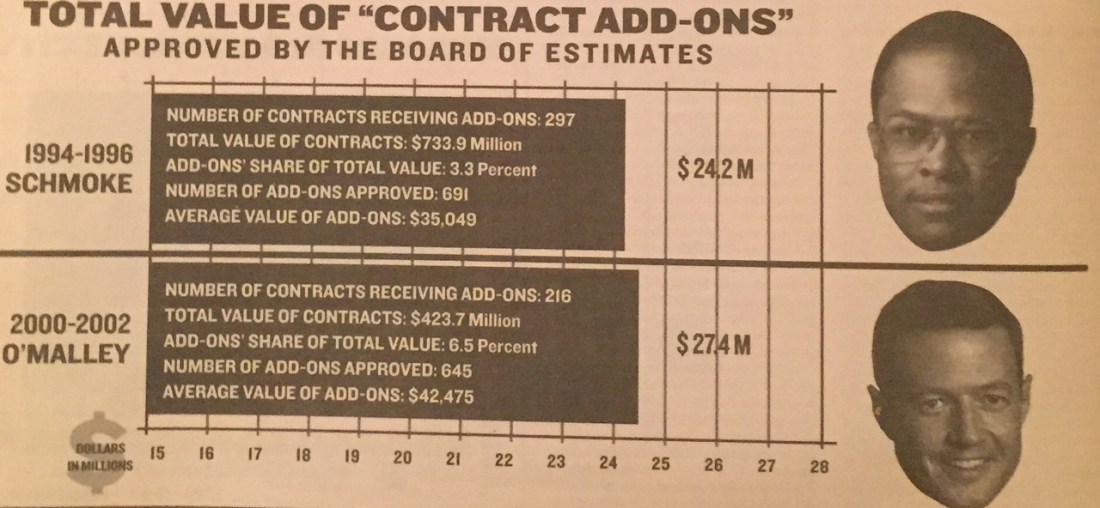
Just to be clear, we’ll call what O’Malley was talking about “contract add-ons.” They are routinely passed by the city’s five-member Board of Estimates, which approves much of the city’s spending on a weekly basis and which is controlled by O’Malley by virtue of his seat on the board, plus two mayoral appointees. When the board approves a contract add-on, they are granting city contractors payments in addition to the amount of the original contract. The payments were the subject of occasional controversy during Schmoke’s tenure at City Hall, based on suspicions that some such payments were unnecessary and wasteful. After O’Malley came into office, City Councilman Nicholas D’Adamo Jr. in 2000 announced that, based on numbers he had obtained, the city had spent $99 million on such additional work in the previous five years–though he never completed his promised report on the problem.

Board of Estimates records of two three-year periods of city spending–1994-’96 under Schmoke, and 2000-’02 under O’Malley–reveal a mixed bag of progress on this front. While the board has granted fewer add-ons under O’Malley than they did under Schmoke and has reduced the number of contracts receiving additional work, the amounts granted have grown–especially when measured as a share of the total value of city contracts receiving additional payments. While the city spent $24.2 million on add-ons during the three-year period under Schmoke, it spent $27.4 million on such additional payments under O’Malley–and the add-ons’ share of the total value of contracts rose from 3.3 percent to 6.5 percent.
IMG_7652

The mayor’s office provided alternative figures to City Paper, but they don’t square with the records of the Board of Estimates, which were the basis for City Paper‘s analysis and which are the only source available for the public to independently research city spending patterns. Raquel Guillory, the mayor’s chief spokeswoman, told City Paper the total value of contracts from 1994 through ’96 was $323,649,981, with add-ons comprising 8.4 percent of that total, while the figures for 2000 through ’02 were $379,340,369 and 7.2 percent, respectively. Thus, the O’Malley administration’s numbers show efficiency–add-ons as a percentage of total contract amounts–has increased under O’Malley, while City Paper shows greatly increased inefficiency under O’Malley.

City Paper asked Guillory to explain how city government arrived at their figures. She said that the city’s numbers were derived from the sum total of construction contracts that came before the Board of Estimates for contract add-ons. City Paper based its figures on the sum total of all city contracts–including everything from waste-water treatment improvements to consulting work to digital mapping of the city.

Guillory also explains that two projects worked on under the O’Malley administration–extensive and glitch-riddled contracts on the police headquarters building and Hopkins Plaza downtown–were held over from the Schmoke administration and made up for a large amount of the extra work passed by the Board of Estimates during O’Malley’s term. Also, O’Malley adds, city managers have “been trying to do a better job in terms of the degree of detail that’s in the contracts to begin with, when they go out for bid,” explaining that “if we put out better contracts, we might get the job done for less, without these expensive overages.” So far, the Board of Estimate records don’t reflect the improvements O’Malley suggested have had a money-saving effect, because both the amount and the share of additional work have risen markedly compared to the Schmoke administration in the mid-1990s.
IMG_7651

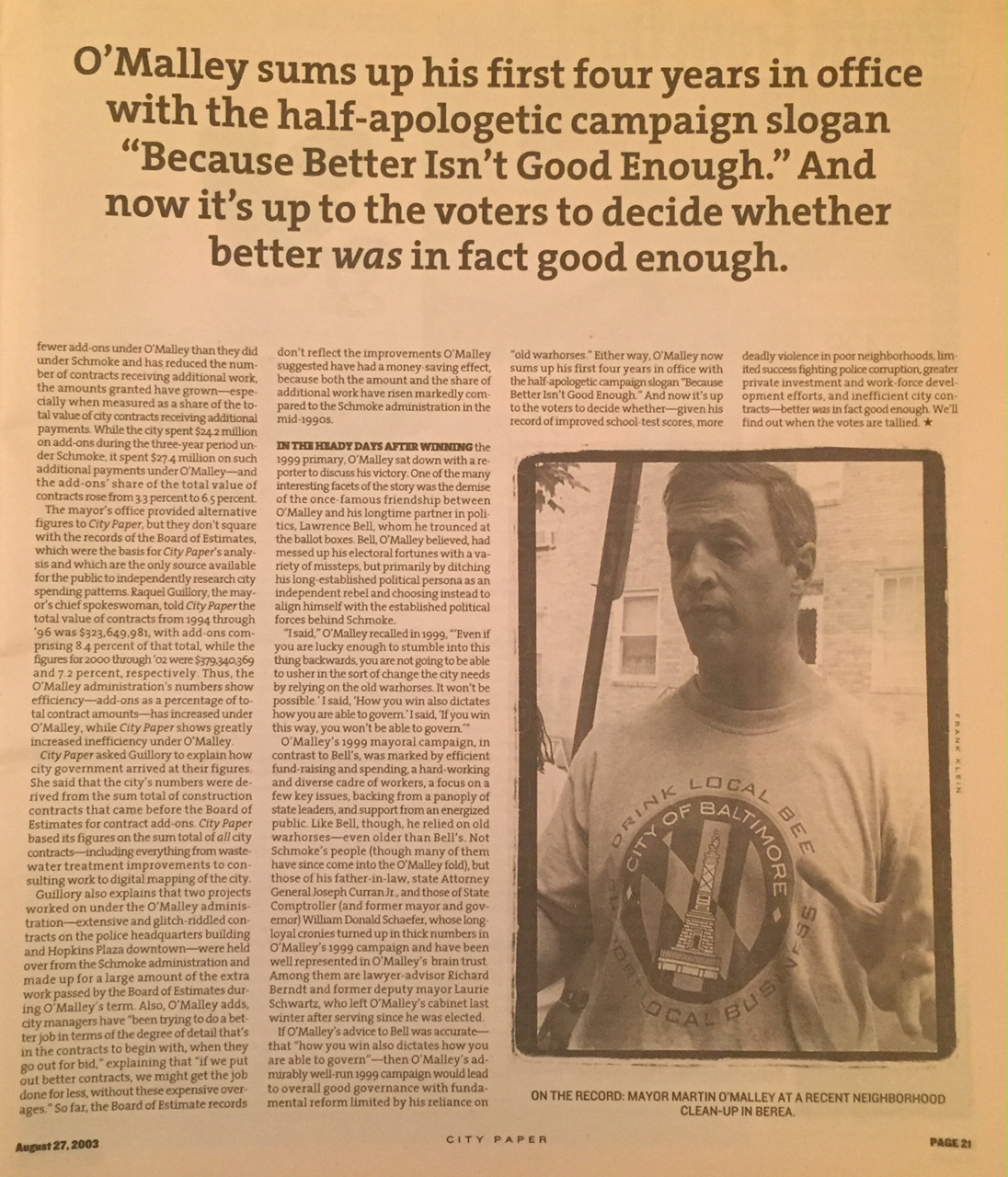
In the heady days after winning the 1999 primary, O’Malley sat down with a reporter to discuss his victory. One of the many interesting facets of the story was the demise of the once-famous friendship between O’Malley and his longtime partner in politics, Lawrence Bell, whom he trounced at the ballot boxes. Bell, O’Malley believed, had messed up his electoral fortunes with a variety of missteps, but primarily by ditching his long-established political persona as an independent rebel and choosing instead to align himself with the established political forces behind Schmoke.

“I said,” O’Malley recalled in 1999, “‘Even if you are lucky enough to stumble into this thing backwards, you are not going to be able to usher in the sort of change the city needs by relying on the old warhorses. It won’t be possible.’ I said, ‘How you win also dictates how you are able to govern.’ I said, ‘If you win this way, you won’t be able to govern.'”

O’Malley’s 1999 mayoral campaign, in contrast to Bell’s, was marked by efficient fund-raising and spending, a hard-working and diverse cadre of workers, a focus on a few key issues, backing from a panoply of state leaders, and support from an energized public. Like Bell, though, he relied on old warhorses–even older than Bell’s. Not Schmoke’s people (though many of them have since come into the O’Malley fold), but those of his father-in-law, state Attorney General Joseph Curran Jr., and those of State Comptroller (and former mayor and governor) William Donald Schaefer, whose long-loyal cronies turned up in thick numbers in O’Malley’s 1999 campaign and have been well represented in O’Malley’s brain trust. Among them are lawyer-advisor Richard Berndt and former deputy mayor Laurie Schwartz, who left O’Malley’s cabinet last winter after serving since he was elected.

If O’Malley’s advice to Bell was accurate–that “how you win also dictates how you are able to govern”–then O’Malley’s admirably well-run 1999 campaign would lead to overall good governance with fundamental reform limited by his reliance on “old warhorses.” Either way, O’Malley now sums up his first four years in office with the half-apologetic campaign slogan “Because Better Isn’t Good Enough.” And now it’s up to the voters to decide whether–given his record of improved school-test scores, more deadly violence in poor neighborhoods, limited success fighting police corruption, greater private investment and work-force development efforts, and inefficient city contracts–better was in fact good enough. We’ll find out when the votes are tallied.

The Colombian Connection: Feds say Baltimore man was trusted client of Colombian heroin traffickers

By Van Smith

Published by City Paper, Jan. 1, 2014

For nearly six years, Paul Eugene Sessomes of Baltimore was on the radar of U.S. Drug Enforcement Administration (DEA) agents in New York and Bogota, Colombia, who believed he was coordinating delivery of heroin proceeds on behalf of Colombians at the top of the supply chain. In December, those suspicions were unveiled in an indictment against Sessomes and three others in New York, where they face federal money-laundering conspiracy charges.

The two lead defendants in the case, Jorge Humberto Espitia Arciniegas and his nephew Carlos Andres Espitia Garcia, were arrested in Colombia in early December and are expected to be extradited, according to press coverage there. The other defendant, Marleny Amparo Torres, is a mother of two who lives in Stamford, Conn., and works as a nanny for a Darien, Conn. psychotherapist and her husband, the founder of a health care company, according to court records.

Sessomes, who is in his early 60s and has been previously arrested twice on drug charges that later were dismissed, pleaded not guilty to the charges when he was arraigned on Dec. 12 before New York U.S. District Judge Ramon Reyes Jr., and was ordered temporarily detained, with bond set at $125,000.

Meanwhile, on Dec. 6, federal authorities moved to take ownership of two Baltimore-area properties tied to Sessomes, claiming they are tied to his alleged drug-money transactions: a luxury condominium he owns at 414 Water St. in downtown Baltimore and a home on Jericho Road in Columbia which he co-owns with Juliet Branker.

Two of the prosecutors handling the cases involving Sessomes—Adrian Rosales in the New York criminal case and Darrin McCullough in the Maryland forfeiture lawsuit—work out of the U.S. Department of Justice (DOJ) headquarters in Washington, D.C., suggesting Sessomes’ alleged conduct has attracted attention at high levels of U.S. anti-drug efforts. Both work for DOJ’s Narcotic and Dangerous Drug Section, which, according to its website, targets “priority national and international drug trafficking groups.”

City Paper first wrote about Sessomes in a 2010 article detailing Baltimore cases in which targets are alleged to deal directly with foreign sources of drugs (“Direct Connections,” Mobtown Beat, March 3, 2010). At the time, the DEA had recently seized $535,200 in cash from two storage lockers leased by Sessomes, saying they were tied to Sessomes’ transactions with the Espitia heroin-trafficking organization, based in Colombia. The allegations in the storage-lockers search warrant mirror those in the recently filed forfeiture case, which adds new details indicating Sessomes was held in high esteem by his Colombian contacts.

Sessomes was Arciniegas’ “best client” at “selling ‘H,’” or heroin, and was “very ‘honest and good’ because Sessomes always maintained the money correctly and never tried to cheat” the Espitia organization, court documents state. A cooperating source told agents that, from 2006 to August 2008, he met Sessomes about a dozen times to pick up heroin proceeds of between $70,000 and $120,000, which he would pick up in Baltimore and deliver to New York for deposit into bank accounts.

DEA investigators have previously tied Sessomes to Thomas Corey Crosby, a convicted Baltimore heroin dealer who is currently in prison. In 2008, when Crosby was named in connection with, but never charged in, a 2007 federal drug case involving Fat Cats Variety store in Southwest Baltimore (“All the Emperor’s Men,” Mobtown Beat, Aug. 27, 2008), agents alleged Crosby laundered drug money through Westport Auto, Inc., a used-car business tied to Sessomes.

The defense attorney for Sessomes and Crosby at that time, James Gitomer, when asked by City Paper to comment about Sessomes’ current legal problems, responded with a “No thanks.” Sessomes’ court-appointed attorney in New York, John Michael Burke, did not respond to a request for comment.

Peter Carr, spokesperson for the U.S. Attorney’s Office in New York, responded to City Paper’s inquiries by stating that “at this stage of the case, we are unable to provide additional details beyond what is in public court documents,” and explained that DOJ Narcotic and Dangerous Drugs Section prosecutors “get involved in cases that are both multi-jurisdictional and international in scope.”

Court documents indicate that investigators’ interest in Sessomes—who court documents describe as a “member” of the Espitia organization who is “actively involved in its illegal activities”—began on April 4, 2008, when Arciniegas left on Sessomes’ phone a voicemail message that was intercepted by the DEA in Bogota, saying, “Good morning, Paulie, it’s Georgie, I have the good news very soon. I’ll call you very soon.”

Subsequently, as the DEA’s probe continued, agents concluded that two Espitia members, one in New York and the other in Miami, “were regularly traveling to the greater Baltimore area to collect narcotics proceeds from Sessomes,” court documents state. Both of those members, who later became cooperating sources for DEA’s investigation, allegedly went to Baltimore to collect $300,000 on Aug. 3, 2008—a transaction that became the core conduct charged in the money-laundering conspiracy indictment against Sessomes and his co-defendants.

About a month later, court documents state, agents watched as Sessomes met in Baltimore with two people—Diego Neira and Maria Espitia-Garcia—described as “known money launders [sic] for the Bogota, Columbia [sic] based Espitia heroin organization.”

The indictment was filed under seal on Aug. 1, almost exactly five years after the $300,000 transaction. Five years is the statute of limitations for most crimes charged under federal law, including conspiracy. The same day it was unsealed, on Dec. 6, Sessomes appeared before Maryland U.S. Magistrate Judge Susan Gauvey, who ordered him detained and committed to New York to face the indictment.

Rye Shills: A Short History of City Paper’s Long Obsession with Pikesville Rye

By Van Smith

Published by City Paper, Jan. 23, 2013

pikesvillerye

A text message lit up my phone in the middle of the night recently: a New York friend was at a pub in Edinburgh, Scotland, and wanted me to know that “they have a bottle of Pikesville Rye behind the counter.” How far the lowly have risen, for the self-styled “aristocrat of whiskeys,” distilled in Kentucky but based on an old Maryland process, to be stocked deep in the peaty heart of exalted single malts.

Even here in Baltimore, where rye traditions run deep, Pikesville Supreme Straight Rye Whiskey has proven at times a rare commodity. Certain joints and packies have reliably purveyed it for years, but most didn’t – and barkeeps and store-owners would even, at times, claim total ignorance of its very existence. That’s been changing of late, though. Just as rye generally has enjoyed a revival over the past 10 years or so, Pikesville, too, has re-emerged as an old faithful. And we here at Baltimore’s most Pikesville-Rye-promoting weekly will presume, however unscientifically, to take some credit for that.

For all practical purposes, written history today begins with online content, and City Paper‘s reveals an abnormal, against-the-grain obsession with Pikesville Rye. It started with Tom Scocca’s “You Gonna Eat That?” feature in 2000, which, along with other notable Maryland edibles (crab cakes, scrapple, etc.), established the nutritional values for rye . A year later, after the Ravens won the Super Bowl, David Dudley wrote in from Canada, where he was living at the time, that he celebrated by doing shots of Pikesville and spinning Kix albums.

Our Pikesville-promoting ways picked up steam in 2004, when an Eat feature about shad roe included a photograph of the dish – and in the frame, inexplicably, was a one-third empty bottle of Pikesville . More rational was its inclusion in a photograph for that year’s “Some Like it Hot” feature, about hot drinks, which recommended Pikesville for making hot toddies.

Starting in 2005, and continuing nearly unabated since, we’ve been hyping Pikesville Rye in Best of Baltimore awards:

2005’s Best Cheap Drink was a Pikesville Rye with a soda back at Mount Royal Tavern (hereinafter called, simply, “the Tavern”). Ditto in 2006, also at the Tavern, except substitute Natty Boh for the soda back. In 2008, a Pikesville Rye mention was included in Best Wi-Fi Spot, awarded to the Tavern , while Best Opportunity for Free Whiskey went to Alexander’s Tavern, where a shot of rye goes to anyone who puts a Dropkick Murphys song on the jukebox . Club Charles was dinged for not having Pikesville when it got Best Bar for Tourists in 2009, and in 2010 it got Best Bar, Station North, in part because Pikesville’s place behind the bar had been restored. In 2011, the Tavern got Best Cheap Drinks, with a nod to its low price for Pikesville, and Best Totally Disgusting Thing to do with a Natty Boh went to Windup Space’s “Kosher Boh,” a Pikesville Rye-involved concoction.

The Nose made much of the relative benefits of the Tavern and the Club Charles as Pikesville Rye purveyors in 2005 and 2007. In the first instance, we were shocked – shocked! – to find Club Charles out of the stuff on Christmas night, saying “we’d been tasting our favorite rye there since we had more pimples than wrinkles,” so “this news was drink-shattering,” then adding that we “huffed off to the Tavern, where they reliably serve Pikesville in topped-off rocks glasses-a neat feat if ever there was one, especially for the reddening Nose at closing time.” In 2007, by which time Club Charles had started stocking Pikesville Rye again, the Nose got into it with proprietor Joy Martin, who told us the high pricing is “because only you drink it,” adding that so few people buy it that “we have to toss” out bottles before they’re empty – “but the fruit flies seem to like the stuff.”

In the Holiday Guide, a bottle of Pikesville Rye has only been recommended as a gift once, in 2005, though in 2011, when touting a bottle of Sloop Betty wheat vodka, we declared that “we won’t be satisfied with the Maryland craft-booze scene until we get Pikesville Rye back in Pikesville.”

In 2009, an end-of-the-decade recollection of the year 2000 painted a picture of a Pikesville-Rye addled writer, obsessed with the shadow-economy figures who’d opened a car-chopping shop next door, and in 2010, four paragraphs of a seven-paragraph review of Frank DeFord’s book, Bliss, Remembered, were dedicated to deconstructing DeFord’s references to Pikesville Rye (his mistakes were duly forgiven).

Finally, in 2012, all of this shilling started to pay off. The City That Drinks celebrated Pikesville Rye, raising hopes that someday a rye will be distilled in Maryland again. Juice extolled rye generally as a Manhattan’s foundation, while dryly acknowledging Pikesville’s long-ago exit from Maryland. Topping it all off, Joe MacKeepacigarhandy, in a calendar write-up for the Beer, Bourbon, and BBQ Festival, boasted that “we’ve been imbibing Pikesville Rye for years and recommending it to anybody who will listen, and now ‘the hottest adult beverage in the market today’ will have its own special tasting area” at the festival.

Apparently, our work is done.

Holy War: Inside the Crusade to Kill Maryland’s New Marriage-Equality Law

By Van Smith

Published by City Paper, Oct. 3, 2012

logo

Maryland holds a special place in the legal history of same-sex marriage in America. In 1973, Maryland lawmakers reacted to marriage attempts by same-sex couples by enacting the nation’s first state law defining marriage as occurring between one man and one woman—what has since been dubbed the Defense of Marriage Act (DOMA), which became federal law in 1996.

This year, nearly two generations later, Maryland reversed course and passed the Civil Marriage Protection Act (CMPA), legalizing same-sex marriages. While public polls show it is increasingly popular nationwide and in Maryland, same-sex marriage is anathema to many for whom the Bible, which frowns on homosexuality, is “The Word,” setting God’s laws for all people. And for them, the National Organization for Marriage (NOM) is the best hope for keeping the biblical basis for marriage on the law books in Maryland and wherever else it is threatened.

Since forming in 2007 to back California’s Proposition 8, the successful constitutional-amendment referendum to end same-sex marriages there, NOM has been the driving force to keep gays and lesbians from gaining or maintaining the legal right to marry in America. With the passage of the CMPA in Maryland, NOM’s well-honed organizational prowess has come to the state in the form of the Maryland Marriage Alliance (MMA), on whose three-member board sits NOM’s executive director, Brian S. Brown.

MMA and NOM donated more than four-fifths of the money raised to support the highly successful petition drive that landed the CMPA on the Nov. 6 ballot as Question 6, which will decide whether the law survives. And MMA is the main group—joined by one other, Jump the Broom for Marriages (JBM)—registered to raise and spend campaign funds to defeat Question 6. The first campaign-finance reports of the ballot battle are due in October, so who’s raising and spending how much, and where the money’s coming from, remains to be seen.

In each of the 32 times same-sex marriage questions were on state ballots around the country, they have failed, and those opposed are determined to make sure that happens again this year in Maryland, as well as in the other three states—Maine, Minnesota, and Washington—that have ballot questions on the issue on Nov. 6.

The question is: How far will NOM, MMA, and JBM go in their attempt to kill the new law, given that polling shows a majority of Marylanders support gay marriage and a dwindling number oppose it?

The answer may never be entirely clear, since NOM goes to great lengths in its attempts to protect how it raises and spends money from public scrutiny. But based on NOM’s past conduct, its time-tested partnerships with anti-gay-marriage leaders in Maryland, and JBM’s ties to a Maryland political mover-and-shaker with scandal in his past, expect anti-gay-marriage tactics to get ugly in Maryland.

The ugliness has already shown its face in the rhetoric of NOM-tied preachers in Maryland. Perhaps the boldest statements have come from Bishop Harry R. Jackson Jr., of Hope Christian Church in Beltsville, where MMA Executive Director Derek McCoy is associate pastor. Jackson has linked gay marriage with “a Satanic plot to destroy our seed.”

Among longtime opponents of gay marriage in Maryland, such as state Del. Donald Dwyer (R-Anne Arundel County)—who has introduced legislation each year for nearly a decade that would make DOMA an amendment to the Maryland Constitution—and Michael Peroutka of the Institute on the Constitution (IOTC), a longtime Dwyer supporter, the use of venom against gays and lesbians is particularly overt.

In a February column on the IOTC’s web site, the American View, Peroutka praises Dwyer “valiantly fighting the desperate efforts of the sodomite lobby in Annapolis to redefine the God-given and God-ordained institution of marriage.” He then goes on to thank Dwyer for the way he testified against the CMPA, since it helped Peroutka realize something “that had eluded me.” That something was this, as memorialized in Dwyer’s written testimony:

“The reason why it is so desperately important to homosexuals to redefine marriage has little to do with ‘fairness’ and much to do with gaining access to straight, normal, decent Maryland children. . . . You see, homosexuals can’t reproduce. So they must recruit. The best place to recruit is in schools where they can have unfettered access to children. . . . Stripped of all its phony ‘fairness’ language, what is being pushed is nothing short of government-authorized perversion of Maryland children. It’s a license for child abuse.”

In August, Bishop Jackson echoed this point at Glenn Beck’s “Under God: Indivisible” conference in Texas, saying, in connection with the gay marriage issue, that “folks who cannot reproduce want to recruit your kids.”

After the CMPA passed in Annapolis, Peroutka wrote a column entitled “Maryland Legislature Commits Suicide.” In it, he concluded that “no earthly government body can redefine marriage any more than it can redefine the law of gravity” and that “no matter how much ink gets spilled on paper in Annapolis, no change has occurred in either the laws of gravity or the definition of marriage. . . . Until this Governor is impeached and until this legislature is recalled and replaced with citizens who know the law and the limits of civil jurisdiction, there is no reason to consider this a valid legislature or this a legitimate governor. Other than fear, I can think of no reason to further obey their dictates.”

In this environment among opponents of gay marriage, it was hardly surprising when Dennis Leatherman, pastor of the Mountain Lake Independent Baptist Church in Oakland, Md., said of gays during a May sermon: “Kill them all. Right? I will be very honest with you. My flesh kind of likes that idea.” Then he backed off, noting that such a notion “violates Scripture. It is wrong.”

On the other side of the marriage-equality question, potent backing for Question 6 has been found among prominent African-American pastors who agree with the Maryland NAACP, as well as its branches in Baltimore and Prince George’s County, that marriage equality is a civil rights issue. Many of them gathered to speak in support of Question 6 at a Sept. 21 press conference at the National Press Club in Washington, D.C.

The roster of African-American luminaries from churches across the country who came to the event included well-known names among the faithful, such as Dr. Otis Moss III, of Trinity United Church of Christ in Chicago; Dr. Amos C. Brown of the Third Baptist Church in San Francisco; Dr. Frederick D. Haynes III, of Friendship-West Baptist Church in Dallas; and Dr. Howard-John Wesley of Alfred Street Baptist Church in Alexandria, Va. Their arguments invoked the “equal protection under the law” clause of the 14th Amendment of the U.S. Constitution—the same clause that undergirded the legal arguments for civil rights causes that were so bitterly fought in U.S. history—and stressed the tradition of separation of church and state, pointing out that civil laws and religious tenets best not intermingle, including in questions of marriage.

All spoke passionately, with concise, tightly hewn moral and theological logic. The marquee name at the event was Rev. Al Sharpton, who delivered a short homily, pointing out that he’s been for same-sex marriage since 2003. But perhaps the tightest, most moving statement came from someone who may not be a household name: Dr. Brad R. Braxton of the Open Church in Baltimore.

“My support of marriage equality is an endorsement of justice and love,” Braxton began. “Marriage can be a moral good,” he continued, and “denying access to the fullness of that moral good on the basis of sexual orientation is politically unjust and morally inappropriate.” After acknowledging the diversity of views on the issue and emphasizing that they “need to be discussed and debated in a respectful manner,” Braxton said, “my enthusiastic support of this legislation is rooted in a sense of political justice.” He invoked the past, saying that “as an African-American Christian pastor and theologian, I feel a moral obligation to advocate for marriage equality” because “in this country’s history, African-Americans were once denied the right to marry and form families. As a descendent of people who were denied these rights, why would I want to deny gay and lesbian people these rights?”

Finally, Braxton spoke of the power and goodness of love. “Marriage equality is a celebration of love,” he said, and “in light of the hatred and hostility in our world, we should celebrate and protect the political right of two consenting adults to unite in love to form a family. Surely, relationships rooted in love, irrespective of one’s sexual orientation, strengthen the body politic and enhance the common good. If we genuinely want liberty and justice for all, then it is crucial for voters in Maryland to vote ‘Yes’ on Question 6 on this year’s ballot. A ‘Yes’ vote affirms that the small word—‘all’—is really big enough to include everyone.”

Other than engaging in the battle of words that marks any policy debate, opponents of same-sex marriage also employ litigation, which NOM has undertaken readily in other states—and which MMA has already put to use in Maryland.

Though only five years old, NOM has sued five times in federal court: in California, Maine, New York, Rhode Island, and Florida. Each time, it sought to overturn aspects of the states’ election laws in order to avoid campaign-finance reporting requirements, and each time, it failed. On its legal team for each case was James Bopp, the attorney who started the successful Citizens United lawsuit that prompted the U.S. Supreme Court decision that led to super PACs, which are allowed to raise unlimited amounts of money in politics.

So far, NOM and MMA have not attempted to undermine Maryland’s campaign-finance laws in the courts. But in August, MMA filed a lawsuit in Anne Arundel County Circuit Court, seeking to replace the ballot language of Question 6 and replace it with its own proposed language. In addition to MMA, the plaintiffs were its executive director and board member, Derek McCoy, and state Del. Emmett C. Burns (D-10th District), a Baltimore pastor. They withdrew their complaint in September, but what it says reveals much about how anti-Question 6 forces feel about the law they want overturned.

The approved ballot language for Question 6 reads:

Establishes that Maryland’s civil marriage laws allow gay and lesbian couples to obtain a civil marriage license, provided they are not otherwise prohibited from marrying; protects clergy from having to perform any particular marriage ceremony in violation of their religious beliefs; affirms that each religious faith has exclusive control over its own theological doctrine regarding who may marry within that faith; and provides that religious organizations and certain related entities are not required to provide goods, services, or benefits to an individual related to the celebration or promotion of marriage in violation of their religious beliefs.

Here is the language MMA proposed in its lawsuit:

Redefines marriage as between one man and one woman to allow gay and lesbian couples to marry; exposes clergy and certain non-profit charitable organizations which are not operated, supervised, or controlled by a religious organization to liability for refusing to perform same-sex marriage against their religious convictions; only provides limited exceptions to clergy from having to perform any particular marriage ceremony in violation of their religious beliefs; provides no protection for religious or other non-profit organizations that receive State and/or Federal funding for its programs from having to perform any particular marriage ceremony in violation of their religious beliefs; provides for a criminal charge of misdemeanor and on conviction is subject to a fine of up to $500.00.

The differences between the two are stark. The approved language emphasizes that clergy and religious organizations are explicitly protected from liability should they choose not to marry gay and lesbian couples. But the proposed MMA language says that’s not so, claiming that the law “exposes” clergy and others who perform marriage ceremony to liability, including criminal prosecution.

The only provisions for criminal penalties in the CMPA, though, pertain to individuals who marry their relatives. There is nothing in the law suggesting clergy or others who conduct marriage ceremonies are liable for anything, criminally or otherwise. That hasn’t stopped MMA from suggesting otherwise by using rhetorical devices designed to shed doubt on anything Question 6 supporters say.

On Sept. 23, after MMA dropped its lawsuit over the Question 6 language, McCoy took the stage at Manna Bible Baptist Church in Baltimore to speak about the law and MMA’s drive to defeat it. In the speech, which was posted on YouTube, McCoy admitted that the new law won’t penalize pastors and churches that don’t perform same-sex marriage ceremonies.

“What you’re going to hear is, ‘Well, that bill does not force pastors to marry anybody in their pulpits. It gives churches the free rein to do whatever they want to do. You don’t have to worry, this is only a civil marriage license.’ Most of the stuff you are going to hear on the other side, saying, ‘It’s not going to do this, and it’s not going to do this, this is civil marriage, and da-da-da,’” McCoy said, “I just want you to know, it’s just not true.”

Thus, when McCoy declared, “That is true, they will not come tomorrow and handcuff Pastor Gaines,” Manna’s leader, he had already gone to such great lengths to sow doubt about the other side’s veracity that his listeners may well believe that, in fact, something like that could happen if Question 6 passes. It’s a time-tested trick—when faced with opposing facts that are unassailable, undermine them with blanket assaults on the opponent’s honesty. When it works, believers take it as a matter of faith that the other side is simply wrong on every score.

City Paper attempted to reach McCoy for comment, but did not hear back from him by press time.

The anti-Question 6 forces in Maryland face formidable, well-heeled opponents. Four pro-Question 6 groups have formed: Freedom to Marry Maryland PAC, Human Rights Campaign National Marriage Fund, Marylanders for Marriage Equality, and Human Rights Campaign Maryland Families PAC. Their efforts are supported by Maryland’s NAACP, many prominent religious leaders of a variety of faiths, unions, and a healthy cross-section of the state’s political establishment, led by Maryland Governor Martin O’Malley. They also, in spirit at least, have the backing of President Barack Obama, who in May cited his Christian faith in announcing his support for allowing gays and lesbians to marry.

Even before Obama’s announcement, national public-opinion polling had been trending in favor of same-sex marriage, with majorities first appearing in 2010. Analysis of the results indicates that older, more religious, less educated residents of the South and Midwest are more likely to be opposed to legalizing same-sex marriage, while younger, less religious, more educated residents of the Northeast and West are more likely to be supportive. Also, support is more prevalent among women than men.

Obama’s opinion on the matter had dramatic consequences among Marylanders. In January, Gonzales Research and Marketing Strategies found that 49 percent of Marylanders supported legalizing same-sex marriages, while 47 percent opposed it, with a much larger margin among African-Americans, with 33 percent in favor and 60 percent opposed. In September, Gonzales found 51 percent would vote in favor of Question 6 and 43 percent would vote against, with 44 percent of African-Americans in favor and 52 percent opposed.

“Although a majority of black voters say they’ll vote against Question 6,” Gonzales’ poll summary states, “support is up from our January survey when only 33% favored same-sex marriage, suggesting public pronouncements in the interim from the President and others have had an ameliorative impact for proponents.”

In May, two weeks after Obama’s announcement, Public Policy Polling, a North Carolina firm, found even greater support. Fifty-seven percent said they would vote for Question 6, including 55 percent of African-Americans. As for intensity, 46 percent said they would vote yes on the ballot question and feel strongly about it, compared to 36 percent who said they would vote no and feel strongly about it.

“Maryland voters were already prepared to support marriage equality at the polls this fall even before President Obama’s announcement,” the firm’s summary states. “But now it appears the passage will come by a much stronger margin.”

McCoy, though, dismisses the polling. “Every poll is nothing but propaganda,” he said in May while announcing MMA’s successful petition drive. More dispassionate observers also doubt how well the results gauge how people will actually vote on Election Day. Richard Vatz, a Towson University communications professor, wrote in a letter to The Baltimore Sun in August that “five of the eight public polls conducted in the two months before California voters decided on Proposition 8” in 2008 “suggested that the measure would be defeated, perhaps by a wide margin. Instead, voters outlawed gay marriage, 53-47.” And in Maine in 2009, he continues, “most polls showed that voters favored same-sex marriage, in one case by double digits. But it was defeated, also 53-47.”

Vatz ventured to pose a reason why polling on same-sex marriage has so widely diverged from the results on Election Day: “Gay marriage is an issue in which polls don’t necessarily reflect what voters will actually do at the ballot because it is increasingly politically incorrect to oppose such nuptials.”

The national zeitgeist on same-sex marriage has indeed seemed to be shifting in its favor, which may make those who harbor doubts about opening up marriage to gays and lesbians keep their true feelings to themselves, so as not to seem politically incorrect, as Vatz suggests. Celebrity support has been growing, most recently evidenced by a New York fundraiser to help pass Maryland’s Question 6, hosted by O’Malley and attended by Hollywood stars like Susan Sarandon and John Waters, and political leaders across the partisan divide.

The cost of political incorrectness on marriage equality was made abundantly clear in the case of Emmett Burns, the Maryland state delegate who joined MMA’s lawsuit over the Question 6 ballot language. Shortly after Burns sent a letter in late August to Baltimore Ravens owner Steve Bisciotti, writing, “I find it inconceivable that one of your players, Mr. Brendon Ayanbadejo, would publicly endorse Same-Sex marriage, specifically, as a Raven [sic] football player,” he quickly backed off amid overwhelming negative public reaction—and may have unwittingly helped the supporters’ cause.

The star-studded appeal of the same-sex marriage cause doesn’t stymie the zealous drive of its opponents in Maryland, though. Other than NOM, the MMA is supported by the Maryland Family Alliance, a nonprofit chaired by McCoy, and the Maryland Catholic Conference (MCC), which does public-policy advocacy on behalf of the Catholic Church. MCC spokeswoman Kathy Dempsey told The Sun recently that “our campaign is not about raising millions and millions from Hollywood and Madison Avenue,” an apparent dig at the fundraising strategy of Question 6 supporters.

While the opponents may not get fat checks from national celebrities, they do have prodigious resources. NOM’s involvement brings not only money but strategy—including, as revealed earlier this year, attempts to divide the African-American and gay-and-lesbian communities. The idea, according to a NOM memo that turned up as part of one of its federal lawsuits to evade campaign-finance disclosures, is to “drive a wedge between gays and blacks—two key Democratic constituencies. Find, equip, energize, and connect African American spokespeople for marriage; develop a media campaign around their objections to marriage as a civil right; provoke the gay marriage base into responding by denouncing these spokesmen and women as bigots.”

NOM’s strategy has been put in play in Maryland. McCoy has been “equipped” by NOM with direct employment as executive director of MMA—a salary he apparently needs, given the $32,586 federal tax lien filed against him by the IRS in 2011 in Prince George’s County Circuit Court. Jackson, too, has financial reasons to be “energized” about NOM’s agenda. NOM gave $20,000 to Jackson’s High Impact Leadership Coalition, which, along with NOM, bankrolled Jackson’s Stand4MarriageDC, which unsuccessfully sought to put Washington, D.C.’s law legalizing same-sex marriage up for referendum. (Stand4Marriage’s other donor, with a token amount, was Chuck Donovan of the Family Research Council, a conservative Christian lobbying group that the Southern Poverty Law Center has dubbed an anti-gay hate group.)

Evidence abounds of a media campaign objecting to the idea of same-sex marriage as a civil right, the second part of NOM’s three-part wedge strategy, as McCoy, Jackson, Burns, and many other African-American pastors have regularly turned to this theme in their public speaking.

As for the third element of NOM’s strategy, McCoy claimed at his speech at Manna Bible Baptist Church that “I’ve been told that I’m a racist, a bigot, a hater—and I said, ‘Wow, I never knew in my life that I’d be called those things.’” He did not, however, say who the name-callers were or where and when they made such statements.

Whether Jump the Broom for Marriages is also part of NOM’s Maryland operations remains to be seen: October’s campaign-finance reports should clarify whether NOM’s supporting the effort. JBM’s approach, though, will likely reflect the hardball political tactics of longtime Maryland political operative Julius Henson, who—after his May election-law conviction over the 2010 robo-calls scandal involving former Maryland governor Robert Ehrlich’s gubernatorial campaign—told the Maryland Gazette he’d be helping JBM. The group’s signs bear the telltale purple-and-yellow color scheme of many of Henson’s campaigns in the past, and its leadership includes many former Henson clients, including Lisa Joi Stancil, a former Baltimore City State’s Attorney candidate, and Deborah Claridy, who ran for Baltimore City sheriff in 2010.

Despite the positive polling, political clout, and celebrity backing Question 6 supporters are getting, NOM and MMA will continue to mount a memorable, combative campaign. Their motivation, after all, comes from above—as McCoy pointed out at his Manna speech.

“When we are in the Kingdom,” McCoy said, whipping himself and his audience into a fury, “we are supposed to be the third team on the field. We have a different rule book. This rule book is the Word of God,” so “our obligation is to be . . . the team that says no, we play by a different set of rules.” Just like “the prophets [who] spoke to the kings” in the Bible “about what God said, and what was good and what was bad, and what was right and what was wrong,” McCoy exhorted Manna’s congregation to “believe we have a voice of authority, and we can declare and decree.” Referring obliquely to Question 6 supporters, he said, “I get what they’re saying over here, but God says it differently,” adding, “we cannot let this go down on our watch.”

If Question 6 fails, McCoy will have reason to believe his words were prophetic.