Bringing It Back Home: Baltimore Looms Large in West Coast Drug Case

By Van Smith

Published in City Paper, Feb. 2, 2011

Everyone knows Baltimore has a drug problem, with a high demand for narcotics fueling an active and violent drug trade. But how the drugs get here often goes unnoticed, since local drug cases overwhelmingly focus on corner boys serving street-level customers. Instead, the details of Baltimore’s supply chain tend to come out in major federal cases—including those brought by law enforcers elsewhere.

A recent California drug-trafficking and money-laundering case accomplished just that, showing how hundreds of pounds of cocaine allegedly reached Baltimore’s streets last year thanks to Hollywood-based traffickers, and how millions in drug proceeds left town: by private jet, shuttling between California and Martin State Airport in Essex.

As first reported in The Washington Times last year, the case, which stemmed from a U.S. Drug Enforcement Administration investigation dubbed operation “Snow Bird,” alleges that glitzy Hollywood types may fuel Baltimore’s drug game along with more low-key traffickers. It also is emblematic of how “hometown boy does good” stories may not always hold water, since the case features three defendants with strong Baltimore ties who appear to have gotten some legitimate traction in the Hollywood entertainment industry.

The amounts of drugs and cash involved in the case are staggering by Baltimore standards, where a 40-kilogram bust is considered historic. Investigators produced evidence that the scheme transported nearly 400 kilograms of cocaine and more than $4 million in cash during a six-week period last fall. Of that, law enforcers were able to seize nearly 300 kilograms and $1.1 million in cash. Whether from their success in entertainment or drugs, the defendants became wealthy enough to own expensive vehicles, including two 2010 Aston Martin Rapides, a 2008 Mercedes CL63 AMG, and a 2009 BMW 750Li, all of which were seized in the investigation, along with a trove of weapons.

Three of the 14 defendants in the case—Ricky James Brascom, Charles Dwight Ransom Jr., and Darrin Ebron—have roots in Baltimore. Court records show that one of the main phones tapped in the case, used by Brascom, was subscribed to by a man named Thomas Jackson at an address at Reisterstown Road Plaza in Baltimore, and that Brascom had an Owings Mills address when he received a Baltimore County traffic violation in 2009. Ransom and Ebron both have Maryland arrest records dating from the 1990s, and Ransom owns real estate in Baltimore City. Ransom was released from federal prison in 2008, after a 2003 conviction for shipping cocaine to Baltimore and money back to Los Angeles in Federal Express packages.

All three went to California and entered the entertainment industry. But, if law enforcers are correct, they also exploited Baltimore’s appetite for drugs to enrich themselves, using five other Baltimore-based co-defendants—the indictment identifies them only by their nicknames, “Cuzzo,” “O.G.,” “S.O.,” “M,” and “SM”—as local distributors.

Brascom, Ransom, and Ebron “have ties to what appears to be legitimate music-industry business,” says Assistant U.S. Attorney Rob Villeza, the California prosecutor who’s handling the case. “But it is not uncommon for criminals to have legitimate businesses. They may profit from the business, but they can make substantial profits on the criminal side and it gets infused into the legitimate business.”

As for the alleged Baltimore distributors, indicted under their nicknames, Villeza says, “It’s an ongoing investigation.”

For Brascom and Ransom, the main vehicle for their entertainment careers appears to be a company called Behind Da Scenes Entertainment. Villeza calls them the “CEOs” of Behind Da Scenes, which promotes Paypa, a Chicago rapper who was signed last fall by SRC/Universal.

But Behind Da Scenes, which was formed last year in Maryland and lists its principal office on Church Lane in Pikesville, does not list Ransom or Brascom on its incorporation papers. Instead, it has one director: a real estate investor and construction company owner named Gerald Lamont Jones. Real estate records show that Jones’ construction company, JBL Construction, gave two Baltimore City properties—2705 Ashland Ave. and 815 N. Kenwood Ave., both in the Madison-Eastend neighborhood—to Ransom in 2007.

“I know that Mr. Jones would not want to speak to you,” says Behind Da Scenes’ Pikesville-based attorney Diane Leigh Davison. “He has no involvement in or awareness of” the drug-trafficking accusations against Ransom and Brascom. The “unfortunate” indictment, Davison adds, has “dragged in and affected an emerging artist”—Paypa—and “also affected other people in the business who have nothing to do with the two individuals under indictment.” Furthermore, she adds, “the real estate transactions have no relation to the recent allegations or to Behind Da Scenes Entertainment, Inc. Mr. Jones . . . has always tried to assist and mentor family and friends in business, and tried to do the same for his former college fraternity brother, Charles Ransom.”

In sum, Davison says, Behind Da Scenes “has nothing to do with any of these allegations.” Villeza echoes that conclusion, saying the company “has nothing to do with the evidence against” the defendants.

Ebron (“DJ Darrin Ebron Takes a Fall,” The News Hole, citypaper.com, Nov. 10, 2010), however, has brought Behind Da Scenes into the drug-trafficking case in his efforts to be released on bond pending trial. He is arguing, in ongoing hearings on the matter, that the wiretapped conversations the government is using to accuse him of drug trafficking were actually about his music-industry work on behalf of Behind Da Scenes Entertainment.

To support this contention, a declaration was entered into the court record from Virgil Roberts, a Harvard-educated entertainment lawyer and former president of SOLAR Records, who reviewed the wiretap transcripts. Roberts concluded that “all of the conversations . . . clearly pertain only to the work” Ebron was doing on behalf of Behind Da Scenes and its artist, Paypa, and “has no relationship to any other activity.” Roberts wrote that Ebron “was retained” by Behind Da Scenes “to produce music” and “was paid in cash for all of his work.” The disputes over money captured on the wiretap were over payments for this work, not drugs. To support this argument, Roberts attached as an exhibit “a copy of the budget and handwritten notes prepared by Mr. Ebron as he worked on the PayPa project.” (Davison says that Behind Da Scenes Entertainment “has no knowledge of these purported expenses.”)

The charging documents also include celebrity references, caught on wiretaps recording the defendants’ conversations. The alleged traffickers used jets owned by a Las Vegas company called Marquez Brothers Aviation; one of the pilots, Leonardo Concepcion, is named in the indictment. Concepcion spoke of a scheduling conflict in his alleged work for the traffickers because he needed to fly Janet Jackson somewhere. And Drew Sidora Jordan, an actress and singer who is Brascom’s girlfriend, allegedly tells him that she’s worried he’ll get arrested, after he told her law enforcers seized some of the group’s cocaine.

When the charges were first filed on Nov. 2, 2010, Ebron remained a fugitive until he voluntarily surrendered in New Jersey, where he had his first court appearance on Nov. 19. The judge at that hearing released him on $500,000 bail, secured by two pieces of real estate, including one on Maryland’s Eastern Shore. (That property, in Grasonville in Queen Anne’s County, is owned by a Baltimore funeral director, John L. Williams IV, who could not be reached for comment.) When Ebron appeared in California on Dec. 6 to face the indictment, though, the judge ordered him temporarily detained as arguments over the issue are debated. The next hearing on whether Ebron remains in custody or goes free on bond is scheduled for Feb. 7.

Ebron’s criminal-defense attorney, Winston McKesson, says “we do not think the underlying charges [against Ebron] have any basis in fact,” and states that “Mr. Ebron has no experience with drugs.” (The charging documents say Ebron was caught sending five kilograms of cocaine to New York in 2008, yet was not charged to avoid undermining an ongoing investigation, but McKesson says those facts are “not accurate.”) McKesson says Roberts’ interpretation of the wiretap evidence—that “the conversations are consistent with music-industry talk, not slang for drug sales”—carries the weight of Roberts’ reputation as “one of the best known, if not the best known, entertainment lawyers in the world.” Whether that will convince the judge to let Ebron go free pending trial remains to be seen.

Attorneys for Brascom did not return e-mails seeking comment, and the case docket does not list an attorney representing Ransom.

“Mr. Ebron can certainly claim these [wire-tapped conversations] were music-related,” Villeza says, “but we have strong evidence that they were about drugs and that he was involved in the cocaine conspiracy.”

The “Scarface” Treatment: Missing Baltimore man believed killed and dismembered in large-scale pot conspiracy

By Van Smith

Published by City Paper, Dec. 10, 2010

Michael Paul Knight, 50, was last seen around 8 P.M. on Dec. 16, 2009, when he left his Woodlawn home driving a green 1991 Honda Accord after telling his family “he was going out to meet someone,” according to a Baltimore County Police missing persons flier. “Police and his family are concerned for his well-being, and do not know of any remarkable medical issues with Mr. Knight,” the flier continues.

If investigators are right about Knight’s fate, he was beaten, tied up, and murdered, and his body was then dismembered “with a power-type saw” and disposed of, according to Detective Carroll Bollinger of the Baltimore County Police homicide unit, who believes the alleged crime is related to a cross-country marijuana trafficking organization.

Bollinger’s suspicions about Knight’s case are contained in an affidavit for a search-and-seizure warrant filed in U.S. District Court on Dec. 9. The warrant was used in mid-November to collect evidence from a Rosedale apartment—especially its bathroom, which is believed to be the scene of the dismemberment—and a vehicle where he had allegedly been beaten prior to the murder. Knight’s body “has not been recovered,” Bollinger’s affidavit states, and the warrant was needed to help develop leads about its whereabouts.

At precisely whose hands Knight was murdered remains unclear, though Bollinger’s affidavit names two people—Jean Therese Brown and Carl Smith, who is also known as Mario Skelton Jr.—as present when Knight was beaten in a vehicle and taken to the apartment where he is believed to have met his death. Smith is no longer around to help solve the crime, because he “was murdered on April 26, 2010, in Tijuana, Mexico,” the affidavit states. Brown, meanwhile, recently pleaded guilty in federal court to bulk-cash smuggling and is due to be sentenced in February.

Bollinger’s affidavit says the alleged details about how Knight died were obtained from Brown and “others closely associated with the events.” Those others remain unnamed “due to the violent nature of the individuals involved in this investigation and the magnitude of the drug operation.”

Who killed Knight—or even if he was killed—and where his body might be remain undetermined, but Bollinger’s affidavit draws a clear picture of why he may have been killed. He was “holding as much as a million dollars” for Brown and Smith—money that “was being held for an upcoming drug transaction”—and “possibly as much as $250,000, was missing.” The missing money, the affidavit suggests, may have cost Knight his life.

Brown and Smith were participating in “a large scale marijuana smuggling and distribution operation,” the affidavit states, “which included the states of California, Arizona, Pennsylvania, Maryland, New York, and Florida,” and used a “trucking company to transport the marijuana and money across the country.” Knight’s prior dealings with Brown include a Dec. 25, 2008, trip to deliver cash to Jamaica for Brown, Bollinger’s affidavit says. Knight and two others—including Brown’s co-defendant in the bulk-cash smuggling case, Debbie Ann Shipp—were stopped as they entered Jamaica that Christmas day, and $565,035 in U.S. currency was found on them.

City Paper’s attempts to contact Knight’s sister, who is named in the affidavit as the person who reported him missing last year, were unsuccessful.

Clocked: Baltimore port timekeepers convicted of fraud over no-show work

By Van Smith

Published by City Paper, Oct. 6, 2010

IMG_7616

A federal jury in Baltimore returned a guilty verdict on Sept. 30 against three union port workers, finding that they conspired to defraud their employer, the stevedoring company Ports America Baltimore, Inc., by submitting payroll information that caused them to get paid for time when they weren’t on the job. The jury found that federal prosecutors proved that International Longshoremen’s Association (ILA) Local 953 members William Richard Zichos Jr., Dale Martin Kowalewski, and Joseph Ross Bell intentionally engaged in a mail-fraud conspiracy that, from 2004 to 2008, netted them nearly $42,000 in wages and benefits for work they did not perform.

The convictions are likely to send a strong message to waterfront workers that the practice, which was described during the trial as longstanding and commonplace, is illegal and can be successfully prosecuted.

“The evidence showed that the defendants used their positions as timekeepers to falsify their attendance reports and receive salary payments for lengthy periods of time when they were not at work, including many occasions when they were on vacation overseas,” U.S. Attorney Rod J. Rosenstein said in a statement issued after the verdict.

“We thought—and still think—there wasn’t any intent to defraud Ports America out of anything,” Zichos’ attorney Steven Wrobel said after the verdict. “Ports America is not a victim, but the jury didn’t see it that way.” Ports America, through a spokeswoman, declined to comment. The attorneys for Kowalewski and Bell did not return messages seeking comment. Messages left at the Local 953 office and for ILA President Richard Hughes Jr., who testified at the trial, also were not returned.

The case against the three men, whose timekeeping duties involve logging hours worked by themselves and by others who help load and unload ships, stemmed from an August 2008 raid on their office, Building 1200A at the Dundalk Marine Terminal, which is known as the “timekeepers’ shack.” The target of that raid was not the timekeepers, but Milton Tillman Jr., an ILA Local 333 member who is also a politically connected bailbondsman and real estate investor (“Collateral Catch,” Mobtown Beat, March 31).

Tillman Jr. and his son, Milton “Moe” Tillman III, were charged early this year in a wide-ranging indictment for tax evasion, illegal insurance-writing, and, in respect to Tillman Jr., mail fraud for getting paid for no-show work at the docks. As the Tillman investigation progressed, the timekeepers were interviewed by law enforcers and brought before the grand jury, and as a result ended up charged themselves.

In an Oct. 4 phone interview, Rosenstein acknowledged the connection between the Tillman investigation and the timekeepers’ case, saying the latter were pursued, in part, because “sometimes you’re not looking for fraud, but you come across it and can’t ignore it.” He also said the case was important because the timekeepers’ fraud scheme raised questions about “the integrity of the entire process” of payroll on the docks.

While never explicitly permitted, drawing pay for work not performed—known along the waterfront as “covering” —has been seen as a victimless practice, according to Baltimore longshoreman John Blom, a member of ILA Local 333, who was interviewed shortly before the timekeepers’ verdict was returned.

“Everybody [who works at the port] has been covered at one point or another in their working careers,” Blom says. “It happens all the time, and [Ports America] knows that. Formally, it has never been that covering is allowed, and I don’t condone it either. But I can’t see how Ports America was harmed—under [union contracts] it is obligated to hire ‘X’ number of workers to get the job, so they just would have to hire somebody else instead. The only person who should be complaining is the guy who didn’t” get called up to replace an absent worker.

Blom claims that last year’s indictment of the timekeepers, even before their conviction, prompted a change in behavior on the waterfront. “Covering doesn’t happen nearly as much as it used to,” he says.

Assistant U.S. attorneys Martin Clarke and Stephen Schenning, who are also prosecuting the Tillmans, handled the case against the timekeepers. During final arguments, Clarke told the jurors that “the evidence is overwhelming” that the defendants submitted fraudulent paperwork to get paid for unperformed work. He recounted the voluminous exhibits in the case, proving that the defendants had been paid for working when in fact they were elsewhere: Zichos and Kowalewski had taken vacations abroad, for instance, while Bell had been out getting and recovering from surgery.

“And so,” Clarke continued, “we’re at the next stage—they’re caught. And having been caught, they really can’t mount a defense that they didn’t do it.” Rather, “they circled the wagons” and, during the trial, attempted to create a factual basis that they had a “good-faith belief that it was all right” to engage in covering.

In fact, Clarke argued, the defendants “had their own little union within a union,” engaged in a “well-known corrupt practice” of covering—and “they paid who they wanted to pay, to keep them in the club” of no-show timekeepers.

The government’s case involved testimony from two other Local 953 timekeepers who had engaged in covering too. Both—Michael Schaeffer, who was granted immunity from prosecution in exchange for taking the witness stand, and George McKenzie Jr. —told jurors that the practice was wrong, and they knew it was wrong when they did it.

Bell’s attorney, William Butler, attempted to persuade jurors that his client had nothing to hide and was only doing what port workers had done for a long time—that he “merely complied with past practices.” He said Ports America and other stevedoring companies knowingly tolerate covering because all they want to do is “get the job done, mission accomplished,” and this ages-old practice serves that end. Nonetheless, the federal government stepped in, so the timekeepers ended up “charged criminally for activities that have been going on for many, many, many years.”

John Bourgeois, Kowalewski’s attorney, demonstrated a deep sense of outrage over the charges during closing arguments, stressing that the defendants’ conduct harmed no one, that Ports America never protested the well-known practice until the law enforcers started to build a criminal case, and that the amounts involved were “a pittance.” Bourgeois kept repeating “$41,656 among three men over five years,” adding that Kowalewski’s take amounted to 17 days of work, or about four days a year. “Would these men throw away their livelihood, their honor, for four days a year?”

Evidently, the jury’s answer to that question was, “Yes.”

The Rake’s Helper: California man to cooperate with federal online gambling probe as part of plea deal

By Van Smith

Published by City Paper, Jan. 12, 2011

“Yes, your honor,” James Davitt said, over and over again, as he answered U.S. District Judge Catherine Blake’s questions during his Jan. 4 hearing in the federal courthouse in Baltimore. He was in Blake’s court to plead guilty to a single count of conducting an illegal gambling business. The hearing revealed that the 38-year-old California man—one of five people charged publicly in connection with an ongoing federal probe of online gambling staged by Maryland’s U.S. Attorney’s Office (“The Ghost Hand,” Feature, March 24, 2010)—signed an agreement in November to cooperate with federal authorities in Maryland and New York, where a high-profile online gambling investigation is also underway.

Davitt’s plea agreement, as summarized by Blake during the hearing, may require him to testify in court and turn over documents. “If truthful in your cooperation,” Blake explained to Davitt, then the documents and information that he may provide “cannot be used against you” by prosecutors, though if he breaks the agreement or fails to be truthful, she continued, he could face new charges based on that same information. Davitt’s “sentencing might be delayed until your cooperation is complete,” Blake said. The prosecutor, Richard Kay, told Blake that Davitt’s cooperation will “take up at least the next several months.”

Davitt—a square-faced, broad-shouldered fellow with a close-cropped beard, wearing a brown suit—was released on his own recognizance while the charges are pending against him. His release form indicates he resides in La Habra, Calif. A portion of the hearing was spent addressing the fact that he keeps a gun in a safe at his home, which he is required to relinquish under the terms of his supervised release.

The other four people charged so far in Maryland are Edward Courdy, Michael Garone, Kenneth Wienski, and Martin Loftus. The cases against them, and related forfeiture cases in which the government seeks to keep seized cash, are part of a federal push to interrupt the flow of international online gambling money when it is in the United States, where the proceeds are considered illicit gains. The companies that provide online gambling services tend to be foreign entities that allegedly rely on facilitators, called “payment processors,” to conduct gambling transactions in the massive U.S. market, which is estimated to account for about 70 percent of the $4 billion-a-year industry.

Courdy, of California, and Garone, a Georgian, were charged with money laundering in 2008 (“Bodog Internet Gambling Investigation Leads to Money-Laundering Charges,” Mobtown Beat, Oct. 30, 2008). The cases against both men were initially filed publicly, but disappeared from the court docket in late 2009, presumably after having been placed under seal by a judge. Courdy’s case appears to still be under seal, but Garone’s re-emerged on the public docket in December, when he was sentenced to a year of probation. He signed his plea agreement in September 2008, when the charges were first filed against him, and the agreement’s statement of facts describes a scheme in which he helped launder money used as payouts in 2007 to online gamblers who wagered on sites operated by Bodog, a company based in Canada and Costa Rica. The transactions amounted to at least $7.9 million.

Gambling and money-laundering charges were leveled against Wienski, a Missourian, in May 2010 (“Billing Complaint,” Mobtown Beat, May 24, 2010). The 12-page criminal complaint against Wienski accuses him of using a medical-billing company, SNR Inc., and a check-processing company where he worked, Diversified Check Solutions, to move online gambling funds in 2009. The complaint also summarizes how federal law enforcers in Maryland have gone after the industry since 2006, when then President George W. Bush signed the Unlawful Internet Gambling Enforcement Act (UIGEA) prohibiting internet gambling-related transactions in the United States. To date, Wienski has not had any court appearances related to the Maryland charges.

Davitt’s name was mentioned numerous times in the complaint against Wienski, though Davitt himself was not formally charged until Dec. 7 (“Superfecta,” Mobtown Beat, Dec. 10, 2010). In the Wienski complaint, Davitt is described as using two California companies, HMD Inc. and Forshay Enterprises—both of which have had funds seized by investigators (The News Hole, Sept. 24, 2009)—to facilitate online gambling transactions. In particular, Davitt and Wienski are alleged to have moved funds for two of the world’s largest online poker sites—Ireland’s Full Tilt Poker, and Poker Stars, based in the Isle of Man—in 2009 via HMD and SNR. Davitt’s plea agreement says $3.9 million in Full Tilt Poker money was involved in the transactions for which he pleaded guilty.

In preparing for Davitt to plead guilty, the Maryland U.S. Attorney’s Office filed a memorandum to persuade Blake that online poker is primarily a game of chance rather than skill, and thus is illegal under Maryland law (The News Hole, Dec. 16, 2010). The memorandum, which includes as an attachment an academic paper prepared for prosecutors by University of Maryland mathematics professor Benjamin Kedem, addresses a subject that has been hotly debated. Last year in Pennsylvania, a state judge ruled that “skill predominates over chance” in poker, though the ruling was later overturned by a higher state court.

On Dec. 8, 2010, the day after Davitt was charged, a criminal information was filed against Loftus, accusing him of a single count of money laundering in connection with the 2009 transfer of $1.5 million from Switzerland to an HMD bank account in California. Details of the accusation against Loftus are spare, though in Davitt’s guilty plea, Loftus and another man—Daward Lee Falls, the CEO of Electracash, a California company previously associated with Courdy (The News Hole, Sept. 24, 2009) —are named as having “made arrangements with representatives of Full Tilt Poker to make payments by checks to gamblers through HMD, Inc.” Loftus is scheduled to be arraigned in court on Jan. 19.

Loftus and Wienski, neither of whom have defense attorneys listed on their case dockets, could not be reached for comment, and neither could Garone. Courdy’s attorney, Stanley Greenberg, has consistently declined comment. Falls has not responded to City Paper’s numerous messages since investigators seized money from Electracash bank accounts in 2009. Davitt’s attorney, Christopher Mead, had no comment.

In addition to the five men charged in Maryland’s online gambling investigation, U.S. Attorney’s Office spokesperson Marcia Murphy writes in an e-mail that “our office has seized $65 million, some of which is still being litigated.” The amount, while large, pales in comparison to the federal investigation being conducted by the U.S. Attorney’s Office for the Southern District of New York, which Davitt will be helping under his plea agreement. There, for instance, more than half a billion dollars has been seized in connection with charges against Douglas Rennick, a Canadian, who ran payment-processing companies that served the online gambling industry, and another $300 million was forfeited by Anurag Dikshit, a founder of partypoker.com. Both men pleaded guilty in 2010. In addition, the Financial Times in London reported last year that Full Tilt Poker is under criminal investigation by New York’s Southern District prosecutors.

The fact that Davitt’s plea agreement commits him to cooperating with authorities both in Maryland and in the Southern District of New York suggests investigators in the two jurisdictions are coordinating their efforts. And, since efforts to repeal the UIGEA failed during the lame-duck session of Congress that ended in December, it appears that facilitators of online gambling in the United States will remain targeted by federal investigators for the foreseeable future. At the very least, the ongoing probe is proving lucrative to federal coffers.

Truth or Consequences: Cop credibility undermines two federal cases built on Baltimore Police traffic stops

By Van Smith

Published by City Paper, Dec. 15, 2010

U.S. District Judge Richard Bennett tossed out evidence in a gun case Dec. 6 because, as he wrote in his opinion, the testimony of the Baltimore police officers who arrested the defendant “simply strains credulity.” In September, U.S. District Judge J. Frederick Motz did the same in a heroin case.

In both instances, the evidence was obtained as a result of traffic stops for minor infractions, and was at issue during motions hearings at which the arresting officers testified. In both cases, the officers’ credibility did not survive scrutiny, raising questions about the efficacy of the police practice of using minor traffic violations as a pretext for going after major crimes.

The most recent case charged Travis Gaines with being a felon in possession of a firearm. Gaines was arrested in January near Pennsylvania Avenue and Mosher Street by three members of the Central District Operations Unit: Jimmy Shetterly, Frank Schneider, and Manuel Moro, according to Bennett’s written opinion. Two of them were allegedly assaulted by Gaines after one of them patted him down and found a gun in his waistband. The problem, Bennett wrote, was the officers’ reason for pulling over the car in which Gaines was a passenger: that they saw a crack in its windshield.

“This Court does not believe it was possible for the police officers to see the crack in the windshield,” Bennett wrote, so “the gun must be suppressed as the fruit of the illegal stop”—despite Gaines’ alleged assault of the officers, since it occurred after the unlawful search. The “gun was discovered before the assault, and the fact that Mr. Gaines engaged in allegedly unlawful behavior after the discovery of the gun does not expunge the government’s unlawful conduct in making an illegal traffic stop” (emphasis in the original).

U.S. Attorney Rod Rosenstein says his office is “reviewing the case and there is a strong probability that we will appeal” Bennett’s ruling. In the second case—against Stephen Chester, who was charged with possession with intent to distribute heroin—Rosenstein’s office did not appeal Motz’s ruling to throw out the government’s evidence, but instead opted to dismiss the charges against Chester.

Motz did not issue a written opinion in Chester’s case. But the courtroom drama exposing the false testimony of the police who took the stand during the motions hearing is reflected in the transcript.

During the Aug. 31 hearing, two Baltimore Police detectives—Timothy Stach and Jamal Harris—testified that they and other officers pulled over Chester’s car on April 16, 2009, in the Mondawmin Mall parking lot, because they saw he wasn’t wearing a seatbelt; and that they flashed their unmarked police vehicles’ lights as they conducted the traffic stop so that the defendant would know they were police. Yet, on cross examination, defense attorney Chris Nieto of the Office of the Federal Public Defender played video footage of the stop, which convinced Motz that the detectives’ version of events was false.

“I think that the video speaks for itself,” Motz said to Assistant U.S. Attorney Christine Celeste at the end of the hearing, as he granted the defense motion. It’s “a scenario where there’s certainly a reasonable inference that Mr. Chester thought he was being robbed. And that sort of makes . . . your case fall apart.”

It is “rare” for evidence to be thrown out in federal cases, Rosenstein says, because “these cases are carefully reviewed” by his office before they are charged. Prosecutors first sift through the police reports and then they “meet with the police officers face-to-face and interview them about the facts,” a process that “screens out potential problems.” But it is still “possible that new evidence might come up, and that’s what happened in the Chester case.”

“The video,” Rosenstein adds, “shows that [the police detectives’] testimony is incorrect.” While he declined to comment specifically about any repercussions from the Chester case, he says “whenever there are concerns about officers’ credibility, we discuss it with departmental officials.”

Baltimore Police spokesperson Anthony Guglielmi says “we obviously take extremely seriously” any instance when police credibility on the witness stand is found lacking, and such cases are “normally referred to internal investigations” to probe whether or not disciplinary proceedings are in order. Because Bennett’s ruling in the Gaines case happened only recently, Guglielmi was not in a position to discuss the status or existence of such a probe. By press time, he had not produced any information about any repercussions for the officers who testified in the Chester case.

As for the practice of pulling people over for traffic violations in pursuit of larger crimes, Rosenstein says “as a police tactic, it is useful. A lot of times, all it results in is a traffic citation. But in other cases, the result is a major arrest for drugs or guns. It is part of [a police officer’s] job to stop people for traffic violations,” he adds, and the tactic “is accepted by the [U.S.] Supreme Court as good police work.”

But the defense attorneys for Gaines and Chester say it comes with a price—the confidence and trust regular, law-abiding citizens place in their law enforcers.

“For every suspect traffic stop that results in the recovery of contraband,” Nieto says, “there are countless more involving law-abiding citizens whose rights are violated when they are pulled over, removed from their cars, and searched for no reason.” Those instances don’t receive public attention because “the people involved are never charged with a crime.” Yet, Nieto continues, “These citizens are the same people that sit on our city juries, who hear Baltimore City officers testify, and are asked to believe every word they say. It surprises me that prosecutors and the police department don’t understand that it is this type of bullying that contributes to our city’s juries being so skeptical and distrusting of Baltimore City police.”

Nieto’s colleague in the public defender’s office, Joseph Evans, who represented Gaines, adds, “The larger point is that people are beginning to realize that this is very counterproductive. It generates disrespect for the law and law enforcement and creates a lot of antagonism in African-American communities in particular against law enforcement. And this is actually a shame.”

Cashed Out: Video-poker executive-cum-developer John Vontran forced to liquidate

By Van Smith

Published by City Paper, Dec. 1, 2010

John Vontran, whose video-poker-machine company Amusement Vending Inc. forfeited more than $50,000 in illegal gambling proceeds to the federal government early this year, consented on Oct. 25 to Chapter 7 liquidation of assets after a U.S. bankruptcy trustee accused him and his wife, Kelly Vontran, of “gross mismanagement” and providing “inaccurate and incomplete information” to creditors. The couple initially filed for Chapter 11 reorganization last December.

How this change will affect the prospects for his ambitious redevelopment of Dundalk’s Yorkway parcel—a formerly crime-ridden apartment complex that has been cleared for 66 new homes, a project widely anticipated and promoted by local and state politicians—remains unclear. Work was busily underway during a recent visit, with nine homes completed (including the model unit, which houses the project’s sales office) and sold signs marking numerous lots where construction had not yet begun. Vontran’s company acquired the site in 2008 for nearly $1.64 million from Baltimore County, which bought it for nearly $21 million two years earlier.

When news of the Vontrans’ bankruptcy first emerged last winter, John Vontran stressed that his personal financial straits were “completely separate” from the Yorkway project. His initial bankruptcy filing lists the company that owns the parcel, Yorkway LLC, as a creditor.

Vontran did not return multiple messages left at his cell phone number, which was provided by Baltimore County spokesperson Angela Heffner after City Paper asked her for information about Yorkway’s progress so far. Heffner later said she spoke to Vontran, but “was unable to get a completion date” or “any information” about the project’s current status. When asked if she knew whether Vontran intended to return City Paper’s calls, she said, “I don’t think so.”

The motion to convert the Vontrans’ bankruptcy to Chapter 7 was filed in September, and focuses on Vontran’s conflicting statements, made during creditors meetings held in January and July, regarding three companies: Amusement Vending, JKBK Inc., and Yorkway Properties LLC.

Amusement Vending, trading as Amusement Novelty Sales, is the company that forfeited cash early this year, part of which had been seized during a 2007 federal raid of its offices at 6806 Eastern Ave., according to court documents. As part of a November 2009 agreement with the federal government, which Vontran signed, $51,295 was forfeited as illegal gambling proceeds in connection with the company’s business of holding “casino night” fundraisers for nonprofit organizations. In a 2005 City Paper article (“Game Sharks,” Mobtown Beat, March 9, 2005) that covered a police bust of one of those events, Vontran explained that his company “doesn’t touch the money” that’s raised, but only “rent[s] out the tables” used for gambling.

The bankruptcy trustee’s filing paints a picture of Vontran as a flustered, story-changing debtor when asked to explain Amusement Vending during the two creditors meetings. It concludes that Vontran either “effectively transferred ownership” of the company “to his brother-in-law,” Kirk Kacala, “for no consideration, or his testimony does not provide a complete and accurate picture of the transactions as they took place.” Vontran’s stated reasons for putting the business in his brother-in-law’s hands, the filing states, were that “he ‘wanted to change his hat’ and that he ‘rolled out of bed and looked up at the sky’ and ‘for personal reasons,’” according to the trustee’s filing.

The other two businesses that the trustee’s filing states the Vontrans mismanaged—JKBK and Yorkway Properties, the latter a separate company from Yorkway LLC—are related, though Vontran shed little light on what it is the two businesses do. JKBK is described as an “operating business, which Mr. Vontran was actively managing and from which he was receiving regular compensation.” The filing asserts that the Vontrans transferred JKBK’s assets to Yorkway Properties—a company in which they have a 25 percent stake— “for no consideration.” As for Yorkway Properties, the filing continues, “Mr. Vontran TWICE [capitalization in the original] indicated that he did not know who the owners of Yorkway Properties, LLC were,” then “testified that he did, in fact, know” who they were, but “declined to disclose them”—though he later acknowledged that they are his brother, his brother-in-law, and his mother. Vontran went on to say he formed Yorkway Properties for “no special reason” and would not say what business it conducts. “I haven’t decided what I’m going to do with it,” he testified, indicating that it “has never generated any income since its formation and does not have any assets.”

The Vontrans’ “failure and refusal” to “respond to questioning” and their “provision of inaccurate and incomplete information” to creditors, the filing argues, establish cause to convert the bankruptcy to Chapter 7 liquidation. On Oct. 25, the Vontrans consented to the conversion. Another creditors meeting is scheduled for Dec. 22, and the last day for parties to object to the Vontrans’ discharge as debtors is set for April 1, 2011.

In the meantime, in March an adversary case was filed in the Vontrans’ bankruptcy. It was brought by Frank Scarfield, a longtime Baltimore-area real estate developer and investor, who alleges Vontran engaged in fraud and false pretenses in setting up the financing to purchase from Baltimore County the Yorkway property that is now actively being developed. That case is scheduled for trial next June.

Among Scarfield’s dealings with Vontran was the sale of the old Seagram’s distillery to a Vontran company called VO LLC. The distillery property is adjacent to the Yorkway development, and Vontran has stated that he intends to develop it next. However, VO went bankrupt itself in January—halting at the last minute a planned auction of the distillery property—and in October the distillery property suffered a fire.

Trash Talk: Troubles for Baltimore’s Newest and Long-Delayed Waste-to-Energy Plant Are Mounting

By Van Smith

Published by City Paper, July 22, 2014

Image-1-11

Drivers approaching the entrance of the former FMC Corp. chemical-making complex on Baltimore’s industrial Fairfield peninsula are welcomed by a large and well-lit green sign mounted on a landscaped terrace: “Future Home of Fairfield Renewable Energy Power Plant.” They’ve been so welcomed since at least June 2011, when Google Street View captured images of the same sign and the 90-acre site, where the only visible changes since are the removal of a smokestack and the installation of a series of metal beams on the property’s eastern edge.

On a recent visit, a car and a motorcycle were parked behind the closed gates at the entrance, the only signs of human presence. Other than two large buildings, the security post, and a few trailers, the property is a yawning expanse of concrete and grass pocked by a few tanks and the occasional pile of rubble.

This is not how the defunct FMC site, which the company mothballed in the mid-2000s, was supposed to look in the summer of 2014. By today, it was meant to house the largest waste-to-energy (WTE) incinerator in the country by far, and the first new one constructed in the U.S. since 1995. Each day, more than 230 trucks were supposed to be delivering 4,000 tons of refuse-derived fuel for incineration in boilers capable of generating nearly 160 megawatts (MWs) of power, enough to satisfy the electrical demands of more than 130,000 homes and more than double the WTE-generation capacity of Maryland’s three existing incinerators. Construction of the plant was supposed to have already generated 1,300 jobs, with another 600 derived from its operation, including almost 150 positions at the plant itself, where the annual payroll would be $12.5 million.

The still-dormant site must be a bit of an embarrassment for Maryland Governor Martin O’Malley (D), Baltimore Mayor Stephanie Rawlings-Blake (D), U.S. Rep. C.A. “Dutch” Ruppersberger (D-Md.), FMC Corp. president and CEO Pierre Brondeau, United Steelworkers vice president Fred Redmond, former Brooklyn and Curtis Bay Coalition executive director Carol Eshelman, and U.S. Environmental Protection Agency (EPA) deputy administrator Robert Perciasepe—and a source of great frustration for Patrick Mahoney, the president and CEO of the Albany, NY-based Energy Answers (EA), the company that wants to build and operate the plant on FMC Corp.’s property.

On Oct. 18, 2010, after EA’s proposed plant had gotten all the necessary regulatory go-aheads, each of those leaders sat on a temporary stage at the FMC Corp. site and rose, one by one, to a podium, giving grandiose speeches at the project’s ceremonial kickoff event, portions of which are memorialized in a video on EA’s website. They extolled the virtues of a technology that, as the WTE industry group Energy Recovery Council claims in its publications, each year in the U.S. burns more than 30 million tons of trash that would otherwise go to landfills in order to sell vast quantities of electricity while recovering hundreds of thousands of tons of metals for recycling.

O’Malley, declaring that “Maryland’s economy is an innovation economy,” stood to say the plant “fits directly into this innovation economy and where we’re going in this fight for a cleaner, greener, more sustainable future with more jobs.” Rawlings-Blake said, “I’m proud, very proud, to have this project in Baltimore City,” and deemed the event “truly a great day in Baltimore,” claiming it would provide “jobs for skilled union workers” and serve as “a national model for green, renewable energy.” After Ruppersberger said that “this is the way that we need to do things in our community, in our country,” Perciasepe added that “it’s projects like this that show the right thing to do for the environment is also the right thing to do for the economy. We don’t have to choose between the two.”

On the day of the event, coverage of the project showed up on the trade website Waste Business Journal, announcing that “construction of the power plant is expected to begin in December 2010, with completion and commencement of commercial operations by December 2013.” Today, EA’s brochure about the Fairfield project predicts it will be in operation in the spring of 2016.

Beset by construction delays, financing difficulties, and an ongoing permit violation for which fines are currently mounting at the rate of $25,000 per day, EA’s Fairfield project is now suffering a public-image threat. A vocal, impassioned group of students at a nearby high school has targeted the project as fundamentally unjust, and they’ve gotten a lot of attention by invoking human rights when arguing their community has enough pollution already without an additional load from EA’s proposed new smokestacks, which will be allowed to emit more brain-damaging mercury than all of Maryland’s coal-burning power plants combined.

The planned and permitted incinerator’s problems continue despite Maryland’s best efforts to help: In 2011, O’Malley signed into law a measure making EA’s prospective product–WTE-generated electricity–a preferred commodity on the energy markets, as it is in most states around the country. Even with this boost, though, proposed WTE generators in Maryland have struggled to come on line. In addition to EA’s long-delayed Fairfield project (the planned plant is pictured above), plans for a proposed WTE incinerator in Frederick that earlier this year finally received its permit now seems on the verge of collapse.

City Paper asked EA to explain the project’s current status and how the company is handling community opposition, but received no response. By delving into the public record and talking to people knowledgeable about the project and WTE in Maryland, though, it becomes clear that there is a fundamental dilemma with the technology: It needs special treatment from the government to work, yet, by working, it competes with cleaner alternatives. Its special status on the electricity-supply markets puts it in direct competition with non-polluting renewables, and its raw material is trash, of which it needs a large and constant supply, and that’s precisely the resource that the recycling and composting industries need to thrive.

Greg Smith, a longtime anti-burn advocate who heads a Takoma Park-based nonprofit called Community Research, offers a nuanced counterpoint to Perciasepe’s win-win rhetoric: “If you do the right thing environmentally, you’re likely going to be able to do the right thing fiscally and economically, but if you do the wrong thing environmentally, you’re more than likely going to have a really hard time doing the right thing fiscally and economically.” While O’Malley says WTE fits in with Maryland’s innovation economy, maybe, without new WTE capacity, Maryland will have a better chance of growing cleaner, greener ways to innovate on the waste-management and electricity-generating fronts than building more mercury-emitting trash-burning plants.


At first, it seemed that EA’s Fairfield project was wired for success.

Certainly, the display of impassioned support from government, union, and community leaders at its kickoff ceremony in Oct. 2010 gave that impression. The show was all the more impressive because it came right on the heels of serious controversies over the project at the Maryland Public Service Commission (PSC), which cleared it to proceed with an August 2010 order granting a required “certificate of public convenience and necessity.”

The PSC’s order had prompted a lawsuit by some powerful national and local players in the solid-waste arena: the National Solid Wastes Management Association and Wheelabrator Baltimore, the owner of the city’s existing trash-burning incinerator, commonly known as the BRESCO plant. They contended, unsuccessfully, that a July 2010 settlement agreement between the Maryland Department of the Environment (MDE), the Department of Natural Resources Power Plant Research Project (PPRP), and EA illegally gave the company waivers from legal requirements that prohibit solid-waste incinerators from being built within a mile of a school and that require such facilities to obtain a refuse-disposal permit, like Wheelabrator has for the BRESCO plant. While they dismissed the lawsuit a few months after filing it, their point was clear: EA was getting preferential treatment.

Then came O’Malley’s 2011 decision to sign the bill making WTE part of Maryland’s renewable-power mix as a Tier I resource under the state’s Renewable Portfolio Standard (RPS). This was key, since Maryland’s RPS program gives power-supply companies credits for buying electricity from renewable sources, and by law the amount coming from such sources must increase in stages to 18 percent by 2022, with an additional two percent coming from solar energy by 2020. As a Tier 1 resource, WTE now gets counted the same as—and, in essence, competes with—power generation from wind, biomass (such as burning chicken manure), landfill gas, and small hydroelectric power.

After these successes for EA, on December 29, 2011, the first signs of trouble emerged. Under the conditions of the PSC order, the Fairfield project was required to start construction by Feb. 5, 2012, and EA didn’t think they could make it. As EA’s Baltimore attorneys, Todd Chason and Michael C. Powell, explained in a PSC filing made that day:

“Energy Answers has worked diligently and in good faith to construct the Fairfield Facility, but to date has been able to enter into contracts for some, but not all, of its electric output and fuel requirements. Until additional contractual commitments are secured, financing cannot be obtained. Efforts to sign contracts are ongoing, but may not be finalized until after the deadline.”

Though EA’s energy-sales contracts weren’t enough to qualify for financing, the filing explained that EA “has made progress” by “executing a deal for 25 MWs with the Baltimore Regional Cooperative Purchasing Committee.” The committee is a group of local-government entities—Baltimore City and Baltimore, Anne Arundel, Howard, Harford, and Carroll counties, as well as their respective public-school systems, along with the City of Annapolis—organized under the Baltimore Metropolitan Council to make purchases together to get better deals on goods and services. In addition, the filing said EA had gotten “a Letter of Intent with Maryland’s Department of General Services for up to an additional 10 MWs,” while it had “secured a waste/fuel sourcing agreement with the Maryland Environmental Service,” a self-financed government agency that serves as an environmental contractor for other government agencies and private entities.

Clearly, agreements from public agencies to purchase about 15 percent, or possibly 20 percent, of the Fairfield plant’s expected generation capacity, together with another agreement to get an indeterminate amount of refuse from another public agency to serve as fuel, was not enough to impress whatever financiers were thinking about backing the plant’s construction.

Yet, the filing continued, “since first coming to Maryland in 2008, Energy Answers has spent millions of dollars developing this project and continues to do so,” while also “working to reform Maryland’s energy policies to promote the Fairfield Facility, including participation in last year’s successful effort to make refuse-derived fuel a Tier 1 resource.” In other words, paying engineers, lawyers, and lobbyists to plan the project, navigate the regulatory framework, and urge the passage of favorable laws is expensive.

Ultimately, after environmental groups, the NAACP, and local government leaders in Anne Arundel County weighed in, on Dec. 10, 2012, the PSC gave EA an 18-month extension on its construct-start deadline, to Aug. 6, 2013.

At this point, the resilience of EA’s Fairfield project to the near-death experience started to prompt amusing observations among regulators. One of the key players is the PPRP, which advises the PSC as to the suitability of proposed new power generators. PPRP’s administrator for atmospheric sciences John Sherwell, an old hand at the agency who has been there since 1993, wrote an email to colleagues in early Sept. 2012, summing up the sentiment: “EA just keeps going—like the energizer bunny’s evil twin.”

“The governor,” Sherwell explains in a recent interview to give a bird’s-eye view of the project’s progress, “has been pushing renewables, waste-to-energy, which is now considered to be a renewable energy source, and he had been encouraging Energy Answers to come and build this facility. The official goal for the companies actually delivering electricity to your door is to be 20 percent from renewables by 2022,” he says, “and the regulations allow the renewable energy sources to be from outside Maryland, but as much as possible they would like for them to be from inside Maryland–and the Energy Answers plant would be big for a waste-to-energy facility, roughly twice the size of BRESCO, a big undertaking. So they are very keen to support that, though wind and solar, particularly offshore wind, are the preference.

“But it was a controversial project,” Sherwell continues, “as these always are wherever they are proposed, and it’s been start-and-stop ever since. A lot of the delays were due to working through the issues to get the emissions lower, because when the permitting first came along for Energy Answers, Maryland was regulating emissions for coal plants more strictly than for waste-to-energy, so there was a push for stricter controls, and now they are lower than the industry standards. Then, after the company got an extension for starting construction, they were right on the edge of needing to get another extension when they began construction on one of the boilers last summer.”

Sherwell then starts to explain the next hang-up for EA’s Fairfield plant, saying “they failed to obtain the necessary emission offsets recently,” but points out that “I’m not sure how MDE enforces that. We’ll see what they can work out.”

Turns out, those emission offsets Sherwell mentioned are a big deal.

Under the terms EA agreed to before the PSC granted its order to proceed, the company needed to purchase about 1,500 tons of the offsets, covering nitrogen oxides, volatile organic compounds, fine particulate matter, and sulfur dioxide, prior to starting construction of the Fairfield facility. The offsets, in essence, are tradable units of pollution rights created under the federal Clean Air Act, allowing a polluter who ceases polluting in one location to sell them to a proposed polluter in another location.

On June 2, an offset seller in Texas, the chemical company Sasol North America, contacted MDE to report that EA had failed to exercise its option to buy nearly 80 tons of emissions offsets from Sasol, according to a June 19 letter to EA from Roberta James, an assistant Maryland attorney general representing MDE’s Air and Radiation Management Administration. That failure, the letter explained, violates Maryland air-quality laws, so EA “must discontinue all construction operation” at the Fairfield site until the company “is able to demonstrate to the Department’s satisfaction that it has replaced all the emissions offsets for which Energy Answers had an option to purchase from Sasol.”

While James’ letter points out that EA could be on the hook for $25,000 for each day the violation continued, it also offered “an opportunity to resolve, in advance of litigation, a civil penalty claim” over the issue. According to a July 14 email to City Paper from MDE spokesman Jay Apperson, “we verified that construction did stop,” and “we have offered the company the opportunity to pursue settlement,” but “no settlement has been reached” and “the company still must satisfy the requirement for offsets before construction can resume.”

“This certainly indicates that there is a problem,” says Leah Kelly, an attorney with the Washington, D.C.-based Environmental Integrity Project (EIP) who has made PSC filings over EA’s Fairfield project and monitors the WTE situation in Maryland. “For us, it’s a really big concern,” she adds, pointing out that the offset purchases are “a key provision of the Clean Air Act.” And, since Baltimore is beset with ozone-laden air that impinges on public health and aggravates asthma sufferers, EA’s “failure to obtain the offsets is very important for us, and anyone else concerned about air quality.”

To Community Research’s Smith, EA’s failure to purchase the offsets, in conjunction with the construction delays—“they were supposed to have started construction by last August, and now it’s a year later, and they’ve begun work on one of the burners?”—makes it seem like the Fairfield project “doesn’t have any legs.” The Maryland coordinator of the national environmental group Clean Water Action (CWA), Andy Galli, who was the first outside party to file a notice of interest with the PSC after EA’s initial May 2009 filing to seek permission to build the Fairfield project, agrees. “It makes it seem that they are struggling financially,” Galli says.

“When this came out,” Galli adds, “I heard from allies in Puerto Rico, where Energy Answers is trying to build another project, and they were happy about what was happening here because it seemed like the company was struggling.”

For the Fairfield project’s public image, news of the offset violation came at a particularly bad time. A group of students at Benjamin Franklin High School, a Curtis Bay public school located about a mile west of the planned plant, began attracting public attention last fall over concerns about the incinerator’s allowable emissions. The students argued that EA’s plant would pose additional public-health risks in a community already beset with pollution sources, including from the nation’s largest medical-waste incinerator, operated just a few miles away on Hawkins Point by Curtis Bay Medical Waste Services.

The students’ voices had been resonating louder and louder as fall and winter gave way to spring and summer. Press coverage by City Paper, Baltimore Brew, the Real News Network, the Baltimore Sun, and local television stations focused public attention on their campaign, which included hundreds of supporters marching from the school to the Fairfield site in December, testimony in support of an environmental-justice bill before the Maryland General Assembly in February, and a May 27 presentation to the Baltimore City public-schools board that included rap performances and a Shakespearean soliloquy and  drew a standing ovation from board members. Despite the Brooklyn and Curtis Bay Coalition’s formal support for the project under Eshelman, who has since retired and did not respond to City Paper’s effort to contact her, the students’ efforts were giving the distinct impression that the locals were turning against the project.


“The real voice of the residents is being heard now—the students,” says Rebecca Kolberg, a science-savvy citizen activist from Anne Arundel County who lives on the Patapsco River near the Brandon Shores coal-burning power plant. Kolberg says that last November she and Mary Rosso, a former state delegate and longtime environmental activist, “met with the kids on a Saturday out in front of the incinerator site, and we were so impressed that that many would turn out on a cold weekend day. The community’s early backing of Energy Answers may be dissipating now. People are beginning to realize that it’s about the dirtiest kind of power you can produce, plus you have a bunch of diesel trucks that’ll be hauling the trash in there. The kids know their stuff.”

The students began looking into the planned EA incinerator after Greg Sawtell—a social-work student and former Peace Corps volunteer who works for United Workers, a Baltimore-based human rights group that advocates for low-wage workers—came to the high school about three years ago to start a human-rights study project called Free Your Voice (FYV). It has since grown to include about 15 core student leaders who meet every week at the high school, Sawtell says, with “a network of students, parents and teachers that they have built that’s much larger.” City Paper tried unsuccessfully to reach Destiny Watford, an 18-year-old Benjamin Franklin graduate now studying at Towson University who has emerged as FYV’s strongest voice, and so has relied on Sawtell’s input to learn about the group.

“We didn’t start the incinerator project as an anti-incinerator campaign,” Sawtell explains, “but a human-rights project that focused on this issue.” As the students dug in on the topic, he says, “they realized that Maryland was allowing the nation’s largest trash incinerator to be built right down the street from the high school, and they wanted to understand how that decision was made, since this is already an overburdened community that has the biggest medical waste incinerator in the country and there are 18 other schools that are three miles away or less. The students started to look at the issues of waste and energy in a way that is more comprehensive: We’re going all in on this giant incinerator project rather than looking at zero-waste strategies that would create recycling and composting jobs that would make it unnecessary. So they began trying to stop it.”

They wouldn’t be the first. As Smith told a Maryland General Assembly committee during a hearing on an anti-incinerator bill in March, “I’ve done this work for 25 years,” and “I’ve never encountered a local community, once they’ve began to learn about the potential impact side, say, ‘Yeah, come give us this large polluting industrial facility so we can make our kids sicker.’” Instead, he added, “they typically try to fight these off, and they’re doing it on a very unlevel playing field.” PPRP’s Sherwell points out that WTE proposals tend to draw opposition, and he says EA’s was delayed in part by “other parties taking pot shots at the project.” Among them were established environmental groups: EIP, CWA, Chesapeake Climate Action Network, and Environment Maryland, which all filed public comments during the PSC proceedings.

But FYV was coming in late in the game, years after EA’s permits were issued and public-comment periods in regulatory proceedings were closed. So the students came up with a different, nuts-and-bolts strategy: try to undermine the incinerator’s business plan.


Energy Answer’s lawyers, in their December 2011 PSC filing asking for an extension to the start-construction deadline, referred EA’s 25 MWs energy-buying contract with local government entities organized as the BRCPC. The students started to target that contract, telling the Baltimore City school board, for instance, that they could opt out of purchasing the power if EA’s plant didn’t start delivering electricity to them within 48 months of the agreement. According to Sawtell, that deadline arrives next April, well before EA’s current forecast for starting operations at the end of 2016.

Baltimore City school board member Cheryl Casciani says the students’ late-May presentation at the school-board meeting was “very impressive,” that they “had a command of the facts” which made her think, “good for them, they deserve an audience.” As for students’ request the school system opt out of the electricity-purchase contract with EA, she says “we don’t have a position on this right now” because “we are still very much in the information-gathering mode.” The contract “was part of this larger purchasing consortium,” she adds, and there are “a lot of factors involved in the decision to enter into it,” so there is “a lot more work to understand the contract, and we are doing that.”

Opting out of the purchase contract with EA was not the only proposition the students made during their presentation, Casciani says. The other was an invitation to a site visit, and “within a few weeks, a few of us made a very good site visit to Curtis Bay,” she adds. In addition to meeting the students to take a look around the neighborhood, they went to the Fairfield site, and Casciani says she was struck because “Energy Answers, when you are standing at the site, unless I was missing something, there’s no evidence of construction.” Then, Casciani recalls, “the day after our site visit, the articles appeared” in the press about EA’s failure to purchase the emission offsets, prompting her to think, “what’s up with Energy Answers missing all these deadlines? What does it mean?”

Other than serving as a Baltimore City school-board member, Casciani also chairs Baltimore City’s Commission on Sustainability, which, along with city’s Office of Sustainability, is tasked with conceiving and implementing the Baltimore Sustainability Plan to guide the city’s efforts to grow in an environmentally and economically sustainable fashion. Casciani says some of the FYV students have also gained an audience with the commission and, as with the school board, the commission is following up on their concerns. In particular, with respect to the Fairfield project’s delayed construction, Casciani says the “commission is asking the regulatory bodies, what does this mean for the ongoing viability of this plant? And we’re waiting to hear back.”

In the big picture, though, Casciani says, “I wish the commission had taken a position” on the 2011 bill making WTE a renewable form of energy, “which I consider to be a very key decision that opened a door for this kind of thing, so I regret not being more active in Annapolis on that. We have found our sea legs on this stuff now, but on this one, we didn’t.” While there “is nothing in Baltimore’s sustainability plan to say the way to solve our issues is incineration,” she continues, “it does call for relying more on renewable energy, and now it is considered part of that. We are very much leaning toward a more zero-waste strategy for the city, with a much more aggressive, progressive approach to waste management, which would make this moot because it would starve incinerators. But this bill changed the equation.”

The question is whether a student-led anti-incinerator campaign, along with broader misgivings about WTE generation in Maryland generally, can change it back.


When O’Malley signed the 2011 WTE-as-a-renewable bill, he issued a public statement.

“Despite the success of recycling programs in our State,” he explained, “the reality is that Marylanders generate tons of solid waste each and every day.  If there is no waste-to-energy facility available, these tons of trash are simply dumped into landfills, no value is derived from the waste, and our State continues to rely on coal-fired generation to account for 55% of our energy needs. Therefore, the question is not whether waste-to-energy facilities are better for the environment than coal-fired generation or better for the environment than the land filling of trash, but rather whether waste-to-energy facilities are better than the combination of coal and land filling, based on the best available science.  The answer to that question is a qualified ‘yes.’”

The “qualified” aspect of his approval of the bill had to do with mercury emissions, which he called “the most worrisome aspect of waste-to-energy facilities.” But clean-energy and sustainability advocates point to what they consider a fundamental flaw in the governor’s reasoning: that waste not burned for energy would end up in landfills.

“It’s a false dichotomy that it’s either burn it or landfill it,” says EIP’s Kelly. “You should put in better requirements for recycling and waste reduction and composting before incineration is turned to as a waste-management practice,” she adds.

What Kelly is referring to is a zero-waste strategy, and the O’Malley administration nominally embraces it. In April, MDE issued a draft document entitled “Zero Waste Maryland: The O’Malley/Brown Administration’s Plan to Reduce, Reuse and Recycle Nearly All Waste Generated in Maryland by 2040.” It explains that “zero waste is an ambitious, long-term goal to nearly eliminate waste sent to landfills and incinerators,” and quotes the Zero Waste International Alliance’s advice that getting to that goal will require “designing and managing products and processes to systematically avoid and eliminate the volume and toxicity of waste and materials, conserve and recover all resources, and not burn or bury them.”

Clearly, the zero-waste strategy is at odds with O’Malley’s pro-burn policies to support WTE. The document ignores this conflict by openly embracing WTE as a preferred alternative landfilling.

City Paper asked the campaign of Maryland lieutenant governor Anthony Brown, the Democratic contender of governor in the coming November elections, “what are Anthony Brown’s policy views of WTE as an answer to Maryland’s energy needs, and do they differ from what O’Malley pursued as governor?” The answer came from Jared Smith, Brown’s deputy campaign manager, in the form of a statement attributed to Brown that avoided the question.

“Renewable energy will remain a critical part of our effort to create jobs for Marylanders while building a strong and sustainable future for our state,” the statement reads. “We will work in partnership with the private sector to expand Tier 1 renewable energy production in Maryland while ensuring that local communities have a strong voice and input throughout the process. And as we look to the future, I am committed to neighborhood-focused sustainability that helps grow our economy and gives consumers affordable, environmentally friendly energy options.”

The campaign spokesman of Republican gubernatorial candidate Larry Hogan, Adam Dubitsky, engaged in an off-the-record discussion of the topic with City Paper, but it did not result in an attributable statement.

No wonder, then, that while WTE opponents’ arguments for cleaner, more sustainable approaches would seem to invite more job-creating innovation than simply burning mountains of trash, not all of them are holding their breath for Maryland to ratchet back its legislated preference for WTE generation.

“We can’t fight climate change by incentivizing emissions producers,” says Smith, but “I’m not prepared to say the tide is turning” because “we keep having to work hard to stop some really bad pro-burn legislation brought by Energy Answers or Covanta,” another WTE company that runs the Montgomery County Resource Recovery Facility. For an example, he points to a 2013 bill that he says sought to assure additional trash flows to plants by penalizing counties that failed to send all of their post-recycled trash for WTE incineration. As it stands, he says, “hundreds of thousands of tons of compostable and recyclable resources are getting burned every year in Maryland, destroying dollars and jobs, because composting and recycling would produce more local jobs than either landfilling or incinerating.”

Galli harbors hopes that a bill to repeal the Tier 1 designation for WTE will arrive in Annapolis, or perhaps a measure that would “move it back to Tier 2 over time,” where it will not command the preferred credits that Tier 1 renewables do, “or maybe have an efficiency standard that plants would have to meet to be eligible for Tier 1.” In the meantime, Galli says he’d like to see the legislature pass a measure similar to a Delaware law that prohibits the siting of new incinerators within three miles of homes, schools, or hospitals.

Such a law would stop EA’s Fairfield plant in its tracks. But in Frederick, a long-proposed WTE plant appears to be on the rocks even without restrictive legislation. It has been in the works since the mid-2000s, and early this year received its permit from MDE—but then, in April, Carroll County, which had signed on to be a 40-percent partner in the project with Frederick County, decided to pay a $1 million penalty to withdraw from the deal. Now, come July 31, Frederick County could follow suit without penalty, according to a recent editorial in the Frederick News-Post.

“If we had to bet,” the editorial states, “our money would now be on this highly controversial project not going forward. If it plays out that way, it will be due in large measure to those many in the community who worked long and diligently to expose the weaknesses in this plan, the financial liability that Frederick County could incur, and the many health, safety and environmental issues they believed it presented.”

Carroll County, Galli explains, “has commissioners who are politically conservative, but they became advocates against the incinerator, saying how unwise that investment was, that we don’t have to do this, do some of these other things, like reduce, recycle, reuse, instead. Politics makes strange bedfellows.”

“It’s a sleeping giant, though,” Galli continues. “Companies continually suggest and propose to build these things, and you have to be in these battles for the long haul, because the companies have the ability to keep it going at a slow pace.”

As for the EA Fairfield project, Galli says, “Free Your Voice is making great inroads,” and “the company floundering the way it has has added to the idea that this might not be the way to go.” Kolberg, meanwhile, suggests that, thanks to FYV, it’s EA that should be worried about what lies ahead.

“If I were Energy Answers,” she says, “I’d know I’m in it for the long haul, because these kids ain’t going away.”

Mainstream Extremism

By Van Smith

Published by City Paper, July 30, 2014

IMG_7593

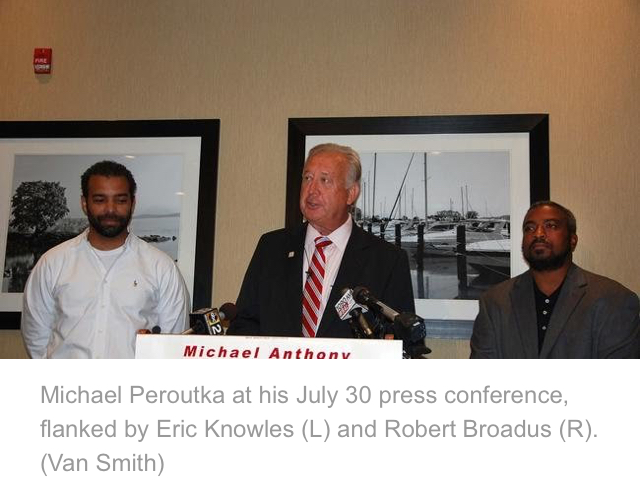
Anne Arundel County’s Fifth Councilmanic District is the whitest, most educated, and richest of the county’s seven districts, and its voters lean heavily in favor of Republicans. If that pattern holds true in November’s general election for the council seat, the district’s 75,000 residents — 87 percent white, 97 percent with a high-school diploma, and about half with a college degree or higher, and with a median household income of $111,000, higher than any Maryland county — will be turning for constituent services and leadership on local issues to the GOP candidate, Michael Peroutka.

Peroutka, a highly successful debt-collection attorney whose brother and law partner Stephen Peroutka is a board member of the Babe Ruth Museum, also is white, smart, and rich, but it’s doubtful that many of his potential constituents have used their advantages in the way he long has: to advance a militant theocratic agenda.

A decade ago, Peroutka already had a record of supporting the formation of local militias when he ran for U.S. president under the Constitution Party banner, with a campaign slogan — “God-Family-Republic” — that dressed up his extremism with rhetoric that run-of-the-mill patriotic Christians might find innocuously attractive. Similarly, the name of Peroutka’s Institute on the Constitution (IOTC) fails to communicate its actual mission: creating theocratic governance based on both testaments of the Bible, similar to how extremist Muslims would like to establish states based on sharia law derived from the Quran.

Peroutka has now hit on a more pragmatic approach: run for something winnable, like a local race where the outcome is relatively malleable for someone like Peroutka, whose fundraising capabilities are virtually limitless within the usual legal constraints. He has more than a quarter-million dollars in his campaign chest as of late June, and surely much more has come in since. Top supporters include Roy Moore, the Bible-thumping chief judge of the Alabama Supreme Court who believes the separation of church and state is an attack on Christianity and to whom Peroutka has dedicated a field and monument at his 40-acre Prince George’s County property called Gladway Farm; prominent Christian evangelical lawyers William Olson and Herbert Titus, a former Constitution Party vice-presidential candidate; and ex-con Franklin Sanders, a Tennessee metals-trader with secessionist sympathies.

Peroutka’s campaign treasurer is Tom Pavlinic, a sex-crimes defense attorney who specializes in defending clients accused by very young victims. Pavlinic was Peroutka’s attorney when he unsuccessfully sued a social worker who had helped Peroutka’s step-daughters when Peroutka and his then-wife, Diane Peroutka, despite his strongly voiced belief that the state should not be in the parenting business, had placed them in the care of the government’s foster-care system after one of them had accused Peroutka of sexual abuse and then recanted.

Though the Fifth District is a pretty solid GOP stronghold, most of its voters recently came out in support of something that Peroutka is stridently against: same-sex marriage. When the Maryland General Assembly in 2012 passed the law extending the right to marry to same-sex couples, Peroutka reacted by stating that “no earthly government body can redefine marriage any more than it can redefine the law of gravity” and that therefore “there is no reason to consider this a valid legislature or this a legitimate governor. Other than fear, I can think of no reason to further obey their dictates.” Yet when the law went up for referendum that fall, nearly 55 percent of the Fifth District’s voters supported it. Only in four of the district’s 34 precincts, clustered in its far northern reaches near where Peroutka lives in Millersville, did majorities oppose same-sex marriage.

Even if he loses the council race to Democratic contender Patrick Armstrong, Peroutka still won an elected position in the June 24 primary election: he’s now a member of the Republican State Central Committee in his district, making him a leader of the local GOP faithful — whether they like it or not.

And clearly, some of the drivers of mainstream GOP thinking find Peroutka to be a philosophical pariah. In February, when Peroutka’s name was being bandied about as a possible GOP candidate for Maryland attorney general, Mark Newgent penned a blog at Red Maryland pointing out that Peroutka is an avowed Christian Reconstructionist. This God’s-law-reigns-supreme approach was birthed by Rousas Rushdoony, and Newgent summed up its goal: “a civil government whose first duty is to carry out a religious mandate to do what God requires as written in the Old Testament, including executions for adulterers and homosexuals.”

Cato Institute senior fellow Walter Olson has called Peroutka a “wackypants anti-gay crusader,” and on his Free State Notes blog in June he wrote that Peroutka’s IOTC “promotes a deeply erroneous view of the U.S. Constitution as an essentially religious document.” And in pointing out that the man is stridently anti-Republican, Olson quoted a Peroutka screed from last fall imploring “anyone, including those who identify with the ‘Tea Party,’ who loves America and desires real reform” to “disengage themselves from the Republican Party and their brand of worthless, Godless, unprincipled conservatism.”

In 2012, Peroutka, a prodigious donor to deeply conservative causes, gave $10,000 to the Maryland Marriage Alliance, which was working to defeat marriage-equality referendum question that ultimately passed muster with the voters. The donation drew the attention of the Human Rights Campaign, a pro-marriage-equality group, which promptly broadcast Peroutka’s strong ties to the League of the South, a Southern secessionist outfit that the Southern Poverty Law Center labels a racist hate group. Today, Peroutka’s ties to the League have become a serious concern for Maryland GOP leaders, including gubernatorial candidate Larry Hogan, who disavowed Peroutka after the campaign of his Democratic opponent, Lt. Gov. Anthony Brown, played up Peroutka’s extremism.

On July 30, Peroutka held a press conference at a Glen Burnie hotel to try to manage the fallout. He was flanked by two African-American men who support him and his candidacy: Republican state-senate candidate Eric Knowles (who lost in the primary, and has previously run as the Constitution Party’s candidate for governor) and Robert Broadus, who ran as a Republican for U.S. Senate in 2012. Peroutka refused to back down from his support for the League, which he called a “Christian, free-market group,” and, in response to a question, said he’d made no mistake when he sang “I Wish I Was In Dixie” and called it “the national anthem” at a League event in 2012, a YouTube video of which has drawn attention since his primary win. Peroutka sought to cast doubt on the SPLC, referring to “the dangers” of its endeavors, in which he said it engages in “smearing together obvious hatred, such as Neo Nazis or the Klan, with groups,” like the League, “where the SPLC simply doesn’t like their politics.”

Peroutka’s effort to separate the League from neo-Nazis is a blurry endeavor itself, though. As the Huffington Post’s coverage of Peroutka’s press conference pointed out, the YouTube video of Peroutka singing “Dixie” in 2012 “was shot by Michael Cushman, a former member of the National Alliance, a neo-Nazi group, who now leads the League’s South Carolina chapter.”

Newgent, meanwhile, saw all this coming when Peroutka was being discussed as a candidate for attorney general. “Imagine the field day the media, not to mention Democrats, would have” with a Peroutka GOP candidacy, he wrote, adding that it would be an “embarrassment and drag on other candidates.”

Some of the most intelligent analysis of Peroutka, though, is coming from the left.

On Huffington Post, Jonathan Hutson has chronicled Peroutka’s ongoing alliance with the League of the South, and quotes its president, Michael Hill, promoting guerrilla warfare and the deployment of “death squads” to obtain the League’s goals. “The primary targets will not be enemy soldiers,” Hill wrote on July 15. “Instead, they will be political leaders, members of the hostile media, cultural icons, bureaucrats, and other of the managerial elite without whom the engines of tyranny don’t run.”

Political Research Associates‘ Frederick Clarkson, meanwhile, writes that Peroutka’s run, as well as that of the GOP candidate for Anne Arundel County Sheriff, Peroutka and League of the South ally Joseph “Joe” Delimater III, “may signal a small, but significant, national trend in applied theocratic theory.”

Peroutka and his followers and allies “believe that holding local office empowers them to defy state and federal law under the rubric of an ancient concept called The Doctrine of the Lower Civil Magistrate,” Clarkson continues. He explains that this doctrine “has been adopted by conservative Christian leaders who are opposed to religious pluralism and separation of church and state, as well as such matters as abortion, LGBTQ rights, taxes, public education and gun control laws,” saying it empowers them “to overthrow ‘tyrannical government.'”

In an earlier post in June, Clarkson recalls an interview he had with Peroutka donor Titus in 1996, when Titus was running for vice president. Titus “told me at a press conference that lower-level government officials (called ‘lesser magistrates’ in the archaic language of the ideas on which his views are based), may refuse to enforce ungodly laws and policies of the government, and rise up against a government that has become corrupt or tyrannical.”

Given Peroutka’s attraction to militias and overthrowing the government, the highly educated voters of Anne Arundel County’s Fifth District could be forgiven if they worry that his candidacy presents a potential threat to civil society. If they happen to fall into debt that Peroutka’s firm tries to collect, though, they might also worry about his tactics.

Consider the case of Antonietta Serruto, who, after gaining bankruptcy protection in 2012, was still illegally targeted for collection by Peroutka’s firm, which took court action against her in 2013, despite her alerting the firm that the debt they sought to collect had been discharged. She ended up suing the firm (and quickly winning a $20,000 settlement, plus costs, expenses, and attorneys fees), after a processor server showed up at her home, where she lives alone, on Thanksgiving night last fall to pound on her door and demand she “open up,” according to her lawsuit. Serruto “was terrified by the pounding and the demands of the unknown male at her door,” the lawsuit states.

As Peroutka’s county-council campaign continues, gaining the attention it deserves, at least the district’s voters won’t be casting votes for or against an unknown male anymore. He is what he is: an extremist dressed up for mainstream appeal.

The High Seas: Baltimore’s narcotic history dates back to the 19th-century shipping-driven boom, quietly aided by bringing Turkish opium to China

By Van Smith

Published in City Paper, Oct. 21, 2014

Image-1-10

With its longstanding reputation as a high-volume heroin town, Baltimore’s modern black-market economy is openly opiated, driving sizeable budgets for maintaining the criminal-justice apparatus to combat it. Far less appreciated, and only opaquely understood, is the role another poppy-derived narcotic—opium—had in forming Baltimore’s 19th-century fortunes, when trade with China helped fuel the city’s shipping boom.  In fact, merchant John O’Donnell was the first to bring goods from the Chinese city Canton to Baltimore and it was such a boon that he named his waterfront plantation Canton, and the name for the area persists today (along with its O’Donnell Square).

Despite Baltimore ships being central to several historic events in America’s opium trade to China, Baltimore merchants’ overall piece of the trade seems to have paled in comparison to the quick fortunes made by famous merchant families from Philadelphia to New England. So, when historians eventually pieced together what such towering American capitalist families as the Astors, Forbes, Perkins, Delanos, Peabodys, and Girards had actually been up to in China—selling Turkish opium, competing with the enormous British supplies brought there from India—Baltimore’s role got little attention.

At the time, “all of this was able to occur really under the radar,” says Towson University history professor Elizabeth Kelly Gray, “because there were no reporters, and if someone came back with a huge fortune and said, ‘Oh, I was in the China trade,’ people wouldn’t necessarily assume that opium was involved. People seem to have kind of kept their mouths shut about what they did, and even though I found a couple of published comments where someone would say, ‘Don’t you know that Americans are involved?’ it didn’t seem to catch anyone’s attention. We can dig back and find it now, but it wasn’t known then.

“There was a recognition that this was disreputable, this was smuggling,” Gray continues, since China outlawed opium in 1799. So merchants tended to justify it by saying “‘we couldn’t make a profit if they wouldn’t buy it,’ or ‘if we don’t do it someone else would,’” while arguing that “we’re not actually breaking the law because the opium we’re bringing is 12 miles” away from the Chinese port of Canton, in ships anchored in Whampoa Reach or Macoa Roads, “and then it’s brought in by others.” Given the controversial nature of the trade, she adds, “some of the merchants were able to cover their tracks,” since “they’re thousands of miles from home, everyone that they’re hanging out with is fine with this, and they’re making lots of money. So we don’t have the smoking gun with some of them that we have with others.”

The secrecy surrounding America’s China opium trade came out when the first Opium War between Britain and China broke out in 1839, after China, dismayed at the damage addiction was causing among its people, started to seriously enforce its opium ban and seized sizeable British cargoes. The war prompted Congress to get interested in the American involvement, and “then you have this sort of sheepish admission to Congress that, well, we are involved in the opium trade,” Gray says, “which some of the congressmen already knew, but it wasn’t public.

“We definitely know that Baltimore was involved,” Gray adds, but details are elusive, and more northern American cities appear to have been more deeply entrenched. While “the British were earning tens of millions of dollars” from opium in China, historian Eric Jay Dolin told China Business Review last year, “the Americans were earning millions of dollars,” and the late historian Kenneth LaTourrette concluded that, “although she began early,” Baltimore “was never as actively engaged in the trade as were the more northern ports.” Historian Dael Norwood of Yale University, sums it up in an email to City Paper: While “the New Englanders and New Yorkers were (for the most part) running the show alongside the Brits, “you might say that the Baltimore money was keeping its hand in.”

One smoking gun linking Baltimore to the China opium trade is the Eutaw, a Baltimore ship owned by John Worthington and captained by Christopher Gantt. The history books credit the Eutaw with bringing the very first delivery of Turkish opium by an American ship to China. It left Smyrna, Turkey (pictured above), in November 1805 with several tons of opium, and arrived in Canton in 1806. Sussing out Worthington’s significance in Maryland society has proven elusive, but Gantt later became a member of the Maryland House of Delegates and served as a customs clerk in Baltimore for the U.S. Department of Treasury.

A second smoking gun is the Wabash, another Baltimore ship captained by Gantt, which in 1817 suffered an attack that became known as “the Wabash incident.” While anchored in the Macao Roads near Canton, Chinese pirates boarded the ship, murdered some of its crew, and took its cargo, including opium. The American consul at Canton—Benjamin Wilcocks, himself an opium smuggler—wrote to Secretary of State John Quincy Adams about the incident, explaining that he’d reported it to the Chinese authorities, but “was careful not to mention the opium.” The Chinese, after they later found the pirates with a large quantity of opium, expressed “not a little disgust” over the contraband, Wilcocks explained, and shortly thereafter announced a crackdown on Americans trying to bring opium into China.

In 1821, the Terranova incident involved a Baltimore opium ship at Canton, and produced “lingering bad memories” which, the late Sino-American historian Jacques Downs wrote, “would help shape the first U.S. treaty with China” in the 1840s. It involved an Italian sailor, Francis Terranova, on the Baltimore ship Emily, owned by John Donnell and captained by William Cowpland. The Emily was “anchored peacefully in Whampoa Reach,” Downs recounted, “gradually selling off its cargo of opium,” when Terranova somehow caused a woman who’d approached the Emily to fall into the water and drown—and for this, China convicted and sentenced the sailor to execution, which shocked the community of Western traders there.


Downs described Donnell as “the great Baltimore China merchant” who was “among the largest shippers of the drug” in the period after the War of 1812. After the Bostonians led by the Perkins family, Donnell was “probably the most important of all” the “very substantial merchants who sent opium cargoes to Canton.” After Donnell’s death in 1827, his nephew Griffin Stith—who had served as agent for the Emily—formed another American firm in the China opium trade, Issaverdes, Stith & Co., a partnership  of Stith and John B. and George Issaverdes. Stith’s papers, describing his experiences in the opium trade in China and Jakarta, are held in the collections of the Maryland Historical Society.

Donnell in 1800 purchased Willow Brook, an estate where West Baltimore’s Union Square neighborhood now stands that was built by his wife’s uncle, Thorowgood Smith, who served as Baltimore’s mayor from 1804 to 1808. Today, a complete replica of Brook’s Oval Room is on permanent display at the Baltimore Museum of Art.

Another famous Baltimore-China trade merchant, Isaac McKim, served in the Maryland Senate and served two terms in the U.S. House of Representatives, and also was a director of the Baltimore & Ohio Railroad. His part in the American opium trade is described in “Tidewater Triumphs,” a book by naval historian Geoffrey Footner. “McKim developed an ingenuous plan which began with the purchase of Turkish opium for resale to other traders, mostly Baltimore merchants,” Footner wrote, “then used the proceeds to buy copper and other products.” In 1816, McKim’s ship the Plattsburgh left Fells Point with cargo bound for Smyrna, where the captain was instructed to “sell the cargo and use the proceeds to buy opium,” but the crew mutinied, and the resulting legal wrangling “revealed Isaac McKim’s plan for broadening his narrow export base.” While there is “no record of any McKim ships sailing in the China trade,” Footner explained, “there is circumstantial evidence that McKim resold opium acquired in Turkey to other Baltimore and Philadelphia merchants doing business in China.”

Evidence of Baltimore ships being involved with shipments of Turkish opium also come from the U.S. Senate, which in 1838, on the eve of the First Opium War, made records of American ships entering and leaving Smyrna over the years, including McKim’s schooner, the Yellat, picking up 45 cases of opium and Donnell’s brig, Midas, taking on 111 cases of opium in 1824, part of their proceedings. Another entry mentions the brig Torpedo, owned by William Patterson (one of the founders of the B&O Railroad) and his son George Patterson.  Finally, an English translation of the geneology of a prominent Dutch family says that Jacob van Lennep & Co., based in Smyrna, made “large shipments of opium” to “a company in Baltimore for onward shipment” to China. And, last year at the Smithsonian Institutions, an intern uncovered historical documents of a shipment of 10 tons of opium arriving in Canton in 1821 on the Baltimore brig Ea.

While Baltimore’s role in Smyrna-to-Canton opium smuggling may have been less robust than those of more northern American cities, it made a mark because its opium-laden ships, explains Norwood, “attracted the harsh attention of Chinese authorities” thanks to the sacking of the Wabash and the Terranova affair. Still, there’s plenty of evidence to suggest that the drug trade quietly drove significant creation of wealth in Mobtown’s early economy—as it still does today.

Too Rich: Alleged cocaine trafficking mastermind Richie Rich isn’t going down without a fight

By Van Smith

Published in City Paper, Feb. 20, 2013
wonder1

Baltimore is rife with neighborhoods ravaged as fronts in the drug war, but the area around 30th and St. Paul streets, in Charles Village, isn’t one of them. This is a “college town” neighborhood near the Homewood campus of Johns Hopkins University, frequented by many who study or work at Hopkins, not by drug dealers.

Yet, on Oct. 8, 2010, the area around 30th and St. Paul streets suddenly became ground zero in the intelligence-gathering efforts of the U.S. Drug Enforcement Administration (DEA) to take down one of Baltimore’s major cocaine suppliers.

“We were pretty excited,” DEA special agent Mark Lester says, referring to the moment he and his colleague, special agent Todd Edwards, realized that Richard Anthony Wilford, who goes by the nickname “Richie Rich,” had walked into their investigation of another drug dealer, Lawrence Lee Hayes Jr., who they’d been pursuing for two months. Literally walked, because the agents watched as Wilford and Hayes spent an hour walking up and down the block around 30th and St. Paul, Lester says while testifying during a Jan. 25 hearing in the resulting case.

“Edwards knew that Mr. Wilford had been arrested before,” Lester explains, and that it was “widely known that he was suspected of being a large-scale drug dealer.”

As the investigation progressed, sussing out the details of the cross-country scheme—the coke would come from California and cash would be sent back—it uncovered the telltale elements of a classic shadow-economy scheme: legitimate-looking businesses, cars, and other assets put in the names of other parties, including ties to a Baltimore City court commissioner and a man working at City Hall.

Hayes allegedly stood at the top of a supply chain that, when it was brought down in the spring of 2011, put in the government’s hands a massive haul of cocaine—nearly 150 kilograms, 136 kilos of it in a tractor-trailer driven by Robert Nyakana, a Ugandan who made the DEA’s “Most Wanted” list while a fugitive, until he was later arrested—and about $3.5 million in cash (including $1.6 million taken from a house in Randallstown), $600,000 in jewelry, 23 vehicles, six pieces of real estate in Georgia, and some expensive electronics. Wilford, Hayes, and four others were indicted in federal court, and five other co-conspirators faced indictments in Baltimore City Circuit Court.

Wilford went on the run, hiding in Los Angeles until August 2011, when he was spotted by agents, who raided his home there and recovered $68,000 in cash. Then he laid low in Baltimore, at a house near Pimlico Race Course, where, when he was finally arrested on Sept. 16, 2011, agents found $190,000 in cash. So even as a fleet-footed fugitive, running from the U.S. marshals months after the coke scheme had been dismantled, Wilford still had access to substantial means.

Today, in the federal case, all but Wilford have pleaded guilty. He’s retained an expensive, well-regarded attorney, William Purpura—the same one Wilford has used in his criminal cases for years—to battle the government with a vengeance. Wilford says not only that serious errors were contained in affidavits in the case, but that Lester, Edwards, and their fellow law enforcers conducted illegal electronic surveillance in pursuing him and his co-conspirators by monitoring cellphone “pings”—the communication signals that bounce between phones and cell towers—and global positioning systems (GPS) devices attached to vehicles.

But if not for this warrantless electronic surveillance—which had been common practice until January 2012, when the U.S. Supreme Court ordered warrants for “slap-on” GPS devices, and August 2010, when the D.C. Circuit’s appellate court handed down a similar ruling—Wilford contends that Lester and Edwards would not have known to be in Charles Village that October day to watch him meeting with Hayes. If Wilford’s arguments prevail, the government’s case against him would suffer, or even be dismissed, as key evidence could no longer be presented to a trial jury.

Purpura and Assistant U.S. Attorney John Sippel offered testimony and argued their respective takes on these questions for much of the day on Jan. 25, before U.S. District Judge Ellen Hollander, who has scheduled more arguments for March 8. During the hearing, Purpura points out that “we guessed, and guessed correctly” that slap-on GPS devices were used in the investigation—a detail that the government had not volunteered and then “gave it up in drips and drabs.” Whichever way Hollander rules—and she indicated she was leaning in the government’s favor, despite a law enforcer’s affidavit in the case that was “replete with mistakes,” she said—the resulting decision will likely go to Richmond to be reviewed by the Fourth Circuit Court of Appeals.

Wilford, at a few inches shy of 6 feet and with neither much fat nor muscle on his frame, is not an imposing man. In the courtroom for the Jan. 25 arguments, he appears relaxed as he waves and mouths conversations with friends and family there to support him. Despite the prison jumpsuit, he looks very much a mild-mannered, legitimate businessman, with a sharp look in his eye. But the man’s not going down without a fight, and if he wins, not only will he likely go free, but drug cops are going to have to push a lot more paper getting warrants before they go pinging suspects’ cellphones—just like they have to do now, thanks to the Supreme Court, before slapping GPS units on suspects’ cars.

To say it’s “widely known” that Wilford is “suspected of being a large-scale drug trafficker,” as Lester put it, is a bit of an understatement. Wilford’s nickname has figured in some of the more storied chapters in the modern annals of Baltimore drug dealing.

Wilford’s first federal drug case, brought in 1992 when he was 19, was a conspiracy that included two men who were then twice Wilford’s age—legendary Baltimore gangsters Walter Louis Ingram and Walter Lee Powell, who are now in their 60s and, like Wilford, in trouble again with the feds (“Old and in the Game,” Mobtown Beat, Dec. 19, 2012). Wilford’s cocaine conviction in that case got him five years in federal prison, and after his release, in 2001 he caught another federal stint—two years for possession with intent to distribute heroin.

Then, while still on supervised release for his 2001 conviction, Wilford in 2008 emerged in the vortex of law-enforcement intrigue surrounding a corrupt Baltimore cop named Mark Lunsford (“Costly Charges,” Mobtown Beat, Nov. 11, 2009); Querida Lewis, a cross-country drug dealer (“Femme Fatale,” Mobtown Beat, Jan. 14, 2009) with ties to three-time Baltimore felon Milton Tillman Jr. (“Citizen of the Year,” Mobtown Beat, Aug. 27, 2008), a politically connected bailbondsman, longshoreman, and real-estate developer; and a bevy of other Baltimore drug dealers, among them Gilbert Watkins, Donta Dotson, and Dante Chavez.

Wilford’s ties to all of this came into focus in court documents, many of them sworn out by Lunsford, a former DEA task-force officer who pleaded guilty to theft and lying and who was released from federal prison in March 2012. The documents describe Wilford and his partner, Mark Anthony Hawkins, as large-scale marijuana and cocaine suppliers.

Ultimately, neither Wilford nor Hawkins got in much trouble. Wilford pleaded guilty in Baltimore County court and received probation before judgment, while the feds seized $39,045 of his money, returning $5,000 of it pursuant to a settlement agreement. During the motions battle in the case, which was built based on wiretaps, Purpura argued that Lunsford’s involvement in the probe undermined its integrity and that agents had failed to constrain their eavesdropping to relevant conversations by recording exchanges about Wilford being a “daddy to be” and “shooting over to Shorty’s [for a] cookout.” Hawkins, meanwhile, pleaded guilty in federal court and was sentenced to time served.

The others weren’t so fortunate: Lewis, Dotson, Watkins, and Chavez all remain in federal prison for their convictions.

Thus, when October 2010 rolled around and Lester and Edwards discovered Wilford walking around Charles Village with Hayes, the two DEA agents were understandably “excited”—a target of longstanding significance was suddenly in their sights. Wilford’s criminal past and flashy present—an informant told investigators he drove a $150,000 Mercedes and, indeed, several months earlier he’d been clocked at 111 mph in a Mercedes on the Washington Beltway—made him worthy prey if he was, in fact, still in the drug game.

The details of the Wilford investigation, revealed in a myriad of court documents, bring into focus the shadowy elements of the criminal enterprise, including not only the legitimate-looking business endeavors of the conspirators, but their ties to local government as well. The businesses, including Blow It Off Power Washing, R.A.W. Enterprises, B’Mores Dumping, M&M Construction, and Eight K Contracting, were varied, and some of the investigation’s targets had legitimate jobs, including one who worked for a private special-education school, the Chimes School, and another who was on the Baltimore City Hall payroll.

The picture, in all its high-resolution glory, emerged not from wiretaps—none were obtained in the case—but largely thanks to high-tech surveillance aids that provided Lester, Edwards, and their law-enforcement colleagues with nearly real-time location data about the whereabouts of their targets’ vehicles and cellphones. If someone was on the move, law enforcers could watch on computer screens and react quickly, hitting the streets to gain valuable insights leading to hard intelligence about their targets’ habits, associates, and affiliations, wherever they may lead.

During the Jan. 25 hearing, Lester explained that four slap-on GPS trackers were affixed to a total of 12 different vehicles during the investigation, which also obtained “pinging orders” from judges for at least 23 phones, allowing the agents to quickly receive GPS coordinates for those phones via emails from their service providers. If a tracked vehicle or phone moved, the agents would quickly know, and could decide whether to go out and do some good old-fashioned eyeball surveillance.

Wilford’s attorney, Purpura, had a last-minute witness to put on at the Jan. 25 hearing: Joshua Brown of GLS Litigation Services, who demonstrated with mapping software how revealing the government’s GPS-derived data can be about a person’s movements and patterns in life. City Paper visited GLS’ offices at Clipper Mill a few days later, so Brown and his partner, Gabriel Saunders, could give a guided tour of what is shown by the 30,000-or-so latitude/longitude points the government has on Wilford’s phones and vehicles over a nearly 11-month period starting in late October 2010.

“It helps you find important places,” says Brown, pointing out Wilford’s mother-in-law’s home in Los Angeles, his shopping routines when in Los Angeles, his regular routes to and from his luxury home near Elkton in Cecil County, and a trip Wilford took to the Catskills at one point. “Places of interest might also emerge when you have monitored phones intersecting with cars that were monitored—you can use both to determine whether people are together, or whether people are in a car together.”

“We take the data the government has,” says Saunders, “and make it understandable to people.” He ponders the implications as technology advances: “It won’t be long before there’s software that analyzes this, and starts to predict where you will be,” and before facial recognition capabilities can be applied to images caught on public closed-circuit television camera—so that so-called “aids to surveillance” become simply surveillance, done remotely.

While scanning the mapped data on a computer monitor, it is clear that Wilford—or at least his car—went to Baltimore’s jail complex for about two hours on Nov. 19, 2010, and that in late January and early February 2011, both his car and his phone were at the industrial waterfront in Canton, possibly to fill dump trucks with sand from the stockpiles there. On March 9, 2011, multiple cars and phones were at Perring Plaza at the same time—likely a meeting of the conspirators. At various times, the monitoring placed phones and cars in Little Italy, near Mo’s Crab and Pasta Factory and the nightclub Milan, and investigators learned that Wilford and his associates hung out at a barbershop on the 3700 block of Wabash Avenue. Throughout the period of phone- and car-tracking, the conspirators maintained a nearly constant presence in the Union Square neighborhood, in West Baltimore, in a block near Lombard and Calhoun streets that’s known for open-air drug dealing.

What Brown and Saunders show is a remarkably detailed, nuanced portrait of Wilford’s movements not only in Baltimore but Los Angeles and elsewhere. As long as he and his co-conspirators’ cars and phones were being tracked, their lives—or at least their locations, which led to a host of possibilities for surveillance and follow-up investigation—were open books.

One of the places to which electronic surveillance led the agents was 1020 Park Ave., the Symphony Center Apartment Homes, near the Meyerhoff Symphony Hall. This, they learned, was where Hayes laid his head, in unit number 907. They’d seen Hayes leave the apartment with a backpack, meet Wilford over near 30th and St. Paul, and exchange the backpack for a large cardboard box that Wilford would bring, and then Hayes would take the box to an apartment at Belvedere Towers, at Northern Parkway and Falls Road. When agents raided Hayes’ Symphony Center apartment in May 2011, they found and seized $318,006 in cash and seven expensive watches. And even before they raided the Belvedere Towers apartment, they did a trash dump there, after watching one of the co-conspirators throw some garbage in a dumpster, and found evidence that cocaine was being processed there after being shipped in hollowed-out computer towers.

But before all that, in late Sept. 2010, the agents looked into who was leasing the Symphony Center unit used by Hayes. Turned out, it was a man named Damon Crump, a Baltimore City district court commissioner at the Pataspco Avenue courthouse in Brooklyn, whose day-to-day duties involve setting defendants’ bails and reviewing sworn statements of charges to make sure they pass muster for probable cause.

Edwards, in an affidavit, explained that Crump, along with one of Hayes’ and Wilford’s co-conspirators, Alvin Purcell Wells, leased the apartment on Hayes’ behalf. Crump’s name also was on the BGE account for the apartment. “In addition,” Edwards wrote, Symphony Center’s management “identified Hayes as the individual they knew to be Damon Crump,” while Wells paid the rent—and had run up a couple thousand dollars in credit.

Crump, who was not charged with any crime for the role Edwards ascribes to him in the investigation, said in a Feb. 1 phone interview that “I’m a victim” for having helped Hayes, who he says he’s known since “I was 8 years old.” He explains that Hayes came to him in 2006 and said he’d been “put out from his home and needed a place to stay, so I got the apartment for him” by signing the lease.

The first year, Crump continues, Hayes was “doing fine, selling cars and doing carpentry and landscaping work,” and so “I see that everything is going well, so I’m going to back off.” Then Hayes talked “Wells into putting his name on the lease too,” and “so I am not down there [at the apartment] from the middle of 2007 on,” since the rent’s being paid and Wells—who Crump says he’s known since middle school, and whom he describes as “a legitimate businessman who had a group home”—is sharing responsibility for the lease. Then, Hayes gets arrested in the Wilford investigation and “I was just dumbfounded,” says Crump, adding that “I had no involvement—if I did, I would have been arrested—and if I’d known, I would’ve broken the lease.” As for Wells, Crump says, “he could have been a victim too”—and, indeed, prosecutors later declined to pursue the charges against Wells.

Much less detail is available about a target in the investigation who court documents say was on that payroll of Baltimore City mayor’s office in 2009 and early 2010, during the waning days of Sheila Dixon’s tenure there. His name appears in the Baltimore City Circuit Court case file against one of Wilford’s co-conspirators, Michael Smooth, who owns a dump-truck company, B’Mores Dumping, located at a Wilford-owned industrial property near Cherry Hill. The target is described in a “report of investigation” as one of several unindicted targets in the case, without any further details—except that he also earned income from a clothing store he owned in West Baltimore’s Union Square neighborhood, a few blocks from the near-constant cluster of locational data points turned up by the investigation’s GPS tracking efforts.

Attempts to contact the target were unsuccessful, as were efforts to learn his duties at the mayor’s office, but a visit to the clothing store’s location reveals it is no longer in operation, and its listed phone number is no longer active. As he was not charged and could not be located, City Paper is not publishing his name.

That the Wilford investigation touched on a court commissioner and a man on City Hall’s payroll is perhaps not surprising in an era of Baltimore crime-consciousness informed by intricacies of The Wire, with its thought-provoking fictional portrayals of the drug game’s far-reaching consequences. But this is real life—at least insofar as the agent’s sworn facts reflect reality—and the Wilford case stacks up as a big one by Baltimore standards.

In 2008, a 40-kilo cocaine seizure was touted by the Baltimore police as the biggest in the department’s history (“Man Gets Federal Charges for Historic 40-Kilo Coke Bust Next to Kevin Liles Drive,” Mobtown Beat, Feb. 23, 2009), though two prior ones at the Port of Baltimore were bigger, but involved other law-enforcement agencies (“OK, But It’s Probably Like the Third-Biggest Drug Bust Ever. At Least,” The News Hole, March 2, 2009). One of those larger ones, in 2004, involved a little over 130 kilograms—a few kilos less than in the Wilford case.

At the very same time as the Wilford investigation, another probe handled by the DEA in California, involving Hollywood-based figures with Baltimore ties, turned up evidence that nearly 400 kilograms of cocaine were shipped to Baltimore over a six-week period, with more than $4 million in cash going back to California (“Bringing It Back Home,” Mobtown Beat, Feb. 2, 2011). Aside from the large amounts of California coke being exchanged for Baltimore cash, the case has another similarity to Wilford’s—some of the coke in both cases was shipped in hollowed-out desktop computer towers.

In a case involving Mexican cartel coke coming to Baltimore, trial testimony from a cartel operative provided some context for these amounts (“Corner Cartel,” Feature, Feb. 23, 2011). The operative, Alex Noel Mendoza-Cano, told jurors that he had been one of the Gulf cartel’s Houston-based distributors, and his group handled about 300 tons of coke a month coming over the border from Mexico—that’s more than 272,000 kilograms per month. On the Baltimore end, Mendoza-Cano said he delivered 40 to 60 kilos per month for six months to one of the case’s co-conspirators.

The Wilford investigation, then, turned up big amounts by Baltimore standards—but in the overall scheme of things, it’s a drop in the bucket. Still, it’s not a case prosecutors care to lose over the question of whether or not the agents failed to get needed warrants for their highly effective electronic-surveillance tactics—which is precisely what Wilford is trying to make happen. Whether or not Wilford wins, he can at least say he tried.