
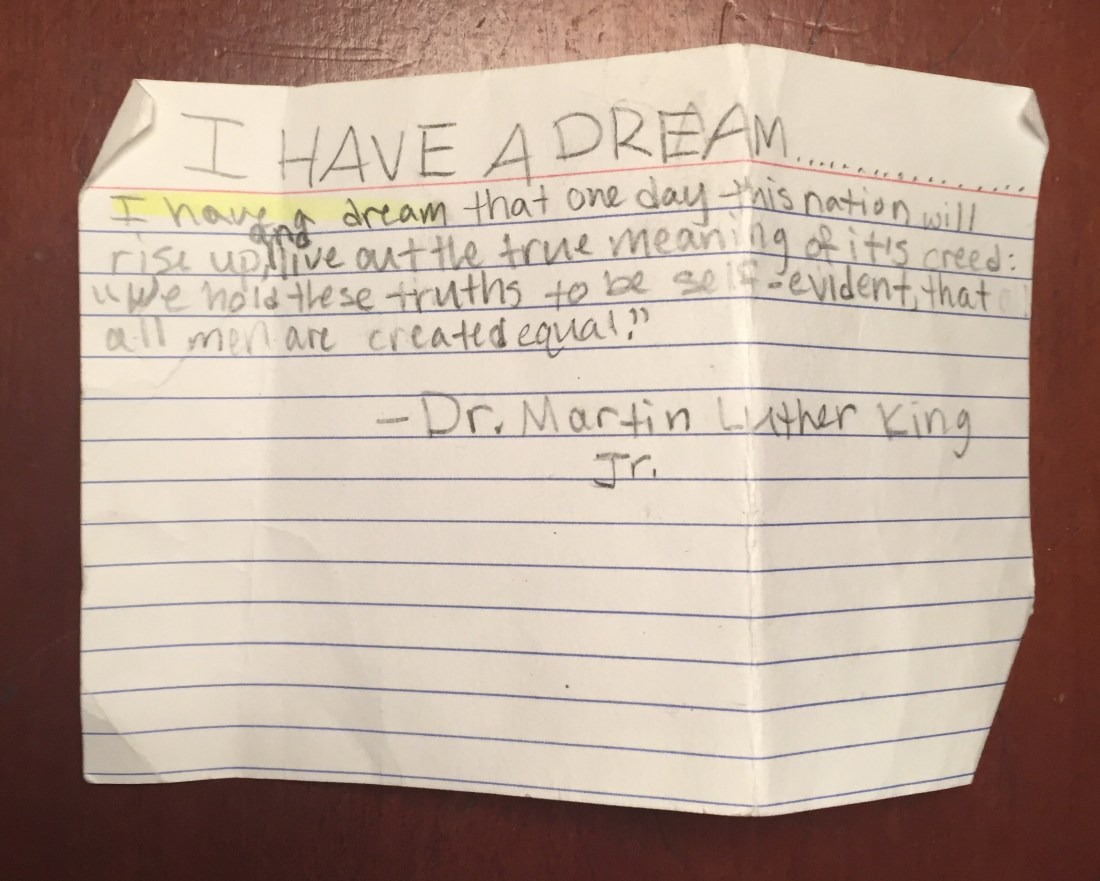
Just grabbed a hat out of my cubby-basket, and this fell out. #ihaveadream
Just grabbed a hat out of my cubby-basket, and this fell out. #ihaveadream


This collection of signatures at the William J. Myers Pavilion in Curtis Bay brings back a torrent of memories about City Hall in the 1980s. Schaefer and du Burns, of course, but also: Mimi di Pietro, Edgar Silver, Chris Delaporte, Frances Reeves, Joe DiBlasi, Ben Brown, Frank Gallagher, Tom Waxter, Jacqueline McLean, Mike Curran, Frank Kuchta, George Della, Rikki Spector, Phil Jimeno, Ron Mullen, Brian McHale, Tony Ambridge, and Jody Landers. That’s some serious company honoring Bill Myers, whose significance was elusive to me, but clearly potent and widely understood by many others.
By Van Smith
Published by City Paper, Jan. 30, 2008
“The law is very clear that the licensee can’t be a convicted felon,” explains Douglas Paige, spokesman for the Baltimore City Board of Liquor License Commissioners. He’s fielding questions about a newly filed application to transfer a liquor license from the closed Red Lyon Tavern in Canton to the old Hammerjacks nightclub property, downtown at 316 Guilford Ave. The plan is to open a large club called Heaven, but a convicted felon who is not the proposed licensee is listed in the application as its full-time operator. Felons are barred from holding liquor licenses, Paige says, but full-time operators of liquor-licensed businesses can have a felony background, as long as they’re not on the liquor license.
Having paid the $400 filing fee and filled out the necessary paperwork, he says, “the applicants are entitled to a hearing.” Valentine’s Day is the scheduled date of the hearing in the Pressman Board Room in City Hall, Paige says, and the three-member Liquor Board then will decide what to do about the proposed transfer.
“The board would have grave concerns about this, I’m sure,” he predicts. “They will have to look over this application closely to see how this is going to be operated.”
The application lists Leroy M. Brown, 50, and Joanne Giorgilli, 63, as the would-be owners of Heaven’s liquor license, and the full-time operator of Heaven would be Joanne Giorgilli’s 41-year-old son, John Americo Giorgilli.
Known to many as “Johnny G,” Giorgilli’s career as a nightlife impresario includes Club 101 in Towson, which closed in the mid-1990s amid controversy, and the China Room, a downtown club that operated at Uncle Lee’s Szechuan Restaurant and closed down in the early 2000s. He is currently under indictment in Baltimore County for first- and second-degree assault and false imprisonment, and since the mid-1990s he’s racked up charges and convictions for drugs and violence and served at least one stint in jail. The state’s online court-case database lists 85 cases dating back to 1993 in which Giorgilli was a criminal defendant.
On Jan. 25, Liquor Board Chairman Stephan Fogleman told City Paper that “the Liquor Board, in addition to making sure that licensees aren’t felons, wants to make sure the actual operators aren’t felons, too. . . . There are numerous ways we can look at applications such as this, and we will do just that at the hearing.”
One issue raised by information in the Heaven liquor-license application is the source of funds for starting up the club. The application shows that Brown has no money in it, but, since the Giorgillis live in Baltimore County, he satisfies board requirements that a resident city taxpayer be on the license. Joanne Giorgilli, a 29-year employee of Maryland School for the Blind, is listed as 100 percent owner, with the money for the club coming from her Bank of America savings account. Not mentioned in the application is the fact that Joanne Giorgilli is listed as co-debtor in her husband’s 2005 filing for bankruptcy protection. Two others listed in the license application–John Goertler and Ron Jones–are named as each having $200,000 available to pay for remodeling, should the club need financial assistance.
“If the question is, do I have that kind of money, the answer is yes,” says Goertler, one of John Giorgilli’s former partners in the China Room. “If the question is, have I committed fully to [putting $200,000 into Heaven], the answer is, not at this time. I’m thinking about it.”
Jones declined to be interviewed, but sources who spoke to him about it say he, like Goertler, is considering the Heaven proposal. Jones, a former Baltimore City police officer whose interests over the years include for-amusement-only gambling devices, dry cleaning, used cars, bars, and strip clubs. (“Mob Rules,” Oct. 6, 2004).
The Hammerjacks property is owned by 316 Guilford Avenue LLC, controlled by Richard W. Naing, and is on the footprint of a proposed skyscraper. Lonnie Fisher, project manager for RWN Development Group, says “we do not care to make any comment on the liquor application at this time.” The license application states Heaven has a three-year lease on the building for $15,000 per month.
John Giorgilli would not answer questions about Heaven during a phone interview on Jan. 28 unless, he said, City Paper gave him “final proof and approval of whatever is written” about the deal. When asked if he had a financial stake in the proposed club, his response was, “No, not at this time.”
Brown says the plan for Heaven is for it to be like Hammerjacks was–a place for large crowds to gather for a good time. “It’s going to be just basically like it was before,” he explains, “for enjoyment, for partying.” Brown refuses to say whether he has a monetary stake in the club, stating only that “I’m going to be a part of it. As for John Giorgilli, Brown says, “we’re friends, business friends.”
For 12 years, Brown’s job has been, as he explains it, to “assist, teach, and counsel mildly mentally challenged adults” for the National Center on Institutions and Alternatives, a Woodlawn-based nonprofit that promotes ways other than incarceration and institutionalization to help troubled people. Brown says he’s never before been on a liquor license and is not entirely familiar with what the requirements are.
“As a juvenile, there was some stuff,” Brown says of his own criminal record. “But I thought that was expunged.” When reminded that public records indicate that a man with his name and birthday was convicted of breaking and entering, in 1986, and of theft, twice, in 1993–long after Brown passed his juvenile years–he exclaims, “You have a computer there and you can look that up?” He asks for the web address, says, “I’m going to look that up,” and abruptly ends the phone call.
Subsequent attempts to reach Brown for this article were unsuccessful. Whether his record of criminal convictions came up in the Liquor Board’s required review of his background was unclear as of press time, as was the question of whether Brown’s theft-related background, which includes a history of incarceration, bars him from being on a liquor license.
“Leroy Brown, I didn’t know he didn’t have a clean record, and that pisses me off,” Giorgilli says. As for his own background, Girogilli owns up to having one felony conviction–“and that’s under appeal,” he says, “so that doesn’t even really count, according to my lawyer. I served jail time, I paid restitution, I paid my debt to society, and it’s under appeal.”
Giorgilli refused to discuss or confirm details of his criminal charges and declined to have an attorney explain any possible discrepancies in the online court records, which show he was guilty of second-degree assault and false imprisonment in 1997, drug possession and telephone misuse in 1998, a traffic violation with $14,000 in court costs and fines in 2000, and theft and passing a bad check in 2005. A pending sentence-modification motion was filed in the drug case in 2005. His arraignment on the open assault charges was held on Jan. 7, though no court date had been set as of Jan. 28.
Melvin Kodenski, a veteran lawyer for clients appearing before the Liquor Board, is the attorney for both parties in the license transfer for Heaven. At a Jan. 24 hearing, Kodenski appeared before the board with Craig Stanton, the current owner of the Red Lyon liquor license that owners are hoping to move to Heaven. The Red Lyon shut its doors last July, Kodenski told the board. Since inactive licenses die for good after 180 days of disuse, unless a 180-day “hardship extension” is granted, Kodenski asked the board to extend the license’s life for another six months.
“This is the license that’s up for transfer to John Giorgilli for the old Hammerjacks,” Kodenski said. “So while the board’s mulling that, we’re asking you to give [Stanton] an extension.”
The board agreed, pushing back the deadline for transferring the license to July 9. Thus, if Stanton’s Red Lyon license does not go to Giorgilli, as proposed, Stanton still has time to find another buyer.
In the Liquor Board’s conference room the day after the Red Lyon’s extension, board spokesman Paige is reminded that the circumstances surrounding Giorgilli’s application for Heaven are similar to a case uncovered by City Paper 12 years ago. That situation involved a large club called the Royal Café slated for the old Sons of Italy Building on West Fayette Street downtown. In that case (“The High Life,” Jan. 3, 1996), Kenneth Antonio “Bird” Jackson, owner of the Eldorado Gentleman’s Club and a felon and former lieutenant in “Little Melvin” Williams’ drug organization, appeared to be the co-owner (with his mother, Rosalie Jackson) of the proposed club, but a high-school guidance counselor named Mary Collins applied for the license. Though the Liquor Board approved the Sons of Italy license, the club never opened and Jackson eventually sold the building to the University of Maryland.
Why, Paige is asked, is there a prohibition on felons being on liquor licenses when felons are permitted to own and operate liquor-licensed businesses? Isn’t the point to keep felons from owning and running nightclubs, whether they are on the license or not?
“That’s a matter for the legislature,” Paige responds. “The law is the law. We just administer it.”
By Van Smith
Published in City Paper, May 3, 2006
Paloma’s, the Mount Vernon nightclub whose run on West Eager Street from 1999 to 2003 started strong but fizzled in debt by the end, is planning an invitation-only reopening at its new location May 5. The invitations, which were gift-wrapped and delivered to the City Paper editorial staff April 26, announce that “the spirit and energy of Paloma’s has moved to Sowebo!” The catered, open-bar event promises five DJs, living sculpture, and valet parking. “Industrial sheik attire” is encouraged.
The new Paloma’s is marketing itself as “Sowebo’s Esoteric Nightclub,” and its new abode—at Ramsay and Woodyear streets, near the Mount Clare Junction shopping center—has been renovated to fit the bill. The concept and design of the club belongs to a middle-aged self-described artist who calls herself River, and it includes graffiti-style murals on the walls, fabric hanging from the ceilings, high-tech lighting, loungy furniture arrangements, computer stations, and sketch-pads with colored pencils. While the new Paloma’s isn’t actually located in Sowebo—a Hollins Market-centered arts-community concept dating from the 1980s that lives on in the annual Sowebohemian Arts Festival—it’s pretty close.
River, in an April 30 telephone interview, points out that, unlike the original Paloma’s, she is not a part of the business running the new club. The liquor license is held by others: River’s daughter Charity Deeb, 34; a 26-year-old Ellicott City guitarist named Jason B. Crebs; and a 45-year-old man River calls her husband, Robert A. Fogle Jr., who says he works for BGE. Fogle, she emphasizes, is the main owner of the business. “I’m involved with Paloma’s in the concept and design,” she explains. “But my husband is the one who wanted to make it happen.” River lives upstairs, above the club.
The reason River isn’t officially involved with Paloma’s is because she’s consumed with “other projects,” according to its liquor-license application. She is preparing to open another club, Eris, in October. “I’m the owner of Eris,” River says, though both Fogle and Crebs appear in official documents as partners in Eris. She sketches out her plans: a 1,500-capacity live-music venue on the 500 block of South Monroe Street, about 10 blocks west of Paloma’s, where River says she plans to showcase “national and seminational acts,” drawing crowds from Washington.
She and Fogle and Crebs, operating as Monroe Street Properties LLC, have already closed on the real estate for Eris—a $1.8 million multiple-property deal with a $200,000 down payment to former owner Abdolreza Parvizian, a D.C.-based rug merchant who, River says, holds the note for the transaction. The loan involves $10,000 payments each month, with the balance due after two years. On top of the $350,000 deal for the Paloma’s property, these transactions add up to rather large commitments to draw entertainment revenue from West Baltimore.
“We have some investors,” River explains, without elaborating, and adds that part of her enterprising spirit is to bring life to neglected places. If Eris’ business plan, which was submitted to the Baltimore City Board of Liquor License Commissioners during its ongoing licensing process, is borne out, it would be a surprising shift in the neighborhood’s lagging fortunes. In its first year of operating, the plan states, Eris will host “at least five high-profile, sell-out concerts of nationally recognized acts, such as Moby,” a famous electronic musician.
A look at River’s previous stabs at success suggests that her plans should perhaps be taken with a grain of salt. As the original Paloma’s was withering, River’s attempt to gain federal bankruptcy protection in 2002 failed. (City Paper was listed as a creditor in that case, but publisher Don Farley says the $1,180 owed was written off as bad debt.) According to Maryland court records, River has a total of 13 outstanding judgments against her, some dating back to the mid-’90s, for a total of more than $82,500, not including interest and attorneys’ fees. Those cases are against River personally, and do not include judgments against her various defunct companies. Fogle, meanwhile, emerged from bankruptcy protection in 2000.
Judy Laylon, a retired Harford County public-school teacher, is one of River’s creditors. The wife of retired postal worker and military veteran Leonard Laylon of Bel Air holds a $16,000 judgment against River. Because she is hard of hearing, Leonard Laylon answered questions for her.
“When the judge ordered [the judgment]” in 2004, Leonard Laylon recalls, “we thought we could find this woman, but she stayed one step ahead of us.” After loaning the $16,000—which Leonard says Judy Laylon did because she believed her brother Caitlyn Lance Antrim, a postoperative transsexual son of a former U.S. Navy admiral and an international-law expert, was a partner in Paloma’s—the Laylons came to the conclusion that they’d been duped. Although Antrim was a Paloma’s liquor licensee, the Laylons later decided that the business, in fact, was all River’s. (As of press time, Antrim could not be reached for comment.)
“I was told so many stories” about the ownership of the business and the real estate, Leonard says over the phone, “that I’m not sure what to believe.” In the background, Judy Laylon proclaims, “I want my money!”
Another creditor, Hail Haleem, was River’s landlord in Rockville in the mid-’90s. He says she parsed out partial payments on the monthly rent during her entire tenancy. “I’ve been following her ever since” says Haleem, who won a $10,437 judgment against her, plus interest, in 1995. “I’ve never written it off,” he says, adding that “this is the first time I’m actually learning that she’s in Baltimore.”
River, when asked about the court judgments against her, says that “things aren’t always as they appear.” Which brings up another issue: her real name. Records of past charges against her for driving while intoxicated, passing bad checks, and theft (she pleaded guilty and received probation before judgment in the 1994 DWI case, and prosecutors declined to pursue the other charges, dating from 1999 and 2002) show her legal name to be Martha Jane Biton. In more recent liquor board and corporate records, she is listed as “Martha River Bitton Fogle” or “River Fogle.” This confusion was one of several “material misstatements” that were unearthed during Eris’ licensing process that were brought up in a liquor board investigative report from last fall. The city liquor board, as a result of the report, is awaiting clarification pending license approval.
To explain her various names, River says she “went through a spiritual cleansing and was given a new name” a few years back. In the process, she continues, “a little girl named Martha Jane went away. I released her, and I released her pain, and I let her go. She’s free now, but River does exist.”
Haleem, meanwhile, is happy to have learned her various new names— he says when he knew her she was “Marti Biton”—because now he can look forward to pursuing repayment. “I want her to succeed,” Haleem says of River’s new enterprises, “because that just makes it better for collections.”

By Van Smith
Published in City Paper, Aug. 22, 2007
Edward Reisinger and his family own a tiny little bar in Morrell Park called Good Times, where amusement devices line the narrow walls. Reisinger, a Democrat, is the 10th District city councilman and chairs the Land Use and Transportation Committee, which in April recommended expanding the presence of such regulated devices in neighborhood businesses like his. The machines are known to be used for illegal gambling, yet the Baltimore Licensed Beverage Association, which represents bars and other liquor establishments, requested the bill, and its supporters have donated heavily to Reisinger’s re-election campaign. The measure still awaits a full City Council vote.
Let’s recap: A bar-owning councilman’s committee touts a law backed by his campaign donors to expand opportunities for illegal gambling at bars.
That is some old-school politics, but Reisinger comes from the old school. His father was a South Baltimore state delegate during the midcentury apex of the Stonewall Democratic Club’s since-waned power, when the late state senators George W. Della Sr. (father of today’s 46th District state senator) and Harry J. “Soft Shoes” McGuirk ran the show south of the Inner Harbor. Reisinger himself showed his Morrell Park colors three summers ago, when he got into a scrap with a convicted drug dealer who assaulted him after Reisinger stepped out of Good Times and confronted the guy for throwing trash in the street.
“The system took a drug dealer off the streets of Morrell Park, and that’s what I wanted,” Reisinger told the judge after his attacker got six months in jail.
Like its politicians, the 10th is traditionally old-school territory, and its boundaries are wide. Morrell Park’s Good Times is a long way from, say, Thumpers in Curtis Bay, but like their respective neighborhoods–and like the amusement devices found at both bars–they share a sense of lowbrow stability. Little seems to have changed in the last half-generation or so, just as little has changed in the neighborhoods between them: Brooklyn, Cherry Hill, Westport, and Lakeland. These are places where incomes are low and working-class traditions are old.
While many good jobs left long ago, the number of voters registered there has grown recently. According to the latest data from July, the Democratic electorate in these communities is nearly two-thirds of the district’s 15,345 registered Democrats, and it has grown by nearly 1,500 voters since July 2003, prior to the last city primary. If Reisinger has a territory, this should be it, since all three of his challengers hail from the district’s northern, more posh quarters on the South Baltimore peninsula.
Donnie Fair, 30, is a community activist and computer-network administrator who grew up on a farm, moved to Baltimore in 1999, and bought a rowhouse on Fort Avenue in South Baltimore in 2005. Terry Hickey lives in Federal Hill and is a 37-year-old community lawyer who started a nonprofit to help kids grow up to be good citizens. Hunter Pruette, a 31-year-old North Carolina native, is a criminal defense attorney who moved to South Baltimore after working in 2003 as traveling chief of staff of U.S. Senator John Edwards’ presidential campaign.
These three challengers live in some of the hottest neighborhoods in the Baltimore real-estate market, where a new breed of residents has been drawn. Long-rooted families have moved on in recent years, getting top dollar for their ancestral rowhouses. Taverns have changed hands, accommodating new tastes. Aging industrial sites have been rezoned and redeveloped. The yuppies took over.
Times have changed since 1990, when Reisinger, as an appointed councilman (he lost re-election in 1991, and regained a seat in 1995), told The Washington Times in an article about Locust Pointers that “I don’t think anybody’s moving out. They’re hanging tough.”
Here’s the twist: Reisinger’s committee chairmanship has involved facilitating the district’s fast-paced redevelopment that has supplanted the old-timers with newcomers–including his challengers in this race. Voters on the South Baltimore peninsula between Middle Branch and the Inner Harbor make up a little more than a third of 10th’s Democrats, and 1,974 more voters are registered there today than in 2003. The downside: Only 625 of them are Democrats. But they vote; average turnout by Democrats voting in these precincts in 2003 was high at 42 percent, compared to 33 percent in the rest of the district.
But if this is the challengers’ political base, and they’re splitting it three ways, they’ll have to look beyond the peninsula for success.
A measure of Reisinger’s support comes from the results of his last election, which he almost lost. It was a similar scenario in 2003, with three challengers. Reisinger won with 39 percent of the vote, but the only precincts where the majority voted for him were in Locust Point, Morrell Park, and South Baltimore. Nicole Pastore-Klein got more than half the votes in Federal Hill and ended up with 36 percent districtwide, while Charlie Metz took 21 percent and a fourth candidate barely made a showing. Thus, the challengers undermined one another by splitting the large anti-incumbent vote and Reisinger kept his council seat by a hair.
Could it happen again?
“Based on Ed’s approach to his campaign,” Hickey responds, “that’s what he thinks is going to happen again. But there is a lot of anti-Ed sentiment, and whoever gets that [voting bloc] wins.”
“I don’t necessarily agree” that a reprise of 2003’s split vote is in the offing, Pruette responds. “People want new ideas and new leadership and they’re tired of the same old promises.”
“Well, sure we’re going to split the vote,” Fair says. “But that’s only because that’s the way math works. I’m going to win because I have a different kind of connection to voters than these other guys.”
Reisinger sees these thirtysomethings as “political opportunists” who are misperceiving a weak incumbent where there is none, and trying vainly to cash in. “I’m not being arrogant,” he explains, “but these are three people who want to run, and they are running from the peninsula. That’s not something I can control. If they want the job, they got to hit the rest of the district.”
All three challengers have some money to spend, but only one has anything like Reisinger’s war chest, which on Aug. 14 carried a balance of $36,600: Pruette, with $29,400, thanks to a national donor base that stretches from Washington to Dallas, Chicago, and Los Angeles. Hickey’s balance of $9,800 is next in line, and his top donor, with $4,000, is Leonard Bush of Pasadena in Anne Arundel County, better known as “Len the Plumber,” who grew up in Morrell Park. Fair had about $1,200 on hand, just enough to cover outstanding bills. But one of Fair’s most generous donors–Joyce Bauerle, president of the Locust Point Civic Association, who gave $300, compared to the $50 she gave Reisinger last year–carries some clout on the peninsula.
Raising funds to underwrite even a modest campaign can be a Sisyphean task, especially for neophyte challengers like Reisinger’s opponents. It’s not so hard for most incumbents, but Reisinger, as the chairman of the Land Use and Transportation Committee, has it especially easy. The position draws big-money political donors, since legislation developers need passed must be approved by his committee first. (It also helps to have Good Times in the family; the bar contributed $3,100.)
Reisinger’s political fundraising, as with many politicians’ campaigns, can be directly tied to his legislative record. He was sole sponsor of two enacted bills that came through his committee to permit redevelopment of the old Chesapeake Paperboard property in Locust Point, for instance, and his efforts were rewarded with a total of at least $3,950 in campaign donations from the developer, his lawyer, and his family members. Another enacted bill, sole-sponsored by Reisinger and approved by his committee, was to down-zone a Locust Point property on Beason Street from manufacturing to residential use, prompted donations totaling $1,575 from the owner and his lawyers. There are other examples in Reisinger’s record of the same pattern, though there was one notable example, the Harborview development, in which he sided against the developer.
“Any developer who comes to me, I say, `You got to go to the community first, and if they see it as a win-win, then I’ll introduce the bill and I’ll support it,'” Reisinger says, explaining his protocol for handling land-use bills. As for how the same developers often donate to his campaign, he implies that they’re simply in the list of potential donors whom he calls. “I hired Colleen Martin-Lauer as a consultant to do my fundraising,” Reisinger explains. “And she has a book with a number of businesses and individuals that I call, tell them my spiel, and ask for a contribution. It doesn’t mean I carry water for them.”
Fair’s gloves come off when he talks about how Reisinger raises money: “It’s easy to raise money when everyone knows you’re for sale.” Hickey says he doesn’t want to hire a fundraiser–“I don’t want that book to raise money from.”–but acknowledges that if he becomes an incumbent running for re-election, “you may end up writing an article later that says I’m a hypocrite.”
Pruette says Reisinger’s fundraising strategy is “very common, and that’s the power of incumbency. But you have to be careful to represent your constituents and not those who fund our campaign. People have come to expect better than that, and I think that’s part of this race.”
In this race, the three challengers are all trying to slay a giant–Reisinger, the incumbent, who has all the trappings and advantages of longstanding power. If Reisinger wins, then his vote-splitting opponents, despite their intentions, will actually have served as his friends.
By Van Smith
Published in City Paper, March 31, 2004
Shortly after Tropical Storm Isabel’s floodwaters hit the Chesapeake Bay shoreline last fall, carrying away chunks of waterfront land and destroying vast sums of bay-side investments, the Maryland Court of Appeals relaxed key provisions of a 20-year-old law restricting development within 1,000 feet of the water (“Time and Tide,” Oct. 22). Backers of the Critical Areas Act of 1984 assaulted the court’s opinion and argued that the law had slowed the pace of coastal construction for nearly a generation, and thus, by constraining new development where storms exact the heaviest tolls, had prevented further losses from Isabel. But the judges’ blow to the law, coming from the state’s highest court, was final. The job of straightening its spine now falls to members of the Maryland General Assembly, who are now attempting to trump the court’s move with legislation to restore the law to its original ecologically protective intent.
The Critical Areas Act, which bans new construction within a 100-foot buffer zone closest to bay waters and curtails it in specified areas within a 1,000-foot strip, is overseen by the state Critical Areas Commission for the Chesapeake and Atlantic Coastal Bays. The commission’s chairman, former Republican state Sen. Martin Madden, was sworn in less than a year ago and immediately alerted lawmakers of his hope to firm up the act’s enforcement provisions. Then came Lewis v. Department of Natural Resources, a case before the high court in which Edwin Lewis, an apparel-industry executive, belatedly sought permission to build a hunting lodge and cabins on a tidewater hummock he owns in Wicomico County. By the time Lewis had applied in 2000 for a county variance to build on his site, which is in the critical-areas buffer zone, construction had already started.
The seven-member court’s 4-3 decision relieved Lewis, and therefore other landowners in the critical areas, of the burden to prove that their proposed building projects won’t harm the bay. Instead, local governments now have to show that such projects would harm the bay. That’s a tall order for governments to fill, say Madden and others who criticized the court ruling. Asking cash-strapped counties to prove the harm caused by each proposed project in the critical areas, Madden says, would effectively undermine the law’s intended goal of protecting the shoreline from damaging development. To make matters worse, the decision condoned Lewis’ course of action: build first, seek permission later, then claim the remedy–the removal of illegally built structures–is an undue hardship.
“The ruling turned everything on its ear,” says Dru Schmidt-Perkins, executive director of the 1,000 Friends of Maryland, a nonprofit coalition that advocates environmentally sound growth. “Twenty years ago, when the law passed, we said, ‘We all agreed that we’re going to protect this fragile shoreline,’ but now we have to come back and re-establish the intent of the law. I find that extraordinary.”
In the decision’s aftermath, Madden, like the many homeowners repairing post-Isabel wreckage, set about patching up the court’s blows to the Critical Areas Act. He has been working his persuasive magic on his former colleagues in the state legislature, and his efforts appear to be paying off: The legislation, introduced this session, is moving through the General Assembly process at a brisk pace with little controversy or fanfare.
“The main bill basically brings us back to where we were prior to Lewis,” Madden says. It clarifies the law’s overall intent to protect the bay and plugs the holes shot through the law by the Lewis decision. It also increases penalties–from the existing maximum of $500, to a proposed $10,000–for violations. And it gives local governments the option of asking the state Critical Areas Commission to handle tough enforcement cases. The measure was supported by a broad array of interests–everyone from realtors and builders to the Chesapeake Bay Foundation and the Maryland Association of Counties–and passed, 41-6, in the Senate on March 22. The House will consider the bill after a hearing scheduled for April 2.
“It was agreed by everyone that we needed to go back” to the law’s pre-Lewis strength, says lobbyist Bill Castelli, of the Maryland Association of Realtors. “[But] everybody needed to get comfortable that the bill wouldn’t go beyond that.”
A comfortable consensus was reached, Castelli adds, after a few, minor clarifying amendments were added. Still, he points out a cautionary note about future litigation over a restored Critical Areas Act: “You just can’t predict what will and won’t get challenged in court.”
By Van Smith
Baltimore, March 7, 2019
As the U.S. economy increasingly fails to produce sufficient low-income jobs to prevent extreme working poverty, and as the gap between rich and poor continues to grow unsustainably, discussions have turned to mechanisms that would pay everyone a universal basic income (UBI). (Here’s a decent explainer.) In Alaska, the government has been doing it for decades, setting aside oil revenues to cut checks of up to $2000 a month to every resident since the scheme, created by a libertarian-leaning Republican legislature in 1977, started making payouts in the early 1980s.
Now in Annapolis, Montgomery County state Del. Gabriel Acevero (D-District 39) would like to see Maryland do the same thing, but funding would come from the revenue stream created by the state’s nascent, but fast-growing, medical-cannabis industry. By setting aside 25 percent of medical-cannabis revenues, the Maryland People’s Fund would be seeded for investment by the state treasurer – and eventual payouts could grow substantially with additional future funding from fully legal weed, should Maryland go the tax-and-regulate route.
As currently proposed in House Bill 1089, the Maryland People’s Fund would have humble beginnings. According to the fiscal note on the bill, prepared by the Department of Legislative Services, a single government position costing about $60,000 per year could handle the creation and maintenance of the fund, and, assuming projected medical-cannabis growth in the coming years, the fund would have nearly $4 million available for investment by the treasurer by 2024. Payouts would await the fund’s future growth into meaningful UBI source.
The fund would provide not “a hand out, but a hand up,” Acevero told the Maryland House of Delegates Ways and Means Committee on March 1, and would be “yet another transformative policy” to “put a dent in extreme poverty.”
Also testifying in support of the measure was Ioana Marinescu, an economist at University of Pennsylvania’s Wharton School of Business. She explained that some of her research addressed critics’ concerns that “if we give people free money, they are not going to be working.” But “the share of Alaskans that were working remained the same” in “every year after the dividend was introduced” in the 1980s, Marinescu explained. Meanwhile, the “positive effects” of UBI in Alaska have been measurable “in terms of health and education, especially among the poorest families,” where “improvement in mental health and decrease in drug addiction” were observed.
“This is the start of the conversation” about UBI in Maryland, Acevero told his House colleagues, stressing that the proposal “really raises all families” and “is a bipartisan issue.” Using cannabis revenues to underwrite it may be just the beginning – “we can also look at other sources,” he explained, in response to legislators’ questions.
By Van Smith
Published in City Paper, Nov. 12, 2003
It may sound crass, but development is pure and simple speculation. One can dress it up with high-minded jargon–“public-private partnership” or “urban renewal”–but the game remains a tangled, chancy knot of land deals and debt-fueling projects aided or underwritten by taxpayer dollars.
And so it’s been played in Baltimore since Colonial times, when Baltimore Town, Jones Town, and Fells Point were first laid out in the 1730s. As historian Sherry Olson writes at the beginning of her authoritative tome Baltimore, “the city itself was to be the great speculation,” with its growth driven from the start by the overlapping financial affairs of private and public interests.
Similarly, developers today commonly reduce their risks by relying on public money to build on scarce harbor-front land. This business-government alliance, then-Rouse Co. chief executive officer Mathias DeVito told City Paper back in 1995, “is a part of our culture here.”
Sometimes this development dance has worked, sometimes it hasn’t–and sometimes it turned out differently than intended, or was never done at all. The high-end residences of Mount Vernon Place, built in the 19th century, comprise what many say is the most beautiful urban space in the United States. The high-end condo complex Scarlett Place, on the other hand, looks as much like a Lego creation today as it did in the go-go 1980s, when it rose in the footprint of a closed President Street warehouse. The 6-year-old Columbus Center sits forlornly at the Inner Harbor, an unmitigated failure as a science-based tourist attraction. Next door, though, the brand-name draws at the Power Plant (Barnes and Noble, ESPN Zone, Hard Rock Café) have preserved a striking century-old relic. Harborview Towers along Key Highway broke ground 14 years ago and is only half-built, its lone high-rise bearing a cartoonish resemblance to a lighthouse, but the Howard Street Arts District, meant to revitalize the old west-side shopping district by nurturing the muses, was never built at all.
Successful or not, Baltimore’s drive to build and rebuild has been inexorable, even in the face of the Great Fire of 1904, the Great Depression and other financial disasters, the tenacious flight of jobs and residents to the suburbs, and the riots of 1968. Housing, highways, hotels, industry, office space, public transportation–it’s all gone up, in one way or another, shaped by geography (especially the city’s waterfront and watersheds) and the resolve and resources of the rich and powerful, be they in business or government. And thus we, for better or worse, have places to live, work, play, shop, and travel–places whose stories, sampled below, echo the strains and harmonies of Baltimore’s development.
The Fairfield Ecological Industrial Park
When Baltimore was awarded a $100 million federal Empowerment Zone grant to boost jobs for poor residents in 1994, city leaders confidently called the proposed Fairfield Ecological Industrial Park the “crown jewel” of the plan. Located on a South Baltimore peninsula far from downtown, the industrial park–a polluting cluster of oil-tank farms, factories, and scrap yards–was to become an economic engine fueled by recycling and reuse; one plant’s waste would be another’s raw material. Residents of the city’s other two Empowerment Zones, one each in East and West Baltimore, were expected to fill the coming jobs, along with the handful of people still living in Fairfield, and businesses would claim tax benefits for hiring them.
Then, nothing really happened. There were planning symposiums, community meetings and strategy sessions–even enrollment in a federal program to make environmental permitting more flexible for businesses there. Much feel-good rhetoric was spun about the eco-industrial park. Then-Mayor Kurt Schmoke and luminaries from Washington used it in speeches as a model for the economy of the future. The city made ambitious promises for capital improvements–new roads, new storm drains, new curbs and lighting. In 1997, the state passed brownfields legislation to make it easier to redevelop abandoned and polluted industrial land, a step that ostensibly would help facilitate the eco-industrial park plan.
Other than the wholesale buyout by the city of the homes of the remaining 300 or so Fairfield residents in 1998, little change came about. In 1999, the eco-industrial park was withdrawn from the flexible-permitting program for inactivity and lack of interest. By 2000, the city was already quieting on the ecological part of the equation, though efforts to bring new business to the area continued. The city has spent about $5.5 million to date on road and drainage improvements in Fairfield. A granite-slab company was enticed with a $150,000 city loan to move there in 2000, the same year that the city forgave $300,000 in debt owed by the Struever Bros. Eccles and Rouse development company, which has been trying since 1989 to revive a polluted portion of Fairfield called Port Liberty. In the end, though, the eco-park concept was abandoned, and Fairfield remains the same old petro-chemical industrial park that it’s been for decades.
The Middle Branch Waterfront
In 1724, just six years before Baltimore Town was founded on the North Branch of the Patapsco River, landowners in the area approached the legislature with plans for a town at Spring Gardens, near where the Gwynns Falls empties into the Patapsco’s Middle Branch in what is now known as South Baltimore. Their efforts were blocked by John Moale, who owned the land and preferred to mine for iron there–which he did until he died in 1740–so a first settlement was chosen instead on the North Branch. Thus, if not for Moale’s self-interest, Middle Branch would be Baltimore’s Inner Harbor today. Instead, it’s Baltimore’s other, overlooked waterfront.
The Middle Branch was committed to industrial purposes during Baltimore’s formative years in the 19th century. The Baltimore Gas and Electric Co.’s precursor in the 1850s chose Spring Gardens as the site for a gas-making plant, then later chose Westport, across the river, for a giant coal-fired power plant. The Carr Lowery Glass Co., which closed this year, first set up shop on the Middle Branch’s shores in 1889. Rubble from the 1904 fire was pushed into Middle Branch marshland, as was fill from city subway excavations in the 1970s.
The waterway’s other favorite use was recreation, as city dwellers at the turn of the 20th century chose places like Ferry Bar Park and the various rowing clubs dotting the shoreline as weekend destinations. They were always cheek-to-jowl with the smokestacks, but today the BRESCO trash incinerator is the only stack still belching.
Nascent signs of new investment have started to peek through the industrial detritus of Middle Branch. On the former Port Covington railroad yards sits a new Wal-Mart and Sam’s Club that opened in 2002, thanks in part to tax credits. Nearby, at the dilapidated city-owned marina next to the Hanover Street Bridge, a team of investors is planning extensive renovations, including a new restaurant and entertainment venue. The National Aquarium had been planning a $30 million Center for Aquatic Life and Conservation at a 7-acre city park on the west side of the Hanover Street Bridge, but it recently ran into cleanup problems.
Also poking up from the urban detritus–and the refuse and sewage coming into the Middle Branch from the Gwynns Falls and various storm drains–is an ecology of sorts. Herons, kingfishers, and even beavers frequent its shores and rotted piers, which themselves have become vegetated islands of habitat.
For the last quarter century, city planners and local architects have been calling for the Middle Branch to become the city’s “second waterfront” by creating access and amenities along its shores and promoting recreational uses like fishing, biking, and picnicking. As the city strives to solve its extensive leaky-sewer problems and also installs a debris collector to keep trash from entering Middle Branch in the first place, the degraded waterway may yet become a destination again–this time without the heavy industry.
Coldspring NewTown
Back in 1970, when Abell Foundation President Robert Embry was the city’s housing commissioner, Moshe Safdie captured his imagination. The young Israeli-born Canadian architect had wowed the crowds at Montreal’s 1967 World Fair with Habitat, a complex of modular, mass-produced housing and retail space arranged as a self-contained community for urban markets. With residents fast abandoning Baltimore for the surrounding suburbs, Embry and other city leaders were willing to commit urban-renewal funds to try new things–even something along the lines of Habitat–in order to keep the city’s dwindling middle class. And try they did with Coldspring NewTown.
Located just south of Cylburn Arboretum between Greenspring Avenue and the Jones Falls, the project was initially designed to straddle Coldspring Lane on 370 acres and comprise 3,700 dwelling units for 12,000 people. Some were to live in “deck houses”–raised concrete, aluminum, and-stucco condominium complexes with parking beneath the homes and walkways and green space throughout–and many more in apartment buildings, including a top-entry high-rise to be built down the face of the old Woodberry Quarry. The price tag was $200 million, with $50 million coming from federal coffers. City voters approved a bond sale to insure condo buyers’ mortgages.
In 1977, the first phase was completed: 252 deck houses. They were snatched up by a mixed bag of professionals–including high-ranking city bureaucrats, architects, lawyers, teachers, doctors, and journalists. More public money was spent to lay the foundation for the project’s next phase–the NewTown part of the concept, with stores and community services–when Ronald Reagan became president and nearly turned off the spigot of federal funds that had fueled Baltimore’s urban-renewal gravy train during the 1970s. The project stalled, only a fraction completed.
Until the 1990s, when construction started on a different tack–a hundred or so suburban-style homes along Coldspring NewTown’s boundary with the Cylburn Arboretum–the isolated development was surrounded by vestiges of its failure. Mounds of earth had been moved, sewers and roads installed, foundation work laid down, but much of it was left eerily idle. Almost 900 people, however, now live in what had been uninhabited woodland. Their combined property taxes contribute approximately $500,000 per year to city coffers. That’s not much return for tens of millions of dollars in public investment–unless, of course, you’re one of the original condo buyers who scored unique urban homes for $30,000 to $60,000 with low-rate, bond-insured mortgages.
Inner Harbor East
Three or four decades ago, Inner Harbor East–a 20-acre parcel around where the Jones Falls empties into the harbor, right next to Little Italy–was slated for a highway interchange. After that proposal crashed and burned, thanks to an epic political battle that spawned several careers (including that of now-U.S. Sen. Barbara Mikulski), a decade-long community planning process started to create a vision for the property.
What was ultimately agreed upon, in a plan made official in 1990–a cluster of upscale townhouses, a marina, offices, retail space, and an 18-story hotel–was “to balance all the interests of neighborhood life with the interests of commercial developers,” as then-Mayor Schmoke explained at the time. New buildings, all agreed, were to have low elevations and a street-level orientation, so as not to overshadow the rowhouses and restaurants of nearby Little Italy and Fells Point.
With a hard-fought plan in place, community activists rested easy. The city held up its end of the bargain, building roads and water lines and completing marina renovations, and then started to sweeten the deal for the property’s main owner–H&S; Bakery owner John Paterakis.
The favors started with $1.5 million in federal money, which was chipped in for a $9.2 million office and apartment complex where Sylvan Learning Systems is now based. Then the city subtracted first $1.7 million, then another $1 million, from Paterakis’ $4 million share of the costs for infrastructure (roads, water lines, marina renovations, etc.). Then, in 1995, the city gave Paterakis another $1.8 million in financial breaks, and deferred his $6.5 million obligation to purchase two city-owned parcels in the development area. But that was just for starters.
The real surprise at Inner Harbor East didn’t come until 1997. At that point, the city’s $150 million Convention Center expansion was completed, but the center needed about 1,000 more hotel rooms in order to support the expected growth in bookings. Two-thirds of the Convention Center’s cost had been covered by the state, so legislators all around Maryland were anxious to see it succeed.
To the surprise of many, Inner Harbor East–about a mile from the Convention Center–was chosen as the Convention Center headquarters hotel’s home in 1997 over two other closer sites. What’s more, Paterakis’ proposed hotel blew the Inner Harbor East plan out of the water–as initially approved, his hotel was to be a 48-story behemoth, costing nearly $150 million, with a third of the cost covered by public funds.
Ultimately, Paterakis’ Baltimore Marriott Waterfront Hotel rose 32 stories–not quite twice the height spelled out in the 1990 urban-renewal plan–and vocal critics have tempered their complaints since its construction was completed in 2000. After all, with a significant public stake in the project, its success significantly impacts city coffers. And now it is joined by a proposal for a $130 million Four Seasons hotel and condo complex made up of two 20-story towers, also receiving healthy public subsidies. So much for Inner Harbor East having the scale and feel of the quaint neighborhoods surrounding it.
HOPE VI
President Bill Clinton came and went, but Baltimore will bear the mark of $150 million his administration gave to the city’s public-housing program for years to come. The money came in the form of HOPE VI grants, and they were used to demolish and replace antiquated public-housing high-rises with mixed-income townhouse developments for homeowners and public-housing residents alike. Lafayette Courts, Hollander Ridge, Flag House, Murphy Homes, Lexington Terrace, Broadway Homes–for nearly 50 years, these were familiar addresses and home to thousands of Baltimore’s poor. Now they are all gone, some of them replaced with new housing–but for vastly fewer people, and less of them poor, than were living there before.
“When the towers come down, the tenants have to go somewhere, and what they do is fan out to nearby working-class neighborhoods, using federal housing vouchers to pay the rent,” according to an article in the October issue of Governing magazine. “Most of these are aging, fragile communities struggling to stave off dysfunction themselves. A large influx of welfare families brings increased crime and disorder and sometimes threatens a neighborhood’s very survival.” In Baltimore, a study released this year by the Johns Hopkins Institute for Policy Studies found this effect to be the main problem with the HOPE VI program.
The critics aren’t saying the old high-rises–which Al Gore called “monuments of hopelessness”–were preferable. But they make the argument that big-money, big-impact moves like imploding high-rises and replacing them with mixed-income townhouses fails to address the complex root causes of poverty and all its ills. In fact, some call the program government-funded gentrification and complain that HOPE VI amounts to little more than a massive dereliction of duty for the nation’s giant public-housing system, which is supposed to support the poor. Residents lucky enough to obtain housing at the suburban-style complexes, though, find a lot to like–they’re new, clean, and generally safer than what they replaced.
The Public Rails
Controversial highway plans to link interstates 70 and 95 near Fells Point, then build a bridge over Locust Point, fell through in the 1970s–but not before a portion of I-70 was constructed through a slice of West Baltimore neighborhoods. East-west traffic in Baltimore and those West Baltimore communities have struggled ever since. But part of the strain was meant to be relieved by rail-based public transportation, an idea that has never fully blossomed in Baltimore, despite its demonstrable boost to economic development in cities that have extensive systems.
Baltimore’s extensive trolley system had been phased out entirely by the early 1960s, thanks in part to the indirect efforts of General Motors to shut it down. The new generation of rails now consists of the 15-mile Baltimore Metro subway between Owings Mills and Johns Hopkins’ East Baltimore medical campus, and the 30-mile light-rail line between Hunt Valley and BWI Airport. Combined, the projects cost nearly $2 billion in public funds, with construction lasting two decades.
That price tag is nothing compared to a current proposal, announced earlier this year, to create a six-line, 109-mile, 122-station system for $12 billion over a period of 40 years. The extensive, expensive scheme, dubbed the Baltimore Regional Rail System, was cooked up by an advisory committee of the Mass Transit Administration and has the backing of heavy hitters like the Greater Baltimore Committee, a large and respected business group. But Gov. Robert Ehrlich’s administration is balking at its lofty ambitions, saying a rapid-bus plan may be a feasible alternative, given the tight state budget.
The chilly reception at the State House suggests Baltimore’s rail future, for now, has much more humble possibilities–such as a monorail to carry tourists around the Inner Harbor’s attractions. The idea has cropped up periodically over the last 25 years, most recently in the late 1990s, when then-Mayor Schmoke proposed a $210 million system that officials likened to the one at Disneyland. Others were reminded of the fictional Springfield, where the Simpsons, in a classic episode of the animated show, saw firsthand where monorails lead you–around and around in a runaway train sold to the public by a passing huckster. So, instead of rails for the Inner Harbor, the Greater Baltimore Committee is backing a $26-million electric tram system with dedicated lanes on existing roads. Either way, it sounds like tourists to Baltimore will have their public-transportation problems solved long before Baltimore as a whole does.
 Van Smith