The Great American Meatout 2006 Vegetarian Feast

By Van Smith

Published by City Paper, Mar. 15, 2006

Unknown

Fatback. Braised short ribs. Broiled lamb chops with papaya chutney. Pickled whale fat. Aitch bones. Pork tenderloin with raspberry mint sauce. Oxtails. Shad roe. Wild turkey with ginger chestnut stuffing. Headcheese. Rabbits stuffed with blood sausage. Cheek meats. Pecan-encrusted venison. Singed sheep heads. Cranberry-port pot roast. Brains. Liver. Oven-roasted rockfish with peppers and baby potatoes. Baby-seal flippers. You can forget about all of that today. It’s March 20, the day of the Great American Meatout. Tomorrow, though, get as greasy as you like: haggis, beef tongue, sturgeon filets in aspic, cracklings, chicken livers wrapped in bacon–you name it. Tomorrow, and whenever else you want it.

“Mr. Boh’s Brewery”

By Van Smith

Published in City Paper, Mar. 8, 2006

15350809352_ef19ace93a_b

Mr. Boh’s co-option is complete. His one-eyed face, which has long graced the labels of the no-longer-local brew, National Bohemian, seemingly inspired the Shawn Belschwender cartoon character Refrigerator Johnny. Rocker Mary Prankster’s logo is a more direct rip, clearly “Mrs. Boh.” When drummer Rob Oswald snipped and pasted Boh cans all over his kit, Mr. Boh must’ve felt 12 full ounces of honor every time Oswald wailed on ’em. Now there’s a film about Mr. Boh’s mother, the National Brewery, screened courtesy of the erstwhile brewery’s redevelopers, who’ve perched a giant neon Mr. Boh atop the Canton skyline. He’s arrived, so go fete him.

Dismemberment Plan: Gruesome murder case highlights violence in the pot trade

By Van Smith

Published in City Paper, July 25, 2012

1883588079_e98b54b95c_b

Peter Blake shouldn’t have been in the United States on the evening of Dec. 16, 2009, much less at an apartment on Daybrook Circle, near White Marsh Mall in Baltimore County. Blake, now 54, had been deported back to Jamaica, his homeland, in 2004, after serving a lengthy federal prison sentence for 1990 drugs-and-firearms convictions in Texas. Yet, by his own admission in court documents, Blake was there at the apartment, where he participated in a brutal contract murder and dismemberment (“The Scarface Treatment,” Mobtown Beat, Dec. 10, 2010; “Reefer Madness,” Mobtown Beat, March 9, 2011).

The victim, 50-year-old Michael Paul Knight, was a bulk-cash transporter for a massive Baltimore-based marijuana-dealing enterprise and had been entrusted with $1 million in the business’ proceeds, but more than $200,000 of that money had gone missing. He was killed after failing to explain the missing money, despite being beaten until one of his eyes came out of its socket and being threatened with a gun. Ultimately, Blake helped hold Knight face down in the apartment’s bathtub, and Blake and another man stabbed him until he died, according to Blake’s guilty plea. Over the next three days, Blake and two others sawed up Knight’s body and discarded the pieces in two or more dumpsters around the Baltimore region. Blake’s plea says the top conspirator in the killing, Jean Therese Brown, paid $100,000 to have Knight killed and have his body disposed of.

Blake, during his 1990 trial in Texas, was alleged by prosecutors to have admitted to “killing 10 people, two of which were police officers in Jamaica” in the past, though on the stand he denied making this admission, according to court documents. He unsuccessfully appealed his conviction based on the prosecutors’ inclusion of the multiple-murder suggestions raised before the jury, but the appeals court ruled that Blake had impeached his credibility in so many other ways while testifying that the prosecutors’ fast-and-loose conduct on this score was a wash.

The charges against Blake in the Maryland case—one count of “conspiracy to commit murder and kidnapping in aid of racketeering” and one count of “aggravated re-entry of a deported alien”—were filed in February, and he pleaded guilty to them in April, before U.S. District Judge William Quarles, Jr. The maximum sentence for the murder-conspiracy count is 10 years in prison. The others alleged to have been involved in Knight’s murder—Brown, Hubert “Doc” Downer, Dean “Journey” Myrie, and Carl Smith, who is also known as Mario Skelton, Jr.—are in much more serious trouble.

Brown, Downer, and Myrie face mandatory life sentences for murder in aid of racketeering if convicted of Knight’s killing. They are fortunate not to be facing the death penalty, which, until early July, when the U.S. Department of Justice declined to pursue capital punishment in this case, had been a real possibility.

Smith, meanwhile, was murdered in Tijuana, Mexico, in April 2010. He allegedly was shot in the head by Leo Alvarez Tostado-Gastellium, one of three defendants in a separate pot-distribution indictment filed in April in U.S. District Court in Maryland. That indictment, which does not include a murder count, also charges two other men—Julio Carlos Meza-Mendez and Gabrial Campa-Mayen—with participating in the Baltimore-based pot conspiracy involving Brown, Smith, and others, which prosecutors have dubbed “the Brown Organization.” After Smith’s murder, the indictment says, Brown called Meza-Mendez to confirm Smith’s murder.

Myrie had been a fugitive until early July, when he was picked up in New York City as a result of an America’s Most Wanted segment that aired recently. At his first appearance at Baltimore’s federal courthouse on July 17, the tall, barrel-chested Myrie, who has a close-cropped beard and a shaved head, appeared unmoved as U.S. Magistrate Judge Paul Grimm explained his rights.

Numerous others have been charged in federal court for their part in the Brown Organization, which court records say grossed $1-$2 million per month, selling weed for $1,000 per pound. The other codefendants in the main conspiracy case are Tamara Henry, Robert Henry, Dmytro “the Russian” Holovko, Jason Carnegie, and Anthony Hendrickson. Two other men—Mowayne McKay and Shamar Dixon—were arrested at their Ellicott City residence in March 2011, charged separately, and pleaded guilty in July and August 2011.

The scope of the Brown Organization’s alleged pot-distribution scheme was enormous and long-lasting and was orchestrated from Baltimore and Miami, Fla. The indictment says it started by 2000, at the latest, and continued until Oct. 2011, and other court documents state that it moved as much as 1,000 pounds of pot at a time, once or twice a month. Brown owned and operated trucking companies, including one called Full Range Trucking, to move the shipments of marijuana from Arizona and California to Maryland, Pennsylvania, and New York, and make shipments of cash payments back to Arizona and California. Another Brown trucking company, called Coast to Coast Express LLC, was based in an office at 6400 Baltimore National Pike in Catonsville, according to its business records.

Brown “concealed” some of the profits in Baltimore, court records say, and some of the money was carried to her native Jamaica by couriers, including Knight. Once the money was in Jamaica, authorities say, some of it was converted to real estate held by Brown, Smith, and their relatives.

When Brown was charged in the pot-conspiracy indictment in Feb. 2011, she pleaded guilty to bulk-cash smuggling and received a 37-month prison sentence. Her codefendant in that case, Debbie Ann Shipp, also pleaded guilty but has yet to be sentenced.

Prior to her indictment in the pot conspiracy, Brown cooperated with authorities investigating the case against her and her codefendants—though her attorneys, Gary Proctor and Thomas Crowe, have moved to have her statements suppressed. According to their filings, “Ms. Brown has given extraordinarily detailed statements to law enforcement officers implicating Messrs. Downer and Holovko, among others, which include, but are not limited to, three audio-video statements with a combined running time slightly in excess of seven hours.” Proctor and Crowe argue that two interviews of Brown, conducted by Baltimore County police detectives in Oct. and Nov. 2010, were involuntary, even though they were given with the permission of her attorney at the time, Sebastian Cotrone of Florida, who was not present when the interviews took place.

The shocking violence that Blake has admitted to not only implicates the others accused in Knight’s murder, it also serves as a reminder that the pot trade, though often thought to be a more peaceful enterprise than dealing cocaine, heroin, or other harder drugs, can prove tragically lethal.

“The organizations that distribute marijuana often engage in the same kind of violence that we see in any drug gang,” says Maryland U.S. Attorney Rod Rosenstein. “Maybe the users aren’t as dangerous,” he adds, “but sometimes the dealers are.”

Top Round Carry Out: A heart-busting meat platter smorgasbord

By Van Smith

Published by City Paper, July 25, 2012

5650319378_b209131f74_b

Sometimes we want to eat something that would prompt earnest foodies such as Michelle Obama and Michael Pollan to take us to the woodshed and force us to learn exactly how scrapple is made. Getting such a cheap, killer meal would likely lead us to a all-day-breakfast joint such as Top Round Carry-Out, near the Shot Tower. Given its name (nothing is as explicit as a thick cut of meat), it’s no surprise Top Round’s menu offers a heart-busting meat platter ($6.25) with two eggs; homefries or grits; bacon, ham, scrapple, and sausage; and toast. But that’s not all the breakfast meat they have on hand, so we also got a bologna-and-egg sandwich ($2.57) to round out our fat-and-protein smorgasbord. It was good, hot, greasy, and so over-the-top filling we’re gonna stop typing now and take a nap.

811 E. Baltimore St., Balt., MD 21202; (410) 752-0061; 6am – 3pm

Claws Out: Competition at Southwest Baltimore’s “Crab Corner” is good for crab lovers

By Van Smith

Published in City Paper, May 16, 2012

DSC_5611

This looks to be a banner year for crab lovers. According to the Chesapeake Bay Program, Maryland’s and Virginia’s annual winter-dredge survey results, released in April, showed a two-thirds increase in the Bay’s crab population over last year, when about 67 million pounds of crabs were harvested. If this year’s harvest increases by the same ratio, it could outstrip even 2010’s blockbuster harvest of 92 million pounds.

Regardless of the harvest, though, an intense and longstanding crab-selling rivalry in Southwest Baltimore tends to benefit buyers. It’s known as “Crab Corner,” where three crab houses—Bay Island Seafood Carry Out (1903 W. Pratt St., [410] 566-0200), Sea Pride Crab House (201 S. Monroe St., [410] 624-3222), and Always Cooking Best Crabs (225 N. Monroe St., [410] 233-5804)—compete near the intersection of West Pratt and South Monroe streets, infusing the surroundings with the mouth-watering scent of steamed crabs.

According to Gary Moree, co-owner of Bay Island, which is celebrating its 60th anniversary this year and sold 31,000 bushels of crabs in 2010, landing it the No. 2 slot on the Baltimore Business Journal’s list of the largest crab houses in the Baltimore area, Crab Corner’s patrons are mostly from the surrounding neighborhoods, and the prices are as low as they go.

“We sell extra-large males for $60 or $65 [a dozen] right now,” Moree said during a recent visit, “but at places out in the suburbs and on the waterfront, they’ll go for more like $90. We can only charge so much, because our customers can’t spend that much.”

The cut-throat competition for this thin-walleted clientele is evident in the crab houses’ marketing strategies. Bay Island’s motto, “Can’t Be Beat,” is printed on its plastic carryout bags, which also feature its mascot, a fierce-looking crab wearing boxing gloves. At Best Crabs, a hand-painted sign out front reads, “Bigger Better Over Here,” and one inside claims that “nothing will make ‘their’ crabs taste better.”

This smack-talking tone, appropriately enough, is reminiscent of a mind-set known as “the crab mentality,” inspired by the behavior live crabs display when put en masse into pots. As individual crabs try to escape, others grab at them and pull them back, ensuring that all share in their collective fate. In the case of the crabs, that fate is the steamer; in the case of the Crab Corner carryouts, it is relatively low prices for crabs—a plus for customers, who rave about all three places in online reviews.

“I’ve had a lot of crab claiming to be Maryland crab, but I have yet to have crab like this!” writes one Bay Island reviewer, adding that the “seasoning is amazing! Perfectly blended, perfectly spicy!” Another says “this place is really a locals’ joint due to the somewhat sketchy location, but the service is friendly and generous and the crabs are a decent size and good eating.”

Best Crabs gets concise, thumbs-up treatment: “Crabs are steamed hot and are very good!!!” writes one, while another adds, “Good crabs, cheap,” and yet another confirms the boast in the name: “The crabs there are the best.”

Sea Pride’s secret spice earns its special treatment, including the ringing endorsement of a long-traveling customer from Virginia, who says, “any time we have a crab feast we drive to Baltimore” to get them, and that “no others compare to Sea Pride,” where “the spice they use is not Old Bay, they won’t give you the recipe, but it really makes these crabs.” Another reviewer jokes that “here you can kill two birds with one stone” because you “can buy crabs and crack on the same block,” but contends that Sea Pride’s crabs “are so far above good that you will find yourself here the next day.”

On a recent visit to Crab Corner, City Paper went to each crab house and asked for the same thing: “a dozen of your largest males.” This uniform request resulted in three vastly different orders, though all of them were generous in terms of crab counts, which far exceeded a dozen. Sea Pride quickly handed over a $30 bag of reheated crabs. Bay Island charged $40 for a bag, also reheated. At Best Crabs, a bag of freshly steamed crabs cost $60, plus a long wait while they cooked. The more money spent, the heavier the bag.

All who shared in eating them agreed on how to rank the quality. The best, most meaty, and largest were the pricey, freshly steamed ones from Best Crabs. Next up was Sea Pride’s, which were perfectly good for being reheated, followed by Bay Island’s, which were soggy and nothing to brag about.

The experience at Bay Island suggests that patrons interested in the biggest possible crabs should press about their availability, because Moree, after learning that City Paper was there doing an article, said he had some huge ones for $65 a dozen. The request for the largest available males, though, had already been taken, and yielded the lackluster $40 bag.

A famous aficionado of Crab Corner culture, former Sun scribe and The Wire producer David Simon, says in a recent e-mail from New Orleans that he misses Sea Pride, which is his favorite. Simon worked there for a few days in the 1990s because Gary McCullough, the late protagonist of The Corner, in which Simon explored the tragic hopelessness of the drug war, was an employee. (McCullough, an addict, died before the book was published.)

Simon recalls that “after working a day in a Southwest Baltimore crab house, you go home and have crab dreams at night.” One day, he continues, a bushel of live crabs broke open, and watching them “race sideways around Monroe Street, trying to escape in every direction, is genuinely funny to me for some reason. I haven’t had Sea Pride crabs for a couple years now. Their spice is one of the best in the city. This is making me homesick.”

Rest assured, Simon: When you get home, Crab Corner will be there, smelling of crabs and showing off that crab mentality that, thankfully, means good, cheap crabs for the masses.

A Step Above: Stoop-sitting in Baltimore

By Van Smith

Published in City Paper, May 16, 2012

unnamed


Back in the late 1980s, a New York architect told The New York Times that Baltimore’s stoops are “without balusters, without railings, just three crisp marble steps.” This prompted the Times’ scribe to call Mobtown’s stoops “pure and parsimonious” compared to Gotham’s, which grace the fronts of brownstones and apartment buildings and are “invariably inviting wherever one finds them.”

“Balusters” are also known as “stair sticks,” and, along with the railings they support, they take up valuable stoop-sitting space. Baltimore’s “parsimonious” stoops may be small, this being a city of narrow rowhouses, not grand brownstones, but they are every bit as “invariably inviting” as New York’s. Invited or not, people stoop-sit in Baltimore. It’s one of the city’s hallmarks, up there with steamed crabs, beehive hairdos, and Bmore club music.

The famous Baltimore stoops of white marble may not be as bright and shiny as in generations past, when they were bleached and scrubbed immaculate. (Maybe that’s what the Times meant by “pure.”) Where they still remain, though, they are kept relatively clean by the fidgety butts that sit on them. And there are plenty of those, thanks to the ever-unfolding theatrics of the street. Stoop-sitting and storytelling are kissing cousins for good reason: Stories are told on the stoops, and the stoops, over time, tell stories.

On the leisure scale, stoop-sitting beats sitting inside watching TV and runs about even with hanging out in the backyard, but it falls short of actually going out and doing something. Unlike those other options, though, it has an added, communal benefit: more eyes, ears, and noses to observe the goings-on. In theory, people behave better when others are watching.

The social qualities of stoop-sitting are not unique to Baltimore, of course, and, since the U.S. Census doesn’t plumb the subject, gauging Baltimore’ s per-capita stoop-sitting rank isn’t an option. But those stoops, baluster-less and lined up like teeth, make for such fine front-row seats to the streets that, in many neighborhoods, people in large numbers risk random arrest or violence to sit on them. And that, perhaps, is the best measure of how “invariably inviting” they are.

Reefer Madness: One woman’s terrifying pot-smuggling saga

By Van Smith

Published in City Paper, Mar. 9, 2011

marijuana-2766343_960_720

Jean Therese Brown’s undoing began on Christmas Day 2008, when she arranged for about a half-million dollars in cash to be flown by couriers from Baltimore-Washington International Airport to Jamaica. Since then, court documents show, the 41-year-old received a 37-month federal prison sentence for bulk-cash smuggling and was hit with new drug-conspiracy charges that tie her to Mexican suppliers, and two people close to her have been murdered.

One of the murder victims, Carl Smith, who is also known as Mario Skelton Jr., was the father of Brown’s child and was killed in Tijuana, Mexico, in April 2010, according to court documents. The other, Michael Paul Knight, who was one of the couriers Brown used to carry cash to Jamaica, was beaten and slain over missing drug money and then dismembered with a power saw in an apartment near White Marsh Mall in December 2009 (“The Scarface Treatment,” Mobtown Beat, Dec. 10, 2010). Knight’s body, which Brown told investigators was disposed of in trash bags over a two-day period, has never been found.

That’s a lot of heartache and carnage over moving pot, which is what Brown is accused of doing.

The drug-trafficking scheme, court documents state, involved using a trucking company to distribute marijuana in California, Arizona, Pennsylvania, Maryland, New York, and Florida. Under the new indictment—unsealed on Feb. 24 after it was first filed on Feb. 1, the same day Brown was sentenced in the cash-smuggling case, to which she pleaded guilty—Brown and four others are accused of moving more than 1,000 kilograms of pot since 2000.

The docket in the drug-conspiracy case indicates that none of the defendants has an attorney. Brown’s lawyer in the cash-smuggling case, Sebastian Cotrone of Florida, says he did not know Brown had been charged again. “I wish I could be of more help to you,” Cotrone says, “but I haven’t heard from her since her sentencing, and she has not hired me” to represent her in connection with the new indictment. The assistant U.S. attorney prosecuting the case, Peter Nothstein, declined to comment.

What is known about Brown’s criminal activities, both alleged and admitted, comes strictly from court documents, and there is virtually no available information about her background—except that she also is known as Jean Therese Lawrence and was first arrested in Florida, where she has a court record in Miami under that name.

The cash-smuggling indictment against Brown and her co-defendant, Debbie Ann Shipp, who was arrested in New York and awaits sentencing after pleading guilty in December, was filed last summer. It revealed that large sums of undeclared cash were transported to Jamaica under Brown’s direction by Shipp and two others, including Knight (who was identified in the indictment only by his initials, “MPK”).

In November, a search warrant issued to Baltimore County investigators hoping to solve Knight’s disappearance provided the first public glimpses of the breadth of the investigation, giving details of the two murders, the cooperation provided to law enforcers by Brown and other unnamed co-conspirators, and the alleged pot-smuggling operation’s ties to the bulk-cash smuggling case against Brown and Shipp.

The new indictment unsealed in February shed little light on the nitty gritty of Brown’s alleged conspiracy, other than to name the defendants, say how long it operated, and state the quantity of marijuana involved. Brown’s co-defendants are Hubert “Doc” Downer (also known as Michael Reid), Tamara Henry, Robert Henry, and Dmytro Holovko, whose nickname is “the Russian.”

Most recently, though, on March 1, federal prosecutors moved for a court-ordered forfeiture decree against one of the trucks allegedly used in the operation, and that document unveiled new details—including the assertion that Brown was the leader of the enterprise, and that it dealt directly with Mexican suppliers.

The forfeiture states that Brown’s outfit “used trucks to transport marijuana from Arizona to Baltimore and transported the cash proceeds of the marijuana sales from Baltimore back to Arizona where it was used to pay her Mexican suppliers and to purchase additional marijuana.”

Based on information provided by confidential sources, the forfeiture describes Holovko as one of Brown’s truckers and gives details about numerous trips in which Holovko hauled drugs and cash back and forth between Arizona and Baltimore. One of the sources, the forfeiture recounts, “stated he and Holovko would drive to a predetermined destination on Liberty Road in Baltimore,” where “they would offload the marijuana into one of Brown’s vehicles.” The source “stated that on one occasion he loaded approximately 38 boxes of Marijuana, with each box weighing approximately 20 to 25 pounds.”

City Paper was able to locate phone numbers for Holovko and a trucking company that New Jersey business records indicate is associated with him, but no one had answered either phone as of press time.

The forfeiture filing adds to mounting indications that Baltimore traffickers have direct links to Mexican cartel suppliers. The use of trucks and other large vehicles to move massive quantities of drugs and cash back and forth between Baltimore and the Mexican border, as is alleged in Brown’s case, was recently detailed in a federal drug trial (“Corner Cartel,” Feature, Feb. 23) featuring a cartel witness who greatly enhanced the already-established picture of Baltimore’s ties to Mexican suppliers (“Direct Connections,” Mobtown Beat, March 3, 2010). The danger of such dealings is suggested by the murders of Smith and Knight.

The truck that is subject to the forfeiture filing was seized when Holovko was arrested in New Jersey in mid-February, at around the same time Tamara Henry and Robert Henry were arrested in Florida. Downer faces a separate Maryland indictment, filed in December, accusing him of illegally reentering the United States after having been deported due to a prior aggravated-felony conviction. The dockets in his cases suggest he has yet to be arrested.

Direct Connections: Evidence mounts that foreign sources, including the Los Zetas cartel, deal directly with Baltimore traffickers

By Van Smith

Published in City Paper, Mar. 3, 2010

mobs

“The goal of any drug dealer is to cut out as many middle men as possible in order to increase profits.”

That statement was made by Maryland U.S. Attorney Rod Rosenstein a year ago, when he unveiled Operation Xcellerator, a U.S. Justice Department initiative aimed at laying low the long reach of the Sinaloa Cartel in Mexico. “I do believe,” he said at the time, “there are Baltimore drug dealers who do this by having connections with drug distributors outside of the U.S.” He vowed to “continue to trace the drugs back to the source, work our way to the top, and ultimately indict the major players.”

Since then, law enforcers here have successfully ferreted out some international ties to Baltimore’s entrenched drug economy. Though Rosenstein’s office points to only one Xcellerator case in Baltimore–a conspiracy with ties to Hollywood and Baltimore City Hall (“Mexican Connection,” Mobtown Beat, March 4, 2009)–City Paper has found three recent examples of evidence filed in U.S. District Court that indicate direct ties between Baltimore and foreign sources of supply, including the fearsome Los Zetas cartel (whose symbol is pictured above) in Mexico.

The Los Zetas connection arose on Feb. 17, when a superseding indictment was filed in a conspiracy case involving 44-year-old Jamaica-born Baltimorean Wade Coats (“Armed Drug Dealer for Steele?” Mobtown Beat, June 17, 2009). Coats and his co-defendants–43-year-old Ronald Brown of Baltimore and 42-year-old Jose Cavazos of Midlothian, Texas–were snared by law enforcers last April, when Coats and Cavazos used a room at the Baltimore Marriott Waterfront hotel to conduct an alleged high-dollar cocaine and heroin deal. The superseding indictment names a fourth defendant, 38-year-old Baltimorean James Bostic, whose presence in the case added evidence of dealings with Los Zetas.

Prior to the superseding indictment, the government’s case seemed tenuous, since the Baltimore police detective who swore out the initial complaints in the case–Mark James Lunsford–has since been charged federally with lying and embezzlement (“Costly Charges,” Mobtown Beat, Nov. 11, 2009).

Investigators learned of Bostic’s alleged acts involving Los Zetas in December, according to court documents, when a confidential source said that Bostic “would be making a large cash payment to a representative of the Los Zetas Mexican Drug Cartel for previously obtained cocaine and marijuana on December 29, 2009 at the Marriott Residence Inn in White Marsh.”

After receiving the information, the documents say, investigators “pre-wired a room for audio and visual recording” at the hotel. Bostic arrived at the appointed time, allegedly carrying a suitcase containing $590,000, which he gave to cartel representatives at the meeting. The documents say he complained to them about “the poor quality of the marijuana he had received and asked when he could expect his next shipment of cocaine.” Cartel representatives then allegedly counted the money, placed it in heat-sealed bags, and hid it in a Ford Explorer. According to the documents, as the cartel representatives were leaving the state the next day, “a vehicle stop was conducted of the Ford Explorer,” and the same amount of money Bostic had turned over was recovered.

The investigation continued on Feb. 2, according to the documents, when the confidential source told law enforcers “that a multi-kilogram drug transaction” involving Bostic and a cartel representative was about to occur at the same White Marsh Marriott. The investigators again pre-wired the room. Bostic and a cartel representative met and “the representative produced a suitcase.” Bostic opened it, “began counting kilograms of cocaine,” then left with the suitcase. After a short foot chase in the hotel’s parking lot, Bostic was arrested and “recovered from his person was a large hunting style knife and a large sum of U.S. currency.” The suitcase, which Bostic had dropped when the chase began, contained approximately 12 kilograms of cocaine.

The court documents do not say what became of the Los Zetas representatives who met with Bostic. According to the Justice Department’s 2008 National Drug Threat Assessment, Los Zetas is “the enforcement arm of the Gulf Cartel” and some of its members are former Mexican Special Forces soldiers who “maintain expertise in the use of heavy weaponry, specialized military tactics, sophisticated communications equipment, intelligence collection, and counter surveillance techniques.” More recently, according a 2009 U.S. Drug Enforcement Administration (DEA) press release, Los Zetas has “evolved into not only a security force but a drug trafficking organization in their own right,” merging with the Gulf Cartel to become a powerful entity known as “The Company.”

None of the attorneys representing defendants in the Coats case would comment for this article, since it involves an ongoing matter.

Another recent federal drug case involving Baltimore and Mexico nabbed Santiago Vargas-Ponce, who was charged Feb. 17. The case against him, like the one against Bostic, was built on information provided by a confidential source, followed by recorded surveillance. That source, according to court documents, was “in negotiations” in January with “a Mexican drug-trafficker . . . to deliver a large quantity of cocaine to Baltimore.”

Vargas-Ponce, the court documents say, arrived in Baltimore on Feb. 15 with a drug-laden vehicle, met with the confidential source, and arranged to do the drug deal the next day. After the source picked Vargas-Ponce up at a hotel and “gathered tools to extract the cocaine from the vehicle,” the two headed to “a secured garage located in Owings Mills,” which investigators had equipped with a hidden camera. Once the source dropped Vargas-Ponce off at the garage and left the area to go get money, agents watched Vargas-Ponce “disassemble the vehicle” and “extract a large object from the engine compartment.” The agents then arrested Vargas-Ponce and proceeded to discover another object in the engine compartment. In all, the two objects held approximately six kilograms of cocaine, the court documents say. Vargas-Ponce’s attorney from the federal public-defender’s office, who was appointed on Feb. 24, did not wish to comment for this story.

The third recent case is a Nov. 2009 DEA search warrant for two Baltimore storage lockers leased by a Baltimore man named Paul Sessomes. The warrant relates DEA intelligence-gathering by its offices in New York and Bogota, Colombia, dating to 2008, and names recently convicted drug-dealer Thomas Corey Crosby, who in turn was tied to (but not charged in) a 2007 federal case involving convicted drug conspirators who used Fat Cats Variety store in Southwest Baltimore (“All the Emperor’s Men,” Mobtown Beat, Aug. 27, 2008).

The November search warrant turned up $535,200 in cash stuffed in a large dufflebag, and mortgage documents in Sessomes’ name. The items were retrieved from a Public Storage locker near Security Square Mall. The affidavit supporting the warrant describes how Sessomes used a cell-phone to discuss “the delivery of drug proceeds” with targets of a DEA heroin-trafficking-and-money-laundering investigation conducted by DEA New York and DEA Bogota. “In fact,” the affidavit states, “during September 2008, Paul Sessomes was observed by the agents meeting with Diego Neira and Maria Espitia-Garcia, known money launderers for the Bogot?, Colombia based Espitia heroin organization under investigation, in Baltimore.”

Public records show that Sessomes has a used-auto dealership, Westport Auto, and owns real estate in the area, including a house in Columbia and a condominium at 414 Water St. in downtown Baltimore. State court records show that Westport Auto has been a defendant in four Baltimore City forfeiture cases brought by Rudolph Drayton of the Baltimore City State’s Attorney’s Office since 2005. Co-defendants in each of the cases were charged or convicted drug dealers.

Sessomes’ attorney, James Gitomer, says he doesn’t “have anything to say about” the search warrant, but points out that Sessomes has not been charged with a crime and that “there has never been a claim made for that money” seized from the storage locker leased by his client, suggesting that it might not belong to Sessomes.

The three recent instances of alleged direct Baltimore ties to foreign drug-world suppliers suggest that Rosenstein’s office, even after prosecuting the Sinaloa-tied Xcellerator case, is still finding that some Mobtown dealers are indeed able to cut out the middle-men in the global drug game and go straight to source.


The Holidays Are Your Oyster: Good tidings of great joy come on a half shell around the Chesapeake Bay

By Van Smith

Published in City Paper, Nov. 23, 2011

DSC_2782

I love September. It means Chesapeake Bay oysters, which local traditions dictate should be had only in those months with “r”s in their names, start coming to market. And that means the holidays are coming, when oysters will be part of the festivities all fall and winter long.

Maybe oysters aren’t a part of the winter holidays in your house, but maybe they should be. Each raw oyster opens like a holiday gift you know you’re getting: a cold, salty, slippery taste treat, packed with pleasing cholesterol, but also with healthful magnesium, phosphorous, protein, iron, zinc, copper, manganese, selenium, and vitamins D and B12. Prying them open with an oyster knife takes a little getting used to, like when young children first struggle to open wrapped presents. Once you become deft at it, though, a veritable oyster shower ensues. Pop them open one after the other, scrape the muscle that anchors the meat to the shell—being careful not to spill the flavorful oyster liquor—and slurp them down.

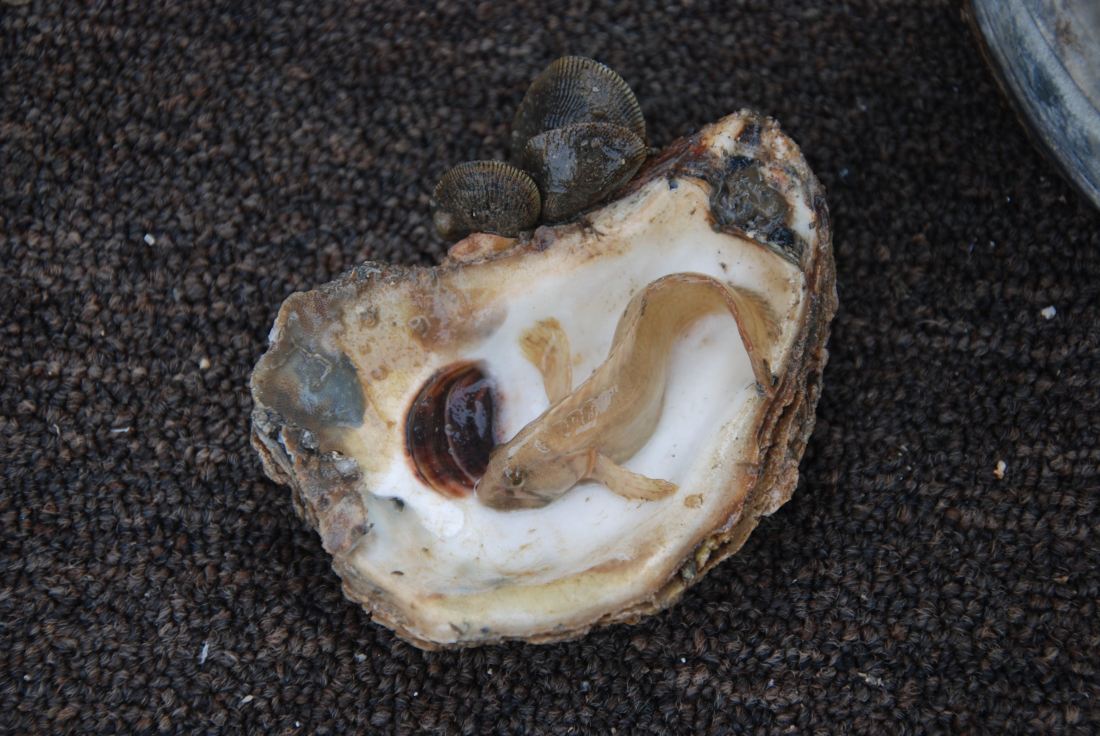
Sometimes there’s a bonus gift inside: a tiny pearl, or a scrappy little pea crab, living symbiotically among the folds of the oyster meat. The pearls you can save as mementos—or even the delicate pea crab, if, like my 2-year-old, you find the little crustaceans fascinating. After one turned up in a plate of oysters we were eating this fall, she carried it around in her palm for the rest of the afternoon, showing it to all who cared to listen. When it died, she saved its frail shell in a small wooden dish for days, until it finally fell to pieces in her hands. She still talks about it, hoping to come across another.

Oysters are ever-present at fall and winter gatherings among my crew of friends. When we get together in the cold months, someone usually brings a cooler full of oysters on ice, a shucking glove, and an oyster knife, and people take turns opening them at an outside table for all to enjoy. If there’s enough snow on the ground, a good way to present oysters is stuffed in a snow bank, so partiers can simply pluck them out one at a time when they’re ready to shuck. Either way, it ensures the party has an outside contingent that’s not just the smokers.

A long-running Thanksgiving feast at a friend’s home, where there’s a craftily masoned fire pit in the back yard, generally features the host’s specialty: As a spitted leg of lamb turns, he roasts oysters next to the fire, spooning melted garlic butter over them just before handing them to guests. Noreen Eberly, seafood marketing director for the Maryland Department of Natural Resources (DNR) Fisheries Service, says this is called an “oyster scald,” and it’s a Chesapeake Bay tradition. “On a cool day,” she says, “it’s delightful to enjoy the nice warm oysters outside by the fire.”

Eberly cites three other well-established Chesapeake Bay holiday traditions involving oysters: oyster stuffing in the Thanksgiving turkey, oyster stew on Christmas Eve, and baked oysters on Christmas day. “I also give away oysters as gifts, just to friends around the holidays,” she adds.

“Oyster stew is one of the things I look forward to on the holidays,” says Greg Barranco, communications and government liaison for the U.S. Environmental Protection Agency’s Chesapeake Bay Program. “My mom always talks about my great-grandmother’s oyster stew for Christmas Eve, and she makes it every year.” Barranco now lives in Annapolis, but he grew up in Towson and, later, Timonium. “My parents live in Oxford now,” on Maryland’s Eastern Shore, he says, “so now my mom gets oysters right from a boat down the street for the Christmas Eve stew.”

Barranco worries about the bay’s declining oyster population. “The numbers on the fishery are so bad,” he says. A just released study recommends a moratorium, since fishing, disease, and habitat loss has caused the Upper Chesapeake’s population to plummet an estimated 99.7 percent since the early 1800s and 92 percent since 1980. “But if my mom can’t get them from the bay, she’ll find oysters to make stew on Christmas Eve one way or another. It’ll cost her more, getting them from PEI [Prince Edward Island in Canada] or somewhere, but she’ll get them.”

These holiday oyster dishes are strikingly simple to make. For the oyster stuffing, just add a pint of raw oysters to your favorite stuffing recipe. Oyster stew involves melting butter; adding garlic, salt, and pepper; stirring in milk and half-and-half; and quickly cooking oysters in the mixture before adding a touch of sherry, parsley, and cayenne pepper to each serving. Baked oysters can get more complicated, but baking them shucked on the half shell in a hot oven (450 to 500 degrees), perched atop a savory mixture of, say, Gruyère cheese, spinach, and seasoned bread crumbs, until the oysters’ edges start to curl, is sure to make holiday revelers think you’re a proper gourmet. (To learn more about holiday cooking with oysters and other Chesapeake Bay seafood, Eberly recommends DNR’s free holiday recipe brochure. Send a self-addressed stamped envelope to DNR Fisheries Service, B-2, 580 Taylor Ave., Annapolis, Md., 21401, and write “Seafood” on the outside of the envelope.)

If you’re not into including oysters in your holiday feasts, there are other ways to make them part of the festivities. Using the shells to make Christmas tree decorations, or to adorn gift-wrapping, is a favorite. “My Christmas tree is always filled with oyster shells,” Eberly says. “Some I make on my own, and some I get in craft stores.” The insides of the shells can be painted with holiday scenes, or cutouts of holiday cards can be pasted on them, or glue and glitter can be used to make them sparkle.

Giving oyster plates as holiday gifts is a way to get in good with the oyster aficionado in your life. These specially made dishes with molded indentations to hold oysters on the half shell, along with the condiments often served with them, such as lemons or sauces, can be highly collectible—or simply utilitarian, if oysters are a regular part of one’s diet. My father-in-law is an oyster-plate collector who hangs them on the wall above his bar at home, and Mama’s on the Half Shell, a restaurant in Canton, has its collection similarly displayed. This hobby can get quite refined: The eBay oyster-plate page generally has about 1,000 plates on auction, with starting prices at anywhere from $10 to hundreds of dollars.

While oysters are often associated with rarefied elegance or hypersexuality, I just think of them as something delectable to go with beer, white wine, or bubbly in the cold months. They arrive with Labor Day’s observance of work and toil, but they stay all throughout the holidays, when I get to try my best to enjoy the fruits of my labor with friends and family. In fact, I think I’ll go get some right now.

Plot Device: Equal Parts Rant and Amateur Investigation, “The Midnight Ride of Jonathan Luna” Looks For a Conspiracy Behind the Death of a Local Prosecutor

By Van Smith

Published in City Paper, Feb. 23, 2005

“There’s time for a second edition,” says William Keisling, a 46-year-old Pennsylvania writer whose 515-page The Midnight Ride of Jonathan Luna was just published by his own Harrisburg, Pa.-based house, Yardbird Books. He’s defending the fact that the book is nearly devoid of interviews, and instead relies on court documents from the final case prosecuted by Jonathan Luna, an assistant U.S. attorney in Baltimore until his death on Dec. 4, 2003, when his body was found in a Lancaster County, Pa., stream, stabbed 36 times. But readers can easily be left wondering whether to trust Keisling to give a solid interpretation of the events leading up to Luna’s death. And trusting the writer is paramount here: In Midnight Ride, Keisling finds the most likely suspect in Luna’s death to be an FBI agent.

“People will know where I’m coming from, if I don’t get totally destroyed over this,” Keisling worries as he finishes a crab cake at Mamie’s Café at 911 W. 36th St. in Hampden—an address the restaurant once shared with Stash House Records, the rap studio at the center of a drug investigation that was the last case Luna worked on. “I really put myself out here with this book,” Keisling continues. “I really hung myself out. But I really care about what’s going on in this city, and I really care about what happened to [Luna] and his family.”

Keisling is guileless in his attempt to construct a theory of Luna’s death. He’s flabbergasted by the lack of attention given to the story so far, he says, and he’s outraged by leak-fueled media coverage that the case may be a suicide, or that Luna had a sordid personal life that had something to do with his fate. But the result of Keisling’s effort to put the pieces together is a display of fantastic logic, as hard to believe as it is, at times, to read.

Court transcripts (and, by Keisling’s estimate, 200 to 300 pages of Midnight Ride are taken up with them) give raw narration recorded under oath, but they don’t give insights into body language, inflection, and the things that go on when the recordings stop. Instead, Midnight Ride riffs freely off the court record and ends up pointing the finger at a federal agent as the likely culprit—without even providing the accused an opportunity to respond. (Due to that lapse in protocol, this review won’t mention the agent’s name.)

Of course, Keisling’s theory could end up being the right one. Since the book itself presents this theory in convoluted layers, here it is in Keisling’s spoken words: “It points to an internal courthouse murder. He’s stabbed 36 times, once for every thousand bucks missing from the safe. Coincidentally, [that is] also the number of times that the Dawsons called 9-1-1. The theory of the case is that he was covering up FBI and Justice Department culpability in the Dawson murder[s].”

Some explanation is necessary. As the book points out, in a previous Luna case from October 2002, $36,000 used as evidence went missing between the courtroom and the nearby evidence storage area, and Luna, another prosecutor, and federal agents were the only ones who had access to it. Midnight Ride assumes that an agent who worked with Luna on the Stash House Records case also figured in that unsolved theft case. This same agent, Midnight Ride claims, bungled the handling of a cooperating witness in the Stash House case, allowing a violent drug offender to go free, discharge a firearm, and deal drugs while on the FBI payroll as a paid informant.

The public furor over the arson murders of the seven members of the Dawson family in East Baltimore, who died at the hands of a repeat offender while the FBI was working the Stash House case, made the misadventures of the Stash House informant a sensitive issue for Baltimore’s federal law-enforcement bureaucracy, Midnight Rideasserts. The local police, with its corrupt leadership, didn’t help the Dawsons in time, so where were the feds? the book asks. Paying criminals to continue committing crimes, it answers.

Compounding the public-relations threat alleged in Midnight Ride were congressional investigations that were pulling the covers off of FBI informant scandals. On the morning that Luna’s body was found, the mishandling of the Stash House witness would have come to light in the courtroom—unless a plea deal could be reached, and Luna was preparing those agreements when he suddenly left his office to meet his demise. But, Midnight Ride discloses, the plea deal—which was accepted by the court the next morning—was patently improper, flouting federal rules by letting a suspect off the hook for a drug-related murder. After Luna’s death, the leaks began, disparaging the prosecutor’s character and throwing the public off the scent of what the book concludes is manifest: that the feds killed Luna. Presumably, Luna had balked at finishing the questionable plea deals and thus was going to let the Stash House embarrassment come out in court the next day.

In the end, Keisling says, Luna’s death was like that of Christopher Marlowe, the early English dramatist and spy whose death, centuries later, remains a much-argued mystery. Keisling, with Midnight Ride, is the first to fire a salvo in the neglected debate about Luna’s mysterious death, and he begs for others—especially Congress—to enter the fray. Fourteen months of federal investigation have gone by, without any answers—not even a hint about what the motive may have been. At some point—especially given the facts Keisling dug out of the courthouse about the Stash House case—Congress has a duty to step in and take a close look at how the Justice Department has handled Luna’s death. Maybe then Keisling’s inventive theory will be exonerated. Or maybe, by then, Midnight Ride’s second edition will come out—with its literary flourish replaced by the fruit of hard, investigative labor.