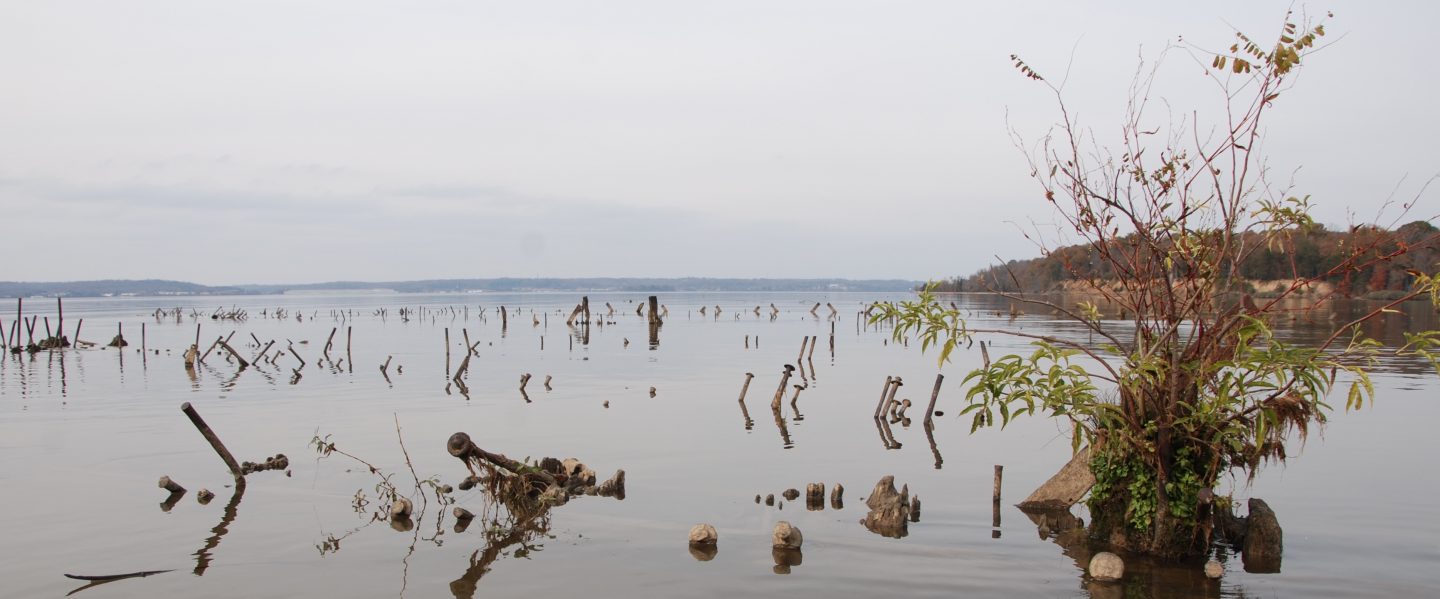
The Oyster Counters: On the water with the scientists on Maryland’s 75th annual Chesapeake Bay oyster survey

By Van Smith

Published in City Paper, Nov. 11, 2014

Image-1-4

It’s dark outside, and the pre-dawn Monday morning traffic in Baltimore’s Harbor Tunnel is light. I just made a mad dash out of bed, into my truck, and to the ATM and gas station, thinking I’d overslept to make a timely 7 a.m. arrival for my date near Taylor’s Island on Maryland’s Eastern Shore, where I was to jump on a boat with a host of state-employed oyster experts. As I emerge from the tunnel and head toward Interstate 97, I glance at my phone—oh, right, the clocks changed back over the weekend. Knowing I’d be early, I slow down, put on the cruise control, relax to some tunes, and start to think about oysters.

The men I’ll be meeting carry on what they and others have been doing for 75 straight years: conducting Maryland’s annual oyster survey, a running measure of the size and health of Maryland’s wild population of Crassostrea virginica, better known as the Eastern oyster, the only oyster species in the Chesapeake Bay. From aboard the 48-foot, diesel-powered research vessel Miss Kay, they dredge samples of oysters off their colonies, or bars, from the same locations all over the Bay every year, and sort, count, and measure the catch, saving some to take to a lab to study for disease, and putting the rest back overboard. After a few months, the resulting data ends up released and summarized in the widely anticipated “Maryland Oyster Population Status Report.”

When the survey started in 1939, Maryland watermen landed more than three million oysters; in 2013, the commercial harvest was 341,000 oysters—about a tenth of the historic take, but the largest in a dozen years. The survey has yielded good news in recent times, as the incidence of disease among oysters has been low and their survivorship high, though the measure of their reproductive success—the amount of “spat,” or baby oysters growing on shells—has been uneven. The generally positive trend tentatively indicates a depleted fishery on a bit of a mend, a sign that nearly 200 years of regulation of the fishery, and significant modern public investment in recovery efforts, are bearing some fruit.

As Eric Schott, a University of Maryland Center for Environmental Science biologist at University of Maryland Baltimore County’s Institute of Marine and Environmental Technology, told me over the phone recently, the oyster survey is “seeing historically low disease rates with high recruitment rates, and this last year was really a blockbuster,” trends that he attributes to “oyster restoration efforts that are fantastic now.”

I’m hungry and under-caffeinated, but determined not to hit some franchise along Route 50 East. So I hold off as I leave Cambridge, faithful that there will be a stalwart back-roads survivor that serves the locals as I head westward on Route 16, which, as the convenience stores and housing tracts give way to farmland, pine stands, and salt marshes, eventually becomes Taylor’s Island Road.

Sure enough, as the sun starts casting a few dim rays on the tops of the pines, I come across a roadside building that houses both a U.S. Post Office and the Woolford General Store, where a big sign outside advertises kits for growing your own Chesapeake Gold oysters, sold by an aquaculture outfit in nearby Hooper’s Island. This reminds me of a simmering cultural and economic conflict between traditional Maryland watermen, who rely on healthy wild stocks to make their living, and a new breed of science-savvy oyster farmers, whose caged stocks form manufactured reefs on leased stretches of bay bottom. The watermen tend to see the rise in oyster aquaculture as an unsightly threat to their freedom to fish, but the ecological benefit of live oysters, the more the better, is hard to argue against: Each full-grown one can filter many gallons of water a day, helping to cleanse the bay’s polluted waters and thereby boosting the fortunes of all its fisheries.

A couple of dudes in camouflage and wearing muck boots are walking out of the Woolford General Store, carrying coffee and brown bags as they get in their lift-kitted pickups. Inside, munching on bacon-egg-and-cheese-on-ryes and watching the political ads on the local TV station, I note the wares for sale: guns, fishing equipment, beer. I’m less than 10 miles from the strip malls of Cambridge, and only about 90 miles from Baltimore, but places like this remind me how rural much of Maryland is. A rooster crows nearby as I get back in my truck to leave.

Heading west from Woolford, the road crosses the upper reaches of Madison Bay, Woolford Creek, and Parsons Creek, where dead pine trees at the edges of the salt marshes stand as testaments to one of the many changes the Bay’s habitats are undergoing: The intrusion of brackish water from inexorable sea-level rise is killing off the pines at the edges of marshes. A bald eagle lights from one of them as I drive by, and I remember past trips to Taylor’s Island, when, while kayaking, I drifted close by as dozens of eagles feasted on huge rockfish, too busy using their talons to tear apart the fish flesh to be bothered by me. The dead pines apparently make good habitat for hungry eagles, as they can perch atop them and watch for passing fish.

Slaughter Creek Marina, where I’m to meet the oyster-survey team from Maryland’s Department of Natural Resources (DNR), is providing a temporary berth for the Miss Kay, but it’s the permanent home of Palm Beach Willie’s Restaurant and Bar, an unlikely Key West-style party spot in a tiny community that boasts a population of 174. I’m quite early, and totally alone, so I change into my foul-weather gear, sip my coffee, and wait. The Miss Kay is at a slip, basking in the rising sun, amid a spare combination of working boats and yachts that bob in the wind-driven waters of the marina. Finally, right at 7 a.m., a white pickup truck with state-government license plates arrives, and two men get out and walk the pier to the Miss Kay. They seem not to notice me, so I tentatively follow.

“You the reporter?” asks Dave White, the pony-tailed, clean-shaven captain of the Miss Kay. He’s wearing a U.S. Navy cap and khakis and he and his mate, Thomas Wilson, are busying themselves with starting the Miss Kay’s engines, booting up the navigational systems, getting a pot of coffee going, and preparing the deck for a day of work on the water. I try to stay out of the way, feeling very much the landlubber despite my bright-yellow nautical attire.

Soon, the scientific team arrives: leader Mitchell Tarnowski, head of monitoring and assessment for DNR’s Shellfish Division; two biologists who work under him, Robert Bussell and Mark Homer; Chris Judy, the former Shellfish Division director who now runs a DNR citizen-involvement aquaculture program called Marylanders Grow Oysters (MGO); and Steve Schneider, also with MGO. Tarnowski, Homer, and Judy have known one another for nearly a quarter-century, while Bussell’s been around with them for about a decade, and Schneider joined in four or five years ago, Tarnowski explains later, calling Homer the “old guy” and Schneider—the only beardless one of the bunch—the “newbie.” All of them, it becomes apparent over the course of the day, enjoy the kind of in-the-field camaraderie that grows from mutual respect earned over time spent in their common cause: understanding and trying to heal the bay’s struggling wild oysters.

This is “probably the longest-running oyster survey in the country, if not the world,” says Tarnowski, adding that its 75th anniversary makes it “sort of a special year for us.” He also points out that “you came out on a good day,” because “two of the most knowledgeable guys on oysters in Maryland” are on board: Judy and Homer. Judy’s MGO program—which promotes the placement of caged oysters off waterfront property, strictly for their ecological benefits, not for eating—is “going like gangbusters,” Tarnowski explains, and Homer has a Ph.D. and has been “working on oysters for 25 years,” so “you’ve got two guys who really, really know their stuff.”


The men wear hats, put on oilskins, and get work gloves at the ready, for warmth and protection from the cold, wet, dirty work ahead (except for the long-haired Homer, who goes bare-handed and hatless, wearing a green parka over his Orioles T-shirt). Bussell wears nothing on his feet but Teva-style sandals, and, faced with remarks about what must be his remarkable circulatory health, quips that his toes “died years ago.”

“First station’s right out here,” announces  Tarnowski over the roar of Miss Kay’s engines, as he points up Slaughter Creek to an unmarked spot. “All right, let’s get going,” announces White from the helm, and starts to maneuver the vessel out of the marina.

Minutes later, White slows down the Miss Kay as Bussell, Wilson, and Schneider ready the power-dredge rig, which sits on the vessel’s stern and releases the dredge over its starboard aft. The first of the day’s data-gathering rituals is set to begin.

The dredge is a 32-inch-wide heavy-chain basket attached by lines to a powerful hydraulic winch. At 14 locations all over the Little Choptank River during the course of the day, it will be lowered onto the bar below and dragged for a short distance before being winched back up, filled with whatever was in its path. Once hoisted out of the water, the dredge will be guided back aboard, and, as it hovers over a platform fitted on the Miss Kay’s aft deck, Wilson will pull its release lever, causing its bottom to open and its contents to dump onto the platform.

Once a dredged batch of oysters is on the platform, Bussell uses two hands to scoop them into a half-bushel bucket, takes the full bucket to another platform on the port side, just outside the Miss Kay’s cabin, and dumps them out. Now, after buckets of bay water are poured over the oysters to give them a quick cleansing, the sorting, counting, measuring, and inspecting begin in earnest.

Judy, Homer, Schneider, and Bussell dig into the pile of oysters and start calling out things like “two markets,” “small box old,” “oh yeah, gaper, market gaper,” and “market spat,” as they plunk them into metal buckets. They also call out the names of other creatures found in the batch, like “mud crab,” “sponge,” “barnacle,” “mussel,” and the name of a small fish that Homer describes as “beautiful” and explains is “one of the few true reef fish that only live on reefs.” He releases it overboard, saying, “I don’t think he’s going to make it to the bottom, probably get eaten on the way down.” After separating larger from smaller oysters, the men use little plastic rulers to measure their length in millimeters, sounding out a chorus of numbers such as “98, 77, 82, 90,” and “92, 117, 106, 112.”

As his crew calls out their findings, Tarnowski sits nearby with a clipboard and a pencil, madly scribbling on a legal-sized sheet of paper that is printed with boxes, rows, columns, and checklists designed for the survey, turning the chorus of code words and numbers into meaningful data. He has an interesting and efficient way of marking out counts of 10: First he makes four dots, then he connects them with four lines to make a box, and finally he marks an “X” in the middle.

“We look at how many are alive, how many dead, their sizes, and fouling organisms like barnacles and crabs,” Tarnowski explains—as well as large numbers of “sea squirts,” ball-shaped organisms about the size of marbles that cluster around the oysters, and which Tarnowski says “are more closely related to us than they are to the oysters.” Market-sized oysters of 76 millimeters (three inches) or more are called “markets,” while “smalls” are less than market size and “boxes” are dead oysters whose shells have not yet separated from one another, indicating they died relatively recently–though there can be new boxes with clean shells inside and old boxes, which tend have things living in them. A “gaper,” Homer explains, is “a dead oyster that still has meat in it. You don’t want to smell it, very disgusting.”

Thus, an endemic oyster culture infuses the whole enterprise, as the terminology, Schneider explains, is specific to the survey, while the oyster bars sampled have names such as Cason, Ragged Point, Butter Pot, and Grapevine, says Tarnowski, that arose from age-old local traditions.

The oyster-eating tradition, though, is not universally shared by the survey crew. Judy, who opened up a couple for close examination over the course of the day, only likes them cooked, but Schneider happily slurps a raw one down, and recalls long-ago days in Louisiana when he could get them so cheap “you could make a meal out of them for less than 10 bucks, beer included. It’ll never be like that again.” They all seemed to like my description of a P.S. Mueller line-drawing cartoon I’ve always remembered, though, in which a man holds an oyster on the half shell, and the thought-balloon over the man says, “I wonder if it’s alive,” and the one over the oyster says, “I wonder if he’ll chew.”


After finishing up the tally at the Slaughter Creek site, White throttles up the Miss Kay and heads up the Little Choptank River toward the Cason bar, passing two large barges on the way, one bearing a crane and the other filled with fossilized oyster shells brought up from Florida. These are part of an ongoing, high-dollar effort by DNR to construct hundreds of acres of oyster reefs in the Little Choptank and two other tributaries, Harris Creek and the Tred Avon River, and all told the price tag could come to more than $70 million. At one of the Little Choptank sites the Miss Kay crew visits, fossilized oyster shells came up in the dredge, along with “marl,” the calcium-carbonate substrate in which the oyster fossils were embedded.

Local officials have questioned the oyster-reef projects, worrying that its potential future benefits come at the expense of current fishing. But perhaps a more fundamental issue is whether the Little Choptank and its tributaries, which are showing signs of a natural rebound thanks to being oyster sanctuaries where harvesting has been banned since 2010, are appropriate sites for reef-building, rather than other places where oyster populations have collapsed. I make the point that unproven investments made in places where success is likely, should they succeed, will enhance the public’s willingness to make similar investments elsewhere in places that have greater need. Tarnowski agrees, saying later that “other people have other opinions, but it makes more sense to get the momentum going to prove the concept, so we can get to the other areas that need it.”

Once at the Cason bar, a slight controversy comes aboard with the dredged catch: “hatchery spat,” they call it. Over about 1,600 acres of Bay bottom, the nonprofit Oyster Recovery Partnership (ORP) has planted about five billion baby oysters on shells, after they’ve been raised from seeds at the Horn Point Laboratory’s hatchery at the University of Maryland Center for Environmental Science’s campus in Cambridge. The ORP’s efforts have been quite successful—monitoring reports by University of Maryland’s Paynter Laboratory found survivorship among ORP’s planted spat to average around 35 percent over the past few years, much higher than in years previous—but an apparent breakdown in coordination between ORP and DNR’s survey team has resulted in hatchery spat being planted on part of the Cason bar.

“Generally speaking, it hasn’t been that much of a problem,” Tarnowski explains later, “but I was surprised that it was on Cason that they planted, because that’s one of our main bars.” The difference between natural spat and hatchery spat is easily spotted: “Hatchery spat tend to be clustered in large numbers,” he explains later, “and you can also tell by the shells, which are from shucking houses, so they have nicks on them. There are one or two oysters per shell in natural spat.” The issue can be cleared up, he says, with “a meeting of the brain trust” to avoid ORP planting on bars that are part of DNR’s annual survey. “In the beginning of the year, they just need to say ‘we’re going to plant here, here, and here,’” he concludes.

Another sample is taken at another part of the Cason, untainted by hatchery spat, and, after the sorting, counting, and measuring, Tarnowski is enthused, saying, “that’s a nice haul.” Overall, he says, the day’s survey is showing about 250 market-sized oysters per bushel dredged, and a bushel sold usually contains about 350 oysters, “so we can say roughly two-thirds is just oysters, and that’s very nice, so this river’s doing good. It’s coming back all on its own.”

Two years ago, Tarnowski continues, “we got a lot of spat, and we can see that they’ve grown up,” though “they’re not reproducing” like they did in 2012 and 2010. “Recruitment—that is spat set—was poorer than in previous years, but there’s very good survivorship, not many boxes,” he adds, and that’s “very encouraging” given that “this is a river where there was 92-percent mortality 12 years ago” due to disease.


Back in the Miss Kay’s cabin, while en route between locations, the conversation among these professional oyster counters tends toward the jocular and trivial. Killing time is an art form, and among these guys, with their long histories together, it’s been perfected.

Tarnowski asks who recorded the most popular version of Donovan’s song ‘Season of the Witch,’ and eventually gives up the answer: Steve Stills and Al Kooper on their “Super Sessions” release, and Homer points out that Jimmy Page played guitar on the original. They work out that the H.L. Mencken-inspired character in the movie version of “Inherit the Wind,” about the Scopes monkey trial, was played by Gene Kelly, that Stills’ accordion made a cameo in the Ridley Scott movie “Prometheus,” and that it’s strange that there are many people named “Viola,” but probably none named “Violin.” Tarnowski is a huge Joseph Mitchell fan, given the writer’s detailed journalistic treatments of marine-biology subjects, including oysters, while Bussell and Homer proudly recollect their work on a short video about the precipitous collapse of Maryland’s razor-clam population, a prized bait-fishery for crabbers, and especially reminisce on their creative use of music in it, including snippets from Pink Floyd’s “Wish You Were Here.” I contribute my bit about how I once caught my very pretty cat carrying on amorously with a baby rat, and that it turns out there’s a scientific explanation for such oddball behavior on the part of the rat—but not the cat, who’s just incredibly dumb.

As the day wears on, the breeze eases and the temperature rises with the sun. At the mouth of the Little Choptank, James Island is visible, a shrinking, sinking island whose contours I mapped by kayak in 2007 and 2013, using a handheld GPS, showing it had lost 67 percent of its acreage in six years. It looks like it’s lost even more in the past year, as has the farm on Oyster Cove on the northwest tip of Taylor’s Island whose fields have been falling into the Bay in huge chunks, once again reminding me how real sea-level rise is. Nearby, divers are collecting oysters from the bottom, working off of two boats outside the sanctuary boundaries, and Judy remarks on the incredible dangers they face. As for the dangers the bay faces, Judy says he’s “an optimist. You got to just keep grinding and working, and there are setbacks, but hopefully we can get the job done.”


The oyster-recovery job has really only just begun, despite generations of earlier efforts. The U.S. Army Corps of Engineers has been working on it for the last 15 or 20 years, but its coordinated master plan for Maryland and Virginia, the latest draft of which was put out in 2012, calls for restoring 20 to 40 percent of the bay’s historic oyster habitat and protecting it as sanctuary. The cost, covering about 20,000 to 40,000 acres of habitat restoration in 19 targeted tributaries, is estimated to range from $2 to $8 billion. Citing scientific literature to provide a baseline for the hoped-for rebound, the Corps says the bay’s oyster abundance has dropped 92 percent since 1980, and 70 percent of its habitat has been lost in that time. It’s a big, big project, but it’s now begun: The Chesapeake Bay Watershed Agreement, signed in June this year, calls for 10 reef-building projects like the ones in the Little Choptank to be completed by 2025.

The Miss Kay heads back to the Slaughter Creek Marina, and I jump ship, as do Bussell and Homer. The rest, though, head back out to do a few more dredges on their way to Oxford, where they’ll drop off the bags of oysters they saved for lab work at the Cooperative Oxford Laboratory, an oyster-studying facility run jointly by DNR and the federal government, to see if they are suffering from any diseases.

Though it’s too soon to say that setting up sanctuaries, planting hatchery spat, and building new reefs are actually leading to a self-sustaining and rebounding oyster population, what’s known so far about this year’s oyster survey—that, as Tarnowski puts it, “we’re still seeing good survivorship, but not much spat set”—indicates that it’s another decent showing, especially if the disease work, which won’t be completed for another couple of months, continues to show a healthy population.


Three days later, I talk to Tarnowski over the phone, and he’s again enthused at what the survey is showing. “We had a shit-load of oysters today on Harris Creek,” he says, “and also on Broad Creek, which is open to harvesting, including dredging. And on one bar at the mouth of Harris Creek, we saw 28 boats dredging.” Thus, what’s shaping up to be another good year for DNR’s oyster counters may also be another banner season for the watermen. And you know what that means: more Chesapeake Bay oysters to eat.

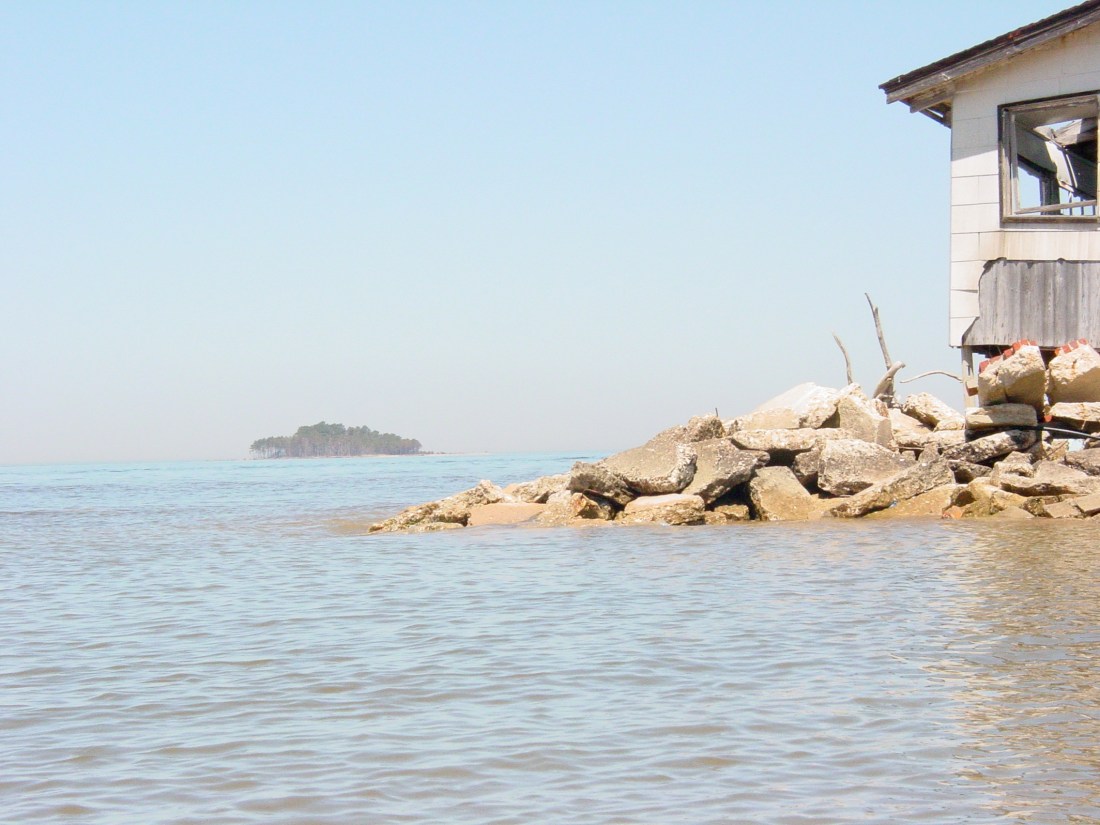
Aquageddon: A disappearing island shows what rising sea levels mean for the Chesapeake Bay

By Van Smith

Published in City Paper, Apr. 17, 2013

DSC_4628

My trusty handheld GPS helps keep me safe while kayaking, letting me know precisely where I am on a map. But bringing it along on kayaking trips, it turns out, can serve more than my own personal safety: It’s also a useful tool to map the land-devouring effects of sea-level rise in the Chesapeake Bay.

On April 21, 2007, I kayaked around James Island (pictured), at the mouth of the Little Choptank River, in Dorchester County on Maryland’s Eastern Shore. The outing, for which I made camp at the nearby Taylor’s Island Family Campground, was part of my research for an article about exploring the Chesapeake Bay’s vanishing islands (“Wetlands,” Feature, May 23, 2007), about 40 of which oceanographer William Cronin had chronicled in his 2005 book, The Disappearing Islands of the Chesapeake.

As Cronin pointed out, sea-level rise in the bay had been estimated at 3 feet per millennium until about 1900, but then, over the course of the 20th century, a 1-foot rise was observed-an acceleration that washed away at least three notable islands and was eating away at the rest.

As I circumnavigated James Island in 2007, hugging the shoreline as closely as possible while dodging fallen pine trees partially submerged in the murky water, my GPS recorded my route, laying it out like a bread-crumb trail on its map. In the end, I’d mapped the contours of the island’s shore-or, rather, the coastline of its three islets, since James is no longer a single island.

The shoreline here is virtually free of gradually sloping beaches and instead ends abruptly with short, precipitous drops into the drink. The small cliffs have been left behind after chunks of land fall into the bay as it erodes, similar to the way melting glaciers lose pieces of their mass in a process known as “ice calving.” Thus, the bay’s tides, rather than going in and out along the shoreline, covering up and then exposing the intertidal zone, go up and down vertically along the bold shore, allowing a shallow-draft craft like a kayak to stay quite close to land regardless of when in the tide cycle one is paddling.

James Island used to be populated as recently as the early 1900s, with 20 houses, a school, a boatyard, a church, and a cemetery. Studies have described its inexorable and ongoing destruction: from 975 acres in 1848 to 72 acres in 2006, losing an average of 5.7 acres annually over the course of those 158 years. A return trip with my GPS would allow me to estimate its land loss in the past six years and calculate whether its rate of loss was more or less than the historical record indicated.

Also in 2007, I gunk-holed around the nearby coast of Taylor’s Island, lingering close to a farmhouse at the northern mouth of Oyster Cove that was precariously close to falling into the bay, and noting the ochre cliffs, 6-plus feet high, that had formed as farmland had been shorn off in great chunks by the force of incoming waves. A return trip with the GPS could provide me with a rough indication of how much more farmland had been lost to the bay’s rising waters-though the fate of the house would be a matter of simply using my eyes.

First I paddled from the campground on Taylor’s Island to the Oyster Cove farmhouse, which is now reduced to a pile of rubble. My GPS indicates I paddled on water about 100 feet inland from where I’d been in 2007-a feat only possible due to a significant sacrifice of farmland to Neptune. When I had asked about this earlier at the campground, an old-timer estimated about 30 acres of this farm had fallen into the bay in the last five years or so-as reasonable a guess as any, I suppose, given that the bay’s now 100 feet further inland.

I headed out from the Oyster Cove point to the southern tip of James Island-a stretch that has lengthened in the past six years, according to my GPS. It’s now a 0.6 mile trip, about 530 feet more than it was in 2007, yet another measurement of vanished land. Then I paddled around the three islets, forming another GPS bread-crumb trail that, when compared to the one laid down in 2007, indicates 67 percent of James Island’s land has succumbed to the Chesapeake’s tides in six years. The rate-6.2 acres per year-is a half-acre more than the average annual rate of land loss over the 158 years prior to 2006.

CP’s webmaster Andrew Vogel took the GPS locational data from my two trips around James Island, imported it into Google Earth, and used the software to create two shapes for each island, one for 2007 and the other for this year. Google Earth then automatically calculated the area for each of the shapes, providing precise measurements to determine how much land James Island lost in the intervening six years.

The results are striking: 37.3 acres have been lost, leaving behind a paltry 18.3. The middle island suffered most, losing at least 16 of the 21 acres it had in 2007.

Based on the GPS coordinates recorded during my two paddling trips, two broad conclusions about the James Island coastline are clear: The bay’s rising waters are claiming its land, and they are claiming it faster than in the past.

Turns out, that’s not surprising. Last year, two groups of scientists published research indicating not only that the mid-Atlantic coast’s sea level recently rose significantly faster than the global average, but that its rate of rise in the Chesapeake Bay is accelerating.

James Island is “like a canary in a coal mine,” says Court Stevenson, a professor at University of Maryland’s Center for Environmental Science in Cambridge and a long-respected expert on sea-level rise’s impacts on the bay’s shores. He recalls going to James Island about 15 years ago and tagging 100 pine trees whose circumference he intended to measure to determine their rate of growth. “We went back a year a half, two years later, not a tree was standing. They were all gone-100 of them. Basically, our whole study was gone.

That kind of rapid land loss, especially if it quickens with an acceleration of sea-level rise, may well foretell the story of the Chesapeake Bay coastline’s future.In 1914, J. Fred. Hunter of the U.S. Geological Survey (USGS) studied several of the Chesapeake’s fast-eroding islands near the Choptank and Little Choptank rivers, including James Island. After chronicling the land-loss facts based on available evidence, Hunter hazarded a guess: James Island “should disappear in about 150 years,” while adding the blanket caveat that “numerous other factors may enter to disturb the present conditions and rate of erosion.”

Interestingly, should James Island’s land-loss rate of the past six years continue apace, Hunter’s prediction that it will have vanished by 2064 would prove quite prescient. If it continues to lose about 67 percent of its acreage every six years, by 2064 only a third of an acre would remain.

Since I can’t paddle over land, and wasn’t willing to trespass on the Oyster Creek farmland to walk the edge of its cliffs with my GPS, it’s anybody’s guess how much of its acreage has been lost-and how much more will calve off into the bay in the future. But more will; as James Island’s destruction continues, the shore it protected from the waves will take ever-worse beatings and more direct hits by wind-driven waves.

Meanwhile, Hunter’s caveat in making his prediction about James Island’s disappearance-the “other factors”-recently entered into play. The fact that the Chesapeake region’s land continues to subside, thanks to a combination of long-term regional settling of the Earth’s crust after the glaciers last melted, starting about 18,000 years ago, and the more recent drawing down of groundwater as population swelled, only compounds the sea’s accelerating encroachment on land. And that encroachment, based on recent science, is becoming more and more worrisome.

In a paper appearing last June in Nature Climate Change, USGS researchers identified a 1,000-mile long “hotspot” on the East Coast between Cape Hatteras in North Carolina and just north of Cape Cod in Massachusetts – which includes the bay – where sea-level rise has accelerated at three to four times the global average over the last 20 years. This discovery was followed in October by a Geophysical Research Letters paper by a two-man, British-American team of oceanographers who found that the bay’s sea-level rise may have sped up from 1 to 3 millimeters per year in the 1930s to 4 to 10 millimeters per year so far in the 2000s. If the 10-millimeter high end holds true in the future, then the bay’s water will rise a little bit more in the next 100 years than it did in the 1,000 years prior to 1900.

In short, scientists recently started to detect a “hockey stick” shape to the sea-level-rise curve for the Chesapeake Bay, which would spell faster-arriving impacts from the already-expected inundation resulting from climate change. No wonder, then, that James Island’s land loss has been appreciably faster in the last six years than in the preceding period back to 1848. It’s just one example of a near-endless litany of anxiety-inducing repercussions that faster-rising seas are expected to have on the bay.

Stevenson, who says he first came to live on and study the bay in 1972, says that “when I first started talking about sea-level rise, people thought it was just sort of flat-it was increasing but it wasn’t accelerating. But now it is inflecting upwards, and that spells trouble. You just get much more erosion since the water level is higher and higher in the flood plain, and the wave attack is much, much higher, and places that once were underwater only a few hours a day get inundated much more of the day, so they just keep getting this wave action that just keeps beating on it. If sea level is inflecting upwards, then it’s all just going to happen a lot quicker than we had seen in previous centuries of sea-level rise. And that, in a nutshell, is what a number of us who are concerned about sea-level rise are worried about.”

Not surprisingly, such worries have been getting high-level attention.

On Dec. 28, Gov. Martin O’Malley (D) signed an executive order that, had it been read at the time by Marylanders trying to enjoy a holiday break from their routines, would likely have caused some to choke on their eggnog.

It’s purpose was dry enough-that state agencies incorporate the risk of inundation from coastal flooding and sea-level rise into all planning for future state-capital projects, that agency construction projects be built at least 2 feet above the 100-year flood line, and that additional recommendations for safely building or renovating state structures in light of sea-level rise be devised quickly. But its preamble-the “Whereas” section-cited the recent USGS “hotspot” study to tick off a list of current and anticipated problems sea-level rise entails. Among them were:

-“The State of Maryland is currently losing approximately 580 acres every year to shore erosion.”

-“Alarmingly, thirteen Chesapeake Bay islands once mapped on nautical charts have been lost.”

-“Future changes in sea level threaten to increase the State of Maryland’s vulnerability to storm events, causing more shore erosion and severe coastal flooding, inundating low-lying lands, submerging tidal wetlands and marshes, and resulting in additional salt-water intrusion, and high water tables.”

-“The State of Maryland has approximately 450 existing State-owned facilities and 400 miles of roadways within areas likely to be impacted by sea level rise over the next 100 years.”

-“Billions of dollars of investments in public infrastructure will be threatened if the State of Maryland fails to prepare adequately for climate change.”

In the neighboring state of Delaware, Gov. Jack Markell (D) got into the act in January, with a “state of the state” address that envisioned a future so threatened by rising seas-and especially the hurricanes that come with them-that the time has arrived to do triage on what can and cannot be protected. Calling last fall’s Superstorm Sandy a “wakeup call,” Markell said that Delaware must start “strengthening dikes and dams, conserving wetlands, improving drainage, or nourishing beaches,” but “the need for this infrastructure exceeds the resources available,” so the state must have a “frank conversation” about how to “prioritize and finance projects, so that we protect what we can and make realistic choices about what we cannot.”

There have long been such frank conversations about restoring the bay’s vanishing islands with dredging spoils, 3 to 4 million cubic yards of which are scooped out of the bay’s channels each year to keep the Port of Baltimore accessible to ships. Since 2006, James Island has been one of the islands selected to be built back up this way, as part of something called the Mid-Chesapeake Bay Island Ecosystem Restoration Program, which would provide new uplands and wetlands as wildlife habitat and also recreate a buffer to help protect the Little Choptank River coastline from ongoing loss of land. But other than studies-many of them have been conducted, providing a wealth of details about James Island’s history, ecology, and geology-there’s been no further action.

The project is “unfortunately stalled,” says Maryland state Del. Jeannie Haddaway-Riccio (R-District 37B), who represents several bay-facing Eastern Shore counties and strongly supports the program. The reason, she says, is that it relies on “federal money that has not been dedicated other than to planning.” Still, she stresses the need to “shore up those islands” to provide a buffer for communities and landowners to the east.

“The longer we put it off,” she says, “the more expensive and harder it is to rectify.” She says that on Hooper’s Island, just south of Taylor’s Island, “gravesites have been going into the water” and notes that “it’s amazing, the cliffs that have been created” by the gouging action of the waves hitting the shore.

At Taylor’s Island Family Campground, owner Bruce Coulson has a front-row seat to the damage wrought by sea-level rise. He and his group, the Dorchester County Shoreline Erosion Group, have long promoted ways to reduce the force of the waves pounding the shoreline in these parts so the bay’s increasingly ravenous appetite for nearby land will be slowed. He has good reason: The bay’s been stealing away his land-though not as fast as it’s been taking it from other nearby landowners, thanks to the huge chunks of concrete he’s placed along his shoreline. Each weighs 15,000 to 20,000 pounds, he estimates, yet the waves of Superstorm Sandy still managed to move them. Of the 15 acres of land that once comprised this parcel, 11 remain. “The other four is out there in the bay,” he says.

The land loss on Taylor’s Island and other parts of the Little Choptank River waterfront, including a lot of farmland, “just keeps adding pollutants and nutrients and sediments to the bay,” he says. “It’s terrible. It’s chewing off everything. You can sit there and do all you want to clean up the bay, but until you control something like this, you’re just not doing the job.”

One option, he says, is offshore breakwaters to reduce the force of the waves hitting the shoreline. Do that, he says, and coastal property owners might stand a chance to establish “living shorelines” that are being promoted as an environmentally sustainable alternative to lining the shore with heavy rocks. If there were breakwaters, which he estimates would cost about $70 million, based on studies from the late 1990s, “then you can probably put in your living shorelines up and down the bay, but you’ve got to stop that force from coming at you first.”

Another idea Coulson tosses out concerns the imminent problems at Conowingo Dam on the Susquehanna River, which since the 1920s has been holding back huge volumes of sediment that otherwise would have entered the bay. It is nearing capacity, and when it does, new sediments coming down the Susquehanna will simply enter the bay unimpeded, unless something is done. “They’re talking about dredging it,” he says, “and I’m thinking, put it all on barges and dump it off at James Island.”

“If you put that island back in there, you’ve built a breakwater,” Coulson says. Without it, he says, “when James Island is completely gone, up here at Oyster Cove it’s going to really nail us with the northwest wind. There’s farmland that’ll go, but what’s next is the road, and then the county’s going to have to spend a lot of money.”

Until something is done, though, Coulson’s campground will continue to take a beating, protected by the concrete chunks. Erosion has gouged out a cove just south of his property, and during a visit, a stiff breeze was slamming waves relentlessly into the roots of the adjacent pine forest. The bay’s water was thick and gray with sediment, which was being carried northward in discolored tidal currents as downed pine trunks pounded around in the surf.

This is what active, everyday erosion looks like, and it’s not pretty. It looks like what it is: pollution. As the seas continue to rise, scenes like this will become more and more commonplace along the bay’s shores, eating away land and further undermining the bay’s health.

Stevenson knows Coulson and says he “has a lot of good common sense, and he’s a good observer.” But Stevenson is not as sold as Coulson is that rebuilding James Island or building offshore breakwaters is a solution. “I don’t think we can solve it,” Stevenson says of the inexorable erosion caused by winds and waves carried by rising seas. While agreeing that the active loss of large amounts of farming may be a serious pollution issue for the bay-“there’s a lot of nitrogen and phosphorous associated with farmland,” he says, “and 30 acres has a lot of nitrogen and phosphorous that’s going into the bay, as well as the sediment itself that makes the water murky”-he’s essentially gloomy about the whole problem. “We might be able to protect some things and slow it down,” he says, “but I don’t think there’s a fix.”

The bleak outlook seems uncharacteristic for a man whose career has been dedicated to finding smart ways to reverse the long decline of the bay’s ecological health. Yet there it is: “I think that we’re just going to get submersion of land,” he says. “And we’re just going to see more open water.” He holds out a depressing fact for consideration: “We’ve looked at how much marsh is being formed versus how much we are losing-for every 10 acres that we’ve lost, we’ve only gained one over the last 30 years. I’m pessimistic.”

The very real prospect of climate change driving sea-level rise at a quickening pace, and more so in the bay than most other parts of the world, has Stevenson very worried, and he wonders about the wisdom of attempting to concoct technological fixes for the symptoms rather than treating the disease, which he says is clear: the rise in greenhouse-gas emissions, especially carbon dioxide, in the modern era. “If you really look at the expense for the whole Eastern Seaboard and maybe part of the Gulf Coast” for preparing for more rapidly rising sea levels, “it’s maybe better to do something about containing greenhouse gases. But that argument doesn’t seem to have much resonance.”

Major hurricanes – not like Isabel in 2003 or Agnes in 1972, but ones like the one that stormed up the bay in 1938 and is etched in the Eastern Shore’s collective memory – are what make Stevenson “pull my hair out with worry,” he says. “It’s just a matter of time” before one hits, he says, “and it really will be formidable. There’s a lot of places that now exist that won’t. Baltimore is not immune either, with the surge amplified as you go up the bay. It may come in at 3 to 5 feet at the mouth of the bay, and reach 10 feet as you get up to Baltimore. Sea-level rise keeps adding to your base water level, and then you get the storm and what used to be a problem is now a mega-disaster.”

The technological fixes for that kind of threat are truly huge public-works projects, he says, and he has at times brought them up, “arguing that maybe we really start to think about a tidal gate” across the Patapsco River. “That’s what it’ll take, if you really want to keep the infrastructure that you’ve got around the Baltimore harbor, especially if we get this acceleration in the sea-level rise,” he continues, “but it’s billions of dollars for something like that, and then you have Annapolis and Norfolk to worry about too.

“We’re on the edge of a major change, I think, and it’s almost getting to be inevitable,” he continues. “Even the bay cleanup, I think, is at risk, because you see all the pollution just from the erosional processes that we’re going to have to take care of, even more so than in the past, and I don’t know if we can really spend that much money on it. I don’t know what the willingness to pay is to keep the bay in good shape, as global warming and sea-level rise really has a major, growing impact, and I think it’s going to get harder and harder to control the forces we’re unleashing.”

Like most people, Stevenson says he “would like to leave something for the next generation, and I always thought that we could make a big dent here, in terms of cleaning up the Chesapeake Bay.” In the early 1980s, when the bay cleanup program really got into gear, “I thought at that point, Well, they’re probably a little trigger-happy, trying to do too much too quickly. But I thought we had a chance to make a dent. After 30 years, I’m not so sure right now. I think sea-level rise is going to bite us in the ass.”

By the time that happens, James Island will likely have already been bitten out of existence. As long as it’s still around, though, its shrinking, sinking acreage can serve as a reminder that, at the very least, people and leaders around the bay need to prepare for an increasingly inundated future.

Wetlands: Exploring the Shrinking, Sinking Islands of the Chesapeake Bay

By Van Smith

Published in City Paper, May 23, 2007

Taylor's Island House 7

The white strip along the Barren Island shoreline looks like a sand beach nestled in front of a stand of pine trees, a perfect place to rest after the two-mile crossing of Tar Bay by kayak from the Eastern Shore’s Upper Hooper Island. Upon arrival, though, the beach turns out to be an eroding, wave-battered heap of old oyster shells that’s been spread along the island’s edge. The Chesapeake Bay has been licking away at the shell mound, unearthing its contents. Ten minutes of beachcombing yields a handful of weathered pottery shards and an arrowhead with a broken-off tip, likely artifacts of the Nanticoke Indians who once feasted here. Not bad for a brief and unexpected treasure hunt.

In time–a time that’s likely not far off–the treasures of Barren Island will be buried again, this time a yard or so beneath the surface of the bay. The island is going the way of Atlantis, sinking in rising seas like the rest of the Chesapeake coast. Scenes of destruction are dramatic where land is swallowed up in big bites: remnants of old buildings and bulkheads succumbed to storm and tide, forest edges tumbling directly into the bay, small soil cliffs formed at the water’s edge where fields and salt marshes surrender chunks of acreage to Neptune. This inexorable process, seen up close from the low-lying comfort of a shallow-draft paddling craft like a kayak or canoe, is eerily fascinating.

At Barren Island, which has historically lost an average of five acres a year, the seas have claimed tracts that the maps still show as part of the island, and visitors can paddle over what had been land just prior to the last heavy storm. The land loss here and elsewhere along the bay, seen firsthand from the water, is more palpable than on the many TV shows and documentaries that have been made about the effects of the Chesapeake’s rapid rise. One can literally reach out and touch the evidence, or stand on the bay’s bottom where, until recently, dry land had been.

Submerging islands like Barren and its northward neighbor, James Island (pictured), eventually will join sunken ones, like Sharps Island. North of James and a few miles west of the Choptank River’s wide mouth, Sharps used to house a hotel, a small farm, and a steamboat pier. For about 50 years now, the erstwhile island has been underwater, nothing but a shallow stretch of the bay marked on the charts as a nautical obstruction. (Which it is, judging by the 712-foot cargo ship that was stuck in Sharp’s shallow muck for a week this past winter.) Barren Island’s last human residents abandoned its farms, stores, school, and church a century ago; if nature continues its course, Barren, too, soon will be a patch of shoals.

A vessel, a destination, and a willingness to negotiate the logistics of getting there are all one needs for an outing to witness the action of the Chesapeake’s diluvial tendencies. The first part is the easiest for those who own or can borrow a kayak or canoe. Others must seek outfitters, a list of which can be found on the Maryland Department of Natural Resources web site at dnr.state.md.us/outdooradventures/guideeast.html. The last two parts–picking a destination and reaching it–are where the adventures begin.

William Cronin’s The Disappearing Islands of the Chesapeake is a good place to start when thinking about where to go. The book chronicles the histories of 42 bay islands as they’ve grown smaller and is illustrated with A. Aubrey Bodine photographs showing how things looked a half-century or so ago, more recent images of coastal destruction, and maps new and old to demonstrate erosion’s unrelenting hand. For more inspiration, Bodine’s books of photography, especially 1954’s Chesapeake Bay and Tidewater, are worthy companions when choosing a spot to head for. Having narrowed it down to an enticing destination or two, a copy of Delorme’s Maryland-Delaware Atlas and Gazetteer (Delorme.com, [800] 561-5105) will help pinpoint what roads to take to the closest boat ramp, and the location of a nearby campground to use as a base.

Once on the water, a portable, waterproof GPS device is useful. Not only can it (along with a handheld marine-frequency radio) serve as a crucial tool for nautical safety, but it will mark paths on its map screen to show the routes traveled. When kayaking around James and Barren islands, the GPS bread-crumb trails dotting the topographic map will appear largely over land. Paddlers using a GPS while hugging an island’s perimeter function as amateur cartographers, drawing its most up-to-date boundaries and thereby creating striking imagery of the impacts of sea-level rise on the bay’s coastline. Lacking a GPS, a nautical chart is an essential co-pilot.

The Eastern Shore’s Dorchester County is an obvious destination, as the effects of sea-level rise there are particularly dramatic. Blackwater National Wildlife Refuge is Dorchester’s main outdoors attraction, where extensive salt marshes are rapidly giving way to open water, and many old homes lining the county’s low-lying roads have been abandoned due to the Chesapeake’s intrusion. Just west of the county’s bay-facing shoreline are Barren and James islands, which are relatively easy to paddle to, weather conditions permitting.

Camping in Dorchester County is limited to three private campgrounds that mostly function as trailer parks, and two of them are on Taylor’s Island. Given its tiny marina–a mere notch on the coastline–the Taylor’s Island Family Campground ([410] 397-3275) is most convenient for a trip to nearby James Island, and it’s but a short drive to the put-in for paddling to Barren Island. Its small area for tent camping is in the marshy pine woods behind the last row of trailers, a short walk to the showers, a convenient store with a liquor license, a pool room, and a shack filled with video-poker machines. The most prevalent patrons here are beer-drinking men in baseball caps telling fish tales by fire pits, their boats nearby, hitched to pickup trucks. But paddlers are more than welcome to join in the fun.

The bay regularly beats up on Taylor’s Island, with land-moving equipment and piles of rubble along the campground’s battered bulkhead serving as reminders of the constant effort to hold back the tides. Just south of the campground, the coast is rimmed with pine trees fallen out of the woods hugging the high-tide line. North of the campground, miniature coves have been gouged out of the tide marsh by the lapping waves. At the end of the peninsula at the mouth of Oyster Bay, another mile northward, an abandoned, weather-beaten house is awaiting a storm to carry it away, and the farm fields next to it end at the water, with a sharp precipice: a smaller, darker cousin of the famous White Cliffs of Dover.

Bald eagles seem to like this stretch of Taylor’s Island coastline. They perch in high, dead pine trees, or on a ramshackle pier near a crude duck blind, pulling apart rockfish. When visitors get too close, they fly off, wheeling majestically in the air. Eagles are so abundant here, they quickly become a dime a dozen, and a pair of diving loons soon surpasses them as a more unusual sight.

James Island is about a mile into the bay from Oyster Cove, and from that distance, it looks to be forested. Author William Cronin found that it had first been settled in the 1660s, when it covered 1,350 acres and was attached to Taylor’s Island, but as of 1998, James was split up into three small remnants totaling less than 100 acres. It’s even smaller today, as becomes apparent while crossing the passage to it at the mouth of the Little Choptank River. Its remaining pine stands are sparse, and a recent storm knocked many of them into the bay, their needles still green as they soak on their sides in the brackish water. Some of the still-standing trees are gray and dead. Where the island’s salt marshes have fallen away en masse, one can imagine that the embedded pilings and timbers at the edges are all that remain of what was once a pier. So little remains today that it takes an active imagination to envision the island as having been inhabited once.

One of the James Island maps available on-line at Maptech.com shows a cemetery, and Cronin reports that 20 families lived on James in 1892. But the burial plots likely are underwater now, or the grave markers have sunken into a marshy area. The remaining landmass is too small to support the Sitka deer population that was imported to James in the early 20th century.

Gunkholing the coasts of the three little islands that now make up James is a telling erosion tour, but also part of the story are former pieces of the island that are now submerged off the coasts. The waves washing over them call them to attention, and one, a couple hundred yards offshore, is extensive and shallow enough to stand on. A sand-and-shell crescent beach on the north-facing side of the middle remnant is a draw for picnicking locals, and for beachcombers it yields occasional pottery shards and “mermaid’s tears,” pieces of sea glass worn by the waves.

Barren Island’s storied history involves family farms and commerce, like James’ does, but adds the dash of modern politics. The late, long-term Maryland comptroller Louis Goldstein, who died in 1998, once owned the island, and former Maryland governor Marvin Mandel was entertained at the since-submerged Barren Island Clubhouse. Cronin’s book has two photographs of the hunting lodge, one taken around 1950, looking grand with two tall pines standing as sentries at the base of the wide staircase at its entrance. The other, taken in 1987, shows it collapsing into the bay. He reports that its foundation still lives on, underwater, though so much of the island is now submerged it is hard to say where to find it.

Barren, which is home to heron rookeries and is visited by scads of migrating ducks, is now owned by the U.S. Fish and Wildlife Service. The federal government has designs on Barren and James islands–a plan to save them from Sharp’s fate by building new bulkheads and filling the shallows behind them with dredging spoils from the Chesapeake’s shipping channels. The U.S. Army Corps of Engineers last fall advertised its latest report on the plan, which would create a combined total of more than 2,100 acres of new land at James and Barren.

If the government’s plans end up forestalling the ultimate submergence of these islands for a while, Cronin’s book still describes 40 other disappearing bay islands to tour. Paddlers won’t soon run out of stops on an erosion tour. And someday, the rising tides will create new islands to explore in what today are uplands. In the meantime, the archeologically inclined can still try to claim those arrowheads before Neptune does.

Hot Grease

By Van Smith

Published in City Paper, Nov. 6, 2013

IMG_7528

On normal shifts working the mean streets of Baltimore’s northwest police district, officer Maunda Williams catches people engaged in typical Mobtown crimes, like shooting people. But just after midnight on Oct. 18, 2012, Williams’ shift started with something oddly amiss, right before his crime-keen eyes. It was going down right next door to the police station, at the Roost, the beautifully retro drive-in eatery that is far-famed for its deep-fried fare, especially its delectable lake trout.

Long lines of fried-food connoisseurs regularly form at the Roost, so its fryers work overtime, needing fresh oil on a regular basis-and producing huge volumes of used oil that restaurants like the Roost sell to companies that recycle it into animal feed or biofuels. That night, Williams had reason to suspect the Roost’s prodigious quantities of old fryer fat were about to go somewhere they shouldn’t, which would rob revenue from both the Roost and its used-oil recycler.

Williams, after returning to his personal vehicle to retrieve some items he needed for his shift, “observed a white Freightliner truck with a green tank on the back” as it entered the Roost’s property, he wrote in court records. Williams “began to observe the actions of the truck driver in the rear of the restaurant” as the man “extended a long blue hose” from “a vacuum pumper type of tank on the rear of his truck” to two 300-gallon tanks “that are kept in the rear of the location to store the used cooking oil of the Roost.”

Williams knew a thing or two about the used fryer-fat market-more than, say, a casual fan of The Simpsons, which in 1998 ran an episode, “Lard of the Dance,” in which Homer and Bart try haplessly to enter the grease-theft racket.

“This used oil is very valuable,” Williams wrote, “and is often specifically targeted by thieves who have the proper trucks and pumper equipment needed to syphon this used oil,” which is “then sold to recycling companies and is worth approximately $3.00 per gallon.”

The two tanks, Williams pointed out, bore signs announcing them as “the property of Valley Proteins, Inc.,” yet “this truck did not bear any markings or company information,” which “struck me as odd,” since “I have seen these types of vacuum trucks in the past and have always observed the recycling company information to be clearly displayed.”

Williams “decided to approach and investigate further.” After returning to his patrol car and driving next door to the Roost, he “asked the driver/operator if he was authorized to collect this used oil,” the court records state. When confronted, the driver, Anthony Lamont Fitzgerald, explained that “he was a subcontractor for Valley Proteins” and, as proof, showed Williams a black binder that “contained detailed listings of restaurant used oil collection locations from across” Maryland, Washington, D.C., and Northern Virginia.

Williams was not impressed. He called Valley Proteins, using the phone number displayed on the Roost’s tanks, and reached Marcus Singletary, described in the court records as “the transport manager who is in charge of the used oil collections for this region.” Singletary explained that “his company does not employ any subcontractors and no one other than his employed drivers are authorized to collect used oil from their storage tanks.”

Since Fitzgerald isn’t a Valley Proteins employee, Singletary confirmed what Williams suspected: “If he’s taking oil from our tanks,” Singletary said, “then he’s stealing from my company.”

Busted-and not for the first time, nor the last. This was the second of three grease-theft cases brought against Fitzgerald since 2011. He got suspended prison sentences and probation for the first two, and is currently facing fresh charges in Baltimore County.

Fitzgerald should count his lucky stars that it was the lightly punitive local authorities that brought the boom down on him. It could be much, much worse. As accused grease thieves in Maryland, Pennsylvania, and Rhode Island have learned over the past year, more potent law enforcers are on the case: the serious hardasses working for the U.S. Department of Justice.

Though used cooking oil is often stored outside, next to restaurants’ garbage Dumpsters, it is not waste. It is “yellow gold,” as Homer calls it. Thanks to the efforts of Valley Proteins and other well-heeled interests that lawfully collect used cooking oil for processing and resale, pilfering it is now being prosecuted at the federal level-and if convicted, those charged so far are facing as much as 15 years in federal prison and a $500,000 fine.


“Grease thieves are huge,” says Neil Gagnon, Valley Proteins’ district manager, whose bailiwick includes its Baltimore plant in Curtis Bay. Formed in 1949 and headquartered in Winchester, Va., the company is one of the bigger players in the rendering industry, an ancient trade that cooks, cleans, and separates the leftovers of food production to make raw materials for a myriad of products, from biofuels and animal feed to paint and cosmetics.

Back in 1995, Gagnon took City Paper on a tour of Valley Proteins’ Baltimore plant, one of 15 the company operates in states from New York to Florida. Located in Curtis Bay on the banks of Cabin Branch, the plant’s grinders, cookers, and centrifuges process millions of pounds of offal and restaurant grease each year, separating the liquid fats from the solid proteins. The fats are rendered into high-end tallows and lesser-valued “yellow grease,” while the proteins become meat-and-bone meal, the core ingredient of animal feed.

Restaurants used to pay renderers to haul away their used oil. That changed in the mid-2000s-Gagnon pegs it to about 2005 or 2006-as rising fuel prices prompted increasing demand for biofuels that can be used in petroleum diesel vehicles. As a result, restaurants’ waste oil has become a hot commodity, so renderers and biofuel producers pay restaurants about $1 per gallon for it-sometimes up to $2 per gallon-and then turn a tidy profit by processing and reselling it at higher margins.

At Baltimore Biodiesel Cooperative, which has fueling stations at the Mill Valley General Store in Remington and at Merriweather Post Pavilion, members can purchase biodiesel currently for $3.75 to $4.50 per gallon, according to its website. Yellow grease, meanwhile, has been going for between $2 and $3 per gallon, according to market surveys. So every gallon of grease stolen is one less gallon that renderers and biofuel producers can buy, taking a bite out of their profits.

“It’s such an issue that we have a full-time lawyer on it, to help deal with the millions of pounds that grease thieves steal from us on a weekly basis,” Gagnon explains, adding that the Baltimore/Washington, D.C./Philadelphia area “is the hardest hit for our company,” though “it’s a nationwide issue.”

That lawyer, Charles Gittins, says that “across our company, we estimate that we lost over $5 million last year to grease theft. It’s serious money.”

Gittins says “my job is basically to try to educate law enforcement” about grease theft, “track the problem,” and “hire investigators to identify the loci of big theft.” He was hired by Valley Proteins in May 2012 after leaving a long and notable career as a military-justice defense attorney for those accused in some of the most notable military scandals in memory, from the Navy’s Tailhook sex scandal to the torture of Abu Ghraib prisoners and the Haditha massacre of unarmed civilians in Iraq. So Gittins is no stranger to taking on big adversaries.

In joining Valley Proteins’ team, Gittins signed on with an outfit with some serious industry clout. The company’s president, Gerald F. Smith Jr., chairs the National Renderers Association (NRA), the industry’s alliance of 51 companies that operate more than 205 rendering plants in North America, according to its website. The NRA has been taking grease theft very seriously, including the creation of a Grease Theft Task Force that Gittins has joined.

Earlier this year, the NRA published a “Restaurant Grease Theft Backgrounder,” which puts some numbers on the industry-wide scope of the problem. From 2005 to 2012, the number of grease-theft incidents reported increased 150 percent to nearly 6,000, while the number of criminal charges filed jumped from 12 in 2005 to 188 in 2012. An industry survey found that the volume of grease stolen annually stands at about 8 percent of the total collected-an amount valued at nearly $40 million in lost revenue. The tanks and stout locks that are meant to prevent theft often get damaged during the crimes, adding an additional loss of around $3.26 million per year.

Given those eye-popping loss numbers, it’s no wonder the NRA and Valley Proteins took the offensive. A key moment occurred in November 2012, when the NRA hired the Freeh Group, a consulting firm headed by former FBI director Louis Freeh, to meet with senior DOJ and FBI officials in Washington. As Gittins explained it in an article in the October issue of NRA’s magazine, Render, the purpose was “to educate them on the magnitude of the grease theft problem in the rendering industry and the collateral criminal activity that accompanies the individual thefts, including interstate transport of stolen grease, money laundering, and tax evasion.”

Based on what’s been happening since, hiring the Freeh Group appears to have been a smart move. Grease thieves have definitely been feeling the pain from the feds.


“Actually, I don’t do the biodiesel,” says Richard Arturo Figueroa of Hunt Valley. He’s talking on his cellphone while driving, and there’s a lot of loud noise in the background, like what a big truck might make, but he understands he’s talking to a City Paper reporter. “I just collect the waste vegetable oil, that’s all we do. We pick it up from restaurants and have a facility where we process it.”

Is that the place in Middle River? “Not anymore, that’s somebody else.” Then, only about a minute into the conversation, he explains that he’s approaching a toll booth and really should get off the phone, and maybe call back in an hour.

Figueroa seems not to know that he and his business-Rafxcel Services-are in the middle of a federal grease-theft investigation in Maryland that has resulted in charges and a guilty plea from Ahmad Qaabid Abdul-Rahim, the 37-year-old owner of a College Park grease-collection company called Waste Not Inc. If Figueroa does know he’s squarely in the middle of this ongoing probe, he’s being mighty coy about it.

According to Rahim’s plea agreement, Waste Not in 2011 had 650 legitimate contracts to collect waste vegetable oil (WVO) from restaurants, but Rahim also stole grease-and “would take both his legitimate WVO and the stolen WVO to R.F.’s collection facility” at 1701 Leland Ave. in Middle River. Once at the facility, the WVO “would be sold to a fuel company located in Pennsylvania, among others,” the plea agreement states, and “the Pennsylvania fuel company would send trucks to” the Middle River warehouse, “load the WVO, and transport it back to the fuel company’s location in Pennsylvania.”

Money from the sales went into bank accounts held by Figueroa’s company, Rafxcel Services-and generated a ton of revenue: $1,575,982 between Jan. 18, 2012 and Sept. 20, 2012, according to Rahim’s plea agreement, which says that Waste Not’s take from this arrangement was $361,356 for 180,678 gallons of WVO-an even $2 per gallon.

But here’s the rub: Rahim sold the stolen WVO at a marked-down price of $1.05 per gallon, according to the plea agreement, which means his legitimate WVO-86,500 gallons of it-sold for $3.03 per gallon.

Thus, Rafxcel Services paid about two-thirds less for stolen grease than for legitimate grease.

This is why Gittins says he wishes law enforcers would crack down on grease buyers who are only too happy to accept low prices with a wink and a nod, and thus enable the thieves to convert their quarry to cash.

“The thieves are selling it well under market,” Gittins says, “so the buyers should be on notice.”

Steve Blankenship, the logistics manager in the Washington, D.C. region for Greenlight Biofuels-which, like Valley Proteins, has been working hard to get grease thieves caught and prosecuted-adds that “that’s the problem, the buyers aren’t really interested in what the source is. And the problem is not going to solve itself without some sort of regulation of the buyers, to make sure it’s coming from legitimate sources.”


Rafxcel Services was not alone at the Middle River warehouse. Also there was a company called Green Initiative Global (GIG), a Delaware concern that advertises in Manhattan as a used-restaurant-oil collector. GIG’s resident agent in Maryland, Anthony Jean Claude, registered in February with the U.S. Department of Transportation as a carrier of “WVO Waste Vegetable Oil” out of the same Leland Avenue address as Rafxcel Services’ Middle River warehouse.

Claude has another Maryland company, MDGB (short for Maryland Green BioFuel), based out of an Arbutus address it shares with a company called Parking Management Enforcement, which does business as PME Towing-an outfit also mentioned in Rahim’s plea agreement. Corporate records show Rahim and Claude formed Parking Management Enforcement in 2006.

After several years operating PME as a towing business, in May 2010 “A.C. suggested that he and Rahim could make money stealing WVO from restaurants in Maryland and Virginia and selling it to out-of-state oil companies,” Rahim’s plea agreement states. So the two did just that, “using Rahim’s flatbed tow truck from PME towing.” From May to October 2010, the plea agreement states, they “simply stole the WVO using the flatbed truck and a tank and mechanical pump.”

After Rahim started Waste Not, he obtained a proper vacuum-pumper truck, got legitimate grease-collection contracts, and hired a driver, referred to in the plea agreement as “J.L.,” who suggested they use the truck not only to service the contracts but also to steal WVO from other locations. From October 2011 until September 2012, J.L. would take the truck to Northern Virginia “to collect stolen WVO,” the plea agreement states, and deliver it to the Middle River facility, where “A.C. used this warehouse to collect the stolen WVO, process it, and store it” until arranging for “the refined WVO to be sold to a fuel company located in Pennsylvania, among others.”

Attempts to reach Claude at numerous phone numbers in the Baltimore area, Washington, D.C., and Florida-where in 2009 and 2010 he was a director of a now-defunct Miami company called MD Biodiesel Corporation-were fruitless.

GIG and Rafxcel in July were sued by a Hawkins Point company, BakerCorp, which leases heavy-duty tanks, pumps, and filtration systems. BakerCorp’s lawyer, Mark Lynch, says the company “leased grease collection tanks to Rafxcel,” and successfully sued for their return. Lynch says grease collection is a “popular use” of BakerCorp’s leased tanks, stressing that “BakerCorp had absolutely no idea that the tanks were going to be used potentially for any illegal purpose.”

It takes a lot of money to lease a grease-collection tank from BakerCorp, according to Blankenship. “They’re not cheap,” he says, adding that “if you have the means to lease one, you’re in it big-time.”

Figueroa and Claude have not been charged publicly with any crime related to the Rahim investigation-though Rahim was charged on Aug. 27 with interstate transportation of stolen goods in Maryland U.S. District Court and entered his guilty plea on Sept. 23. He’s scheduled to be sentenced on Dec. 3.

A call back to Figueroa at the appointed time, an hour after he talked on his phone while driving, went to voicemail. He never returned the call. A quick Google search turns up the likely location of the new facility he referred to in the earlier call: Rafxcel Services is now at 8213 Rosebank Ave. in Dundalk, on the banks of Back River.


On Aug. 15, a little less than two weeks before Rahim’s grease-theft charges were filed in Maryland, the FBI and the U.S. Attorney’s Office in Philadelphia issued a press release: “Philadelphia Man Charged with Stealing Cooking Oil.”

That’s a quaint headline in the realm of federal law-enforcement press releases, which usually announce milestones in efforts to take down more sinister-sounding criminals like drug kingpins, child pornographers, or big-time financial fraudsters.

But the recent federal grease-theft crackdown has meant more such publicity coming out of law enforcers’ PR teams. The Maryland U.S. Attorney’s Office press release announcing Rahim’s case was titled “Owner of Waste Collection Business Pleads Guilty to Transporting Stolen Waste Vegetable Oil.” An even wordier one was issued by the Rhode Island U.S. Attorney’s Office last December: “Three Indicted in Alleged Theft of Used Cooking Oil From Hundreds of Massachusetts and Rhode Island Restaurants.”

The fact that these press releases are being written at all, though, is evidence of progress for Valley Proteins, Greenlight Biofuels, and other big players in the kitchen-grease collection business. It means their concerns are prompting tangible action at the highest levels of national law enforcement, and the resulting publicity is spreading the word about the grease-theft phenomenon.

The Rhode Island case is replete with an inside snitch, thousands of gallons of allegedly stolen oil transported in approximately 50,000-pound loads, an attempt to camouflage the alleged theft operation by outfitting a pickup truck with a camper cap and a quiet pump, and a mobster-probing FBI agent interviewing grease buyers.

Three men were indicted: brothers Andrew and Bruce Jeremiah-the owners and operators of three companies, Jeremiah Motors Corp., Removal Services, and Green Energy, who both have prior drug-conspiracy convictions-and one of their truck drivers, Anthony Simone Sr., also a drug convict, who cooperated with the FBI in the final stages of the investigation and pleaded guilty in the resulting indictment. The Jeremiah brothers’ trial is scheduled to begin on Nov. 5, and if convicted, they face possible 15-year prison sentences and $500,000 fines.

The case records allege that starting in January 2012, a New Hampshire trucking company, Abenaqui Carriers, delivered 806,740 pounds-almost 110,000 gallons-of used cooking oil from the Jeremiahs’ operation to a New Hampshire biodiesel producer, AMENICO, which is short for American Energy Independence Company. Between Jan. 31, 2011 and Nov. 5, 2012, the court records show, AMENICO paid the Jeremiahs’ business Removal Services $429,268.07 for deliveries of used cooking oil.

As part of the ongoing Jeremiah investigation, FBI agent Jeffrey Cady-a veteran of taking down New England mobsters-in May interviewed two companies that buy unrefined used restaurant oil to establish the going price per gallon, according to court records. Mopac, a rendering company in Souderton, Pa., was willing to pay approximately $1.75 per gallon, and EnviroTek USA, a biodiesel producer in Tewksbury, Mass., would pay $2 gallon if “there was a large volume of oil being sold.”

The Jeremiah case also has an interesting tidbit about tactics in the grease-theft world intended to lessen the attention unmarked pumper trucks attract. Andrew Jeremiah allegedly wanted the collection operation to be more “mysterious” so they could “rob things . . . right in the [expletive] daytime,” court records state. To that end, he allegedly took “several steps towards camouflaging his Dodge pickup truck,” including “attempting to outfit it with a low profile oil tank, a quiet pump with a custom muffler, and a camper cap” without windows.

The Philadelphia case is against Bernard Corbin, whose indictment remained under seal from February until shortly before he was detained in August. His trial date, initially scheduled for October, was recently reset to start in January. He’s accused of setting up a company called Simply Green that “hired employees to travel around the Philadelphia area and steal used cooking oil from storage containers used by restaurants and then bring the cooking oil back to the Simply Green facility,” according to the indictment.

Corbin is also accused of supplying his employees with “bolt cutters to cut open the locks which restaurants used to secure” the waste-oil containers, and “vans containing holding tanks and pumping systems to pump the stolen oil” out of the containers.

The Corbin indictment also describes the fate of Simply Green’s allegedly stolen oil, illustrating the multi-tiered, multi-player, integrated nature of the grease-theft economy. Corbin allegedly “sold the cooking oil to K.D., a cooking oil merchant,” who sold it to “J.K., a broker located in New Jersey,” who sold it to “a New York company named ‘B Green Group,'” who “hired a Minnesota trucking company to drive to Pennsylvania to pick up the stolen oil. After further processing, the oil was shipped around the United States.”

If the feds’ cases against Corbin and the Jeremiah brothers proves the scenarios they’ve alleged, and if the Rahim probe expands from its already admitted complexity, there are many, many players in the grease-theft world who may find themselves in the authorities’ crosshairs.

After all, each of these probes in ongoing, and the available evidence suggests they could travel far and wide.


Valley Proteins’ Gittins knows all about Anthony Fitzgerald, the guy Baltimore police officer Maunda Williams busted at the Roost last fall.

“He came out of our Baltimore plant,” Gittins explains, claiming that “two of our former employees have been out there stealing. We call them ‘the Two Anthonys.'”

The other, Anthony Barner, has not been charged criminally-though Valley Proteins sued him in September 2011, several months after he resigned as one of the company’s truck drivers who picked up used restaurant grease.

“He kept his uniforms, the keys to the locks at the restaurants, [and] the manifest” that listed Valley Proteins grease-collection customers, says Gittins, echoing what the lawsuit claims.

On June 6, 2011, according to the lawsuit, Barner was stopped and ticketed by Rockville police “after he caused a grease spill from a green vacuum truck he was driving on Rockville Pike”-and when this happened, he “was wearing a Valley [Proteins] uniform” and had a Valley Proteins “service manifest” listing the company’s “restaurant customers on Rockville Pike.”

Then, the lawsuit continues, on Aug. 31, 2011, also while wearing a Valley Proteins uniform, Barner went to America’s Best Wings in Randallstown-whose owner confronted him, prompting Barner to leave.

The lawsuit, which was settled after three lawyers for Valley Proteins spent more than a year litigating the case (including relentless efforts to serve Barner), concludes that he “has taken or attempted to take grease” from Valley Proteins customers “while misrepresenting himself” as an employee.

While trying to serve him, the lawyers discovered that in August 2011, Barner started a company in White Marsh called Planet Fuel Recovery-another feel-good corporate name along the lines of others in the picture of the grease-theft probes, like Simply Green, Waste Not, Green Initiative Global, and Green Energy.

Gittins says Valley Proteins got its property back and the lawsuit was dismissed.

Meanwhile, Greenlight Biofuels’ Blankenship says his efforts to make grease thieves feel the pain have started to bear fruit too. The thefts are “so easy to do,” he explains, but by “educating law enforcement on the problem, saying, ‘This is a problem, we need some help,’ it’s starting to get on their radar.”

Blankenship’s optimism is tempered by the scale of the problem, though. “We filed 647 police reports about grease thefts last year,” he explains, “and we’ve filed about 350 so far this year. But I believe theft is not down. It’s unbelievable the number of people out there doing this. The thieves are just getting smarter.”

The Sociable Satanist: Occult investigator “Dr. Daniel Rumanos” doesn’t need a day job

By Van Smith

Published in City Paper, Aug. 8, 2012

Meeting “Dr. Daniel Rumanos” face-to-face can be somewhat of a letdown. He is, after all, someone who once claimed to cast Satanist spells so that 12-year-old girls would have sex with him and who, when setting up a meeting with a reporter, says, “I will be the one who resembles Rasputin.”

While Rumanos’ appearance may call to mind Grigori “Mad Monk” Rasputin, the oversized, hard-to-kill Russian Orthodox mystic who finally gave up the ghost in 1916, it’s due only to Rumanos’ wispy, graying beard and black clothes. As for the pedophilia claim, which he made on a Christian radio show in the mid-1990s, it was only “performance art,” Rumanos explains. Turns out, Rumanos isn’t really a Satanist but simply a gentle, thoughtful, open-minded deist.

Rumanos, who says he grew up in Baltimore’s Greektown neighborhood, hands over a business card for his “occult investigations” practice, which lists “demonology, exorcism, psychic research, UFOs, ghosts and hauntings, [and] spellcasting” as his areas of expertise. His chosen meet-up spot, the Pura Vida Organic Coffeehouse at Levering Hall on the campus of Johns Hopkins University, plays to his tendency to suggest he’s connected to the storied and reputable research university.

His Facebook profile, which lists more than 900 friends, gives his TinyURL as “JHUParanormal” and claims he’s studied there. In fact, he explains, he hasn’t. “I happen to live in the neighborhood, so I’ve kind of used it as a home base for a couple of years.”

A short, link-littered history of City Paper’s Black Guerrilla Family coverage

By Van Smith

Published by City Paper in April, 2013

IMG_7394

The Black Guerrilla Family (BGF), though long known to be active in Maryland’s prisons and Baltimore’s streets, has suddenly become hot news, with the April 23 announcement of a federal indictment against 25 alleged members, including 13 Maryland correctional officers (COs). But the BGF had already burnished its image in the public’s mind in April 2009, when federal prosecutors announced two indictments against alleged BGF members, including correctional officers.

City Paper jumped on the story, covering the press conference announcing the indictments and the BGF’s ties to a Baltimore bar called Club 410. From that point on, the stories kept rolling – starting with the unnerving news that the BGF had offered $10,000 to anyone who killed people involved in helping to build the case. A series of profiles, dubbed “Family Portraits,” was assembled, spotlighting co-defendants Nelson Arthur Robinson, Rainbow Lee Williams, Randolph Edison, Eric Marcell Brown, Deitra Davenport, Calvin Renard Robinson, and The Black Book (pictured), the BGF’s 122-page self-improvement guide that was subtitled “Empowering Black Families and Communities.” A lengthy feature provided a birds-eye view of the case.

By the fall of 2009, the first guilty pleas were entered, including by two COs, and a few defendants were sentenced, including Marlow Bates, the son of a famous Baltimore gangster. Meanwhile, City Paper discovered an inmate’s federal lawsuit that had unearthed a trove of evidence that Maryland’s prison administrators had turned a blind eye to the long-known problem of gang-tied COs, including the lawsuit’s defendant, Antonia Allison, who the inmate accused of facilitating his brutal beating by a group of gang-members. (Allison is now one of the 13 recently-indicted COs.)

Driving home that the issue was an ongoing problem, a state criminal case was brought against another CO, Lynae Chapman, accused of delivering a cellphone to her unborn child’s father, a BGF member who was in a Baltimore jail awaiting trial on murder charges. Chapman’s case was intriguing, in part because she initially was denied the opportunity to enter a guilty plea. Then, in March 2010, another CO was charged for bringing pot and cellphones into the Baltimore City Detention Center.

Almost exactly a year after the 2009 BGF indictments, prosecutors took another whack at the gang, and this time the focus was on its infiltration of an anti-gang non-profit group. One of the more fascinating defendants was Kimberly McIntosh, a health-care worker with no criminal record who was accused of being at the “epicenter” of the gang’s street-level operations.

Shortly after the 2010 indictment was filed, City Paper ran a lengthy feature examining the issue of corrupt COs, and how the Maryland General Assembly had just passed reforms that would make it harder to discipline them. After the article ran, concerns were elevated as another CO, Alicia Simmons, was charged in the federal BGF probe, when the 2009 and 2010 indictments were rolled into one, big racketeering case, and another inmate gained traction with another federal lawsuit alleging a gang-tied CO facilitated his prison beating.

Finally, in 2012, after covering the courthouse fates of some of the BGF defendants here and there, City Paper ran a lengthy feature about the BGF probe’s impact – which, given recent developments, would seem to have been lacking. Maybe this next round, as it unfolds, will have more lasting repercussions.

Partial Admission: Tearful gang leader sentenced on RICO charges he calls overblown

By Van Smith

Published by City Paper, Jan. 26, 2011

Image-1-2

When 36-year-old Todd “Donnie” Duncan—a former gang-interventionist who worked for the West Baltimore nonprofit Communities Organized to Improve Life (COIL)—pleaded guilty in September to federal racketeering charges, he admitted to being what his plea agreement says he is: “the overall city-wide commander” of the street-level criminal operations of the Black Guerrilla Family (BGF) prison gang in Baltimore. Duncan (pictured) and 14 other alleged BGF members are accused of orchestrating the gang’s drug trafficking, bribery, witness retaliation, extortion, and money laundering, both inside and outside of Maryland prisons. But during Duncan’s Jan. 20 sentencing hearing, when he rose to make a statement to U.S. District Judge William Quarles, he cast himself—and the BGF—in a different light.

“Yes, I was part of the BGF,” Duncan said, while trying unsuccessfully to hold back tears, “but it didn’t really function on the street,” adding that “the BGF had no leaders on the street because it’s too many people.” He paused to collect himself, but continued to cry, saying “the guys I dealt with, we were not bad guys,” “we weren’t about violence,” and “I believe in the justice system, I believe in right and wrong, I believe in God.” While openly copping to drug dealing, he asserted that the overall charges have been “blown out of context” by the government.

Duncan’s statements to Quarles, along with those of his lawyer, Robert Waldman, may foreshadow how the remaining BGF defendants, scheduled for trial in May, will try to contest the Racketeer Influenced and Corrupt Organizations (RICO) charges before a jury. So far, three out of the 15 have pleaded guilty, leaving 12 to take it to the jury.

Prosecutors, relying on the work of investigators with the U.S. Drug Enforcement Administration’s Baltimore-based Special Investigations Group, have painted a picture of the BGF as cloaking itself in legitimacy and the rhetoric of self-improvement and dignity while, in fact, empowering itself through a fearsome array of criminal activity (“Black Booked,” Feature, Aug. 5, 2009). A critical aspect of the BGF’s operations has been its reliance on corrupt prison guards (“Inside Job,” Feature, May 12, 2010), several of whom have pleaded guilty to helping gang members, including its alleged Maryland leader, veteran inmate Eric Brown (“Eric Marcell Brown,” Mobtown Beat, May 7, 2009), who with his wife, Deitra Davenport (“Deitra Davenport,” Mobtown Beat, May 27, 2009), published The Black Book (“The Black Book,” Mobtown Beat, May 27, 2009), a self-help guide that won kudos from local educators.

To combat the government’s version of the truth about the BGF, defense attorneys may set out to do for their clients at the upcoming trial what Waldman attempted to do for Duncan during his sentencing: cast the BGF as more of an ideological social club whose members sometimes sell a few drugs than the dire threat to public safety that the government contends.

Waldman’s soliloquy on behalf of Duncan was broken up, here and there, by Quarles’ comments, which injected facts from Duncan’s plea agreement. Yet Waldman’s points, if used before a jury instead of a judge, may have a measure of traction.

“This group really was a bunch of mostly older guys who had been incarcerated together,” Waldman said, adding that “nearly everybody” in the BGF who was no longer incarcerated “had a job.” In saying “I wouldn’t call it a social club,” Waldman suggested just that, telling Quarles the BGF was not like the “gangs that you and I know about from other cases,” that it did not engage in “turf wars,” that there were “no executions in order to expand territory.” In fact, Waldman said, there was “no indication of serious violence at all” at the hands of the BGF defendants.

Waldman also sought to differentiate BGF members who aren’t inmates from those who are, saying, “It is true that the BGF inside prisons is a nasty outfit” and that “other inmates complain about the grip that the BGF has” inside prison walls. On the outside, though, while “they sold some drugs,” Waldman contended, “they did not sell large quantities. There is no indication of bulk sales of any degree whatsoever.” They did some “selling on the side,” he said, but weren’t even very good at it; evidence in the case, Waldman pointed out, includes complaints from fellow members that it took one BGF dealer “days to sell 30 pills.”

In sum, regarding the BGF as a whole, Waldman told Quarles, “We need to keep this thing in context . . . Most of these guys were up to bad, but not a whole lot of bad.”

As for Duncan in particular, Waldman cast him as a man who was “looked up to as a guy who carried himself with integrity without swagger.” He became BGF’s street-level leader because of those qualities, Waldman explained—because “he didn’t step on toes or heads” as he was “dealing with beefs and ameliorating conflicts” on the streets. After serving 14 years in prison for two attempted second-degree murder convictions, Waldman explained, Duncan got out and started working at COIL. While Duncan “helped other fellows getting out of prison find jobs,” Waldman continued, he didn’t get them jobs at COIL, which therefore didn’t become “a nest for the BGF”—so Duncan “didn’t misuse his COIL connection in that respect, at least.” And Duncan “had no dealings with anybody inside the prisons,” the attorney added.

(As a result of Duncan’s work at COIL, he made a television appearance on a religious show, Grace and Glory, hosted by Rev. Lee Michaels, in January 2010, several months prior to his arrest.)

Assistant U.S. Attorney James Wallner didn’t attempt to rebut Waldman’s broad assertions belittling the government’s charges against the BGF; presumably, he’s saving his fire for trial. Rather, he succinctly asked Quarles to sentence Duncan to 180 months in prison, given that Duncan has admitted to being the BGF’s citywide commander, to dealing drugs, to supporting the BGF’s overall racketeering enterprise—and the fact that he has two prior convictions for violent felonies, although, due to the particulars of the federal sentencing guidelines, he dodged “career offender” status, which would have enhanced his penalty.

Waldman argued that 151 months was an appropriate sentence for Duncan. “That’s a lot of time,” he told Quarles, and it “provides him the opportunity to get out and see his children before it is too late.”

Quarles asked each of Duncan’s seven loved ones in the courtroom to rise and speak—including his fiancee, with whom he has children. The fiancee mentioned that her prior partner, who fathered one of the children Duncan had helped her to raise, was deceased. When Quarles pressed her to explain the circumstances of that man’s death, she was overcome with emotion, and Quarles relented. Six other people spoke in support of Duncan. One said news coverage of the case had failed to point out “the good things he did in the community,” and another said, “I think he’s a pretty decent guy.”

As Quarles prepared to announce the sentence, he revealed more about Duncan: that he’d been arrested 17 times between the ages of 12 and 18, and that he’d faced “at least 10 other adult charges”; that he is “no stranger to the violence that often accompanies the drug trade”; that his sister had been murdered in 1993, at the age of 19; that his fiancee’s prior partner had been murdered in connection with drug violence; and that he dropped out of school in ninth grade. As for the BGF, Quarles stressed that it is “not a purely social club.” And he allowed that Duncan “has some good things going for him,” that he’s “not a big-time gangster,” and that he “did not misuse his COIL affiliation.”

With that, Quarles, noting that Duncan had narrowly “avoided career offender status,” announced a sentence of 168 months in federal prison, with a start date on May 7, 2010. When Duncan is done serving his 14 years in 2024, he will be 50 years old—and 28 of those years will have been spent behind bars.

Day of Reckoning: Ex-Mortgage Broker Sentenced for Bank Fraud and Gang-Related Prison Smuggling

By Van Smith

Published by City Paper, Dec. 22, 2010

To hear Tomeka Harris and her attorney tell it, Harris was a model citizen who suddenly and briefly turned to a life of crime. But that foray into the dark side, however fleeting, will have lasting repercussions for Harris, 34, who on Dec. 17 was sentenced by U.S. District Judge William Quarles Jr. to serve four years in prison and to pay more than half a million dollars in restitution for her crimes, which resulted in Harris pleading guilty in two separate criminal conspiracies. One involved encoding stolen credit-card numbers onto new cards used fraudulently to buy hundreds of thousands of dollars worth of goods, and the other concerned her aid in smuggling contraband for the Black Guerrilla Family (BGF) prison gang.

Wearing pants and a tunic, both khaki, and her hair straight, Harris’ appearance and demeanor at her sentencing was in striking contrast to her first appearance on the prison-smuggling charges, in April 2009, when she and two dozen others were indicted in a federal case targeting the BGF for drugs and violence. Then, Harris appeared not to have a care in the world about her predicament, clad in furry boots with her highlighted hair hanging down to low-slung pants revealing tattoos on her lower back. The confidence she exuded was derived perhaps from her success in life thus far: She owned Club 410, a popular and controversial Northeast Baltimore hangout considered a magnet for drugs and crume, and was a licensed mortgage and insurance broker who had no criminal convictions in her background. At her sentencing, though, having been incarcerated since, Harris looked worried and anxious as Quarles considered her penalty.

Assistant U.S. Attorney Tamera Fine, who prosecuted the bank-fraud conspiracy, told Quarles that Harris held a “management position” in the scheme, having “people she recruited” use stolen credit-card numbers provided by Harris. One of her co-defendants in the case, John Forrester, received a 39-month prison sentence, which Fine argued should be “the floor” for Harris, who was “far more involved” than Forrester. Another co-defendant, Michael Hayes, absconded and committed new crimes while the case was still pending, Fine explained, and so received an enhanced sentence, but his initial penalty of 87 months’ incarceration reflected his leadership position in the conspiracy. Thus, Fine concluded, Harris should receive a prison term somewhere between those meted out to Forrester and Hayes.

Fine added that Quarles should take into account several factors considering Harris’ sentence. First is the “seriousness of the offense,” in which Harris “became more and more involved” over time and “sent people out to use” fraudulent credit cards in a “fairly widespread” fashion, resulting in more than $521,000 in bank losses. The second factor, which Fine argued “merits a significant penalty,” is deterrence, since “there are more and more schemes of this sort in the community,” drawing in otherwise law-abiding people who are in financial straits and turning them into criminals. Lastly, Fine said Quarles should consider the fact that Harris “very quickly after her arrest accepted full responsibility” for her actions. Thus, Fine concluded that a sentence of five years or 48 months would be “appropriate”—and would give Harris “an opportunity to rejoin the community” as a “law-abiding citizen as quickly as possible.”

Harris’ attorney, Allen Orenberg, then rose to tell Quarles that “we don’t agree, obviously, with the government’s recommendations,” and contended that Harris had “more or less a minor role” in the bank-fraud scheme—though he said “we appreciate Ms. Fine’s remarks” about Harris’ rapid acceptance of responsibility. Quarles retorted that Harris “was fairly active and she did employ sophisticated means” in carrying out her part of the conspiracy, but Orenberg argued Harris spent only “six months” participating in it. “She is going to be punished,” Orenberg pointed out, saying she has already spent almost two years in prison. “We’re asking that she has the opportunity to go home in the near future,” he said, requesting that Quarles take into account “her total background.”

That background, Orenberg continued, includes “somewhat of a troubled childhood,” though Harris graduated from Baltimore Polytechnic Institute and attended Morgan State University, where she didn’t complete the coursework required for a degree. In 2000, he continued, she became a mortgage broker and also earned a license to sell insurance. Her career came screeching to a halt in late 2008, when she was charged in the bank-fraud case after making “a series of bad choices,” Orenberg said.

Quarles interjected at this point, saying Harris made “a rather lengthy series” of bad choices, resulting “in two criminal cases” against her in federal court. But Orenberg contended she was active in the conspiracy for “less than a year” and that she “fell into the abyss,” but had made “very good choices before that,” and that during her incarceration she’s been “preparing for the future”—though he acknowledges that she likely won’t be in the financial services industry in the future. (“I think that’s pretty clear,” Quarles commented.) Orenberg added that there’s a “job waiting for her at a salon” when she’s done serving time, and he pointed to a group of people present in the courtroom who “support their loved one.” Orenberg assured Quarles that Harris won’t be a repeat offender—to which Quarles said, “That was a prediction you would have made more confidently two or three years ago. It’s hard to predict future lawfulness.”

“It is obvious that my client is a resourceful person” who has “pluck and resolve . . . to better herself,” Orenberg declared, saying she is “accountable for a very large sum of money” and she can “satisfy those requirements” by “returning to the workforce.”

Harris rose to speak on her own behalf, and Quarles asked her, “What went wrong?” He received his answer in a bench conference with Harris rather than publicly. As they spoke in confidence, Harris started to cry and Quarles gave her a box of Kleenex. Then Harris resumed her remarks in open court, saying, “Morally I’m a good person that just made a mistake” that “hurt my family, my friends, other people.” She contended she’s done “200 good things” for every bad thing “the government says I’ve done,” and said she’s a “god-fearing” person whose short period of criminality “already cost me two years of my life” and “my career.”

Harris told Quarles that, while incarcerated, she has “learned how to stay clear of trouble” and points out that “I’m the only person in my case with no criminal history”—though Quarles matter-of-factly added that, while not convicted of anything, she was charged twice in the past, once for obstructing and hindering and once for passing a bad check, so “it’s not entirely accurate” to say her record is clear. Weeping, Harris asked Quarles to “show mercy” and “forgive me” by allowing her to rejoin her family and friends for the upcoming holidays, and promised that “I will be the one that you will be able to say, ‘I made the right call’” by going light on her.

“Ms. Harris, please stand,” Quarles said, after she finished making her statement. He called her a “rather exceptional 34-year-old person” whose “admitted conduct” included “participation in a sophisticated scheme to defraud financial institutions” involving the use of more than 1,000 stolen cards and efforts to smuggle contraband into Maryland prisons. While Harris has “explained some of the dynamics of that” conduct, Quarles continued, and asserted that it “is a departure” from her law-abiding past that is “perhaps not fully reflective of her character,” Quarles ordered her to spend a total of four years in prison—with credit for time served since April 2009—and to pay restitution of $521,312.67. “Good luck, ma’am,” Quarles concluded.

The Big Hurt: Inmate claims gang-tied correctional officer ordered “hit”

By Van Smith

Published in City Paper, Aug. 4, 2010

“Beware the Ides of March,” Julius Caesar was warned before he was stabbed to death on March 15. But Michael Smith, an inmate in the Maryland correctional system, had no such warning on March 15, 2007, when he was stabbed and beaten on a prison bus in Baltimore. Two weeks later, he was attacked again. And on June 2, 2007, it happened a third time.

Smith contends he knows why the three attacks occurred: A correctional officer he identifies by last name only, “Crew,” who he dubs a Bloods gang member, has it out for him.

Smith contends he and Crew had been in the drug-smuggling business together, splitting among themselves part of the proceeds from bringing pot into prison, and putting the balance in the Bloods’ treasury. When Smith could no longer hold up his end of the arrangement, he tried to pull out of the partnership, he says, and as a result Crew allegedly put a “hit” out on his life. Smith also contends that prison officials withheld immediate medical care and failed repeatedly to keep him safe, despite his consistent attempts—both verbally and in writing—to call attention to the danger he faced.

Smith, who also uses the name Michael Reed, put his allegations in a federal lawsuit, with voluminous documents attached to verify his claims. He filed it on March 15, 2010, exactly three years after the initial attack, naming as defendants Crew and eight other prison officials and asking for $500,000 in punitive and compensatory damages. Lawyers with the Maryland Office of the Attorney General, who are representing the defendants, have requested extensions on filing a response, which is now due in September.

Maryland Department of Public Safety and Correctional Services (DPSCS) spokesman Rick Binetti would not comment on Smith’s lawsuit, since it is pending litigation.

During a recent phone interview, Smith’s mother, Brenda Smith, initially expresses concern that publicity about her son’s lawsuit might place him in renewed danger, but she agrees to speak about it in the hopes that his experiences would spark public discussion about problems in the correctional system.

“He didn’t die,” she says, “but he almost died. I’m kind of scared for him, because he’s still in there. He still has two more years [to serve]. Everything has calmed down, and he’s in protective custody now, but even when he comes out in the street, you never know—there’s a contract out to kill him.”

City Paper asked DPSCS to provide Crew’s full name, but official confirmation was not provided by press time. However, in response to an earlier request, DPSCS has said that a correctional officer named Duwuane Crew resigned on May 22, 2007, a little over two months after Smith’s initial attack. Attempts to locate Crew for comment were unsuccessful.

Duwuane Crew was described in a deposition in another inmate’s lawsuit (“Ganging Up,” Mobtown Beat, Oct. 21, 2009) as having “passed handcuff keys on to inmates,” which is precisely what Smith says Crew did in order to facilitate the first attack. DPSCS documents filed in that lawsuit—which the plaintiff, Tashma McFadden, and the defendant, Correctional Officer Antonia Allison, recently settled—show that, as early as November 2006, DPSCS had internal intelligence identifying Duwuane Crew as a Bloods gang member.

Michael Smith’s claims, if true, fit into a pattern of corruption among correctional officers in Maryland that has come into tight focus since April 2009, when a federal drug indictment of members of a prison gang, the Black Guerrilla Family (BGF), named four correctional employees as defendants (“Black-Booked,” Feature, Aug. 5, 2009). All of them have since pleaded guilty, and a fifth was recently indicted in a BGF racketeering conspiracy (“Working Overtime,” Mobtown Beat, July 14).

Meanwhile, court records of other criminal and civil cases provide evidence that the Maryland correctional system is rife with correctional-officer corruption (“Inside Job,” Feature, May 12), though DPSCS says corruption is not a systemic problem and that it is confronting the issue.

The March 15, 2007, attack on Michael Smith made the news at the time, though Smith’s lawsuit adds details that were not provided to the media. In his complaint, Smith writes that the attack occurred in the prison transport van, as he and four other inmates were being taken back to BCDC after their court appearances. Smith, who was 22 years old at the time, had just received a 20-year prison sentence, all but eight years suspended, as a plea deal for a variety of violent, drug-related conduct.

Smith writes that, while in the transport van, he “noticed Ofc. Crew speaking ‘confidentially’ with inmate Brian Medlin” and “witnessed Ofc. Crew ‘slip’ something to inmate Medlin.” Soon thereafter, “Medlin escaped his 3-point security restraint devices (i.e., handcuffs, waist-chain w[ith] padlock, and ankle-chain cuffs) and began to viciously beat me repeatedly about the head, neck and shoulder area, while stabbing me with a home-made knife.”

Court records confirm that the incident led to Medlin’s conviction, as Smith contends in his complaint. Medlin received a 30-year sentence for attempted second-degree murder.

After the attack, Smith writes, he asked prison officials to have him hospitalized, but instead he was “capriciously placed in isolation without medical treatment of any kind,” even though he was “severely injured and in real pain,” suffering from “an assortment of contusions, head trauma, deep lacerations, and stab wounds.” While in the isolation cell, Smith continues, he “actually lost consciousness,” which “was not discovered until some time later,” at which point he was “immediately rushed” to the emergency room at Johns Hopkins Hospital.

Brenda Smith says prison officials never contacted her about the attack. “They left Michael in that cell,” she says, “and they did not call me.”

After returning from the hospital, Smith was transferred to the Maryland Reception, Diagnostic, and Classification Center (MRDCC), also in Baltimore, where he writes that he “immediately made ‘any and all staff’ aware of the nature of my circumstances, specifically the threat to my safety and ‘hit’ on my life,” and asked “to be placed on protective custody.” Instead, he was kept in administrative segregation—a less safeguarded status.

On April 4, 2007, Smith was transferred to the Maryland Correctional Institution in Hagerstown, where he writes that he was “viciously attacked in the dormitory area by a ‘group’ of unknown individuals” within 24 hours of his arrival. He was again taken to a hospital for treatment, and again, upon his return to the prison, was placed on administrative segregation until June 1, 2007, when he was transferred to Brockbridge Correctional Facility in Jessup. There, Smith writes that he was stabbed in his “right eye and head several times, as well as hit in the head with locks,” within a day of his arrival, and was “immediately transferred to the Jessup Correctional Institution’s hospital,” where he stayed for a week.

Ultimately, Smith—who claims, with documentation, to have filed and appealed inmate grievances at every step of the way, only to have them rejected—ended up in protective custody at Western Correctional Institution in Cumberland.

Working Overtime: Correctional officer indicted in prison-gang RICO conspiracy

By Van Smith

Published by City Paper, July 14, 2010

Image-1-3

On Tuesday morning, July 6, Alicia Simmons’ rocky 10-year career as a Maryland correctional officer suddenly got rockier. That’s when she was arrested after a federal grand jury indicted her for participating, along with 14 others already charged in prior indictments, in a racketeering-and-drug-trafficking enterprise on behalf of the Black Guerrilla Family (BGF) prison gang.

The BGF, which federal authorities say is Maryland’s biggest, most powerful prison gang, has been hit with three federal indictments since April 2009. Simmons is the fifth corrections employee to be charged as a result of the ongoing investigation by the U.S. Drug Enforcement Administration’s Special Investigations Group (DEA-SIG). The other four have already pleaded guilty.

Details of what DEA-SIG has learned about Simmons’ involvement with the BGF are contained in a 25-page search-warrant affidavit. The document spells out information obtained from confidential sources, including federal defendants, inmates, and “several sources within the [Maryland] Division of Corrections,” as well as from an intercepted March 2009 telephone call between two inmates.

Among Simmons’ conduct alleged in the affidavit: smuggling cell phones, heroin, and marijuana (including about a pound and a half of pot to one of the inmate sources); receiving payment for contraband smuggling by use of Green Dot pre-paid debit cards; facilitating prison assaults; and telling inmates that a prisoner, who already was the subject of a BGF “hit on sight” order, was cooperating with law enforcement. Among the inmates the affidavit says Simmons’ assisted are several high-profile convicts, including Raymond Stern, David Rich, and Melvin Gilbert. The affidavit also includes information about Simmons being disciplined for inmate fraternization and for allowing inmate assaults to occur.

On the same day as her arrest, Simmons’ Pikesville apartment and her car were searched by federal agents. According to court documents, among the items seized were a host of inmate identification cards (including one for Ronnie Thomas, better known as “Skinny Suge,” the producer of the infamous Stop Fucking Snitching videos whose prison cell phone was seized in 2008 [“Unstopped Snitching,” Mobtown Beat, Dec. 24, 2008]) and letters from inmates, BGF-related documents (including copies of the gang’s constitution and code list), a copy of a City Paper article about widespread corruption among correctional officers (“Inside Job,” Feature, May 12), three cell phones, a digital scale, and numerous Green Dot cards.

Two of the Green Dot cards recovered from Simmons’ apartment were in the names of former correctional officer Fonda White and inmate Jeffrey Fowlkes, who were convicted in federal court last year of running an extortion scheme that got relatives of inmates to pay for their loved ones’ safety inside of prison. “Mail in the name of Fonda White” was also seized, according to the court documents.

In a July 6 press release, law-enforcement officials played up the significance of the RICO indictment against the BGF, while emphasizing the need to curtail corruption among correctional officers. “Let this indictment remind all those who engage in drug trafficking,” said DEA special agent in charge Ava Cooper-Davis, “that it does not matter if your wear the colors of a gang or a badge of gold, if your break the law and try to destroy our communities, we will go after you.” Maryland Department of Public Safety and Correctional Services (DPSCS) secretary Gary Maynard said the indictment serves “notice to those employees who would break the law that you will be caught.” (DPSCS spokesman Rick Binetti says Simmons is currently on administrative leave from the department.)

Simmons appeared at the U.S. District Court in Baltimore July 8, wearing an orange jumpsuit with the letters HCDC on the back. During the brief hearing, she consented to detention pending trial. Her attorney, M. Scotland Morris, declined to comment on the charges.